
Gina Kolata
Author of Flu
About the Author
Gina Kolata is a science reporter for The New York Times.
Image credit: Fanatic Cook
Works by Gina Kolata
The New York Times Book of Mathematics: More Than 100 Years of Writing by the Numbers (2013) 136 copies
Mercies in Disguise: A Story of Hope, a Family's Genetic Destiny, and the Science That Rescued Them (2017) 128 copies, 7 reviews
The New York Times Book of Medicine: More than 150 Years of Reporting on the Evolution of Medicine (2015) 32 copies
Flu The Story of The Great Influenza Pandemic of 1918 and the Search for the Virus That Caused It 2 copies
Associated Works
Tagged
Common Knowledge
- Birthdate
- 1948-02-25
- Gender
- female
- Education
- Massachusetts Institute of Technology
University of Maryland (MS|Mathematics)
University of Maryland (BS|Microbiology) - Occupations
- science journalist
- Organizations
- Science
The New York Times - Awards and honors
- Sound Science in Journalism Award (1995)
Pulitzer Prize finalist (Explanatory Reporting, 2010) - Relationships
- Bari, Judi
- Nationality
- USA
- Places of residence
- Princeton, New Jersey, USA
- Associated Place (for map)
- New Jersey, USA
Members
Discussions
The Great Influenza / Flu - SRH group read in 75 Books Challenge for 2014 (April 2014)
Reviews
Rethinking Thin: The New Science of Weight Loss---and the Myths and Realities of Dieting by Gina Kolata
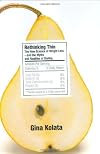
Every now and then I come across a book that reminds me of why I read non-fiction. A book that takes one of my many seemingly unshakable worldviews and flips it on its head. Rethinking Thin is one of those books.
I began Rethinking Thin expecting the material would argue against the endless chain of fad diets in favor of good ol' fashioned healthy eating and regular exercise. And the pear photo on the cover also suggests that we shouldn't expect to have movie star figures. The author does show more advocate these habits, but she also goes further and presents data on obesity that is so... unpopular. So... Darwinian.
For as long as I've had an interest in health and body weight I believed, with rare exceptions, that we are in control of our weight through what we eat and the amount of calories we burn. Energy in, energy out. Simple as that. Fatter people may have a more difficult time becoming healthy but ultimately it came down to personal willpower. Then along comes Rethinking Thin and says this: The evidence isn't 100% conclusive but science has shown for years that people realistically only have control of about 10%-20% of their body weight. The rest is determined by genetics and NOT environment. Stating this is pretty much a moral affront to our way of life. After all, we live in a culture of expected personal responsibility and choice. There are exceptions here, such as the meticulous dieters who maintain strict food schedules (and perpetual semi-starvation) for their whole lives. But for the rest of us, well, we're only human.
I feel like this is something we intuitively know to be true. I mean, how many people do you know who have drastically reduced their body weight AND permanently maintained it? The argument that first convinced me was how, even though my daily caloric intake may vary by the hundreds every day, my body weight remained fairly constant over a period of weeks and months. As the book puts it, our bodies are better at counting calories than we are.
Rethinking Thin also cautions against putting too much stock in the so-called obesity epidemic and argues that deaths related to being overweight might be statistically exaggerated. Are we heavier than 100 years ago? Yes, but we're also taller with better nutrition. Again, the evidence isn't fully conclusive because it's very difficult to separate other physiological causes of death from simply being fat. In my opinion, there are two main reasons why the information from this book isn't more widely known: (1) There's lots of money to be made in the business of convincing people that being fat is their own fault, and (2) the start of a diet is a hopeful time. There's little hope in knowing that some things will probably never change. show less
I began Rethinking Thin expecting the material would argue against the endless chain of fad diets in favor of good ol' fashioned healthy eating and regular exercise. And the pear photo on the cover also suggests that we shouldn't expect to have movie star figures. The author does show more advocate these habits, but she also goes further and presents data on obesity that is so... unpopular. So... Darwinian.
For as long as I've had an interest in health and body weight I believed, with rare exceptions, that we are in control of our weight through what we eat and the amount of calories we burn. Energy in, energy out. Simple as that. Fatter people may have a more difficult time becoming healthy but ultimately it came down to personal willpower. Then along comes Rethinking Thin and says this: The evidence isn't 100% conclusive but science has shown for years that people realistically only have control of about 10%-20% of their body weight. The rest is determined by genetics and NOT environment. Stating this is pretty much a moral affront to our way of life. After all, we live in a culture of expected personal responsibility and choice. There are exceptions here, such as the meticulous dieters who maintain strict food schedules (and perpetual semi-starvation) for their whole lives. But for the rest of us, well, we're only human.
I feel like this is something we intuitively know to be true. I mean, how many people do you know who have drastically reduced their body weight AND permanently maintained it? The argument that first convinced me was how, even though my daily caloric intake may vary by the hundreds every day, my body weight remained fairly constant over a period of weeks and months. As the book puts it, our bodies are better at counting calories than we are.
Rethinking Thin also cautions against putting too much stock in the so-called obesity epidemic and argues that deaths related to being overweight might be statistically exaggerated. Are we heavier than 100 years ago? Yes, but we're also taller with better nutrition. Again, the evidence isn't fully conclusive because it's very difficult to separate other physiological causes of death from simply being fat. In my opinion, there are two main reasons why the information from this book isn't more widely known: (1) There's lots of money to be made in the business of convincing people that being fat is their own fault, and (2) the start of a diet is a hopeful time. There's little hope in knowing that some things will probably never change. show less
Rethinking Thin: The New Science of Weight Loss--And the Myths and Realities of Dieting by Gina Kolata

As a formerly skinny woman who has recently put on weight and is having a hell of a time taking it off, I have reached the stage where I am turning to books to help me understand and develop a strategy. I don’t eat excessively and I exercise regularly albeit less intensely than before (used to be a 5-day-a-week gym rat for 10 years). What has happened to my willpower and positive outlook? Did more than my body suffer in my injuries of the last 4 years? Did my metabolism change? Why did I show more go from being the woman who could eat anything to the woman who wouldn’t lose a pound on a concentration camp diet? Is it my fault? Is it hormones? The moon? What?!
From the above, you can probably deduce my frustration with my body and its inability to return to its former state. Rethinking thin hasn’t given me easy answers to any of these questions, but I do have some hope. The upshot theory of this book is that each body has a predetermined weight range it can comfortably maintain. Wired similarly to height, it is unchangeable without rigorous dietary changes. A caloric intake that sustains a 200-pound body is not the caloric intake that will sustain the same body after a 50-pound weight loss. Generally the caloric intake that will sustain the new 150-pound person is drastically lower. Scientists are only beginning to understand why. The stalwart principle of eat less and exercise more doesn’t always work.
My problem with the why is that everyone seems to want a single reason. I bet it’s multiple reasons. Availability of food. Quality of food. Reduced exercise. Hormone levels. Chemicals. They want one of these to be the culprit and that just seems silly. All of these things are probably factors. In my case, I think it’s beer. I’m weaning myself off beer and I bet it will happen. I’m hoping that I’m at the top of my maintainable weight range and that if I return to the bottom part of the range I was at in my early 30s, I can stay there without starving myself. I’m not shooting for the skinny 20 year old I was, but the fit 30 year old I was, too. show less
From the above, you can probably deduce my frustration with my body and its inability to return to its former state. Rethinking thin hasn’t given me easy answers to any of these questions, but I do have some hope. The upshot theory of this book is that each body has a predetermined weight range it can comfortably maintain. Wired similarly to height, it is unchangeable without rigorous dietary changes. A caloric intake that sustains a 200-pound body is not the caloric intake that will sustain the same body after a 50-pound weight loss. Generally the caloric intake that will sustain the new 150-pound person is drastically lower. Scientists are only beginning to understand why. The stalwart principle of eat less and exercise more doesn’t always work.
My problem with the why is that everyone seems to want a single reason. I bet it’s multiple reasons. Availability of food. Quality of food. Reduced exercise. Hormone levels. Chemicals. They want one of these to be the culprit and that just seems silly. All of these things are probably factors. In my case, I think it’s beer. I’m weaning myself off beer and I bet it will happen. I’m hoping that I’m at the top of my maintainable weight range and that if I return to the bottom part of the range I was at in my early 30s, I can stay there without starving myself. I’m not shooting for the skinny 20 year old I was, but the fit 30 year old I was, too. show less
Flu: The Story Of The Great Influenza Pandemic of 1918 and the Search for the Virus that Caused It by Gina Kolata
Consider this: During the great influenza pandemic of 1918 the average life span of the U.S. population fell by twelve years. Twelve! Gina Kolata writes that “Undertakers in Philadelphia were overwhelmed and some were…hiking prices as much as 600%.”
Desperate, and with no animal model available to use in studying the disease, authorities offered pardons to convicted naval prisoners who would agree to be infected by what scientists hoped were fluids or air with the contagion. Sixty-two show more convicts agreed to be lab rats. Prison must have been an especially dire place ca. 1918.
You might think a book about such terrible epidemics, and the pursuit of defenses against them, would have no amusing moments. Not so. As an example, in 1940, Johan Hultin, while on leave from the University of Uppsala in Sweden where he studied medicine, came to the U.S. to work at the University of Iowa. First he visited New York and when a friend there showed him a sign that said ‘coin laundry,’ recalled “I never asked what it was—I knew it. Americans are so worried about germs that they have their coins cleaned.”
If only there were such places. Think of all those bright, shining pennies.
Gina Kolata has written an informative account covering disease origin, manifestation, spread, treatment, mortality, and prevention. One might expect the approaches we use to address these issues would tap primarily our rationality and intelligence. But as she relates, they are matters that have become much politicized. With what consequences remains to be seen. show less
Desperate, and with no animal model available to use in studying the disease, authorities offered pardons to convicted naval prisoners who would agree to be infected by what scientists hoped were fluids or air with the contagion. Sixty-two show more convicts agreed to be lab rats. Prison must have been an especially dire place ca. 1918.
You might think a book about such terrible epidemics, and the pursuit of defenses against them, would have no amusing moments. Not so. As an example, in 1940, Johan Hultin, while on leave from the University of Uppsala in Sweden where he studied medicine, came to the U.S. to work at the University of Iowa. First he visited New York and when a friend there showed him a sign that said ‘coin laundry,’ recalled “I never asked what it was—I knew it. Americans are so worried about germs that they have their coins cleaned.”
If only there were such places. Think of all those bright, shining pennies.
Gina Kolata has written an informative account covering disease origin, manifestation, spread, treatment, mortality, and prevention. One might expect the approaches we use to address these issues would tap primarily our rationality and intelligence. But as she relates, they are matters that have become much politicized. With what consequences remains to be seen. show less
Flu: The Story of the Great Influenza Pandemic of 1918 and the Search for the Virus That Caused It by Gina Kolata

I decided to reread Gina Kolata's Flu during self-imposed COVID-19 isolation. I thoroughly enjoyed this book when it was first published in 1999. The author provides a brief history of the 1918 flu pandemic, and of earlier pandemics, but most of the book is focused on the efforts to identify and understand the virus that caused that pandemic. Many of the researchers the author interviewed for this book have probably retired or passed on by now, and epidemiology has changed dramatically since show more 1999, but the stories are still interesting.
The 1918 flu struck near the end of WWI, when troops on the front were already exhausted and malnourished, and when US military bases were packed with new recruits. The movement and mixing of large numbers of people greatly contributed to the spread of the pandemic.
Some things never change. In 1918, crazy conspiracy theories about the cause of the pandemic were rampant. Public officials in many countries tried to downplay the risk - until they couldn't. Various "cures" were promoted, some worse than others. And 100+ years later, we are still making the same mistakes. show less
The 1918 flu struck near the end of WWI, when troops on the front were already exhausted and malnourished, and when US military bases were packed with new recruits. The movement and mixing of large numbers of people greatly contributed to the spread of the pandemic.
Some things never change. In 1918, crazy conspiracy theories about the cause of the pandemic were rampant. Public officials in many countries tried to downplay the risk - until they couldn't. Various "cures" were promoted, some worse than others. And 100+ years later, we are still making the same mistakes. show less
Lists
Awards


You May Also Like


Associated Authors
Statistics
- Works
- 15
- Also by
- 1
- Members
- 2,529
- Popularity
- #10,148
- Rating
- 3.8
- Reviews
- 75
- ISBNs
- 62
- Languages
- 8
- Favorited
- 4
