
John Sladek (1937–2000)
Author of Tik-Tok
About the Author
Disambiguation Notice:
"James Vogh" was a pseudonym of Sladek's.
Image credit: Ansible
Series
Works by John Sladek
The Happy Breed [short fiction] 6 copies
Blood and gingerbread 5 copies
The Great Wall Of Mexico [novelette] 3 copies
1937 A.D.! {short story} 2 copies
THIRTEENTH ZODIAC 2 copies
見えないグリーン 2 copies
The Real Martian Chronicles 2 copies
Dining Out 2 copies
Roderick à solta - 1 2 copies
Bill gets hep to God! 1 copy
Undecember [short fiction] 1 copy
Another Look [short fiction] 1 copy
Flatland [short fiction] 1 copy
Puff Love 1 copy
Orgasmo mecánico 1 copy
The Man from Not-Yet 1 copy
Prisoner of Paradise 1 copy
In the distance 1 copy
The Face [short fiction] 1 copy
The Design [short fiction] 1 copy
It takes your breath away 1 copy
The Switch (vt The Train) 1 copy
The floating Panzer 1 copy
The way to a man's heart 1 copy
In the Oligocene 1 copy
Publish and perish 1 copy
Practical joke 1 copy
Now that I'm free 1 copy
Timetable 1 copy
The marching raspberries 1 copy
Just another victim 1 copy
Radio cats 1 copy
Robot "Kiss of Life" drama 1 copy
Goodbye, Germany? 1 copy
The future of John Sladek 1 copy
Peabody slept here 1 copy
The incredible giant hot dog 1 copy
Comedo 1 copy
Roderick Livro 1 1 copy
Roderick à Solta - 1 1 copy
Alien territory 1 copy
The misinterpreted letter 1 copy
By an unknown hand 1 copy
4-part list 1 copy
Writing places 1 copy
Transplant your own heart 1 copy
The Atheist's bargain 1 copy
United we stand still 1 copy
Associated Works
Twenty Houses of the Zodiac: Anthology of International Science Fiction (1979) — Contributor — 47 copies, 1 review
Light Years and Dark: Science Fiction and Fantasy of and for Our Time (1984) — Contributor — 37 copies
Holding your eight hands; an anthology of science fiction verse (1970) — Contributor — 25 copies, 1 review
The Magazine of Fantasy and Science Fiction December 1974, Vol. 47, No. 6 (1974) — Contributor — 17 copies
Worlds of If Science Fiction 152, January/February 1971 (Vol. 20, No. 9) (1971) — Contributor — 11 copies
Pistolero fuori tempo — Contributor — 3 copies
Den elektriske myre og andre science fiction-fortællinger (1984) — Author, some editions — 2 copies, 1 review
ロボット・オペラ — Contributor — 1 copy
Tagged
Common Knowledge
- Legal name
- Sladek, John Thomas
- Other names
- Knye, Cassandra (psuedonym together with Thomas M. Disch)
Demijohn, Thom
Vogh, James
Sladek, John T.
Johns, Dale
*s*m*v, *s**c (show all 10)
D*ck, Ph*l*p K.
H**nl**n, R*b*rt
B******, J. G.
G*rnsb*ck, H*g* - Birthdate
- 1937-12-15
- Date of death
- 2000-03-10
- Gender
- male
- Education
- University of Minnesota (engineering)
- Occupations
- science fiction writer
technical writer - Awards and honors
- Guest of Honour, Eastercon, UK (1982)
- Cause of death
- lung disease
- Nationality
- USA
- Birthplace
- Waverly, Iowa, USA
- Places of residence
- England
Minneapolis, Minnesota, USA - Place of death
- Edina, Minnesota, USA
- Disambiguation notice
- "James Vogh" was a pseudonym of Sladek's.
- Associated Place (for map)
- Minnesota, USA
Members
Reviews

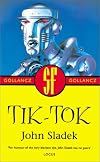
Before Bender “Bending Bot” Rodriquez there was Tik-Tok—a sophisticated robot who went on a murderous and violent crime spree that no one believed and went on to be the first nominated robot Vice-President.
The story of Tik-Tok is an amusing one. Throughout the book, his story interchanges between his past and the colourful people he is passed onto service for and his present, which usually involves him plotting his next crime or his next step in bringing equality to all robot in show more America.
A satirical comedy, Tik-Toks journey is an exploration of America which still feels relevant on a political level today. In fact it is the political satire which holds up the strongest with more relevance than ever in what often feels like an increasingly corrupt system no matter which way you turn.
Whilst the rest of the social satire doesn’t hold up as well as it did half a century ago, Tik-Tok’s exploits are amusing and it’s easy to find yourself rooting for him even as he heinously experiments with crimes such as arson, fraud, hijacking, jewel heists, violent chess games and more often than not—varied forms of murder.
What elevates Tik-Tok’s story is that is never explicit what his motivations are and when exactly he broke his “Asimov circuits” which previously prevented him commiting these acts—most of which no one believes because it is unheard of for a robot to do such things, leading to the framing of an unfortunate soul instead. Is Tik-Tok doing this because he wants to feel “real”? Or perhaps to further his cause for bringing rights to robots having rescued so many from dereliction. Or perhaps it’s just because he can. Whatever Tik-Tok’s motivations, it’s hard not to root for him no matter how low he stoops simply because he is somehow fundamentally likeable, whilst those around him seem to deserve it.
As a piece of social satire, some of its power has of course diminished in time, but this is still an entertaining read with some thought provoking moments. Sladek is clearly using it as platform for some deeper social beliefs, but at its heart has also created one of the finest anti-heroes in literature. show less
The story of Tik-Tok is an amusing one. Throughout the book, his story interchanges between his past and the colourful people he is passed onto service for and his present, which usually involves him plotting his next crime or his next step in bringing equality to all robot in show more America.
A satirical comedy, Tik-Toks journey is an exploration of America which still feels relevant on a political level today. In fact it is the political satire which holds up the strongest with more relevance than ever in what often feels like an increasingly corrupt system no matter which way you turn.
Whilst the rest of the social satire doesn’t hold up as well as it did half a century ago, Tik-Tok’s exploits are amusing and it’s easy to find yourself rooting for him even as he heinously experiments with crimes such as arson, fraud, hijacking, jewel heists, violent chess games and more often than not—varied forms of murder.
What elevates Tik-Tok’s story is that is never explicit what his motivations are and when exactly he broke his “Asimov circuits” which previously prevented him commiting these acts—most of which no one believes because it is unheard of for a robot to do such things, leading to the framing of an unfortunate soul instead. Is Tik-Tok doing this because he wants to feel “real”? Or perhaps to further his cause for bringing rights to robots having rescued so many from dereliction. Or perhaps it’s just because he can. Whatever Tik-Tok’s motivations, it’s hard not to root for him no matter how low he stoops simply because he is somehow fundamentally likeable, whilst those around him seem to deserve it.
As a piece of social satire, some of its power has of course diminished in time, but this is still an entertaining read with some thought provoking moments. Sladek is clearly using it as platform for some deeper social beliefs, but at its heart has also created one of the finest anti-heroes in literature. show less

A typical Sladek tongue-in-cheek title leads us into a satirical tale of a doll factory that has fallen on hard times, and engages a super-scientist from MIT to help them get a lucrative military contract. However, the super-scientist in question graduated from the Miami Institute of Technocracy, and his idea, of a self-replicating machine, gets out of control...
I really can't see why people would dislike this author because he's too clever. Sure, satire and puns belong in the sock drawer of literature, but when a great satire like this comes along, I just want to scribble its telephone number on the bathroom stall. This novella came out before American Psycho, which I also adore, but on a few levels, it succeeds even better. I can't believe how easily I rooted for this psychopathic tin can. I recommend this author, people. Don't let his name show more disappear from our hearts. show less

3.5/5
Sladek is the first writer I've encountered who even remotely resembles Vonnegut in style, form, and subject matter. Sladek is not as refined as Vonnegut, and Mechasm certainly has more graphic sexual content and violence than anything that I've ever read from the later. Though, like a lot of Vonnegut's works, Mechasm follows a broad cast of characters that are all loosely tied together in the most absurd ways. Here, a secret government project has produced a self-replicating system of show more robots that function like cells, who voraciously consume all the metal they can find in order to both grow in size and produce more of themselves. Honestly though, these robots aren't exactly the focus of the novel. Instead, they suffuse into the background of nearly every scene, which gives the characters a common struggle. The book follows several groups in the US who witness the expansion of the self-replicating system, and an absurd government spy operation in Morocco, where France is attempting to launch a mission to claim the moon.
Through the course of Mechasm, Sladek takes satirical shots at an uncountable number of things, including: government overspending, the military industrial complex, scientific academia, consumerism, gender relations, American exceptionalism, formulaic fiction, etc.. Sladek clearly sympathized with left-leaning libertarian ideals, and was a devoted skeptic. All of these more serious satirizations are interspersed with slapstick humor and absurdist plotting. Not all the jokes land, but a surprising amount of them do, and I'm impressed by the ratio that I experienced. Humor is such an ephemeral thing, written humor especially so. Anything that was written more than 60 years ago and can make me laugh in the present day deserves a lot of credit. There are so many absurd and outlandish turn of events that it's hard to remember them all, but the book overall was very memorable on the whole.
When Sladek switches into less farcical writing he shows that he can really do some beautiful prose work. Really the whole book is a cut above in terms of prose quality, especially when compared to his peers of the time period, though it's not the best I've ever read either. There's a section of text that describes a group entering 'the belly of the beast' as it were, as their runaway car takes them into Las Vegas, which has been converted into a nightmarish landscape of machines. This section is particularly noteworthy and hallucinogenic. Unfortunately there are also sections of boredom and monotony, where his prose is touchy at best. This is really where Vonnegut outstrips Sladek, because I can't remember any Vonnegut book where there was as much unevenness as Mechasm.
A very pleasant, funny, and enjoyable read that is significantly different than a lot of the stuff being produced at the time, which is refreshing. The central premise hooked me, and the absurdity and skepticism kept me coming back in spite of the unpolished quality of the novel. Sladek is definitely worth looking into if you enjoy this type of writing. show less
Sladek is the first writer I've encountered who even remotely resembles Vonnegut in style, form, and subject matter. Sladek is not as refined as Vonnegut, and Mechasm certainly has more graphic sexual content and violence than anything that I've ever read from the later. Though, like a lot of Vonnegut's works, Mechasm follows a broad cast of characters that are all loosely tied together in the most absurd ways. Here, a secret government project has produced a self-replicating system of show more robots that function like cells, who voraciously consume all the metal they can find in order to both grow in size and produce more of themselves. Honestly though, these robots aren't exactly the focus of the novel. Instead, they suffuse into the background of nearly every scene, which gives the characters a common struggle. The book follows several groups in the US who witness the expansion of the self-replicating system, and an absurd government spy operation in Morocco, where France is attempting to launch a mission to claim the moon.
Through the course of Mechasm, Sladek takes satirical shots at an uncountable number of things, including: government overspending, the military industrial complex, scientific academia, consumerism, gender relations, American exceptionalism, formulaic fiction, etc.. Sladek clearly sympathized with left-leaning libertarian ideals, and was a devoted skeptic. All of these more serious satirizations are interspersed with slapstick humor and absurdist plotting. Not all the jokes land, but a surprising amount of them do, and I'm impressed by the ratio that I experienced. Humor is such an ephemeral thing, written humor especially so. Anything that was written more than 60 years ago and can make me laugh in the present day deserves a lot of credit. There are so many absurd and outlandish turn of events that it's hard to remember them all, but the book overall was very memorable on the whole.
When Sladek switches into less farcical writing he shows that he can really do some beautiful prose work. Really the whole book is a cut above in terms of prose quality, especially when compared to his peers of the time period, though it's not the best I've ever read either. There's a section of text that describes a group entering 'the belly of the beast' as it were, as their runaway car takes them into Las Vegas, which has been converted into a nightmarish landscape of machines. This section is particularly noteworthy and hallucinogenic. Unfortunately there are also sections of boredom and monotony, where his prose is touchy at best. This is really where Vonnegut outstrips Sladek, because I can't remember any Vonnegut book where there was as much unevenness as Mechasm.
A very pleasant, funny, and enjoyable read that is significantly different than a lot of the stuff being produced at the time, which is refreshing. The central premise hooked me, and the absurdity and skepticism kept me coming back in spite of the unpolished quality of the novel. Sladek is definitely worth looking into if you enjoy this type of writing. show less
Lists
SF Masterworks (1)
Awards


You May Also Like


Associated Authors
Statistics
- Works
- 126
- Also by
- 56
- Members
- 2,743
- Popularity
- #9,358
- Rating
- 3.7
- Reviews
- 59
- ISBNs
- 122
- Languages
- 9
- Favorited
- 7