
Bob Shaw (1) (1931–1996)
Author of Orbitsville
For other authors named Bob Shaw, see the disambiguation page.
About the Author
Image credit: Photo by Lars-Olov Strandberg, Seacon '79 (37th World Science Fiction Convention), Brighton, England, 1979. Copyright © Lars-Olov Strandberg
Series
Works by Bob Shaw
Os balonautas - 2 4 copies
Os balonautas - 1 4 copies
As naves de madeira - 2 3 copies
Appointment On Prila {short story} 3 copies
Millemondinverno 1985 — Author — 3 copies
Fugitive Worlds Vol.2 2 copies
Os mundos perdidos - 2 2 copies
Short Fiction Collected 1 copy
Altar Egoes 1 copy
Burden of Proof (SS) 1 copy
Buone notizie dal Vaticano 1 copy
Prepilo Nocturno 1 copy
Land and Overland - Omnibus 1 copy
balonautas 1 1 copy
As Luzes do Espaço 1 copy
A Solução de Ceres Livro 1 1 copy
Retroactive {novelette} 1 copy
Arrival 1 copy
Associated Works
Isaac Asimov's Wonderful Worlds of Science Fiction, Volume 2: The Science Fictional Olympics (1984) — Contributor — 97 copies, 1 review
Twenty Houses of the Zodiac: Anthology of International Science Fiction (1979) — Contributor — 47 copies, 1 review
Pulsar: An Original Anthology of Science Fiction and Science Futures: No. 1 (1978) — Contributor — 27 copies
Analog Science Fiction/Science Fact: Vol. XCV, No. 12 (December 1975) (1975) — Contributor — 24 copies
Analog Science Fiction/Science Fact: Vol. LXXXVI, No. 2 (October 1970) (1970) — Contributor — 20 copies
Analog Science Fiction/Science Fact: Vol. LXXVII, No. 6 (August 1966) (1966) — Contributor — 20 copies
Analog Science Fiction/Science Fact: Vol. LXXXI, No. 6 (August 1968) (1968) — Contributor — 18 copies
Worlds of If Science Fiction 153, March/April 1971 (Vol. 20, No. 10) (1971) — Contributor — 9 copies
Tagged
Common Knowledge
- Legal name
- Shaw, Robert
- Birthdate
- 1931-12-31
- Date of death
- 1996-02-12
- Gender
- male
- Awards and honors
- Guest of Honour, Eastercon, UK (1974 ∙ 1995)
Hugo (Fan Writer ∙ 1979)
Hugo (Fan Writer ∙ 1980) - Nationality
- UK
- Birthplace
- Belfast, Northern Ireland, UK
- Places of residence
- Belfast, Northern Ireland, UK
Ulverston, Cumbria, UK - Place of death
- Stockton Heath, Warrington, Cheshire, UK
- Map Location
- Northern Ireland, UK
Members
Discussions
Found: Old SciFi short story with shape shifting alien eating people in Name that Book (June 2023)
50s sci fi 2 men/2 universes change places in Name that Book (February 2013)
scifi stories/books mentioning 'Oscars' superhuman golden beings and throwrugs or rug monsters in Name that Book (May 2011)
Night Walk by Bob Shaw in Science Fiction Fans (May 2011)
Reviews

Leaving the village behind, we followed the heady sweeps of the road up into a land of slow glass. [...] On our right the mountain sifted down into an incredibly perfect valley of timeless pine, and everywhere stood the great frames of slow glass, drinking light. An occasional flash of afternoon sunlight on their wind bracing created an illusion of movement, but in fact the frames were deserted. The rows of windows had been standing on the hillside for years, staring into the valley, and men show more only cleaned them in the middle of the night when their human presence would not matter to the thirsty glass.
An August 1966 story (Analog) featuring technological innovation almost as MacGuffin: the emphasis of the story rests on the emotional fall-out from using slow glass, rather than a genre-typical focus on the immediate application or discovery of it. Too often in stories I've read from this era the focus rests squarely on the weaponization or power-aggregating potential for technology, and while there are no lack of such applications for slow glass, they are less interesting than innovations for lighting cities at night or as slow-reveal videos of loved ones.
There are at least two other slow glass stories, each written after this first story, the three collected in a fix-up (1972's Other Days, Other Eyes). Worth looking out for in used bookshops but probably won't seek it out specifically. show less
An August 1966 story (Analog) featuring technological innovation almost as MacGuffin: the emphasis of the story rests on the emotional fall-out from using slow glass, rather than a genre-typical focus on the immediate application or discovery of it. Too often in stories I've read from this era the focus rests squarely on the weaponization or power-aggregating potential for technology, and while there are no lack of such applications for slow glass, they are less interesting than innovations for lighting cities at night or as slow-reveal videos of loved ones.
There are at least two other slow glass stories, each written after this first story, the three collected in a fix-up (1972's Other Days, Other Eyes). Worth looking out for in used bookshops but probably won't seek it out specifically. show less

In the course of my on-going re-read of the works of Bob Shaw, I came to A Wreath of Stars. This was one of Bob's novels that I had only read once or twice, as opposed to his earlier books which I re-read voraciously when I was much younger.
My 1978 Pan first edition paperback came with fulsome praise from reviewers. My last Bob Shaw re-read, Orbitsville, was equally praised at the time, but came up very short for me. I was fearful that the same might happen here. I needn't have worried.
The show more novel follows one Gilbert Snook, an aircraft engineer on contract to a Middle Eastern air force. But when a strange astronomical phenomenon - an antineutrino planet - is discovered to be on a collision course with Earth, turmoil ensues, even though it is physically insubstantial and will have no direct effect on Earth. Snook gets caught up in this and ends up, rather against his will, in East Africa as an unwanted guest of a small and rather unstable republic. He might have stayed there, but then workers in the country's main diamond mine start reporting seeing ghosts (though only when wearing special low-light glasses), and matters spiral out of control.
Shaw tells this story in his usual, economic style, but in this novel he manages to fit the world-building, action, characterisation and the exploration of the wonderful - for there is indeed something wonderful behind the apparitions - into his usual short novel format. Somehow in this one, all the pacing works out just right. Characters are well-formed, and Bob even managed to get one of his personal obsessions, eye injuries, into the plot. You may never look at a plastic fork the same again.
Possibly twenty years ago, I serendipitously came across some of Bob's professional journalism: a piece he wrote when he was employed by the Belfast aircraft manufacturer Shorts, about flying Short Skyvans with the Sultan of Oman's air force in the Arabian peninsula. Bob used his easy and elegant way with prose just as much in the description of a desert air base at night as he did in his novels and the corresponding section in A Wreath of Stars draws heavily on this other piece. Equally, the setting for the bulk of the novel is equally well-drawn. In a few paragraphs, he gives us a convincing picture of an African diamond mine. I don't know if either of the aerospace companies he worked for - first Shorts, and then Vickers - actually ever sent him out to the places they asked him to write about (I've never seen any reference to long-haul travel for work in his other writings, though it must have been quite possible), but the scene setting in this novel has particular immediacy.
Having said that, it seems odd now to read a novel written in 1976 but set in 1993, which places its action in the Arabian peninsula and then in East Africa, which has no mention in it whatsoever of militant Islam. Furthermore, a number of the characters in the book are black Africans, but Bob writes them generally in a racially neutral way, although some of the miners are shown in ways that edge close to stereotyping. And some more sensitive readers may consider that Bob's use of these characters shows elements of cultural appropriation. But for a novel from fifty years ago, this book comes out with few if any seriously cringeworthy moments.
So, rather to my surprise, I found myself re-discovering one of Bob Shaw's better novels. It has been reprinted a number of times, including in Gollancz's SF Collectors series; I would say it deserves those reprints, and equally deserves your seeking a copy out. show less
My 1978 Pan first edition paperback came with fulsome praise from reviewers. My last Bob Shaw re-read, Orbitsville, was equally praised at the time, but came up very short for me. I was fearful that the same might happen here. I needn't have worried.
The show more novel follows one Gilbert Snook, an aircraft engineer on contract to a Middle Eastern air force. But when a strange astronomical phenomenon - an antineutrino planet - is discovered to be on a collision course with Earth, turmoil ensues, even though it is physically insubstantial and will have no direct effect on Earth. Snook gets caught up in this and ends up, rather against his will, in East Africa as an unwanted guest of a small and rather unstable republic. He might have stayed there, but then workers in the country's main diamond mine start reporting seeing ghosts (though only when wearing special low-light glasses), and matters spiral out of control.
Shaw tells this story in his usual, economic style, but in this novel he manages to fit the world-building, action, characterisation and the exploration of the wonderful - for there is indeed something wonderful behind the apparitions - into his usual short novel format. Somehow in this one, all the pacing works out just right. Characters are well-formed, and Bob even managed to get one of his personal obsessions, eye injuries, into the plot. You may never look at a plastic fork the same again.
Possibly twenty years ago, I serendipitously came across some of Bob's professional journalism: a piece he wrote when he was employed by the Belfast aircraft manufacturer Shorts, about flying Short Skyvans with the Sultan of Oman's air force in the Arabian peninsula. Bob used his easy and elegant way with prose just as much in the description of a desert air base at night as he did in his novels and the corresponding section in A Wreath of Stars draws heavily on this other piece. Equally, the setting for the bulk of the novel is equally well-drawn. In a few paragraphs, he gives us a convincing picture of an African diamond mine. I don't know if either of the aerospace companies he worked for - first Shorts, and then Vickers - actually ever sent him out to the places they asked him to write about (I've never seen any reference to long-haul travel for work in his other writings, though it must have been quite possible), but the scene setting in this novel has particular immediacy.
Having said that, it seems odd now to read a novel written in 1976 but set in 1993, which places its action in the Arabian peninsula and then in East Africa, which has no mention in it whatsoever of militant Islam. Furthermore, a number of the characters in the book are black Africans, but Bob writes them generally in a racially neutral way, although some of the miners are shown in ways that edge close to stereotyping. And some more sensitive readers may consider that Bob's use of these characters shows elements of cultural appropriation. But for a novel from fifty years ago, this book comes out with few if any seriously cringeworthy moments.
So, rather to my surprise, I found myself re-discovering one of Bob Shaw's better novels. It has been reprinted a number of times, including in Gollancz's SF Collectors series; I would say it deserves those reprints, and equally deserves your seeking a copy out. show less

In my re-read of Bob Shaw's books, I came to 1 Million Tomorrows with a little trepidation. Its preceding work in Bob's oeuvre, Shadow of Heaven, had come up with some shortcomings in plotting and a somewhat far-fetched premise that didn't really hang together, let alone allow Bob the spase to exercise his trademark ingenious imagination. It was many years since I had read this, and my memory of the book wasn't exceptionally fond.
What I found was not quite what I expected.
The year is 2197. show more Humanity has possessed the secret of immortality for around two hundred years, but it comes at a price - male impotence. The protagonist, Will Carewe, is invited by his employers, a large pharmaceuticals firm, to trial an new version of the immortality drug - one that retains full male potency. But almost from the outset, he finds that his life is in danger, as he experiences a series of accidents which prove not to be accidents. He begins to realise that for some reason, he is the focus of a conspiracy, and his employers may be behind it. And then his wife is abducted...
So we have a reasonably well constructed future thriller. I had not remembered the plot details, and I found myself turning the pages quite eagerly to try to understand quite why Carewe was the focus of such murderous intent, especially when all the pointers led back to his employers - but why should they?
Throughout the book, I kept coming across vignettes which I had remembered, though not necessarily from where. In the course of the novel, for example, Will Carewe gets stabbed and suffers a collapsed lung. Bob was personally horrified by the thought that the inside of his body consisted of a series of tubes, sacs, bladders and other squishy bits - he would much have preferred, he said, to be homogenous throughout, like an apple - and his visceral horror is well-shown as he writes about Carewe walking, running and climbing about with this collapsed lung flapping about inside his ribcage 'like a piece of wet leather'. I had forgotten that, but it came back to me with full force as I realised how vividly Bob had visualized this idea which he found so personally repugnant. On another occasion, following a chase sequence in a factory devoted to making frictionless ball-bearings, a villain falls into a vat of said ball-bearings and drowns in tiny metal spheres. This is described with quite some relish, though again I suspect Bob had succeeded in horrifying himself and put this down on paper.
Again, I found that I was now reading a Bob Shaw novel with a better appreciation of his talent for language, something which as a younger reader I did not appreciate, instead being dazzled by the science-fictional wonders on show.
Elsewhere, Bob's technical ingenuity is given full rein, with all manner of asides showing innovations Bob couldn't help but think up. Two of them - airbags and automated navigation - are now familiar to us.
Bob made a very good job of exploring quite what some of the implications of a society where a large proportion of the population were immortal would be. These implications range from macro-economics to personal interrelations, crimes and prejudices. Some of them were quite poignant; one of Carewe's neighbours is an extremely old man, who must have been an early adopter of the treatment when it first appeared in (we assume) the 1990s. But this very old man has lost so many memories; Alzheimer's Syndrome wasn't considered a major problem in 1970, when this book was written, but Carewe's conversation with this character couldn't help but make me now think of some of our reactions to that illness. And another character suffered a life-changing event connected with his mother's attitudes to sex and immortality; giving someone immortality might not always be a gift.
As ever, Bob Shaw crammed a lot into his novels. I've commented before that he probably got into a bad habit of working at a shorter length because of contractual obligations; certainly, there are a lot of ideas thrown off almost casually which could be explored at much greater length in a longer novel. And his command of prose is in no way diminished by the restrictions in length, or by the restraints imposed by one other feature of this book.
Because there is a problem with it. It is a problem common to a lot of science fiction, especially that written in earlier times. A friend of mine has coined the term "Men in Hats SF" - a tendency for science fiction writers to show us distant worlds and far-flung futures, only to have the characters (usually men) wearing hats, smoking pipes and reading newspapers. Bob Shaw was not immune from that, though in his case it's not too jarring when it happens. I also happen to think that this isn't such a terrible thing. My friend points at Men in Hats as a failure of imagination; but given that we all have things in our homes which would be familiar to people from much earlier generations, even going back centuries in the case of furniture or kitchen utensils (as examples). The failure isn't so much in imagination, it's more not being lucky in picking winners, like Bob's airbags and satnavs as I said earlier.
But science fiction can sometimes be guilty of going to the other extreme: think Logan's Run, showing us a society almost totally changed from our own, even down to common nouns, such as (in this case) a 'dhome', which is, of course, a home in a dome. This would strike many readers as rather contrived, especially when it gets used constantly throughout the novel. Changing the society, even down to quite minor details, can strike many readers, especially those not fully versed in the tropes of the genre, as superficial change for change's sake, especially if the author isn't particularly adept at slipping the references seamlessly into the text. Bob Shaw was far more competent than that, but even so in the early stages of this novel, the changes he shows us - men not yet immortal (and so still virile) sporting designer stubble and wearing codpieces to advertise their potency, or changes to womens' attitudes towards men - seem clunky and unlike his usual ability to paint pictures of situations unusual to us in a few well-chosen words.
The other matter is less obvious. We have a thriller story here, but the action of the novel depends rather on an improbably competent senior accountant turning into a man of action at a moment's notice. In a way, Will Carewe is another Bob Shaw competent hero, once more probably written in Bob's own image. And this, in turn, has issues for more modern readers as the attitudes on display, especially in relation to gender attitudes, are firmly those of the 1960s and 1970s.
But all that aside, I was pleasantly surprised by this novel. Not one of Bob's best, but a surprisingly good one and definitely better than I remembered.
(NB : the Gollancz first edition hardcover appears to be fairly rare.) show less
What I found was not quite what I expected.
The year is 2197. show more Humanity has possessed the secret of immortality for around two hundred years, but it comes at a price - male impotence. The protagonist, Will Carewe, is invited by his employers, a large pharmaceuticals firm, to trial an new version of the immortality drug - one that retains full male potency. But almost from the outset, he finds that his life is in danger, as he experiences a series of accidents which prove not to be accidents. He begins to realise that for some reason, he is the focus of a conspiracy, and his employers may be behind it. And then his wife is abducted...
So we have a reasonably well constructed future thriller. I had not remembered the plot details, and I found myself turning the pages quite eagerly to try to understand quite why Carewe was the focus of such murderous intent, especially when all the pointers led back to his employers - but why should they?
Throughout the book, I kept coming across vignettes which I had remembered, though not necessarily from where. In the course of the novel, for example, Will Carewe gets stabbed and suffers a collapsed lung. Bob was personally horrified by the thought that the inside of his body consisted of a series of tubes, sacs, bladders and other squishy bits - he would much have preferred, he said, to be homogenous throughout, like an apple - and his visceral horror is well-shown as he writes about Carewe walking, running and climbing about with this collapsed lung flapping about inside his ribcage 'like a piece of wet leather'. I had forgotten that, but it came back to me with full force as I realised how vividly Bob had visualized this idea which he found so personally repugnant. On another occasion, following a chase sequence in a factory devoted to making frictionless ball-bearings, a villain falls into a vat of said ball-bearings and drowns in tiny metal spheres. This is described with quite some relish, though again I suspect Bob had succeeded in horrifying himself and put this down on paper.
Again, I found that I was now reading a Bob Shaw novel with a better appreciation of his talent for language, something which as a younger reader I did not appreciate, instead being dazzled by the science-fictional wonders on show.
Elsewhere, Bob's technical ingenuity is given full rein, with all manner of asides showing innovations Bob couldn't help but think up. Two of them - airbags and automated navigation - are now familiar to us.
Bob made a very good job of exploring quite what some of the implications of a society where a large proportion of the population were immortal would be. These implications range from macro-economics to personal interrelations, crimes and prejudices. Some of them were quite poignant; one of Carewe's neighbours is an extremely old man, who must have been an early adopter of the treatment when it first appeared in (we assume) the 1990s. But this very old man has lost so many memories; Alzheimer's Syndrome wasn't considered a major problem in 1970, when this book was written, but Carewe's conversation with this character couldn't help but make me now think of some of our reactions to that illness. And another character suffered a life-changing event connected with his mother's attitudes to sex and immortality; giving someone immortality might not always be a gift.
As ever, Bob Shaw crammed a lot into his novels. I've commented before that he probably got into a bad habit of working at a shorter length because of contractual obligations; certainly, there are a lot of ideas thrown off almost casually which could be explored at much greater length in a longer novel. And his command of prose is in no way diminished by the restrictions in length, or by the restraints imposed by one other feature of this book.
Because there is a problem with it. It is a problem common to a lot of science fiction, especially that written in earlier times. A friend of mine has coined the term "Men in Hats SF" - a tendency for science fiction writers to show us distant worlds and far-flung futures, only to have the characters (usually men) wearing hats, smoking pipes and reading newspapers. Bob Shaw was not immune from that, though in his case it's not too jarring when it happens. I also happen to think that this isn't such a terrible thing. My friend points at Men in Hats as a failure of imagination; but given that we all have things in our homes which would be familiar to people from much earlier generations, even going back centuries in the case of furniture or kitchen utensils (as examples). The failure isn't so much in imagination, it's more not being lucky in picking winners, like Bob's airbags and satnavs as I said earlier.
But science fiction can sometimes be guilty of going to the other extreme: think Logan's Run, showing us a society almost totally changed from our own, even down to common nouns, such as (in this case) a 'dhome', which is, of course, a home in a dome. This would strike many readers as rather contrived, especially when it gets used constantly throughout the novel. Changing the society, even down to quite minor details, can strike many readers, especially those not fully versed in the tropes of the genre, as superficial change for change's sake, especially if the author isn't particularly adept at slipping the references seamlessly into the text. Bob Shaw was far more competent than that, but even so in the early stages of this novel, the changes he shows us - men not yet immortal (and so still virile) sporting designer stubble and wearing codpieces to advertise their potency, or changes to womens' attitudes towards men - seem clunky and unlike his usual ability to paint pictures of situations unusual to us in a few well-chosen words.
The other matter is less obvious. We have a thriller story here, but the action of the novel depends rather on an improbably competent senior accountant turning into a man of action at a moment's notice. In a way, Will Carewe is another Bob Shaw competent hero, once more probably written in Bob's own image. And this, in turn, has issues for more modern readers as the attitudes on display, especially in relation to gender attitudes, are firmly those of the 1960s and 1970s.
But all that aside, I was pleasantly surprised by this novel. Not one of Bob's best, but a surprisingly good one and definitely better than I remembered.
(NB : the Gollancz first edition hardcover appears to be fairly rare.) show less
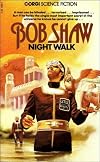
I have taken it upon myself to start a re-read of the works of Bob Shaw, an Irish SF writer who was a mainstay of the science fiction community from the 1950s, when he was one of the leading lights of Irish Fandom, up to his death in 1996. Awarded the Hugo for his fan writing twice (in 1979 and 1980), he made his first professional sale in 1954; this novel was his first, published in the USA in 1967 but not in the UK until nearly ten years later.
By the time he wrote Night Walk, in addition show more to his fifteen years contributing to fanzines, Shaw was writing in his Day Job as science correspondent for the Belfast Telegraph; this shows in his easy command of prose.
An agent for the Earth government, Sam Tallon, has come into possession of a great secret whilst on the colonised world of Emm Luther. But he is captured, and in the course of his arrest is blinded. Imprisoned in a supposedly escape-proof facility, he devises a method of seeing, using the eyes of other sentient beings around him - not only other people, but also dogs, cats and birds. His escape takes him across the single colonised continent of Emm Luther and back to Earth - but his capture is always likely, and his own side would consider him expendable if that was what it would take to retrieve the information literally locked away inside his head.
So what we have here is a science fictional spy thriller. There is a lot of technological ingenuity in this book, even if some of the neuroscience looks a bit shaky to us now. Shaw puts a lot of world-building into the book, and whilst this comes in the form of science fiction's traditional "expository lumps", these are dovetailed quite effectively into the story and come over as essential background rather than the author having to tediously explain stuff away. The novel doesn't betray its age too much, though there are some aspects of life in the twenty-second century which we would now look at as quaint. More concerning, there is one incident of violence against a woman, and also mentions of alcoholism that hint that Bob Shaw's background may not have been quite as warm and welcoming as was popularly thought. SF fandom was good at keeping its own secrets; Arthur C. Clarke's homosexuality was the best-kept secret that everyone in fandom knew about during the 1950s, and in later life Bob admitted to problems with alcohol. Other rumours regarding his personal life were not widely circulated, but they nonetheless were there. But detecting this in Night Walk will require a degree of reading between the lines that many readers will not, at this remove in time, be able to manage.
This should not put readers off. It is true that Night Walk relies on the same level of coincidental serendipity and convenient glossing over of practicalities that most thrillers need to allow their plots to work. Sam Tallon isn't the most sympathetic character, and the main romantic relationship in the book is a textbook example of Stockholm Syndrome, although this is introduced with an unexpected temporary switch of p.o.v. character that attempts to explain some of this. (Late in my reading, I suddenly realised that had this been filmed when it was a new novel, the best choice to play Sam Tallon would have been Patrick McGoohan - of The Prisoner fame - whose sometimes abrasive character and single-mindedness would be a very good fit to Tallon.)
Night Walk is a short read by modern standards - around 165 pages - and as long as its detractions aren't triggering, well worth looking for by those with an interest in either SF or thrillers. show less
By the time he wrote Night Walk, in addition show more to his fifteen years contributing to fanzines, Shaw was writing in his Day Job as science correspondent for the Belfast Telegraph; this shows in his easy command of prose.
An agent for the Earth government, Sam Tallon, has come into possession of a great secret whilst on the colonised world of Emm Luther. But he is captured, and in the course of his arrest is blinded. Imprisoned in a supposedly escape-proof facility, he devises a method of seeing, using the eyes of other sentient beings around him - not only other people, but also dogs, cats and birds. His escape takes him across the single colonised continent of Emm Luther and back to Earth - but his capture is always likely, and his own side would consider him expendable if that was what it would take to retrieve the information literally locked away inside his head.
So what we have here is a science fictional spy thriller. There is a lot of technological ingenuity in this book, even if some of the neuroscience looks a bit shaky to us now. Shaw puts a lot of world-building into the book, and whilst this comes in the form of science fiction's traditional "expository lumps", these are dovetailed quite effectively into the story and come over as essential background rather than the author having to tediously explain stuff away. The novel doesn't betray its age too much, though there are some aspects of life in the twenty-second century which we would now look at as quaint. More concerning, there is one incident of violence against a woman, and also mentions of alcoholism that hint that Bob Shaw's background may not have been quite as warm and welcoming as was popularly thought. SF fandom was good at keeping its own secrets; Arthur C. Clarke's homosexuality was the best-kept secret that everyone in fandom knew about during the 1950s, and in later life Bob admitted to problems with alcohol. Other rumours regarding his personal life were not widely circulated, but they nonetheless were there. But detecting this in Night Walk will require a degree of reading between the lines that many readers will not, at this remove in time, be able to manage.
This should not put readers off. It is true that Night Walk relies on the same level of coincidental serendipity and convenient glossing over of practicalities that most thrillers need to allow their plots to work. Sam Tallon isn't the most sympathetic character, and the main romantic relationship in the book is a textbook example of Stockholm Syndrome, although this is introduced with an unexpected temporary switch of p.o.v. character that attempts to explain some of this. (Late in my reading, I suddenly realised that had this been filmed when it was a new novel, the best choice to play Sam Tallon would have been Patrick McGoohan - of The Prisoner fame - whose sometimes abrasive character and single-mindedness would be a very good fit to Tallon.)
Night Walk is a short read by modern standards - around 165 pages - and as long as its detractions aren't triggering, well worth looking for by those with an interest in either SF or thrillers. show less
Lists
Awards


You May Also Like


Associated Authors
Statistics
- Works
- 118
- Also by
- 56
- Members
- 6,040
- Popularity
- #4,071
- Rating
- 3.6
- Reviews
- 106
- ISBNs
- 218
- Languages
- 12
- Favorited
- 15