
Michael Polanyi (1891–1976)
Author of Personal Knowledge: Towards a Post-Critical Philosophy
About the Author
Image credit: Owen Barfield World Wide Website
Works by Michael Polanyi
The Contempt of Freedom: The Russian Experiment and After (History, Philosophy, and Sociology of Science) (1975) 8 copies
Jenseits Des Nihilismus: Dreizehnte Vorlesung Zum Gedachtnis Von Arthur Stanley Eddington, 16 Februar 1960 (1961) 6 copies
Michael Polanyi 1 copy
Atomic reactions 1 copy
Faith and Reason 1 copy
Associated Works
Tagged
Common Knowledge
- Legal name
- Polányi, Mihály
- Other names
- Polanyi, Michael
- Birthdate
- 1891-03-11
- Date of death
- 1976-02-22
- Gender
- male
- Education
- University of Budapest (MD|1913)
University of Budapest (PhD|1917)
University of Berlin (DSc|1919)
Eötvös Loránd University, Budapest
Technische Hochschule, Karlsruhe - Occupations
- polymath
philosopher
chemist
sociologist
economist
physician - Organizations
- Galileo Society
Kaiser Wilhelm Institut für Faserstoffchemie
Institut für Physikalische Chemie und Elektrochemie
University of Manchester
Society for Freedom in Science (founder) - Awards and honors
- Royal Society (Fellow)
American Academy of Arts and Sciences
Gifford Lectures
Nuffield Gold Medal from Royal Society of Medicine, 1970
Honorary Degree, University of Leeds, 1947
Honorary Degree, Princeton University, 1949 (show all 10)
Honorary Degree, Notre Dame University, 1965
Honorary Degree, Wesleyan University, 1965
Honorary Degree, University of Toronto, 1967
Lecomte du Nouy Award, 1959 - Relationships
- Polanyi, Karl (brother)
Polanyi, John (son)
Polanyi, George (son)
Polanyi-Levitt, Kari (niece)
Zeisel, Eva (niece)
Calvin, Melvin (student) (show all 7)
Wigner, Eugene (student) - Nationality
- Hungary
England - Birthplace
- Budapest, Hungary
- Place of death
- Northampton, England, UK
- Associated Place (for map)
- Northampton, England, UK
Members
Reviews
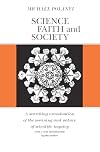
In this book, philosopher of science and eminent chemist Michael Polanyi warns, scientific inquiry cannot exist without a society and a culture that supports it. That is, science’s light can be extinguished if society decides to stamp it out. The freedom to learn about nature requires not only economic supports but also cultural supports. Writing just after the conclusion of World War II, he argues that scientific progress in Europe needs the foundation of a democratic society. He’s show more pessimistic about the ability of communist science because it lacks freedom, and despite Sputnik, history proved him correct on that point.
Interestingly, in a sort of postmodern way 30-40 years before postmodern thought, he describes the foundations of science as residing in communities. Science does not progress based on one authority figure but instead from personal knowledge dispersed through dialogue with one’s colleagues. Science’s communal foundations are made clear.
Since community and society play a central role in scientific inquiry, we must also consider the transcendent ideals of religious faith. Polanyi sees theism as compatible with scientific inquiry, which he defines as the determined pursuit of truth. Nonetheless, he eschews religious fundamentalism on the one hand and totalitarian nationalism on the other. He observes that some humans pursue power instead of truth – a fact I realize again and again when I read the newspapers. Although he acknowledges that some historical periods involve shedding prior dogmas, he does not view this nature as central to science’s identity. Rather, the dogged but free pursuit of truth remains.
He does not investigate the economic aspects of science, a realm I’m all too aware of in 21st century America. The pursuit of truth relies on economic funding to accomplish a community’s good, and 75 years after Polanyi described science as “personal knowledge,” team science requires coordinating individuals across many disciplines. His ideals from prior decades can seem slightly out of place in this environment. Nonetheless, I found the book encouraging and thought-provoking. His brilliant insights extend science beyond mere pragmatism. It also underscores the necessity for science to continue to advocate for societies across the globe to be based on liberty for all. show less
Interestingly, in a sort of postmodern way 30-40 years before postmodern thought, he describes the foundations of science as residing in communities. Science does not progress based on one authority figure but instead from personal knowledge dispersed through dialogue with one’s colleagues. Science’s communal foundations are made clear.
Since community and society play a central role in scientific inquiry, we must also consider the transcendent ideals of religious faith. Polanyi sees theism as compatible with scientific inquiry, which he defines as the determined pursuit of truth. Nonetheless, he eschews religious fundamentalism on the one hand and totalitarian nationalism on the other. He observes that some humans pursue power instead of truth – a fact I realize again and again when I read the newspapers. Although he acknowledges that some historical periods involve shedding prior dogmas, he does not view this nature as central to science’s identity. Rather, the dogged but free pursuit of truth remains.
He does not investigate the economic aspects of science, a realm I’m all too aware of in 21st century America. The pursuit of truth relies on economic funding to accomplish a community’s good, and 75 years after Polanyi described science as “personal knowledge,” team science requires coordinating individuals across many disciplines. His ideals from prior decades can seem slightly out of place in this environment. Nonetheless, I found the book encouraging and thought-provoking. His brilliant insights extend science beyond mere pragmatism. It also underscores the necessity for science to continue to advocate for societies across the globe to be based on liberty for all. show less
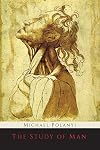
Academic and professional life can seem fragmented at times. After receiving a course of general education, we specialize and then sub-specialize. (Will we sub-sub-specialize in the future?) In particular, the humanities can seem vastly different from the natural sciences, which can seem vastly different from engineering. Into this fragmentation, Polanyi offers a comprehensive philosophy with humans at the center. Polanyi, a physical chemist with economic and philosophical interests, can show more speak with authority on such broad matters due to his broad erudition.
Of course, Polanyi is most well-known for his book Personal Knowledge. This book can be read as a short introduction to that seminal work. Here, he introduces the concept that all objective knowledge relies on “tacit knowledge” based in human practices. We do not simply memorize our environment but take part in a social inquiry. This rightly notes that there is a human component to all studies. At its core, all studies of the outside are a way to teach ourselves how to live.
This means that all academic inquiry is ultimately a way to study humans and our place in the universe. By mastering endeavors of the mind, we master ourselves, and by mastering our subject matter, we find our place in human history. For Polanyi, this aim of mastery is equally true for the humanities, the natural sciences, and applied fields like engineering.
This work has had great impact in the second-half of the twentieth century. I find Polanyi’s approach liberating from those who just view the sciences as a way to earn money. Instead, they can involve the human soul and spirit as much as the humanities. And they also give scientists a reason to explore inquiry into what it means to be human. In the twenty-first century, this uniting vision is still needed, both on campus and in society, where fragmentation abounds along political lines. show less
Of course, Polanyi is most well-known for his book Personal Knowledge. This book can be read as a short introduction to that seminal work. Here, he introduces the concept that all objective knowledge relies on “tacit knowledge” based in human practices. We do not simply memorize our environment but take part in a social inquiry. This rightly notes that there is a human component to all studies. At its core, all studies of the outside are a way to teach ourselves how to live.
This means that all academic inquiry is ultimately a way to study humans and our place in the universe. By mastering endeavors of the mind, we master ourselves, and by mastering our subject matter, we find our place in human history. For Polanyi, this aim of mastery is equally true for the humanities, the natural sciences, and applied fields like engineering.
This work has had great impact in the second-half of the twentieth century. I find Polanyi’s approach liberating from those who just view the sciences as a way to earn money. Instead, they can involve the human soul and spirit as much as the humanities. And they also give scientists a reason to explore inquiry into what it means to be human. In the twenty-first century, this uniting vision is still needed, both on campus and in society, where fragmentation abounds along political lines. show less

Polanyi offers an insightful examination of tacit knowledge, that which we "know but cannot say." He sets the study in the context of science and its pursuit of objective knowledge of the world through skepticism and methodological purification, but the arguments apply more broadly to other knowledge pursuits.
Through three lectures, Polanyi argues that the tacit dimension is a realm of knowing that we comprehend (or maybe intuit) but do not articulate. Nevertheless, what we comprehend show more tacitly guides our explicit, concrete practices of knowledge creation. It guides our selection of problems to attend to, our choice of techniques, and our moment-by-moment assessment of whether something is right or wrong. The more skilled we become in any kind of practice (whether riding a bicycle, driving, singing, or doing an experiment) the more likely we are to look through the particulars of our actions to the more distant intent that is guiding those actions. In doing so, we are looking into the realm of comprehension and knowing that encompasses and mediates the more particular areas of knowledge. Areas of knowledge creation that focus outward (e.g., psychology, sociology, literature, art) afford us some glimpse of what might motivate the particulars of our actions. This tacit realm is then the seat of knowledge production: it provides the exigence, the selection of problems, and the hunches and intuitions that drive the development of more specific questions or concrete attempts at forming knowledge that are the particulars of knowledge creation. We bring our specific knowledge practices into coordination with what we understand tacitly. Although (and this is me speaking) surely there must be times when our tacit understanding of a situation is just play wrong because we cannot form an accurate tacit comprehension of something. I am not sure how concrete knowledge practices that conflict with tacit comprehension work backwards to change our tacit sensibilities. Maybe that, too, is a function of art and literature.
For such a slender book, it puts up a fight. As clearly as Polanyi is able to describe something as ineffable as tacit knowledge, readers will need to give it a measure and half of attention. show less
Through three lectures, Polanyi argues that the tacit dimension is a realm of knowing that we comprehend (or maybe intuit) but do not articulate. Nevertheless, what we comprehend show more tacitly guides our explicit, concrete practices of knowledge creation. It guides our selection of problems to attend to, our choice of techniques, and our moment-by-moment assessment of whether something is right or wrong. The more skilled we become in any kind of practice (whether riding a bicycle, driving, singing, or doing an experiment) the more likely we are to look through the particulars of our actions to the more distant intent that is guiding those actions. In doing so, we are looking into the realm of comprehension and knowing that encompasses and mediates the more particular areas of knowledge. Areas of knowledge creation that focus outward (e.g., psychology, sociology, literature, art) afford us some glimpse of what might motivate the particulars of our actions. This tacit realm is then the seat of knowledge production: it provides the exigence, the selection of problems, and the hunches and intuitions that drive the development of more specific questions or concrete attempts at forming knowledge that are the particulars of knowledge creation. We bring our specific knowledge practices into coordination with what we understand tacitly. Although (and this is me speaking) surely there must be times when our tacit understanding of a situation is just play wrong because we cannot form an accurate tacit comprehension of something. I am not sure how concrete knowledge practices that conflict with tacit comprehension work backwards to change our tacit sensibilities. Maybe that, too, is a function of art and literature.
For such a slender book, it puts up a fight. As clearly as Polanyi is able to describe something as ineffable as tacit knowledge, readers will need to give it a measure and half of attention. show less
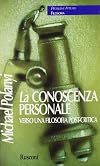
Libro eccezionale, che scuote le basi della presunta oggettività scientifica ribaltandole a favore della conoscenza personale intesa come modalità prima di apprendimento. Il testo è del 1958, la chiarezza filosofica con cui affronta problematiche scientifiche è inoppugnabile e alcune delle riflessioni qui messe su carta (per esempio il tema delle conoscenze tacite/esplicite) sono state negli anni a venire rimasticate e banalizzate un po' ovunque. Una lettura fondamentale.
Lists
Awards

You May Also Like


Associated Authors
Statistics
- Works
- 26
- Also by
- 2
- Members
- 2,162
- Popularity
- #11,888
- Rating
- 3.9
- Reviews
- 17
- ISBNs
- 69
- Languages
- 10
- Favorited
- 4