
Walter J. Ong (1912–2003)
Author of Orality and Literacy
About the Author
Walter J. Ong, S.J. (1912-2003), was University Professor of Humanities at Saint Louis University, where he taught for thirty-six years. His books include Fighting for Life: Contest, Sexuality, and Consciousness and Interfaces of the Word: Studies in the Evolution of Consciousness and Culture, both show more from Cornell; Orality and Literacy: The Technologizing of the Word; The Presence of the Word: Some Prolegomena for Cultural and Religious History; and Ramus, Method, and the Decay of Dialogue: From the Art of Discourse to the Art of Reason. show less
Image credit: Educomunicación
Works by Walter J. Ong
Ramus, Method, and the Decay of Dialogue: From the Art of Discourse to the Art of Reason (1983) 111 copies
The Presence of the Word: Some Prolegomena for Cultural and Religious History (1967) 108 copies, 1 review
Rhetoric, Romance, and Technology: Studies in the Interaction of Expression and Culture (1971) 19 copies
Associated Works
New Theology No. 5: New Talk of the Future, Hope, and Eschatology (1968) — Contributor — 52 copies, 1 review
Tagged
Common Knowledge
- Canonical name
- Ong, Walter J.
- Legal name
- Ong, Walter Jackson
- Birthdate
- 1912-11-30
- Date of death
- 2003-08-12
- Gender
- male
- Education
- Rockhurst College (BA|1933)
Saint Louis University (MA|1941)
Harvard University (PhD|1955) - Occupations
- priest
professor (English Literature)
historian
philosopher - Organizations
- Society of Jesus
Saint Louis University
Modern Language Association of America
Roman Catholic Church - Nationality
- USA
- Birthplace
- Kansas City, Missouri, USA
- Places of residence
- St. Louis, Missouri, USA
- Associated Place (for map)
- Missouri, USA
Members
Reviews
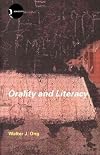
I discovered Walter Ong's 'Orality and Literacy' (1982) only recently. I wish I had read it 30 or more years ago at the same time as my encounter with the similarly illuminating William Ivins, in his 'Prints and Visual Communications' (1953). Ong, who acknowledges Ivins in 'Orality and Literacy', was concerned with the evolution of human consciousness effected by the invention of written language as an extension of oral communication. In his memorably strange coinage, literate peoples live show more in the hybrid world of the 'grapholect' in which oral and written cultures are melded. Ivins' discussion of the evolution of printed illustrations is an inspiring complement to Ong on literacy: his 'Prints and Visual Communication' is a history of printed illustrations as a 'medium for the transmission of information in invariant form', with similar implications for the enlargement of consciousness. For both Ong and Ivins, the significance of printed information, whether in words or illustrations, was the liberation of knowledge from the vagaries and limits of memory that constrain consciousness in non-literate cultures and preclude scientific or conceptual enquiry.
Grapholexy has its own constraints. Ong remarks the difficulty for literate peoples of conceiving, in any accurate or meaningful way, what it is like to live in a primal world of purely oral communication: 'The effects of oral states of consciousness are bizarre to the literate mind.' The intimate relationship between oral and written communication is itself hard to conceive, lending itself to his oracular formulation: '[T]ext is fundamentally pretext - though this does not mean that text can be reduced to orality'.
'Orality and Literacy' is an essentially evolutionary story of the development of civil modes of discourse in which the omnipresence of modern print culture contains and constrains the exuberance of discussion and argument in earlier more orally saturated cultures. But evolution, like progress, is a tricky concept. Ong's reflections on ‘modern’, televised US presidential debates (he probably had in mind the Reagan-Carter debates of 1980) are marvellous for their lack of prescience about the direction that evolution or progress might take. He remarks the agonistic style of 19th century political debates, which resembled a prize fight. By contrast, in the 1980’s, 'Presidential debates on television today are completely out of this older oral world...candidates...make short presentations, and engage in crisp little conversations with each other in which any agonistic edge is deliberately kept dull....Electronic media do not tolerate a show of open antagonism....the media are totally dominated by a sense of closure which is the heritage of print: a show of hostility might break open the closure, the tight control. Candidates accommodate themselves to the psychology of the media. Genteel, literate domesticity is rampant.'
In late 2020 after the debacle of the Trump vs Biden shouting matches, it was only to be expected that the news media would recall Walter Ong's analysis of the rhetorical excesses of illiterate cultures: ‘Donald Trump has come to represent the most concentrated form of toxic waste produced by a part of our culture that no longer finds any value in the written word'. (Desolation Press, 2020). show less
Grapholexy has its own constraints. Ong remarks the difficulty for literate peoples of conceiving, in any accurate or meaningful way, what it is like to live in a primal world of purely oral communication: 'The effects of oral states of consciousness are bizarre to the literate mind.' The intimate relationship between oral and written communication is itself hard to conceive, lending itself to his oracular formulation: '[T]ext is fundamentally pretext - though this does not mean that text can be reduced to orality'.
'Orality and Literacy' is an essentially evolutionary story of the development of civil modes of discourse in which the omnipresence of modern print culture contains and constrains the exuberance of discussion and argument in earlier more orally saturated cultures. But evolution, like progress, is a tricky concept. Ong's reflections on ‘modern’, televised US presidential debates (he probably had in mind the Reagan-Carter debates of 1980) are marvellous for their lack of prescience about the direction that evolution or progress might take. He remarks the agonistic style of 19th century political debates, which resembled a prize fight. By contrast, in the 1980’s, 'Presidential debates on television today are completely out of this older oral world...candidates...make short presentations, and engage in crisp little conversations with each other in which any agonistic edge is deliberately kept dull....Electronic media do not tolerate a show of open antagonism....the media are totally dominated by a sense of closure which is the heritage of print: a show of hostility might break open the closure, the tight control. Candidates accommodate themselves to the psychology of the media. Genteel, literate domesticity is rampant.'
In late 2020 after the debacle of the Trump vs Biden shouting matches, it was only to be expected that the news media would recall Walter Ong's analysis of the rhetorical excesses of illiterate cultures: ‘Donald Trump has come to represent the most concentrated form of toxic waste produced by a part of our culture that no longer finds any value in the written word'. (Desolation Press, 2020). show less
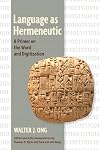
The book is a collection of manuscripts that thematically hang together around the idea that computers increase the digitization of ideas and experience but it is the human capacity for interpretation that is required to make sense out of it. Even so, chapters read like fragments of arguments; some fit together like pieces in a puzzle, some don't even if they appear to be on the same topic. Ultimately, there are some good ideas in here about hermeneutics and the nature of digitization but show more the reader is left to their own devices stitching some of those ideas together. show less
This is a five-star book in terms of its content: Ong's theory about the orality-literacy binary is illuminating, if oversimplified.
His main argument: that oral speech and written word are not merely two different ways of expressing the same thing, but qualitatively different with far-reaching implications. Drawing on literary analysis and anthropological studies in pre-literate societies, Ong argues that oral culture is driven by the inability to ever "look something up." As a result, oral show more cultures exist perpetually in the present — only what can be remembered exists, so communication in these cultures is designed to be mnemonic: proverbs, rhymes and verse, containing larger-than-life characters, catchy phrasing and a focus on the communal rather than the individual. People who've interiorized writing as part of literate cultures have no need to keep everything in their minds, so they can be more inwardly focused, more analytic, more linear and less digressive. (Though literacy clearly has benefits, Ong is careful not to describe it as superior to orality; knowing that he is writing to literate readers, Ong goes to great pains to defend and explain orality.) The two ideas aren't binary, but rather represent a continuum — many people are influenced, in Ong's formulation, by both oral and literate modes of thought and communication, but some are more literate than others.
The book passes the standard of my very favorite works of nonfiction: it gives me an analytic framework I can generalize and apply to other areas. (One striking application of Ong's work others have recently made: looking at the many ways in which President-elect Donald Trump's speeches and tweets reflect the oral tradition.)
Unfortunately, I can't give it the usual five-star review I would to that type of transformative work because for a variety of reasons it falls just short in its presentation. Orality and Literacy is in some cases over-technical in its language, in other cases too bound up with arcane academic disputes, even though it was written as a popularization of Ong's more academic work. It's not a hard read per se, but it's not as accessible as it could be. More significantly, it spends so much time responding to the assumed pro-literate bias of Ong's readers and interlocutors that it often falls short in defining the literacy half of his dichotomy. It's assumed that readers are familiar with literate culture, which we may very well be (on Ong's continuum I'm certainly hyper-literate), but I'd have appreciated more of a compare-and-constrast approach.
It's also worth noting that some of Ong's theories are dated, not least by the revolutionary changes in communication brought about by the Internet and mobile phones since this was published in 1983. Additionally scholars in various fields have challenged some of his conclusions. Fortunately, the 30th Anniversary Edition I read includes a very helpful afterword that takes on some of these criticisms and changes in a fair manner.
Ultimately these are more quibbles than objections. I wish the book were better, but even with its flaws, people who enjoy this sort of conceptual theories should absolutely give this a read. show less
His main argument: that oral speech and written word are not merely two different ways of expressing the same thing, but qualitatively different with far-reaching implications. Drawing on literary analysis and anthropological studies in pre-literate societies, Ong argues that oral culture is driven by the inability to ever "look something up." As a result, oral show more cultures exist perpetually in the present — only what can be remembered exists, so communication in these cultures is designed to be mnemonic: proverbs, rhymes and verse, containing larger-than-life characters, catchy phrasing and a focus on the communal rather than the individual. People who've interiorized writing as part of literate cultures have no need to keep everything in their minds, so they can be more inwardly focused, more analytic, more linear and less digressive. (Though literacy clearly has benefits, Ong is careful not to describe it as superior to orality; knowing that he is writing to literate readers, Ong goes to great pains to defend and explain orality.) The two ideas aren't binary, but rather represent a continuum — many people are influenced, in Ong's formulation, by both oral and literate modes of thought and communication, but some are more literate than others.
The book passes the standard of my very favorite works of nonfiction: it gives me an analytic framework I can generalize and apply to other areas. (One striking application of Ong's work others have recently made: looking at the many ways in which President-elect Donald Trump's speeches and tweets reflect the oral tradition.)
Unfortunately, I can't give it the usual five-star review I would to that type of transformative work because for a variety of reasons it falls just short in its presentation. Orality and Literacy is in some cases over-technical in its language, in other cases too bound up with arcane academic disputes, even though it was written as a popularization of Ong's more academic work. It's not a hard read per se, but it's not as accessible as it could be. More significantly, it spends so much time responding to the assumed pro-literate bias of Ong's readers and interlocutors that it often falls short in defining the literacy half of his dichotomy. It's assumed that readers are familiar with literate culture, which we may very well be (on Ong's continuum I'm certainly hyper-literate), but I'd have appreciated more of a compare-and-constrast approach.
It's also worth noting that some of Ong's theories are dated, not least by the revolutionary changes in communication brought about by the Internet and mobile phones since this was published in 1983. Additionally scholars in various fields have challenged some of his conclusions. Fortunately, the 30th Anniversary Edition I read includes a very helpful afterword that takes on some of these criticisms and changes in a fair manner.
Ultimately these are more quibbles than objections. I wish the book were better, but even with its flaws, people who enjoy this sort of conceptual theories should absolutely give this a read. show less
Ong raises a lot of interesting ideas, but his scholarship strikes me as anything but rigorous. I get the feeling that he can stretch his examples to support any point he happens to wish to make. I was convinced by his argument that particular media inform content and may even structure consciousness. But I didn't buy the dichotomy he set up between oral and literate cultures... I couldn't find any rhyme or reason in which cultures he designated as oral, and which as literate, so I concluded show more that pretty much every contemporary culture includes aspects of both. I don't see that literacy has supplanted orality, nor that it ever will -- they seem to be constantly informing each other. show less
Lists
You May Also Like


Associated Authors
Statistics
- Works
- 28
- Also by
- 6
- Members
- 1,797
- Popularity
- #14,314
- Rating
- 4.2
- Reviews
- 17
- ISBNs
- 80
- Languages
- 8
- Favorited
- 2