
Phil Klay
Author of Redeployment
About the Author
Phil Klay is a graduate of Dartmouth College and a veteran of the U.S. Marine Corps. He served in Iraq's Anbar Province as a Public Affairs Officer. After being discharged he went to Hunter College and received an MFA. His story "Redeployment" was originally published in Granta and is included in show more Fire and Forget: Short Stories from the Long War. His writing has also appeared in the New York Times, Newsweek, The Daily Beast, the New York Daily News, Tin House, and The Best American Nonrequired Reading 2012. (Bowker Author Biography) show less
Image credit: By Jessica Alvarez - privat (Phil Klay), CC BY-SA 3.0, https://commons.wikimedia.org/w/index.php?curid=35058331
Works by Phil Klay
Ten Kliks South 8 copies
Associated Works
Tagged
Common Knowledge
- Birthdate
- 1983
- Gender
- male
- Education
- Dartmouth College
Hunter College (MFA) - Organizations
- U.S. Marine Corps
- Awards and honors
- National Book Foundation, 5 Under 35 Honoree (2014)
- Agent
- Eric Simonoff (WME)
- Nationality
- USA
- Places of residence
- White Plains, New York, USA
- Associated Place (for map)
- New York, USA
Members
Reviews
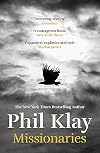
Missionaries is one of those books which take a few seemingly completely disparate characters, and over time manages to weave them into a cohesive narrative. This is a strategy which can work really well, or go disastrously wrong. It’s a technique I like when it works well, and luckily here it does. Klay further complicates things by introducing his major characters at different intervals in different years. Initially they tell their own stories.
Abel was a young boy, Abelito, in 1999 when show more the guerrilleros came to his Columbian village seeking “justice”, which Abelito knew was just another word for executions. His father hid him in a boat and pushed it downstream, saving Abelito, but the rest of the family was murdered. His story is told by the older disassociated Abel.
Lisette was a journalist in Kabul in 2015. Most of the other westerners had left long ago, but she found it difficult to live in the west, where no one seemed to care what was happening in places like Afghanistan. At least in Afghanistan, she felt able to act, to perhaps make someone care back home while they read the morning news and drank their morning coffee. Now she was looking for a war to cover “where we’re not losing”.
Then there was Mason, a miner’s son. In 2005, he was a medic with Special Forces in Iraq. He believed in the mission then, believed that he was “experiencing the violence and horror of this place so that they didn’t have to experience the same things in Fayetteville, North Carolina”. That was about to change.
Lastly there was Juan Pablo. a lieutenant colonel in the Colombian army. In 2016, his concern was what would happen with a pending treaty with FARC, and afterwards should it materialise.
Klay manages to bring all four together in a believable fashion, at which time the novel switches to third person narrative. There is ideological struggle here between Americans reared on democracy as a black and white concept, and the realties of South America, where just achieving consensus on what democracy is, may prove impossible. There is an unfiltered portrayal of American actions in foreign wars, yet the American characters are sympathetically drawn.
There are echoes of Robert Stone and Philip Caputo here, but some of Klay’s characters actually do believe there will be a better tomorrow, despite and maybe even because of what is happening today. Whichever side of the debate you fall on, it makes for powerful reading. show less
Abel was a young boy, Abelito, in 1999 when show more the guerrilleros came to his Columbian village seeking “justice”, which Abelito knew was just another word for executions. His father hid him in a boat and pushed it downstream, saving Abelito, but the rest of the family was murdered. His story is told by the older disassociated Abel.
Lisette was a journalist in Kabul in 2015. Most of the other westerners had left long ago, but she found it difficult to live in the west, where no one seemed to care what was happening in places like Afghanistan. At least in Afghanistan, she felt able to act, to perhaps make someone care back home while they read the morning news and drank their morning coffee. Now she was looking for a war to cover “where we’re not losing”.
Then there was Mason, a miner’s son. In 2005, he was a medic with Special Forces in Iraq. He believed in the mission then, believed that he was “experiencing the violence and horror of this place so that they didn’t have to experience the same things in Fayetteville, North Carolina”. That was about to change.
Lastly there was Juan Pablo. a lieutenant colonel in the Colombian army. In 2016, his concern was what would happen with a pending treaty with FARC, and afterwards should it materialise.
Klay manages to bring all four together in a believable fashion, at which time the novel switches to third person narrative. There is ideological struggle here between Americans reared on democracy as a black and white concept, and the realties of South America, where just achieving consensus on what democracy is, may prove impossible. There is an unfiltered portrayal of American actions in foreign wars, yet the American characters are sympathetically drawn.
There are echoes of Robert Stone and Philip Caputo here, but some of Klay’s characters actually do believe there will be a better tomorrow, despite and maybe even because of what is happening today. Whichever side of the debate you fall on, it makes for powerful reading. show less
When Fujita's squad approached the battle cross, they knelt close together, their arms over one another's shoulders, leaning into each other until it was one silent, weeping block. Geared up, Marines are terrifying warriors. In grief, they look like children. Then one by one they stood up, touched the helmet, and walked to where Captain Bolden stood in the back, grim, stupid determination on his thick, square face.
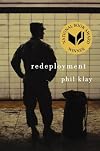
Fans of The Things They Carried and Sebastian Junger's War are going to want show more to read Redeployment by Phil Klay as soon as possible, as will fans of lucid, varied and skillful writing about soldiers' experiences during and after a war, as will fans of exceptionally skillful writing, period.
In this short story collection, Klay's range may be what impresses most, as he convincingly takes on a dozen or more widely varying main character perspectives. This includes, for example, the veteran in the title story who shamefully looks back at shooting dogs for sport in Iraq, who now is faced with the need, for entirely different reasons, to the do the same to his dog back home, the earnest chaplain in "Prayer in the Furnace" who has all the right intentions but is frustratingly ineffective at helping the cynical, reality-beaten soldiers, and the newly converted Muslim woman in "Psychological Operations" who has to listen an Iraqi vet college classmate explain his disgust with himself for his role in luring Iraqi opponents to their death. (The last is the one story in this tightly written collection that runs a bit long). The author is an Iraqi war veteran, a Marine, and he knows whereof he speaks. The convincing expletive-filled dialogue, the troubling descriptions, the black humor, the authentic characterizations, all add up to one of the most impressive debuts I've ever read.
"Money as a Weapons System" is a cynical, funny triumph. An expensive, American-made and poorly designed water treatment plant is inoperable, but there may be momentum to fix it among some officers, because its excessive water pressure through the pipes would cause Iraqi houses to "explode". Not exactly the original goal. Meanwhile, the protagonist is being pressured, because of an influential civilian contributor, to distribute baseball uniforms and teach Iraqi children baseball, as a way to get them on track to a more organized, civilized, Western style of life.
The endings of his stories are often killers, arrowing into the heart while simultaneously changing your understanding of what came before. I can't repeat them here, of course, but one involving a vet with severe burns who a journalist targets for an article, and one comparing wounded bees to a haunted vet who drinks himself to oblivion, just plain knocked me on my keister. And kept me thinking long beyond the story's end.
More than once I wondered whether a woman could read this collection without being offended. It often features men behaving badly, sexually objectifying women, and saying offensive things. That it all rings true is a sad story in its own right. He does feature some memorable and believable women characters, including the Muslim woman in "Psychological Operations" who first appears to be annoying, and then turns out to be wiser than the vet who wants to argue with her. In the end, because of the honesty, sophistication and depth of the stories, I concluded that many women will want to read the book, even with its offensiveness and often brutal circumstances. Four and a half stars. show less
Fans of The Things They Carried and Sebastian Junger's War are going to want show more to read Redeployment by Phil Klay as soon as possible, as will fans of lucid, varied and skillful writing about soldiers' experiences during and after a war, as will fans of exceptionally skillful writing, period.
In this short story collection, Klay's range may be what impresses most, as he convincingly takes on a dozen or more widely varying main character perspectives. This includes, for example, the veteran in the title story who shamefully looks back at shooting dogs for sport in Iraq, who now is faced with the need, for entirely different reasons, to the do the same to his dog back home, the earnest chaplain in "Prayer in the Furnace" who has all the right intentions but is frustratingly ineffective at helping the cynical, reality-beaten soldiers, and the newly converted Muslim woman in "Psychological Operations" who has to listen an Iraqi vet college classmate explain his disgust with himself for his role in luring Iraqi opponents to their death. (The last is the one story in this tightly written collection that runs a bit long). The author is an Iraqi war veteran, a Marine, and he knows whereof he speaks. The convincing expletive-filled dialogue, the troubling descriptions, the black humor, the authentic characterizations, all add up to one of the most impressive debuts I've ever read.
"Money as a Weapons System" is a cynical, funny triumph. An expensive, American-made and poorly designed water treatment plant is inoperable, but there may be momentum to fix it among some officers, because its excessive water pressure through the pipes would cause Iraqi houses to "explode". Not exactly the original goal. Meanwhile, the protagonist is being pressured, because of an influential civilian contributor, to distribute baseball uniforms and teach Iraqi children baseball, as a way to get them on track to a more organized, civilized, Western style of life.
The endings of his stories are often killers, arrowing into the heart while simultaneously changing your understanding of what came before. I can't repeat them here, of course, but one involving a vet with severe burns who a journalist targets for an article, and one comparing wounded bees to a haunted vet who drinks himself to oblivion, just plain knocked me on my keister. And kept me thinking long beyond the story's end.
More than once I wondered whether a woman could read this collection without being offended. It often features men behaving badly, sexually objectifying women, and saying offensive things. That it all rings true is a sad story in its own right. He does feature some memorable and believable women characters, including the Muslim woman in "Psychological Operations" who first appears to be annoying, and then turns out to be wiser than the vet who wants to argue with her. In the end, because of the honesty, sophistication and depth of the stories, I concluded that many women will want to read the book, even with its offensiveness and often brutal circumstances. Four and a half stars. show less
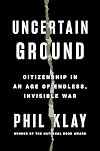
Stunning, brilliant. Why are our leaders incapable of seeing war this way" Particularly our meaningless protracted engagements in Iraq and Afghanistan. Klay is a Marine (no longer active duty) but more importantly he is a person who thinks. He brings together Hannah Arendt, Franz Fanon, and St. Augustine to discuss how nations led through force always lose. He speaks of the disservice we do to veterans when when we shut down discussion with platitudes. He retuns again and again to what it show more means that nearly no Americans fight in wars anymore, and how that has allowed Americans to ignore a 20 year war. He talks about how living without faith diminished him and about the comfort he got from his return to Catholicism. He talks about the shift in perspective he experienced when he had a child and realized what we were leaving him. The essays address huge issues of morality and political philosophy, and the quotidian experiences of service personnel and of fathers at the mall, but all the stories are in service to a central philosophy. It is so smart and so good and so readable. I recommend this to every American, but sadly few will read it and be forced to ask themselves the hard questions.
ETA: I forgot to mention the essay "A History of Violence" on the history of the AR-15. It was absolute genius. show less
ETA: I forgot to mention the essay "A History of Violence" on the history of the AR-15. It was absolute genius. show less
With these stories set in Iraq Phil Klay captures both the inhumanity and humanity in war, often in the same story. In Ten Kliks South a marine artilleryman can’t help wondering, and even trying to find out what happened to the bodies of the ISIS insurgents he supposedly killed as part of a gun team. It’s his first time shooting at live targets and his sergeant has a different perspective: “We provide the bodies. We don’t clean ‘em up. You hear me?” This is the last story in the show more collection, which roughly progresses from front line action to the rear, and aftermath.
Several stories involve veterans attempting to re-integrate into the civilian world. Some are disfigured, all are wounded, either physically or unseen to the eye. This is some of the best war writing around, reminiscent of Tim O’Brien’s work. show less
Several stories involve veterans attempting to re-integrate into the civilian world. Some are disfigured, all are wounded, either physically or unseen to the eye. This is some of the best war writing around, reminiscent of Tim O’Brien’s work. show less
Lists
Awards


You May Also Like


Associated Authors
Statistics
- Works
- 7
- Also by
- 2
- Members
- 2,026
- Popularity
- #12,690
- Rating
- 4.0
- Reviews
- 83
- ISBNs
- 44
- Languages
- 7
- Favorited
- 1