
About the Author
Ken Alder is an associate professor of history at Northwestern University and holds a Ph.D. from Harvard. A novelist and an avid bicyclist, he has biked Delambre and Mechain's entire route. His first book, Engineering the Revolution, won the 1998 Dexter Prize for the best book on the history of show more technology. He lives in Evanston, Illinois show less
Works by Ken Alder
The Measure of All Things: The Seven-Year Odyssey and Hidden Error That Transformed the World (2002) 1,076 copies, 19 reviews
Tagged
Common Knowledge
- Canonical name
- Alder, Ken
- Birthdate
- 1959-04-14
- Gender
- male
- Education
- Harvard University
- Occupations
- historian
professor - Nationality
- USA
- Places of residence
- Evanston, Illinois, USA
- Associated Place (for map)
- Illinois, USA
Members
Reviews

This is one of the most ambitious book I've read in a while. Alder tackles the origins of engineering as a discipline, the purported inevitability of interchangeable parts and mass production, and the formation of the French Revolutionary state through the artifact of the gun (both artillery and muskets). Taking as a starting point Langdon Winner's question "Do artefacts have politics?", Alder demonstrates that mastery over the 'thick' world of material objects via mechanical drawings, show more mathematical description, and the tools of analytic theory is intensely political.
This is not a book for the faint of heart. It's long, dense, and prior background in the history of technology and the structure of the Ancien Regime is necessary. But for all that, it's a masterpiece of scholarship. show less
This is not a book for the faint of heart. It's long, dense, and prior background in the history of technology and the structure of the Ancien Regime is necessary. But for all that, it's a masterpiece of scholarship. show less
The Measure of All Things: The Seven-Year Odyssey and Hidden Error That Transformed the World by Ken Alder
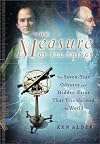
I asked for this book because I wanted to learn more about the development of the metric system and found so much more in it.
Other than the herculean effort it took to try and "measure" a portion of a meridian, it was the story of Méchain's struggles that helped me get a better understanding of the origin of the scientific concept of "precision". He couldn't understand why repeat measurements would yield different results and died thinking he had committed a serious scientific error that show more he was ashamed to reveal. show less
Other than the herculean effort it took to try and "measure" a portion of a meridian, it was the story of Méchain's struggles that helped me get a better understanding of the origin of the scientific concept of "precision". He couldn't understand why repeat measurements would yield different results and died thinking he had committed a serious scientific error that show more he was ashamed to reveal. show less
Although this is a book about the struggles for and against the implementation of interchangeable parts manufacturing for guns in the pre-revolutionary and post-revolutionary era, it’s also a great book for anyone interested in the history of technology generally, because it’s a closely observed and theoretically rich study of the ways in which technology always has and helps make meaning. Even whether something “works,” it turns out, is hotly contested, especially when it’s human show more beings doing the measuring. Technological progress is not a phenomenon independent of political and cultural organization, as the workers who resisted the measurements and deskilling that came along with interchangeable parts knew quite well; Alder also points out that Japan was able to reject the gun entirely for a long period, because it didn’t fit with the kinds of fights the rulers wanted to have. In France, what it meant for a gun to “work” within a context of particular strategies for organizing men and fighting tactics was itself up for grabsons. And lest you think that’s all over and done now that we have really advanced tech, consider how well the iPhone “works” despite needing a case to limit dropped calls and frequent replacement of the gorgeous but easily cracked glass front and back. show less
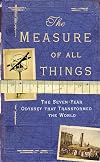
I have always believed in the paradox of formal systems. The accuracy of any measurement can only go so far no matter how perfect we think the system is. With the latest news of the deteriorating condition of the "official' kilogram which rots away in some shed in France, this book seems all the more timely. The metric system is flawed, but not by paradox; it is due to human error. Alder writes an excellent account of how this mistake happened and what its ramifications were and are.
Lists
Awards


You May Also Like


Associated Authors
Statistics
- Works
- 4
- Members
- 1,174
- Popularity
- #21,919
- Rating
- 3.8
- Reviews
- 22
- ISBNs
- 34
- Languages
- 8