
Mervyn Peake (1911–1968)
Author of The Gormenghast Trilogy
About the Author
Series
Works by Mervyn Peake
Mervyn Peake, Oscar Wilde: Extracts from the Poems of Oscar Wilde (1980) — Illustrator — 5 copies, 2 reviews
Dr. Jekyll and Mr. Hyde 1 copy
11 Poems 1 copy
Mervyn Peake 1 copy
Associated Works
Alice's Adventures in Wonderland / Through the Looking-Glass (1865) — Illustrator, some editions — 29,578 copies, 317 reviews
The Strange Case of Dr Jekyll and Mr Hyde (1886) — Illustrator, some editions — 19,763 copies, 369 reviews
The Rime of the Ancient Mariner [poem] (1798) — Illustrator, some editions — 2,773 copies, 43 reviews
The adventures of the young soldier in search of the better world (1943) — Illustrator, some editions — 29 copies
Le livre d'or de la Science-Fiction : Le manoir des roses (1978) — Contributor — 21 copies, 1 review
Tagged
Common Knowledge
- Canonical name
- Peake, Mervyn
- Legal name
- Peake, Mervyn Laurence
- Birthdate
- 1911-07-09
- Date of death
- 1968-11-17
- Gender
- male
- Education
- Croydon School of Art
Royal Academy of Arts
Eltham College - Occupations
- teacher
illustrator
playwright
poet
painter
novelist - Organizations
- British Army (WWII)
- Awards and honors
- Royal Society of Literature (Fellow, 1951)
Heinemann Prize for Literature (1951)
The Times "50 greatest British writers since 1945" (2008) - Relationships
- Gilmore, Maeve (wife)
Peake, Fabian (son)
Peake, Sebastian (son)
Penate, Clare (daughter) - Cause of death
- Lewy body dementia
- Nationality
- UK
- Birthplace
- Kuling, Jiangxi, China
- Places of residence
- Wallington, Surrey, England, UK
Sark, Bailiwick of Guernsey
Smarden, Kent, England, UK
Greaves Hall, Southport, Lancashire, England, UK - Place of death
- Burcot, Oxfordshire, England, UK
- Burial location
- St Mary the Virgin, Burpham, West Sussex, England, UK
- Map Location
- England, UK
Members
Discussions
Gormenghast SE photos in Folio Society Devotees (May 8)
OT: Extraordinary Editions - MR PYE in Folio Society Devotees (March 13)
British Author Challenge July 2025: Dodie Smith & Mervyn Peake in 75 Books Challenge for 2025 (July 2025)
Gormenghast LE 2022 in Folio Society Devotees (April 2023)
Gormenghast LE! in Folio Society Devotees (May 2022)
Group Read: Gormenghast Trilogy - Titus Groan, Gormenghast, Titus Alone in 2013 Category Challenge (October 2013)
Reviews

This novel, the first in the Gormenghast trilogy (though a fragment of a fourth volume has recently been completed), details the events of a year in the fantastic castle of Gormenghast, from the birth of Titus, 77th Earl, through to shortly after his first birthday. Gormenghast castle forms a self-contained community, within which members of the Groan dynasty live, die, go mad, commune with birds and act out arcane rituals. They are attended by a retinue of servants and retainers, with their show more own agendas of ambition, revenge, hate and love. At best, these characters are a little fey, or what my mother would have called "affected"; the worst of them are seriously deranged, hideously deformed grotesques, or both.
The events of the novel form a backdrop for the ambitious rise of the kitchen boy Steerpike. He is best described as an anti-hero; he plots and connives to exploit any advantage he can find for his own advancement; though not every misfortune that falls to other occupants of the castle can be laid at his feet.
If that was all there was to 'Titus Groan', then this wouldn't be such a tour de force. This is not a book to read for excitement or unexpected turns of the plot. But the language! Peake's powers of description make this book essential reading. The castle of Gormenghast becomes a character in itself, with halls, stairways, turrets, corridors, high windows, battlements, a Library, a Tower of Flints, a Hall of Spiders, a Great Kitchen, a Room of Cats and a Hall of Bright Carvings, to name but a few. And Peake has no less an apposite turn of phrase when describing his characters; though in case the words were not enough, he also prepared sketches of many of them.
(The edition I read, part of a 1992 omnibus volume, is plagued by misprints and some strange textual contractions: "along corridor" instead of "a long corridor" is a prime example of a common error, repeated so often throughout the novel that I began to wonder if it was a transcription error from manuscript to print. Other errors are also sprinkled liberally through the text.)
The setting is so resonant that I have coined the word 'Gormenghastly' to describe any excessively eccentric stately home, though there are none in real life that can come close to Peake's vision. Many have eccentric contents - a Cabinet of Stones here, a Corridor of Lizards there, perhaps a Courtyard of Dead Poets. But none combine all these things in one place, in one vast structure the size of a small town. Because whatever you have seen in real life, it cannot compare with Gormenghast itself, "the main massing of the original stone". show less
The events of the novel form a backdrop for the ambitious rise of the kitchen boy Steerpike. He is best described as an anti-hero; he plots and connives to exploit any advantage he can find for his own advancement; though not every misfortune that falls to other occupants of the castle can be laid at his feet.
If that was all there was to 'Titus Groan', then this wouldn't be such a tour de force. This is not a book to read for excitement or unexpected turns of the plot. But the language! Peake's powers of description make this book essential reading. The castle of Gormenghast becomes a character in itself, with halls, stairways, turrets, corridors, high windows, battlements, a Library, a Tower of Flints, a Hall of Spiders, a Great Kitchen, a Room of Cats and a Hall of Bright Carvings, to name but a few. And Peake has no less an apposite turn of phrase when describing his characters; though in case the words were not enough, he also prepared sketches of many of them.
(The edition I read, part of a 1992 omnibus volume, is plagued by misprints and some strange textual contractions: "along corridor" instead of "a long corridor" is a prime example of a common error, repeated so often throughout the novel that I began to wonder if it was a transcription error from manuscript to print. Other errors are also sprinkled liberally through the text.)
The setting is so resonant that I have coined the word 'Gormenghastly' to describe any excessively eccentric stately home, though there are none in real life that can come close to Peake's vision. Many have eccentric contents - a Cabinet of Stones here, a Corridor of Lizards there, perhaps a Courtyard of Dead Poets. But none combine all these things in one place, in one vast structure the size of a small town. Because whatever you have seen in real life, it cannot compare with Gormenghast itself, "the main massing of the original stone". show less

Why, when I already have two editions of this book (not to mention Peake's Complete Nonsense) do I need a third? Because:
i) This has 12 previously unpublished Peake sketches on glossy paper;
ii) I have Christmas and birthday book tokens nagging to be used;
iii) I am cursed by the collecting bug.
Perhaps, only maybe and possibly perhaps, I might divest myself of one of the other editions when I have my next library rationalisation.
In the meantime, I shall enjoy re-reading some of my favourite show more poems and will bask in the Technicolour glow of the illustration of Uncle Jake, who became a snake but never found it out and, as no one mentions it, one sees him still about.
(Review of the Centenary Edition, ISBN 0720613612)
Eight-Years-Later Update: Next library rationalisation under way: no copies being got rid of. show less
i) This has 12 previously unpublished Peake sketches on glossy paper;
ii) I have Christmas and birthday book tokens nagging to be used;
iii) I am cursed by the collecting bug.
Perhaps, only maybe and possibly perhaps, I might divest myself of one of the other editions when I have my next library rationalisation.
In the meantime, I shall enjoy re-reading some of my favourite show more poems and will bask in the Technicolour glow of the illustration of Uncle Jake, who became a snake but never found it out and, as no one mentions it, one sees him still about.
(Review of the Centenary Edition, ISBN 0720613612)
Eight-Years-Later Update: Next library rationalisation under way: no copies being got rid of. show less

When I saw this book I thought, "Mervyn Peake's illustrations; Michael Moorcock's words: what more could you ask for?" The answer is, "Mervyn Peake's words."
The illustrations were made by Peake for his children's story times and were not originally intended for publication. That many of them are drawn on line-ruled note paper and that some drawings have "leaked" through from the page beneath just adds to the charm.
Some of the drawings are rough sketches, but still clearly "Peake-ian" and show more worthy of inclusion. For the most part, however, they are really high quality illustrations and they look like they were made for a professional commission.
Moorcock's introduction is sweet and, as a friend of Peake and his family, his affection and regard really comes through. There are also some nice photos of the Peake family that I haven't seen before.
Regarding the main text, as Peake didn't record the stories he told to his children while making the drawings, Moorcock has written a story to link them together. He's created a pastiche of [b:Captain Slaughterboard Drops Anchor|39266|Captain Slaughterboard Drops Anchor|Mervyn Peake|http://photo.goodreads.com/books/1309674090s/39266.jpg|1332136] and [b:Letters from a Lost Uncle|39268|Letters from a Lost Uncle|Mervyn Peake|http://photo.goodreads.com/books/1169282265s/39268.jpg|1180463], but it doesn't quite work. The story feels overly forced to reference the illustrations instead of flowing naturally. I also found a few of the references to contemporary news stories (the banking crisis, rising oil prices, etc.) rather jarring. Annoying because Moorcock is a brilliant writer and should have done this better.
So, five stars for Peake's illustrations, three stars for Moorcock's text = 4 stars.
As an artefact, the book is very well put together: good quality paper and sturdily constructed. It sits really well in the hand and is a pleasure to read. show less
The illustrations were made by Peake for his children's story times and were not originally intended for publication. That many of them are drawn on line-ruled note paper and that some drawings have "leaked" through from the page beneath just adds to the charm.
Some of the drawings are rough sketches, but still clearly "Peake-ian" and show more worthy of inclusion. For the most part, however, they are really high quality illustrations and they look like they were made for a professional commission.
Moorcock's introduction is sweet and, as a friend of Peake and his family, his affection and regard really comes through. There are also some nice photos of the Peake family that I haven't seen before.
Regarding the main text, as Peake didn't record the stories he told to his children while making the drawings, Moorcock has written a story to link them together. He's created a pastiche of [b:Captain Slaughterboard Drops Anchor|39266|Captain Slaughterboard Drops Anchor|Mervyn Peake|http://photo.goodreads.com/books/1309674090s/39266.jpg|1332136] and [b:Letters from a Lost Uncle|39268|Letters from a Lost Uncle|Mervyn Peake|http://photo.goodreads.com/books/1169282265s/39268.jpg|1180463], but it doesn't quite work. The story feels overly forced to reference the illustrations instead of flowing naturally. I also found a few of the references to contemporary news stories (the banking crisis, rising oil prices, etc.) rather jarring. Annoying because Moorcock is a brilliant writer and should have done this better.
So, five stars for Peake's illustrations, three stars for Moorcock's text = 4 stars.
As an artefact, the book is very well put together: good quality paper and sturdily constructed. It sits really well in the hand and is a pleasure to read. show less
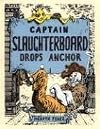
A delightful children's book, handwritten and illustrated by Mervyn Peake, though like all really good children's books, it can also be enjoyed by adults.
This book reflects Peake's lifelong love of pirates and islands, though it's really a simple story of friendship, fun and adventure. The Captain and his mate, Smear, bond partly over a shared joy of reading. One surprise is the lack of a peg-leg, given that Barquentine (in Gormenghast, which I reviewed HERE) and the eponymous Lost Uncle (my show more review HERE) both have one.
The publication date means there are hints of colonialism, but in context, I have no problem with that.
Fantastical
The opening strikes a change from the traditional "Once upon a time", yet somehow has a fairytale familiarity, enhanced by its illustration:
"Far beyond the jungles and the burning deserts lay the bright blue ocean that stretched forever in all directions. There were little green islands with undiscovered edges, and whales swam around them in this sort of way."
There is a panoply of fantastical creatures, with suitably exotic names, including the lonely Mousterashe, croaking Hunchabil, lazy Guggaflop, melancholy Saggerdroop, loathsome Squirmarins, along with the prosaically named, Yellow Creature (male in pronoun, but not exactly masculine).
Illustrations
The pictures are a pen and ink. Many are black and white; others use just a few solid colours (it was first published in 1939).
There is a general air of Heath Robinson, the carvings on the ship resemble caricatures of ancient Greek statues, and there’s a large wave echoing Hukusi’s famous one (but rolling the other way, and with a ship atop).
There is a wealth of detail in the lines, shading and stippling. This is especially true of details: tattoos, body hair, fabric, plants, sea creatures, and patched repairs of people(!), clothes and ship. Adults may notice some rather phallic stylising of noses, fingers, and a banana.
Sexuality and gender fluidity?
The lack of women reflects the plot and setting, but there is a gay subtext, or would be if the yellow creature was unambiguously male. In appearance, the yellow creature isn't, but the text uses he/him pronouns. It's subtle and ahead of its time: a subtext that will go over the heads of small children and shouldn't be an issue for anyone anyway. This aspect is the theme of an exhibition at the Kunstmuseum in Luzern, 28.10.2017 07.01.2018 (details here).
Most cowboy stories and many pirate ones have similar, tacit, themes, which is why Brokeback Mountain was startling (as mentioned in my review, HERE).
Short and charming. And a little bit adult if you want it to be.
All My Peake Reviews
Note that this is unrelated to Mr Slaughterboard, which is a longer, nastier (a more violent and tyrannical pirate captain), less illustrated story of a bibliophile, and is included in "Peake's Progress" (my review HERE).
All my Peake/Gormenghast reviews (including biographies/memoirs and books about his art) are on a shelf,
HERE. show less
This book reflects Peake's lifelong love of pirates and islands, though it's really a simple story of friendship, fun and adventure. The Captain and his mate, Smear, bond partly over a shared joy of reading. One surprise is the lack of a peg-leg, given that Barquentine (in Gormenghast, which I reviewed HERE) and the eponymous Lost Uncle (my show more review HERE) both have one.
The publication date means there are hints of colonialism, but in context, I have no problem with that.
Fantastical
The opening strikes a change from the traditional "Once upon a time", yet somehow has a fairytale familiarity, enhanced by its illustration:
"Far beyond the jungles and the burning deserts lay the bright blue ocean that stretched forever in all directions. There were little green islands with undiscovered edges, and whales swam around them in this sort of way."
There is a panoply of fantastical creatures, with suitably exotic names, including the lonely Mousterashe, croaking Hunchabil, lazy Guggaflop, melancholy Saggerdroop, loathsome Squirmarins, along with the prosaically named, Yellow Creature (male in pronoun, but not exactly masculine).
Illustrations
The pictures are a pen and ink. Many are black and white; others use just a few solid colours (it was first published in 1939).
There is a general air of Heath Robinson, the carvings on the ship resemble caricatures of ancient Greek statues, and there’s a large wave echoing Hukusi’s famous one (but rolling the other way, and with a ship atop).
There is a wealth of detail in the lines, shading and stippling. This is especially true of details: tattoos, body hair, fabric, plants, sea creatures, and patched repairs of people(!), clothes and ship. Adults may notice some rather phallic stylising of noses, fingers, and a banana.
Sexuality and gender fluidity?
The lack of women reflects the plot and setting, but there is a gay subtext, or would be if the yellow creature was unambiguously male. In appearance, the yellow creature isn't, but the text uses he/him pronouns. It's subtle and ahead of its time: a subtext that will go over the heads of small children and shouldn't be an issue for anyone anyway. This aspect is the theme of an exhibition at the Kunstmuseum in Luzern, 28.10.2017 07.01.2018 (details here).
Most cowboy stories and many pirate ones have similar, tacit, themes, which is why Brokeback Mountain was startling (as mentioned in my review, HERE).
"The British author and draftsman Mervyn Peake (1911-1968) created a figure with Yellow Creature already in 1939, which in every drawing between woman and man, animal and man 'changiert' and while still faithful above all remains faithful to itself. Yellow Creature is therefore the title for the group exhibition, which focuses on the relationship between gender and genres."
Short and charming. And a little bit adult if you want it to be.
All My Peake Reviews
Note that this is unrelated to Mr Slaughterboard, which is a longer, nastier (a more violent and tyrannical pirate captain), less illustrated story of a bibliophile, and is included in "Peake's Progress" (my review HERE).
All my Peake/Gormenghast reviews (including biographies/memoirs and books about his art) are on a shelf,
HERE. show less
Lists
1950s (1)
Literary SF/F (1)
Folio Society (1)
Autumn books (1)
A Novel Cure (1)
Unread books (1)
Sense of place (1)
Read These Too (4)
Favourite Books (2)
BBC Big Read (1)
Catalog (1)
Best Audiobooks (1)
Overdue Podcast (1)
Awards


You May Also Like


Associated Authors
Statistics
- Works
- 47
- Also by
- 38
- Members
- 17,161
- Popularity
- #1,294
- Rating
- 4.0
- Reviews
- 354
- ISBNs
- 291
- Languages
- 18
- Favorited
- 150
