
Judith Pella
Author of The Crown and the Crucible
About the Author
Judith Pella has a BA degree in social science. She was a registered nurse and worked as an instructional teacher's aide. She primarily writes Christian historical fiction. Her works include The Journals of Corrie Bell Holister series, The Stonewycke Trilogy, Daughters of Fortune series, and show more Patchwork Circle series. (Bowker Author Biography) show less
Image credit: Used by permission of Baker Publishing Group, copyright © 2008. All rights to this material are reserved. Materials are not to be distributed to other web locations for retrieval, published(see © info.)
Series
Works by Judith Pella
The Stonewycke Legacy (Stranger at Stonewycke / Shadows over Stonewycke / Treasure of Stonewycke) (1997) 164 copies
The Crown and the Crucible/A House Divided/Travail and Triumph/Heirs of the Motherland/The Dawning of Deliverance (The R (1995) 14 copies
Wohin, blauer Himmel? 3 copies
Unruhe der Herzen Band 2 2 copies
Where the Fire Burns 1 copy
Portraits, Books 1-6: Awakening Heart / The Balcony / Blind Faith / Endangered / Entangled / Framed 1 copy
Tür zum Herzen 1 copy
The Awakening 1 copy
Associated Works
Tagged
Common Knowledge
- Other names
- Livingstone, Mark J. (joint pseudonym with Michael R. Phillips)
- Gender
- female
- Education
- Humboldt State University (BA|Social Science)
- Nationality
- USA
- Places of residence
- Scappoose, Oregon, USA
- Associated Place (for map)
- Oregon, USA
Members
Reviews

The first book in this series was slow moving and had enough description of history in it that I wondered if I would want to read the rest of the series. I chose to read A House Divided, though, because it worked for a reading challenge that I was struggling to find a book for. I quickly found myself engrossed in it and didn’t want to quit. There were several plot lines that kept coming together and parting again, and each of the main characters had important decisions to make. By the time show more I had finished this book, I knew I wanted to read the entire series! show less

After Bloody Sunday in St. Petersburg brings tragedy to the Fedorcenkos in 1905, the family's younger son develops a taste for vengeance, the older son feels driven to take his rightful place as an aristocrat, and societal unrest heightens into revolution in White Nights, Red Morning by author Judith Pella.
I'm nearly finished with this historical ChristFic series after reading this sixth novel, and I'm kind of on pins and needles as I imagine how the saga might wrap up.
As I've mentioned show more before, it's the plot that's hooked me to this series more so than the characters. Many of the people in these stories still have a fairly caricatural, sometimes melodramatic feel, and as for drama on the whole, I think it's overdone when the narrator exclaims (!) the story at the reader. Also, I still haven't been able to find any of the romance convincing, mostly because I'd need the characters to feel more real and natural.
Even so, the wealth of history here—the parts I already knew and those I'm reading about for the first time—is fascinating. And the reminders of humanity's vices and hazardous tendencies are disturbing, including people's susceptibility to brainwashing when they give too much trust and devotion to prominent, vainglorious, self-serving figures who manipulate people (even many people) through their fears.
Yes, that kind of stuff really happens, and those who cannot remember the past are condemned to...
Well.
As with the preceding novel, the climax in this one is gripping, and the short conclusion teeters on uncertainty. I'm quite curious to see how World War I, revolution, and civil war in Russia will play into the end of this series. On to Book Seven. show less
I'm nearly finished with this historical ChristFic series after reading this sixth novel, and I'm kind of on pins and needles as I imagine how the saga might wrap up.
As I've mentioned show more before, it's the plot that's hooked me to this series more so than the characters. Many of the people in these stories still have a fairly caricatural, sometimes melodramatic feel, and as for drama on the whole, I think it's overdone when the narrator exclaims (!) the story at the reader. Also, I still haven't been able to find any of the romance convincing, mostly because I'd need the characters to feel more real and natural.
Even so, the wealth of history here—the parts I already knew and those I'm reading about for the first time—is fascinating. And the reminders of humanity's vices and hazardous tendencies are disturbing, including people's susceptibility to brainwashing when they give too much trust and devotion to prominent, vainglorious, self-serving figures who manipulate people (even many people) through their fears.
Yes, that kind of stuff really happens, and those who cannot remember the past are condemned to...
Well.
As with the preceding novel, the climax in this one is gripping, and the short conclusion teeters on uncertainty. I'm quite curious to see how World War I, revolution, and civil war in Russia will play into the end of this series. On to Book Seven. show less
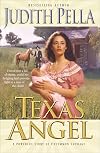
Once the dangerous secret comes out that Elise, a young mother, has Negro blood, it spells the end of her marriage—and the beginning of her enslavement. A minister's compassionate wife may be able to provide some urgent help for Elise, but it'll mean facing the fire and brimstone of the minister, Benjamin, who's determined to convert the lawless sinners of Texas in Texas Angel by author Judith Pella.
Some time ago, I read and enjoyed The Russians series, a sweeping historical saga by this show more ChristFic author, even though I had some issues concerning the style. So when it came to this historical Western novel, I wasn't surprised by the occasional overuse of exclamation points, some overdramatic depictions of the main characters, and an overdone villain.
On a different note, I expected I'd probably be somewhat uncomfortable with the handling of race in this book, but I was curious to see how that aspect of the plot would play out.
On at least two different occasions, certain characters speak almost as if they (and Jesus) are there for Elise in spite of the fact that she's part Black. Of course, being a person of color isn't an offense or an inadequacy, something that Christian grace must overlook. While it unfortunately wouldn't be unrealistic for the white characters in this setting to see Elise's mixed race as a flaw, the story doesn't make it clear that they'd be wrong to see her that way.
Later on, Benjamin reflects on how God's love is simple enough for the "savage Indian[s]" in the story, and he doesn't grow past using the "savage" label in his thoughts regarding the indigenous people.
Moreover, because I recently learned this publisher used to allow the N-word to appear in their novels (I'm assuming they don't anymore?), I wasn't caught off guard by the few racial slurs in this book, which was published in the 1990s. Still, I don't believe everyone fully grasps the magnitude of what comes with words like that and what it means for a diverse audience when authors include slurs as strong as the N-word in fiction. I'm in no way saying that no racial epithets should appear in any art or literature anywhere, but for certain books, it's just unnecessary as well as an inappropriate choice, especially from publishers that aren't known for publishing many diverse authors of fiction who'd bring their own cultural perspectives and the experience of their own race.
Now, concerning all that Elise suffers in slavery: Although her feelings of shame and guilt are all too common for abuse victims, the abuse isn't something that victims need to apologize or be forgiven for, or to be accepted and loved in spite of. The story doesn't make it 100% clear that Elise isn't at all at fault for what her abusers have done to her and what they've forced her into.
Aside from that, I struggled with the love story. One look at the book cover's beautiful artwork let me know where the plot would eventually go, but when one character or another thinks, believes, and behaves in downright awful ways for half or more of a novel, I tend not to feel great about that character as a romantic hero or heroine. Also, I'm all for a fictional couple's embraces and kisses when they're passionate and respectful and the moments feel earned. But this love story had an icky feel to me, largely because the broken hero acts on his libido in a broken way on more than one occasion, bursting into insensitive and desperate physical "affection" that doesn't honor the heroine.
Anyhow. I felt compelled to address all of this because of the overall journey I'm taking with Christian Fiction (a genre that's changing) and because of the social climate we're living in, where we need to tackle some critical issues with open honesty. Nonetheless, this historical fiction lover ultimately enjoyed working through some thoughts and emotions with the help of this interesting story, and I fully intend to read the sequel that features a different main character. show less
Some time ago, I read and enjoyed The Russians series, a sweeping historical saga by this show more ChristFic author, even though I had some issues concerning the style. So when it came to this historical Western novel, I wasn't surprised by the occasional overuse of exclamation points, some overdramatic depictions of the main characters, and an overdone villain.
On a different note, I expected I'd probably be somewhat uncomfortable with the handling of race in this book, but I was curious to see how that aspect of the plot would play out.
On at least two different occasions, certain characters speak almost as if they (and Jesus) are there for Elise in spite of the fact that she's part Black. Of course, being a person of color isn't an offense or an inadequacy, something that Christian grace must overlook. While it unfortunately wouldn't be unrealistic for the white characters in this setting to see Elise's mixed race as a flaw, the story doesn't make it clear that they'd be wrong to see her that way.
Later on, Benjamin reflects on how God's love is simple enough for the "savage Indian[s]" in the story, and he doesn't grow past using the "savage" label in his thoughts regarding the indigenous people.
Moreover, because I recently learned this publisher used to allow the N-word to appear in their novels (I'm assuming they don't anymore?), I wasn't caught off guard by the few racial slurs in this book, which was published in the 1990s. Still, I don't believe everyone fully grasps the magnitude of what comes with words like that and what it means for a diverse audience when authors include slurs as strong as the N-word in fiction. I'm in no way saying that no racial epithets should appear in any art or literature anywhere, but for certain books, it's just unnecessary as well as an inappropriate choice, especially from publishers that aren't known for publishing many diverse authors of fiction who'd bring their own cultural perspectives and the experience of their own race.
Now, concerning all that Elise suffers in slavery: Although her feelings of shame and guilt are all too common for abuse victims, the abuse isn't something that victims need to apologize or be forgiven for, or to be accepted and loved in spite of. The story doesn't make it 100% clear that Elise isn't at all at fault for what her abusers have done to her and what they've forced her into.
Aside from that, I struggled with the love story. One look at the book cover's beautiful artwork let me know where the plot would eventually go, but when one character or another thinks, believes, and behaves in downright awful ways for half or more of a novel, I tend not to feel great about that character as a romantic hero or heroine. Also, I'm all for a fictional couple's embraces and kisses when they're passionate and respectful and the moments feel earned. But this love story had an icky feel to me, largely because the broken hero acts on his libido in a broken way on more than one occasion, bursting into insensitive and desperate physical "affection" that doesn't honor the heroine.
Anyhow. I felt compelled to address all of this because of the overall journey I'm taking with Christian Fiction (a genre that's changing) and because of the social climate we're living in, where we need to tackle some critical issues with open honesty. Nonetheless, this historical fiction lover ultimately enjoyed working through some thoughts and emotions with the help of this interesting story, and I fully intend to read the sequel that features a different main character. show less
Prince Sergei returns from war in the Balkans to St. Petersburg, jaded, restless, and perplexed about life and his place in it. He can make no immediate plans about a possible future with Anna, the peasant woman he loves. And Anna's disillusioned and grieved brother, Paul, is heading down the precarious path of an angry revolutionary in A House Divided by authors Michael Phillips and Judith Pella.
In my review of the first book in this series, I mentioned that the landscape is ripe for show more revolution. This second book agrees with me.
It wasn't long before I became thoroughly absorbed in the novel. The politics, the intrigue, the corruption, the forging of relationships and alliances, the heightening rumble of unrest and the blasts of violence—so much happening for this longtime lover of historical fiction to take in.
Yet, as with the previous book, there were many places where this novel's style got to me. The narrator sometimes spells out too much, leaving no room for nuance or trust in the reader's perception. The overabundance of italics and exclamation points makes for narration that seems to be shouting when there's no need, and it gives the dialogue an overdramatic feel, making the characters harder to take seriously.
Katrina and Anna (among other characters, though not all of them) usually feel more like stereotypical caricatures than real people. On account of the awkward and sometimes rushed romantic development, I couldn't find any of the romance satisfying. At this point in the series, I'm more interested in the events than I'm really into most of the characters those events involve.
Maybe someone present or yet to appear in the series will eventually grow on me though, as I do plan to read at least one more of these novels. The up-close unfolding of the historical side of it all has me hooked. show less
In my review of the first book in this series, I mentioned that the landscape is ripe for show more revolution. This second book agrees with me.
It wasn't long before I became thoroughly absorbed in the novel. The politics, the intrigue, the corruption, the forging of relationships and alliances, the heightening rumble of unrest and the blasts of violence—so much happening for this longtime lover of historical fiction to take in.
Yet, as with the previous book, there were many places where this novel's style got to me. The narrator sometimes spells out too much, leaving no room for nuance or trust in the reader's perception. The overabundance of italics and exclamation points makes for narration that seems to be shouting when there's no need, and it gives the dialogue an overdramatic feel, making the characters harder to take seriously.
Katrina and Anna (among other characters, though not all of them) usually feel more like stereotypical caricatures than real people. On account of the awkward and sometimes rushed romantic development, I couldn't find any of the romance satisfying. At this point in the series, I'm more interested in the events than I'm really into most of the characters those events involve.
Maybe someone present or yet to appear in the series will eventually grow on me though, as I do plan to read at least one more of these novels. The up-close unfolding of the historical side of it all has me hooked. show less
Lists
Awards

You May Also Like


Associated Authors
Statistics
- Works
- 73
- Also by
- 4
- Members
- 13,030
- Popularity
- #1,787
- Rating
- 4.1
- Reviews
- 129
- ISBNs
- 284
- Languages
- 6
- Favorited
- 6