
Richard Hough (1922–1999)
Author of Captain James Cook
About the Author
Works by Richard Hough
The great dreadnought; the strange story of H. M. S. Agincourt, the mightiest battleship of World War I (2003) 22 copies, 1 review
Verona Campione: The Miracle of 85 2 copies
De avontuurlijke ballontocht 1 copy
La Flotta Suicida. 1 copy
Associated Works
Advice to my grand-daughter: Letters from Queen Victoria to Princess Victoria of Hesse (1975) — Editor — 50 copies
MHQ: The Quarterly Journal of Military History — Summer 1990 (1990) — Co-Author "The Fury of Eagle Day" — 18 copies
Reader's Digest Condensed Books: The Terminal Man • Captain Bligh and Mr. Christian • The Sunbird • A Falcon for a Queen (1973) 6 copies
Tagged
Common Knowledge
- Legal name
- Hough, Richard Alexander
- Other names
- Carter, Bruce
Churchill, Elizabeth
Strong, Pat - Birthdate
- 1922-05-15
- Date of death
- 1999-10-07
- Gender
- male
- Education
- Frensham Heights School, Surrey, England, UK
- Occupations
- maritime historian
journalist - Organizations
- Royal Air Force (WWII)
Garrick Club, London, England, UK - Relationships
- Garland, Sarah (daughter)
Moggach, Deborah (daughter)
Hough, Charlotte (wife) - Nationality
- England
UK - Birthplace
- Brighton, Sussex, England, UK
- Places of residence
- London, England, UK
Gloucestershire, England, UK - Place of death
- London, England
- Map Location
- England
Members
Reviews
It took a very big scandal to produce this very small book.
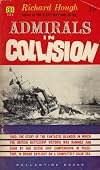
In 1893, Vice Admiral George Tryon commanded the British fleet in the Mediterranean. That summer, during a series of maneuvers, he issued an order to the fleet which resulted in his flagship, the Victoria, being hit and sunk by the Camperdown, the flagship of his second-in-command. In addition to destroying a new, expensive ship, the collision cost the lives of about 350 of her crew.
Why? That was the issue that consumed the Royal show more Navy that summer. Why had Tryon issued an order that almost inevitably led to the collision of his two biggest ships -- which, indeed, potentially would have led to every other pair of ships in the two parallel lines of ships colliding.
No one knows the answer, because Tryon was one of those who died in the wreck. The inquiry and trial of the ship's captain couldn't figure out much, either; all it could do was honorably acquit Captain Bourke and cast a very jaundiced eye on Admiral Markham, the second-in-command who had allowed the Camperdown to sail on her collision course.
This book sets out the bare facts fairly well, but I couldn't help but wish it had told us more. For instance, a plan and detailed description of Victoria would have been nice. Instead, we get descriptions of her big guns -- but nothing about her secondary armaments, the construction of her watertight compartments, her seakeeping characteristics. We get descriptions of Admirals Tryon and Markham (the former much more favorable than the latter -- given that his subordinates seem frankly to have feared Tryon, I wonder if the description isn't overly flattering), but little about what it meant to lead a late nineteenth century fleet, or what the role of the Royal Navy was in the Mediterranean. Author Hough admits that he is left with a puzzle he can't solve. I'm sure he's right, but I wish he'd given me a few more pieces than this thin little 144-page un-indexed volume allows.
[Correction 8/3/2020: changed "un-indeed" in the last sentence to "un-indexed."] show less
In 1893, Vice Admiral George Tryon commanded the British fleet in the Mediterranean. That summer, during a series of maneuvers, he issued an order to the fleet which resulted in his flagship, the Victoria, being hit and sunk by the Camperdown, the flagship of his second-in-command. In addition to destroying a new, expensive ship, the collision cost the lives of about 350 of her crew.
Why? That was the issue that consumed the Royal show more Navy that summer. Why had Tryon issued an order that almost inevitably led to the collision of his two biggest ships -- which, indeed, potentially would have led to every other pair of ships in the two parallel lines of ships colliding.
No one knows the answer, because Tryon was one of those who died in the wreck. The inquiry and trial of the ship's captain couldn't figure out much, either; all it could do was honorably acquit Captain Bourke and cast a very jaundiced eye on Admiral Markham, the second-in-command who had allowed the Camperdown to sail on her collision course.
This book sets out the bare facts fairly well, but I couldn't help but wish it had told us more. For instance, a plan and detailed description of Victoria would have been nice. Instead, we get descriptions of her big guns -- but nothing about her secondary armaments, the construction of her watertight compartments, her seakeeping characteristics. We get descriptions of Admirals Tryon and Markham (the former much more favorable than the latter -- given that his subordinates seem frankly to have feared Tryon, I wonder if the description isn't overly flattering), but little about what it meant to lead a late nineteenth century fleet, or what the role of the Royal Navy was in the Mediterranean. Author Hough admits that he is left with a puzzle he can't solve. I'm sure he's right, but I wish he'd given me a few more pieces than this thin little 144-page un-indexed volume allows.
[Correction 8/3/2020: changed "un-indeed" in the last sentence to "un-indexed."] show less

The title of Richard Hough's book promises more than it delivers, for instead of providing a comprehensive coverage of the naval campaigns of the First World War he offers a study focused on the arms race involving dreadnought construction and the stalemated confrontation between the British Grand Fleet and the German High Seas Fleet between the start of the war and the battle of Jutland. While Hough's focus is understandable, it comes at slighting the myriad other aspects of the naval war: show more of the sixteen chapters, only five do not address either one of these two relatively narrow aspects of the war at sea. Yet Hough is an able writer who provides a gripping account of such events as the pursuit of Germany's Pacific Squadron or the battle of Jutland. Readers seeking an entertaining account of the naval war will not be disappointed by this book, though those desiring a more comprehensive analysis would be better served turning to Paul Halpern's superb [b:A Naval History of World War I|16720656|A Naval History of World War I|Paul G. Halpern|https://images.gr-assets.com/books/1386587161s/16720656.jpg|1607472]. show less

As a layman without a strong background in history, and no background in 18th century nautical terminology, I found this a fascinating and readable book. Had to skip to a dictionary or atlas from time to time to keep straight what was going on, but Hough's writing style is accessible without ever being simplistic.
Cook was an interesting man, ahead of his time in many ways. The bulk of the book details his three voyages in which he served as captain and commander. The first voyage, main show more purpose to complete an astronomical observation that the Royal Society wanted done on a certain day in a certain spot on earth. The second voyage was primarily to discover the rumored great southern continent. The third voyage, to discover the also rumored Northwest Passage.
For the first 2 voyages, Cook was constantly on top of his game and never lost sight of the mission. He was humane, both with his crew and with natives on the various islands that were discovered or visited. He was loved and respected by his officers and crew.
Something happenend to Cook which affected him mentally, and on his third voyage he frequently seemed to lose sight of the mission, have erratic and inexplicable explosions of temper, which were sometimes taken out on his crew, and more frequently on the natives that he had been so respectful of on earlier trips.
His questionable actions cost him his life on his third voyage, where after first being welcomed on the Hawaiian Islands as a god, he was in the end brutally murdered by these same natives. show less
Cook was an interesting man, ahead of his time in many ways. The bulk of the book details his three voyages in which he served as captain and commander. The first voyage, main show more purpose to complete an astronomical observation that the Royal Society wanted done on a certain day in a certain spot on earth. The second voyage was primarily to discover the rumored great southern continent. The third voyage, to discover the also rumored Northwest Passage.
For the first 2 voyages, Cook was constantly on top of his game and never lost sight of the mission. He was humane, both with his crew and with natives on the various islands that were discovered or visited. He was loved and respected by his officers and crew.
Something happenend to Cook which affected him mentally, and on his third voyage he frequently seemed to lose sight of the mission, have erratic and inexplicable explosions of temper, which were sometimes taken out on his crew, and more frequently on the natives that he had been so respectful of on earlier trips.
His questionable actions cost him his life on his third voyage, where after first being welcomed on the Hawaiian Islands as a god, he was in the end brutally murdered by these same natives. show less

A readable account, sharing a good deal of inflammation and slant with with the later film "the Bounty". A pretty good set of character studies, and it succeeds in humanizing Bligh. It gets points for that, in my opinion.
Lists
You May Also Like


Associated Authors
Statistics
- Works
- 98
- Also by
- 8
- Members
- 2,980
- Popularity
- #8,558
- Rating
- 3.7
- Reviews
- 42
- ISBNs
- 226
- Languages
- 9
- Favorited
- 2