
Shan Sa
Author of The Girl Who Played Go
About the Author
Image credit: Europe & Me
Works by Shan Sa
Tagged
Common Knowledge
- Canonical name
- Shan Sa
- Legal name
- 阎妮 (Yan Ni)
- Other names
- Shan Sa
山飒 (Shan sa)
阎妮 (Yan Ni)
Yan Ni Ni - Birthdate
- 1972-10-26
- Gender
- female
- Education
- Beijing Second Experimental Primary School (北京市海淀区东升小学), Beijing, China
Middle School attached to North-East Normal University (东北师大附中学), Changchun, Jilin, China
High School Affiliated to Peking University (北京大学附属中学), Beijing, China
École Alsacienne, Paris, France
Sorbonne University, Paris, France - Occupations
- painter
secretary - Organizations
- Académie française
- Awards and honors
- Prix Cazes-Brasserie Lipp (1999)
Kiriyama Prize for fiction (2004) - Relationships
- Yan Chunde [阎纯德] (father)
- Short biography
- Shan Sa is the pseudonym of Yan Ni , a French author and painter. The Girl Who Played Go was the first of her novels to be published outside of France, and won the Prix Goncourt des Lycéens . Her second novel to appear in English translation was Empress . Shan Sa is also a painter with exhibitions in Paris and New York. Shan Sa was born as Yan Ni in Beijing, China to a scholarly family. She adopted the pseudonym Shan Sa from a poem by the Tang Dynasty poet Bai Juyi. At age 8, she published her first poetry collection, and went on to obtain the first prize in the national poetry contest for children under 12 years, an event that created a public upheaval. After graduating from secondary school in Beijing, she moved to Paris in August 1990 thanks to a grant by the French government. Settling there with her father, a professor at the Sorbonne University, she quickly adopted the French language. In 1994, she finished her studies of philosophy. From 1994 to 1996 she worked as a secretary of painter Balthus.
- Nationality
- China (birth)
France - Birthplace
- Beijing, China
- Places of residence
- Beijing, China
Changchun, Jilin Province, China
Paris, France - Map Location
- France
Members
Reviews
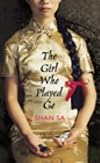
The Girl Who Played Go by Shan Sa is deceptively simple book about two people - a Chinese girl in Manchuria who excels at the game of go and a Japanese officer sent to Manchuria en route to the frontline in China, and how their lives cross and are changed.
Just as in a game of go, the two players do not interact much as first; Shan Sa deftly and poetically portrays the two characters individual lives. As time goes on, the two draw inexorably closer and moves are played faster, as the climax show more of the game and of the story rapidly approaches. From the book's halfway point, the two plots become more and more intertwined and what began as a light-hearted game soon becomes cruel and tragic.
Shan Sa's writing style is simple yet elegant and she manages to portray the lives of both Japanese and Chinese in Manchuria well. Using the game of go as a metaphor, she is able to explore the choices people make in life and the effects they have: Go imitates life, life imitates go. show less
Just as in a game of go, the two players do not interact much as first; Shan Sa deftly and poetically portrays the two characters individual lives. As time goes on, the two draw inexorably closer and moves are played faster, as the climax show more of the game and of the story rapidly approaches. From the book's halfway point, the two plots become more and more intertwined and what began as a light-hearted game soon becomes cruel and tragic.
Shan Sa's writing style is simple yet elegant and she manages to portray the lives of both Japanese and Chinese in Manchuria well. Using the game of go as a metaphor, she is able to explore the choices people make in life and the effects they have: Go imitates life, life imitates go. show less
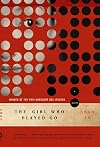
La joueuse de go is an historical novel, set in Manchuria during the Japanese occupation in the 1930s, although it obviously also draws obliquely on the author's experience as a young woman growing up in Beijing around the time of the Tiananmen Square protests of 1989. The book uses the "alternating chapters" structure, with the odd-numbered chapters (the black moves) being given to a sixteen-year-old Chinese girl, and the even ones (the white moves) to a lieutenant in the Japanese army of show more occupation. As we would expect, the two meet over a go board, but this only happens about halfway through the book, and even then they scarcely talk apart from the few phrases they need to exchange in the course of the game. By then the author has established both their characters: the girl is tough on the outside, but very much an adolescent, more in love with the idea of growing up than with the young radicals who draw her into the fringes of the communist underground; the officer is a creature of acute, if rather conservative, aesthetic sensibilities, following a career that involves dealing out violence and death (and frequenting prostitutes) because of his sense of duty to his family and his emperor, but obviously - as he dimly starts to realise himself - someone who would have been far happier as a poet or a watercolorist. We know this isn't going to end well, but it's a great pleasure to watch the elegant way in which Shan Sa manoeuvres her two narrators around within the frameworks of their respective cultures to get them to the point where she wants them.
Basically it's Romeo and Juliet with lashings of what we used to call "oriental subtlety", so you probably shouldn't take it too seriously, but there's a great deal to enjoy in the style and execution, which are for the most part absolutely spot on.
Fun fact: like Gilbert & Sullivan's The Mikado, this book is claimed to have been inspired by a chance encounter with an antique Japanese sword in a market. ("Un sabre japonais était exposé. On m'a dit qu'il datait du XVIIe siècle. Personne ne s'attendait à ce que je le dégaine. J'ai tiré cette lame incandescente et tout d'un coup, j'avais l'impression de tenir la mort entre mes mains...") show less
Basically it's Romeo and Juliet with lashings of what we used to call "oriental subtlety", so you probably shouldn't take it too seriously, but there's a great deal to enjoy in the style and execution, which are for the most part absolutely spot on.
Fun fact: like Gilbert & Sullivan's The Mikado, this book is claimed to have been inspired by a chance encounter with an antique Japanese sword in a market. ("Un sabre japonais était exposé. On m'a dit qu'il datait du XVIIe siècle. Personne ne s'attendait à ce que je le dégaine. J'ai tiré cette lame incandescente et tout d'un coup, j'avais l'impression de tenir la mort entre mes mains...") show less
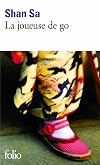
Un peu tiré par les cheveux dans les péripéties et rencontres, un peu gavé de métaphores de poête-pouet-pouet - peut-être pas toutes les phrases, mais pas loin, ce livre reste très agréable à lire, et les personnages intéressants à suivre - je suppose que le "je" y aide, même si l'auteur "triche" un peu parfois, laissant penser que les narrateurs sont comme des livres ouverts (si j'ose dire) pour le lecteur, pour finalement nous révéler des actes et pensées quand même un peu show more importants pour le récit.
Mais je pardonne, car vraiment j'ai apprécié lire ce récit à deux voix, au rythme maîtrisé, aux enchaînements qui fonctionnent très bien, à l'ambiance balançant entre la mélancolie et la franche déprime, qui plus est dans un contexte historique que je ne conaissais que très peu, et même si ce n'est pas un roman historique, ça éclaire un peu. show less
Mais je pardonne, car vraiment j'ai apprécié lire ce récit à deux voix, au rythme maîtrisé, aux enchaînements qui fonctionnent très bien, à l'ambiance balançant entre la mélancolie et la franche déprime, qui plus est dans un contexte historique que je ne conaissais que très peu, et même si ce n'est pas un roman historique, ça éclaire un peu. show less
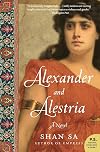
I read this book determined to understand where Shan Sa came from in her literary career. I think that this is less a work of historical fiction than it is a study of gender issues set within an historical, fantastical context. I believe that if you go into the book with the understanding that it is more about feminine and masculine forms of power and how those may have been used differently between the sexes throughout history, and if you keep an open mind, you will have a much better time show more with this book. show less
Lists
Awards


You May Also Like


Associated Authors
Statistics
- Works
- 15
- Members
- 2,061
- Popularity
- #12,476
- Rating
- 3.5
- Reviews
- 64
- ISBNs
- 91
- Languages
- 17
- Favorited
- 3