

Hsun Tzu
Author of Hsun Tzu: Basic Writings
About the Author
Works by Hsun Tzu
Hemel en aarde verenigen zich door rituelen een bloemlezing uit het werk van de Chinese wijsgeer Xunzi (2003) 5 copies
Xunzi jianzhu 荀子 1 copy
The works of Hsüntze 1 copy
Basic writings 1 copy
荀子简释 1 copy
Tagged
Common Knowledge
- Legal name
- 荀子
- Birthdate
- 4th c. BCE
- Date of death
- 4th c. BCE
- Gender
- male
- Occupations
- philosopher
- Nationality
- China
- Associated Place (for map)
- China
Members
Reviews

Hsun Tzu has some great zingers (e.g., the one about the wise man trapping learning in his mind, while the petty man sprews his learning forth), but ultimately his thinking boils down to two points:
1. Man is inherently bad (incompetent, evil, lazy, impulsive, ineffective ... take your pick) and only training and ritual can tun him into something good
2. A True Leader who perfectly follows Ritual and Principle will never have any problems - nobody will attack him, his people will love him, show more there will always be enough food and money
The first is either trivially true or obviously false, depending on whether you believe children are a) beasts or b) perfect beings who are degraded over time as innocence is replaced by experience.
The second is absolute hogwash. show less
1. Man is inherently bad (incompetent, evil, lazy, impulsive, ineffective ... take your pick) and only training and ritual can tun him into something good
2. A True Leader who perfectly follows Ritual and Principle will never have any problems - nobody will attack him, his people will love him, show more there will always be enough food and money
The first is either trivially true or obviously false, depending on whether you believe children are a) beasts or b) perfect beings who are degraded over time as innocence is replaced by experience.
The second is absolute hogwash. show less
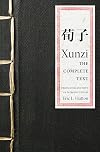
One of the three great Confucian philosophers of the classical period in China. Xunzi elaborated and systematized the work undertaken by Confucius and Mencius, giving a cohesiveness, comprehensiveness, and direction to Confucian thought that was all the more compelling for the rigor with which he set it forth; and the strength he thereby gave to that philosophy has been largely responsible for its continuance as a living tradition for over 2,000 years. Many of his diverse intellectual show more achievements came to be obscured as later Confucians focused on the misanthropic view attributed to him that human nature is basically ugly or evil.
Xunzi’s importance in the development of Confucian philosophy rests on the historical influence of his major work, known today as the Xunzi. This book comprises 32 chapters, or essays, and is regarded as being in large part from his own hand, uncorrupted by later emendations or forgeries. The Xunzi essays are a milestone in the development of Chinese philosophy. The anecdotal and epigrammatic style that had characterized earlier philosophical literature—i.e., the Analects, Tao-te Ching, Mencius, Zhuangzi—no longer sufficed to convey fully and persuasively the complex philosophical disputes of Xunzi’s day. Xunzi was the first great Confucian philosopher to express his ideas not merely by means of the sayings and conversations recorded by disciples but also in the form of well-organized essays written by himself. In his book he introduced a more rigorous writing style that emphasized topical development, sustained reasoning, detail, and clarity.
Xunzi’s view of human nature was, of course, radically opposed to that of Mencius, who had optimistically proclaimed the innate goodness of man. Both thinkers agreed that all men are potentially capable of becoming sages, but for Mencius this meant that every man has it within his power to develop further the shoots of goodness already present at birth, whereas for Xunzi it meant that every man can learn from society how to overcome his initially antisocial impulses. Thus began what became one of the major controversies in Confucian thought.
The difference between Mencius and Xunzi is metaphysical as well as ethical. Tian (heaven) for Mencius, though not an anthropomorphic deity, constituted an all-embracing ethical power; therefore it is inevitable that man’s nature should be good, since he receives it from heaven at birth. For Xunzi, on the other hand, tian embodied no ethical principle and was simply the name for the functioning activities of the universe (somewhat like our word Nature). These activities he conceived of naturalistically and almost mechanistically. Moral standards, therefore, have no metaphysical justification but are man-made creations.
One may ask how, if man is born “evil” (by which Xunzi really meant uncivilized), it is possible for him to create the higher values of civilization. In the essay “A Discussion of Ritual,” Xunzi attempts to answer this question and in the process elaborates the concept central to his entire philosophy. Xunzi asserts that man differs from other creatures in one vital respect: besides his instinctual drives, he also possesses an intelligence which enables him to form cooperative social organizations. Hence the sages, realizing that man cannot well survive in a state of anarchy, used this intelligence to formulate the social distinctions and rules of social behavior which would check the encroachments of one individual upon another and thereby ensure sufficiency for all. Xunzi thus presents a believable utilitarian explanation for the creation of social institutions. show less
Xunzi’s importance in the development of Confucian philosophy rests on the historical influence of his major work, known today as the Xunzi. This book comprises 32 chapters, or essays, and is regarded as being in large part from his own hand, uncorrupted by later emendations or forgeries. The Xunzi essays are a milestone in the development of Chinese philosophy. The anecdotal and epigrammatic style that had characterized earlier philosophical literature—i.e., the Analects, Tao-te Ching, Mencius, Zhuangzi—no longer sufficed to convey fully and persuasively the complex philosophical disputes of Xunzi’s day. Xunzi was the first great Confucian philosopher to express his ideas not merely by means of the sayings and conversations recorded by disciples but also in the form of well-organized essays written by himself. In his book he introduced a more rigorous writing style that emphasized topical development, sustained reasoning, detail, and clarity.
Xunzi’s view of human nature was, of course, radically opposed to that of Mencius, who had optimistically proclaimed the innate goodness of man. Both thinkers agreed that all men are potentially capable of becoming sages, but for Mencius this meant that every man has it within his power to develop further the shoots of goodness already present at birth, whereas for Xunzi it meant that every man can learn from society how to overcome his initially antisocial impulses. Thus began what became one of the major controversies in Confucian thought.
The difference between Mencius and Xunzi is metaphysical as well as ethical. Tian (heaven) for Mencius, though not an anthropomorphic deity, constituted an all-embracing ethical power; therefore it is inevitable that man’s nature should be good, since he receives it from heaven at birth. For Xunzi, on the other hand, tian embodied no ethical principle and was simply the name for the functioning activities of the universe (somewhat like our word Nature). These activities he conceived of naturalistically and almost mechanistically. Moral standards, therefore, have no metaphysical justification but are man-made creations.
One may ask how, if man is born “evil” (by which Xunzi really meant uncivilized), it is possible for him to create the higher values of civilization. In the essay “A Discussion of Ritual,” Xunzi attempts to answer this question and in the process elaborates the concept central to his entire philosophy. Xunzi asserts that man differs from other creatures in one vital respect: besides his instinctual drives, he also possesses an intelligence which enables him to form cooperative social organizations. Hence the sages, realizing that man cannot well survive in a state of anarchy, used this intelligence to formulate the social distinctions and rules of social behavior which would check the encroachments of one individual upon another and thereby ensure sufficiency for all. Xunzi thus presents a believable utilitarian explanation for the creation of social institutions. show less
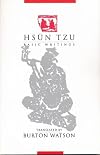
Interesting as representing the more pessimistic and severe side of Confucianism, in contrast to the gentler Mencius. H. is less popular but probably represents a lot of the grimmer side of
Confucianism in practice.
Confucianism in practice.
Once again Burton Watson provides an insight into pre-Classical Chinese philosophy, this time translating a selection of the Xunzi by Xun Zi (Hsün Tzu): a Confucian but not like Mencius or Confucius, rather a more reasoned and rigorous thinker who wrote essays as opposed to the monologues given by Mencius or the aphorisms given by Confucius.
Xun Zi stands out among Confucians for his believe that "man's nature is wayward" and inclined to evil, unlike his predecessors who believed in man's show more inherent goodness.
Watson provides both historical and philosophical context to the Xunzi, and his translations reads well. A useful book for students and those interested in less well-known currents of Classical Chinese philosophy. show less
Xun Zi stands out among Confucians for his believe that "man's nature is wayward" and inclined to evil, unlike his predecessors who believed in man's show more inherent goodness.
Watson provides both historical and philosophical context to the Xunzi, and his translations reads well. A useful book for students and those interested in less well-known currents of Classical Chinese philosophy. show less
You May Also Like


Associated Authors
Statistics
- Works
- 16
- Members
- 314
- Popularity
- #75,176
- Rating
- 3.6
- Reviews
- 4
- ISBNs
- 16
- Languages
- 5
- Favorited
- 2