
Gaston Dorren
Author of Lingo
About the Author
Works by Gaston Dorren
Tagged
Common Knowledge
- Birthdate
- 1965
- Gender
- male
- Occupations
- linguist
journalist
author - Short biography
- Gaston Dorren is a linguist, journalist and polyglot. He speaks Dutch, Limburgish, English, German, French and Spanish, and reads Afrikaans, Frisian, Portugese, Italian, Catalan, Danish, Norwegian, Swedish and Luxembourgish. He's the author of 2 books in Dutch - Nieuwe Tongen (New Tongues) on the language of migrants and Taaltoerisme (Language Tourism) on which Lingo is based - and an app, the Language Lover's Guide to Europe. When not writing he likes to perform songs - in several languages of course.
- Nationality
- Netherlands
- Birthplace
- Netherlands
- Places of residence
- Amersfoort, Netherlands
- Associated Place (for map)
- Amersfoort, Netherlands
Members
Reviews
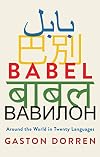
A truly fascinating look at the 20 most-spoken languages in the world, Babel is freewheeling, casual, and discursive, but not dumbed down or shallow—the kind of book Simon Garfield should be aiming for. The author is fluent in six languages and reads nine more. Because English is a learned language for him—his mother tongue is Limburgish, of all things, and I wish the format of the book had let him talk about that!—he has a perspective on it that I haven't encountered in books about show more language written by native speakers.
Each chapter examines a single language, or more precisely, examines either the linguistic features or the social history of the language's home culture. The close relation between some of the featured languages mean that not every chapter is actually about the language: there's not enough that's unique about Portuguese to fill a chapter in a book that also discusses Spanish, so the chapter on Portuguese is mostly about how languages spread through colonization. As a language geek--and who else would pick up this book--I would have preferred that the chapter discuss the variations in the several languages of the Iberian peninsula, and how only two became associated with political power. But that's just me. And there's certainly enough geeky linguistic detail (about cases, Japanese "women's language," and the importance of social status in Javanese speech, for example) to keep me happy.
Dorren refers to other rarefied books that I'm familiar with (The World's Writing Systems, edited by Daniels and Bright, and The Turkish Language Reform: a Catastrophic Success by Geoffrey Lewis), so he and I are of like mind. Perhaps because I find him so perceptive and discerning, I don't mind the liberties he takes, such as applying judgmental adjectives to certain language features or a slight tendency to glibness. Don't let me scare you: this is actually an easy read! The chapters are short and interesting, with much to learn on each page, and if you want to skip over the seven-page "dictionary" of Arabic roots or the chapter on Bengali (not that different from Hindi, from the perspective of one who is unlikely ever to learn either), it won't hurt a thing. This is also a fun book just to dip into. show less
Each chapter examines a single language, or more precisely, examines either the linguistic features or the social history of the language's home culture. The close relation between some of the featured languages mean that not every chapter is actually about the language: there's not enough that's unique about Portuguese to fill a chapter in a book that also discusses Spanish, so the chapter on Portuguese is mostly about how languages spread through colonization. As a language geek--and who else would pick up this book--I would have preferred that the chapter discuss the variations in the several languages of the Iberian peninsula, and how only two became associated with political power. But that's just me. And there's certainly enough geeky linguistic detail (about cases, Japanese "women's language," and the importance of social status in Javanese speech, for example) to keep me happy.
Dorren refers to other rarefied books that I'm familiar with (The World's Writing Systems, edited by Daniels and Bright, and The Turkish Language Reform: a Catastrophic Success by Geoffrey Lewis), so he and I are of like mind. Perhaps because I find him so perceptive and discerning, I don't mind the liberties he takes, such as applying judgmental adjectives to certain language features or a slight tendency to glibness. Don't let me scare you: this is actually an easy read! The chapters are short and interesting, with much to learn on each page, and if you want to skip over the seven-page "dictionary" of Arabic roots or the chapter on Bengali (not that different from Hindi, from the perspective of one who is unlikely ever to learn either), it won't hurt a thing. This is also a fun book just to dip into. show less
De-accessioned and bookcrossed July 2017
(29 December 2015)
Purporting to be a romp (OK, an “intriguing tour”) through the main and minor languages of Europe, this translated book is a bit of an oddity. It’s often simultaneously two detailed and not detailed enough, going into linguistic subtleties but then laughing at linguists, and then skating across whole languages and only giving them a paragraph at the end of their own chapter.
Then there were some big problems. It made a little show more more sense when I realised on reading the Acknowledgements that the author is Dutch and the book has been translated, because it’s a well-known fact that humour is practically untranslatable, but the chapter on Belarus(s)ian, made up of two invented addresses from the different sides of the dispute about which form of the language to adopt seemed in very poor taste, inflammatory and at best misguided. This was followed by a chapter on Luxembourgish written in the form of a fable, which was confusing and never actually explained which languages the author was talking about. Then there was a section later very carefully explaining how to read the Cyrillic alphabet based on the Greek, which even I, someone who likes an alphabet, skimmed.
There were good bits, and a nice pairing of a loan word plus a not-directly-translatable word that would be useful to have in English at the end of this chapter, but this was a bit patchy and in places downright uncomfortable. show less
(29 December 2015)
Purporting to be a romp (OK, an “intriguing tour”) through the main and minor languages of Europe, this translated book is a bit of an oddity. It’s often simultaneously two detailed and not detailed enough, going into linguistic subtleties but then laughing at linguists, and then skating across whole languages and only giving them a paragraph at the end of their own chapter.
Then there were some big problems. It made a little show more more sense when I realised on reading the Acknowledgements that the author is Dutch and the book has been translated, because it’s a well-known fact that humour is practically untranslatable, but the chapter on Belarus(s)ian, made up of two invented addresses from the different sides of the dispute about which form of the language to adopt seemed in very poor taste, inflammatory and at best misguided. This was followed by a chapter on Luxembourgish written in the form of a fable, which was confusing and never actually explained which languages the author was talking about. Then there was a section later very carefully explaining how to read the Cyrillic alphabet based on the Greek, which even I, someone who likes an alphabet, skimmed.
There were good bits, and a nice pairing of a loan word plus a not-directly-translatable word that would be useful to have in English at the end of this chapter, but this was a bit patchy and in places downright uncomfortable. show less
In sixty brief chapters, Gaston Dorren's Lingo takes readers on a whirlwind tour of European languages, from the "big five" Romance languages (Spanish, French, Italian, Portuguese and Romanian), to more obscure tongues such as Slovene, Manx, and Gagauz.
The book is intended to be breezy, anecdotal and entertaining. Some chapters, such as the one on the extinction of the Dalmatian language, shine, but others fall flat. For example, the chapter on Ossetian, the so-called "tenth branch" on the show more Indo-European language family tree, is a mere four paragraphs long and gives readers very little idea what the language is like.
Moreover, in the chapter comparing English and Chinese, Dorren sets up a straw man argument that English became a world language because it is "simpler" than languages with gendered nouns, declensions, and mutations (a component of Welsh). Even though it lacks these features, English, with its weird spelling and pronunciation, is by no means simple, and I don't think anyone out there thinks English became an international language because of its own characteristics.
If you enjoy reading about languages, you may find this book worth picking up. Just don't expect too much from it. show less
The book is intended to be breezy, anecdotal and entertaining. Some chapters, such as the one on the extinction of the Dalmatian language, shine, but others fall flat. For example, the chapter on Ossetian, the so-called "tenth branch" on the show more Indo-European language family tree, is a mere four paragraphs long and gives readers very little idea what the language is like.
Moreover, in the chapter comparing English and Chinese, Dorren sets up a straw man argument that English became a world language because it is "simpler" than languages with gendered nouns, declensions, and mutations (a component of Welsh). Even though it lacks these features, English, with its weird spelling and pronunciation, is by no means simple, and I don't think anyone out there thinks English became an international language because of its own characteristics.
If you enjoy reading about languages, you may find this book worth picking up. Just don't expect too much from it. show less
Unlike many "linquistics for laypeople" books, this one successfully bridges the divide between hardcore language geeks and people who are just a bit curious, and it does so all while being incredibly witty, entertaining, and accessible.
Lists
Travel (1)
Awards

You May Also Like


Associated Authors
Statistics
- Works
- 11
- Members
- 1,075
- Popularity
- #23,918
- Rating
- 3.7
- Reviews
- 24
- ISBNs
- 50
- Languages
- 10
