
Manuel Alvarez Bravo (1902–2002)
Author of Manuel Alvarez Bravo (Aperture Masters of Photography)
About the Author
Works by Manuel Alvarez Bravo
Dreams--visions--metaphors: The photographs of Manuel Alvarez Bravo (Catalogue / Israel Museum) (1983) 11 copies
Manuel Alvarez Bravo 5 copies
Polaroids : Manuel Alvarez Bravo 2 copies
Revelaciones : the art of Manuel Alvarez Bravo = Revelaciones : el arte de Manuel Alvarez Bravo 2 copies
Nude : theory 2 copies
Manuel Alvarez Bravo at ninety-five: An exhibition of rare platinum prints = Manuel Alvarez Bravo en sus 95 años : una (1997) 2 copies
Manuel Alvarez Bravo 2 copies
Estampa europea de los siglos XV y XVI: Colección Manuel Alvarez Bravo (Spanish Edition) (1998) 2 copies
Manuel Álvarez Bravo by Mosquera, Gerardo, de la Nue, Ivan, David, Catherine (2012) Hardcover 1 copy
Nude Theory 1 copy
Ojos en los ojos 1 copy
Guía de estudio no. 125 1 copy
Manuel Alvarez Bravo, Louise Lawler, Henk Tas : [8. Dezember 1991 bis 19. Januar 1992, Museum Morsbroich Leverkusen] (1992) 1 copy
Espacios y Formas 1 copy
More Human Than Divine 1 copy
Objetos 1 copy
Miradas Convergentes 1 copy
Reluctant Surrealist 1 copy
Bravo~ Cien Anos, Cien Dias 1 copy
Flor y Canto del Arte Prehispánico de México — Photographer — 1 copy
Tagged
Common Knowledge
- Birthdate
- 1902-02-04
- Date of death
- 2002-10-19
- Gender
- male
- Occupations
- photographer
- Relationships
- Alvarez Bravo, Lola (spouse)
- Nationality
- Mexico
- Places of residence
- Mexico City, Mexico (birthplace)
- Associated Place (for map)
- Mexico City, Mexico
Members
Reviews
Manuel Alvarez Bravo: Masters of Photography Series (Aperture Masters of Photography) by Manuel Alvarez Bravo
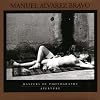
Histories of Photography typically limit their focus to North American and Western European photography. Artists from other geographic regions are usually ignored. The work of Manuel Alvarez Bravo is an example.
Bravo was a contemporary of Edward Weston, Henri Cartier-Bresson, Paul Strand to name but a few. Although his work is scarcely known to the general public it was appreciated by the leading photographers of his time.
A. D. Colman nicely capture's Bravo's work in his introduction. "… show more there are many dialects at the disposal of the photographer; his/her choice thereof is also a choice audience." [he] uses photography as a probe, an incisive tool for uncovering the heart of a culture embodied in the individual people who form its base."
As with any volume of photography, I found the selections to be somewhat uneven in quality and particularly in interest. "Bicycles on Sunday" (page 21) and "Tree struck by lightning" (page 23) document the arid desert landscape. "Window to the choir" (page 39) and "Stretched light" (page 77) nicely illustrate the abstract beauty that can be found all around us if we but look. The harsh consequences of conflict are depicted graphically in "Striking worker, assassinated" (page 59) and symbolically in "The crouched ones" (page 15). The pensive pose of the young woman in "Daydreaming" (page 73) suggests that even in harsh times dreams of better times ahead provide inspiration. show less
Bravo was a contemporary of Edward Weston, Henri Cartier-Bresson, Paul Strand to name but a few. Although his work is scarcely known to the general public it was appreciated by the leading photographers of his time.
A. D. Colman nicely capture's Bravo's work in his introduction. "… show more there are many dialects at the disposal of the photographer; his/her choice thereof is also a choice audience." [he] uses photography as a probe, an incisive tool for uncovering the heart of a culture embodied in the individual people who form its base."
As with any volume of photography, I found the selections to be somewhat uneven in quality and particularly in interest. "Bicycles on Sunday" (page 21) and "Tree struck by lightning" (page 23) document the arid desert landscape. "Window to the choir" (page 39) and "Stretched light" (page 77) nicely illustrate the abstract beauty that can be found all around us if we but look. The harsh consequences of conflict are depicted graphically in "Striking worker, assassinated" (page 59) and symbolically in "The crouched ones" (page 15). The pensive pose of the young woman in "Daydreaming" (page 73) suggests that even in harsh times dreams of better times ahead provide inspiration. show less


You May Also Like


Associated Authors
Statistics
- Works
- 55
- Members
- 459
- Popularity
- #53,509
- Rating
- 4.0
- Reviews
- 6
- ISBNs
- 44
- Languages
- 5