

Niklas Luhmann (1927–1998)
Author of Social Systems
About the Author
Niklas Luhmann (1927-1998) was Professor Emeritus, of Sociology at Bielefeld University.
Disambiguation Notice:
(yid) VIAF:29546145
Series
Works by Niklas Luhmann
Gesellschaftsstruktur und Semantik 3. Studien zur Wissenssoziologie der modernen Gesellschaft. (1989) 14 copies, 1 review
Gesellschaftsstruktur und Semantik 1. Studien zur Wissenssoziologie der modernen Gesellschaft. (1980) 11 copies, 1 review
Teoria politica en el Estado de Bienestar / Political Theater of the State of Wellbeing (Alianza Universidad) (Spanish Edition) (1981) 11 copies
Zweckbegriff und Systemrationalität : über die Funktion von Zwecken in sozialen Systemen (1973) 10 copies
Warum haben Sie keinen Fernseher, Herr Luhmann: Letzte Gespräche mit Niklas Luhmann (2004) — Contributor — 9 copies, 1 review
Soziologische Aufklärung, Bd.4, Beiträge zur funktionalen Differenzierung der Gesellschaft (1994) 7 copies
Teoria de la sociedad y pedagogia/ Theory of Society and Education (Educador / Educating) (Spanish Edition) (1996) 5 copies
Das Kind als Medium der Erziehung 4 copies
PARADOJA DE LOS DERECHOS HUMANOS TRES ESCRITOS SOBRE POLITICA DERECHO Y DERECHOS HUMANOS, LA (2014) 3 copies
The Making of Meaning: From the Individual to Social Order: Selections from Niklas Luhmann's Works on Semantics and Social Structure (2022) 3 copies
Potere e codice politico 3 copies
Ühiskonna ühiskond. peatükid 1-3 3 copies
El amor como pasion. 2 copies
Teoria dos Sistemas na Pratica Vol. III - Historia semantica e sociedade (Em Portugues do Brasil) (2019) 2 copies
Religious Dogmatics and the Evolution of Societies (Studies in Religion and Society, Vol 9) (1984) 2 copies
Teoria dos Sistemas na Pratica - Vol. II - Diferenciacao funcional e modernidade (Em Portugues do Brasil) (2019) 2 copies
La constitución como logro evolutivo (Clásicos - Clásicos del Pensamiento) (Spanish Edition) (2024) 2 copies
Niklas Luhmann, Humberto Maturana, Mikio Namiki, Volker Redder, Francisco Varela, Beobachter Konvergenz der Erkennnisttheorien? (2003) 2 copies
Kadife Karanlik 2 - 21.Yuzyil Iletisim Cagini Aydinlatan Kuramcilar - Ayna Sovalyeleri (2006) 2 copies
El Derecho De La Sociedad 2 copies
Eine Welt aus Systemen 1 copy
La economía de la sociedad 1 copy
SPEAKING AND SILENCE 1 copy
Problems of Reflection in the System of Education (International Educational Studies, Vol 3) (2002) 1 copy
Illuminismo sociologico 1 copy
La paradoja de los derechos humanos : tres escritos sobre política, derecho y derechos humanos 1 copy
The Modernity of science 1 copy
Associated Works
Tagged
Common Knowledge
- Canonical name
- Luhmann, Niklas
- Birthdate
- 1927-12-08
- Date of death
- 1998-11-06
- Gender
- male
- Education
- University of Freiburg
University of Münster (Ph.D|Hab.|1966) - Occupations
- sociologist
professor - Organizations
- University of Bielefeld
- Nationality
- Germany
- Birthplace
- Lüneburg, Free State of Prussia
- Place of death
- Oerlinghausen, Germany
- Disambiguation notice
- VIAF:29546145
- Associated Place (for map)
- Germany
Members
Reviews
Liebe als Passion: Zur Codierung von Intimität (suhrkamp taschenbuch wissenschaft) by Niklas Luhmann

Zunächst beschreibt Luhmann Liebe als "symbolisch generalisiertes Kommunikationsmedium": Liebe wird nicht formuliert, sondern symbolisiert; die allgemeine "Codehaftigkeit", die auch dann funktioniert, wenn ein Code durchschaut wird, wird hier besprochen.
In den weiteren Kapiteln wird ausführlich die Geschichte der Liebessemantik besprochen. Insbesondere zitiert Luhmann aus einem breiten Fundus französischer Literatur - unübersetzt, Französisch lesen zu können ist hier vorteilhaft. Es show more wird Bezug genommen auf andere Systeme wie Freundschaft, Abgrenzungen und Entwicklungen wie plaisir/amour und Idealisierung/Paradoxierung und auf Auswirkungen anderer Entwicklungen wie Individualisierung (die eine verstärkte Symbolhaftigkeit erfordert) und Ausdifferenzierung z.B. der Gesellschaftsreproduktion (die die Ehe "freigibt").
Zuletzt geht es um aktuelle Probleme und Entwicklungen.
Schön zu lesen ist Luhmanns ab und an aufblitzender trockener Humor. show less
In den weiteren Kapiteln wird ausführlich die Geschichte der Liebessemantik besprochen. Insbesondere zitiert Luhmann aus einem breiten Fundus französischer Literatur - unübersetzt, Französisch lesen zu können ist hier vorteilhaft. Es show more wird Bezug genommen auf andere Systeme wie Freundschaft, Abgrenzungen und Entwicklungen wie plaisir/amour und Idealisierung/Paradoxierung und auf Auswirkungen anderer Entwicklungen wie Individualisierung (die eine verstärkte Symbolhaftigkeit erfordert) und Ausdifferenzierung z.B. der Gesellschaftsreproduktion (die die Ehe "freigibt").
Zuletzt geht es um aktuelle Probleme und Entwicklungen.
Schön zu lesen ist Luhmanns ab und an aufblitzender trockener Humor. show less
Gesellschaftsstruktur und Semantik: Studien zur Wissenssoziologie der modernen Gesellschaft. Band 3: BD 3 (suhrkamp taschenbuch wissenschaft) by Niklas Luhmann
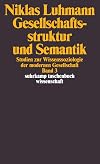
I liked this third volume of Luhmann's Gesellschaftsstruktur und Semantik much more than the second one. Especially the chapter on religion, which gave an outline of how the church lost its overarching relevance for Europen society, was informative. But still this is really just a collection of disconnected essays. Luhmann calls them "case studies" for his theory of semantic change but I don't think that label fits.
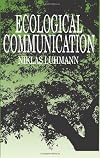
I will admit that I could have given this dry, abstruse, even forbidding work more sober, methodical effort, but I understand that Luhmann aimed for dry/abstruse/forbidding on purpose so that people would not read too fast and miss the symphony of deep meaning in his theory, and that nonsense is not okay in a world of mortals. Um, the un-abstruse version of the purpose of this book is that it tries to determine how we can change our thinking (which for Luhmann, is rooted in our show more communication, his biggest keyword) on environmental issues, which for him is done by extending out his systems theory into the concept of "environment" to efface it and integrate it with the human systems or gestalts it contains. That seems like common sense, and basically aligned with the idea of moving from an "environmentalism" to an "ecologism." Desacralizing the other and bringing it into us and us into it, rendering it and us changeable.
And Luhmann brings out some aspects to the question that I find mildly agreeable: the paralytic effect of thinking there is a big change in the offing, or even possible, that is going to change the discourse (Luhmann prefers "resonance" between parts of a system--he might not agree with the equivalency with discourse, but I, roughly, do) and fix the world; the need instead to understand that the only effective response to complexity is complexity; but also the paralytic effect of complexity, and the need for a heuristic (I guess that's what they call "systems theory" reduced to its bones, that is if it's anything more than just tarted-up structuralism); and still and yet, the advantage of the sacral that it makes things harder to change--how many religious ceremonies have ecological valences (Luhmann's representative term is the "pig cycle," after the way Roy Rappaport described the Maring people of New Guinea letting the pigs weed their crops and then throwing ritual pig feasts when there got to be too many pigs) and without them, any system can be twisted to the immediate purpose of the twisters, which are unlikely to be ecological ones (the villain, as always, capitalism, though Luhmann is not voluble on this point).
But these sparks are progressively smothered in the ashes of what one might loosely call Luhmann's "style," and it gets harder and harder to maintain any sympathy. This is not postmodern prose mysticism; it is ugly, graceless, full of technical terms that he does not explain (except in a glossary, which adds insult to injury by explaining them only in terms of other technical terms that he does not explain). This is never necessary. A brief, heurisitic explanation or callout that a term is being used in a jargon sense is always possible if one is aspiring to the kind of technocratic theory that Luhmann seems to be. Chapter after chapter where he just takes banalities on various generic topics ("law," "economy," "science," "politics," "religion") and translates them into his language fill me with despair.
"Anyone who hoped that these reflections on the theme of 'ecological communication' would clarify how this kind of communication could contribute to the solution of pressing environmental problems will be disappointed. Our aim was to work out how society reacts to environmental problems, not how it ought to or has to react if it wants to improve its relation with the environment. Prescriptions of this sort are not hard to supply. All that is necessary is to consume fewer resources, burn off less waste gas in the air, produce fewer children. But whoever puts the problem in this way does not reckon with society […]." See what he did there? He makes the point that he's not looking to provide policy prescriptions, since it's how we think about things that needs to change for what we do to change. But that is just as much as to say "how we react" has to change, and Luhmann has just clarified that saying how that can happen is not our purpose. He's just decoupled the discourse around the environment from the environment, reduced it to a floating object for his fucked-up system analysis manifesting as some linguistically uninformed, double-abstracted discourse theory. show less
And Luhmann brings out some aspects to the question that I find mildly agreeable: the paralytic effect of thinking there is a big change in the offing, or even possible, that is going to change the discourse (Luhmann prefers "resonance" between parts of a system--he might not agree with the equivalency with discourse, but I, roughly, do) and fix the world; the need instead to understand that the only effective response to complexity is complexity; but also the paralytic effect of complexity, and the need for a heuristic (I guess that's what they call "systems theory" reduced to its bones, that is if it's anything more than just tarted-up structuralism); and still and yet, the advantage of the sacral that it makes things harder to change--how many religious ceremonies have ecological valences (Luhmann's representative term is the "pig cycle," after the way Roy Rappaport described the Maring people of New Guinea letting the pigs weed their crops and then throwing ritual pig feasts when there got to be too many pigs) and without them, any system can be twisted to the immediate purpose of the twisters, which are unlikely to be ecological ones (the villain, as always, capitalism, though Luhmann is not voluble on this point).
But these sparks are progressively smothered in the ashes of what one might loosely call Luhmann's "style," and it gets harder and harder to maintain any sympathy. This is not postmodern prose mysticism; it is ugly, graceless, full of technical terms that he does not explain (except in a glossary, which adds insult to injury by explaining them only in terms of other technical terms that he does not explain). This is never necessary. A brief, heurisitic explanation or callout that a term is being used in a jargon sense is always possible if one is aspiring to the kind of technocratic theory that Luhmann seems to be. Chapter after chapter where he just takes banalities on various generic topics ("law," "economy," "science," "politics," "religion") and translates them into his language fill me with despair.
"Anyone who hoped that these reflections on the theme of 'ecological communication' would clarify how this kind of communication could contribute to the solution of pressing environmental problems will be disappointed. Our aim was to work out how society reacts to environmental problems, not how it ought to or has to react if it wants to improve its relation with the environment. Prescriptions of this sort are not hard to supply. All that is necessary is to consume fewer resources, burn off less waste gas in the air, produce fewer children. But whoever puts the problem in this way does not reckon with society […]." See what he did there? He makes the point that he's not looking to provide policy prescriptions, since it's how we think about things that needs to change for what we do to change. But that is just as much as to say "how we react" has to change, and Luhmann has just clarified that saying how that can happen is not our purpose. He's just decoupled the discourse around the environment from the environment, reduced it to a floating object for his fucked-up system analysis manifesting as some linguistically uninformed, double-abstracted discourse theory. show less
Gesellschaftsstruktur und Semantik: Studien zur Wissenssoziologie der modernen Gesellschaft. Band 4.: BD 4 (suhrkamp taschenbuch wissenschaft) by Niklas Luhmann

This fourth and final volume of Gesellschaftsstruktur und Semantik was as disappointing as volumes 2 and 3. Like those earlier volumes, this one is a collection of random essays, not a focused study. The author apparently loved writing "case studies", but they really do not relate in any interesting ways to his theoretical musings in volume 1. In volume 4, the essay on the development of the state in Europe was fairly interesting, but I still think only volume 1 is worth reading in this series.
Awards


You May Also Like


Associated Authors
Statistics
- Works
- 167
- Also by
- 1
- Members
- 1,997
- Popularity
- #12,893
- Rating
- 3.9
- Reviews
- 11
- ISBNs
- 363
- Languages
- 16
- Favorited
- 2