
Norman Housley
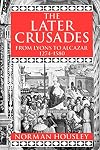
Author of The Later Crusades, 1274-1580: From Lyons to Alcazar
About the Author
Norman Housley is Professor of History at the University of Leicester.
Series
Works by Norman Housley
Associated Works
War, Government and Aristocracy in the British Isles, c.1150-1500: Essays in Honour of Michael Prestwich (2008) — Contributor — 11 copies
Tagged
Common Knowledge
Members
Reviews
The Italian Crusades : the Papal-Angevin alliance and the crusades against Christian lay powers, 1254-1343 by Norman Housley

The first crusades were launched against Muslims, but the list of targets was soon extended to pagans, heretics, and even Catholics who happened to be the temporal enemies of the papacy. This book deals with three sets of crusades of the last kind, fought by the papacy in alliance with the House of Anjou: in the 1260s against the heirs of Frederick II in southern Italy, in the 1280s-1300s in Sicily and southern Italy against the Aragonese, and in the 1320s-1330s against the Holy Roman Empire show more and various Ghibelline cities in central and northern Italy.
Dealing successively with the legal-theological justification of the crusades, the preaching of them and the popular response thereto, and the financial machinery sustaining them, Housley seeks to prove that, contrary to various previous scholarship, the Italian crusades, despite their transparently "political" rather than religious motivation, did little to dampen crusading enthusiasm, and if they helped bring about the decline in papal power and prestige during the period, this was less because of the papacy being seen as perverting or misusing the crusading indulgence than because the crusades were frequently unsuccessful in strictly military terms.
Whether one accepts this thesis or not - I did finish the book with a suspicion Housley overstates his case - the book has a lot of interest to offer about the machinery behind these wars. show less
Dealing successively with the legal-theological justification of the crusades, the preaching of them and the popular response thereto, and the financial machinery sustaining them, Housley seeks to prove that, contrary to various previous scholarship, the Italian crusades, despite their transparently "political" rather than religious motivation, did little to dampen crusading enthusiasm, and if they helped bring about the decline in papal power and prestige during the period, this was less because of the papacy being seen as perverting or misusing the crusading indulgence than because the crusades were frequently unsuccessful in strictly military terms.
Whether one accepts this thesis or not - I did finish the book with a suspicion Housley overstates his case - the book has a lot of interest to offer about the machinery behind these wars. show less
You May Also Like


Associated Authors
Statistics
- Works
- 15
- Also by
- 2
- Members
- 308
- Popularity
- #76,455
- Rating
- 4.1
- Reviews
- 2
- ISBNs
- 37
- Languages
- 1