
Amin Maalouf
Author of The Crusades through Arab Eyes
About the Author
Amin Maalouf was formerly director of the leading Beirut daily, an-Nahar, and editor of Jeune Afrique.
Works by Amin Maalouf
Disordered World: Setting a New Course for the Twenty-first Century (2009) — Author — 295 copies, 6 reviews
Yolların başlangıcı : roman 2 copies
Stijena Tanios 1 copy
Lleò l'africà 1 copy
Maalouf Amin 1 copy
متاهة الضائعين 1 copy
La Invasión 1 copy
Associated Works
The Raft of the Medusa: Five Voices on Colonies, Nations, and Histories (1993) — Contributor — 5 copies
Tagged
Common Knowledge
- Canonical name
- Maalouf, Amin
- Legal name
- أمين معلوف
- Birthdate
- 1949-02-25
- Gender
- male
- Education
- Saint Joseph University, Beirut
Collège Notre Dame de Jamhour - Occupations
- journalist
novelist
librettist - Organizations
- Académie française (2011)
- Awards and honors
- Ordre national du Mérite (2020)
International Fellow, Royal Society of Literature (2021)
Prix Al Owais (2011)
Prix Goncourt en 1993, pour Le rocher de Tanios
Prix Européen de l'Essai, en 1999
Académie française, 23/06/2011 (show all 17)
Prix de l'amitié franco-arabe, en 1986 pour Léon l'africain
Prix France-Liban , en 1986 pour Léon l'africain
Prix des Maisons de la presse, en 1988 pour Samarcande
Prix Européen de l'Essai, en 1999 pour Les identités meurrières
Prix Jacques Audibert-ville d'Antibes, en 2000 pour Le périple de Baldassare
Prix Méditerranée, en 2004 pour Origines
Prix Prince des Asturies des lettres ,en 2010
Prix du public de l'Algue d'or (Saint-Briac-sur-Mer), en 2013 pour Les désorientés
Sheikh Zayed Book Award (2016)
Finaliste du prix international Man Booker (2011)
Méditerranée (2004) - Relationships
- Maalouf, Andrée (spouse)
- Nationality
- Lebanon
- Birthplace
- Beirut, Lebanon
- Places of residence
- Paris, Île-de-France, France
île d'Yeu, Vendée, France - Map Location
- Lebanon
Members
Reviews

And this is why I keep picking up weird books that catch my eye in the library -- not all of them work for me but then I find gems like this one.
Adam had left his native Lebanon almost 25 years ago, fleeing a war which made his life as a Christian pretty miserable. Not that it was easy for anyone -- the Civil War was just starting and things were looking bad for everyone. And while some people chose to stay, a lot of people chose to leave all they knew and move away.
A lot happened in those show more 25 years - Adam became a historian, reconnected with some old friends who also fled the country, lost track of others but neither he, nor any of the others ever went home. Until the phone rang in his Paris apartment and a voice from the past called him to the sickbed of his friend Mourad. Despite Adam's rush, Mourad dies before he makes it there. So when the widow asks him to try to organize a meeting of all the old friends, the story is set in motion.
Maalouf choses to tell that story in two voices - a narrator and the diary (and letters) of Adam. We know that something is looming - the very beginning talks about something being 2 days before a disaster but we won't learn what until the very end. The first time when the diary made an appearance I almost groaned - it is an old trick to allow an author to "know" what the character thinks but as the story progresses, it becomes clear that the duality of the novel works in this as well. It is a story about the past and the future; about coming and going, about choices and memories.
And via the thoughts of Adam, the memories of everyone else and the letters Adam reads (and writes), two parallel stories emerge - one in the past, showing the start of a war that devastated a nation; the other of a now and here -- when people are still afraid to go home and where the war seems to be still raging - not on the streets, but in people's minds.
The novel is semi-autobiographical and I doubt that we will ever know which parts were real and which supplemented the reality. Just like his main character, Maalouf is a trained historian (it took me awhile to connect the name but then when I turned I saw his [The Crusades Through Arab Eyes] and that reminded me where I had heard his name before). And his Lebanon, the one he had to flee shows up under his pen here - both as it was and as it never was and as it never had a chance to be, with a taste of regret and sorrow. Each of the old friends had followed his path - and some of them had changed their paths more than once - a businessman turns into a monk, a man held for ransom decides to "adopt" his captors as parents . The circle of friends is a metaphor of the Lebanese society at the start of the Civil War - but even if they started as types, they are fully fledged and believable. And then the end shatters you.
And if this is not enough for one novel, you also get one of the best explanations of the bias blind spot I've read in awhile, a religions and history lesson (which sounds like everything but), a civil war 101 (from outside it is one war, inside it is a skirmish after skirmish and war after war with ever changing sides) and some of the best writing I had seen this year. The fact that the novel is 500+ pages and still feels too short (despite some middle parts that drag a bit) is a testament to a talent that I probably should have discovered much earlier. show less
Adam had left his native Lebanon almost 25 years ago, fleeing a war which made his life as a Christian pretty miserable. Not that it was easy for anyone -- the Civil War was just starting and things were looking bad for everyone. And while some people chose to stay, a lot of people chose to leave all they knew and move away.
A lot happened in those show more 25 years - Adam became a historian, reconnected with some old friends who also fled the country, lost track of others but neither he, nor any of the others ever went home. Until the phone rang in his Paris apartment and a voice from the past called him to the sickbed of his friend Mourad. Despite Adam's rush, Mourad dies before he makes it there. So when the widow asks him to try to organize a meeting of all the old friends, the story is set in motion.
Maalouf choses to tell that story in two voices - a narrator and the diary (and letters) of Adam. We know that something is looming - the very beginning talks about something being 2 days before a disaster but we won't learn what until the very end. The first time when the diary made an appearance I almost groaned - it is an old trick to allow an author to "know" what the character thinks but as the story progresses, it becomes clear that the duality of the novel works in this as well. It is a story about the past and the future; about coming and going, about choices and memories.
And via the thoughts of Adam, the memories of everyone else and the letters Adam reads (and writes), two parallel stories emerge - one in the past, showing the start of a war that devastated a nation; the other of a now and here -- when people are still afraid to go home and where the war seems to be still raging - not on the streets, but in people's minds.
The novel is semi-autobiographical and I doubt that we will ever know which parts were real and which supplemented the reality. Just like his main character, Maalouf is a trained historian (it took me awhile to connect the name but then when I turned I saw his [The Crusades Through Arab Eyes] and that reminded me where I had heard his name before). And his Lebanon, the one he had to flee shows up under his pen here - both as it was and as it never was and as it never had a chance to be, with a taste of regret and sorrow. Each of the old friends had followed his path - and some of them had changed their paths more than once - a businessman turns into a monk, a man held for ransom decides to "adopt" his captors as parents . The circle of friends is a metaphor of the Lebanese society at the start of the Civil War - but even if they started as types, they are fully fledged and believable. And then the end shatters you.
And if this is not enough for one novel, you also get one of the best explanations of the bias blind spot I've read in awhile, a religions and history lesson (which sounds like everything but), a civil war 101 (from outside it is one war, inside it is a skirmish after skirmish and war after war with ever changing sides) and some of the best writing I had seen this year. The fact that the novel is 500+ pages and still feels too short (despite some middle parts that drag a bit) is a testament to a talent that I probably should have discovered much earlier. show less
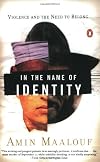
The topic of this book is as meaningful today as it was 20 or so years ago when it was written. This continued relevance would be something the author would detest. In a stunning closure the author reveals the desire for the matters he discusses to become so well understood that a book on the subject would become a simple tautology. He wants his book to become irrelevant soon.
As it stands, the book touches the raw nerve of our times. What is an identity of a human being? Is it the language show more of childhood, the religious beliefs, the community a person belongs to, the color of skin, or the choice of a profession? The correct answer is none of the above and all of the above (and more) at the same time. The main premise is that in normal times, when individual values shine in all their complex variety no two identities are alike. In times of crisis, war, a real or perceived attack on a part of our complex identities, one part is inflated, consumes other parts and becomes the driving force of our actions. It gives birth to antagonism and hatred.
This is a simple statement of affairs, the question is how to avoid such polarizing reactions in our increasingly global society? And the answer lies in the original claim of the complex nature of our unique identities. A person who cherishes the multifaceted nature of his/her identity is less likely to become carried away by a sweepingly simplifying political slogan or a crude interpretation of a religious duty. Are we not responsible ourselves for building up our identities in a way that the core principles are the humanistic values that cannot be pushed aside by some imposed agenda? show less
As it stands, the book touches the raw nerve of our times. What is an identity of a human being? Is it the language show more of childhood, the religious beliefs, the community a person belongs to, the color of skin, or the choice of a profession? The correct answer is none of the above and all of the above (and more) at the same time. The main premise is that in normal times, when individual values shine in all their complex variety no two identities are alike. In times of crisis, war, a real or perceived attack on a part of our complex identities, one part is inflated, consumes other parts and becomes the driving force of our actions. It gives birth to antagonism and hatred.
This is a simple statement of affairs, the question is how to avoid such polarizing reactions in our increasingly global society? And the answer lies in the original claim of the complex nature of our unique identities. A person who cherishes the multifaceted nature of his/her identity is less likely to become carried away by a sweepingly simplifying political slogan or a crude interpretation of a religious duty. Are we not responsible ourselves for building up our identities in a way that the core principles are the humanistic values that cannot be pushed aside by some imposed agenda? show less

A lively historical novel loosely based on the life of the 16th century Moorish diplomat and travel writer who was known in western Europe as Leo Africanus. Maalouf tweaks the known facts slightly to put Hasan/Leo in the middle of just about every significant event in the Mediterranean region from the Fall of Granada in 1492 to the Sack of Rome in 1527, using his Andalusian Muslim perspective to make us look again at these relatively familiar bits of European history in a fresh light. show more There’s plenty of danger, excitement and romance along the way, of course, and Hasan/Leo makes a fascinating narrator and a very penetrating observer of the world around him. Fun! show less

Uma excelente história que nos prende do início ao fim. Passado no oriente médio no século XIX durante a queda do império Otomano, tem a pegada das histórias orientais mas traz uma influência dos romances do sec XX com uma interessante construção psicológica da trama. Para ser justo, nenhum personagem se destaca em termos psicológicos com a exceção de Geryos que me pareceu ser o personagem mais bem construídos e é central na trama. O autor, Amin Maalouf, é comparado a Umberto show more Eco por ser um escritor que mistura fatos históricos com ficção e que conhece profundamente o local e a história de onde seus romances se passam. Esse livro e quase toda obra do autor é escrita originalmente em Francês e o original se chama "Le Rocher de Tanios". Excelente para adolescentes pela trama atribulada e pelas histórias de amor e amizade, mas também para os mais maduros para refletirem sobre a vida e a vida a nossa volta. É um livro sobre relações entre as pessoas, entre famílias, entre aldeias e assim sucessivamente num crescendo de proporções políticas muito maiores do que podemos imaginar. Como num espiral, a trama começa a se desenrolar a partir de um caso entre um sheik e a esposa de seu secretário e cresce num conflito entre nações; somos guiados entre os desejos e as possibilidades, entre o que se quer e o que se pode, entre o bom do curto prazo e o bom do longo prazo. O autor mantém sempre a dimensão humana e as relações pessoais como ponto de apoio de toda a trama e constrói uma história repleta de subjetividade onde o certo e o errado são desafiados a todo momento. Pelas dezenas de personagens e suas tramas entrelaçadas recebemos uma aula sobre maturidade, princípios e valores e como eles são importantes para podermos estar de bem conosco e por extensão com a vida. Ao fechar a última página nos damos conta que mesmo quando não nos damos conta nossas ações tem repercursões muito além do nosso pequeno mundinho individual, mas nosso destino apesar de tudo, é construído pelas nossas ações fruto das nossas escolhas. show less
Lists
Awards


You May Also Like


Associated Authors
Statistics
- Works
- 34
- Also by
- 1
- Members
- 11,696
- Popularity
- #2,011
- Rating
- 3.9
- Reviews
- 245
- ISBNs
- 558
- Languages
- 27
- Favorited
- 28

