
S. E. Hinton
Author of The Outsiders
About the Author
S. E. Hinton was born in Tulsa, Oklahoma and attended the University of Tulsa. Her first novel, The Outsiders, was published in 1967 and changed publishing for young adults by portraying a grittier, more realistic view of the lives of teenagers. It was made into a movie in 1983. Her other young show more adult works include Rumble Fish, Tex, Taming the Star Runner, and That Was Then, This is Now. Her children's books include The Puppy Sister and Big David, Little David. She has won numerous awards including the Margaret Alexander Edwards Award, the Media and Methods Maxi Award, and the Land of the Enchantment Award. (Bowker Author Biography) show less
Image credit: S.E. Hinton on April 24, 2017 in New York City
Works by S. E. Hinton
Some of Tim's Stories (The Oklahoma Stories & Storytellers Series) (2007) — Author — 147 copies, 11 reviews
S.E. Hinton: The Collection: The Outsiders / Rumble Fish / That Was Then, This Is Now (1995) 28 copies
S.E. Hinton Classic Collection: Rumble Fish, Some of Tim's Stories, Taming the Star Runner, and Tex 2 copies
Tempos de Juventude Livro 1 1 copy
Ngựa Chứng Đầu Xanh 1 copy
Passou, Já Era 1 copy
Te Huajt 1 copy
Ngựa Chứng Đầu Xanh 1 copy
Associated Works
Tagged
Common Knowledge
- Legal name
- Hinton, Susan Eloise
- Birthdate
- 1948-07-22
- Gender
- female
- Education
- University of Tulsa (B.S. | 1970)
- Occupations
- novelist
children's book author - Awards and honors
- Margaret A. Edwards Award (1988)
Oklahoma Writers Hall of Fame (1998)
Anne V. Zarrow Award for Young Readers' Literature (1991) - Relationships
- Inhofe, David (spouse)
- Nationality
- USA
- Birthplace
- Tulsa, Oklahoma, USA
- Associated Place (for map)
- Oklahoma, USA
Members
Reviews
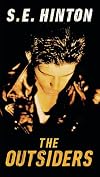
I read this in one big gulp about 30 years too late and absolutely loved it. Vivid and punchy and very moving, it immerses you so completely in the characters lives that you don't want it to stop. There is a plot, but it's almost an irrelevance, what matters is the wonderfully plain prose and the beautifully drawn depiction of teenage reality.
I’ve wanted to read this since I heard Rob Lowe talk about his experiences making the film in his autobiography. Whilst some of the slang and styling has aged the characterisation and themes of friendship, family, belonging and loyalty mean it still resonates today.
Plot /b>
Ponyboy is a (just) 14 year old orphan living being brought up by his older two brothers, and to a lesser extent, the gang of ‘greasers’ from their poor neighbourhood. Gang tensions based on socio economic show more distinctions bubble below the surface constantly and are brought to the forefront when one of their friends kills a ‘soc’ – one of the richer boys.
Thoughts
Reading this for the first time as an adult is an odd experience, the slang is dated, the many references to how the boys look and their obsessions with hair and shirts is difficult for a modern reader to relate to and the women in the story are largely irrelevant and one dimensional. And yet. There is a reason this book continues to win over teenage readers. The language is clear and straightforward and Ponyboy, whilst having a ludicrous name, has a clear and convincing voice that feels authentic and honest throughout.
Thematically Hinton does not shy away from the difficult topics – Ponyboy is an orphan, domestic abuse in his neighbourhood is commonplace, the boys are petty criminals and their lives are violent. These issues are presented factually and honestly but as a narrator Ponyboy also shows provides the other perspective– they are also kind to their friends, supportive, sportsmanlike and academic.
I think trying to reconnect with the teenage me – it is this nuanced characterisation that highlights the grey of life vs the black and white plus the age old tribalism of teenagers is what has made this such a popular novel. show less
Plot /b>
Ponyboy is a (just) 14 year old orphan living being brought up by his older two brothers, and to a lesser extent, the gang of ‘greasers’ from their poor neighbourhood. Gang tensions based on socio economic show more distinctions bubble below the surface constantly and are brought to the forefront when one of their friends kills a ‘soc’ – one of the richer boys.
Thoughts
Reading this for the first time as an adult is an odd experience, the slang is dated, the many references to how the boys look and their obsessions with hair and shirts is difficult for a modern reader to relate to and the women in the story are largely irrelevant and one dimensional. And yet. There is a reason this book continues to win over teenage readers. The language is clear and straightforward and Ponyboy, whilst having a ludicrous name, has a clear and convincing voice that feels authentic and honest throughout.
Thematically Hinton does not shy away from the difficult topics – Ponyboy is an orphan, domestic abuse in his neighbourhood is commonplace, the boys are petty criminals and their lives are violent. These issues are presented factually and honestly but as a narrator Ponyboy also shows provides the other perspective– they are also kind to their friends, supportive, sportsmanlike and academic.
I think trying to reconnect with the teenage me – it is this nuanced characterisation that highlights the grey of life vs the black and white plus the age old tribalism of teenagers is what has made this such a popular novel. show less

Mistakes were made, OK. I had never read the book, saw the movie yes, but never read (or listened to it) before now. Why now? My son had to read it for school and I thought, damn, I remember that movie (kinda) and if he has to read this modern classic, I should too. Give us something to talk about.
Well I forgot most of what happened and am thoroughly disappointed in myself for having waited so long to get through S.E. Hinton's work of art.
Friends and family, what are they? who are they? show more Adolescence. School. Loss. Life...such big questions, so much to get through. Who can you turn to? Who can you trust? What does it all mean? All of these were on the table for Hinton's 1967 work "The Outsiders". This title made me think, reflect, and remember. Well written, heck more than well written, S.E. Hinton is a woman who wrote a coming-of-age book about boys and young men and never missed a beat. What a feat! The stresses of youth, the life on the wrong side of the tracks, life on the run, but from who or what. And the story of family who they are, finding them, losing them and finally discovering something unlooked for.
What a book, and I might add, extremely well read by Spike McClure. I cannot recommend this more highly than I do. Everyone should read this and experience it. I am absolutely kicking myself for making the mistake of putting off for this long. show less
Well I forgot most of what happened and am thoroughly disappointed in myself for having waited so long to get through S.E. Hinton's work of art.
Friends and family, what are they? who are they? show more Adolescence. School. Loss. Life...such big questions, so much to get through. Who can you turn to? Who can you trust? What does it all mean? All of these were on the table for Hinton's 1967 work "The Outsiders". This title made me think, reflect, and remember. Well written, heck more than well written, S.E. Hinton is a woman who wrote a coming-of-age book about boys and young men and never missed a beat. What a feat! The stresses of youth, the life on the wrong side of the tracks, life on the run, but from who or what. And the story of family who they are, finding them, losing them and finally discovering something unlooked for.
What a book, and I might add, extremely well read by Spike McClure. I cannot recommend this more highly than I do. Everyone should read this and experience it. I am absolutely kicking myself for making the mistake of putting off for this long. show less

I actually never read The Outsiders before I taught it in my young adult literature class; I somehow missed this classic of young adult literature. And when I say classic, I mean it: The Outsiders is widely considered by critics to have created a genre. The teenager had really only just been invented after World War II by marketers and advertisers who needed to name this demographic so that they could target it. Thomas Hines, in The Rise and Fall of the American Teenager, argues that what show more defines teenagers is their awareness of the world connected to their powerlessness: "[teens] are exposed to all the violence and economic insecurity of the society at large, but, unlike their predecessors, they have few avenues for bearing real responsibility to improve their situation." Previously, this had not been the case: when you discovered society's insecurity it was because you were an adult and thus you were able to do something about it.
Hinton, so the story goes, noticed that there were no books that addressed the world the way she experienced it as a teenager-- and so she wrote one, the book she wanted and needed. Fascinatingly, this is as true within the text as it is outside of it; within The Outsiders, the novel itself is Ponyboy's homework for English class, written for "boys going down under street lights because they were mean and tough and hated the world, and it was too late to tell them that there was still good in it, and they wouldn't believe you if you did. It was too vast a problem to be just a personal thing. There should be some help, someone should tell them before it was too late. Someone should tell their side of the story, and maybe people would understand them and wouldn't be son quick to judge a boy by the amount of hair oil he wore" (179). The book is for teenagers in a way that previous books were not, designed to help them through the problems of their lives that were uniquely teenage, and speaking to them through a distinctly teenage voice, from a distinctly teenage perspective. This is a world of sex and violence, where advice from adults is either nonexistent or completely useless. (The adults, after all, were never teenagers themselves, as teenagers hadn't been invented yet.) And the book has to signal that is by-a-teen-for-a-teen within the text of the novel because that hadn't been done before.
Young adult literature is a tricky genre to define, which is why it fascinates me. Is there any other genre defined so much by audience and marketing? What unites The Outsiders with Twilight other than the age of its protagonist? Yet age is insufficient, because you can have a novel about a young adult that is still not young adult literature. In considering what teenagerhood (teenagerdom? teenagerness? teenagerity?) is like, I think, we begin to discover an answer. Young adult fiction is preoccupied with the questions of teenagers.
I have a friend who criticizes people who identify with The Outsiders: most teenagers, he says, do not have friends who get killed in fights, experience social divisions that lead to murder. And I guess this is true. But The Outsiders captures what being a teenager feels like, that violence that you are so sure is simmering underneath everything. And maybe, most importantly, the uselessness of adults. The Outsiders literalizes this by making Ponyboy and his brother orphans, and having Ponyboy's older brother Darry act as a parent. You have no one who can give you the guidance you need and/or the people who give you advice actually don't know much more than you do. It's a teenager utopian dream, I think, to imagine a world without adults, but The Outsiders depicts that as a dystopia, a horrible hellscape where teenagers prey on each other without oversight. Because, if you're a teenager, that's what teenagerhood feels like, even if an adult (like my friend) would know better. The Outsiders doesn't know better (though Ponyboy begins to have glimpses that this isn't true as the book goes on, so this might just be a pose on the novel's part), and that's what makes it young adult literature. show less
Hinton, so the story goes, noticed that there were no books that addressed the world the way she experienced it as a teenager-- and so she wrote one, the book she wanted and needed. Fascinatingly, this is as true within the text as it is outside of it; within The Outsiders, the novel itself is Ponyboy's homework for English class, written for "boys going down under street lights because they were mean and tough and hated the world, and it was too late to tell them that there was still good in it, and they wouldn't believe you if you did. It was too vast a problem to be just a personal thing. There should be some help, someone should tell them before it was too late. Someone should tell their side of the story, and maybe people would understand them and wouldn't be son quick to judge a boy by the amount of hair oil he wore" (179). The book is for teenagers in a way that previous books were not, designed to help them through the problems of their lives that were uniquely teenage, and speaking to them through a distinctly teenage voice, from a distinctly teenage perspective. This is a world of sex and violence, where advice from adults is either nonexistent or completely useless. (The adults, after all, were never teenagers themselves, as teenagers hadn't been invented yet.) And the book has to signal that is by-a-teen-for-a-teen within the text of the novel because that hadn't been done before.
Young adult literature is a tricky genre to define, which is why it fascinates me. Is there any other genre defined so much by audience and marketing? What unites The Outsiders with Twilight other than the age of its protagonist? Yet age is insufficient, because you can have a novel about a young adult that is still not young adult literature. In considering what teenagerhood (teenagerdom? teenagerness? teenagerity?) is like, I think, we begin to discover an answer. Young adult fiction is preoccupied with the questions of teenagers.
I have a friend who criticizes people who identify with The Outsiders: most teenagers, he says, do not have friends who get killed in fights, experience social divisions that lead to murder. And I guess this is true. But The Outsiders captures what being a teenager feels like, that violence that you are so sure is simmering underneath everything. And maybe, most importantly, the uselessness of adults. The Outsiders literalizes this by making Ponyboy and his brother orphans, and having Ponyboy's older brother Darry act as a parent. You have no one who can give you the guidance you need and/or the people who give you advice actually don't know much more than you do. It's a teenager utopian dream, I think, to imagine a world without adults, but The Outsiders depicts that as a dystopia, a horrible hellscape where teenagers prey on each other without oversight. Because, if you're a teenager, that's what teenagerhood feels like, even if an adult (like my friend) would know better. The Outsiders doesn't know better (though Ponyboy begins to have glimpses that this isn't true as the book goes on, so this might just be a pose on the novel's part), and that's what makes it young adult literature. show less
Lists
Gen X Library (4)
Books About Boys (1)
First Novels (1)
Books for Birute (1)
Books I've Read (1)
Cooper (1)
Elevenses (1)
Ryan's Books (1)
Ambleside Books (1)
Best Young Adult (1)
el (1)
B-B to Get (2)
READ IN 2021 (1)
Overdue Podcast (1)
Female Author (1)
DELETE (1)
Sonlight Books (1)
Stuff from Bard (1)
Awards


You May Also Like


Associated Authors
Statistics
- Works
- 25
- Also by
- 8
- Members
- 34,840
- Popularity
- #543
- Rating
- 3.9
- Reviews
- 919
- ISBNs
- 435
- Languages
- 21
- Favorited
- 53
