
Henri Michaux (1899–1984)
Author of A Barbarian in Asia
About the Author
Image credit: Henri Michaux à la Fondation Maeght, 1976
Series
Works by Henri Michaux
Verschijningen 20 copies
Spaced, Displaced: Deplacements Degagements (Bloodaxe Contemporary French Poets, Vol 3) (1992) 19 copies
Henri Michaux: [exposition], Centre Georges Pompidou, Musée national d'art moderne, 15 mars-14 juin 1978 (French Edition) (1978) 13 copies, 1 review
Trage nederlaag met volle zeilen bloemlezing uit het werk van Henri Michaux deel 1 1922-1946 (2017) 5 copies
Jeux d'encre : trajet Zao Wou-Ki : [lecture par Henri Michaux de huit lithographies de Zao Wou-Ki] (1993) 4 copies
And More Changes Still 4 copies
Michaux Meskalin : die Meskalinzeichnungen von Henri Michaux 1954-1959, 1966-1969 (1998) 4 copies, 1 review
Hoekposten 2 copies
アンリ・ミショー全集 1 : OEUVERS COMPLETES D'HENRI MICHAUX — Author — 2 copies
Dichtungen 2 copies
Nós dois ainda 2 copies
Poemas 1 copy
Toward Totality II 1 copy
Mercure de France. Le souvenir d'Adrienne Monnier. Tome CCCXXVI, no. 1109. Janvier 1956. (1956) 1 copy
Art Tantrique 1 copy
Yantra poem 1 copy
Les grandes encres 1 copy
Tvář se ztracenými ústy 1 copy
Cesta nepoddajnosti 1 copy
À la nuit sans limites 1 copy
Plume Adında Biri 1 copy
Retour à Bruxelles 1 copy
Quand tombent les toits 1 copy
promesse 1 copy
Capturar 1 copy
O Retiro pelo Risco 1 copy
Portrait d'homme 1 copy
L'avenir de la poésie 1 copy
Ratureurs 1 copy
Braakadbar 1 copy
Poezje 1 copy
Bárbaro en Asia, Un 1 copy
Det elendige mirakel - meskalinet : med otteogfyrre tegninger og originale håndskrevne dokumenter (2020) 1 copy
No país da magia 1 copy
Henri Michaux: A selection 1 copy
Selected Poems 1 copy
Spațiul dinlăuntru 1 copy
Antologia Poetica 1927-1986 / Poetic Anthology 1927-1986 (El Otro Lado/poesia / The Other Side/Poetry) (Spanish Edition) (2002) 1 copy
Liberté 1 copy
Associated Works
Theories and Documents of Contemporary Art: A Sourcebook of Artists' Writings (1995) — Contributor — 422 copies, 1 review
De mooiste verhalen van James Baldwin, John Berger, Jorge Luis Borges, Jane Bowles, Joseph Brodsky, Charles Bukowski, Wi (1990) — Contributor — 6 copies
From Flaubert to the Present: French Stories — Contributor — 3 copies
Pondichery, Chandernagor, Karikal, Mahe, Yanaon. Les anciens Comptoirs franȧis de l'Inde (1992) — Citation — 2 copies
ユリイカ 1972年 09月号 (第4巻第10号) 特集=総展望フランス現代詩 — Contributor — 1 copy
イリュミナシオン 創刊号 — Contributor — 1 copy
詩と思想 1989年 03月号 — Contributor — 1 copy
現代詩手帖 1971年 05月号 特集=薬・眩暈 — Contributor — 1 copy
現代フランス幻想小説 — Contributor — 1 copy
Tagged
Common Knowledge
- Legal name
- Michaux, Henri
- Other names
- Michaux, Henry (Pseudonyme)
- Birthdate
- 1899-05-24
- Date of death
- 1984-10-18
- Gender
- male
- Education
- Putte-Grasheide
- Occupations
- painter
poet
author - Organizations
- Hermès, Revue littéraire (Membre du comité de rédaction, 19 36)
Editions le Sagitaire, Paris (Coursier, Commis, 19 24)
Collège, Saint-Gilles, (Professeur, Lettres, 19 23 |19 24)
Le Disque vert, Revue littéraire (Rédacteur, 19 22 | 19 23) - Relationships
- Ferdière, Marie-Louise (Compagne, 1935, Epouse, 1943 | 1948)
Fourcade, Jacques-Olivier (Ami intime)
Supervielle, Jules (Ami intime)
Paulhan, Jean (Ami)
Hellens, Franz (Ami)
Soca, Susana (Amie intime) - Cause of death
- Naturelle (Vieillesse, Infarctus)
- Nationality
- Belgium
France (naturalized 1955) - Birthplace
- Namur, Belgium
- Place of death
- Paris, France
- Burial location
- Naturelle (Vieillesse, Infarctus)
- Associated Place (for map)
- Namur, Belgium
Members
Reviews

The brain is not the mind.
Oliver Wendell Holmes, Sr., just shaking off the effects of ether, convinced that he had come across ‘the one great truth that underlies all human experience,’ staggered to his desk and wrote: ‘the smell of turpentine prevails throughout.’ Henri Michaux, repudiating omniscience in the aftermath of one of his mescaline trips, expressed irritation at the overmany shades of pink.
A superbly imaginative writer of preternatural psychological insight, Michaux show more initially maintains that he is separate from the drug and its effects, an objective witness of “the retinal circus,” the mad vibrating motions of cascading images. He is amused by the urge to make proclamations “about what I did not know or care.” But. Over the course of the journals both writer and reader are drawn nearer and nearer to “the insufferable winds of mind,” mental speed and rhythm accelerating beyond control. The self banished by the incessant mingling of tiny rivulets, swarmings, fractured barriers. Cats high up in the trees, the absurdity of Argentina. After inadvertantly dosing himself with six times the usual amount, he undergoes an “experiment in schizophrenia,” developing in his mind a fascination with the aberrant, the desire to shove a stranger off a great height, or to throw himself under a train just pulling in to the station. Four weeks later he is still recalibrating his mental equipment, recuperation hastened by drumming a rhythm on the wooden bedframe, and mountains. He feels himself as a fallen leaf, returning to the tree.
In a series of addenda written decades after his experience with mescaline, Michaux attempts an answer to the question of whether the effects ever really wear off. The kind of unconventional insight apparent in these pages suggests that the effects last a long strange time. show less
Oliver Wendell Holmes, Sr., just shaking off the effects of ether, convinced that he had come across ‘the one great truth that underlies all human experience,’ staggered to his desk and wrote: ‘the smell of turpentine prevails throughout.’ Henri Michaux, repudiating omniscience in the aftermath of one of his mescaline trips, expressed irritation at the overmany shades of pink.
A superbly imaginative writer of preternatural psychological insight, Michaux show more initially maintains that he is separate from the drug and its effects, an objective witness of “the retinal circus,” the mad vibrating motions of cascading images. He is amused by the urge to make proclamations “about what I did not know or care.” But. Over the course of the journals both writer and reader are drawn nearer and nearer to “the insufferable winds of mind,” mental speed and rhythm accelerating beyond control. The self banished by the incessant mingling of tiny rivulets, swarmings, fractured barriers. Cats high up in the trees, the absurdity of Argentina. After inadvertantly dosing himself with six times the usual amount, he undergoes an “experiment in schizophrenia,” developing in his mind a fascination with the aberrant, the desire to shove a stranger off a great height, or to throw himself under a train just pulling in to the station. Four weeks later he is still recalibrating his mental equipment, recuperation hastened by drumming a rhythm on the wooden bedframe, and mountains. He feels himself as a fallen leaf, returning to the tree.
In a series of addenda written decades after his experience with mescaline, Michaux attempts an answer to the question of whether the effects ever really wear off. The kind of unconventional insight apparent in these pages suggests that the effects last a long strange time. show less

There is a revealing moment in “Major Ordeals of the Mind” when a hallucinating Henri Michaux confesses to avoiding a female friend who would be concerned and disappointed about his continued drug experiments. At another moment, two of his friends walk into the middle of his trip, linger briefly failing at their interactions before deciding to leave him in perplexing solitude. These events take up less than half a page of Michaux’s book and he does not offer any other context on his show more life. Accordingly, the remainder of his narrated experiences are accessible to anyone with an interest in drug experiences and their effects on consciousness.
Michaux’s careful and honest observations seem universal—freed of personal baggage and purged of cryptic references—and they are often hilarious, “it was a biscuit wrapping, nothing more. I know that perfectly well. It was also a disturbing, annoying, deceptive being, capable of anything.” His descriptions of dissociation, anxiety, nervousness and disrupted thought (chapters 1-4) moved quickly and resonated best with me. The second half of the book is at once more focused on those with permanent mental problems (primarily schizophrenics) and more absorbed with powerful, transcendent and appalling hallucinations. These were perhaps less universal experiences—though I am in no position to judge. For example, his cosmic launch into outer space and his explanation of losing touch with his body parts, was—for me—less accessible and because of that, less interesting (in the way that a stranger’s dreams are). Chapter 7 however, should not be missed; its discussion of a “table” made by a schizophrenic sheds more light on people with that misfortune than anything else I have read.
I was only skimmingly interested in his bizarre mystic system (“The Four Worlds”) that glorifies the movement from eroticism through fear, towards love and into contemplation. On the whole, the book reads with unusual speed and the first half of it is memorable, revealing, accurate and entertaining. It is fun to see someone so motivated and earnest struggling as all of the world’s small obstacles turn into major ordeals. show less
Michaux’s careful and honest observations seem universal—freed of personal baggage and purged of cryptic references—and they are often hilarious, “it was a biscuit wrapping, nothing more. I know that perfectly well. It was also a disturbing, annoying, deceptive being, capable of anything.” His descriptions of dissociation, anxiety, nervousness and disrupted thought (chapters 1-4) moved quickly and resonated best with me. The second half of the book is at once more focused on those with permanent mental problems (primarily schizophrenics) and more absorbed with powerful, transcendent and appalling hallucinations. These were perhaps less universal experiences—though I am in no position to judge. For example, his cosmic launch into outer space and his explanation of losing touch with his body parts, was—for me—less accessible and because of that, less interesting (in the way that a stranger’s dreams are). Chapter 7 however, should not be missed; its discussion of a “table” made by a schizophrenic sheds more light on people with that misfortune than anything else I have read.
I was only skimmingly interested in his bizarre mystic system (“The Four Worlds”) that glorifies the movement from eroticism through fear, towards love and into contemplation. On the whole, the book reads with unusual speed and the first half of it is memorable, revealing, accurate and entertaining. It is fun to see someone so motivated and earnest struggling as all of the world’s small obstacles turn into major ordeals. show less

Michaux was a painter and a poet, so his travel journals are not really about itineraries or the procession of local charms. Instead, we get impressions, short notes, snippets of verse—
Between innocent houses and livid houses.
A slow traffic of blood clots.
And the pregnant, the police, these are the real lepers.
arranged in short sections, with headings
Suña, Friday, March 2 at dawn
5th hour
eating
17th hour
Guadalupe
the next day
a little later
somewhat later
a little later
in the show more pirogue suffering
He describes his writing as ‘an impossible bazaar, with no bread.’
He does not trust exoticism; it plays tricks on us. In Quito, the details all seem to be at work on their own without any concern for the whole. He notices most what is missing. There is no place to stand, no place to turn.
His horse seems to wonder if this is really his country, with this wind. Michaux takes ether. A bird in the jungle mimics the sound of a cork torn off a bottle of champagne. Michaux impossibly tries to keep his mind off of it.
Along the Rio Napo there are vampire bats. During the night drops of blood are falling from the hammock above. You must, whenever possible, go on to the stop ahead, no matter how silly it looks; don’t wait where you are. The tropics cannot be discussed matter-of-factly.
Michaux went to Ecuador in 1927 as ‘a man who knows neither how to travel nor how to keep a journal.’ But he did write about his trip, if not in any conventional way, and there are pleasures in the reading of it. show less
Between innocent houses and livid houses.
A slow traffic of blood clots.
And the pregnant, the police, these are the real lepers.
arranged in short sections, with headings
Suña, Friday, March 2 at dawn
5th hour
eating
17th hour
Guadalupe
the next day
a little later
somewhat later
a little later
in the show more pirogue suffering
He describes his writing as ‘an impossible bazaar, with no bread.’
He does not trust exoticism; it plays tricks on us. In Quito, the details all seem to be at work on their own without any concern for the whole. He notices most what is missing. There is no place to stand, no place to turn.
His horse seems to wonder if this is really his country, with this wind. Michaux takes ether. A bird in the jungle mimics the sound of a cork torn off a bottle of champagne. Michaux impossibly tries to keep his mind off of it.
Along the Rio Napo there are vampire bats. During the night drops of blood are falling from the hammock above. You must, whenever possible, go on to the stop ahead, no matter how silly it looks; don’t wait where you are. The tropics cannot be discussed matter-of-factly.
Michaux went to Ecuador in 1927 as ‘a man who knows neither how to travel nor how to keep a journal.’ But he did write about his trip, if not in any conventional way, and there are pleasures in the reading of it. show less
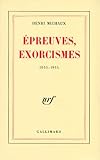
"Il serait bien extraordinaire que des milliers d'événements qui surviennent chaque année résultât une harmonie parfaite. Il y en a toujours qui ne passent pas, et qu'on garde en soi, blessants. Une des choses à faire : l'exorcisme. Toute situation est dépendance et centaines de dépendances. Il serait inouï qu'il en résultât une satisfaction sans ombre ou qu'un homme pût, si actif fût-il, les combattre toutes efficacement, dans la réalité. Une des choses à faire : show more l'exorcisme. L'exorcisme, réaction en force, en attaque de bélier, est le véritable poème du prisonnier. Dans le lieu même de la souffrance et de l'idée fixe, on introduit une exaltation telle, une si magnifique violence, unies au martèlement des mots, que le mal progressivement dissous est remplacé par une boule aérienne et démoniaque - état merveilleux ! [...] Pour qui l'a compris, les poèmes du début de ce livre ne sont point précisément faits en haine de ceci, ou de cela, mais pour se délivrer d'emprises. La plupart des textes qui suivent sont en quelque sorte des exorcismes par ruse. Leur raison d'être : tenir en échec les puissances environnantes du monde hostile." Henri Michaux. show less
Lists
Awards


You May Also Like


Associated Authors
Statistics
- Works
- 182
- Also by
- 20
- Members
- 2,290
- Popularity
- #11,214
- Rating
- 3.7
- Reviews
- 27
- ISBNs
- 242
- Languages
- 17
- Favorited
- 24


