
Martin Puchner
Author of The Written World: The Power of Stories to Shape People, History, Civilization
About the Author
Martin Puchner is the Byron and Anita Wien Professor of Drama and of English and Comparative Literature at Harvard University. He is the author of Poetry of the Revolution: Marx, Manifestos and the Avant-Gardes and Stage Fright: Modernism, Anti-Theatricality, and Drama.
Works by Martin Puchner
The Written World: The Power of Stories to Shape People, History, Civilization (2017) 498 copies, 9 reviews
The Language of Thieves: My Family's Obsession with a Secret Code the Nazis Tried to Eliminate (2020) 90 copies, 1 review
The Norton Anthology of World Literature (Third Edition) (Vol. Package 1: Volumes A, B, C) (2012) 44 copies
The Norton Anthology of World Literature (Third Edition) (Vol. Package 2: Vols. D, E, F) (2012) 29 copies
Literature for a Changing Planet (The Oxford Research Centre in the Humanities/Princeton University Press Lectures in European Culture, 1) (2022) 14 copies
The Norton Anthology of World Literature (Fourth Edition) (Vol. Package 1: Volumes A, B, C) (2018) 12 copies
Associated Works
Tagged
Common Knowledge
- Birthdate
- 1969
- Gender
- male
- Education
- Konstanz University (BA)
University of Bologna
University of California, Santa Barbara
Harvard University (PhD, Literature) - Occupations
- Professor of Drama and of English and Comparative Literature
- Organizations
- Harvard University
Columbia University
Queen Mary University of London
Friedrich-Alexander Universität - Agent
- Jill Kneerim
- Nationality
- USA
- Places of residence
- Cambridge, Massachusetts, USA
- Map Location
- Germany
- Associated Place (for map)
- Massachusetts, USA
Members
Reviews
The Written World: The Power of Stories to Shape People, History, and Civilization by Martin Puchner
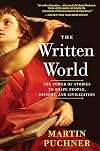
This was a fascinating account of the role of literature (writing, reading, printing) in history. The author covers a timeline spanning from Alexander the Great to modern day -- although the modern day is lightly skimmed over, maybe because it's still a work in progress. The book looks at how technological advances changed world literacy, and how that changed the way people think. I liked the focus on "foundational texts" (largely origin stories) and appreciated that the author was not show more euro-centric, but included Asia, Africa and the Americas. He also looked at impactful texts, such as the Communist Manifesto. Missing, for me, were early feminist texts.
Written in an engaging, accessible style. show less
Written in an engaging, accessible style. show less
I really enjoyed this tour of history's watershed writings. The book really shines in the first half; to me it seemed pretty clear that Puchner was much more at home discussing Scheherazade and Gilgamesh than discussing Harry Potter. (Or maybe he was just bitter that he was sorted into Slytherin.) I especially appreciated what a wide net Puchner cast--the chapters on The Tale of Genji, the Mayan Popul Vuh, and the West African Epic of Sunjata are some of the strongest and most interesting in show more the book.
Highly recommended for anyone interested in literary history. But be forewarned that the Mayan chapter will break your heart. show less
Highly recommended for anyone interested in literary history. But be forewarned that the Mayan chapter will break your heart. show less
The Language of Thieves: My Family's Obsession with a Secret Code the Nazis Tried to Eliminate by Martin Puchner
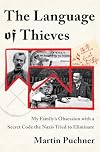
Harvard professor and native German Martin Puchner discusses Rotwelsch, a centuries-old Central European sociolect, or “secret language” spoken by people outside the boundaries of polite society such as beggars, vagrants, and criminals. Based on German, but infused with quasi-Yiddish and Hebrew vocabulary, this language was also associated with Jews, although they were by no means the only speakers.
Puchner’s family of academics and archivists had its own connections to Rotwelsch. His show more grandfather was a Nazi Party member who advocated stamping out the language and its speakers as a means of purifying Germany. His father and uncle shared a fascination with Rotwelsch as well, but their efforts were geared toward its preservation, rather than its destruction.
As he researches stories related to his family and Rotwelsch, Puchner uncovers long-buried secrets. This book is as much a family story as a story about a language. I liked the parts about the language more than the parts about the family members, none of whom really come alive as characters. Still, I recommend this book to those interested in sociolinguistics. show less
Puchner’s family of academics and archivists had its own connections to Rotwelsch. His show more grandfather was a Nazi Party member who advocated stamping out the language and its speakers as a means of purifying Germany. His father and uncle shared a fascination with Rotwelsch as well, but their efforts were geared toward its preservation, rather than its destruction.
As he researches stories related to his family and Rotwelsch, Puchner uncovers long-buried secrets. This book is as much a family story as a story about a language. I liked the parts about the language more than the parts about the family members, none of whom really come alive as characters. Still, I recommend this book to those interested in sociolinguistics. show less
Whether you are looking at your screen, a paper or an advert in the underground almost all we see around us has words in some form or other. Even the TV news has a ticker tape of other headlines now running underneath the presenter. This technology of the written word has shaped cultures through the ages as much as cultures have shaped language and the written world.
Beginning with Alexander and his pillow book, Puchner takes us from the first marks pressed into clay, the invention of vellum, show more paper and inks that were first made into codex's or books as we now call them. Most importantly though was the stories, messages and words that were written on them. These words and works of literature from the epic classics to the political tracts and the religious texts, they have shaped the way people think, cause revolutions and inspired people to fight for the causes they believe in.
A lie can run round the world before the truth has got its boots on. ― Terry Pratchett
That power of language is still with us today, as can be seen from modern day politics… This is an interesting book and Puchner has done pretty well to distil the vast magnitude of world literature and the effects that it has had around the world and bring it in between the covers of this book. It has a really helpful timeline at the beginning with locations where each chapter of our literary journey was started and the text is enhanced with images of some of the books he mentions in the text. It is an enjoyable read, the only flaw being that it cannot go into too much depth to make the book manageable, however, there is a large reference section though for those that want to discover more about our shared literary legacy. show less
Beginning with Alexander and his pillow book, Puchner takes us from the first marks pressed into clay, the invention of vellum, show more paper and inks that were first made into codex's or books as we now call them. Most importantly though was the stories, messages and words that were written on them. These words and works of literature from the epic classics to the political tracts and the religious texts, they have shaped the way people think, cause revolutions and inspired people to fight for the causes they believe in.
A lie can run round the world before the truth has got its boots on. ― Terry Pratchett
That power of language is still with us today, as can be seen from modern day politics… This is an interesting book and Puchner has done pretty well to distil the vast magnitude of world literature and the effects that it has had around the world and bring it in between the covers of this book. It has a really helpful timeline at the beginning with locations where each chapter of our literary journey was started and the text is enhanced with images of some of the books he mentions in the text. It is an enjoyable read, the only flaw being that it cannot go into too much depth to make the book manageable, however, there is a large reference section though for those that want to discover more about our shared literary legacy. show less
Lists
Awards


You May Also Like


Associated Authors
Statistics
- Works
- 37
- Also by
- 1
- Members
- 1,952
- Popularity
- #13,182
- Rating
- 4.2
- Reviews
- 10
- ISBNs
- 85
- Languages
- 7
