

Anna Ahkmatova (1889–1966)
Author of Selected Poems
About the Author
Image credit: wikimedia commons
Works by Anna Ahkmatova
El canto y la ceniza/ Singing and ash: Antologia Poetica/ Poetic Anthology (Spanish Edition) (2005) 33 copies, 1 review
Selected Poems 16 copies
→Šestoe čuvstvo⇋ = Het zesde zintuig : gedichten van Anna Achmatova, Nikolaj Goemiljov en Osip Mandelstam (1997) 4 copies
Collected Poems 4 copies
Guests from the future = Гости из будущего : Poems of Anna Akhmatova, Osip Mandelstam a. Boris Pasternak (1999) 2 copies
Примите этот дар... 2 copies
Stikhotvoreniia (1909-1960) 2 copies
Avond 2 copies
Chetki; stikhi 2 copies
Le rose di Modigliani 2 copies
Réquiem y otros escritos 2 copies
" Taĭny remesla". 2 copies
Стихотворения и поэмы 2 copies
Poems of Akhmatova 2 copies
Anna Akhmatova. Selected Poems. Translated by Richard McKane with an Essay by Andrei Sinyavsky (1969) 2 copies
Het zevende boek 2 copies
Il prodigio delle cose - poesie (25) 2 copies
Poesie 1 copy
Antología 1 copy
Сероглазый король 1 copy
Misterios del oficio 1 copy
Сочинения в двух томах. Том второй, Стихтворения и поэмы / Анна Ахматова ; составление и подготовка… 1 copy
Стихов моих белая стая 1 copy
Сочинения 1 copy
Сочинения в двух томах (1-2) 1 copy
Стихи и проза 1 copy
У самого моря 1 copy
Лирика 1 copy
Стихотворения. (1909-1960) 1 copy
Сочинения в двух томах 1 copy
Бег времени Стихотворения 1 copy
Nechet 1 copy
Seçilmiş Şiirler 1 copy
Gedichte an Gott sind Gebete Gott in der neusten sowjetischen Poesie ; [Anthologie 1960 - 1972] 1 copy
Achmatova Anna 1 copy
Poetry 1 copy
Ποιήματα 1 copy
Le Soir 1 copy
قداس جنائزي 1 copy
L'hôte venu du futur : Cinque ; L'églantier fleurit ; Le trèfle de Moscou ; Vers de minuit (2020) 1 copy
Poems 1 copy
Achmàtova poesie 1 copy
Belaíà staíà 1 copy
The Sentence 1 copy
Gedichte 1902 - 1943. 1 copy
Vecher : stikhi 1 copy
Le soir 1 copy
Izbranaia lirika 1 copy
Breve antología 1 copy
Стихи о любви 1 copy
Стихи разных лет 1 copy
Сочинения в 2 томах 1 copy
Milostný deník 1 copy
おおばこ 1 copy
Associated Works
World Poetry: An Anthology of Verse from Antiquity to Our Time (1998) — Contributor — 499 copies, 2 reviews
Women in Praise of the Sacred: 43 Centuries of Spiritual Poetry by Women (1994) — Contributor — 386 copies, 5 reviews
Against Forgetting: Twentieth-Century Poetry of Witness (1993) — Contributor — 377 copies, 2 reviews
Answering Back: Living Poets Reply to the Poetry of the Past (2007) — Contributor — 119 copies, 1 review
The Company They Kept, Volume Two: Writers on Unforgettable Friendships (2011) — Contributor — 25 copies
Saint Petersburg in Russian Poetry of the 18th to the Early 20th Century: A Poetic Anthology (2001) — Contributor — 1 copy
Tagged
Common Knowledge
- Canonical name
- Ahkmatova, Anna
- Legal name
- Gorenko, Anna Andreyevna
- Other names
- Gorenko, Anna
Ajmátova, Anna
Ajmátova, Anna Andréyevna
Ajmatova, Anna - Birthdate
- 1889-06-23
- Date of death
- 1966-03-05
- Gender
- female
- Education
- University of Kiev
- Occupations
- poet
- Awards and honors
- Taormina prize (1964)
Oxford University honorary doctoral degree (1965) - Relationships
- Gumilev, Nikolai (spouse 1910-1918)
Gorenko, Andrei (father)
Stogova, Inna (mother)
Modigliani, Amedeo (lover)
Pasternak, Boris (friend)
Punin, Nikolai (husband) - Short biography
- Anna Akhmatova was one of the most beloved of Russian poet-wriiters although her work was condemned and censored by the Soviet authorities. Although she had visited the West as a young woman, Anna did not try to emigrate during war, revolution, or Stalin's Great Terror, but served as a witness to the atrocities committed around her. Several of her friends and her husband were sent to the gulag to die or into exile; her son Lev was repeatedly imprisoned.
- Nationality
- Russia (birth)
- Birthplace
- Odessa, Ukraine, Russian Empire
- Places of residence
- Odessa, Russia
Kiev, Ukraine
St. Petersburg, Russia
Komarovo, Russia
Tsarskoye Selo, Russian Empire - Place of death
- Domodedovo, Moscow, Russia, USSR
- Burial location
- Komarovo (outside St Petersburg)
Members
Reviews

Poetry is translation is often not a winning proposition. While a few of these translations do scan as pretty good poetry, most of their effect is lost in translation--I suppose. Perhaps they read just like this in Russian. In any case, it's the best I can do to appreciate Akhmatova's ouevre. Reflecting her hard life struggle under Stalin, this is affecting work, even if I can't read much of it exactly as poetry. But the recollections and references to those who didn't survive Stalinism are show more stark reminders that poetry can be--must be--about life itself. show less

I first became aware of poet Anna Akhmatova from portraits of her in the Russian Museum in St. Petersburg, one painted by Nathan Altman in 1914, the other by Kuzma Petrov-Vodkin in 1922. At once fashionable and striking, the first captures her at 25 in her ascent, having travelled to Paris a few years earlier, famously meeting Modigliani and forming quite a relationship with him, and having already published two volume of poetry (‘Evening’ and ‘Rosary’). The second, three volumes of show more poetry and eight years later, was made a year after her first husband Nikolay Gumilev had been rounded up with 61 others and shot. It reflects the grim sobriety of an intellectual whose world is about to crumble, but even it doesn’t anticipate just how difficult it will be over the coming decades – her poetry banned by Stalin, watching friends sent off to the gulags and being executed, and standing outside a prison for hundreds of hours, pleading on her son’s behalf after he too was jailed. ‘Requiem’, a longer poem from 1957 about that experience, is a tour-de-force, reflecting a mother’s grief, an intellectual’s anger, and beautiful poetic moments:
“Gently flows the gentle Don,
Yellow moonlight leaps the sill,
Leaps the sill and stops aston-
ished as it sees the shade
Of a woman lying ill,
Of a woman stretched alone.
Son in irons and husband clay.
Pray. Pray.”
…and my understanding those last two lines are nearly impossible to translate from the original. Akhmatova would also live through the siege of Leningrad in WWII and great poverty. Her poetry being memorized in bits and pieces by close friends because she wasn’t allowed to write it is a real-life Fahrenheit 451, and her story of perseverance and strength through this oppression is truly inspiring.
This collection includes poems spanning her entire life, and while there are certainly common themes, her range is broad – from her direct, approachable style (most of which I quote below, out of practicality), to her elegies and avant-garde symbolic works (e.g. ‘Poem Without a Hero’). Through it all, while clearly haunted, she endures.
A few samples…
Untitled (1910)
I share my room with
A slow black snake;
It’s like me, just as lazy,
Just as cold.
In the evening I make up
Marvellous stories, on the rug
By the fire’s glow. Its emerald
Eyes gaze at me indifferently.
At night the dead, mute icons hear
Moans of resistance … It’s true
I’d take my desires elsewhere
Were it not for the serpent eyes.
In the morning I’m compliant again,
I melt like a slender candle;
Then from my bare shoulder
A black strap slides.
Untitled (1915)
There is a frontier-line in human closeness
That love and passion cannot violate –
Though in silence mouth to mouth be soldered
And passionate devotion cleave the heart.
Here friendship, too, is powerless, and years
Of that sublime and fiery happiness
When the free soul has broken clear
From the slow languor of voluptuousness.
Those striving towards it are demented, and
If the line seem close enough to broach –
Stricken with sadness … Now you understand
Why my heart does not beat beneath your touch.
Untitled (1940)
Some walk in a straight line,
Others in circles,
Waiting to return home, hoping
Their sweethearts have waited.
But I walk neither straight ahead
Nor aslant,
But to nowhere and never,
Like a derailed train.
In Dream (1946)
Black and enduring separation
I share equally with you.
Why weep? Give me your hand,
Promise me you will come again.
You and I are like high
Mountains and we can’t move closer.
Just send me word
At midnight sometime through the stars. show less
“Gently flows the gentle Don,
Yellow moonlight leaps the sill,
Leaps the sill and stops aston-
ished as it sees the shade
Of a woman lying ill,
Of a woman stretched alone.
Son in irons and husband clay.
Pray. Pray.”
…and my understanding those last two lines are nearly impossible to translate from the original. Akhmatova would also live through the siege of Leningrad in WWII and great poverty. Her poetry being memorized in bits and pieces by close friends because she wasn’t allowed to write it is a real-life Fahrenheit 451, and her story of perseverance and strength through this oppression is truly inspiring.
This collection includes poems spanning her entire life, and while there are certainly common themes, her range is broad – from her direct, approachable style (most of which I quote below, out of practicality), to her elegies and avant-garde symbolic works (e.g. ‘Poem Without a Hero’). Through it all, while clearly haunted, she endures.
A few samples…
Untitled (1910)
I share my room with
A slow black snake;
It’s like me, just as lazy,
Just as cold.
In the evening I make up
Marvellous stories, on the rug
By the fire’s glow. Its emerald
Eyes gaze at me indifferently.
At night the dead, mute icons hear
Moans of resistance … It’s true
I’d take my desires elsewhere
Were it not for the serpent eyes.
In the morning I’m compliant again,
I melt like a slender candle;
Then from my bare shoulder
A black strap slides.
Untitled (1915)
There is a frontier-line in human closeness
That love and passion cannot violate –
Though in silence mouth to mouth be soldered
And passionate devotion cleave the heart.
Here friendship, too, is powerless, and years
Of that sublime and fiery happiness
When the free soul has broken clear
From the slow languor of voluptuousness.
Those striving towards it are demented, and
If the line seem close enough to broach –
Stricken with sadness … Now you understand
Why my heart does not beat beneath your touch.
Untitled (1940)
Some walk in a straight line,
Others in circles,
Waiting to return home, hoping
Their sweethearts have waited.
But I walk neither straight ahead
Nor aslant,
But to nowhere and never,
Like a derailed train.
In Dream (1946)
Black and enduring separation
I share equally with you.
Why weep? Give me your hand,
Promise me you will come again.
You and I are like high
Mountains and we can’t move closer.
Just send me word
At midnight sometime through the stars. show less
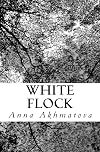
(This book was given to me by the translator, Andrey Kneller, in exchange for a review of my thoughts)
Anna Akhmatova (1889-1966) is intimidating to review. Her work has such gravity that any attempted encapsulation would fail. White Flock is one of her early collections, published in 1917 and so tightly focused on themes of love and the Muse that at first glance it feels removed from the enormous tragedy of the First World War. Only on first glance. There is in fact a strong somberness at show more work here that enjoins you to read between the lines and find evidence of a world gone wrong, while as the collection progresses, references to the war become more regular.
May Snow
A see-through shroud now disperses
And melts unnoticed on the sod.
The spring, so very cold and merciless,
Is killing off each swelling bud.
So frightful of the early death,
That I can’t look at God’s creation.
I feel the grief King David left, -
Millenniums of desolation.
1916
Andrey Kneller is an independent translator and he self-published this bilingual edition of Akhmatova in 2013. It’s a little bit hard for me to comment on his role in White Flock without familiarizing myself with earlier translations (I have only read the Kunitz/Hayward selections prior to this) but he clearly cares a great deal for the text and I found it pleasing to read, though not as impressive as her later works. A large number of the poems (one of the challenges inherent in this review is in her near-complete dispensing with titles – I can’t refer to poems but can only quote them) speak from the vantage point of a woman within whom love has ceased to be requited. An unassailable personage. "Without love, I’m more at ease, I’m sure/The sky is high, the mountain wind is sweeping/And all my thoughts are innocent and pure."
We’re immediately in the ostensibly personal but icily aloof landscapes similarly mapped out by Polish poet Anna Swir, but where Swir’s retreat from the world seemed savage and ironic, Akhmatova projects a deep-seated calm, reserved in the midst of guilts and regrets. In one poem she gives forgiveness to a sick man and he concludes by saying “It’s good that you forgave,/You were not always so nice.” She makes no effort in her writing to seem “nice” – whether affectionate or austere, she stands strong and fortified. It does make it hard for the reader to get close to her… and in real life, her husband Nikolai Gumilev went to the front in 1914 and four years later their strained and dissolving marriage ended in divorce, adding another layer of conflicts and reservations to the poems written here.
Throughout White Flock Akhmatova displays a warm attachment to architecture and landscape. She grew up in Tsarskoye Selo (the town where Pushkin studied at the Lyceum) and viewed poetry almost as an inheritance. Mixing all her themes together, of love, landscape and the Muse, the result has the immediate flavour of “standard” poetry. Understandably, the Kunitz/Hayward selection drew few of its poems from this and her early work. If you want the Akhmatova legend, you have to read her writings from the 20s, 30s and after. However, the elements that went towards her great works began to appear in this volume. Kneller’s decision to use Joseph Brodsky as the back cover blurb was very smart, grounding the book in a critical evolution: “The mechanism designed to keep in check emotions of a romantic nature proved to be as effective when applied to mortal terrors. The latter was increasingly intertwined with the former until they resulted in emotional tautology…”
Of course, this means that White Flock intrigues more within her oeuvre than it does standing alone – though it is peaceful reading, at times with a somber beauty. Her rhymes as translated are sometimes too sing-song for my taste but contain a lilting musicality at other stations:
He was jealous, and anxious, and tender.
And I was like God’s sun to him.
To stop her from singing of the days she remembered,
He killed my white bird on a whim.
Combining so delicate and childlike a rhythm with inexplicable cruelty makes this three-stanza poem one of the most genuinely haunting of the set. The best poems in White Flock resonate with a disciplined, survivalist serenity in the face of growing shadows. "Like sorrow or song in me brooding/in the winter before the war." Love and war become metaphors mirroring one another and her heartfelt pleas present themselves more strongly when the text as a whole is so often reserved.
Prayer
Give me sickness without an end,
Suffocation and fevers prolonged,
Take away both my child and friend,
My mysterious gift of the song -
After mass, thus I’m praying, impassioned,
After so many tormented days,
Let the menacing cloud over Russia
Shimmer brightly in glorious rays.
1915
As for the physical qualities of the book, no problems there. It’s well-bound, reasonably heavy and there’s no question of the cover being ugly or wrongfooted (as often happens in the self-published sphere). A couple of grammatical errors (but no more or less than I’ve found in the NYRB Classic I’m currently reading) and some irrelevant commas are the only things I questioned. Bilingualism is always an appreciated feature where poetry in translation is concerned, so what I most miss in White Flock is a helpful essay (a biographical piece on Akhamatova’s early life and marriage, perhaps) but there is a brief and useful note on translation: "Readers should be wary of [bad translations] as art collectors are wary of forged paintings." That I am so keen for detail on Akhmatova’s life is mostly an indication that I need to buy a biography of this woman.
http://pseudointellectualreviews.wordpress.com/2014/09/13/white-flock-anna-akhma... show less
Anna Akhmatova (1889-1966) is intimidating to review. Her work has such gravity that any attempted encapsulation would fail. White Flock is one of her early collections, published in 1917 and so tightly focused on themes of love and the Muse that at first glance it feels removed from the enormous tragedy of the First World War. Only on first glance. There is in fact a strong somberness at show more work here that enjoins you to read between the lines and find evidence of a world gone wrong, while as the collection progresses, references to the war become more regular.
May Snow
A see-through shroud now disperses
And melts unnoticed on the sod.
The spring, so very cold and merciless,
Is killing off each swelling bud.
So frightful of the early death,
That I can’t look at God’s creation.
I feel the grief King David left, -
Millenniums of desolation.
1916
Andrey Kneller is an independent translator and he self-published this bilingual edition of Akhmatova in 2013. It’s a little bit hard for me to comment on his role in White Flock without familiarizing myself with earlier translations (I have only read the Kunitz/Hayward selections prior to this) but he clearly cares a great deal for the text and I found it pleasing to read, though not as impressive as her later works. A large number of the poems (one of the challenges inherent in this review is in her near-complete dispensing with titles – I can’t refer to poems but can only quote them) speak from the vantage point of a woman within whom love has ceased to be requited. An unassailable personage. "Without love, I’m more at ease, I’m sure/The sky is high, the mountain wind is sweeping/And all my thoughts are innocent and pure."
We’re immediately in the ostensibly personal but icily aloof landscapes similarly mapped out by Polish poet Anna Swir, but where Swir’s retreat from the world seemed savage and ironic, Akhmatova projects a deep-seated calm, reserved in the midst of guilts and regrets. In one poem she gives forgiveness to a sick man and he concludes by saying “It’s good that you forgave,/You were not always so nice.” She makes no effort in her writing to seem “nice” – whether affectionate or austere, she stands strong and fortified. It does make it hard for the reader to get close to her… and in real life, her husband Nikolai Gumilev went to the front in 1914 and four years later their strained and dissolving marriage ended in divorce, adding another layer of conflicts and reservations to the poems written here.
Throughout White Flock Akhmatova displays a warm attachment to architecture and landscape. She grew up in Tsarskoye Selo (the town where Pushkin studied at the Lyceum) and viewed poetry almost as an inheritance. Mixing all her themes together, of love, landscape and the Muse, the result has the immediate flavour of “standard” poetry. Understandably, the Kunitz/Hayward selection drew few of its poems from this and her early work. If you want the Akhmatova legend, you have to read her writings from the 20s, 30s and after. However, the elements that went towards her great works began to appear in this volume. Kneller’s decision to use Joseph Brodsky as the back cover blurb was very smart, grounding the book in a critical evolution: “The mechanism designed to keep in check emotions of a romantic nature proved to be as effective when applied to mortal terrors. The latter was increasingly intertwined with the former until they resulted in emotional tautology…”
Of course, this means that White Flock intrigues more within her oeuvre than it does standing alone – though it is peaceful reading, at times with a somber beauty. Her rhymes as translated are sometimes too sing-song for my taste but contain a lilting musicality at other stations:
He was jealous, and anxious, and tender.
And I was like God’s sun to him.
To stop her from singing of the days she remembered,
He killed my white bird on a whim.
Combining so delicate and childlike a rhythm with inexplicable cruelty makes this three-stanza poem one of the most genuinely haunting of the set. The best poems in White Flock resonate with a disciplined, survivalist serenity in the face of growing shadows. "Like sorrow or song in me brooding/in the winter before the war." Love and war become metaphors mirroring one another and her heartfelt pleas present themselves more strongly when the text as a whole is so often reserved.
Prayer
Give me sickness without an end,
Suffocation and fevers prolonged,
Take away both my child and friend,
My mysterious gift of the song -
After mass, thus I’m praying, impassioned,
After so many tormented days,
Let the menacing cloud over Russia
Shimmer brightly in glorious rays.
1915
As for the physical qualities of the book, no problems there. It’s well-bound, reasonably heavy and there’s no question of the cover being ugly or wrongfooted (as often happens in the self-published sphere). A couple of grammatical errors (but no more or less than I’ve found in the NYRB Classic I’m currently reading) and some irrelevant commas are the only things I questioned. Bilingualism is always an appreciated feature where poetry in translation is concerned, so what I most miss in White Flock is a helpful essay (a biographical piece on Akhamatova’s early life and marriage, perhaps) but there is a brief and useful note on translation: "Readers should be wary of [bad translations] as art collectors are wary of forged paintings." That I am so keen for detail on Akhmatova’s life is mostly an indication that I need to buy a biography of this woman.
http://pseudointellectualreviews.wordpress.com/2014/09/13/white-flock-anna-akhma... show less

Lovely. Stark. Accuracy of the image. Had heard Akhmatova's name before but never read her – the name stuck with me because of who had held a newly-arrived copy in her hand during my bookstore days. Fifteen years or more later I found this slim volume at a book fair, and picked it up as much for that memory as for Akhmatova's name itself.
Twenty short, mostly lyrical love or love-gone-awry poems that can cut the way the winters she describes cut during a deep breath – precise, vital, and show more painful. There's moments when these tiny poems imply the scope and sweep of the Russia, pre- and post-revolution, that we know from Tolstoy and Dostoyevsky and Pasternak, within the intensity of a short, personal cry of love or – and – anguish.
You can read through these poems twice in an hour's time, with extra time for lingering on the best of them. Going back afterwards to Jane Kenyon's introduction (the poet half of the poet-translator team for this book) is well worth it, although I'm glad I waited until after the poems for explanations. But Kenyon's decision to (according to her) sacrifice the perfected meter and form of Akhmatova's poems for the perfected image seemed to fit what I'd just read, and not having time to learn Russian, I'll simply trust her for now, track down more Akhmatova, and see what's translation, what's Akhmatova. For now, I'm glad to have found, read, and written down myself to remember, the final stanza of the poem “Like a white stone in a deep well . . .” (that's the first line - few of these poems have titles):
I remember how the gods turned people
into things, not killing their consciousness.
And now, to keep these glorious sorrows alive,
you have turned into my memory of you. show less
Twenty short, mostly lyrical love or love-gone-awry poems that can cut the way the winters she describes cut during a deep breath – precise, vital, and show more painful. There's moments when these tiny poems imply the scope and sweep of the Russia, pre- and post-revolution, that we know from Tolstoy and Dostoyevsky and Pasternak, within the intensity of a short, personal cry of love or – and – anguish.
You can read through these poems twice in an hour's time, with extra time for lingering on the best of them. Going back afterwards to Jane Kenyon's introduction (the poet half of the poet-translator team for this book) is well worth it, although I'm glad I waited until after the poems for explanations. But Kenyon's decision to (according to her) sacrifice the perfected meter and form of Akhmatova's poems for the perfected image seemed to fit what I'd just read, and not having time to learn Russian, I'll simply trust her for now, track down more Akhmatova, and see what's translation, what's Akhmatova. For now, I'm glad to have found, read, and written down myself to remember, the final stanza of the poem “Like a white stone in a deep well . . .” (that's the first line - few of these poems have titles):
I remember how the gods turned people
into things, not killing their consciousness.
And now, to keep these glorious sorrows alive,
you have turned into my memory of you. show less
Lists
Awards


You May Also Like


Associated Authors
Statistics
- Works
- 236
- Also by
- 21
- Members
- 3,292
- Popularity
- #7,775
- Rating
- 4.1
- Reviews
- 55
- ISBNs
- 263
- Languages
- 21
- Favorited
- 50