
Robert Louis Wilken (1936–2026)
Author of The Spirit of Early Christian Thought: Seeking the Face of God
About the Author
Robert Louis Wilken is William R. Kenan Professor of the History of Christianity Emeritus, University of Virginia. He is the author of many books, including The Christians as the Romans Saw Them, published by Yale University Press.
Series
Works by Robert Louis Wilken
Judaism and the Early Christian Mind: A Study of Cyril of Alexandria's Exegesis and Theology (1971) 43 copies
Early Christian literature and the classical intellectual tradition : in honorem Robert M. Grant (1979) — Editor — 10 copies
Associated Works
Evangelicals and the Early Church: Recovery, Reform, Renewal (Wheaton Center for Early Christian Studies) (2011) — Contributor — 12 copies
The Limits of Ancient Christianity: Essays on Late Antique Thought and Culture in Honor of R. A. Markus (1999) — Contributor — 12 copies
Christians And Christianity in the Holy Land: From the Origins to the Latin Kingdoms (Cultural Encounters in Late Antiqu (2006) — Contributor — 3 copies
Journal of the American Academy of Religion, Winter 1989, Vol. LVII, No. 4 (1989) — Contributor — 2 copies
Tagged
Common Knowledge
- Canonical name
- Wilken, Robert Louis
- Birthdate
- 1936-10-20
- Date of death
- 2026-06-06
- Gender
- male
- Education
- University of Chicago (MA|1961|Ph.D|1963)
Concordia Seminary (BA|1957|BD|1960) - Occupations
- historian
professor
theologian - Organizations
- University of Virginia
University of Notre Dame
Fordham University
Lutheran Theological Seminary at Gettysburg
American Historical Association
American Academy of Religion (show all 8)
American Society of Church History
St Paul Center for Biblical Theology - Awards and honors
- Fellow, American Academy of Arts and Sciences (1996)
- Nationality
- USA
- Birthplace
- New Orleans, Louisiana, USA
- Places of residence
- Charlottesville, Virginia, USA
- Associated Place (for map)
- USA
Members
Reviews
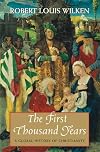
Wilken's book is a shining exemplar of solid, elegantly written historical narrative, accessible to non-scholars. In my mind, it displaces Chadwick as my top recommendation for nonspecialists. One of the things I appreciate is the way Wilken challenges the traditional ancient/medieval periodization by venturing past the fall of the western Roman empire with an extended treatment of the rise of Islam, conversion of the Slavic lands, and much more. He approaches the history of the church as a show more history of cultures and societies as much as it is a history of ideas and beliefs.
Here are some of the topics Wilken highlights that don't get as much attention in traditionally assigned histories:
-Coptic, Nubian, and Ethiopian Christianity
-The Church of the East (and other Syriac-speaking communions)
-Central Asia, India, and China (the spread of Christianity along the Silk Road)
-Christianity under Islam in North Africa, Egypt, and Spain
I recommend this book highly for anyone wanting to learn more about Christianity's first millennium! show less
Here are some of the topics Wilken highlights that don't get as much attention in traditionally assigned histories:
-Coptic, Nubian, and Ethiopian Christianity
-The Church of the East (and other Syriac-speaking communions)
-Central Asia, India, and China (the spread of Christianity along the Silk Road)
-Christianity under Islam in North Africa, Egypt, and Spain
I recommend this book highly for anyone wanting to learn more about Christianity's first millennium! show less

An interesting and very informative perspective of early Christianity as seen through the eyes of various Roman/pagans from the second, third and fourth centuries, AD. From the earliest perspectives (brief correspondence from Pliny the younger to the Emperor Trajan) to the later well-developed critical arguments (by Celsus, Porphyry and the last pagan Emperor Julian) each viewpoint was fascinating.
I would have rated this book higher but for the author's unimaginative, dry writing style.
I would have rated this book higher but for the author's unimaginative, dry writing style.
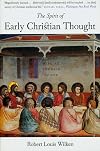
Anyone who has ever tried to dip their toes into the waters of medieval theology can quickly be overwhelmed by its complexities and occasional rank obscurantism. Wilken, much to his credit, knows his subjects so well that he can distill their most important ideas in historical context (especially important as this book covers a period where much of the known world begins as Roman and pagan and ends several centuries later, when both the Empire and its paganism were gone) and explain how they show more were important in the development of Christian intellectual history – all while remaining extraordinarily accessible for the reader with no formal knowledge of patristic theology.
At the heart of the book are two major messages. First, to separate evidence and sensory knowledge from pure faith – very much a temptation for those of us who have been born since the Enlightenment – would have made no sense to the early Church fathers. From the time of Origen and Tertullian, earthly evidence and divine faith were both seen as necessary, and even to feed into one another. Thinking is part of believing, and vice versa. Second, the series of practices that we recognize as early Christianity are undoubtedly social and communal in nature. Wilken stresses over and over again that even the monks would lived in desert confinement for decade after decade, still saw Christianity, at its root, as love for fellow man and community.
The thinkers that he covers are all very important, and range in time from its first couple of centuries to approximately the eighth century, covering the entire harvest of early Christian thought. The most important among them include Justin Martyr, Origen, Clement (and Cyril) of Alexandria, Athanasius, Basil of Caesarea, Ambrose, John Chrysostom, Gregory of Nyssa, Maximus the Confessor – and perhaps the greatest mind the Church has ever known, Saint Augustine. To assist the reader who has minimal familiarity with this rich history of thought, Wilken arranges his discussions topically, with chapter names drawn from an appropriate epigram which opens each chapter. “Founded on the Cross of Christ” discusses how we come to know God, “An Awesome and Unbloody Sacrifice” references worship and the sacraments, and “Seek His Face Always” picks up Trinitarian themes (Trinitarian discussions, as fundamental as they were to early Christology, are not relegated to this one chapter alone). For me, the most fascinating chapters were on a couple of the first Christian poets, and another on importance of the Bible and how the shape and texture of its writing so differed from Greek and Roman literature that it profoundly refigured the ideas of the early fathers.
While the author covers a wide range of topics that are often considered dry, the overall effect of the book comes across as the passionate history of a fascination with the people Wilken writes about. His vim and vigor for the fathers of the early Church is clear and unmistakable, so much so that the historical figures he presents almost seem whitewashed – pure and almost superhuman. His orthodoxy perhaps results in a lack of thorough criticism on some points where it would have been welcome. However, if you’re looking for critical responses to the fathers, these should not be difficult to find. However, as pure contemporary apology for a centuries-old intellectual tradition, this book stands above many others I have read. show less
At the heart of the book are two major messages. First, to separate evidence and sensory knowledge from pure faith – very much a temptation for those of us who have been born since the Enlightenment – would have made no sense to the early Church fathers. From the time of Origen and Tertullian, earthly evidence and divine faith were both seen as necessary, and even to feed into one another. Thinking is part of believing, and vice versa. Second, the series of practices that we recognize as early Christianity are undoubtedly social and communal in nature. Wilken stresses over and over again that even the monks would lived in desert confinement for decade after decade, still saw Christianity, at its root, as love for fellow man and community.
The thinkers that he covers are all very important, and range in time from its first couple of centuries to approximately the eighth century, covering the entire harvest of early Christian thought. The most important among them include Justin Martyr, Origen, Clement (and Cyril) of Alexandria, Athanasius, Basil of Caesarea, Ambrose, John Chrysostom, Gregory of Nyssa, Maximus the Confessor – and perhaps the greatest mind the Church has ever known, Saint Augustine. To assist the reader who has minimal familiarity with this rich history of thought, Wilken arranges his discussions topically, with chapter names drawn from an appropriate epigram which opens each chapter. “Founded on the Cross of Christ” discusses how we come to know God, “An Awesome and Unbloody Sacrifice” references worship and the sacraments, and “Seek His Face Always” picks up Trinitarian themes (Trinitarian discussions, as fundamental as they were to early Christology, are not relegated to this one chapter alone). For me, the most fascinating chapters were on a couple of the first Christian poets, and another on importance of the Bible and how the shape and texture of its writing so differed from Greek and Roman literature that it profoundly refigured the ideas of the early fathers.
While the author covers a wide range of topics that are often considered dry, the overall effect of the book comes across as the passionate history of a fascination with the people Wilken writes about. His vim and vigor for the fathers of the early Church is clear and unmistakable, so much so that the historical figures he presents almost seem whitewashed – pure and almost superhuman. His orthodoxy perhaps results in a lack of thorough criticism on some points where it would have been welcome. However, if you’re looking for critical responses to the fathers, these should not be difficult to find. However, as pure contemporary apology for a centuries-old intellectual tradition, this book stands above many others I have read. show less
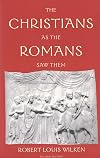
A well-written account of Roman arguments against Christianity from the 2nd century to the 4th. It's not a history of Roman attitudes in general but a literary analysis of the works of Pliny, Galen, Celsus, Porphyry and Julian which touch upon christianity. Sadly (but not surprisingly) the story is built on fragmentary evidence since none of the original works survived to the present day. Compared to other books that I've read on ancient greek and roman literature this one is quite lively show more and it also says more about the social context of this literature than most other books manage to do. show less
Awards

You May Also Like


Associated Authors
Statistics
- Works
- 26
- Also by
- 9
- Members
- 3,068
- Popularity
- #8,321
- Rating
- 4.0
- Reviews
- 19
- ISBNs
- 47
- Languages
- 4
- Favorited
- 1