
Julian E. Zelizer
Author of Myth America: Historians Take On the Biggest Legends and Lies About Our Past
About the Author
Julian E. Zelizer is professor of history and public affairs at Princeton University. His most recent books include Jimmy Carter, Arsenal of Democracy, and The Presidency of George W. Bush (Princeton). He writes a weekly column for CNN.com and Politico and has written for the New York Times, the show more Washington Post, and many other publications. show less
Works by Julian E. Zelizer
Myth America: Historians Take On the Biggest Legends and Lies About Our Past (2022) — Editor; Contributor — 284 copies, 5 reviews
Burning Down the House: Newt Gingrich, the Fall of a Speaker, and the Rise of the New Republican Party (2020) 119 copies, 5 reviews
The Fierce Urgency of Now: Lyndon Johnson, Congress, and the Battle for the Great Society (2015) 92 copies, 1 review
Arsenal of Democracy: The Politics of National Security from World War II to the War on Terrorism (2010) 70 copies
The Democratic Experiment: New Directions in American Political History (2003) — Editor; Contributor — 31 copies
Conservatives in Power: The Reagan Years, 1981-1989: A Brief History with Documents (2011) 19 copies
Associated Works
Report of the National Advisory Commission on Civil Disorders (1968) — Introduction, some editions — 359 copies, 1 review
Upon Further Review: The Greatest What-Ifs in Sports History (2018) — Contributor — 50 copies, 2 reviews
Tagged
Common Knowledge
- Birthdate
- 1969-12-06
- Gender
- male
- Education
- Johns Hopkins University (Ph.D.)
Brandeis University (B.A.) - Occupations
- historian
university professor - Organizations
- Princeton University
- Agent
- Scott Moyers
- Nationality
- USA
- Associated Place (for map)
- USA
Members
Reviews
Burning Down the House: Newt Gingrich, the Fall of a Speaker, and the Rise of the New Republican Party by Julian E. Zelizer
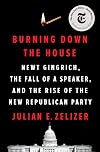
I have maintained for more than 25 years that Reagan started the modern partisan divide and Gingrich codified it (and as more fallout from that came, I've added that Rove and Ailes perfected it; and T benefited). So when this came across my email feed last year through NetGalley, I requested a review copy. But, the request was sadly to me, declined, so I put it on my To Read list. I got a surprising email near the end of April offering it to me (from the publisher Penguin Group, again show more through NetGalley), so off the To Read and immediately on to Currently Reading! (And obviously, now Read.)
This is an in-depth look at where it began and how Gingrich machiavellied it. One might say "engineered", but I am an engineer and that's insulting, so I coined a new word. And the book is largely focused on the subject of the subtitle - taking down Speaker Jim Wright. Gingrich hardly is mentioned in more than half of the book, as Zelizer relates the complexities of the times and the histories of the event. He gives the well-researched background histories of the players in the grand game, Gingrich and Wright, obviously, but also the others who facilitated the coup or were victims of it. And from my armchair, we are all victims. Zelizer hits it in his Prologue
Zelizer sums it well:
Note on my notes: My ADE e-reader allows me to highlight and make notes, but not copy quotes, so I'm going to have to be economical with which ones I'll include here because I have to type the quotes by hand and I have more books to read!
Selected observations:
In 1976,
On the censure of Congressman Charles Diggs in 1979, a staffer for the NRCC noted
Some of that background history
Crystal ball:
In 1982, Gingrich wrote to his "fellow Republicans" of the need to develop a coordinated message.
Gingrich though bipartisanship was a political trap that only benefited Democrats. Thinking on that, I can't argue.
On muckraker Jack Anderson, who wrote an attack column on Wright titled "SHOOTING AT FISH IN THE PORK BARREL"
On a procedural power play that Wright maneuvered for a vote on a deficit reduction bill, there were many temper tantrums by the Rs, and
On congressional accountability,
In 1988, Michael Dukakis got a lot of mileage from (the at-the-time the worst presidency ever, my opinion):
Then there were The Words...
In his penultimate chapter titled "Gingrich on Top", Zelizer finally called the wrongwing for what they are: "Gingrich and his ilk had been emboldened." In his Wright's response in his step-down speech, Wright urged both parties to 'bring this period of mindless cannibalism to an end!'" Thirty one years later, I still do not think we will see that in my lifetime. Zelizer notes "Once politicians lowered the bar as to what kinds of actions were permissible in the political arena, it was virtually impossible to restore conditions to where they had been."
And we come to the codification of the lowered bar...
In the next to last paragraph of his concluding chapter "Mindless Cannibalism", Zelizer quotes President Obama...
The fires Gingrich started still burn. If his part-time belief in a hell has any truth, his ticket was punched long ago. show less
This is an in-depth look at where it began and how Gingrich machiavellied it. One might say "engineered", but I am an engineer and that's insulting, so I coined a new word. And the book is largely focused on the subject of the subtitle - taking down Speaker Jim Wright. Gingrich hardly is mentioned in more than half of the book, as Zelizer relates the complexities of the times and the histories of the event. He gives the well-researched background histories of the players in the grand game, Gingrich and Wright, obviously, but also the others who facilitated the coup or were victims of it. And from my armchair, we are all victims. Zelizer hits it in his Prologue
...the unlikely, unorthodox, nativist populist campaign trump had mounted, which aimed to tear down the political leaders of both parties and to destabilize the entire U.S. political system, was Gingrich's creation.Zelizer notes that Gingrich recognized that politics in the modern media was "as much about perception as substance" (I'll submit less about substance,or actual substance, anyway). He says "The way journalists framed a story and the narratives they crafted about an issue could be as powerful as the facts." I long for the time when good journalism was about facts. That word doesn't mean what it used to mean.
Zelizer sums it well:
The new GOP goal was not to negotiate or legislate but to do everything necessary to maintain partisan power. If it was politically useful to engage in behavior that could destroy the possibility of governance, which rendered bipartisanship impossible and would unfairly decimate their opponents' reputation, the so be it.They've been obstructing, destroying, and doing that anything to maintain power since. No legislation, no governing. And Gingrich played a huge role in creating the unculture to which we are subjected. Zelizer says what I've been saying since T broke through: "Gingrich planted; Trump reaped." And his theme: "We can date precisely the moment when our toxic political environment was born: Speaker Wright's downfall in 1989."
Note on my notes: My ADE e-reader allows me to highlight and make notes, but not copy quotes, so I'm going to have to be economical with which ones I'll include here because I have to type the quotes by hand and I have more books to read!
Selected observations:
In 1976,
"Our legislative system," Gingrich insisted with his attention turned toward Capitol Hill, "has become morally, intellectually, and spiritually corrupt."Like evangelicals and too many of his party, to Gingrich, morals were what other people needed.
On the censure of Congressman Charles Diggs in 1979, a staffer for the NRCC noted
An A.P. reporter who covered Newt and another freshman in 1979 told him last week that there are about six Representatives whose phone numbers reporters know by heart, and Newt's was one of them - because they thought Newt understood what was happening and would play it straight with the press.Straight...really? Oh how that was both so wrong and portentous.
Some of that background history
Reagan's election had only been possible after fifteen years of a brewing political backlash toward the Democratic embrace of civil rights in 1964 and 1965 - as President Johnson had famously predicted - finally allowed the GOP to start dominating the South.Zelizer nails it again here.
Crystal ball:
It all came down to this: for republicans to dislodge House Democrats from power, they would have to be ruthless. Democrats didn't play fair, Gingrich believed. He said that incumbents rigged elections through gerrymandering and campaign money; they relied on arcane procedures, such as imposing rules that prevented floor amendments to bills, that disempowered the minority party; and they solidified their public support through corrupt pork-barrel spending and favors for business leaders in their districts.Wow. Fast forward 15 and 30 years. Who's been gerrymandering and reaping the campaign money?
In 1982, Gingrich wrote to his "fellow Republicans" of the need to develop a coordinated message.
After reviewing twelve Sunday television interview shows, Gingrich came away impressed by how much attention congressional Democrats devoted to perfecting and repeating their message. Republicans were far less polished, Gingrich thought. "A political party which focuses on the management and allocation of campaign resources, and neglects political strategy, is a party that loses, "Gingrich warned. "Two minutes on the evening news is watched by more people, believed by more people, and, politically has a greater multiplier effect than paid political advertising."Fast forward again...D messages are not polished, not consistent; Rs on the other hand... Of course it helps to have your own Pravda...
Gingrich though bipartisanship was a political trap that only benefited Democrats. Thinking on that, I can't argue.
On muckraker Jack Anderson, who wrote an attack column on Wright titled "SHOOTING AT FISH IN THE PORK BARREL"
Wright resented the piece, which he insisted was based on a fabricated account of the conversation [of a Public Works Committee secret session]. "The Anderson treatment," Wright noted to himself, "is so typical of the growing irresponsibility of sensational 'expose' type journalism that increasingly appalls, angers and even frightens a lot of conscientious public officials."What was to become the blueprint for Fox.
On a procedural power play that Wright maneuvered for a vote on a deficit reduction bill, there were many temper tantrums by the Rs, and
Dick Cheney growled to the National Journal that the Speaker had proven he was a "heavy-handed son of a bitch"Pot, meet kettle. Kettle,,,pot. Really?
On congressional accountability,
Without these reformers [reform-oriented institutions], Gingrich looked as if he were orchestrating a shabby partisan coup. They would offer reluctant Republicans the cover they needed to get behind him. This would be his masterstroke, and it would capitalize on the Democrats' shortsightedness.I've observed that shortsightedness for more than 30 years... On the flipside of today, George Mair, former reporter and Wright's chief press officer in late 1987, attacked journalists and editors of U.S. News & World Report, The Wall Street Journal, Newsweek, Los Angeles Times for their slander, innuendo, poor research, flat-out incorrectness, ...
Directly attacking the press was a dangerous strategy. They had a big platform from which to respond. And they did. The editors of these powerful publications were not going to sit quietly by as Mair delivered these reprimands and smeared the reputations of their top journalists. So, the editors exposed Mair's campaign by speaking to reporters. The story looked to many Americans like an effort to intimidate and harass honest journalists investigating potential corruption.Well, damn... like some procedural reforms that backfired on them, they set the stage up for the other guys. T and ilk lowered the bar to the mind-numbing nadir it is today (I recommend Jim Acosta's book, The Enemy of the People: A Dangerous Time to Tell the Truth in America.)
In 1988, Michael Dukakis got a lot of mileage from (the at-the-time the worst presidency ever, my opinion):
The opinion that Reagan had run the "most corrupt administration" in American history was prevalent in Democratic circles.Surpassed as another #1 by the 2017 administration, likely to never be broken. Another way the Ds started something that the Rs perfected:
The House Ethics Committee had earned a bad reputation since its creation in 1967. The solution for previous chairmen of this panel, like John Flynt, had been to do nothing when a complaint was made. With Democrats in perpetual control of the House, Republicans saw the committee as one more example of how the opposition abused their power to protect its own members, regardless of the sordid behavior that ethics investigations turned up.Like I said, the Rs became masters of this. Another stage-setter, on the promotion of Gingrich's book, Window of Opportunity,
The COS [Conservative Opportunity Society] Limited Partnership, as Gingrich called it, raised $105,000 in 1984. Each partner contributed $5,000 to the fund. The goal, Gingrich genially acknowledged to a reporter, was a half-baked plan to "force a best-seller", which would of course enhance Gingrich's public standing.Hardly a blink when Jr. did it 34 years later.
Then there were The Words...
Still, legislation remained a secondary concern for Gingrich, who spent most of his first month as minority whip selling his message to reporters. He tested out catchphrases such as the "looney left" to describe Democrats to the press. One of his favorite terms was "institutional corruption,"...Where Gingrich crafted the narrative, T lowered it to a juvenile level. Journalists suffer greatly now. And as to journalism, the unwitting complicity...
Good government organizations and mainstream reporters, not always thinking about how they might be playing into a concerted partisan attack, had moved the investigation [of Wright] forward on their own terms, finding time after time smoke that looked like fire.As they did in the election of 2000 and since...And on the ethics hearing,
What bothered Democrats most was that Wright's team did not seem to understand the most fundamental point: a technical defense would not work in such a highly politicized environment.Neither would it work in the impeachment of 2020.
In his penultimate chapter titled "Gingrich on Top", Zelizer finally called the wrongwing for what they are: "Gingrich and his ilk had been emboldened." In his Wright's response in his step-down speech, Wright urged both parties to 'bring this period of mindless cannibalism to an end!'" Thirty one years later, I still do not think we will see that in my lifetime. Zelizer notes "Once politicians lowered the bar as to what kinds of actions were permissible in the political arena, it was virtually impossible to restore conditions to where they had been."
And we come to the codification of the lowered bar...
The gospel of Gingrich kept spreading. He literally shared his rhetorical style through a GOPAC pamphlet first distributed in 1990, titled "Language: A Key Mechanism of Control," which he crafted with the pollster Frank Luntz, that offered a road map to replicate his way with words. Responding to Republican candidates who, GOPAC said, had told them, "I wish I could speak like newt," the memo recommended using certain words repeatedly like "corruption," "traitors," "sick," "radical," "shame," "pathetic," "steal," and "lie" to describe the Democrats.This has continued to this day, only getting worse. Gingrich found himself a victim, reaping what he sowed when he was the first Speaker in history to be punished for ethics violations.
In the next to last paragraph of his concluding chapter "Mindless Cannibalism", Zelizer quotes President Obama...
We've seen this coming. Donald Trump is not an outlier; he is a culmination, a logical conclusion of the rhetoric and tactics of the Republican Party for the past ten, fifteen, twenty years. What surprised me was the degree to which those tactics and rhetoric completely jumped the rails. There were no governing principles, there was no one to say, 'No, this is going too far, this isn't what we stand for.' But we've seen it for eight years, even with the reasonable people like John Boehner, who, when push came to shove, wouldn't push back against these currents.Spot on, Mr. President.
The fires Gingrich started still burn. If his part-time belief in a hell has any truth, his ticket was punched long ago. show less
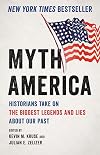
Amateur history written by non-historians with obvious and blatant political bias might just be the most socially harmful genre of writing in existence. This is history at its worst; oversimplified accounts with conclusions established ahead of time and facts either ignored or invented to support the desired interpretation.
Although it is true that historical facts and events often lend themselves to varying interpretations, it is also true that there exists a rich literature of research from show more credible professionals that limit the scope of reasonable interpretations in history.
It is only when non-specialists deviate from this consensus—often for what are clearly political motivations—that serious problems arise, and, unfortunately, we see this most often and most egregiously from the political right. Many conservatives have become so disconnected from reality that the only possible way to compete in the marketplace of ideas more broadly—and historical writing more specifically—is to cast doubt on legitimate institutions of learning, research, and communication. It’s no surprise, then, that universities, the media, and the institutions of science itself have all come under attack. For those on the right, conservatives aren’t crazy; EVERYONE ELSE is part of some vast global conspiracy.
A good example of blatant conservative political bias was President Trump’s 1776 Commission, which promised a version of history that would enable “patriotic education.” The only problem: the authors of the final “1776 report” included NO American historians. This is like creating a task force to study a particular disease or disorder and recruiting a team that lacks a single medical doctor—opting instead for non-licensed homeopathic healers.
That’s why Myth America is so critical for people to read; it’s a collection of essays from actual historians—i.e., people who know what they’re talking about because they’ve spent their entire lives studying historical sources, not having propaganda pieces ghost-written for them—debunking common myths spread largely by non-historians. It’s an opportunity to actually learn about the complexities of history that may or may not align with your preconceived beliefs.
What is so striking about the essays might be the fact that modern conservative arguments—consisting largely of conspiracy- and fear-mongering and blatant xenophobia and racism—are nothing new. The names and targets have changed, but the plot is the same.
In the 19th century, for example, it was Irish Catholics that triggered conservative fear and resentment; in the 20th century, it was Asians and Eastern Europeans; and in the 21st century, Muslims and Mexicans. So while many people celebrate the US as a “country of immigrants” and welcome the benefits of a diverse population, there has always been an undercurrent of racism and xenophobia that has largely defined American conservatism. These essays make this inescapable fact abundantly clear.
Several other conservative myths circulate among the less-informed or hyper-partisan. Myths such as: the US is not a democracy; the New Deal and Great Society were failures; the Civil War was not primarily fought over slavery; Confederate monuments are not primarily about the celebration of white supremacy; socialism is un-American; free enterprise is part of the Constitution; free markets can solve all problems; and voter fraud is not imaginary.
Instead, you’ll learn things like:
- The history of socialism in the US, and the socialists that campaigned strongly for changes, are largely responsible for progressive policies such as women’s suffrage, the minimum wage, workplace safety and overtime laws, expanded health insurance, and civil rights. Once considered radical ideas, who would dare call for these policies to be reversed now?
- Policies like Social Security and Medicare, while initially labeled as “socialist” and “un-American” by conservatives, turned out to be among the nation’s most popular policies no politician would now dare touch.
- There are countless historical sources showing that Confederate monuments were erected specifically to promote the continuation of white supremecist ideology.
- In surveys, two-thirds of borderland residents (along the US/Mexico border) reported that they “absolutely” did not want Trump’s wall to get built, while another 10 percent thought that it “probably” should not get built.
- The argument that World War II ended the Depression is an argument that the New Deal should have been BIGGER. It was federal spending during the war that stimulated the economy, so as the author wrote, “If federally created jobs building tanks and airplanes could wipe out the Depression, so could federally created jobs building schools and roads.”
- Ronald Reagan famously said, “Lyndon Johnson declared war on poverty, and poverty won,” in reference to LBJ’s Great Society program. But here’s the thing: as the author states, “Even without accounting for near-cash assistance, the national poverty rate declined from 20 percent to 12 percent under LBJ’s watch.” The number never moved under Reagan. This shows how easy it is to spread myths through soundbites that have nothing to do with reality.
- Claims of voter fraud are not only unfounded, but thinly-veiled guises to institute voter suppression laws, of which there is a rich history in the US. True to form, conservatives cast blame on others for what they themselves are doing; voter fraud is an issue only insofar as Republicans try to decrease voter turnout. Voter fraud in the form claimed by conservatives is imaginary; as GOP attorney Benjamin Ginsberg, who had spent four decades litigating election cases for the Republicans, admitted, “proof of systematic fraud has become the Loch Ness Monster of the Republican Party. People have spent a lot of time looking for it, but it doesn’t exist.” A federal judge also called Trump’s claims of rampant voter fraud to be based on “levels of hearsay” so “speculative” as to be “fantastical.”
You will learn all of this and much more across 20 deeply researched essays from specialists in each area.
This is not to say that the book is without problems, however. It would have been nice, for instance, to have a short bio of each author and their specializations as an intro to each essay. The quality of the essays also vary, with some more persuasive, well-researched, or balanced than others. There’s also the possibility that those more versed in history will view some of these myths as so idiotic as to not be worth refuting. But, unfortunately, these are not straw man arguments; these are things conservatives actually believe.
Overall, while the execution might not be perfect, this is just the book we need to start fighting back against dangerous far-right conservative mythology, which has been and always will be nothing more than a clever guise for racism, xenophobia, and the preservation of income inequality under the name of “election integrity,” “America first,” or “state rights.” show less
Although it is true that historical facts and events often lend themselves to varying interpretations, it is also true that there exists a rich literature of research from show more credible professionals that limit the scope of reasonable interpretations in history.
It is only when non-specialists deviate from this consensus—often for what are clearly political motivations—that serious problems arise, and, unfortunately, we see this most often and most egregiously from the political right. Many conservatives have become so disconnected from reality that the only possible way to compete in the marketplace of ideas more broadly—and historical writing more specifically—is to cast doubt on legitimate institutions of learning, research, and communication. It’s no surprise, then, that universities, the media, and the institutions of science itself have all come under attack. For those on the right, conservatives aren’t crazy; EVERYONE ELSE is part of some vast global conspiracy.
A good example of blatant conservative political bias was President Trump’s 1776 Commission, which promised a version of history that would enable “patriotic education.” The only problem: the authors of the final “1776 report” included NO American historians. This is like creating a task force to study a particular disease or disorder and recruiting a team that lacks a single medical doctor—opting instead for non-licensed homeopathic healers.
That’s why Myth America is so critical for people to read; it’s a collection of essays from actual historians—i.e., people who know what they’re talking about because they’ve spent their entire lives studying historical sources, not having propaganda pieces ghost-written for them—debunking common myths spread largely by non-historians. It’s an opportunity to actually learn about the complexities of history that may or may not align with your preconceived beliefs.
What is so striking about the essays might be the fact that modern conservative arguments—consisting largely of conspiracy- and fear-mongering and blatant xenophobia and racism—are nothing new. The names and targets have changed, but the plot is the same.
In the 19th century, for example, it was Irish Catholics that triggered conservative fear and resentment; in the 20th century, it was Asians and Eastern Europeans; and in the 21st century, Muslims and Mexicans. So while many people celebrate the US as a “country of immigrants” and welcome the benefits of a diverse population, there has always been an undercurrent of racism and xenophobia that has largely defined American conservatism. These essays make this inescapable fact abundantly clear.
Several other conservative myths circulate among the less-informed or hyper-partisan. Myths such as: the US is not a democracy; the New Deal and Great Society were failures; the Civil War was not primarily fought over slavery; Confederate monuments are not primarily about the celebration of white supremacy; socialism is un-American; free enterprise is part of the Constitution; free markets can solve all problems; and voter fraud is not imaginary.
Instead, you’ll learn things like:
- The history of socialism in the US, and the socialists that campaigned strongly for changes, are largely responsible for progressive policies such as women’s suffrage, the minimum wage, workplace safety and overtime laws, expanded health insurance, and civil rights. Once considered radical ideas, who would dare call for these policies to be reversed now?
- Policies like Social Security and Medicare, while initially labeled as “socialist” and “un-American” by conservatives, turned out to be among the nation’s most popular policies no politician would now dare touch.
- There are countless historical sources showing that Confederate monuments were erected specifically to promote the continuation of white supremecist ideology.
- In surveys, two-thirds of borderland residents (along the US/Mexico border) reported that they “absolutely” did not want Trump’s wall to get built, while another 10 percent thought that it “probably” should not get built.
- The argument that World War II ended the Depression is an argument that the New Deal should have been BIGGER. It was federal spending during the war that stimulated the economy, so as the author wrote, “If federally created jobs building tanks and airplanes could wipe out the Depression, so could federally created jobs building schools and roads.”
- Ronald Reagan famously said, “Lyndon Johnson declared war on poverty, and poverty won,” in reference to LBJ’s Great Society program. But here’s the thing: as the author states, “Even without accounting for near-cash assistance, the national poverty rate declined from 20 percent to 12 percent under LBJ’s watch.” The number never moved under Reagan. This shows how easy it is to spread myths through soundbites that have nothing to do with reality.
- Claims of voter fraud are not only unfounded, but thinly-veiled guises to institute voter suppression laws, of which there is a rich history in the US. True to form, conservatives cast blame on others for what they themselves are doing; voter fraud is an issue only insofar as Republicans try to decrease voter turnout. Voter fraud in the form claimed by conservatives is imaginary; as GOP attorney Benjamin Ginsberg, who had spent four decades litigating election cases for the Republicans, admitted, “proof of systematic fraud has become the Loch Ness Monster of the Republican Party. People have spent a lot of time looking for it, but it doesn’t exist.” A federal judge also called Trump’s claims of rampant voter fraud to be based on “levels of hearsay” so “speculative” as to be “fantastical.”
You will learn all of this and much more across 20 deeply researched essays from specialists in each area.
This is not to say that the book is without problems, however. It would have been nice, for instance, to have a short bio of each author and their specializations as an intro to each essay. The quality of the essays also vary, with some more persuasive, well-researched, or balanced than others. There’s also the possibility that those more versed in history will view some of these myths as so idiotic as to not be worth refuting. But, unfortunately, these are not straw man arguments; these are things conservatives actually believe.
Overall, while the execution might not be perfect, this is just the book we need to start fighting back against dangerous far-right conservative mythology, which has been and always will be nothing more than a clever guise for racism, xenophobia, and the preservation of income inequality under the name of “election integrity,” “America first,” or “state rights.” show less
June 17, 1972.
It was the day of my marriage. By our first anniversary, the date had another meaning: the date of the Watergate break-in.
As a girl, I had seen America come together with the assassination of President Kennedy and divide over the war in Viet Nam. The sounds of my teenage years were the chants of "Hey, hey, LBJ, how many kids did you kill today," and the music of Woodstock.
I finished my education, worked, had a child, sent him to college, saw him settle in work and a house, and show more retired against the backdrop of a further dividing America.
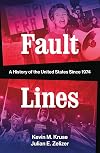
Fault Lines condenses history into paragraphs, each event eliciting a memory. I remembered it all. And the more I read the angrier I became.
In under 400 pages, Kevin M. Kruse and Justin E. Zelizer have compacted American political, social, and media history into a readable narrative.
Movements arose demanding equal rights while counter-movements strove to maintain the status quo--the authority of white males. The conflict has not resolved to a Hegelian shift to the center though, just a rising antagonism and deepening divide.
They describe how cultural shifts and disturbances impacted film and television and how the rise of the Internet and cable news shattered the common ground of national news.
For me, it was a condensation of memories. I had to wonder how a younger reader would respond. The authors are historians and Princeton University professors. They have taught this history to students.
This is a history book and not an offering of solutions; there are plenty of current books that address where to go from here. The authors state that the challenge is to "harness the intense energy that now drives us apart and channel it once again toward creating new and stronger bridges that can bring us together."
But so far, those leaders who endeavored to bridge the gap and pledge bipartisanship failed. There is no indication that the old fashioned values cherished in the past--working together for the common good, obeying the rule of law and custom, communicating, finding common ground--are reemerging. Instead, political leaders are ignoring the will of the majority, engineering ways to disenfranchise groups, with special interest group money buying political clout.
We are told that by knowing the past we can plan for the future, understanding our errors we can proactively prevent the repetition of those errors. I know that America has gone astray many times in our brief history, and the countering movements arighted our ship of state. It is my 'glass half full' hope.
I received an ARC from the publisher. My review is fair and unbiased. show less
It was the day of my marriage. By our first anniversary, the date had another meaning: the date of the Watergate break-in.
As a girl, I had seen America come together with the assassination of President Kennedy and divide over the war in Viet Nam. The sounds of my teenage years were the chants of "Hey, hey, LBJ, how many kids did you kill today," and the music of Woodstock.
I finished my education, worked, had a child, sent him to college, saw him settle in work and a house, and show more retired against the backdrop of a further dividing America.
Fault Lines condenses history into paragraphs, each event eliciting a memory. I remembered it all. And the more I read the angrier I became.
In under 400 pages, Kevin M. Kruse and Justin E. Zelizer have compacted American political, social, and media history into a readable narrative.
Movements arose demanding equal rights while counter-movements strove to maintain the status quo--the authority of white males. The conflict has not resolved to a Hegelian shift to the center though, just a rising antagonism and deepening divide.
They describe how cultural shifts and disturbances impacted film and television and how the rise of the Internet and cable news shattered the common ground of national news.
For me, it was a condensation of memories. I had to wonder how a younger reader would respond. The authors are historians and Princeton University professors. They have taught this history to students.
This is a history book and not an offering of solutions; there are plenty of current books that address where to go from here. The authors state that the challenge is to "harness the intense energy that now drives us apart and channel it once again toward creating new and stronger bridges that can bring us together."
But so far, those leaders who endeavored to bridge the gap and pledge bipartisanship failed. There is no indication that the old fashioned values cherished in the past--working together for the common good, obeying the rule of law and custom, communicating, finding common ground--are reemerging. Instead, political leaders are ignoring the will of the majority, engineering ways to disenfranchise groups, with special interest group money buying political clout.
We are told that by knowing the past we can plan for the future, understanding our errors we can proactively prevent the repetition of those errors. I know that America has gone astray many times in our brief history, and the countering movements arighted our ship of state. It is my 'glass half full' hope.
I received an ARC from the publisher. My review is fair and unbiased. show less

This account of the Carter presidency begins and ends by saying nice things about Carter, which meseems are belied by the book's main focus, which is on Carter's fraught relationship with his own party. Carter came to Washington fixed with a stubborn determination to break congressional old bulls such as Jack Brooks, Thos. O'Neill, and Edward Kennedy. Although he won some legislative victories, especially at first, he made enemies who eventually came back to haunt him, especially with show more Kennedy, who challenged him for the 1980 nomination, turned that convention into a gigantic Kennedy rally despite not having enough votes to attain the nomination, and, perhaps most crucially, when Carter's briefing book for his debate with Republican Dutch Reagan turned up in the Republican camp, it seems to have been the work of a vindictive Kennedy staffer. O'Neill even made a point of calling a Carter aide on election night and said, "You guys came in as jerks, and you're going out as jerks" when Carter conceded before the West Coast polls had closed. Meanwhile, Carter had also alienated many if not most groups of the traditional Democratic coalition who turned apathetic if not hostile to his re-election campaign. The book is very readable throughout most of its length, with its laser focus on the politics of the campaigns and his battles with Congress, but ends unfortunately with an uninteresting, longish coda on Carter's post-presidential humanitarian and diplomatic endeavors. show less
Lists
Awards


You May Also Like


Associated Authors
Statistics
- Works
- 21
- Also by
- 2
- Members
- 1,222
- Popularity
- #21,016
- Rating
- 3.7
- Reviews
- 21
- ISBNs
- 65