
William K. Hartmann
Author of The Grand Tour: A Traveler's Guide to the Solar System
About the Author
William K. Hartmann tells a true-life adventure story that recounts the shared history of the United States and Mexico, unveiling episodes both tragic and uplifting. Hernan Corts, Montezuma, Francisco Vzquez de Coronado, and Viceroy Antonio Mendoza are just some of the principal eyewitnesses in show more this vivid history of New World exploration. show less
Works by William K. Hartmann
Associated Works
Tagged
Common Knowledge
- Canonical name
- Hartmann, William K.
- Legal name
- Hartmann, William Kenneth
- Other names
- Hartmann, W. K.
- Birthdate
- 1939-06-06
- Gender
- male
- Education
- Pennsylvania State University (BS|Physics)
University of Arizona (MS|Geology)
University of Arizona (PhD|Astronomy) - Occupations
- planetary scientist
author
writer
space artist
illustrator - Organizations
- Planetary Science Institute
Mars Global Surveyor Imaging Team
International Association of Astronomical Artists
Condon Committee
American Association for the Advancement of Science
International Academy of Astronautics - Awards and honors
- Carl Sagan Medal (1997)
Asteroid Namesake "3341 Hartmann"
Nininger Meteorite Award (1996)
Runcorn-Florensky Medal (2002)
Lucien Rudaux Memorial Award (2002)
G.K. Gilbert Award (2004) (show all 7)
Barringer Medal (2010) - Nationality
- USA
- Birthplace
- New Kensington, Pennsylvania, USA
- Associated Place (for map)
- Pennsylvania, USA
Members
Reviews

The Grand Tour is one of my favourite books on astronomy. It's an introduction to our solar system, and is somewhat unconventional as it does not list the planets in order of their distance from the Sun, but rather in order of size, starting with Jupiter. This arrangement reveals the solar system to be far more complex and interesting than the eight or nine planets we all learned in elementary school - and makes obvious the fact that the moons Ganymede and Titan are both larger than the show more planet Mercury, something that surprised me a bit! While the larger planets and satellites are the most interesting and diverse, even the smaller objects, which may at first glance appear to be little more than cratered rocks, can tell us much about the history of our solar system and our place in it. Miller and Hartmann's imaginative illustrations really make this book stand out, as they help to give each planet and satellite a personality and help the reader imagine what it would be like to walk on the surface of another world. I highly recommend this book, especially for a young person interested in astronomy or for anyone who doesn't want a book that is too technical or intimidating. show less

This 1990 book celebrates the work of astronomical artists from West and East (the packaging talks about it being 'Soviet/American', but the Western artists include the UK's own David Hardy, and within a very short time of publication, the Soviet Union itself would come to an end). It came about following the creation of the International Association for the Astronomical Arts and their being approached by the Soviet Union of Artists to participate in their celebration of the thirtieth show more anniversary of Sputnik I.
The book notes that American artists tend to approach their subject empirically, whereas the Soviet artists, much to the surprise of some, had a more symbolic, even spiritual approach. The western writers were not aware of the historical role of the Russian 'Cosmism' movement, which sought to place humankind in its proper place in the cosmos from a philosophical and spiritual viewpoint. Cosmism arose in the early 20th Century, and was encouraged by the Bolsheviks for making a break with Western materialism and encouraging scientific progress through collective effort. Although not acknowledged by the Soviet artists in this book, it nonetheless remains a potent theme in many of the works shown from Russian artists.
The book includes essays and work from two highly notable space artists who have also flown in space: Alexei Leonov, the first man to walk in space, and Alan Bean, who landed on the Moon on the Apollo 12 mission. show less
The book notes that American artists tend to approach their subject empirically, whereas the Soviet artists, much to the surprise of some, had a more symbolic, even spiritual approach. The western writers were not aware of the historical role of the Russian 'Cosmism' movement, which sought to place humankind in its proper place in the cosmos from a philosophical and spiritual viewpoint. Cosmism arose in the early 20th Century, and was encouraged by the Bolsheviks for making a break with Western materialism and encouraging scientific progress through collective effort. Although not acknowledged by the Soviet artists in this book, it nonetheless remains a potent theme in many of the works shown from Russian artists.
The book includes essays and work from two highly notable space artists who have also flown in space: Alexei Leonov, the first man to walk in space, and Alan Bean, who landed on the Moon on the Apollo 12 mission. show less
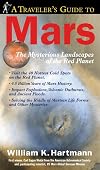
I bought this book primarily because I am a science fiction author and have even placed a few of my stories on Mars. I thought having a book that gave me more information on the world could help with future stories. The depth of information in these well-written and informative pages is incredible, and not only for any story placed on Mars, but as a general look at an alien world.
Hartmann's in depth knowledge of the world and is excellent ability to explain the formations has created a far show more better understanding of this fascinating world than anything else I have ever read. Even the two fold out maps at the front of the book -- one showing the 'Classic' map of the Martian landscape from the 1960's and the second a topographical map created between 1997 and 2000 -- are fascinating to look at.
The pictures in this book are extraordinary. Different sections of the world are shown and the landscape explained. Ancient oceans, huge mountains, outflows, canyons... Mars is a world filled with breathtaking scenery. Until we can go to visit the world itself, this is the best way to take a trip to another world.
Harmann has a wonderful writing style that takes what could have been a dull recitation of facts made slightly better by great photos, into an exciting fun journey. He is the first winner of the Carl Sagan Medal from the American Astronomical Society, and an author of both nonfiction and fiction works.
I recommend this book to anyone who wants to know more about the mysterious Red Planet. Science writing is rarely this much fun. show less
Hartmann's in depth knowledge of the world and is excellent ability to explain the formations has created a far show more better understanding of this fascinating world than anything else I have ever read. Even the two fold out maps at the front of the book -- one showing the 'Classic' map of the Martian landscape from the 1960's and the second a topographical map created between 1997 and 2000 -- are fascinating to look at.
The pictures in this book are extraordinary. Different sections of the world are shown and the landscape explained. Ancient oceans, huge mountains, outflows, canyons... Mars is a world filled with breathtaking scenery. Until we can go to visit the world itself, this is the best way to take a trip to another world.
Harmann has a wonderful writing style that takes what could have been a dull recitation of facts made slightly better by great photos, into an exciting fun journey. He is the first winner of the Carl Sagan Medal from the American Astronomical Society, and an author of both nonfiction and fiction works.
I recommend this book to anyone who wants to know more about the mysterious Red Planet. Science writing is rarely this much fun. show less

Page-turner about the disappearance of a famous citizen of Mars, and the mystery surrounding it, bolstered by solid science, marred only by a juvenile romantic subplot that adds little but distraction--after awhile I just flipped through those parts. It ends a little abruptly, with one mystery replaced by another, more significant, but ultimately unsolved. Overall a good read.
Awards

You May Also Like


Associated Authors
Statistics
- Works
- 20
- Also by
- 1
- Members
- 1,334
- Popularity
- #19,298
- Rating
- 3.9
- Reviews
- 13
- ISBNs
- 56
- Languages
- 2