
Roméo Dallaire
Author of Shake Hands with the Devil: The Failure of Humanity in Rwanda
About the Author
Lieutenant General Romeo Dallaire joined the Canadian army in 1964. After returning from Rwanda, he was promoted to three-star general and served in various senior positions including assistant deputy minister in the Canadian Ministry of Defence. He is the highest-ranking military officer ever to show more suffer so publicly from post-traumatic stress disorder, and advises international militaries on PTSD. In January 2002 he received the inaugural Aegis Award for Genocide Prevention in London. In 2004-2005 he will be a Fellow at the Carr Center for Human Rights in the Kennedy School of Government at Harvard University show less
Image credit: Joshua Sherurcij
Works by Roméo Dallaire
Canada's Role in the World 1 copy
Associated Works
Tagged
Common Knowledge
- Canonical name
- Dallaire, Roméo
- Legal name
- Dallaire, Roméo Antonius
- Birthdate
- 1946-06-25
- Gender
- male
- Education
- Royal Military College of Canada
- Occupations
- military officer (Canadian Army)
Canadian Senator (Quebec|2005-2014)
politician - Organizations
- United Nations Assistance Mission for Rwanda
Canadian Army
Liberal Party of Canada - Awards and honors
- CBA Libris Award (Author of the Year ∙ 2004)
Governor General's Literary Award
Order of Canada
Pearson Medal of Peace (2004) - Nationality
- Canada
- Birthplace
- Denekamp, Netherlands
- Places of residence
- Montreal, Quebec, Canada
- Associated Place (for map)
- Canada
Members
Reviews
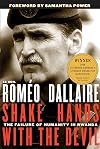
This book is in your face raw. I read this for a book review in university and it ended with me writing my most passionate and well thought essay of that span. What happened in Rwanda was devastating and Dallaire pulls no punches in describing it to you. It seems like a very emotional and well thought out account of what happened during his time and his reasonings for his actions while in command. It would be impossible to try and understand the mental anguish he would have gone through day show more in and day out.
This is a must read for everyone. show less
This is a must read for everyone. show less
In 1994, between April 7 and July 15, nearly one million innocent people were killed in the Rwandan Genocide. Subsequent wars in the region killed more than five million people. The genocide was planned years in advice, perpetrated by racist nationalists bent on removing Tutsis from the planet. In "Shake Hands with the Devil: The Failure of Humanity in Rwanda," Roméo Dallaire convinces readers that these tragedies were easily preventable, but dithering politicians and bureaucrats all over show more the world watched in disinterest.
The book is compelling. Having read extensively for academic and personal reasons about the genocide, I knew many of the details listed below, so Dallaire's book had been sitting on my shelf unread for almost 15 years. I wish I had read it sooner because it is Dallaire and his military subordinates - not international aide groups or politicians - who were the international witnesses to these crimes.
The book moves quickly because it reads like a daily journal. Although it can be very disturbing and depressing given the nature of the genocide, there are moments of manic highs, too. It is emotional and frustrating because readers will be able to quickly identify with Dallaire's heart. He is effuse in praising his his-working aides and does not hold back at offering his personal assessments of the people who impede his work.
Dallaire's book, dedicated to victims, including the soldiers killed under his command, details his negotiations to stop the genocide and his actions during the genocide to bring an end to it. Assigned to Rwanda as part of a United Nations team in the summer of 1993 in order to help implement a peace agreement between the standing government and an incoming rebel army, he saw firsthand that a humanitarian crisis was coming. His documented pleas for help from New York, Paris, Nairobi, Geneva, Washington DC, and London in the first part of the book were willfully ignored as he and his small team of military observers shuttled around the country trying to avert the disaster. He was denied requests for funding for communications equipment, rations for his soldiers, office space, and even simple soccer balls to replace the banana-leaf balls used in refugee camps.
Extremist politicians on the government side began openly looking for a way to instigate the attack that led to the genocide. Their wish was granted when their moderate president's plane went down, probably from their own missile. Even after this catalyst, Dallaire's team's cries for help continued to be ignored. The bulk of "Shake Hands with the Devil" documents the daily routine of these brave observers who were abandoned by the UN and their supporting states. The book presents awful images and stories of the genocide and the people whom the UN also abandoned.
Dallaire asked for only 5,000 troops in order to save the country, but he was denied time and time again as bureaucrats and politicians in cities around the world took weekends off and justified his cries by telling him that the UN doesn't work quickly. That time was dizzying, destructive, and counter-productive when the French finally arrived to establish camps that protected runaway génocidaires, those responsible for openly slaughtering Tutsis in churches, orphanages, hamlets, and checkpoints in cities. By that time, nearly a million people had been cut down with machetes. The génocidaires rearmed themselves in the international refugee camps, leading to the subsequent Congo Wars.
In the last, shortest section of the book, Dallaire offers suggestions for improving how governments respond to humanitarian crises outside their borders. His suggestions are reasonable. In the case of Rwanda, simple support for implementing the peace agreement would have been enough. Unfortunately, as we have seen time and again, from Sudan to Myanmar to Wester China, the international community, including national capitals, relief organizations, and the UN, refuse to use the needed fiscal and physical muscle in order to save lives.
"Shake Hands with the Devil" has an extensive index and a glossary of terms and names, although Dallaire's easy-to-read style reminds readers of who he is meeting and working with, so there is little reason to consult it. show less
The book is compelling. Having read extensively for academic and personal reasons about the genocide, I knew many of the details listed below, so Dallaire's book had been sitting on my shelf unread for almost 15 years. I wish I had read it sooner because it is Dallaire and his military subordinates - not international aide groups or politicians - who were the international witnesses to these crimes.
The book moves quickly because it reads like a daily journal. Although it can be very disturbing and depressing given the nature of the genocide, there are moments of manic highs, too. It is emotional and frustrating because readers will be able to quickly identify with Dallaire's heart. He is effuse in praising his his-working aides and does not hold back at offering his personal assessments of the people who impede his work.
Dallaire's book, dedicated to victims, including the soldiers killed under his command, details his negotiations to stop the genocide and his actions during the genocide to bring an end to it. Assigned to Rwanda as part of a United Nations team in the summer of 1993 in order to help implement a peace agreement between the standing government and an incoming rebel army, he saw firsthand that a humanitarian crisis was coming. His documented pleas for help from New York, Paris, Nairobi, Geneva, Washington DC, and London in the first part of the book were willfully ignored as he and his small team of military observers shuttled around the country trying to avert the disaster. He was denied requests for funding for communications equipment, rations for his soldiers, office space, and even simple soccer balls to replace the banana-leaf balls used in refugee camps.
Extremist politicians on the government side began openly looking for a way to instigate the attack that led to the genocide. Their wish was granted when their moderate president's plane went down, probably from their own missile. Even after this catalyst, Dallaire's team's cries for help continued to be ignored. The bulk of "Shake Hands with the Devil" documents the daily routine of these brave observers who were abandoned by the UN and their supporting states. The book presents awful images and stories of the genocide and the people whom the UN also abandoned.
Dallaire asked for only 5,000 troops in order to save the country, but he was denied time and time again as bureaucrats and politicians in cities around the world took weekends off and justified his cries by telling him that the UN doesn't work quickly. That time was dizzying, destructive, and counter-productive when the French finally arrived to establish camps that protected runaway génocidaires, those responsible for openly slaughtering Tutsis in churches, orphanages, hamlets, and checkpoints in cities. By that time, nearly a million people had been cut down with machetes. The génocidaires rearmed themselves in the international refugee camps, leading to the subsequent Congo Wars.
In the last, shortest section of the book, Dallaire offers suggestions for improving how governments respond to humanitarian crises outside their borders. His suggestions are reasonable. In the case of Rwanda, simple support for implementing the peace agreement would have been enough. Unfortunately, as we have seen time and again, from Sudan to Myanmar to Wester China, the international community, including national capitals, relief organizations, and the UN, refuse to use the needed fiscal and physical muscle in order to save lives.
"Shake Hands with the Devil" has an extensive index and a glossary of terms and names, although Dallaire's easy-to-read style reminds readers of who he is meeting and working with, so there is little reason to consult it. show less
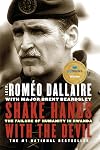
Dallaire was a Canadian peacekeeper sent by the UN as commander of the peacekeeping effort in Rwanda a few months before the genocide in 1994. It was very interesting (and extremely frustrating at times) to read about what happened from this perspective. It was the perspective of the people on the ground who were trying with what (very) little resources they had (not nearly enough) to find peace in the country before the genocide and civil war broke out.

This book, while ultimately hopeful, is a disturbing read. General Dallaire's message is that, as a whole, we have learned little from past tragedies, notably the Rwandan genocide. That in global conflicts, we continue to settle for finding truces rather that finding permanent solutions. Many conflicts appear resolved, but underlying frictions remain, making further conflict inevitable.
General Dallaire begins by talking about war and peace. He then broadens his perspective to environmental show more aspects of war, technological innovations in warcraft and human rights. Then he narrows his focus to his own story of personal healing., Thus the book ends on in a very different trajectory from where it seemed to be heading at the beginning. But consistent, and providing an intimate look at how global conflicts affect individuals as well as societies. show less
General Dallaire begins by talking about war and peace. He then broadens his perspective to environmental show more aspects of war, technological innovations in warcraft and human rights. Then he narrows his focus to his own story of personal healing., Thus the book ends on in a very different trajectory from where it seemed to be heading at the beginning. But consistent, and providing an intimate look at how global conflicts affect individuals as well as societies. show less
Lists
Africa (1)
Awards


You May Also Like


Associated Authors
Statistics
- Works
- 6
- Also by
- 1
- Members
- 2,209
- Popularity
- #11,610
- Rating
- 4.2
- Reviews
- 46
- ISBNs
- 35
- Languages
- 4
- Favorited
- 2