

Philip Gourevitch
Author of We wish to inform you that tomorrow we will be killed with our families: Stories from Rwanda
About the Author
Philip Gourevitch, a staff writer at "The New Yorker", lives in New York City. His last book, "We Wish to Inform You that Tomorrow We Will be Killed with Our Families: Stories from Rwanda" (FSG, 1998), won the National Book Critics Circle & Los Angeles Times Book Awards. (Bowker Author Biography)
Image credit: Credit: Larry D. Moore, Texas Book Festival, Austin, TX, Nov. 1, 2008
Works by Philip Gourevitch
We wish to inform you that tomorrow we will be killed with our families: Stories from Rwanda (1998) 3,850 copies, 70 reviews
Paris 2 copies
Associated Works
The Condé Nast Traveler Book of Unforgettable Journeys: Great Writers on Great Places (2007) — Contributor — 280 copies, 5 reviews
Know the Past, Find the Future: The New York Public Library at 100 (2011) — Contributor — 132 copies, 4 reviews
Tagged
Common Knowledge
- Birthdate
- 1961
- Gender
- male
- Education
- Columbia University (MFA)
Cornell University (BA) - Occupations
- journalist
editor - Organizations
- The Forward
The New Yorker
The Paris Review - Relationships
- MacFarquhar, Larissa (wife)
- Nationality
- USA
- Birthplace
- Philadelphia, Pennsylvania, USA
- Places of residence
- Middletown, Connecticut, USA
New York, New York, USA - Associated Place (for map)
- USA
Members
Reviews

honestly i didn't expect this book to be both so readable and so relevant. i picked it up anyway but thought it would be a slog, and that it wouldn't have much of a bearing on today. i'm so glad i did because first of all, what a comprehensive and detailed job of reporting this, from the mouths of the people who experienced the war and perpetrated the war crimes. this is excellent journalism. more than that, it shows so clearly and easily how someone (anyone) can be made to do violence and show more commit egregious acts of humiliation, terror, and assault, up to and including murder. it is a clear - so clear - stop in the roadmap to how we got to where we are now. this wasn't the beginning of the journey, but it's a stopover worth remembering and acknowledging. and to see, basically in real time, the way the people who perpetrated (and documented!) the violence justified it or made it seem less meaningful than it was, it was such a lord of the flies situation where it devolved so quickly and became something so different (violence and humiliation for the sake of it) than it (maybe) was intended to be. how easily we slip into this sort of behavior and mentality. and what a reminder of how only the people at or close to the bottom of the ladder rungs were the ones who ever were held accountable. it's good to remember, when we have such blatant autocracy and fascism happening, that george w bush should also be serving time for war crimes.
"...democratic self-rule has never been imposed upon a people by the military invasion of a foreign power..." show less
"...democratic self-rule has never been imposed upon a people by the military invasion of a foreign power..." show less
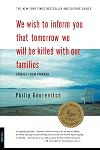
We Wish to Inform You That Tomorrow We Will be Killed With Our Families: Stories from Rwanda by Philip Gourevitch
Gorgeous writing and a very (very.) convoluted narrative. Eventually, his inability to make any sort of conclusion — emotional, political, moral — feels like its own sort of cowardice; it feels like giving up. That passivity (unintentionally, I think) echoes the theme of “why didn’t they fight back” — because animal fight exhausts itself when there is no hope — but exhaustion and passivity seems an unjust response, coming from a man who only viewed the aftermath of genocide.
All at once, as it seemed, something we could have only imagined was upon us—and we could still only imagine it. This is what fascinates me most in existence: the peculiar necessity of imagining what is, in fact, real.
This was a very difficult book to read, and an even harder book to review. If it wasn't for my library's year-long reading challenge, and the prompt to "read a book written by a journalist", I never would have even picked this up. But I'm so glad I did, however horrible it show more was to read. It explained a lot of the questions I had about this dark time. My only other knowledge of the Rwandan Genocide came entirely from the film Hotel Rwanda, which really only showed a select part of the story, and left a great deal of context out. It's a fantastic film, and I do really recommend it, but this book definitely far surpasses it in terms of information and educational value.
This book is split into two main parts, and in general, they follow first the events leading up to and including the massacre, and then the aftermath and recovery efforts (if some of them can even be called that). It's a tiring tale with apocalyptic elements straight out of a far-fetched science fiction novel. It feels a little unreal sometimes, this dark age story from just a few years before I was born. It feels anachronistic but then, looking at the world I live in now, so very relevant and intrinsically real.
The massacre itself, this cruel act of genocide, was, and I feel wrong admitting this, my favorite part of the book. It was straightforwardly awful, and there was some part of it that was morbidly fascinating. Gourevitch addresses this phenomenon directly and gives excellent commentary on it without either condemning or condoning. This same very direct but equally objective perspective pervades the entire book, and I really appreciated it.
"It sometimes happens that some people tell lies and others tell the truth."
The part that disgusted me beyond even the senseless slaughter itself was the reaction or lack thereof on the part of the international community, primarily regarding America and France. I guess people just want to ignore that the French actively supplied the Hutu aggressors and that the world refused to call this a genocide lest they be required to give any aid whatsoever. And when they were forced to help, they continued to help those doing the killing and ignored those who suffered the most. And why? For what? What could have possibly made these modern nations commit such atrocities?
"You cannot count on the international community unless you're rich, and we are not[...] We don't have oil, so it doesn't matter that we have blood, or that we are human beings."
And it makes sense: look at the USA's constant neglect of even its own people in recent years and throughout history, as seen in the Michigan water crisis, in post-hurricane Puerto Rico, and in the systematic abuse of African Americans and Mexican immigrants, particularly children. What seems, at face value, wrong and illogical -- that first world countries in the modern age could be so cruel and unusual against their fellow man -- is actually very, very believable.
And when Rwanda tried to recover on its own, it was attacked again from all angles, from within and from without.
"It's not so much the human rights concerns, it's more political. It's 'Let's kill this development, this dangerous development of these Africans trying to do things their own way.'"
This book taught me that human nature is complicated and sometimes very extreme, that people hold grudges, sometimes senselessly and sometimes with good reason. That people can be tipped over the edge and will keep falling until either they or their enemy are dead. What I learned will stick with me forever. In this age of mass killings every other day, it's something I can hardly ever forget. show less
We Wish to Inform You That Tomorrow We Will be Killed With Our Families: Stories from Rwanda by Philip Gourevitch
The title of the book comes from a letter written to Paston Elizaphan Ntakirutimana. In it, several Advent pastors, hiding in a hospital state, "We wish to inform you that tomorrow we will be killed with our families..." (p 42). Such a devastating cry for help...only to end in betrayal. But probably the most helpless and hopeless line in the book (for me anyway), was "I took it we were under attack, and did nothing because I had no idea what to do" (p 33). I can't imagine knowing full well show more murderers were coming for me, and yet having no idea how to save myself. Imagine having nowhere to go. Nowhere to hide. No way to protect yourself. Heartbreaking. Like macabre trick or treating, gangs went from town to town, just looking for people to massacre.
I find myself asking over and over again how neighbors, friends, relatives, business partners could rise up against their brethren. To kill over and over again with such horrific brutality. Not just an impersonal shot to the head. Not just a quick execution from a far off distance, but an up-close and personal hacking, slashing, chopping; a hand to hand combat/rape/pillage with machetes and knives, sticks and stony rage. The willingness, the eagerness to turn on people you had once worked, lived, learned or played side by side. Colleagues killed colleagues. Neighbors annihilated neighbors. Teachers assassinated their students. Friends turned one another with surprising ease. Gourevitch tries to make sense of it in We Wish to Inform You... by going back historically and analyzing the time before the genocide. His style is to think about the subject from a distance and then living with it up close. He walks around a topic to scrutinize it from every angle. His focus was to ask what really happened and how its aftermath is understood today (at the time of his writing). show less
I find myself asking over and over again how neighbors, friends, relatives, business partners could rise up against their brethren. To kill over and over again with such horrific brutality. Not just an impersonal shot to the head. Not just a quick execution from a far off distance, but an up-close and personal hacking, slashing, chopping; a hand to hand combat/rape/pillage with machetes and knives, sticks and stony rage. The willingness, the eagerness to turn on people you had once worked, lived, learned or played side by side. Colleagues killed colleagues. Neighbors annihilated neighbors. Teachers assassinated their students. Friends turned one another with surprising ease. Gourevitch tries to make sense of it in We Wish to Inform You... by going back historically and analyzing the time before the genocide. His style is to think about the subject from a distance and then living with it up close. He walks around a topic to scrutinize it from every angle. His focus was to ask what really happened and how its aftermath is understood today (at the time of his writing). show less
Lists
Awards


You May Also Like


Associated Authors
Statistics
- Works
- 34
- Also by
- 7
- Members
- 5,357
- Popularity
- #4,648
- Rating
- 4.2
- Reviews
- 99
- ISBNs
- 100
- Languages
- 9
- Favorited
- 1