
Roger L. Martin
Author of Playing to Win: How Strategy Really Works
About the Author
Roger Martin is dean at the Rotman School of Management at the University of Toronto. He is a columnist at Business Week Online and a regular contributor to Harvard Business Review and the Financial Times.
Works by Roger L. Martin
The Opposable Mind: How Successful Leaders Win Through Integrative Thinking (2007) 329 copies, 5 reviews
The Design of Business: Why Design Thinking is the Next Competitive Advantage (2009) 221 copies, 2 reviews
Fixing the Game: Bubbles, Crashes, and What Capitalism Can Learn from the NFL (2011) 67 copies, 1 review
The Responsibility Virus: How Control Freaks, Shrinking Violets-and The Rest Of Us-can Harness The Power Of True Partnership (2002) 63 copies, 1 review
When More Is Not Better: Overcoming America's Obsession with Economic Efficiency (2020) 48 copies, 3 reviews
Tagged
Common Knowledge
Members
Reviews
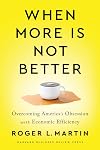
America’s economy is so rigid it is doomed unless it can allow tweaking. Ideologies such as strictly “free” markets hold back any attempt to make the economy flexible, responsive or resilient. It must be completely one way or the other in the USA and everything must be locked down and tamperproof with rules and laws. This kind of thinking is ripped to shreds in Roger Martin’s When More is not Better, an eloquent and timely look at the decline and fall. It is filled with innovative show more ideas that are working elsewhere, and plenty of ideas that need serious consideration.
Martin says all models are wrong. They attempt to mimic a natural, complex, dynamic and adaptive system that is tied up in absolutely everything going on on the planet. So naturally, they can’t account for every event, every variable and every happenstance. The result is usually one economist out of thousands being right about the coming year.
Imperfect models and rigid ideologies mean a change from the bell-shaped Gaussian curve to the rather ugly Pareto curve. In the Gaussian, he says, the distribution of wealth, income or production, peaks in the center, and the extremes get or achieve less. In the Pareto curve, the rich 1% are at the very tip on the extreme right, will all the success and no competitors. This is also where the one or two companies that control a market find themselves. Almost everyone else is bunched up against the vertical axis, with lots of competition and little or no revenues. From beer to mobile phones to missiles, monopolists get nearly all the revenues, while all the smaller fish split the rest.
In far too many examples, from corporate concentration and monopolies, to income distribution, the Pareto has replaced the Gaussian, an unstable and unsustainable situation. This has made the US economy ripe for a fall. It doesn’t have the ability to bounce back from external shocks like tariff wars and pandemics. It is instead set in reinforced concrete as the only way for the capitalist world to be. And if it seems to be failing, double-down and make the rules even stricter.
In Martin’s terms, it is a case of balancing efficiency with resilience. In America’s case, it is not so much 50-50 as 100-0 for efficiency over resilience.
Martin’s message is that the economy is not a machine that experts can fine tune for maximum efficiency. But that is precisely how American government, regulatory agencies and business think of it. This kind of thinking permeates the economy. He demonstrates with labor. It is wrong for workers, for the government and for the economy, but the drive to efficiency wins over entrepreneurial activities, innovation and resilience every time. He shows that lower pay is the goal for higher productivity, therefore the outsourcing and offshoring proxy becomes the goal itself. America is seeing the results in its inability to produce the drugs it needs, the defense systems it wants, or to process the natural resources it craves. Most jobs hug minimum wage rates and fewer and fewer formerly middle class jobs provide a decent living. They’ve all been abandoned in the name of efficiency. As I have said elsewhere, it used to be called serfdom. Now it’s called freedom. But enough people have been fooled now that it has the power to destabilize the economy.
An example Martin gives of non-ideological balance is Canada’s Bank Act of 1871. It provided for a complete review every ten years, because things change and no one could predict what the world would be like. The process worked when the finance minister (and later prime minister) Paul Martin refused to allow Canadian banks to merge into too-big-to-fail giants like their counterparts across the border. Banks whined they needed the heft to compete in a global market of swollen American leviathans. Canada said no. Then, in the Financial Crisis of 2008, Canada’s banks needed a total of zero dollars in bailouts. There were no failures. Today, without mergers, the top five supposedly tiny Canadian banks rank in the top ten in the world. And the ten year review of the Bank Act has become a five year event, as both banks and the regulator recognize the need to constantly change as the economy evolves. Compare Canada’s sole banking regulatory body to America’s clutch of unending regulators and congressional committee hearings. Flexibility shows its hand mightily.
Meanwhile, in the USA, the government encourages and even forces mergers. Banks need publicly funded bailouts, and unwieldy laws like Sarbanes-Oxley handcuff them into strict structures, processes and abilities. The result is all kinds of cheating and envelope-pushing as US banks look for end runs around the rules and regulators. For every potential action there is a law or a rule governing it in the USA. The big US banks may dominate, but they are not competitive, nimble or innovative. By law.
The misguided goal of efficiency shows up everywhere. In the stock markets, high-speed trading has meant firms placing their own servers in the exchanges’ facilities, giving them an advantage measured in thousandths of a second to get their orders filled first. It’s not about the value of a company and its shares, it’s about the efficiency of the stock trade itself. Efficiency is also measured in the narrowness of the spread in bid and ask. It used to be measured in eighths of a dollar. Now it is measured in thousandths of a cent. In the USA, this is what economic success looks like. Proxies for efficiency become the actual goals of the business instead of being just proxies. Americans are playing the wrong game.
Martin has solutions for all kinds of other domains too. He proposes 19 initiatives for four groups of actors, from educators to regulators and politicians. For beating back monopolies, hedge funds and private equity firms, he recommends tenure-based voting rights. These already exist in France, where the Florange Act came into being in 2014. It provides more votes per share the longer they are held by the same entity. This means someone who holds a stock for say ten years can easily outvote a hedge fund that only holds them for a few months as it attempts to restructure or bankrupt the target firm. Martin thinks it is a good concept, but needs to go much farther than ten votes per share that Florange provides. He envisions thousands of votes per share. This will refocus the vultures on productive efforts rather than the efficient extraction of dollars from every asset - which is all they do now.
He says so-called slack is not the enemy of efficiency; it is a benefit of people working together. Excising all slack from the workday is unhealthy and rigid. Once again the proxy becomes the goal as companies eliminate bathroom breaks, discourage chance meetings and go so far as to provide subsidized lunches to keep workers in the building instead of socializing downtown. In this case, efficiency prevents creativity.
One of the great things about the book is the ratio of history to solutions. In 99% of economics books I review, history dominates. It goes on forever, page after endless page. Only the final chapter proposes solutions, and after all that history, it is usually a total letdown. In When More is not Better, Martin actually acknowledges this, and provides a nearly 50-50 split between history and solutions. His solutions are innovative, intuitively correct, and eminently doable.
He also stresses that there are no cure-alls. Everything needs the flexibility to adapt, continuously. It needs to start everywhere, with really tiny adjustments that might seem insignificant. A bold new national policy will not work alone; it has to be small steps that add up to big changes. This is refreshingly different, and even hopeful, because it means every government, every company, as well individuals can make this happen. He says to save our precious democratic capitalism, it must.
David Wineberg show less
Martin says all models are wrong. They attempt to mimic a natural, complex, dynamic and adaptive system that is tied up in absolutely everything going on on the planet. So naturally, they can’t account for every event, every variable and every happenstance. The result is usually one economist out of thousands being right about the coming year.
Imperfect models and rigid ideologies mean a change from the bell-shaped Gaussian curve to the rather ugly Pareto curve. In the Gaussian, he says, the distribution of wealth, income or production, peaks in the center, and the extremes get or achieve less. In the Pareto curve, the rich 1% are at the very tip on the extreme right, will all the success and no competitors. This is also where the one or two companies that control a market find themselves. Almost everyone else is bunched up against the vertical axis, with lots of competition and little or no revenues. From beer to mobile phones to missiles, monopolists get nearly all the revenues, while all the smaller fish split the rest.
In far too many examples, from corporate concentration and monopolies, to income distribution, the Pareto has replaced the Gaussian, an unstable and unsustainable situation. This has made the US economy ripe for a fall. It doesn’t have the ability to bounce back from external shocks like tariff wars and pandemics. It is instead set in reinforced concrete as the only way for the capitalist world to be. And if it seems to be failing, double-down and make the rules even stricter.
In Martin’s terms, it is a case of balancing efficiency with resilience. In America’s case, it is not so much 50-50 as 100-0 for efficiency over resilience.
Martin’s message is that the economy is not a machine that experts can fine tune for maximum efficiency. But that is precisely how American government, regulatory agencies and business think of it. This kind of thinking permeates the economy. He demonstrates with labor. It is wrong for workers, for the government and for the economy, but the drive to efficiency wins over entrepreneurial activities, innovation and resilience every time. He shows that lower pay is the goal for higher productivity, therefore the outsourcing and offshoring proxy becomes the goal itself. America is seeing the results in its inability to produce the drugs it needs, the defense systems it wants, or to process the natural resources it craves. Most jobs hug minimum wage rates and fewer and fewer formerly middle class jobs provide a decent living. They’ve all been abandoned in the name of efficiency. As I have said elsewhere, it used to be called serfdom. Now it’s called freedom. But enough people have been fooled now that it has the power to destabilize the economy.
An example Martin gives of non-ideological balance is Canada’s Bank Act of 1871. It provided for a complete review every ten years, because things change and no one could predict what the world would be like. The process worked when the finance minister (and later prime minister) Paul Martin refused to allow Canadian banks to merge into too-big-to-fail giants like their counterparts across the border. Banks whined they needed the heft to compete in a global market of swollen American leviathans. Canada said no. Then, in the Financial Crisis of 2008, Canada’s banks needed a total of zero dollars in bailouts. There were no failures. Today, without mergers, the top five supposedly tiny Canadian banks rank in the top ten in the world. And the ten year review of the Bank Act has become a five year event, as both banks and the regulator recognize the need to constantly change as the economy evolves. Compare Canada’s sole banking regulatory body to America’s clutch of unending regulators and congressional committee hearings. Flexibility shows its hand mightily.
Meanwhile, in the USA, the government encourages and even forces mergers. Banks need publicly funded bailouts, and unwieldy laws like Sarbanes-Oxley handcuff them into strict structures, processes and abilities. The result is all kinds of cheating and envelope-pushing as US banks look for end runs around the rules and regulators. For every potential action there is a law or a rule governing it in the USA. The big US banks may dominate, but they are not competitive, nimble or innovative. By law.
The misguided goal of efficiency shows up everywhere. In the stock markets, high-speed trading has meant firms placing their own servers in the exchanges’ facilities, giving them an advantage measured in thousandths of a second to get their orders filled first. It’s not about the value of a company and its shares, it’s about the efficiency of the stock trade itself. Efficiency is also measured in the narrowness of the spread in bid and ask. It used to be measured in eighths of a dollar. Now it is measured in thousandths of a cent. In the USA, this is what economic success looks like. Proxies for efficiency become the actual goals of the business instead of being just proxies. Americans are playing the wrong game.
Martin has solutions for all kinds of other domains too. He proposes 19 initiatives for four groups of actors, from educators to regulators and politicians. For beating back monopolies, hedge funds and private equity firms, he recommends tenure-based voting rights. These already exist in France, where the Florange Act came into being in 2014. It provides more votes per share the longer they are held by the same entity. This means someone who holds a stock for say ten years can easily outvote a hedge fund that only holds them for a few months as it attempts to restructure or bankrupt the target firm. Martin thinks it is a good concept, but needs to go much farther than ten votes per share that Florange provides. He envisions thousands of votes per share. This will refocus the vultures on productive efforts rather than the efficient extraction of dollars from every asset - which is all they do now.
He says so-called slack is not the enemy of efficiency; it is a benefit of people working together. Excising all slack from the workday is unhealthy and rigid. Once again the proxy becomes the goal as companies eliminate bathroom breaks, discourage chance meetings and go so far as to provide subsidized lunches to keep workers in the building instead of socializing downtown. In this case, efficiency prevents creativity.
One of the great things about the book is the ratio of history to solutions. In 99% of economics books I review, history dominates. It goes on forever, page after endless page. Only the final chapter proposes solutions, and after all that history, it is usually a total letdown. In When More is not Better, Martin actually acknowledges this, and provides a nearly 50-50 split between history and solutions. His solutions are innovative, intuitively correct, and eminently doable.
He also stresses that there are no cure-alls. Everything needs the flexibility to adapt, continuously. It needs to start everywhere, with really tiny adjustments that might seem insignificant. A bold new national policy will not work alone; it has to be small steps that add up to big changes. This is refreshingly different, and even hopeful, because it means every government, every company, as well individuals can make this happen. He says to save our precious democratic capitalism, it must.
David Wineberg show less
When More is Not Better : overcoming America's obsession with economic efficiency by Roger L. Martin

Listened and while I missed some of the details of the argument, the basic premise makes all kinds of horse sense. The economy is not a machine, it’s a complex organism. It needs rules and laws that recognize that. Efficiency in the form of consolidation of industry is harmful at a certain point.
There is nothing I can do about this except hope that the people in power absorb this truth.
There is nothing I can do about this except hope that the people in power absorb this truth.
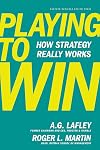
This book is known as a classics on strategic planning and the role of strategy in business. It speaks from the point of view of leadership over Procter & Gamble’s (P&G) numerous businesses. The company identified its organization to be weak in understanding strategy, and it sought to inculcate strategic thinking into its leadership. Although this book references a few other corporations, it consists largely of case studies around how P&G succeeded using strategy.
The authors divide show more strategy into two central questions: Where to play, and how to win? The first question is often overlooked in meeting rooms. Deciding what consumers to target can provide a make-or-break decision concerning whether a product will succeed. The authors then break down these two central questions into sub-questions with cases to illustrate insights.
The book tries to identify general principles based on P&G’s experiences. One author was the CEO, and the other was a paid consultant to the company. Both were intimately involved in P&G’s refashioned approach to the market and in its numerous successes and occasional failures. The book’s main weakness lies in its magnified focus on and access to P&G. I would like to have heard a critical analysis of other ventures’ strategic plans, especially in my fields of healthcare and technology. That is probably too much to want from one treatment.
This book portrays a relentless focus on “winning.” In the field of healthcare technology, this verbiage can repel and appear difficult. My workplace does not talk about “wins” as much (though we occasionally talk so); we more often use language of fulfilling “goals.” Still, I remained able to abstract the point, but the authors’ bias towards a game-centered view of the world, with winners and losers, was apparent throughout.
This book’s audience consists of business folk, especially at more leadership levels. It’s reputed to be one of the best looks on strategy in the literature. I can see why. Although a scientist, I found its wording fairly accessible although I found it voyaged into jargon occasionally. Someone need not be an expert to learn from this book. show less
The authors divide show more strategy into two central questions: Where to play, and how to win? The first question is often overlooked in meeting rooms. Deciding what consumers to target can provide a make-or-break decision concerning whether a product will succeed. The authors then break down these two central questions into sub-questions with cases to illustrate insights.
The book tries to identify general principles based on P&G’s experiences. One author was the CEO, and the other was a paid consultant to the company. Both were intimately involved in P&G’s refashioned approach to the market and in its numerous successes and occasional failures. The book’s main weakness lies in its magnified focus on and access to P&G. I would like to have heard a critical analysis of other ventures’ strategic plans, especially in my fields of healthcare and technology. That is probably too much to want from one treatment.
This book portrays a relentless focus on “winning.” In the field of healthcare technology, this verbiage can repel and appear difficult. My workplace does not talk about “wins” as much (though we occasionally talk so); we more often use language of fulfilling “goals.” Still, I remained able to abstract the point, but the authors’ bias towards a game-centered view of the world, with winners and losers, was apparent throughout.
This book’s audience consists of business folk, especially at more leadership levels. It’s reputed to be one of the best looks on strategy in the literature. I can see why. Although a scientist, I found its wording fairly accessible although I found it voyaged into jargon occasionally. Someone need not be an expert to learn from this book. show less
DNF at 40% or so.
Martin's book focuses on "economic efficiency," a concept that he defines as "the desired outputs" of an economic system being created with "the least possible inputs". This makes a certain intuitive sense when considering manufacturing - making a car using less raw materials feels more efficient. Even in manufacturing, though, it's not clear how we're meant to include labor and time in this calculation. Since there are inevitably situations where wasting a little raw show more materials can save a little time, this definition starts to feel a little flimsy, but OK, we can pretend that all cars are the same, all inputs can be reduced (somehow) to dollars, and producing more cars per dollar is more efficient.
However, his definition gets so fuzzy as to be useless once we get over into services. If a company is providing Internet service, for example, what is the desired output? Bandwidth? Service area? Customers served? When one company merges with another, it can probably save money by firing half the customer service reps and offshoring the rest, but the actual customer service - part of the product - will not be the same. It's probably not valid to say it's more efficient.
The examples are insufficiently detailed and don't really hold up to scrutiny, the politics has a certain "but both sides are really the same" to it, and Martin keeps implying that larger companies are more efficient than small ones without presenting any evidence. show less
Martin's book focuses on "economic efficiency," a concept that he defines as "the desired outputs" of an economic system being created with "the least possible inputs". This makes a certain intuitive sense when considering manufacturing - making a car using less raw materials feels more efficient. Even in manufacturing, though, it's not clear how we're meant to include labor and time in this calculation. Since there are inevitably situations where wasting a little raw show more materials can save a little time, this definition starts to feel a little flimsy, but OK, we can pretend that all cars are the same, all inputs can be reduced (somehow) to dollars, and producing more cars per dollar is more efficient.
However, his definition gets so fuzzy as to be useless once we get over into services. If a company is providing Internet service, for example, what is the desired output? Bandwidth? Service area? Customers served? When one company merges with another, it can probably save money by firing half the customer service reps and offshoring the rest, but the actual customer service - part of the product - will not be the same. It's probably not valid to say it's more efficient.
The examples are insufficiently detailed and don't really hold up to scrutiny, the politics has a certain "but both sides are really the same" to it, and Martin keeps implying that larger companies are more efficient than small ones without presenting any evidence. show less
Awards


You May Also Like


Associated Authors
Statistics
- Works
- 15
- Members
- 1,275
- Popularity
- #20,119
- Rating
- 3.8
- Reviews
- 17
- ISBNs
- 34
- Languages
- 3