
Whittaker Chambers (1901–1961)
Author of Witness
About the Author
Image credit: World Telegram & Sun photo by Fred Palumbo (Library of Congress Prints and Photographs Division, LC-USZ62-114739)
Works by Whittaker Chambers
Notes from the Underground: The Whittaker Chambers/Ralph de Toledano Letters, 1949-1960 (1997) 22 copies, 1 review
Witness (abridged) 1 copy
Of Love Forbidden 1 copy
Associated Works
Did You Ever See a Dream Walking? American Conservative Thought in the Twentieth Century (1970) — Contributor — 86 copies
Years of Protest: A Collection of American Writings of the 1930's (1967) — Contributor — 44 copies, 1 review
Tagged
Common Knowledge
- Legal name
- Chambers, Jay Vivian
- Other names
- Chambers, Jay David Whittaker
Adams, Charles
Whittaker, Charles
Breen, David
Cantwell, Lloyd - Birthdate
- 1901-04-01
- Date of death
- 1961-07-09
- Gender
- male
- Education
- Williams College
Columbia University
Western Maryland College, Westminster, Maryland (now McDaniel College) - Occupations
- poet
journalist
editor
spy
short story writer
translator - Organizations
- Time Magazine (1940-1948)
National Review (1955-1957)
New Masses (1930-1932)
Daily Worker (1925-1930)
American Workers Party (1925-1937)
Communist Party of the United States (1925-1937) - Awards and honors
- Presidential Medal of Freedom (1984)
- Relationships
- Buckley, William F., Jr. (friend)
Regnery, Henry (friend) - Nationality
- USA
- Birthplace
- Philadelphia, Pennsylvania, USA
- Places of residence
- Westminster, Maryland, USA
Lynbrook, New York, USA
Philadelphia, Pennsylvania, USA
New York, New York, USA - Place of death
- Westminster, Maryland, USA
- Burial location
- cremated
- Associated Place (for map)
- USA
Members
Reviews

I have known and read around the biography/memoir of Whittaker Chambers for years. Now, I have finally read it. Chambers was a communist engaged in espionage in the United States in the 1930s, and he knew of communists and spies in the environs of the federal government. When he broke with communism, in a kind of religious and political conversion, he told people in the government, but was pretty much ignored until the full specter of communism became apparent with the beginning of the Cold show more War after World War II. In 1948 he accused Alger Hiss, a former State Department official, of being a communist and, after some hesitation, a spy. This became high drama: committee hearings, grand juries, suits, claims, investigations, etc. And it became a cause célèbre. Those Americans, conservatives and Republicans mostly, who feared communism, the Soviet Union, and possible skullduggery in the government rallied to Chambers. Those Americans, liberals and Democrats mostly, who were Fabian, New Dealers, progressives, peaceniks, and unafraid or incredulous of Soviet espionage rallied to Hiss. It is a battle whose lines are still manned to the present day, like, say, the scar of a border in Korea is still manned since the start of the Cold War. This despite the overwhelming weight of evidence shows Hiss was a communist and a spy, his most vociferous and naïve defenders notwithstanding.
Now, to Chambers's book itself. Witness is well-written and engaging. It strives for literary pretentiousness but does not come off as pretentious (at least not too much). Chambers was a professional writer, he worked for TIME (he was a translator too, penning the English translation of Bambi). Even seventy years after its 1952 publication it still has sections of literary beauty, bon mots of present-day utility, and a pro-life, pro-Christian, pro-work, pro-American philosophy. No wonder it is still well-known and recommended by a whole set of conservative intellectuals in the tradition of William F. Buckley conservative intellectualism. I first knew of Chambers due to reading Buckley and the old Intercollegiate Review (a journal which, as an aside, has been saddeningly killed off as a sort of blog/e-mail newsletter). This book earned all of its plaudits.
As a piece of history, it is an important memoir and an important window into the Soviet espionage of the era, the mind of early communists, and the appeal and reach of communism amongst its adherents and sympathizers in a capitalist, democratic, successful United States. ("Why would someone like Hiss do this?" Chambers is asked multiple times.) There have been new developments since 1952. A score of books, at least, have been written on Chambers, Hiss, and the Hiss-Chambers case. These should be read in concert with Chambers's memoir. (I know Hiss wrote a memoir, I may read it one day, but I have no desire to read the works of a consummate liar.) It is long 800-plus pages. Half the book is devoted to Chambers's biography, life in espionage, and his break with communism. A fair portion is devoted to the Hiss allegations, but Hiss's two trials for perjury are not detailed at length and only covered in a few pages. (Perhaps the book was already too long?) Still, I read it quickly and found it engaging, thought-provoking, and pure of heart; I would recommend it.
[I read this in a 1952 Book of the Month Club version released by Random House in its original dustjacket, which has been creased and crumpled.] show less
Now, to Chambers's book itself. Witness is well-written and engaging. It strives for literary pretentiousness but does not come off as pretentious (at least not too much). Chambers was a professional writer, he worked for TIME (he was a translator too, penning the English translation of Bambi). Even seventy years after its 1952 publication it still has sections of literary beauty, bon mots of present-day utility, and a pro-life, pro-Christian, pro-work, pro-American philosophy. No wonder it is still well-known and recommended by a whole set of conservative intellectuals in the tradition of William F. Buckley conservative intellectualism. I first knew of Chambers due to reading Buckley and the old Intercollegiate Review (a journal which, as an aside, has been saddeningly killed off as a sort of blog/e-mail newsletter). This book earned all of its plaudits.
As a piece of history, it is an important memoir and an important window into the Soviet espionage of the era, the mind of early communists, and the appeal and reach of communism amongst its adherents and sympathizers in a capitalist, democratic, successful United States. ("Why would someone like Hiss do this?" Chambers is asked multiple times.) There have been new developments since 1952. A score of books, at least, have been written on Chambers, Hiss, and the Hiss-Chambers case. These should be read in concert with Chambers's memoir. (I know Hiss wrote a memoir, I may read it one day, but I have no desire to read the works of a consummate liar.) It is long 800-plus pages. Half the book is devoted to Chambers's biography, life in espionage, and his break with communism. A fair portion is devoted to the Hiss allegations, but Hiss's two trials for perjury are not detailed at length and only covered in a few pages. (Perhaps the book was already too long?) Still, I read it quickly and found it engaging, thought-provoking, and pure of heart; I would recommend it.
[I read this in a 1952 Book of the Month Club version released by Random House in its original dustjacket, which has been creased and crumpled.] show less
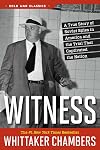
If you are looking for a book on the Hiss Case, this is not a good choice. This is a book, a very long book, about Whittaker Chambers. The title My Struggle was already taken, so he settled for Witness, in the sense of its Greek form: Martyr. From his childhood, described in a hundred pages straight from the analyst's couch, through his Communist career, his break with the Party, his successful career as farmer/Time magazine editor nobly sacrificed to the struggle against Communist show more infiltration of the US government, to the final ordeal in the courts, it's all about Chambers. Apart from God, his wife (a saint, full stop) and occasional unlikely angels of mercy such as Henry R. Luce and Richard Nixon ("the kindest of men") he slogged on alone, the tragic hero battling cosmic forces of evil. The chapters on his Communist career are relatively boring; names are endlessly named but nothing much happens. But otherwise it is a psychodrama of operatic proportions. When I learned that Chambers' father was a semi-closeted gay man, as was Chambers himself, some of the tone became more comprehensible. But I do not mean to be reductive; the book is a compelling read on many levels. The political just didn't strike me as by any means the most important.
PS 2016-11-01 The essays in Alger Hiss, Whittaker Chambers, and the Schism in the American Soul (Patrick A. Swan, ed), mostly contemporary with the case, have provided a number of new insights on Chambers' bio. I recommend the book highly. show less
PS 2016-11-01 The essays in Alger Hiss, Whittaker Chambers, and the Schism in the American Soul (Patrick A. Swan, ed), mostly contemporary with the case, have provided a number of new insights on Chambers' bio. I recommend the book highly. show less
For years, the names Alger Hiss and Whittaker Chambers in the context of a trial about Communism floated below the radar in my mind. I can remember reading about President Nixon being villified for his role in the trial and about an enormous controversy in our country, but never looked into the exact nature of what it was all about until I picked up this book. Although this all happened over 60 years ago, I found by searching Wikipedia that the controversy is still alive and people are still show more fighting the outcome of the trial. The facts as laid out in Chambers's book are quite believable particularly with the evidence that was introduced in the trial. The close friends of Hiss in the highest places of our government would never be convinced that their good friend was a traitor to his country. Despite documents typed on his typewriter with his signature, it was too shattering to their worldview that one of their own was a Communist agent. Mr. Chambers writes in a very open and literate style. His spiritual, intellectual and emotional struggles are laid bare in a painfully raw manner. A disturbing revelation of how our government can become infiltrated by those inimical to this country's welfare and the hostile agent be protected by those who are blind to the danger. show less

Very important book to understand the history of the 30's and the intelligentsia's love affair with communism. Chambers was an amazing patriot whose moral depth was unmatched, and he had a fantastic ability to understand events in their context. For these reasons I give it 3 stars.
The book labors in many places, however, with lengthy and cumbersome prose, probably not atypical of the period. For a noted Time magazine editor this book clearly lacked an editor's red pen. For that reason I show more wanted to give it 2 stars.
Overall, you must read this book for its importance in the narrative of our nation, but you will have to slog through it in spots. But do it. Its worth it. show less
The book labors in many places, however, with lengthy and cumbersome prose, probably not atypical of the period. For a noted Time magazine editor this book clearly lacked an editor's red pen. For that reason I show more wanted to give it 2 stars.
Overall, you must read this book for its importance in the narrative of our nation, but you will have to slog through it in spots. But do it. Its worth it. show less
Lists
Awards


You May Also Like


Associated Authors
Statistics
- Works
- 11
- Also by
- 11
- Members
- 1,159
- Popularity
- #22,169
- Rating
- 4.0
- Reviews
- 14
- ISBNs
- 26
- Favorited
- 1

