
Max Ernst (1891–1976)
Author of Une Semaine de Bonté
About the Author
Works by Max Ernst
Max Ernst : rétrospective : [cat. exp., Tate Gallery, London, 13 février-21 avril, 1991] (1991) 55 copies
Max Ernst : [Exhibition dates : Museum of Modern Art, Mar. 1-May 7, 1961. Art Institute of Chicago, June 16-July 23, 1961] (1961) 45 copies
Max Ernst: Maximiliana: The illegal practice of astronomy : hommage à Dorothea Tanning (1974) 6 copies
Max Ernst : exhibition, New York, Helly Nahmad Gallery, 6 November 2006 - 31 January 2007 (2006) 5 copies
Max Ernst, Maximiliana : die widerrechtliche Ausübung der Astronomie : hommoge [i.e. hommage] à Dorothea Tan (1974) 5 copies
Max Ernst in Köln: Die rheinische Kunstszene bis 1922 :[7.5.-6.7.1980 Kölnischer Kunstverein, Köln] (German Edition) (1980) 3 copies
Max Ernst Sculpture 1934-1974 2 copies
Max Ernst : . Avant-propos de Georges Bataille. eTextee... de Max Ernst. L'oeuvre et la vie (1960) 2 copies
Max Ernst: Oeuvre-Katalog, the Graphic Work. Das Graphische Werk. Volume I. (Catalogue Raisonné) (2006) 2 copies
Note per una biografia 1 copy
Répétitions 1 copy
Seven large element or a charity week (Kawade Bunko) (1997) ISBN: 4309461700 [Japanese Import] 1 copy
Aus unserm Leben an der Penne., Herausgegeben und mit einem Nachwort versehen von Karl Riha. 1 copy, 1 review
Max Ernst 1 copy
Art of this Century 1 copy
Max Ernst : [catalogue of an exhibition at] Galleria Galatea, Torino, 21 ottobre-22 novembre 1969 1 copy
Lieux communs 1 copy
Les malheurs des immortels 1 copy
Fishbone flower 1 copy
Identidade instantânea 1 copy
Max Ernst, Inside The Sight 1 copy
Max Ernst, A Retrospective 1 copy
Max Ernst 1891 - 1976 1 copy
Max Ernst, Oeuvre-Katalog 1 copy
Max Ernst: estampes et livres illustrés: [exposition, Paris, Bibliothèque nationale, 26 juin-28 septembre 1975] (1975) 1 copy
Max Ernst 1 copy
Livros e obra grafica 1 copy
Figure humaine [postcard] 1 copy
Associated Works
The Doors of Perception / Heaven and Hell (1959) — Cover artist, some editions — 5,177 copies, 47 reviews
Theories of Modern Art: A Source Book by Artists and Critics (1968) — Contributor — 855 copies, 5 reviews
The London Magazine : April 1963, New series Volume 3, No. 1 — Illustrator — 1 copy
Tagged
Common Knowledge
- Legal name
- Ernst, Max
- Birthdate
- 1891-04-02
- Date of death
- 1976-04-01
- Gender
- male
- Education
- University of Bonn
- Occupations
- painter
sculptor
Graphic Artist
poet
Dadaist
Surrealist - Organizations
- American Academy of Arts and Letters (Foreign Honorary, Art, 1974)
- Relationships
- Guggenheim, Peggy (spouse)
Fry, Varian (rescue network)
Carrington, Leonora (lover)
Tanning, Dorothea (spouse)
Ernst, Jimmy (son)
Straus, Luise (spouse) - Short biography
- Max Ernst, born in Brühl, Germany, was an avant-garde artist who helped found both the Dadaist and Surrealist movements and organize exhibitions of the works. In 1938, he separated from his wife and went to live and create art in Saint-Martin-d'Ardèche in southern France with fellow artist Leonora Carrington. He was interned by the French authorities at Camp des Milles near Marseille as an "enemy alien" after the start of World War II in 1939, but released a few weeks later thanks to the intercession of friends, including Paul Éluard, and American journalist Varian Fry. When Nazi Germany occupied France, he was arrested by the Gestapo, but managed to escape and flee to the USA with his patron and lover Peggy Guggenheim, whom he later married. Along with other European refugee artists and friends, Ernst helped introduce new art forms to Americans. In 1948, he wrote the treatise Beyond Painting, which helped bring him publicity and financial success. In 1953, Ernst returned to live in France with his second wife, Dorothea Tanning. The Galeries Nationales du Grand-Palais in Paris published a complete catalogue of his works.
- Nationality
- Germany (birth)
- Birthplace
- Brühl, Germany
- Places of residence
- Brühl, Germany
Paris, France
Marseille, France
New York, New York, USA
Sedona, Arizona, USA
Saint-Martin-d'Ardèche, France - Place of death
- Paris, France
- Burial location
- Cimetière du Père-Lachaise, Paris, France
Plot: Columbarium (Division 87)
Members
Reviews
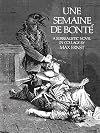
Darkly comic, with all the visual lyricism of Ernst's exhibited collage works and a large dose of macabre exuberance. The use of altered complete images and similar source material makes the pictures feel more like complete images in themselves than collage, to great uncanny effect. It also transforms the whole into a satire of the equivocal, quotidian attitude to violence and death in popular culture.
The book comes into it's own in the partial and overlapping narratives, the pictures force show more interpretation on the reader, but the strands of detail and apparent continuities combine and flow in dozens of different ways, loading the mute images to bursting point with different narratives competing for prominence. Is there one lion of belfort, or does the leonine face and medal take over the violent and prideful, are the pictures in the house in the court of the dragon (assuming it's the same house) prophesy the future or has this all happened before? Does is this face twisted in shock or anger? Is this figure a woman languishing in orgasmic bliss or a staring corpse? The images play beautifully between self-consistency that demands explanation and evanescent phantasmagoria that render it impossible. show less
The book comes into it's own in the partial and overlapping narratives, the pictures force show more interpretation on the reader, but the strands of detail and apparent continuities combine and flow in dozens of different ways, loading the mute images to bursting point with different narratives competing for prominence. Is there one lion of belfort, or does the leonine face and medal take over the violent and prideful, are the pictures in the house in the court of the dragon (assuming it's the same house) prophesy the future or has this all happened before? Does is this face twisted in shock or anger? Is this figure a woman languishing in orgasmic bliss or a staring corpse? The images play beautifully between self-consistency that demands explanation and evanescent phantasmagoria that render it impossible. show less

This is German artist Max Ernst's collage-novel. He beckons us to provide our own personal interpretation to the captions and surreal collages he constructed from old picture books and journal so that we create our own version of the story. I did exactly that – and created my own micro fiction below:
-----
Black Collage
I’m constructing a Max Ernst-like collage out of last night’s dream. Here are the pieces: a room, a toilet bowl, a boy named Danny who has one red eye and one green eye, show more a menacing black-hooded figure and a host of animals: opossum, Tasmanian devil, wallaby, aardvark, baboon, rabbit, mallard, chameleon, bullfrog and snake.
The dream consists of the following: Danny walks into a room with a toilet bowl at one end and all those animals, stacked one on top of another like a totem pole at the other.
“I would really like to have a pet,” shouts Danny.
Hearing his wish, the animals flee – fly, run and crawl straight for the toilet bowl. All the animals escape except one – Danny catches the mallard by its rump feathers just as it is about to disappear down the plumbing. Not wishing to be converted to pet status, the mallard plays possum, closing its eyes and flattening itself out like a rug. At this point the hooded figure enters and accuses Danny of engaging in tasteless black humor.
Now for the collage: I place Danny in the middle giving him grasping, outstretched hands. Since I’m working like Max Ernst, that is, constructing a collage in black-and-white, I attempt to convey the bizarreness of Danny’s eyes by giving him the eyes of a fly. I then paste the baboon, wallaby, rabbit, aardvark and snake beyond Danny’s grasp and position the toilet bowl at the bottom with a string of other animals – opossum, chameleon, bullfrog and finally the mallard – heading its way.
The one in the hood goes at the very top of the collage. As for his comment about black humor, I think it only appropriate to give this menacing figure the head of a Tasmanian devil. With such an absurd head, let’s see how seriously anybody takes his comment about bad taste. show less
Both this novel (ironically titled as " A Week of Kindness") and Ernst's other, more aptly titled novel in collage, "The Hundred Headless Women" are some of the most impressive products to come out of the surrealist movement. Each illustration in the book is carfully arranged to hint at a much larger story.
The book itself is traumatic-- dark, grizzly, sexually overt, the series of illustrations comprising each chapter tell a story, but it's a story that Ernst kindly forces you to close your show more eyes to right when it seems to be too much. Only, when you open them again you're faced with an entirely new shock. As the reader, you're left to fill in the gaps. The novel resembles a train wreck: you can't help but stare in wonder despite the fact that you know you shouldn't be.
What makes the novel so spooky is in the way Ernst blends the seraphic with the mundane. A demon in the form of a very proper victorian woman kisses a man in a parlor where every painting on the wall implies violence. Gentlemen gather in the streets to discuss a gigantic glowing breast while smoking their pipes. The half-man/half-tiger smiles as he shows off the head of a man alongside his war medals. Every image tells a story by itself; the disturbing aspect of the book is that you, the reader, are the sole interpreter. Whatever story you pull from the book is a reflection of you. show less
The book itself is traumatic-- dark, grizzly, sexually overt, the series of illustrations comprising each chapter tell a story, but it's a story that Ernst kindly forces you to close your show more eyes to right when it seems to be too much. Only, when you open them again you're faced with an entirely new shock. As the reader, you're left to fill in the gaps. The novel resembles a train wreck: you can't help but stare in wonder despite the fact that you know you shouldn't be.
What makes the novel so spooky is in the way Ernst blends the seraphic with the mundane. A demon in the form of a very proper victorian woman kisses a man in a parlor where every painting on the wall implies violence. Gentlemen gather in the streets to discuss a gigantic glowing breast while smoking their pipes. The half-man/half-tiger smiles as he shows off the head of a man alongside his war medals. Every image tells a story by itself; the disturbing aspect of the book is that you, the reader, are the sole interpreter. Whatever story you pull from the book is a reflection of you. show less
This is German artist Max Ernst's collage-novel. He beckons us to provide our own personal interpretation to the captions and surreal collages he constructed from old picture books and journal so that we create our own version of the story. I did exactly that – and created my own micro fiction below:
-----
Black Collage
I’m constructing a Max Ernst-like collage out of last night’s dream. Here are the pieces: a room, a toilet bowl, a boy named Danny who has one red eye and one green eye, show more a menacing black-hooded figure and a host of animals: opossum, Tasmanian devil, wallaby, aardvark, baboon, rabbit, mallard, chameleon, bullfrog and snake.
The dream consists of the following: Danny walks into a room with a toilet bowl at one end and all those animals, stacked one on top of another like a totem pole at the other.
“I would really like to have a pet,” shouts Danny.
Hearing his wish, the animals flee – fly, run and crawl straight for the toilet bowl. All the animals escape except one – Danny catches the mallard by its rump feathers just as it is about to disappear down the plumbing. Not wishing to be converted to pet status, the mallard plays possum, closing its eyes and flattening itself out like a rug. At this point the hooded figure enters and accuses Danny of engaging in tasteless black humor.
Now for the collage: I place Danny in the middle giving him grasping, outstretched hands. Since I’m working like Max Ernst, that is, constructing a collage in black-and-white, I attempt to convey the bizarreness of Danny’s eyes by giving him the eyes of a fly. I then paste the baboon, wallaby, rabbit, aardvark and snake beyond Danny’s grasp and position the toilet bowl at the bottom with a string of other animals – opossum, chameleon, bullfrog and finally the mallard – heading its way.
The one in the hood goes at the very top of the collage. As for his comment about black humor, I think it only appropriate to give this menacing figure the head of a Tasmanian devil. With such an absurd head, let’s see how seriously anybody takes his comment about bad taste. show less
Lists
Awards


You May Also Like


Associated Authors
Statistics
- Works
- 120
- Also by
- 19
- Members
- 1,570
- Popularity
- #16,442
- Rating
- 3.7
- Reviews
- 20
- ISBNs
- 112
- Languages
- 12
- Favorited
- 6
