
Tom Hazuka
Author of Flash Fiction: 72 Very Short Stories
About the Author
Tom Hazuka is an associate professor of English at Central Connecticut State University.
Series
Works by Tom Hazuka
Last chance for first / 1 copy
Tagged
Common Knowledge
Members
Reviews
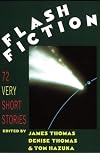
The problem with genres like Flash Fiction, Short Shorts, Prose Poetry, and whatever else is out there that someone wants to come up with an arbitray definition for is that it's incredibly difficult to accurately decide what's in a genre that no one can really define. This collection bases their criteria for Flash Fiction on the word length of the piece. In doing so, they've included a number of poets and there's some discord between the pieces.
To the credit of the editors, they've picked a show more number of great pieces that really fit the flash fiction criteria. The pieces that don't are either staples (like Carolyn Forche's prose poem about dinner with Castro) or that are interesting enough that genre definitions don't matter (Russell Edson, for example). The ordering is wacky at time but the overall collection makes up for it.
For people hesitant to approach new genres like this, the editors have included a lot of recognizable names. All in all, it's a good anthology-- accessable, cheap, and it represents a wide variety of styles. show less
To the credit of the editors, they've picked a show more number of great pieces that really fit the flash fiction criteria. The pieces that don't are either staples (like Carolyn Forche's prose poem about dinner with Castro) or that are interesting enough that genre definitions don't matter (Russell Edson, for example). The ordering is wacky at time but the overall collection makes up for it.
For people hesitant to approach new genres like this, the editors have included a lot of recognizable names. All in all, it's a good anthology-- accessable, cheap, and it represents a wide variety of styles. show less
Apparently this was the anthology that coined the term 'flash fiction'. Which is defined here as shorter than 'sudden fiction'. The stories included are mostly from the 80's and 90's. There were 3 names I recognized: Margaret Atwood, Joyce Carol Oates, and... drat, some white guy I forget. The rest of the names were unknown to me, but this was a clearly literary anthology and I am not a literary reader. A few of the stories were English translations.I had the notion that I should take some show more short stories, distill the plot, and rewrite them. I figured the shorter the better for this exercise. So when I searched the library catalog, this is the best option that turned up. I did not do the exercise I had invented for myself. But I did read all the way through this in about a day.Short short stories (as I came to know them, having been first exposed to them from Asimov anthologies) are pretty awesome. Get in, get out. It works particularly well for science fiction idea stories. Which these were not.The first couple of stories were okay. Somewhat interesting. The first one was even sf/f-ish (gasp! don't tell them that!) But then I started to hit some real duds.Why duds? Because I didn't sharding understand them. Did it mean this? Did it mean something else? Does the story mean exactly what it seems to mean and nothing else? Ie, rather trite. Does the story mean what I've guessed it means? I'm not sure. Does the story mean something else entirely and I'm just too dumb to get it? Or does the story not really mean anything at all?I'm not so keen on uncertainty when it comes to stories. I'm fine with 'engaging' with the text and trying to work out what is meant. I just like to know I'm right! Or know that I'm probably not thinking what the author was thinking, and that's okay, because my idea is better.But too many of these stories left me with a sense of 'wha? huh?' and an utter vagueness about the whole thing.Still, there is something about the shortness and the sheer quantity of them that makes my brain start sparking. The problem is, to keep that up, you need more and more and more! show less
As with anthologies, sometimes you've got to take the bad with the good....I thought this book was a good way to get a feel for flash fiction, having never read it before. Flash fiction, to be a great artform, needs the power of words like in poetry but also a glimmer of a story. It certainly isn't easy to do. My favorite one in this collection is an excerpt from Joyce Carol Oates "August Evening." Other ones that I liked: "Paring Knife" by Michael Oppenheimer, "Girl" by Jamaica Kincaid, and show more "Stockings" excerpted from Tim O'Brien. show less
Flash fiction has become, in recent years, a craze among writers. Partly because of the internet era and the dwindling attention spans of readers, flash fiction, as James Thomas writes in the introduction, is a product of the times. For example, there are hundreds of literary magazines dedicated to the genre, including SmokeLong Quarterly, QuickFiciton, and the Vestal Review. There are also more (some more credible than others) on the internet. Flash fiction is a phenomenon of the current show more era. But is it lasting fiction? Flash fiction, among more serious writers and beginning writers alike, has always been seen as easy publication. Admittedly, beginning writers seek to publish flash fiction due to it's seemingly relative ease and the fact that some publishers eagerly accept it due to the amount of space it takes (very little).
But as James Thomas shows in this 1992 anthology, flash fiction can be a respectable genre that is not only daring, but stories in the same way longer stories are, with affect and the ability to leave an imprint on the reader's mind. Overall, the anthology shows that flash stories--these stories with less than 1000 words--can be full stories, all the same, and maybe perhaps more.
The anthology includes many stories that are considered by now modern classics by authors who have made footprints in the literary sands. Among them are Francine Prose, Raymond Carver, and Maragret Atwood, just to name a few outstanding pieces. These stories in particular show writers of short prose taking chances with shorter forms, with the results not unlike their masterpieces. FOr example, Raymond Carver's "The Father" shows the king of minimalism at his most minimalist, in a story about adultry and distrust--all of which implied--in a matter of three pages (only one of which is full).
Also of note here are the writers who are not so well known. These are really the treasure pieces of the book. Among them are Carol Edelstein, Richard Shelton, Jo Sapp, as well as foregin authors such as Pavo Pavlicic and Luisa Valenzuela. These are especially prizes since some of these works are no longer in print.
The collection as a whole is something to be cherished, for it is one of the few in its genre. Yet for one of the few, it does a splendid job: gathered here are short, short stories, but full stories nonetheless that capture perfectly the power of language to linger in the head. The only complaint is that this collection is too old, yet can we say: classic? Jame Thomas's anthology, is indeed a classic in the genre, and needs to be read as soon as possible for anyone thinking of writing flash fiction, especially those seeing it as an easy way to get published. The collection shows that flash fiction can be just as complex and spellbinding.
The publishing scene needs more books like this. show less
But as James Thomas shows in this 1992 anthology, flash fiction can be a respectable genre that is not only daring, but stories in the same way longer stories are, with affect and the ability to leave an imprint on the reader's mind. Overall, the anthology shows that flash stories--these stories with less than 1000 words--can be full stories, all the same, and maybe perhaps more.
The anthology includes many stories that are considered by now modern classics by authors who have made footprints in the literary sands. Among them are Francine Prose, Raymond Carver, and Maragret Atwood, just to name a few outstanding pieces. These stories in particular show writers of short prose taking chances with shorter forms, with the results not unlike their masterpieces. FOr example, Raymond Carver's "The Father" shows the king of minimalism at his most minimalist, in a story about adultry and distrust--all of which implied--in a matter of three pages (only one of which is full).
Also of note here are the writers who are not so well known. These are really the treasure pieces of the book. Among them are Carol Edelstein, Richard Shelton, Jo Sapp, as well as foregin authors such as Pavo Pavlicic and Luisa Valenzuela. These are especially prizes since some of these works are no longer in print.
The collection as a whole is something to be cherished, for it is one of the few in its genre. Yet for one of the few, it does a splendid job: gathered here are short, short stories, but full stories nonetheless that capture perfectly the power of language to linger in the head. The only complaint is that this collection is too old, yet can we say: classic? Jame Thomas's anthology, is indeed a classic in the genre, and needs to be read as soon as possible for anyone thinking of writing flash fiction, especially those seeing it as an easy way to get published. The collection shows that flash fiction can be just as complex and spellbinding.
The publishing scene needs more books like this. show less
Lists
You May Also Like


Associated Authors
Statistics
- Works
- 10
- Members
- 490
- Popularity
- #50,415
- Rating
- 3.7
- Reviews
- 12
- ISBNs
- 15