
J. D. Vance
Author of Hillbilly Elegy: A Memoir of a Family and Culture in Crisis
About the Author
J.D. Vance grew up in Middletown, Ohio, and Jackson, Kentucky. He enlisted in the Marine Corps after high school and served for four years in Iraq. He is a graduate of the Ohio State University (2007-2009) Political Science and Philosophy, Summa Cum Laude and Yale Law School, Doctor of Law (J.D.) show more (2010-2013). He has contributed to the National Review and is the author of Hillbilly Elegy: A Memoir of a Family and Culture in Crisis. He is also a principal at a leading Silicon Valley investment firm. (Bowker Author Biography) show less
Works by J. D. Vance
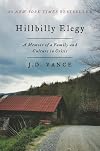
Hillbilly Elegy: A Memoir of a Family and Culture in Crisis (2016) — Narrator, some editions — 8,939 copies, 397 reviews
Associated Works
Tagged
Common Knowledge
- Canonical name
- Vance, J. D.
- Legal name
- Vance, James David
- Other names
- Hamel, J. D.
Bowman, J. D.
Bowman, James Donald (birth) - Birthdate
- 1984-08-02
- Gender
- male
- Education
- Ohio State University (BA|2009)
Yale Law School (JD|2013) - Occupations
- marine
lawyer
investment manager
U.S. Senator - Organizations
- United States Marines Corps
Mithril Capital
Revolution LLC
Narya Capital
United States Senate - Awards and honors
- Audie Award for Nonfiction (2017)
- Relationships
- Vance, Usha Chilukuri (wife)
- Short biography
- J. D. Vance grew up in the Rust Belt city of Middletown, Ohio, and the Appalachian town of Jackson, Kentucky. He enlisted in the Marine Corps after high school and served in Iraq. A graduate of the Ohio State University and Yale Law School, he has contributed to the National Review and is a principal at a leading Silicon Valley investment firm. Vance lives in San Francisco with his wife and two dogs. [from Hillbilly Elegy (2016)]
- Nationality
- USA
- Birthplace
- Middletown, Ohio, USA
- Places of residence
- Jackson, Kentucky, USA
San Francisco, California, USA
Cincinnati, Ohio, USA
Washington, D.C., USA - Associated Place (for map)
- USA
Members
Discussions
President Vance in Pro and Con (July 4)
Reviews
I debated for a long time over what rating to give this book.
I am from the Appalachian region of Virginia. It was not until I moved to Berea, KY for college that I truly began identifying as an Appalachian. It was also because of Berea that I turned a critical eye on my home. I was simultaneously proud of my heritage and ashamed of the region.
It is because of my own background that I both love and hate Hillbilly Elegy. I found so much truth in Vance’s work, and I can relate to his life show more in more ways than I care to admit. There is an undeniable problem in the region; it is palpable each time I visit home from the crumbling buildings to the failing schools and the overwhelming drug epidemic.
However, I think that Vance paints a bit too grim of a picture. When outsiders—non-Appalachians—read this book, they are confronted with reason after reason to look down on the region and the people. Vance presents himself as an anomaly for having found stability and wealth. The very fact that he uses the term “hillbilly” demeans Appalachians and perpetuates negative stereotypes.
I struggle with this book because I struggle with my feelings in Appalachia. I will, however, tell anyone who will listen stories of the brave, intelligent, loving Appalachians I know—people who are certainly not “hillbillies” or people trapped in their own misery. show less
I am from the Appalachian region of Virginia. It was not until I moved to Berea, KY for college that I truly began identifying as an Appalachian. It was also because of Berea that I turned a critical eye on my home. I was simultaneously proud of my heritage and ashamed of the region.
It is because of my own background that I both love and hate Hillbilly Elegy. I found so much truth in Vance’s work, and I can relate to his life show more in more ways than I care to admit. There is an undeniable problem in the region; it is palpable each time I visit home from the crumbling buildings to the failing schools and the overwhelming drug epidemic.
However, I think that Vance paints a bit too grim of a picture. When outsiders—non-Appalachians—read this book, they are confronted with reason after reason to look down on the region and the people. Vance presents himself as an anomaly for having found stability and wealth. The very fact that he uses the term “hillbilly” demeans Appalachians and perpetuates negative stereotypes.
I struggle with this book because I struggle with my feelings in Appalachia. I will, however, tell anyone who will listen stories of the brave, intelligent, loving Appalachians I know—people who are certainly not “hillbillies” or people trapped in their own misery. show less
This book has been the thing to talk about in political circles, especially progressive ones, for the past year; regretfully, I am a little late in getting around to reading it, but J.D. Vance’s short memoir is well worth the time. His chronicle of how he endured the dysfunction of growing up in a “hillbilly” family in Kentucky and southern Ohio and then ultimately achieving an Ivy League education at Yale and a law degree that will guarantee him a life far beyond the limited horizons show more of his forbearers. This book also presents an insider’s view of a genuine American subculture, that of the Scotch-Irish of Appalachia, a blood line that spread across much of the Old South, especially the mountains and hollers of West Virginia and eastern Kentucky. Many would drift north in the mid 20th Century to find work in the factories of the industrial mid-west, taking their “hillbilly” ways with them. These were proud and contentious people who lived what outsiders would consider a hopelessly insular life, revolving around family, work and church.
J.D. was born in 1984, after the end of the great post World War II boom that gave jobs to men like his grandfather in the Armco plant in Middletown, Ohio. Though they had achieved an outwardly middle class life, J.D.’s grandparents could never escape the worst aspects of the culture they came from, especially a tendency to fight and argue at even the slightest hint of disrespect and a distrust of strangers, not being the least among them; constant abuse of alcohol was another deadly trait. When the economic decline took hold, the lives of many in the working class would become filled with anger and apprehension, with drugs, alcohol and casual violence became the main forms of relief from this malaise. Young J.D.’s mother drifted from one relationship to another as her substance abuse problems worsened, while his father was not part of his life. But he had a rock to lean on in the persons of his mother’s parents, Mamaw and Papaw Vance, who gave him the love and stability to not only endure his rough environment, but ultimately, to rise above it. After high school, he did a stint in the Marine Corp, where he gained the discipline and focus to apply to the Yale School of Law.
J.D. Vance is wonderfully candid about his early life, and his retelling of events and portraits of his family are spot on and unforgettable; Mamaw Vance is one of the most vivid characters I have met in any book –fiction included – in the past year. His honest, blow by blow accounts of family dysfunction, like his mother’s repeated meltdowns, can be painful to read, but it’s impossible not to turn the page. Also impressive is J.D.’s honesty in how terribly unprepared he was life in the world of upward social mobility, when he had not the slightest idea how to dress for a job interview with a recruiters from big law firms or even how to use a salad fork.
But what has won this book so much renown is the picture it creates of, as the book cover says, “a culture in crisis.” This is the culture of working class America that has taking a beating ever since the Reagan era when the steel mills and manufacturing plants began moving overseas in search of cheap labor; and the jobs that didn’t move away were threatened by automation. We get a picture of a community plagued with underemployment and low wage service jobs, where opportunities for a better life lies elsewhere, yet where most refuse to make to effort at a better life, clinging to the old and the familiar, even as it drags them down. J.D. makes it clear that this poverty is a state of mind, a culture of “learned hopelessness,” where everyone believes that there is nothing they can do to improve their circumstances; that the system is against them, and always will be. His life refutes this belief, but he makes it clear that it takes people like his grandparents to give children the stability and love of learning necessary to the have the self confidence – as opposed to self esteem – to make something of themselves. This is a change which must come from within; there is no government program or tax cut for the rich that will impose it from the outside. It’s a brutally honest assessment that flies in the face of the orthodoxies of many sincere liberals and conservatives.
I found myself agreeing with many of J.D.’s observations, such as how many working class Americans became disenchanted with the party FDR and JFK when it became associated with welfare and food stamps; how many in working class America felt that Obama was the embodiment of the Ivy League elitists who had been looking down on them since forever; how comments like “clinging to their religion and guns” was like spit in the face. I have many experiences in my own life that would back this up, and proves that not all the problems between Democrats and the white working class is a matter of racism. J.D. is a conservative, but he is clearly no member of the Tea Party, a rare political person capable of objective reasoning. He makes it plain that there is a role for government in improving the lives of the people of Appalachia, but that bureaucracy and arbitrary rules often make it ineffective.
I’ve seen on more than one online review of HILLBILLY ELEGY by readers like me on such sights as Amazon, Goodreads and Librarything, many of them having come from the same part of the country as the author or from a similar background. Some of them heartily agree with him, others take him to task for being too dismissive of blue collar workers and over estimating the benefits of college and a professional life – that those successful families have more than little of the same “hillbilly” dysfunction in them. Others dislike his insistence that it is solely on the individual to improve his circumstances, that no one can do it all on their own. Many readers relate real life experiences that either affirm or deny J.D. assertions. This is what a real discussion looks like, and it is being done in a polite, but vigorous manner, and not like one of those “national conversations” that politicians are always talking about, the kind where one side lectures and hectors the other; where no one learns anything.
I do wonder what the progressives who champion this book so much will ultimately get out of it? Do they think this explains why Trump beat Clinton so badly among the white working class? Will they stop being so condescending when they say that the white working class always “votes against their interests?” If it makes them realize that change cannot be made by a bunch of well meaning “experts” in a room in Washington D.C. and then imposed from the top down; that culture is more than an affinity for the Confederate flag, pickup trucks, and desire to listen to Toby Keith. If so, then maybe they might learn something. But I doubt it.
Back around 2006, I heard a young DeeJay on a Northern Virginia/Washington D.C. talk radio station refer to the young men and women fighting in Iraq as “dopey kids,” bamboozled by military recruiters. He could make this observation, he said, because he was a recent college graduate and listened to a lot of rap and hip hop, which meant he knew what was really going on the world. Among those so-called “dopey kids” serving his country in Iraq at that time was J.D. Vance. Not long after, that DeeJay was fired, and never heard from again. We know what happened to J.D. show less
J.D. was born in 1984, after the end of the great post World War II boom that gave jobs to men like his grandfather in the Armco plant in Middletown, Ohio. Though they had achieved an outwardly middle class life, J.D.’s grandparents could never escape the worst aspects of the culture they came from, especially a tendency to fight and argue at even the slightest hint of disrespect and a distrust of strangers, not being the least among them; constant abuse of alcohol was another deadly trait. When the economic decline took hold, the lives of many in the working class would become filled with anger and apprehension, with drugs, alcohol and casual violence became the main forms of relief from this malaise. Young J.D.’s mother drifted from one relationship to another as her substance abuse problems worsened, while his father was not part of his life. But he had a rock to lean on in the persons of his mother’s parents, Mamaw and Papaw Vance, who gave him the love and stability to not only endure his rough environment, but ultimately, to rise above it. After high school, he did a stint in the Marine Corp, where he gained the discipline and focus to apply to the Yale School of Law.
J.D. Vance is wonderfully candid about his early life, and his retelling of events and portraits of his family are spot on and unforgettable; Mamaw Vance is one of the most vivid characters I have met in any book –fiction included – in the past year. His honest, blow by blow accounts of family dysfunction, like his mother’s repeated meltdowns, can be painful to read, but it’s impossible not to turn the page. Also impressive is J.D.’s honesty in how terribly unprepared he was life in the world of upward social mobility, when he had not the slightest idea how to dress for a job interview with a recruiters from big law firms or even how to use a salad fork.
But what has won this book so much renown is the picture it creates of, as the book cover says, “a culture in crisis.” This is the culture of working class America that has taking a beating ever since the Reagan era when the steel mills and manufacturing plants began moving overseas in search of cheap labor; and the jobs that didn’t move away were threatened by automation. We get a picture of a community plagued with underemployment and low wage service jobs, where opportunities for a better life lies elsewhere, yet where most refuse to make to effort at a better life, clinging to the old and the familiar, even as it drags them down. J.D. makes it clear that this poverty is a state of mind, a culture of “learned hopelessness,” where everyone believes that there is nothing they can do to improve their circumstances; that the system is against them, and always will be. His life refutes this belief, but he makes it clear that it takes people like his grandparents to give children the stability and love of learning necessary to the have the self confidence – as opposed to self esteem – to make something of themselves. This is a change which must come from within; there is no government program or tax cut for the rich that will impose it from the outside. It’s a brutally honest assessment that flies in the face of the orthodoxies of many sincere liberals and conservatives.
I found myself agreeing with many of J.D.’s observations, such as how many working class Americans became disenchanted with the party FDR and JFK when it became associated with welfare and food stamps; how many in working class America felt that Obama was the embodiment of the Ivy League elitists who had been looking down on them since forever; how comments like “clinging to their religion and guns” was like spit in the face. I have many experiences in my own life that would back this up, and proves that not all the problems between Democrats and the white working class is a matter of racism. J.D. is a conservative, but he is clearly no member of the Tea Party, a rare political person capable of objective reasoning. He makes it plain that there is a role for government in improving the lives of the people of Appalachia, but that bureaucracy and arbitrary rules often make it ineffective.
I’ve seen on more than one online review of HILLBILLY ELEGY by readers like me on such sights as Amazon, Goodreads and Librarything, many of them having come from the same part of the country as the author or from a similar background. Some of them heartily agree with him, others take him to task for being too dismissive of blue collar workers and over estimating the benefits of college and a professional life – that those successful families have more than little of the same “hillbilly” dysfunction in them. Others dislike his insistence that it is solely on the individual to improve his circumstances, that no one can do it all on their own. Many readers relate real life experiences that either affirm or deny J.D. assertions. This is what a real discussion looks like, and it is being done in a polite, but vigorous manner, and not like one of those “national conversations” that politicians are always talking about, the kind where one side lectures and hectors the other; where no one learns anything.
I do wonder what the progressives who champion this book so much will ultimately get out of it? Do they think this explains why Trump beat Clinton so badly among the white working class? Will they stop being so condescending when they say that the white working class always “votes against their interests?” If it makes them realize that change cannot be made by a bunch of well meaning “experts” in a room in Washington D.C. and then imposed from the top down; that culture is more than an affinity for the Confederate flag, pickup trucks, and desire to listen to Toby Keith. If so, then maybe they might learn something. But I doubt it.
Back around 2006, I heard a young DeeJay on a Northern Virginia/Washington D.C. talk radio station refer to the young men and women fighting in Iraq as “dopey kids,” bamboozled by military recruiters. He could make this observation, he said, because he was a recent college graduate and listened to a lot of rap and hip hop, which meant he knew what was really going on the world. Among those so-called “dopey kids” serving his country in Iraq at that time was J.D. Vance. Not long after, that DeeJay was fired, and never heard from again. We know what happened to J.D. show less
There's a good reason why Hillbilly Elegy recently rocketed to the top of amazon's bestseller list. Democrats eager for an explanation why their candidate lost to Donald Trump expect to find it in the tale of a broken family and even more broken society in the Rust Belt and hills of Kentucky.
I started reading Hillbilly Elegy a couple of days before the election of Donald Trump and finished it a few days after.
I read it on the advice of the eastern “elites” who suggested that Vance’s show more poignant autobiography would give some hint as to the popularity of Trump in the face of screaming evidence that he has neither temperament nor any decent ideas to bring to the Presidency.
Like others I desperately sought answers.
Instead I found humour, tragedy, pathos, and redemption. Standard fare in pretty good books, but no relief to my angst over the election results.
It has also left me with maybe a little fear that the White House is now in the hands of hillbillies (in this case, Hillbillies from the Hamptons), and now I know what that means.
As much as I enjoyed Vance’s tale, I can’t for a second believe the moral of the story: if hillbillies want to climb out of poverty, drug dependency, and broken families they shouldn't look for public support. The Gov’t ain’t got no answers.
Granted Vance comes from the part of the country which don’t trust no “ReveNOOers.” But facts are facts. Education works. Sometimes professional healthcare is needed, including mental health care.
It’s great if family members pitch in, but sometimes they don’t, or don’t know what works and what doesn’t.
No matter what you think, in fact often government can deliver the services faster and cheaper than higgledy-piggledy community services. And granted sometimes government doesn’t do it well.
But the government, especially municipal government are your neighbours for goodness sakes. And Vance made big strides with the help of outsiders himself.
He just doesn’t get by the distrust for government. He doesn’t make the connection between public servants like his teachers and the politicians and judges he worked for and government with the big ‘G’. A man who served loyally in the Marines, who knows what collective action must mean, even if he might have questioned his country’s ultimate role in iraq.
Vance talks in so many cliches, the biggest one being “working-class” Americans as if there was ever a clear divide between people who don’t work and people who do work. That might have made sense in Edwardian England but it was never true of America.
Those blue-collar jobs aren’t coming back. Something must replace them, and somehow the work ethic outside of the home must come back too. And replace the sense of victimisation.
Ultimately I don't think Vance's book answers some of the big questions about Trump's victory. Indeed in the hill country of Kentucky we see the same distrust of government that Trump played upon but that is nothing new and not unique to Trump. It's been going on for a long time and has been a staple of Republican rhetoric and talk radio for a very long time.
I'm more likely going to re-read Nathaniel Hawthorne's The Scarlett Letter or maybe Arthur Miller's The Crucible to rediscover the society which is suspicious of everything, possibly because the frontier is so spooky, and possibly because Americans treat their own government as if it were filled with witches and warlocks. show less
I started reading Hillbilly Elegy a couple of days before the election of Donald Trump and finished it a few days after.
I read it on the advice of the eastern “elites” who suggested that Vance’s show more poignant autobiography would give some hint as to the popularity of Trump in the face of screaming evidence that he has neither temperament nor any decent ideas to bring to the Presidency.
Like others I desperately sought answers.
Instead I found humour, tragedy, pathos, and redemption. Standard fare in pretty good books, but no relief to my angst over the election results.
It has also left me with maybe a little fear that the White House is now in the hands of hillbillies (in this case, Hillbillies from the Hamptons), and now I know what that means.
As much as I enjoyed Vance’s tale, I can’t for a second believe the moral of the story: if hillbillies want to climb out of poverty, drug dependency, and broken families they shouldn't look for public support. The Gov’t ain’t got no answers.
Granted Vance comes from the part of the country which don’t trust no “ReveNOOers.” But facts are facts. Education works. Sometimes professional healthcare is needed, including mental health care.
It’s great if family members pitch in, but sometimes they don’t, or don’t know what works and what doesn’t.
No matter what you think, in fact often government can deliver the services faster and cheaper than higgledy-piggledy community services. And granted sometimes government doesn’t do it well.
But the government, especially municipal government are your neighbours for goodness sakes. And Vance made big strides with the help of outsiders himself.
He just doesn’t get by the distrust for government. He doesn’t make the connection between public servants like his teachers and the politicians and judges he worked for and government with the big ‘G’. A man who served loyally in the Marines, who knows what collective action must mean, even if he might have questioned his country’s ultimate role in iraq.
Vance talks in so many cliches, the biggest one being “working-class” Americans as if there was ever a clear divide between people who don’t work and people who do work. That might have made sense in Edwardian England but it was never true of America.
Those blue-collar jobs aren’t coming back. Something must replace them, and somehow the work ethic outside of the home must come back too. And replace the sense of victimisation.
Ultimately I don't think Vance's book answers some of the big questions about Trump's victory. Indeed in the hill country of Kentucky we see the same distrust of government that Trump played upon but that is nothing new and not unique to Trump. It's been going on for a long time and has been a staple of Republican rhetoric and talk radio for a very long time.
I'm more likely going to re-read Nathaniel Hawthorne's The Scarlett Letter or maybe Arthur Miller's The Crucible to rediscover the society which is suspicious of everything, possibly because the frontier is so spooky, and possibly because Americans treat their own government as if it were filled with witches and warlocks. show less
JD Vance takes us on his unlikely journey from a large, Appalachian family to middle class Ohio, to Yale. He is beautifully candid and perceptive about the cultures he passes through, and how those around him react to them. Childhood treks to Grandma's house, with all the aunts, uncles and cousins, seem bucolic. Vance is able, without erasing the childhood sense of security, to describe the adult roles and trials in this extended hillbilly family. Again, he is able to relate working class show more Ohio to us both as a child in an abusive home, as well as a sociologist exploring the lives of manufacturing workers, their families, and the disconnect between their pasts and futures. Away from his family, he takes us through his service in the Marines, and college work at Ohio State. When we go with him to Yale Law School with no clue about the lives his classmates have lived and the lives to which they aspire, it is almost overwhelming. I knew I needed to read this book, but I was dreading it. I figured it would be dry and hard to stay awake through. Instead, I couldn't put it down. Vance is an Everyman for our generation. show less
Lists
To Read (1)
True Color (1)
Favorite Memoirs (1)
Non-Fiction (1)
Movies/Shows (1)
Awards


You May Also Like


Associated Authors
Statistics
- Works
- 6
- Also by
- 3
- Members
- 8,986
- Popularity
- #2,673
- Rating
- 3.7
- Reviews
- 397
- ISBNs
- 55
- Languages
- 11
- Favorited
- 1