avaland's 2012 thread
This topic was continued by avaland's 2012 thread II.
Talk Club Read 2012
Join LibraryThing to post.
This topic is currently marked as "dormant"—the last message is more than 90 days old. You can revive it by posting a reply.
1avaland
My 2011 thread is here.
NOW READING:


Now That You're Back by A. L. Kennedy (1994, Scottish)
The Dream of a Common Language Poems 1974-1977 by Adrienne Rich
Mad Women by Jane Maas (2012, memoir)
2012 Reading
Novels/Novellas
Icefields by Thomas Wharton (1995, Canadian)
Sail of Stone by Åke Edwardson (2012, T 2012, Swedish, police procedural)
Mudwoman by Joyce Carol Oates (2012, US)
Pure by Julianna Baggott (2012, US, dystopian)
The Flight of Gemma Hardy by Margot Livesey (2012, Scottish author)
Them by Joyce Carol Oates (1969, NBA winner 1970)
The Lowenskold Ring by Selma Lagerlof (1923, Swedish, new ed)
The Rise of Life on Earth by Joyce Carol Oates (1991, US, novella)
The Tattooed Girl by Joyce Carol Oates (2003, US)
The Robber Bridegroom by Eudora Welty (1970, US)
Short Fiction (collection/anthologies)
Heading Inland: Stories by Nicola Barker (1998, UK)
Open Secrets: Stories by Alice Munro (1995, Canadian)
Poetry
Sin: Selected Poems of Forugh Farrokhzad (2010, Iranian)
Selections from The Zoo in Winter by Polina Barskova (2011, Translated from the Russian)
Selections from: Figures in a Landscape by Gail Mazur (2011, US)
Nonfiction, General
Bestsellers: A Very Short Introduction by John Sutherland (2007, UK, nonfiction)
Selections from: The Tragic Vision of Joyce Carol Oates by Mary Kathryn Grant (literary criticism, 1974, 1978)
Selections from: (Woman Writer) Occasions and Opportunities by JCO (1988, essays)
Tragedy: A Very Short Introduction by Adrian Poole
Nonfiction, Design/Art/Quilting...etc
Quilts and Quilting from Threads by the Editors
Art and Inspirations: Ruth B. McDowell by Ruth McDowell
Piecing: Expanding the Basics by Ruth McDowell
Piecing Workshop by Ruth McDowell
Design Workshop by Ruth McDowell
Pattern on Pattern by Ruth McDowell
"Selections From" or Misc. Reading
Western Taxidermy by Barbara Howard (2012, Canadian, short stories)
Loud Sparrows: Contemporary Chinese Short-Shorts, edited (2008, China)(continuous)
"Happy Ending 2.0" by James Patrick Kelly from Fantasy and Science Fiction
Hark! A Vagrant! by Kate Beaton (2011, comics)
Abandoned Reads
NOW READING:


Now That You're Back by A. L. Kennedy (1994, Scottish)
The Dream of a Common Language Poems 1974-1977 by Adrienne Rich
Mad Women by Jane Maas (2012, memoir)
2012 Reading
Novels/Novellas
Icefields by Thomas Wharton (1995, Canadian)
Sail of Stone by Åke Edwardson (2012, T 2012, Swedish, police procedural)
Mudwoman by Joyce Carol Oates (2012, US)
Pure by Julianna Baggott (2012, US, dystopian)
The Flight of Gemma Hardy by Margot Livesey (2012, Scottish author)
Them by Joyce Carol Oates (1969, NBA winner 1970)
The Lowenskold Ring by Selma Lagerlof (1923, Swedish, new ed)
The Rise of Life on Earth by Joyce Carol Oates (1991, US, novella)
The Tattooed Girl by Joyce Carol Oates (2003, US)
The Robber Bridegroom by Eudora Welty (1970, US)
Short Fiction (collection/anthologies)
Heading Inland: Stories by Nicola Barker (1998, UK)
Open Secrets: Stories by Alice Munro (1995, Canadian)
Poetry
Sin: Selected Poems of Forugh Farrokhzad (2010, Iranian)
Selections from The Zoo in Winter by Polina Barskova (2011, Translated from the Russian)
Selections from: Figures in a Landscape by Gail Mazur (2011, US)
Nonfiction, General
Bestsellers: A Very Short Introduction by John Sutherland (2007, UK, nonfiction)
Selections from: The Tragic Vision of Joyce Carol Oates by Mary Kathryn Grant (literary criticism, 1974, 1978)
Selections from: (Woman Writer) Occasions and Opportunities by JCO (1988, essays)
Tragedy: A Very Short Introduction by Adrian Poole
Nonfiction, Design/Art/Quilting...etc
Quilts and Quilting from Threads by the Editors
Art and Inspirations: Ruth B. McDowell by Ruth McDowell
Piecing: Expanding the Basics by Ruth McDowell
Piecing Workshop by Ruth McDowell
Design Workshop by Ruth McDowell
Pattern on Pattern by Ruth McDowell
"Selections From" or Misc. Reading
Western Taxidermy by Barbara Howard (2012, Canadian, short stories)
Loud Sparrows: Contemporary Chinese Short-Shorts, edited (2008, China)(continuous)
"Happy Ending 2.0" by James Patrick Kelly from Fantasy and Science Fiction
Hark! A Vagrant! by Kate Beaton (2011, comics)
Abandoned Reads
2Nickelini
Hi, Lois. I'm just here to put my coat down and reserve my spot to hear about your reading. See you back here in a few weeks.
3avaland
>2 Nickelini: That's lovely of you. The weather will be nice and we'll have live music between readings. Bring your own bug spray and beverages. I've had a more difficult time chronicling my reading the last few months. I think the "life" snowball came down the hill and rolled over me...
4dukedom_enough
I'm about four reviews behind, myself!
5avaland
>4 dukedom_enough: ahem, I think the same snowball ran over you too! (perhaps it hit the house)
6avaland
Just to provide the antithesis to the readers who are fretting over their TBR piles and feel compelled to severely reduce the pile by way of reading and or limiting their book purchases... here is what I wrote on Cait86's thread:
"I can't think of anything better to being surrounded by the books I've read, than to be surrounded by unread books that I've chosen at some time or another."
So, I prefer to think of them not as obstacles to be tackled or reduced, but as a wealth of possibilities! And that wealth gives me great comfort and offers me unlimited possibilities for exploration and discovery. Yum.
(image removed. yes, you missed it).
"I can't think of anything better to being surrounded by the books I've read, than to be surrounded by unread books that I've chosen at some time or another."
So, I prefer to think of them not as obstacles to be tackled or reduced, but as a wealth of possibilities! And that wealth gives me great comfort and offers me unlimited possibilities for exploration and discovery. Yum.
(image removed. yes, you missed it).
7dukedom_enough
She's kneeling on an open book! That could damage it! For shame!
8kidzdoc
I stand firmly behind Cait and Joyce in their efforts to reduce their TBR piles. Solidarność!
9rebeccanyc
I'm with you, Lois. The more the better. And we'll have the last laugh if they ever stop producing real books and convert almost entirely to e-books.
11Nickelini
I do think my books will come in really useful during the Great Apocalypse. You know, when we're hiding in our barracades, and electricity is a thing of the past and all the batteries that were ever made are dead. I'll be happily hunkered down, reading my books. And if things get really bad, I can burn the ones I've already read for fuel.
13Nickelini
She's kneeling on an open book! That could damage it! For shame!
I don't think she's actually putting any weight on it, and even if she did, I don't think she weighs enough to make a difference.
I don't think she's actually putting any weight on it, and even if she did, I don't think she weighs enough to make a difference.
14labfs39
Lois, have you read Too Loud a Solitude? I often think of Hanta, with his piles of books and even hammock/loft of them over his bed. To me the idea of a house stuffed with books is a warm, comforting thought. Although I would have to carefully keep my mind off the possibility of silverfish!
15avaland
There is a scene in the book People of the Sparks, sequel to The City of Ember (both excellent on audio, btw), where the kids investigate a derelict building and discover a room jammed with old books. I was living that scene with those kids! It is set in a low-tech, dystopian future so the books turned out to be quite useful.
>14 labfs39: AC does the trick! I would not call our house 'stuffed', but there are probably 5 or 6,000 (we can't be sure because someone who shall remain nameless has not entered about a 1,000 of his books). Now, AsYouKnow_Bob and MaggieO, they have a house I imagine to be stuffed.
>14 labfs39: AC does the trick! I would not call our house 'stuffed', but there are probably 5 or 6,000 (we can't be sure because someone who shall remain nameless has not entered about a 1,000 of his books). Now, AsYouKnow_Bob and MaggieO, they have a house I imagine to be stuffed.
16avaland
Ok, I spent some time today (while I was getting a pedicure, mind you) jotting down questions to ask of readers to get them thinking about the books they read. I will have to find a way to use them in this group. I'm dying to ask them to you all.
17RidgewayGirl
And we, in turn, are dying to be asked. Will you open a thread in January?
18AnnieMod
Now - the whole idea behind the TBR reduction is that every read book is an excuse to go and buy another one. Or five.
20avaland
>16 avaland:, 19 Yes, well-maybe, a thread would be in order. I've thought of calling it "42 Questions" (you know the significance of the number 42, of course) and throw a question out every week or so. But, I want to be confident I can come up with 42 intriguing questions.
>18 AnnieMod: Good answer!
>18 AnnieMod: Good answer!
21laytonwoman3rd
I am intrigued (and a little intimidated) to contemplate what these wonderful questions may be, Lois! But what if everyone just says "The answer is 42", and that's all you get?
22Poquette
I went on such a book-buying toot in the last few months of 2011, I'm taking a breather. And that's my excuse. For now, at least.
23avaland
>21 laytonwoman3rd: questions are now on a separate thread, please visit!
24avaland
I am quite behind in reviews from the end of 2011, so I hope to catch up here. First, the easler ones:

Death Comes to Pemberley by P. D. James (2011, UK, read in November 2011)
As a fan of both Austen and James, I certainly looked forward to reading this book. I believe James, in an interview, referred to the writing of this as an "indulgence." At age 90 with decads of wonderful books behind her, she's entitled to all the indulgences she wants!
This story, which involves the cast of Pride & Prejudice six years after the events of that book, is an historical crime novel written by James. A secondary character from P&P is found dead after an argument with Wickham. There are other suspects (that's all you need to know)
Austen fans who are not James fan may be disappointed, as there is no attempt to write in the style of Austen, nor is there the Austen wit. The lives of some of our Austen favorite characters are far less interesting after marriage than before, although I did enjoy seeing some of the workings of Pemberley. The book is very much a PD James novel and once I understood that I enjoyed seeing how she handled crime-solving and forensics in the early 19th century. All in all, enjoyable as an historical crime novel.

Salvage the Bones by Jesmyn Ward (2011, US)(read—appropriately—while the power was out during our Halloween snow storm and days thereafter)
I read Ward's first novel, Where the Line Bleeds, when it came out a few years ago and saw a lot of promise in it. Salvage the Bones has everything I love about the first, but shows Ward's growth as a writer in the years since.
A short book, the story is told in the arresting voice (and in the local vernacular) of the pregnant, 15 year-old Esch. Set on the Mississippi Gulf coast during the 10 days leading up to the landfall of Hurricane Katrina, it is a story of day-to-day survival under a grim, relentless poverty; but also it is a powerful story of enduring familial love. Ward is gifted with the ability to create characters and empathy for them; and she performs her magic remarkably quickly in this book. The book stays with you long after the back cover is closed. I am still struck with the parallel survival stories against powerful forces, poverty and Katrina, set one upon the other...
*I admit I wasn't going to read this book. I really enjoyed her first but thought I'd bypass this in order to give another debut author a read (one can only read so many books), but here I am...
ETA: It seems I am more behind on last fall's commentary than I thought. I have 5 more books from last year to comment on. Will try to get it done over the next couple of days (she says to herself). My excuse is two-fold 1. I had writer's block over comments for Bellefleur and it dammed up nearly everything that followed, and 2. I was beginning to feel that my reading had become a kind of public performance art and I reacted by doing a "Jane Eyre" - running off to read behind the curtains in the window seat. Of course, we've had a lot going on here and it could have just been stress. 2012 is going to be quieter. I hope.

Death Comes to Pemberley by P. D. James (2011, UK, read in November 2011)
As a fan of both Austen and James, I certainly looked forward to reading this book. I believe James, in an interview, referred to the writing of this as an "indulgence." At age 90 with decads of wonderful books behind her, she's entitled to all the indulgences she wants!
This story, which involves the cast of Pride & Prejudice six years after the events of that book, is an historical crime novel written by James. A secondary character from P&P is found dead after an argument with Wickham. There are other suspects (that's all you need to know)
Austen fans who are not James fan may be disappointed, as there is no attempt to write in the style of Austen, nor is there the Austen wit. The lives of some of our Austen favorite characters are far less interesting after marriage than before, although I did enjoy seeing some of the workings of Pemberley. The book is very much a PD James novel and once I understood that I enjoyed seeing how she handled crime-solving and forensics in the early 19th century. All in all, enjoyable as an historical crime novel.

Salvage the Bones by Jesmyn Ward (2011, US)(read—appropriately—while the power was out during our Halloween snow storm and days thereafter)
I read Ward's first novel, Where the Line Bleeds, when it came out a few years ago and saw a lot of promise in it. Salvage the Bones has everything I love about the first, but shows Ward's growth as a writer in the years since.
A short book, the story is told in the arresting voice (and in the local vernacular) of the pregnant, 15 year-old Esch. Set on the Mississippi Gulf coast during the 10 days leading up to the landfall of Hurricane Katrina, it is a story of day-to-day survival under a grim, relentless poverty; but also it is a powerful story of enduring familial love. Ward is gifted with the ability to create characters and empathy for them; and she performs her magic remarkably quickly in this book. The book stays with you long after the back cover is closed. I am still struck with the parallel survival stories against powerful forces, poverty and Katrina, set one upon the other...
*I admit I wasn't going to read this book. I really enjoyed her first but thought I'd bypass this in order to give another debut author a read (one can only read so many books), but here I am...
ETA: It seems I am more behind on last fall's commentary than I thought. I have 5 more books from last year to comment on. Will try to get it done over the next couple of days (she says to herself). My excuse is two-fold 1. I had writer's block over comments for Bellefleur and it dammed up nearly everything that followed, and 2. I was beginning to feel that my reading had become a kind of public performance art and I reacted by doing a "Jane Eyre" - running off to read behind the curtains in the window seat. Of course, we've had a lot going on here and it could have just been stress. 2012 is going to be quieter. I hope.
25Jargoneer
>24 avaland: - I'm surprised to hear you say that. I was listening to a R4 programme over the holidays about writers creating sequels to other writers' work and James was interviewed. I can't remember her exact words but she stated that it was relatively easy for her to pick up Austen's style because she had been re-reading the novels for decades now.
26avaland
>25 Jargoneer: That's interesting. I would have to look at it again, and perhaps reread a bit of P&P to compare, but perhaps the style without the wit and without the 'concerns' of P&P just reads differently? And just because Phyllis says so, doesn't make it so:-) I do think she writes the characters in keeping with the originals, but I thought there something missing on the Austen end. Don't get me wrong, I enjoyed the book which landed in my mailbox and just the right time!
28theaelizabet
Lois, I read Death Comes to Pemberley right after Christmas and was disappointed. How boring Elizabeth had become! No, I found little of Austen's spark. In fact I almost set the book aside before finishing it. This was my first James (hard to believe, right?), so maybe that was the problem. Reading it as a James novel, rather than strictly as a pastiche might have made the difference.
Glad to read your opinion on Salvage the Bones. I've been tempted by it.
Glad to read your opinion on Salvage the Bones. I've been tempted by it.
29avaland
>28 theaelizabet: Hi Teresa! Yes, Lizzie was boring, I agree. I started reading James in the 80s, loved her character of Adam Dalgleish (not many poet-detectives out there), and that of her short-running series Cordelia Gray...now I am wondering how Lizzie-like Cordelia might be (hadn't thought of that when I read them).
30avaland

An Instant in the Wind by André Brink (1976, South Africa)
An Instant in the Wind is an intriguing and thought-provoking novel. The book was banned in South Africa when it was published. In it Brink was challenging the boundaries of Afrikaans literature and was also using it to speak against apartheid (more here on Brink). This book clearly does both.
Set in 1749, in the South African interior, An Instant in the Wind tells the love story of a Adam, a black, runaway slave, and Elizabeth Larssen, a white woman and only survivor of an exploratory expedition led by her husband. When the two meet, deep in the interior, in them clashes two very different ways of thinking. It is this conflict of attitudes and the changes in them that I found the most interesting part of the book. In order for that change to occur, Brink has isolated his characters from the society that has shaped their respective worldviews. Eventually, overcoming a rather volatile relationship, the two fall in love and book becomes a bit of a sexual romp in an Eden-like paradise, the two of them alone and naked in it. While there is temptation to stay in this blissful state, they decide they will make the long trek back to the Cape and face/confront society with their love (she will procure him a pardon certainly). Their trek eventually takes them through the Karoo, the desert, a kind of Biblical crucible, and the story becomes one of survival. Miraculously they make it through, but as the reader, one cannot help but have a sense of foreboding as they near the Cape.
Brink writes beautifully about the landscape of South Africa, whether it be the lush or arid parts, the mountains or the sea. I enjoyed this book, but found myself impatient with some parts of the romp and survival stories. At times, it seemed a bit melodramatic (or cinematic?) and I wondered how this might have read to me if I had read it in the 70s. The book brought to mind Valerie Martin's Property but also McCarthy's The Road, mostly in the way that both have isolated their characters in order to tell a kind of Biblical-style tale.
31akeela
> 30 Interesting comments - especially about how you'd feel if you had read it in the 70s. I couldn't read this title now. It's dated, for me, as a South African and I just absolutely-would-not be able to make it through it. Yet I loved these very works by Brink in the pre-90s.
I'm happy that people are still reading it though. It's important that South Africa's story, however gruesome, be told :)
I'm looking forward to your comments on the Bombal. No pressure!
I'm happy that people are still reading it though. It's important that South Africa's story, however gruesome, be told :)
I'm looking forward to your comments on the Bombal. No pressure!
32avaland
>31 akeela: Yes, even I felt it a bit dated (probably because the sexual content felt a bit over the top to me, but Brink was trying to push boundaries back then), and perhaps even I am reaching a saturation point with Apartheid lit. Still, at its basic level, it does have a timeless relevance. Seems I have one of his newer books in the house and might dig it out.
re: the Bombal. It's coming.
re: the Bombal. It's coming.
33akeela
>32 avaland: The new Brink you're referring to is Other Lives. I picked up somewhere along the line that you have it. It's a quick, enjoyable read. Hope you'll unearth it soon.
Re: the Bombal. Good.
Re: the Bombal. Good.
34avaland
>33 akeela: Yep, that's it. It's here somewhere. I noticed there is a short fiction collection by Bombal available on Amazon. Might have to get that. It was her short story in the Latin American anthology I read, that led me to House of Mist initially.
35avaland
I see we have all started the year with great enthusiasm and the posts are piling up! So, I find myself already waaay behind in getting around to people's thread. Apologies. I have vowed to finished my 2011 comments/review and catch up with 2012 before I wander about. I'm behind 3+2 now. Sigh.
36avaland

The House of Mist by María Luisa Bombal (1935, Chilean)
An early example of what would be called "magical realism", The House of Mist is set in the early part of the 20th century in Argentina and takes, I think, from both the Gothic and fairy tale tradition. Our awkwardly-named heroine, Helga, begins her story when she is a child, orphaned and being brought up by her aunt and uncle; and, of course, she has a beautiful cousin to be measured against. She knows little of her parents, a mystery that will be revealed over the course of the novel. Helga is a reader and her head is filled with fairy and folk tales when she meets the young Daniel next door, she is looking for a frog prince. She will eventually marry the mercurial Daniel and go to live in his big, isolated, deteriorating (creepy) hacienda in the woods. But Daniel is NO prince and she is not his first wife. And that is not the end of the story.
While the premise has the sound of a fairy tale to it, and its narrative often has a feel of fairy tale, the story is more complex, full of secrets and mystery (and death), and woven into it are visions and illusions that may or may not be reality.
When I began the book, I thought it might be too light for my tastes, but I soon found myself thoroughly captivated by the story. I think, Bombal uses magical realism as tool to change Helga; for as she sorts out illusion and reality, she really comes into her own (perhaps stopping short of being a feminist novel).
For excellent and eloquent review of this book, read Akeela's review in an early issue of Belletrista.
A short, basic bio on María Luisa Bombal. A concise overview, however it fails to mention that she fled to Argentina after and attempted suicide and shooting her husband.
37dukedom_enough
"...shooting her husband." Maybe you'd best read someone else, next? :-)
38avaland

The Blue Fox by Sjón (2004, T 2008, Icelandic)
The Blue Fox, set in late 19th century Iceland, is a fable that weaves together an historical story of the naturalist Fridrik and his ward Abba (who suffers with Down's Syndrome), with that of a local priest and his quest for the mystical and elusive blue fox. At a mere, 115 pages, it's a short read (as one might expect from a 'fable'), enjoyable, beautifully written (Sjon is also a poet and musician), with a more thoughtful ending than a classic fable one, I think.
Of course, the story is made all the more interesting by my after having visited Iceland in late 2010.
39laytonwoman3rd
#36 You sold me on that one, Lois. I've just ordered it from PBS.
40avaland
>38 avaland: Oh, you are quick! I went looking for books by Bombal after being struck by her short story in Short Stories by Latin American Women, read in late '09. Of course, it ended up in the TBR pile until the right time:-)
>36 avaland: I'm not prone to emulating the actions of authors, dear.
>36 avaland: I'm not prone to emulating the actions of authors, dear.
41laytonwoman3rd
#37, No...she'll do something totally original and not-to-be-expected! *evil chortle*
42dchaikin
finally catching up here...like you I'm already way behind on all the CR posts. Back in your ETA in post 24, I understand the writers block & damn analogy completely. As for your performance art, I do hope you're recovering. We all love your voice here, and your wonderful selection of books you chose to place it on. What a great list of books reviewed here and listed in post 1.
43StevenTX
I haven't figured out yet what CR and ETA stand for ("current reading"?; no clue on ETA), but I understand your point about reviewing becoming a performance art. I've found that knowing I will need to post a review has steered me away both from works so heavy that I'm embarrassed to try to review them and works so light I'm embarrassed to have read them. But as Dan said, you have a great selection of books and reviews.
44laytonwoman3rd
#43 ETA = "edited to add" CR= "Club Read"
45akeela
>36 avaland: :) Thank you, Lois. It's so easy to review a book when you've loved it. House of Mist was one of my favorite reads in 2010, and I'm always looking for someone to share it with in RL.
46avaland
>42 dchaikin: Well, thank you for the compliment. I'm trying not to put a lot of time into them because I just don't have it to give at the moment.
>43 StevenTX: That's interesting, I don't think I've altered what I've read at all, but if, as I heard quoted on NPR yesterday, FaceBook allows us all to be the stars in our own reality shows, then perhaps LT allows us bookish types to stars of our own book show! Linda in #44 has posted what the abbreviations are for (thanks, Linda).
>45 akeela: And now we'll have Linda (#41) to share it with (we'll call it the Bombal club, ha ha). I enjoy a good fairy tale/fable/folk tale type book and I seem to have run into more than a few lately.
>43 StevenTX: That's interesting, I don't think I've altered what I've read at all, but if, as I heard quoted on NPR yesterday, FaceBook allows us all to be the stars in our own reality shows, then perhaps LT allows us bookish types to stars of our own book show! Linda in #44 has posted what the abbreviations are for (thanks, Linda).
>45 akeela: And now we'll have Linda (#41) to share it with (we'll call it the Bombal club, ha ha). I enjoy a good fairy tale/fable/folk tale type book and I seem to have run into more than a few lately.
47laytonwoman3rd
I was just contemplating posting in the Questions thread about another book like that, which I read because of you, Lois--- On the Overgrown Path. Haven't composed my thoughts enough yet, and it's hard to do that while I'm here at work, but I will try! That thread certainly barrels along, and I struggle to keep up with it.
48avaland
>47 laytonwoman3rd: I still have not read/bought the 3rd book in that series, Linda, but I'd like to. Right now, the UK publishers are asking too high a price for it. The second one features the Capek brothers. You are still over on the 75 group? I dare not even go there for fear of being swallowed whole (which is why I depend on reading what you are reading in that other group). btw, did I recommend to you Castle Freeman?
49laytonwoman3rd
Yes, I'm in the 75 group, Lois. The full list of my 2011 reading is here if you change your mind. Aaaand my current reading thread is here (You can't do yourself too much damage with that one yet!).
My review of On The Overgrown Path. I have the second, but haven't read it yet. I didn't realize the third book had been published. I posted on Herter's author page asking him to let me know when it was available, but he never responded to that. What's N0. 3 called?
I don't recall you mentioning Castle Freeman. Do tell.
ETA: OK, just read your review of Go With Me. You've got me again, haven't you? That's twice in one day. And you "don't dare" expose yourself to the 75 group? HA!
My review of On The Overgrown Path. I have the second, but haven't read it yet. I didn't realize the third book had been published. I posted on Herter's author page asking him to let me know when it was available, but he never responded to that. What's N0. 3 called?
I don't recall you mentioning Castle Freeman. Do tell.
ETA: OK, just read your review of Go With Me. You've got me again, haven't you? That's twice in one day. And you "don't dare" expose yourself to the 75 group? HA!
50rebeccanyc
Just catching up with you, Lois. Thanks for the new reviews.
51avaland
>49 laytonwoman3rd: One Who Disappeared http://www.pspublishing.co.uk/one-who-disappeared-hc-by-david-herter-717-p.asp (no touchstone, apparently). Title clearly come from the title of a Janacek musical piece because that's what comes up instead of the David Herter title. I don't see the book on Amazon UK or Book Depository yet. £19 seems a bit steep+shipping from the UK....geesh.
Re: Castle Freeman. That title and the other one about the sheriff. I thought of you because I knew that you, like me, would actually know people that are not unlikely those who populate these two books.
re: 75 group. I can't even keep up here and that 75 group is like this on speed. There's some great people over there though! (not to mention that I probably navigate LT in an entirely old-fashioned kind of way...thus, I probably don't get around to as much as maybe I could...)
>50 rebeccanyc: Oh, you are welcome, rebeccanyc. This grouping probably not so much in the area where we crossover...
Re: Castle Freeman. That title and the other one about the sheriff. I thought of you because I knew that you, like me, would actually know people that are not unlikely those who populate these two books.
re: 75 group. I can't even keep up here and that 75 group is like this on speed. There's some great people over there though! (not to mention that I probably navigate LT in an entirely old-fashioned kind of way...thus, I probably don't get around to as much as maybe I could...)
>50 rebeccanyc: Oh, you are welcome, rebeccanyc. This grouping probably not so much in the area where we crossover...
52pamelad
Lois, is War with the Newts on your tbr list? I'm no connoisseur of science fiction and fantasy, but very much enjoyed Karel Capek's book.
53avaland
>52 pamelad: Well, it hasn't been, but RUR tempts me from time to time.
54avaland

Bellefleur by Joyce Carol Oates (1980, US)
For those who don’t remember the 70s, or weren’t alive for them, the middle of the decade was filled with preparations for the 200th anniversary celebrations commemorating the signing of the Declaration of Independence. In the atmosphere surrounding this, there was a seemingly insatiable appetite for famly saga stories and their various television adaptations. There was also a parallel surge of interest in geneaology.
To give you some examples:
The Kent Family Chronicles (8 book series) by John Jakes, (first book published in 1974) were written specifically to commemorate the bicentennial. Roots by Alex Haley was published in1976; and the telelvision mini-series followed in 1977. These books were BIG bestsellers, and it certainly seemed that everyone was reading them! (including me).
Howard Fast’s The Immigrants was published in 1977 (beginning a 6 book family saga). Television mini-series of other family sagas of the era included: Mann’s Buddenbrooks, 1979; and Steinbeck’s East of Eden, 1979. And yes, we were all reading those books too.
So, with all this national pride, celebration, and interest in family sagas, is it any surprise that Joyce Carol Oates might reflect upon our nation's first 200 years, and the whole family saga thing, and pick up her pen in 1978 (perhaps, with tongue firmly planted in cheek) to begin writing her own contribution?
Bellefleur is a sweeping Gothic tale, a satirical family saga which spans several hundred years. It is set in upstate New York near the Canadian border (similar to the Adirondack area where Lake Placid* is located). In the book’s first few pages there is a large family tree diagram, and after seeing it, one might approach the novel with some trepidation. The story is rooted in the ‘current’ generation (mostly the early 20th century) and from there it moves back and forth across the generations in a non-linear, willy-nilly manner. I found myself flipping back to the family tree often until I realized that “order” in the tree truly doesn’t matter to the story.
Bellefleur Manor and the family are seemingly inseparable. It’s a castle to some, a prison to others. And what a parade of inhabitants! The Bellefleurs are a family of eccentrics, maybe something like what would result of cross-breeding between the Kennedys and the Addams Family. There are murderers, millionaires, religious nuts, poets and prodigies. For example, the legacy of Raphael Bellefleur was that after death a Calvary drum be made with his treated and stretched skin and played to announce meals, guests arrivals...etc.! Leah Pym Bellefleur (before she was actually a Bellefleur) creepily had a large pet spider named Love. Young Samuel Bellefleur disappears into a mirror in the Turquoise Room with some escaped slaves and is never seen again. One can see why the youngest generation sees the crumbling manor as a prison and longs to escape ...
Told in a somewhat elevated voice which gives the story a sweeping or epic tone, the tale of the Bellefleurs is at once riveting, often almost comic, and more or less exhausting. According to her diaries, Oates was quite obsessed in her writing of it, and the book does have an obsessive feel. The amount of detail in it is astounding. I did not read it straight through but chose to take breaks to read other books.
There are fantasy elements in the story, the first I have come across any in of Oates’ works. They are beautifully executed and integrated into the story, and used in a symbolic way. I remember finishing one chapter and thought, ‘what just happened there? Was he a vampire?” (the reading equivalent of rubbing your eyes and looking at something again because you can’t believe what you have seen).
I know I’m not being terrible cohesive here, but the book is so wonderfully congested and there so much one could say, and so many angles one could look at it from.. Even as I spread the reading of this novel across months, it was a terrific read, one that I will read again. It will not be my favorite Oates’ work, but it’s up there.
*Ok, maybe not the Kennedys
**And to the family saga list, for fun, let’s add John Crowley’s Little, Big (1981)
***An interesting tidbit: although Oates sets many of her books in this region, the Adirondacks were preparing for the 1980 Olympics while she was writing this book...
***Considering all the family saga books I did read in the 70s, it's a wonder I did not read Bellefleur in 1980, but my reading shifted at the end of '79 when I had my first child.
Och. I am so glad that's done.
eta: I think Oates is commenting on, among other things, our national (and personal?) myth-making.
55avaland
One can understand why most of the reviews of Bellefleur (other than Laura Ryan's) are only two lines long.
56Nickelini
Fun comments on Bellefleur, Lois. Sometime when I need a long saga, I'll hunt down that one. But not this year!!
I remember the bicentennial. As an outsider, I wasn't exactly sure what to make of it. But I had a special Dennis the Menace comic book all about his take on it. That's about all I remember.
I did read Roots, and my whole family was glued to the TV set when those ran.
I remember the bicentennial. As an outsider, I wasn't exactly sure what to make of it. But I had a special Dennis the Menace comic book all about his take on it. That's about all I remember.
I did read Roots, and my whole family was glued to the TV set when those ran.
58avaland
To finish out 2011:
In Their Father's Country by Anne-Marie Drosso (2009, Egypt)
Published in Belletrista, Issue 13, HERE.
An excerpt:
'What's a life?' Claire Sahli wondered. The answer seemed obvious to her: 'if you're young, it's the future; not so young, it's the present; old, it's the past; and very old, it's the deaths of all those who mattered in your life' As she now saw it, that's what a life seemed to be. A succession of deaths, one after the other.
Anne-Marie Drosso has chosen this unusual approach to tell us Claire Sahli's story—each chapter chronicles the death of someone who has mattered to Claire. Beginning with her father's death in 1924 and ending with her sister's death in 1998, and set against the undercurrent of a politically turbulent 20th century Egypt, the story follows Claire, and to a lesser extent her older sister Gabrielle, skipping through the years and decades, pausing to linger and focus intermittently. This revelation of a life is mesmerizing, and we are soon absorbed in Claire's story. . . .
And now on to 2012...
In Their Father's Country by Anne-Marie Drosso (2009, Egypt)
Published in Belletrista, Issue 13, HERE.
An excerpt:
'What's a life?' Claire Sahli wondered. The answer seemed obvious to her: 'if you're young, it's the future; not so young, it's the present; old, it's the past; and very old, it's the deaths of all those who mattered in your life' As she now saw it, that's what a life seemed to be. A succession of deaths, one after the other.
Anne-Marie Drosso has chosen this unusual approach to tell us Claire Sahli's story—each chapter chronicles the death of someone who has mattered to Claire. Beginning with her father's death in 1924 and ending with her sister's death in 1998, and set against the undercurrent of a politically turbulent 20th century Egypt, the story follows Claire, and to a lesser extent her older sister Gabrielle, skipping through the years and decades, pausing to linger and focus intermittently. This revelation of a life is mesmerizing, and we are soon absorbed in Claire's story. . . .
And now on to 2012...
59Poquette
Enjoyed your review of Bellefleur, which reminds me to add it to my list of books I have been meaning to read. Thanks!
60avaland
>59 Poquette: Warning: it's a tome (near 600 pages, I think).
61neverlistless
I also enjoyed your review of Bellefleur and am looking for the perfect opportunity to dive into the copy that you sent me! I actually have the next 6 days off, but do not know if I want to attempt two JCO's in a row. Decisions, decisions.
62neverlistless
Oh! And I see that you are reading Tattooed Girl... I cannot wait to see your review of it!
63Poquette
>60 avaland: – Warning: it's a tome (near 600 pages, I think)
That's why I haven't read it yet! But I'm an optimist . . .
That's why I haven't read it yet! But I'm an optimist . . .
64avaland
>62 neverlistless: Were you the one who was reading that? I knew someone was... Which is probably why I pulled it out of a pile of endless Oates possibilities. I'm strangely riveted thus far.
65neverlistless
It was one that I read last year and I was fascinated by it. I took away this idea of a "throw away woman" that fought back with the only power she had - being a woman. She had an odd way of seducing men, if I remember correctly, and I will never forget the scene in which she was preparing steak. I do not want to give it away, but let me know when you get there. I would love to read your interpretation!
66DieFledermaus
Hi avaland - great review of House of Mist - that was a pretty addictive book.
I've been having problems getting the Herter books, but he mentioned on his blog that the first two would be released as ebooks. Perhaps the third one in the series will be released as an ebook also?
I've been having problems getting the Herter books, but he mentioned on his blog that the first two would be released as ebooks. Perhaps the third one in the series will be released as an ebook also?
67arubabookwoman
I love your description of the Bellefleur family as a cross between the Kennedys and the Adams Family. Bellefleur is one of my favorite Oates. I'm glad I read it long before LT, because I can understand the fear and trepidation one would bring to an attempt to review it. Your review was lovely, though!
68avaland
>62 neverlistless:, 64, 65 Finished! Very tragic (oh! what a surprise coming from Oates, hee hee). Actually, I would disagree, I don't think that was her fighting back. She was one of the most passive characters I have ever read about, I think. Oates seems to emphasis that in the physical description of her. I kept thinking to myself, why doesn't she fight back? and could a person be so ill-used and not have some really deep-seated anger, but I suppose one has to feel human, feel a glimmer of self in order to get angry, and when she did it was so amazingly misplaced. And yet, Alma slowly changes.... I'm not sure what I think about Joshua, I thought he would be the main character, but I found myself drawn to her. He has an interesting evolution also. And I'm not so sure that I think the novel is about anti-Semitism, though it certainly places a part. I will need to mull this book for a while...which is not a problem because it lingers still...
>66 DieFledermaus: We got the second one in hardback but I don't remember paying £20 for it (+ shipping). It's not shown up on the Book Depository yet. We may yet break down and buy it, if only to support the author. I imagine that somewhere down the road there will be a nice omnibus edition, hopefully by a more mainstream publisher.
>67 arubabookwoman: Oh, thank you. It's not very cohesive, just want comes to mind. You like the Kennedy choice, eh? I had second thoughts. They seemed too "recent" but I couldn't come up with a better alternative. Of her Gothics, I think A Bloodsmoor Romance is my favorite.
Ha! I am now 3 behind in 2012!
>66 DieFledermaus: We got the second one in hardback but I don't remember paying £20 for it (+ shipping). It's not shown up on the Book Depository yet. We may yet break down and buy it, if only to support the author. I imagine that somewhere down the road there will be a nice omnibus edition, hopefully by a more mainstream publisher.
>67 arubabookwoman: Oh, thank you. It's not very cohesive, just want comes to mind. You like the Kennedy choice, eh? I had second thoughts. They seemed too "recent" but I couldn't come up with a better alternative. Of her Gothics, I think A Bloodsmoor Romance is my favorite.
Ha! I am now 3 behind in 2012!
69laytonwoman3rd
#66 I see from his blog that he has also "expanded" On the Overgrown Path for the e-book version. Now that leaves me in quite a quandry, since I've read the print version, and don't have an e-reader or any plans to obtain one. Wonder what I'll be missing?
#68 I wondered about an omnibus, too, Lois. That would be a great idea.
#68 I wondered about an omnibus, too, Lois. That would be a great idea.
70auntmarge64
War with Newts is just up my alley. Hadn't heard about it, but now it's on my wishlist. Sounds very funny, or maybe it's just the title.
Have you read 'Sjon's latest - From the Mouth of the Whale? I didn't particularly like it, but you might, given your review of The Blue Fox.
Have you read 'Sjon's latest - From the Mouth of the Whale? I didn't particularly like it, but you might, given your review of The Blue Fox.
71avaland
>70 auntmarge64: auntmarge, I started Sjon's latest during the holidays but set it down after a few pages, probably just not the right time.
72dchaikin
I've been wondering about the Bellefleur ever since you started mention it. Very nice to get a sense of what it actually is from your (excellent) review. I'll go dust off my copy and set in view and see what happens.
Lovely review of In Their Fathers Country.
Lovely review of In Their Fathers Country.
73avaland

Open Secrets: Stories by Alice Munro (1994, Canadian)
Eight excellent, dare-I-say understated, short stories about long-held secrets (of one kind or another). The stories, whether set on frontier or more contemporary, are about women, and many are loosely connected by place and family names (although I would not call these "linked" stories). Several of the stories still stick with me, including "A Wilderness Station," a tale of an indentured frontier bride, and, "Carried Away," a story that begins with a mysterious library patron writing letters to a young librarian—and it doesn't go where you expect it will... All of the stories are engrossing and it was the very best way to start 2012.
When you think that 3 prominent North American writers: Munro, Atwood and Oates, all come from that Southern Ontario/Northern NY (both sides of Lakes Ontario and Erie), one has to wonder what is in the water (or what was in the water)! All very different, but they each have made indelible marks upon the literary world.
74avaland

The Rise of Life on Earth by Joyce Carol Oates (1991, US, novella)
In 2010 I set out to read all 8 of JCO's novellas (as listed on her website), but I did not get to this one. This was actually the book I was looking for when I instead picked up The Tattooed Girl (review still to come). There are some interesting similarities between the two.
The Rise of Life on Earth is more or less a character study of Kathleen Hennessey, whom we first meet as an 11 year-old child, recovering in the hospital from her father's severe beating, a tirade that killed her younger sister. Her father is jailed and Kathleen is placed in a foster home. After a fire that kills four in the house, Kathleen is placed in a succession of several more foster homes. In high school she is encouraged by two teachers, and Kathleen, remembering those nurses in the hospital when she was a girl, becomes a nurse's aide. Kathleen is known even as a child as quiet, patient, and diligent—she is an excellent nurse's aide—but, a relationship with a resident doctor, a mercurial druggie, triggers a kind of quiet unraveling in Kathleen.
In this book, Oates shows us a well-respected woman with a damaged soul, who has never really healed from the traumas of her life. The anger within her is so deep and yet it oozes out in unexpected—and unsuspected—ways: in mysterious patient deaths; and, in the climax of the story, her own brutal, bloody, self-performed abortion (horrific, yet you are unable to take you eyes away from the page), which amazingly she survives.
Once again, Oates examines the people and parts of our society most of us would prefer not to look at, and the results are disturbing but surely must be acknowledged.
75japaul22
Hmmm. I've never read any Joyce Carol Oates and now you've got me very interested, especially in Bellefleur. Any opinion on which of her books is a good introduction to her writing?
76avaland
>75 japaul22: I have never really been able to answer that question well and succinctly. In most of her fiction, as I mention above, she writes about the things we don't like to look at. She explores violence, poverty, power & powerlessness...etc and how these things change people, yet in other books she explores our American mythologies as she did in Bellefleur and A Bloodsmoor Romance and yet very differently in Black Water or Blonde, and she thinks tragedy is the highest form of art. Her short stories are generally terrific (and in keeping with her usual themes). Yet she also explores 'genre' by writing detective fiction (Winterthurn features her 19th century American Sherlock Holmes), suspense and even horror.
Everyone would probably give you a different answer to your question, and I would probably give you a different answer every time you asked, but...after peeking at the books we have in common...I think you might enjoy one of the Gothics, though they are larger books; or perhaps you could start with a novella like I Lock My Door Upon Myself (I've read a lot of Oates, but strangely I have not read her most popular titles like the Falls, We Were the Mulvaneys or Blonde). You have both Shirley Jackson in your library, and tragedies like House of Mirth and The Mill on the Floss, I think you could survive and encounter with Oates, bearing in mind that Oates doesn't always soften the blow of what she shows you like a 19th century novel would.
A Bloodsmoor Romance is probably my favorite of her Gothics - for reasons best explained HERE in my review.
Everyone would probably give you a different answer to your question, and I would probably give you a different answer every time you asked, but...after peeking at the books we have in common...I think you might enjoy one of the Gothics, though they are larger books; or perhaps you could start with a novella like I Lock My Door Upon Myself (I've read a lot of Oates, but strangely I have not read her most popular titles like the Falls, We Were the Mulvaneys or Blonde). You have both Shirley Jackson in your library, and tragedies like House of Mirth and The Mill on the Floss, I think you could survive and encounter with Oates, bearing in mind that Oates doesn't always soften the blow of what she shows you like a 19th century novel would.
A Bloodsmoor Romance is probably my favorite of her Gothics - for reasons best explained HERE in my review.
77kidzdoc
Nice reviews of Open Secrets and The Rise of Life on Earth. One of these days I'll eventually read something by Munro and JCO.
78fuzzy_patters
I have read a lot of positive reviews of JCO on club read over the years, and I have never read anything by her. I will have change that this year.
79akeela
I enjoyed your Munro and JCO reviews so much that I want to go out and read some of either of them right now :)
80rebeccanyc
#73. When you think that 3 prominent North American writers: Munro, Atwood and Oates, all come from that Southern Ontario/Northern NY (both sides of Lakes Ontario and Erie), one has to wonder what is in the water (or what was in the water)! All very different, but they each have made indelible marks upon the literary world.
I guess I really should try Oates, since I like both Munro and Atwood. I'm also a big fan of Mavis Gallant,. but she comes from slightly farther away, Montreal.
I guess I really should try Oates, since I like both Munro and Atwood. I'm also a big fan of Mavis Gallant,. but she comes from slightly farther away, Montreal.
81japaul22
Thanks for the JCO suggestions! I will look into each of your suggestions more and give one a try this year.
ETA: Wow! Oates has written a TON of books! With that many out there, I can't believe I haven't read any yet.
ETA: Wow! Oates has written a TON of books! With that many out there, I can't believe I haven't read any yet.
82avaland
>80 rebeccanyc: I would say Atwood and Munro are more similar than Oates is with either. I would have to think about which Oates you might like.
re: Oates. You may wish to explore others' recommendations of Oates before you decide. Someone like, jargoneer, for example, is very different recommendations than what I might come up with.
I still have to review The Tattooed Girl - it requires a bit more thinking...
re: Oates. You may wish to explore others' recommendations of Oates before you decide. Someone like, jargoneer, for example, is very different recommendations than what I might come up with.
I still have to review The Tattooed Girl - it requires a bit more thinking...
83laytonwoman3rd
As someone who has read very little of JCO, I can recommend I Lock My Door Upon Myself for the neophyte---I thought it was brilliant.
84rebeccanyc
I own, but have never read, Because It Is Bitter, and Because It is My Heart. Any thoughts?
86baswood
I read Blonde a few years ago and found it overwrought. However it has not put me off trying another of her books in the future.
87dchaikin
Two great reviews up in 73/74. Your review The Rise of Life on Earth has caught my interest...well, except for that bit about the "brutal, bloody, self-performed abortion"...that just gives me shivers.
88avaland
>87 dchaikin: and so it is meant to! I heard an interview with actor Ben Kingsley recently and while talking about a character he has played, he talked about the character's actions in the present being"one, long scream"...and that is what I think Kathleen's actions are.
89avaland

The Tattooed Girl by Joyce Carol Oates (2003)
Joshua Siegel, 38, a bachelor, trust fund baby, and notable writer of nonfiction (and most notably, one fictional 'masterpiece' with a Holocaust theme) is suffering from some yet untreated neuromuscular symptoms and having difficulty keeping up with his day to day needs. He reluctantly decides to hire an assistant. Our book begins with Joshua interviewing a long parade of young male candidates.
Joshua is certainly not a totally likable person. He is rich, self-centered and quite snobbish at times, but he can be kind, patient and generous. Although not technically Jewish (his mother is a Gentile), and not self-defined as so, Joshua's grandparents were Holocaust survivors, and it is this legacy that he wrestles with.
Alma Busch, single, late 20s, pretty but disfigured by bad tattoos, including a large, unidentifiable one on her cheek, rolls into town and is picked up by the sadistic cafe waiter Dmitri, who uses and abuses her (and when he can't or doesn't want to use her, sells her to his friends). Alma has to be the most passive character I have ever read about in a novel, and even Oates physical description of screams "passive". Alma is from a mining town in Ohio or Pennsylvania, and it is there were her messy, scribbly tattoos were done to her by a gang of young men while she was apparently unconscious. Like many abused women, she imagines she loves Dmitri and that he loves her, when it is abundantly clear, to the reader at least, that she is merely an object of his psychopathic fancy. She gives him her wages, allows him to do what he wishes with her, and would do anything to impress him.
Joshua comes across Alma in a local used bookstore where she has begun to work part-time. She seems slow-witted and shy, and Joshua is fascinated with her. He hires her as his assistant, and after a slow start she settles in: sorting his paperwork, answering the phone, cooking and cleaning...etc. Alma is both drawn to Joshua and repelled by him. As the story moves forward we see Alma express a virulent antisemitism in secret little acts she performs against Joshua. She crushes a glass and includes the pieces in a casserole she has made for him, for example, but just as she is to serve it to him, she intentionally drops it on the floor so it cannot be eaten. She presents little trophies—things she has stolen from Joshua's house—to Dmitri. At the same time, Alma, begins a tentative, awkward conversation about the Holocaust with Joshua which will eventually start to change her thinking, and will have an interesting affect on Joshua also. They are both changed by the other. When Joshua suffers a remission of his unnamed disease and then a relapse, he enters into an experimental treatment program. It is Alma who stays at his hospital bedside. Ultimately, just as the clouds clear and sun peeks through, the story turns tragic (oh, on so many levels...).
-------
There's a couple of things going on in this book. There is an exploration of legacies, things we inherit: money, identity...even hatred (this theme brought to mind Gordimer's Burger's Daughter). There is the exploration of antisemitism. Alma's hatred is entirely inherited from the adults she had grown up with (she has never even met a Jewish person before Joshua, who ironically is not really Jewish), but it really 'blossoms' during her time with the also antisemitic Dmitri. Astounded by abuse Alma is subjected to, and her profound passivity; one doesn't have to take a huge mental leap to understand that her unspoken rage is being misdirected and expressed in this antisemitism (this doesn't excuse it, of course). Joshua's internal struggles are interesting, but Alma's evolution is both horrible and riveting to watch.
This isn't a perfect book, perhaps not one of Oates's best, but I found it absorbing, even gripping at times, certainly thought-provoking. The profound tragedy of the story (although I'm not sure the actual ending worked for me), affected me more than I expected.
90RidgewayGirl
That sounds similar in theme to Man Crazy, which also had an extremely passive protagonist who allowed herself to undergo horrific abuse, in this case in a motorcycle gang. I had the feeling that Oates was out of her element writing about life in a criminal gang, but the parts she set earlier in the woman's life were vivid and horribly believable.
91StevenTX
Great review of The Tattooed Girl. I've only read some of Oates's earliest novels. This sounds like one I would like.
93dchaikin
Does Oates always pursue the darkest story she can come up with, and then find a worse case scenario? Great review, I'm intrigued.
95Nickelini
Does Oates always pursue the darkest story she can come up with, and then find a worse case scenario? Great review, I'm intrigued.
Yes, it seems that way, doesn't it! There are some authors who seem to really like that (I think I'm reading one of them myself--Trezza Azzopardi and The Hiding Place). Count me as intrigued too.
Yes, it seems that way, doesn't it! There are some authors who seem to really like that (I think I'm reading one of them myself--Trezza Azzopardi and The Hiding Place). Count me as intrigued too.
96kidzdoc
Excellent review of The Tattooed Girl, although that story is a bit too creepy for me.
97dukedom_enough
Avaland and I were still talking about it last night. Sticks with you, clearly (I haven't read it).
98avaland
>93 dchaikin: Dan, as I mentioned earlier in the thread, Oates often looks at the things we don't want to look at. She holds them up to the light and turns them around to see from all sorts of angles. It can be unsettling at best, horrifying at worst. Racism, sexism, poverty, violence...etc, these are as much part of America as the elements we revere. I don't think she's trying to make these things our dominant mythos, but she wants us to really, really look at the world around us and see it all. And once we have seen, now what?
I've come to appreciate being made to see the things that I prefer not to, it's ....hard to explain, but I expect it has to do with tragedy and suffering. HERE'S an interesting piece on tragedy, particularly the paragraphs about suffering... "Whereas the causes of suffering are diverse, the purpose of suffering in tragedy appears almost universally acknowledged: only through suffering does a person attain wisdom..." (one might argue that the reader attains wisdom also....)
Speaking of suffering, I've got to run to an appointment with an orthopedic surgeon, but I'll be mulling this on the way!
I've come to appreciate being made to see the things that I prefer not to, it's ....hard to explain, but I expect it has to do with tragedy and suffering. HERE'S an interesting piece on tragedy, particularly the paragraphs about suffering... "Whereas the causes of suffering are diverse, the purpose of suffering in tragedy appears almost universally acknowledged: only through suffering does a person attain wisdom..." (one might argue that the reader attains wisdom also....)
Speaking of suffering, I've got to run to an appointment with an orthopedic surgeon, but I'll be mulling this on the way!
99labfs39
Are you okay? My orthopedic surgeon and I have become well-acquainted in the last three years. Hips.
The article on tragedy was interesting. I do think that tragedy as a literary genre is a bit different, and less messy, than the question of suffering in other literary types. I appreciated the parts about Fate and the paradox of freedom, because I'm current reading Life and Fate, which explores many of the same questions from a slightly different point of view. The author of the article writes, As Eric Bentley states, "Tragedy cannot entail extreme optimism, for that would be to underestimate the problem; it cannot entail extreme pessimism for that would be to lose faith in man". Grossman's approach to suffering seems to be that people are capable of both within their lifetime, and that capacity is the ultimate tragedy. For instance, a confident optimistic man who worked for the NKVD and is later arrested by them, but never looses faith in the Party, is not tragic. It's the confident, optimistic NKVD man who, when arrested, has an epiphany, that is tragic. The more extreme the change, the more tragic the situation. And then too, the man in the first instance may suffer physical abuse, but not emotional pain and suffering; whereas for the second man, the internal confusion and recognition of his mistakes is even more painful and therefore suffers more. (?) But then that gets back to the point in We All Wore Stars that one can not differential between degrees of suffering. I don't know. Much to ponder.
In general, I find that the most moving and affecting stories are those that are understated. Once an author crosses into the graphic details of violence, rape, etc. , I become overwhelmed by the ickiness and can no longer appreciate the point. I am so distracted, that it is hard for me to appreciate the writing or the issues raised. Issues which may indeed be extremely important for us to look at and address. Perhaps I'm just squeamish, or perhaps my imagination runs amok, but I have a hard time even physically reading the page. Hard for an author to get their point across if they are losing their readers as soon as they begin. But then, such books are often very noteworthy and popular, so maybe I'm just an anomaly!
The article on tragedy was interesting. I do think that tragedy as a literary genre is a bit different, and less messy, than the question of suffering in other literary types. I appreciated the parts about Fate and the paradox of freedom, because I'm current reading Life and Fate, which explores many of the same questions from a slightly different point of view. The author of the article writes, As Eric Bentley states, "Tragedy cannot entail extreme optimism, for that would be to underestimate the problem; it cannot entail extreme pessimism for that would be to lose faith in man". Grossman's approach to suffering seems to be that people are capable of both within their lifetime, and that capacity is the ultimate tragedy. For instance, a confident optimistic man who worked for the NKVD and is later arrested by them, but never looses faith in the Party, is not tragic. It's the confident, optimistic NKVD man who, when arrested, has an epiphany, that is tragic. The more extreme the change, the more tragic the situation. And then too, the man in the first instance may suffer physical abuse, but not emotional pain and suffering; whereas for the second man, the internal confusion and recognition of his mistakes is even more painful and therefore suffers more. (?) But then that gets back to the point in We All Wore Stars that one can not differential between degrees of suffering. I don't know. Much to ponder.
In general, I find that the most moving and affecting stories are those that are understated. Once an author crosses into the graphic details of violence, rape, etc. , I become overwhelmed by the ickiness and can no longer appreciate the point. I am so distracted, that it is hard for me to appreciate the writing or the issues raised. Issues which may indeed be extremely important for us to look at and address. Perhaps I'm just squeamish, or perhaps my imagination runs amok, but I have a hard time even physically reading the page. Hard for an author to get their point across if they are losing their readers as soon as they begin. But then, such books are often very noteworthy and popular, so maybe I'm just an anomaly!
100dchaikin
Lois - I probably won't read the article, I started and looked at the length and the topic and my brain protested. : )
I agree we learn through suffering. We also learn through other peoples trials and suffering, but in a different way. It's a heck of a lot easier, so most of us are more willing to invest in dark stories then in actual personal suffering itself. And this is one essential purpose of story telling.
Lisa - thinking about your post. You second paragraph seems to highlight ambiguity over the opposite (clarity?) in a novel. Clarity helps the narrative but stifles the range of response and interpretation. Thinking about Thomas Mann and Dostoevsky...ambiguity can go a long way - especially if it resides both in the author and in their text.
ETA - I'm realizing this post is a little off to the side of what you (Lisa) actually said...
I agree we learn through suffering. We also learn through other peoples trials and suffering, but in a different way. It's a heck of a lot easier, so most of us are more willing to invest in dark stories then in actual personal suffering itself. And this is one essential purpose of story telling.
Lisa - thinking about your post. You second paragraph seems to highlight ambiguity over the opposite (clarity?) in a novel. Clarity helps the narrative but stifles the range of response and interpretation. Thinking about Thomas Mann and Dostoevsky...ambiguity can go a long way - especially if it resides both in the author and in their text.
ETA - I'm realizing this post is a little off to the side of what you (Lisa) actually said...
101avaland
>99 labfs39: knee. on a scale from 1 - 10 with 10 being the worst knee he has ever seen, my right knee is a 7. That is actually better than I thought. We agreed to push replacement further into the future. This saga has been going on since an injury in '05 and surgery in '06.
re: your point about graphic acts of violence: I think there is room for both the understated and a full-sensory realism, though I'm not for the gratuitous. I have never thought Oates gratuitously violent, but she certainly can bring it to the edge. There were parts of The Tattooed Girl—when Alma was being used by Dmitri—that was just awful to read, but it said a lot about her passivity and certainly involves the reader... But everyone has their own toleration points, of course. Are we suggesting that such realism is populist, and understatement is something...better?
>100 dchaikin: yes, but you caused me to run off and buy two books on the subject of tragedy.
And regarding your comments to Lisa above: We live in a very different world than did Mann and Dostoevsky. Imo, understatement offers the reader a veil between the awfulness and ourselves, a way to consider or reflect without actually getting dirty.
re: your point about graphic acts of violence: I think there is room for both the understated and a full-sensory realism, though I'm not for the gratuitous. I have never thought Oates gratuitously violent, but she certainly can bring it to the edge. There were parts of The Tattooed Girl—when Alma was being used by Dmitri—that was just awful to read, but it said a lot about her passivity and certainly involves the reader... But everyone has their own toleration points, of course. Are we suggesting that such realism is populist, and understatement is something...better?
>100 dchaikin: yes, but you caused me to run off and buy two books on the subject of tragedy.
And regarding your comments to Lisa above: We live in a very different world than did Mann and Dostoevsky. Imo, understatement offers the reader a veil between the awfulness and ourselves, a way to consider or reflect without actually getting dirty.
102dchaikin
#101 think I took a wrong turn and got lost in my response to Lisa... Anyway, I agree with your comments.
But, which two books did you buy?
But, which two books did you buy?
103avaland
We now pause for a nonprofit interruption:
Belletrista is now officially a 501(c)3 tax exempt public charity, so deemed by the US Dept. of Internal Revenue Service!!!!!!! We were incorporated as a non-profit business but this designation is much coveted and valuable on a number of levels.
Michael got the application in at the beginning of November and we were led to believe that we probably would not hear anything for six months and then probably there would be a back and forth exchange between us and the IRS. But here it is, two and half months later, and they not only made contact, but made the decision. We are stunned and thrilled.
The designation has been made retroactive to our incorporation, August 11, 2009.

Belletrista is now officially a 501(c)3 tax exempt public charity, so deemed by the US Dept. of Internal Revenue Service!!!!!!! We were incorporated as a non-profit business but this designation is much coveted and valuable on a number of levels.
Michael got the application in at the beginning of November and we were led to believe that we probably would not hear anything for six months and then probably there would be a back and forth exchange between us and the IRS. But here it is, two and half months later, and they not only made contact, but made the decision. We are stunned and thrilled.
The designation has been made retroactive to our incorporation, August 11, 2009.

104avaland
Meanwhile, back to our regularly scheduled program:
>102 dchaikin: I'm probably overthinking. I bought Tragedy: A Very Short Introduction (Very Short Introductions) and Why Does Tragedy Give Pleasure?
Nuttall, A. D. Both are short books. Will keep you posted.
>102 dchaikin: I'm probably overthinking. I bought Tragedy: A Very Short Introduction (Very Short Introductions) and Why Does Tragedy Give Pleasure?
Nuttall, A. D. Both are short books. Will keep you posted.
105dchaikin
A big congratulations for you and belletrista!!
(I'll wait for input on the those two tragedy books in 104)
(I'll wait for input on the those two tragedy books in 104)
106labfs39
>103 avaland: Congratulations!
>101 avaland: Your question about understatement, populism, and quality of literature is making me think. I am not someone who thinks every book is equal to every other, it's true. And I do think that some authors write very graphic sex and violence themes because it sells. But certainly the book you reviewed is not in that category. I was more thinking aloud about whether it is necessary to be graphic to make a point about abuse and other horrible acts of violence. Does reading the gritty in your face detail make suffering more real to the reader? I'm not sure. For me it is a negative distraction. Does that mean the books I read are ambiguous? Personally I think it's possible to convey precisely what is happening without describing genitalia or the sound of tearing flesh. Does that make me a reader who is hiding from reality? I've never thought so. I'm more interested in what is going on inside of characters heads, how they think and feel about suffering, than I am in the details of their physical torture. I don't know. Interesting discussion.
>101 avaland: Your question about understatement, populism, and quality of literature is making me think. I am not someone who thinks every book is equal to every other, it's true. And I do think that some authors write very graphic sex and violence themes because it sells. But certainly the book you reviewed is not in that category. I was more thinking aloud about whether it is necessary to be graphic to make a point about abuse and other horrible acts of violence. Does reading the gritty in your face detail make suffering more real to the reader? I'm not sure. For me it is a negative distraction. Does that mean the books I read are ambiguous? Personally I think it's possible to convey precisely what is happening without describing genitalia or the sound of tearing flesh. Does that make me a reader who is hiding from reality? I've never thought so. I'm more interested in what is going on inside of characters heads, how they think and feel about suffering, than I am in the details of their physical torture. I don't know. Interesting discussion.
108avaland
>106 labfs39: It's making me think too! I certainly agree about the commercial benefits of writing explicit (and often gratuitous) sex and violence scenes, but if we remove these from our conversation, it's still quite interesting to think about the difference in approaches.
I ran across this fab 1981 piece by Oates from the New York Times, responding to the question she is plagued with wherever she goes: "why is your writing so violent?" It more or less addresses the sexism of the question, but there is this tidbit:
''Why is your writing so violent?'' Since it is commonly understood that serious writers, as distinct from entertainers or propagandists, take for their natural subjects the complexity of the world, its evils as well as its goods, it is always an insulting question; and it is always sexist.
The serious writer, after all, bears witness. The serious writer restructures ''reality'' in the service of his or her art, and surely hopes for a unique esthetic vision and some felicity of language; but reality is always the foundation, just as the alphabet, in whatever motley splendor, is the foundation of ''Finnegans Wake.'' (The claustrophobic nature of self-referential art is, perhaps, a paradigm of the infant's world: Nothing objective is grasped as real, everything refers inward, words appear to be created, enhanced with private meanings. Hence such an artist's contempt for ''real'' worlds and the sentimental hope for a forcible remaking of the universe - as if there were not a universe in existence beyond the artist's control.) So the serious male writer is allowed his vision and takes as his rightful subject a world as vast as Dostoyevsky's Russia, or Melville's oceans or Faulkner's ''postage stamp of earth'' in Mississippi. One does not inquire of them, ''Why is your writing so violent?''
Oh, and I can't resist putting the two previous paragraphs here also (remember, written in 1981):
It was once put to me directly, and no doubt has often been suggested by indirection, that I should focus my writing on ''domestic'' and ''subjective'' material, in the manner (for instance) of Jane Austen or Virginia Woolf, that I should leave large social-philosophical issues to men. The implication is that if Jane Austen and Virginia Woolf had lived in Detroit, they might have been successful in ''transcending'' their environment and writing novels in which not a hint of ''violence'' could be detected. Woolf might have been tremulous, quivering with sensitive insights, and not distracted by the vicissitudes of the world around her; Austen might have been arch and amusing and ''delightful,'' and fit to be read by virtually anyone. If they successfully resisted writing about large ''social issues'' in their own times, it is implied, surely they would not have failed in this new and challenging context, and ''femininity'' would not have to be despoiled.
The question is always insulting. The question is always ignorant. The question is always sexist.We seem to have inherited, along with its two or three blessings, the manifold curse of psychoanalysis: the assumption that the grounds of discontent, anger, rage, despair - ''unhappiness'' in general - reside within the sufferer rather than outside of him. Psychoanalysis maintains that if the Oedipal aggressions of the male are a function merely of the domestic triangle, arising ineluctably out of the ''family romance,'' so too are the female emotions - with the added embarrassment that the female is doomed to the greater imperfection of being both non-male and presumably resentful as a consequence of this condition. Aggression, discontent, rebellious urges, a sense of injustice - these have nothing to do with the outer world, but only with the sufferer; and if the sufferer is a woman, by definition a creature characterized by envy, how is it possible to take her seriously? The territory of the female artist should be the subjective, the domestic. She is allowed to be ''charming,'' ''amusing,'' ''delightful.'' Her models should not be Shakespeare or Dostoyevsky but one or another woman writer. Her skills should be those of a conscientious seamstress.
OK, that took us a bit off the path, but her anger is refreshing:-)
I ran across this fab 1981 piece by Oates from the New York Times, responding to the question she is plagued with wherever she goes: "why is your writing so violent?" It more or less addresses the sexism of the question, but there is this tidbit:
''Why is your writing so violent?'' Since it is commonly understood that serious writers, as distinct from entertainers or propagandists, take for their natural subjects the complexity of the world, its evils as well as its goods, it is always an insulting question; and it is always sexist.
The serious writer, after all, bears witness. The serious writer restructures ''reality'' in the service of his or her art, and surely hopes for a unique esthetic vision and some felicity of language; but reality is always the foundation, just as the alphabet, in whatever motley splendor, is the foundation of ''Finnegans Wake.'' (The claustrophobic nature of self-referential art is, perhaps, a paradigm of the infant's world: Nothing objective is grasped as real, everything refers inward, words appear to be created, enhanced with private meanings. Hence such an artist's contempt for ''real'' worlds and the sentimental hope for a forcible remaking of the universe - as if there were not a universe in existence beyond the artist's control.) So the serious male writer is allowed his vision and takes as his rightful subject a world as vast as Dostoyevsky's Russia, or Melville's oceans or Faulkner's ''postage stamp of earth'' in Mississippi. One does not inquire of them, ''Why is your writing so violent?''
Oh, and I can't resist putting the two previous paragraphs here also (remember, written in 1981):
It was once put to me directly, and no doubt has often been suggested by indirection, that I should focus my writing on ''domestic'' and ''subjective'' material, in the manner (for instance) of Jane Austen or Virginia Woolf, that I should leave large social-philosophical issues to men. The implication is that if Jane Austen and Virginia Woolf had lived in Detroit, they might have been successful in ''transcending'' their environment and writing novels in which not a hint of ''violence'' could be detected. Woolf might have been tremulous, quivering with sensitive insights, and not distracted by the vicissitudes of the world around her; Austen might have been arch and amusing and ''delightful,'' and fit to be read by virtually anyone. If they successfully resisted writing about large ''social issues'' in their own times, it is implied, surely they would not have failed in this new and challenging context, and ''femininity'' would not have to be despoiled.
The question is always insulting. The question is always ignorant. The question is always sexist.We seem to have inherited, along with its two or three blessings, the manifold curse of psychoanalysis: the assumption that the grounds of discontent, anger, rage, despair - ''unhappiness'' in general - reside within the sufferer rather than outside of him. Psychoanalysis maintains that if the Oedipal aggressions of the male are a function merely of the domestic triangle, arising ineluctably out of the ''family romance,'' so too are the female emotions - with the added embarrassment that the female is doomed to the greater imperfection of being both non-male and presumably resentful as a consequence of this condition. Aggression, discontent, rebellious urges, a sense of injustice - these have nothing to do with the outer world, but only with the sufferer; and if the sufferer is a woman, by definition a creature characterized by envy, how is it possible to take her seriously? The territory of the female artist should be the subjective, the domestic. She is allowed to be ''charming,'' ''amusing,'' ''delightful.'' Her models should not be Shakespeare or Dostoyevsky but one or another woman writer. Her skills should be those of a conscientious seamstress.
OK, that took us a bit off the path, but her anger is refreshing:-)
109japaul22
Very interesting quotes. Now I'm even more interested in her writing! Thanks for sharing.
And congrats on the news about Belletrista. After hearing about it here I have it bookmarked and am enjoying browsing the site.
And congrats on the news about Belletrista. After hearing about it here I have it bookmarked and am enjoying browsing the site.
110labfs39
>108 avaland: It's interesting that in both of the quotes above, Oates references Dostoyevsky, the same author Dan mentioned back in post #100.
I'm sorry to hear about your knee. My surgeon has operated on both hips now, but is pushing off replacements as well. It's nice to hear surgeons urging restraint in this area.
I'm sorry to hear about your knee. My surgeon has operated on both hips now, but is pushing off replacements as well. It's nice to hear surgeons urging restraint in this area.
111janeajones
Congratulations on the Belletrista coup, Lois.
I finally got a knee replacement when I couldn't walk around the grocery story any more and the cortisone stopped working. It's not perfect, but it sure beats the alternative, and I'm mobile.
I finally got a knee replacement when I couldn't walk around the grocery story any more and the cortisone stopped working. It's not perfect, but it sure beats the alternative, and I'm mobile.
112Nickelini
Lois - your review of The Tattooed Girl really stuck in my head. So much so that when I saw a used copy of the book today, I bought it. Not sure when I'll get to it, but I'm very intrigued.
113pamelad
I agree, Lois. Oates' anger is refreshing. In the thirty years since that article, we've moved even further along the psychoanalytic path, to the extent of blaming physical illnesses, such as cancer, on psychological causes and personality traits.
114avaland
>110 labfs39:, 111 Can't do cortisone (causes heart palpatations), have been doing Syn-visc...which works okay.
>112 Nickelini: I did think you might find some of it interesting, but it is a rough and tumble ride.
re: The Tattooed Girl. Of late I have been thinking a bit more about the character of Joshua. I believe he considers himself only culturally Jewish, but as mentioned, he is not religious nor is he technically Jewish, BUT he has this really weighty legacy... He also is very rich because of the efforts of his earlier family members and feels very guilty about having money that he did not earn. There's a interesting exchange between Joshua and Alma, after Alma reads his Holocaust masterpiece. Her perspective is very simplistic but astute...
>112 Nickelini: I did think you might find some of it interesting, but it is a rough and tumble ride.
re: The Tattooed Girl. Of late I have been thinking a bit more about the character of Joshua. I believe he considers himself only culturally Jewish, but as mentioned, he is not religious nor is he technically Jewish, BUT he has this really weighty legacy... He also is very rich because of the efforts of his earlier family members and feels very guilty about having money that he did not earn. There's a interesting exchange between Joshua and Alma, after Alma reads his Holocaust masterpiece. Her perspective is very simplistic but astute...
116dchaikin
#108 - Very interesting Lois, glad you posted.
and if the sufferer is a woman, by definition a creature characterized by envy, how is it possible to take her seriously?
Do you think she would write the same about these questions today?
Is the question ''Why is your writing so violent?'' really feminine-critical (or whatever the correct phrase should be here)? It didn't feel that way when I asked it in my own way in #93...
and if the sufferer is a woman, by definition a creature characterized by envy, how is it possible to take her seriously?
Do you think she would write the same about these questions today?
Is the question ''Why is your writing so violent?'' really feminine-critical (or whatever the correct phrase should be here)? It didn't feel that way when I asked it in my own way in #93...
117avaland
>116 dchaikin: If she were writing about it today? Probably, but perhaps without the degree of anger. She's certainly royally pissed in this piece, isn't she? I think we still assume, albeit unconsciously, that violence in the writing of women has some kind of subjective origin, and cannot be from the outside. She resents people assuming that she is not just witnessing the world around her but working out some bad childhood or horrible experience.
I think the word is sexist. I did not take it so, even after reading the piece. I think it might be less the question, and more the particular assumption that accompanies it.
(Clearly, now I'm going to have to scrounge to find an academic who can write a piece on the subject for Belle...)
I think the word is sexist. I did not take it so, even after reading the piece. I think it might be less the question, and more the particular assumption that accompanies it.
(Clearly, now I'm going to have to scrounge to find an academic who can write a piece on the subject for Belle...)
118dchaikin
Yes "sexist" , thanks. I'm still wondering what assumptions I actually put in the question.
119avaland
>117 avaland: Apologies, I did not mean to infer your question might have assumptions accompanying it (that being that if she writes violence there must be some internal origin to it...), I meant the latter half of that to be a general statement. That probably wasn't very clear.
Taking it back to "tragedy", I'm glad you and Lisa stirred the pot a bit. It has me thinking and I'm certainly looking forward to those books.
Taking it back to "tragedy", I'm glad you and Lisa stirred the pot a bit. It has me thinking and I'm certainly looking forward to those books.
120arubabookwoman
Congratulations on the 501(c)(3) status--quite a feat. I'm a tax attorney (including a stint at the IRS from 1974-1986), so I know.
Re Joyce Carol Oates--I was planning to reread them this year. It won the National Book Award, in 1969 I think, and it was the first book by Oates that I read. Looking on Amazon, I see that it is the third of a quartet, of which I don't think I've read the first two, so now I will read those before my reread. Have you read any of these? I remember very little about them except that I thought it was extremely good.
Re Joyce Carol Oates--I was planning to reread them this year. It won the National Book Award, in 1969 I think, and it was the first book by Oates that I read. Looking on Amazon, I see that it is the third of a quartet, of which I don't think I've read the first two, so now I will read those before my reread. Have you read any of these? I remember very little about them except that I thought it was extremely good.
121avaland
>120 arubabookwoman: I have not read that particular trilogy. It says I have a copy—an old mass market paperback with dated cover—which is probably why I have looked too closely yet, but, I will have to now that you have said this, won't I? :-)
122davidherter
A belated reply and apologies to laytonwoman3rd in regards to my books. My blog was swamped with robocomments and I didn't think I'd find an actual one, so I stopped paying attention.
The third novel in my "Czech" trilogy is now officially published, four years after I turned the manuscript in to PS Publishing. It's called One Who Disappeared, and unlike the first two in the series -- On the Overgrown Path and Luminous Depths -- it's a full-size novel.
PS has the cover matter posted here:
http://www.pspublishing.co.uk/one-who-disappeared-hc-by-david-herter-717-p.asp
Yeah, the price is a bit steep, but at least it's a big honking book. (Though I'm still waiting for my contributor's copies to arrive. . .)
And yes, I've prepared expanded e-books of OTOP and LD. I'm currently waiting for designer to get the files formatted and uploaded. I wanted to have them available the day OWD was published. Alas.
I've not entirely left War-time Mittel Europe behind. My latest book, The Cold Heavens, is a planetary romance in the style of C.L. Moore and Leigh Brackett, but entirely infused with the myths and realities of pre-and-post Weimar-era Germany, and includes its own composer-as-character, Richard Strauss.
The third novel in my "Czech" trilogy is now officially published, four years after I turned the manuscript in to PS Publishing. It's called One Who Disappeared, and unlike the first two in the series -- On the Overgrown Path and Luminous Depths -- it's a full-size novel.
PS has the cover matter posted here:
http://www.pspublishing.co.uk/one-who-disappeared-hc-by-david-herter-717-p.asp
Yeah, the price is a bit steep, but at least it's a big honking book. (Though I'm still waiting for my contributor's copies to arrive. . .)
And yes, I've prepared expanded e-books of OTOP and LD. I'm currently waiting for designer to get the files formatted and uploaded. I wanted to have them available the day OWD was published. Alas.
I've not entirely left War-time Mittel Europe behind. My latest book, The Cold Heavens, is a planetary romance in the style of C.L. Moore and Leigh Brackett, but entirely infused with the myths and realities of pre-and-post Weimar-era Germany, and includes its own composer-as-character, Richard Strauss.
123DieFledermaus
>122 davidherter: - Hi davidherter - I'm interested in the ebooks for the Czech series - will they be available from PS Publishing or directly from your blog?
The Cold Heavens also sounds intriguing. Where are you in the publication process with that book?
The Cold Heavens also sounds intriguing. Where are you in the publication process with that book?
124laytonwoman3rd
#122 Apology graciously accepted---although quite unnecessary! I'm glad to know the third book has made it through the publishing gauntlet, and I look forward to reading it. Best of luck with it.
125dukedom_enough
davidherter >122 davidherter:,
A Princess of Mitteleuropa, so to speak? Sounds very interesting. 2012 is already turning into a planetary romance-themed year for me, since we have the centennial of the Burroughs book and John Carter the movie coming out. I'd love to add The Cold Heavens to the list.
A Princess of Mitteleuropa, so to speak? Sounds very interesting. 2012 is already turning into a planetary romance-themed year for me, since we have the centennial of the Burroughs book and John Carter the movie coming out. I'd love to add The Cold Heavens to the list.
126davidherter
DieFledermaus,
The e-books should be available on Amazon for Kindle and BN for nook, with links from my website. PS won't be involved.
laytonwoman3rd,
It was quite a gauntlet, and I look forward to you reading it, too. Thanks.
DieFledermaus and dukedom_enough,
The Cold Heavens currently exists as a 900 page manuscript in 8 point Verdana, rumpled and covered with almost unreadable edits. I lug around only the few hundred pages I'm currently working on. In this paperless age, I feel very conspicuous while working on it at the coffee house.
So, it's not going to be finished for 2012, most likely, but I hope you keep it in mind. To make things more complicated, it's the first of two books, the second tentatively titled The Fiery Angels. A long book, but then again it's subject is the Great War projected onto a solar stage, with literal angels and demons. I should say also that author and Theosophist Gustav Meyrink is a major influence, and a major character in my book. If you haven't read his Prague-haunted novels, I highly recommend them. As to my protagonist, she might be pigeon-holed as Jirel of Joiry meets Louise Brooks.
The e-books should be available on Amazon for Kindle and BN for nook, with links from my website. PS won't be involved.
laytonwoman3rd,
It was quite a gauntlet, and I look forward to you reading it, too. Thanks.
DieFledermaus and dukedom_enough,
The Cold Heavens currently exists as a 900 page manuscript in 8 point Verdana, rumpled and covered with almost unreadable edits. I lug around only the few hundred pages I'm currently working on. In this paperless age, I feel very conspicuous while working on it at the coffee house.
So, it's not going to be finished for 2012, most likely, but I hope you keep it in mind. To make things more complicated, it's the first of two books, the second tentatively titled The Fiery Angels. A long book, but then again it's subject is the Great War projected onto a solar stage, with literal angels and demons. I should say also that author and Theosophist Gustav Meyrink is a major influence, and a major character in my book. If you haven't read his Prague-haunted novels, I highly recommend them. As to my protagonist, she might be pigeon-holed as Jirel of Joiry meets Louise Brooks.
128avaland
Hi David, Yes, that's me, I'm grousing about the cost of the book + the shipping from the UK, but only as a prelude to breaking down and buying it. We wouldn't do that for just any author, you know. The new book sounds interesting. Any chance the ebooks might be available through something like Weightless Books?
>127 Poquette: Thanks, Poquette
I have several books ongoing, but I'm not progressing much. I have a creative project on my mind and I've not been reading before bed (and dukedom & I have been seriously addicted to "Mad Men" -- an excellent, character-driven show ironically with intriguing characters that mostly don't like.
>127 Poquette: Thanks, Poquette
I have several books ongoing, but I'm not progressing much. I have a creative project on my mind and I've not been reading before bed (and dukedom & I have been seriously addicted to "Mad Men" -- an excellent, character-driven show ironically with intriguing characters that mostly don't like.
129davidherter
avaland,
You're right to grouse. I hope that some stateside booksellers carry it, and that people can pick it up easily on abebooks.com and other sites.
I must admit, I'm at sea concerning e-books and most everything else on the internets. What's the advantage of Weightless Books. Yes, I'd be interested in making them available there. I'd also like to do more here on Librarything. I think I have an "author" page. A friend of mine is going to be starting up a Facebook page "David Herter author".
I think OWD is going to get reviewed at some pretty major places, so I'd like to have the earlier books easily available.
And finally, since we're here to talk about books we're reading and we love, let me say I've been hugely engrossed in the latest Tim Powers, Hide Me Among the Graves, due out in March. It centers on the Pre-Raphaelite artists in London and their battle against the immortal muses. It's a sequel to The Stress of Her Regard, which centered on Keats, Shelley and Bryon.
You're right to grouse. I hope that some stateside booksellers carry it, and that people can pick it up easily on abebooks.com and other sites.
I must admit, I'm at sea concerning e-books and most everything else on the internets. What's the advantage of Weightless Books. Yes, I'd be interested in making them available there. I'd also like to do more here on Librarything. I think I have an "author" page. A friend of mine is going to be starting up a Facebook page "David Herter author".
I think OWD is going to get reviewed at some pretty major places, so I'd like to have the earlier books easily available.
And finally, since we're here to talk about books we're reading and we love, let me say I've been hugely engrossed in the latest Tim Powers, Hide Me Among the Graves, due out in March. It centers on the Pre-Raphaelite artists in London and their battle against the immortal muses. It's a sequel to The Stress of Her Regard, which centered on Keats, Shelley and Bryon.
130DieFledermaus
>126 davidherter: - davidherter -
900 page manuscript in 8 point Verdana, rumpled and covered with almost unreadable edits
Okay, won't hold my breath waiting, but it does sound very interesting - I just finished The Golem by Meyrink.
Do you have any idea where OWD will be reviewed? Also - read the synopsis and I'm assuming the protagonist is an alternative version of Pavel Haas who survived WWII?
900 page manuscript in 8 point Verdana, rumpled and covered with almost unreadable edits
Okay, won't hold my breath waiting, but it does sound very interesting - I just finished The Golem by Meyrink.
Do you have any idea where OWD will be reviewed? Also - read the synopsis and I'm assuming the protagonist is an alternative version of Pavel Haas who survived WWII?
131dukedom_enough
davidherter,
The appeal of Weightless Books for the consumer is that they sell ebooks without digital rights management, DRM. The buyer can back up copies in any way that works, and read the book on any device. And can send copies to friends, of course, but DRM doesn't stop the real thieves anyway. Weightless Books is a project of Kelly Link and Gavin Grant at Small Beer Press.
The appeal of Weightless Books for the consumer is that they sell ebooks without digital rights management, DRM. The buyer can back up copies in any way that works, and read the book on any device. And can send copies to friends, of course, but DRM doesn't stop the real thieves anyway. Weightless Books is a project of Kelly Link and Gavin Grant at Small Beer Press.
132avaland
>129 davidherter: David, I see the book is now listed with The Book Depository (it hadn't been previously), so I'm off to buy it. I'll look forward to reading it...
133davidherter
DieFledermaus,
I was creeped out by the Golem. It's a claustrophobic book. I enjoy his other books even more. I would highly recommend his short story collection, The Opal and other stories, and his tour de force novel of John Dee and Rudolfine Prague, The Angel of the West Window.
I'll have to be vague at this point, but yes, OWD is going to be reviewed by at least two major publications (though not Pub Week or LJ, so far as I know). Let's just say one is a major SF magazine, and the other is a west coast newspaper book review. Fingers crossed.
And yes, Paul is Pavel. He's joined his brother Hugo, who in our world did in fact emigrate to Hollywood, where he played nefarious types in A-movies (quite greatly in the 1950 King Solomon's Mines) and wrote/directed and starred in a number of B-movies which are, alas, not in print.
dukedom_enough,
I'll have to ponder the Weightless Books idea. I'm so twentieth century in regards to books. But now that I can sell ebooks myself, I look forward to actually making a small amount of money from my craft. I've calculated that my wage for writing my first six novels was around a dollar an hour. I look forward to minimum wage!
avaland,
I hope you enjoy it!
I was creeped out by the Golem. It's a claustrophobic book. I enjoy his other books even more. I would highly recommend his short story collection, The Opal and other stories, and his tour de force novel of John Dee and Rudolfine Prague, The Angel of the West Window.
I'll have to be vague at this point, but yes, OWD is going to be reviewed by at least two major publications (though not Pub Week or LJ, so far as I know). Let's just say one is a major SF magazine, and the other is a west coast newspaper book review. Fingers crossed.
And yes, Paul is Pavel. He's joined his brother Hugo, who in our world did in fact emigrate to Hollywood, where he played nefarious types in A-movies (quite greatly in the 1950 King Solomon's Mines) and wrote/directed and starred in a number of B-movies which are, alas, not in print.
dukedom_enough,
I'll have to ponder the Weightless Books idea. I'm so twentieth century in regards to books. But now that I can sell ebooks myself, I look forward to actually making a small amount of money from my craft. I've calculated that my wage for writing my first six novels was around a dollar an hour. I look forward to minimum wage!
avaland,
I hope you enjoy it!
134DieFledermaus
>133 davidherter: - Claustrophobic is a good description of the Golem. I'll look for The Angel of the West Window - sounds interesting.
Hugo Haas' IMDB page is fascinating. A couple quotes from his bio there -
A recurring "Blue Angel"-styled theme appeared in many of Hugo's starring vehicle whereas an older respectable man was seduced and ruined by the charms of a much younger hussy (blonde, busty bombshells such as Cleo Moore, Beverly Michaels, and (former "Miss Universe") Carol Morris.
Haas' reputation was so tainted by these so-called vanity projects that he was quickly dubbed the "foreign Ed Wood", which was unfair given his earlier reputation.
He is solid proof that Hollywood has a way of sometimes robbing a person of his artistic creativity or integrity.
Apparently he adapted one of Karel Capek's plays for his movie Skeleton on Horseback (the translation I read was called The White Plague) and his brother scored some of his movies - has this happened in your book?
Also, the summary of One Who Disappeared (Janacek's music caused a rift in time) reminded me a bit of the new Murakami 1Q84 where the transition to a parallel world is associated with his Sinfonietta.
>131 dukedom_enough: - Thanks for the tip about Weightless Books. Always looking for interesting places to get ebooks.
Hugo Haas' IMDB page is fascinating. A couple quotes from his bio there -
A recurring "Blue Angel"-styled theme appeared in many of Hugo's starring vehicle whereas an older respectable man was seduced and ruined by the charms of a much younger hussy (blonde, busty bombshells such as Cleo Moore, Beverly Michaels, and (former "Miss Universe") Carol Morris.
Haas' reputation was so tainted by these so-called vanity projects that he was quickly dubbed the "foreign Ed Wood", which was unfair given his earlier reputation.
He is solid proof that Hollywood has a way of sometimes robbing a person of his artistic creativity or integrity.
Apparently he adapted one of Karel Capek's plays for his movie Skeleton on Horseback (the translation I read was called The White Plague) and his brother scored some of his movies - has this happened in your book?
Also, the summary of One Who Disappeared (Janacek's music caused a rift in time) reminded me a bit of the new Murakami 1Q84 where the transition to a parallel world is associated with his Sinfonietta.
>131 dukedom_enough: - Thanks for the tip about Weightless Books. Always looking for interesting places to get ebooks.
135Jargoneer
Weightless Books is worth looking at, there are some very good writers using it - Jeff VanderMeer, Geoff Ryman, Lisa Tuttle, Michael Swanwick, etc. I certainly would rather buy something from there than any of the big suppliers (Apple, Amazon, B&N) who seem to use the intro to The Outer Limits as their mission statement.
136avaland
>133 davidherter:, 134 And speaking of golems...as I was reading a backlog of PW's the other day, I noted down a new book called The Golem Redux: From Prague to Post-Holocaust Fiction by Elizabeth Baer (Wayne State University Press). I'm not sure why I noted it, it's not something I'm particularly interested in.
137davidherter
DieFledermaus,
Yes, in OWD Paul works as composer on Hugo's films. (Though he's also had success at the Metropolitan Opera, with an adaptation of the Capeks' The Insect Play).
I would love to see The White Plague. I've had no success in seeing Hugo's Czech films. With its thinly-veiled anti-Nazi subject matter, WP is likely a major cause for Hugo Haas emigrating to Hollywood. Karel Capek was third on the Nazi's arrest list after the invasion; alas, he'd died the previous Christmas.
I managed to track down a bootleg VHS of Strange Fascination, one of Hugo's "trashy" Hollywood films, and it was quite good. Hugo plays a pianist, in a role clearly meant as a tribute to his brother. In one scene, Pavel's portrait is in the frame with Hugo, not otherwise commented upon.
Yeah, I was struck too by the Murakami, but moreso its concordance with On the Overgrown Path. My novella opens with Janacek stepping out of a train into strangeness, spurred by the promise of melodies. Murakami opens with his protagonist stepping out of a cab into strangeness, spurred by Janacek. Too bad they got the diacritics messed up on the first page (how does that happen in an uber-major release?).
I have to say, I think the Sinfonietta is one of the least magical of Janacek's works.
Yes, in OWD Paul works as composer on Hugo's films. (Though he's also had success at the Metropolitan Opera, with an adaptation of the Capeks' The Insect Play).
I would love to see The White Plague. I've had no success in seeing Hugo's Czech films. With its thinly-veiled anti-Nazi subject matter, WP is likely a major cause for Hugo Haas emigrating to Hollywood. Karel Capek was third on the Nazi's arrest list after the invasion; alas, he'd died the previous Christmas.
I managed to track down a bootleg VHS of Strange Fascination, one of Hugo's "trashy" Hollywood films, and it was quite good. Hugo plays a pianist, in a role clearly meant as a tribute to his brother. In one scene, Pavel's portrait is in the frame with Hugo, not otherwise commented upon.
Yeah, I was struck too by the Murakami, but moreso its concordance with On the Overgrown Path. My novella opens with Janacek stepping out of a train into strangeness, spurred by the promise of melodies. Murakami opens with his protagonist stepping out of a cab into strangeness, spurred by Janacek. Too bad they got the diacritics messed up on the first page (how does that happen in an uber-major release?).
I have to say, I think the Sinfonietta is one of the least magical of Janacek's works.
138DieFledermaus
>136 avaland: - That one sounds pretty interesting - found a synopsis at the publisher's website
http://wsupress.wayne.edu/books/1342/Golem-Redux
PW is only available to subscribers - what did they say about the book? It seems a bit expensive but maybe I'll put in a request for my library to buy it.
>137 davidherter: - An operatic adaptation of The Insect Play would be fun to imagine - varied music and moods and leitmotifs for all the different insects. Maybe a bit like The Cunning Little Vixen? I really love Janacek's The Makropulos Case and that play seemed much less amenable to adaptation.
Good luck in your quest for Haas films. The IMDB page said some of his movies were still shown in the Czech Republic but it sounds like they're not readily available. Was Strange Fascination a Blue Angel-type film?
Yeah, that was a bad mistake for the first page - very noticeable too, not just a typo. I strongly disagreed with Aomame's thoughts about the Sinfonietta - I think it's actually very catchy. I do like it quite a bit, though that goes for pretty much all of his pieces that I'm familiar with. Maybe I'd recommend one of the string quartets as a first piece, but would have to think about that.
http://wsupress.wayne.edu/books/1342/Golem-Redux
PW is only available to subscribers - what did they say about the book? It seems a bit expensive but maybe I'll put in a request for my library to buy it.
>137 davidherter: - An operatic adaptation of The Insect Play would be fun to imagine - varied music and moods and leitmotifs for all the different insects. Maybe a bit like The Cunning Little Vixen? I really love Janacek's The Makropulos Case and that play seemed much less amenable to adaptation.
Good luck in your quest for Haas films. The IMDB page said some of his movies were still shown in the Czech Republic but it sounds like they're not readily available. Was Strange Fascination a Blue Angel-type film?
Yeah, that was a bad mistake for the first page - very noticeable too, not just a typo. I strongly disagreed with Aomame's thoughts about the Sinfonietta - I think it's actually very catchy. I do like it quite a bit, though that goes for pretty much all of his pieces that I'm familiar with. Maybe I'd recommend one of the string quartets as a first piece, but would have to think about that.
139avaland
>138 DieFledermaus: I go through PW at the library, and I didn't jot down any notes on it.
140rebeccanyc
Just catching up and enjoying the discussion.
141avaland

Pattern on Pattern, Piecing: Expanding the Basics, Art & Inspirations, and Piecing Workshop, all by Ruth McDowell.
While working in the New England Quilters Museum library, I was chatting with my fellow volunteer, telling her about this artsy quilt project I had in mind and how I thought I might accomplish it, when she asked if I was familiar with Ruth McDowell. I wasn't. (one of the detriments to being a reclusive quilter over the years, is that you don't know who the 'stars' of the field are...) But it turns out that I had seen at least one of her quilts (below) at a show.
Ruth McDowell is a MIT fine arts grad, I'm guessing in the 60s or early 70s. She has explored a few different types of design in quilting, but all blend art and design with traditional quilting techniques. Here is an example of her work, this is just a portion of the whole work:
This is not cut and pasted (or fused on, as is the current trend), but all "pieced" - in this case, joined by machine stitching. Most pieced quilts are assembled quite logically: small components pieced together to make larger components which are then pieces together ...and so on. With these irregular pieces, it's much more of a challenge to break it down into components.
I am fascinated with her use of fabric color and pattern in her compositions, the way she simplifies the composition into shapes...etc. There is text in these books, and I did read them cover to cover, but mostly I study the pictures (much as one might do with other art masters)
142avaland

Hark! A Vagrant! by Kate Beaton
Kate Beaton is a Canadian web comics artist, whose work has appeared in pretty much all of the notable venues for intelligent comics (i.e. The New Yorker). This is her second collection and it is thoroughly enjoyable. Nothing is safe from her wry, poking. Not Jane Austen, Jane Eyre, Shakespeare, Canada, WWII, US history, UK history, Nancy Drew, The Great Gatsby, Jules Verne, The French Revolution, Les Miserables....etc. The book includes the comics with her commentar,y as does her website, which is here:http://harkavagrant.com/
Here are some examples:
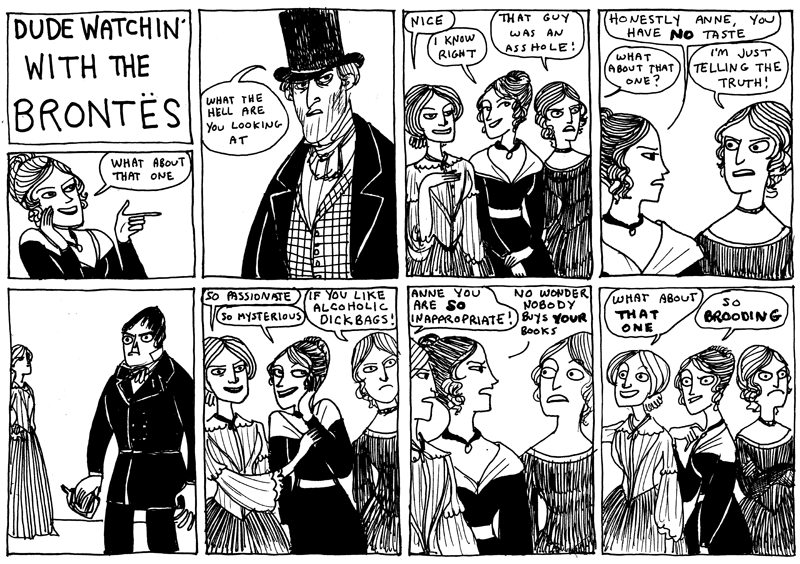
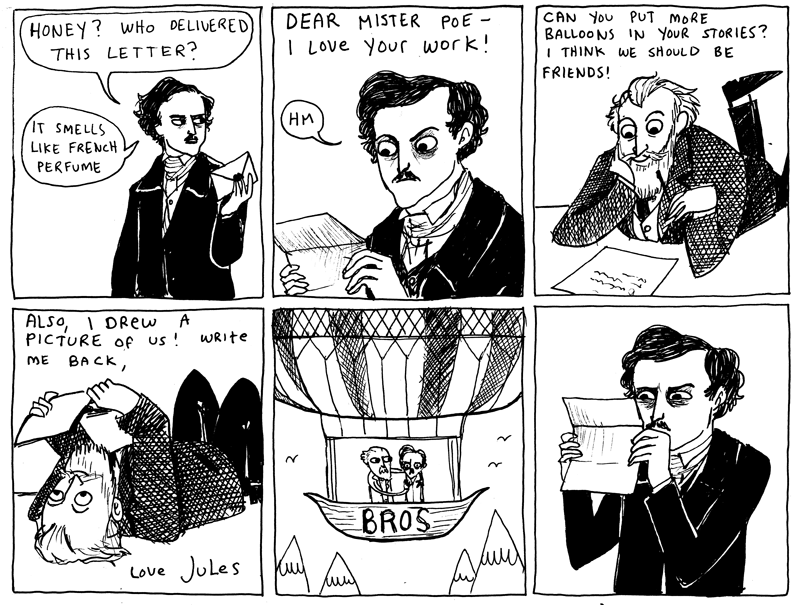
These miss the commentary, but the 2nd one refers to fan letters that Verne actually wrote to Poe.
This was a surprisingly, well-selected gift from one of my daughters. It's almost impossible for them to buy me books...
143avaland
I have reached the halfway point in my little tragedy book. It will be very difficult to comment on, I think. I'm going very slowly, and although I have seen some delectable little bits towards the end, I am making myself first read all that comes before -- twice! One can begin by thinking about how often the word 'tragedy' is used these days. Not a disaster, or a crisis, but everything now seems a "tragedy".
145Nickelini
I've seen the Bronte one before (but it's still excellent every time), but the Poe-Verne one was new to me--love it! Nina and I were just talking about "slash" ficiton--gay fan fiction--and then I read that. Perfect timing.
"Can you put more balloons in your stories?" ha ha ha ha ha.
I think I need that book.
"Can you put more balloons in your stories?" ha ha ha ha ha.
I think I need that book.
147laytonwoman3rd
#142 In honor of the day is there an appropriate Dickens cartoon strip?
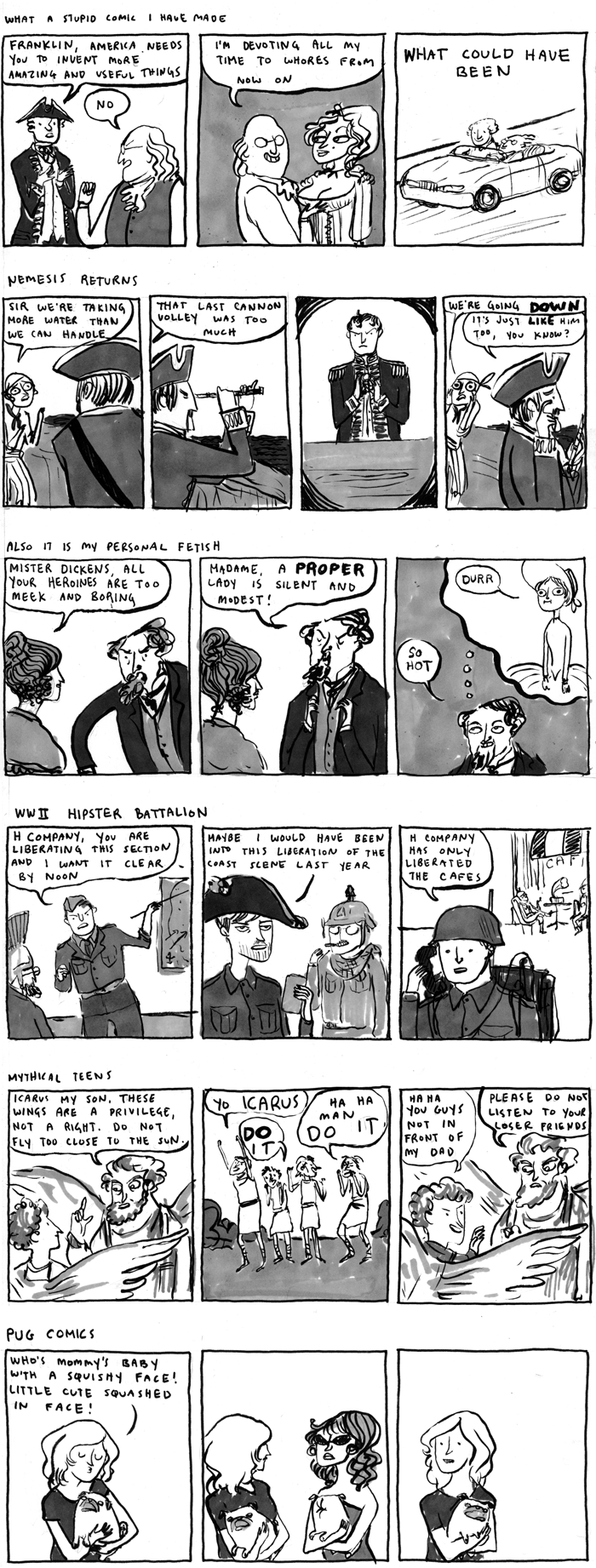
149Nickelini
Lois - I walked into a little bookstore in the village over by where Fab works and what was the first thing I saw? Yep, Hark a Vagrant. It was a sign, so I had to buy it. This isn't a 'reading' book though, so it's not going on Mnt TBR, thus it hardly counts as a book purchase.
150fannyprice
Hark, A vagrant is too funny.
151laytonwoman3rd
#148 Thanks, Lois!
152arubabookwoman
Ruth McDowell's quilts are amazing. Her piecing is so intricate. She spoke at a guild I am in several years ago, and brought many of her quilts, so I got to see them "in person" and up close.
I don't know whether you've heard of or have read the magazine Quilting Arts. My art group and our work is going to be featured in the magazine in the fall issue.
I don't know whether you've heard of or have read the magazine Quilting Arts. My art group and our work is going to be featured in the magazine in the fall issue.
153avaland
>152 arubabookwoman: I am, though I don't usually pick it up. Remind me when the issue is out and I'll chase it down. (though I suspect the NEQM library will have a copy also).
Some of her books that I have picked up and read through recently are fairly redundant to each other. And I don't need all the piecing (mechanics of) instructions as I've been sewing clothing and other things since the late 60s, but it's her use of color, hue, and pattern that fascinates me.
Some of her books that I have picked up and read through recently are fairly redundant to each other. And I don't need all the piecing (mechanics of) instructions as I've been sewing clothing and other things since the late 60s, but it's her use of color, hue, and pattern that fascinates me.
154SassyLassy
Have you seen the wonderful fish quilts by the aptly named Laurie Swim? The Quilt as Art shows some of her development and doesn't have any mechanics. Your fish above are incredible.
155avaland
>154 SassyLassy: Sassy, I'm probably more of a Ruth McDowell (the fish) than Laurie Swim, I think. I popped over to her website to take a peek. Thanks for pointing her out to me.
156SassyLassy
I see what you mean about the website. These look much more market oriented. I was lucky enough to see her studio once and it was a quite different experience.
157avaland

The Robber Bridegroom by Eudora Welty (1942, US)
Seems I missed commenting on my first read of 2012. I have not read much Eudora Welty, just her One Writer's Beginnings, a excellent memoir about a lifetime of writing.
The Robber Bridegroom retells the classic fairy tale set in Mississippi during its early frontier days. Apparently, it features some legendary local characters (i.e. Clement Musgrove, Jamie Lockhart), none of which were familiar to me. Whether my enjoyment of the story suffered because of my ignorance in this matter I cannot say. Clement has a beautiful daughter, who is stolen away by the bandit Jamie, aided by the nefarious acts of Clement's evil second wife, who is jealous of his daughter.
The story is an interesting mix of frontier legend and fairy tale, but prose reads like a fairy tale, with a kind of cadence to it that I enjoyed:
"Ho! Ho! Said the other, and taking off his red shirt and filling his bristling chest with a breath of fresh air, he seized the other's own jug and finished it off. Then, sailing his cap into the air, he gave a whistle and a shake and declared that he was none other than Mike Fink, champion of all the flatboat bullies on the Mississippi River, and ready for anything."
An easy, short read, the book is very witty and yet oddly disturbing in places.
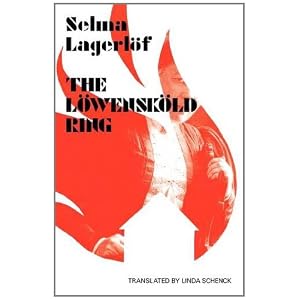
The Lowenskold Ring by Selma Lagerlof (1923, Swedish, new ed)
This is a new edition of Linda Schenck's 1991 translation of Lagerlof's book (the first of a trilogy, her last work of prose fiction). I seldom say this, but I think I enjoyed the introduction, translator's afterword, and translator's addendum to the afterword, as much as I enjoyed the book. I usually read all introductions after I have read the book for I don't like to be told how I should enjoy a book and what I should take away from it before I experience it. This book was no different.
The Lowenskold Ring is a deceptively simple tale that attempts to put folk tale from oral tradition onto paper. It tells the tale of a ring, once given to General Lowenskold by the king, but stolen from the General's tomb, and follows it through a succession of owners who suffer terrible consequences for having it in their possession. It's a tale of murder and ghosts, not unlike The Turn of the Screw, as the translator, Linda Schenck, points out. It also can be read, Ms. Schenck mentions later in the afterword, as metafiction, for when the narrator inserts herself into the story, it's clear Lagerlof is commenting on more than just the tale, but also herself as a writer and her "variable status in the predominantly male literary establishment." This latter bit jives nicely with a well-done introduction, less for the book, than for its intriguing author.
Linda Schenck, also talks about translation itself, quoting others who feel that translation should not be definitive, but ephemeral and argue for frequent re-translation to update work for contemporary audiences. What I take away from this is that a translation carries with it the baggage of its current culture, so thus a 1928 English tradition may not now best serve this 1925 work.
Like I said, the additional material is an interesting as the short novel itself.
-----
I'm still plodding slowly through Tragedy: A Very Short Introduction, having just read a chapter that discussed Hegel and Nietzsche's views on the subject (och!), and a chapter on dark humor, which was a great relief after the brain burn of the previous chapter. I'm more or less interested in how tragedy in manifest in a contemporary society that overuses the word...
158Linda92007
Interesting comments on introductions and Linda Schenck's afterword. I have often found a translator's comments to be more insightful than the average introduction. Most likely because they must engage with the work on such a deep level.
159baswood
#158 I agree, I always read the translator's introductions first. Recently I have read David Young's preface to his translation of The Poetry of Petrarch which was absolutely wonderful.
160dmsteyn
>157 avaland: I read One Writer's Beginnings last year, and agree that it is excellent. I'm also interested in reading more by Welty. The Robber Bridegroom sounds interesting, but I want to read The Golden Apples first. Do you think Atwood took the title of The Robber Bride from Welty? Do the books have anything in common?
161laytonwoman3rd
#160 The Robber Bridegroom isn't original with Welty. There's a Grimm's fairy tale about the robber bridegroom. And the concept of a "false bride" who seduces and steals a husband is fairly common in folk culture too.
162avaland
>160 dmsteyn: There really isn't anything in common between the two books except their original inspiration, but that is what drew me to the Welty. It's interesting to see what an entirely different author does with the same fairy tale root.
163pamelad
Lois, that's an interesting point you report, about translations being ephemeral. After reading The Artificial Silk Girl I heartily disagree with the translator's updating of thirties German slang and other references to a twenty first century American equivalent. The anachronisms and Americanisms are quite jarring. In many places I stopped to think, "Can this be right?" before remembering that the translator had reinterpreted the book. I want to read, as far as possible, what the writer originally wrote, not a translator's update to a modern approximation.
164dmsteyn
On translations, here's an interesting extract from chapter 62 of part 2 of Don Quixote:
'... it seems to me that translation from one language into another, if it be not from the queens of languages, the Greek and the Latin, is like looking at Flemish tapestries on the wrong side; for though the figures are visible, they are full of threads that make them indistinct, and they do not show with the smoothness and brightness of the right side; and translation from easy languages argues neither ingenuity nor command of words, any more than transcribing or copying out one document from another. But I do not mean by this to draw the inference that no credit is to be allowed for the work of translating, for a man may employ himself in ways worse and less profitable to himself.'
'... it seems to me that translation from one language into another, if it be not from the queens of languages, the Greek and the Latin, is like looking at Flemish tapestries on the wrong side; for though the figures are visible, they are full of threads that make them indistinct, and they do not show with the smoothness and brightness of the right side; and translation from easy languages argues neither ingenuity nor command of words, any more than transcribing or copying out one document from another. But I do not mean by this to draw the inference that no credit is to be allowed for the work of translating, for a man may employ himself in ways worse and less profitable to himself.'
165bonniebooks
Those cartoons are hilarious. I like what you have to say about JC Oates intent. You make me want to read more of her writing even though I really don't like listening to her speaking. There's something about her tone and manner that just grates, and it's hard not to hear her voice when I read her work. Salvage the Bones sounds like my kind of book.
166avaland
>163 pamelad: I think they were talking a bit more...generally(?) I'll excerpt it when I get a minute.
167rebeccanyc
#163 I agree with you, Pam, about how jarring translations can be when they use, for example, modern slang or expressions. It can drive me nuts.
169avaland
>168 dchaikin: Dukedom & I have had that discussion, but he mentions that Tolkien, though he certainly may have read the Lagerlof tale (which is 3 short books, btw), was probably more likely inspired by Wagner's opera "Der Ring des Nibelungen" of the 19th century ( http://en.wikipedia.org/wiki/Der_Ring_des_Nibelungen ), the origin of which is old Norse myths.
Lagerlof probably also knew of the Wagner, but being Swedish and interested in putting oral tradition to prose, I'm inclined to think that she is working from the same myth/folk tale source material Wagner is.
Lagerlof probably also knew of the Wagner, but being Swedish and interested in putting oral tradition to prose, I'm inclined to think that she is working from the same myth/folk tale source material Wagner is.
170DieFledermaus
Added The Lowenskold Ring to the list - Wagner + metafiction sounds like something I would enjoy.
171avaland
>170 DieFledermaus: Make sure to get the newer translation though. I think I actually have an older copy of the same story somewhere around the house....but I think the title is The General's Ring. Apparently, I must have thought it something different when I ordered the new edition:-)
172avaland
Deep into Them now: a bleak but mesmerizing story of life in the slums of Detroit in the 40s, 50s and early 60s. It's based on a true story, a young woman who attended one of Oates's night classes in the early to mid 60s (in Detroit). The book gives inner lives to people on the margins of society.
173Nickelini
Back at post 143, you said One can begin by thinking about how often the word 'tragedy' is used these days. Not a disaster, or a crisis, but everything now seems a "tragedy".
I'm interested in this too. Years ago I took a course in Public Relations, and our instructor had quite a rant about the misuse of "tragedy." In his books, it was wrong to use the word to describe a bad thing that happened to one person. For example, "Commuter tragedy: mother of four crushed by subway train." He said to only use it for cases of something really bad happening to a group of people, such as "Flooding in Bangladesh kills 200,000." Then it came up in a conversation with a group of copy editors and the old curmudgeon in the group said that it could ONLY ever be used in the Aristotelian sense of a bad thing happening because of a tragic error. Since then I have watched carefully how this word is use. Hence, my interest in your conversation about "tragedy."
I'm looking forward to your thoughts on the book about tragedy that you're reading, and I'm off to read the article you linked to way back in January.
I'm interested in this too. Years ago I took a course in Public Relations, and our instructor had quite a rant about the misuse of "tragedy." In his books, it was wrong to use the word to describe a bad thing that happened to one person. For example, "Commuter tragedy: mother of four crushed by subway train." He said to only use it for cases of something really bad happening to a group of people, such as "Flooding in Bangladesh kills 200,000." Then it came up in a conversation with a group of copy editors and the old curmudgeon in the group said that it could ONLY ever be used in the Aristotelian sense of a bad thing happening because of a tragic error. Since then I have watched carefully how this word is use. Hence, my interest in your conversation about "tragedy."
I'm looking forward to your thoughts on the book about tragedy that you're reading, and I'm off to read the article you linked to way back in January.
174DieFledermaus
>171 avaland: - Thanks for the tip - the Schenck translation is the one that my library has. But it looks like the other books in the trilogy haven't had a new translation since 1931 (this is from Wikipedia - might not be correct).
175avaland
>173 Nickelini: Thanks for your comments, it's all very interesting. I have a second book on the subject, and I think there will be a lot of crossover, but I think I need to write about the first, if only to help digest it. Perhaps this weekend.
176avaland
>174 DieFledermaus: I think you are correct. Drop a little note to Norvik Press and perhaps they'll get on it :-)
>175 avaland: Joyce, wasn't it you who read Jude the Obscure not so long ago? Hardy comes up in the tragedy discussion (particularly Tess), but the author also talks about classical tragedy ending with the 19th century.
>175 avaland: Joyce, wasn't it you who read Jude the Obscure not so long ago? Hardy comes up in the tragedy discussion (particularly Tess), but the author also talks about classical tragedy ending with the 19th century.
177avaland

Tragedy :A Very Short Introduction
This small book is crammed full of intriguing stuff, and I have no idea where to start or how to even summarize it. It set out a number of questions in its introduction that it aimed to answer in its nine chapters. While each chapter is very interesting and full of information, in the end I did not feel the expected answers are presented with much clarity overall. The problem for me may have been the way each chapter is constructed: with many small subtopics with little introduction or summation.
Most of my experience with classical tragedy comes from Shakespeare, but beyond that I have never made a real study of tragedy itself. The subject and its application to contemporary literature; such as that of Joyce Carol Oates, intrigues me.
What interested me most was the various elements and aspects of tragedy that might be applicable to contemporary literature (I was less interested in how it might apply to our contemporary overuse? of the word in the news, though that is touched upon), so I will cherry pick, and talk about some of these 'aspects' for your own cerebral stimulation. (was the last book you called a tragedy, really so?)
Classical tragedy is concerned with ideas of fate, fortune and chance (which can be linked to our modern concept of accident)
Classic tragedy, often said to have ended with the 17th century, is concerned with Gods, collective myth, public figures, and poetry.
Tragedy is full of ghosts, not all materialize. “...tragedy always deals with toxic matter bequeathed from the past to the present. In personal terms, this often means what mothers and fathers have passed on to their children in the form of duties, loyalties, passions and injuries.”
There are many kinds of scapegoats in tragedy. :Scapegoats are meant to solve the problems of guilt or innocence, but in tragedy they raise questions about the process of judgement by which blame is affixed and punsihment executed.”
Tragedy explores pain and our ideas of it. “Yet is it not so much the pain my pain or yours with which tragedy is concerned... It is the pain of others, and the painful questions to which this gives rise: such as “whose business is it?” *
(more to come in a day or two)
*Susan Sontag's Regarding the Pain of Others is also quite good on this subject.
178rebeccanyc
Sounds intriguing . . Might have to look for this myself, especially since my taste runs to gloomy books . . .
179Nickelini
Lois -- I'm picking up mixed messages about your tragedy book. Not sure if you're recommending it or not. Now that I see the title with the cover, I recognize it as part of a vast series, and I have to admit I haven't found that series well written from my sampling. Also, I have read Regarding the Pain of Others, and although I've kept the book for a future reread, I thought Sontag's writing was somewhat exasperating. I found myself editing each sentence and wondering why she had to use such obtuse construction. It distracted me from her very interesting thoughts. I'm engaged on the topic, but not sure that these books are where I want to spend my time .....
180avaland
>179 Nickelini: Yes, there is a mixed message there, isn't there? The author is clearly passionate about his subject and, for the most part, his prose is accessible (though naturally jammed with classical examples), but the piecemeal arrangement of lots of small subtopics leaves a bit to be desired on first reading. However, it improves on second reading, and I suspect I have taken away lots of bits and pieces that will enrich my future reading, despite my current whining about the arrangement.
I have a second, short book called Why Does Tragedy Give Pleasure? by A. D. Nuttall; bought at the same time. I will pick that up after I finish going through the other for a second read.
>178 rebeccanyc: Actually, I do think you would find the subject interesting, because we do share that penchant for the dark, gloomy and tragic. Will let you know on the 2nd book also.
I have a second, short book called Why Does Tragedy Give Pleasure? by A. D. Nuttall; bought at the same time. I will pick that up after I finish going through the other for a second read.
>178 rebeccanyc: Actually, I do think you would find the subject interesting, because we do share that penchant for the dark, gloomy and tragic. Will let you know on the 2nd book also.
181DieFledermaus
Interesting review of Tragedy: A Short Introduction - I'll be looking for your review of the second book also.
I had a couple questions about the book - what were the reasons they gave for stating that classical tragedy ended in the 19th century?
Were some of the characteristics of a classical tragedy taken from the Greeks? I remember discussing this in a class and some of the requirements listed for a tragedy didn't show up as frequently in later novels - unity of time and place, the protagonist has to be a high-status person, situation is more important than character.
I had a couple questions about the book - what were the reasons they gave for stating that classical tragedy ended in the 19th century?
Were some of the characteristics of a classical tragedy taken from the Greeks? I remember discussing this in a class and some of the requirements listed for a tragedy didn't show up as frequently in later novels - unity of time and place, the protagonist has to be a high-status person, situation is more important than character.
182avaland
>181 DieFledermaus: I have that wrong, it should have said the 17th century. Although there is some discussion of Hardy here and there, so perhaps that is why the 19th stuck in my head. Will correct.
He considers the 'real' thing to have been produced by Greeks in the 5th century and early modern Europe (which he notes, owes much of its "cultural vitality to the rediscovery of classical antiquity." So, yes, his characteristics are drawn from the Greeks, but he also uses Shakespeare, Racine...etc in his examples.
He considers the 'real' thing to have been produced by Greeks in the 5th century and early modern Europe (which he notes, owes much of its "cultural vitality to the rediscovery of classical antiquity." So, yes, his characteristics are drawn from the Greeks, but he also uses Shakespeare, Racine...etc in his examples.
183avaland
Well, it has been weeks since I have reported on any reading, and again I am very behind on comments. When last I spoke, I was trying to summarize the short book on tragedy. Part II of that summary will come along as soon as I locate that little book. In the meanwhile I have a lot of catching up to do...

The Flight of Gemma Hardy by Margot Livesey
A modern re-telling of Jane Eyre, The Flight of Gemma Hardy is set in Scotland the 50s and 60s. The narrative of Gemma Hardy follows the narrative of Jane Eyre relatively closely. The story invites comparison early on because there is a lack of pop cultural markers that would really place the story in the mid-20th century. For maybe the first 100 pages I did just that, compare. But somewhere along the line I relaxed, got involved in Gemma's story, and anticipated how Livesey was going to interpret later parts of the story.
And here, let me tell you here that I have 4 different editions of Jane Eyre in my library. The story and its plucky heroine has had an important place in my life since the first time I read it in a Classics Illustrated comic book. Thus, I feel that I am as entitled and qualified to criticize this re-telling as much as anyone. Also, on another note, I am also a reader of Margot Livesey, having read most of her fiction to date).
I enjoyed Livesey's story, despite the tendency to compare. It was just what I needed at the time. The power of Livesey's tale is less that it is a love story, and more Gemma's coming into her own. Frankly, I thought she could have dispensed with Rochester/Mr. Sinclair after that.
But the book got me thinking about what is important in Jane Eyre, why is was important to me, and whether Jane Eyre could really be retold today (I decided I might be tempted to cast Jane as a kind of Lisbeth Salander and let her express a bit more of that eyre/ire!)
Note: I have also recently read an essay on Jane Eyre by JCO which I will report on later in this thread.

The Flight of Gemma Hardy by Margot Livesey
A modern re-telling of Jane Eyre, The Flight of Gemma Hardy is set in Scotland the 50s and 60s. The narrative of Gemma Hardy follows the narrative of Jane Eyre relatively closely. The story invites comparison early on because there is a lack of pop cultural markers that would really place the story in the mid-20th century. For maybe the first 100 pages I did just that, compare. But somewhere along the line I relaxed, got involved in Gemma's story, and anticipated how Livesey was going to interpret later parts of the story.
And here, let me tell you here that I have 4 different editions of Jane Eyre in my library. The story and its plucky heroine has had an important place in my life since the first time I read it in a Classics Illustrated comic book. Thus, I feel that I am as entitled and qualified to criticize this re-telling as much as anyone. Also, on another note, I am also a reader of Margot Livesey, having read most of her fiction to date).
I enjoyed Livesey's story, despite the tendency to compare. It was just what I needed at the time. The power of Livesey's tale is less that it is a love story, and more Gemma's coming into her own. Frankly, I thought she could have dispensed with Rochester/Mr. Sinclair after that.
But the book got me thinking about what is important in Jane Eyre, why is was important to me, and whether Jane Eyre could really be retold today (I decided I might be tempted to cast Jane as a kind of Lisbeth Salander and let her express a bit more of that eyre/ire!)
Note: I have also recently read an essay on Jane Eyre by JCO which I will report on later in this thread.
184avaland

Pure by Julianna Baggott (2012, US)
Pure is a dystopian tale with a post nuclear apocalyptic setting in which some people were saved and sheltered by a dome built in anticipation of the nuclear attack, but most weren't. Outside the dome, most people who survived are either maimed in some way and or fused to whatever they were near at the time of the explosions. Pressia, a young girl on the outside, has a plastic doll's head where her right hand should be. Her friend, has living birds fused into his back. {the author's creations here are wonderfully Miéville-eske!)
To both sets of people, the other is just that 'other', neither really knows the other - only what they have heard, or been taught. Outside the dome it's a rough world and survival is the story; inside the Dome life is comfortable and controlled. When Bradwell, a young man in the Dome, learns his mother might still be alive on the outside, he finds a way to escape. Eventually, as one might expect, he connects up with Pressia and the two join forces in what become common cause. They are joined by others.
I'm not going to belabor the plot summary here. I'm not particularly a reader of YA fiction, though I have read some. I am however a reader of Julianna Baggott (I've read all of her adult fiction and her three volumes of poetry) and a fan of dystopian fiction. Pure is a clever, surprisingly complex adventure tale with pretty much non-stop action (and here is where I remember what a snoozer I thought Never Let Me Go was...). It's decidedly addicting. No magic wands to solve any problems here! And, damn, it's nice to read about girl action heroes...
The book is fairly complete in itself, despite being the first part in a trilogy. That is, if you think you will be able to stop at just that one.
186Linda92007
>183 avaland: I was interested in your review of The Flight of Gemma Hardy, as I plan to attend a talk by Livesey next week. I think I read somewhere that it contains some autobiographical elements. I haven't read any of her books but I do have The House on Fortune Street waiting on my Kindle.
187avaland
>186 Linda92007: Lucky you! I will be interested in your report. She has taught for quite a long time now at Emerson College in Boston which is actually not all that far from me. I missed her appearance at the bookstore in Concord...(it was on the calendar but it just slipped my mind that day...)
188avaland
Selections from:
(Women Writer): Occasions and Opportunities, essays by Joyce Carol Oates (1988)
This is a collection of Oates's critical work: essays, special occasion lectures, introductions to classics...etc. It begins with a short preface where she suggests that critical writing is an indirect form of storytelling. I tend to dip in and out of these kind of collections and so I have done with this one since it arrived last week. Here's what I have read thus far:
"Jane Eyre: an Introduction" first published in a different version in the Virginia Quarterly
I enjoyed this look at JE which talked many aspects of the book: Jane's authority over her experience comes from it being history rather than story (she is in 1819 recounting the events of 1799-1809), it is remarkable for its "forthright declaration of its heroine's passions and appetites," noting in the structure of the story the attempt to balance one kind of temptation (Rochester/romantic passion) with the other kind (Christian ambition) which Oates then suggests that JE is a novel of ideas and more akin to the work of George Eliot than her sister Emily Bronte.
(and one note that I hadn't thought about: Bertha Mason is suffering from the effects of syphilitic infection, which means Rochester would be infected, which means...)
"Moby Dick: An American Book of Wonders" With all the talk of MD around ClubRead, I thought I'd read this one. I've never read MD or wanted to. The essay is full of wonderful tidbits, thoughtful stuff that readers may agree or disagree with. This is why we read this stuff.
"Herman Melville was clearly one of those figures of the mid- and late nineteenth century who suffered the absence of God with as much passion as his Puritan and Calvinist predecessors suffered God's probably wrath. The will to believe, to have faith, is so poignant a motive in Melville's major works—Pierre, The Confidence Man, and Billy Budd, in addition to Moby Dick—that it is no exaggeration to say that it informs their very conceptions. The white whale is the most celebrated (and, in literary terms, the most inspired) of the images of an unknowable God..."
More on other essays read later perhaps...
(Women Writer): Occasions and Opportunities, essays by Joyce Carol Oates (1988)
This is a collection of Oates's critical work: essays, special occasion lectures, introductions to classics...etc. It begins with a short preface where she suggests that critical writing is an indirect form of storytelling. I tend to dip in and out of these kind of collections and so I have done with this one since it arrived last week. Here's what I have read thus far:
"Jane Eyre: an Introduction" first published in a different version in the Virginia Quarterly
I enjoyed this look at JE which talked many aspects of the book: Jane's authority over her experience comes from it being history rather than story (she is in 1819 recounting the events of 1799-1809), it is remarkable for its "forthright declaration of its heroine's passions and appetites," noting in the structure of the story the attempt to balance one kind of temptation (Rochester/romantic passion) with the other kind (Christian ambition) which Oates then suggests that JE is a novel of ideas and more akin to the work of George Eliot than her sister Emily Bronte.
(and one note that I hadn't thought about: Bertha Mason is suffering from the effects of syphilitic infection, which means Rochester would be infected, which means...)
"Moby Dick: An American Book of Wonders" With all the talk of MD around ClubRead, I thought I'd read this one. I've never read MD or wanted to. The essay is full of wonderful tidbits, thoughtful stuff that readers may agree or disagree with. This is why we read this stuff.
"Herman Melville was clearly one of those figures of the mid- and late nineteenth century who suffered the absence of God with as much passion as his Puritan and Calvinist predecessors suffered God's probably wrath. The will to believe, to have faith, is so poignant a motive in Melville's major works—Pierre, The Confidence Man, and Billy Budd, in addition to Moby Dick—that it is no exaggeration to say that it informs their very conceptions. The white whale is the most celebrated (and, in literary terms, the most inspired) of the images of an unknowable God..."
More on other essays read later perhaps...
189avaland

Selections from Sin: Selected Poems of Forugh Farrokhzad (2007, Trans. by Sholeh Wolpé)
Forugh Farrokhzad was an Iranian poet of the 1950s and 60s, who died tragically when she was 32. Her poems caused quite a stir because they were sensuous and modern rather than traditional, and, while women were often the subjects of much Iranian poetry (written by men, of course) she was a woman now writing about men. She stretched the boundaries of what Iranian women could say. She quickly became a literary celebrity.
On first reading I thought these poems somewhat unsophisticated and plain-spoken, albeit passionately so. But I did not bring my full, thoughtful attention to that first read (for clearly the collection intrigued me enough when I browsed through it in the bookstore to inspire me to purchase it) As a Western women (or men) reading these poems a half century later, we take for granted being able to express ourselves passionately, so understanding the cultural context these poems were written enhances one reading. And Farrokhzad is a young poet and that youth is apparent in her work. Even now, 50+ years after her first collection was published (1955), her poetry is still rich with emotional and sensual/sexual intensity. Here are some excerpts of the many I like:
Those days are gone
the days of staring at the secrets of flesh,
of cautious intimacies and the blue-veined beauty
of a hand holding a flower, calling
from behind a wall
to another hand—
a small ink-stained hand,
anxious, trembling, and afraid...
And love unveiling in a shy salaam.
---excerpt from "Those Days" in the collection Reborn, 1964
Like the disheveled locks of a woman
the Karun river spreads itself
on the naked shoulders of the shore.
The sun is gone, and the night's hot breath
wafts over the water's beating heart.
Far in the distance the river's southern shore
is love-drunk in moonlight's embrace.
The night with its million brilliant bloodshot eyes
spies on beds of innocent lovers
The cane field is fast asleep. A bird
shrieks from amid its darkness,
and the moonbeams rush to see
what fear has driven it to such despair.
---excerpt from "Grief" in the collection Asir (1955, her first collection)
Our garden is forlorn.
It yawns waiting
for rain from a stray cloud,
and our pond sits empty.
Callow stars bite the dust
from atop tall trees
and from the pale home of the fish
comes the hack of coughing every night.
Our garden is forlorn.
---excerpt from "I Pity the Garden" in the collection Let Us Believe in the Dawn of the Cold Season (1967, published posthumously)
190avaland

Them by Joyce Carol Oates (1969, 1970 National Book Award winner)
Set in the slums of Detroit in the decades of the 1930s through 1960s, Them follows the lives of three (white) family members: Loretta and her two children, Jules and Maureen. It’s an embarrassingly riveting story, a survival tale of relentless poverty and violence. I was mesmerized and flew through most of the novel’s nearly 500 pages.
JCO calls this novel history as fiction (a slight paraphrase). Maureen, the daughter in the story, was a student in one of the night classes JCO taught while at the University of Detroit. Some years later, Maureen wrote to her and, as they became acquainted, Maureen began to tell her own story. JCO says she was riveted by it, conscious that she was to bear witness of it. Maureen’s (not her real name, of course) actual remarks/recollections have been used verbatim wherever possible, and nothing has been exaggerated for dramatic effect. All this JCO notes in the preface.
And here is where I might add some synopsis but I think it’s best to leave that for you to discover. Suffice it to say that the three are survivors; and that, in and of itself, is a testament to the resilience of the human spirit.
While the book is about a specific, and very real “them,” one could also say that the story also speaks of a more general “other” — “them”, whomever they may be. For Loretta it seems to be anyone outside her small circle of family and friends. For us, the reader, it is this specific family as representative of the people in our culture we don’t see, the people who have no voice in our society. It’s a powerful story, we cannot help be carried along with it.
There was a section towards the end of the book that I found less enthralling, but otherwise the book captures one’s attention completely, right up through it’s climax—the awful 1967 Detroit riots.
191avaland
Selection from: The Tragic Vision of Joyce Carol Oates by Mary Kathryn Grant (1974, 1978)
This is a literary criticism of Oates's early works of the 60s and early 70s. I have not read most of the books frequently referred to the bulk of this work, but I found that I could enjoy most of the first chapter which serves basically as an introduction to the rest of the book. I enjoy literary criticism, particularly of favorite authors, for the same reason one enjoys reading others' reviews of a book one has already read.
Here's some tidbits (this is an old, ex-library copy and I thoroughly enjoyed underlining and marking up the pages!):
Her fiction is her attempt to 'give a shape to certain obsessions of mid-century Americans—a confusion of love and money, of categories of public and private experience, of a demonic urge...an urge to violence as the answer to all problems, an urge to self-annihilation, suicide, the ultimate experience and the ultimate surrender. The use of language is all we have to pit against death and silence." This testament to the power of art underlines her awesome sense of responsibility of the writer who, by raising the consciousness of the age, creates history and the future.
So insistent is she that "all art is moral, educative, illustrative," that she dismisses her fourth novel, Wonderland, as immoral because she could not resolve its moral issues.** Art, she insists, demands a vision of life as cyclical tragedy, and its purpose is to lead the reader to a more profound "sense of the mystery and the sanctity of the human predicament." For a work not to achieve this is for it to be judged a moral failure. Her present body of fiction tells the tragic tale of a decade wasted by war, assassinations, and riots, and a people paralyzed by their fear of being powerless to change things. But her works do more than merely chronicle the horrors of the sixties and early seventies, they are efforts to raise the consciousness of ordinary people to the realization of the destruction of their lives, to "show us how to get through and transcend paid," to encourage us to continue the struggle to put some meaning into human life.
...her fiction yields the affirmation and celebration of survivors
There is some interesting, albeit brief commentary, comparisons and commonalities noted, between Oates and other authors, some who predate her and may be influences, and some her contemporaries: Saul Bellow, Flannery O'Connor, William Faukner, Philip Roth, Doris Lessings D. H. Lawrence.
There's some discussion of three common themes: woman, city and community before the book moves into too many references to books I have not read—yet.
(ha ha, are you sick of me writing about JCO yet? I have often gone on author 'jags' in years past, but Oates provides fodder for a jag that could (has!) last years.
This is a literary criticism of Oates's early works of the 60s and early 70s. I have not read most of the books frequently referred to the bulk of this work, but I found that I could enjoy most of the first chapter which serves basically as an introduction to the rest of the book. I enjoy literary criticism, particularly of favorite authors, for the same reason one enjoys reading others' reviews of a book one has already read.
Here's some tidbits (this is an old, ex-library copy and I thoroughly enjoyed underlining and marking up the pages!):
Her fiction is her attempt to 'give a shape to certain obsessions of mid-century Americans—a confusion of love and money, of categories of public and private experience, of a demonic urge...an urge to violence as the answer to all problems, an urge to self-annihilation, suicide, the ultimate experience and the ultimate surrender. The use of language is all we have to pit against death and silence." This testament to the power of art underlines her awesome sense of responsibility of the writer who, by raising the consciousness of the age, creates history and the future.
So insistent is she that "all art is moral, educative, illustrative," that she dismisses her fourth novel, Wonderland, as immoral because she could not resolve its moral issues.** Art, she insists, demands a vision of life as cyclical tragedy, and its purpose is to lead the reader to a more profound "sense of the mystery and the sanctity of the human predicament." For a work not to achieve this is for it to be judged a moral failure. Her present body of fiction tells the tragic tale of a decade wasted by war, assassinations, and riots, and a people paralyzed by their fear of being powerless to change things. But her works do more than merely chronicle the horrors of the sixties and early seventies, they are efforts to raise the consciousness of ordinary people to the realization of the destruction of their lives, to "show us how to get through and transcend paid," to encourage us to continue the struggle to put some meaning into human life.
...her fiction yields the affirmation and celebration of survivors
There is some interesting, albeit brief commentary, comparisons and commonalities noted, between Oates and other authors, some who predate her and may be influences, and some her contemporaries: Saul Bellow, Flannery O'Connor, William Faukner, Philip Roth, Doris Lessings D. H. Lawrence.
There's some discussion of three common themes: woman, city and community before the book moves into too many references to books I have not read—yet.
(ha ha, are you sick of me writing about JCO yet? I have often gone on author 'jags' in years past, but Oates provides fodder for a jag that could (has!) last years.
192baswood
Nothing wrong with an author who may be influenced by D H Lawrence. Enjoyed your review of Them.
193avaland
>192 baswood: Thanks, Barry.
194Linda92007
I used to own a fair number of unread Oates' novels, including Them, but a few years ago donated them all to a book sale being held to benefit a local arboretum. I had not read Oates in many years and was convinced I was not interested in them. Now I am reading your wonderful reviews and very much regretting that decision. Luckily, the library system seems to have a good collection. Or maybe some will still be there at the upcoming Spring sale and I can buy them back!
195avaland
>194 Linda92007: How sad! But there are always more JCO! Perhaps you would prefer some of her later books...
I just read through all the reviews of Them on the book's page. I suppose I shouldn't have been shocked, but so many of the reviews seem so...well..."unenlighted". A book is bad because it is painful to read? It does intrigue me though that someone would get something entirely different from the novel than I did. One reader thought the book was all about Detroit, the city. Where did he/she get that? And clearly many didn't understand the riots (perhaps they are too young... I wonder if they thought it was something she made up...)
I just read through all the reviews of Them on the book's page. I suppose I shouldn't have been shocked, but so many of the reviews seem so...well..."unenlighted". A book is bad because it is painful to read? It does intrigue me though that someone would get something entirely different from the novel than I did. One reader thought the book was all about Detroit, the city. Where did he/she get that? And clearly many didn't understand the riots (perhaps they are too young... I wonder if they thought it was something she made up...)
196laytonwoman3rd
"I wonder if they thought it was something she made up"..... Oh, brother. I suppose it's not just possible, but entirely likely to be true.
197Nickelini
196 - yes, entirely likely.
About 7 years ago I was a mature student at university and I was assigned a presentation on the Berlin Wall for my Euro history class. The day before it struck me--will these students even know what the Berlin Wall was? Did I have to describe it? If I was in the audience, I'd find a description insulting to my intelligence, but I quickly ran this past my prof and he advised me to definitely describe what the Berlin Wall was all about.
About 7 years ago I was a mature student at university and I was assigned a presentation on the Berlin Wall for my Euro history class. The day before it struck me--will these students even know what the Berlin Wall was? Did I have to describe it? If I was in the audience, I'd find a description insulting to my intelligence, but I quickly ran this past my prof and he advised me to definitely describe what the Berlin Wall was all about.
198dukedom_enough
It is amazing that people seem to forget history so quickly.
199avaland

Heading Inland: Stories by Nicola Barker (1996, UK)
I come to Barker's short stories, after having read her award-winning novel Wide Open. I thought that a wonderfully quirky, superbly crafted piece of fiction, and I began to collect more of her work for future reading. After reading these stories, if I didn't know I was in love before, I know now.
These imaginative stories are equally quirky, some laugh out loud funny, but always includes a healthy, wry peek into the humanity of her often off-beat characters. A rebellious fetus, unhappy with the petty criminal mother he's being carried by, devises a plan to change her. A woman, dubious about the guy she's dating and about the thong she's bought for the occasion, finds it's more valuable than the guy when the car needs emergency repair. A guy sets free the live eels from a restaurant. A woman falls in love with a man whose buttons are done up wrong, though he is accused by another of using that old "three button trick."
What an imagination! I have several other Barker works in the pile, including Darkmans, which was heavily recommended to me by shearrob quite some time ago.
200laytonwoman3rd
Sounds like my kind of stuff...I'll put it on the watch list.
201wandering_star
Yes! I love Darkmans, it's my favourite of Nicola Barker's that I've read so far (although I haven't read Heading Inland or Wide Open). It's probably not for everyone - I just went back to check whether I had reviewed it, and I compare the experience of reading it to "riding a ghost train with its brake cable cut - you hurtle with increasing speed through bizarre and sometimes sinister surroundings, with the occasional flash of illumination to show you where you are". (I think my prose gets most purple when I've just read something that's inventively written). But if you are prepared to go along for the ride, it's fantastic.
Re: #197, a good friend of my mother's had escaped from East Germany when she was young, and in 1989 she was working in a nursery school in the UK. She took a bottle of champagne into the staffroom and left it with a note - 'to celebrate the fall of the Wall' - and one of the other staff members asked her what she meant!
Re: #197, a good friend of my mother's had escaped from East Germany when she was young, and in 1989 she was working in a nursery school in the UK. She took a bottle of champagne into the staffroom and left it with a note - 'to celebrate the fall of the Wall' - and one of the other staff members asked her what she meant!
202edwinbcn
I had some LOL with Love your enemies by Nicola Barker, to the obvious amusement of other patrons of the cafe.
203janeajones
I don't know Nicola Barker, but she sounds like a breath of fresh air!
204avaland
>200 laytonwoman3rd: Will keep an eye out for other copies. Got this one at a library sale.
>201 wandering_star: Wide Open not unlike some of these stories are, there is some of the same inventiveness, the same off-beat characters and unusual things going on. What I was struck with in that book was how gifted a writer she was—even in the craft of writing—"it's not just the prose, or the way she affectionately makes these people so real, but after I had finished the book, looking back, I realized that nothing in the book is wasted, everything is made to service the story..." (I like to see how a story is crafted, much like my son used to like to take mechanical and electronic things apart).
>203 janeajones: I certainly found it so. I was exactly what I needed at the time.
>202 edwinbcn: Yes, I know what you mean. I think the story about using the g-string to fix the car nearly did me in. I'm reading an A. L. Kennedy collection at the moment that is also quite quirky but with a different tone. Barker's tone in her stories I probably would call playful or affectionate. Day, hmmm, perhaps much drier.
But, I just returned from the bookstore with the new Oates, so other materials may be set aside for a time...
>201 wandering_star: Wide Open not unlike some of these stories are, there is some of the same inventiveness, the same off-beat characters and unusual things going on. What I was struck with in that book was how gifted a writer she was—even in the craft of writing—"it's not just the prose, or the way she affectionately makes these people so real, but after I had finished the book, looking back, I realized that nothing in the book is wasted, everything is made to service the story..." (I like to see how a story is crafted, much like my son used to like to take mechanical and electronic things apart).
>203 janeajones: I certainly found it so. I was exactly what I needed at the time.
>202 edwinbcn: Yes, I know what you mean. I think the story about using the g-string to fix the car nearly did me in. I'm reading an A. L. Kennedy collection at the moment that is also quite quirky but with a different tone. Barker's tone in her stories I probably would call playful or affectionate. Day, hmmm, perhaps much drier.
But, I just returned from the bookstore with the new Oates, so other materials may be set aside for a time...
205avaland
Well, I am back from seeing "The Hunger Games" with my 29 year old daughter who insisted I have to see it. I have NOT read the books.
What she said: Excellent adaptation, some change to the ending (they soften it a bit, she says).
What I thought overall: Excellent action movie with an appealing female hero. I liked it.
What I saw in it: Shirley Jackson's "The Lottery," growing up with the draft for Vietnam War, and odd blending of cultural entertainments: Survivor (and other similar reality TV), American Idol, and, yes, blood sport. Now, take that and mix a bit of Terry Gilliam and a bit of ...
The movie (and no doubt the book) is an amazing reflection of the cultural era in which we live. Right now, how much of our pop culture visual entertainment is about surviving? Quite a lot it seems . Dancing with Stars, the Bachelor...etc and perhaps even my favorite, Mad Men. It's all about competing and surviving. It's about winners and losers. The movie is certainly entertainment, and about entertainment.
Oh, just a few thoughts.
What she said: Excellent adaptation, some change to the ending (they soften it a bit, she says).
What I thought overall: Excellent action movie with an appealing female hero. I liked it.
What I saw in it: Shirley Jackson's "The Lottery," growing up with the draft for Vietnam War, and odd blending of cultural entertainments: Survivor (and other similar reality TV), American Idol, and, yes, blood sport. Now, take that and mix a bit of Terry Gilliam and a bit of ...
The movie (and no doubt the book) is an amazing reflection of the cultural era in which we live. Right now, how much of our pop culture visual entertainment is about surviving? Quite a lot it seems . Dancing with Stars, the Bachelor...etc and perhaps even my favorite, Mad Men. It's all about competing and surviving. It's about winners and losers. The movie is certainly entertainment, and about entertainment.
Oh, just a few thoughts.
206wandering_star
I'm seeing it tomorrow! I have only recently read the first book, which was OK, but really made me want to see the movie - one of my friends commented that when she read the book it almost felt like reading a screenplay, and I agree that it was a very visual narration. Glad you liked it.
207kidzdoc
Nice review of Heading Inland. I have three of Nicola Barker's novels, including Darkmans, which I plan to read later this year.
208Nickelini
I just recently learned about Darkmans. There have been lots of copies at the charity sales at Charlotte's school, but I never brought it home. If it's there next time I will.
209avaland
Am now, once again, behind on commentary. Not sure when I'll get to them, so...the really short versions:
Mudwoman by Joyce Carol Oates - still thinking what to say about this one. It's not one of my favorites perhaps because the main character is an academic - well, college president. I think 4 Oates novels might be enough for this year...
Sail of Stone by Åke Edwardson. I swear it took about 80 pages to get into this police procedural, but it was pretty good thereafter. Most recent of his Erik Winter series.
Bestsellers: A Very Short Introduction. History, overview and other interesting bits about "bestsellers" or "big sellers" (and various genres) since lists began being kept.
Figures in a Landscape by Gail Mazur and The Zoo in Winter by Poina Barskova, two poetry collections, interesting in their own ways. I often have to go back to these a few times before I can write about them...
Mudwoman by Joyce Carol Oates - still thinking what to say about this one. It's not one of my favorites perhaps because the main character is an academic - well, college president. I think 4 Oates novels might be enough for this year...
Sail of Stone by Åke Edwardson. I swear it took about 80 pages to get into this police procedural, but it was pretty good thereafter. Most recent of his Erik Winter series.
Bestsellers: A Very Short Introduction. History, overview and other interesting bits about "bestsellers" or "big sellers" (and various genres) since lists began being kept.
Figures in a Landscape by Gail Mazur and The Zoo in Winter by Poina Barskova, two poetry collections, interesting in their own ways. I often have to go back to these a few times before I can write about them...
210avaland

Mudwoman by Joyce Carol Oates (2012, US)
Mudwoman is the story of M. R. Neukirchen, newly appointed university president of a university, not unlike Oates's own Princeton, her unraveling and rebirth.
Mudwoman has a mythical beginning, with a deranged, religiously-obsessed woman brutally abandoning her daughter in the Black Snake river mudflats, returning her to God, as he has allegedly has commanded her. The child, barely alive, is found later by a "simple" trapper/hunter, who follows the shrieking of the "King of Crows" to the mudflats. The local people will tell this story as that of the "mudgirl."
Of course, the mudgirl is our university president and with such a mythological beginning one cannot help but read this story as a kind of "hero's story" turned inward. M. R. is a highly accomplished and talented academic, but at the pinnacle of her success the weight of the past, which she remembers only small pieces of, becomes too much and she begins to crumble. In alternating chapters we have M.R.'s story and that of mudgirl until the two stories merge. M. R. has a nervous breakdown but will successfully wrestle her demons, come to terms with her past, and 'rise from the ashes.'
The reader, through the narrator, spends a lot of time in M. R.'s head, which can be alternately fascinating, tedious and unnerving, particularly as she begins to crumble and attempts to keep herself together. Her head is filled with university concerns, political concerns, private concerns related to her relationships, and she slips into fantasy a few times (at least one of those times I was caught thinking that the fantasy was real for awhile). It's an arduous journey we are taking with her, and one can almost imagine a biblical wilderness, a mythological fight with dragons... In the end, Oates' shows us, as in many of her books, a survivor, but in this book not only that, but M.R. is the hero of her own life ("Whether I shall turn out to be the hero of my own life, or whether that station will be held by anybody else, these pages must show. " -- David Copperfield)
There are a lot of things I could add as I find Oates's work endlessly fascinating. The use of names, the mythological and astronomical threads (her secret lover is an astronomer), the use of personal fantasies in M. R.'s story, a philosophy thread (M.R. is a philosophy scholar)...etc. But, for brevity's sake, I will restrain myself. I should mention here that I did read somewhere that JCO was initially inspired to write Mudwoman by a dream in which she envisioned a woman whose makeup was so thickly applied that it resembled mud (and that image will show up in the book). It was such a potent vision that when she awoke she immediately started making notes, though it took years to develop. She has never done this before, she says.
This will not be one of my favorites, and I would not recommend it as a "first" Oates to try, but it is very good, interesting, and certainly could appeal to those who might have more of a connection to academia. But, as usual, I find myself still thinking about one of her books long after I have closed the back cover...
211baswood
Excellent review avaland. You really are an expert on Joyce Carol Oates. Have you read all the novels?
212DieFledermaus
I noticed Bestsellers on your list for the quarter's best reading but was pretty sure I hadn't seen your review for it - good to know I didn't just miss it. Sounds like it could be an interesting read. It's always fun to look at the lists from just a few decades ago because so many of the books are forgotten now.
215edwinbcn
Another great review of one of the many Joyce Carol Oates novels; makes me feel I should pick one up.
Pity your Now That You're Back is still on hold. I will look forward to a review of that, as A. L. Kennedy remains a bit puzzling to me.
Pity your Now That You're Back is still on hold. I will look forward to a review of that, as A. L. Kennedy remains a bit puzzling to me.
216avaland
>215 edwinbcn: Good news, edwinbcn, I've picked it up again and finished the story I was in the middle of (well, I had to reread it from the beginning). Not sure when I'll finish it though.
217avaland

Bestsellers: A Very Short Introduction by John Sutherland (2007, UK) a very short review (not!)
The author begins his “very short introduction” with the question, referring to bestsellers: “Why read, or contemplate, with any degree of seriousness, less than ‘good’ books?” He offers an example and short discussion of an early 20th century bestseller (1923, Black Oxen by Gertrude Atherton), before stating: great literary works are timeless, but bestsellers are “snapshots" of a particular age.
An interesting beginning, but in the next 10 pages or so, he:
*argues sthat Huckleberry Finn is not such an American book as it seems as it borrows from other non-American authors (quotes from Dumas, uses some Walter Scott...)
*notes (with charts) that so few translated books have ever made the US lists
*belabors the point that Americans very liberally pirated British books during the 19th century prior to an international copyright agreement in 1891 (so so difficult to be sympathetic on that point when, during the same era, Britian is plundering half the world...).
I don’t mind criticism of my country; in fact, I can find it quite enlightening; however, this seemed oddly placed, and I began to wonder who Mr. Sutherland’s intended audience actually was.
The good news is that after this part, Sutherland settles down and presents a well-organized short introduction to “bestsellers.” First he looks at the lists generally. He discusses terminology and whether there are cyclical patterns (he says no, not really, but certain types of books do reoccur on the lists. i.e. “religious bestsellers”). He discusses “literary” bestsellers, “comeback” bestsellers (very rare), the origin of paperback books and bestsellers, sales mania in the modern era, and then crunches some impressive numbers—all these topics liberally illustrated with examples of bestselling books.
Sutherland then offers reasonably long chapters on each of the intriguing histories of the American and UK bestseller lists and book markets, including some prehistory for both, beginning back in the 18th century. As an American (and former bookseller), I knew very little about the history of the UK book market, and perhaps falsely assumed that it has functioned fundamentally like the American market, but they have had very different (and fascinating) histories. Included in each of these two chapters are quick overview by decade or era, and a discussion of genre in both regions (again, the American bestselling genres were familiar, but many of the UK ones were not...the “Saharan romance”?). He brings us up relatively up-to-do before spending a couple of pages on the future of the bestsellers.
Overall I thought the book very good, with many fascinating insights for readers who might enjoy a bit of study on the subject of popular fiction and how they reflect the “fashions and ideologies of the day.” However, I don’t think he ever clearly answers his initial question, though I think he does suggest indirectly that we read popular books because we love looking in the cultural mirror. He never mentions (unless I’ve missed it), the desire many readers have for a common, cultural experience..
I did enjoy the trip through the bestsellers, at least the ones mentioned. There were a lot I hadn’t heard of, but there were plenty I had, and though I’m not terribly interested in reading super popular books these days, I’ve certainly read my share during different eras of my life. (For example, I read the entire A. J. Cronin oeuvre—a king in UK bestselling—during the time I had three small children at home in the early 1980s.).
note: my husband found an error in Sutherland’s discussion of science fiction where he identified John W. Campbell as the editor of Amazing Stories...
218avaland
OK, I just read another review of the Bestseller book, which notes the book as being "from the British perspective," which is perhaps a more polite way of acknowledging some of what irritated me at the beginning.
>209 avaland: of my to-do review list: 2 done of the 4 on that list, plus I abandoned one, and I finished another. Still, that's a net reduction of one!
>209 avaland: of my to-do review list: 2 done of the 4 on that list, plus I abandoned one, and I finished another. Still, that's a net reduction of one!
219DieFledermaus
That does sound interesting though I'll be sure to remember the - uh - odd British tangents if I get the book. What were some examples of the "religious bestseller" and "Saharan romance"?
I remember reading an article in The Guardian about how the British bestseller lists always seemed to have one trashy D-list celebrity memoir but that there wasn't an American equivalent.
I remember reading an article in The Guardian about how the British bestseller lists always seemed to have one trashy D-list celebrity memoir but that there wasn't an American equivalent.
220dukedom_enough
Seconding the request for an example of Saharan romance.
As for the Campbell error: there's a rule of thumb about nonfiction books - check what you know, and use that as a gauge of the accuracy elsewhere. Fair? I don't know. Campbell's was one of the major careers prior to 1950. In the late 1930s and 1940s, his editorship of Astounding practically created modern science fiction, and Astounding and Amazing were quite different magazines.
As for the Campbell error: there's a rule of thumb about nonfiction books - check what you know, and use that as a gauge of the accuracy elsewhere. Fair? I don't know. Campbell's was one of the major careers prior to 1950. In the late 1930s and 1940s, his editorship of Astounding practically created modern science fiction, and Astounding and Amazing were quite different magazines.
221avaland
>219 DieFledermaus: religious bestsellers= The Robe, In His Steps, and most recently the Left Behind books.
The "Saharan romance" was an example of an early 20th century British genre; his comment is "exemplified by Robert Hichens and Edith M. Hull." So, examples would be The Garden of Allah and The Sheik, respectively (he didn't name the books, so I checked the authors on wiki).
re: tangents. Well, I thought the discussion about the lack of translated books and the pirating was relevant, but oddly placed at the beginning of the book (and he didn't discuss translated literature on the UK lists), but the Huck Finn thing just seemed odd, considering he offered only a small paragraph on the single most bestselling book in America in the 19th century (short of the Bible), Uncle Tom's Cabin. And that paragraph ended with the line: "...(although echoes of Mrs. Gaskell's social problem novel, Mary Barton, are distantly heard—plantation slaves replacing Manchester wage slaves)"
The "Saharan romance" was an example of an early 20th century British genre; his comment is "exemplified by Robert Hichens and Edith M. Hull." So, examples would be The Garden of Allah and The Sheik, respectively (he didn't name the books, so I checked the authors on wiki).
re: tangents. Well, I thought the discussion about the lack of translated books and the pirating was relevant, but oddly placed at the beginning of the book (and he didn't discuss translated literature on the UK lists), but the Huck Finn thing just seemed odd, considering he offered only a small paragraph on the single most bestselling book in America in the 19th century (short of the Bible), Uncle Tom's Cabin. And that paragraph ended with the line: "...(although echoes of Mrs. Gaskell's social problem novel, Mary Barton, are distantly heard—plantation slaves replacing Manchester wage slaves)"
222avaland

Symmetry by Ruth McDowell (1994)
In this book Ruth McDowell discusses the fundamentals of symmetry and its application to design in general and for use by quilters. She began to explore the subject and the 17 symmetries of a plane a decade before after investigating Martin Buerger's 1978 book, Elementary Crystallography.
In the book she gives examples of all 17 symmetries and how they might be applied to quilting. Many of the symmetries are inherent in quilting, but several had not been used before. She has instructions for the 17 different quilts made to illustration each symmetry.
I was tickled with her inspiration here as in high school chemistry I did an extensive project on crystallography, and was quite fascinated with the subject at the time - the scientific underpinnings of beautiful objects. This is the reason I have enjoyed McDowell's books because her books always discuss the design fundamentals behind making beautiful objects, which really enables one to explore these in their own work.
223avaland
Sail of Stone by Åke Edwardson (2012, Translated 2012, Swedish)
After receiving a strange note, a Swedish man travels to Scotland to investigate his own fisherman father's death (presumed lost) at sea decades before -- during the war. Could he be still alive? It was known that fishing vessels sometimes braved the mine-infested sea to bring their catch and other items into the UK. The man is not heard from for days and his adult children become concerned and contact detective Erik Winter. Winter's investigation takes him from the harbors of Sweden eventually to Scotland.
In another part of the city, neighbors repeatedly report possible domestic violence, but when detective Aneta Djanali arrives the woman refuses to open the door. Several days later she finds the apartment being cleaned out by the young woman's father and brother. The situation doesn't sit well with the detective because she's not actually made full contact with the young woman, so she chases down the location of the parents' house and—surprise—the woman's father is not the "father" that was cleaning out the apartment and the young woman is no where to be found. The plot thickens.
Although it took me about 80 pages to settle into this book, I was eventually rewarded with another excellent police procedural. Edwardson seems to eschew the titillation and gratuitousness of so many popular crime novels these days in favor of an interesting story, acute observation and excellent character development (I wonder if it might be the influence of his journalistic background).
After receiving a strange note, a Swedish man travels to Scotland to investigate his own fisherman father's death (presumed lost) at sea decades before -- during the war. Could he be still alive? It was known that fishing vessels sometimes braved the mine-infested sea to bring their catch and other items into the UK. The man is not heard from for days and his adult children become concerned and contact detective Erik Winter. Winter's investigation takes him from the harbors of Sweden eventually to Scotland.
In another part of the city, neighbors repeatedly report possible domestic violence, but when detective Aneta Djanali arrives the woman refuses to open the door. Several days later she finds the apartment being cleaned out by the young woman's father and brother. The situation doesn't sit well with the detective because she's not actually made full contact with the young woman, so she chases down the location of the parents' house and—surprise—the woman's father is not the "father" that was cleaning out the apartment and the young woman is no where to be found. The plot thickens.
Although it took me about 80 pages to settle into this book, I was eventually rewarded with another excellent police procedural. Edwardson seems to eschew the titillation and gratuitousness of so many popular crime novels these days in favor of an interesting story, acute observation and excellent character development (I wonder if it might be the influence of his journalistic background).
224rebeccanyc
Nice to catch up with your reading, Lois!
225C4RO
>222 avaland:. Is it still an interesting book to quilters? I'm always looking for potential presents for my mother in law and, so long as that is not too technical, that could be the sort of book she might really like.
226avaland
>225 C4RO: Oh, yes, of course, but I think it might depend on what kind of quilter she is...and it's not a new book, so she may have already seen it.
>224 rebeccanyc: nice seeing you here, r :-)
>224 rebeccanyc: nice seeing you here, r :-)
227SassyLassy
> 222 and >225 C4RO: I just checked and Amazon has a 2009 edition and it is also available in ebook, though I'm not sure how that would work with such great images. Obviously I thought it looked like a great book!
228DieFledermaus
>221 avaland: - Thanks for the info. I was thinking about the Left Behind books - another fairly recent was was The Shack of which I heard mixed reviews.
Does he talk a lot about the lack of translated books on the bestseller lists? I'd be interested in what he thinks the main reasons for that are - awareness issues? lack of promotion? too "foreign" or "difficult"?
>223 avaland: - I don't usually read mysteries but that's a tempting review.
Also - referring to some of the discussion upthread - David Herter's ebooks for the first two in the Czech series are out now. I bought On the Overgrown Path for Nook.
Does he talk a lot about the lack of translated books on the bestseller lists? I'd be interested in what he thinks the main reasons for that are - awareness issues? lack of promotion? too "foreign" or "difficult"?
>223 avaland: - I don't usually read mysteries but that's a tempting review.
Also - referring to some of the discussion upthread - David Herter's ebooks for the first two in the Czech series are out now. I bought On the Overgrown Path for Nook.
229Jargoneer
>217 avaland: - I find some of John Sutherland's non-academic work a little slapdash which may account for some of the errors and odd asides. He is genuinely interesting and one of the few academics that thinks genre fiction should be treated seriously - in his How To Read a Novel he stated that Chandler should have won the Nobel Prize instead of some of the other US winners of the time. (The book is not particularly recommended - it is all over the place but does include a chapter on bestsellers which touched on the same areas).
I can't think of any Saharan romance novels but wasn't there was a craze for films in the 1970s set in Arabia - Caravans, The Wind and the Lion, Arabian Adventure, and Sinbad, of course. At least the first two of them are romances of sort - I'm guessing that in the 70s Arabian still seemed exotic.
>228 DieFledermaus: - It's a pity that the books are only available via Amazon or B&N or I would have bought them myself but I can't be bothered going through the rigmarole of acquiring and then converting them.
I can't think of any Saharan romance novels but wasn't there was a craze for films in the 1970s set in Arabia - Caravans, The Wind and the Lion, Arabian Adventure, and Sinbad, of course. At least the first two of them are romances of sort - I'm guessing that in the 70s Arabian still seemed exotic.
>228 DieFledermaus: - It's a pity that the books are only available via Amazon or B&N or I would have bought them myself but I can't be bothered going through the rigmarole of acquiring and then converting them.
230avaland
>228 DieFledermaus: No, he doesn't talk much about translated books, except naming those that have appeared on the American lists over the last century. He implies there should be more considering we have had large populations of immigrants from various countries (he uses Germany/Germans as an example). Some of the books which have been popular and made the American bestseller lists (in the top 10): Doctor Zhivago, The Mandarins, The Leopard, All Quiet on the Western Front, Seven Gothic Tales, Perfume, and I suppose we can now add The Girl With the Dragon Tattoo...
My own opinion of why this has been in the past, though this is changing: 1. geography. 2. some ethnocentricity 3. what has traditionally been translated. At least this is what I see historically as the main reasons.
(I'll elaborate if you like).
>228 DieFledermaus: We did get the 3rd book finally. It's in the pile.
My own opinion of why this has been in the past, though this is changing: 1. geography. 2. some ethnocentricity 3. what has traditionally been translated. At least this is what I see historically as the main reasons.
(I'll elaborate if you like).
>228 DieFledermaus: We did get the 3rd book finally. It's in the pile.
231DieFledermaus
I'd be interested in some elaboration on 1.) geography. Is that an issue of accessibility?
232avaland
>231 DieFledermaus: First, my 3 points in #230 above are not in any particular order of importance. And this is more or less my amateur assessment.
Geography has accounted for some isolation historically (and I think some of our ethnocentricity has come from this).
People travel from country to country in Europe like we travel from state to state within the US. The continental US (not including Alaska and Hawaii) is roughly the size of the European continent. It is approximately the same distance from London to Paris as it is from Boston to NYC, for example. The nearest (and only country) to where I am (near) Boston, would be Canada at 300+ miles away.
Not since 1815 or so has America had foreign troops on its soil. That's mostly because of geography.
Geography also makes it more expensive to travel to other places. The distance between the US and the European coast, for example, is roughly the same as from than traveling from coast to coast in the US. There have certainly always been people in the US who have had the opportunity and means to travel overseas but that is not a majority of the population.
However, I think there has been some really interesting and exciting changes in the last half century with the rate of globalization and the power of the web/internet and particularly social media... (of course, one could really go back to WWII and begin to chronicle major changes from our involvement).
Geography has accounted for some isolation historically (and I think some of our ethnocentricity has come from this).
People travel from country to country in Europe like we travel from state to state within the US. The continental US (not including Alaska and Hawaii) is roughly the size of the European continent. It is approximately the same distance from London to Paris as it is from Boston to NYC, for example. The nearest (and only country) to where I am (near) Boston, would be Canada at 300+ miles away.
Not since 1815 or so has America had foreign troops on its soil. That's mostly because of geography.
Geography also makes it more expensive to travel to other places. The distance between the US and the European coast, for example, is roughly the same as from than traveling from coast to coast in the US. There have certainly always been people in the US who have had the opportunity and means to travel overseas but that is not a majority of the population.
However, I think there has been some really interesting and exciting changes in the last half century with the rate of globalization and the power of the web/internet and particularly social media... (of course, one could really go back to WWII and begin to chronicle major changes from our involvement).
233rebeccanyc
Those are interesting points about geography, Lois. Living in New York City, where I daily see immigrants, descendents of immigrants, and tourists from many many countries, perhaps I have more of an appreciation of the world outside the US than people who live in more homogenous areas. Although I do wonder how many homogenous areas are left.
234avaland
>223 avaland: And that's why I love to come to NYC:-) I would agree cities generally, and coastal port cities specifically, have had more exposure to the world. If by homogeneous, we mean anglo, truly homogeneous areas left? Very few, I think, but I suppose the definition of "homogeneous" changes according to who the 'others' are currently.
235laytonwoman3rd
"I suppose the definition of "homogeneous" changes according to who the 'others' are currently." That's so true, Lois. I see it here in Scranton, where so much of the population has quite recent immigrant ancestry. Historically the Irish hated the "hunkies" and the Poles disliked the "micks", the Catholics mistrusted the Jews, and the Jews feared the Lutherans. Twenty-five years ago, a woman I worked with (whose father came here from Italy as a young boy) would tap her finger disdainfully at the middle of her forehead to refer to Indian immigrants, and complain that the Chinese were taking over all the businesses and their kids were grabbing all the awards in school. Now, the influx is of Spanish-speaking people from Mexico and Puerto Rico and the established Asians look down on them.
236Jargoneer
I can't comment from a literature perspective but if you look at Hollywood - that was an industry predominantly run by immigrants who spent all their time and effort making films that idealised America. This seems to have been due to the desire to become American, to leave the old country with all it's negative history behind, plus the fear of being different, of being left outside again. It's the primary reason why Hollywood didn't tackle different subjects for years - don't offend anyone, don't rock the boat, don't go against the grain.
When writing I started thinking about 'immigrant literature' - isn't there a strong strand in US literature where the children of immigrants write the history of their parents and how the family became Americans?
This leads to my point - immigrants in the past tended not to want to be identified as immigrants, they wanted to be seen as becoming part of the dominant culture. Part of this means leaving your existing culture behind. (You could now argue that the trend has been reversed, where descendants are now investigating their family's history in order to reclaim the past).
When writing I started thinking about 'immigrant literature' - isn't there a strong strand in US literature where the children of immigrants write the history of their parents and how the family became Americans?
This leads to my point - immigrants in the past tended not to want to be identified as immigrants, they wanted to be seen as becoming part of the dominant culture. Part of this means leaving your existing culture behind. (You could now argue that the trend has been reversed, where descendants are now investigating their family's history in order to reclaim the past).
237laytonwoman3rd
"immigrants in the past tended not to want to be identified as immigrants, they wanted to be seen as becoming part of the dominant culture." Also very true, and I have seen proof of it in my own family. My grandmother's parents came to this country just a couple years before she was born, and I did not learn for certain where their homeland was until I was in my late '30's. When my grandmother died, we found letters written to her father by his brothers back in Slovakia, as well as a girl's special outfit that must have come from the "old country". No one had known those things were saved, and no one could tell us anything about them. Most of what we know about my grandmother's family is the result of research my brother and I have done since she died.
238avaland
>236 Jargoneer: Yes, your points about the desire to completely assimilate—to become 'American'—has been true, and it shows up in a lot of literature. I think this has been changing though. For example, I don't think anyone "Americanizes' their names anymore.
This topic was continued by avaland's 2012 thread II.

