fannyprice reads in 2014
This topic was continued by fannyprice reads in 2014, part two.
Talk Club Read 2014
Join LibraryThing to post.
This topic is currently marked as "dormant"—the last message is more than 90 days old. You can revive it by posting a reply.
1fannyprice
(repost from my intro)
Hi all - I'm Kris, aka fannyprice.
I first joined Club Read in 2009 and was a fairly active member for a couple years until the demands of my job - middle east policy and political analysis - became overwhelming in late 2011. I'm now pursuing a year of full-time Arabic language study, which gives me slightly more time to read and reflect on what I read, so I'm tentatively dipping my toe back into Club Read. I love the readers who gather here, but I confess that I am easily overwhelmed by the volume of discussion and the erudition of the discussants!
Like many here, my reading tastes are varied. I have admitted in the last two years to myself that I'm a structured procrastinator (see http://www.structuredprocrastination.com/) and will read anything other than what I commit to reading next, so I've given up on setting goals or plans, other than reading what comes next from my library hold list (even that is often a challenge).
Edited on 5 January 2014 to add: Having discovered that I have what I consider an obscene number of unread or partially read books, fp hereby declares: Each month during the year of 2014, I vow to read one physical (i.e., not an e-book) book from my "To Read" collection.
Things I particularly enjoy reading about are science and history - if I could do it all over again, I'd be a science journalist (or the person who reads and chooses books for Terry Gross to discuss on "Fresh Air"). I have a persistent and inexplicable fascination with World War One, so I hope to participate in a lot of reads related to that this year. In the last year, I also realized that I rather enjoy mysteries and detective novels. I am particularly enamored of two WW1-related mystery series by Charles Todd - one about a nurse during WW1 and the second about a PTSD-suffering Scotland Yard detective.
The best books I read in 2013 have included:
Life After Life - Kate Atkinson
Stay Awake - Dan Chaon
The disappearing spoon : and other true tales of madness, love, and the history of the world from the periodic table of the elements - Sam Kean
The Uninvited Guests - Sadie Jones
If I Stay - Gayle Forman
Going Clear: Scientology, Hollywood, and the Prison of Belief - Lawrence Wright
Hi all - I'm Kris, aka fannyprice.
I first joined Club Read in 2009 and was a fairly active member for a couple years until the demands of my job - middle east policy and political analysis - became overwhelming in late 2011. I'm now pursuing a year of full-time Arabic language study, which gives me slightly more time to read and reflect on what I read, so I'm tentatively dipping my toe back into Club Read. I love the readers who gather here, but I confess that I am easily overwhelmed by the volume of discussion and the erudition of the discussants!
Like many here, my reading tastes are varied. I have admitted in the last two years to myself that I'm a structured procrastinator (see http://www.structuredprocrastination.com/) and will read anything other than what I commit to reading next, so I've given up on setting goals or plans, other than reading what comes next from my library hold list (even that is often a challenge).
Edited on 5 January 2014 to add: Having discovered that I have what I consider an obscene number of unread or partially read books, fp hereby declares: Each month during the year of 2014, I vow to read one physical (i.e., not an e-book) book from my "To Read" collection.
Things I particularly enjoy reading about are science and history - if I could do it all over again, I'd be a science journalist (or the person who reads and chooses books for Terry Gross to discuss on "Fresh Air"). I have a persistent and inexplicable fascination with World War One, so I hope to participate in a lot of reads related to that this year. In the last year, I also realized that I rather enjoy mysteries and detective novels. I am particularly enamored of two WW1-related mystery series by Charles Todd - one about a nurse during WW1 and the second about a PTSD-suffering Scotland Yard detective.
The best books I read in 2013 have included:
Life After Life - Kate Atkinson
Stay Awake - Dan Chaon
The disappearing spoon : and other true tales of madness, love, and the history of the world from the periodic table of the elements - Sam Kean
The Uninvited Guests - Sadie Jones
If I Stay - Gayle Forman
Going Clear: Scientology, Hollywood, and the Prison of Belief - Lawrence Wright
2fannyprice
placeholder
3fannyprice
Recommendations & Interesting Books Others Are Reading
Books for My Eyes
-- The Headmaster's Wife (depressing, family secrets) - Cariola
-- In the Beginning: A Short History of the Hebrew Language - JDHomrighausen
-- The Lady and Her Monsters: A Tale of Dissections, Real-Life Dr. Frankensteins, and the Creation of Mary Shelley's Masterpiece by Roseanne Montillo - janeajones: "The strength of Montillo's book is her investigation into the scientific activity of early experimenters with galvanism (basically the science of electricity, especially as to how it affects animal bodies and animation) and a detailed account of the grisly activity of body snatchers..."
-- Religion and the Decline of Magic: Studies in Popular Beliefs in Sixteenth and Seventeenth-Century England (Penguin History) - dchaikin
-- The Forgotten Waltz Anne Enright - "Gina narrates her story about living in a very modern Ireland, and cheating on her husband with a married man. And that's the novel in a sentence." - Nickelini
-- Sabra Zoo by Mischa Hiller - "Ivan, the son of Palestinians who have escaped from the camps in Beirut...take over some of his parents' work as activists..." - mkboylan
-- Epitaph for a Spy by Eric Ambler - a spy novel, kind of, but so much awesome - AnnieMod
-- The Literary Book of Economics by Michael Watts - Each chapter gives a brief overview of economic concepts and has literary selections to provide examples. - fuzzy_patters
-- The Short Life and Long Times of Mrs. Beeton: The First Domestic Goddess by Kathryn Hughes - japaul22
-- The True History of Chocolate - Avidmom
-- Your Republic Is Calling You by Young-ha Kim - myboylan
-- The Beast Within - Emile Zola - Rebecca
-- Death and the Penguin and Penguin Lost by Andrey Kurkov - ljbwell - This is the follow-up to the Kurkov's popular Death and the Penguin.
-- Gillespie and I by Jane Harris - RidgewayGirl
Books for My Ears
The Warmth of Other Suns (about the African-American migration from South to North and West) - detailmuse
Unbroken (about Olympics runner and WWII POW Louis Zamperini) - detailmuse
Bossypants - Tina Fey - detailmuse
Just Kids - Patti Smith - detailmuse
Why Be Happy When You Could Be Normal? - Jeanette Winterson - detailmuse
The Last of the Doughboys: The Forgotten Generation and Their Forgotten World War - detailmuse
All Passion Spent - Vita Sackville-West (read by Wendy Hiller) - wandering_star
The Observations - Jane Harris (read by the author) - wandering_star
The Minotaur Takes A Cigarette Break - wandering_star
Dan's Audiobooks
Club Read 2011 Recommended Audiobooks Thread
Books for My Eyes
-- The Headmaster's Wife (depressing, family secrets) - Cariola
-- In the Beginning: A Short History of the Hebrew Language - JDHomrighausen
-- The Lady and Her Monsters: A Tale of Dissections, Real-Life Dr. Frankensteins, and the Creation of Mary Shelley's Masterpiece by Roseanne Montillo - janeajones: "The strength of Montillo's book is her investigation into the scientific activity of early experimenters with galvanism (basically the science of electricity, especially as to how it affects animal bodies and animation) and a detailed account of the grisly activity of body snatchers..."
-- Religion and the Decline of Magic: Studies in Popular Beliefs in Sixteenth and Seventeenth-Century England (Penguin History) - dchaikin
-- The Forgotten Waltz Anne Enright - "Gina narrates her story about living in a very modern Ireland, and cheating on her husband with a married man. And that's the novel in a sentence." - Nickelini
-- Sabra Zoo by Mischa Hiller - "Ivan, the son of Palestinians who have escaped from the camps in Beirut...take over some of his parents' work as activists..." - mkboylan
-- Epitaph for a Spy by Eric Ambler - a spy novel, kind of, but so much awesome - AnnieMod
-- The Literary Book of Economics by Michael Watts - Each chapter gives a brief overview of economic concepts and has literary selections to provide examples. - fuzzy_patters
-- The Short Life and Long Times of Mrs. Beeton: The First Domestic Goddess by Kathryn Hughes - japaul22
-- The True History of Chocolate - Avidmom
-- Your Republic Is Calling You by Young-ha Kim - myboylan
-- The Beast Within - Emile Zola - Rebecca
-- Death and the Penguin and Penguin Lost by Andrey Kurkov - ljbwell - This is the follow-up to the Kurkov's popular Death and the Penguin.
-- Gillespie and I by Jane Harris - RidgewayGirl
Books for My Ears
The Warmth of Other Suns (about the African-American migration from South to North and West) - detailmuse
Unbroken (about Olympics runner and WWII POW Louis Zamperini) - detailmuse
Bossypants - Tina Fey - detailmuse
Just Kids - Patti Smith - detailmuse
Why Be Happy When You Could Be Normal? - Jeanette Winterson - detailmuse
The Last of the Doughboys: The Forgotten Generation and Their Forgotten World War - detailmuse
All Passion Spent - Vita Sackville-West (read by Wendy Hiller) - wandering_star
The Observations - Jane Harris (read by the author) - wandering_star
The Minotaur Takes A Cigarette Break - wandering_star
Dan's Audiobooks
Club Read 2011 Recommended Audiobooks Thread
5rebeccanyc
Ditto! Nice to see you back here!
7fannyprice
Day one of vacation - redoing all of my tags to simplify and streamline.
8RidgewayGirl
Yay! I'm glad to see you here.
9Polaris-
Hi Kris, nice to see your thread up and ready to go! I think I will like a lot of the reading you might get to in the future - we have several reading interests in common - and look forward to following your Club Read this year.
10wandering_star
Welcome back! Looking forward to hearing about your reading.
I loved this:
If all the procrastinator had left to do was to sharpen some pencils, no force on earth could get him do it. However, the procrastinator can be motivated to do difficult, timely and important tasks, as long as these tasks are a way of not doing something more important.
I aspire to structured procrastination.
I loved this:
If all the procrastinator had left to do was to sharpen some pencils, no force on earth could get him do it. However, the procrastinator can be motivated to do difficult, timely and important tasks, as long as these tasks are a way of not doing something more important.
I aspire to structured procrastination.
11fannyprice
>10 wandering_star:, wandering_star, exactly! I think I need to make that my email signature or something.
12fannyprice
So I'm starting early, since I didn't have a 2013 thread.
Right now I am reading and enjoying The Story of the Human Body: Evolution, Health, and Disease, by Daniel Lieberman. I am finding it an effective (if unintentional) rejoinder to the popularity of things like the paleo diet and people who think we should live like hunter gatherers because it's healthier. Lieberman begins the book by pointing out that the main purpose of evolutionary adaptation is to promote successful reproduction. No creature has evolved primarily to "be healthy" and therefore behaviors from our evolutionary past are not necessarily better or healthier.
Edited to add a quote that expresses this point more elegantly: "the human body's adaptations evolved...because they increased how many survivable offspring out ancestors had. Consequently, we sometimes get sick because natural selection generally favors fertility over health, meaning we didn't evolve to be healthy."
Lieberman also points out that humans - indeed all organisms - are the product of many iterations of evolution (in that we carry adaptations of every organism before we became modern humans); as such, the question "what are we evolved for is actually much more complicated than indicated by popular health writing that claims a basis in evolutionary biology.
I am quite enjoying it.
Right now I am reading and enjoying The Story of the Human Body: Evolution, Health, and Disease, by Daniel Lieberman. I am finding it an effective (if unintentional) rejoinder to the popularity of things like the paleo diet and people who think we should live like hunter gatherers because it's healthier. Lieberman begins the book by pointing out that the main purpose of evolutionary adaptation is to promote successful reproduction. No creature has evolved primarily to "be healthy" and therefore behaviors from our evolutionary past are not necessarily better or healthier.
Edited to add a quote that expresses this point more elegantly: "the human body's adaptations evolved...because they increased how many survivable offspring out ancestors had. Consequently, we sometimes get sick because natural selection generally favors fertility over health, meaning we didn't evolve to be healthy."
Lieberman also points out that humans - indeed all organisms - are the product of many iterations of evolution (in that we carry adaptations of every organism before we became modern humans); as such, the question "what are we evolved for is actually much more complicated than indicated by popular health writing that claims a basis in evolutionary biology.
I am quite enjoying it.
13rebeccanyc
That's a good point about not evolving to be healthy. Of course it's complicated because in humans (and other organisms that have a lengthy childhood), it's valuable for the parents to be healthy enough to live long enough to raise the children. But I don't see how that could be grist for the evolutionary mill.
14fannyprice
>13 rebeccanyc:, good point Rebecca! I'm now beginning the portion I the book that deals with what Lieberman calls "mismatch diseases," conditions or illnesses that result from a mismatch between conditions out bodies have evolved to cope with and modern conditions in which we find ourselves. Much discussion of cultural evolution and how we pass along environments and behaviors that perpetuate mismatch diseases.
I first heard about this book when Lieberman was on NPR talking about mismatch diseases and evolutionary medicine, so I'm excited to be moving into this portion of the book.
I first heard about this book when Lieberman was on NPR talking about mismatch diseases and evolutionary medicine, so I'm excited to be moving into this portion of the book.
15fannyprice
Finished The Story of the Human Body: Evolution, Health, and Disease by Daniel Lieberman, which I very much enjoyed. It was a great, well-written science book that I would recommend to any reader interested in biology or nutrition or just solid, approachable science writing. Lieberman writes clearly and generally avoids excessive or unexplained jargon.
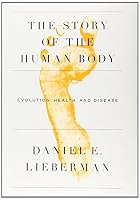
My review
Lieberman's thesis - that an incompatibility between the capabilities of the human body as it has evolved over time and certain aspects of modern culture that have arisen primarily since the Industrial Revolution has led to the spread of a whole range of afflictions that were once rare or unheard of - is not particularly novel, but unlike peddlers of diet books who make similar claims, Lieberman is an evolutionary biologist and backs his carefully couched claims with an exploration of the biology and anthropology that underlie them.
Lieberman highlights several important themes:
-- "the human body's adaptations evolved...because they increased how many survivable offspring out ancestors had. Consequently, we sometimes get sick because natural selection generally favors fertility over health, meaning we didn't evolve to be healthy."
-- humans are the product of an evolutionary process that stretches back to the first form of life on earth and continues to this day; we were not engineered. Meaning: we are not evolved for any one specific thing or lifestyle and we did not stop adapting when we became modern homo sapiens. Consequently, just because our hunter-gather ancestors at one point did not do something or eat something does not necessarily mean modern humans cannot or should not.
-- despite this, human cultural adaptation has now outpaced human biological evolution, particularly since the Industrial Revolution, and we now live in ways that fundamentally challenge our bodies because they are so alien from the conditions under which we have spent most of our time, evolutionarily speaking.
This disjuncture has led to what Lieberman calls "mismatch diseases" (also called "diseases of affluence") - he hypothesizes that this list includes everything from diabetes to flat feet to myopia to heart disease, obesity, and the plague of inflammatory diseases - Crohn's disease, asthma, allergies, arthritis. To his credit, Lieberman acknowledges that while things like farming, cities, modern medicine and methods of food production are probably partially responsible for mismatch diseases, most of humanity would not exist without such advances and we cannot simply turn back the clock.
Lieberman's prescription is definitely the weakest part of the book. Near the end, I felt a bit like I was reading a popular anti-wheat diet book or a Michael Pollan book because the advice was fairly basic - eat more vegetables and fruits, reduce consumption of refined grains, etc. His recommendation that doctors incorporate more of an evolutionary perspective into the treatment of mismatch diseases by trying to change the conditions that lead to mismatch diseases rather than simply treating the symptoms with drugs that allow this "dysevolution" to continue is somewhat more focused, but again, it didn't strike me as revolutionary to advocate prevention in healthcare.
My review
Lieberman's thesis - that an incompatibility between the capabilities of the human body as it has evolved over time and certain aspects of modern culture that have arisen primarily since the Industrial Revolution has led to the spread of a whole range of afflictions that were once rare or unheard of - is not particularly novel, but unlike peddlers of diet books who make similar claims, Lieberman is an evolutionary biologist and backs his carefully couched claims with an exploration of the biology and anthropology that underlie them.
Lieberman highlights several important themes:
-- "the human body's adaptations evolved...because they increased how many survivable offspring out ancestors had. Consequently, we sometimes get sick because natural selection generally favors fertility over health, meaning we didn't evolve to be healthy."
-- humans are the product of an evolutionary process that stretches back to the first form of life on earth and continues to this day; we were not engineered. Meaning: we are not evolved for any one specific thing or lifestyle and we did not stop adapting when we became modern homo sapiens. Consequently, just because our hunter-gather ancestors at one point did not do something or eat something does not necessarily mean modern humans cannot or should not.
-- despite this, human cultural adaptation has now outpaced human biological evolution, particularly since the Industrial Revolution, and we now live in ways that fundamentally challenge our bodies because they are so alien from the conditions under which we have spent most of our time, evolutionarily speaking.
This disjuncture has led to what Lieberman calls "mismatch diseases" (also called "diseases of affluence") - he hypothesizes that this list includes everything from diabetes to flat feet to myopia to heart disease, obesity, and the plague of inflammatory diseases - Crohn's disease, asthma, allergies, arthritis. To his credit, Lieberman acknowledges that while things like farming, cities, modern medicine and methods of food production are probably partially responsible for mismatch diseases, most of humanity would not exist without such advances and we cannot simply turn back the clock.
Lieberman's prescription is definitely the weakest part of the book. Near the end, I felt a bit like I was reading a popular anti-wheat diet book or a Michael Pollan book because the advice was fairly basic - eat more vegetables and fruits, reduce consumption of refined grains, etc. His recommendation that doctors incorporate more of an evolutionary perspective into the treatment of mismatch diseases by trying to change the conditions that lead to mismatch diseases rather than simply treating the symptoms with drugs that allow this "dysevolution" to continue is somewhat more focused, but again, it didn't strike me as revolutionary to advocate prevention in healthcare.
16fannyprice
Also finished two lighter, fun reads.
Curtsies & Conspiracies by Gail Carringer - that's right, steampunk assassin boarding school in an alternate Victorian England with vampires and werewolves! I could tell you that this young adult series has some wickedly clever wordplay, a large cast of comparatively well-developed female characters (for a young adult fantasy book), and completely passes the Bechdel test and all of these things would be true and would be part of what makes me love this series, but mostly it's just a nice mindless palate cleanser. It's such a melange of genres and elements that it shouldn't work, but it really does.


The Woman in Black by Susan Hill. So I accidentally watched this monstrosity of a movie - starring Daniel Radcliffe! - one day and then I heard on LT that the book was actually a good ghost story, so I wanted to check it out. I love ghost stories - supernatural or otherwise - quite a lot. While I admit that one particular portion was probably the most terrifying passage I have ever read in a novel, this book overall didn't stand out for me and I doubt I will remember reading it three months from now.
Palate cleansed! On to more serious things. And making Arabic flashcards until my hand drops off.
Curtsies & Conspiracies by Gail Carringer - that's right, steampunk assassin boarding school in an alternate Victorian England with vampires and werewolves! I could tell you that this young adult series has some wickedly clever wordplay, a large cast of comparatively well-developed female characters (for a young adult fantasy book), and completely passes the Bechdel test and all of these things would be true and would be part of what makes me love this series, but mostly it's just a nice mindless palate cleanser. It's such a melange of genres and elements that it shouldn't work, but it really does.


The Woman in Black by Susan Hill. So I accidentally watched this monstrosity of a movie - starring Daniel Radcliffe! - one day and then I heard on LT that the book was actually a good ghost story, so I wanted to check it out. I love ghost stories - supernatural or otherwise - quite a lot. While I admit that one particular portion was probably the most terrifying passage I have ever read in a novel, this book overall didn't stand out for me and I doubt I will remember reading it three months from now.
Palate cleansed! On to more serious things. And making Arabic flashcards until my hand drops off.
17fannyprice
Some interesting articles that I've read (can you tell I'm on vacation - it is certain that I will not always post this much in the future):
It's time to challenge the notion that there is only one way to speak English
Articles like this fascinate me. I'm working on reforming my grammar police tendencies while at the same time firmly believing that standard language has a place in communication and writing. The problem of standard language is even more prevalent in Arabic and has been on my mind a lot since as I mentioned before, I'm doing a year of full-time Arabic language study. I am studying what is commonly referred to as Modern Standard Arabic (or fusHa), which is basically written Arabic/newscaster Arabic. I have a variety of instructors from across the Arab world and it fascinates me that each of them makes different claims about the use of fusHa. Some claim that educated natives speak it amongst themselves, some claim that educated natives speak a mix of fusHa and local dialect (ammiyya), some claim that no one speaks a word of it in casual conversation. Additionally, there is much greater variability among dialects than one finds in a language like English, such that some claim that different ammiyyat are completely incomprehensible. I have read a tiny bit about Arabic language teaching pedagogy and linguistics and there are some who claim its time to end the fiction -- which they claim is perpetuated by pan-Arab nationalists -- that all Arabs at base speak a single language called "Arabic." I need to read more about this, but language in all its variations is one of my great loves.
A book on English and its variability that I enjoyed this year was: Our Magnificent Bastard Tongue: The Untold Story of English by John McWhorter. McWhorter is a linguist who definitely subscribes to the school of thought that dialects and other forms of "lesser" speech are in fact just as worthy as "standard language." In this book he discusses the influence of different languages on the development of English, going far beyond the typical "English is half Germanic and half Norman French" formula. Particularly interesting was the discussion of the influence of Welsh on English, which is not much studied, apparently.
It's time to challenge the notion that there is only one way to speak English
Articles like this fascinate me. I'm working on reforming my grammar police tendencies while at the same time firmly believing that standard language has a place in communication and writing. The problem of standard language is even more prevalent in Arabic and has been on my mind a lot since as I mentioned before, I'm doing a year of full-time Arabic language study. I am studying what is commonly referred to as Modern Standard Arabic (or fusHa), which is basically written Arabic/newscaster Arabic. I have a variety of instructors from across the Arab world and it fascinates me that each of them makes different claims about the use of fusHa. Some claim that educated natives speak it amongst themselves, some claim that educated natives speak a mix of fusHa and local dialect (ammiyya), some claim that no one speaks a word of it in casual conversation. Additionally, there is much greater variability among dialects than one finds in a language like English, such that some claim that different ammiyyat are completely incomprehensible. I have read a tiny bit about Arabic language teaching pedagogy and linguistics and there are some who claim its time to end the fiction -- which they claim is perpetuated by pan-Arab nationalists -- that all Arabs at base speak a single language called "Arabic." I need to read more about this, but language in all its variations is one of my great loves.
A book on English and its variability that I enjoyed this year was: Our Magnificent Bastard Tongue: The Untold Story of English by John McWhorter. McWhorter is a linguist who definitely subscribes to the school of thought that dialects and other forms of "lesser" speech are in fact just as worthy as "standard language." In this book he discusses the influence of different languages on the development of English, going far beyond the typical "English is half Germanic and half Norman French" formula. Particularly interesting was the discussion of the influence of Welsh on English, which is not much studied, apparently.
18fannyprice
Kill Me Now: The Troubled Life And Complicated Death Of Jana Van Voorhis
Yeah, it's from BuzzFeed. But in addition to the ridiculous lists about cats and Kardashians, they actually publish some good longform pieces every once in a while. This was a fascinating piece about a right-to-die group that helped a severely mentally ill woman take her own life. This article for me raised a different set of issues than it actually addressed. The assumption seems to be that mentally ill people should be prohibited from assisted suicide, but that physically ill people should not. On one level this seems quite sensible - mentally ill people may not be capable of making rational decisions. On another level, this seems extremely patronizing and stupid.
Yeah, it's from BuzzFeed. But in addition to the ridiculous lists about cats and Kardashians, they actually publish some good longform pieces every once in a while. This was a fascinating piece about a right-to-die group that helped a severely mentally ill woman take her own life. This article for me raised a different set of issues than it actually addressed. The assumption seems to be that mentally ill people should be prohibited from assisted suicide, but that physically ill people should not. On one level this seems quite sensible - mentally ill people may not be capable of making rational decisions. On another level, this seems extremely patronizing and stupid.
19rebeccanyc
#17, Very interesting about Arabic. I have always heard that it is spoken differently in different countries, and I suppose that's what you're saying too, although maybe it varies even more locally than that. I love language too (and I also have grammar police tendencies!).
20JDHomrighausen
Just found your thread, Kris. I am fairly 'fluent' in biblical Hebrew and would love to hear your observations on Arabic. Looking forward to your interesting reviews!
21fannyprice
>20 JDHomrighausen:, Jonathan, are you familiar with modern Hebrew at all? I actually studied it when I did my study abroad in Israel in college (quite a long time ago now!) and I would be curious to know how much of a relationship there is. I found that when I started learning Arabic I had to purge my mind of my Hebrew, because there were too many false similarities (letter shapes that are similar but produce entirely different sounds). I do find sometimes that I accidentally throw in some Hebrew when I intend to speak Arabic - my instructors are always confused and then say that I must be using an Arabic dialect they aren't familiar with!
The thing that I love most about Arabic is the trilteral root system and how it is possible to build words with related meanings by adding different affixes and short vowels. It's truly a system of magic, those Semitic languages.
The thing that I love most about Arabic is the trilteral root system and how it is possible to build words with related meanings by adding different affixes and short vowels. It's truly a system of magic, those Semitic languages.
22fannyprice
(cross-posted with slight modifications from another thread)
I've just recently gotten started listening to audiobooks because I commute about two hours each day now. I've only tried non-fiction books (Going Clear: Scientology, Hollywood, and the Prison of Belief and Rabid: A Cultural History of the World's Most Diabolical Virus), because it seems more straightforward, but I have found it a real struggle to pay attention, even when the topic is interesting and the reader is good. I find myself spacing out, making grocery lists in my head, etc.
I found Going Clear, which moved in a generally linear fashion through time and focused on a smallish number of larger-than-life personalities, easier to follow than Rabid, which is structured chronologically but contains a ton of diversions (rabies in classical mythology, medical treatments for rabies, man's relationship to dogs, rabies in 19th century literature) that often make it hard to keep the overall story in mind. Oddly, this latter type of book is exactly the kind of wide-ranging, eclectic history style that I like to read with my eyes.
I think there are some avid audiobookers in ClubRead and I would welcome any recommendations you all have about excellent audiobooks, either fiction or non-fiction.
I've just recently gotten started listening to audiobooks because I commute about two hours each day now. I've only tried non-fiction books (Going Clear: Scientology, Hollywood, and the Prison of Belief and Rabid: A Cultural History of the World's Most Diabolical Virus), because it seems more straightforward, but I have found it a real struggle to pay attention, even when the topic is interesting and the reader is good. I find myself spacing out, making grocery lists in my head, etc.
I found Going Clear, which moved in a generally linear fashion through time and focused on a smallish number of larger-than-life personalities, easier to follow than Rabid, which is structured chronologically but contains a ton of diversions (rabies in classical mythology, medical treatments for rabies, man's relationship to dogs, rabies in 19th century literature) that often make it hard to keep the overall story in mind. Oddly, this latter type of book is exactly the kind of wide-ranging, eclectic history style that I like to read with my eyes.
I think there are some avid audiobookers in ClubRead and I would welcome any recommendations you all have about excellent audiobooks, either fiction or non-fiction.
23detailmuse
I loved The Disappearing Spoon, loved The Story of the Human Body, loved Stay Awake. Looking forward to following your reading this year.
24detailmuse
>22 fannyprice: I liked the audio of both The Warmth of Other Suns (about the African-American migration from South to North and West) and Unbroken (about Olympics runner and WWII POW Louis Zamperini).
Tina Fey, Patti Smith, and Jeanette Winterson read their own memoirs on audio and they’re all good -- Bossypants, Just Kids and Why Be Happy When You Could Be Normal?, respectively.
I've just started audio of The Last of the Doughboys: The Forgotten Generation and Their Forgotten World War; it's very good.
Tina Fey, Patti Smith, and Jeanette Winterson read their own memoirs on audio and they’re all good -- Bossypants, Just Kids and Why Be Happy When You Could Be Normal?, respectively.
I've just started audio of The Last of the Doughboys: The Forgotten Generation and Their Forgotten World War; it's very good.
25dchaikin
#17 - that first line - keep at it, enjoying.
I have been doing the audio book-during-commute thing for about four months now, also all non-fiction.
I have been doing the audio book-during-commute thing for about four months now, also all non-fiction.
26fannyprice
>25 dchaikin:, what have you listened to, Dan? Are they tagged or otherwise indicated as audiobooks in your library?
27dchaikin
They are tagged and in their own collection. Try this link: Here (Or, in my library, go to collection=Audio Books, Tag=read_2013)
28wandering_star
Some time back I started a thread asking for good audiobook recommendations: http://www.librarything.com/topic/105819
I think I'd recommend All Passion Spent read by Wendy Hiller, The Observations read by the author, Jane Harris, and The Minotaur Takes A Cigarette Break.
I think I'd recommend All Passion Spent read by Wendy Hiller, The Observations read by the author, Jane Harris, and The Minotaur Takes A Cigarette Break.
29arubabookwoman
Hi Kris--I'm looking forward to following your reading this year. I see one of your favorites was The Uninvited Guests, which I have on my Kindle, but which I have heard mixed things about. I liked her first book, so I'm interested to see whether this one satisfies.
30NanaCC
Hi, Kris. I listen to a fair number of audio books. I have favorite readers, but I think you said you prefer listening to non-fiction, where I prefer fiction for audio. I think the reason is that it is too hard while driving to go back and catch something you might have missed. Or I often start looking things up when I read non-fiction, and I can't do that in the car. I am a sucker for an accent, so that tends to color my choices, as well. :)
31fannyprice
Thanks all, for the audiobook suggestions!
>24 detailmuse:, detailmuse, I forgot that I also have Mindy Kaling's Is Everyone Hanging Out Without Me, which she reads and which has been awesome so far. Tina Fey sounds like a good one, though I worry I might get in an accident from laughter.
>28 wandering_star:, wandering_star, based on the common tags for The Observations, it seems like something I would love, so I'll definitely look into that in one format or another.
>29 arubabookwoman:, Aruba - looking forward to following you as well! The Uninvited Guests is definitely a little weird. I think unsympathetic characters can really turn people off if they are expecting something different.
>30 NanaCC:, NanaCC, I have gravitated toward non-fiction for audiobooks because it seemed to me that it would be more straightforward, but I am completely open to trying fiction. I've got a lot of time in the car!
Right now the audiobook for Rabid: A Cultural History of the World's Most Diabolical Virus is really freaking me out because the reader, who normally has a fairly bland straightforward male voice with no accent (to my ears) has started reading parts of the book in accents when they are passages from books or quotes from interviews. So he's done an extremely awkward imitation of a southern black woman (when reading quotes from Their Eyes Were Watching God) and an awful Scottish brogue when citing interviews with Scots about AIDS. It's extremely uncomfortable.
>24 detailmuse:, detailmuse, I forgot that I also have Mindy Kaling's Is Everyone Hanging Out Without Me, which she reads and which has been awesome so far. Tina Fey sounds like a good one, though I worry I might get in an accident from laughter.
>28 wandering_star:, wandering_star, based on the common tags for The Observations, it seems like something I would love, so I'll definitely look into that in one format or another.
>29 arubabookwoman:, Aruba - looking forward to following you as well! The Uninvited Guests is definitely a little weird. I think unsympathetic characters can really turn people off if they are expecting something different.
>30 NanaCC:, NanaCC, I have gravitated toward non-fiction for audiobooks because it seemed to me that it would be more straightforward, but I am completely open to trying fiction. I've got a lot of time in the car!
Right now the audiobook for Rabid: A Cultural History of the World's Most Diabolical Virus is really freaking me out because the reader, who normally has a fairly bland straightforward male voice with no accent (to my ears) has started reading parts of the book in accents when they are passages from books or quotes from interviews. So he's done an extremely awkward imitation of a southern black woman (when reading quotes from Their Eyes Were Watching God) and an awful Scottish brogue when citing interviews with Scots about AIDS. It's extremely uncomfortable.
32Cait86
>29 arubabookwoman:, 31 - I loved The Uninvited Guests too, but I don't know many other people who have enjoyed it. It is certainly very different from Jones' other two novels!
33fannyprice
So I wrapped up a couple books so far this year.
A Fearsome Doubt (Inspector Ian Rutledge Mystery) - The sixth in this detective series starring Inspector Ian Rutledge, a shell-shocked WWI vet and Scotland Yard detective. These books continue to get better with each one.
I like this series because it is a soundly written detective series, the prose is solid and lovely in places without being overly flowery or showy, and the WWI backdrop is omnipresent, as Rutledge is haunted by his experiences in the war and how England has and has not changed as a result of the war. Over the course of six books, the crimes have gradually begun to involve people from Rutledge's past, both in the war and before the war, and nearly every character in each book has been touched in some way by the war and its aftermath.
It's clear that the authors - Charles Todd is actually a pseudonym for a mother-son writing team - have done a ton of research about the war and about the process of social, economic, and political change in the post-WWI period, but they slip these details in so naturally in a way that creates a sense of place without overwhelming the narrative. In contrast to Connie Willis' Blackout and All Clear, which I felt floundered because of the author's apparent need to put in EVERY detail about train routes during the Blitz that she had ever encountered.
In many senses, it's probably not super original - everyone now does the "tortured dysfunctional detective" - but since I've never read much other detective fiction, it suits me just fine. Charles Todd also writes another detective series focusing on Bess Crawford an English nursing sister serving in WWI. The plots are much more contrived than the Ian Rutledge books, since there's much less reason for Bess to be investigating murders, but I rather enjoy that series as well.


I have also finally finished Overthrow: America's Century of Regime Change from Hawaii to Iraq by Stephen Kinzer, which is exactly what its title suggests - a historical account of every time since the 19th century that the United States has intervened overtly or covertly to depose a regime perceived as unfriendly to US interests. I normally love Kinzer's books - he wrote the excellent All the Shah's Men, about an American-backed coup against a democratically elected Iranian leader in 1953 - but this one was tough going for me, perhaps because it was so long and so wide-ranging that I started to feel numb after a while. I confess that I skimmed the chapters on the most recent American interventions in Iraq and Afghanistan because I have recently read so many books and articles about these topics & Kinzer did not appear to bring anything new to my understanding of these two conflicts.
Kinzer assesses that both political/ideological and economic reasons have motivated nearly every American attempt at regime change and his exploration of the role of corporations in shaping 19th and early 20th century American foreign policy in Latin America was particularly new and interesting for me.
His assertion that all states pursue their interests in foreign policy but that only the United States sees and describes its interventions as motivated by charitable ideals seemed somewhat of a stretch for me. Didn't European colonial powers claim that they were at least in part on a civilizing mission? All in all, however, a good read, but one that I am glad to finally be done with. I bought this book in 2012 and I swear I've been picking at it for a year.
A Fearsome Doubt (Inspector Ian Rutledge Mystery) - The sixth in this detective series starring Inspector Ian Rutledge, a shell-shocked WWI vet and Scotland Yard detective. These books continue to get better with each one.
I like this series because it is a soundly written detective series, the prose is solid and lovely in places without being overly flowery or showy, and the WWI backdrop is omnipresent, as Rutledge is haunted by his experiences in the war and how England has and has not changed as a result of the war. Over the course of six books, the crimes have gradually begun to involve people from Rutledge's past, both in the war and before the war, and nearly every character in each book has been touched in some way by the war and its aftermath.
It's clear that the authors - Charles Todd is actually a pseudonym for a mother-son writing team - have done a ton of research about the war and about the process of social, economic, and political change in the post-WWI period, but they slip these details in so naturally in a way that creates a sense of place without overwhelming the narrative. In contrast to Connie Willis' Blackout and All Clear, which I felt floundered because of the author's apparent need to put in EVERY detail about train routes during the Blitz that she had ever encountered.
In many senses, it's probably not super original - everyone now does the "tortured dysfunctional detective" - but since I've never read much other detective fiction, it suits me just fine. Charles Todd also writes another detective series focusing on Bess Crawford an English nursing sister serving in WWI. The plots are much more contrived than the Ian Rutledge books, since there's much less reason for Bess to be investigating murders, but I rather enjoy that series as well.


I have also finally finished Overthrow: America's Century of Regime Change from Hawaii to Iraq by Stephen Kinzer, which is exactly what its title suggests - a historical account of every time since the 19th century that the United States has intervened overtly or covertly to depose a regime perceived as unfriendly to US interests. I normally love Kinzer's books - he wrote the excellent All the Shah's Men, about an American-backed coup against a democratically elected Iranian leader in 1953 - but this one was tough going for me, perhaps because it was so long and so wide-ranging that I started to feel numb after a while. I confess that I skimmed the chapters on the most recent American interventions in Iraq and Afghanistan because I have recently read so many books and articles about these topics & Kinzer did not appear to bring anything new to my understanding of these two conflicts.
Kinzer assesses that both political/ideological and economic reasons have motivated nearly every American attempt at regime change and his exploration of the role of corporations in shaping 19th and early 20th century American foreign policy in Latin America was particularly new and interesting for me.
His assertion that all states pursue their interests in foreign policy but that only the United States sees and describes its interventions as motivated by charitable ideals seemed somewhat of a stretch for me. Didn't European colonial powers claim that they were at least in part on a civilizing mission? All in all, however, a good read, but one that I am glad to finally be done with. I bought this book in 2012 and I swear I've been picking at it for a year.
34NanaCC
Kris, I listened to the first book in the Ian Rutledge series and really enjoyed it. Didn't like the reader, but the story made up for that. I must do another one soon. I received a few books in Ian Rankin's Rebus series for Christmas. I can't wait to get to those.
35baswood
Fearsome doubt (inspector Rutledge mystery sounds good and fits in nicely with the commemorating WWI theme here on club read. I could be tempted to dip into one of those in the series.
36fannyprice
Mah cats - allow me to inflict them upon you.
Mischa the Russian Bear - aka "Pretty Princess Ballerina Toes" aka "Chewer of Expensive Cords"

Pico the Arabic Cat - aka "Martin, President of the Snuggle Club" aka "The Sun King"

Mischa the Russian Bear - aka "Pretty Princess Ballerina Toes" aka "Chewer of Expensive Cords"

Pico the Arabic Cat - aka "Martin, President of the Snuggle Club" aka "The Sun King"

37fannyprice
Some interesting articles and podcasts from recently. I read a lot online. I promise I won't always post it here, once this year really gets going, but I had a snow day today.
Visible And Invisible: 'Servants' Looks At Life Downstairs
God, how I love Terry Gross's conversations about books. Since I have started commuting during the hour when "Fresh Air" is on, so many of my book recommendations come from her. Like everyone now, I'm fascinated with "service". I've got this book on hold at the library.
Anthony Quinn questions the 'innocence' of prewar Britain
"Mark Bostridge's The Fateful Year, an absorbing kaleidoscope of events and episodes from a century ago, argues that England in 1914 was no more or less innocent than any other time – indeed, even before war engulfed the country on 4 August, it was a crucible of violent antagonisms that touched on gender, class, labour and nationhood." - Yet another book added to my WW1 Wishlist. What a great time to be a reader. Many of these themes are also dealt with in Adam Hochschild's wonderful To End All Wars: A Story of Loyalty and Rebellion, about England's anti-war movement during WW1.
The battle over the burial of King Richard III has become savage
"For many Ricardians, rescuing the King from the place where he was killed and humiliated (his corpse was stabbed through the buttock, buried shroudless, and with its hands tied) is also about rescuing him from history. It goes to the heart of the Ricardian project." - Until the last year or so, I had no idea there was a society of Richard III defenders; it fascinates me that something that seems such a part of ancient history to me could be so real and now for others.
Is 2014 the Year Scotland Finally Gains Independence?
I'm hoping to find something more thoughtful on Scottish independence than this. This seemed very dismissive of the pro-independence camp.
Visible And Invisible: 'Servants' Looks At Life Downstairs
God, how I love Terry Gross's conversations about books. Since I have started commuting during the hour when "Fresh Air" is on, so many of my book recommendations come from her. Like everyone now, I'm fascinated with "service". I've got this book on hold at the library.
Anthony Quinn questions the 'innocence' of prewar Britain
"Mark Bostridge's The Fateful Year, an absorbing kaleidoscope of events and episodes from a century ago, argues that England in 1914 was no more or less innocent than any other time – indeed, even before war engulfed the country on 4 August, it was a crucible of violent antagonisms that touched on gender, class, labour and nationhood." - Yet another book added to my WW1 Wishlist. What a great time to be a reader. Many of these themes are also dealt with in Adam Hochschild's wonderful To End All Wars: A Story of Loyalty and Rebellion, about England's anti-war movement during WW1.
The battle over the burial of King Richard III has become savage
"For many Ricardians, rescuing the King from the place where he was killed and humiliated (his corpse was stabbed through the buttock, buried shroudless, and with its hands tied) is also about rescuing him from history. It goes to the heart of the Ricardian project." - Until the last year or so, I had no idea there was a society of Richard III defenders; it fascinates me that something that seems such a part of ancient history to me could be so real and now for others.
Is 2014 the Year Scotland Finally Gains Independence?
I'm hoping to find something more thoughtful on Scottish independence than this. This seemed very dismissive of the pro-independence camp.
38fannyprice
The War No Image Could Capture - kind of a review of a newish book of photography from WWI - The Great War: A Photographic Narrative, but also an assertion of this war's unique "unphotographibility," which I'm not quite sure is convincingly argued. While I can buy that WWI marked a departure in European and American understandings of warfare, it seems strange to argue that part of the reason the war was visually unrepresentable is because "the staggering statistics of matériel, manpower, and casualties threaten constantly to extinguish the individual," when the number of casualties in WWII was perhaps double that of WWI and the author has no problem pulling a supposedly defining image out of the former.
39JDHomrighausen
So much reading! Are you an Audible subscriber by any chance? That may be the only way to make your commute bearable.
I have never studied Modern Hebrew, although I know a bit of its story. Spoken/conversational language doesn't interest me terribly. I know there are specific grammatical constructions that were lost in modern, such as the vav-consecutive.
This year my language goals (other than continuing the ones I am doing) are Pali and German. I have considered Quranic/Classical Arabic but the Qur'an itself doesn't interest me terribly as a literary work.
I have never studied Modern Hebrew, although I know a bit of its story. Spoken/conversational language doesn't interest me terribly. I know there are specific grammatical constructions that were lost in modern, such as the vav-consecutive.
This year my language goals (other than continuing the ones I am doing) are Pali and German. I have considered Quranic/Classical Arabic but the Qur'an itself doesn't interest me terribly as a literary work.
40fannyprice
Not Here to Make Friends: On the importance of unlikable female protagonists - Great piece
"That the question of likability even exists in literary conversations is odd. It implies we are engaging in a courtship. When characters are unlikable, they don’t meet our mutable, varying standards. Certainly, we can find kinship in fiction, but literary merit shouldn’t be dictated by whether or not we want to be friends or lovers with those about whom we read."
"That the question of likability even exists in literary conversations is odd. It implies we are engaging in a courtship. When characters are unlikable, they don’t meet our mutable, varying standards. Certainly, we can find kinship in fiction, but literary merit shouldn’t be dictated by whether or not we want to be friends or lovers with those about whom we read."
41dchaikin
Enjoying your article summaries. Intrigued about the Richard III stuff. I can't disagree with the quote immediately above in post 40.
43.Monkey.
>42 dchaikin: I can't speak for Fanny, but many people subscribe to the RSS feed on sites that they've noticed tend to put forth articles that they enjoy.
44fannyprice
>42 dchaikin:, indeed, RSS feeds are my main tool. I use feedly, since the demise of Google Reader. There is a free and a paid version, but the free version has always worked perfectly for me. It is great on a computer and there is an iphone/ipad app, which is great since I do a lot of my article reading on the phone. I've got it set so that I just see the headlines or article titles, so I can pretty easily scan and see what is of interest to me.
I also use facebook, believe it or not. I follow a lot of cool sites there that post articles - the atlantic monthly, brain pickings, etc.
One tool that I have also found essential is pocket, which is also free, available on the computer and mobile devices. it allows one to save articles to read later, integrates seemlessly with feedly on the iphone and has easy bookmark applets or firefox add-ons to save articles that I don't find through feedly. This way, I can save things and go back to them later, when I have more time for thoughtful reading.
Some of my favorite sources for articles recently have been: The Guardian's Book page, the New York Review of Books blog, of course NPR's book blog, brainpickings, and the atlantic monthly blog.
I also use facebook, believe it or not. I follow a lot of cool sites there that post articles - the atlantic monthly, brain pickings, etc.
One tool that I have also found essential is pocket, which is also free, available on the computer and mobile devices. it allows one to save articles to read later, integrates seemlessly with feedly on the iphone and has easy bookmark applets or firefox add-ons to save articles that I don't find through feedly. This way, I can save things and go back to them later, when I have more time for thoughtful reading.
Some of my favorite sources for articles recently have been: The Guardian's Book page, the New York Review of Books blog, of course NPR's book blog, brainpickings, and the atlantic monthly blog.
45fannyprice
Oh dear me, I have just discovered that I have 447 books in my "To Read" Collection. While this is probably miniscule compared to some readers' TBR piles and does include books that I bought for academic or professional interests and read part of, right now it feels like shameful evidence of one of my worst habits - buying books and not reading them. So, I shall overrule myself and set for myself one reading goal this year:
Each month during the year of 2014, I vow to read one physical (i.e., not an e-book) book from my "To Read" collection.
Each month during the year of 2014, I vow to read one physical (i.e., not an e-book) book from my "To Read" collection.
46.Monkey.
Fanny, you should consider joining the ROOT group! It's specifically for reading our own books (or "tomes," as the acronym stands for), you just make a goal number (so you could choose 12, if that's what you're aiming for) and have at! :D Most of us here are book hoarders, so we encounter that issue as well, the books keep piling up far faster than we get to them! Haha. So we make our goals to try and keep up a little better. :))
47fannyprice
Finished Isaac Asimov's I, Robot when awakened by the cat for food at 1:30am! I haven't read terribly much of this kind of science fiction and I have found other Asimov books (mostly from the Foundation series), to be really hard going. Something about the prose style, perhaps? But these shorter works were easier for me and maybe it helps that I am endlessly fascinated by the idea of at what point robots become essentially human.
I don't have a real cover for this one, since it was an e-library book and I refuse to post their cover with Will Smith on it. I hate movie tie-in covers.
I don't have a real cover for this one, since it was an e-library book and I refuse to post their cover with Will Smith on it. I hate movie tie-in covers.
48JDHomrighausen
So many interesting articles, Kris. I used to feel guilty for not reading more of them. Then a wise and old friend of mine, a 94-year-old Jesuit who had taught philosophy for college students for six decades, told me he believed that students should focus on imbibing the information of the past in college more than reading the news. Not that reading the news is bad for students, mind you, but that we should not place that expectation on them when they already have so much information to absorb!
One strategy I came up with for managing the TBR pile is an imaginary point system. Every time I read a book (whether mine or borrowed), I gain a point. Every time I buy a book, I lose two. Every time I give away a book, I also gain a point. (If I read a book and then discard it, I gain two.) I try to keep my point-count as great as possible, and to never go below zero (or at least -5). Over time this will reduce your TBR pile, and it's also more realistic than trying to go cold turkey off book buying entirely. Theoretically I could continue this strategy by merely buying and reading books, never getting rid of any, but even that is a lofty goal: having read the majority of books on one's shelves!
I have a parallel system for my kindle, where the concern is less about space and more about spending lots of money on ebooks.
My other strategy is dating a girl who isn't much of a bookworm. Every month or so we'll get into an argument over why I must have so many damn books. She'll give me an epiphany that lasts long enough for me to do some weeding. Last time this happened I filled 3 bags' worth of books to sell.
My third and final strategy is making one of 14 in 14 categories "books to give away after reading." It helps me weed those books that will be fun once but that I won't need for future academic or personal use.
Hope some of those are useful for you. I come from a family where hoarding is common (mostly my mom's side) so I am very careful (paranoid?) that I will not be down that road in a few decades.
One strategy I came up with for managing the TBR pile is an imaginary point system. Every time I read a book (whether mine or borrowed), I gain a point. Every time I buy a book, I lose two. Every time I give away a book, I also gain a point. (If I read a book and then discard it, I gain two.) I try to keep my point-count as great as possible, and to never go below zero (or at least -5). Over time this will reduce your TBR pile, and it's also more realistic than trying to go cold turkey off book buying entirely. Theoretically I could continue this strategy by merely buying and reading books, never getting rid of any, but even that is a lofty goal: having read the majority of books on one's shelves!
I have a parallel system for my kindle, where the concern is less about space and more about spending lots of money on ebooks.
My other strategy is dating a girl who isn't much of a bookworm. Every month or so we'll get into an argument over why I must have so many damn books. She'll give me an epiphany that lasts long enough for me to do some weeding. Last time this happened I filled 3 bags' worth of books to sell.
My third and final strategy is making one of 14 in 14 categories "books to give away after reading." It helps me weed those books that will be fun once but that I won't need for future academic or personal use.
Hope some of those are useful for you. I come from a family where hoarding is common (mostly my mom's side) so I am very careful (paranoid?) that I will not be down that road in a few decades.
49fannyprice
>46 .Monkey.:, I appreciate what the ROOT group is doing, but I'm already having trouble keeping up with this group and a couple others that are really important to me, so I probably will decline the suggestion.
>48 JDHomrighausen:, I love the point system!
>48 JDHomrighausen:, I love the point system!
50.Monkey.
Haha, I understand, I'm snowed in with posts, I'm pretty much just waiting for March for some folks to start fizzling out of the groups so things get more manageable, bahaha :P
I'm glad you say I, Robot is better reading, since that's the one of his that I own, and have for a bunch of years but haven't yet gotten around to reading. I suppose it'll be a good one to help test if I want to delve deeper. :)
>48 JDHomrighausen: Oh man, I could never be with someone who couldn't understand my books! I had enough trouble dating people who didn't like books but didn't care what I did, but the moment someone tries arguing with me about my shelves is the moment they can stop worrying about me and what I do! Granted, having finally married a bookworm is of course completely enabling, but somehow I think that's just A-OK!
I'm glad you say I, Robot is better reading, since that's the one of his that I own, and have for a bunch of years but haven't yet gotten around to reading. I suppose it'll be a good one to help test if I want to delve deeper. :)
>48 JDHomrighausen: Oh man, I could never be with someone who couldn't understand my books! I had enough trouble dating people who didn't like books but didn't care what I did, but the moment someone tries arguing with me about my shelves is the moment they can stop worrying about me and what I do! Granted, having finally married a bookworm is of course completely enabling, but somehow I think that's just A-OK!
51urania1
>48 JDHomrighausen:,
I love your point system. It's hilarious. I am married to a nonreader, so I get all of the bookshelf space. In truth, he became a reader when he married me. I select what I think he will like. I am right 95% of the time. He's a big Jane Austen and L.M. Montgomery fan. The advent of ereaders ended my guilt.
I love your point system. It's hilarious. I am married to a nonreader, so I get all of the bookshelf space. In truth, he became a reader when he married me. I select what I think he will like. I am right 95% of the time. He's a big Jane Austen and L.M. Montgomery fan. The advent of ereaders ended my guilt.
52rebeccanyc
When my sweetie moved in, it was harder for me to clear off bookshelves for him than to clean out a closet. He is reading more and has acquired more books since we got together, because of the good example I set.
53dchaikin
I will look up feedly and pocket. Thanks!
We had a TBR support group once in CR. Consensus therapy was mainly to acquire more books. : )
We had a TBR support group once in CR. Consensus therapy was mainly to acquire more books. : )
54lesmel
I love Feedly. If I didn't prefer to curate my own feeds, I'd probably use Flipboard on my iPad instead of Feedly.
55rebeccanyc
I use Feedly, will have to look for Pocket.
56fannyprice
Augh, I'm so exhausted from having stayed up too late reading. Woe is me.
Between commuting and making vegetable stock - in a valiant effort to avoid doing homework - I finished two audiobooks today.
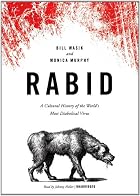
Rabid: A Cultural History of the World's Most Diabolical Virus
An extremely wide-ranging book that looks at rabies in medicine and popular culture, tracing literary depictions and medical descriptions since the ancients. Along the way, Bill Wasik examines vampire and werewolf stories, wondering if rabies could provide a source for these tales; the relationships between humans and dogs, which were most often the real or suspected source of rabies; zoonotic (i.e., human illnesses with origins in animals) diseases from bubonic plague to influenza to AIDS to hemorrhagic fever; Louis Pasteur's professional career and his role in developing a rabies vaccine; and efforts throughout time and place to combat rabies epidemics or prevent them. (I learned that Kentish opposition to the Chunnel was often pitched in terms of a fear that French foxes would come through the Chunnel and spread rabies!)
This is normally the kind of eclectic, broad-minded history that I love. However, I listened to this as an audiobook, which really was a struggle for me. I had previously done really well with a non-fiction audiobook (Going Clear: Scientology, Hollywood, and the Prison of Belief), so I'm not sure if it's just that this book's eclecticism made it more difficult to follow or if it was something else. The reader was rather monotone, but about halfway through the book, he started reading parts of the book in accents when they are passages from books or quotes from interviews. This included an extremely awkward and racist-feeling imitation of a southern black woman (when reading quotes from Their Eyes Were Watching God), an awful Scottish brogue when citing interviews with Scots about AIDS, an even more awful Irish accent, and I swear to god he started to try to imitate an Anglo-Indian woman before thinking better of it.

AND... Is Everyone Hanging Out Without Me? (And Other Concerns) - the fabulous Mindy Kaling's memoir. I bought this at least a year ago, listened to most of it, and I think I forgot I owned it. Bad on me because I love Mindy Kaling. I adore her. She is hilarious and sharp and more than willing to talk about what its like to be named one of People magazine's 100 most beautiful people and then to go to a photo shoot where the stylist has only brought size zero dresses. She can't have another book soon enough. ETA that she reads her own book with a couple friends as guest voices. Also, that the section on revenge fantasies as workout fuel is to die for.
Next listen will be Tina Fey's Bossypants, because I just can't get enough of awesome women who are funny as hell. When are Amy Poehler and Aubrey Plaza going to write a book?
Between commuting and making vegetable stock - in a valiant effort to avoid doing homework - I finished two audiobooks today.
Rabid: A Cultural History of the World's Most Diabolical Virus
An extremely wide-ranging book that looks at rabies in medicine and popular culture, tracing literary depictions and medical descriptions since the ancients. Along the way, Bill Wasik examines vampire and werewolf stories, wondering if rabies could provide a source for these tales; the relationships between humans and dogs, which were most often the real or suspected source of rabies; zoonotic (i.e., human illnesses with origins in animals) diseases from bubonic plague to influenza to AIDS to hemorrhagic fever; Louis Pasteur's professional career and his role in developing a rabies vaccine; and efforts throughout time and place to combat rabies epidemics or prevent them. (I learned that Kentish opposition to the Chunnel was often pitched in terms of a fear that French foxes would come through the Chunnel and spread rabies!)
This is normally the kind of eclectic, broad-minded history that I love. However, I listened to this as an audiobook, which really was a struggle for me. I had previously done really well with a non-fiction audiobook (Going Clear: Scientology, Hollywood, and the Prison of Belief), so I'm not sure if it's just that this book's eclecticism made it more difficult to follow or if it was something else. The reader was rather monotone, but about halfway through the book, he started reading parts of the book in accents when they are passages from books or quotes from interviews. This included an extremely awkward and racist-feeling imitation of a southern black woman (when reading quotes from Their Eyes Were Watching God), an awful Scottish brogue when citing interviews with Scots about AIDS, an even more awful Irish accent, and I swear to god he started to try to imitate an Anglo-Indian woman before thinking better of it.

AND... Is Everyone Hanging Out Without Me? (And Other Concerns) - the fabulous Mindy Kaling's memoir. I bought this at least a year ago, listened to most of it, and I think I forgot I owned it. Bad on me because I love Mindy Kaling. I adore her. She is hilarious and sharp and more than willing to talk about what its like to be named one of People magazine's 100 most beautiful people and then to go to a photo shoot where the stylist has only brought size zero dresses. She can't have another book soon enough. ETA that she reads her own book with a couple friends as guest voices. Also, that the section on revenge fantasies as workout fuel is to die for.
Next listen will be Tina Fey's Bossypants, because I just can't get enough of awesome women who are funny as hell. When are Amy Poehler and Aubrey Plaza going to write a book?
57dchaikin
I like your two reviews with covers between them structure.
Too bad rabid didn't fully work, but interesting to ponder the relationship of rabies and vampires and werewolves. What other sicknesses could have influences these ideas, or other ideas? Something I had not thought about before.
Too bad rabid didn't fully work, but interesting to ponder the relationship of rabies and vampires and werewolves. What other sicknesses could have influences these ideas, or other ideas? Something I had not thought about before.
58bragan
I have Rabid sitting on my TBR Pile, and I'm looking forward to reading it. Rabies is just such a bizarre, terrifying, fascinating disease. Your comments have, if anything, made me even more interested, because an "eclectic, broad-minded history" based around a specific topic is also right up my alley. Fortunately, I have it in print, not audio, because that reading sounds really, really annoying.
59rebeccanyc
Rabid does sound interesting -- I've always been totally creeped out by the idea of rabies!
60fannyprice
All I can say is I'm so glad I had to get a rabies vaccination for travel because you do NOT want rabies.
61kidzdoc
Nice review of Rabid, Kris; it's high on my wish list as well. I don't read audiobooks, so that weird narrator won't turn me against it.
You're right; you definitely don't want to contract rabies! It's almost impossible to cure once its symptoms develop. I was freaked out for a few days when I was an undergraduate student at Rutgers after I saw a furry small object on the floor of one of the men's rest rooms in a campus building. I brushed it with my foot, and was shocked to see that it was a sick bat, which turned its head and bared its teeth at me. Fortunately I ran away before it could bite me, and needless to say I didn't catch rabies from it.
You're right; you definitely don't want to contract rabies! It's almost impossible to cure once its symptoms develop. I was freaked out for a few days when I was an undergraduate student at Rutgers after I saw a furry small object on the floor of one of the men's rest rooms in a campus building. I brushed it with my foot, and was shocked to see that it was a sick bat, which turned its head and bared its teeth at me. Fortunately I ran away before it could bite me, and needless to say I didn't catch rabies from it.
62fannyprice
Oooh, I love bats. I feel so bad for them, with their nose fungus that's killing them off in droves.
63kidzdoc
I love bats too, but I didn't like that one!
The area around my parents' house in suburban Philadelphia used to have a bat colony nearby. We and our older neighbors liked them, since they ate mosquitoes and kept them from biting us. The bats are no longer there, thanks to complaints from newer neighbors, and we are practically bled dry by mosquitoes if we sit outside on summer evenings.
ETA: I hadn't heard about the decimation of bats in the Northeastern US from nose fungus, which I just read about.
The area around my parents' house in suburban Philadelphia used to have a bat colony nearby. We and our older neighbors liked them, since they ate mosquitoes and kept them from biting us. The bats are no longer there, thanks to complaints from newer neighbors, and we are practically bled dry by mosquitoes if we sit outside on summer evenings.
ETA: I hadn't heard about the decimation of bats in the Northeastern US from nose fungus, which I just read about.

66rebeccanyc
One of the big problems with the decimation of bats is that bats are BIG insect eaters. So with fewer bats there will be more pesky bugs about. And not just the ones we don't like because they bite us, but the ones that eat crops, etc.
67fannyprice
>66 rebeccanyc:, yes, I keep thinking that I could write a very prescient dystopian novel using the bat fungus and the bee colony collapse. I think we're basically doomed.
68urania1
Yes,
We are really missing our bats in East Tennessee. We used to have hundreds of them. This summer we were down to two or three who slept in the shop basement during the day.
We are really missing our bats in East Tennessee. We used to have hundreds of them. This summer we were down to two or three who slept in the shop basement during the day.
69baswood
I have bats that live behind the shutters of my room, I have a bat box for them, but they prefer being behind the shutters.
70Jargoneer
>56 fannyprice: - the UK government used to be obsessed with rabies, convinced that a horde of rabid dogs were waiting on the French coast to invade the UK and cause havoc.
I agree with Rebecca in #59 about being creeped out by the idea of rabies. When I was impressionable youngster I saw an episode of a TV show called Survivor, set in a post-apocalyptic UK, wherein there was an outbreak of rabies, and that did it for me. On some level I still don't trust dogs.
>36 fannyprice: - beautiful cats. Looking at Mischa reminds me that I don't fully trust cats either. Their look always seems to say something like, "Petty human, I have nothing but disdain for you" or "If I was bigger I would eat you".
I agree with Rebecca in #59 about being creeped out by the idea of rabies. When I was impressionable youngster I saw an episode of a TV show called Survivor, set in a post-apocalyptic UK, wherein there was an outbreak of rabies, and that did it for me. On some level I still don't trust dogs.
>36 fannyprice: - beautiful cats. Looking at Mischa reminds me that I don't fully trust cats either. Their look always seems to say something like, "Petty human, I have nothing but disdain for you" or "If I was bigger I would eat you".
71lesmel
>70 Jargoneer: - Who needs to be bigger? There are reported cases of cats munching on dead owners. Then again, I think there are reported cases of dogs munching on dead owners, too. My cat (1/2 the size of my dog) regularly re-enacts the ancient art of taking down a gazelle...on my dog. My dog returns the favor by slobbering all over the cat.
72.Monkey.
>71 lesmel: Any carnivorous (/omnivorous) animal will eat its owner if they're laying there dead. The animal has no food and will starve otherwise, and people are meat.
73rebeccanyc
Oh, I love dogs, and don't most of them have to get rabies shots? When I freak out about rabies, I think about wild animals. Although I live in NYC, I live across the street from a park (and NYC parks have more wild animals than you would probably imagine and, for those of you chortling, I am NOT referring to people), and one time a raccoon crossed the street from the park and was hanging out on our street. When I saw it in the daytime, I gave it a wide berth, because raccoons are nocturnal and it was sufficiently weird to see one in broad daylight that I thought it might be rabid.
74.Monkey.
In areas where they know people are leaving around lots of food, they can be out in the day. If you look on youtube there's lots of vids of them stealing catfood from porches and things. Animals that live in the vicinity of people will often adapt a bit if it's to their benefit (or if they're forced). Not saying you should run up to strange wild animals or anything, just that in that sort of situation it's not necessarily something to worry over.
75rebeccanyc
You're probably right, as it was a day for garbage pickup so there was food aplenty!
76.Monkey.
Haha, exactly. When animals realize there's food advantages about, they'll shift their habits accordingly. :)
77fannyprice
This conversation is awesome. I love it. One characteristic of rabies is aggression, so if a normally skittish or nonviolent animal is coming at you, watch out! Rabid had all kinds of anecdotes about people basically beating a rabid animal to death before it let go of them. Definitely a bit stomach churning.
On cats, once I read the wikipedia definition of a cat: "a small, carnivorous mammal" and for some reason it cracked me up so much to think that I am sharing my house with two small, carnivorous mammals. I hope they never have cause to eat my corpse.
On a completely separate note, am listening to a great podcast series. The History of English podcast Each episode is about an hour and there are thirty-some episodes. In one of the first episodes, the host read the Lord's Prayer in Old English, Middle English, and Modern English and I realized how wonderfully suited language and linguistics is as a topic for audiobooks/podcasts because it is so much easier to understand the sound shifts, etc. that are being discussed. I highly recommend this podcast for anyone who is at all interested in the history of English.
On cats, once I read the wikipedia definition of a cat: "a small, carnivorous mammal" and for some reason it cracked me up so much to think that I am sharing my house with two small, carnivorous mammals. I hope they never have cause to eat my corpse.
On a completely separate note, am listening to a great podcast series. The History of English podcast Each episode is about an hour and there are thirty-some episodes. In one of the first episodes, the host read the Lord's Prayer in Old English, Middle English, and Modern English and I realized how wonderfully suited language and linguistics is as a topic for audiobooks/podcasts because it is so much easier to understand the sound shifts, etc. that are being discussed. I highly recommend this podcast for anyone who is at all interested in the history of English.
78rebeccanyc
Those podcasts sound great. I wish I had more time for podcasts . . .
79rachbxl
Love the look of those podcasts, Kris - I've downloaded the first few.
Gently envious of your whole year of language study...
Gently envious of your whole year of language study...
80fannyprice
>79 rachbxl:, rachel, it is an incredible opportunity! I am very lucky.
81fannyprice

Finished Among the Janeites: A Journey Through the World of Jane Austen Fandom the other day. I knew this wasn't going to be a scholarly look at the topic of Jane Austen and her fans, but I was still pretty disappointed by how shallow, unreflective, and flippant this book was at times. There are some interesting insights in the book, but for the most part they are not fully developed, and many of them come from people the author interviews, rather than from the author.
The author, Deborah Yaffe, admits she's a Jane Austen fan, but continually strives to demonstrate how she is a better, more authentic, thoughtful fan than others: she likes Austen because of the books - not the films! - never refers to the author by her first name, would never consider dressing in period costume, believes that when Austen fans discuss her characters' behavior they are incapable of realizing that they are fictional, etc... By the end of the book, she will engage in all of these activities and more for the sake of research, but one cannot escape the feeling that she still feels she is better than the people she writes about. (I should note that despite my username, I have never engaged in any of the above activities and have only read each major Austen work once.)
"I wish fewer people liked Jane Austen, I think crossly, as I thread my way among the other tourists crowding the low-ceilinged rooms of Chawton cottage, now officially known as Jane Austen’s House Museum."
The most interesting parts of the book, frankly, were when Yaffe focused on Janeites who had particularly out-there interpretations of the books.
Such as a man who believes that "each Austen novel can be read as telling two different stories: the familiar one, with its beloved heroine, witty social satire, and happy ending, and an unfamiliar, far darker version, in which even sympathetic characters lie and scheme, indulge in illicit sex, conceal out-of-wedlock pregnancies, and even commit murder, en route to an ending that may not be so happy after all." Or an independent scholar who believes that "Jane Austen’s own mother had borderline personality disorder (bpd) and that many of Austen’s characters are portraits of people with the same condition" and has founded a "bibliotherapy" group for people with relatives with bpd. Or the woman who believes that Fitzwilliam Darcy from Pride & Prejudice and a number of other Austen characters were autistic, rather than simply snobs.
Whether one thinks these interpretations are interesting and enrich the worlds of Austen's novels or reductionistic and diminish them, they were the highlight of this otherwise largely unrewarding book.
82baswood
Enjoyed your excellent review of Among the Janeites although I am faintly disappointed that you have never engaged in dressing in period costume.
83fannyprice
It's hard to know how to feel about former Israeli Prime Minister Ariel Sharon's passing, other than possibly relief that I no longer have to remember that the man is technically still alive. In general, it is hard for me to ever rejoice at someone's passing, no matter how many horrible things s/he may be responsible for. I guess if it were someone like Hitler, Stalin, Pinochet, or Pol Pot - someone who was universally acknowledged as a "bad man" - maybe then. But it's impossible to read the reactions of Palestinians who suffered because of Sharon's decisions and policies and say that they are not entitled to feel the way they do about him.
Here's some of the articles about his death that I read today.
Sabra-Shatila residents rejoice over Sharon's death (Al-Akhbar is a Lebanese, Hizballah-leaning paper.)
BBC, as expected, has a more balanced picture
"Palestinian political figure Mustafa Barghouti said while no-one should gloat at his death, Mr Sharon had taken 'a path of war and aggression' and had left "no good memories with Palestinians'."
The Sharon Doctrine: The Mixed Legacy of an Israeli Unilateralist (login required, but free to read - I can send the article to anyone who wants to read, but not create a Foreign Affairs account.)
"For most Arabs, no Israeli in history is more synonymous with violence and Israeli expansionism than Ariel Sharon. His name quickly conjures the worst massacres, deepest pro-settlement fanaticism, and most extreme nationalistic provocations in the Palestinian bill of particulars against Israel. Less readily appreciated by most Arabs is the complexity of Sharon's legacy and the important lessons, both positive and negative, his final policies suggest for peace."
Internet Harassment
There's been a lot of conversation online recently about how online is not a friendly place for women. The first of these two articles has some fairly disturbing language.
Why Women Aren’t Welcome on the Internet
"...this type of gendered harassment—and the sheer volume of it—has severe implications for women’s status on the Internet. Threats of rape, death, and stalking can overpower our emotional bandwidth, take up our time, and cost us money through legal fees, online protection services, and missed wages."
When Misogynist Trolls Make Journalism Miserable for Women
Here's some of the articles about his death that I read today.
Sabra-Shatila residents rejoice over Sharon's death (Al-Akhbar is a Lebanese, Hizballah-leaning paper.)
BBC, as expected, has a more balanced picture
"Palestinian political figure Mustafa Barghouti said while no-one should gloat at his death, Mr Sharon had taken 'a path of war and aggression' and had left "no good memories with Palestinians'."
The Sharon Doctrine: The Mixed Legacy of an Israeli Unilateralist (login required, but free to read - I can send the article to anyone who wants to read, but not create a Foreign Affairs account.)
"For most Arabs, no Israeli in history is more synonymous with violence and Israeli expansionism than Ariel Sharon. His name quickly conjures the worst massacres, deepest pro-settlement fanaticism, and most extreme nationalistic provocations in the Palestinian bill of particulars against Israel. Less readily appreciated by most Arabs is the complexity of Sharon's legacy and the important lessons, both positive and negative, his final policies suggest for peace."
Internet Harassment
There's been a lot of conversation online recently about how online is not a friendly place for women. The first of these two articles has some fairly disturbing language.
Why Women Aren’t Welcome on the Internet
"...this type of gendered harassment—and the sheer volume of it—has severe implications for women’s status on the Internet. Threats of rape, death, and stalking can overpower our emotional bandwidth, take up our time, and cost us money through legal fees, online protection services, and missed wages."
When Misogynist Trolls Make Journalism Miserable for Women
84fannyprice
>82 baswood:, I am faintly disappointed myself. I have dressed as Sherlock Holmes for Halloween, and in a corset and 17th century French ballgown for a college play. But I have never dressed up for Austen-related activities.
85Nickelini
Interesting comments on the Jane Austen book. I have done a lot of reading about Austen and Austen fans, etc. and so on, and I do see that there are a lot of people who think they are the only ones who really get Austen or are the only ones who like her the right way. Usually it makes me roll my eyes, but I have to admit to a little of doing that myself when someone dismisses her books as JUST romance novels, or says the 2005 Kiera Knightly debacle is better than the 1995 Firth/Eahle version. (Philistines!)
I think one thing all this froo-fra about Austen tells us is that she is earning her place in the cannon near William Shakespeare. From what I hear, his both his crazy and his snobby admirers outnumber even hers.
Thanks for warning me away from this book--there is a lot of Austen dreck out there, for sure.
I think one thing all this froo-fra about Austen tells us is that she is earning her place in the cannon near William Shakespeare. From what I hear, his both his crazy and his snobby admirers outnumber even hers.
Thanks for warning me away from this book--there is a lot of Austen dreck out there, for sure.
86fannyprice
>85 Nickelini:, Joyce, I thought you'd be interested. :)
87kaylaraeintheway
Just popping in to recommend All Roads Lead to Austen by Amy Smith (who was actually my English professor in my undergrad years!). She travels for a year in South America teaching Jane Austen )in Spanish) to different book clubs. It's a really interesting study on how Jane Austen can translate to other cultures (or not translate, as the case may be). She returned from her travels my freshman year (2008), and her book was published the summer after I graduated, so I got to hear the process of her writing the book, which was fascinating (her publisher recommended the title "Salsa and Sensibility" which, thankfully, Amy turned down).
88Cait86
Too bad about Among the Janeites. I admit that I was a bit fan-girlish when I was in Bath in 2010 and had tea in the Pump Room. Knowing that Austen had been there, and set her books in the city, was a thrill. I personally love her books, but I'm not so enamored that I think she can do no wrong. I actually hate Sense and Sensibility, and think Northanger Abbey is nothing special, though it has been a long time since I have read it.
89Linda92007
Thanks for mentioning The History of English podcast. It sounds fascinating and I am going to look for it.
90fannyprice
>87 kaylaraeintheway:, I think it would be exciting to visit things like her home, places she'd lived, etc. Cait, it is so interesting that you say that about some of the books - none of them are entirely unproblematic, are they?
I find that with many of the stories, one has to engage with them on two levels. The first is purely entertainment/emotional - do I enjoy the story, are the characters interesting, etc. The second is a little bit more technical - how is what Austen did in this story distinct from her contemporaries or predecessors? what is she saying by having a character act in a certain way or come to a certain end?, etc.
So for instance, I too find Sense & Sensibility to be one of my least favorite Austen works in terms of the characters and the plot. Edward is an awful male lead, with basically no personality and no spine; Elinor seems rather a drip; Marianne is histrionic and then unceremoniously dealt with, etc. However, my perception of the book changes a bit when I learn that Marianne's fate is actually far more humane than that suffered by similar women in the literature of Austen's contemporaries. Or when I remind myself that Austen is making a commentary about extremes of emotions in either direction. I don't necessarily like the book any more, but I can appreciate it a bit better.
Having said all that, I must disagree on Northanger Abbey - it's such a funny little book!
I find that with many of the stories, one has to engage with them on two levels. The first is purely entertainment/emotional - do I enjoy the story, are the characters interesting, etc. The second is a little bit more technical - how is what Austen did in this story distinct from her contemporaries or predecessors? what is she saying by having a character act in a certain way or come to a certain end?, etc.
So for instance, I too find Sense & Sensibility to be one of my least favorite Austen works in terms of the characters and the plot. Edward is an awful male lead, with basically no personality and no spine; Elinor seems rather a drip; Marianne is histrionic and then unceremoniously dealt with, etc. However, my perception of the book changes a bit when I learn that Marianne's fate is actually far more humane than that suffered by similar women in the literature of Austen's contemporaries. Or when I remind myself that Austen is making a commentary about extremes of emotions in either direction. I don't necessarily like the book any more, but I can appreciate it a bit better.
Having said all that, I must disagree on Northanger Abbey - it's such a funny little book!
91fannyprice

Hyperbole and a Half: Unfortunate Situations, Flawed Coping Mechanisms, Mayhem, and Other Things That Happened by Allie Brosh
I'd only occasionally read Allie Brosh's webcomic Hyperbole and a Half before reading this book, but my s.o. had purchased this and I had gotten curious based on the hysterical laughter that he emitted while reading it. Brosh's intentionally crudely-drawn webcomic depicts histrionic versions of things that have happened to her, frequently in her childhood and often having to do with dogs. She has also gained a lot of press recently for talking/drawing very openly about her struggle with depression. Her depictions of the trials of pet ownership are familiar and hilarious.
While reading this short book last night, I: (1) laughed so hard for so long that (2) cried until I could no longer see out my glasses (3) cry-laughed so hard that I could no longer breathe and (4) began making seal-like gasping noises which (5) made me laugh even harder. This is literally the funniest thing I have ever read.
In case the book cover isn't enough to get a sense of her artistic style, here are a couple selections from the webcomic - the first picture is on dog anxiety, the second and third an instance from Brosh's childhood where she is prevented from eating a cake.
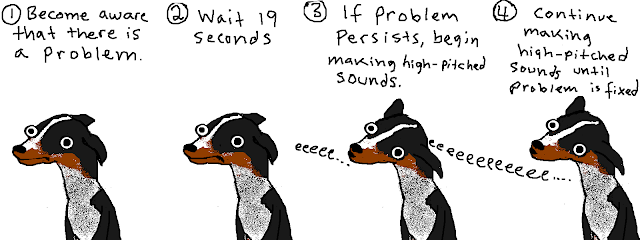


93rebeccanyc
This is the second time I've heard of Allie Brosh -- will have to check her out.
94RidgewayGirl
I am definitely getting the Allie Brosh book come my Thingamaversary.
95Cait86
>90 fannyprice: - I agree that Austen's novels are about both enjoyment and education, so to speak. I read Mansfield Park for the first time last year, and loved it, not just for the story itself, but because I also read a few critical essays on Fanny's character, her uncle, and slave trade. The secondary reading helped me see beyond the book itself. Maybe I should hunt down some Sense and Sensibility criticism!
96AnnieMod
Great review of the Austen book. Sometimes I wonder if such books should be written by fans at all - if the author chose to write the book, she/he thought that he/she is better than most of the other fans and then feels obliged to show it in the book... which leads to exactly this problem. Someone that is not part of the fandom has a lot better chance to write a better book...
97bragan
I'm not a fan of Jan Austen -- anything but, really, thanks mostly to a bad experience with her in a long-ago high school English class -- but that sort of "I am better than all those other people who also like this same thing" attitude is painfully familiar. You see it a lot with science fiction fans, for example, as amusingly illustrated in "the Geek Hierarchy Chart". It often seems to me that there's this weird cultural idea that too much enthusiasm about anything (or at least anything that isn't a sport) is uncool, so everybody with strong enthusiasms seems to want to find others they can point at and say, "Well, at least I'm not like those guys!"
98fannyprice
That's a brilliant little flow chart!
99kidzdoc
Nice review of Hyperbole and a Half, Kris. I looked at the two Allie Brosh comics whose images you posted, and laughed out loud at both of them.
100urania1
>87 kaylaraeintheway: All Roads Lead to Austen sounds fascinating. I first read Pride and Prejudice when I was in the 3rd grade and have been hooked ever since. I have never dressed up in early 19th century period dresss although the fashion lover in me can picture lots of modern and more wearable updates. I have dressed in 16th century English style clothing when I was a member of a performing group called The Renaissance Dancers. I discovered then why there are always servants on the scene. You cannot get dressed by yourself when wearing these costumes. And they are intensely uncomfortable to wear.
101dchaikin
Just requested Hyperbole and a Half from the library. And you are making want to read more Austen. I've only read P&P.
Also, thanks for post #83 on Sharon - for the links, quotes and your thoughts.
Also, thanks for post #83 on Sharon - for the links, quotes and your thoughts.
102NanaCC
I gave Hyperbole and a Half as a Christmas gift, based upon Betty(bragan)'s review in December. It really does sound funny.
103fannyprice
Listening to Tina Fey's Bossypants, read by Ms. Fey herself. These are the best books to listen to. I will never read another humorous memoir if I have the option instead to hear the author of such a memoir read it him/herself.
Best quote so far: "I have a uniquely German capacity to vacillate between sentimentality and coldness." Tina Fey and I are the same person.
Best quote so far: "I have a uniquely German capacity to vacillate between sentimentality and coldness." Tina Fey and I are the same person.
104cabegley
Some great reviews, Kris! I wish Among the Janeites wasn't a disappointment--it's a great cover. My husband got Hyperbole and a Half for Christmas (thanks, Nana!), and I meant to steal it right away. I've read some of her stuff and really liked it. You've nudged it back into my consciousness.
I'm with you on the humorous memoirs. I really enjoyed listening to Tina Fey read her own memoir.
I'm with you on the humorous memoirs. I really enjoyed listening to Tina Fey read her own memoir.
105Linda92007
I don't do well with audiobooks (mind wandering problems), but received an iPod as a gift. Bossypants sounds like it may be the perfect one to try.
106.Monkey.
Linda, I'm the same, I just can't sit and listen like that. Plus I think it's not really the same, it uses different parts of your brain and stuff, to hear vs read, doesn't it? It's different input and it doesn't come off the same. I just don't like books to be turned audio! lol.
107NanaCC
Audiobooks work well for me. When I was still working, my job was crazy and if I hadn't been able to listen to books in the car, I would have been very sad. I had no time to sit and read. I still listen in the car, and sometimes get so engrossed in a book that I will sit in the car for a bit after I arrive at my destination to listen longer. Bossypants was an easy one for audio.
108detailmuse
I'm listening to audio of Still Foolin' 'Em, Billy Crystal's latest (on aging, and uncensored). Too early to tell, but so far it's intriguing that he not only reads these essays but does so in performance to a live audience for the audio. I thought Tina Fey read fast but Billy, whoa!
109Nickelini
Enjoyed the audiobook of Bossypants too.
110fannyprice
>105 Linda92007:, 106: I won't turn this into an advert for audiobooks, because I appreciate that some things just do not work for some people & have no desire to convert anyone.
I will say, however, that I suffer from the same "wandering mind" problem, Linda, and have found that humorous memoirs work really well as audiobooks for me. Each story is short enough and relatively simple enough that my mind doesn't usually wander. The humor factor is also very helpful in keeping me focused. I have only had moderate success with non-fiction audiobooks. It's hard to believe that all culture and stories were originally auditory/oral.
I will say, however, that I suffer from the same "wandering mind" problem, Linda, and have found that humorous memoirs work really well as audiobooks for me. Each story is short enough and relatively simple enough that my mind doesn't usually wander. The humor factor is also very helpful in keeping me focused. I have only had moderate success with non-fiction audiobooks. It's hard to believe that all culture and stories were originally auditory/oral.
111FlorenceArt
110 It's hard to believe that all culture and stories were originally auditory/oral.
Well, they were formatted in a very different way, with lots of repetitions and alliterations and devices to help memorizing. And they were told to an audience who was trained to this kind of communication. Non-fiction books are structured for a reading audience who can go back and check a reference whenever they need to and don't need to remember all the details of the demonstration as it unfolds.
Well, they were formatted in a very different way, with lots of repetitions and alliterations and devices to help memorizing. And they were told to an audience who was trained to this kind of communication. Non-fiction books are structured for a reading audience who can go back and check a reference whenever they need to and don't need to remember all the details of the demonstration as it unfolds.
112fannyprice
Articles
You may notice a preponderance of articles from the Guardian, which allows one to subscribe via RSS to all articles concerning WWI. How convenient. Catching up on them tonight.
Teaching the first world war: what Europe's pupils learn about the conflict
Most interesting is the Polish high school teacher quoted: "Poland gained independence as a result of the first world war. Over here, tales of the Great war are not tales of catastrophe, but of a wonderful event which, thanks to the combined wisdom of the leaders of the socialist and nationalist camps, made possible the rebirth of the Polish state after 123 years of being non-existent."
Black Diggers: challenging Anzac myths - A new play running in Sydney about the role of Australian Aboriginal people in WWI and their post-war experiences.
First world war: 15 legacies still with us today
Archduke Franz Ferdinand descendant: don't blame us for first world war
Echoes of 1914: are today's conflicts a case of history repeating itself? -"It remains important that we challenge manipulative or reductive readings of the past when these are mobilised in support of present-day political objectives." - Historian Christopher Clark, author of The Sleepwalkers: How Europe Went to War in 1914.
The 1914 Christmas armistice: a triumph for common humanity - Historian Margaret MacMillan, author of Paris 1919 and The War That Ended Peace, continuing the debate about when perceptions of the war began to shift towards viewing it as a waste. This is a fascinating debate, but one that I am not informed enough to weigh in on at this point.
"At the time people on all sides thought they had a just cause. It is condescending and wrong to think they were hoodwinked. British soldiers felt they were fighting for their country and its values; French, German or Russian soldiers felt much the same."
You may notice a preponderance of articles from the Guardian, which allows one to subscribe via RSS to all articles concerning WWI. How convenient. Catching up on them tonight.
Teaching the first world war: what Europe's pupils learn about the conflict
Most interesting is the Polish high school teacher quoted: "Poland gained independence as a result of the first world war. Over here, tales of the Great war are not tales of catastrophe, but of a wonderful event which, thanks to the combined wisdom of the leaders of the socialist and nationalist camps, made possible the rebirth of the Polish state after 123 years of being non-existent."
Black Diggers: challenging Anzac myths - A new play running in Sydney about the role of Australian Aboriginal people in WWI and their post-war experiences.
First world war: 15 legacies still with us today
Archduke Franz Ferdinand descendant: don't blame us for first world war
Echoes of 1914: are today's conflicts a case of history repeating itself? -"It remains important that we challenge manipulative or reductive readings of the past when these are mobilised in support of present-day political objectives." - Historian Christopher Clark, author of The Sleepwalkers: How Europe Went to War in 1914.
The 1914 Christmas armistice: a triumph for common humanity - Historian Margaret MacMillan, author of Paris 1919 and The War That Ended Peace, continuing the debate about when perceptions of the war began to shift towards viewing it as a waste. This is a fascinating debate, but one that I am not informed enough to weigh in on at this point.
"At the time people on all sides thought they had a just cause. It is condescending and wrong to think they were hoodwinked. British soldiers felt they were fighting for their country and its values; French, German or Russian soldiers felt much the same."
113FlorenceArt
112> Thanks! I'll try to read a few of those at least, especially the one by Clark.
"It remains important that we challenge manipulative or reductive readings of the past when these are mobilised in support of present-day political objectives." We're going to get a lot of that this year.
"It remains important that we challenge manipulative or reductive readings of the past when these are mobilised in support of present-day political objectives." We're going to get a lot of that this year.
114rebeccanyc
Thanks for those links!
115fannyprice
Bossypants by Tina Fey

Thanks so much to everyone in ClubRead who recommended this to me as an audiobook. I probably would have never gotten around to reading it in paper form, despite being a big fan of Ms. Tina Fey, and it was so entertaining to listen to!
I loved Fey's snarky comments about sexism and being a woman in the entertainment industry, her musings on parenthood (because she's got one now, so she's an expert, as she mockingly claims), and her penchant for offhand swearing. For some reason, I also particularly enjoyed her stories about her dad and what a stone-cold badass he was. ("That's Don Fey!")
The portions of the book dealing with Fey's portrayal of Sarah Palin on Saturday Night Live were also pretty interesting - the level of ugly directed at her seems disproportional and sexist towards both her and Mrs. Palin, as Fey herself notes. But I also found it so funny that when Palin came on SNL, her hair and makeup people gave Fey tips and tricks to help her impersonate Palin more accurately. I'm still not a fan, but anyone who demonstrates a better sense of humor than I expect from them immediately wins a couple of points with me.
However, the best quote for me remains: "I have a uniquely German capacity to vacillate between sentimentality and coldness," because I can relate oh-so-well.

Thanks so much to everyone in ClubRead who recommended this to me as an audiobook. I probably would have never gotten around to reading it in paper form, despite being a big fan of Ms. Tina Fey, and it was so entertaining to listen to!
I loved Fey's snarky comments about sexism and being a woman in the entertainment industry, her musings on parenthood (because she's got one now, so she's an expert, as she mockingly claims), and her penchant for offhand swearing. For some reason, I also particularly enjoyed her stories about her dad and what a stone-cold badass he was. ("That's Don Fey!")
The portions of the book dealing with Fey's portrayal of Sarah Palin on Saturday Night Live were also pretty interesting - the level of ugly directed at her seems disproportional and sexist towards both her and Mrs. Palin, as Fey herself notes. But I also found it so funny that when Palin came on SNL, her hair and makeup people gave Fey tips and tricks to help her impersonate Palin more accurately. I'm still not a fan, but anyone who demonstrates a better sense of humor than I expect from them immediately wins a couple of points with me.
However, the best quote for me remains: "I have a uniquely German capacity to vacillate between sentimentality and coldness," because I can relate oh-so-well.
116dchaikin
I haven't tried humor in an audio book yet. It hasn't really occurred to me, but it makes perfect sense. I'll keep this one in mind. I can't see myself reading it in paper form.
117Polaris-
Yes, thanks for the links from the Guardian WW1 RSS. Much of interest there. The article on Black Diggers is fascinating - I'd love to see that play if it ever came anywhere near where I live, though I suspect that London might be the closest it comes...
The 'Fifteen Legacies' article is brilliant.
Still a week after the death of Ariel Sharon I find myself pondering how I felt about what he did in his life, and how I think he will be remembered by my countrymen as well as others in the region. I might post my thoughts up later.
The 'Fifteen Legacies' article is brilliant.
Still a week after the death of Ariel Sharon I find myself pondering how I felt about what he did in his life, and how I think he will be remembered by my countrymen as well as others in the region. I might post my thoughts up later.
118Erratic_Charmer
Nice review of the Tina Fey book. I haven't read anything by her but was once told that the 'Mii' version of myself on the Wii gaming console looks like Tina Fey, so I feel like we have a bond.
Hyperbole and a Half is just wonderful. Husband and I had followed the blog for a while before the book came out so we had high expectations for it. They were met in every way. The parrot comic had us just rolling!
I'm in the camp of people who struggle with audiobooks but I dig a good podcast - making a note to myself here to investigate the History of English one. Thank you for the recommendation :)
Hyperbole and a Half is just wonderful. Husband and I had followed the blog for a while before the book came out so we had high expectations for it. They were met in every way. The parrot comic had us just rolling!
I'm in the camp of people who struggle with audiobooks but I dig a good podcast - making a note to myself here to investigate the History of English one. Thank you for the recommendation :)
119fannyprice
>117 Polaris-:, Polaris, I hope you do post your thoughts about Sharon, I would be very interested to read them.
120fannyprice
For World Literature - A review of three books on different sides in the debate about "World Literature." Some fascinating food for thought for those of us who like to read books originating in specific languages or cultures or literature in translation. I must read all of the books mentioned therein: Against World Literature: On The Politics of Untranslatability by Emily Apter; On Literary Worlds by Eric Hayot (no touchstone even approaching appropriate); Distant Reading by Franco Moretti.
"In some specific ways, the old arrangements distorted our understanding of literature. The most familiar framework for literary studies for most of the 20th century was the nation, which routinely obscured the ways that texts travel across borders and reshape the cultures they encounter."
"In some specific ways, the old arrangements distorted our understanding of literature. The most familiar framework for literary studies for most of the 20th century was the nation, which routinely obscured the ways that texts travel across borders and reshape the cultures they encounter."
121Polaris-
{Cross-posted from my Club Read. Apologies for the lengthy post.}
Thoughts on the death of Ariel Sharon.
When I first moved to Israel (in 1991) Ariel Sharon was considered by most as a washed up has been. He was still in the cabinet (Agriculture, or National Infrastructure I think), but the heady days of power when he was Defence Minister in Menachem Begin's government were a thing of the past. Sharon's reputation among most Israelis at that time was one of a fine general - possibly Israel's greatest - who had simply gone too far in Lebanon, and thereby caused A LOT of irreparable damage to the country's reputation.
There soon followed four years of Rabin's coalition, and the 'Oslo Process' of cooperation between Israelis and Palestinians, punctuated with handshakes in desert tents and on the White House lawn, and a Nobel prize or two. Then a deluded Jewish zealot assassinated Rabin and a wave of hyper-terrorism erupted out of the still-occupied territories, bringing a frightened electorate to vote the 'tough' Likud back to power. Corruption and scandal foreshortened Netanyahu's first Premiership, and Labour's Ehud Barak attempted to resume Rabin's peace agenda. All the while Jewish settlements were built apace - and Sharon quietly crept back to the Likud front bench. He'd become a sort of 'father-figure' of the right wing 'national' camp. After his humiliation to Barak in the '99 election, a defeated Netanyahu was replaced by Sharon as leader of the Likud.
With my partner once in Israel (circa '99, following the scoffed reactions in a room to some TV news item on Sharon) I'd explained that after the Lebanon War - the Knesset appointed Kahan Commission had ruled that Sharon had personal responsibility "for ignoring the danger of bloodshed and revenge" in the awful massacre of Palestinian refugees by the Christian Phalangists in Beirut. It added that he should be dismissed as Minister of Defence. Consensus (an Israeli rarity!) was that he should not hold major office again (Israeli code for PM, or the Foreign, Defence, or Finance portfolios.) At that time, the idea of him ever becoming the Likud leader, let alone PM, was no more than a bad joke. Nobody, and I mean NOBODY in Israel imagined at that time that he would be PM within 2 years.

Then he lolloped on to the Temple Mount with a bevvy of security heavies in a calculated provocation and the overdue 2nd Intifada was ignited. A new wave of terror and the collapsed peace talks ("thanks" Arafat!) brought Barak down and the Sharon-led Likud won a landslide election victory.
I was fearful, and the early period of Sharon's rule bore out those fears with a heightening of terrorist actions, and an iron-fisted response from the Israeli military. War was declared on the PLO and an ailing Arafat was forced out of the West Bank - literally.
Then there was a change.
Somewhere in that process - and perhaps it was the superficial 'victory' over his nemesis Arafat that flicked the switch in his mind - the old Bulldozer accepted that a withdrawal from Gaza, and the dismantling of Jewish settlements there (as he had overseen in Sinai 30 years earlier in the wake of the Camp David accords with Egypt) were an unavoidable necessity in the interests of security and any semblance of peace.
As Minister of Defence during the 1982 invasion of Lebanon his actions were deplorable. Aside from allowing the Phalange free reign to conduct murder and terror of innocent civilians, he lied to the Cabinet, and lied to the nation with his declared aims in that conflict. As co-founder of the Likud in the 1970s he had played a key role, in my opinion, of sending Israel down a very long, treacherous and highly expensive dead end in national mismanagement. A path we still are following...
On the other hand, I cannot deny that for his actions in the Yom Kippur War of 1973 he will forever be a national hero - The 'Arik' of national affections, 'King of Israel'. The surprise attack of Egypt had caught a complacent Israel very unawares, and at the time of Sharon's reserve division arriving at the front the Sinai battle was very much in the balance. If Egypt had broken through there would have been a clear path for them all the way into the heart of Israel itself. His decisive tactic of crossing the Suez Canal and taking the war on to the offensive, 'into Africa', was a masterstroke that led to a decisive victory in what would prove to be Israel's last truly existential war to date. It enabled the peace treaty negotiations with Egypt - from a relative position of strength.

For many Israelis his death is a sad milestone - that the generation of founding fathers - who saw us through the brutal fights for survival in '48, '67, and '73 - is now very nearly gone. With its passing, something of Israel's troubled national psyche may well begin to change.
I think his legacy will ultimately be that as the Godfather of the settlement movement he showed to Israelis that the precedent of those same settlements' evacuations could be set, and that in the interests of a more secure future, land could indeed be given up, with the hope of achieving peace. Looking back at Israel's history, with the knowledge of Rabin's murder for reaching an almost identical conclusion a decade earlier, Sharon knew the risks, and I cannot doubt his bravery. For him the most important thing was the country - for that he sacrificed his party, and he even sacrificed Jewish settlements. How much further he would have gone, we will never know.
Thoughts on the death of Ariel Sharon.
When I first moved to Israel (in 1991) Ariel Sharon was considered by most as a washed up has been. He was still in the cabinet (Agriculture, or National Infrastructure I think), but the heady days of power when he was Defence Minister in Menachem Begin's government were a thing of the past. Sharon's reputation among most Israelis at that time was one of a fine general - possibly Israel's greatest - who had simply gone too far in Lebanon, and thereby caused A LOT of irreparable damage to the country's reputation.
There soon followed four years of Rabin's coalition, and the 'Oslo Process' of cooperation between Israelis and Palestinians, punctuated with handshakes in desert tents and on the White House lawn, and a Nobel prize or two. Then a deluded Jewish zealot assassinated Rabin and a wave of hyper-terrorism erupted out of the still-occupied territories, bringing a frightened electorate to vote the 'tough' Likud back to power. Corruption and scandal foreshortened Netanyahu's first Premiership, and Labour's Ehud Barak attempted to resume Rabin's peace agenda. All the while Jewish settlements were built apace - and Sharon quietly crept back to the Likud front bench. He'd become a sort of 'father-figure' of the right wing 'national' camp. After his humiliation to Barak in the '99 election, a defeated Netanyahu was replaced by Sharon as leader of the Likud.
With my partner once in Israel (circa '99, following the scoffed reactions in a room to some TV news item on Sharon) I'd explained that after the Lebanon War - the Knesset appointed Kahan Commission had ruled that Sharon had personal responsibility "for ignoring the danger of bloodshed and revenge" in the awful massacre of Palestinian refugees by the Christian Phalangists in Beirut. It added that he should be dismissed as Minister of Defence. Consensus (an Israeli rarity!) was that he should not hold major office again (Israeli code for PM, or the Foreign, Defence, or Finance portfolios.) At that time, the idea of him ever becoming the Likud leader, let alone PM, was no more than a bad joke. Nobody, and I mean NOBODY in Israel imagined at that time that he would be PM within 2 years.

Then he lolloped on to the Temple Mount with a bevvy of security heavies in a calculated provocation and the overdue 2nd Intifada was ignited. A new wave of terror and the collapsed peace talks ("thanks" Arafat!) brought Barak down and the Sharon-led Likud won a landslide election victory.
I was fearful, and the early period of Sharon's rule bore out those fears with a heightening of terrorist actions, and an iron-fisted response from the Israeli military. War was declared on the PLO and an ailing Arafat was forced out of the West Bank - literally.
Then there was a change.
Somewhere in that process - and perhaps it was the superficial 'victory' over his nemesis Arafat that flicked the switch in his mind - the old Bulldozer accepted that a withdrawal from Gaza, and the dismantling of Jewish settlements there (as he had overseen in Sinai 30 years earlier in the wake of the Camp David accords with Egypt) were an unavoidable necessity in the interests of security and any semblance of peace.
As Minister of Defence during the 1982 invasion of Lebanon his actions were deplorable. Aside from allowing the Phalange free reign to conduct murder and terror of innocent civilians, he lied to the Cabinet, and lied to the nation with his declared aims in that conflict. As co-founder of the Likud in the 1970s he had played a key role, in my opinion, of sending Israel down a very long, treacherous and highly expensive dead end in national mismanagement. A path we still are following...
On the other hand, I cannot deny that for his actions in the Yom Kippur War of 1973 he will forever be a national hero - The 'Arik' of national affections, 'King of Israel'. The surprise attack of Egypt had caught a complacent Israel very unawares, and at the time of Sharon's reserve division arriving at the front the Sinai battle was very much in the balance. If Egypt had broken through there would have been a clear path for them all the way into the heart of Israel itself. His decisive tactic of crossing the Suez Canal and taking the war on to the offensive, 'into Africa', was a masterstroke that led to a decisive victory in what would prove to be Israel's last truly existential war to date. It enabled the peace treaty negotiations with Egypt - from a relative position of strength.

For many Israelis his death is a sad milestone - that the generation of founding fathers - who saw us through the brutal fights for survival in '48, '67, and '73 - is now very nearly gone. With its passing, something of Israel's troubled national psyche may well begin to change.
I think his legacy will ultimately be that as the Godfather of the settlement movement he showed to Israelis that the precedent of those same settlements' evacuations could be set, and that in the interests of a more secure future, land could indeed be given up, with the hope of achieving peace. Looking back at Israel's history, with the knowledge of Rabin's murder for reaching an almost identical conclusion a decade earlier, Sharon knew the risks, and I cannot doubt his bravery. For him the most important thing was the country - for that he sacrificed his party, and he even sacrificed Jewish settlements. How much further he would have gone, we will never know.
122rebeccanyc
#120 Thanks for the link to the world literature article; I've marked your post so I can come back and read it when I have a little more time.
123fannyprice
Catherine the Great: Portrait of a Woman by Robert K. Massie

(Apologies for the length of this post.) I really struggled with how to respond to and review this book, which has received wide acclaim from critics and LTers whom I respect. I had expected, based on the title, a holistic picture of Catherine II of Russia that included her personal and political life. What I got instead was a book that dawdled over each love affair in Catherine's life, no matter how insignificant the man in question; gave short shrift to Catherine's political accomplishments; and - despite Massie's extensive use of Catherine's memoirs and letters - left me feeling that the woman at the center was still a cypher.
The book begins promisingly enough, with Sophia's (as Catherine was known before her marriage) inauspicious birth to an "obscure, penurious" German prince and a shallow, status obsessed train wreck of a mother. But quickly it become clear where we are headed: "Her rejection as a child helps to explain her constant search as a woman for what she had missed." I should have considered myself warned by this bit of amateur psychology.
Oddly, the book is most engaging when focusing on the period of time before Catherine ascends the throne. Massie is great when describing Catherine's marriage to the feckless and creepy future Peter III; the power struggles between Catherine, Peter, Empress Elizabeth and the retinue of court lackeys jockeying for influence; and the foreign intrigue swirling about the Russian throne.
One gets a good sense of the forces and faces that shaped Catherine as she and Peter waited for their coronation and how Catherine transformed herself from a German nobody to someone who was perceived as more authentically Russian than Peter, the grandson of Peter the Great. All of this draws on memoirs written by Catherine herself, so we are at least on historical ground as she saw it.
After Elizabeth's death, Peter's disastrous efforts to make Russia a Prussian vassal state (again Catherine's memoirs) are cut short when Catherine and her devoted advisers - including Catherine's military officer lover - depose him in a coup. This is where Massie starts to let the motives and actions of the people surrounding Catherine really overpower her in the narrative and she becomes essentially a weepy, lovelorn middle-aged woman.
Catherine's affairs begin before Peter ascends to the throne and are actually in some sense forced upon her by Empress Elizabeth, who realizes that Peter cannot be relied upon to produce an heir with Catherine. Peter is aware of - and even amused by - Catherine's affairs. At one point he arranges a dinner for himself, his mistress, Catherine, and her current lover, which amuses the future tsar greatly. Catherine's affair with Russian aristocrat Sergei Saltykov eventually produces the future Paul I. This was a fascinating little tidbit of information.
While Massie occasionally drops in a chapter or two on Catherine's efforts to reform the church, experiments in proto-democratic government, feelings about serfdom, or Russia's foreign relations, most of the book from here on out will be extensive excerpts from Catherine's tedious letters to her assorted paramours and overlong biographical sketches of these paramours, whether they are towering historical figures like Gregory Potemkin or merely attractive faces like so-and-so, whose name I can't even remember, who was packed off to the country with an annual allowance after even Catherine found him too tedious to bear.
Massie's decision to focus so much on Catherine's romantic life left me irritated and angry, especially because he frequently brought up and superficially explored so many more fascinating aspects of her character, such as her infatuation with Enlightenment philosophers and her desire to reform Russia's political and religious systems as contrasted with her ultimate inability to do so and her decision to enact stringent censorship laws, or her role in the partitions of Poland. Massie explains away changes in Catherine's ideas with a nod to peasant revolts in Russia and the French Revolution: "More than any other European monarch, she felt that the ideology of radical France was also directed at her, and the more radical France became, the more defensive and reactionary were her responses."
Ultimately, I felt like this book was filled with so much chaff that it was hard for me to appreciate the good parts. It made me sad, because I enjoyed Massie's book Nicholas and Alexandra and had been thinking about picking up his Peter the Great - one has to wonder if the biography of a male leader would have focused more on that leader's emotions than on his accomplishments.

(Apologies for the length of this post.) I really struggled with how to respond to and review this book, which has received wide acclaim from critics and LTers whom I respect. I had expected, based on the title, a holistic picture of Catherine II of Russia that included her personal and political life. What I got instead was a book that dawdled over each love affair in Catherine's life, no matter how insignificant the man in question; gave short shrift to Catherine's political accomplishments; and - despite Massie's extensive use of Catherine's memoirs and letters - left me feeling that the woman at the center was still a cypher.
The book begins promisingly enough, with Sophia's (as Catherine was known before her marriage) inauspicious birth to an "obscure, penurious" German prince and a shallow, status obsessed train wreck of a mother. But quickly it become clear where we are headed: "Her rejection as a child helps to explain her constant search as a woman for what she had missed." I should have considered myself warned by this bit of amateur psychology.
Oddly, the book is most engaging when focusing on the period of time before Catherine ascends the throne. Massie is great when describing Catherine's marriage to the feckless and creepy future Peter III; the power struggles between Catherine, Peter, Empress Elizabeth and the retinue of court lackeys jockeying for influence; and the foreign intrigue swirling about the Russian throne.
One gets a good sense of the forces and faces that shaped Catherine as she and Peter waited for their coronation and how Catherine transformed herself from a German nobody to someone who was perceived as more authentically Russian than Peter, the grandson of Peter the Great. All of this draws on memoirs written by Catherine herself, so we are at least on historical ground as she saw it.
After Elizabeth's death, Peter's disastrous efforts to make Russia a Prussian vassal state (again Catherine's memoirs) are cut short when Catherine and her devoted advisers - including Catherine's military officer lover - depose him in a coup. This is where Massie starts to let the motives and actions of the people surrounding Catherine really overpower her in the narrative and she becomes essentially a weepy, lovelorn middle-aged woman.
Catherine's affairs begin before Peter ascends to the throne and are actually in some sense forced upon her by Empress Elizabeth, who realizes that Peter cannot be relied upon to produce an heir with Catherine. Peter is aware of - and even amused by - Catherine's affairs. At one point he arranges a dinner for himself, his mistress, Catherine, and her current lover, which amuses the future tsar greatly. Catherine's affair with Russian aristocrat Sergei Saltykov eventually produces the future Paul I. This was a fascinating little tidbit of information.
While Massie occasionally drops in a chapter or two on Catherine's efforts to reform the church, experiments in proto-democratic government, feelings about serfdom, or Russia's foreign relations, most of the book from here on out will be extensive excerpts from Catherine's tedious letters to her assorted paramours and overlong biographical sketches of these paramours, whether they are towering historical figures like Gregory Potemkin or merely attractive faces like so-and-so, whose name I can't even remember, who was packed off to the country with an annual allowance after even Catherine found him too tedious to bear.
Massie's decision to focus so much on Catherine's romantic life left me irritated and angry, especially because he frequently brought up and superficially explored so many more fascinating aspects of her character, such as her infatuation with Enlightenment philosophers and her desire to reform Russia's political and religious systems as contrasted with her ultimate inability to do so and her decision to enact stringent censorship laws, or her role in the partitions of Poland. Massie explains away changes in Catherine's ideas with a nod to peasant revolts in Russia and the French Revolution: "More than any other European monarch, she felt that the ideology of radical France was also directed at her, and the more radical France became, the more defensive and reactionary were her responses."
Ultimately, I felt like this book was filled with so much chaff that it was hard for me to appreciate the good parts. It made me sad, because I enjoyed Massie's book Nicholas and Alexandra and had been thinking about picking up his Peter the Great - one has to wonder if the biography of a male leader would have focused more on that leader's emotions than on his accomplishments.
124Nickelini
Hmmm, I'm interested in learning about her, but maybe this isn't the right book for me--I dislike "chaff"! Great review, once more.
125rebeccanyc
I liked Catherine the Great better than you did, and I did feel I learned a lot about her many accomplishments. But I knew nothing about her beforehand, so it was all new to me.
126baswood
Enjoyed your review of Catherine the Great: Portrait of a Woman Perhaps the subtitle "Portrait of a Woman" gives a clue to where Massie is taking his readers with this book.
127AnnieMod
I liked Catherine more than you did and found other faults with the book - but I also expected that her private life will be a huge part of the story - mainly because it was a huge part of her decisions... Good review.
128fannyprice
>124 Nickelini:, Joyce, don't base your decision on my review. Like I said, many thoughtful people (like rebecca and annie, for instance!) had a much better response to it than I did.
>126 baswood:, Barry, yeah, I guess I just didn't expect that much romantic drama. Before reading this book, I had no idea Catherine was so active, as it were.
>125 rebeccanyc:, 126 - Annie and Rebecca, I'm glad you both enjoyed the book. I certainly didn't mean to imply that this book sucked, just that much of it didn't work for me. I hope others will read it and form their own opinions!
>126 baswood:, Barry, yeah, I guess I just didn't expect that much romantic drama. Before reading this book, I had no idea Catherine was so active, as it were.
>125 rebeccanyc:, 126 - Annie and Rebecca, I'm glad you both enjoyed the book. I certainly didn't mean to imply that this book sucked, just that much of it didn't work for me. I hope others will read it and form their own opinions!
129Erratic_Charmer
Great review, Fanny! I probably won't be picking up this book (wouldn't likely have done so before your review either) but I learned quite a bit from reading your thoughts on it.
130Linda92007
>120 fannyprice: Thank you for the link to a fascinating article. It raises some truly difficult issues that I have not previously considered.
131fannyprice
Longbourn by Jo Baker
I largely enjoyed this retelling of the events of Jane Austen's Pride and Prejudice from the perspective of the Bennet family's servants, which I read in two chunks of time separated by more than a week. I think my manner of reading may have contributed somewhat to my disjointed response - I was totally sucked in to the first half of the book, which focused more narrowly on life at Longbourn; when I returned to the book later, I found myself less engaged by the portions focusing on the footman's experience of the Napoleonic wars. The book's end also struck me as a bit off, but frankly, I have no idea how one could write an ending to such a book that would be both realistic and satisfying.It's not as though it would have been at all plausible for the maid and the footman to suddenly become gentry and I don't think any reader would have been happy with an ending that left them in service.
I was fascinated by how Baker took familiar characters and refracted them through new eyes - Mrs Bennet is still the same silly woman as before, but her foibles and neediness are not just amusing, they are work-making; Elizabeth's outdoorsiness is less charming to those who are forced to do her laundry; Jane is beloved because she never requires anything extra of the servants. In contrast to other reviewers on LT, I didn't think that Baker portrayed the Bennet family in an excessively negative way, merely in a way that was almost certainly a realistic depiction of the relations between servants and served in a smaller household where the relations are more intimate than in a larger household but where boundaries are policed nonetheless.
However, the Bennet family and the other main characters from P&P are really marginal to this story - their dramas figure inasmuch as they create strain on the servants, but Baker does a skillful job of showing how the servants have emotional and mental lives of their own and concerns quite separate from those of the family. Mr. Collins' visit to Longbourn, for instance, produces quite a different response in Mrs. Hill, the housekeeper, and Sarah, the maid from whose perspective most of the story is told. Both women realize that as the future owner of the house, Mr. Collins has power over their livelihoods; consequently, they are much nicer to him than is the Bennet family.
As I've mentioned, some parts of the story were less successful for me than others - the extended detour into the footman's mysterious past in particular did not work for me and seemed at odds with the rest of the book. Baker seemed at her best when she focused on the meaning in everyday life and the transition to the war setting was too melodramatic for me.
In reading and reviewing this book, I tried to think of it on two levels - first, as a complement to P&P; second, as a standalone book in its own right. I think it works quite well as both and I was glad I read it. Anyone who is interested in a look at P&P from a different angle or depictions of servants in literature would probably enjoy it, but I think responses are going to be very polarized because of the Jane Austen angle.
I largely enjoyed this retelling of the events of Jane Austen's Pride and Prejudice from the perspective of the Bennet family's servants, which I read in two chunks of time separated by more than a week. I think my manner of reading may have contributed somewhat to my disjointed response - I was totally sucked in to the first half of the book, which focused more narrowly on life at Longbourn; when I returned to the book later, I found myself less engaged by the portions focusing on the footman's experience of the Napoleonic wars. The book's end also struck me as a bit off, but frankly, I have no idea how one could write an ending to such a book that would be both realistic and satisfying.
I was fascinated by how Baker took familiar characters and refracted them through new eyes - Mrs Bennet is still the same silly woman as before, but her foibles and neediness are not just amusing, they are work-making; Elizabeth's outdoorsiness is less charming to those who are forced to do her laundry; Jane is beloved because she never requires anything extra of the servants. In contrast to other reviewers on LT, I didn't think that Baker portrayed the Bennet family in an excessively negative way, merely in a way that was almost certainly a realistic depiction of the relations between servants and served in a smaller household where the relations are more intimate than in a larger household but where boundaries are policed nonetheless.
However, the Bennet family and the other main characters from P&P are really marginal to this story - their dramas figure inasmuch as they create strain on the servants, but Baker does a skillful job of showing how the servants have emotional and mental lives of their own and concerns quite separate from those of the family. Mr. Collins' visit to Longbourn, for instance, produces quite a different response in Mrs. Hill, the housekeeper, and Sarah, the maid from whose perspective most of the story is told. Both women realize that as the future owner of the house, Mr. Collins has power over their livelihoods; consequently, they are much nicer to him than is the Bennet family.
As I've mentioned, some parts of the story were less successful for me than others - the extended detour into the footman's mysterious past in particular did not work for me and seemed at odds with the rest of the book. Baker seemed at her best when she focused on the meaning in everyday life and the transition to the war setting was too melodramatic for me.
In reading and reviewing this book, I tried to think of it on two levels - first, as a complement to P&P; second, as a standalone book in its own right. I think it works quite well as both and I was glad I read it. Anyone who is interested in a look at P&P from a different angle or depictions of servants in literature would probably enjoy it, but I think responses are going to be very polarized because of the Jane Austen angle.
132fannyprice
William, An Englishman by Cicely Hamilton
(Cross posted at ClubRead 2014 and VMC WWI Read)
Like many, I read this for the VMC "Beginning of the War" read. I honestly have to say that I do not know what to think of this book, which tells the story of a young Englishman and his new wife - both devotees of leftist causes - who are unwittingly caught up in the outbreak of WWI (specifically the Battle of Ardennes) as they honeymoon in Belgium in August 1914. I am very glad I read it, but it was extremely problematic for me. I will be thinking about it for a while and trying to dig up more on this author.
William, the title character, is a "negligible" person who has so little imagination he cannot even determine his own desires; throughout the book, he will be tossed about by circumstance from one extreme set of affiliations to another. He inadvertently becomes a "Social Reformer" after a misunderstanding with a socialist co-worker and quickly develops into an "extremist, passionately well-intentioned and with all the extremist's contempt for those who balance, see difficulties and strive to give the other side its due." Later, after a series of traumatizing events in Europe, he will abandon pacifism and embrace militarism and nationalism with equal fervor before becoming disillusioned with everything.
At first it was easy to read Hamilton's book as a satire of ignorant young people and be amused by their foolishness, but I gradually grew very uncomfortable with this book as it started to seem more and more like an indictment of anti-war sentiment and of "...those who had fiery little battles of their own to fight, and whose own warfare was suddenly rendered null and incompetent by a sudden diversion of energy and interest in the face of the national danger."
Hamilton seems for a period of time to be glorying in militaristic nationalism and issuing a call to arms. But then the book's attitude shifts yet again, as William's dreams of martial glory are replaced by the reality of service. "She knew him for a man disillusioned, in whom the imaginings of his pre-soldier days had died as completely as his faith in his pre-war creed."
I share (substantial spoilers in the linked review) CurrerBell's perplexity at the author's attitude toward her own characters. Is Hamilton critiquing all anti-war and leftist activists? Only stupid activists (because William and his wife are so ignorant and narrow-minded as to be almost unreal)? Is the book a critique of militarism and war, as most reviews suggest, given that Hamilton wrote it during her service as a nurse during the war? I was also confused by Hamilton's frequent references to people who denied that the war was happening. I understand that there was a segment of the public - particularly among leftists - who thought that European war was impossible before it began and another segment among leftists who thought that the war was a conspiracy to distract the common man from the goal of reform and splinter the international labor cause. But was there a group who denied the fact of the war?
Ultimately, I think Hamilton is trying to criticize both those who deny the possibility of war and those who glorify it as somehow redemptive, but I think a lot of her narrative choices are really problematic and end up reinforcing more of a nationalistic, "rally around the crown" perspective. She strongly suggests that suffragists, labor activists, and other leftists who did not suspend their activism during the war - as did the main suffragette group with which Hamilton herself was associated - were somehow unpatriotic, an attitude that really rankled me, especially after reading Adam Hochschild's wonderful history of pacifists and leftists during WWI, To End All Wars: A Story of Loyalty and Rebellion, which explored the moral and political struggles that these activists went through as they tried how to push for domestic reform without being tarred as traitors to the British Government.
I found some comprehensive biographical information on Hamilton that gets more into some of the issues I've raised in my review.
(Cross posted at ClubRead 2014 and VMC WWI Read)
Like many, I read this for the VMC "Beginning of the War" read. I honestly have to say that I do not know what to think of this book, which tells the story of a young Englishman and his new wife - both devotees of leftist causes - who are unwittingly caught up in the outbreak of WWI (specifically the Battle of Ardennes) as they honeymoon in Belgium in August 1914. I am very glad I read it, but it was extremely problematic for me. I will be thinking about it for a while and trying to dig up more on this author.
William, the title character, is a "negligible" person who has so little imagination he cannot even determine his own desires; throughout the book, he will be tossed about by circumstance from one extreme set of affiliations to another. He inadvertently becomes a "Social Reformer" after a misunderstanding with a socialist co-worker and quickly develops into an "extremist, passionately well-intentioned and with all the extremist's contempt for those who balance, see difficulties and strive to give the other side its due." Later, after a series of traumatizing events in Europe, he will abandon pacifism and embrace militarism and nationalism with equal fervor before becoming disillusioned with everything.
At first it was easy to read Hamilton's book as a satire of ignorant young people and be amused by their foolishness, but I gradually grew very uncomfortable with this book as it started to seem more and more like an indictment of anti-war sentiment and of "...those who had fiery little battles of their own to fight, and whose own warfare was suddenly rendered null and incompetent by a sudden diversion of energy and interest in the face of the national danger."
Hamilton seems for a period of time to be glorying in militaristic nationalism and issuing a call to arms. But then the book's attitude shifts yet again, as William's dreams of martial glory are replaced by the reality of service. "She knew him for a man disillusioned, in whom the imaginings of his pre-soldier days had died as completely as his faith in his pre-war creed."
I share (substantial spoilers in the linked review) CurrerBell's perplexity at the author's attitude toward her own characters. Is Hamilton critiquing all anti-war and leftist activists? Only stupid activists (because William and his wife are so ignorant and narrow-minded as to be almost unreal)? Is the book a critique of militarism and war, as most reviews suggest, given that Hamilton wrote it during her service as a nurse during the war? I was also confused by Hamilton's frequent references to people who denied that the war was happening. I understand that there was a segment of the public - particularly among leftists - who thought that European war was impossible before it began and another segment among leftists who thought that the war was a conspiracy to distract the common man from the goal of reform and splinter the international labor cause. But was there a group who denied the fact of the war?
Ultimately, I think Hamilton is trying to criticize both those who deny the possibility of war and those who glorify it as somehow redemptive, but I think a lot of her narrative choices are really problematic and end up reinforcing more of a nationalistic, "rally around the crown" perspective. She strongly suggests that suffragists, labor activists, and other leftists who did not suspend their activism during the war - as did the main suffragette group with which Hamilton herself was associated - were somehow unpatriotic, an attitude that really rankled me, especially after reading Adam Hochschild's wonderful history of pacifists and leftists during WWI, To End All Wars: A Story of Loyalty and Rebellion, which explored the moral and political struggles that these activists went through as they tried how to push for domestic reform without being tarred as traitors to the British Government.
I found some comprehensive biographical information on Hamilton that gets more into some of the issues I've raised in my review.
133fannyprice
I did not expect to finish and review a third book today, but I ended up at home all day and felt guilt about what a bad Early Reviewer I am, with several unreviewed books on my pile. So, I picked up
The Undercover Economist Strikes Back: How to Run - Or Ruin - An Economy by Tim Harford, which I won in one of the recent rounds of ER. I requested this book because economics truly befuddles me - I have like a mental block that no amount of explaining can overcome - and I am ashamed of being so ignorant of such a foundational and relevant subject. The book is written as a dialogue between the imagined reader and Harford and employs the conceit that the reader is running a country's economy with Harford's advice. At first I disliked this because I couldn't really skim uninteresting sections, but soon the subject matter becomes interesting - and amusing - enough that one doesn't really want to skip parts. Harford employs simple scenarios and anecdotes to explain key concepts in macroeconomics, including the different types of recessions, the debate between Keynsians and classicalists about the fundamental nature of economies, and why deflation is - in his estimation - worse than inflation. I still couldn't explain any of this to another person, but I do feel like I learned quite a lot and enjoyed Harford's breezy, cheeky style. Also, when have you ever read the word "wedgie" in an economics book? Harford also apparently has some great podcasts that I may check out.
Now, I think I'm going to go watch the Powerpuff Girls Special. This used to be one of my favorite cartoons (yes, I was an adult when it came out), so I'm excited to see if the update and digital animation works.
The Undercover Economist Strikes Back: How to Run - Or Ruin - An Economy by Tim Harford, which I won in one of the recent rounds of ER. I requested this book because economics truly befuddles me - I have like a mental block that no amount of explaining can overcome - and I am ashamed of being so ignorant of such a foundational and relevant subject. The book is written as a dialogue between the imagined reader and Harford and employs the conceit that the reader is running a country's economy with Harford's advice. At first I disliked this because I couldn't really skim uninteresting sections, but soon the subject matter becomes interesting - and amusing - enough that one doesn't really want to skip parts. Harford employs simple scenarios and anecdotes to explain key concepts in macroeconomics, including the different types of recessions, the debate between Keynsians and classicalists about the fundamental nature of economies, and why deflation is - in his estimation - worse than inflation. I still couldn't explain any of this to another person, but I do feel like I learned quite a lot and enjoyed Harford's breezy, cheeky style. Also, when have you ever read the word "wedgie" in an economics book? Harford also apparently has some great podcasts that I may check out.
Now, I think I'm going to go watch the Powerpuff Girls Special. This used to be one of my favorite cartoons (yes, I was an adult when it came out), so I'm excited to see if the update and digital animation works.
134urania1
>133 fannyprice:,
One of the paradoxes of capitalism. A capitalist economy demands that people spend ever more and more and buy ever more and more. Remember George Bush's admonition after 911: go spend money. Of course when the economic housing and credit crisis occurred consumers were blamed for profligate spending ... but on to deflation from a capitalist viewpoint. Consider the housing crisis. People woke up and discovered their houses were worth far less than they had paid for them - in other words their value was deflated. As a result of the economic crisis, many people decided that paying down their debt, credit card debt in particular, was preferable to spending money, which they didn't really have in the first place. Then as the value of investments (401Ks) for example fell (in my case by a third), many people decided that saving rather than investing was the wiser choice. So per capita savings went up. People saved instead of spending. As a result, the price of "some" goods went down to entice people to spend and to deal with the glut of new products people were not buying. Businesses can't make a profit. Banks end up with assets that are "temporarily" less valuable than they were - real estate for example. But everybody does not lose here. Wealth is merely concentrated in the hands of fewer people - those with available money - who buy up real estate etc., at garage sale prices. These people have to be wealthy enough to wait out the deflationary cycle. Most of us do not have the means to do so.
One of the paradoxes of capitalism. A capitalist economy demands that people spend ever more and more and buy ever more and more. Remember George Bush's admonition after 911: go spend money. Of course when the economic housing and credit crisis occurred consumers were blamed for profligate spending ... but on to deflation from a capitalist viewpoint. Consider the housing crisis. People woke up and discovered their houses were worth far less than they had paid for them - in other words their value was deflated. As a result of the economic crisis, many people decided that paying down their debt, credit card debt in particular, was preferable to spending money, which they didn't really have in the first place. Then as the value of investments (401Ks) for example fell (in my case by a third), many people decided that saving rather than investing was the wiser choice. So per capita savings went up. People saved instead of spending. As a result, the price of "some" goods went down to entice people to spend and to deal with the glut of new products people were not buying. Businesses can't make a profit. Banks end up with assets that are "temporarily" less valuable than they were - real estate for example. But everybody does not lose here. Wealth is merely concentrated in the hands of fewer people - those with available money - who buy up real estate etc., at garage sale prices. These people have to be wealthy enough to wait out the deflationary cycle. Most of us do not have the means to do so.
136wandering_star
Yes, interesting reviews of both William: an Englishman and Longbourn. The subtitle of the former would have suggested to me that he was meant to be in some way a representative figure, but it doesn't seem that was actually the case. I have un-wishlisted William and wishlisted To End All Wars. As for Longbourn, thanks for such a thoughtful and detailed review. It's confirmed that I don't think it's for me, but I am glad that you enjoyed it.
137fannyprice
>136 wandering_star:, I'd encourage you to read the Hamilton still. You can get it free if you have an ereader of some sort and it's a quick read. I'm glad my proselytizing of Hochschild's work is having an impact!
138SassyLassy
>136 wandering_star:, 137 I haven't read William, an Englishman but the fact that it is published by Persephone seems like enough of an inducement. They have such beautiful books.
The book sounds like it captures some of the moral confusion people had at the time over the war. It could be interesting. Liked your review.
The book sounds like it captures some of the moral confusion people had at the time over the war. It could be interesting. Liked your review.
139mkboylan
Oh Lord Fanny I'm new to your thread and could only get to 18 as I try to catch up! I found all of your topics of so much interest that I have to slow down, so am just saying Hi and commenting on a couple of your early posts. The history of the human body sounds like excellent information. I enjoyed your review very much. When I was teaching mate selection there was some research showing that we choose partners that make up for weaknesses in our own DNA. Haven't worked in five years so am not up on the latest, but the implication was without being aware of it, we made those biological choices, so I keep wondering if that is true, how that will effect DNA for couples who meet online. hmmmmm.
I also like your linked articles - about the English language and there being more than one way of saying things (I mean there HAS to be a better way of saying what I just said!).
And Kill Me Now? I just finished an early review book, Changing the Way We Die so am especially interested right now.
I am going to enjoy your thread and your wonderful reviews.
I also like your linked articles - about the English language and there being more than one way of saying things (I mean there HAS to be a better way of saying what I just said!).
And Kill Me Now? I just finished an early review book, Changing the Way We Die so am especially interested right now.
I am going to enjoy your thread and your wonderful reviews.
140NanaCC
>138 SassyLassy: You find that same confusion in the Regeneration trilogy. Men sent home and patched up only to be sent back. Many willing to do so, and others not. There was a general anger at the way the war was being run, even by those who thought the war was just. I felt that was what William, an Englishman showed. I didn't feel as strongly that she was calling them traitors, but that they had no idea what they were talking about. Loss of innocence, anger, confusion, and more anger.
141fannyprice
>139 mkboylan:, thanks merrikay! Yeah, I probably post too much, but it's still early in the year. I'm enjoying following your reading as well.
>140 NanaCC:, Colleen, yeah, I've been meaning to read the Regeneration trilogy for a while now. Perhaps this year. You're right that "traitors" is perhaps a little harsh of me. But it irked me that she could not really seem to acknowledge anti war activists were also wrestling with how to respond, and instead portrayed them as a mass of largely ignorant people with their heads in the sand. It struck me as particularly odd since, given the political and artistic circles that Hamilton moved in before, during, and after the war, she almost certainly would have been aware of both the good and the bad.
>140 NanaCC:, Colleen, yeah, I've been meaning to read the Regeneration trilogy for a while now. Perhaps this year. You're right that "traitors" is perhaps a little harsh of me. But it irked me that she could not really seem to acknowledge anti war activists were also wrestling with how to respond, and instead portrayed them as a mass of largely ignorant people with their heads in the sand. It struck me as particularly odd since, given the political and artistic circles that Hamilton moved in before, during, and after the war, she almost certainly would have been aware of both the good and the bad.
142NanaCC
>141 fannyprice: Kris, I believe I read somewhere that the book was meant as a satire. But I think that when you read it, you can feel the anger underneath her story. If her repertory company was performing plays for the Allied soldiers at the Western Front, you can imagine why she had all of this anger.
I hope you do get to read the Regeneration trilogy. They were really good, and I would love to read your thoughts on them.
I hope you do get to read the Regeneration trilogy. They were really good, and I would love to read your thoughts on them.
143fannyprice
Abandoned my first book of the year, Robert Kaplan's The Revenge of Geography: What the Map Tells Us About the Coming Conflicts and the Battle Against Fate. I can't in good conscience "review" this book, since I read only about 15% thereof, but I can tell you why I decided not to continue.
This book got a lot of play, I felt like I should read it to stay informed on current thinking in foreign policy circles, and I waited for a long time on library hold for it. But I just could not stomach this book, which loudly proclaims that it is not reductionist, declares that it will rediscover the forgotten science of geography and defend it against those who say it is irrelevant (without ever convincingly demonstrating that geography is either forgotten or held to be irrelevant), and goes on to claim that the uprisings in Tunisia that began in late 2010/early 2011 can be explained with reference to maps of Carthage. Beep, beep, my orientalist radar is pinging!
I thought about continuing this, because it might be "important," but ultimately I decided that Kaplan is arguing against a straw man and conflating culture with topography in explaining national cohesion. There are too many other things I'd rather read than this book.

This book got a lot of play, I felt like I should read it to stay informed on current thinking in foreign policy circles, and I waited for a long time on library hold for it. But I just could not stomach this book, which loudly proclaims that it is not reductionist, declares that it will rediscover the forgotten science of geography and defend it against those who say it is irrelevant (without ever convincingly demonstrating that geography is either forgotten or held to be irrelevant), and goes on to claim that the uprisings in Tunisia that began in late 2010/early 2011 can be explained with reference to maps of Carthage. Beep, beep, my orientalist radar is pinging!
I thought about continuing this, because it might be "important," but ultimately I decided that Kaplan is arguing against a straw man and conflating culture with topography in explaining national cohesion. There are too many other things I'd rather read than this book.

144fannyprice
Also, had a snow day today, so I took the opportunity to read some of the children's books, small comics, and other graphic books that have been gifted to me over the last few years that have piled up on the TBR pile.

Two little Edward Gorey tidbits
The Glorious Nosebleed - A macabre little Gorey alphabet book, this time using adverbs. "The creature regarded them Balefully." "He disposed of the fragments Slyly." And the truly inappropriate: "He exposed himself Lewdly." Not the best Gorey book, but still quite charming, in his creepy little way.
The West Wing - A wordless book, each little page illustrated with a single picture suggestive of something malicious, mysterious, or just weird. Three shoes abandoned in an empty room, a ladder casting an ominous shadow, the reflection of something (the hem of a dress?) just as it disappears round a corner, a lumpy black doll like thing hanging from the ceiling by a wire. Is there a narrative? Who knows! Also, an adorable lizard creature, looking quite alone. Again, not the best Gorey ever, but the fact that such simple pictures can be so unsettling is testament to his skill.
Three Mutts-related books
A Shtinky Little Christmas - "Well, it looks like we found a little orphan kitty in the garbage," says Earl. This begins this adorable and heartbreaking little story of Earl the dog, his best friend Mooch the cat, their new friend Jules (aka Shtinky Pudding), and Santa Claus. Mutts is the best and this short holiday themed book offered the usual joys.
Guardians of Being, a collaboration between self-help guru Eckhart Tolle and Mutts creater Patrick McDonnell. Normally I would not like this, but my dad bought it for me and it was kind of soothing.
MUTTS Sunday Evenings: A Mutts Treasury - a collection of the Mutts Sunday strips, which are in color and quite entertaining. The book also contains full-page "splash pages" setting the stage for many of the strips that are done in different artistic or other comics styles. The ones imitating 18th century Japanese prints were a particular favorite.
A couple Skippyjon Jones books - Skippyjon Jones, Lost in Spice and Skippyjon Jones Cirque de Ole. I like this series of lavishly illustrated, brightly colored children's books about a Siamese cat who thinks he's a Chihuahua and imagines adventures with his little gang of multicolored chihuahua friends. In these, Skippyjon goes to Mars with the aid of what I hope is cayenne pepper and to the circus with his sister's tutu. My mom generally buys me a new book from this series for every Christmas.
A couple non-series comics
Down with the Laugh-Out-Loud Cats - The second collection of Adam Koford's comics about two old-timey hobo cats, Kitteh and Pip. This comic is heartwarming and clever and has now built up a nice retinue of jokes about leafs (yes, leafs, not leaves), stew, cigars, and feline criminal activity. Most of these have appeared online, but I love the comic and like to support it. The book also includes some of Koford's illustrations of John Hodgman's hobo names listed in the latter's book, Areas of My Expertise. My only complaint is that the first book of comics was bound in a cute little square board book while this is just a regular paperback, but I think it's probably to lower costs.
The Saga of Rex - a nearly wordless collection of odd illustrated stories about a fox who (I think, none of this is super clear to me) is taken by some sort of alien life form, undergoes trials, and eventually gets to have little fox babies with a weird space fox. Rex was cute, but I have no idea why I bought this.

Two little Edward Gorey tidbits
The Glorious Nosebleed - A macabre little Gorey alphabet book, this time using adverbs. "The creature regarded them Balefully." "He disposed of the fragments Slyly." And the truly inappropriate: "He exposed himself Lewdly." Not the best Gorey book, but still quite charming, in his creepy little way.
The West Wing - A wordless book, each little page illustrated with a single picture suggestive of something malicious, mysterious, or just weird. Three shoes abandoned in an empty room, a ladder casting an ominous shadow, the reflection of something (the hem of a dress?) just as it disappears round a corner, a lumpy black doll like thing hanging from the ceiling by a wire. Is there a narrative? Who knows! Also, an adorable lizard creature, looking quite alone. Again, not the best Gorey ever, but the fact that such simple pictures can be so unsettling is testament to his skill.
Three Mutts-related books
A Shtinky Little Christmas - "Well, it looks like we found a little orphan kitty in the garbage," says Earl. This begins this adorable and heartbreaking little story of Earl the dog, his best friend Mooch the cat, their new friend Jules (aka Shtinky Pudding), and Santa Claus. Mutts is the best and this short holiday themed book offered the usual joys.
Guardians of Being, a collaboration between self-help guru Eckhart Tolle and Mutts creater Patrick McDonnell. Normally I would not like this, but my dad bought it for me and it was kind of soothing.
MUTTS Sunday Evenings: A Mutts Treasury - a collection of the Mutts Sunday strips, which are in color and quite entertaining. The book also contains full-page "splash pages" setting the stage for many of the strips that are done in different artistic or other comics styles. The ones imitating 18th century Japanese prints were a particular favorite.
A couple Skippyjon Jones books - Skippyjon Jones, Lost in Spice and Skippyjon Jones Cirque de Ole. I like this series of lavishly illustrated, brightly colored children's books about a Siamese cat who thinks he's a Chihuahua and imagines adventures with his little gang of multicolored chihuahua friends. In these, Skippyjon goes to Mars with the aid of what I hope is cayenne pepper and to the circus with his sister's tutu. My mom generally buys me a new book from this series for every Christmas.
A couple non-series comics
Down with the Laugh-Out-Loud Cats - The second collection of Adam Koford's comics about two old-timey hobo cats, Kitteh and Pip. This comic is heartwarming and clever and has now built up a nice retinue of jokes about leafs (yes, leafs, not leaves), stew, cigars, and feline criminal activity. Most of these have appeared online, but I love the comic and like to support it. The book also includes some of Koford's illustrations of John Hodgman's hobo names listed in the latter's book, Areas of My Expertise. My only complaint is that the first book of comics was bound in a cute little square board book while this is just a regular paperback, but I think it's probably to lower costs.
The Saga of Rex - a nearly wordless collection of odd illustrated stories about a fox who (I think, none of this is super clear to me) is taken by some sort of alien life form, undergoes trials, and eventually gets to have little fox babies with a weird space fox. Rex was cute, but I have no idea why I bought this.
145Nickelini
The West Wing has been my Amazon queue since the dark ages--it actually sounds very good. I'd like to look at those pictures and think up scenarios.
146wandering_star
I can't stand Kaplan. I think I managed to get through The Ends Of The Earth, but only with much irritation at both the reductionism and the underlying politics. I also learnt that I had to skip his articles in the Atlantic Monthly, however much I felt that I 'ought' to read them and try and engage with the arguments - since they do seem to get plenty of traction.
147avaland
Wow, you are back with a vengeance! :-) I like it!
>56 fannyprice: Rabid sounds interesting. I can't say I'm attracted to books on diseases but I've read one on Aids (A History: The African Aids Epidemic by John Iliffe) and another on tuberculosis (Fevered Lives by Katherine Ott, which I think you read also?). I skimmed a couple of others on TB, but it's the Ott I remember best.
>56 fannyprice: Rabid sounds interesting. I can't say I'm attracted to books on diseases but I've read one on Aids (A History: The African Aids Epidemic by John Iliffe) and another on tuberculosis (Fevered Lives by Katherine Ott, which I think you read also?). I skimmed a couple of others on TB, but it's the Ott I remember best.
148rebeccanyc
Glad you could read all those fun books. I read some Kaplan years ago (pre 9/11) and have had no interest in keeping up with him.
149fannyprice
>145 Nickelini:, Yeah, Joyce, it was fun how The West Wing allowed the reader to do that.
>146 wandering_star:, 148, I think I'm done trying with him. I'm done with the scholars who backed the Iraq War recklessly and now shamelessly say things like, "In retrospect, it was obvious that the mission was doomed from the outset...." or some such. Sadly, or fortunately, depending on your perspective, this gives me very few pundits to read.
>147 avaland:, Lois, the "vengeance" is in part due to all kinds of unexpected time off due to "snow days" and federal holidays. Also, I should probably spend more time studying and less time reading. (guilty face). I have Fevered Lives on my TBR list from you from years ago! I love disease histories.
>146 wandering_star:, 148, I think I'm done trying with him. I'm done with the scholars who backed the Iraq War recklessly and now shamelessly say things like, "In retrospect, it was obvious that the mission was doomed from the outset...." or some such. Sadly, or fortunately, depending on your perspective, this gives me very few pundits to read.
>147 avaland:, Lois, the "vengeance" is in part due to all kinds of unexpected time off due to "snow days" and federal holidays. Also, I should probably spend more time studying and less time reading. (guilty face). I have Fevered Lives on my TBR list from you from years ago! I love disease histories.
150AnnieMod
>149 fannyprice: I should probably spend more time studying and less time reading
:) When I was in uni, I was working full time so studying was evenings and weekends affair. Way too often I would realize it is midnight and the "I'll just read an hour and then study" had turned into "I just read 5 hours and I need to sleep because I am working tomorrow" :)
:) When I was in uni, I was working full time so studying was evenings and weekends affair. Way too often I would realize it is midnight and the "I'll just read an hour and then study" had turned into "I just read 5 hours and I need to sleep because I am working tomorrow" :)
151JDHomrighausen
> 150
As a current university student (and one who usually overloads) I have found audiobooks as my solace for books I want to read. I live about a mile from school and those two 20-minute walks add up to some good novels. :)
As a current university student (and one who usually overloads) I have found audiobooks as my solace for books I want to read. I live about a mile from school and those two 20-minute walks add up to some good novels. :)
152NanaCC
>151 JDHomrighausen: Jonathan, When I was still working, I also found audiobooks a great way to enjoy the books I didn't have time to read. The one or two hour drive each way gave me the opportunity to listen to a lot of really good books. I'm glad you have been able to balance "some good novels" with your impressive workload at school.
153fannyprice
What a strange, short week here in the DC area, with a holiday on Monday and then what seemed an interminable number of snow days and late starts. It's been a struggle of a reading week for me; one during which I have wondered at least three times a day if I am just too critical.
I am listening to the audiobook of Rebecca Skloot's acclaimed The Immortal Life of Henrietta Lacks and having a very difficult time with it. The multiple stories are very interesting, the narrator is soothing but engaging, but part of me feels like it was inappropriate for Skloot to write this book at all. This is extremely awkward for me because of how well-acclaimed this book is and how much effort Skloot clearly put into what she thought was an important story to tell.
One of the threads of the book concerns Skloot's story of her efforts to write this book, and it is this thread that I find most problematic. Skloot, according to her own portrayal of herself, begins researching Henrietta Lacks and the HeLa cells to satisfy her own curiosity without ever questioning whether she has the right to do so.
Although I assume that she ultimately secured the permission of the family to write this book (I have only now just reached the point where Skloot is actually face to face with any of the Lacks children), many of the people Skloot relied on to write this book initially tell her repeatedly to go away and stop invading their privacy because they have been exploited by both scientists and journalists before.
Skloot describes calling every Lacks in the Baltimore phone book when the Lacks family for whom she had phone numbers refuse to speak to her despite her calling them every day for a period of time; staking out the house of a Lacks cousin, peering in his windows, and letting herself into his house when no one answers the door. The reader/listener is meant to be impressed with Skloot's tenacity and determination to "tell Henrietta's story," but it just seemed to me like Skloot was stalking the Lacks family to satisfy her own curiosity.
These passages in the book, the comical way in which nearly all black people in the book are portrayed, and the incredibly intimate and often horrifying details about members of the Lacks family that I am not sure are germane to the larger story are all combining to make this a much more problematic read for me than I had expected based on the near-universal acclaim for this book.
I will probably finish the audiobook in order to do justice to Skloot and her project, but I am very distressed. In a certain sense I feel like I am participating in exploiting this family all over again. Now, in addition to their genetic material being public property, their sometimes very traumatic personal histories are offered for public consumption. I hope with all my heart that every member of the family who is alive and able to do so was given some veto power over what was and wasn't included in the book.
I am listening to the audiobook of Rebecca Skloot's acclaimed The Immortal Life of Henrietta Lacks and having a very difficult time with it. The multiple stories are very interesting, the narrator is soothing but engaging, but part of me feels like it was inappropriate for Skloot to write this book at all. This is extremely awkward for me because of how well-acclaimed this book is and how much effort Skloot clearly put into what she thought was an important story to tell.
One of the threads of the book concerns Skloot's story of her efforts to write this book, and it is this thread that I find most problematic. Skloot, according to her own portrayal of herself, begins researching Henrietta Lacks and the HeLa cells to satisfy her own curiosity without ever questioning whether she has the right to do so.
Although I assume that she ultimately secured the permission of the family to write this book (I have only now just reached the point where Skloot is actually face to face with any of the Lacks children), many of the people Skloot relied on to write this book initially tell her repeatedly to go away and stop invading their privacy because they have been exploited by both scientists and journalists before.
Skloot describes calling every Lacks in the Baltimore phone book when the Lacks family for whom she had phone numbers refuse to speak to her despite her calling them every day for a period of time; staking out the house of a Lacks cousin, peering in his windows, and letting herself into his house when no one answers the door. The reader/listener is meant to be impressed with Skloot's tenacity and determination to "tell Henrietta's story," but it just seemed to me like Skloot was stalking the Lacks family to satisfy her own curiosity.
These passages in the book, the comical way in which nearly all black people in the book are portrayed, and the incredibly intimate and often horrifying details about members of the Lacks family that I am not sure are germane to the larger story are all combining to make this a much more problematic read for me than I had expected based on the near-universal acclaim for this book.
I will probably finish the audiobook in order to do justice to Skloot and her project, but I am very distressed. In a certain sense I feel like I am participating in exploiting this family all over again. Now, in addition to their genetic material being public property, their sometimes very traumatic personal histories are offered for public consumption. I hope with all my heart that every member of the family who is alive and able to do so was given some veto power over what was and wasn't included in the book.
154.Monkey.
Eek, definitely understand why you are feeling that way, that would bother me a lot, too. :|
155almigwin
Another eek from me. Is there to be no end of exploitation? Whether in the name of science or just for prurient journalism it seems to just get worse instead of better.
156Linda92007
Kris, members of the Lacks family spoke in this area a few years ago, I think in conjunction with The Immortal Life of Henrietta Lacks having been chosen for a "One County, One Book" community read. I could kick myself for not attending. I have not read the book and probably won't, as the issues of privacy that you have discussed make me very uncomfortable.
157baswood
I ended up not liking The immortal Life of Henrietta Lacks because I felt it was exploitative and in some respects the reader was encouraged to admire the intrepid reporter Skloot so much that the book ended up being a bit of an exercise in self-aggrandisement.
158cabegley
As I recall, the Lacks family did eventually embrace Skloot, and she set up a scholarship fund for Henrietta's descendants.
159kaylaraeintheway
Such an interesting discussion on Henrietta Lacks! Skloot spoke at my university last semester, and I remember a group of students protesting her presence. I didn't go to the talk because I haven't read the book, but now I'm kind of curious...
160fannyprice
Monkey & Miriam - Yeah, I am hoping that there will be some more self-awareness later in the book. I think Skloot is a well-intentioned person and I think she truly believes that she is telling a tale that needs to be told. I don't think she intended to exploit the Lacks family, which is what makes it sad.
Linda, I bet that would have been really interesting to hear. I wish that at least Debra Lacks, the youngest daughter of Henrietta, who is acknowledged in the introduction as playing a huge role in the book and whom Skloot considers a friend, had been listed as a co-author. It seems impossible that this book could have been written without her input and memories.
Barry, you've hit the nail on the head. Nickelini/Joyce in her wonderful review last year described the book as Skloot's memoir of writing the book. Here's a link to her thoughts. She captures so much of my concerns I feel like I don't even need to review this book!
Chris, I'm sure you're right that the family does eventually embrace her - it would be impossible for her to acquire some of the intensely personal stories that she tells if the family did not trust her and agree to work with her. That only slightly eases my discomfort, however, because all of this crazy behavior precedes the Lacks family's buy-in. I'm glad that she set up a fund for Lacks descendants; I hope they are receiving a significant portion of the proceeds from this book.
Kayla, Interesting that there were protests. I wonder what specifically they were protesting.
Thanks everyone for your thoughtful comments - I am glad that whether we share the same impression of this book or not, we can discourse rationally. I was actually kind of terrified to dislike this book, but I'm learning more and more about the backlash against it every day. I'm going to do some searches online and see if I can find any interviews or comments from Lacks family members.
Linda, I bet that would have been really interesting to hear. I wish that at least Debra Lacks, the youngest daughter of Henrietta, who is acknowledged in the introduction as playing a huge role in the book and whom Skloot considers a friend, had been listed as a co-author. It seems impossible that this book could have been written without her input and memories.
Barry, you've hit the nail on the head. Nickelini/Joyce in her wonderful review last year described the book as Skloot's memoir of writing the book. Here's a link to her thoughts. She captures so much of my concerns I feel like I don't even need to review this book!
Chris, I'm sure you're right that the family does eventually embrace her - it would be impossible for her to acquire some of the intensely personal stories that she tells if the family did not trust her and agree to work with her. That only slightly eases my discomfort, however, because all of this crazy behavior precedes the Lacks family's buy-in. I'm glad that she set up a fund for Lacks descendants; I hope they are receiving a significant portion of the proceeds from this book.
Kayla, Interesting that there were protests. I wonder what specifically they were protesting.
Thanks everyone for your thoughtful comments - I am glad that whether we share the same impression of this book or not, we can discourse rationally. I was actually kind of terrified to dislike this book, but I'm learning more and more about the backlash against it every day. I'm going to do some searches online and see if I can find any interviews or comments from Lacks family members.
161charbutton
I had a similar reaction to The Immortal Life of Henrietta Lacks. I didn't feel like it was Skloot's story to tell. It felt to me like the family were being exploited all over again and that Skloot's should have backed off when the family members' various problems and vulnerability became obvious. It made me really uncomfortable.
162kaylaraeintheway
>160 fannyprice: From what I gathered, they were protesting the exploitation of the family (like char mentioned above) by a white author
163SassyLassy
I read this book about three years ago. Skloot was in a difficult position in many ways. The HeLa cells were a research and testing tool long before she became interested in them. Medical students (at least at some schools) were taught about their origin. It seems to me it would be difficult to decide a book shouldn't be written about such a valuable tool used for years because the family would object. On the other hand, she could have limited the book to the scientific history of the discovery and left out the more personal family history which didn't really contribute to the science.
One of the often overlooked messages in this book was the whole story of maintaining the integrity of the original tissue samples. The recounting of the struggle to get back to the original cytology after testing materials had been corrupted is one worth telling when you think of the importance placed on test results. Skloot told this episode clearly and well.
As nickelini says Skloot also tries to create tension in her book by attempting to make the family victims of the medical establishment. Yes, it’s sad and ironic that the HeLa cells have done so much to advance medical science while the family suffers without medical insurance. But one did not cause the other, and this does not turn the Lacks descendents into victims.
One of the often overlooked messages in this book was the whole story of maintaining the integrity of the original tissue samples. The recounting of the struggle to get back to the original cytology after testing materials had been corrupted is one worth telling when you think of the importance placed on test results. Skloot told this episode clearly and well.
As nickelini says Skloot also tries to create tension in her book by attempting to make the family victims of the medical establishment. Yes, it’s sad and ironic that the HeLa cells have done so much to advance medical science while the family suffers without medical insurance. But one did not cause the other, and this does not turn the Lacks descendents into victims.
164fannyprice
>163 SassyLassy:, Sassy - Yes, certainly, Skloot is not alone is writing about the Lacks family. I find the technical and ethical issues much more interesting and well-told parts of the book - I don't know if I've yet gotten to the part you mention - the book has discussed how HeLa cells were found to have contaminated other tissue samples, but not about HeLa cells themselves being corrupted - it sounds fascinating, however.
I actually think it is quite clear that the family was victimized by the medical establishment, but the irony that Skloot points out seems separate to me. Henrietta Lacks certainly was victimized by specific doctors and researchers who did not adequately explain her condition, treatment, and their actions to her. The Lacks family was victimized by doctors and scientists who collected blood from them under the pretense that the family was being screened for cancer and by others who published family medical information without informing the family or obtaining their consent. This stands whether the Lacks descendants are able to obtain medical insurance or not.
I actually think it is quite clear that the family was victimized by the medical establishment, but the irony that Skloot points out seems separate to me. Henrietta Lacks certainly was victimized by specific doctors and researchers who did not adequately explain her condition, treatment, and their actions to her. The Lacks family was victimized by doctors and scientists who collected blood from them under the pretense that the family was being screened for cancer and by others who published family medical information without informing the family or obtaining their consent. This stands whether the Lacks descendants are able to obtain medical insurance or not.
165fannyprice
2014 is supposed to be the year of reading women.
While the little sketch bookmarks Joanna Walsh drew are only meant to commemorate her favorite women writers and not necessarily to stand for anything larger, the image has quickly become the sort of book blog banner for promoting women's writing. One immediately notices that the women pictured - Anne Carson, Marguerite Duras, Deborah Levy, Simone de Beauvoir, Gertrude Stein, and Djuna Barnes - are not a particularly diverse group of women in terms of race, national origin. The list of women authors on the back of the bookmarks is more diverse and can be seen here about halfway down the page if anyone is interested.
While no one should like an author solely on the basis of gender, national origin, or other personal characteristics, it's worth thinking about which women we will be trying to read in 2014. Not that white, Anglo-American women authors don't struggle to get promoted and be read, but I bet they have an easier time of it than POCs (persons of color) or those from outside the Anglo-American world.
While the little sketch bookmarks Joanna Walsh drew are only meant to commemorate her favorite women writers and not necessarily to stand for anything larger, the image has quickly become the sort of book blog banner for promoting women's writing. One immediately notices that the women pictured - Anne Carson, Marguerite Duras, Deborah Levy, Simone de Beauvoir, Gertrude Stein, and Djuna Barnes - are not a particularly diverse group of women in terms of race, national origin. The list of women authors on the back of the bookmarks is more diverse and can be seen here about halfway down the page if anyone is interested.
While no one should like an author solely on the basis of gender, national origin, or other personal characteristics, it's worth thinking about which women we will be trying to read in 2014. Not that white, Anglo-American women authors don't struggle to get promoted and be read, but I bet they have an easier time of it than POCs (persons of color) or those from outside the Anglo-American world.
166baswood
Well I am going to do my bit for the year of reading women as I am going to be reading through Doris Lessing's oeuvre
167fannyprice
Just stumbled upon this Lewis Carroll quote: “Mental gluttony, or over-reading, is a dangerous propensity, tending to weakness of digestive power, and in some cases to loss of appetite.”
168Nickelini
I'm enjoying this thread very much--it's great to go over some of the issues of the Immortal Life of Henrietta Lacks again. I won't say much more because you all seem to know my thoughts. I did have a struggle too--all those great reviews, but what about? . . . So it's nice to see others getting my "what about?"
From the graphic, I immediately noticed that Simone de Beauvoir is wearing a suit just like one that I made for my grade 12 clothing and textiles course at high school in 1980. It was an Oscar de la Renta pattern and very chic at the time.
From the graphic, I immediately noticed that Simone de Beauvoir is wearing a suit just like one that I made for my grade 12 clothing and textiles course at high school in 1980. It was an Oscar de la Renta pattern and very chic at the time.
169LolaWalser
As one of the many researchers who have used HeLa cells, I can't resist noting that I'm not sure what is mean by HeLa cells' "corruption". Since the original isolation of the line--more than sixty years ago IIRC--there have been dozens of HeLa strains established, none of which bear any resemblance to the original cells. But that's not "corruption"; genetic instability of cancer cell lines is more common than not.
170SassyLassy
Thanks for that Lola. My memory of the book is that Skloot suggested the different strains that developed were not quite true to the original, which given your explanation makes sense, but that somehow this made them less than optimum. She then spent some time talking about working back to the original version, which now doesn't really seem necessary.
171mkboylan
143 - Like your review - The Revenge of the Revenge of.......
Hoboes and cats sounds fun! I think I'd also enjoy The West Wing - fun projective test!
I wonder if you would like Economix by Michael Goodwin. Several of us did. I thought he did a great job of explaining economics.
Hoboes and cats sounds fun! I think I'd also enjoy The West Wing - fun projective test!
I wonder if you would like Economix by Michael Goodwin. Several of us did. I thought he did a great job of explaining economics.
172LolaWalser
#170
I haven't read the book and can't tell what she might mean by "going back to the original"--it is impossible to go back to the original in any physical sense. That is, I assume no viable sample of the original cell line or tumour exist. If she means reconstructing theoretically the original genome, that would depend in part on the records made of the line as it was passaged. Anyone who does extensive cell culture monitors the genetic status of their lines, but the problem with HeLa cells is that they have been used so widely for so many different purposes it is practically impossible to track down every turn they have taken from the moment of isolation from the patient.
As for being "less than optimal", well, that's strictly relative, depending on what you want to use them for. In a broad (but important) sense, no living organism is an optimal experimental model, and one of the reasons is exemplified by HeLa cells: constant change. I agree, though, that for a cell line that unstable they have been over-utilized. But it's also true they have been a fantastic boon to research. If they had been an invention rather than a biological sample, they'd have gotten their Nobel long ago.
Oops, sorry for hogging the thread, Fanny.
I haven't read the book and can't tell what she might mean by "going back to the original"--it is impossible to go back to the original in any physical sense. That is, I assume no viable sample of the original cell line or tumour exist. If she means reconstructing theoretically the original genome, that would depend in part on the records made of the line as it was passaged. Anyone who does extensive cell culture monitors the genetic status of their lines, but the problem with HeLa cells is that they have been used so widely for so many different purposes it is practically impossible to track down every turn they have taken from the moment of isolation from the patient.
As for being "less than optimal", well, that's strictly relative, depending on what you want to use them for. In a broad (but important) sense, no living organism is an optimal experimental model, and one of the reasons is exemplified by HeLa cells: constant change. I agree, though, that for a cell line that unstable they have been over-utilized. But it's also true they have been a fantastic boon to research. If they had been an invention rather than a biological sample, they'd have gotten their Nobel long ago.
Oops, sorry for hogging the thread, Fanny.
174fannyprice
Me too. This is fascinating stuff.
175fannyprice
Finished Edith Wharton's The Age of Innocence. I picked it up because I'd really enjoyed House of Mirth and always meant to read more Wharton. Also, I just really wanted something kind of pleasant and relaxing this week. I chose badly, because this book really wasn't either of those things; however I am glad that I read it.
Most people have probably already read this book or are familiar with it, so I feel slightly silly summarizing it, but I want to for my own memory. This book is Wharton's critical portrayal of the stifling society of Gilded Age "Old New York," which is characterized by its highly circumscribed rules and roles. The book is told through the eyes of Newland Archer, a younger member of Old New York's elite who begins chafing against its customs when he falls in love with his fiance/wife May's exotic cousin Ellen Olenska, who has disgraced herself and her family by fleeing her European husband and returning to New York.
Throughout the book, Newland's feelings for Ellen lead him to increasingly question his society's customs and rituals, and Wharton uses Newland's "awakening" to comment on the Gilded Age's restrictive ideas about the proper roles for women and men and how these warp relations between them. She also critiques the obsession with outward appearances, the tendency to ignore anything unpleasant, and the way in which society delicately but ruthlessly contrives to close ranks around its own and against those who have contravened its rules.
While I think the reader is meant to identify somewhat with Newland, Wharton also seems to be very subtly mocking him - not necessarily in a cruel way, but simply to demonstrate that as far as he goes in transgressing his society's rules and professing his belief that "women ought to be free," he is still very much a product of that society.
I felt that this was most evident in his portrayal of Newland's relationship with his fiance/wife May. The book relates that Newland, during his courtship of May, has begun molding her into a more learned woman and has begun to share his opinions in everything; her sense of humor is demonstrated by her ability to laugh at his jokes. He thinks that behaving this way is a sign of his advanced ideas about women, but in reality, it is just a further manifestation of how he expects marriageable women of her class to submerse themselves in their husbands.
Throughout their relationship, Newland condescendingly thinks of the myriad of ways in which May has failed to perform up to his expectations of her while being seemingly oblivious to the fact that if she behaved as he claims he wants her to behave, she would immediately step outside the bounds of what he and his society consider an acceptable wife. I wanted to slap him when he thought to himself after their marriage that: "There was no use in trying to emancipate a wife who had not the dimmest notion that she was not free," when in fact May's tolerance of Newland's continuously increasingly inappropriate behavior indicates that she is more perceptive of both his transgressions and the limited recourse that she has.
Despite my dislike of both Newland and Olenska, I enjoyed this book very much and delighted in Wharton's vivid and barbed critiques, such as when she describes the unpromising young men "working" in a law firm: "over many of them the green mold of the perfunctory was already perceptibly spreading." Genius - I will await with breathless anticipation the opportunity to use this at work. Or when describing the almost impenetrable social hierarchy of Old New York: "a small and slippery pyramid, in which, as yet, hardly a fissure had been made or a foothold gained."
Or perhaps the most brilliant, when describing an overweight society matron: "The immense accretion of flesh which had descended on her in middle life like a flood of lava on a doomed city had changed her ... into something as vast and august as a natural phenomenon ... in the centre of which the traces of a small face survived as if awaiting excavation."
Edith Wharton is truly a genius and I will definitely return to this book in future years to see how my responses to it change over time. Highly recommended.
Most people have probably already read this book or are familiar with it, so I feel slightly silly summarizing it, but I want to for my own memory. This book is Wharton's critical portrayal of the stifling society of Gilded Age "Old New York," which is characterized by its highly circumscribed rules and roles. The book is told through the eyes of Newland Archer, a younger member of Old New York's elite who begins chafing against its customs when he falls in love with his fiance/wife May's exotic cousin Ellen Olenska, who has disgraced herself and her family by fleeing her European husband and returning to New York.
Throughout the book, Newland's feelings for Ellen lead him to increasingly question his society's customs and rituals, and Wharton uses Newland's "awakening" to comment on the Gilded Age's restrictive ideas about the proper roles for women and men and how these warp relations between them. She also critiques the obsession with outward appearances, the tendency to ignore anything unpleasant, and the way in which society delicately but ruthlessly contrives to close ranks around its own and against those who have contravened its rules.
While I think the reader is meant to identify somewhat with Newland, Wharton also seems to be very subtly mocking him - not necessarily in a cruel way, but simply to demonstrate that as far as he goes in transgressing his society's rules and professing his belief that "women ought to be free," he is still very much a product of that society.
I felt that this was most evident in his portrayal of Newland's relationship with his fiance/wife May. The book relates that Newland, during his courtship of May, has begun molding her into a more learned woman and has begun to share his opinions in everything; her sense of humor is demonstrated by her ability to laugh at his jokes. He thinks that behaving this way is a sign of his advanced ideas about women, but in reality, it is just a further manifestation of how he expects marriageable women of her class to submerse themselves in their husbands.
Throughout their relationship, Newland condescendingly thinks of the myriad of ways in which May has failed to perform up to his expectations of her while being seemingly oblivious to the fact that if she behaved as he claims he wants her to behave, she would immediately step outside the bounds of what he and his society consider an acceptable wife. I wanted to slap him when he thought to himself after their marriage that: "There was no use in trying to emancipate a wife who had not the dimmest notion that she was not free," when in fact May's tolerance of Newland's continuously increasingly inappropriate behavior indicates that she is more perceptive of both his transgressions and the limited recourse that she has.
Despite my dislike of both Newland and Olenska, I enjoyed this book very much and delighted in Wharton's vivid and barbed critiques, such as when she describes the unpromising young men "working" in a law firm: "over many of them the green mold of the perfunctory was already perceptibly spreading." Genius - I will await with breathless anticipation the opportunity to use this at work. Or when describing the almost impenetrable social hierarchy of Old New York: "a small and slippery pyramid, in which, as yet, hardly a fissure had been made or a foothold gained."
Or perhaps the most brilliant, when describing an overweight society matron: "The immense accretion of flesh which had descended on her in middle life like a flood of lava on a doomed city had changed her ... into something as vast and august as a natural phenomenon ... in the centre of which the traces of a small face survived as if awaiting excavation."
Edith Wharton is truly a genius and I will definitely return to this book in future years to see how my responses to it change over time. Highly recommended.
176SassyLassy
It's a wonderful tribute to a writer when you really enjoy a book while disliking the major characters. Wonderful quote about the society matron. I think it's important to go back to books like this as you mention doing, to see how they change or not as we change.
Wharton is on my list of new to me authors for this year. Which would you read first?
Wharton is on my list of new to me authors for this year. Which would you read first?
177Nickelini
Wonderful comments on The Age of Innocence. That was probably my favourite book when I read it 2012. Last year I read The House of Mirth, which got off to a bit of a slow start for me, so at the time I didn't rate as highly. Now I think of both of them as most excellent! Sassy - I think either of these would be a good start. My first Wharton was Ethan Frome, and I liked it, but a lot of people don't. And it's not as good as these.
I agree about disliking the characters in AoI--I don't think I liked anyone in that book. Last year I was in a discussion about the book here at LT and someone said she wouldn't read AoI because she didn't like romance stories and Wikipedia described it as a romance. Although there is that element to it, that's not what the book is about, and besides, how do you have a romance when the characters are unlikeable? I find it interesting that in the movie Olenska is played by Michelle Pfeiffer, who is an actress that I find pretty but who leaves me very cold. Even though I hadn't seen the movie yet, I imagined Pheiffer when I read AoI. I think she was well cast. In the next day or two I will review Dangerous Liaisons--another movie where Michelle Pfeiffer plays a character I dislike.
I agree about disliking the characters in AoI--I don't think I liked anyone in that book. Last year I was in a discussion about the book here at LT and someone said she wouldn't read AoI because she didn't like romance stories and Wikipedia described it as a romance. Although there is that element to it, that's not what the book is about, and besides, how do you have a romance when the characters are unlikeable? I find it interesting that in the movie Olenska is played by Michelle Pfeiffer, who is an actress that I find pretty but who leaves me very cold. Even though I hadn't seen the movie yet, I imagined Pheiffer when I read AoI. I think she was well cast. In the next day or two I will review Dangerous Liaisons--another movie where Michelle Pfeiffer plays a character I dislike.
178avidmom
>175 fannyprice: What a coincidence. I have the movie "Age of Innocence" waiting for me on the DVR. Haven't seen it yet - or read the book. It's rather surprising that Martin Scorcese directed the movie. That last quote you included in your review is absolutely brilliant! Wharton is a genius.
179Nickelini
#178 - I have a soft spot for that movie because one of my friends from high school was a principle dancer in it. He isn't shown very clearly on camera, but I can spot him in the dance scenes, swooping across the floor behind the actors. Makes me laugh--it's a far cry from partying in his basement in east Vancouver, listening to Boz Scaggs, Billy Joel, Supertramp, and Boston.
180fannyprice
>176 SassyLassy:, Sassy, I don't think it really matters what you read first. I read House of Mirth first - it is a much harsher novel than The Age of Innocence, which Wharton apparently wrote as an "apology" for how brutal House of Mirth was. I think I slightly preferred House of Mirth, but both are excellent.
>177 Nickelini:, Joyce, I think it's in part due to the marketing of the film and some of the choicer lines from the novel decontextualized - I've seen things like "Each time you happen to me all over again," which Newland says to Olenska, carved into jewelry, etc. The film and the book supposedly tell the story of a great romance. I think it's a little bit like how Jane Austen's books are supposedly so "romantic." It is slightly ironic, if one thinks about it, since a theme of the book is that the relationships in Newland's life are always inferior to his fantasies about them.
>179 Nickelini:, Joyce, that's so awesome about your friend!
I've only seen bits and pieces of the movie, but I had a hard time not imagining the actors - Daniel Day Lewis, Winona Ryder, and Michelle Pfeiffer - as the characters even when the novel repeatedly talked about Olenska as being a brunette.
>177 Nickelini:, Joyce, I think it's in part due to the marketing of the film and some of the choicer lines from the novel decontextualized - I've seen things like "Each time you happen to me all over again," which Newland says to Olenska, carved into jewelry, etc. The film and the book supposedly tell the story of a great romance. I think it's a little bit like how Jane Austen's books are supposedly so "romantic." It is slightly ironic, if one thinks about it, since a theme of the book is that the relationships in Newland's life are always inferior to his fantasies about them.
>179 Nickelini:, Joyce, that's so awesome about your friend!
I've only seen bits and pieces of the movie, but I had a hard time not imagining the actors - Daniel Day Lewis, Winona Ryder, and Michelle Pfeiffer - as the characters even when the novel repeatedly talked about Olenska as being a brunette.
181Rebeki
Wow, that's a great review/analysis of The Age of Innocence - I wish you'd been at my reading group meeting when we discussed it!
It's funny, because I did find it a "pleasant" read, even though I can see why it shouldn't be. Maybe it's just that I find something comforting about reading a classic...
It's funny, because I did find it a "pleasant" read, even though I can see why it shouldn't be. Maybe it's just that I find something comforting about reading a classic...
182baswood
Loved your review of The Age of Innocence
183NanaCC
I enjoyed your review of The Age of Innocence. I really enjoyed the book when I read it last year. It made my favorites list. Have you read The Custom of the Country? I think I possibly liked that one even more. It was a toss up.
184fannyprice
Thanks all!
>183 NanaCC:, Colleen, I haven't, but I have it on Kindle. I'll probably take a little Wharton break and read it later, but who knows? I never end up doing what I say I'll do next.
I've also finished Faithless: Tales of Transgression, a collection of Joyce Carol Oates short stories I've been working on for probably a year or more at this point. Overall, this was a great collection of stories - as always with collections, I liked some more than others. The stories I liked the best in this collection almost always involved a woman looking back on her past, telling a story and discovering or rediscovering something about her past or her family's past. These stories were quietly unsettling and somewhat hazy, often involving secrets or acts whose meaning the story's main character could not or would not comprehend. Among my favorites: "Faithless," in which a woman uncovers the truth about her mother and father's relationship; "The Scarf," in which a woman remembers buying a gift as a child for her now aged mother; and "What Then, My Life?", in which a woman tries to remember time spent on her grandparents' farm. All of these descriptions of course are stripped of the shocking violence and horribleness that appears in most Oates stories, to avoid spoilers. Less successful for me were the many stories about wronged lovers taking revenge and the stories that seemed "ripped from the headlines" about school violence.
It goes without saying that Oates is impressively prolific, but what's also amazing is her ability to write in so many different registers and prose styles while still remaining clearly herself. I read the ebook version, which also included an interview with the author. Most of the questions were quite silly, but I did enjoy learning about how Oates almost always "curates" her short story collections around a theme and arranges them so that as the reader progesses through the book, the reader moves from more concrete stories to more abstract stories with a greater sense of narrative instability. That progression was definitely clear toward the final stories.

>183 NanaCC:, Colleen, I haven't, but I have it on Kindle. I'll probably take a little Wharton break and read it later, but who knows? I never end up doing what I say I'll do next.
I've also finished Faithless: Tales of Transgression, a collection of Joyce Carol Oates short stories I've been working on for probably a year or more at this point. Overall, this was a great collection of stories - as always with collections, I liked some more than others. The stories I liked the best in this collection almost always involved a woman looking back on her past, telling a story and discovering or rediscovering something about her past or her family's past. These stories were quietly unsettling and somewhat hazy, often involving secrets or acts whose meaning the story's main character could not or would not comprehend. Among my favorites: "Faithless," in which a woman uncovers the truth about her mother and father's relationship; "The Scarf," in which a woman remembers buying a gift as a child for her now aged mother; and "What Then, My Life?", in which a woman tries to remember time spent on her grandparents' farm. All of these descriptions of course are stripped of the shocking violence and horribleness that appears in most Oates stories, to avoid spoilers. Less successful for me were the many stories about wronged lovers taking revenge and the stories that seemed "ripped from the headlines" about school violence.
It goes without saying that Oates is impressively prolific, but what's also amazing is her ability to write in so many different registers and prose styles while still remaining clearly herself. I read the ebook version, which also included an interview with the author. Most of the questions were quite silly, but I did enjoy learning about how Oates almost always "curates" her short story collections around a theme and arranges them so that as the reader progesses through the book, the reader moves from more concrete stories to more abstract stories with a greater sense of narrative instability. That progression was definitely clear toward the final stories.

185Linda92007
Great reviews of The Age of Innocence and Faithless. Ethan Frome is the only Wharton I have read and I really enjoyed it.
Oates' comments on how she curates her short story collections are very interesting. Thanks for including them in your review.
Oates' comments on how she curates her short story collections are very interesting. Thanks for including them in your review.
186fannyprice
(Saving some links to recent articles I've read for myself here - feel free to ignore)
What Can 1914 Tell Us About 2014? The disturbing parallels between pre-WWI and today - interesting comments on social and cultural values at the time - emergence of bipolarity combined with belief in cleansing righteousness of war
An interview with the historian who wrote the article - Evans is author of Altered Pasts: Counterfactuals in History - interesting given this quote: "If you look at the arguments about what would have happened had there been no first World War, or had Britain not entered the First World War, you simply cannot say that there would have been no Holocaust, or no second world war, because you can’t account for chance happenings along the alternative timeline you’re constructing." This book may be more worth checking out than I had thought.
What Can 1914 Tell Us About 2014? The disturbing parallels between pre-WWI and today - interesting comments on social and cultural values at the time - emergence of bipolarity combined with belief in cleansing righteousness of war
An interview with the historian who wrote the article - Evans is author of Altered Pasts: Counterfactuals in History - interesting given this quote: "If you look at the arguments about what would have happened had there been no first World War, or had Britain not entered the First World War, you simply cannot say that there would have been no Holocaust, or no second world war, because you can’t account for chance happenings along the alternative timeline you’re constructing." This book may be more worth checking out than I had thought.
188rebeccanyc
I know I've said it before, but I really need to read some Edith Wharton.
189fannyprice
>188 rebeccanyc:, welcome back Rebecca!
Another backlogged Early Reviewer book for me:
I'll have to come back and add the cover, which is kind of cool, when I'm not on the iPad.
The Clockwork Scarab
An interesting premise marred by the execution. Sherlock Holmes' niece (daughter of Mycroft) and Bram Stoker's sister (who has inherited the family's secret occupation as a vampire hunter) join forces at the request of the British royals (mediated through Irene Adler....) to solve a mystery involving Egyptian antiquities and the deaths and disappearances of young ladies from prominent society families. There are two love triangles emerging - one for each lady. (Fortunately they are each torn between different sets of men, so the reader will not have to look forward to a degrading cat fight between the two female leads.) In an alternate history steampunk London. And there a a time traveller who appears to be from our version of history (carrying an iPhone, from a world where electricity, rather than steam, has always been the dominant power source, Sherlock Holmes is merely a fictional character, and so on). I really could have done without the time traveller element, especially as it is introduced at the beginning, ignored throughout the middle of the book, and then used as a sort of deus ex machina to defeat the baddies at the end of the book.
It just felt like there was a little too much going on in the book. Obviously this is the start of a series and the reader will learn more about the two main ladies as the series progresses, but I felt that the author relied too much on each woman's pedigree rather than investing time in making Mina Holmes and Evaline Stoker interesting characters in their own right. Also, the ultimate identity of the big bad, which is not revealed in this book, seems incredibly obvious.If Irene Adler isn't playing these girls - "I need you for a special mission, don't tell anyone, especially your families or the police"; the villain is a master of disguise who sometimes appears to be male and sometimes appears to be female but always has mannerisms that seem so familiar to Mina but that she just can't quite identify; Adler disappears right before the critical final showdown with the villain and reappears the day after from a "business trip" - I will eat a hat.
I also read The Little Prince Graphic Novel, an adaptation of Antoine de Saint-Exupéry's story with illustrations by Joann Sfar of The Rabbi's Cat fame. I loved this quite a lot - I hate saying things like "magical" but that was really the word for it. I have actually never read the original, so I'll be looking to that now to see how they compare.
Another backlogged Early Reviewer book for me:
I'll have to come back and add the cover, which is kind of cool, when I'm not on the iPad.
The Clockwork Scarab
An interesting premise marred by the execution. Sherlock Holmes' niece (daughter of Mycroft) and Bram Stoker's sister (who has inherited the family's secret occupation as a vampire hunter) join forces at the request of the British royals (mediated through Irene Adler....) to solve a mystery involving Egyptian antiquities and the deaths and disappearances of young ladies from prominent society families. There are two love triangles emerging - one for each lady. (Fortunately they are each torn between different sets of men, so the reader will not have to look forward to a degrading cat fight between the two female leads.) In an alternate history steampunk London. And there a a time traveller who appears to be from our version of history (carrying an iPhone, from a world where electricity, rather than steam, has always been the dominant power source, Sherlock Holmes is merely a fictional character, and so on). I really could have done without the time traveller element, especially as it is introduced at the beginning, ignored throughout the middle of the book, and then used as a sort of deus ex machina to defeat the baddies at the end of the book.
It just felt like there was a little too much going on in the book. Obviously this is the start of a series and the reader will learn more about the two main ladies as the series progresses, but I felt that the author relied too much on each woman's pedigree rather than investing time in making Mina Holmes and Evaline Stoker interesting characters in their own right. Also, the ultimate identity of the big bad, which is not revealed in this book, seems incredibly obvious.
I also read The Little Prince Graphic Novel, an adaptation of Antoine de Saint-Exupéry's story with illustrations by Joann Sfar of The Rabbi's Cat fame. I loved this quite a lot - I hate saying things like "magical" but that was really the word for it. I have actually never read the original, so I'll be looking to that now to see how they compare.
190fannyprice
Oy oy oy. I've gotten quite behind.
Just now noticing that I still have not come back to do a final wrap-up about my thoughts on The Immortal Life of Henrietta Lacks, which I finished on audiobook over a week ago.
My unwillingness/inability to review this book almost certainly stems from the fact that I still feel incredibly conflicted about it - see my initial post on the issue above and the subsequent discussion. While I ultimately found this book an interesting and informative read, I cannot escape the feeling that certain authorial/editorial decisions contributed to the further exploitation of the Lacks family - this time for the entertainment purposes - and that I am complicit as well.
The thoughts that follow are a combination of those expressed in discussions above and new thoughts upon finishing the book. Those of you following my thread may find I have self-plagiarized.
The Good
-- I think Skloot was well-intentioned in that she really believed that Henrietta Lacks' story needed to be told (though given that there were previous articles and documentaries about the topic, the story is not as unknown as I had believed it to be). She sees herself as working in partnership with the Lacks family and friends, and describes how Henrietta Lacks' daughter Debra had veto power to exclude certain things from the book.
-- I also appreciate that the book seems to have helped the Lacks family to acquire some level of control over their genetic information and to further publicize medical abuses of the poor, mentally disabled people, African Americans, and other marginalized groups. I'm glad that Skloot set up a fund for the Lacks descendants; I hope they are receiving a significant portion of the proceeds from this book.
-- The book is exhaustively researched and Skloot does a wonderful job dealing with the science at hand. I was enthralled during the portions of the book dealing with the history of medical research, the struggles of cell-culture biologists, and discussions about ownership/control of genetic material.
The Bad
-- The prominence given to Skloot herself and her story of her efforts to write this book. Skloot, according to her own portrayal of herself, begins researching Henrietta Lacks and the HeLa cells to satisfy her own curiosity without ever questioning whether she has the right to do so. Although Skloot eventually secures the buy-in of several key Lacks family members, it seems like she basically wore them down and ignored their repeated pleas for her to leave them alone.
Skloot describes calling every Lacks in the Baltimore phone book when the Lacks family for whom she had phone numbers refuse to speak to her despite her calling them every day for a period of time; staking out the house of a Lacks cousin, peering in his windows, and letting herself into his house when no one answers the door. The reader/listener is meant to be impressed with Skloot's tenacity and determination to "tell Henrietta's story," but it just seemed to me like Skloot was stalking the Lacks family to satisfy her own curiosity.
-- The inclusion of incredibly intimate and often horrifying details about members of the Lacks family that are not germane to the science story and that veer into voyeuristic territory. I will not be more specific because I didn't feel like I should have learned of these details in the first place and won't repeat them in a review.
-- The ambiguity of the family's consent, awareness of how Skloot would use their stories, and the role they played in okaying the final manuscript. Obviously, to a certain extent, an author has the right to write whatever she or he wants about people regardless of whether the people involved approve. However, given that the Lacks family members are not public figures and that the book uses deeply personal information that could not have otherwise been obtained, I would have liked an explicit statement upfront clarifying these issues. Additionally, I wish Debra Lacks, who is acknowledged in the introduction as playing a huge role the book's research, had been listed as a coauthor or contributor of some formal sort.
Just now noticing that I still have not come back to do a final wrap-up about my thoughts on The Immortal Life of Henrietta Lacks, which I finished on audiobook over a week ago.
My unwillingness/inability to review this book almost certainly stems from the fact that I still feel incredibly conflicted about it - see my initial post on the issue above and the subsequent discussion. While I ultimately found this book an interesting and informative read, I cannot escape the feeling that certain authorial/editorial decisions contributed to the further exploitation of the Lacks family - this time for the entertainment purposes - and that I am complicit as well.
The thoughts that follow are a combination of those expressed in discussions above and new thoughts upon finishing the book. Those of you following my thread may find I have self-plagiarized.
The Good
-- I think Skloot was well-intentioned in that she really believed that Henrietta Lacks' story needed to be told (though given that there were previous articles and documentaries about the topic, the story is not as unknown as I had believed it to be). She sees herself as working in partnership with the Lacks family and friends, and describes how Henrietta Lacks' daughter Debra had veto power to exclude certain things from the book.
-- I also appreciate that the book seems to have helped the Lacks family to acquire some level of control over their genetic information and to further publicize medical abuses of the poor, mentally disabled people, African Americans, and other marginalized groups. I'm glad that Skloot set up a fund for the Lacks descendants; I hope they are receiving a significant portion of the proceeds from this book.
-- The book is exhaustively researched and Skloot does a wonderful job dealing with the science at hand. I was enthralled during the portions of the book dealing with the history of medical research, the struggles of cell-culture biologists, and discussions about ownership/control of genetic material.
The Bad
-- The prominence given to Skloot herself and her story of her efforts to write this book. Skloot, according to her own portrayal of herself, begins researching Henrietta Lacks and the HeLa cells to satisfy her own curiosity without ever questioning whether she has the right to do so. Although Skloot eventually secures the buy-in of several key Lacks family members, it seems like she basically wore them down and ignored their repeated pleas for her to leave them alone.
Skloot describes calling every Lacks in the Baltimore phone book when the Lacks family for whom she had phone numbers refuse to speak to her despite her calling them every day for a period of time; staking out the house of a Lacks cousin, peering in his windows, and letting herself into his house when no one answers the door. The reader/listener is meant to be impressed with Skloot's tenacity and determination to "tell Henrietta's story," but it just seemed to me like Skloot was stalking the Lacks family to satisfy her own curiosity.
-- The inclusion of incredibly intimate and often horrifying details about members of the Lacks family that are not germane to the science story and that veer into voyeuristic territory. I will not be more specific because I didn't feel like I should have learned of these details in the first place and won't repeat them in a review.
-- The ambiguity of the family's consent, awareness of how Skloot would use their stories, and the role they played in okaying the final manuscript. Obviously, to a certain extent, an author has the right to write whatever she or he wants about people regardless of whether the people involved approve. However, given that the Lacks family members are not public figures and that the book uses deeply personal information that could not have otherwise been obtained, I would have liked an explicit statement upfront clarifying these issues. Additionally, I wish Debra Lacks, who is acknowledged in the introduction as playing a huge role the book's research, had been listed as a coauthor or contributor of some formal sort.
191NanaCC
I liked your reviews Kris. I'm sorry to hear that The Clockwork Scarab didn't live up to expectations. The premise sounded good.
192fannyprice
I also have finished two works of fiction.
The first, Maisie Dobbs, the first volume in the Maisie Dobbs Mysteries series, about a female detective in late 1920s England. Maisie began her life as a child in household service to a wealthy but enlightened and well-meaning woman but was given a prestigious education and apprenticed to a gentleman detective friend of the family, as we learn in a series of flashbacks and memories throughout the course of the book. The scars of World War I are still quite prominent - Maisie served as a battlefield nurse during the war and is sometimes plagued by bad memories, and several secondary characters are war veterans and carry their experiences with them in different ways.
The contemporary, mystery-solving storyline in this book was bisected by a lengthy detour into Maisie's past, from childhood through her service in the war, which made the reading experience somewhat disjointed. I loved the detour into Maisie's past, which was a great coming-of-age story; however, the length of the trip into the past made it very hard to get back into the frankly weak mystery involving a country retreat for Great War veterans. There was a bit of a shock ending that really deepened Maisie's character.
Despite my lukewarm rating for this book, I was thoroughly engrossed by parts of it, find Maisie an engaging character, and am going to try the second book to see if the mystery element is better.


You Remind Me of Me by Dan Chaon
Since finally getting around to reading Dan Chaon less than three months ago, I've kind of been on a tear going through whatever I can get my hands on of his. Chaon tells the story of Jonah, who has grown up knowing that his mother gave his older brother up for adoption before Jonah was born, and Jonah's search to find a connection with that brother after all his other family members have died.
Jonah is a thoroughly bizarre individual, bearing hideous facial scars (from a childhood mauling by the family's dog) and an otherworldly countenance that disturb passers-by and leave him generally alienated. "There was a flutter among the people, as among grazing animals who sense a predator..." His thoughts are written so calculatedly and detachedly that I often wondered if he was a sociopath; many of his actions suggest that he lacks any understanding of normal human behavior or boundaries. He watches people's behavior because he wants "to know what he should be like."
He is a pathological liar, repeatedly inventing stories about his past in attempt to be interesting to those he hopes to befriend. And yet, his plight is wrenching and I felt overwhelmingly sad for him. The more desperately Jonah tries to force himself into others' lives, the more they pull away. As his embellished life becomes increasingly baroque, an honest connection with anyone becomes completely untenable. "Each time {they} met, it felt as if he'd unraveled a little bit further from himself, from his true history. Each afternoon...it felt like he was acting out a persona that was more false than the time before. It wouldn't be long, he thought, before he was completely imaginary."
You Remind Me of Me is his first full-length novel. It was very interesting to read it after Await Your Reply because of the way in which it foreshadows so many of the ideas that the latter book will play with in a different way - the fragility of the self; the possibility of living other lives and becoming other people; the bleakness of minimum-wage life in the vast American middle; and the ties that families create or fail to create. Chaon also uses some of the same techniques - multiple perspectives, a lack of guideposts to indicate how these perspectives are related (at least initially), and non-chronological arrangement of the story - to create this vague yet ever-present sense of dread and discomfort. I never knew what kind of story I was in - was a hideous crime right around the corner? was this that kind of book? - and I enjoyed being rather unsettled in such a way.
The first, Maisie Dobbs, the first volume in the Maisie Dobbs Mysteries series, about a female detective in late 1920s England. Maisie began her life as a child in household service to a wealthy but enlightened and well-meaning woman but was given a prestigious education and apprenticed to a gentleman detective friend of the family, as we learn in a series of flashbacks and memories throughout the course of the book. The scars of World War I are still quite prominent - Maisie served as a battlefield nurse during the war and is sometimes plagued by bad memories, and several secondary characters are war veterans and carry their experiences with them in different ways.
The contemporary, mystery-solving storyline in this book was bisected by a lengthy detour into Maisie's past, from childhood through her service in the war, which made the reading experience somewhat disjointed. I loved the detour into Maisie's past, which was a great coming-of-age story; however, the length of the trip into the past made it very hard to get back into the frankly weak mystery involving a country retreat for Great War veterans. There was a bit of a shock ending that really deepened Maisie's character.
Despite my lukewarm rating for this book, I was thoroughly engrossed by parts of it, find Maisie an engaging character, and am going to try the second book to see if the mystery element is better.


You Remind Me of Me by Dan Chaon
Since finally getting around to reading Dan Chaon less than three months ago, I've kind of been on a tear going through whatever I can get my hands on of his. Chaon tells the story of Jonah, who has grown up knowing that his mother gave his older brother up for adoption before Jonah was born, and Jonah's search to find a connection with that brother after all his other family members have died.
Jonah is a thoroughly bizarre individual, bearing hideous facial scars (from a childhood mauling by the family's dog) and an otherworldly countenance that disturb passers-by and leave him generally alienated. "There was a flutter among the people, as among grazing animals who sense a predator..." His thoughts are written so calculatedly and detachedly that I often wondered if he was a sociopath; many of his actions suggest that he lacks any understanding of normal human behavior or boundaries. He watches people's behavior because he wants "to know what he should be like."
He is a pathological liar, repeatedly inventing stories about his past in attempt to be interesting to those he hopes to befriend. And yet, his plight is wrenching and I felt overwhelmingly sad for him. The more desperately Jonah tries to force himself into others' lives, the more they pull away. As his embellished life becomes increasingly baroque, an honest connection with anyone becomes completely untenable. "Each time {they} met, it felt as if he'd unraveled a little bit further from himself, from his true history. Each afternoon...it felt like he was acting out a persona that was more false than the time before. It wouldn't be long, he thought, before he was completely imaginary."
You Remind Me of Me is his first full-length novel. It was very interesting to read it after Await Your Reply because of the way in which it foreshadows so many of the ideas that the latter book will play with in a different way - the fragility of the self; the possibility of living other lives and becoming other people; the bleakness of minimum-wage life in the vast American middle; and the ties that families create or fail to create. Chaon also uses some of the same techniques - multiple perspectives, a lack of guideposts to indicate how these perspectives are related (at least initially), and non-chronological arrangement of the story - to create this vague yet ever-present sense of dread and discomfort. I never knew what kind of story I was in - was a hideous crime right around the corner? was this that kind of book? - and I enjoyed being rather unsettled in such a way.
193baswood
As I have commented before; The Bad by far outweighed the good for me in The Immortal Life of Henrietta Lacks
Enjoyed your excellent review of You remind me of me
Enjoyed your excellent review of You remind me of me
194Linda92007
Great review of You remind me of me, Kris. I am not familiar with Chaon, but you have piqued my interest.
195charbutton
Your review of The Age Innocence makes me want to read it again, immediately!
196JDHomrighausen
I have heard a lot about the Skloot issue as well. You are not the only one. Others have been able to ask her. Part of her response:
The key thing is that the Lacks family is intimately aware of how the Foundation is doing, they are pleased with it, and they do not feel I’ve exploited them in any way. The Henrietta Lacks Foundation is already helping one Lacks descendant get the tutoring necessary to pass college entrance exams, and it will be helping several Lacks descendants go to school starting this fall. I will post updates on the foundation with details of all of that when the information is public.
http://rebeccaskloot.com/2010/03/skloot-launches-faq-blog-series-answering-reade...
Also a detailed NYT article on exactly what the Lacks family has received:
http://www.nytimes.com/2011/02/05/books/05lacks.html
Also, I'm curious if this jives with your thoughts:
http://itsbrowntown.blogspot.com/2012/08/an-open-letter-to-those-colleges-and.ht...
The key thing is that the Lacks family is intimately aware of how the Foundation is doing, they are pleased with it, and they do not feel I’ve exploited them in any way. The Henrietta Lacks Foundation is already helping one Lacks descendant get the tutoring necessary to pass college entrance exams, and it will be helping several Lacks descendants go to school starting this fall. I will post updates on the foundation with details of all of that when the information is public.
http://rebeccaskloot.com/2010/03/skloot-launches-faq-blog-series-answering-reade...
Also a detailed NYT article on exactly what the Lacks family has received:
http://www.nytimes.com/2011/02/05/books/05lacks.html
Also, I'm curious if this jives with your thoughts:
http://itsbrowntown.blogspot.com/2012/08/an-open-letter-to-those-colleges-and.ht...
197witchyrichy
I have enjoyed the Maisie Dobbs series and am eager for the next one. They have a different style than other mysteries because Winspear does take time to develop characters and setting. The focus on the effect of World War I on British men and women give them a depth of feeling and made me want to learn more about that war.
Thanks for your wonderfully detailed reviews. Looking forward to following you this year.
Thanks for your wonderfully detailed reviews. Looking forward to following you this year.
198fannyprice
>196 JDHomrighausen:, Jonathan, thanks for the links. I wish that some of the information about the writing and editorial process had been included in the book itself. It seems like it would not have been hard to include a post-script talking about the role the Lacks family played in reviewing and signing off on the book. Much of the other stuff is obviously post-pub events and is best addressed on the website.
I have read the open letter before and took the time to read it again today. I share some but not all of the author's concerns and I think those are probably reflected in my review. On the language issue, I really struggled with how to feel abut that. I listened to the audiobook, so I didn't have the different fonts and whatnot that the author of the open letter mentions, but I did have a cacophony of voices in my car that often made me uncomfortable. Especially because I'm almost certain the reader was a white woman "speaking black," as it were. White people's voices (and educated minorities) are the norm, while black people require a deviation.
I don't think it's fair for the letter author to assume bad intentions on Skloot's part. Yes, certainly Skloot's project reflects her racial and economic privilege. Her behavior in tracking down the Lacks family reflects that as well - could a young black male journalist lurk around and sneak into houses with as little fear of repercussion as Skloot does? Hell no! Do I wish that Skloot had shown a little more self awareness about this privilege? Hell yes! But I don't think that Skloot set out to make money off this family or to demean them or air their dirty laundry.
I also really didn't like how the letter writer accuses Skloot of using certain loaded racial terms. I obviously didn't mark every term used to refer to black people in this book and note who used it and it what context, but my impression was that Skloot used now-antiquated and offensive terms when she was directly quoting someone or when such a word was in the name of a place or organization.
I have read the open letter before and took the time to read it again today. I share some but not all of the author's concerns and I think those are probably reflected in my review. On the language issue, I really struggled with how to feel abut that. I listened to the audiobook, so I didn't have the different fonts and whatnot that the author of the open letter mentions, but I did have a cacophony of voices in my car that often made me uncomfortable. Especially because I'm almost certain the reader was a white woman "speaking black," as it were. White people's voices (and educated minorities) are the norm, while black people require a deviation.
I don't think it's fair for the letter author to assume bad intentions on Skloot's part. Yes, certainly Skloot's project reflects her racial and economic privilege. Her behavior in tracking down the Lacks family reflects that as well - could a young black male journalist lurk around and sneak into houses with as little fear of repercussion as Skloot does? Hell no! Do I wish that Skloot had shown a little more self awareness about this privilege? Hell yes! But I don't think that Skloot set out to make money off this family or to demean them or air their dirty laundry.
I also really didn't like how the letter writer accuses Skloot of using certain loaded racial terms. I obviously didn't mark every term used to refer to black people in this book and note who used it and it what context, but my impression was that Skloot used now-antiquated and offensive terms when she was directly quoting someone or when such a word was in the name of a place or organization.
199JDHomrighausen
Especially because I'm almost certain the reader was a white woman "speaking black," as it were. White people's voices (and educated minorities) are the norm, while black people require a deviation.
In her retirement my mom has started volunteering with an organization that records textbooks for the blind and reading-impaired. They don't start you off as a reader: they start you off as a checker, making sure others' recordings are accurate. One time she was checking a recording of an autobiographical essay written by a Latina woman. It had a lot of Spanish words which the white woman doing the recording pronounced wrong. My mom told the supervisor that they should just re-record the whole thing!
I think perhaps a better way of doing that would be to have an open ghostwriting situation. Like the authors would be "_____ Lacks, with Rebecca Skloot."
In her retirement my mom has started volunteering with an organization that records textbooks for the blind and reading-impaired. They don't start you off as a reader: they start you off as a checker, making sure others' recordings are accurate. One time she was checking a recording of an autobiographical essay written by a Latina woman. It had a lot of Spanish words which the white woman doing the recording pronounced wrong. My mom told the supervisor that they should just re-record the whole thing!
I think perhaps a better way of doing that would be to have an open ghostwriting situation. Like the authors would be "_____ Lacks, with Rebecca Skloot."
200witchyrichy
Age of Innocence is on my list for this year. Thanks for the review. I haven't read any Edith Wharton and your review and the rest of the conversation has really intrigued me.
201.Monkey.
>196 by @JDHomrighausen, Of course they're not going to come out and badmouth her when they're being given things, that would make them look bad (even though it would be completely legitimate for them to do so); is she really that ignorant to think that because they're not going to the media clamoring about her that she didn't exploit them?? That sounds like those white people who claim that blacks in the time of slavery were happy & carefree, because they didn't complain to the whites around them. There's a huge difference between grinning & bearing it when you have no other option, and actually being happy about things. Just because they're receiving charity after the fact, does not mean that they were not exploited in order to make it happen.
202JDHomrighausen
> 201
Very true. And even if the family members they described were genuinely thankful and felt that they had been treated fairly -- that doesn't mean every family member feels that way.
Very true. And even if the family members they described were genuinely thankful and felt that they had been treated fairly -- that doesn't mean every family member feels that way.
203.Monkey.
Yup. I mean, I imagine she didn't view it that way, but that doesn't make it any less true. People tend to be very good at putting on blinders. :|
204Polaris-
Nice review of You Remind Me of Me. You've got me intrigued about Dan Chaon as well!
205rebeccanyc
Interesting discussion of the Skloot book. I read Await Your Reply by Dan Chaon some years ago and found it hard to put down, although there were some aspects of it I didn't entirely like. I should read more of him.
206fannyprice
Haven't accomplished much in the way of reading recently. My dad was in town for my birthday and we enjoyed many meals out, much Olympics, and took in a performance of Richard III at DC's Folger Shakespeare Theatre, which I enjoyed despite some comprehension issues. I wished I had read the play beforehand, but was able to muddle through with the bits of English history I've accumulated in my reading. I'll probably read it soon, but I have way too many books on the TBR stack right now.
I was able to finish the second Maisie Dobbs mystery, which I liked alright, despite something that was presented as a puzzle being in fact quite obvious.

Also continuing with the audio of Five Days at Memorial - moving into the investigation portion of the book, which is fast-paced and enjoyable. Discussing it over at the CR thread for such matters.
Planning to be distracted from reading for a while by the pressing need to finish the first season of the American House of Cards on Netflix so I can have some hope of watching the just-released second season with minimal spoilers. Apparently over half a million people watched the whole thing in the first weekend it was available.
I was able to finish the second Maisie Dobbs mystery, which I liked alright, despite something that was presented as a puzzle being in fact quite obvious.

Also continuing with the audio of Five Days at Memorial - moving into the investigation portion of the book, which is fast-paced and enjoyable. Discussing it over at the CR thread for such matters.
Planning to be distracted from reading for a while by the pressing need to finish the first season of the American House of Cards on Netflix so I can have some hope of watching the just-released second season with minimal spoilers. Apparently over half a million people watched the whole thing in the first weekend it was available.
207Nickelini
That all sounds very nice! An enjoyable book break. I really like the winter Olympics (well, I like the summer Olympics too, but not quite as much), although the jingoism makes me a little itchy. Lots of good feelings coming out of the Olympics too. My husband had an important client meeting yesterday during the Canada-US women's hockey game, and they had the game on in the background, and stopped the meeting to watch the end . . . a bunch of business men (some of them in the lumber industry), just enjoying quality hockey and not caring a fig that the players were women.
Back in the 90s (?) there was a movie called House of Cards that I remember being excellent, but nothing else. Is this TV show in any way related?
Not sure I want to read Five Days at Memorial, although if I see it in the library audiobook queue, I think I'll grab it.
Love the Maisie Dobbs cover. No idea what those books are about--is this something I need to explore?
Back in the 90s (?) there was a movie called House of Cards that I remember being excellent, but nothing else. Is this TV show in any way related?
Not sure I want to read Five Days at Memorial, although if I see it in the library audiobook queue, I think I'll grab it.
Love the Maisie Dobbs cover. No idea what those books are about--is this something I need to explore?
208fannyprice
>207 Nickelini:, Joyce:
I'm sort of ambivalent about the Olympics, but my dad loves them and he was just here visiting, so we sort of got into the habit of watching them.
I share your "itchiness" about the jingoism and I think it's been particularly interesting to watch how the schadenfreude about reported Sochi shortcomings (substandard hotels, lack of snow, dangerous courses, etc.) has gotten out of control. Surely this has something to do with Americans' pronounced anti-Russia feelings. This has even extended to reporting I've seen about the performance of the Russian teams - like "haha, Putin must be crying that the men's hockey team lost." I tend to root for underdogs anyway, so I find myself rooting against the Americans in a lot of events. (sssh!)
I don't know if the new Netflix-produced House of Cards series is related to the movie, but it is an American adaptation of a British show about politics. Unlike many such things, it is done exceedingly well. I am far from a DC-insider, but I have a few friends and acquaintances in politics, and the show has impressed me with how much it gets right about DC culture and the wheeling & dealing nature of life here. Kevin Spacey is an evil genius in the show and Robin Wright is fascinating as his wife who has clearly made sacrifices to further her own ambitions. All of the episodes are available on Netflix at one time. This is the future of TV, apparently. :)
Five Days at Memorial is so worth reading. I was thinking today in the car, as I drove home listening to the book, about what future historians might make of us if they reviewed a collection of books about Hurricane Katrina. The event raises so many questions about race, class, ethics, etc....
Finally, re: Maisie Dobbs - they do have excellent covers, don't they? I was always intrigued by them solely on the basis of the graphic design. When I learned that they were about a WWI nurse who becomes a private investigator, I was in. The first book is a little rough, as it is split between two different stories in different times and the contemporary mystery is quite weak. The second is better. Check my post #192 for my thoughts about the first book. One thing that's curious and unique that I haven't actually mentioned about these books is that Maisie has been exposed to a lot of Eastern-type philosophy, so there is often a bit of meditation or "stilling the mind" going on. This is sometimes successful in developing her character, sometimes it just seems silly or contrived.
I'm sort of ambivalent about the Olympics, but my dad loves them and he was just here visiting, so we sort of got into the habit of watching them.
I share your "itchiness" about the jingoism and I think it's been particularly interesting to watch how the schadenfreude about reported Sochi shortcomings (substandard hotels, lack of snow, dangerous courses, etc.) has gotten out of control. Surely this has something to do with Americans' pronounced anti-Russia feelings. This has even extended to reporting I've seen about the performance of the Russian teams - like "haha, Putin must be crying that the men's hockey team lost." I tend to root for underdogs anyway, so I find myself rooting against the Americans in a lot of events. (sssh!)
I don't know if the new Netflix-produced House of Cards series is related to the movie, but it is an American adaptation of a British show about politics. Unlike many such things, it is done exceedingly well. I am far from a DC-insider, but I have a few friends and acquaintances in politics, and the show has impressed me with how much it gets right about DC culture and the wheeling & dealing nature of life here. Kevin Spacey is an evil genius in the show and Robin Wright is fascinating as his wife who has clearly made sacrifices to further her own ambitions. All of the episodes are available on Netflix at one time. This is the future of TV, apparently. :)
Five Days at Memorial is so worth reading. I was thinking today in the car, as I drove home listening to the book, about what future historians might make of us if they reviewed a collection of books about Hurricane Katrina. The event raises so many questions about race, class, ethics, etc....
Finally, re: Maisie Dobbs - they do have excellent covers, don't they? I was always intrigued by them solely on the basis of the graphic design. When I learned that they were about a WWI nurse who becomes a private investigator, I was in. The first book is a little rough, as it is split between two different stories in different times and the contemporary mystery is quite weak. The second is better. Check my post #192 for my thoughts about the first book. One thing that's curious and unique that I haven't actually mentioned about these books is that Maisie has been exposed to a lot of Eastern-type philosophy, so there is often a bit of meditation or "stilling the mind" going on. This is sometimes successful in developing her character, sometimes it just seems silly or contrived.
209NanaCC
I have enjoyed the Maisie Dobbs books. I think I've read all but the newest. I tend to like mysteries that might fall into the cozy category (I like the darker ones too), but I know that the cozies are not for everyone.
ETA I like the London between the wars time period that these books fall into.
ETA I like the London between the wars time period that these books fall into.
210fannyprice
Time for another little wrap-up of what I'm reading online:
Literary prizes make books less popular
"...phenomenon happens because a book's audience – and thus the personal tastes of its readers – increases considerably after a prize win, so 'a larger sampling of readers is drawn to a prize-winning book, not because of any intrinsic personal interest in the book, but because it has an award attached to it'."
Why Is Academic Writing So Academic?
This article, part of a recent reaction to an NYTimes columnist's plea for academics to be more publicly engaged, caused much discussion in my household. My significant other, an academic in the social sciences, and I wondered if academics in the hard sciences are plagued with pleas to use "less jargon" or if people just believe that hard science should be less accessible to the general public than social science or the humanities.
Are Today's Germans Morally Responsible for the Holocaust?
How the north ended up on top of the map
“I Forgot to Remember”: Living with amnesia
I don't normally post book reviews, especially ones from fairly mainstream websites, but this book - about a woman who lost all memories from the first 22 years of her life after a freak accident involving a ceiling fan - seems so strange and fascinating, I just had to share it. I've got this book on hold at the library and can't wait to read it.
Literary prizes make books less popular
"...phenomenon happens because a book's audience – and thus the personal tastes of its readers – increases considerably after a prize win, so 'a larger sampling of readers is drawn to a prize-winning book, not because of any intrinsic personal interest in the book, but because it has an award attached to it'."
Why Is Academic Writing So Academic?
This article, part of a recent reaction to an NYTimes columnist's plea for academics to be more publicly engaged, caused much discussion in my household. My significant other, an academic in the social sciences, and I wondered if academics in the hard sciences are plagued with pleas to use "less jargon" or if people just believe that hard science should be less accessible to the general public than social science or the humanities.
Are Today's Germans Morally Responsible for the Holocaust?
How the north ended up on top of the map
“I Forgot to Remember”: Living with amnesia
I don't normally post book reviews, especially ones from fairly mainstream websites, but this book - about a woman who lost all memories from the first 22 years of her life after a freak accident involving a ceiling fan - seems so strange and fascinating, I just had to share it. I've got this book on hold at the library and can't wait to read it.
211bragan
I Forgot to Remember really does sound fascinating. I hadn't thought that particular kind of amnesia existed outside the movies! I think that one may have to go on the wishlist.
212OscarWilde87
I love the article looking into the matter of the north being at the top of our maps. Thanks for posting!
213witchyrichy
Interesting perspective on the inclusion of Eastern mysticism in the Maisie Dobbs books. I have to agree that it was a unique piece of these mysteries but sometimes it did seem contrived. Mostly, I sometimes wanted to shake Maisie as she seemed to get tangled in her own thoughts.
214fannyprice
>213 witchyrichy:, Hah! witchyrichy, I find myself wanting to shake her when she is being somewhat of an imperious, impatient, condescending *****! Fortunately, that doesn't happen overmuch.
215Jargoneer
>210 fannyprice: - I read the article Literary prizes make books less popular and couldn't help thinking the title was a misnomer. It sounds like sales fall due to literary prizes and we all know the opposite is true. I agree with the expectations theory though (it's one reason why I don't read books riding a wave of hype). What I did find strange was quoting someone from Goodreads, not just because it's a poor man's LT, but you would expect bad reviews on there (did the author expect what type of books the reviewer was giving five stars to). I wonder the author has ever visited Amazon where two types of reviews dominate - the five star 'this is the greatest novel/cd/toaster ever' and the one star 'this is worst novel/cd/toaster ever'.
As to Why Is Academic Writing So Academic? the answer is simple - academia is a club and like many clubs it utlises language as a barrier to entry, to keep the riff-raff out. Unfortunately it isn't a very good club as they don't join together to solve mysteries or put on shows right here.
>208 fannyprice: - does Kevin Spacey talk directly to the camera? In the original UK version Iain Richardson used to address the audience with a twinkle in his eye after he had destroyed an opponent, manipulated the situation to his advantage again, etc.
As to Why Is Academic Writing So Academic? the answer is simple - academia is a club and like many clubs it utlises language as a barrier to entry, to keep the riff-raff out. Unfortunately it isn't a very good club as they don't join together to solve mysteries or put on shows right here.
>208 fannyprice: - does Kevin Spacey talk directly to the camera? In the original UK version Iain Richardson used to address the audience with a twinkle in his eye after he had destroyed an opponent, manipulated the situation to his advantage again, etc.
216fannyprice
>215 Jargoneer:, "does Kevin Spacey talk directly to the camera? Oh yes, he does. they freeze all the background stuff behind him and he says what's really on his mind as he slimes his way through DC.
217Polaris-
Enjoying your thread very much. I remember really loving the British House of Cards when it was on TV in the '90s/early '00s (was it?). Francis Urqhuart certainly was one of the vilest characters ever created.
218LolaWalser
#210
I wondered if academics in the hard sciences are plagued with pleas to use "less jargon" or if people just believe that hard science should be less accessible to the general public than social science or the humanities.
Within the field? No, nor would one expect pleas for less jargon. Better writing, in terms of grammar and clarity, yes, but asking for less jargon would be like asking whether French could be less French.
The problem is that useful scientific communication these days assumes a high level of background knowledge and involves an unprecedented amount of detail. When I was a grad student my mentor used to say that study, the Bildung as a scientist, was all about acquiring a language--and this took effort and time.
Ironically perhaps, it is the larger concepts that are more easily popularised than the itty-bitty details of a lab's daily work.The catch is that anyone who isn't capable of following the itty-bitty details of the daily work isn't capable of useful feedback to that work.
I can't tell whether the same is true for social sciences, or whether it could be true in the same measure.
I wondered if academics in the hard sciences are plagued with pleas to use "less jargon" or if people just believe that hard science should be less accessible to the general public than social science or the humanities.
Within the field? No, nor would one expect pleas for less jargon. Better writing, in terms of grammar and clarity, yes, but asking for less jargon would be like asking whether French could be less French.
The problem is that useful scientific communication these days assumes a high level of background knowledge and involves an unprecedented amount of detail. When I was a grad student my mentor used to say that study, the Bildung as a scientist, was all about acquiring a language--and this took effort and time.
Ironically perhaps, it is the larger concepts that are more easily popularised than the itty-bitty details of a lab's daily work.The catch is that anyone who isn't capable of following the itty-bitty details of the daily work isn't capable of useful feedback to that work.
I can't tell whether the same is true for social sciences, or whether it could be true in the same measure.
219rebeccanyc
#218 Part of the problem is that scientists aren't trained to write for the general public, even the educated general public. They are trained to write for scientific journals which follow a standard format and assume a high level of understanding -- of concepts and of "jargon" -- on the part of the reader. I worked for many years as a science editor and a big part of my job was helping scientists learn how to write in a different way.
220LolaWalser
#219
I thought fannyprice was talking about academic journals, not presentations for general public. Obviously one wouldn't employ the same language for both.
I thought fannyprice was talking about academic journals, not presentations for general public. Obviously one wouldn't employ the same language for both.
221rebeccanyc
#220, She was, but I thought I'd expand the conversation . . . And good writing should extend to academic writing, as you pointed out.
222fannyprice
The article was about academic writing, but one of the points that it was making, in my view, was that academic writing has become too "insidery" because academics are only writing for other specialists. Not even an educated non-specialist can penetrate some of the jargon.
223LolaWalser
I suppose it depends on what one means by "educated"... Nobody can hope to be educated at the highest level in every subject on earth. Every expert in something is non-expert regarding infinitely more things.
In hard sciences at least, it would be impossible to transform scientific communications (I mean those published in technical, professional journals) into something at the same time useful to the specialist AND completely intelligible to the non-specialist. This is simply the effect of the huge amount of knowledge accumulated and refined, not something done to keep the rabble out. On the simplest level, the vocabulary, concepts, acronyms, abbreviations, mathematical knowledge of some degree, all these MUST be taken for granted if we are to communicate meaningfully and usefully.
At the same time, much of this knowledge is readily available to anyone who wants to make an effort to educate themselves, only, yes, it does cost some effort!
In hard sciences at least, it would be impossible to transform scientific communications (I mean those published in technical, professional journals) into something at the same time useful to the specialist AND completely intelligible to the non-specialist. This is simply the effect of the huge amount of knowledge accumulated and refined, not something done to keep the rabble out. On the simplest level, the vocabulary, concepts, acronyms, abbreviations, mathematical knowledge of some degree, all these MUST be taken for granted if we are to communicate meaningfully and usefully.
At the same time, much of this knowledge is readily available to anyone who wants to make an effort to educate themselves, only, yes, it does cost some effort!
224mabith
>198 fannyprice: Catching up with your thread far too late, but wanted to comment on part of the Skloot discussion.
Especially because I'm almost certain the reader was a white woman "speaking black," as it were. --That second reader was a black woman (Bahni Turpin), albeit from Michigan and not Maryland.
Especially because I'm almost certain the reader was a white woman "speaking black," as it were. --That second reader was a black woman (Bahni Turpin), albeit from Michigan and not Maryland.
225fannyprice
>224 mabith:, Really? That's fascinating. That makes me feel slightly less uncomfortable, for some reason.
226fannyprice
Oy, oy. Somehow I've finished four books at roughly the same time and now have to write thoughtfully about all of them.
Five Days at Memorial: Life and Death in a Storm-Ravaged Hospital - most of my thoughts about this book are over in the Club Read thread on this book. Overall, a well-researched and well-written look at the deaths of a number of generally fairly ill patients at a New Orleans hospital in the aftermath of Hurricane Katrina. Fink provides a generally objective and yet compassionate look at patients, family members, doctors, nurses, and administrators coping with a crisis. This book corrected a lot of misconceptions that I'd had about Katrina and its effects on New Orleans. I am very glad I read it and will be thinking about the ethical issues it raises - especially about the standards we should hold ourselves to when disasters occur - for a long while. I listened to the audiobook of this, which was fine, but I think I would have preferred to read a printed version of the story so I could go back and refresh my memory about certain details more readily.

What Works for Women at Work: Four Patterns Working Women Need to Know - an ARC from NetGalley. I read this book, particularly the first several chapters, which identify and explain the "four patterns," with a sickening feeling of recognition. The book is the product of Williams' years of work as in what she calls "experimental social psychology" and her interviews and focus groups with women who are generally working in pretty high-powered careers. Unfortunately, while the description and diagnosis of common gender issues and biases in the workplace were scarily spot on, the book's suggestions on how to deal with these problems were often lacking. This would not have bothered me overmuch if I were reading a book that simply aimed to diagnose the ills of the modern workplace, but since the authors state upfront that they explicitly aim to give advice on overcoming these challenges, I was disappointed by how much of it seemed weak.
However, the research on the common patterns was excellent. These patterns are:
(1) Prove It Again, in which women must demonstrate their skills again and again in order to be seen as equally competent to men. A man's success is assumed to be the product of inherent characteristics (e.g., "he's so creative") while a woman's success is contingent (e.g., "she worked really hard on this project").
(2) The Tightrope, in which women have to balance typically feminine behavior, which undermines perceptions of their competence but increases their likeability, with typically masculine behavior, which may increase perceptions of confidence while decreasing likeability.
(3) The Maternal Wall, in which motherhood triggers negative assumptions about a woman's competence, commitment to her workplace, and commitment to her family. Women who carve out time for their families and children are assumed to be insufficiently reliable and may lose out on opportunities. Woman who work "too much" are judged to be poor parents.
(4) The Tug of War, in which women's different strategies about how to navigate challenges in the workplace can pit women against each other. Are you "one of the guys" or "one of the gals"? How do you view woman who've made the other choice?
My workplace is probably about 50-50 men-women, but our leadership is primarily male and the people pointed to as "star performers" are more often male. I recognized so much of my own experience and those of my colleagues and mentees in the description of these patterns, it literally made me nauseated. This is a book that I will be recommending to colleagues - male and female - to raise awareness of common stupid things that we do in the workplace without probably even realizing it to diminish each other's potential.
Five Days at Memorial: Life and Death in a Storm-Ravaged Hospital - most of my thoughts about this book are over in the Club Read thread on this book. Overall, a well-researched and well-written look at the deaths of a number of generally fairly ill patients at a New Orleans hospital in the aftermath of Hurricane Katrina. Fink provides a generally objective and yet compassionate look at patients, family members, doctors, nurses, and administrators coping with a crisis. This book corrected a lot of misconceptions that I'd had about Katrina and its effects on New Orleans. I am very glad I read it and will be thinking about the ethical issues it raises - especially about the standards we should hold ourselves to when disasters occur - for a long while. I listened to the audiobook of this, which was fine, but I think I would have preferred to read a printed version of the story so I could go back and refresh my memory about certain details more readily.

What Works for Women at Work: Four Patterns Working Women Need to Know - an ARC from NetGalley. I read this book, particularly the first several chapters, which identify and explain the "four patterns," with a sickening feeling of recognition. The book is the product of Williams' years of work as in what she calls "experimental social psychology" and her interviews and focus groups with women who are generally working in pretty high-powered careers. Unfortunately, while the description and diagnosis of common gender issues and biases in the workplace were scarily spot on, the book's suggestions on how to deal with these problems were often lacking. This would not have bothered me overmuch if I were reading a book that simply aimed to diagnose the ills of the modern workplace, but since the authors state upfront that they explicitly aim to give advice on overcoming these challenges, I was disappointed by how much of it seemed weak.
However, the research on the common patterns was excellent. These patterns are:
(1) Prove It Again, in which women must demonstrate their skills again and again in order to be seen as equally competent to men. A man's success is assumed to be the product of inherent characteristics (e.g., "he's so creative") while a woman's success is contingent (e.g., "she worked really hard on this project").
(2) The Tightrope, in which women have to balance typically feminine behavior, which undermines perceptions of their competence but increases their likeability, with typically masculine behavior, which may increase perceptions of confidence while decreasing likeability.
(3) The Maternal Wall, in which motherhood triggers negative assumptions about a woman's competence, commitment to her workplace, and commitment to her family. Women who carve out time for their families and children are assumed to be insufficiently reliable and may lose out on opportunities. Woman who work "too much" are judged to be poor parents.
(4) The Tug of War, in which women's different strategies about how to navigate challenges in the workplace can pit women against each other. Are you "one of the guys" or "one of the gals"? How do you view woman who've made the other choice?
My workplace is probably about 50-50 men-women, but our leadership is primarily male and the people pointed to as "star performers" are more often male. I recognized so much of my own experience and those of my colleagues and mentees in the description of these patterns, it literally made me nauseated. This is a book that I will be recommending to colleagues - male and female - to raise awareness of common stupid things that we do in the workplace without probably even realizing it to diminish each other's potential.
227fannyprice
And two works of fiction:
Burial Rites by Hannah Kent - A work of historical fiction about Agnes Magnúsdóttir, the last woman (person?) in Iceland to be executed, and her role in the murders of two men. The novel is told from a number of perspectives. We see Agnes through her own eyes, through those of the priest who is tasked with helping her repent and find God before her death, and those of the matriarch of the rural Icelandic farming family who is forced to board Agnes while she awaits her death. The author, Hannah Kent, also sprinkles in the historical/official perspective by including letters and documents from Danish and Icelandic officials involved in trying and sentencing Magnúsdóttir.
There were some wonderful things about this book - I loved how Kent gradually, painstakingly reveals the events leading up to the murders Agnes is accused of, including two versions of these events that differ quite a bit depending on whether Agnes is talking to the priest or the matriarch. I liked that there was never a clear sense of who Agnes was, only what she chose to reveal to the recipients of her confession and indirectly the reader - isn't that all we ever know of anyone? Kent did a wonderful job capturing the hardscrabble lives of subsistence farmers in a frigid, barren outpost at what seems the end of the world. I felt cold and forlorn most of the time I was reading this book.
But the prose in this book often killed me. I felt a bit like I was being hit over the head with "evocative prose" or something every time Kent dragged out yet another simile - in the span of a few paragraphs, men are "slaughtered like animals," words slip through a man's mouth "like milk," insects are lit up "like flecks of dust." A chapter or two later, Agnes is "like a corpse", bruises "blossoming like star clusters," tied "like a lamb for slaughter" and wonders "where they will store me, cellar me like butter, like smoked meat. Like a corpse, waiting for the ground to unfreeze before they can pocket me in the earth like a stone." All in the span of three paragraphs. This continues throughout the book and is so distracting from what otherwise is an engrossing and somber story; I think even in a highly experimental novel (which this is not), the prose should not draw the reader out of the experience but rather help to reinforce the atmosphere or emotions that the author is trying to create.

And finally, Dare Me: A Novel by Megan Abbott, which was exactly the kind of book I wanted it to be. I read this after reading RidgewayGirl's excellent review thereof. Dark and fairly salacious, unflinchingly frank about the violence that teenage emotions can inflict on others and how friendships between girls can often be pretty ugly. Sensationalistic? Yeah. Implausible and overly knotty plot? Yeah. But I didn't really care, I enjoyed being in it so much. It's what Gillian Flynn would have written if she wrote about high school. I'll definitely be reading more from Abbott.
Burial Rites by Hannah Kent - A work of historical fiction about Agnes Magnúsdóttir, the last woman (person?) in Iceland to be executed, and her role in the murders of two men. The novel is told from a number of perspectives. We see Agnes through her own eyes, through those of the priest who is tasked with helping her repent and find God before her death, and those of the matriarch of the rural Icelandic farming family who is forced to board Agnes while she awaits her death. The author, Hannah Kent, also sprinkles in the historical/official perspective by including letters and documents from Danish and Icelandic officials involved in trying and sentencing Magnúsdóttir.
There were some wonderful things about this book - I loved how Kent gradually, painstakingly reveals the events leading up to the murders Agnes is accused of, including two versions of these events that differ quite a bit depending on whether Agnes is talking to the priest or the matriarch. I liked that there was never a clear sense of who Agnes was, only what she chose to reveal to the recipients of her confession and indirectly the reader - isn't that all we ever know of anyone? Kent did a wonderful job capturing the hardscrabble lives of subsistence farmers in a frigid, barren outpost at what seems the end of the world. I felt cold and forlorn most of the time I was reading this book.
But the prose in this book often killed me. I felt a bit like I was being hit over the head with "evocative prose" or something every time Kent dragged out yet another simile - in the span of a few paragraphs, men are "slaughtered like animals," words slip through a man's mouth "like milk," insects are lit up "like flecks of dust." A chapter or two later, Agnes is "like a corpse", bruises "blossoming like star clusters," tied "like a lamb for slaughter" and wonders "where they will store me, cellar me like butter, like smoked meat. Like a corpse, waiting for the ground to unfreeze before they can pocket me in the earth like a stone." All in the span of three paragraphs. This continues throughout the book and is so distracting from what otherwise is an engrossing and somber story; I think even in a highly experimental novel (which this is not), the prose should not draw the reader out of the experience but rather help to reinforce the atmosphere or emotions that the author is trying to create.

And finally, Dare Me: A Novel by Megan Abbott, which was exactly the kind of book I wanted it to be. I read this after reading RidgewayGirl's excellent review thereof. Dark and fairly salacious, unflinchingly frank about the violence that teenage emotions can inflict on others and how friendships between girls can often be pretty ugly. Sensationalistic? Yeah. Implausible and overly knotty plot? Yeah. But I didn't really care, I enjoyed being in it so much. It's what Gillian Flynn would have written if she wrote about high school. I'll definitely be reading more from Abbott.
228rebeccanyc
Thanks for all these reviews. Scary about how true What Works for Women at Work was, and I have to agree with you how prose style can affect the reading experience. I have gradually realized that if a book isn't written well I can have such a hard time reading it that I no longer want to continue.
229RidgewayGirl
I'm glad you liked Dare Me. I like how Abbott isn't afraid to go wherever the story takes her.
231fannyprice
>230 baswood:, Haha! Jealous!
Finished Zombie by Joyce Carol Oates early this morning. This book, about a serial killer & inspired by Jeffrey Dahmer, was so completely not my thing I don't even feel capable of reviewing it. One of the dangers of reading JCO is that she's so prolific and diverse one doesn't always like what one gets.
Finished Zombie by Joyce Carol Oates early this morning. This book, about a serial killer & inspired by Jeffrey Dahmer, was so completely not my thing I don't even feel capable of reviewing it. One of the dangers of reading JCO is that she's so prolific and diverse one doesn't always like what one gets.
232fannyprice
Will Scotland Go Independent - a very good article in the NYRB.
"Viewed like this, it is, paradoxically, Scotland that has been clinging to an idea of Britain, one that has been abandoned by the rest of the UK—at least if that idea is defined in part as the collectivist spirit of 1945. As Macwhirter writes, 'Scots have arguably been more committed to the idea of Britain than the English over the last 200 years. What Scotland didn’t buy into was the abandonment of what used to be called the post-war consensus: universalism and the welfare state.'"
"Viewed like this, it is, paradoxically, Scotland that has been clinging to an idea of Britain, one that has been abandoned by the rest of the UK—at least if that idea is defined in part as the collectivist spirit of 1945. As Macwhirter writes, 'Scots have arguably been more committed to the idea of Britain than the English over the last 200 years. What Scotland didn’t buy into was the abandonment of what used to be called the post-war consensus: universalism and the welfare state.'"
233mabith
>232 fannyprice: It makes so much more sense viewed from that angle, which I wouldn't have thought about on my own.
234StevenTX
>232 fannyprice: Yes, a good article and an interesting question. When I was in Scotland last summer I got the impression that, while there were people on both sides of the issue, hardly anyone was particularly passionate about it one way or the other. As the article points out, the idea of nationhood isn't as important as it used to be; it's more a case of whether this government or that government can better meet the individual's needs.
235fannyprice
Yes, I hope that some of our Brits and Scots will see and weigh in.
236rebeccanyc
Sigh. I'm so behind with my New York Review of Books pile . . .
237fannyprice
>236 rebeccanyc:, Yeah, I just read an occasional piece here and there online. A weekly subscription would kill me.
Finished a quick graphic novel. Archer Coe - full disclosure: I received an advance review copy of this book through Net Galley.
A cool, very noir graphic novel about a stage hypnotist named Archer Coe with a twisty past. Coe, who talks to cats (they talk back), finds himself tangled up in a series of murders after a wealthy man asks Coe to hypnotize his "frigid" wife to cure her. Coe quickly discerns that there is more to the story than he's being told, but the more he tries to figure out what's going on, the more disoriented he becomes. Can't say much more without giving away spoilers. This book was great, part noir detective film, part Christopher Nolan film (think "Memento" or "Inception"). I hope Coe returns for further adventures.

And Then There Were None - Agatha Christie
My first Agatha Christie book, though I have seen many an episode of Miss Marple and Poirot. I love books where everyone decamps to an isolated location or old house and murder ensues. In this book, 10 strangers have been summoned to an island mansion under various pretenses. It is quickly revealed to them that they are all accused of murder by an unknown person who intends to punish them, as their crimes are such that they have escaped conventional prosecution. Paranoia and distrust quickly spread among the houseguests, who ascertain that they are alone on the island and the murderer be therefore be ... (dramatic pause) one of them. This plotline has been done so many times that it now no longer seems original, as it once might have, but Christie did such a good job building tension that it didn't really matter. My only problem was that I kept playing out scenes from "Clue," one of my favorite movies, which of course is a parody of this kind of mystery. But of course, that's hardly a problem, is it?

Finished a quick graphic novel. Archer Coe - full disclosure: I received an advance review copy of this book through Net Galley.
A cool, very noir graphic novel about a stage hypnotist named Archer Coe with a twisty past. Coe, who talks to cats (they talk back), finds himself tangled up in a series of murders after a wealthy man asks Coe to hypnotize his "frigid" wife to cure her. Coe quickly discerns that there is more to the story than he's being told, but the more he tries to figure out what's going on, the more disoriented he becomes. Can't say much more without giving away spoilers. This book was great, part noir detective film, part Christopher Nolan film (think "Memento" or "Inception"). I hope Coe returns for further adventures.

And Then There Were None - Agatha Christie
My first Agatha Christie book, though I have seen many an episode of Miss Marple and Poirot. I love books where everyone decamps to an isolated location or old house and murder ensues. In this book, 10 strangers have been summoned to an island mansion under various pretenses. It is quickly revealed to them that they are all accused of murder by an unknown person who intends to punish them, as their crimes are such that they have escaped conventional prosecution. Paranoia and distrust quickly spread among the houseguests, who ascertain that they are alone on the island and the murderer be therefore be ... (dramatic pause) one of them. This plotline has been done so many times that it now no longer seems original, as it once might have, but Christie did such a good job building tension that it didn't really matter. My only problem was that I kept playing out scenes from "Clue," one of my favorite movies, which of course is a parody of this kind of mystery. But of course, that's hardly a problem, is it?

238fannyprice

I was home sick today, which I why I finished three books.
I've been trying to read Kate Mosse's The Winter Ghosts for a long time now but kept getting diverted. This disjointed reading pattern is perhaps why the book really didn't do much for me. A British man, recovering from a nervous breakdown after his brother's death in World War I, travels to France and has an accident in the Pyrenees during a storm. In a small, haunted town, he somehow slips into the land of the dead and uncovers a secret history. Somehow, by uncovering this history and falling in love with the ghost of a dead woman from the 1300s, he gets over his brother's death. I enjoyed learning about the Cathars, a heretic Christian sect, but that mostly came from the author's historical afterward.
239lesmel
>237 fannyprice: I LOVE the movie Clue!! I can't ever follow Tim Curry's murder schemes at the end, but I still laugh every time.
240NanaCC
>237 fannyprice: and I love Agatha Christie, predictability and all.... :)
241avidmom
>237 fannyprice: When I was in grade school, we lived in an old Victorian house that had been converted into 4 apartments. Once a week, the tenants would meet in one family's apartment and play Clue. Such good times! I love the game AND the movie.
Hope you feel better soon!
Hope you feel better soon!
242baswood
>237 fannyprice: I think you have read her best book first. I read it ages ago when it was published as Ten little Niggers.
243fannyprice
I really want to watch the "Clue" movie today.
Also, yesterday, was out and about helping the animal rescue that I volunteer for search for a lost cat and discovered this in someone's front yard:

Little Free Library
How cool is that?
Also, yesterday, was out and about helping the animal rescue that I volunteer for search for a lost cat and discovered this in someone's front yard:

Little Free Library
How cool is that?
244NanaCC
>243 fannyprice: I love those Little Free Libraries, but have never seen one in person. Very cool.
245fannyprice
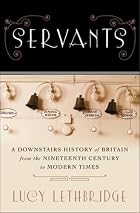
Have finished Servants: A Downstairs History of Britain from the Nineteenth Century to Modern Times by Lucy Lethbridge, which was an info-packed and engrossing social history that got a bit repetitious at times but was very worth reading.
Lethbridge draws on a whole range of biographies and memoirs of servants and those they served to show how the roles and lives of people in service in England changed from the late 19th century through the present day. While the book actually continues almost right up to the now, less space is devoted to the decades after the 1960s, when service in England dramatically changed with the influx of foreign workers and the growth of things like the au pair program. She also weaves in a history of things like cleanliness standards, the rise of the labor movement, domestic architecture, and the invention of labor-saving devices, as changes in these fields affected the lives of servants and were themselves affected by issues the supply and demand for servants.
I particularly enjoyed Lethbridge's discussions of the knotty relationships between the middle class or the new rich and their servants. As not having servants seems to have been a true class demarcation, people scrimped and scraped to afford this help, which often meant that servants in middle and lower-class homes saw their employers as stingy and barely more well-off than they were. Newly middle-class or wealthy people often did not know how to behave with their servants, which lead both sides to trespass and then reinforce social boundaries. The newly rich often could not discern all-important social distinctions and relied on their experienced servants to do the distinguishing for them. As middle class woman began to see leisure time and intellectual enrichment as a right, they often relied on the labor of poorer women to pursue these rights, oblivious to the fact that their servants might desire learning as well. Even class-conscious socialist women writers and activists fell victim to this bias, so entrenched was the feeling that some people were just meant to serve others.
I loved when Lethbridge looked at labor saving technologies or amenities like central heating and discussed the reluctance of Britons, particularly the wealthiest, to adopt these innovations. There were many reasons, including the fear that easing the burden on servants would make them lazy, the British upper class ethic that equated bodily discomfort with virtue (drafts build character), and the feeling that human hard work (as long as it was done by others) built character and was more effective. What this meant in practice was that servants had to keep pace with increasingly rigid standards of cleanliness with increasingly obsolete tools.
Lethbridge discusses the impact of WWI on servants and the served but highlights how in the 1920s and 1930s, many women who had left service or who had never been in service in were forced into the life by economic desperation or the belief that they should give up factory jobs to men returning from the war. This was something I hadn't really been aware of and explains how WWII was the true death knell for service as the dominant occupation in Britain.
Lethbridge also includes a fascinating section on the pre-WWII immigration of Germans and Austrians, mostly Jews, to Britain to fill growing shortages in service positions as a way of escaping the rising threats to them in Continental Europe. She looks at how these often wealthy and educated people found themselves considerably reduced in order to survive, the cultural shocks that a lot of Continentals experienced when confronted with the relative uncleanliness and technological backwardness of British homes, and the suspicion that many found themselves under when war did break out.
A great read, lots more I probably could include. Highly recommended for anyone interested in service, England, social history, or gender history. Anyone who has read Bill Bryson's At Home would probably get a kick out of this.
247baswood
Enjoyed your excellent review of Servants: A Downstairs History of Britain from the Nineteenth Century to Modern Times. I can imagine that some people fascinated by Downton Abbey would enjoy this book.
248FlorenceArt
Yes, great review, thank you! I think I will add this book to my wishlist.
250rebeccanyc
Great review; thanks.
252fannyprice
Oh, I'm so happy - I think you all will enjoy it a lot, based on what I know about your readings.
253dchaikin
Just echoing, great review, fascinating info.
>226 fannyprice: I'm catching up a bit. Very interesting about these four patterns and challenges in What Works for Women at Work. I would think we are beyond #1 by now, overly optimistic as that really is. The the other three are quite complex to resolve - all these crazy balances.
>226 fannyprice: I'm catching up a bit. Very interesting about these four patterns and challenges in What Works for Women at Work. I would think we are beyond #1 by now, overly optimistic as that really is. The the other three are quite complex to resolve - all these crazy balances.
254avidmom
>245 fannyprice: That really does sound very interesting. I learned a lot just by reading your review!
255JDHomrighausen
Enjoyed your review re: servants. Loved this line:
the British upper class ethic that equated bodily discomfort with virtue (drafts build character)
Of course, because the upper class had to experience so much physical discomfort themselves.
the British upper class ethic that equated bodily discomfort with virtue (drafts build character)
Of course, because the upper class had to experience so much physical discomfort themselves.
256fannyprice
In honor of yet another DC snow day (this is starting to feel repetitive...), yet another selection of the most thought-provoking things I'm reading online.
A review of a new Israeli film called "Women/Pioneers" about women living on kibbutzim prior to the founding of the state of Israel.
How the Invention of the Alphabet Usurped Female Power in Society and Sparked the Rise of Patriarchy in Human Culture
"Writing of any kind, but especially its alphabetic form, diminishes feminine values and with them, women’s power in the culture."
I'm gonna have to read this again, but after a first-through, this seems like ridiculous, gender-essentialist garbage. Has anyone read the book The Alphabet Versus the Goddess: The Conflict Between Word and Image?
Andrew Solomon's New Yorker interview with the father of the Sandy Hook shooter Perhaps the thing that I found most sad in this article was learning that Adam Lanza's mother, who he murdered before killing 20 students and 6 teachers at Sandy Hook elementary, is not considered one of his victims.
The failed promise of Ari Shavit’s ‘My Promised Land’ A critique of Shavit's much-lauded, much-discussed book. The book is still on my TBR pile; I have found the content of Shavit's comments in interviews at odds with the laurels placed upon him, so I was interested to read other opinions.
Counterfactual history is misguided and outdated This article encapsulates everything that I am struggling with as I read Archduke Franz Ferdinand Lives!: A World Without World War I and I'm sure that others who have just read the book will appreciate this article as well.
Evans argues that: "'Counterfactuals', as such 'what-if' speculations are generally termed by the aficionados, are often claimed to open up the past by demonstrating the myriad possibilities, thus freeing history from the straitjacket of determinism and restoring agency to the people. But in fact they imprison the past in an even tighter web: one tiny change in the timeline...leads inevitably to a whole series of much larger changes, sometimes stretching over decades almost up to the present day."
And: "If counterfactuals really did restore chance and contingency to history, then we wouldn't actually be able to extrapolate any consequences at all from changes in the timeline..."
A review of a new Israeli film called "Women/Pioneers" about women living on kibbutzim prior to the founding of the state of Israel.
How the Invention of the Alphabet Usurped Female Power in Society and Sparked the Rise of Patriarchy in Human Culture
"Writing of any kind, but especially its alphabetic form, diminishes feminine values and with them, women’s power in the culture."
I'm gonna have to read this again, but after a first-through, this seems like ridiculous, gender-essentialist garbage. Has anyone read the book The Alphabet Versus the Goddess: The Conflict Between Word and Image?
Andrew Solomon's New Yorker interview with the father of the Sandy Hook shooter Perhaps the thing that I found most sad in this article was learning that Adam Lanza's mother, who he murdered before killing 20 students and 6 teachers at Sandy Hook elementary, is not considered one of his victims.
The failed promise of Ari Shavit’s ‘My Promised Land’ A critique of Shavit's much-lauded, much-discussed book. The book is still on my TBR pile; I have found the content of Shavit's comments in interviews at odds with the laurels placed upon him, so I was interested to read other opinions.
Counterfactual history is misguided and outdated This article encapsulates everything that I am struggling with as I read Archduke Franz Ferdinand Lives!: A World Without World War I and I'm sure that others who have just read the book will appreciate this article as well.
Evans argues that: "'Counterfactuals', as such 'what-if' speculations are generally termed by the aficionados, are often claimed to open up the past by demonstrating the myriad possibilities, thus freeing history from the straitjacket of determinism and restoring agency to the people. But in fact they imprison the past in an even tighter web: one tiny change in the timeline...leads inevitably to a whole series of much larger changes, sometimes stretching over decades almost up to the present day."
And: "If counterfactuals really did restore chance and contingency to history, then we wouldn't actually be able to extrapolate any consequences at all from changes in the timeline..."
257stretch
I have falling so for behind, but I can't stop following links you keep posting. Excellent reviews for your reading, I'll catch up someday soon.
258mabith
Thanks for the links! I did especially enjoy the article about counterfactuals.
I could only skim the The Alphabet Versus the Goddess article, because it just sounds like nonsense to me. Especially to say "Well, these societies without writing are less misogynistic," since that's only one difference among many...
I could only skim the The Alphabet Versus the Goddess article, because it just sounds like nonsense to me. Especially to say "Well, these societies without writing are less misogynistic," since that's only one difference among many...
259rebeccanyc
Thanks for all the links. Now I have to remember to come back and click on them when I'm not taking an LT break.
261dchaikin
I did find "How the Invention of the Alphabet Usurped Female Power in Society and Sparked the Rise of Patriarchy in Human Culture" interesting, but I am worried that just finding it interesting may indicate a sexism on my part. Hopefully not.
262fannyprice
>261 dchaikin:, Dan, I'm glad. Honestly, this is why I want to read it again more carefully. On the face of it, this argument seems idiotic to me. But it is written with such (to me) twisty, academic language that I am not sure if I have understood it.
263fannyprice
Turkey Goes Out of Control - Some background on the recent corruption scandal in Turkey and Erdogan's ultimate banning of the Twitter yesterday. I like Christopher de Bellaigue's writing on Iran as well.
264fannyprice
I am now so behind on my reviews. I've got five to report on. I'm going to do the easy ones first.

Megan Abbot's The End of Everything. I loved Dare Me for its darkness and its portrayal of the seedy underbelly of teenage life. This book - about what happens when Lizzie's best friend Evie disappears while walking home from school - touches on many of the same themes but was more disquieting because of the ways in which the two main female characters repeatedly put themselves in danger without really understanding the stakes. Lizzie is the last person to have seen Evie before her disappearance and throughout the book, she remembers things that hint at the truth behind Evie's disappearance and then later, the identity of her abductor. For a long time, it wasn't clear to me whether the reader was meant to believe Lizzie genuinely remembered things or whether she was making things up in part because she enjoyed the attention. There were a lot of uncomfortable, queasy-making relationships in this book, especially involving Evie's father, who all the teenage girls have something of a crush on, which added another delicious layer of ambiguity to the story. Not as good as Dare Me, but still an enjoyable, twisted diversion.

Pardonable Lies, the third Maisie Dobbs mystery, finds our heroine tangled up in multiple investigations involving the fates of men who are presumed to have died during WWI but whose relatives are looking for additional detail to find closure. Maisie also finds herself aiding a young girl forced into prostitution who is accused of murder; also, someone is repeatedly trying to kill Maisie. There's a lot going on in this book, but Winspear pulls it off pretty well, tying seemingly unrelated cases together and forcing Maisie to travel to France to confront her demons from the war (she's a WWI nurse who almost certainly has PTSD) to investigate the cases.
As always, there is an amazing amount of detail about the war and its impact on lives and the changes taking place in England in the interwar years, woven into the book in a way that feels natural, rather than like a data dump. WWII is increasingly foreshadowed through two different techniques that achieve varying levels of success. Maisie reflects on the rebuilding of physical spaces and lives in England and in France and notes how the scars of war are increasingly harder to find, especially in France, where wheat and flowers have covered battlefields and new homes are rebuilt upon the foundations of the old, destroyed buildings. It is impossible, reading these passages, to not think about the impact of WWI on ordinary people and to think of the devastation that many of them will have to live through again in less than 10 years. The second, less successful technique, concerns the conversations that Maisie and her contemporaries have about political developments in Germany and the rise of Adolf Hitler. I felt like these references were just too much, too knowing, although I am sure that they reflect real conversations that happened at the time. All in all though, another success.

Megan Abbot's The End of Everything. I loved Dare Me for its darkness and its portrayal of the seedy underbelly of teenage life. This book - about what happens when Lizzie's best friend Evie disappears while walking home from school - touches on many of the same themes but was more disquieting because of the ways in which the two main female characters repeatedly put themselves in danger without really understanding the stakes. Lizzie is the last person to have seen Evie before her disappearance and throughout the book, she remembers things that hint at the truth behind Evie's disappearance and then later, the identity of her abductor. For a long time, it wasn't clear to me whether the reader was meant to believe Lizzie genuinely remembered things or whether she was making things up in part because she enjoyed the attention. There were a lot of uncomfortable, queasy-making relationships in this book, especially involving Evie's father, who all the teenage girls have something of a crush on, which added another delicious layer of ambiguity to the story. Not as good as Dare Me, but still an enjoyable, twisted diversion.

Pardonable Lies, the third Maisie Dobbs mystery, finds our heroine tangled up in multiple investigations involving the fates of men who are presumed to have died during WWI but whose relatives are looking for additional detail to find closure. Maisie also finds herself aiding a young girl forced into prostitution who is accused of murder; also, someone is repeatedly trying to kill Maisie. There's a lot going on in this book, but Winspear pulls it off pretty well, tying seemingly unrelated cases together and forcing Maisie to travel to France to confront her demons from the war (she's a WWI nurse who almost certainly has PTSD) to investigate the cases.
As always, there is an amazing amount of detail about the war and its impact on lives and the changes taking place in England in the interwar years, woven into the book in a way that feels natural, rather than like a data dump. WWII is increasingly foreshadowed through two different techniques that achieve varying levels of success. Maisie reflects on the rebuilding of physical spaces and lives in England and in France and notes how the scars of war are increasingly harder to find, especially in France, where wheat and flowers have covered battlefields and new homes are rebuilt upon the foundations of the old, destroyed buildings. It is impossible, reading these passages, to not think about the impact of WWI on ordinary people and to think of the devastation that many of them will have to live through again in less than 10 years. The second, less successful technique, concerns the conversations that Maisie and her contemporaries have about political developments in Germany and the rise of Adolf Hitler. I felt like these references were just too much, too knowing, although I am sure that they reflect real conversations that happened at the time. All in all though, another success.
265NanaCC
>264 fannyprice: Kris, I read Pardonable Lies so long ago that I couldn't really remember what it was about. Your review brought it back. I've enjoyed most of the books in that series, and think I only have the latest to read.
266fannyprice
City of Endless Night by Milo Hastings, was a bizarre and eerily prescient dystopia/alternate history written in 1919 by an American midwesterner who wrote primarily about agriculture and nutrition and invented a chicken incubator. He only wrote three works of fiction in his life, most of which were serialized in magazines and do not exist in book form now. City of Endless Night was available as a free ebook and is truly something to behold. It is fascinating both as a work of American anti-German propaganda and for the scary accuracy of its predictions about the rise of fascism in Germany in the post-war period and some of the particular ways in which this fascism would manifest itself. I loved reading this book for these two reasons, despite the fact that it was often cheesy and jingoistic.
Though the shape of the society at hand is only gradually revealed in its fullness over the course of the book, some preliminary description of the world in which City of Endless Night occurs is necessary. This world plays out much like ours until the end of World War I - Germany is defeated and the League of Nations is founded. The League exists and largely preserves peace until 1983, when the second world war begins and Germany conquers nearly all of Eurasia and the Middle East before being gradually beaten back until it is restricted to a "black blot ... no bigger than the Irish Island" on the map - the city of Berlin and its surrounding dead zone. The Germans at the end of the second world war manage to stave off destruction through the discovery of "The Ray" and the construction of a massive enclosed city largely below the surface (as the Ray is only effective to 2000 meters in the air and not even that far on land). Three generations after the end of the war in 2041, Berlin is continually harried by bombers from the United World, but the situation is stalemated.
Into this situation comes an English scientist on a research mission. After discovering that the Germans are attempting to tunnel out of their city and foolishly attempting a one-man mission to stop them, he finds himself stuck alone in a German mine, where he discovers a dead man who (conveniently!) looks exactly like him. The masquerade is further aided by the fact that our Englishman is fluent in German, that all Germans carry elaborate identity papers explaining exactly who they are, and that any oddities in his behavior are assumed to be the result of the gas attack that killed all the other residents of the mine. Thus, this Englishman is taken into Berlin and assumes the life of a German, providing the reader with an entry into this bizarre world.
The Englishman, now going by his German assumed name "Karl Armstadt", quickly discovers that life in the vertical city is highly stratified, with distinct social classes having different rights and privileges according to profession, contributions to society, and bloodlines. The Hohenzollern dynasty still governs German society, but in a bizarre symbiotic relationship with a class of workers who believe that they hold the true power despite being subservient to the royals. Marriage exists, but childbirth is strictly regulated by an elaborate system of eugenics intended to maximize each individual for his or her role in society. Workers are huge, hulking beasts who can barely string together a sentence; intellectuals are pale and weak but significantly more intelligent and creative; and so on. Karl reflects that he is now trapped in "Utopia, a nightmare at the end of man's long dream--Utopia--Black Utopia--City of Endless Night--diabolically compounded of the three elements of civilization in which the Germans had always been supreme--imperialism, science and socialism."
Hastings' descriptions are wonderfully demonstrative of the stereotypes about German culture - obedience is prized above all other virtues, everything is orderly and uniform, militarism suffuses all. Each citizen is immediately identifiable by the clothing appropriate to his or her role in society. Karl early on reflects, "Truly we of the free world very narrowly escaped the fetish of efficiency which finally completely enslaved the Germans."
Throughout the course of the book, Karl advances at a meteoric pace, due to the superiority his outside scientific thought, which is not restricted as scientific thinking is in Berlin. His advancement allows him to see more and more of German society and puts him in contact with a class of dissident intellectuals who secretly work to preserve books and ideas from before the wars. He comes to understand the city and uncovers a liability that could allow the United World to destroy the "black dot" once and for all, if only he can escape the city.
Though the shape of the society at hand is only gradually revealed in its fullness over the course of the book, some preliminary description of the world in which City of Endless Night occurs is necessary. This world plays out much like ours until the end of World War I - Germany is defeated and the League of Nations is founded. The League exists and largely preserves peace until 1983, when the second world war begins and Germany conquers nearly all of Eurasia and the Middle East before being gradually beaten back until it is restricted to a "black blot ... no bigger than the Irish Island" on the map - the city of Berlin and its surrounding dead zone. The Germans at the end of the second world war manage to stave off destruction through the discovery of "The Ray" and the construction of a massive enclosed city largely below the surface (as the Ray is only effective to 2000 meters in the air and not even that far on land). Three generations after the end of the war in 2041, Berlin is continually harried by bombers from the United World, but the situation is stalemated.
Into this situation comes an English scientist on a research mission. After discovering that the Germans are attempting to tunnel out of their city and foolishly attempting a one-man mission to stop them, he finds himself stuck alone in a German mine, where he discovers a dead man who (conveniently!) looks exactly like him. The masquerade is further aided by the fact that our Englishman is fluent in German, that all Germans carry elaborate identity papers explaining exactly who they are, and that any oddities in his behavior are assumed to be the result of the gas attack that killed all the other residents of the mine. Thus, this Englishman is taken into Berlin and assumes the life of a German, providing the reader with an entry into this bizarre world.
The Englishman, now going by his German assumed name "Karl Armstadt", quickly discovers that life in the vertical city is highly stratified, with distinct social classes having different rights and privileges according to profession, contributions to society, and bloodlines. The Hohenzollern dynasty still governs German society, but in a bizarre symbiotic relationship with a class of workers who believe that they hold the true power despite being subservient to the royals. Marriage exists, but childbirth is strictly regulated by an elaborate system of eugenics intended to maximize each individual for his or her role in society. Workers are huge, hulking beasts who can barely string together a sentence; intellectuals are pale and weak but significantly more intelligent and creative; and so on. Karl reflects that he is now trapped in "Utopia, a nightmare at the end of man's long dream--Utopia--Black Utopia--City of Endless Night--diabolically compounded of the three elements of civilization in which the Germans had always been supreme--imperialism, science and socialism."
Hastings' descriptions are wonderfully demonstrative of the stereotypes about German culture - obedience is prized above all other virtues, everything is orderly and uniform, militarism suffuses all. Each citizen is immediately identifiable by the clothing appropriate to his or her role in society. Karl early on reflects, "Truly we of the free world very narrowly escaped the fetish of efficiency which finally completely enslaved the Germans."
Throughout the course of the book, Karl advances at a meteoric pace, due to the superiority his outside scientific thought, which is not restricted as scientific thinking is in Berlin. His advancement allows him to see more and more of German society and puts him in contact with a class of dissident intellectuals who secretly work to preserve books and ideas from before the wars. He comes to understand the city and uncovers a liability that could allow the United World to destroy the "black dot" once and for all, if only he can escape the city.
268NanaCC
>266 fannyprice: City of Endless Night doesn't sound like a book for me, but very interesting that it was written in 1919. Nice review.
269fannyprice
(Go Fanny, Go! You can review them all!)
Playing the Whore: The Work of Sex Work by Melissa Gira Grant is part of a series of books intended to provide "short interrogations on politics, economics, and culture from a socialist perspective". I frankly, like books that make me question my perspective on something that I feel fairly settled on. Even if I don't end up agreeing with the ideas presented, at least I have considered a new point of view and hopefully more deeply examined why I hold the opinions that I do. This book definitely made me rethink some of my ideas about sex work, even if I ultimately wasn't convinced by several of the author's arguments.
It is hard to summarize the content of this book, which contains both practical (i.e., "in any conversation about sex work, sex workers should take the lead in shaping the discussion, since it is about their work and their lives") and academic (i.e., discussions about the terminology that should be used to talk about people who do sex work). The book consists of several chapters with a different focus (police, stigmatization of sex workers, people trying to "save" sex workers, etc.) that all attempt to reshape the way in which we might have conventionally viewed the topic. Thus, the topic on sex workers and the police argues that undercover sting operations, mandatory health testing and sexual exams, and public shaming (such as "caught on tape" shows or internet videos, or forced parades of accused sex workers in China) are part of a "widespread matrix of police misconduct" and demonstrate that we consider certain forms of violence against sex workers acceptable, even while we deplore the violence that they may experience from customers (which Grant argues is far less than they experience from the police).
In other chapters, Grant continues to challenge the view of sex workers by criticizing the way the term "prostitute" turns a behavior - selling sex - into an identity. She argues that the word obfuscates both the myriad of activities included in the sex work industry (stripping, no-sex escort services, naked photography, sex services, etc.) and the very fact that sex work is work like any other job in the service industry that involves negotiation between a client and a service provider, fees for services rendered, and that sex workers are often more able to set the terms of their service than, say, fast food employees or workers in the third world garment industry. Grant argues that viewing a sex worker as a victim who wants to leave the job but is unable to obscures the fact that many woman
(and she does concentrate mostly on cisgender women - women identified at birth as female who identify as female - while acknowledging men and transgender people who do sex work) freely choose sex work because it offers a benefit that another job might not. Grant wonders why we see sex worker complaints about "working conditions" in the industry as evidence of systemic exploitation and desire to leave when we do not view complaints from other parts of the service industry in the same way. Why are low-income Wal-Mart employees who remain in their jobs despite poor working conditions, lack of medical benefits, and significant gender or race-based discrimination not viewed as victims in need to similar saving, Grant might ask.
I confess this is where I started to have significant squirminess with this book. Because Grant is making a very good point. Just because we are most familiar with the Dickensian image of a sex worker as some desperate, downtrodden slag forced onto the streets by poverty and lack of options, doesn't mean that stereotype applies to anyone. Lots of people do work they don't find rewarding, why should selling sex and not "enjoying" it be any different, as long as the individual selling controls the terms of the transaction. And yet.... I squirm. Grant seems to flippant to me. Surely this cannot be right. And yet....why not? Perhaps I have just been too culturally conditioned to view work involving sex as "something different".
My biggest overall problem with this book was that Grant goes so far in problematizing conventional ways of looking at sex work that she sometimes seems to forget to acknowledge the times when this happy fantasy-land doesn't apply. And the fact that this happy fantasy-land cannot by definition exist when kids are involved. Grant brings up human trafficking and the worldwide exploitation of children almost as an afterthought, to criticize activists who work to stop it. When discussing the work of groups in Cambodia that work to free trafficked children, suggests that people like Kristof view "all sex work as a worst case merely for existing" and "cannot accommodate the range of experiences sex workers have..." This is fine and dandy when discussing adults, but to apply this same logic to children just smacks of willful blindness. Grant wants us to acknowledge the diversity of sex work but only if it is acknowledged as largely positive?
It's too bad this book ended on such a horrible note for me, because it did really push me to think deeply about my feelings about sex work. On a separate note, I really hated the cover. I get it - gears = work, sexy lady legs in heels = sex, very clever Mr. Publisher. But haven't we all had enough of dismembered lady parts on things?
I received this advance review copy through Net Galley.
Playing the Whore: The Work of Sex Work by Melissa Gira Grant is part of a series of books intended to provide "short interrogations on politics, economics, and culture from a socialist perspective". I frankly, like books that make me question my perspective on something that I feel fairly settled on. Even if I don't end up agreeing with the ideas presented, at least I have considered a new point of view and hopefully more deeply examined why I hold the opinions that I do. This book definitely made me rethink some of my ideas about sex work, even if I ultimately wasn't convinced by several of the author's arguments.
It is hard to summarize the content of this book, which contains both practical (i.e., "in any conversation about sex work, sex workers should take the lead in shaping the discussion, since it is about their work and their lives") and academic (i.e., discussions about the terminology that should be used to talk about people who do sex work). The book consists of several chapters with a different focus (police, stigmatization of sex workers, people trying to "save" sex workers, etc.) that all attempt to reshape the way in which we might have conventionally viewed the topic. Thus, the topic on sex workers and the police argues that undercover sting operations, mandatory health testing and sexual exams, and public shaming (such as "caught on tape" shows or internet videos, or forced parades of accused sex workers in China) are part of a "widespread matrix of police misconduct" and demonstrate that we consider certain forms of violence against sex workers acceptable, even while we deplore the violence that they may experience from customers (which Grant argues is far less than they experience from the police).
In other chapters, Grant continues to challenge the view of sex workers by criticizing the way the term "prostitute" turns a behavior - selling sex - into an identity. She argues that the word obfuscates both the myriad of activities included in the sex work industry (stripping, no-sex escort services, naked photography, sex services, etc.) and the very fact that sex work is work like any other job in the service industry that involves negotiation between a client and a service provider, fees for services rendered, and that sex workers are often more able to set the terms of their service than, say, fast food employees or workers in the third world garment industry. Grant argues that viewing a sex worker as a victim who wants to leave the job but is unable to obscures the fact that many woman
(and she does concentrate mostly on cisgender women - women identified at birth as female who identify as female - while acknowledging men and transgender people who do sex work) freely choose sex work because it offers a benefit that another job might not. Grant wonders why we see sex worker complaints about "working conditions" in the industry as evidence of systemic exploitation and desire to leave when we do not view complaints from other parts of the service industry in the same way. Why are low-income Wal-Mart employees who remain in their jobs despite poor working conditions, lack of medical benefits, and significant gender or race-based discrimination not viewed as victims in need to similar saving, Grant might ask.
I confess this is where I started to have significant squirminess with this book. Because Grant is making a very good point. Just because we are most familiar with the Dickensian image of a sex worker as some desperate, downtrodden slag forced onto the streets by poverty and lack of options, doesn't mean that stereotype applies to anyone. Lots of people do work they don't find rewarding, why should selling sex and not "enjoying" it be any different, as long as the individual selling controls the terms of the transaction. And yet.... I squirm. Grant seems to flippant to me. Surely this cannot be right. And yet....why not? Perhaps I have just been too culturally conditioned to view work involving sex as "something different".
My biggest overall problem with this book was that Grant goes so far in problematizing conventional ways of looking at sex work that she sometimes seems to forget to acknowledge the times when this happy fantasy-land doesn't apply. And the fact that this happy fantasy-land cannot by definition exist when kids are involved. Grant brings up human trafficking and the worldwide exploitation of children almost as an afterthought, to criticize activists who work to stop it. When discussing the work of groups in Cambodia that work to free trafficked children, suggests that people like Kristof view "all sex work as a worst case merely for existing" and "cannot accommodate the range of experiences sex workers have..." This is fine and dandy when discussing adults, but to apply this same logic to children just smacks of willful blindness. Grant wants us to acknowledge the diversity of sex work but only if it is acknowledged as largely positive?
It's too bad this book ended on such a horrible note for me, because it did really push me to think deeply about my feelings about sex work. On a separate note, I really hated the cover. I get it - gears = work, sexy lady legs in heels = sex, very clever Mr. Publisher. But haven't we all had enough of dismembered lady parts on things?
I received this advance review copy through Net Galley.
270StevenTX
City of Endless Night sounds fascinating. It was already on my tentative SF reading plan, but I've starred it to make sure I don't overlook it.
Playing the Whore sounds like a book with which I would agree simply on the basis that what consenting adults do in private is nobody else's business, but that terrible cover tends to trivialize the issue.
Playing the Whore sounds like a book with which I would agree simply on the basis that what consenting adults do in private is nobody else's business, but that terrible cover tends to trivialize the issue.
271LolaWalser
#270
Consenting adults, including her pimp/madam/slave-trafficking mafia!
#269
I admire your ability to read books that would make my head explode. As it is, the only way I manage is because I have some hydra in my ancestry. ;)
Consenting adults, including her pimp/madam/slave-trafficking mafia!
#269
I admire your ability to read books that would make my head explode. As it is, the only way I manage is because I have some hydra in my ancestry. ;)
272mabith
>269 fannyprice: Yeah I think I'll skip Playing the Whore. The percentage of sex workers, adults included, who are independent agents and who actually have a choice between sex work and something else, is pretty damn small. If you're writing that book you really have to state outright that you're only/maily looking at the very privileged minority.
273fannyprice
>267 dchaikin:, >268 NanaCC:, >270 StevenTX:, City of Endless Night really was something, especially when one considers that it was written a year after the end of the First World War and over 10 years before Brave New World, which treats similar themes of eugenics and assembly-line societies.
>270 StevenTX:, >271 LolaWalser:, >272 mabith:, I've already mentioned that this book forced me out of my comfort zone to confront the possibility that perhaps some people would freely (or as freely as any choice can be) choose to sell sex. As much as my Midwestern American middle-class morality squirms at the idea that sex work is a "normal job", I agree with Grant that women and men who do sex work would be safer if they could do it without fear of abuse from clients, cops, and others. And I think she's probably right that legalizing the kinds of sex work (involving consenting adults only, of course) is the best way to accomplish this.
>270 StevenTX:, Yes, I'm with you that what consenting adults is generally their own business. It was Grant's dogged refusal to acknowledge that sometimes sex workers are neither adult nor consenting that irked me. As someone who has worked in the industry (she mentions this in passing) and has studied it extensively, I find it hard to believe that she has not encountered a single problematic case.
>272 mabith:, Just to play devil's advocate, how do you or I know? I think Grant might define the idea of choice a bit differently than we are using it. How much "choice" do any of us really have? If a person's economic and educational circumstances leave her with the choice between a low-paying retail or food service job and sex work (which encompasses a wide range of activities), Grant might say that such a woman "freely chooses" sex work. Whether she likes it has no bearing on whether she has made a choice or not. (Note that I'm not saying I agree with this argument or am comfortable with it, just that I think it's the one Grant is advancing.)
>270 StevenTX:, >271 LolaWalser:, >272 mabith:, I've already mentioned that this book forced me out of my comfort zone to confront the possibility that perhaps some people would freely (or as freely as any choice can be) choose to sell sex. As much as my Midwestern American middle-class morality squirms at the idea that sex work is a "normal job", I agree with Grant that women and men who do sex work would be safer if they could do it without fear of abuse from clients, cops, and others. And I think she's probably right that legalizing the kinds of sex work (involving consenting adults only, of course) is the best way to accomplish this.
>270 StevenTX:, Yes, I'm with you that what consenting adults is generally their own business. It was Grant's dogged refusal to acknowledge that sometimes sex workers are neither adult nor consenting that irked me. As someone who has worked in the industry (she mentions this in passing) and has studied it extensively, I find it hard to believe that she has not encountered a single problematic case.
>272 mabith:, Just to play devil's advocate, how do you or I know? I think Grant might define the idea of choice a bit differently than we are using it. How much "choice" do any of us really have? If a person's economic and educational circumstances leave her with the choice between a low-paying retail or food service job and sex work (which encompasses a wide range of activities), Grant might say that such a woman "freely chooses" sex work. Whether she likes it has no bearing on whether she has made a choice or not. (Note that I'm not saying I agree with this argument or am comfortable with it, just that I think it's the one Grant is advancing.)
274LolaWalser
As you already noted, the first problem is talking about a broad category such as "sex work" as if every type of activity therein carries the same implications and risks, so the choice of one type is the same as the choice of any other. Surely there are differences between writing dirty stories for a living, modelling, hostessing in "gentlemen's" clubs, pole dancing, stripping, walking the streets, making porn movies, being a kept sexual partner etc., differences that might affect their desirability to someone embarking on one or the other (or indeed more than one) as a "career".
As to one category of sex work, presumably the oldest, largest and virtually inextinguishable--prostitution--here's one recent article from the FBI:
Prostitution and Human Trafficking: A Paradigm Shift
And that's in California. Of course, it's possible that all the "happy hookers" are congregating in Moldova or Azerbaijan...
As to one category of sex work, presumably the oldest, largest and virtually inextinguishable--prostitution--here's one recent article from the FBI:
Prostitution and Human Trafficking: A Paradigm Shift
In over 100 arrests, most of the women expressed that prostitution was not their career of choice. In a 1998 study, 88 percent of the prostituted women surveyed stated that they wanted to leave the sex trade industry.1 The majority of prostitutes interviewed by APD vice investigators believed that selling themselves was their only alternative for survival.
And that's in California. Of course, it's possible that all the "happy hookers" are congregating in Moldova or Azerbaijan...
275Polaris-
>256 fannyprice: I've just caught up with you again... Interesting review of the film "Women/Pioneers", directed by Michal Aviad. Small yet strange coincidence that I only just finished reading Amos Kenan's The Road to Ein Harod, a dystopian vision of what became of some of those 'women/pioneers' and an Israel that their children created. Perhaps... (I've not seen that Jadaliyya website before.)
I too have My Promised Land by Ari Shavit on my wishlist so was interested in your link to "The failed promise of Ari Shavit’s ‘My Promised Land’". I don't think it's a particularly well-crafted article, but the author does make some valid points on Shavit re-treading ground that the likes of the historian Benny Morris have already gone over. Nevertheless, there is a process underway within Israeli society - and it takes a long time. Shavit's book should be welcomed as another voice to the slowly growing chorus among journalists and academics alike.
Great reviews all around, and I'm following the discussions here with great interest. (PS: Concurring on the disapproval of the Playing the Whore cover - not good!)
I too have My Promised Land by Ari Shavit on my wishlist so was interested in your link to "The failed promise of Ari Shavit’s ‘My Promised Land’". I don't think it's a particularly well-crafted article, but the author does make some valid points on Shavit re-treading ground that the likes of the historian Benny Morris have already gone over. Nevertheless, there is a process underway within Israeli society - and it takes a long time. Shavit's book should be welcomed as another voice to the slowly growing chorus among journalists and academics alike.
Great reviews all around, and I'm following the discussions here with great interest. (PS: Concurring on the disapproval of the Playing the Whore cover - not good!)
276fannyprice
And finally we come to the clunkiest clunker that ever clunked. Archduke Franz Ferdinand Lives!: A World without World War I, which I won as an Early Reviewers book. Had I not been reading this for the ER program, I would have chucked it out the window in a rage pretty quickly after beginning it.
Let me begin by saying that I think this could have been a very nice piece of longer short non-fiction that drew out some of the broad themes that Lebow highlights in this book. It would have been thought-provoking and allowed him to avoid the fundamental tension between what he says he's going to do in this book (show that history is contingent and nothing is inevitable) and what he ends up doing (I can't think of a pithy way to summarize it in a parenthetical). What he ends up doing, in short, is arguing that Archduke Franz Ferdinand was the most important person in the world and his non-death in 1914 would have not only prevented war then but forestalled it for decades to come because literally everything in the entire world changes if Franz Ferdinand is around to save Europe. Oh, and writing two extremely detailed novellas about history, politics, culture, and the lives of every famous person in both the 'best world without WWI' and the 'worst world without WWI.'
By making his scenarios in which WWI is avoided both start with Franz Ferdinand's non-death and then showing how the mere fact of the Archduke's existence neutralizes militarism in Germany and Austria for generations to come, Lebow transforms the assassination from the spark that caused existing tensions to flare into a war into a necessity for there to have ever been war. Instead of demonstrating that history is contingent and depends on both the interplay between larger forces and individual decisionmaking, he equates one individual with Europe's (and the world's) destiny. He explicitly says in his concluding chapter: "Simple changes in personnel - most notably the survival of Franz Ferdinand - appear sufficient to have prevented war in August 1914 and to have moved the world further away from war in the years that followed."
The second issue with this book is that Lebow isn't just content with talking about how broad categories of things would change in his new world, but wants to get really nitty gritty. This is sad, because I enjoyed many of his larger insights. For instance, WWI was a significant social leveler in England and Continental Europe that "greatly accelerated the expectation of equal treatment by those who had formerly been characterized as the lower orders." In a world without WWI, Lebow asserts that movements for greater rights among all kinds of disenfranchised people would have proceeded at a slower pace. I can buy this. I can buy that in a world where Europe is not devastated by two wars (because for Lebow, while WWI was not inevitable, apparently we can't escape WWII if WWI happens), the United States does not benefit from European exiles scientific and cultural contributions and never becomes a global hegemon.
What I can't buy and frankly don't see the point of, are the extended detours into how the lives of people from our timeline would have looked in the no-war timeline. Lebow gives us extended detours into the Presidency of Joseph P. Kennedy Jr., who - having not died in WWII in this timeline - becomes America's first Catholic President (how he does this several years earlier than his brother did in the real timeline, despite the existence of even more pronounced anti-Catholic feeling in Lebow's alternative timeline is a contradiction Lebow does not bother to address). Don't worry, John F. Kennedy still gets Jackie O. and is still a philanderer - we learn all about his sex scandals with a mobster's girlfriend.
We learn that Hitler becomes a peddler of quack medical treatments, Lenin a beloved but dogmatic college professor, Nixon the pastor of a Protestant mega-church (who still gets his Watergate - for f&cks sake!), and so on. Corresponding sets are included for all of the same individuals under the 'worst world without WWI' scenario. While it might be entertaining to speculate over drinks how famous people's lives might have looked in the absence of such-and-such event, I had no idea what I was supposed to glean from these extensive rewritten biographies.
What most irked me, however, were the second and third-order changes that Lebow made to the rest of the world (i.e. not Europe, the United States, or Russia) in his scenarios. These changes were often presented with minimal explanation and a general obliviousness to the real world history of these regions.
I'll focus on the Middle East because that is what I know the most about. In Lebow's best case scenario, the Middle East is just great. The Ottoman Empire staves off death thanks to the modernizing reforms of Kemal Attaturk, who comes to power despite the non-existence of most of the significant events that shaped him and his country. Is Lebow trying to suggest that some people are simply so great that they will rise to the top regardless of their environment? Well, that sure seems to fly in the face of his thesis about how historical systems are contingent and nonlinear.
Oh, and somehow the Arab Middle East "avoids kleptocratic dictators," and develops "along the lines of pre-1967 Lebanon" (which arguably couldn't have existed in such a form had it not been partitioned off into a separate country, but whatever, we're just having fun here!). It's not that I can't see how the Middle East in the absence of WWI could have gone down another path, but Lebow barely bothers to construct an argument for many of the ROW (rest of world) countries in his alternate worlds, which just seems lazy to me, especially given that we get the full treatment of Hawaii Governor Barack Obama's tenure some 90+ years after WWI.
In summary, this book was silly and sloppy. It made me angry because it didn't do what it claimed to do at all. It contradicted itself at many turns, both in overall philosophy about history and in the details of the alternate worlds that Lebow painstakingly constructed. It is a shame that Lebow did not write a shorter book that emphasized the thematic material from this book - I think that would have been a stronger piece of historical writing.
In closing, I repost my link to Richard Evans' article:
Counterfactual history is misguided and outdated, which encapsulates everything that I disliked about this book. He has a book out about the use, misuse, and weakness of counterfactuals that I will definitely be picking up.
P.S. I love the cover.
Let me begin by saying that I think this could have been a very nice piece of longer short non-fiction that drew out some of the broad themes that Lebow highlights in this book. It would have been thought-provoking and allowed him to avoid the fundamental tension between what he says he's going to do in this book (show that history is contingent and nothing is inevitable) and what he ends up doing (I can't think of a pithy way to summarize it in a parenthetical). What he ends up doing, in short, is arguing that Archduke Franz Ferdinand was the most important person in the world and his non-death in 1914 would have not only prevented war then but forestalled it for decades to come because literally everything in the entire world changes if Franz Ferdinand is around to save Europe. Oh, and writing two extremely detailed novellas about history, politics, culture, and the lives of every famous person in both the 'best world without WWI' and the 'worst world without WWI.'
By making his scenarios in which WWI is avoided both start with Franz Ferdinand's non-death and then showing how the mere fact of the Archduke's existence neutralizes militarism in Germany and Austria for generations to come, Lebow transforms the assassination from the spark that caused existing tensions to flare into a war into a necessity for there to have ever been war. Instead of demonstrating that history is contingent and depends on both the interplay between larger forces and individual decisionmaking, he equates one individual with Europe's (and the world's) destiny. He explicitly says in his concluding chapter: "Simple changes in personnel - most notably the survival of Franz Ferdinand - appear sufficient to have prevented war in August 1914 and to have moved the world further away from war in the years that followed."
The second issue with this book is that Lebow isn't just content with talking about how broad categories of things would change in his new world, but wants to get really nitty gritty. This is sad, because I enjoyed many of his larger insights. For instance, WWI was a significant social leveler in England and Continental Europe that "greatly accelerated the expectation of equal treatment by those who had formerly been characterized as the lower orders." In a world without WWI, Lebow asserts that movements for greater rights among all kinds of disenfranchised people would have proceeded at a slower pace. I can buy this. I can buy that in a world where Europe is not devastated by two wars (because for Lebow, while WWI was not inevitable, apparently we can't escape WWII if WWI happens), the United States does not benefit from European exiles scientific and cultural contributions and never becomes a global hegemon.
What I can't buy and frankly don't see the point of, are the extended detours into how the lives of people from our timeline would have looked in the no-war timeline. Lebow gives us extended detours into the Presidency of Joseph P. Kennedy Jr., who - having not died in WWII in this timeline - becomes America's first Catholic President (how he does this several years earlier than his brother did in the real timeline, despite the existence of even more pronounced anti-Catholic feeling in Lebow's alternative timeline is a contradiction Lebow does not bother to address). Don't worry, John F. Kennedy still gets Jackie O. and is still a philanderer - we learn all about his sex scandals with a mobster's girlfriend.
We learn that Hitler becomes a peddler of quack medical treatments, Lenin a beloved but dogmatic college professor, Nixon the pastor of a Protestant mega-church (who still gets his Watergate - for f&cks sake!), and so on. Corresponding sets are included for all of the same individuals under the 'worst world without WWI' scenario. While it might be entertaining to speculate over drinks how famous people's lives might have looked in the absence of such-and-such event, I had no idea what I was supposed to glean from these extensive rewritten biographies.
What most irked me, however, were the second and third-order changes that Lebow made to the rest of the world (i.e. not Europe, the United States, or Russia) in his scenarios. These changes were often presented with minimal explanation and a general obliviousness to the real world history of these regions.
I'll focus on the Middle East because that is what I know the most about. In Lebow's best case scenario, the Middle East is just great. The Ottoman Empire staves off death thanks to the modernizing reforms of Kemal Attaturk, who comes to power despite the non-existence of most of the significant events that shaped him and his country. Is Lebow trying to suggest that some people are simply so great that they will rise to the top regardless of their environment? Well, that sure seems to fly in the face of his thesis about how historical systems are contingent and nonlinear.
Oh, and somehow the Arab Middle East "avoids kleptocratic dictators," and develops "along the lines of pre-1967 Lebanon" (which arguably couldn't have existed in such a form had it not been partitioned off into a separate country, but whatever, we're just having fun here!). It's not that I can't see how the Middle East in the absence of WWI could have gone down another path, but Lebow barely bothers to construct an argument for many of the ROW (rest of world) countries in his alternate worlds, which just seems lazy to me, especially given that we get the full treatment of Hawaii Governor Barack Obama's tenure some 90+ years after WWI.
In summary, this book was silly and sloppy. It made me angry because it didn't do what it claimed to do at all. It contradicted itself at many turns, both in overall philosophy about history and in the details of the alternate worlds that Lebow painstakingly constructed. It is a shame that Lebow did not write a shorter book that emphasized the thematic material from this book - I think that would have been a stronger piece of historical writing.
In closing, I repost my link to Richard Evans' article:
Counterfactual history is misguided and outdated, which encapsulates everything that I disliked about this book. He has a book out about the use, misuse, and weakness of counterfactuals that I will definitely be picking up.
P.S. I love the cover.
277StevenTX
That's a wonderful review of Archduke Franz Ferdinand Lives!. Playing "what if" with history can be fun, but it teaches you very little because the number of variables is beyond reckoning. I used to lead a monthly discussion group at a Civil War round table group, and the members were always bringing up these "what if" scenarios. I would try to frustrate them by constructing a scenario exactly the opposite of what they wanted to hear. I've enjoyed alternate history and parallel universe stories in science fiction, but I agree with the article you linked that it is a misguided way to study history. It places far too much emphasis on a single event or person.
278mabith
So glad I wasn't alone on Archduke Franz Ferdinand Lives. You're right, the cover was great and that was it. I hold to my thought that this author really wanted to write a fictional book about with the world he describes and somehow sold the outline as non-fiction.
279JDHomrighausen
Kris, thanks for your thoughts re: sex work. I largely agree with you. I'm also thinking of the recent debate about the freshman student at Duke who went into porn to pay her college bills. She claimed to greatly enjoy her work as well and feel respected in it. A similar debate happens there, with the Duke freshman at one extreme and Lovelace at the other.
I always wonder what the life outlook is for a prostitute. I would assume that after a certain age the johns might not find you so interesting any more. When a prostitute is no longer physical attractive enough to find work, then what does she do? It's not like she's a ballet dancer who has to retire by thirty but can make a living teaching dance for the next 30-40 years. I would think the lack of opportunities or skills in sex work would be another strike against the "this is something people do for a living out of free choice" argument. When one looks at the facts, it just isn't something an intelligent person with options would pick as a career.
I always wonder what the life outlook is for a prostitute. I would assume that after a certain age the johns might not find you so interesting any more. When a prostitute is no longer physical attractive enough to find work, then what does she do? It's not like she's a ballet dancer who has to retire by thirty but can make a living teaching dance for the next 30-40 years. I would think the lack of opportunities or skills in sex work would be another strike against the "this is something people do for a living out of free choice" argument. When one looks at the facts, it just isn't something an intelligent person with options would pick as a career.
280mabith
>273 fannyprice: Forgot which thread this was! I've got nothing against sex work, I think it's important and necessary (especially in cultures where puritanism and bad sex ed. classes lead to unhealthy attitudes) and needs to be regulated to be made safer. The trouble is that we who feel like that often overlook the severely unhealthy majority of sex work and people who have no choice (by which I mean they're trafficked or cannot get any other work or are quickly taken control of by a pimp, etc...), and act like legalization is the most important thing right now. The people who can be professional call girls or stay at home and be phone sex operators or cam girls, it all takes a relative amount of privilege.
281baswood
Greatly enjoyed your reviews of City of Endless night and Playing the whore
282wandering_star
Hi Fanny, really interesting to read your thoughts and responses to Playing The Whore. I agree with where you have come out, but also with some of the challenging aspects of Grant's argument (eg exploitation in the low-wage sector). Are you planning to read any of the other 'short interrogations' in the series?
Similarly, but on a less serious note, I really enjoyed your review of Archduke Franz Ferdinand Lives! (question: how many good books are there with exclamation marks in the title?)
Similarly, but on a less serious note, I really enjoyed your review of Archduke Franz Ferdinand Lives! (question: how many good books are there with exclamation marks in the title?)
283Polaris-
>282 wandering_star: Interesting question!
284Polaris-
Meant to say also Fanny, that I've thumbed your review of Archduke Franz Ferdinand Lives!. It sounds like it was a questionable notion for long-form non-fiction, and executed pretty poorly.
By the way - did the author mix up "pre-1967 Lebanon" with 1976 Lebanon (when the country was occupied by Syria), or possibly pre- or post-1967 Israel? What was the big fulcrum event in Lebanon in '67 (other than misguidedly joining battle in the Six Day War of that year)?
By the way - did the author mix up "pre-1967 Lebanon" with 1976 Lebanon (when the country was occupied by Syria), or possibly pre- or post-1967 Israel? What was the big fulcrum event in Lebanon in '67 (other than misguidedly joining battle in the Six Day War of that year)?
285valkyrdeath
>282 wandering_star: The one that springs instantly to mind for me is Guards! Guards!. And that's the only one that springs to mind right now.
286fannyprice
>278 mabith:, Meredith It really did seem like he would have been happier writing fiction.
>279 JDHomrighausen:, Jonathan Interesting point. Grant doesn't really talk about sex work as a lifetime career, though she does deplore the fact that it is technically illegal for sex workers to share tips and information about safety, etc. because that amounts to "conspiracy to commit prostitution", which is actually treated as a more serious crime than selling sex is. Obviously this is stupid and increases the danger that people working in this field face. It's like banning unionization or something.
>280 mabith:, Meredith, are there other conversations going on about sex work that I should know about?! Its so funny, I never thought I would be arguing many of the points I'm arguing!
>281 baswood:, Thanks, Barry.
>282 wandering_star:, wandering_star Thanks for your comments. I'm not sure if I'll read more books in the series. Honestly, the main reason I read this one was because it was free and there was no loss if I didn't enjoy it. I don't know that I'm in the mood for more books about the same topic any time soon. In answer to your question about the punctuation, I think the answer might be "none." It's like how anything that has the word "fancy" in its name is by default not.
>284 Polaris-:, Paul, hah, good catch. I totally glossed over the fact that he doesn't explain that date, but it is in fact the date printed in the book. Maybe I read 1976 as well? Nothing came to mind for me immediately, so I hit the stacks. The only thing that I could come up with is that there was another influx of Palestinian refugees after the 1967 war with Israel, the Arabs were demoralized, and Lebanon started getting bombed by Israel a lot more after 1968 because of the Palestinian militias operating out of its territory.
He might be alluding to the book The Breakdown of the State in Lebanon, 1967-1976, which argues that the Lebanese state was weakened by forces unleashed against it in the aftermath of the 1967 war and eventually collapsed in 1975/6. I think its a bit silly to use this date, however, since there was no immediate galvanizing Lebanon event that year and since many of the forces were present in Lebanon prior to the 1967 war. From what I can tell from commentary and reviews on the book (which is available on Amazon for $999 new/$128 used!), the argument presented seems very much in the school of "blame the Palestinians for everything bad the Lebanese ever did to each other." One could argue that the premise of Lebanon was fatally flawed from the very beginning and that prewar Lebanon looks like a good model for other countries in the region only from a very narrow perspective.
>279 JDHomrighausen:, Jonathan Interesting point. Grant doesn't really talk about sex work as a lifetime career, though she does deplore the fact that it is technically illegal for sex workers to share tips and information about safety, etc. because that amounts to "conspiracy to commit prostitution", which is actually treated as a more serious crime than selling sex is. Obviously this is stupid and increases the danger that people working in this field face. It's like banning unionization or something.
>280 mabith:, Meredith, are there other conversations going on about sex work that I should know about?! Its so funny, I never thought I would be arguing many of the points I'm arguing!
>281 baswood:, Thanks, Barry.
>282 wandering_star:, wandering_star Thanks for your comments. I'm not sure if I'll read more books in the series. Honestly, the main reason I read this one was because it was free and there was no loss if I didn't enjoy it. I don't know that I'm in the mood for more books about the same topic any time soon. In answer to your question about the punctuation, I think the answer might be "none." It's like how anything that has the word "fancy" in its name is by default not.
>284 Polaris-:, Paul, hah, good catch. I totally glossed over the fact that he doesn't explain that date, but it is in fact the date printed in the book. Maybe I read 1976 as well? Nothing came to mind for me immediately, so I hit the stacks. The only thing that I could come up with is that there was another influx of Palestinian refugees after the 1967 war with Israel, the Arabs were demoralized, and Lebanon started getting bombed by Israel a lot more after 1968 because of the Palestinian militias operating out of its territory.
He might be alluding to the book The Breakdown of the State in Lebanon, 1967-1976, which argues that the Lebanese state was weakened by forces unleashed against it in the aftermath of the 1967 war and eventually collapsed in 1975/6. I think its a bit silly to use this date, however, since there was no immediate galvanizing Lebanon event that year and since many of the forces were present in Lebanon prior to the 1967 war. From what I can tell from commentary and reviews on the book (which is available on Amazon for $999 new/$128 used!), the argument presented seems very much in the school of "blame the Palestinians for everything bad the Lebanese ever did to each other." One could argue that the premise of Lebanon was fatally flawed from the very beginning and that prewar Lebanon looks like a good model for other countries in the region only from a very narrow perspective.
287fannyprice
So I snuck in one more book this quarter. Messenger of Truth: A Maisie Dobbs Novel (Maisie Dobbs Mysteries) - the fourth Maisie Dobbs book. I hadn't been planning to read another one of these so soon after the third one, but it came available to me through the e-library and I was sick and crabby from switching some medicines around, so I read it while hiding at home in bed.

The fourth book in the series finds our heroine investigating the death of a famous young artist. His death is ruled an accident, but his twin sister (an aristocratic young war reporter) just doesn't believe it. The police push her off on Maisie, who ultimately finds herself (as always!) tangled up in something far messier than she first thought. There are a lot of endings and beginnings in this book, which focuses somewhat more on Maisie's emotional life and how she is moving on from her past as she becomes more independent and successful. The case and the people she encounters force Maisie to think about what kind of person she is and whether she wants to be that person. Once again, lovely social detail about the war and aftermath, this time zeroing in on wartime propaganda, post-war political attitudes (eventual leader of the British Union of Fascists Oswald Mosley makes an appearance!), and the deprivations faced by the unemployed and working class. I often find that I tire of a series because each book has a certain sameness, but with this series, each book varies the formula just enough to be comforting without getting old.
And with that, I think I'm moving on to a new thread. I would love to have a whole year in one, but it's getting hard to load, especially on my phone.

The fourth book in the series finds our heroine investigating the death of a famous young artist. His death is ruled an accident, but his twin sister (an aristocratic young war reporter) just doesn't believe it. The police push her off on Maisie, who ultimately finds herself (as always!) tangled up in something far messier than she first thought. There are a lot of endings and beginnings in this book, which focuses somewhat more on Maisie's emotional life and how she is moving on from her past as she becomes more independent and successful. The case and the people she encounters force Maisie to think about what kind of person she is and whether she wants to be that person. Once again, lovely social detail about the war and aftermath, this time zeroing in on wartime propaganda, post-war political attitudes (eventual leader of the British Union of Fascists Oswald Mosley makes an appearance!), and the deprivations faced by the unemployed and working class. I often find that I tire of a series because each book has a certain sameness, but with this series, each book varies the formula just enough to be comforting without getting old.
And with that, I think I'm moving on to a new thread. I would love to have a whole year in one, but it's getting hard to load, especially on my phone.
288rebeccanyc
I know you have a new thread, but I just wanted to note here that I enjoyed catching up with your reviews and the conversation about sex work.
This topic was continued by fannyprice reads in 2014, part two.

