K's Reading and Stuff 2014
This topic was continued by K's Reading and Stuff 2015.
Talk The Green Dragon
Join LibraryThing to post.
This topic is currently marked as "dormant"—the last message is more than 90 days old. You can revive it by posting a reply.
1kceccato
Issue of the Day: Attack of the Kindle Cheapies
There once lived a quaint and old-fashioned woman who thought she had no interest in owning a Kindle. Yet in time, seeing these devices on other hands, she began to wonder what it would be like to hold one, and whether the stroke of a finger across a tablet screen could be as satisfying as turning an actual page. At last her curiosity got the best of her, and she acquired a Kindle. After all, any means or mechanisms for reading must have some merit...
First, I need to establish what I mean by "cheapie": any book I can acquire on Kindle for less than $6.00. I keep a very long Wish List on Amazon.com, not so much to let my friends and family know what I'd like for Christmas and my birthday as to keep track of titles I've glimpsed here or on Goodreads that I find interesting -- everything from used copies of books that have gone out of print (though not so far out of print that a used copy costs somewhere in the neighborhood of $100) to my Kindle cheapies, many of which are "indie published" or self-published. If a book has a storyline or a character that intrigues me, for whatever reason, I don't mind paying between $3.00 and $6.00 to have it delivered to my Kindle, particularly if my friends and family have given me Amazon.com gift cards for Christmas (yes, they did!). It's a fairly painless way to take chances, and "indie published" and self-published do not have to equal "bad."
I'm easy to please. Most of the books I read from start to finish, I end up liking, at least a little bit. They end up earning three stars or more. I'm used to enjoying the books I read. I don't need a book to be a stylistic masterpiece, as long as it delivers a good story with characters whose company I enjoy. I've even taken some pleasure in stories I know darn well would be judged "bad" by readers with more exacting standards. Sometimes I feel a little nervous when I learn that friends of mine are reading certain books specifically because I gave them positive reviews. Hey, guys, I'm an easy sell! My liking it is no guarantee that you will! And if you don't, please, please don't hold it against me.
But how bad is too bad? What will induce me to lay a book aside that I've paid good money for, even if it is around $3.00 in gift card money?
In my last thread, when the question of whether Christopher Paolini's Eragon series might actually be worth reading came up, one of my friends said, "It depends on how much crap you're willing to wade through for the sake of dragons." Well, I love dragons, particularly heroic female dragons, and at the moment I'm trying to get my own "dragon story" off the ground, as it were, and it turns out the answer is, "Quite a lot." One of the Kindle cheapies I read last year was Lyle's The Dragon Within. As I read it I kept finding flaws right and left, from plentiful editing mistakes to shallow characterizations (honestly, would any villain define HIMSELF as evil? Villains don't think of themselves like that!). Yet I kept reading, fascinated by its female Other protagonist and the dragon culture Lyle painted. This is not one I would recommend to others; it turned out to be the very definition of "guilty pleasure" for me.
Yet recently I found there is indeed a limit to how much crap I'll wade through to enjoy the company of a dragon heroine. I attempted to read Deadly Intentions, the second volume in David Temrick's "Blood Feud" series. I actually did come very close to finishing it; I reached 70%. The plotline, which dealt with a human prince with dragon blood and his allies (dragon, dwarf, and elf -- yes, all the Tolkien touchstones were there) fighting off enemies who are determined to exterminate not only all dragons but all those with dragon blood, was rather intriguing. But at last I shook my head and decided I wanted something else. What was wrong with it? Let's see:
1. VERY poor editing; grammar and mechanics errors in almost every sentence. In some places it got so bad that I found myself wincing as if I'd gotten a paper cut every time I finished a paragraph. But I could have endure this, were it not for the second, and, for me, more serious flaw,
2. Very irksome characterizations of women, especially a "romantic heroine" who seems to have stepped straight out Coventry Patmore's "The Angel in the House." Had I met this woman in a nineteenth century novel, I would have endured her, if not accepted her, as a creation of her time. But in a twenty-first century fantasy novel, I found her intolerable. She exists, quite literally, to adore the hero and to be rescued by him. She has no other function (though her stated function is to be nursemaid for the hero's baby nephew -- which makes matters absolutely no better). For the first half of the book, it seemed as if only Evil human women did any fighting or aspired to any power, and this drippy baby-minder was intended to represent the Feminine Ideal. Yet in the second half, two human women on the side of Good actually did go into battle: the hero's sister, and his rejected ex-girlfriend. Yet still, the one woman who wins the hero's love (or any form of romantic love, for that matter) is that damsel more distressed, and more distressing, than Bella Swan. If you're a woman, evidently, you can have strength/power or you can have love. You can't have both.
"Gentlemen Prefer Damsels" is another trope I mean to take issue with in more detail, at another time.
So the book has been banished to the Cloud, uncompleted. But I have to say I'm not entirely sorry I read what I read of it. Bad books do have some value. We can appreciate good books all the more when we have bad ones to compare them to. Plus, since I'm a writer, bad books can show me the pitfalls I need to avoid.
I've moved on to Lokant, the sequel to Draykon. Even at less than 20%, I feel a strong sense of relief at the clear difference in style and mechanics between this and Deadly Intentions.
***
Obligatory Kushiel's Dart progress report:
I have now seen Ysandre de la Courcel emerge as a strong, powerful figure, Light in contrast with the venomous Melisande's Dark. Another character in whom to take an interest, and a possible genuine female friend for Phedre, increases my appreciation. (I'm also glad to see Thelesis de Mornay show herself to be a true friend.) Phedre continues to grow beyond her original role, which is pleasing to see. I'm interested to learn how she'll fare as an ambassador; considering how well she thinks on her feet, I don't doubt she will succeed, but since this is a harsh yet beautiful world, I'm sure it won't be easy.
There once lived a quaint and old-fashioned woman who thought she had no interest in owning a Kindle. Yet in time, seeing these devices on other hands, she began to wonder what it would be like to hold one, and whether the stroke of a finger across a tablet screen could be as satisfying as turning an actual page. At last her curiosity got the best of her, and she acquired a Kindle. After all, any means or mechanisms for reading must have some merit...
First, I need to establish what I mean by "cheapie": any book I can acquire on Kindle for less than $6.00. I keep a very long Wish List on Amazon.com, not so much to let my friends and family know what I'd like for Christmas and my birthday as to keep track of titles I've glimpsed here or on Goodreads that I find interesting -- everything from used copies of books that have gone out of print (though not so far out of print that a used copy costs somewhere in the neighborhood of $100) to my Kindle cheapies, many of which are "indie published" or self-published. If a book has a storyline or a character that intrigues me, for whatever reason, I don't mind paying between $3.00 and $6.00 to have it delivered to my Kindle, particularly if my friends and family have given me Amazon.com gift cards for Christmas (yes, they did!). It's a fairly painless way to take chances, and "indie published" and self-published do not have to equal "bad."
I'm easy to please. Most of the books I read from start to finish, I end up liking, at least a little bit. They end up earning three stars or more. I'm used to enjoying the books I read. I don't need a book to be a stylistic masterpiece, as long as it delivers a good story with characters whose company I enjoy. I've even taken some pleasure in stories I know darn well would be judged "bad" by readers with more exacting standards. Sometimes I feel a little nervous when I learn that friends of mine are reading certain books specifically because I gave them positive reviews. Hey, guys, I'm an easy sell! My liking it is no guarantee that you will! And if you don't, please, please don't hold it against me.
But how bad is too bad? What will induce me to lay a book aside that I've paid good money for, even if it is around $3.00 in gift card money?
In my last thread, when the question of whether Christopher Paolini's Eragon series might actually be worth reading came up, one of my friends said, "It depends on how much crap you're willing to wade through for the sake of dragons." Well, I love dragons, particularly heroic female dragons, and at the moment I'm trying to get my own "dragon story" off the ground, as it were, and it turns out the answer is, "Quite a lot." One of the Kindle cheapies I read last year was Lyle's The Dragon Within. As I read it I kept finding flaws right and left, from plentiful editing mistakes to shallow characterizations (honestly, would any villain define HIMSELF as evil? Villains don't think of themselves like that!). Yet I kept reading, fascinated by its female Other protagonist and the dragon culture Lyle painted. This is not one I would recommend to others; it turned out to be the very definition of "guilty pleasure" for me.
Yet recently I found there is indeed a limit to how much crap I'll wade through to enjoy the company of a dragon heroine. I attempted to read Deadly Intentions, the second volume in David Temrick's "Blood Feud" series. I actually did come very close to finishing it; I reached 70%. The plotline, which dealt with a human prince with dragon blood and his allies (dragon, dwarf, and elf -- yes, all the Tolkien touchstones were there) fighting off enemies who are determined to exterminate not only all dragons but all those with dragon blood, was rather intriguing. But at last I shook my head and decided I wanted something else. What was wrong with it? Let's see:
1. VERY poor editing; grammar and mechanics errors in almost every sentence. In some places it got so bad that I found myself wincing as if I'd gotten a paper cut every time I finished a paragraph. But I could have endure this, were it not for the second, and, for me, more serious flaw,
2. Very irksome characterizations of women, especially a "romantic heroine" who seems to have stepped straight out Coventry Patmore's "The Angel in the House." Had I met this woman in a nineteenth century novel, I would have endured her, if not accepted her, as a creation of her time. But in a twenty-first century fantasy novel, I found her intolerable. She exists, quite literally, to adore the hero and to be rescued by him. She has no other function (though her stated function is to be nursemaid for the hero's baby nephew -- which makes matters absolutely no better). For the first half of the book, it seemed as if only Evil human women did any fighting or aspired to any power, and this drippy baby-minder was intended to represent the Feminine Ideal. Yet in the second half, two human women on the side of Good actually did go into battle: the hero's sister, and his rejected ex-girlfriend. Yet still, the one woman who wins the hero's love (or any form of romantic love, for that matter) is that damsel more distressed, and more distressing, than Bella Swan. If you're a woman, evidently, you can have strength/power or you can have love. You can't have both.
"Gentlemen Prefer Damsels" is another trope I mean to take issue with in more detail, at another time.
So the book has been banished to the Cloud, uncompleted. But I have to say I'm not entirely sorry I read what I read of it. Bad books do have some value. We can appreciate good books all the more when we have bad ones to compare them to. Plus, since I'm a writer, bad books can show me the pitfalls I need to avoid.
I've moved on to Lokant, the sequel to Draykon. Even at less than 20%, I feel a strong sense of relief at the clear difference in style and mechanics between this and Deadly Intentions.
***
Obligatory Kushiel's Dart progress report:
I have now seen Ysandre de la Courcel emerge as a strong, powerful figure, Light in contrast with the venomous Melisande's Dark. Another character in whom to take an interest, and a possible genuine female friend for Phedre, increases my appreciation. (I'm also glad to see Thelesis de Mornay show herself to be a true friend.) Phedre continues to grow beyond her original role, which is pleasing to see. I'm interested to learn how she'll fare as an ambassador; considering how well she thinks on her feet, I don't doubt she will succeed, but since this is a harsh yet beautiful world, I'm sure it won't be easy.
2Sakerfalcon
I have only just entered the wonderful (?) world of the kindle and have barely scratched the surface of all that is available free or at low prices for it. I'm very aware of the size of my physical tbr pile, and am trying not to create a similarly sized virtual one. I did get Draykon because of your recommendation, and I appreciate your willingness to wade through these books and report back on them.
Looking forward to following your reading and discussions in the year ahead.
Looking forward to following your reading and discussions in the year ahead.
3zjakkelien
Starred your thread again! Thanks for the progress report on Kushiel's dart. I really like Ysandre, she's definitely someone worth rooting for. And I'm glad Phedre is growing on you.
Looking forward to a discussion of "Gentlemen Prefer Damsels"! In the mean time I'll steer clear of drippy baby-minders... By the way, I'm reading Scriber now, I think you were the one who recommended that, right? Sorry, sometimes I forget where I get my recommendations from exactly. I've only read the first few chapters, and it sounds really good. Funny, because I don't think I would have gotten past the blurb otherwise...
Looking forward to a discussion of "Gentlemen Prefer Damsels"! In the mean time I'll steer clear of drippy baby-minders... By the way, I'm reading Scriber now, I think you were the one who recommended that, right? Sorry, sometimes I forget where I get my recommendations from exactly. I've only read the first few chapters, and it sounds really good. Funny, because I don't think I would have gotten past the blurb otherwise...
4imyril
Starred - I've really enjoyed reading your perspectives over the past months, and I look forward to hearing about what you read this year. I'm intrigued to hear Kushiel has grown on you, as I wasn't sure it would.
5kceccato
4: The BDSM parts are still a little tough to take, I will admit, but at this point in the book, there's so much else going on that I find it easier to overlook it and relish the aspects I do enjoy.
A few "2014 Reading Resolutions" (understanding that such resolutions are made to be broken):
In paperback/hardback:
Bear, Shattered Pillars (reading now)
Anthony, Beyond the Pale
Elliot, Cold Fire and Cold Steel
Shinn, Jovah's Angel, Wrapt in Crystal, Fortune and Fate (not necessarily in succession)
Green, Swords of Haven
McKillip, The Bards of Bone Plain, Song for the Basilisk
Hoffman, Spirits That Walk in Shadow
Dexter, The Wind-Witch
Butler, Wild Seed
Wrede, Caught in Crystal
Forsyth, Bitter Greens
Sanderson, The Way of Kings
Abercrombie, Red Country
Hambly, The Dark Hand of Magic, Stranger at the Wedding
Malan, The Storm Witch
Huff, The Silvered
On Kindle:
English, Lokant (reading now)
Moon, The Sheepfarmer's Daughter (bought this series as an omnibus for the Kindle)
Host, The Silence of Medair
Lewis, The Burning Sky
Gladstone, Three Parts Dead
Marks, Elfhunter
Smith, Lindh the Thief
West, Poseidon's Children
These books are listed in no particular order. Sometimes I find it fun simply to contemplate all that I want to read; other times, it can be downright intimidating. Do not hold me to it, my friends. Other books might leap ahead of the ones listed here. Interests and priorities are very changeable things. But of course, those changes will emerge in the thread.
A few "2014 Reading Resolutions" (understanding that such resolutions are made to be broken):
In paperback/hardback:
Bear, Shattered Pillars (reading now)
Anthony, Beyond the Pale
Elliot, Cold Fire and Cold Steel
Shinn, Jovah's Angel, Wrapt in Crystal, Fortune and Fate (not necessarily in succession)
Green, Swords of Haven
McKillip, The Bards of Bone Plain, Song for the Basilisk
Hoffman, Spirits That Walk in Shadow
Dexter, The Wind-Witch
Butler, Wild Seed
Wrede, Caught in Crystal
Forsyth, Bitter Greens
Sanderson, The Way of Kings
Abercrombie, Red Country
Hambly, The Dark Hand of Magic, Stranger at the Wedding
Malan, The Storm Witch
Huff, The Silvered
On Kindle:
English, Lokant (reading now)
Moon, The Sheepfarmer's Daughter (bought this series as an omnibus for the Kindle)
Host, The Silence of Medair
Lewis, The Burning Sky
Gladstone, Three Parts Dead
Marks, Elfhunter
Smith, Lindh the Thief
West, Poseidon's Children
These books are listed in no particular order. Sometimes I find it fun simply to contemplate all that I want to read; other times, it can be downright intimidating. Do not hold me to it, my friends. Other books might leap ahead of the ones listed here. Interests and priorities are very changeable things. But of course, those changes will emerge in the thread.
6Narilka
I recently discovered Elizabeth Moon and just started the second book of The Deed of Paksenarrion. I really enjoyed the first one and am hoping the second book stands up. Paks is a good character and a strong female lead that I think could be up your alley.
7JannyWurts
That's a great list, I've read quite a lot of them, a few winning me over as outstanding.
The two Hambly titles are excellent, indeed, some of her best work. I also liked The Bards of Bone Plain and Song for the Basilisk, but I've always been enthralled by McKillip's gorgeous style.
Also just finished Shattered Pillars.
Wild Seed was highly unusual for its time; I wonder how it would play if I'd read it now, given the huge influx of book that center on an idea and original world building at the expense of depth and intricacy of characterization.
I've only read one on your kindle list, and that would be Sheepfarmer's Daughter which delivered with Elizabeth Moon's usual consistency.
The two Hambly titles are excellent, indeed, some of her best work. I also liked The Bards of Bone Plain and Song for the Basilisk, but I've always been enthralled by McKillip's gorgeous style.
Also just finished Shattered Pillars.
Wild Seed was highly unusual for its time; I wonder how it would play if I'd read it now, given the huge influx of book that center on an idea and original world building at the expense of depth and intricacy of characterization.
I've only read one on your kindle list, and that would be Sheepfarmer's Daughter which delivered with Elizabeth Moon's usual consistency.
8pwaites
I'm so glad I found your new thread - could you post a link on the old one in case they's anyone else who's wondering where you went?
I'm also hoping to read The Way of Kings this year. Brandon Sanderson is my most recently discovered author, and I mean to read through his books.
I'm also hoping to read The Way of Kings this year. Brandon Sanderson is my most recently discovered author, and I mean to read through his books.
9clamairy
I'll be tagging along as well.
I understand all too well about the Kindle freebies/cheapies. I've been trying VERY HARD to use some restraint, but it's such a challenge.
I understand all too well about the Kindle freebies/cheapies. I've been trying VERY HARD to use some restraint, but it's such a challenge.
10kceccato
Link! (Hope it works.) http://www.librarything.com/topic/152742
Issue of the Day: K Goes to the Movies
Being a fiction junkie, I relish any form of storytelling. Books will always be my first and foremost love, but I also love TV; I love (and participate in) radio theater; fantasy video games I far from despise, and the only reason I don't play them is because I can all too easily see myself getting addicted and finding my meager time management skills blown to the wind. And I love movies. Turner Classic Movies is my favorite cable channel; I love, love, love classic movies directed by people like John Ford and Howard Hawks and featuring musical scores written by people like Erich Wolfgang Korngold, Max Steiner, and Miklos Rosza. My favorite actor of all time? Claude Rains -- a man that, sadly, too many people younger than I have never heard of, but who brought his inimitable brand of wit and class to countless classic films from "The Invisible Man" to "Lawrence of Arabia." I maintain firmly that he is the reason "Casablanca" is a classic. Without him, it would have been just another World War II B picture.
While my preference is for old Hollywood, I don't dismiss the product of current Hollywood out of hand. Every now and then I venture out to the multiplex. Certain things will move me to see a movie in the theater without waiting for the comfort of Netflix home viewing: 1) good reviews, and/or Academy Awards contention -- so I'll know what to root for and against when the Oscars air; 2) a storyline that hits my specific interests; 3) a setting that is removed in time and place from myself. Fantasy and science-fiction films I have to see in the theater if I see them at all; likewise, animated films. Yes, I'm one of those adults who loves cartoons and rolls her eyes when other adults dismiss them as "kids' movies."
So in 2014, I intend to include the occasional movie review/reaction in my blog, and this is where I start: three films I saw during the holiday season 2013.
1. "The Hobbit: The Desolation of Smaug"
A Facebook friend of mine stated, "Peter Jackson could have made one really great movie out of The Hobbit. Instead he chose to make three (crappy) ones." He's not far wrong. The first film in the series made me yawn. The second is, I think, a little better. I'd call it two-thirds of a good movie. The two-thirds are all the scenes that feature Bilbo and the dwarves as the central characters. The one-third is almost everything else. The scenes I recognized from the book -- the battle with the spiders, the escape in the barrels, the arrival in Lake Town, Bilbo's battle of wits with Smaug -- made me smile. But the more I enjoyed Bilbo's and Thorin and Company's adventures, the more impatient I grew with the padding. I actually liked Tauriel (there, I said it), but if Legolas' only function was to shoot a few orcs and provide a point for a love triangle, he shouldn't have been included. And even though Ian McKellen and Sylvester McCoy are unquestionably awesome, the scenes involving Gandalf and Radagast should have been omitted entirely.
There is so much I like about this movie that I wish the whole were better. Martin Freeman is darn near perfect as Bilbo. Smaug is magnificent. And I enjoy Richard Armitage and the sturdy charisma with which he invests Thorin Oakenshield. Another friend of mine and I part company here. She says, "Thorin isn't supposed to be hot!" I say, "Does the book ever state explicitly that he ISN'T hot?" I will have to see the third film, just so I can watch Thorin's disintegration. But the good parts don't quite add up to a fully satisfying whole.
2. "Frozen"
Pixar ain't what it used to be, but Disney seems to be finding its feet again, with four good movies in a row: "The Princess and the Frog," "Tangled," "Wreck-It Ralph," and "Frozen." While Pixar, "Brave" notwithstanding, still relies heavily on male characters (as I understand it, females barely had a presence in "Monsters University"), Disney's recent releases feature active and engaging heroines at their center. "Frozen" gives its audience not one heroine but two. Add great music and songs (I'm a sucker for musicals), a gorgeous Scandinavian setting, and smart dialogue, and what's not to like? Well, one thing, primarily -- if you are expecting any actual resemblance to anything in Hans Christian Andersen, you will be disappointed. An animation lover who can accept this will probably enjoy it. But I did have a couple of teensy other problems.
First, I find Anna a little disappointing, a bit of a throwback to the Disney princesses of yore. She's certainly spunky and likable. She does prove capable when she sets out on her adventure, and in the end she saves herself and her sister without needing a man's rescue; of course I appreciate that. But something's missing. Tiana, Rapunzel, and Vanellope all have interests and ambitions, and I liked that Disney's writers were acknowledging at last that female characters should have these things. Tiana is an aspiring chef and restauranteur; Rapunzel is (among other things) an artist; Vanellope is a racer; and Anna is... a princess. Her identity doesn't seem to extend beyond her relationships; she has nothing of her own.
Then there's the mixed message regarding women and magic. In Disney's past, the only sympathetic female magic users were little old ladies -- Cinderella's godmother, the three fairies in "Sleeping Beauty." That a female magic user might also be a romantic heroine apparently never occurred to the company until "Tangled," but alas, like Elionwy in Alexander's Prydain Chronicles, Rapunzel loses her magic when she gets her man and her happily ever after. The good news in "Frozen" is that Elsa gets to keep her powers, and her learning how to govern them is central to her character arc. But I can't help noticing that it's Anna, the "completely ordinary," who finds love, while Elsa goes it alone. On the one hand it's a feminist triumph; Elsa will rule independently. But the romantic in me regrets that this is yet another film in which romantic love and magic/power don't mix. You can have one or the other, but not both.
Still, I like the movie. One of my favorite things about it is that it's kicking major butt at the box office. From now on, whenever studio heads try to claim that animated movies with female protagonists don't make money, all anyone has to say is "Frozen!"
3. "Catching Fire"
This is the most gripping and ultimately satisfying of the big-studio films I've seen this year. The action rarely flags, and the cast is letter perfect. Any time a well-known novel becomes a movie, the fans of the novel have their eye on the casting, keen to see that the actors match the images they have formed from their reading. Here, Hollywood gets it right. I can't think of a single actor I'd wish replaced. Jennifer Lawrence does not quite match Suzanne Collins' description of Katniss; in the book she's small and wiry, more like Anna Kendrick. But I don't care. Lawrence brings to life every strength I admire in Katniss except one (more on that in a minute). If anything, I find the character more impressive in the movies than in the books.
I have only one complaint, as far as book-to-movie translation is concerned, and this is as much about "The Hunger Games" as about "Catching Fire." One of the aspects of Katniss I enjoyed in the books was her discovery of the power of music and her own singing voice. This is left out of the movies because Lawrence isn't a singer. Would I want someone besides Lawrence in the role? Definitely not -- but I wish someone could have been found to dub her singing voice. I wish Hollywood still believed in dubbing.
But this is a very minor carp. I'm thrilled that this film, too, has fared well at the box office.
Issue of the Day: K Goes to the Movies
Being a fiction junkie, I relish any form of storytelling. Books will always be my first and foremost love, but I also love TV; I love (and participate in) radio theater; fantasy video games I far from despise, and the only reason I don't play them is because I can all too easily see myself getting addicted and finding my meager time management skills blown to the wind. And I love movies. Turner Classic Movies is my favorite cable channel; I love, love, love classic movies directed by people like John Ford and Howard Hawks and featuring musical scores written by people like Erich Wolfgang Korngold, Max Steiner, and Miklos Rosza. My favorite actor of all time? Claude Rains -- a man that, sadly, too many people younger than I have never heard of, but who brought his inimitable brand of wit and class to countless classic films from "The Invisible Man" to "Lawrence of Arabia." I maintain firmly that he is the reason "Casablanca" is a classic. Without him, it would have been just another World War II B picture.
While my preference is for old Hollywood, I don't dismiss the product of current Hollywood out of hand. Every now and then I venture out to the multiplex. Certain things will move me to see a movie in the theater without waiting for the comfort of Netflix home viewing: 1) good reviews, and/or Academy Awards contention -- so I'll know what to root for and against when the Oscars air; 2) a storyline that hits my specific interests; 3) a setting that is removed in time and place from myself. Fantasy and science-fiction films I have to see in the theater if I see them at all; likewise, animated films. Yes, I'm one of those adults who loves cartoons and rolls her eyes when other adults dismiss them as "kids' movies."
So in 2014, I intend to include the occasional movie review/reaction in my blog, and this is where I start: three films I saw during the holiday season 2013.
1. "The Hobbit: The Desolation of Smaug"
A Facebook friend of mine stated, "Peter Jackson could have made one really great movie out of The Hobbit. Instead he chose to make three (crappy) ones." He's not far wrong. The first film in the series made me yawn. The second is, I think, a little better. I'd call it two-thirds of a good movie. The two-thirds are all the scenes that feature Bilbo and the dwarves as the central characters. The one-third is almost everything else. The scenes I recognized from the book -- the battle with the spiders, the escape in the barrels, the arrival in Lake Town, Bilbo's battle of wits with Smaug -- made me smile. But the more I enjoyed Bilbo's and Thorin and Company's adventures, the more impatient I grew with the padding. I actually liked Tauriel (there, I said it), but if Legolas' only function was to shoot a few orcs and provide a point for a love triangle, he shouldn't have been included. And even though Ian McKellen and Sylvester McCoy are unquestionably awesome, the scenes involving Gandalf and Radagast should have been omitted entirely.
There is so much I like about this movie that I wish the whole were better. Martin Freeman is darn near perfect as Bilbo. Smaug is magnificent. And I enjoy Richard Armitage and the sturdy charisma with which he invests Thorin Oakenshield. Another friend of mine and I part company here. She says, "Thorin isn't supposed to be hot!" I say, "Does the book ever state explicitly that he ISN'T hot?" I will have to see the third film, just so I can watch Thorin's disintegration. But the good parts don't quite add up to a fully satisfying whole.
2. "Frozen"
Pixar ain't what it used to be, but Disney seems to be finding its feet again, with four good movies in a row: "The Princess and the Frog," "Tangled," "Wreck-It Ralph," and "Frozen." While Pixar, "Brave" notwithstanding, still relies heavily on male characters (as I understand it, females barely had a presence in "Monsters University"), Disney's recent releases feature active and engaging heroines at their center. "Frozen" gives its audience not one heroine but two. Add great music and songs (I'm a sucker for musicals), a gorgeous Scandinavian setting, and smart dialogue, and what's not to like? Well, one thing, primarily -- if you are expecting any actual resemblance to anything in Hans Christian Andersen, you will be disappointed. An animation lover who can accept this will probably enjoy it. But I did have a couple of teensy other problems.
First, I find Anna a little disappointing, a bit of a throwback to the Disney princesses of yore. She's certainly spunky and likable. She does prove capable when she sets out on her adventure, and in the end she saves herself and her sister without needing a man's rescue; of course I appreciate that. But something's missing. Tiana, Rapunzel, and Vanellope all have interests and ambitions, and I liked that Disney's writers were acknowledging at last that female characters should have these things. Tiana is an aspiring chef and restauranteur; Rapunzel is (among other things) an artist; Vanellope is a racer; and Anna is... a princess. Her identity doesn't seem to extend beyond her relationships; she has nothing of her own.
Then there's the mixed message regarding women and magic. In Disney's past, the only sympathetic female magic users were little old ladies -- Cinderella's godmother, the three fairies in "Sleeping Beauty." That a female magic user might also be a romantic heroine apparently never occurred to the company until "Tangled," but alas, like Elionwy in Alexander's Prydain Chronicles, Rapunzel loses her magic when she gets her man and her happily ever after. The good news in "Frozen" is that Elsa gets to keep her powers, and her learning how to govern them is central to her character arc. But I can't help noticing that it's Anna, the "completely ordinary," who finds love, while Elsa goes it alone. On the one hand it's a feminist triumph; Elsa will rule independently. But the romantic in me regrets that this is yet another film in which romantic love and magic/power don't mix. You can have one or the other, but not both.
Still, I like the movie. One of my favorite things about it is that it's kicking major butt at the box office. From now on, whenever studio heads try to claim that animated movies with female protagonists don't make money, all anyone has to say is "Frozen!"
3. "Catching Fire"
This is the most gripping and ultimately satisfying of the big-studio films I've seen this year. The action rarely flags, and the cast is letter perfect. Any time a well-known novel becomes a movie, the fans of the novel have their eye on the casting, keen to see that the actors match the images they have formed from their reading. Here, Hollywood gets it right. I can't think of a single actor I'd wish replaced. Jennifer Lawrence does not quite match Suzanne Collins' description of Katniss; in the book she's small and wiry, more like Anna Kendrick. But I don't care. Lawrence brings to life every strength I admire in Katniss except one (more on that in a minute). If anything, I find the character more impressive in the movies than in the books.
I have only one complaint, as far as book-to-movie translation is concerned, and this is as much about "The Hunger Games" as about "Catching Fire." One of the aspects of Katniss I enjoyed in the books was her discovery of the power of music and her own singing voice. This is left out of the movies because Lawrence isn't a singer. Would I want someone besides Lawrence in the role? Definitely not -- but I wish someone could have been found to dub her singing voice. I wish Hollywood still believed in dubbing.
But this is a very minor carp. I'm thrilled that this film, too, has fared well at the box office.
11trisweather
I really like your movie reviews. I have been debating if I want to see Frozen, because I really like Snedroningen (is it The Snow Queen in English?), which supposedly gave the first inspiration. But after your review I think I should just go and see it as a good movie and forget all about Andersen
12pwaites
10> I have actually seen all three of those movies. I agree with you on the Hobbit - it needs to be cut. Seriously cut. In my opinion the best part was Smaug. The visuals of him were amazing, and he was everything a dragon should be.
In the multiple times I tried to read The Hobbit, I don't think I ever made it to Smaug. I'm wondering, how is there enough of the book left for the third movie?
I haven't given up on Pixar. Yes, Brave wasn't that great and Cars 2 is the only Pixar movie I haven't seen. However, those are only two movies, and Monsters University was pretty good. But, yes there were hardly any female characters. It was very much the male bonding sort of movie. The most significant female character was the Dean of the university (I can't remember her name), the antagonist of the movie. This being said, the next scheduled Pixar movie has a female lead, so maybe things are finally changing.
I'm glad that Elsa didn't end up with someone - it's practically unheard of for a Disney heroine. And yes, ordinary Anna got the guy, but Anna was much more the romantic. Elsa never showed an interest in romance. (I kind of think that Disney will make a direct to video sequel or something were Elsa has a romance plot. Anyone else getting this feeling?)
I haven't seen Wreck-It-Ralph, I've seen only pieces of The Princess and the Frog, but I have seen Tangled. I didn't like it nearly as much as you and many others seem to. In between art classes, they'll put on movies for the younger kids. The five year olds seemed to loved that dratted horse, but I only found him annoying. I also didn't think the characters weren't very well developed. For one thing, we never find out why Flint became a thief, and he gives it up for love within the space of something like 48 hours. Plus, I figured out she was the princess practically from the get go (I think it was fairly obvious). Part of my dislike could have been the setting. Half hour increments over the span of a week and surrounded by a bunch of young kids probably isn't the best setting for appreciating movies.
I loved Catching Fire also. I actually like Katniss better in the movies than I did on the books. Jennifer Lawrence brings so much to the role, and in the movies Katniss seems more independent. I don't know what it is exactly - maybe more time spent on action than romance?
11> Forget about Anderson. Or think of Frozen being inspired by The Snow Queen but not based on it. There are very few similarities between the two.
In the multiple times I tried to read The Hobbit, I don't think I ever made it to Smaug. I'm wondering, how is there enough of the book left for the third movie?
I haven't given up on Pixar. Yes, Brave wasn't that great and Cars 2 is the only Pixar movie I haven't seen. However, those are only two movies, and Monsters University was pretty good. But, yes there were hardly any female characters. It was very much the male bonding sort of movie. The most significant female character was the Dean of the university (I can't remember her name), the antagonist of the movie. This being said, the next scheduled Pixar movie has a female lead, so maybe things are finally changing.
I'm glad that Elsa didn't end up with someone - it's practically unheard of for a Disney heroine. And yes, ordinary Anna got the guy, but Anna was much more the romantic. Elsa never showed an interest in romance. (I kind of think that Disney will make a direct to video sequel or something were Elsa has a romance plot. Anyone else getting this feeling?)
I haven't seen Wreck-It-Ralph, I've seen only pieces of The Princess and the Frog, but I have seen Tangled. I didn't like it nearly as much as you and many others seem to. In between art classes, they'll put on movies for the younger kids. The five year olds seemed to loved that dratted horse, but I only found him annoying. I also didn't think the characters weren't very well developed. For one thing, we never find out why Flint became a thief, and he gives it up for love within the space of something like 48 hours. Plus, I figured out she was the princess practically from the get go (I think it was fairly obvious). Part of my dislike could have been the setting. Half hour increments over the span of a week and surrounded by a bunch of young kids probably isn't the best setting for appreciating movies.
I loved Catching Fire also. I actually like Katniss better in the movies than I did on the books. Jennifer Lawrence brings so much to the role, and in the movies Katniss seems more independent. I don't know what it is exactly - maybe more time spent on action than romance?
11> Forget about Anderson. Or think of Frozen being inspired by The Snow Queen but not based on it. There are very few similarities between the two.
13Sakerfalcon
I too thought very highly of Frozen (and also recommend not trying to connect it with Andersen's tale). I was a bit worried at the portrayal of "woman with great power misuses it/does evil things" trope, but it is made pretty clear that it was her father's decision to shut her away, rather than actually find her a teacher, which led to her losing control. And I too don't mind Elsa not having a romance, especially as I think the line they'd have taken would either have been that she has to give up her powers, or that she falls in love with the man who can help her tame them. And as Pwaites says above, it's good to see a female shown with political power to rule the kingdom in her own right.
14kceccato
12, 13: I don't think I would have had THIS movie end any differently. But I would like to see Disney try something different with women and magic for their next film -- a scenario in which love and magic/power actually can mix. Seeing a woman rule as a Queen and a sorceress is of course a good thing. But who gets to love and be loved does carry a socio-political weight of its own. Susan Isaacs explains in her Brave Dames and Wimpettes: "Novels and movies and TV shows do communicate, and the meaning is often clear: Wimpettes live happily ever after. Brave dames go bonkers or go it alone or go to hell in a handbasket."
This may not be altogether applicable to "Frozen," for Elsa certainly doesn't go to hell in a handbasket and is saved from going bonkers; while she may not get a romantic interest, she IS loved, and isn't alone, and at no point in the story is she ever Anna's romantic rival. The more I think of it, the more convinced I am that my minor problem is with Anna, not Elsa. I wouldn't dismiss Anna as a wimpette, considering that her actions do end up saving the day. But if I had the power to "fix" the movie, I would use it to give Anna a little more autonomy -- to give her some interest and ambition and identity besides "princess" -- rather than to match Elsa with a romantic interest. I would let one girl have her authority and her independence, but I would make the other girl a little less "completely ordinary."
Still, this is as good a launching point as any for the next issue:
"Gentlemen Prefer Damsels"
If there are two women in a movie or book, both portrayed sympathetically, and one is more what we'd call more traditional, more "girly," while the other is more unorthodox -- either because she can kick butt, has magic powers, or lacks certain traits we call "feminine" -- and there is one man with romance on his mind, which of these women is more likely to choose? If we find this set-up in a novel, it can be a crap shoot, as physically or magically powerful women often do find love in today's print fiction. But movies are a little more conservative. Lately I've noticed that the "damsel," the traditionally feminine, seems to win every time.
The preference for damsels has its roots in literature, specifically the novels of the early to mid nineteenth century, with the trope of "light heroine vs. dark heroine." The light heroine was the Angel in the House; the dark heroine tended to be more outspoken, more capable, and -- here was the thing -- more overtly sexual. For a happy ending to occur, the hero had to choose the blonde over the brunette. Sir Walter Scott used this trope most famously in Ivanhoe (blonde Rowena winning out over brunette Rebecca, a situation that so irritated William Makepeace Thackeray that he wrote an unauthorized "sequel," Rebecca and Rowena, in which the hero reversed his decision) and Waverley (blonde Rose winning out over dark Flora). In George Eliot's The Mill on the Floss, dark heroine Maggie Tulliver waxes frustrated:
"I'm determined to read no more books where the blond-haired women carry away all the happiness. I should begin to have a prejudice against them. If you could give me some story, now, where the dark woman triumphs, it would restore the balance. I want to avenge Rebecca, and Flora MacIvor, and Minna, and all the rest of the dark unhappy ones."
In the end, Maggie, too, is denied a happily ever after. The prescription against the more sensual brunette heroine is simply too strong to be overturned at that time, even by an author who critiques it.
We've certainly come a long way since then; for one thing, feminine virtue isn't quite as color-coded as it once was (though the old trope does raise its head now and again). Now we've opened enough to let the sexual dark-haired woman win love, at least in books; Kushiel's Dart is an example of this, although it's interesting to me that the dark heroine Phedre's main antagonist is another dark woman, while the sympathetic Queen Ysandre, who believes that a political match may also be a love match, is blonde. Yet we still have to contend with the likes of Twilight, where strong supernatural men fall hard and inexplicably for a passive, featureless woman, sending the seductive message to teen girl readers that ANYONE -- however weak, however bland, however incapable -- can be adored to the point of madness and sacrifice.
Another movie I saw at the multiplex recently is "Thor: the Dark World." This film and its predecessor feature a character who could easily be a heroine for the ages: the tough, capable, sword-wielding, armor-bearing Sif. Unlike the first film, the sequel makes it clear that she's in love with her captain and prince, Thor. Yet in comic book films, the man of steel must always choose a woman of Kleenex. (I do believe one of the main reasons we're not likely to see a Wonder Woman feature film on the big screen anytime soon is that the Hollywood creative types are loath to place a man, Steve Trevor, in the Kleenex role.) Sif's love goes unrequited. Whom does Thor prefer? Fainting Jane, who was somewhat capable and useful in the first film but in the second film spends all but the last thirty minutes in distress and needing protection, and a good chunk of screen time actually unconscious. (It does not help that Jaime Alexander is more beautiful, IMO, than Natalie Portman.) Last year's X-Men movie "The Wolverine" has a similar scenario. Its trailer features a whirling dervish of martial-arts ass-kickery, Yukio, whom we're led to believe is the movie's heroine. But no. Like Sif, Yukio crushes on the hero in vain, while he chooses her more demure, less powerful older sister, who of course is in trouble and needs his help. Evidently, big-screen superheroes are utterly incapable of resisting the allure of the damsel in distress, while the women who can hold their own are ignored or trapped in the Friend Zone.
I do know that every well-developed character in fiction, just like every person in real life, has to carry the Distress Ball on occasion. We all find ourselves in trouble from time to time, and it is nice to know we have someone around who can help us to our feet when we stumble. But I can't help finding it regrettable that in certain kinds of movies, the weaker a heroine is, the more likely she is to find love, at least in a heterosexual context.
On a not-very-related note, one of the things I'm noticing about Kushiel's Dart is the conspicuous lack of Action Girls. I don't say that I would want Phedre to be an Action Girl; I appreciate that she's much more of a Guile Heroine. Of course not every heroine needs to be an Action Girl. Strength and competence can take many forms other than just butt-kicking. Yet apparently, the female population of Terre D'Ange includes no tomboys whatsoever. No D'Angeline woman is a rough-and-tumble athletic type. I find I miss the Starhawk, Meguet Vervaine, Dhulyn Wolfshead types when they're not around.
This may not be altogether applicable to "Frozen," for Elsa certainly doesn't go to hell in a handbasket and is saved from going bonkers; while she may not get a romantic interest, she IS loved, and isn't alone, and at no point in the story is she ever Anna's romantic rival. The more I think of it, the more convinced I am that my minor problem is with Anna, not Elsa. I wouldn't dismiss Anna as a wimpette, considering that her actions do end up saving the day. But if I had the power to "fix" the movie, I would use it to give Anna a little more autonomy -- to give her some interest and ambition and identity besides "princess" -- rather than to match Elsa with a romantic interest. I would let one girl have her authority and her independence, but I would make the other girl a little less "completely ordinary."
Still, this is as good a launching point as any for the next issue:
"Gentlemen Prefer Damsels"
If there are two women in a movie or book, both portrayed sympathetically, and one is more what we'd call more traditional, more "girly," while the other is more unorthodox -- either because she can kick butt, has magic powers, or lacks certain traits we call "feminine" -- and there is one man with romance on his mind, which of these women is more likely to choose? If we find this set-up in a novel, it can be a crap shoot, as physically or magically powerful women often do find love in today's print fiction. But movies are a little more conservative. Lately I've noticed that the "damsel," the traditionally feminine, seems to win every time.
The preference for damsels has its roots in literature, specifically the novels of the early to mid nineteenth century, with the trope of "light heroine vs. dark heroine." The light heroine was the Angel in the House; the dark heroine tended to be more outspoken, more capable, and -- here was the thing -- more overtly sexual. For a happy ending to occur, the hero had to choose the blonde over the brunette. Sir Walter Scott used this trope most famously in Ivanhoe (blonde Rowena winning out over brunette Rebecca, a situation that so irritated William Makepeace Thackeray that he wrote an unauthorized "sequel," Rebecca and Rowena, in which the hero reversed his decision) and Waverley (blonde Rose winning out over dark Flora). In George Eliot's The Mill on the Floss, dark heroine Maggie Tulliver waxes frustrated:
"I'm determined to read no more books where the blond-haired women carry away all the happiness. I should begin to have a prejudice against them. If you could give me some story, now, where the dark woman triumphs, it would restore the balance. I want to avenge Rebecca, and Flora MacIvor, and Minna, and all the rest of the dark unhappy ones."
In the end, Maggie, too, is denied a happily ever after. The prescription against the more sensual brunette heroine is simply too strong to be overturned at that time, even by an author who critiques it.
We've certainly come a long way since then; for one thing, feminine virtue isn't quite as color-coded as it once was (though the old trope does raise its head now and again). Now we've opened enough to let the sexual dark-haired woman win love, at least in books; Kushiel's Dart is an example of this, although it's interesting to me that the dark heroine Phedre's main antagonist is another dark woman, while the sympathetic Queen Ysandre, who believes that a political match may also be a love match, is blonde. Yet we still have to contend with the likes of Twilight, where strong supernatural men fall hard and inexplicably for a passive, featureless woman, sending the seductive message to teen girl readers that ANYONE -- however weak, however bland, however incapable -- can be adored to the point of madness and sacrifice.
Another movie I saw at the multiplex recently is "Thor: the Dark World." This film and its predecessor feature a character who could easily be a heroine for the ages: the tough, capable, sword-wielding, armor-bearing Sif. Unlike the first film, the sequel makes it clear that she's in love with her captain and prince, Thor. Yet in comic book films, the man of steel must always choose a woman of Kleenex. (I do believe one of the main reasons we're not likely to see a Wonder Woman feature film on the big screen anytime soon is that the Hollywood creative types are loath to place a man, Steve Trevor, in the Kleenex role.) Sif's love goes unrequited. Whom does Thor prefer? Fainting Jane, who was somewhat capable and useful in the first film but in the second film spends all but the last thirty minutes in distress and needing protection, and a good chunk of screen time actually unconscious. (It does not help that Jaime Alexander is more beautiful, IMO, than Natalie Portman.) Last year's X-Men movie "The Wolverine" has a similar scenario. Its trailer features a whirling dervish of martial-arts ass-kickery, Yukio, whom we're led to believe is the movie's heroine. But no. Like Sif, Yukio crushes on the hero in vain, while he chooses her more demure, less powerful older sister, who of course is in trouble and needs his help. Evidently, big-screen superheroes are utterly incapable of resisting the allure of the damsel in distress, while the women who can hold their own are ignored or trapped in the Friend Zone.
I do know that every well-developed character in fiction, just like every person in real life, has to carry the Distress Ball on occasion. We all find ourselves in trouble from time to time, and it is nice to know we have someone around who can help us to our feet when we stumble. But I can't help finding it regrettable that in certain kinds of movies, the weaker a heroine is, the more likely she is to find love, at least in a heterosexual context.
On a not-very-related note, one of the things I'm noticing about Kushiel's Dart is the conspicuous lack of Action Girls. I don't say that I would want Phedre to be an Action Girl; I appreciate that she's much more of a Guile Heroine. Of course not every heroine needs to be an Action Girl. Strength and competence can take many forms other than just butt-kicking. Yet apparently, the female population of Terre D'Ange includes no tomboys whatsoever. No D'Angeline woman is a rough-and-tumble athletic type. I find I miss the Starhawk, Meguet Vervaine, Dhulyn Wolfshead types when they're not around.
15kceccato
Here is my Goodreads review of To Say Nothing of the Dog:
https://www.goodreads.com/review/show/640440267?book_show_action=false
I did find the book disappointing in the end. Had it been around three hundred pages, I think I would have liked it much better. That's about as long as I think a "comedy of manners" needs to be -- which is what this novel basically was, its time-travel elements notwithstanding. I can enjoy an airy trifle full of witty, Oscar-Wildean dialogue for three hundred pages. But if I'm going to be reading nearly five hundred pages, I need to connect with the story and its characters on a deeper level. I need to care about what happens, not just be curious or mildly amused. At no point in the story was I worried about its outcome. That's not a good sign.
Even though I like Terry Pratchett quite a bit, I'm afraid I'm more emotionally drawn to drama than to comedy. Perhaps, of Connie Willis's work, Doomsday Book will be a better fit for me.
Ah, well. Now I'm moving on to Beyond the Pale. Once I've finished Kushiel's Dart, it will be time to catch up with Cat Barahal in Cold Fire.
https://www.goodreads.com/review/show/640440267?book_show_action=false
I did find the book disappointing in the end. Had it been around three hundred pages, I think I would have liked it much better. That's about as long as I think a "comedy of manners" needs to be -- which is what this novel basically was, its time-travel elements notwithstanding. I can enjoy an airy trifle full of witty, Oscar-Wildean dialogue for three hundred pages. But if I'm going to be reading nearly five hundred pages, I need to connect with the story and its characters on a deeper level. I need to care about what happens, not just be curious or mildly amused. At no point in the story was I worried about its outcome. That's not a good sign.
Even though I like Terry Pratchett quite a bit, I'm afraid I'm more emotionally drawn to drama than to comedy. Perhaps, of Connie Willis's work, Doomsday Book will be a better fit for me.
Ah, well. Now I'm moving on to Beyond the Pale. Once I've finished Kushiel's Dart, it will be time to catch up with Cat Barahal in Cold Fire.
16pwaites
15> I'd say that of Connie Willis's work, To Say Nothing of the Dog is the one that makes you laugh and Doomsday Book is the one that makes you cry.
17kceccato
Here is my Goodreads review of Lokant (be warned -- it is Spoiler-tagged!):
https://www.goodreads.com/review/show/780748920
For those wishing to avoid the review because of Spoilers, I'll simply say, without getting too specific, that I enjoyed the previous volume more than this one. It's not top-flight world-building like Kushiel's Dart or Shattered Pillars, but it is a lot of fun. My fascination with the female Other led me to this series, and as Kindle cheapies go, it's a thousand times better than David Temrick's Deadly Intentions. But I can't call it an unqualified success, when both of the heroines -- the ingenue whose power has supposedly increased tenfold since the last volume, and the sophisticated magical thirtysomething -- undergo "damsel-fication" in the course of the story, and prove less capable and effectual than I'd hoped. Charlotte English may correct this problem in the third volume, Orlind. I do want to acquire it for my Kindle and read it soon. But my next Kindle read will be Elizabeth Moon's The Sheepfarmer's Daughter, where I need have absolutely NO fear that the female lead will be subjected to damsel-fication in the course of the story.
Thoughts on other current reads:
I have now reached the last hundred pages of Kushiel's Dart. In post 14 I bemoaned the lack of Action Girls, wondering whether the amazing swordmaster Joscelin could have a female equivalent. Well, since then some Action Girls have appeared on the scene, on the side of Good. It seems to be a regular occurrence that once I've posted a complaint about this book, the very next passage I read will correct the problem. Okay. Still, however, while Grainne and a number of the other Alban/Dalriadan women can kick serious butt, they are not D'Angeline. While women might be found in various positions of power in Terre D'Ange, there still seems to be some gender essentialism here -- not in Carey, but in the culture Carey creates, the culture to which Phedre is fiercely loyal. Phedre likes and admires Grainne (and even has a fling with her, which I was glad to see, since up to that point Phedre's only lesbian encounters had been with two despicable women, Solaine and Melisande). But she still thinks "it's a good thing D'Angeline women don't ride into battle." At this point, no character has really called into question the gender divisions in D'Angeline culture, though I'm pretty sure Carey expects us readers to notice these divisions and not accept them uncritically. To my friends who have read further in the series: Might such a creature as a D'Angeline tomboy actually emerge?
Gender roles in a patriarchal culture ARE called into question in Elizabeth Bear's Shattered Pillars, a novel that features quite a few women in prominent roles, both good and bad. Samarkar is a very competent heroine who can both fight and wield magic; also, like Eva from Draykon and Lokant, she's a woman in her thirties, which is always good to see. The Cho-tse tiger Hrahima is a welcome female-Other presence. Even Edene, the love interest, stuck in the damsel-in-distress role in the first volume, Range of Ghosts, is actually becoming interesting. But the thing that impresses me most about Bear's novel is not its characterization but its powerfully descriptive world-building, its meticulous detail of a setting that evokes the world of the Arabian Nights but doesn't duplicate it. I would recommend this series highly to all those readers of fantasy fiction who are frustrated with the endless depictions of medieval and Renaissance Europe and the preponderance of Caucasian heroes and heroines.
I am not quite far enough into Beyond the Pale to say much about it. I've met Travis and Grace; I'm interested in them, and want to see how they developed; but I have yet to enter the world of Eldh. "Crossover fantasy" usually isn't my thing, but I wanted to see what Mark Anthony could do, beyond his work as Galen Beckett, and I was told this series, unlike The Magician and Mrs. Quent, does not suffer from Highlander Syndrome. So far its style is engaging and readable -- not breathtaking like Bear's in Shattered Pillars, but good.
https://www.goodreads.com/review/show/780748920
For those wishing to avoid the review because of Spoilers, I'll simply say, without getting too specific, that I enjoyed the previous volume more than this one. It's not top-flight world-building like Kushiel's Dart or Shattered Pillars, but it is a lot of fun. My fascination with the female Other led me to this series, and as Kindle cheapies go, it's a thousand times better than David Temrick's Deadly Intentions. But I can't call it an unqualified success, when both of the heroines -- the ingenue whose power has supposedly increased tenfold since the last volume, and the sophisticated magical thirtysomething -- undergo "damsel-fication" in the course of the story, and prove less capable and effectual than I'd hoped. Charlotte English may correct this problem in the third volume, Orlind. I do want to acquire it for my Kindle and read it soon. But my next Kindle read will be Elizabeth Moon's The Sheepfarmer's Daughter, where I need have absolutely NO fear that the female lead will be subjected to damsel-fication in the course of the story.
Thoughts on other current reads:
I have now reached the last hundred pages of Kushiel's Dart. In post 14 I bemoaned the lack of Action Girls, wondering whether the amazing swordmaster Joscelin could have a female equivalent. Well, since then some Action Girls have appeared on the scene, on the side of Good. It seems to be a regular occurrence that once I've posted a complaint about this book, the very next passage I read will correct the problem. Okay. Still, however, while Grainne and a number of the other Alban/Dalriadan women can kick serious butt, they are not D'Angeline. While women might be found in various positions of power in Terre D'Ange, there still seems to be some gender essentialism here -- not in Carey, but in the culture Carey creates, the culture to which Phedre is fiercely loyal. Phedre likes and admires Grainne (and even has a fling with her, which I was glad to see, since up to that point Phedre's only lesbian encounters had been with two despicable women, Solaine and Melisande). But she still thinks "it's a good thing D'Angeline women don't ride into battle." At this point, no character has really called into question the gender divisions in D'Angeline culture, though I'm pretty sure Carey expects us readers to notice these divisions and not accept them uncritically. To my friends who have read further in the series: Might such a creature as a D'Angeline tomboy actually emerge?
Gender roles in a patriarchal culture ARE called into question in Elizabeth Bear's Shattered Pillars, a novel that features quite a few women in prominent roles, both good and bad. Samarkar is a very competent heroine who can both fight and wield magic; also, like Eva from Draykon and Lokant, she's a woman in her thirties, which is always good to see. The Cho-tse tiger Hrahima is a welcome female-Other presence. Even Edene, the love interest, stuck in the damsel-in-distress role in the first volume, Range of Ghosts, is actually becoming interesting. But the thing that impresses me most about Bear's novel is not its characterization but its powerfully descriptive world-building, its meticulous detail of a setting that evokes the world of the Arabian Nights but doesn't duplicate it. I would recommend this series highly to all those readers of fantasy fiction who are frustrated with the endless depictions of medieval and Renaissance Europe and the preponderance of Caucasian heroes and heroines.
I am not quite far enough into Beyond the Pale to say much about it. I've met Travis and Grace; I'm interested in them, and want to see how they developed; but I have yet to enter the world of Eldh. "Crossover fantasy" usually isn't my thing, but I wanted to see what Mark Anthony could do, beyond his work as Galen Beckett, and I was told this series, unlike The Magician and Mrs. Quent, does not suffer from Highlander Syndrome. So far its style is engaging and readable -- not breathtaking like Bear's in Shattered Pillars, but good.
18sandragon
I've been wanting to try Elizabeth Bear, but hadn't found a series I wanted to commit to. You've just sold me on her Eternal Sky series. Sounds wonderfully different!
I'm enjoying reading about your journey through Kushiel's Dart. Someday soon, I'll do a Kushiel reread. I've forgotten enough that I can never answer your questions, but when you answer them yourself I think 'Ah, yes, now I remember.' I do remember some BDSM scenes in either the 2nd or 3rd book that were discomforting for me, that I thought were over the top, but otherwise I very much enjoyed the first three books and want to reread them before going on to the next three.
I'm enjoying reading about your journey through Kushiel's Dart. Someday soon, I'll do a Kushiel reread. I've forgotten enough that I can never answer your questions, but when you answer them yourself I think 'Ah, yes, now I remember.' I do remember some BDSM scenes in either the 2nd or 3rd book that were discomforting for me, that I thought were over the top, but otherwise I very much enjoyed the first three books and want to reread them before going on to the next three.
19zjakkelien
17: To my friends who have read further in the series: Might such a creature as a D'Angeline tomboy actually emerge? Someone correct me if I'm wrong, but no, I don't think so. All the sword-wielding women I can think of are not d'Angeline.
18: I've got the feeling that might have been the third book.When she spends time with the Mahrkagir, the BDSM stuff becomes more gruesome.
18: I've got the feeling that might have been the third book.
20sandragon
19: That's probably it. It was when she ended up rescuing Imriel and others from slavery. The details are all vague. I really do need to do a reread soon!
21zjakkelien
20: Yep, that's book 3. When Imriel is kidnapped, it turns out he was sold to these scary priests and is held in a harem. Phedre and Joscelin join to try to save him, and Phedre becomes the favorite of the Mahrkagir, and he is abusive (it was part of the religion, plus, he was damaged).
22imyril
17> from memory (and it's slight; I've read the first 2 books more than once, but only read all the others once at the time each was first published), there's never a D'Angeline female in the Grainne mould. I'd never quite clocked this as a gender restriction; somehow I translated it as part of the general lack of martial interest amongst the D'Angeline, but that's clearly not the case. So it's rather disappointing. I vaguely vaguely think that (maybe in the Naamah trilogy?) there's eventually reference to women taking more of an interest here, but if so it remains strictly peripheral to the main characters and storyline.
23kceccato
I have an analogy that might be appropriate to my feelings about the BDSM elements in Carey's novel.
I love the early seasons of "The Simpsons." When asked which seasons I enjoy, I can answer simply: the seasons that were made when Phil Hartman was still alive. The episodes from those seasons can make me laugh harder than anything else. BUT... I do not like Itchy and Scratchy. I find those sequences unpleasant; "gross" is an apt word here. So every time I'm watching an episode and an Itchy and Scratchy segment comes up, I will either forward through it (when my husband isn't watching with me) or close my eyes and wait for it to end (when my husband is watching with me). Once that part is over, I re-engage with the episode and have a great time.
The BDSM sequences, for me, are the Itchy and Scratchy segments of Kushiel's Dart. I hope for them to end quickly so I can go back to reading about the stuff in the book (90% of it) I do enjoy. I know now I'm never going to warm up to the "pleasure in pain" aspect of Phedre's character, which is a shame because I like so much else about her. It's something I have to put up with, just as we put up with annoying traits in real people we know and love.
I will say, however, that I'm finding it interesting to read about characters whose ideas about sexuality differ from my own. Eva from Draykon and Lokant is quite comfortable separating sex from love; it's not a trait I share, but I can like and admire her nonetheless. In Shattered Pillars I'm asked to believe something I thought I would have a hard time accepting: that a heroic young man (Temur) could genuinely and sincerely love two different women (Edene and Samarkar) -- and since I like all three characters, I find myself hoping he'll find a way to end up with both of them. Love as thou wilt, indeed. The one thing in sexual relationships, however, that I still find intolerable, in fiction and in real life, is dishonesty. If a character wants an open relationship, that's fine, just as long as he/she doesn't lead his/her partners on with expectations of monogamy. The people involved in these relationships need to know exactly what they're getting, no tricks and no betrayals.
As for the lack of action-oriented D'Angeline women, again I'm going to draw a comparison with another work: George R. R. Martin's A Song of Ice and Fire. The world Martin creates is overtly, often brutally patriarchal, and women with combat skills are neither encouraged nor appreciated. Appropriate behavior is divided sharply along gender lines. Yet Martin creates a diverse group of female characters that includes Arya and Brienne. The world these two live in doesn't want what they have to offer, yet they are who they are and cannot be otherwise. The world of Terre D'Ange is similarly patriarchal, though (for the most part) less brutal. Gender roles are strictly assigned, and even the most cunning, powerful women are uber-feminine. Yet in that world full of Sansas, Margaerys, and Cerseis, I can't help wondering why there isn't a single Arya or Brienne to be found, and thinking there's a little something wrong with that. It makes the cast of female characters less diverse, and such diversity is something I always enjoy seeing.
Coming soon: pwaites's 2014 reading journal includes a list of "best female characters." I want to lift a page from that book and make one of my own. I already have in mind some characters to include, but I need to sort them out.
I love the early seasons of "The Simpsons." When asked which seasons I enjoy, I can answer simply: the seasons that were made when Phil Hartman was still alive. The episodes from those seasons can make me laugh harder than anything else. BUT... I do not like Itchy and Scratchy. I find those sequences unpleasant; "gross" is an apt word here. So every time I'm watching an episode and an Itchy and Scratchy segment comes up, I will either forward through it (when my husband isn't watching with me) or close my eyes and wait for it to end (when my husband is watching with me). Once that part is over, I re-engage with the episode and have a great time.
The BDSM sequences, for me, are the Itchy and Scratchy segments of Kushiel's Dart. I hope for them to end quickly so I can go back to reading about the stuff in the book (90% of it) I do enjoy. I know now I'm never going to warm up to the "pleasure in pain" aspect of Phedre's character, which is a shame because I like so much else about her. It's something I have to put up with, just as we put up with annoying traits in real people we know and love.
I will say, however, that I'm finding it interesting to read about characters whose ideas about sexuality differ from my own. Eva from Draykon and Lokant is quite comfortable separating sex from love; it's not a trait I share, but I can like and admire her nonetheless. In Shattered Pillars I'm asked to believe something I thought I would have a hard time accepting: that a heroic young man (Temur) could genuinely and sincerely love two different women (Edene and Samarkar) -- and since I like all three characters, I find myself hoping he'll find a way to end up with both of them. Love as thou wilt, indeed. The one thing in sexual relationships, however, that I still find intolerable, in fiction and in real life, is dishonesty. If a character wants an open relationship, that's fine, just as long as he/she doesn't lead his/her partners on with expectations of monogamy. The people involved in these relationships need to know exactly what they're getting, no tricks and no betrayals.
As for the lack of action-oriented D'Angeline women, again I'm going to draw a comparison with another work: George R. R. Martin's A Song of Ice and Fire. The world Martin creates is overtly, often brutally patriarchal, and women with combat skills are neither encouraged nor appreciated. Appropriate behavior is divided sharply along gender lines. Yet Martin creates a diverse group of female characters that includes Arya and Brienne. The world these two live in doesn't want what they have to offer, yet they are who they are and cannot be otherwise. The world of Terre D'Ange is similarly patriarchal, though (for the most part) less brutal. Gender roles are strictly assigned, and even the most cunning, powerful women are uber-feminine. Yet in that world full of Sansas, Margaerys, and Cerseis, I can't help wondering why there isn't a single Arya or Brienne to be found, and thinking there's a little something wrong with that. It makes the cast of female characters less diverse, and such diversity is something I always enjoy seeing.
Coming soon: pwaites's 2014 reading journal includes a list of "best female characters." I want to lift a page from that book and make one of my own. I already have in mind some characters to include, but I need to sort them out.
24zjakkelien
Looking forward to seeing your list! I'm glad you now like Phedre enough to overlook the things you find hard to stomach. I see your point about the diversity of women in Terre d'Ange, but what I do like about these books is that women are not disliked for being feminine. This is what I feel is sometimes lacking in our own world: the appreciation of female traits as opposed to male ones. In Terre d'Ange, women are not less than men for not displaying male traits. I agree with you that to divide traits and roles strictly into male and female ones is not good either, because the dividing line between women and men is simply not that strict. Still, I do not like books where a woman is only cool because she does things generally considered to be a male prerogative either. In the end, it would be nice if everyone could simply be who they are and be accepted as such, but I fear that is a long way off...
25kceccato
Here it is at last, everybody: my Goodreads review of Kushiel's Dart.
https://www.goodreads.com/review/show/548613447?book_show_action=false
24: I do agree it can be very annoying when books send a clear message that "a woman is only cool if she acts 'like a man.'" Put another way, too often we're led to believe that for a female character, "strong" = "unlike other women," and thus we get Highlander Syndrome. Certainly Jacqueline Carey steers far away from those unfortunate messages. Also disappointing is the tendency to characterize the more tomboyish Action Girl types as stiff and humorless. One of the elements I enjoyed about Scriber was its portrayal of a diverse community of warrior women, all of whom could kick butt, but each of whom was depicted as an interesting individual.
Issue of the Day: Favorite Female Characters, Part 1
(I will be adding to this list over time, and it's in no particular order, except as I happen to think of them.)
1. Favorite childhood and adolescent heroines: Anne Shirley (Anne of Green Gables) and Jo March (Little Women)
When I was growing up, I thought the coolest thing a fictional character could be was a storyteller. I loved watching Danny Kaye as Hans Christian Andersen. The trouble was that I didn't want to marry Hans Christian Andersen; I wanted to BE Hans Christian Andersen. I wanted to be the character who told the stories. But it wasn't easy to find books and movies that put the female character in the storyteller role. (It still isn't; 1994's A Little Princess features probably my favorite screen heroine of this type.) Anne and Jo, with their literary aspirations, were girls who spoke directly to what I wanted to be, how I wanted to see myself; they showed me in my childhood that I was not alone. I love them because they have imagination and creativity to burn, and also because they're rash and impulsive and prone to mistakes. I can see myself re-reading their stories well into my old age.
2. Starhawk, The Ladies of Mandrigyn et. seq.
I'm going to keep this short, because I talked a great deal about her in my 2013 thread. But Starhawk is among my favorite warrior women, because I appreciate the way she treats other women with respect and understanding. This is a woman who will befriend and help a romantic rival (in The Ladies of Mandrigyn)! Honestly, how often do we see that? She's a fully realized individual just as notable for her kindness and empathy as for her skill with a sword.
3. Elena, The Fairy Godmother
Woman + Magic/Power = Evil? Not here. This book gave me the pleasure of seeing the fairy godmother, the woman who arranges happy endings, as the heroine of her own story. She's a powerful, imaginative wielder of authority, and her romantic plot develops satisfyingly over time. (I doubt that many female characters embroiled in "insta-love" will find themselves on my Favorites list.)
4. Althea, The Liveship Traders
Althea had to put up with so much unholy garbage in the course of the trilogy that I frequently found myself getting angry, nay, downright outraged on her behalf the whole while I was reading it. But Althea doesn't know the meaning of the word quit. In situations one would think would drive the most stalwart of women into a breakdown, Althea stays strong and comes out swinging, and more than earns her happy ending.
5. Ista, Paladin of Souls
We're so used to seeing coming-of-age stories featuring adolescents or young adults coming into their magical power. But a story about a middle-aged grandmother finding her magical power? And finding true love for the first time in her life? I'm so there. Ista, like Althea, stays tough in the direst of circumstances, and her powers of observation and empathy are as important as anything supernatural.
6. Rosie, Spindle's End
Robin McKinley's heroine did what I thought was impossible: she made me like Sleeping Beauty. "Sleeping Beauty" has always been one of my least favorite of the major fairy tales (and one of my least favorite Disney films) thanks to the obvious passivity of its heroine. But McKinley gives us a tomboy -- not a warrior woman, but a "horse-leech," a competent healer -- who spends almost none of the story being passive. I love it that, despite her birth, she's distinctly "un-princess," and she likes it that way.
7. Cimorene, The Enchanted Forest Chronicles
Princesses are everywhere in fantasy fiction. You can't avoid them, as much as you might wish to. So it's a good thing that at least a few of them are like Cimorene, who forsakes the passive royal life to become best friends with a dragon, and who, when her friend is in trouble, leads the charge to rescue her.
8. Juna, The Color of Distance
Here's another heroine who manages not only to survive, but to thrive, in extremely adverse conditions. Marooned on an alien world, she manages to adapt physically to her surroundings, learn the aliens' language, make friends with them, and repair the damage wrought by her mistakes. She's competent, insightful, and empathetic, a big part of why this tale has an optimistic ending when so many stories of human/alien first contact (e.g. The Word for World is Forest) have only despair to offer.
This will do for a beginning.
https://www.goodreads.com/review/show/548613447?book_show_action=false
24: I do agree it can be very annoying when books send a clear message that "a woman is only cool if she acts 'like a man.'" Put another way, too often we're led to believe that for a female character, "strong" = "unlike other women," and thus we get Highlander Syndrome. Certainly Jacqueline Carey steers far away from those unfortunate messages. Also disappointing is the tendency to characterize the more tomboyish Action Girl types as stiff and humorless. One of the elements I enjoyed about Scriber was its portrayal of a diverse community of warrior women, all of whom could kick butt, but each of whom was depicted as an interesting individual.
Issue of the Day: Favorite Female Characters, Part 1
(I will be adding to this list over time, and it's in no particular order, except as I happen to think of them.)
1. Favorite childhood and adolescent heroines: Anne Shirley (Anne of Green Gables) and Jo March (Little Women)
When I was growing up, I thought the coolest thing a fictional character could be was a storyteller. I loved watching Danny Kaye as Hans Christian Andersen. The trouble was that I didn't want to marry Hans Christian Andersen; I wanted to BE Hans Christian Andersen. I wanted to be the character who told the stories. But it wasn't easy to find books and movies that put the female character in the storyteller role. (It still isn't; 1994's A Little Princess features probably my favorite screen heroine of this type.) Anne and Jo, with their literary aspirations, were girls who spoke directly to what I wanted to be, how I wanted to see myself; they showed me in my childhood that I was not alone. I love them because they have imagination and creativity to burn, and also because they're rash and impulsive and prone to mistakes. I can see myself re-reading their stories well into my old age.
2. Starhawk, The Ladies of Mandrigyn et. seq.
I'm going to keep this short, because I talked a great deal about her in my 2013 thread. But Starhawk is among my favorite warrior women, because I appreciate the way she treats other women with respect and understanding. This is a woman who will befriend and help a romantic rival (in The Ladies of Mandrigyn)! Honestly, how often do we see that? She's a fully realized individual just as notable for her kindness and empathy as for her skill with a sword.
3. Elena, The Fairy Godmother
Woman + Magic/Power = Evil? Not here. This book gave me the pleasure of seeing the fairy godmother, the woman who arranges happy endings, as the heroine of her own story. She's a powerful, imaginative wielder of authority, and her romantic plot develops satisfyingly over time. (I doubt that many female characters embroiled in "insta-love" will find themselves on my Favorites list.)
4. Althea, The Liveship Traders
Althea had to put up with so much unholy garbage in the course of the trilogy that I frequently found myself getting angry, nay, downright outraged on her behalf the whole while I was reading it. But Althea doesn't know the meaning of the word quit. In situations one would think would drive the most stalwart of women into a breakdown, Althea stays strong and comes out swinging, and more than earns her happy ending.
5. Ista, Paladin of Souls
We're so used to seeing coming-of-age stories featuring adolescents or young adults coming into their magical power. But a story about a middle-aged grandmother finding her magical power? And finding true love for the first time in her life? I'm so there. Ista, like Althea, stays tough in the direst of circumstances, and her powers of observation and empathy are as important as anything supernatural.
6. Rosie, Spindle's End
Robin McKinley's heroine did what I thought was impossible: she made me like Sleeping Beauty. "Sleeping Beauty" has always been one of my least favorite of the major fairy tales (and one of my least favorite Disney films) thanks to the obvious passivity of its heroine. But McKinley gives us a tomboy -- not a warrior woman, but a "horse-leech," a competent healer -- who spends almost none of the story being passive. I love it that, despite her birth, she's distinctly "un-princess," and she likes it that way.
7. Cimorene, The Enchanted Forest Chronicles
Princesses are everywhere in fantasy fiction. You can't avoid them, as much as you might wish to. So it's a good thing that at least a few of them are like Cimorene, who forsakes the passive royal life to become best friends with a dragon, and who, when her friend is in trouble, leads the charge to rescue her.
8. Juna, The Color of Distance
Here's another heroine who manages not only to survive, but to thrive, in extremely adverse conditions. Marooned on an alien world, she manages to adapt physically to her surroundings, learn the aliens' language, make friends with them, and repair the damage wrought by her mistakes. She's competent, insightful, and empathetic, a big part of why this tale has an optimistic ending when so many stories of human/alien first contact (e.g. The Word for World is Forest) have only despair to offer.
This will do for a beginning.
26zjakkelien
Lovely list! But not good for my TBR...
27pwaites
Oh, no. The Ladies of Mandrigyn, Ship of Magic, Paladin of Souls and The Color of Distance have all ended up on my TBR. The list is ballooning at an uncomfortably fast rate.
28sandragon
The Color of Distance has also made its way onto my wishlist.
29kceccato
Here's my Goodreads review of Bear's Shattered Pillars:
https://www.goodreads.com/review/show/580718322?book_show_action=false
It's a little on the short side, but I think I'll have more to say after I have read the third book in the series. The story is still in progress.
A few more Favorite Inspirational Heroines:
1. Samarkar, Range of Ghosts et. seq.
Timing is everything. I was reading this book at the same time I was finishing Lokant, and just as I was lamenting the ineffectuality of the two female leads in that book, I read the scene in which Samarkar, through the use of her wizardly power, "unmakes" a fire and thereby saves many lives, even though she laments that "I did it too late." This is a lady who gets things done, who supports and saves her friends, who overcomes a loveless past to earn the loyalty, admiration, and affection of her companions. She kicks butt, too. (One of my favorite things about her, though, is that she is not the only capable heroine this story has to offer; Tsering, the non-wizard wizard, who has no magic but abundant healing capabilities, could just as easily find a place on my list.)
2. Senneth, Mystic and Rider
To explain my admiration for this character, I'm going to offer a quote, an observation from Justin, a Rider who (in the first volume) distrusts Mystics: "How often have you seen someone strong fight for someone weak? Just because the weak one has no other defenders?... I never protected anyone just because he needed care. I've never seen anyone do it." He's speaking of Senneth, who has just rescued a mother and infant from her bigoted family. She's a powerful mage who will do the right thing without expecting reward. Of course, the reward she receives is the love and admiration of most of the people with whom she comes into contact (those who are not out-and-out bigots). She's not a "Mary Sue" to whom everyone is devoted for no discernible reason; she EARNS the regard of those around her, and it's satisfying to see characters like Justin and his Rider comrade Tayse come to understand the nature of goodness by watching her in action.
https://www.goodreads.com/review/show/580718322?book_show_action=false
It's a little on the short side, but I think I'll have more to say after I have read the third book in the series. The story is still in progress.
A few more Favorite Inspirational Heroines:
1. Samarkar, Range of Ghosts et. seq.
Timing is everything. I was reading this book at the same time I was finishing Lokant, and just as I was lamenting the ineffectuality of the two female leads in that book, I read the scene in which Samarkar, through the use of her wizardly power, "unmakes" a fire and thereby saves many lives, even though she laments that "I did it too late." This is a lady who gets things done, who supports and saves her friends, who overcomes a loveless past to earn the loyalty, admiration, and affection of her companions. She kicks butt, too. (One of my favorite things about her, though, is that she is not the only capable heroine this story has to offer; Tsering, the non-wizard wizard, who has no magic but abundant healing capabilities, could just as easily find a place on my list.)
2. Senneth, Mystic and Rider
To explain my admiration for this character, I'm going to offer a quote, an observation from Justin, a Rider who (in the first volume) distrusts Mystics: "How often have you seen someone strong fight for someone weak? Just because the weak one has no other defenders?... I never protected anyone just because he needed care. I've never seen anyone do it." He's speaking of Senneth, who has just rescued a mother and infant from her bigoted family. She's a powerful mage who will do the right thing without expecting reward. Of course, the reward she receives is the love and admiration of most of the people with whom she comes into contact (those who are not out-and-out bigots). She's not a "Mary Sue" to whom everyone is devoted for no discernible reason; she EARNS the regard of those around her, and it's satisfying to see characters like Justin and his Rider comrade Tayse come to understand the nature of goodness by watching her in action.
30zjakkelien
And there goes my TBR again...
32kceccato
Issue of the Day: K Goes Back to the Movies
"Philomena"
In movies, as well as in books, I look for heroines to admire and enjoy. Such heroines are far more plentiful in print than on screen. In a typical movie year, I may find one impressive heroine, or two if I'm lucky, as a supporting player in a male protagonist's story (e.g. 1993: Emma Thompson's smart, capable housekeeper in "The Remains of the Day" and Debra Winger's soulful poet in "Shadowlands" -- interestingly, the two best heroines of the year both appeared in Anthony Hopkins films). But 2013 was not a typical movie year. It gave us Elsa and Anna in "Frozen," Jennifer Lawrence's take-no-prisoners Katniss in "Catching Fire," the determined titular heroine of the remarkable Saudi Arabian film "Wadjda," and the titular heroine of "Philomena," which I saw this past weekend.
If there is any justice in the world of film, Judi Dench will win Best Actress in her lifetime. She was nothing short of brilliant in 1997's "Mrs. Brown," but she lost the Oscar to the bland Helen Hunt for a performance in a movie I strongly dislike (and I still get angry when I think about it). She was great again in 2005, in "Mrs. Henderson Presents," but she lost again, to the spunky and likable but still less impressive Reese Witherspoon. This year she's up for the Big Prize again for "Philomena," and it seems likely she'll lose again, as the Academy is apparently already carving Cate Blanchett's name onto the statue for "Blue Jasmine," a movie I will never see due to the presence of Andrew Dice Clay in the cast. But those of us who have seen "Philomena" know that no decision the Academy can make could dilute the effect of Dench's wonderfully sympathetic performance as a woman who would strike us as utterly unremarkable on the surface, but who possesses a greatness of soul not often seen in the movie protagonists of our ultra-hip, cynical era.
Some conservative commentators have attacked this film, claiming it bashes the Catholic Church, since it tells the story of a woman searching for the son who was taken from her by the Sisters of the Sacred Heart, who are just as determined that the two never find each other. Yet I -- as a Christian geek -- see the film as addressing an issue vital to the followers of any religious faith, a crossroads between the two approaches first illustrated in Christ's own parable of the Pharisee and the Tax Collector. "Two men went to the temple to pray," and while the Pharisee prays boastfully, "I thank God I am not like other men," the tax collector humbly pleads, "God, be merciful to me, a sinner." Christ makes it clear on whose side he comes down, yet history is full of men and women "of God" who have followed the example of the Pharisee, embracing religious legalism and shutting out charity and compassion, using their faith to prop themselves up as superior. (Let's all do our Superior Dance...) The Sisters of the Sacred Heart are clearly of this ilk. The worst of them, Sister Hildegard, states plainly that the "sinning" unwed mothers deserve the anguish they suffer because they have not mortified their flesh as she, Hildegard, has -- a clear paraphrase of the Pharisee's boast. "I thank God I am not like other women."
More interesting than the stony-hearted Hildegard are the nuns who are warmer, gentler, and even friendly to the "fallen" Philomena -- one of whom takes a photograph of her little boy and gives it to her, the one keepsake she has of him -- yet somehow go along with a system that marginalizes her and other "sinning" girls, using them as virtual slaves as well as separating them from their children. These were good women; surely they knew better! Yet they were apparently guilty of the same thinking that motivates the angry commentators who attack the film: "My Church, right or wrong." How many variations of this regrettable blind spot have we seen across the years? "My country, right or wrong." "My state, right or wrong." "My gender, right or wrong." "My child, right or wrong." Has this thinking ever led to enlightenment or improvement of any kind? Has it not, far more often, led to destruction and various shades of suffering?
What critics of the film are choosing to ignore is that the Pharisees do not have the last word. Philomena herself, a woman without a mean bone in her body, is also a devout Catholic, and her penultimate gesture (which I will not Spoil) is a profound act of faith. This movie offers something Hollywood almost NEVER gives us: an admiring and admirable portrait of a sincere, large-hearted Christian.
Brief Thoughts on Current Reads:
Beyond the Pale: First, the good news: I am enjoying it more than The Magicians and Mrs. Quent, because here (at least so far) there are no "sympathetic" characters whom I long to pitch bodily through a plate glass window, as I did Eldyn and Sashie Garritt almost every time they appeared on the page. I do have one quibble about it, though, and that is the distinction between the Travis plot and the Grace plot. Travis is on a journey, while Grace is fixed in one place. The hero's plot (the masculine) involves traveling, while the heroine's plot (the feminine) is stationary. It does help a little that one of Travis's traveling companions is a woman, but I hope Grace will have some honest-to-God adventures in Eldh before the book is through. On the whole, I'm enjoying the book, and I'm already concerned about the difficulties I might encounter in tracking down the sequels.
Now that I'm finished with Shattered Pillars, I'm planning to catch up with my awesome sword-wielding homegirl, Starhawk, in The Dark Hand of Magic.
"Philomena"
In movies, as well as in books, I look for heroines to admire and enjoy. Such heroines are far more plentiful in print than on screen. In a typical movie year, I may find one impressive heroine, or two if I'm lucky, as a supporting player in a male protagonist's story (e.g. 1993: Emma Thompson's smart, capable housekeeper in "The Remains of the Day" and Debra Winger's soulful poet in "Shadowlands" -- interestingly, the two best heroines of the year both appeared in Anthony Hopkins films). But 2013 was not a typical movie year. It gave us Elsa and Anna in "Frozen," Jennifer Lawrence's take-no-prisoners Katniss in "Catching Fire," the determined titular heroine of the remarkable Saudi Arabian film "Wadjda," and the titular heroine of "Philomena," which I saw this past weekend.
If there is any justice in the world of film, Judi Dench will win Best Actress in her lifetime. She was nothing short of brilliant in 1997's "Mrs. Brown," but she lost the Oscar to the bland Helen Hunt for a performance in a movie I strongly dislike (and I still get angry when I think about it). She was great again in 2005, in "Mrs. Henderson Presents," but she lost again, to the spunky and likable but still less impressive Reese Witherspoon. This year she's up for the Big Prize again for "Philomena," and it seems likely she'll lose again, as the Academy is apparently already carving Cate Blanchett's name onto the statue for "Blue Jasmine," a movie I will never see due to the presence of Andrew Dice Clay in the cast. But those of us who have seen "Philomena" know that no decision the Academy can make could dilute the effect of Dench's wonderfully sympathetic performance as a woman who would strike us as utterly unremarkable on the surface, but who possesses a greatness of soul not often seen in the movie protagonists of our ultra-hip, cynical era.
Some conservative commentators have attacked this film, claiming it bashes the Catholic Church, since it tells the story of a woman searching for the son who was taken from her by the Sisters of the Sacred Heart, who are just as determined that the two never find each other. Yet I -- as a Christian geek -- see the film as addressing an issue vital to the followers of any religious faith, a crossroads between the two approaches first illustrated in Christ's own parable of the Pharisee and the Tax Collector. "Two men went to the temple to pray," and while the Pharisee prays boastfully, "I thank God I am not like other men," the tax collector humbly pleads, "God, be merciful to me, a sinner." Christ makes it clear on whose side he comes down, yet history is full of men and women "of God" who have followed the example of the Pharisee, embracing religious legalism and shutting out charity and compassion, using their faith to prop themselves up as superior. (Let's all do our Superior Dance...) The Sisters of the Sacred Heart are clearly of this ilk. The worst of them, Sister Hildegard, states plainly that the "sinning" unwed mothers deserve the anguish they suffer because they have not mortified their flesh as she, Hildegard, has -- a clear paraphrase of the Pharisee's boast. "I thank God I am not like other women."
More interesting than the stony-hearted Hildegard are the nuns who are warmer, gentler, and even friendly to the "fallen" Philomena -- one of whom takes a photograph of her little boy and gives it to her, the one keepsake she has of him -- yet somehow go along with a system that marginalizes her and other "sinning" girls, using them as virtual slaves as well as separating them from their children. These were good women; surely they knew better! Yet they were apparently guilty of the same thinking that motivates the angry commentators who attack the film: "My Church, right or wrong." How many variations of this regrettable blind spot have we seen across the years? "My country, right or wrong." "My state, right or wrong." "My gender, right or wrong." "My child, right or wrong." Has this thinking ever led to enlightenment or improvement of any kind? Has it not, far more often, led to destruction and various shades of suffering?
What critics of the film are choosing to ignore is that the Pharisees do not have the last word. Philomena herself, a woman without a mean bone in her body, is also a devout Catholic, and her penultimate gesture (which I will not Spoil) is a profound act of faith. This movie offers something Hollywood almost NEVER gives us: an admiring and admirable portrait of a sincere, large-hearted Christian.
Brief Thoughts on Current Reads:
Beyond the Pale: First, the good news: I am enjoying it more than The Magicians and Mrs. Quent, because here (at least so far) there are no "sympathetic" characters whom I long to pitch bodily through a plate glass window, as I did Eldyn and Sashie Garritt almost every time they appeared on the page. I do have one quibble about it, though, and that is the distinction between the Travis plot and the Grace plot. Travis is on a journey, while Grace is fixed in one place. The hero's plot (the masculine) involves traveling, while the heroine's plot (the feminine) is stationary. It does help a little that one of Travis's traveling companions is a woman, but I hope Grace will have some honest-to-God adventures in Eldh before the book is through. On the whole, I'm enjoying the book, and I'm already concerned about the difficulties I might encounter in tracking down the sequels.
Now that I'm finished with Shattered Pillars, I'm planning to catch up with my awesome sword-wielding homegirl, Starhawk, in The Dark Hand of Magic.
33kceccato
Issue of the Day: Favorite Inspirational Heroines
(I think I could keep this series up for several weeks...)
Today, the Non-Fantasy, Non-Sci Fi edition.
1. Beatrice, Much Ado about Nothing
"A star danced, and under that was I born." This line, spoken so beautifully by Emma Thompson in my preferred film of the play, crystallizes my admiration for this "pleasant-spirited lady" who falls in love without losing any of the qualities that make her special (e.g. her ability to spot BS a mile away, her ability to laugh at herself and with others, her fierce and uncompromising loyalty to her cousin Hero). Shakespeare's comedies offer some of the smartest, wittiest, most inventive heroines in all literature; Beatrice just happens to be my favorite.
2. Scout Finch, To Kill a Mockingbird
I remember hearing Laurell K. Hamilton speak at DragonCon; I'm not a Hamilton fan, but Mercedes Lackey was on the panel. Hamilton stated (and I'm paraphrasing a little bit here), "I don't try to write the Great American Novel. I don't even LIKE the Great American Novel. Except for To Kill a Mockingbird. That one I love." I love it, too, and Scout Finch, with her distinctive, observant, surprisingly insightful voice, is its major selling point for me. She's a curious young girl just beginning to develop her own ethical code, her sense of who she is and who she can hope to become. And she's funny. "Pass the damn ham, please."
3. Jane Eyre, Jane Eyre
This may be a controversial choice -- several of my friends like neither the character nor the novel in which she appears -- but I'm going to let Jane speak for herself: "It is in vain to say human beings ought to be satisfied with tranquility; they must have action; and they will make it if they cannot find it. ... Women are supposed to be very calm generally: but women feel just as men feel; they need exercise for their faculties, and a field for their efforts as much as their brothers do; they suffer from too rigid a restraint, too absolute a stagnation, precisely as men would suffer; and it is narrow-minded in their more privileged fellow-creatures to say that they ought to confine themselves to making puddings and knitting stockings, to playing on the piano or embroidering bags. It is thoughtless to condemn them, or laugh at them, if they seek to do more or learn more than custom has pronounced necessary for their sex" (136). To us with our 2014 vantage point, this sounds like plain common sense, and it's all too easy to forget that when Charlotte Bronte put these words in the mind of her creative and introspective heroine, this was radical philosophy. Jane thinks outside the box, but unlike a lot of contemporary "unorthodox" heroines, she makes friends with other women.
4. Elizabeth Bennet, Pride and Prejudice
Not a very original choice, I know, but there's a reason so many people choose her as a favorite: because she's awesome -- smart, funny, and flawed, and firmly loyal to her sister Jane. (In case it is not already obvious, I gravitate toward heroines with a strong or at least noticeable sense of humor.)
5. Betsey Trotwood, David Copperfield
Dickens is by no means a feminist writer. In fact, he's known for incorporating distinctly anti-feminist messages into some of his works (e.g. Bleak House, a great novel in its own right, but an attack on feminism in the form of Mrs. Jellyby). But as I mentioned in last year's blog, sometimes he can surprise us, and none of his female characters is more surprising than Betsey Trotwood, who first appears as a blustering, bullying harridan, intimidating David's pregnant mother, but emerges as a strong, tough, loving mother figure who takes absolutely no guff from anyone and has an affinity for outsiders (the not-quite-there Mr. Dick). Her defense of young David against his brutal stepfather Mr. Murdstone and Murdstone's equally repellent sister Jane is one of the most engaging moments of heroism in all Dickens' work. "I'll take my chance with the boy. If he's all you say he is, at least I can do as much for him then, as you have done. But I don't believe a word of it" (194). (The 1935 MGM film has its flaws, as faithful adaptations go, but it does offer a picture-perfect Betsey Trotwood in the splendidly redoubtable Edna May Oliver. Whenever I see her, I regret Terry Pratchett wasn't alive in the 1930s, for she would have made an awesome Granny Weatherwax.)
(I think I could keep this series up for several weeks...)
Today, the Non-Fantasy, Non-Sci Fi edition.
1. Beatrice, Much Ado about Nothing
"A star danced, and under that was I born." This line, spoken so beautifully by Emma Thompson in my preferred film of the play, crystallizes my admiration for this "pleasant-spirited lady" who falls in love without losing any of the qualities that make her special (e.g. her ability to spot BS a mile away, her ability to laugh at herself and with others, her fierce and uncompromising loyalty to her cousin Hero). Shakespeare's comedies offer some of the smartest, wittiest, most inventive heroines in all literature; Beatrice just happens to be my favorite.
2. Scout Finch, To Kill a Mockingbird
I remember hearing Laurell K. Hamilton speak at DragonCon; I'm not a Hamilton fan, but Mercedes Lackey was on the panel. Hamilton stated (and I'm paraphrasing a little bit here), "I don't try to write the Great American Novel. I don't even LIKE the Great American Novel. Except for To Kill a Mockingbird. That one I love." I love it, too, and Scout Finch, with her distinctive, observant, surprisingly insightful voice, is its major selling point for me. She's a curious young girl just beginning to develop her own ethical code, her sense of who she is and who she can hope to become. And she's funny. "Pass the damn ham, please."
3. Jane Eyre, Jane Eyre
This may be a controversial choice -- several of my friends like neither the character nor the novel in which she appears -- but I'm going to let Jane speak for herself: "It is in vain to say human beings ought to be satisfied with tranquility; they must have action; and they will make it if they cannot find it. ... Women are supposed to be very calm generally: but women feel just as men feel; they need exercise for their faculties, and a field for their efforts as much as their brothers do; they suffer from too rigid a restraint, too absolute a stagnation, precisely as men would suffer; and it is narrow-minded in their more privileged fellow-creatures to say that they ought to confine themselves to making puddings and knitting stockings, to playing on the piano or embroidering bags. It is thoughtless to condemn them, or laugh at them, if they seek to do more or learn more than custom has pronounced necessary for their sex" (136). To us with our 2014 vantage point, this sounds like plain common sense, and it's all too easy to forget that when Charlotte Bronte put these words in the mind of her creative and introspective heroine, this was radical philosophy. Jane thinks outside the box, but unlike a lot of contemporary "unorthodox" heroines, she makes friends with other women.
4. Elizabeth Bennet, Pride and Prejudice
Not a very original choice, I know, but there's a reason so many people choose her as a favorite: because she's awesome -- smart, funny, and flawed, and firmly loyal to her sister Jane. (In case it is not already obvious, I gravitate toward heroines with a strong or at least noticeable sense of humor.)
5. Betsey Trotwood, David Copperfield
Dickens is by no means a feminist writer. In fact, he's known for incorporating distinctly anti-feminist messages into some of his works (e.g. Bleak House, a great novel in its own right, but an attack on feminism in the form of Mrs. Jellyby). But as I mentioned in last year's blog, sometimes he can surprise us, and none of his female characters is more surprising than Betsey Trotwood, who first appears as a blustering, bullying harridan, intimidating David's pregnant mother, but emerges as a strong, tough, loving mother figure who takes absolutely no guff from anyone and has an affinity for outsiders (the not-quite-there Mr. Dick). Her defense of young David against his brutal stepfather Mr. Murdstone and Murdstone's equally repellent sister Jane is one of the most engaging moments of heroism in all Dickens' work. "I'll take my chance with the boy. If he's all you say he is, at least I can do as much for him then, as you have done. But I don't believe a word of it" (194). (The 1935 MGM film has its flaws, as faithful adaptations go, but it does offer a picture-perfect Betsey Trotwood in the splendidly redoubtable Edna May Oliver. Whenever I see her, I regret Terry Pratchett wasn't alive in the 1930s, for she would have made an awesome Granny Weatherwax.)
35kceccato
Issue of the Day: Looking for the Female Geek
I don't usually use my blog to request recommendations; I do that mostly over on FantasyFans. But something has been bothering me of late, and every time I hear or read about it, it sinks deeper under my skin. I want to see more people stepping up and DOING something about it.
I refer to the myth of the "fake geek girl," and the presumption that geek culture, and especially fan culture, both is and should be dominated by boys and men. It is the myth that TV and movies are apparently keen to perpetuate. The wildly popular sitcom "The Big Bang Theory" is one of the worst offenders. For its first three seasons, the only female regular existed to serve as a "hot" contrast to the uber-geeky guys across the hall, a woman with no interest in science or sci-fi or fantasy or comics or anything even remotely nerdish... a woman with no interest, in fact, in much of anything. More recently they've brought two more female regulars onto the show, and they might represent a step forward -- but even though they're both scientists, they share the "hot" anti-nerd's disinterest in sci-fi and fantasy and comics and RPGs, and often join her in laughing at the guys' enthusiasm for such things. This show is not the only one doing its part to hang a huge sign on the doorway of Fandom saying "No Girls Allowed." On television and in the movies, the female fan, the female geek, is conspicuous by her absence.
The world of print fiction is considerably more open to acknowledging female geeks' existence, but even there, we see signs that geek culture has a long way to go before it becomes the Big Tent it ought to be. One of the most noticeable, this past year, was the huge controversy surrounding the Science Fiction Writers of America Bulletin, the gist of which can be gathered here:
http://www.jimchines.com/2013/06/roundup-of-some-anonymous-protesters-sfwa-bulle...
It makes me sad, because I continue to dream of a world in which, when a woman goes into a hobby shop to buy gaming dice, the guy behind the counter does NOT automatically assume she is buying the dice for her husband.
As my friends know, I don't read much urban or contemporary fantasy, but I am trying to broaden my horizons a little in that respect. I mean to focus my search a bit. I am now looking specifically for urban and contemporary fantasy or sci-fi books that feature female geeks as major characters and present them in a friendly light. Could you guys recommend a few titles for me?
Guidelines:
1. What is a "geek"? It's hard to agree on a definition, but my idea -- the kind of character I'm looking for -- is someone who enjoys fiction, particularly speculative fiction, and someone who knows a bit more about computers and gaming than I do.
2. No YA, please. It isn't that I don't enjoy YA, but the problem I'm seeing isn't as much of an issue in YA. In fact, in YA, girl geek characters are rather plentiful, e.g. Hermione from Harry Potter, the titular Matilda, Annabeth in the Percy Jackson books, the female lead in Inkheart, Caitlin in W.W.W. Wake et. seq., Meg Murry in A Wrinkle in Time... you get the idea. I wouldn't have to look hard at all to find a geeky heroine in YA. The problem is with books classified as adult or general fantasy/sci-fi/magical realism. Heck, I wouldn't even mind reading a little straight-up general fiction of a female geek played a major role.
It would do me good to know about some writers who are at least making an effort to overturn that damaging "fake geek girl" stereotype. I want to support their work.
I don't usually use my blog to request recommendations; I do that mostly over on FantasyFans. But something has been bothering me of late, and every time I hear or read about it, it sinks deeper under my skin. I want to see more people stepping up and DOING something about it.
I refer to the myth of the "fake geek girl," and the presumption that geek culture, and especially fan culture, both is and should be dominated by boys and men. It is the myth that TV and movies are apparently keen to perpetuate. The wildly popular sitcom "The Big Bang Theory" is one of the worst offenders. For its first three seasons, the only female regular existed to serve as a "hot" contrast to the uber-geeky guys across the hall, a woman with no interest in science or sci-fi or fantasy or comics or anything even remotely nerdish... a woman with no interest, in fact, in much of anything. More recently they've brought two more female regulars onto the show, and they might represent a step forward -- but even though they're both scientists, they share the "hot" anti-nerd's disinterest in sci-fi and fantasy and comics and RPGs, and often join her in laughing at the guys' enthusiasm for such things. This show is not the only one doing its part to hang a huge sign on the doorway of Fandom saying "No Girls Allowed." On television and in the movies, the female fan, the female geek, is conspicuous by her absence.
The world of print fiction is considerably more open to acknowledging female geeks' existence, but even there, we see signs that geek culture has a long way to go before it becomes the Big Tent it ought to be. One of the most noticeable, this past year, was the huge controversy surrounding the Science Fiction Writers of America Bulletin, the gist of which can be gathered here:
http://www.jimchines.com/2013/06/roundup-of-some-anonymous-protesters-sfwa-bulle...
It makes me sad, because I continue to dream of a world in which, when a woman goes into a hobby shop to buy gaming dice, the guy behind the counter does NOT automatically assume she is buying the dice for her husband.
As my friends know, I don't read much urban or contemporary fantasy, but I am trying to broaden my horizons a little in that respect. I mean to focus my search a bit. I am now looking specifically for urban and contemporary fantasy or sci-fi books that feature female geeks as major characters and present them in a friendly light. Could you guys recommend a few titles for me?
Guidelines:
1. What is a "geek"? It's hard to agree on a definition, but my idea -- the kind of character I'm looking for -- is someone who enjoys fiction, particularly speculative fiction, and someone who knows a bit more about computers and gaming than I do.
2. No YA, please. It isn't that I don't enjoy YA, but the problem I'm seeing isn't as much of an issue in YA. In fact, in YA, girl geek characters are rather plentiful, e.g. Hermione from Harry Potter, the titular Matilda, Annabeth in the Percy Jackson books, the female lead in Inkheart, Caitlin in W.W.W. Wake et. seq., Meg Murry in A Wrinkle in Time... you get the idea. I wouldn't have to look hard at all to find a geeky heroine in YA. The problem is with books classified as adult or general fantasy/sci-fi/magical realism. Heck, I wouldn't even mind reading a little straight-up general fiction of a female geek played a major role.
It would do me good to know about some writers who are at least making an effort to overturn that damaging "fake geek girl" stereotype. I want to support their work.
36AndreaKHost
Geekomancy? (Caveat - this book portrays its female geek positively, but also annoyed me for various reasons in relation to logic and worldbuilding - but most people seem to like it.)
37LolaWalser
Ugh. Men just don't want to share. Not anything. Drives me up the wall.
This is not a question I'd normally have any ideas for, but as it happens, my recent "once-in-a-blue-moon-I'll-read-something-popular" book was Ready Player One and it has more than one positively portrayed female "geek". But the main protagonist, the central figure and saviour of the world, is the usual white male. Still, he does it with the help of his female/PoC friends. (Fwiw, it was a fast and mildly pleasant read for me, but not something I can rate highly. Too flat and linear, and I couldn't care less about the horrid eighties pop culture.)
Of course, this being a popular book, everyone has read it ten years before I did... :)
This is not a question I'd normally have any ideas for, but as it happens, my recent "once-in-a-blue-moon-I'll-read-something-popular" book was Ready Player One and it has more than one positively portrayed female "geek". But the main protagonist, the central figure and saviour of the world, is the usual white male. Still, he does it with the help of his female/PoC friends. (Fwiw, it was a fast and mildly pleasant read for me, but not something I can rate highly. Too flat and linear, and I couldn't care less about the horrid eighties pop culture.)
Of course, this being a popular book, everyone has read it ten years before I did... :)
38sandstone78
Somehow I managed to miss your new thread! Starred now, and catching up.
>25 kceccato: Nice list! Several books on my TBR that I'm looking forward to and others I'll have to try. (I just saw that Ship of Magic is on sale as one of Amazon's Kindle Monthly Deals...)
I have to ask though, regarding your description of Starhawk you say that she's "anything but a 'man with boobs.'" I don't mean to derail, but I am curious because I only seem to see this term used in the negative as you've used it, that X character is a well-written strong female character because she's not a "man with boobs," and I've never actually seen it defined. What does it actually mean, that a female character's behavior is "too masculine" for her to be considered a woman? Are there particular characters you would consider "men with boobs"?
>32 kceccato: Completely agreed on that kind of thinking leading to no good, in religious contexts or otherwise.
>35 kceccato: Among Others may fit the bill from what I've heard- I don't believe it's young adult, but I do think the protagonist is young throughout. Hmm, I do see it has quite a few people tagging it as YA, though, so it may not count...
>25 kceccato: Nice list! Several books on my TBR that I'm looking forward to and others I'll have to try. (I just saw that Ship of Magic is on sale as one of Amazon's Kindle Monthly Deals...)
I have to ask though, regarding your description of Starhawk you say that she's "anything but a 'man with boobs.'" I don't mean to derail, but I am curious because I only seem to see this term used in the negative as you've used it, that X character is a well-written strong female character because she's not a "man with boobs," and I've never actually seen it defined. What does it actually mean, that a female character's behavior is "too masculine" for her to be considered a woman? Are there particular characters you would consider "men with boobs"?
>32 kceccato: Completely agreed on that kind of thinking leading to no good, in religious contexts or otherwise.
>35 kceccato: Among Others may fit the bill from what I've heard- I don't believe it's young adult, but I do think the protagonist is young throughout. Hmm, I do see it has quite a few people tagging it as YA, though, so it may not count...
39zjakkelien
38: I think Among others is classified as YA because the protagonist is young. Other than that, it didn't feel that young to me. Perhaps because the main character is not your run-of-the-mill teenager, she's more introspective and serious than most.
40kceccato
I want to address the "man with boobs" issue first off -- in fact, make it my Issue of the Day. In my earlier post I expressed myself wrongly. For my own part, I have never met with a female character who merited that description. But I've heard the term from others. I wanted to defend a character I like from that criticism -- yet in doing so, in pointing out that she has the "softer" virtues (compassion, empathy) as well as the tougher ones (physical courage, skill in battle), I gave the criticism a validity it does not deserve. Gender essentialism lies at the heart of it.
It starts when we put virtues and vices into boxes labeled "masculine" and "feminine." Physical courage, hardiness, goes into the "masculine" box, even though such strength may be found in women. Empathy goes into the "feminine" box, even though men may have this quality. If we're keen on our boxes, then when we meet with a female character whose traits all come from the box we've labeled "masculine," we may be tempted to dismiss her as a "man with boobs." What kinds of heroines tend to get this criticism?
1) Obviously, women who ride into battle, who have the upper body strength to wield a heavy sword. Despite the growing presence of women in the military, soldiership still gets put in the "masculine" box.
2) Women who have no interest in the things women are expected to want -- namely, marriage and children. This is especially irksome for me on a personal level, as, even though I'm married, I neither have nor want children (except of the four-legged, fur-bearing kind), and rarely if ever do I see non-maternal female characters portrayed sympathetically in any medium. Even feminist writers seem to shrink from depicting heroines who are overtly non-maternal. If a heroine doesn't want children, it's usually because "the world is too horrible a place to bring children into" rather than because she lacks the mothering instinct, and she almost always changes her mind by the end.
The writers I appreciate most take traits out of those "masculine" and "feminine" boxes and mix them up, creating distinctly individual personalities. What makes Starhawk so special is that she is both empathetic and hardy, compassionate and battle-ready; her capacity for kindness stands out to me because a fair share of writers (and people in general) may dismiss kindness as weakness, a "wimp virtue." Yet my mistake was invoking the "man with boobs" criticism, when a male character might just as easily, and just as convincingly, display these traits.
Other warrior-woman characters I enjoy: Meguet (Cygnet), Bel (The Steerswoman), Blaze (The Aware), Dhulyn Wolfshead (The Sleeping God et. seq.), Sulien (The King's Peace), Bryndine (Scriber), Tazendra (The Phoenix Guards). I'm getting to know Paksenarrion in The Sheepfarmer's Daughter right now, and expect she will soon find a place on my Favorite Inspirational Heroines list.
Thoughts on Current Reads:
Cold Fire starts out with a bang; we see our heroine, Cat, sink deeper and deeper into danger, running from one disaster to another. This is not one of those Book 2s that can be understood and enjoyed without first having read Book 1. I still like Cat, and have been glad to see more of Bee. The world Elliot creates is pleasingly diverse and multicultural, in both the physical and the spirit worlds.
One thing that's rubbing me a little bit the wrong way is the depiction of mages. A male mage, like the male lead, might be a misunderstood and basically honorable man. But female mages, both cold and fire? Evil, evil, evil. Both Cat and Bee have some rudimentary magical abilities, but not strong or specific enough to earn them the name "mage" -- and apparently, that's what keeps them from being evil. This depiction of magic power along gender lines (or, as LeGuin would put it, "Wicked is women's magic"), is one of the things that put me off Chima's Seven Realms series. In those books, wizards (a gender-neutral term) are usually bad news, but the two main male heroes are both wizards. Female wizards? Evil, every one. Good women employ elemental Green Magic rather than wizard magic. (I also decided not to venture further into this series because Chima combines "Huge Guy, Tiny Girl" with "Magical Guy, Mundane Girl." One of these tropes I might be willing to put up with, but not both of them together.)
Still, if I want to read about sympathetic female mages -- and I do -- I have plentiful options. I've now read far enough in Beyond the Pale to learn that every major female character, good and bad, has some degree of witch power, a direct reversal of the world this author sets up in The Magicians and Mrs. Quent. The further I get into Beyond the Pale, the more I enjoy it. Boy, do I have a lot of sequels to track down.
The Dark Hand of Magic, however, is proving a crushing disappointed. The sub-theme of sisterhood we find in the first two books is missing from this one, and my favorite character, Starhawk, has been "Chick-ified." After a brief moment of heroic glory at the very beginning, she has been reduced to a helpless damsel in need of rescue, barely on-page for the book's first half. Also bothersome is the emergence of a love triangle. This time, Starhawk's rival is not a basically decent girl whom the heroine could actually befriend, but a nasty piece of work -- think Patsy Kensit's character in "Love Actually," who, with malice aforethought, schemes to steal Alan Rickman's heart and mind from his smart, classy wife Emma Thompson -- the sort of woman who goes after married or spoken-for men because she relishes her sense of superiority over other women. Sun Wolf divides his time between figuring out how to save the helpless Starhawk and dreaming about bedding the little brunette hottie. I've been grinding my teeth in impatience as I read it.
But I have to keep reading. Barbara Hambly is too good a writer for me to abandon her book, especially this far into the series. I still have half the book yet to go, and I hold out hope that Starhawk will rise from the ashes of damsel-hood, start kicking bad-guy butt again, and put the would-be homewrecker in her place. If she doesn't, well, I can't say I'll never read Hambly again (Stranger at the Wedding is still fairly high in my TBR pile), but I will be angry with her for destroying a wonderful character.
It starts when we put virtues and vices into boxes labeled "masculine" and "feminine." Physical courage, hardiness, goes into the "masculine" box, even though such strength may be found in women. Empathy goes into the "feminine" box, even though men may have this quality. If we're keen on our boxes, then when we meet with a female character whose traits all come from the box we've labeled "masculine," we may be tempted to dismiss her as a "man with boobs." What kinds of heroines tend to get this criticism?
1) Obviously, women who ride into battle, who have the upper body strength to wield a heavy sword. Despite the growing presence of women in the military, soldiership still gets put in the "masculine" box.
2) Women who have no interest in the things women are expected to want -- namely, marriage and children. This is especially irksome for me on a personal level, as, even though I'm married, I neither have nor want children (except of the four-legged, fur-bearing kind), and rarely if ever do I see non-maternal female characters portrayed sympathetically in any medium. Even feminist writers seem to shrink from depicting heroines who are overtly non-maternal. If a heroine doesn't want children, it's usually because "the world is too horrible a place to bring children into" rather than because she lacks the mothering instinct, and she almost always changes her mind by the end.
The writers I appreciate most take traits out of those "masculine" and "feminine" boxes and mix them up, creating distinctly individual personalities. What makes Starhawk so special is that she is both empathetic and hardy, compassionate and battle-ready; her capacity for kindness stands out to me because a fair share of writers (and people in general) may dismiss kindness as weakness, a "wimp virtue." Yet my mistake was invoking the "man with boobs" criticism, when a male character might just as easily, and just as convincingly, display these traits.
Other warrior-woman characters I enjoy: Meguet (Cygnet), Bel (The Steerswoman), Blaze (The Aware), Dhulyn Wolfshead (The Sleeping God et. seq.), Sulien (The King's Peace), Bryndine (Scriber), Tazendra (The Phoenix Guards). I'm getting to know Paksenarrion in The Sheepfarmer's Daughter right now, and expect she will soon find a place on my Favorite Inspirational Heroines list.
Thoughts on Current Reads:
Cold Fire starts out with a bang; we see our heroine, Cat, sink deeper and deeper into danger, running from one disaster to another. This is not one of those Book 2s that can be understood and enjoyed without first having read Book 1. I still like Cat, and have been glad to see more of Bee. The world Elliot creates is pleasingly diverse and multicultural, in both the physical and the spirit worlds.
One thing that's rubbing me a little bit the wrong way is the depiction of mages. A male mage, like the male lead, might be a misunderstood and basically honorable man. But female mages, both cold and fire? Evil, evil, evil. Both Cat and Bee have some rudimentary magical abilities, but not strong or specific enough to earn them the name "mage" -- and apparently, that's what keeps them from being evil. This depiction of magic power along gender lines (or, as LeGuin would put it, "Wicked is women's magic"), is one of the things that put me off Chima's Seven Realms series. In those books, wizards (a gender-neutral term) are usually bad news, but the two main male heroes are both wizards. Female wizards? Evil, every one. Good women employ elemental Green Magic rather than wizard magic. (I also decided not to venture further into this series because Chima combines "Huge Guy, Tiny Girl" with "Magical Guy, Mundane Girl." One of these tropes I might be willing to put up with, but not both of them together.)
Still, if I want to read about sympathetic female mages -- and I do -- I have plentiful options. I've now read far enough in Beyond the Pale to learn that every major female character, good and bad, has some degree of witch power, a direct reversal of the world this author sets up in The Magicians and Mrs. Quent. The further I get into Beyond the Pale, the more I enjoy it. Boy, do I have a lot of sequels to track down.
The Dark Hand of Magic, however, is proving a crushing disappointed. The sub-theme of sisterhood we find in the first two books is missing from this one, and my favorite character, Starhawk, has been "Chick-ified." After a brief moment of heroic glory at the very beginning, she has been reduced to a helpless damsel in need of rescue, barely on-page for the book's first half. Also bothersome is the emergence of a love triangle. This time, Starhawk's rival is not a basically decent girl whom the heroine could actually befriend, but a nasty piece of work -- think Patsy Kensit's character in "Love Actually," who, with malice aforethought, schemes to steal Alan Rickman's heart and mind from his smart, classy wife Emma Thompson -- the sort of woman who goes after married or spoken-for men because she relishes her sense of superiority over other women. Sun Wolf divides his time between figuring out how to save the helpless Starhawk and dreaming about bedding the little brunette hottie. I've been grinding my teeth in impatience as I read it.
But I have to keep reading. Barbara Hambly is too good a writer for me to abandon her book, especially this far into the series. I still have half the book yet to go, and I hold out hope that Starhawk will rise from the ashes of damsel-hood, start kicking bad-guy butt again, and put the would-be homewrecker in her place. If she doesn't, well, I can't say I'll never read Hambly again (Stranger at the Wedding is still fairly high in my TBR pile), but I will be angry with her for destroying a wonderful character.
41zjakkelien
40: Your description of Starhawk reminds me a bit of Tarma (Mercedes Lackey), @kceccato.
42sandstone78
>40 kceccato: An eloquent response, and completely in line with my findings elsewhere, that there aren't actually an epidemic of "man with boobs" chraracters, but there's a lot of gender policing to make sure that female characters have enough characteristics from the "female box," as you put it. (See discussions around the internet just a few weeks ago, where Alex Dally MacFarlane's proposal that maaaaybe 1950s essentialist binary gender should not still be the default for created human and alien societies in the year 2014 was revealed by Larry Correia for the liberal plot designed to replace entertaining fiction with didactic message fiction and ruin everything for everyone forever it is.)
The most common "man with boobs" prophylactics in my experience being a very narrowly defined heterosexuality (usually including a committed monogamous relationship with actual or implied babies!! as you mentioned, with her male partner being superior to her as marked in one or more of experience, physical or magical strength, height, age, social status) and explicitly feminine gender presentation from skin-tight leather to long hair and so on- characters who disguise themselves as boys are either outed dramatically (Alanna gets her clothes ripped off- twice) or are revealed to have betrayed themselves all along through little things, because men and women are so essentially different that of course no female-bodied person could pass as a man- our manly heterosexual hero could no doubt tell she was secretly a woman the instant he started falling in love with her, because as everyone knows, magical psychic soulmate lifebonds evolved among the human race for the explicit purpose of making optimal babies.
Strong female characters' strength is an exception- the Highlander syndrome, where there can only be one, and her strength is unique among womankind- but it's also often "false strength," where her strength of character is not inborn and ingrained, but a coping mechanism in response to some tragedy or trauma, a thin facade to protect her secret defenseless self. See also the narrow version of heterosexuality above- all she needs is the love of a good man she can confide in and rely on to put her in her proper place in the universe, so she doesn't have to be so strong and independent any more. "Defence of people less capable of defence than oneself, honesty, loyalty, self-discipline and true friendship" are only characteristics that come naturally to men- by definition stories about these things are, as Paul S. Kemp reminded us recently, masculine stories, not feminine ones.
It's disconcerting how stereotypes fit together and reinforce each other, even poisoning the well of terminology used to discuss them- thank goodness for the ongoing conversation bringing awareness to them, and the growing number of works written in the light of that awareness that try to do things better.
The most common "man with boobs" prophylactics in my experience being a very narrowly defined heterosexuality (usually including a committed monogamous relationship with actual or implied babies!! as you mentioned, with her male partner being superior to her as marked in one or more of experience, physical or magical strength, height, age, social status) and explicitly feminine gender presentation from skin-tight leather to long hair and so on- characters who disguise themselves as boys are either outed dramatically (Alanna gets her clothes ripped off- twice) or are revealed to have betrayed themselves all along through little things, because men and women are so essentially different that of course no female-bodied person could pass as a man- our manly heterosexual hero could no doubt tell she was secretly a woman the instant he started falling in love with her, because as everyone knows, magical psychic soulmate lifebonds evolved among the human race for the explicit purpose of making optimal babies.
Strong female characters' strength is an exception- the Highlander syndrome, where there can only be one, and her strength is unique among womankind- but it's also often "false strength," where her strength of character is not inborn and ingrained, but a coping mechanism in response to some tragedy or trauma, a thin facade to protect her secret defenseless self. See also the narrow version of heterosexuality above- all she needs is the love of a good man she can confide in and rely on to put her in her proper place in the universe, so she doesn't have to be so strong and independent any more. "Defence of people less capable of defence than oneself, honesty, loyalty, self-discipline and true friendship" are only characteristics that come naturally to men- by definition stories about these things are, as Paul S. Kemp reminded us recently, masculine stories, not feminine ones.
It's disconcerting how stereotypes fit together and reinforce each other, even poisoning the well of terminology used to discuss them- thank goodness for the ongoing conversation bringing awareness to them, and the growing number of works written in the light of that awareness that try to do things better.
43kceccato
42: This is an amazing post, sandstone78. I've only just gotten started exploring all the links, and all the links of the links, because there is so much of interest attached to your post. My thoughts on what I've read so far:
1. I like this quote by Sam Sykes:
"Frankly, it strikes me as weird when there’s no prominent women characters in a fantasy book these days. I’m not outraged. I’m not incensed. I’m just kind of…bored."
This makes me feel a little less "way out there" when I purposely seek out books in which female characters feature prominently, and avoid books that leave women out altogether or shove them into the background. People don't look askance at me for the former, but I've had friends chastise me for the latter. They don't understand that I'm not calling into question the QUALITY of all-male stories. I'm simply not interested in all-male fantasy or science fiction books these days. (I might read a book with only or mostly male characters if it has a historical military setting, like, say, Master and Commander or Regeneration -- but I just can't find much of an excuse to accept a speculative fiction story or setting that excludes women.) This means that a lot of the "classics" by the "deans of science fiction" aren't calling out to me; I gravitate toward the recent stuff, that lets women play larger roles -- even if it means I don't always get taken seriously as a spec fic fan.
2. I have a fresh new list of authors/ series to avoid. I was actually planning to read Joe Abercrombie's Red Country in the not-so-distant future, but some of his comments quoted in "her secret, defenseless self" are giving me second thoughts. I'm not touching Throne of the Crescent Moon. The Sookie Stackhouse books are not for me. I won't be entering the world of Harry Dresden anytime soon. Daniel Abraham's Dagger and the Coin series did look a little interesting to me, but now I think I may give it a pass.
3. I am now going up to edit my original post on Starhawk, and eliminate the phrase I should never have used in the first place.
1. I like this quote by Sam Sykes:
"Frankly, it strikes me as weird when there’s no prominent women characters in a fantasy book these days. I’m not outraged. I’m not incensed. I’m just kind of…bored."
This makes me feel a little less "way out there" when I purposely seek out books in which female characters feature prominently, and avoid books that leave women out altogether or shove them into the background. People don't look askance at me for the former, but I've had friends chastise me for the latter. They don't understand that I'm not calling into question the QUALITY of all-male stories. I'm simply not interested in all-male fantasy or science fiction books these days. (I might read a book with only or mostly male characters if it has a historical military setting, like, say, Master and Commander or Regeneration -- but I just can't find much of an excuse to accept a speculative fiction story or setting that excludes women.) This means that a lot of the "classics" by the "deans of science fiction" aren't calling out to me; I gravitate toward the recent stuff, that lets women play larger roles -- even if it means I don't always get taken seriously as a spec fic fan.
2. I have a fresh new list of authors/ series to avoid. I was actually planning to read Joe Abercrombie's Red Country in the not-so-distant future, but some of his comments quoted in "her secret, defenseless self" are giving me second thoughts. I'm not touching Throne of the Crescent Moon. The Sookie Stackhouse books are not for me. I won't be entering the world of Harry Dresden anytime soon. Daniel Abraham's Dagger and the Coin series did look a little interesting to me, but now I think I may give it a pass.
3. I am now going up to edit my original post on Starhawk, and eliminate the phrase I should never have used in the first place.
44LolaWalser
#42
Excellent post, as always, sandstone78--but I'm afraid to click on your links. :) It's a bit early for heart transplants!
#43
This means that a lot of the "classics" by the "deans of science fiction" aren't calling out to me
Alas, due to my weakness for olden things, I do pick up the occasional title from the decades before I was born--and regularly get slapped up the head for it. Just the other day I took one of Groff Conklin's anthologies, 13 above the night, with me on my commute... a sample from the first story, Founding father ("Ven" and "Eu Kor", intelligent reptiles from outer space, have captured Earthlings Donald and Edith and are "modifying" them. Eu Kor, the male, is the narrator):
Women in sf: patronised and derided by men, AND extraterrestrial lizards! Oh, and lest you should ask--Ven, the female alien reptile, although a member of this super-intelligent race, has all the defects of "female of the species", being prone to irrationality, moodiness and in general being less intelligent, less experienced and less capable than her mate.
I'm very tempted to do a reverse-Freud on male doyens of science fiction.
Excellent post, as always, sandstone78--but I'm afraid to click on your links. :) It's a bit early for heart transplants!
#43
This means that a lot of the "classics" by the "deans of science fiction" aren't calling out to me
Alas, due to my weakness for olden things, I do pick up the occasional title from the decades before I was born--and regularly get slapped up the head for it. Just the other day I took one of Groff Conklin's anthologies, 13 above the night, with me on my commute... a sample from the first story, Founding father ("Ven" and "Eu Kor", intelligent reptiles from outer space, have captured Earthlings Donald and Edith and are "modifying" them. Eu Kor, the male, is the narrator):
...Ven wouldn't allow me to modify the higher centers. "There's no need to make her a mindless idiot," Ven said. "You didn't do that to Donald."
"Yes, but Donald controls his emotions. He doesn't like me any better than Edith likes you, but he doesn't work himself into an emotional homogenate every time I make a suggestion. We argue it out like rational intelligences. Often I can use his experience and viewpoint. And when I can't agree, he will cooperate rather than operate under control. He's not like that bundle of glands and emotions you are trying to make into a useful proxy."
Women in sf: patronised and derided by men, AND extraterrestrial lizards! Oh, and lest you should ask--Ven, the female alien reptile, although a member of this super-intelligent race, has all the defects of "female of the species", being prone to irrationality, moodiness and in general being less intelligent, less experienced and less capable than her mate.
I'm very tempted to do a reverse-Freud on male doyens of science fiction.
45kceccato
44: Are there any early works that might pleasantly surprise me? I'd be happy to hear about any early sci-fi writers who departed from the usual molds of "all men, all the time" and/or highly stereotyped characterizations of females, alien or otherwise.
(Note: If a work is touted as feminist, yet includes no significant female characters, I'm not interested in it.)
(Note: If a work is touted as feminist, yet includes no significant female characters, I'm not interested in it.)
46pwaites
"Feminism without women". LOL. :)
On a more serious note, this conversation has been really interesting. Sandstone78, thanks for those links. I especially liked the one on how women are depicted as secretly vulnerable. Besides instilling a fear that one of my own characters is "secretly vulnerable," it got me thinking about the female protagonists I'd read. Namely, Katniss from the Hunger Games.
I didn't like Katniss. I will freely admit it. She was too reliant and indecisive on the romance aspects of the books, and her passivity in the third was plain boring (it might be a realistic depiction, but it was still boring). However, I recall reading criticisms that she was to cold in the first book, and one reviewer saying that her feelings for Prim helped "soften" her. The same thing went for Rue. While I agree that these characters did make Katniss more sympathetic, it reeks of playing the "maternal" card, which we don't see in regards to any of the other characters. Just Katniss, our female lead.
For a depiction of "secretly vulnerable" in a male protagonist, see Pixar's Monsters University and the quote "I act scary, Mike. But most of the time, I'm terrified." That one always tends to pop into my head.
43, 44> I likewise haven't read much of the old science fiction masters. I did read some Asimov but got frustrated with the The Caves of Steel trilogy. By the third book, the main character (and even the author) seems to forget that he's married, regardless of the fact that the wife's an extremely minor character, and has an affair with some buxom blond who's "vulnerable" and "needy." I never really found any of his female characters worth remembering, which may have contributed to my dropping his books.
Edited - Oh, and I'm still surprised that Starbuck from the re visioned Battlestar Galactica didn't come up as a counter example in the "secretly vulnerable" women link. The article pointed out that women are usually given emotional weaknesses, and one of the commentators speculated as to what it would be like if the Black Widow's weaknesses were tendencies to fight and drink, as it is with so many of the male Avengers. I'd say this is Starbuck's weakness, far more than anything emotional. She gets thrown in the brig within the first hour of the show for punching a superior office while (presumably) drunk.
I apologize for derailing this thread with my inner BSG fangirl.
On a more serious note, this conversation has been really interesting. Sandstone78, thanks for those links. I especially liked the one on how women are depicted as secretly vulnerable. Besides instilling a fear that one of my own characters is "secretly vulnerable," it got me thinking about the female protagonists I'd read. Namely, Katniss from the Hunger Games.
I didn't like Katniss. I will freely admit it. She was too reliant and indecisive on the romance aspects of the books, and her passivity in the third was plain boring (it might be a realistic depiction, but it was still boring). However, I recall reading criticisms that she was to cold in the first book, and one reviewer saying that her feelings for Prim helped "soften" her. The same thing went for Rue. While I agree that these characters did make Katniss more sympathetic, it reeks of playing the "maternal" card, which we don't see in regards to any of the other characters. Just Katniss, our female lead.
For a depiction of "secretly vulnerable" in a male protagonist, see Pixar's Monsters University and the quote "I act scary, Mike. But most of the time, I'm terrified." That one always tends to pop into my head.
43, 44> I likewise haven't read much of the old science fiction masters. I did read some Asimov but got frustrated with the The Caves of Steel trilogy. By the third book, the main character (and even the author) seems to forget that he's married, regardless of the fact that the wife's an extremely minor character, and has an affair with some buxom blond who's "vulnerable" and "needy." I never really found any of his female characters worth remembering, which may have contributed to my dropping his books.
Edited - Oh, and I'm still surprised that Starbuck from the re visioned Battlestar Galactica didn't come up as a counter example in the "secretly vulnerable" women link. The article pointed out that women are usually given emotional weaknesses, and one of the commentators speculated as to what it would be like if the Black Widow's weaknesses were tendencies to fight and drink, as it is with so many of the male Avengers. I'd say this is Starbuck's weakness, far more than anything emotional. She gets thrown in the brig within the first hour of the show for punching a superior office while (presumably) drunk.
I apologize for derailing this thread with my inner BSG fangirl.
47zjakkelien
42 and beyond: There is something that is bugging me. In one of the articles that was quoted, someone complained about vulnerability in female characters. In general, I do agree with what's been said above and what I've read in some of the links. The thing is though... I cry. I show emotions. And I think I show vulnerability. Not always, but truth to be told, I've been pushing my emotions away for a long time, and part of my development is acknowledging them for myself, and showing them to the people around me. To me, that's vulnerability: showing the pain that lives inside you to other people. Well, and to yourself, because that can be even harder sometimes. So, does this mean I am not a strong woman? Quite honestly, I don't think so. I think strength lies in actions, not in emotions. The choice to show emotions, and thereby show vulnerability, can be a choice of strength, not of weakness.
I realize that what I describe is not how it happens in the book examples I read. There, the display of vulnerability is often forced (the vampire one) and treated with contempt. And I think that is more the problem than showing the vulnerability is. I don't think there is anything wrong with vulnerability itself, what's wrong is when we equate it to weakness. When it is coupled to defenselessness, needing to be rescued, when it is used to diminish the woman. When it is used to diminish anyone, men included. I don't remember where I read it, but I've come across strong strapping men crying without feeling ashamed of it. I believe there was a man in one of the Steerswoman's book by Rosemary Kirstein who cried like that.
All in all, I believe the articles were referring to the negativity of secretly defenseless female characters, but the terminology started to include vulnerability without further specification and I wanted to add the above as a sidenote...
I realize that what I describe is not how it happens in the book examples I read. There, the display of vulnerability is often forced (the vampire one) and treated with contempt. And I think that is more the problem than showing the vulnerability is. I don't think there is anything wrong with vulnerability itself, what's wrong is when we equate it to weakness. When it is coupled to defenselessness, needing to be rescued, when it is used to diminish the woman. When it is used to diminish anyone, men included. I don't remember where I read it, but I've come across strong strapping men crying without feeling ashamed of it. I believe there was a man in one of the Steerswoman's book by Rosemary Kirstein who cried like that.
All in all, I believe the articles were referring to the negativity of secretly defenseless female characters, but the terminology started to include vulnerability without further specification and I wanted to add the above as a sidenote...
48kceccato
47: In my own writing, I have never been afraid to have my sympathetic characters cry. Only my villains never weep. In the novel I'm working on now, my hero welcomes the tears he sheds after he has lost his home in a fire. Who WOULDN'T cry in such circumstances? Earlier in the story, my heroine weeps openly for the first time (it had been her habit to hold tears in) because she feels compassion for someone else's misfortune, rather than self-pity. It's meant to be a moment, not of weakness, but of strength and growth. So it will come across, if I've written it right.
I didn't care for Kaari in Lackey's The Snow Queen, but I remember she did have one strong moment, when her actions made all the difference -- when she wept in sympathy for a group of forest demons, and in so doing, changed them from threats to protectors. Tears can be useful.
I think the problem is when characters, male or female, cry to excess. They're crying at the drop of a proverbial hat, on almost every other page. This can get tiresome, as any action repeated ad nauseum would likely get tiresome. When a character who rarely cries finally weeps, that moment has power. But tears mean little or nothing if a character is crying practically all the time.
I'll be honest: I don't agree with all the statements in the links in post 42. I like the links because I enjoy reading about the issue at hand, not because I'm ready to embrace all the statements. For instance, the author of "her secret defenseless self" implies that "white dudes" can't be trusted to write complex and capable female characters; she tars them all with the Jim Butcher brush. If I accepted this sweeping dismissal, I'd be giving up Terry Pratchett. We need to take writers one at a time, acknowledging each one's strengths and weaknesses, and beware of assuming the worst before we've even begun. After all, Pratchett's best women (Granny Weatherwax, Sergeant Angua, Tiffany Aching, Susan Death) are a hundred times more heroic and more entertaining to read about than any "heroine" Stephenie Meyer could come up with.
As for vulnerability, well, anyone and everyone capable of love is vulnerable. Love -- and not just romantic love -- is the riskiest step anyone can take. Therefore, all characters who love are vulnerable, at least to some degree. If female characters are painted as more vulnerable than men in this regard, it's because a lot of writers may still paint female characters' lives and identities as revolving exclusively around relationships, while male characters are rarely drawn this way. Vulnerability, like tears, is only a problem in excess. The real problem is that "tough but vulnerable" has become one of those Stock Phrases critics and reviewers use in regard to female characters, like "man with boobs."
I didn't care for Kaari in Lackey's The Snow Queen, but I remember she did have one strong moment, when her actions made all the difference -- when she wept in sympathy for a group of forest demons, and in so doing, changed them from threats to protectors. Tears can be useful.
I think the problem is when characters, male or female, cry to excess. They're crying at the drop of a proverbial hat, on almost every other page. This can get tiresome, as any action repeated ad nauseum would likely get tiresome. When a character who rarely cries finally weeps, that moment has power. But tears mean little or nothing if a character is crying practically all the time.
I'll be honest: I don't agree with all the statements in the links in post 42. I like the links because I enjoy reading about the issue at hand, not because I'm ready to embrace all the statements. For instance, the author of "her secret defenseless self" implies that "white dudes" can't be trusted to write complex and capable female characters; she tars them all with the Jim Butcher brush. If I accepted this sweeping dismissal, I'd be giving up Terry Pratchett. We need to take writers one at a time, acknowledging each one's strengths and weaknesses, and beware of assuming the worst before we've even begun. After all, Pratchett's best women (Granny Weatherwax, Sergeant Angua, Tiffany Aching, Susan Death) are a hundred times more heroic and more entertaining to read about than any "heroine" Stephenie Meyer could come up with.
As for vulnerability, well, anyone and everyone capable of love is vulnerable. Love -- and not just romantic love -- is the riskiest step anyone can take. Therefore, all characters who love are vulnerable, at least to some degree. If female characters are painted as more vulnerable than men in this regard, it's because a lot of writers may still paint female characters' lives and identities as revolving exclusively around relationships, while male characters are rarely drawn this way. Vulnerability, like tears, is only a problem in excess. The real problem is that "tough but vulnerable" has become one of those Stock Phrases critics and reviewers use in regard to female characters, like "man with boobs."
49LolaWalser
#45
I'd be curious about answers to that question too. I haven't read LeGuin in ages, but I loved The left hand of darkness and The Dispossessed--the former especially offered me much comfort, although in light of your criticism, I'd really have to revisit it to understand what and why it meant to me then. Vaguely, I think I always suffered acutely from the pressure to act as was expected from such a one as me (woman, pretty, must be feminine, must like men, must want babies), and was refreshed by the idea that masculinity is just as much a performance, that we never just "are", we perform what we are... whereas fundamentally there is a neutral personhood to all of us, a field of potentialities from which more than one kind of "performance" may arise.
#46
I read a fair bit of Asimov as a schoolkid, but... did he ever have any female characters you wouldn't miss if you blinked? To be fair, I don't think he was able of doing a good job with men either...
Kara was such a great character! She and the old Adama are my faves (although I don't gladly like a soldier...)
#47, #48
kceccato, I think you nail it when you say:
I think the problem is when characters, male or female, cry to excess. They're crying at the drop of a proverbial hat, on almost every other page.
Women are too frequently portrayed as crying about "anything", as being too sensitive, i.e. unjustifiably sensitive.
I don't think it's a problem that women might cry more than men, or cry in situations when the manly man remains stone-faced--it's a problem when what they are crying about is (shown as) trivial.
I'd be curious about answers to that question too. I haven't read LeGuin in ages, but I loved The left hand of darkness and The Dispossessed--the former especially offered me much comfort, although in light of your criticism, I'd really have to revisit it to understand what and why it meant to me then. Vaguely, I think I always suffered acutely from the pressure to act as was expected from such a one as me (woman, pretty, must be feminine, must like men, must want babies), and was refreshed by the idea that masculinity is just as much a performance, that we never just "are", we perform what we are... whereas fundamentally there is a neutral personhood to all of us, a field of potentialities from which more than one kind of "performance" may arise.
#46
I read a fair bit of Asimov as a schoolkid, but... did he ever have any female characters you wouldn't miss if you blinked? To be fair, I don't think he was able of doing a good job with men either...
Kara was such a great character! She and the old Adama are my faves (although I don't gladly like a soldier...)
#47, #48
kceccato, I think you nail it when you say:
I think the problem is when characters, male or female, cry to excess. They're crying at the drop of a proverbial hat, on almost every other page.
Women are too frequently portrayed as crying about "anything", as being too sensitive, i.e. unjustifiably sensitive.
I don't think it's a problem that women might cry more than men, or cry in situations when the manly man remains stone-faced--it's a problem when what they are crying about is (shown as) trivial.
50kceccato
49: I suspect that Asimov, like most of the early science fiction writers, was more interested in the Big Ideas than in characterization. While I do enjoy reading about ideas, I find characters -- and also, ideas about characters -- more interesting. Maybe this is "feminine" of me; I don't care. Today's science fiction writers seem to understand that they don't have to make a choice between emphasizing ideas and emphasizing characters. They can do BOTH. But then, I can't be too hard on the early guys because they laid the groundwork on which writers now can move freely.
I edited the LeGuin reference out of post 45 because I realized it wasn't entirely fair. She was not the only female science-fiction writer from the early days to leave female characters out of her stories, although she's the one whose male-driven works are most often touted as feminist. Andre Norton did the same; the spaceships she creates in her fiction from the 1950s are piloted by all-male crews. The female writers, like the male, are creatures of their time. And both LeGuin and Norton "got better" with time when it comes to including women in their fiction -- although, interestingly enough, it's in fantasy (Tehanu, The Other Wind, Lavinia) that LeGuin places women in central roles, while male characters still dominate in her sci-fi. THERE's an issue we've been dealing with for a while: Why have women (both writers and characters) gained ground so much faster in fantasy than in science fiction, even when women are writing the stories?
But I'm still curious to know whether anyone, but ANYONE broke the usual mold, in a satisfying way, in those early days. I ask because my friends here are bound to know a lot more about the work of the early writers than I do.
I'm linking Chuck Wendig's article again, just to show my strong and whole-hearted approval of it. I seriously need to read this man's work.
http://terribleminds.com/ramble/2014/01/10/manly-men-tales-swingin-dick-stories-...
Paul S. Kemp, however, I will avoid. It isn't so much the article "Why I Write Masculine Stories," or his enthusiasm for those stories he deems "masculine" -- hard-riding, chest-thumping sword and sorcery. It's that I looked at some descriptions and reviews of some of his works on Goodreads, and they make it quite clear: Women are not heroes in his world. I'm not sure he understands how/ why they can or should be heroes. They may be plot devices; they may even be villains; but they are not heroes. So I don't see why I should bother with him, when there are plenty of other authors for me to read.
I edited the LeGuin reference out of post 45 because I realized it wasn't entirely fair. She was not the only female science-fiction writer from the early days to leave female characters out of her stories, although she's the one whose male-driven works are most often touted as feminist. Andre Norton did the same; the spaceships she creates in her fiction from the 1950s are piloted by all-male crews. The female writers, like the male, are creatures of their time. And both LeGuin and Norton "got better" with time when it comes to including women in their fiction -- although, interestingly enough, it's in fantasy (Tehanu, The Other Wind, Lavinia) that LeGuin places women in central roles, while male characters still dominate in her sci-fi. THERE's an issue we've been dealing with for a while: Why have women (both writers and characters) gained ground so much faster in fantasy than in science fiction, even when women are writing the stories?
But I'm still curious to know whether anyone, but ANYONE broke the usual mold, in a satisfying way, in those early days. I ask because my friends here are bound to know a lot more about the work of the early writers than I do.
I'm linking Chuck Wendig's article again, just to show my strong and whole-hearted approval of it. I seriously need to read this man's work.
http://terribleminds.com/ramble/2014/01/10/manly-men-tales-swingin-dick-stories-...
Paul S. Kemp, however, I will avoid. It isn't so much the article "Why I Write Masculine Stories," or his enthusiasm for those stories he deems "masculine" -- hard-riding, chest-thumping sword and sorcery. It's that I looked at some descriptions and reviews of some of his works on Goodreads, and they make it quite clear: Women are not heroes in his world. I'm not sure he understands how/ why they can or should be heroes. They may be plot devices; they may even be villains; but they are not heroes. So I don't see why I should bother with him, when there are plenty of other authors for me to read.
51zjakkelien
50: Chuck Wendig is making a whole lot of sense, @kceccato. An excellent article.
48, 49: I don't think it's only the amount of crying. It's what the character and her surroundings do with it afterwards. I imagine the vampire character didn't cry all the time, did she? But still that scene was meant to diminish her character.
it's a problem when what they are crying about is (shown as) trivial.
Whether there's a lot of crying or little, I think this is always true...
48: For instance, the author of "her secret defenseless self" implies that "white dudes" can't be trusted to write complex and capable female characters; she tars them all with the Jim Butcher brush.
Indeed. If you look at it like that, why would any man even need to try to write good female characters? Apparently they're doomed to fail... Some men can't write good female characters, some women can't do it either... And the other way around.
48, 49: I don't think it's only the amount of crying. It's what the character and her surroundings do with it afterwards. I imagine the vampire character didn't cry all the time, did she? But still that scene was meant to diminish her character.
it's a problem when what they are crying about is (shown as) trivial.
Whether there's a lot of crying or little, I think this is always true...
48: For instance, the author of "her secret defenseless self" implies that "white dudes" can't be trusted to write complex and capable female characters; she tars them all with the Jim Butcher brush.
Indeed. If you look at it like that, why would any man even need to try to write good female characters? Apparently they're doomed to fail... Some men can't write good female characters, some women can't do it either... And the other way around.
52sandstone78
>43 kceccato: I liked that Sykes quote as well.
>44 LolaWalser:,45 Unfortunately not The Stars My Destination.
I'm halfway through, and we have one important female character, Jisabella McQueen. Jiz fell into thievery because she didn't want any of the other options allowed to women. Contrary to the book LolaWalser's mentions, we're told she's cool and controlled while the male protagonist Gully has no emotional or impulse control- in fact, he asks her to teach him control. Sounds surprisingly good for a novel from the 50s? The problem is that what we're actually shown is just the opposite- Jiz panics while Gully takes action and tells her to shut up, and she repeatedly gets angry with him and tells him she hates him only to then immediately start having sex with him. Sigh.
>46 pwaites: Criticism is one thing, actually taking it to your own writing is quite another. When reviewing my outline for a piece I've been working recently, I was disappointed to realize that of four major character deaths before and during the story that impacted events, three of the characters that died were female, and the biggest effect of two of those was to motivate male characters to action. (I asked myself "Does it really count as fridging if she was only faking her death?" and settled on "If you have to ask, the answer is probably yes, and since you're giving the page space the male character being motivated to action in the narrative rather than her experiences after faking her death, the answer is definitely yes.") I've got some replotting to do on that one...
I've held off watching BSG because everyone I knew who watched it while it aired felt the ending ruined the series and I'm wary of putting in the investment when I know a dissatisfying ending is coming- is it still worth it to watch? The female protagonists in Fortune's Pawn and God's War seem like they could be in the same vein as Starbuck from what I've heard. I'm hard-pressed to think of characters like this in fantasy, though- maybe Mary Gentle's Ash?
>47 zjakkelien:,48,49,51 I also have difficulty with my own emotions, and with opening up to others for a number of reasons. I agree with you that vulnerability takes an amazing amount of courage, and requires a strength certainly no less than physical endurance.
But yes- to me, the problem isn't the vulnerability itself, it's the way vulnerability manifests in the trope that the examples demonstrate, accompanied with furious, ineffectual tears- it's the humiliation that seems to be there with it that bothers me. These scenes are not about the female characters or even the experience of vulnerability. The Butcher excerpt invites the reader to rejoice that the villainous powerful woman been put in her place by a man who was ostensibly less powerful than she was, and the Ahmed excerpt is about the white knight saving the helpless damsel; the intended takeaways of the Butcher and Ahmed scenes quoted are "Dresden is such a badass!" and "Abdullah is such a nice guy!" and female vulnerability is being used to make those points. (One could reasonably argue for these specific examples that this is a valid narrative strategy because Dresden and Abdullah are the protagonists and Bianca and Miri are secondary characters, but I would argue back that relying on tired gender tropes for characterization is, well, tired.)
>48 kceccato:,51 I don't always agree with all of the statements presented at Requires Hate either, but I do often find some food for thought there.
I will however admit that while there are inarguably "white dudes" who can write women well and women who write women poorly, but I will admit that I tend to do more research to find out if there are poorly written female characters or similar pitfalls when picking up a book by a male author I'm not familiar with than when picking up a book by a female author I'm not familiar with...
I also do think that to some extent men are given a pass for failing to write good female characters- there certainly seems to be an order of magnitude more of criticism about Stephenie Meyer's failures than there are about say George R.R. Martin's questionable tropes in A Song of Ice and Fire.
>45 kceccato:,49 I read The Left Hand of Darkness last year and it was a five-star book for me because the emotional journey and descriptions were right at the right time for me. I do think it's a historically important work with regards to gender exploration, but its attitudes in that respect are somewhat dated, and I absolutely would not hold it up as the end-all-be-all of feminist SF. Le Guin does have at least one female protagonist in a science fiction novel, The Telling. I find it curious that though like you say female authors and characters seem more common in fantasy than science fiction, there hasn't really been a "feminist fantasy" movement like there was a feminist science fiction movement- there are some isolated books I'm aware of, like Tehanu and The Mists of Avalon, but that's about it.
>50 kceccato: That was a good article. I happened to notice that Wendig's Blackbirds in Kindle is on sale at Amazon for $1.39 at the moment while I was browsing the other day.
>44 LolaWalser:,45 Unfortunately not The Stars My Destination.
I'm halfway through, and we have one important female character, Jisabella McQueen. Jiz fell into thievery because she didn't want any of the other options allowed to women. Contrary to the book LolaWalser's mentions, we're told she's cool and controlled while the male protagonist Gully has no emotional or impulse control- in fact, he asks her to teach him control. Sounds surprisingly good for a novel from the 50s? The problem is that what we're actually shown is just the opposite- Jiz panics while Gully takes action and tells her to shut up, and she repeatedly gets angry with him and tells him she hates him only to then immediately start having sex with him. Sigh.
>46 pwaites: Criticism is one thing, actually taking it to your own writing is quite another. When reviewing my outline for a piece I've been working recently, I was disappointed to realize that of four major character deaths before and during the story that impacted events, three of the characters that died were female, and the biggest effect of two of those was to motivate male characters to action. (I asked myself "Does it really count as fridging if she was only faking her death?" and settled on "If you have to ask, the answer is probably yes, and since you're giving the page space the male character being motivated to action in the narrative rather than her experiences after faking her death, the answer is definitely yes.") I've got some replotting to do on that one...
I've held off watching BSG because everyone I knew who watched it while it aired felt the ending ruined the series and I'm wary of putting in the investment when I know a dissatisfying ending is coming- is it still worth it to watch? The female protagonists in Fortune's Pawn and God's War seem like they could be in the same vein as Starbuck from what I've heard. I'm hard-pressed to think of characters like this in fantasy, though- maybe Mary Gentle's Ash?
>47 zjakkelien:,48,49,51 I also have difficulty with my own emotions, and with opening up to others for a number of reasons. I agree with you that vulnerability takes an amazing amount of courage, and requires a strength certainly no less than physical endurance.
But yes- to me, the problem isn't the vulnerability itself, it's the way vulnerability manifests in the trope that the examples demonstrate, accompanied with furious, ineffectual tears- it's the humiliation that seems to be there with it that bothers me. These scenes are not about the female characters or even the experience of vulnerability. The Butcher excerpt invites the reader to rejoice that the villainous powerful woman been put in her place by a man who was ostensibly less powerful than she was, and the Ahmed excerpt is about the white knight saving the helpless damsel; the intended takeaways of the Butcher and Ahmed scenes quoted are "Dresden is such a badass!" and "Abdullah is such a nice guy!" and female vulnerability is being used to make those points. (One could reasonably argue for these specific examples that this is a valid narrative strategy because Dresden and Abdullah are the protagonists and Bianca and Miri are secondary characters, but I would argue back that relying on tired gender tropes for characterization is, well, tired.)
>48 kceccato:,51 I don't always agree with all of the statements presented at Requires Hate either, but I do often find some food for thought there.
I will however admit that while there are inarguably "white dudes" who can write women well and women who write women poorly, but I will admit that I tend to do more research to find out if there are poorly written female characters or similar pitfalls when picking up a book by a male author I'm not familiar with than when picking up a book by a female author I'm not familiar with...
I also do think that to some extent men are given a pass for failing to write good female characters- there certainly seems to be an order of magnitude more of criticism about Stephenie Meyer's failures than there are about say George R.R. Martin's questionable tropes in A Song of Ice and Fire.
>45 kceccato:,49 I read The Left Hand of Darkness last year and it was a five-star book for me because the emotional journey and descriptions were right at the right time for me. I do think it's a historically important work with regards to gender exploration, but its attitudes in that respect are somewhat dated, and I absolutely would not hold it up as the end-all-be-all of feminist SF. Le Guin does have at least one female protagonist in a science fiction novel, The Telling. I find it curious that though like you say female authors and characters seem more common in fantasy than science fiction, there hasn't really been a "feminist fantasy" movement like there was a feminist science fiction movement- there are some isolated books I'm aware of, like Tehanu and The Mists of Avalon, but that's about it.
>50 kceccato: That was a good article. I happened to notice that Wendig's Blackbirds in Kindle is on sale at Amazon for $1.39 at the moment while I was browsing the other day.
53pwaites
52> It certainly is something else! But hopefully my writing will be improved by it (and it sounds like yours is too).
I personally loved the ending of BSG, and I know my sister and mom did too. I think I know what bothered people about the ending, but I found it to be consistent with the rest of the series. One such thing would be the spiritual/mystical aspect of the show, which are present from the beginning in the form of visions and prophecies. Towards the end, the mystical aspects get more prevalent, which could bother someone who's really into hard science fiction or not expecting it. And they left some of the mystical elements ambiguous rather than extensively explain them, a bit more like fantasy than science fiction, you could say.
The other issue is there from the beginning, if you're looking for it. They're looking for Earth, and their religion is similar to Greek mythology. If you build logically on this, you can figure out that the entire show takes place somewhere in the past, not the future. Of course, what happened to all the spaceships and technology and things? The answer here wasn't entirely satisfying, but I don't think it ruins the show. It just requires some suspension of belief.
Or possibly they stopped watching at season three and didn't make it to when things actually happen in season four. Season three was pretty terrible, and you can actually skip most of it.
I haven't read any of the books you mentioned, so I can't really say how Starbuck compares to them.
I personally loved the ending of BSG, and I know my sister and mom did too. I think I know what bothered people about the ending, but I found it to be consistent with the rest of the series. One such thing would be the spiritual/mystical aspect of the show, which are present from the beginning in the form of visions and prophecies. Towards the end, the mystical aspects get more prevalent, which could bother someone who's really into hard science fiction or not expecting it. And they left some of the mystical elements ambiguous rather than extensively explain them, a bit more like fantasy than science fiction, you could say.
The other issue is there from the beginning, if you're looking for it. They're looking for Earth, and their religion is similar to Greek mythology. If you build logically on this, you can figure out that the entire show takes place somewhere in the past, not the future. Of course, what happened to all the spaceships and technology and things? The answer here wasn't entirely satisfying, but I don't think it ruins the show. It just requires some suspension of belief.
Or possibly they stopped watching at season three and didn't make it to when things actually happen in season four. Season three was pretty terrible, and you can actually skip most of it.
I haven't read any of the books you mentioned, so I can't really say how Starbuck compares to them.
54LolaWalser
I'd be one of those who despised the ending of BSG, but still think the first couple seasons are worth watching on their own.
#52
I also do think that to some extent men are given a pass for failing to write good female characters-
I think male writers are given a pass for lots of things, and it needs examining. For instance, after reading Jim Thompson's The killer inside me recently, I wondered whether there exists a book written by a woman, a book of comparable popularity and status , that would exhibit the same kind and degree of sadism and gender hatred--but directed against men. Could such a book exist? Wouldn't it be stomped into the ground as a hysterical, pathological attack by someone belonging in a sanatorium, and this probably before it even got to publication? Could such a book secure any readership? Why do seemingly normal, nice men relish such books while one is hard put to imagine normal, nice women enjoying similar books with male victims?
Thompson is highly regarded as a crime writer, a number of his books were made into movies and this one in particular is considered to be one of the "best" of the genre. Vintage keeps him and similar authors in print with very nice editions. LT rating of this book is very high (above four stars, when plenty of famous masterpieces have trouble vaulting three)--and lots of people rated it highly. This sort of thing is popular.
I hope this isn't too much of a digression... The ubiquity of sadism directed against women in entertainment has only recently become clear to me. (Yes, I know, I'm sloooooow. :))
#52
I also do think that to some extent men are given a pass for failing to write good female characters-
I think male writers are given a pass for lots of things, and it needs examining. For instance, after reading Jim Thompson's The killer inside me recently, I wondered whether there exists a book written by a woman, a book of comparable popularity and status , that would exhibit the same kind and degree of sadism and gender hatred--but directed against men. Could such a book exist? Wouldn't it be stomped into the ground as a hysterical, pathological attack by someone belonging in a sanatorium, and this probably before it even got to publication? Could such a book secure any readership? Why do seemingly normal, nice men relish such books while one is hard put to imagine normal, nice women enjoying similar books with male victims?
Thompson is highly regarded as a crime writer, a number of his books were made into movies and this one in particular is considered to be one of the "best" of the genre. Vintage keeps him and similar authors in print with very nice editions. LT rating of this book is very high (above four stars, when plenty of famous masterpieces have trouble vaulting three)--and lots of people rated it highly. This sort of thing is popular.
I hope this isn't too much of a digression... The ubiquity of sadism directed against women in entertainment has only recently become clear to me. (Yes, I know, I'm sloooooow. :))
55Meredy
Ok, I've scanned this whole thread twice, and parts of it three or four times, and I still can't make out what BSG stands for.
57kceccato
Okay, get out the lynch ropes: I did not watch past Season 1 of the new "Battlestar Galactica." It was one of those situations where I thought I OUGHT to love the show, and I was interested in certain aspects of it, mainly the characters of Starbuck and Roslin. But after Season 1 I had to shake my head and sigh my admission: "I'm not really enjoying this." It was simply too dark and humorless for my tastes.
My favorite sci-fi TV show in terms of female characters (and world-building, and character development, and weaving a welcome current of humor through the largely serious situations) is "Babylon 5." Delenn and Ivanova are both favorites of mine.
54: The current, well, current of gender hostility in popular culture has troubled me for a while. I've been looking for as many things as I can find that "swim against that stream."
My favorite sci-fi TV show in terms of female characters (and world-building, and character development, and weaving a welcome current of humor through the largely serious situations) is "Babylon 5." Delenn and Ivanova are both favorites of mine.
54: The current, well, current of gender hostility in popular culture has troubled me for a while. I've been looking for as many things as I can find that "swim against that stream."
58Meredy
Oh, goodness. Thanks, I never would have guessed. A 2004 series? The one I remember starred Lorne Greene and Dirk Benedict and was a lot of fun. I guess TVland never tires of remakes.
59Jim53
I'm looking back through my library for earlier SF books with decent female characters. Some of them I don't remember very well. Maye someone else can comment on these:
Rydra Wong in Chip Delany's Babel-17, which as I recall had lots of fascinating ideas about language but was stylistically awful.
less ancient but still 20th c:
Leisha and Alice in Nancy Kress's Beggars in Spain et seq., which explored the consequences of having people who didn't need to sleep.
Dobbs in Sarah Zettel's Fool's War, who has an interesting secret.
Rydra Wong in Chip Delany's Babel-17, which as I recall had lots of fascinating ideas about language but was stylistically awful.
less ancient but still 20th c:
Leisha and Alice in Nancy Kress's Beggars in Spain et seq., which explored the consequences of having people who didn't need to sleep.
Dobbs in Sarah Zettel's Fool's War, who has an interesting secret.
60pwaites
57: That completely makes sense - it's not a very humorous show! In fact, I think it was written partly as reaction against the lighter, fluffier science fiction shows out there.
I haven't see much in the way of other science fiction shows, or actually shows in general. I saw the first episode of Firefly but didn't get into it, struggled to about half way through the first season of Buffy the Vampire Slayer... Both are supposed to be good in terms of female characters, but I couldn't really get into them.
I haven't see much in the way of other science fiction shows, or actually shows in general. I saw the first episode of Firefly but didn't get into it, struggled to about half way through the first season of Buffy the Vampire Slayer... Both are supposed to be good in terms of female characters, but I couldn't really get into them.
61kceccato
Here is my last word on The Dark Hand of Magic:
https://www.goodreads.com/review/show/645657207?book_show_action=false
A couple of new characters for my Favorite Inspirational Heroines list:
Cheery Littlebottom, Feet of Clay, The Fifth Elephant
You say you want a revolution? Our Corporal Littlebottom is a one-woman (well, one-dwarf) sea change. First, it's gratifying to see a major dwarf character who is female; after all, how often do we see that? (The most Tolkien does is acknowledge that female dwarves exist.) Second, Cheery comes from a culture in which no one, even other dwarfs, can tell who is male and who is female, since they all dress, speak, and behave identically. Cheery is the first dwarf to consider there may be something wrong with that. She realizes that the way she's expected to behave is not who she really is:
"I can't hold an axe! I'm scared of fights! I think songs about gold are stupid! I hate beer! I can't even drink dwarfishly! When I try to quaff I drown the dwarf behind me!" (Feet of Clay)
What Cheery is good at, it turns out, is alchemy and forensic science, and with these skills she becomes an essential part of Commander Vimes's Night Watch. As she starts displaying "feminine" traits unheard of for any dwarf (e.g. wearing lipstick, earrings), she remains whip-smart and competent. Some readers might fault her for introducing gender-recognized traits into the dwarf culture, as other female dwarfs start to follow her example; yet for me, Cheery's real triumph lies in discovering how to be herself, "feminine" traits and forensic skills and all.
Eddi McCandry, War for the Oaks
Eddi earns a place here for being a part of one of the very few examples of "magical guy, mundane girl" that doesn't irritate the hell out of me. Yes, she's a human girl who eventually finds love with a supernatural guy, yet she differs from the usual type in a couple of crucial ways. First, she has talent and a purpose in life, aside and apart from the supernatural doings in which she becomes embroiled. Yes, she discovers she can deal with those situations head-on, but Eddi would actually have been a remarkable person had she never encountered the supernatural at all; she's a singer-songwriter, a guitarist who rocks out. When I read about her, I know that if she really existed, I'd be a fan of her stuff. Second, as the romance develops (and it's thankfully not a case of insta-love; instead, it develops so gradually that the reader may not be entirely sure what's happening), Eddi does NOT start to depend on the supernatural guy to solve all her problems. She doesn't settle into the role of protected spectator; she's the one who has what it takes to save the day. As much as I like to see women with superpowers in action, I have to admit it is nice, every once in a while, to see the non-powered girl emerge triumphant, by using the skills and talents she does possess.
Coming soon:
"Characters I want to hurl through a plate-glass window"
https://www.goodreads.com/review/show/645657207?book_show_action=false
A couple of new characters for my Favorite Inspirational Heroines list:
Cheery Littlebottom, Feet of Clay, The Fifth Elephant
You say you want a revolution? Our Corporal Littlebottom is a one-woman (well, one-dwarf) sea change. First, it's gratifying to see a major dwarf character who is female; after all, how often do we see that? (The most Tolkien does is acknowledge that female dwarves exist.) Second, Cheery comes from a culture in which no one, even other dwarfs, can tell who is male and who is female, since they all dress, speak, and behave identically. Cheery is the first dwarf to consider there may be something wrong with that. She realizes that the way she's expected to behave is not who she really is:
"I can't hold an axe! I'm scared of fights! I think songs about gold are stupid! I hate beer! I can't even drink dwarfishly! When I try to quaff I drown the dwarf behind me!" (Feet of Clay)
What Cheery is good at, it turns out, is alchemy and forensic science, and with these skills she becomes an essential part of Commander Vimes's Night Watch. As she starts displaying "feminine" traits unheard of for any dwarf (e.g. wearing lipstick, earrings), she remains whip-smart and competent. Some readers might fault her for introducing gender-recognized traits into the dwarf culture, as other female dwarfs start to follow her example; yet for me, Cheery's real triumph lies in discovering how to be herself, "feminine" traits and forensic skills and all.
Eddi McCandry, War for the Oaks
Eddi earns a place here for being a part of one of the very few examples of "magical guy, mundane girl" that doesn't irritate the hell out of me. Yes, she's a human girl who eventually finds love with a supernatural guy, yet she differs from the usual type in a couple of crucial ways. First, she has talent and a purpose in life, aside and apart from the supernatural doings in which she becomes embroiled. Yes, she discovers she can deal with those situations head-on, but Eddi would actually have been a remarkable person had she never encountered the supernatural at all; she's a singer-songwriter, a guitarist who rocks out. When I read about her, I know that if she really existed, I'd be a fan of her stuff. Second, as the romance develops (and it's thankfully not a case of insta-love; instead, it develops so gradually that the reader may not be entirely sure what's happening), Eddi does NOT start to depend on the supernatural guy to solve all her problems. She doesn't settle into the role of protected spectator; she's the one who has what it takes to save the day. As much as I like to see women with superpowers in action, I have to admit it is nice, every once in a while, to see the non-powered girl emerge triumphant, by using the skills and talents she does possess.
Coming soon:
"Characters I want to hurl through a plate-glass window"
62sandstone78
>61 kceccato: I liked War for the Oaks too- I should give it a reread.
Cheery sounds like an interesting character, and one I'll have to keep an eye out for as I venture further into the Discworld series now and again. I've been on the lookout more feminine protagonists who aren't reduced to damsels in distress or "the love interest."
I am curious, though- I suspect I might be one of your faulty readers (heh) you're talking about. Despite the dwarves making no particular distinction between men and women in their gender expression, are all of the dwarves that adopt the "feminine" traits female? Ie is the underlying theme "a wider array of gender expression is cool" or is it "men and women are fundamentally different and women are being turned! into! men! oh no"?
I think I might react badly to the latter purely because I keep seeing articles in the IT field I work in about how "it's okay to be feminine, ladies" when that's not actually a real problem for me or any other woman I know in the field. (I groused about just such an article recently over in my reading thread.)
I eagerly await the sound of breaking glass coming from your thread.
>54 LolaWalser: I think Helen Oyeyemi's Mr. Fox might interest you- it's a literary examination of this problem that's been on my reading list for a while. It's a sort of magical realism Bluebeard retelling about a male author, St. John Fox, who keeps violently killing off his female characters (despite his wife Daphne's protests) and what happens when his muse Mary Foxe shows up and calls him on it.
>59 Jim53: I would second the first part of Beggars in Spain, which I think is the same as the original novella. I thought the rest of the series was pretty much downhill from there, though- I lost interest as the focus shifted away from Leisha. Definitely Fool's War though, that was very good.
My favorite older science fiction stories are Melisa Michaels' Skyrider series from I think the 80s, space adventure with a hotshot female pilot (the best pilot- without threats of rape to move the plot along or having to prove herself because she's a woman) and her sidekick, a single father who can't live comfortably in gravity while his stepson can't live without it. (They are also not a romantic couple.)
Cheery sounds like an interesting character, and one I'll have to keep an eye out for as I venture further into the Discworld series now and again. I've been on the lookout more feminine protagonists who aren't reduced to damsels in distress or "the love interest."
I am curious, though- I suspect I might be one of your faulty readers (heh) you're talking about. Despite the dwarves making no particular distinction between men and women in their gender expression, are all of the dwarves that adopt the "feminine" traits female? Ie is the underlying theme "a wider array of gender expression is cool" or is it "men and women are fundamentally different and women are being turned! into! men! oh no"?
I think I might react badly to the latter purely because I keep seeing articles in the IT field I work in about how "it's okay to be feminine, ladies" when that's not actually a real problem for me or any other woman I know in the field. (I groused about just such an article recently over in my reading thread.)
I eagerly await the sound of breaking glass coming from your thread.
>54 LolaWalser: I think Helen Oyeyemi's Mr. Fox might interest you- it's a literary examination of this problem that's been on my reading list for a while. It's a sort of magical realism Bluebeard retelling about a male author, St. John Fox, who keeps violently killing off his female characters (despite his wife Daphne's protests) and what happens when his muse Mary Foxe shows up and calls him on it.
>59 Jim53: I would second the first part of Beggars in Spain, which I think is the same as the original novella. I thought the rest of the series was pretty much downhill from there, though- I lost interest as the focus shifted away from Leisha. Definitely Fool's War though, that was very good.
My favorite older science fiction stories are Melisa Michaels' Skyrider series from I think the 80s, space adventure with a hotshot female pilot (the best pilot- without threats of rape to move the plot along or having to prove herself because she's a woman) and her sidekick, a single father who can't live comfortably in gravity while his stepson can't live without it. (They are also not a romantic couple.)
63kceccato
62: I think it's more "a wider array of gender expression is cool." However, I can see that the other, more prescriptive interpretation might be possible, because you're right -- all the dwarfs who start to adopt gendered traits are female. I think both interpretations are possible, and even "right," depending on what the reader wants/hopes to take away. (There is no ONE RIGHT WAY to read a good book.)
I tend to give Pratchett the benefit of some doubt when it comes to gender issues, not because he has never, ever gotten it wrong (dunderheaded Ptraci in Pyramids, for example, irritated me so much that I couldn't finish the book; then we have dim-bulb Juliet in Unseen Academicals and damsel-in-distress Ginger in Moving Pictures), but because he has managed to create some of the most FUN female protagonists/leads I've ever read: Granny Weatherwax, Nanny Ogg, Tiffany Aching, Susan Sto Helit, Adora Belle Dearheart, Corporal Angua, Renata Flitworth (Reaper Man), Eskarina (Equal Rites), and the redoubtable Sybil Ramkin, who shows her awesome side in Guards! Guards!, The Fifth Elephant, and Snuff.
Cheery first shows up in Feet of Clay, and her friendship with Corporal Angua is a major thread in the book. It aces the Bechdel Test.
I tend to give Pratchett the benefit of some doubt when it comes to gender issues, not because he has never, ever gotten it wrong (dunderheaded Ptraci in Pyramids, for example, irritated me so much that I couldn't finish the book; then we have dim-bulb Juliet in Unseen Academicals and damsel-in-distress Ginger in Moving Pictures), but because he has managed to create some of the most FUN female protagonists/leads I've ever read: Granny Weatherwax, Nanny Ogg, Tiffany Aching, Susan Sto Helit, Adora Belle Dearheart, Corporal Angua, Renata Flitworth (Reaper Man), Eskarina (Equal Rites), and the redoubtable Sybil Ramkin, who shows her awesome side in Guards! Guards!, The Fifth Elephant, and Snuff.
Cheery first shows up in Feet of Clay, and her friendship with Corporal Angua is a major thread in the book. It aces the Bechdel Test.
64sandstone78
>64 sandstone78: Ambiguity is certainly the spice of literary discussion, if nothing else. I'll keep an eye out for Feet of Clay for sure if it has Cheery and Angua who was mentioned both on your thread and @pwaites', and Monstrous Regiment is also on my list as a good and fairly nuanced exploration of the "girl disguises self as boy" trope.
65JaneAustenNut
>32 kceccato: Kceccato; Just finished reading your take on Philomena, I was thinking of watching the movie because of Judi Dench. Now, if it is still on at my theatre, I will certainly go see. If not, then I will watch on Netflix or buy the DVD. Judi Dench is one of my all time favorites and I'm sure the subject matter of the film will be very interesting. Again, thanks for the great post.
66pwaites
62, 63> because you're right -- all the dwarfs who start to adopt gendered traits are female.
I think presumed female might be a better way to put it. I've always wondered about Pepe and Madam Sharn from Unseen Academicals...
I think presumed female might be a better way to put it. I've always wondered about Pepe and Madam Sharn from Unseen Academicals...
67C4RO
In reference to gender, a really interesting example is the character Vaarsuvius in Rich Burlews Order of the Stick. It has not yet been declared which gender Vaarsuvius is. There are loads of books and it's not for lack of screentime/ character development that you can't tell. Quite a lot of idle banter about it too from readers- are people just curious about it as it's still unclear or is there an underlying wish to be able to box the character to one or the other side of the divide?
68kceccato
My Goodreads review of Sheepfarmer's Daughter:
https://www.goodreads.com/review/show/607033228?book_show_action=false
Despite my ambivalence, I do mean to complete the series, though I won't be moving on to the second novel right away. My new Kindle selection is Three Parts Dead, and at only 7% in, I can feel the difference. Replacing The Dark Hand of Magic is Sharon Shinn's Jovah's Angel; I chose to read this one before Archangel because the series doesn't necessarily have to be read in sequence, and I wanted first to read the one that pairs the female Other with the male human. Here, too, I can feel the difference from Moon. Shinn and Hambly have something to which my emotions respond, that I simply didn't find in Moon. It is NOT necessarily romance. One of the things I appreciated most about Paksenarrion's character was that she was comfortably asexual, without any rape or abuse in the backstory to "justify" her asexuality. You can have a degree more introspection and emotion without adding a love plot.
I had to read Moon's work since it's highly regarded and I enjoy reading about warrior women. But is it terribly wrong of me that I strongly prefer Hambly's and Shinn's writing to Moon's?
"Characters I Want to Hurl Through a Plate Glass Window," Part 1
1. Eldyn and Sashie Garritt, The Magicians and Mrs. Quent
They are the reason I have not continued with this series, despite my liking for the heroine, Ivy. Eldyn is one of three major points of view, and every time the narrative shifted back to him, I started grinding my teeth down to the nub. Sashie Garritt, as I've stated elsewhere on this site, is everything misogynist men believe women to be: utterly stupid, shallow, dependent on men for protection and guidance. I don't think we readers are supposed to like her. But Eldyn, whom we ARE supposed to like, bears a substantial share of responsibility for Sashie's being the waste of space she is: he infantilizes her, repeatedly talking to her as if she were a five-year-old, regarding her as a responsibility rather than a person. I think Beckett hopes we will sympathize with Eldyn for having the millstone known as Sashie hanging from his neck. Instead I came away from the book despising them both, and never wanting to see them again. It remains to be seen whether my interest in Ivy can surmount my disgust for those two, and prompt me towards the sequels.
2. Bashira, W.W.W.: Watch
We first meet this character in W.W.W.: Wake, and in that book I didn't have much of a problem with her; she was just "there," as the rather ordinary best friend of the extraordinary teenage heroine, Caitlin. In W.W.W.: Watch, however, my feelings escalated into full-blown hatred. Caitlin, a math and computer genius whose sight has been restored, starts to take a romantic interest in a fellow nerd (one of the few teenage romances that I actually like, since Sawyer depicts them as drawn to each other by common interests and genuinely enjoying each other's company). Caitlin, having been blind most of her life, has not yet learned to judge people by appearance. But Bashira, our representative of all that is most deplorable about "teen girl culture," is on hand to give her a crash course in the art, to tell her that she shouldn't get involved with her soul-mate in nerditude because he's not "hot" enough for her! Caitlin, a much nicer person than I would have been in similar circumstances, regrettably does not kick this shallow bubblehead to the curb. But then, I wonder if an Idiot BFF is an accessory, something the Well-Dressed Smart Female Protagonist is wearing this fall (Alexia in Soulless and Telmaine in Darkborn also sporting Idiot BFFs).
Pressed for time today, so I can't make as extensive a list as I would like, but I will add more characters to it in the future.
https://www.goodreads.com/review/show/607033228?book_show_action=false
Despite my ambivalence, I do mean to complete the series, though I won't be moving on to the second novel right away. My new Kindle selection is Three Parts Dead, and at only 7% in, I can feel the difference. Replacing The Dark Hand of Magic is Sharon Shinn's Jovah's Angel; I chose to read this one before Archangel because the series doesn't necessarily have to be read in sequence, and I wanted first to read the one that pairs the female Other with the male human. Here, too, I can feel the difference from Moon. Shinn and Hambly have something to which my emotions respond, that I simply didn't find in Moon. It is NOT necessarily romance. One of the things I appreciated most about Paksenarrion's character was that she was comfortably asexual, without any rape or abuse in the backstory to "justify" her asexuality. You can have a degree more introspection and emotion without adding a love plot.
I had to read Moon's work since it's highly regarded and I enjoy reading about warrior women. But is it terribly wrong of me that I strongly prefer Hambly's and Shinn's writing to Moon's?
"Characters I Want to Hurl Through a Plate Glass Window," Part 1
1. Eldyn and Sashie Garritt, The Magicians and Mrs. Quent
They are the reason I have not continued with this series, despite my liking for the heroine, Ivy. Eldyn is one of three major points of view, and every time the narrative shifted back to him, I started grinding my teeth down to the nub. Sashie Garritt, as I've stated elsewhere on this site, is everything misogynist men believe women to be: utterly stupid, shallow, dependent on men for protection and guidance. I don't think we readers are supposed to like her. But Eldyn, whom we ARE supposed to like, bears a substantial share of responsibility for Sashie's being the waste of space she is: he infantilizes her, repeatedly talking to her as if she were a five-year-old, regarding her as a responsibility rather than a person. I think Beckett hopes we will sympathize with Eldyn for having the millstone known as Sashie hanging from his neck. Instead I came away from the book despising them both, and never wanting to see them again. It remains to be seen whether my interest in Ivy can surmount my disgust for those two, and prompt me towards the sequels.
2. Bashira, W.W.W.: Watch
We first meet this character in W.W.W.: Wake, and in that book I didn't have much of a problem with her; she was just "there," as the rather ordinary best friend of the extraordinary teenage heroine, Caitlin. In W.W.W.: Watch, however, my feelings escalated into full-blown hatred. Caitlin, a math and computer genius whose sight has been restored, starts to take a romantic interest in a fellow nerd (one of the few teenage romances that I actually like, since Sawyer depicts them as drawn to each other by common interests and genuinely enjoying each other's company). Caitlin, having been blind most of her life, has not yet learned to judge people by appearance. But Bashira, our representative of all that is most deplorable about "teen girl culture," is on hand to give her a crash course in the art, to tell her that she shouldn't get involved with her soul-mate in nerditude because he's not "hot" enough for her! Caitlin, a much nicer person than I would have been in similar circumstances, regrettably does not kick this shallow bubblehead to the curb. But then, I wonder if an Idiot BFF is an accessory, something the Well-Dressed Smart Female Protagonist is wearing this fall (Alexia in Soulless and Telmaine in Darkborn also sporting Idiot BFFs).
Pressed for time today, so I can't make as extensive a list as I would like, but I will add more characters to it in the future.
69imyril
68> I think you captured my response to Paks perfectly. I found the novels intriguing (especially once past the military company focus), and I'll reread them at some point - but I wasn't carried away by them.
70zjakkelien
68: I SO agree with you on Eldyn and Sashie! I despised the both of them. I did read the entire series, and I do really like those books. Ivy is cool, even one of the sisters grows up during the last books, and I just love trees, particularly if they have some sentience! But I skip Eldyn's bits as much as possible when I re-read. He is utterly despicable, not only in his relationship with Sashie, but he's not particularly rootworthy in his relationship with his boyfriend either. He sort of turns around towards the end, but that was way too late in my opinion. It's such a shame of a nice set of books...
71sandstone78
>68 kceccato: I reread Archangel, Jovah's Angel, and The Alleluia Files last year, and I think Jovah's Angel overall was my favorite. I really liked both Alleluia and Delilah, and the fact they were so different but the author didn't demonize either of them to make the other look better.
I had a little more sympathy for Sashie, reading that most of her stupid actions were either trying to act out against Eldyn or were only stupid in the light of information that Eldyn was keeping from her for no good reason- which was pretty much all of the information he ever had. (Not that that sometimes amounted to much, given that Eldyn was painfully naïve or outright ignorant through most of the book...)
I was disappointed that the characterization seemed so much weaker than in Beyond the Pale by the author under a different name, where I had pretty much liked all of the characters.
>69 imyril: Gosh, I haven't read Order of the Stick in ages, but I remember that. I also remember a similar debate about the gender of Kurapika, one of the main characters in the manga Hunter X Hunter, but it seems like the author eventually settled on Kurapika being a man- I know there's a character in Attack on Titan that the author has explicitly refused to gender, though.
These kinds of things are harder to do in text, especially in languages like English where there's the pronoun issue. There are of course books like The Left Hand of Darkness and Ancillary Justice that pick "he" or "she" for everyone. Marion Zimmer Bradley's first Lythande story conceals Lythande's gender by using Lythande's name in place of pronouns, and Kelley Eskridge uses a first person narrative for her character Mars (some collected in Dangerous Space, and And Salome Danced is available on her website). I think Melissa Scott does the latter for a main character in The Kindly Ones as well, however the publisher referred to the character as "she" in the blurb- I've not read it yet, but I think there are multiple narrators, so I am curious how this is handled from the other characters' point of view.
Alex Dally MacFarlane has an article up at Tor discussing the intersection of authorial trickery that plays with gender with depiction of characters that don't identify as male or female- it raises some interesting questions about the line between characters having a gender that's concealed from the reader and characters explicitly not being men or women.
I had a little more sympathy for Sashie, reading that most of her stupid actions were either trying to act out against Eldyn or were only stupid in the light of information that Eldyn was keeping from her for no good reason- which was pretty much all of the information he ever had. (Not that that sometimes amounted to much, given that Eldyn was painfully naïve or outright ignorant through most of the book...)
I was disappointed that the characterization seemed so much weaker than in Beyond the Pale by the author under a different name, where I had pretty much liked all of the characters.
>69 imyril: Gosh, I haven't read Order of the Stick in ages, but I remember that. I also remember a similar debate about the gender of Kurapika, one of the main characters in the manga Hunter X Hunter, but it seems like the author eventually settled on Kurapika being a man- I know there's a character in Attack on Titan that the author has explicitly refused to gender, though.
These kinds of things are harder to do in text, especially in languages like English where there's the pronoun issue. There are of course books like The Left Hand of Darkness and Ancillary Justice that pick "he" or "she" for everyone. Marion Zimmer Bradley's first Lythande story conceals Lythande's gender by using Lythande's name in place of pronouns, and Kelley Eskridge uses a first person narrative for her character Mars (some collected in Dangerous Space, and And Salome Danced is available on her website). I think Melissa Scott does the latter for a main character in The Kindly Ones as well, however the publisher referred to the character as "she" in the blurb- I've not read it yet, but I think there are multiple narrators, so I am curious how this is handled from the other characters' point of view.
Alex Dally MacFarlane has an article up at Tor discussing the intersection of authorial trickery that plays with gender with depiction of characters that don't identify as male or female- it raises some interesting questions about the line between characters having a gender that's concealed from the reader and characters explicitly not being men or women.
72kceccato
Here is my review of Beyond the Pale:
https://www.goodreads.com/review/show/681595748?book_show_action=false
A good book, and one that, unlike The Magicians and Mrs. Quent, does inspire me to seek out the sequels with all due haste.
Regarding "gendered writing," in which the style and characterizations make the author's gender clear: some years ago, back during my college days, my professor in a Women's Literature course raised this issue. She passed out excerpts from various literary works with the author's names removed, and asked us to identify the gender of the author. I got them all right, but of course the excerpts were chosen purposely, as examples of "gendered writing." (One of the passages was from Ulysses; another from Lady Chatterley's Lover; and another was a passage from George Eliot, a work whose name escapes me.)
Which of our favorite fantasy works are most clearly "gendered," in terms of style and character -- and which, like Beyond the Pale, make it more difficult to identify the author as male and female?
Gendered: anything by Jim Butcher; anything by Juliet Marillier; Kushiel's Dart.
(I hasten to say that if I identify a work as gendered, I'm not disparaging its quality.)
Non-gendered, or at least less gendered: Gladstone's Three Parts Dead (at least so far; I'm at the very beginning); O'Malley's The Rook.
Of course we also have works like Daughter of the Empire, which have both male and female authors...
Issue of the Day: How to persuade me NOT to read your novel, Part 1
I see a lot of titles and book covers as I browse both this site and Goodreads. Some catch my attention in a not-so-good way. Today's example is Touched By an Alien.
1) Have an off-putting cover image -- like, say, a female lead with a protruding posterior, wearing low-rider jeans that show off the butt-crack. I suspect the cover artist meant to depict the heroine as having a healthy and liberating sexuality, perhaps akin to Phedre, whose back is more sensually and stylishly displayed on the cover of Kushiel's Chosen. But I find the image on Touched By an Alien more reminiscent of Miley Cyrus than of Phedre no Delaunay.
2) Give your lead character a stupid name. (I wonder if I'm the only reader shallow enough to avoid a book if the protagonist has a cringeworthy cognomen.) "Katherine" is actually a favorite name of mine, but if I were friends with Mr. and Mrs. Katt and they were blessed with a daughter, I would counsel them against giving her this name; while the proper name "Katherine" would sound all right, any diminutive, even the classy "Kate," would sound a little silly. The female lead in this book is cursed with the silliest of all. It may be a flaw in me, but I feel pretty sure I could never take a heroine popularly known as "Kitty Katt" seriously.
More "How to persuade me NOT to read your novel" examples will follow in later posts, as well as more characters thrown through the plate-glass window. But my next lengthy post (unless Fate intervenes) will be, "Why we keep coming back to fairy tales."
https://www.goodreads.com/review/show/681595748?book_show_action=false
A good book, and one that, unlike The Magicians and Mrs. Quent, does inspire me to seek out the sequels with all due haste.
Regarding "gendered writing," in which the style and characterizations make the author's gender clear: some years ago, back during my college days, my professor in a Women's Literature course raised this issue. She passed out excerpts from various literary works with the author's names removed, and asked us to identify the gender of the author. I got them all right, but of course the excerpts were chosen purposely, as examples of "gendered writing." (One of the passages was from Ulysses; another from Lady Chatterley's Lover; and another was a passage from George Eliot, a work whose name escapes me.)
Which of our favorite fantasy works are most clearly "gendered," in terms of style and character -- and which, like Beyond the Pale, make it more difficult to identify the author as male and female?
Gendered: anything by Jim Butcher; anything by Juliet Marillier; Kushiel's Dart.
(I hasten to say that if I identify a work as gendered, I'm not disparaging its quality.)
Non-gendered, or at least less gendered: Gladstone's Three Parts Dead (at least so far; I'm at the very beginning); O'Malley's The Rook.
Of course we also have works like Daughter of the Empire, which have both male and female authors...
Issue of the Day: How to persuade me NOT to read your novel, Part 1
I see a lot of titles and book covers as I browse both this site and Goodreads. Some catch my attention in a not-so-good way. Today's example is Touched By an Alien.
1) Have an off-putting cover image -- like, say, a female lead with a protruding posterior, wearing low-rider jeans that show off the butt-crack. I suspect the cover artist meant to depict the heroine as having a healthy and liberating sexuality, perhaps akin to Phedre, whose back is more sensually and stylishly displayed on the cover of Kushiel's Chosen. But I find the image on Touched By an Alien more reminiscent of Miley Cyrus than of Phedre no Delaunay.
2) Give your lead character a stupid name. (I wonder if I'm the only reader shallow enough to avoid a book if the protagonist has a cringeworthy cognomen.) "Katherine" is actually a favorite name of mine, but if I were friends with Mr. and Mrs. Katt and they were blessed with a daughter, I would counsel them against giving her this name; while the proper name "Katherine" would sound all right, any diminutive, even the classy "Kate," would sound a little silly. The female lead in this book is cursed with the silliest of all. It may be a flaw in me, but I feel pretty sure I could never take a heroine popularly known as "Kitty Katt" seriously.
More "How to persuade me NOT to read your novel" examples will follow in later posts, as well as more characters thrown through the plate-glass window. But my next lengthy post (unless Fate intervenes) will be, "Why we keep coming back to fairy tales."
73pwaites
72> I once read a book where the main character's name was America Singer. Guess what she was?
I really should have known not to pick up that book. Just the name alone should have told me.
I really should have known not to pick up that book. Just the name alone should have told me.
74LolaWalser
If it's not too much of a digression, I wonder if you could explain what specifically makes Ulysses, Chatterley and George Eliot's book in question gendered? How does one identify the author's gender from their writing?
75sandstone78
>72 kceccato: I'm glad you enjoyed Beyond the Pale! I mean to get back to the series myself later this year.
I'm in the same boat as Lola, where I'd be curious to know what strikes you in particular as gendered about the works you selected, not having read Kushiel's Dart or Juliet Marilliers work yet. Is it the prose style, or the tropes used, or the way the narrative views gender (the Harry Dresden books have very specific views of what men and women are like, for example), ie who shows up and who gets to be awesome? A combination? Are there female authors whose works strike you as being gender neutral?
Scrolling through the books in my library, most of the books I read don't really strike me as having a particularly gendered feel. A couple do- Laurie J. Marks' books, for example, strike me as feminine, and Robert Jordan's books masculine, for their respective perspectives on gender. The questioning of gender in Delan the Mislaid, for example, seems rooted in the experience of being a woman in Western society to the degree that I would have been surprised that a man wrote it, while Jordan's propensity for male characters that complain about women being manipulative, devious, sneaky, controlling, and so on and female characters that complain about how "wool-headed," stubborn, and dumb men are combined with the male characters being explicitly more awesome in the text than the female ones (eg though Egwene, Nynaeve, and Moiraine are all extremely powerful and competent or become so throughout the series, Rand, Mat, and Perrin are all of the above and bend reality around themselves to shape the fate of the entire world.)
Do you believe authors can write books that feel gendered in a way that the authors themselves is not? Taking a "gendered work" as one grounded in the experiences of a certain gender, I would say that Nix's Sabriel and sequels strike me as slightly feminine, though from what I remember some of Sabriel's relationship with her father struck me as more written from a male perspective. Memory suggests also Jim Grimsley's The Ordinary, though that's been due for a reread for a while so I'm not sure I could provide anything specific. I can't really think of any books authored by women that strike me as particularly masculine in sensibility- possibly slightly N.K. Jemisin's The Kingdom of Gods?
The infamous "Gender Genie" identifies this post as MALE. Most of my writing in my thread varies between MALE, weak MALE, and occasionally weak FEMALE, while my fiction seems to vary between weak MALE and weak FEMALE with a loose correlation to the gender of the POV character I'm writing (some characters cross lines.)
>73 pwaites: :)
I'm in the same boat as Lola, where I'd be curious to know what strikes you in particular as gendered about the works you selected, not having read Kushiel's Dart or Juliet Marilliers work yet. Is it the prose style, or the tropes used, or the way the narrative views gender (the Harry Dresden books have very specific views of what men and women are like, for example), ie who shows up and who gets to be awesome? A combination? Are there female authors whose works strike you as being gender neutral?
Scrolling through the books in my library, most of the books I read don't really strike me as having a particularly gendered feel. A couple do- Laurie J. Marks' books, for example, strike me as feminine, and Robert Jordan's books masculine, for their respective perspectives on gender. The questioning of gender in Delan the Mislaid, for example, seems rooted in the experience of being a woman in Western society to the degree that I would have been surprised that a man wrote it, while Jordan's propensity for male characters that complain about women being manipulative, devious, sneaky, controlling, and so on and female characters that complain about how "wool-headed," stubborn, and dumb men are combined with the male characters being explicitly more awesome in the text than the female ones (eg though Egwene, Nynaeve, and Moiraine are all extremely powerful and competent or become so throughout the series, Rand, Mat, and Perrin are all of the above and bend reality around themselves to shape the fate of the entire world.)
Do you believe authors can write books that feel gendered in a way that the authors themselves is not? Taking a "gendered work" as one grounded in the experiences of a certain gender, I would say that Nix's Sabriel and sequels strike me as slightly feminine, though from what I remember some of Sabriel's relationship with her father struck me as more written from a male perspective. Memory suggests also Jim Grimsley's The Ordinary, though that's been due for a reread for a while so I'm not sure I could provide anything specific. I can't really think of any books authored by women that strike me as particularly masculine in sensibility- possibly slightly N.K. Jemisin's The Kingdom of Gods?
The infamous "Gender Genie" identifies this post as MALE. Most of my writing in my thread varies between MALE, weak MALE, and occasionally weak FEMALE, while my fiction seems to vary between weak MALE and weak FEMALE with a loose correlation to the gender of the POV character I'm writing (some characters cross lines.)
>73 pwaites: :)
76kceccato
74, 75: Legitimate questions, and I hope I don't get in too much trouble as I try to answer.
The exercise in my Women's Lit class came from an idea of feminism that Women's Literature was unique and worthy of study because it was written by women, and we were encouraged to look for qualities in that literature that made it unique, distinct from that literature written by men. The supposition was that a certain style of introspection made a work "feminine," more likely to have been written by a woman. The problem was that there wasn't a specific quality to which you could put a name, that distinguished feminine interiority from masculine interiority. We had to go by FEEL -- and I have found that, since then, some works I read do strike me as having a more "masculine" or "feminine" FEEL.
Yet FEEL doesn't always work.
Patricia McKillip, for example, employs a descriptive quality I would be tempted to call "feminine" -- yet Charles de Lint uses similar descriptive elements.
Works that lack much introspection and emphasize doing over thinking/feeling might, according to the Old Stereotypes, seem "masculine" -- yet I recently had issues with Elizabeth Moon for employing a sharply non-introspective style in one of her most famous works.
Marillier's work strikes me as feminine, not so much because she uses female protagonists as because she creates their perspective with such meticulous detail, and writes about what might be called the "world of women" in that historical-fantasy setting in similar detail. I will admit that I have never read any work by a male author that managed this. With regard to Kushiel's Dart, the character of Phedre no Delaunay is created with an acute understanding of what a woman experiences re: sex and sexuality. It's hard for me to imagine such a character springing from the mind of someone who hasn't "been there," at least to some degree. But then, the problem here may lie with the limits of my own imagination, and not with what other writers could or could not do. A gay male writer could possibly create someone like Phedre; I can't be sure.
When I try to describe works with a more "masculine" feel, I find myself on even shakier ground. As I mentioned earlier, I can't assume that a work that emphasizes action over introspection must have been written by a man, just as I can't assume that a work that emphasizes introspection over action must have been written by a woman. Nor can I peg over-reliance on stereotypical depictions of gender as the mark of a male author, such obvious examples as Robert Jordan, Fritz Leiber, Piers Anthony, and Robert A. Heinlein notwithstanding. Male writers are not the only ones who believe the stereotypes (and, of course, not all male writers believe the stereotypes). Many of us, men and women alike, swallow the stereotypes that have been handed down to us, because we think it makes it easier to understand the world and the people in it -- never mind that this "understanding" is, by its very nature, faulty. We man even accept negative stereotypes about our own "group" because it lets us off the hook for questionable choices and behavior ("hey, I'm a guy, I can't help it"; "hey, I'm a woman, I'm supposed to be that way").
I do think that certain writers like Garth Nix might be able to "gender" their writing so that it comes across as opposite-gender -- so that we might assume the work was written by a woman if we didn't know any better. But I can't think of many examples of this.
It's late and this is the best I can come up with for now. But it is an issue worth examining.
The exercise in my Women's Lit class came from an idea of feminism that Women's Literature was unique and worthy of study because it was written by women, and we were encouraged to look for qualities in that literature that made it unique, distinct from that literature written by men. The supposition was that a certain style of introspection made a work "feminine," more likely to have been written by a woman. The problem was that there wasn't a specific quality to which you could put a name, that distinguished feminine interiority from masculine interiority. We had to go by FEEL -- and I have found that, since then, some works I read do strike me as having a more "masculine" or "feminine" FEEL.
Yet FEEL doesn't always work.
Patricia McKillip, for example, employs a descriptive quality I would be tempted to call "feminine" -- yet Charles de Lint uses similar descriptive elements.
Works that lack much introspection and emphasize doing over thinking/feeling might, according to the Old Stereotypes, seem "masculine" -- yet I recently had issues with Elizabeth Moon for employing a sharply non-introspective style in one of her most famous works.
Marillier's work strikes me as feminine, not so much because she uses female protagonists as because she creates their perspective with such meticulous detail, and writes about what might be called the "world of women" in that historical-fantasy setting in similar detail. I will admit that I have never read any work by a male author that managed this. With regard to Kushiel's Dart, the character of Phedre no Delaunay is created with an acute understanding of what a woman experiences re: sex and sexuality. It's hard for me to imagine such a character springing from the mind of someone who hasn't "been there," at least to some degree. But then, the problem here may lie with the limits of my own imagination, and not with what other writers could or could not do. A gay male writer could possibly create someone like Phedre; I can't be sure.
When I try to describe works with a more "masculine" feel, I find myself on even shakier ground. As I mentioned earlier, I can't assume that a work that emphasizes action over introspection must have been written by a man, just as I can't assume that a work that emphasizes introspection over action must have been written by a woman. Nor can I peg over-reliance on stereotypical depictions of gender as the mark of a male author, such obvious examples as Robert Jordan, Fritz Leiber, Piers Anthony, and Robert A. Heinlein notwithstanding. Male writers are not the only ones who believe the stereotypes (and, of course, not all male writers believe the stereotypes). Many of us, men and women alike, swallow the stereotypes that have been handed down to us, because we think it makes it easier to understand the world and the people in it -- never mind that this "understanding" is, by its very nature, faulty. We man even accept negative stereotypes about our own "group" because it lets us off the hook for questionable choices and behavior ("hey, I'm a guy, I can't help it"; "hey, I'm a woman, I'm supposed to be that way").
I do think that certain writers like Garth Nix might be able to "gender" their writing so that it comes across as opposite-gender -- so that we might assume the work was written by a woman if we didn't know any better. But I can't think of many examples of this.
It's late and this is the best I can come up with for now. But it is an issue worth examining.
77zjakkelien
75: I'd never heard of the gender genie before! I checked a bit of my writing from here, and it said weak male. Hmm, and European, because apparently the system is calibrated for American English, and if the bias is weak, then they assume you're not American.
This remark at the bottom of the page is a bit off-putting:
The system generates a simple estimate (profiling). While Gender Guesser may be 60% - 70% accurate, it is not 100% accurate. This is better than random guessing (50%), but should not be interpreted as "fact". In particular, men should not be offended if it says you write like a girl.
*sighs* Because writing like a girl is an insult of course.
This remark at the bottom of the page is a bit off-putting:
The system generates a simple estimate (profiling). While Gender Guesser may be 60% - 70% accurate, it is not 100% accurate. This is better than random guessing (50%), but should not be interpreted as "fact". In particular, men should not be offended if it says you write like a girl.
*sighs* Because writing like a girl is an insult of course.
78LolaWalser
#77
Wow, that IS super-insulting. What's funny is that it is insulting to men too. How fragile the egos that have to be protected in particular! ;)
#76
Thanks, kceccato, I agree this is potentially a huge discussion (I at least am having dozens of questions roiling in my mind right now), and maybe not something you'd want to overtake your thread.
Keeping it brief, I'd just agree that women are frequently as misogynistic and sexist as men (speaking of content), and that men do display variety in style (speaking of style).
One of the problems is that the qualities that are praised in men (which can be pretty much ALL qualities), easily become faults in women. Lots of introspection in a male author--hey, he's a subtle psychologist! In a woman--boring navel-gazing tendencies. Etc.
Wow, that IS super-insulting. What's funny is that it is insulting to men too. How fragile the egos that have to be protected in particular! ;)
#76
Thanks, kceccato, I agree this is potentially a huge discussion (I at least am having dozens of questions roiling in my mind right now), and maybe not something you'd want to overtake your thread.
Keeping it brief, I'd just agree that women are frequently as misogynistic and sexist as men (speaking of content), and that men do display variety in style (speaking of style).
One of the problems is that the qualities that are praised in men (which can be pretty much ALL qualities), easily become faults in women. Lots of introspection in a male author--hey, he's a subtle psychologist! In a woman--boring navel-gazing tendencies. Etc.
79sandstone78
>76 kceccato: I guess I'm not sure what point that the exercise you mention is trying to make. The fact that you ended up having to go by feel and the fact that even then not all books by women have the same feel seems to conclusively disprove the hypothesis that there's anything universal across all works written by women, and as usual I'm extraordinarily skeptical of any argument that bases the value of things done women on their distinctness from men- it seems like the same old gender essentialism all over again.
(I'm bemused by the intimation that women's work needs justification for its worthiness at all, in fact, and in a women's lit class of all places where I would expect such worth should be taken for granted- it seems to me that the burden of proof should be on the side of anyone attempting to say it's not worthy instead.)
I like to look at the way gender is constructed in the narrative from the part that character is given to play in the narrative and the narrative "voice" of a particular point of view character (which is what I tend to think of when I think of gendered style- I think maybe you were talking about something larger, recurring through an author's entire work rather than a single work or a single point of view character within a work?).
My reading might be more charitable regarding plausibility if I believe the author is of the same gender as the character in question, but if I had doubts- like an ambiguous pseudonym- I would tend to look for biographical information if I thought it mattered rather than trying to infer a gender from the text.
>77 zjakkelien:,78 My favorite part was "For example, a woman who has spent 20 years working in a male-dominated field may write like her co-workers. Similarly, professional female writers (and experienced hobbyists) frequently use male writing styles. Gender Guesser does not take any of these factors into account."
I love all of the hoops it jumps through to maintain that this is a "male" writing style when there are so many women that write in the same way rather than a gender-neutral "professional" writing style that both men and women learn... presumably all men are born writing this way?
(I'm bemused by the intimation that women's work needs justification for its worthiness at all, in fact, and in a women's lit class of all places where I would expect such worth should be taken for granted- it seems to me that the burden of proof should be on the side of anyone attempting to say it's not worthy instead.)
I like to look at the way gender is constructed in the narrative from the part that character is given to play in the narrative and the narrative "voice" of a particular point of view character (which is what I tend to think of when I think of gendered style- I think maybe you were talking about something larger, recurring through an author's entire work rather than a single work or a single point of view character within a work?).
My reading might be more charitable regarding plausibility if I believe the author is of the same gender as the character in question, but if I had doubts- like an ambiguous pseudonym- I would tend to look for biographical information if I thought it mattered rather than trying to infer a gender from the text.
>77 zjakkelien:,78 My favorite part was "For example, a woman who has spent 20 years working in a male-dominated field may write like her co-workers. Similarly, professional female writers (and experienced hobbyists) frequently use male writing styles. Gender Guesser does not take any of these factors into account."
I love all of the hoops it jumps through to maintain that this is a "male" writing style when there are so many women that write in the same way rather than a gender-neutral "professional" writing style that both men and women learn... presumably all men are born writing this way?
80pwaites
76 - 79> I put different parts of I short story I wrote into the Gender Genie. The parts from a male POV turned up weakly male, and the parts from a female POV weakly female. I have a hunch that it's looking at pronouns.
81kceccato
Issue of the Day: We Keep Coming Back to Fairy Tales
Let's get the "bad stuff" over with first. Fairy tales have a questionable reputation, not entirely undeserved. A fair number of gender stereotypes, along with ideas about "correct" behavior for girls as opposed to boys, find affirmation in these stories. The boys of fairy tales march off to make their fortunes and end up vanquishing monsters and winning kingdoms; the girls of fairy tales -- the most popular ones, at any rate -- display the passive virtues of endurance and obedience, and end up getting married. Boys do the rescuing; girls get rescued. Boys are valued for pluck and resourcefulness; girls are valued for beauty and docility. Surely such outmoded templates have no place in modern culture; we should throw them on the fire and forget them, right?
Yet I own three different translations of the Grimms' Tales, and when I stumble upon a translation I'm not familiar with, I can't resist picking it up to look at it. I have collections of fairy tales from around the world, and whenever I'm stuck for a story idea, these volumes are the first place I look.
Obviously I'm not alone. Where would fantasy novelists be without fairy tales? Elaborations and re-tellings of these old stories are without number. A fairy tale offers a framework, a skeleton, the bones of which may be rearranged or redirected. A novelist then adds flesh to the bones, turning character sketches into fleshed-out individuals.
This topic is on my mind because I read Cinder last year, and found it to be one of the more intriguing YA novels I'd read in a while -- yet also one of the more frustrating, because the darn thing ended on a cliffhanger. Fortunately, the sequel, Scarlet, just came out in paperback, and I've just begun to read it. I have a couple of reservations. First, I was drawn to Cinder because it was recommended to me in the "Books about the female Other" thread over on FantasyFans. (Cinderella as a cyborg mechanic in futuristic Earth? I'm there.) The heroine of Scarlet, by contrast, is Little Miss Human; worse, she's headed straight for a romantic entanglement with a male Other, and female human/male Other pairings are something I have lately gone out of my way to avoid. But if I want to find out what will happen to Cinder, I have no choice but to read Scarlet.
Second, while "Cinderella" is hardly the most feminist of tales, it's better in that regard than "Little Red Riding Hood." The central female is a victim, not a heroine. In one of the two most famous versions, she simply gets eaten; in the other, she gets rescued. In neither does she have a shred of agency. She pays the price for leaving the path, for "thinking outside the box" -- the sort of thing that boys in fairy tales are rewarded for doing.
Yet I've found that the very tales I find least satisfying in their original form can yield very satisfying elaborations. Sleeping Beauty is probably my least favorite fairy-tale non-heroine. She doesn't DO a darn thing but prick her finger on an enchanted spindle and fall into a deep sleep. But in Spindle's End, Robin McKinley makes her Sleeping-Beauty figure a capable tomboy who doesn't spend more than 10% of the novel in an enchanted sleep, and surrounds her with a corps of helpful female allies. The moral of the original tale "Bluebeard" is, "Ladies, obey your husbands and don't ask too many questions" -- never mind that the serial killer's crimes OUGHT to be discovered, and the killer punished. Yet in her novella The Bloody Chamber, Angela Carter makes her heroine a gifted musician, makes it clear that the husband's perfidy should be exposed and that asking questions is a good thing, and has the heroine rescued not by her brothers (Boy Power), but by her "eagle-featured, indomitable mother."
So I can't judge the novel by the tale. All the same, I'm 150 pages into Scarlet, and my impression of Scarlet Benoit is this: she's a damsel. A determined, gun-toting damsel, but a damsel nonetheless. She may know how to hold and point a gun, but I have my doubts that she will ever actually fire it, and I suspect she'll need a lot of rescuing before her story is through. YA speculative fiction these days is crawling with "faux action girls," wanna-be-Katniss-Everdeens who may look and talk tough, but freeze into ineffectuality when the need for real action arises. Scarlet, I fear, may be of this ilk. But I have three hundred pages left to read, and Marissa Meyer may surprise me. Besides, the brainy cyborg Cinder is still a major character.
If I want to read original tales in which the heroines display spirit and competence, I have a favorite compilation to which I can turn: Kathleen Ragan's Fearless Girls, Wise Women, and Beloved Sisters, which features scores of fairy-tale heroines from all over the world who break the passive-damsel mold. One of the stories Ragan includes, a Russian tale called "The Tsaritsa Harpist," inspired me to write one of my favorite of the plays I've composed for the Atlanta Radio Theatre Company, "Sarabande for a Condemned Man." In the original, the Tsaritsa rescues her captured husband by disguising herself as a male minstrel. In my steampunk variation, human musicians have been outlawed, replaced by "clockwork minstrels," and the heroine saves her fiance by pretending to be not a man, but a machine. (The curious can find it on www.artcpodcast.org. Click on January 2012.) Fairy tales have helped me do wonderful things.
Some of my favorite re-tellings include:
Daughter of the Forest, an elaboration on "The Six Swans," the book that confirmed my liking for Juliet Marillier (my first of her books was Wolfskin), and one of the reasons I still name her as an author I like even though her more recent works have tried my patience;
The Swan Kingdom, a YA re-telling of the same tale, which thankfully has none of the qualities that so often bug me in current YA;
The Goose Girl, which kicks off the Books of Bayern, a world I've been meaning to revisit;
Beauty, which, along with Spindle's End, confirms Robin McKinley as the best of all YA fairy-tale elaborators. (I haven't yet read her second Beauty-and-the-Beast take, Rose Daughter.)
Let's get the "bad stuff" over with first. Fairy tales have a questionable reputation, not entirely undeserved. A fair number of gender stereotypes, along with ideas about "correct" behavior for girls as opposed to boys, find affirmation in these stories. The boys of fairy tales march off to make their fortunes and end up vanquishing monsters and winning kingdoms; the girls of fairy tales -- the most popular ones, at any rate -- display the passive virtues of endurance and obedience, and end up getting married. Boys do the rescuing; girls get rescued. Boys are valued for pluck and resourcefulness; girls are valued for beauty and docility. Surely such outmoded templates have no place in modern culture; we should throw them on the fire and forget them, right?
Yet I own three different translations of the Grimms' Tales, and when I stumble upon a translation I'm not familiar with, I can't resist picking it up to look at it. I have collections of fairy tales from around the world, and whenever I'm stuck for a story idea, these volumes are the first place I look.
Obviously I'm not alone. Where would fantasy novelists be without fairy tales? Elaborations and re-tellings of these old stories are without number. A fairy tale offers a framework, a skeleton, the bones of which may be rearranged or redirected. A novelist then adds flesh to the bones, turning character sketches into fleshed-out individuals.
This topic is on my mind because I read Cinder last year, and found it to be one of the more intriguing YA novels I'd read in a while -- yet also one of the more frustrating, because the darn thing ended on a cliffhanger. Fortunately, the sequel, Scarlet, just came out in paperback, and I've just begun to read it. I have a couple of reservations. First, I was drawn to Cinder because it was recommended to me in the "Books about the female Other" thread over on FantasyFans. (Cinderella as a cyborg mechanic in futuristic Earth? I'm there.) The heroine of Scarlet, by contrast, is Little Miss Human; worse, she's headed straight for a romantic entanglement with a male Other, and female human/male Other pairings are something I have lately gone out of my way to avoid. But if I want to find out what will happen to Cinder, I have no choice but to read Scarlet.
Second, while "Cinderella" is hardly the most feminist of tales, it's better in that regard than "Little Red Riding Hood." The central female is a victim, not a heroine. In one of the two most famous versions, she simply gets eaten; in the other, she gets rescued. In neither does she have a shred of agency. She pays the price for leaving the path, for "thinking outside the box" -- the sort of thing that boys in fairy tales are rewarded for doing.
Yet I've found that the very tales I find least satisfying in their original form can yield very satisfying elaborations. Sleeping Beauty is probably my least favorite fairy-tale non-heroine. She doesn't DO a darn thing but prick her finger on an enchanted spindle and fall into a deep sleep. But in Spindle's End, Robin McKinley makes her Sleeping-Beauty figure a capable tomboy who doesn't spend more than 10% of the novel in an enchanted sleep, and surrounds her with a corps of helpful female allies. The moral of the original tale "Bluebeard" is, "Ladies, obey your husbands and don't ask too many questions" -- never mind that the serial killer's crimes OUGHT to be discovered, and the killer punished. Yet in her novella The Bloody Chamber, Angela Carter makes her heroine a gifted musician, makes it clear that the husband's perfidy should be exposed and that asking questions is a good thing, and has the heroine rescued not by her brothers (Boy Power), but by her "eagle-featured, indomitable mother."
So I can't judge the novel by the tale. All the same, I'm 150 pages into Scarlet, and my impression of Scarlet Benoit is this: she's a damsel. A determined, gun-toting damsel, but a damsel nonetheless. She may know how to hold and point a gun, but I have my doubts that she will ever actually fire it, and I suspect she'll need a lot of rescuing before her story is through. YA speculative fiction these days is crawling with "faux action girls," wanna-be-Katniss-Everdeens who may look and talk tough, but freeze into ineffectuality when the need for real action arises. Scarlet, I fear, may be of this ilk. But I have three hundred pages left to read, and Marissa Meyer may surprise me. Besides, the brainy cyborg Cinder is still a major character.
If I want to read original tales in which the heroines display spirit and competence, I have a favorite compilation to which I can turn: Kathleen Ragan's Fearless Girls, Wise Women, and Beloved Sisters, which features scores of fairy-tale heroines from all over the world who break the passive-damsel mold. One of the stories Ragan includes, a Russian tale called "The Tsaritsa Harpist," inspired me to write one of my favorite of the plays I've composed for the Atlanta Radio Theatre Company, "Sarabande for a Condemned Man." In the original, the Tsaritsa rescues her captured husband by disguising herself as a male minstrel. In my steampunk variation, human musicians have been outlawed, replaced by "clockwork minstrels," and the heroine saves her fiance by pretending to be not a man, but a machine. (The curious can find it on www.artcpodcast.org. Click on January 2012.) Fairy tales have helped me do wonderful things.
Some of my favorite re-tellings include:
Daughter of the Forest, an elaboration on "The Six Swans," the book that confirmed my liking for Juliet Marillier (my first of her books was Wolfskin), and one of the reasons I still name her as an author I like even though her more recent works have tried my patience;
The Swan Kingdom, a YA re-telling of the same tale, which thankfully has none of the qualities that so often bug me in current YA;
The Goose Girl, which kicks off the Books of Bayern, a world I've been meaning to revisit;
Beauty, which, along with Spindle's End, confirms Robin McKinley as the best of all YA fairy-tale elaborators. (I haven't yet read her second Beauty-and-the-Beast take, Rose Daughter.)
82Sakerfalcon
Your play sounds fascinating; I will check out the podcast when I can listen at home.
Having just read The wild girl by Kate Forsyth I've been thinking about fairy tales recently too. Forsyth's novel is about Dortchen Wild, the girl-next-door who told Jakob and Wilhelm Grimm many of the tales in their collection, including several of the best-known ones. It's a satisfying historical novel which artfully weaves fairy tale themes (many of the darkest ones) into the lives of the characters. My main complaint would be that because of the need to stick to the timeline of her characters lives the novel is not always logically paced and Forsyth has to spread the story out over a few years when it might have been better resolved sooner. I'm not sure if the book has been published in the US yet, but you might want to look out for it.
Having just read The wild girl by Kate Forsyth I've been thinking about fairy tales recently too. Forsyth's novel is about Dortchen Wild, the girl-next-door who told Jakob and Wilhelm Grimm many of the tales in their collection, including several of the best-known ones. It's a satisfying historical novel which artfully weaves fairy tale themes (many of the darkest ones) into the lives of the characters. My main complaint would be that because of the need to stick to the timeline of her characters lives the novel is not always logically paced and Forsyth has to spread the story out over a few years when it might have been better resolved sooner. I'm not sure if the book has been published in the US yet, but you might want to look out for it.
83kceccato
82: The Wild Girl and Bitter Greens are both on my Want-Want-Want-Really-Want-to-Read list. Both were on my Amazon wish list. The latter is still somewhat affordable, at around $10 used. Unfortunately, the former went up to $88, and I had to remove it (temporarily) from my list. I can't fathom why those two books have been so slow to get a proper US release. It's not as if Kate Forsyth is an obscure author whose works don't sell over here.
Ah, the vagaries of publication...
Ah, the vagaries of publication...
84AndreaKHost
$88? Amazing.
Local Australian prices are pretty ludicrous, but that's over the top amazing. If you truly want The Wild Girl (or other Australian books that aren't available in overseas markets) you can usually get them from Fishpond. They'll still be way above US prices, but not $88!
http://www.fishpond.com.au/Books/Wild-Girl-Kate-Forsyth/9781741668506
BTW, the kindle version of The Wild Girl seems to be $8.98, but I know Amazon does display things differently depending on what country you're in, so you mightn't be seeing the same thing as me.
Local Australian prices are pretty ludicrous, but that's over the top amazing. If you truly want The Wild Girl (or other Australian books that aren't available in overseas markets) you can usually get them from Fishpond. They'll still be way above US prices, but not $88!
http://www.fishpond.com.au/Books/Wild-Girl-Kate-Forsyth/9781741668506
BTW, the kindle version of The Wild Girl seems to be $8.98, but I know Amazon does display things differently depending on what country you're in, so you mightn't be seeing the same thing as me.
85Sakerfalcon
Or try thebookdepository.co.uk , which will charge a little less than the UK cover price, and ship to the US for free. But I agree that it is ridiculous that Forsyth doesn't have a US publisher for these titles yet.
86kceccato
Issue of the Day: Why I Don't Dig Villainesses
I wonder why the creators of the new animated feature "Mr. Peabody and Sherman" felt the need to include a major female character at all. The original Jay Ward cartoon got along fine without one. If the creators of the film felt the inclusion of a girl might draw that demographic into the theater, then surely they would have chosen to make the girl at least somewhat likeable, someone the girls in the audience might enjoy identifying with, instead of writing her as a vicious little bully who, if the trailers and reviews are anything to judge by, makes Lucy van Pelt look like Mother Teresa. Worse, she's not the only repellent female figure in the film. ALL the females are repellent. What is a young girl moviegoer supposed to take away from this? That girls make the world worse? That the perfect family is a father/son duo with no female presence at all? I can see the movie may be trying to say something positive about non-traditional families. That's a worthy message. But did it have to come with a liberal lacing of misogyny?
I know that even as a little girl, I would have seen through this. Between the ages of nine and thirteen, I read Charles M. Schulz' Peanuts zealously. Yet even while I was laughing, I couldn't help noticing, to my dismay, that while boys might be lovable losers (Charlie Brown), neurotic philosophers (Linus), or musical geniuses (Schroeder), girls -- with the possible exceptions of Peppermint Patty and Marcie -- had only one skill and purpose: to make life miserable for boys. Whom was I supposed to identify with? I saw myself mostly in Linus, so I imagined Linus as a girl. I got some contentment from that, for a while. But at the end of the day, I knew he was a boy, just like every other character in the strip who appealed to me (though I came to appreciate Marcie in time). From that day to this, the message of cartoons and comics hasn't changed much, occasional bright spots like "Frozen" notwithstanding: every dog should have a boy, but God save us from the girl.
I have never liked stories in which all girls and women are painted in a negative light, or in which we see a strict division between active, powerful evil women and passive, helpless good women (e.g. Disney's Maleficent vs. Princess Aurora). In the past I might have tried to overlook it or to temper my disappointment by imagining one of the likable male characters as female, but now, I will avoid such stories, no matter how many critics praise them or how often they might turn up inadvertently among my Goodreads Recommendations. I also can't accept the idea that I, a female reader, should somehow find female villainy empowering, or find characters like Morgan le Fay, Ayesha, or Poison Ivy satisfying points of identification. All these characters must be thwarted and/or brought low by heroic male authority if the world is to be safe.
But aren't they strong women? Don't they "kick butt and take names"? Don't they challenge the patriarchy? Maybe so -- but the message is there, that in order for a woman to be powerful, she must smash her moral compass and become a danger to the innocent as well as the guilty. Powerful men may help; powerful women only harm. Powerful men rescue and save; powerful women destroy. The original King Arthur stories -- not the revisions by Marion Zimmer Bradley and others, but the stories as they're depicted in "Excalibur" and the BBC's "Merlin" -- make one thing very clear: only men may be trusted with magic. In a woman's hands, magic is always a malign force. If power corrupts, it corrupts women faster, if these stories are to be believed.
I can enjoy reading about or watching a villainous female in action, but only if there are good women, women with working moral compasses, who are equally smart and strong, forces to be reckoned with. Even if the male hero must defeat the female villain in the end, let there be a worthy heroine somewhere in the picture. That shouldn't be so much to ask. I don't want to come away from a story with the distasteful impression that I've just seen "uppity women" put in their place, and I'm supposed to be happy about it.
I wonder why the creators of the new animated feature "Mr. Peabody and Sherman" felt the need to include a major female character at all. The original Jay Ward cartoon got along fine without one. If the creators of the film felt the inclusion of a girl might draw that demographic into the theater, then surely they would have chosen to make the girl at least somewhat likeable, someone the girls in the audience might enjoy identifying with, instead of writing her as a vicious little bully who, if the trailers and reviews are anything to judge by, makes Lucy van Pelt look like Mother Teresa. Worse, she's not the only repellent female figure in the film. ALL the females are repellent. What is a young girl moviegoer supposed to take away from this? That girls make the world worse? That the perfect family is a father/son duo with no female presence at all? I can see the movie may be trying to say something positive about non-traditional families. That's a worthy message. But did it have to come with a liberal lacing of misogyny?
I know that even as a little girl, I would have seen through this. Between the ages of nine and thirteen, I read Charles M. Schulz' Peanuts zealously. Yet even while I was laughing, I couldn't help noticing, to my dismay, that while boys might be lovable losers (Charlie Brown), neurotic philosophers (Linus), or musical geniuses (Schroeder), girls -- with the possible exceptions of Peppermint Patty and Marcie -- had only one skill and purpose: to make life miserable for boys. Whom was I supposed to identify with? I saw myself mostly in Linus, so I imagined Linus as a girl. I got some contentment from that, for a while. But at the end of the day, I knew he was a boy, just like every other character in the strip who appealed to me (though I came to appreciate Marcie in time). From that day to this, the message of cartoons and comics hasn't changed much, occasional bright spots like "Frozen" notwithstanding: every dog should have a boy, but God save us from the girl.
I have never liked stories in which all girls and women are painted in a negative light, or in which we see a strict division between active, powerful evil women and passive, helpless good women (e.g. Disney's Maleficent vs. Princess Aurora). In the past I might have tried to overlook it or to temper my disappointment by imagining one of the likable male characters as female, but now, I will avoid such stories, no matter how many critics praise them or how often they might turn up inadvertently among my Goodreads Recommendations. I also can't accept the idea that I, a female reader, should somehow find female villainy empowering, or find characters like Morgan le Fay, Ayesha, or Poison Ivy satisfying points of identification. All these characters must be thwarted and/or brought low by heroic male authority if the world is to be safe.
But aren't they strong women? Don't they "kick butt and take names"? Don't they challenge the patriarchy? Maybe so -- but the message is there, that in order for a woman to be powerful, she must smash her moral compass and become a danger to the innocent as well as the guilty. Powerful men may help; powerful women only harm. Powerful men rescue and save; powerful women destroy. The original King Arthur stories -- not the revisions by Marion Zimmer Bradley and others, but the stories as they're depicted in "Excalibur" and the BBC's "Merlin" -- make one thing very clear: only men may be trusted with magic. In a woman's hands, magic is always a malign force. If power corrupts, it corrupts women faster, if these stories are to be believed.
I can enjoy reading about or watching a villainous female in action, but only if there are good women, women with working moral compasses, who are equally smart and strong, forces to be reckoned with. Even if the male hero must defeat the female villain in the end, let there be a worthy heroine somewhere in the picture. That shouldn't be so much to ask. I don't want to come away from a story with the distasteful impression that I've just seen "uppity women" put in their place, and I'm supposed to be happy about it.
87LolaWalser
in order for a woman to be powerful, she must smash her moral compass and become a danger to the innocent as well as the guilty
This is connected to the refusal to admit women can be actively virtuous, or, yes, just plain "active". Good women are passive, wanting to act is in itself a claim to a mode of being reserved for men. It is a "will to power". Definitely a no-no for girls.
"uppity women" put in their place
You've reminded me of something excellent Pauline Kael said about the "bad girls" in movies--I'll quote it as soon as I find the book again (but maybe elsewhere, it's a bit long).
I too find over-ready identification with female villains problematic, and not only on moral grounds. The villains, no matter how kick-ass, are typically defeated. I'm sick of seeing women defeated just as much as I'm sick of seeing them defended by the big strong male.
Bottom line is, we simply aren't getting enough female heroes, female leads, female main characters--it's the numbers. If the guy is going to be the lead in 90% of stories, what "meaty" role is there left for the woman? Girlfriend or foe. How many male leads lose out, and to a woman?
Off the top of my head I can only recall one such instance, and it wasn't a big Hollywood film or a bestseller--The last seduction with Linda Fiorentino.
This is connected to the refusal to admit women can be actively virtuous, or, yes, just plain "active". Good women are passive, wanting to act is in itself a claim to a mode of being reserved for men. It is a "will to power". Definitely a no-no for girls.
"uppity women" put in their place
You've reminded me of something excellent Pauline Kael said about the "bad girls" in movies--I'll quote it as soon as I find the book again (but maybe elsewhere, it's a bit long).
I too find over-ready identification with female villains problematic, and not only on moral grounds. The villains, no matter how kick-ass, are typically defeated. I'm sick of seeing women defeated just as much as I'm sick of seeing them defended by the big strong male.
Bottom line is, we simply aren't getting enough female heroes, female leads, female main characters--it's the numbers. If the guy is going to be the lead in 90% of stories, what "meaty" role is there left for the woman? Girlfriend or foe. How many male leads lose out, and to a woman?
Off the top of my head I can only recall one such instance, and it wasn't a big Hollywood film or a bestseller--The last seduction with Linda Fiorentino.
88imyril
87> blimey, and Linda Fiorentino's character (can't for the life of me remember any of their names - it's been years) was far from a role model or a good guide on the moral compass :)
But you're absolutely right about it being a numbers game, especially in Hollywood. When the people commissioning the content have a dominant demographic, they simply don't notice the problem. Some research that came out of Geena Davis' institute pointed out that even crowd scenes don't have equal representation. Men can outnumber women 5:1 in those crowds - and the producers (and typically the audience) won't even notice. I think the next film I saw after reading that was one of the Harry Potters - and I watched out for it. Yep, even Hogwarts has a skewed student demographic.
But you're absolutely right about it being a numbers game, especially in Hollywood. When the people commissioning the content have a dominant demographic, they simply don't notice the problem. Some research that came out of Geena Davis' institute pointed out that even crowd scenes don't have equal representation. Men can outnumber women 5:1 in those crowds - and the producers (and typically the audience) won't even notice. I think the next film I saw after reading that was one of the Harry Potters - and I watched out for it. Yep, even Hogwarts has a skewed student demographic.
89LolaWalser
#88
Interesting! I wonder what could be the justification for that. Fewer female extras? Nothing really makes sense.
Interesting! I wonder what could be the justification for that. Fewer female extras? Nothing really makes sense.
90imyril
I'm really not sure there is a justification ;) nobody keeps track of hiring?
I should clarify that Harry Potter isn't that bad - far higher than 17% female (but not 50%)
I should clarify that Harry Potter isn't that bad - far higher than 17% female (but not 50%)
91LolaWalser
I don't recall much about the HP movies, but I didn't care for female representation in the books. (There isn't a single female character in the books I like unreservedly.) But, mainly, I'll never get over my regret that the Chosen One was once again a boy. Whatever the sad likelihood that there'd never have been a HP "phenomenon" if the main character had been a girl...
92Marissa_Doyle
>91 LolaWalser: Having Harry not be Harriet was probably partly a marketing decision: unfortunately, boys will avoid reading books with girls with main charactres, while girls will cheerfully read books with main characters of either gender.
93LolaWalser
#92
Hm, really? I had the impression Rowling always imagined a boy in the role. The HP books at least take a very traditional view of gender roles. Ironic considering she began by telling the story to her daughter. Or am I mixing up something? My great fave Astrid Lindgren told the original Pippi Longstocking story to her daughter, during the little girl's illness. Compare the two and weep...
Hm, really? I had the impression Rowling always imagined a boy in the role. The HP books at least take a very traditional view of gender roles. Ironic considering she began by telling the story to her daughter. Or am I mixing up something? My great fave Astrid Lindgren told the original Pippi Longstocking story to her daughter, during the little girl's illness. Compare the two and weep...
94Marissa_Doyle
She may well have always viewed him as a boy...but the sad truth is that "Harriet Potter" would just not have sold as well. I wish we could change that.
95pwaites
91> I think the books actually do well when it comes to gender representation. Yes, the main character's a boy, but that doesn't mean there aren't female characters. There's Hermione, Luna, Professor McGonagall, Tonks, Ginny, Umbridge and Bellatrix to name some of the more important. And yes, Umbridge and Bellatrix are villains, but they don't fall into the usual traps of female villains.
And yes, Rowling always pictured Harry as a boy. She says the character popped into her head while she was on a train.
And yes, Rowling always pictured Harry as a boy. She says the character popped into her head while she was on a train.
96LolaWalser
#95
There are female characters, yes, and in one way they are not that different from Rowling's male characters--they are all stereotypical. That said, there's an evident bias in that the male characters tend to be much more important than the female characters. This is true even for "mythical" characters who appear only as names, like the founders of the Hogwarts houses. The big feud is the one between Gryffindor and Slytherin, both founded by men. The big honcho is Dumbledore, McGonagall's at best the sidekick. Harry's the Chosen One, and the "alternative" is another boy, Neville. The super-villain is another male, as is the anti-hero Snape.
And negative female clichés abound, even among the "goodies". There's the eternally nagging housewife and mother who can only be motivated by the danger to her brood and the need to whip up a dinner, there's the silly little girl with a crush on the hero, the unscrupulous tabloid reporter, the New Age ditz, and nondescript characters--generic "girls"--like the Indian twins and the transitory love interests for Ron and Harry, Lavender and Cho Chang. Slytherins have a prominent "mean girl", and Bellatrix isn't just a villain, but insane. I can't remember the name of the sadistic ministry official who physically tortures Harry, but I'd count her as insane as well. The French girl, Fleur, is a xenophobic stereotype, a foreign femme fatale. Stereotypically, the mother and the sister of the man she's seduced by her unholy charms can't stand her. The most competent girl, Hermione, is first undermined by ridiculing her as an ugly bookworm (being "book smart" can never be real intelligence, for that one must listen to one's "heart") and at the end she gets palmed off on Ron... because a guy can never be too stupid, average-looking and just plain boring to bag a girl no matter how excellent.
Tonks is likeable but she's another character wrapped up in a man. Harry's mother is a saint who died protecting him--the ultimate ideal female.
Obviously, it all worked for millions of people, but that's because tradition is strong and sexism works beautifully for millions of people.
There are female characters, yes, and in one way they are not that different from Rowling's male characters--they are all stereotypical. That said, there's an evident bias in that the male characters tend to be much more important than the female characters. This is true even for "mythical" characters who appear only as names, like the founders of the Hogwarts houses. The big feud is the one between Gryffindor and Slytherin, both founded by men. The big honcho is Dumbledore, McGonagall's at best the sidekick. Harry's the Chosen One, and the "alternative" is another boy, Neville. The super-villain is another male, as is the anti-hero Snape.
And negative female clichés abound, even among the "goodies". There's the eternally nagging housewife and mother who can only be motivated by the danger to her brood and the need to whip up a dinner, there's the silly little girl with a crush on the hero, the unscrupulous tabloid reporter, the New Age ditz, and nondescript characters--generic "girls"--like the Indian twins and the transitory love interests for Ron and Harry, Lavender and Cho Chang. Slytherins have a prominent "mean girl", and Bellatrix isn't just a villain, but insane. I can't remember the name of the sadistic ministry official who physically tortures Harry, but I'd count her as insane as well. The French girl, Fleur, is a xenophobic stereotype, a foreign femme fatale. Stereotypically, the mother and the sister of the man she's seduced by her unholy charms can't stand her. The most competent girl, Hermione, is first undermined by ridiculing her as an ugly bookworm (being "book smart" can never be real intelligence, for that one must listen to one's "heart") and at the end she gets palmed off on Ron... because a guy can never be too stupid, average-looking and just plain boring to bag a girl no matter how excellent.
Tonks is likeable but she's another character wrapped up in a man. Harry's mother is a saint who died protecting him--the ultimate ideal female.
Obviously, it all worked for millions of people, but that's because tradition is strong and sexism works beautifully for millions of people.
97kceccato
96: Even though I'm a Potter fan myself, I'm not blind to the flaws in the series. All the criticisms here are well taken; I was particularly bothered by the strong animosity Hermione (whom I liked) and the Weasley women showed to Fleur, who had done nothing to deserve their dislike except be exceptionally pretty and be loved by one of the family's elder sons. This is straight out of the Sexist Stereotype Playbook: women will always conceive a deep envy-born hatred for the Hottest Woman in the Room. The same Playbook dictates that Dad must always be the Fun Parent and Mom must be the shrill, humorless killjoy who holds to the letter of the law, and Molly Weasley fits this mold exactly. Her "badass moment" in the last book did nothing to win me over, particularly after she mistreated Hermione through quite a bit of Book 4, because she believed the implication in Rita Skeeter's articles that Hermione was in love with Harry. Why should THAT move Mrs. Weasley to start cold-shouldering Hermione? Because Ron would lose out? Ron wasn't even interested in Hermione at that point! Because Ginny would lose out? Ginny was interested in somebody else at that point! Mrs. Weasley's only motivation seemed to be a over-protective attitude toward Harry that would move her to think ANY girl, even a girl she had previously liked and trusted, not good enough for him. (Darn it, I'm getting mad at her all over again...)
The biggest flaw I see, in retrospect, regarding characterization of girls and women in the Harry Potter books is that female friendships are conspicuous by their absence. The Harry/Ron bromance has no counterpart among the girls. Hermione's best friends are both boys, and her relationships with Luna and Ginny never move beyond casual friendly acquaintanceship. Hermione has no female mentor among the faculty. The only moment in the entire series when we see one female act bravely on behalf of another is Mrs. Weasley's One Courageous Moment. That's not enough.
I liked the adventure of the books, and I liked Hermione. I appreciated that the girl got to be "the nerd" for a change; at the time the first book came out, we saw that rarely. (Now, of course, we see it much more frequently, thanks to Rowling's influence; Annabeth in Rick Riordan's Heroes of Olympus series, for example, is clearly in the Hermione mold.) But I can't ignore the flaws, and I'm not sure how quick I would be to read Rowling's other work.
Still, while the Potter books may have sexism issues, at least they are not out-and-out misogynistic. Misogyny should have no place whatsoever in family entertainment, in print or on the screen. The more I think about that "Mr. Peabody and Sherman" business, the more annoyed I get, even though I have no intention of ever seeing the film. If it were anomalous, it probably wouldn't bother me, but it's not the only recent animated film to carry a misogynist taint. "Mars Needs Moms" quite overtly depicts females as Evil Oppressors and males as Hapless Victims; add to that, it shows a male child coming to the rescue of a helpless grown woman. Thankfully critics didn't laud the film, and the public stayed away. But "ParaNorman," released later that same year, garnered positive reviews, even though Norman's deceased grandmother is its only sympathetic female figure, the female leads being the destructive witch antagonist whom Norman must defeat, and his shallow, vapid sister; I can't imagine any girls in the audience would be eager to identify with either of those unpleasant creatures. "Mr. Peabody and Sherman" follows the same pattern, though it's actually a lot worse in its uniformly negative portrayal of girls and women; even Mona Lisa is a jerk! Yet critics are singing the movie's praises. Evidently, misogyny gets overlooked or excused -- never mind that the target audience is at that critical age where the media heavily influences the possibilities they perceive for themselves.
Conventional wisdom holds that boy audiences refuse to identify with female characters, while girl audiences are quite willing to identify with male characters; girls, evidently, will identify with the strongest and/or most likable characters regardless of their gender. Yet taking into account both the children's literature and film available in my own childhood and that available now, I find it easy to see why girls are so quick to identify with boy characters: because THEY DON'T HAVE A CHOICE. Because there are still so few girl characters worth identifying with. In YA literature, of course, girls are more prominent as protagonists (though, sadly, not necessarily better characterized), and guess what? Some critics and social commentators see this as a problem. Because female protagonists dominate YA, they say, teenage boys aren't reading enough. Got it? Misogyny in family films like "Mr. Peabody and Sherman" is not a problem, but the proliferation of female protagonists in YA literature is. Yeah. Sure.
Okay, I need to talk about some good news. Time for "Thoughts on Current Reads."
Jovah's Angel:
"Their conversation was thoughtful, unhurried, built half of memories and half of observations, and Caleb had never felt so completely in tune with himself or with another human being." (258) This sentence sums up perfectly why Shinn is one of my favorite writers of romantic plots in fantasy. Her heroes and heroines talk to each other. They admire each other as whole people. Because of this, it matters deeply whether they end up together. I find I'm not reading this one quite as quickly as I zipped through, say, Troubled Waters, but it usually takes me a little longer to read science fiction than it does to read fantasy (and I'm not sure why). It's still a rewarding book, and Caleb and Alleya are both interesting, sympathetic figures. The supporting characters, Delilah especially, are also developed in fine detail. I'd venture to say that even my friends who don't especially like reading about angels might enjoy this one.
More on Current Reads later.
The biggest flaw I see, in retrospect, regarding characterization of girls and women in the Harry Potter books is that female friendships are conspicuous by their absence. The Harry/Ron bromance has no counterpart among the girls. Hermione's best friends are both boys, and her relationships with Luna and Ginny never move beyond casual friendly acquaintanceship. Hermione has no female mentor among the faculty. The only moment in the entire series when we see one female act bravely on behalf of another is Mrs. Weasley's One Courageous Moment. That's not enough.
I liked the adventure of the books, and I liked Hermione. I appreciated that the girl got to be "the nerd" for a change; at the time the first book came out, we saw that rarely. (Now, of course, we see it much more frequently, thanks to Rowling's influence; Annabeth in Rick Riordan's Heroes of Olympus series, for example, is clearly in the Hermione mold.) But I can't ignore the flaws, and I'm not sure how quick I would be to read Rowling's other work.
Still, while the Potter books may have sexism issues, at least they are not out-and-out misogynistic. Misogyny should have no place whatsoever in family entertainment, in print or on the screen. The more I think about that "Mr. Peabody and Sherman" business, the more annoyed I get, even though I have no intention of ever seeing the film. If it were anomalous, it probably wouldn't bother me, but it's not the only recent animated film to carry a misogynist taint. "Mars Needs Moms" quite overtly depicts females as Evil Oppressors and males as Hapless Victims; add to that, it shows a male child coming to the rescue of a helpless grown woman. Thankfully critics didn't laud the film, and the public stayed away. But "ParaNorman," released later that same year, garnered positive reviews, even though Norman's deceased grandmother is its only sympathetic female figure, the female leads being the destructive witch antagonist whom Norman must defeat, and his shallow, vapid sister; I can't imagine any girls in the audience would be eager to identify with either of those unpleasant creatures. "Mr. Peabody and Sherman" follows the same pattern, though it's actually a lot worse in its uniformly negative portrayal of girls and women; even Mona Lisa is a jerk! Yet critics are singing the movie's praises. Evidently, misogyny gets overlooked or excused -- never mind that the target audience is at that critical age where the media heavily influences the possibilities they perceive for themselves.
Conventional wisdom holds that boy audiences refuse to identify with female characters, while girl audiences are quite willing to identify with male characters; girls, evidently, will identify with the strongest and/or most likable characters regardless of their gender. Yet taking into account both the children's literature and film available in my own childhood and that available now, I find it easy to see why girls are so quick to identify with boy characters: because THEY DON'T HAVE A CHOICE. Because there are still so few girl characters worth identifying with. In YA literature, of course, girls are more prominent as protagonists (though, sadly, not necessarily better characterized), and guess what? Some critics and social commentators see this as a problem. Because female protagonists dominate YA, they say, teenage boys aren't reading enough. Got it? Misogyny in family films like "Mr. Peabody and Sherman" is not a problem, but the proliferation of female protagonists in YA literature is. Yeah. Sure.
Okay, I need to talk about some good news. Time for "Thoughts on Current Reads."
Jovah's Angel:
"Their conversation was thoughtful, unhurried, built half of memories and half of observations, and Caleb had never felt so completely in tune with himself or with another human being." (258) This sentence sums up perfectly why Shinn is one of my favorite writers of romantic plots in fantasy. Her heroes and heroines talk to each other. They admire each other as whole people. Because of this, it matters deeply whether they end up together. I find I'm not reading this one quite as quickly as I zipped through, say, Troubled Waters, but it usually takes me a little longer to read science fiction than it does to read fantasy (and I'm not sure why). It's still a rewarding book, and Caleb and Alleya are both interesting, sympathetic figures. The supporting characters, Delilah especially, are also developed in fine detail. I'd venture to say that even my friends who don't especially like reading about angels might enjoy this one.
More on Current Reads later.
98LolaWalser
#97
That's a good observation about Hermione and her lack of female friends. Harry's mum had a similar situation it seems, hanging out with all boys (more than one of whom fancied her). Bechdel test fail?
I'd forgotten that awful Dursley woman too. With all that, I don't know what it means to say that Rowling isn't misogynistic, because the whole picture is so mired in traditional gender relations and representation.
And yet just one character could have changed it considerably, say if Harry had had a female mentor. If Sirius or Lupin had been a woman, for instance.
I find it easy to see why girls are so quick to identify with boy characters: because THEY DON'T HAVE A CHOICE.
Complete agreement.
Because female protagonists dominate YA, they say, teenage boys aren't reading enough.
Oh, tough titty. (Heh, sorry, couldn't resist.)
Boys have to be taught that "girl" isn't a dirty word. It's not happening very fast, but it's happening. Once they are being raised to respect women like they respect men, what a character is doing is going to be more important than its gender. Besides, there are already examples of sufficiently interesting plot and adventure trumping gender stereotypes, from Miss Marple to Alien.
That's a good observation about Hermione and her lack of female friends. Harry's mum had a similar situation it seems, hanging out with all boys (more than one of whom fancied her). Bechdel test fail?
I'd forgotten that awful Dursley woman too. With all that, I don't know what it means to say that Rowling isn't misogynistic, because the whole picture is so mired in traditional gender relations and representation.
And yet just one character could have changed it considerably, say if Harry had had a female mentor. If Sirius or Lupin had been a woman, for instance.
I find it easy to see why girls are so quick to identify with boy characters: because THEY DON'T HAVE A CHOICE.
Complete agreement.
Because female protagonists dominate YA, they say, teenage boys aren't reading enough.
Oh, tough titty. (Heh, sorry, couldn't resist.)
Boys have to be taught that "girl" isn't a dirty word. It's not happening very fast, but it's happening. Once they are being raised to respect women like they respect men, what a character is doing is going to be more important than its gender. Besides, there are already examples of sufficiently interesting plot and adventure trumping gender stereotypes, from Miss Marple to Alien.
99kceccato
Issue of the Day: Acquisition Month Begins
This will be a largely positive, optimistic post, because it's about book shopping/buying, and few things make me feel quite as optimistic. There may be only a finite number of plots, but there is an infinite ocean of stories.
March is my birthday month, which means it's the month for a good number of new books to enter my home. My birthday proper is still over a week away, but I've already started making purchases at my favorite used bookstores. Will I be able to adhere to my plan of Post #5? Or are such plans made to be departed from?
Some of my new titles:
Enchantress from the Stars -- YA sci-fi, but it showed up on some Goodreads lists that I've plundered. I don't turn up my nose at good YA.
The Ring of Allaire -- I want to read Dexter's The Wind-Witch first, but this one also seems like something I would enjoy.
Wind from a Foreign Sky -- this one I know almost nothing about, but when you're shopping at a used bookstore and everything is discounted, you can afford to take chances. The heroine is a strongly-built redhead, and I like strongly-built redheaded heroines.
The Witches of Karres -- normally I would avoid pre-1970s science fiction like it had cooties, but I have some hope that Schmitz, author of the Telzey Amberdon series, might offer more positive (or at least interesting) portraits of girls and women than a lot of his contemporaries.
The Soprano Sorceress -- I'd been interested in trying out Modesitt, even though I'd heard his writing style is flawed, because I like the idea of musical magic. Thanks to Books for Less in Alpharetta, GA, I finally got my hands on the first volume of the Spellsong Cycle.
Warrior Woman -- something potentially cool by Marion Zimmer Bradley.
The Song of Mavin Manyshaped and The Flight of Mavin Manyshaped -- Tepper is another author I've been meaning to try, and these looked particularly intriguing to me.
Mind of the Magic -- I already have Fire in the Mist and Bones of the Past; this completes the series, although I know they can be read as stand-alones.
Caught in Crystal -- Now I have four volumes in Wrede's Lyra Chronicles. This one, after The Raven Ring, was the one I most wanted to read. Thank you again, Books for Less.
All this, and I haven't yet made it to my favorite of all, McKay in Chattanooga. As long as there are books to be bought and read, life can never be without joy.
Thoughts on Current Reads:
I've finished Jovah's Angel. I will be posting a Goodreads review tomorrow; I have given up Goodreads for Lent, and oh, dear Lord above, is it hard, and haven't I started to look forward hungrily to my Sunday visits to that site -- but if I find myself spending more time reading ABOUT books I might want to read than reading the books themselves, I have to acknowledge I may have a problem.
My liking for the book is finally sealed by an ending that's Just Right for all the characters I have cared about.
Cold Steel:
This one strikes me as a little faster-paced than the other volumes in the Spiritwalker Trilogy; I appreciate it that the chapters are shorter. Cat and Bee continue to impress me, and I've even started to like Andevai a little. He had his moments to shine in the previous volume, Cold Fire, but now he's the Dude in Distress, and Cat is racing to his rescue. I still remember reading John C. Wright's assertion that male characters who need to be rescued generally aren't worth the bother. Cat -- and by extension, Elliot -- would beg to differ. As with the other volumes, the characterization of the heroine and the meticulous world-building stand out as strengths. The supporting cast is pretty close to evenly divided between male and female characters, and their heroism or villainy is individual rather than gender-linked. There's a pleasing racial and ethnic diversity to this cast as well.
Scarlet:
Hollywood seems to be very keen on adapting prominent YA novels to film these days, hoping to duplicate the success of the big-screen adaptations of Harry Potter and The Hunger Games. Many of them -- e.g. The Mortal Instruments, Vampire Academy, I Am Number Four -- have sunk without a trace, and I suspect Divergent may meet the same fate, so Hollywood may "go off" YA before much longer. But if they move away from the genre before they have adapted Meyer's "The Lunar Chronicles," it would be a tragedy. These books are SCREAMING to be made into movies! The descriptions and the dialogue are highly cinematic; much of the time, I feel as if I'm reading a movie -- although I don't mean to say that like it's a bad thing. Like Cinder before it, Scarlet reads very fast and is highly entertaining. I still haven't quite taken Scarlet to my heart as I did Cinder, but I'm still hopeful that she will show real, solid strength and have a chance to take charge of a situation before the book is over.
Three Parts Dead:
This is the most original of all my current reads, certainly the hardest to classify. Is it urban fantasy? Is it steampunk? Is it sci-fi? At times it feels like a fascinating hybrid of all three. It touches on a highly vital theme, the relationship between human and divine and the question of what role faith can or should play in that society. Caught up in the question are some intriguing characters, including powerful heroine Tara Abernathy. Writers, take note: if you must write about a damsel in distress (or, as TV Tropes might accurately put it, a "badass in distress"), this is how to do it, without making a reader like me grind her teeth in impatience. Even when Tara is in trouble or even rendered physically helpless, she NEVER STOPS THINKING. She never expects someone else to come to the rescue, but is always processing what she herself can do about the situation. It's thrilling to watch her in action.
#98: Yes -- Lupin would have made a wonderful female character. Aside from the love connection between him and Tonks that takes almost no page space, he could be rewritten as female with no problem. (Actually, we could keep Tonks as the love interest and thereby avoid hetero-normity.)
The way I distinguish between "sexist" and "misogynist" may be bet-hedging, but here it is: Sexism is a simple belief in gender essentialism, a tendency to assign certain traits to characters (and to expect those same traits from people in real life) according to their gender. Sexist beliefs are characterized by constant thinking of "Men" and "Women" as vast pluralities. Yet hostility and suspicion may not be a part of the picture. With misogyny, they very much are. Misogyny is a fear, mistrust, or outright hatred of women. Sexists say, "Women are (this way)." Misogynists say, "Women are (this way), and AREN'T THEY EVIL."
This will be a largely positive, optimistic post, because it's about book shopping/buying, and few things make me feel quite as optimistic. There may be only a finite number of plots, but there is an infinite ocean of stories.
March is my birthday month, which means it's the month for a good number of new books to enter my home. My birthday proper is still over a week away, but I've already started making purchases at my favorite used bookstores. Will I be able to adhere to my plan of Post #5? Or are such plans made to be departed from?
Some of my new titles:
Enchantress from the Stars -- YA sci-fi, but it showed up on some Goodreads lists that I've plundered. I don't turn up my nose at good YA.
The Ring of Allaire -- I want to read Dexter's The Wind-Witch first, but this one also seems like something I would enjoy.
Wind from a Foreign Sky -- this one I know almost nothing about, but when you're shopping at a used bookstore and everything is discounted, you can afford to take chances. The heroine is a strongly-built redhead, and I like strongly-built redheaded heroines.
The Witches of Karres -- normally I would avoid pre-1970s science fiction like it had cooties, but I have some hope that Schmitz, author of the Telzey Amberdon series, might offer more positive (or at least interesting) portraits of girls and women than a lot of his contemporaries.
The Soprano Sorceress -- I'd been interested in trying out Modesitt, even though I'd heard his writing style is flawed, because I like the idea of musical magic. Thanks to Books for Less in Alpharetta, GA, I finally got my hands on the first volume of the Spellsong Cycle.
Warrior Woman -- something potentially cool by Marion Zimmer Bradley.
The Song of Mavin Manyshaped and The Flight of Mavin Manyshaped -- Tepper is another author I've been meaning to try, and these looked particularly intriguing to me.
Mind of the Magic -- I already have Fire in the Mist and Bones of the Past; this completes the series, although I know they can be read as stand-alones.
Caught in Crystal -- Now I have four volumes in Wrede's Lyra Chronicles. This one, after The Raven Ring, was the one I most wanted to read. Thank you again, Books for Less.
All this, and I haven't yet made it to my favorite of all, McKay in Chattanooga. As long as there are books to be bought and read, life can never be without joy.
Thoughts on Current Reads:
I've finished Jovah's Angel. I will be posting a Goodreads review tomorrow; I have given up Goodreads for Lent, and oh, dear Lord above, is it hard, and haven't I started to look forward hungrily to my Sunday visits to that site -- but if I find myself spending more time reading ABOUT books I might want to read than reading the books themselves, I have to acknowledge I may have a problem.
My liking for the book is finally sealed by an ending that's Just Right for all the characters I have cared about.
Cold Steel:
This one strikes me as a little faster-paced than the other volumes in the Spiritwalker Trilogy; I appreciate it that the chapters are shorter. Cat and Bee continue to impress me, and I've even started to like Andevai a little. He had his moments to shine in the previous volume, Cold Fire, but now he's the Dude in Distress, and Cat is racing to his rescue. I still remember reading John C. Wright's assertion that male characters who need to be rescued generally aren't worth the bother. Cat -- and by extension, Elliot -- would beg to differ. As with the other volumes, the characterization of the heroine and the meticulous world-building stand out as strengths. The supporting cast is pretty close to evenly divided between male and female characters, and their heroism or villainy is individual rather than gender-linked. There's a pleasing racial and ethnic diversity to this cast as well.
Scarlet:
Hollywood seems to be very keen on adapting prominent YA novels to film these days, hoping to duplicate the success of the big-screen adaptations of Harry Potter and The Hunger Games. Many of them -- e.g. The Mortal Instruments, Vampire Academy, I Am Number Four -- have sunk without a trace, and I suspect Divergent may meet the same fate, so Hollywood may "go off" YA before much longer. But if they move away from the genre before they have adapted Meyer's "The Lunar Chronicles," it would be a tragedy. These books are SCREAMING to be made into movies! The descriptions and the dialogue are highly cinematic; much of the time, I feel as if I'm reading a movie -- although I don't mean to say that like it's a bad thing. Like Cinder before it, Scarlet reads very fast and is highly entertaining. I still haven't quite taken Scarlet to my heart as I did Cinder, but I'm still hopeful that she will show real, solid strength and have a chance to take charge of a situation before the book is over.
Three Parts Dead:
This is the most original of all my current reads, certainly the hardest to classify. Is it urban fantasy? Is it steampunk? Is it sci-fi? At times it feels like a fascinating hybrid of all three. It touches on a highly vital theme, the relationship between human and divine and the question of what role faith can or should play in that society. Caught up in the question are some intriguing characters, including powerful heroine Tara Abernathy. Writers, take note: if you must write about a damsel in distress (or, as TV Tropes might accurately put it, a "badass in distress"), this is how to do it, without making a reader like me grind her teeth in impatience. Even when Tara is in trouble or even rendered physically helpless, she NEVER STOPS THINKING. She never expects someone else to come to the rescue, but is always processing what she herself can do about the situation. It's thrilling to watch her in action.
#98: Yes -- Lupin would have made a wonderful female character. Aside from the love connection between him and Tonks that takes almost no page space, he could be rewritten as female with no problem. (Actually, we could keep Tonks as the love interest and thereby avoid hetero-normity.)
The way I distinguish between "sexist" and "misogynist" may be bet-hedging, but here it is: Sexism is a simple belief in gender essentialism, a tendency to assign certain traits to characters (and to expect those same traits from people in real life) according to their gender. Sexist beliefs are characterized by constant thinking of "Men" and "Women" as vast pluralities. Yet hostility and suspicion may not be a part of the picture. With misogyny, they very much are. Misogyny is a fear, mistrust, or outright hatred of women. Sexists say, "Women are (this way)." Misogynists say, "Women are (this way), and AREN'T THEY EVIL."
100pwaites
97, 98, 99> Harry Potter is very boy centered, but not all of Rowlings books have been. The Casual Vacancy had several female viewpoint characters, and one of the more important relationships was between Sukhvinder and her mother (not great for the most part, but way better by the end). Kyrstal's grandmother was also very important to her, and there are other relationships between women.
101zjakkelien
>99 kceccato: I agree on Three parts dead, it's interesting, isn't it? I probably would have read the sequels by now, if it weren't for the fact that book 2 is not about the same characters. Quite frankly, I was put off because the main character is a guy. Part of the thing I really liked was the protagonist's gender. Strange, I read plenty of books with male main characters (I would almost say, how could I not), and usually I note it, but it doesn't bother me (too much). Just the idea of the male version of this book is off-putting to me, though. On the other hand, the third book has a female protagonist again. The stories don't seem to be very connected to each other, perhaps I can read book 3 without reading book 2? Absolutely love the covers of book 1 and 3, by the way. They are wonderful.
102kceccato
It's Sunday, so I can catch up with Goodreads! Here is my Goodreads review of Jovah's Angel:
https://www.goodreads.com/review/show/849725070?book_show_action=false
Up next: Tanya Huff's The Silvered.
https://www.goodreads.com/review/show/849725070?book_show_action=false
Up next: Tanya Huff's The Silvered.
103Sakerfalcon
I thought Enchantress from the stars was very good, even though I was beyond the YA age bracket when I read it. I've since passed it on to teen girls who've also enjoyed it. Caught in crystal might be my favourite of the Lyra books; it's a tough call between that and The raven ring. I'll be interested to see what you think of Wind from a foreign sky; I read it when it was first published and was disappointed, but I can't remember why!
I'm glad you liked Cold steel; I thought it was a strong conclusion to the trilogy after a slow second instalment. It would be nice if Elliott wrote some more stories set in that universe; seems a pity not to use all that great worldbuilding again! And we could certainly use more fantasy with such a diverse range of characters.
Excellent distinction between sexism and misogyny; thank you for sharing it.
I hope you enjoy The silvered.
I'm glad you liked Cold steel; I thought it was a strong conclusion to the trilogy after a slow second instalment. It would be nice if Elliott wrote some more stories set in that universe; seems a pity not to use all that great worldbuilding again! And we could certainly use more fantasy with such a diverse range of characters.
Excellent distinction between sexism and misogyny; thank you for sharing it.
I hope you enjoy The silvered.
104kceccato
103: I am enjoying it so far, although I'm not quite 100 pages in.
I'm posting this link as my Issue of the Day, because it fits in with my previous comments regarding the heavily boy-skewed nature of "family" entertainment. Girls are free to like "boy things," but Heaven forfend that boys should like things that the world has decided are "for girls."
http://news.yahoo.com/school-tells-boy-bullied-over-little-pony-lunchbox-1317465...
I'm posting this link as my Issue of the Day, because it fits in with my previous comments regarding the heavily boy-skewed nature of "family" entertainment. Girls are free to like "boy things," but Heaven forfend that boys should like things that the world has decided are "for girls."
http://news.yahoo.com/school-tells-boy-bullied-over-little-pony-lunchbox-1317465...
105Sakerfalcon
That news story made me feel sad. Poor kid. And the school's attitude is appalling for so many reasons, not least because they are avoiding the issue, not fixing it. I know from experience that kids will find anything to pick on; take away his lunchbox and they'll just start on something else - his hair, weight, whatever - if the bullying is not addressed. And it's no wonder more boys don't want to read "girl" books if this sort of treatment might result.
On a related note, here in the UK there has been a distressing "pinkification" of horse/pony things - books, clothing, accessories all seem to be aggressively marketed as For Girls, which I find both sad and ridiculous - anyone who has ever spent time around real live horses soon learns that they are anything but sparkly and magical!
On a related note, here in the UK there has been a distressing "pinkification" of horse/pony things - books, clothing, accessories all seem to be aggressively marketed as For Girls, which I find both sad and ridiculous - anyone who has ever spent time around real live horses soon learns that they are anything but sparkly and magical!
106zjakkelien
>104 kceccato: That is horrible... The school is acting totally irresponsibly, but apparently, My Little Pony should change a few things too.
107sandstone78
>99 kceccato: A great list! I liked Enchantress from the Stars as well- it also has a companion novel, The Far Side of Evil, that follows the protagonist later in her life, but the tone and setting are quite different.
The Song of Mavin Manyshaped is interesting, but the society Mavin starts out in is very, very patriarchally oppressive and unpleasant to read- it's an odd mix with the otherwise lyrical, fairy tale quest tone it has.
I agree with @Sakerfalcon that Caught in Crystal and The Raven Ring are the standouts of the Lyra series- Caught in Crystal does interesting things with flashbacks as well, and has a whole society of female adventurers I would have loved to see more of.
Warrior Woman, Fire in the Mist, and Wind from a Foreign Sky are all of interest to me, I'll be curious to see your thoughts on them.
>102 kceccato: I'm so pleased you liked Jovah's Angel. I think that is my favorite Shinn. I like Archangel and The Alleluia Files (though gosh does that book have some plot holes, and it pairs possibly my favorite Shinn heroine, the resourceful Tamar, with definitely my least favorite Shinn love interest, the emotionally manipulative Jared), but Jovah's Angel was the best of the series to me.
I had the audiobook of Cinder out from the library, but didn't finish it before it had to go back- I really thought the performance added something to the book over reading it as text and definitely see what you mean that they would make good movies. I'm waiting for another chance with it.
I'm looking forward to Three Parts Dead.
>103 Sakerfalcon: Elliott has a chapbook from Bee's perspective, The Secret Journal of Beatrice Hassi Barahal, and plans for a collection of short stories in the Spiritwalker universe too. I want to get back to the series with Cold Fire...
>104 kceccato: Well, he was just asking for it by having something girly! Ugh.
>105 Sakerfalcon: I think there is clear evidence that toys are getting more aggressively
gendered over time, even just since I was a kid in the 1990s. Anita Sarkeesian has a video showing how Lego has gone from gender-neutral and building-focused to boys-only and aggression/battle focused. As far as I can tell, Lego's latest line, Mixels, has no female characters in its cast of nine heroes plus villains- of course, since it was created in cooperation with Cartoon Network who does not want the girls, that maybe shouldn't be a
surprise...
>94 Marissa_Doyle: "She may well have always viewed him as a boy...but the sad truth is that "Harriet Potter" would just not have sold as well. I wish we could change that."
We can! Buy books that get it right, talk about books that get it right, talk about books that get it wrong and discuss how it can be done better, if you write try to write it better, and things will change- possibly one discussion thread, one group read, and one sale at a time, but we'll get there.
The Song of Mavin Manyshaped is interesting, but the society Mavin starts out in is very, very patriarchally oppressive and unpleasant to read- it's an odd mix with the otherwise lyrical, fairy tale quest tone it has.
I agree with @Sakerfalcon that Caught in Crystal and The Raven Ring are the standouts of the Lyra series- Caught in Crystal does interesting things with flashbacks as well, and has a whole society of female adventurers I would have loved to see more of.
Warrior Woman, Fire in the Mist, and Wind from a Foreign Sky are all of interest to me, I'll be curious to see your thoughts on them.
>102 kceccato: I'm so pleased you liked Jovah's Angel. I think that is my favorite Shinn. I like Archangel and The Alleluia Files (though gosh does that book have some plot holes, and it pairs possibly my favorite Shinn heroine, the resourceful Tamar, with definitely my least favorite Shinn love interest, the emotionally manipulative Jared), but Jovah's Angel was the best of the series to me.
I had the audiobook of Cinder out from the library, but didn't finish it before it had to go back- I really thought the performance added something to the book over reading it as text and definitely see what you mean that they would make good movies. I'm waiting for another chance with it.
I'm looking forward to Three Parts Dead.
>103 Sakerfalcon: Elliott has a chapbook from Bee's perspective, The Secret Journal of Beatrice Hassi Barahal, and plans for a collection of short stories in the Spiritwalker universe too. I want to get back to the series with Cold Fire...
>104 kceccato: Well, he was just asking for it by having something girly! Ugh.
>105 Sakerfalcon: I think there is clear evidence that toys are getting more aggressively
gendered over time, even just since I was a kid in the 1990s. Anita Sarkeesian has a video showing how Lego has gone from gender-neutral and building-focused to boys-only and aggression/battle focused. As far as I can tell, Lego's latest line, Mixels, has no female characters in its cast of nine heroes plus villains- of course, since it was created in cooperation with Cartoon Network who does not want the girls, that maybe shouldn't be a
surprise...
>94 Marissa_Doyle: "She may well have always viewed him as a boy...but the sad truth is that "Harriet Potter" would just not have sold as well. I wish we could change that."
We can! Buy books that get it right, talk about books that get it right, talk about books that get it wrong and discuss how it can be done better, if you write try to write it better, and things will change- possibly one discussion thread, one group read, and one sale at a time, but we'll get there.
108JannyWurts
I recall Witches of Karres and Enchantress from the Stars very fondly - good books that stuck in my memory very clearly, both read when I was a teen.
109imyril
Now here's an interesting addition to the girls vs boys narrative: two publishers have pledged to stop publishing gender-specific children's books, and the Independent on Sunday have said they'll refuse to review (and hence promote) them.
Needless to say not everyone will follow, but as a first step it's encouraging!
Needless to say not everyone will follow, but as a first step it's encouraging!
110LolaWalser
#99
Interesting. So, basically you see sexism and misogyny as the same thing, but of different degree, intensity? My own understanding of them is far less precise, in part because I find it difficult to pin down complex social phenomena in single terms, and in part because I think the two are connected. So, I would agree that sexism implies essentialising the sexes (typically to the detriment of women), but then I see misogyny as a result of that (among other things).
To me, misogyny isn't just opinions and attitudes but a situation, a structural feature of society. The thing is, if it were just a matter of individual opinion, it is difficult to see how it could survive, because "Women are (this way), and AREN'T THEY EVIL." is actually a rare attitude. That is, it is rare to come across someone who genuinely believes it and acts according to it.
If I may use a comparison--homophobia isn't rare, but homophobes LIKE Fred Phelps are rare. So, if the existence of homophobia depended on extremists like Phelps, it could hardly be so widespread, insidious and persistent.
And so with misogyny. The inequalities of treatment of men and women that persist even in the most egalitarian societies aren't due to there being a vociferous majority of outright woman-haters who genuinely believe women are evil. I really don't mean to bash Rowling, but as it began with her--I think her Harry Potter books are actually a good example of the real "majoritarian" misogyny. I don't know and wouldn't bet that she thinks women are evil, but in building a world in which they are very much the secondary, support characters, rife with traditional stereotypes, she gave plenty of support to traditional misogyny--or, her sexist tropes result in a picture of a misogynistic society.
Interesting. So, basically you see sexism and misogyny as the same thing, but of different degree, intensity? My own understanding of them is far less precise, in part because I find it difficult to pin down complex social phenomena in single terms, and in part because I think the two are connected. So, I would agree that sexism implies essentialising the sexes (typically to the detriment of women), but then I see misogyny as a result of that (among other things).
To me, misogyny isn't just opinions and attitudes but a situation, a structural feature of society. The thing is, if it were just a matter of individual opinion, it is difficult to see how it could survive, because "Women are (this way), and AREN'T THEY EVIL." is actually a rare attitude. That is, it is rare to come across someone who genuinely believes it and acts according to it.
If I may use a comparison--homophobia isn't rare, but homophobes LIKE Fred Phelps are rare. So, if the existence of homophobia depended on extremists like Phelps, it could hardly be so widespread, insidious and persistent.
And so with misogyny. The inequalities of treatment of men and women that persist even in the most egalitarian societies aren't due to there being a vociferous majority of outright woman-haters who genuinely believe women are evil. I really don't mean to bash Rowling, but as it began with her--I think her Harry Potter books are actually a good example of the real "majoritarian" misogyny. I don't know and wouldn't bet that she thinks women are evil, but in building a world in which they are very much the secondary, support characters, rife with traditional stereotypes, she gave plenty of support to traditional misogyny--or, her sexist tropes result in a picture of a misogynistic society.
111kceccato
110: I don't think misogyny is such a rare thing. I find it disturbingly prevalent in some corners of popular culture. Misandry, too, is prevalent. I call it "gender hostility," and I see its ugly head popping up almost every time I read the Comments attached to an interesting news article.
Example: I read a rather silly and sexist opinion column entitled "Why women are into the Super Bowl" on CNN.com. For me, the answer is simple: because some women enjoy football, and it should be no more surprising to find women who like football than it is to find men who don't like it. But I found comments like this:
"Yet another woman who wants to feminize a male event."
"Secretly, women have a thinly veiled disgust with men. I hope my son never gets suckered into the marriage scam."
"women wont be satisfied until they completely ruin our lives Which means doing everything we do Women are ruining the game and will kill the game in the end"
"Everyone knows that women only pretend like they're into football to impress some cute guy they're into and so they go to the superbowl parties and act like they've been a avid football fan and been keeping up with the season.
It's not something unprecedented: the same thing occurs in ''gamer chicks'' too. Women are so fake."
If comments like this were isolated, I wouldn't be disturbed by them. But they're not. They sadden me, giving me a picture of a world where men and women don't really like each other or enjoy each other's company. Fortunately the men (and women as well) whom I have the pleasure of knowing in real life give me much more reason to feel hopeful than those I read about on the 'Net or in pop culture magazines.
Why does gender hostility crackle in the air these days? Is it the divorce culture, and so many young people growing up without an example of a healthy, respectful, affectionate relationship between a man and a woman before their eyes? Is it uncertainty about our changing roles? Or does our popular culture simply encourage many different forms of short-sighted thinking? Or some combination thereof? Or some factor I haven't thought to name? Perhaps this level of gender hostility has always existed, but now we have social media and the widespread dissemination of opinion as well as information to rub our faces in it. Whatever the reason, I don't think it's good for men or women, and I hope both my nephew and niece can evade its poison.
Example: I read a rather silly and sexist opinion column entitled "Why women are into the Super Bowl" on CNN.com. For me, the answer is simple: because some women enjoy football, and it should be no more surprising to find women who like football than it is to find men who don't like it. But I found comments like this:
"Yet another woman who wants to feminize a male event."
"Secretly, women have a thinly veiled disgust with men. I hope my son never gets suckered into the marriage scam."
"women wont be satisfied until they completely ruin our lives Which means doing everything we do Women are ruining the game and will kill the game in the end"
"Everyone knows that women only pretend like they're into football to impress some cute guy they're into and so they go to the superbowl parties and act like they've been a avid football fan and been keeping up with the season.
It's not something unprecedented: the same thing occurs in ''gamer chicks'' too. Women are so fake."
If comments like this were isolated, I wouldn't be disturbed by them. But they're not. They sadden me, giving me a picture of a world where men and women don't really like each other or enjoy each other's company. Fortunately the men (and women as well) whom I have the pleasure of knowing in real life give me much more reason to feel hopeful than those I read about on the 'Net or in pop culture magazines.
Why does gender hostility crackle in the air these days? Is it the divorce culture, and so many young people growing up without an example of a healthy, respectful, affectionate relationship between a man and a woman before their eyes? Is it uncertainty about our changing roles? Or does our popular culture simply encourage many different forms of short-sighted thinking? Or some combination thereof? Or some factor I haven't thought to name? Perhaps this level of gender hostility has always existed, but now we have social media and the widespread dissemination of opinion as well as information to rub our faces in it. Whatever the reason, I don't think it's good for men or women, and I hope both my nephew and niece can evade its poison.
112LolaWalser
#111
We do seem to define misogyny differently, because I certainly don't see IT as rare. I think the whole world is misogynistic, although not everywhere in the same way or to the same degree. I can't agree about misandry. If misogyny is a systemic and systematic oppression of women (as I view it), then misandry doesn't exist because nowhere are women oppressing men, nowhere is being male considered a "bad thing" such as being female is. There is no place on earth where being born male isn't (considered) better than being born a woman or where men are treated worse than women.
And I think it is important to note that misogyny isn't a gendered phenomenon--women are misogynistic as often as men. Whereas it seems to me that "misandry" is something usually women, typically hairy-legged ugly dyke feminists, get accused of.
I'm sure there are women who hate men, just as I'm sure that there are men who hate women. But these are not equal phenomena, because men and women aren't equal. Hatred of women is reinforced and supported by the culture, hatred of men--to me invisible, I must confess (about the only thing that comes to mind is Valerie Solanas' SCUM manifesto--how many people know of it or are influenced by it?)--is entirely marginalized.
It's interesting what you say about "gender hostility these days". I'm not sure I know what you mean, but I've been thinking myself a lot about the current situation and the future. Some trends indicate a slowing down or even regression in women's rights. Those of us currently alive in the West probably won't see any dramatic changes in our remaining lifetimes, but I wonder whether our so very recently won freedom and political rights will survive longer than another century.
On a personal level, I know for certain that I have become more pessimistic with age, and I think there are very good reasons for this. It's not just accumulated experience, but also that ageing exposes us all--but especially women--to being treated very differently based on our sex appeal. Ageing strips away a lot of lies in gender relations. I do believe that a lot of young women mistake sexual interest for genuine regard. I know I did.
Sorry for going on so long! I too have a niece and nephew, by the way (12 and 10), which keeps me interested in these topics more than I'd be just for my sake.
We do seem to define misogyny differently, because I certainly don't see IT as rare. I think the whole world is misogynistic, although not everywhere in the same way or to the same degree. I can't agree about misandry. If misogyny is a systemic and systematic oppression of women (as I view it), then misandry doesn't exist because nowhere are women oppressing men, nowhere is being male considered a "bad thing" such as being female is. There is no place on earth where being born male isn't (considered) better than being born a woman or where men are treated worse than women.
And I think it is important to note that misogyny isn't a gendered phenomenon--women are misogynistic as often as men. Whereas it seems to me that "misandry" is something usually women, typically hairy-legged ugly dyke feminists, get accused of.
I'm sure there are women who hate men, just as I'm sure that there are men who hate women. But these are not equal phenomena, because men and women aren't equal. Hatred of women is reinforced and supported by the culture, hatred of men--to me invisible, I must confess (about the only thing that comes to mind is Valerie Solanas' SCUM manifesto--how many people know of it or are influenced by it?)--is entirely marginalized.
It's interesting what you say about "gender hostility these days". I'm not sure I know what you mean, but I've been thinking myself a lot about the current situation and the future. Some trends indicate a slowing down or even regression in women's rights. Those of us currently alive in the West probably won't see any dramatic changes in our remaining lifetimes, but I wonder whether our so very recently won freedom and political rights will survive longer than another century.
On a personal level, I know for certain that I have become more pessimistic with age, and I think there are very good reasons for this. It's not just accumulated experience, but also that ageing exposes us all--but especially women--to being treated very differently based on our sex appeal. Ageing strips away a lot of lies in gender relations. I do believe that a lot of young women mistake sexual interest for genuine regard. I know I did.
Sorry for going on so long! I too have a niece and nephew, by the way (12 and 10), which keeps me interested in these topics more than I'd be just for my sake.
113kceccato
Issue of the Day: Acquisition Month Continues
Today was the day for shopping at another favorite venue, this one in Commerce, GA. Commerce is what might be called a "bloated small town"; we have a lot of those north of Atlanta. Its chief attraction is an Outlet Mall. Yet tucked away off the town's main drag is a treasure trove called the Bookstand of Northeast Georgia. I make sure to keep an ample supply of credit with the Bookstand, as I'm sure to find several books worth having every time I go in there. Today my eye lit on even more prospective delights than usual, and forced myself to limit my purchases to these seven:
The Broken Crown -- Dare I dip my toes in the water of an epic series, particularly when I'm not positive I will find all the volumes? Dare I make that sort of time commitment? Okay.
Expendable -- This one caught my attention on Goodreads, on a "Best Science Fiction With a Female Protagonist" list.
The Alleluia Files -- After enjoying Jovah's Angel, I'm keen to explore Shinn's Samaria further. Jovah's Angel drew me first because I liked to see the angel as the heroine and the mortal man as the hero, rather than yet another "human girl/nonhuman guy" pairing. But this is probably the next volume I will read in this series. It interests me a bit more than Archangel, as I've read some reviews of that volume that make me suspect the heroine might irritate the hell out of me; the heroine in The Alleluia Files, however, strikes me as someone I'll like a great deal.
The Keep of Fire -- Here I was concerned I would have the devil's own time finding the sequels to Beyond the Pale! Well, I might still have a hard time finding the others, but hey, I got my hands on No. 2, and I can't help being thrilled.
Aisling -- I read the first volume in the Indigo series last year and enjoyed it, and I have the next two. I may not be able to track down every volume, but this one I need to have, so I will know how the whole thing ends.
Angel with the Sword -- It's C.J. Cherryh.
In Conquest Born -- Here's another one that caught my attention on Goodreads, from the same list that pointed me toward Expendable. I will be interested to see how Friedman manages to depict two mortal enemy protagonists as equally complex and sympathetic.
Today was the day for shopping at another favorite venue, this one in Commerce, GA. Commerce is what might be called a "bloated small town"; we have a lot of those north of Atlanta. Its chief attraction is an Outlet Mall. Yet tucked away off the town's main drag is a treasure trove called the Bookstand of Northeast Georgia. I make sure to keep an ample supply of credit with the Bookstand, as I'm sure to find several books worth having every time I go in there. Today my eye lit on even more prospective delights than usual, and forced myself to limit my purchases to these seven:
The Broken Crown -- Dare I dip my toes in the water of an epic series, particularly when I'm not positive I will find all the volumes? Dare I make that sort of time commitment? Okay.
Expendable -- This one caught my attention on Goodreads, on a "Best Science Fiction With a Female Protagonist" list.
The Alleluia Files -- After enjoying Jovah's Angel, I'm keen to explore Shinn's Samaria further. Jovah's Angel drew me first because I liked to see the angel as the heroine and the mortal man as the hero, rather than yet another "human girl/nonhuman guy" pairing. But this is probably the next volume I will read in this series. It interests me a bit more than Archangel, as I've read some reviews of that volume that make me suspect the heroine might irritate the hell out of me; the heroine in The Alleluia Files, however, strikes me as someone I'll like a great deal.
The Keep of Fire -- Here I was concerned I would have the devil's own time finding the sequels to Beyond the Pale! Well, I might still have a hard time finding the others, but hey, I got my hands on No. 2, and I can't help being thrilled.
Aisling -- I read the first volume in the Indigo series last year and enjoyed it, and I have the next two. I may not be able to track down every volume, but this one I need to have, so I will know how the whole thing ends.
Angel with the Sword -- It's C.J. Cherryh.
In Conquest Born -- Here's another one that caught my attention on Goodreads, from the same list that pointed me toward Expendable. I will be interested to see how Friedman manages to depict two mortal enemy protagonists as equally complex and sympathetic.
114pwaites
The Broken Crown is threatening to jump on my "To Read" list.
115zjakkelien
>113 kceccato: The broken crown is definitely a time investment, but I rather liked it. Have you read The hidden city and sequels? The first three books of that series take place before The broken crown. That's where I started, and I'll admit that I liked the house war books better than I did the sun sword books. The style of the latter is more formal, a bit more stiff. Still, the world building is amazing, and the characters are wonderful. Plus, women in positions of power (at least in the Empire). And even in the Dominion, women use the power that they have and are by no means timid or weak.
I would love to continue in the fourth of the house war books (taking place after the sun sword books), but I'm not sure if I should re-read the sun sword books, and that would be a huge investment...
I would love to continue in the fourth of the house war books (taking place after the sun sword books), but I'm not sure if I should re-read the sun sword books, and that would be a huge investment...
116kceccato
115: I think I actually have the first volume in the House War series somewhere on my shelves. I may start with that one.
Here is my Goodreads review of Three Parts Dead:
https://www.goodreads.com/review/show/623514342?book_show_action=false
Definitely one of my happier Kindle reads.
Here is my Goodreads review of Three Parts Dead:
https://www.goodreads.com/review/show/623514342?book_show_action=false
Definitely one of my happier Kindle reads.
117zjakkelien
>116 kceccato: I like your review, kceccato. It makes me consider a re-read. But I'm already re-reading Mistborn, plus I'm reading Hidden warrior, which I'm enjoying greatly, and I sort of have some simpler reads on the side, so I guess I'd better not. Perhaps when the third book comes out. I'm pretty sure I got the recommendation for The bone doll's twin (prequel to Hidden warrior) somewhere on LT, perhaps it was from you? It might also have been @Sakerfalcon or @Sandragon. In any case, I'm quite happy with it. The gender issues give something special to these books, I think, and beside that, I like the characters and the way they really come alive. I like how some of the good ones, in particular the wizards, have some clear flaws. It's all very well done, I think.
118kceccato
117:
I'll admit I have been a little hesitant to forge into the Tamir Triad series. I had a couple of fears: 1) Highlander Syndrome, and 2) my own insufficiency as a reader -- my inability to think of a character as a heroine if "she" is, physically, a boy. I had the same problem with the character of Tip in The Marvelous Land of Oz; even though I knew in advance that Tip was really Ozma, as long as he was physically Tip I had to think of him as a hero, not a heroine. Something similar happened with Snyder's New Moon, when Jobber, the first of the quartet of heroines we meet in the Oran Trilogy, was referred to by male pronouns in the first third of the book, because we weren't supposed to know that she was a girl. As long as I was reading male pronouns, I thought of the character as male, even though I already knew Jobber would eventually be revealed as female.
(I also got the impression that Lynn Flewelling might be one of those female writers like Carol Berg and Sarah Monette, who prefer writing male characters to writing female ones; her Nightrunner series, as I understand it, is very male-centric. If I'm wrong, I will gladly accept correction.)
Problem No. 2 I might overcome. Problem No. 1, however, I have very little tolerance for. So I ask for a Spoiler: are there other impressive female characters in the book besides Tamir? If there are, that would mean I would have a female figure or two to like and admire, even while Tamir is Tobin.
I'll admit I have been a little hesitant to forge into the Tamir Triad series. I had a couple of fears: 1) Highlander Syndrome, and 2) my own insufficiency as a reader -- my inability to think of a character as a heroine if "she" is, physically, a boy. I had the same problem with the character of Tip in The Marvelous Land of Oz; even though I knew in advance that Tip was really Ozma, as long as he was physically Tip I had to think of him as a hero, not a heroine. Something similar happened with Snyder's New Moon, when Jobber, the first of the quartet of heroines we meet in the Oran Trilogy, was referred to by male pronouns in the first third of the book, because we weren't supposed to know that she was a girl. As long as I was reading male pronouns, I thought of the character as male, even though I already knew Jobber would eventually be revealed as female.
(I also got the impression that Lynn Flewelling might be one of those female writers like Carol Berg and Sarah Monette, who prefer writing male characters to writing female ones; her Nightrunner series, as I understand it, is very male-centric. If I'm wrong, I will gladly accept correction.)
Problem No. 2 I might overcome. Problem No. 1, however, I have very little tolerance for. So I ask for a Spoiler: are there other impressive female characters in the book besides Tamir? If there are, that would mean I would have a female figure or two to like and admire, even while Tamir is Tobin.
119zjakkelien
>118 kceccato: I'd say yes, there are certainly other impressive women in The bone doll's twin. Society used to be quite egalitarian, with female warriors being normal and the land ruled by a queen (a prophecy states that there has to be a queen of a certain line, and then the land will always be protected). These queens were all warrior queens. In current day, the power has been taken by one of the princes, and he has murdered almost all of the royal women, and he discourages female warriors. So both attitudes are found in the book: sexism and condemnation of it.
As for the female characters, there is a female wizard who has an important role (she's sort of the driving force behind Tobin's transformation). Tobin's squire stems from a family where all the kids learn fighting, including the women, and one of his sisters gets a little bit of page time (she's cool!). Then there is a witch with some decent page time who is female. Most of the page time goes to Tobin and his squire, though, and Tobin wants to be a warrior and this is not an approved occupation for women. Of the admirable women, Lhel (the witch) gets the most page time. Iya (the wizard) has appeared in the second book, so I imagine we will see more of her in this book.
As for seeing Tobin as a boy, I do that too. Logical, I think, since Tobin thinks of herself as a boy. (I don't think the following is very spoilery, but I put spoilerfont just in case.)When she discovers she's really a girl, she doesn't like it much, particularly since she wants to be a warrior, and she fears this will get in the way (like I said, she hasn't seen many female warriors). Still, every now and then you get reminded, for instance when she yearns for a doll to play with.
As for the female characters, there is a female wizard who has an important role (she's sort of the driving force behind Tobin's transformation). Tobin's squire stems from a family where all the kids learn fighting, including the women, and one of his sisters gets a little bit of page time (she's cool!). Then there is a witch with some decent page time who is female. Most of the page time goes to Tobin and his squire, though, and Tobin wants to be a warrior and this is not an approved occupation for women. Of the admirable women, Lhel (the witch) gets the most page time. Iya (the wizard) has appeared in the second book, so I imagine we will see more of her in this book.
As for seeing Tobin as a boy, I do that too. Logical, I think, since Tobin thinks of herself as a boy. (I don't think the following is very spoilery, but I put spoilerfont just in case.)
120kceccato
Issue 1: How Positive Reviews May Persuade Me NOT to Read a Book
Since this is still on my mind, but since I do not want to hijack pwaites's Reading Journal with the discussion, I move it into my own thread. This is a review I found on Amazon.com, of Jim C. Hines's duology (so far), Libriomancer and Codex Born -- a pair of books I'd originally thought I would quite enjoy:
"The Magic Ex Libras books are a lot of fun. The magic system itself is basically Nerd Porn. Grab all the cool stuff you love from books, and use it to fight monster. And a hot magical sex slave is your girlfriend.
And it's not your fault she's your super powered, warrior, Gor slave girl knockoff(seriously Hines calls her a World of Gor knock off). If she wasn't yours, she might fall into the hands if a bad person who would use her powers for evil. So for the good of the planet, she needs to be Your sex slave."
This review firmly labels it as the sort of wish fulfillment fantasy targeted directly at a male readership that has compromised speculative fiction for decades, and led to its label as a "genre for guys." That plenty of science fiction and fantasy writers are still keen to write for a primarily male audience, despite the progress we've seen over the past couple of decades, wouldn't bother me. After all, if reviews lead me to believe that a certain book contains messages/implications I won't like, I will simply not read it. What bothers me is that the books in question are the work of Jim C. Hines, a writer I badly want to like. He identifies himself as a feminist and has (supposedly) set out to work AGAINST the questionable images of girls and women we see all too often in sci fi and fantasy. If even the Good Guys are writing male wish-fulfillment fantasy, and even plenty of female authors are happier writing about male protagonists than female -- well, it makes me feel just a tad more pessimistic than I would like.
Hines's Princess series (The Stepsister Scheme et. seq) might still be worth exploring further, though I've stumbled onto some Spoilers that may lead me to prefer to imagine the series came to an end with the first book. His Goblin series is male-driven (I don't know of any significant, positively-depicted female characters in that series, though I might be mistaken) and I've never felt pulled toward it.
Issue 2: Thoughts on Current Reads
The Silvered, my impressions so far:
What I don't like:
1) The book is running up against my general dislike of human girl/nonhuman guy pairings, though I expect this will bother me less as the heroine gradually becomes less and less "ordinary." Still, I really wish the (apparently) only two female werewolves in existence had not been erased from the story in the first hundred pages.
2) The Good Guys do not allow their women to fight. The Bad Guys, however, do. Are we to infer, then, that it is somehow "wrong" for women to be soldiers when they really ought to be having babies? Especially considering that Good is represented by a group of pregnant women? (I had a similar issue with the Codex Alera series, where the main advocate of voting and property rights for women just happens to be the most evil human character in the book. Go figure.)
What I do like:
1) The women in captivity are constantly thinking about how they might better their situation and escape, instead of sitting back and passively waiting for their menfolk to rescue them. The women are mages, yet their ability to use their powers is hampered; yet they seek to use what they DO have, proving they're more than just the sum of their magical parts.
2) The heroine is moving step by step toward awesomeness. The human girl might actually end up being more powerful than the nonhuman guy, thus driving a stake through the heart of any possible Bella Swan Influence.
Speaking of the Bella Swan Influence, I have finally finished Scarlet, thank God, and will shortly be posting a scathing review. I will say now, however, that this was a problematic book for me because I liked half of it. Were it not for that half, I would have put the book into my Sell-Back Pile without even bothering to finish it. No book with clear echoes of "Twilight" will ever win my heart.
Since this is still on my mind, but since I do not want to hijack pwaites's Reading Journal with the discussion, I move it into my own thread. This is a review I found on Amazon.com, of Jim C. Hines's duology (so far), Libriomancer and Codex Born -- a pair of books I'd originally thought I would quite enjoy:
"The Magic Ex Libras books are a lot of fun. The magic system itself is basically Nerd Porn. Grab all the cool stuff you love from books, and use it to fight monster. And a hot magical sex slave is your girlfriend.
And it's not your fault she's your super powered, warrior, Gor slave girl knockoff(seriously Hines calls her a World of Gor knock off). If she wasn't yours, she might fall into the hands if a bad person who would use her powers for evil. So for the good of the planet, she needs to be Your sex slave."
This review firmly labels it as the sort of wish fulfillment fantasy targeted directly at a male readership that has compromised speculative fiction for decades, and led to its label as a "genre for guys." That plenty of science fiction and fantasy writers are still keen to write for a primarily male audience, despite the progress we've seen over the past couple of decades, wouldn't bother me. After all, if reviews lead me to believe that a certain book contains messages/implications I won't like, I will simply not read it. What bothers me is that the books in question are the work of Jim C. Hines, a writer I badly want to like. He identifies himself as a feminist and has (supposedly) set out to work AGAINST the questionable images of girls and women we see all too often in sci fi and fantasy. If even the Good Guys are writing male wish-fulfillment fantasy, and even plenty of female authors are happier writing about male protagonists than female -- well, it makes me feel just a tad more pessimistic than I would like.
Hines's Princess series (The Stepsister Scheme et. seq) might still be worth exploring further, though I've stumbled onto some Spoilers that may lead me to prefer to imagine the series came to an end with the first book. His Goblin series is male-driven (I don't know of any significant, positively-depicted female characters in that series, though I might be mistaken) and I've never felt pulled toward it.
Issue 2: Thoughts on Current Reads
The Silvered, my impressions so far:
What I don't like:
1) The book is running up against my general dislike of human girl/nonhuman guy pairings, though I expect this will bother me less as the heroine gradually becomes less and less "ordinary." Still, I really wish the (apparently) only two female werewolves in existence had not been erased from the story in the first hundred pages.
2) The Good Guys do not allow their women to fight. The Bad Guys, however, do. Are we to infer, then, that it is somehow "wrong" for women to be soldiers when they really ought to be having babies? Especially considering that Good is represented by a group of pregnant women? (I had a similar issue with the Codex Alera series, where the main advocate of voting and property rights for women just happens to be the most evil human character in the book. Go figure.)
What I do like:
1) The women in captivity are constantly thinking about how they might better their situation and escape, instead of sitting back and passively waiting for their menfolk to rescue them. The women are mages, yet their ability to use their powers is hampered; yet they seek to use what they DO have, proving they're more than just the sum of their magical parts.
2) The heroine is moving step by step toward awesomeness. The human girl might actually end up being more powerful than the nonhuman guy, thus driving a stake through the heart of any possible Bella Swan Influence.
Speaking of the Bella Swan Influence, I have finally finished Scarlet, thank God, and will shortly be posting a scathing review. I will say now, however, that this was a problematic book for me because I liked half of it. Were it not for that half, I would have put the book into my Sell-Back Pile without even bothering to finish it. No book with clear echoes of "Twilight" will ever win my heart.
121pwaites
120> Oh, I think I know what your issue with Scarlet is. Ordinary human girl and dangerous, "bad boy" werewolf love interest. And of course, they bring up the "wolves mate for life thing." Urghhh.
Were they actually werewolves or were they just wolf like? I can't remember which it was.
Were they actually werewolves or were they just wolf like? I can't remember which it was.
122kceccato
121:
You're very close. But I could have dealt with that, were it not for the general incompetence of the heroine. Here's where the "Twilight" echoes were strongest for me. We're supposed to be impressed with Scarlet because she talks tough and packs heat; yet apparently we're not supposed to notice that she CONSTANTLY needs to be rescued and, after a promising beginning, gets absolutely nothing right for the rest of the novel. This is what I mean to detail in my review. It will be Spoiler-tagged.
Scarlet comes off even worse because the novel alternates between her story and that of Cinder, a much more intriguing and competent (though flawed) heroine. I had to keep reading because I had to find out what would happen to Cinder, and it is my interest in Cinder which will propel me into the next volume of this series, despite my deep disappointment in this one.
The wolves were sci-fi werewolves -- Lunar men whose DNA had been spliced with that of wolves.
You're very close. But I could have dealt with that, were it not for the general incompetence of the heroine. Here's where the "Twilight" echoes were strongest for me. We're supposed to be impressed with Scarlet because she talks tough and packs heat; yet apparently we're not supposed to notice that she CONSTANTLY needs to be rescued and, after a promising beginning, gets absolutely nothing right for the rest of the novel. This is what I mean to detail in my review. It will be Spoiler-tagged.
Scarlet comes off even worse because the novel alternates between her story and that of Cinder, a much more intriguing and competent (though flawed) heroine. I had to keep reading because I had to find out what would happen to Cinder, and it is my interest in Cinder which will propel me into the next volume of this series, despite my deep disappointment in this one.
The wolves were sci-fi werewolves -- Lunar men whose DNA had been spliced with that of wolves.
123kceccato
Here it is: my Goodreads review of Scarlet:
https://www.goodreads.com/review/show/580717404?book_show_action=false
I didn't really like this one enough to add it to my shelf.
https://www.goodreads.com/review/show/580717404?book_show_action=false
I didn't really like this one enough to add it to my shelf.
124pwaites
122, 123> I'm doubting Cress will be that much better. She does spend her entire life locked up in a satellite - however you spin it, Rapunzel is not the most knowledgeable heroine.
I liked the parts with Cinder the best.Probably my favorite moment in the book was when she broke out of jail. Scarlet doesn't stand up to her, and I don't know how well the series will work with new heroines being added every book. Scarlet already suffered from juggling two story-lines, protagonists, and relationship plots. Three, not to mention four in the final book, will probably not help the series out.
Don't get me wrong. I like books with multiple protagonists - Leviathan, The Raven Boys and the Bartimeaus Trilogy are all YA books in a similar genera with at least two protagonists and POVs. Yet, for some reason I can't see the Lunar Chronicles working as well. Maybe it's that sense I'm getting that everyone's going to have a love interest. The above series either focused on one romantic relationship plot or didn't have one at all. Or maybe it's just that Scarlet isn't a strong enough protagonist.
I'll read Cress eventually, but I don't feel any hurry.
I liked the parts with Cinder the best.
Don't get me wrong. I like books with multiple protagonists - Leviathan, The Raven Boys and the Bartimeaus Trilogy are all YA books in a similar genera with at least two protagonists and POVs. Yet, for some reason I can't see the Lunar Chronicles working as well. Maybe it's that sense I'm getting that everyone's going to have a love interest. The above series either focused on one romantic relationship plot or didn't have one at all. Or maybe it's just that Scarlet isn't a strong enough protagonist.
I'll read Cress eventually, but I don't feel any hurry.
125kceccato
124: The insistence on hooking everyone up is wearisome, and feels a little too much like pandering to the Twilight fans. One thing I will say on behalf of Scarlet: at least there wasn't a bleepin' love triangle. Neither partner had a rival.
The Month of Acquisitions Comes to an End
My trouble, I realize, is that I like shopping for books almost as much as I like reading them. I particularly like shopping for them when it won't cost me anything -- as long as I can find plenty of things I'm willing to give up.
I just got home from a visit to my favorite used media store, McKay in Chattanooga, TN. It's an almost three-hour drive from where we live, but it's worth it, and the distance ensures that we don't go there so often our credit becomes depleted. McKay is a special-occasion place, this particular occasion being my birthday. If I can acquire enough credit, I can take chances on books that look sorta-kinda interesting, and it will cost me nothing but my time. Here are the books I've hauled home:
Shadowbridge
God's War
Obernewtyn and The Farseekers
Chime
Tinker
A Brother's Price
Tehanu
In the Garden of Iden
Daughter of Witches and The Seven Towers
Lord of the Isles
A Dance With Dragons
A Tremor in the Bitter Earth and Prince of Fire and Ashes
Wolverine's Daughter
Rhiana
The Four Forges
With some gift card money from Amazon, I also laid hold of A College of Magics and (so I might get in on the group reading for May) The Siren Depths. I also got Bitter Greens as a gift.
As long as there is still one book left that I want to read, life is good.
The Month of Acquisitions Comes to an End
My trouble, I realize, is that I like shopping for books almost as much as I like reading them. I particularly like shopping for them when it won't cost me anything -- as long as I can find plenty of things I'm willing to give up.
I just got home from a visit to my favorite used media store, McKay in Chattanooga, TN. It's an almost three-hour drive from where we live, but it's worth it, and the distance ensures that we don't go there so often our credit becomes depleted. McKay is a special-occasion place, this particular occasion being my birthday. If I can acquire enough credit, I can take chances on books that look sorta-kinda interesting, and it will cost me nothing but my time. Here are the books I've hauled home:
Shadowbridge
God's War
Obernewtyn and The Farseekers
Chime
Tinker
A Brother's Price
Tehanu
In the Garden of Iden
Daughter of Witches and The Seven Towers
Lord of the Isles
A Dance With Dragons
A Tremor in the Bitter Earth and Prince of Fire and Ashes
Wolverine's Daughter
Rhiana
The Four Forges
With some gift card money from Amazon, I also laid hold of A College of Magics and (so I might get in on the group reading for May) The Siren Depths. I also got Bitter Greens as a gift.
As long as there is still one book left that I want to read, life is good.
126imyril
>125 kceccato: you know, that's exactly it - I enjoy browsing and buying books as much as I enjoy reading them. I think this makes me a magpie, but a well-read magpie ;)
127Marissa_Doyle
A College of Magics is one of my all-time favorites--I hope you enjoy it!
128Peace2
>125 kceccato: I found the world building in God's War fascinating although it wasn't my favorite book (I listened to an audio version towards the end of last year).
Obernewtyn and The Farseekers were good ones a few years ago (I'm a bit further on in the series now having read The Keeping Place last month).
Obernewtyn and The Farseekers were good ones a few years ago (I'm a bit further on in the series now having read The Keeping Place last month).
129kceccato
128: I picked up God's War largely because I liked a lot of what Kameron Hurley had to say in her blog, in the wake of the big "SFWA Bulletin" scandal.
127: I read Sorcery and Cecelia last year, and since I've seen what Patricia C. Wrede can do on her own, I thought it might be nice to check out one of Caroline Stevermer's solo efforts.
New reads:
Having finished Scarlet, I've now filled the YA slot on my rotation with The Book Thief -- something quite different, and hopefully a little bit more satisfying on the heroine front. In my Kindle slot, since Tara Abernathy and the unique world-building of Three Parts Dead would be hard to top, I've also opted for Complete Difference, in this case Nicola Griffith's Hild. I'm not very far into either book yet, but so far I'm engaged by the styles and intrigued by the characters.
Still moving through Cold Steel; I know I will miss Cat Barahal and the world she inhabits when I have to leave them behind. I'm considering following it up with Sanderson's The Way of Kings, of which I have read discussions in friends' blogs. It's huge, so it's what I call a "long haul book," but I've always found that Sanderson reads fast; I'm curious to see how long this one will take me.
127: I read Sorcery and Cecelia last year, and since I've seen what Patricia C. Wrede can do on her own, I thought it might be nice to check out one of Caroline Stevermer's solo efforts.
New reads:
Having finished Scarlet, I've now filled the YA slot on my rotation with The Book Thief -- something quite different, and hopefully a little bit more satisfying on the heroine front. In my Kindle slot, since Tara Abernathy and the unique world-building of Three Parts Dead would be hard to top, I've also opted for Complete Difference, in this case Nicola Griffith's Hild. I'm not very far into either book yet, but so far I'm engaged by the styles and intrigued by the characters.
Still moving through Cold Steel; I know I will miss Cat Barahal and the world she inhabits when I have to leave them behind. I'm considering following it up with Sanderson's The Way of Kings, of which I have read discussions in friends' blogs. It's huge, so it's what I call a "long haul book," but I've always found that Sanderson reads fast; I'm curious to see how long this one will take me.
130Sakerfalcon
>125 kceccato:: Some great books there; that sounds like a wonderful store. I read the Shadowbridge duology last year and really enjoyed it. The first book is really set-up and backstory for the real plot that takes off in Lord Tophet; I think the two books should have been published as one volume.
And I'm so glad you have finally received a copy of Bitter greens! I know that's been on your wishlist for a while.
>126 imyril: Yes, me too!
And I'm so glad you have finally received a copy of Bitter greens! I know that's been on your wishlist for a while.
>126 imyril: Yes, me too!
131pwaites
129> Oh, The Book Thief is amazing! And yes, very different from what you normally read, but Liesel is an amazing character.
So, there's a YA slot, a kindle slot, and presumably a fantasy slot (The Way of Kings). Am I wrong in thinking there's a fourth as well?
So, there's a YA slot, a kindle slot, and presumably a fantasy slot (The Way of Kings). Am I wrong in thinking there's a fourth as well?
132kceccato
131: I keep two slots open for fantasy. Another alternates between YA and science fiction. Then there's whatever I happen to feel like reading on my Kindle. I enjoy different writing and world-building styles.
At this moment:
YA: The Book Thief (historical fiction)
Kindle: Hild (historical fiction)
Fantasy: The Silvered and Cold Steel
Each of these books has its own strengths to offer, as well as its own questions to raise; I'm enjoying them all.
At this moment:
YA: The Book Thief (historical fiction)
Kindle: Hild (historical fiction)
Fantasy: The Silvered and Cold Steel
Each of these books has its own strengths to offer, as well as its own questions to raise; I'm enjoying them all.
133pwaites
132> Thanks! I thought there might have been science fiction in there somehow. It's an interesting method of reading, and your ability to divide your attention is admirable.
134Narilka
Kceccato, I noticed you mentioned you hit up Books for Less in Alpharetta. I was there this past weekend and learned sad news: they're closing at the end of April :( On the plus side they're having a sale this Saturday if you're in the area and their Mall of Georgia location is staying open.
135Jim53
Happy belated birthday. I'll be very interested to see what you think about Tehanu. I think I like it better than anyone else I know does. I liked The Other Wind quite a bit too, for different reasons.
136kceccato
135: Tehanu caught my attention because it's supposedly LeGuin's attempt to "take back" the ethos of the earlier Earthsea books -- "weak is women's magic; wicked is women's magic" -- which she claimed she incorporated into those works unconsciously. (I'm a little skeptical of that claim, though; considering how aware LeGuin is of gender issues in her other works, how could she not have known what she was doing?)
Issue of the Day: Thoughts on Current Reads
The Silvered and Shape-Shifting
The following is not meant to be a criticism of Tanya Huff's novel, which I am enjoying quite a bit. One of the problems I came in with, my overall dislike of "human girl/ nonhuman guy" pairings, has all but vanished as the novel shows the human girl is actually more powerful than the nonhuman guy. This makes it a good antidote to the crushingly disappointing Scarlet (second in a series I have decided not to continue), in which the human girl is constantly imperiled, Bella Swan style, and the nonhuman guy must forever rush to her rescue. Here, it's usually Mirian who does the saving, while Tomas the werewolf needs to be saved. I might even find Tomas's "damsel" qualities a little trying if I were a male reader. (The enemy soldier, Captain Reiter, is actually a more interesting male lead.)
I also doubt seriously that the inclusion of women in the bad guys' military rather than the good guys' is meant to be some sort of screed against female soldiers, since Huff has written books about heroic military women in the past. I will admit, however, I'm still a little bit bothered that Danika and the other captured mages are important because they're pregnant. The pop culture analysis Ink-Stained Amazons has a chapter title that's relevant here: "Always the Mother, Never the Messiah." The "unborn child" will begin the fall of the evil Empire, and that child will almost certainly be male, because the Messiah always is.
The greatest continued dissatisfaction I have is the absence of female werewolves. Female werewolves do exist, but the only ones we've actually seen were eliminated in the first seventy pages. One of them isn't even referred to by name until after her death. Since then, every single werewolf to appear on the page has been male. This wouldn't bother me, except that it serves as a reminder that, other than Terry Pratchett's superb Angua, I have never encountered a shapeshifting heroine I could admire without reservation. Shapeshifting is one of the coolest magical powers on the menu, yet a substantial majority of shapeshifting characters are male, and the females we do see have their potential for awesomeness hampered all too often.
Some examples:
Hawksong -- the hawk shifter heroine is supposed to be a Queen, yet she never shows any real authoritative strength. Her one true act of courage in the entire book is actually someone else's idea. Plus, she's locked into damsel-in-distress mode for the book's last third. All the book's other females, including the villainess, are more competent and more interesting than she is.
Bitten -- Elena would be awesome, except that she and her author, Kelley Armstrong, are keen to remind us repeatedly that she is the world's ONLY female werewolf. Like so many heroines of urban fantasy, Elena has no female friends and is surrounded by hot horny dudes.
Masques -- Aralorn is in a "less-powerful-than-thou" relationship with her fellow shifter, Wolf. Wolf, of course, is a werewolf, but Aralorn's most common alternate form is a mouse. The two fit the "Huge Guy, Tiny Girl" paradigm whatever shape they take.
Lord of the Fading Lands et. seq. -- the heroine is a Tairen Soul, so she should have the same shapeshifting power as her mate, right? Wrong. She doesn't get to shift until the last scene of the last volume in the series. Yet again, the female can't measure up to the sheer awesomeness of the male.
The Dream Thief -- the heroine is a "drakon," one of a rare race of dragon shifters, yet we're told that the power to take dragon form is almost nonexistent in females. What's the point of being a "drakon" if you can't shift into a dragon? Making matters worse: when the heroine finally does manage to shift, it proves to be more weakness than strength, and she joins the ranks of supposedly "strong" heroines who have to be saved by others at the climax.
Chronicles of the Cheysuli -- Jennifer Roberson is evidently one of those female writers of the Carol Berg/ Sarah Monette school who would much, much rather write about men than women, either because their conceptions of what a female protagonist could do are very narrow, or because they're just plain more interested in male characters than in female. Only two volumes of this long series feature female protagonists. (Daughter of the Lion I might venture to read one day.) Females' shifting abilities are strictly limited, and women's main function in the Cheysuli world is to breed powerful shape-shifting sons. They (and by extension, we) are supposed to be okay with this.
Why are female shapeshifters almost never allowed to be honest-to-God awesome?
For one thing, the archetypal Beast is male. He represents the savage Other, who must be lured into civilization and domesticity by the civilized and domestic Beauty. Even now, writers are reluctant to cast the heroine in the savage loner role. Women must be beautiful, elegant, and social, the symbols of order and normalcy. They represent a status quo that must be preserved.
Men, by contrast, are allowed to navigate the fringes, the wilderness.
For another, almost all the examples I've cited are romantic rescue fantasies targeted at female audiences. Writers of such stories may allow the heroine a teensy bit of power, but if the rescue fantasy is to work, the hero must always be more powerful. Tanya Huff thankfully does not take that route in The Silvered, though her women still represent civilization and order while the men get to walk on the wild side. Pratchett's genuinely awesome Angua also evades the rescue fantasy trap. In fact, Pratchett makes fun of it; when criminals take Angua hostage, within minutes it's the criminals who need rescuing. Yet so many authors -- so many of them female -- remain dedicated to the rescue fantasy and repeat the same patterns over and over again. Little wonder that male readers shy away from identifying with female characters. (More on that problem in a forthcoming blog.)
Shapeshifting tropes interest me. My own novel Atterwald (the title of which I hope to be able to bracket very soon) employs them. Yet I can't help wishing more of the existing female shifters were just a little more powerful, a little more awesome. Is it too much to ask that they might be a little bit... scary?
Issue of the Day: Thoughts on Current Reads
The Silvered and Shape-Shifting
The following is not meant to be a criticism of Tanya Huff's novel, which I am enjoying quite a bit. One of the problems I came in with, my overall dislike of "human girl/ nonhuman guy" pairings, has all but vanished as the novel shows the human girl is actually more powerful than the nonhuman guy. This makes it a good antidote to the crushingly disappointing Scarlet (second in a series I have decided not to continue), in which the human girl is constantly imperiled, Bella Swan style, and the nonhuman guy must forever rush to her rescue. Here, it's usually Mirian who does the saving, while Tomas the werewolf needs to be saved. I might even find Tomas's "damsel" qualities a little trying if I were a male reader. (The enemy soldier, Captain Reiter, is actually a more interesting male lead.)
I also doubt seriously that the inclusion of women in the bad guys' military rather than the good guys' is meant to be some sort of screed against female soldiers, since Huff has written books about heroic military women in the past. I will admit, however, I'm still a little bit bothered that Danika and the other captured mages are important because they're pregnant. The pop culture analysis Ink-Stained Amazons has a chapter title that's relevant here: "Always the Mother, Never the Messiah." The "unborn child" will begin the fall of the evil Empire, and that child will almost certainly be male, because the Messiah always is.
The greatest continued dissatisfaction I have is the absence of female werewolves. Female werewolves do exist, but the only ones we've actually seen were eliminated in the first seventy pages. One of them isn't even referred to by name until after her death. Since then, every single werewolf to appear on the page has been male. This wouldn't bother me, except that it serves as a reminder that, other than Terry Pratchett's superb Angua, I have never encountered a shapeshifting heroine I could admire without reservation. Shapeshifting is one of the coolest magical powers on the menu, yet a substantial majority of shapeshifting characters are male, and the females we do see have their potential for awesomeness hampered all too often.
Some examples:
Hawksong -- the hawk shifter heroine is supposed to be a Queen, yet she never shows any real authoritative strength. Her one true act of courage in the entire book is actually someone else's idea. Plus, she's locked into damsel-in-distress mode for the book's last third. All the book's other females, including the villainess, are more competent and more interesting than she is.
Bitten -- Elena would be awesome, except that she and her author, Kelley Armstrong, are keen to remind us repeatedly that she is the world's ONLY female werewolf. Like so many heroines of urban fantasy, Elena has no female friends and is surrounded by hot horny dudes.
Masques -- Aralorn is in a "less-powerful-than-thou" relationship with her fellow shifter, Wolf. Wolf, of course, is a werewolf, but Aralorn's most common alternate form is a mouse. The two fit the "Huge Guy, Tiny Girl" paradigm whatever shape they take.
Lord of the Fading Lands et. seq. -- the heroine is a Tairen Soul, so she should have the same shapeshifting power as her mate, right? Wrong. She doesn't get to shift until the last scene of the last volume in the series. Yet again, the female can't measure up to the sheer awesomeness of the male.
The Dream Thief -- the heroine is a "drakon," one of a rare race of dragon shifters, yet we're told that the power to take dragon form is almost nonexistent in females. What's the point of being a "drakon" if you can't shift into a dragon? Making matters worse: when the heroine finally does manage to shift, it proves to be more weakness than strength, and she joins the ranks of supposedly "strong" heroines who have to be saved by others at the climax.
Chronicles of the Cheysuli -- Jennifer Roberson is evidently one of those female writers of the Carol Berg/ Sarah Monette school who would much, much rather write about men than women, either because their conceptions of what a female protagonist could do are very narrow, or because they're just plain more interested in male characters than in female. Only two volumes of this long series feature female protagonists. (Daughter of the Lion I might venture to read one day.) Females' shifting abilities are strictly limited, and women's main function in the Cheysuli world is to breed powerful shape-shifting sons. They (and by extension, we) are supposed to be okay with this.
Why are female shapeshifters almost never allowed to be honest-to-God awesome?
For one thing, the archetypal Beast is male. He represents the savage Other, who must be lured into civilization and domesticity by the civilized and domestic Beauty. Even now, writers are reluctant to cast the heroine in the savage loner role. Women must be beautiful, elegant, and social, the symbols of order and normalcy. They represent a status quo that must be preserved.
Men, by contrast, are allowed to navigate the fringes, the wilderness.
For another, almost all the examples I've cited are romantic rescue fantasies targeted at female audiences. Writers of such stories may allow the heroine a teensy bit of power, but if the rescue fantasy is to work, the hero must always be more powerful. Tanya Huff thankfully does not take that route in The Silvered, though her women still represent civilization and order while the men get to walk on the wild side. Pratchett's genuinely awesome Angua also evades the rescue fantasy trap. In fact, Pratchett makes fun of it; when criminals take Angua hostage, within minutes it's the criminals who need rescuing. Yet so many authors -- so many of them female -- remain dedicated to the rescue fantasy and repeat the same patterns over and over again. Little wonder that male readers shy away from identifying with female characters. (More on that problem in a forthcoming blog.)
Shapeshifting tropes interest me. My own novel Atterwald (the title of which I hope to be able to bracket very soon) employs them. Yet I can't help wishing more of the existing female shifters were just a little more powerful, a little more awesome. Is it too much to ask that they might be a little bit... scary?
137pwaites
136> You should try Gunmetal Magic. While it is urban fantasy, the POV character is a were-hyena (actually a bit more complicated, but that's the short form). She's the only strong, likable shapeshifter heroine who I can think of besides Angua.
138Sakerfalcon
WRT The silvered, I really really hope that Huff will write more in that world and show us some of the female werewolves. It frustrated me too that they were present in the world and yet we didn't get to know any of them. Apart from that it is a really good book, with plenty of strong women to root for and good male characters too. I'm glad you're enjoying it despite the disappointment.
139kceccato
Ongoing Issue: "Boys won't read books about girls"
A few posts ago, I mentioned that the preponderance of female protagonists in contemporary YA literature (fantasy and otherwise) is seen as a problem. I never can browse the reviews for YA books on Goodreads without seeing the problem brought up at least once. Boys won't read books about girls, says "everyone," and all those writers who insist on centering their stories on girls are driving adolescent boys out of the libraries, out of the bookstores. I want to return to this point, and I'll need more than one post to deal with it in full. Of course I want to see all young people, girls and boys, reading. But how can writers create stories and characters that appeal to both genders, without shortchanging one or the other? If they write about boys to appeal to boy readers, are they telling girls that they should just content themselves with identifying with boy characters, since they're so famously able to do that? Is there a way to create girl characters that boys might actually enjoy reading about -- and that girls might prefer to the featureless, love-obsessed drips so common in present-day YA lit (the Bellas, the Luces, the Noras, the Evers, the Kelseys)?
Part I: My History with Gender Flips
When I was ten years old, Rudyard Kipling's The Jungle Book was one of my favorite reads. Don't judge. I wasn't attuned to British imperialist politics; I hadn't even heard of "The White Man's Burden." All I knew or cared about was that Mowgli and his animal friends were cool. And the coolest of them all -- in Kipling's stories, not in the Disney film -- was the fearsome, gorgeous black panther Bagheera. This character won my heart the minute she appeared at the wolves' council to pay for the toddler Mowgli's life with the carcass of a bull she had killed.
That's right -- she. Whenever I read The Jungle Book, I made Bagheera female. Kipling himself would never have done that, but I saw no reason why I shouldn't. After all, the character could have the same personality, and do all the same things, and still, I reasoned, be female. I saw nothing in the text that insisted she be male. See, I'm still doing it. When I think about the book (not the film), Bagheera is, and always will be, female.
When I was eleven, I fell in love with Watership Down, and my proclivity for changing the sex of my favorite character showed itself again. This time it was Fiver. Fiver wasn't the coolest character (that was Bigwig) or the wisest (that was Hazel), yet still she fascinated me above the rest, because I identified with her predicament, as the outsider to whom nobody wanted to listen. I latched onto Fiver not because she was cool, but because she was weird. So I made her female, and justified the excursion into Efrafa for mates by imagining that Fiver, being a runt, was too physically weak to bear a healthy litter. (Besides, one doe was too few, anyway.)
The Wind in the Willows was an interesting case. I had a small role in a production of a play based on the book. Almost every theater group I've been involved with has had more actresses than actors, and since there weren't enough actors to fill all the male roles, actresses had to play Mole and Water Rat. The characters themselves remained male in the play, but the actresses played them so well that my gender flip magic was halfway done when I read the book. The Winnie the Pooh stories already had a somewhat visible female character, but Kanga was by far the least interesting of the whole gang, to me. I liked Eeyore, not because I shared the donkey's pessimistic outlook but because I thought Eeyore had all the best lines. So Eeyore became female.
Why did I have to make such transformations in order to provide myself with heroines, or at least more interesting female presences? What about characters whose writers created them as female? Why didn't I take to them? As should be clear from the examples I've chosen, my younger self had a weakness for animal stories, and when I was growing up, the animal stories available to me, almost without exception, centered on male characters. (This was well before Brian Jacques gave us Mariel of Redwall, a book my ten-year-old self would have adored.) Except in Charlotte's Web, females were relegated to the background, and were largely cast in the maternal and unadventurous Kanga mold. Hyzenthlay in Watership Down showed some spirit and personality, but she didn't appear until the book's last third, far too late to supplant Fiver as the heroine of my imagination. Girl protagonists? They were all human (yawn). Alice in Wonderland? Heidi? Didn't do it for me. Judy Blume's works? Too contemporary/realistic for my fanciful tastes. I don't recall really loving a female protagonist until I read Little Women in the seventh grade, and latched onto Jo March. A large part of me still prefers the heroines I had to create for myself to the actually-female characters on offer. I did appreciate Charlotte and her web, but she just wasn't as cool as Bagheera. And Bagheera got a much happier ending.
Among the last major gender flips I performed on male characters came about in my undergraduate days, when I read The Hobbit and The Lord of the Rings. After that I grew impatient with the practice, and made up my mind to find actual female characters who impressed me as much as the ones I'd gender-flipped from male. I knew they must be somewhere. These early experiences still fuel my drive.
Therefore, I am the exception that proves the rule. Yes, I could identify with male characters, but never AS MALE. I wanted, no, needed a girl presence in the stories I read, and when I couldn't find one, I created one. I wonder how many other girl readers have worked this magic. I'm pretty certain I'm not the only one. I'm also pretty certain that few if any boy readers have ever needed to change the gender of the characters in the books they read, in order to feel more represented. They might change the race, or the sexual orientation, but not the gender. So they haven't had half the practice at "identifying" with characters of the other gender than girls have.
Writers and publishers should never assume that girl readers' ability to "identify with boy characters" means we don't want to read about characters of our own gender, or that we don't hope to see much stronger, smarter, more awesome female protagonists than the ones we've been getting, especially in YA.
A few posts ago, I mentioned that the preponderance of female protagonists in contemporary YA literature (fantasy and otherwise) is seen as a problem. I never can browse the reviews for YA books on Goodreads without seeing the problem brought up at least once. Boys won't read books about girls, says "everyone," and all those writers who insist on centering their stories on girls are driving adolescent boys out of the libraries, out of the bookstores. I want to return to this point, and I'll need more than one post to deal with it in full. Of course I want to see all young people, girls and boys, reading. But how can writers create stories and characters that appeal to both genders, without shortchanging one or the other? If they write about boys to appeal to boy readers, are they telling girls that they should just content themselves with identifying with boy characters, since they're so famously able to do that? Is there a way to create girl characters that boys might actually enjoy reading about -- and that girls might prefer to the featureless, love-obsessed drips so common in present-day YA lit (the Bellas, the Luces, the Noras, the Evers, the Kelseys)?
Part I: My History with Gender Flips
When I was ten years old, Rudyard Kipling's The Jungle Book was one of my favorite reads. Don't judge. I wasn't attuned to British imperialist politics; I hadn't even heard of "The White Man's Burden." All I knew or cared about was that Mowgli and his animal friends were cool. And the coolest of them all -- in Kipling's stories, not in the Disney film -- was the fearsome, gorgeous black panther Bagheera. This character won my heart the minute she appeared at the wolves' council to pay for the toddler Mowgli's life with the carcass of a bull she had killed.
That's right -- she. Whenever I read The Jungle Book, I made Bagheera female. Kipling himself would never have done that, but I saw no reason why I shouldn't. After all, the character could have the same personality, and do all the same things, and still, I reasoned, be female. I saw nothing in the text that insisted she be male. See, I'm still doing it. When I think about the book (not the film), Bagheera is, and always will be, female.
When I was eleven, I fell in love with Watership Down, and my proclivity for changing the sex of my favorite character showed itself again. This time it was Fiver. Fiver wasn't the coolest character (that was Bigwig) or the wisest (that was Hazel), yet still she fascinated me above the rest, because I identified with her predicament, as the outsider to whom nobody wanted to listen. I latched onto Fiver not because she was cool, but because she was weird. So I made her female, and justified the excursion into Efrafa for mates by imagining that Fiver, being a runt, was too physically weak to bear a healthy litter. (Besides, one doe was too few, anyway.)
The Wind in the Willows was an interesting case. I had a small role in a production of a play based on the book. Almost every theater group I've been involved with has had more actresses than actors, and since there weren't enough actors to fill all the male roles, actresses had to play Mole and Water Rat. The characters themselves remained male in the play, but the actresses played them so well that my gender flip magic was halfway done when I read the book. The Winnie the Pooh stories already had a somewhat visible female character, but Kanga was by far the least interesting of the whole gang, to me. I liked Eeyore, not because I shared the donkey's pessimistic outlook but because I thought Eeyore had all the best lines. So Eeyore became female.
Why did I have to make such transformations in order to provide myself with heroines, or at least more interesting female presences? What about characters whose writers created them as female? Why didn't I take to them? As should be clear from the examples I've chosen, my younger self had a weakness for animal stories, and when I was growing up, the animal stories available to me, almost without exception, centered on male characters. (This was well before Brian Jacques gave us Mariel of Redwall, a book my ten-year-old self would have adored.) Except in Charlotte's Web, females were relegated to the background, and were largely cast in the maternal and unadventurous Kanga mold. Hyzenthlay in Watership Down showed some spirit and personality, but she didn't appear until the book's last third, far too late to supplant Fiver as the heroine of my imagination. Girl protagonists? They were all human (yawn). Alice in Wonderland? Heidi? Didn't do it for me. Judy Blume's works? Too contemporary/realistic for my fanciful tastes. I don't recall really loving a female protagonist until I read Little Women in the seventh grade, and latched onto Jo March. A large part of me still prefers the heroines I had to create for myself to the actually-female characters on offer. I did appreciate Charlotte and her web, but she just wasn't as cool as Bagheera. And Bagheera got a much happier ending.
Among the last major gender flips I performed on male characters came about in my undergraduate days, when I read The Hobbit and The Lord of the Rings. After that I grew impatient with the practice, and made up my mind to find actual female characters who impressed me as much as the ones I'd gender-flipped from male. I knew they must be somewhere. These early experiences still fuel my drive.
Therefore, I am the exception that proves the rule. Yes, I could identify with male characters, but never AS MALE. I wanted, no, needed a girl presence in the stories I read, and when I couldn't find one, I created one. I wonder how many other girl readers have worked this magic. I'm pretty certain I'm not the only one. I'm also pretty certain that few if any boy readers have ever needed to change the gender of the characters in the books they read, in order to feel more represented. They might change the race, or the sexual orientation, but not the gender. So they haven't had half the practice at "identifying" with characters of the other gender than girls have.
Writers and publishers should never assume that girl readers' ability to "identify with boy characters" means we don't want to read about characters of our own gender, or that we don't hope to see much stronger, smarter, more awesome female protagonists than the ones we've been getting, especially in YA.
140pwaites
139> When I was very young, my favorite picture book was about a mother tiger trying to get her son to go to sleep. But when my parents read it aloud to me, I made them change the little tiger into a girl.
That's the only gender flip I can think of. Modern children's and YA books do have more female protagonists, and I didn't read any of the classic books for younger readers unless forced to for school. In fourth grade, I read Artemis Fowl and immediately latched onto Holly. At around the same age I was reading about Kitty Jones from The Bartimeaus Trilogy, Max from the Maximum Ride series, Ella from Ella Enchanted. When I entered middle school I found Terry Pratchett through Monstrous Regiment and soon grew to love Angua, Cheri, Polly, Susan, Sybil, Granny Weatherwax, Margrat, Tiffany and all his other characters.
Even when I was very young I was lucky enough to grow up with books with female protagonists. My dad read aloud Dealing With Dragons to me before I could read. I read books about girls who were friends with pixies and unicorns. I really wouldn't want to try reading them now, but I liked Avalon: Web of Magic and Unicorns of Balinor a lot at the time. Around third grade, I was reading Eva Ibbotson, who always had female characters in her books.
The only books mentioned in your post that I read were Heidi and Charlotte's Web. Neither made a particular impression. I preferred (and still do) dragons and unicorns and princesses.
I will agree that a lot of the female protagonists in YA recently aren't that impressive. But while the majority of Hunger Games fans are female, it has attracted fans of the other gender in a quantity that other dystopians with female protagonists have failed to. I think there's an assumption (sadly true) that YA books, or any books for that matter, with female protagonists will focus on a romance. And then there's the issue of gendered cover designs. Just compare the cover of The Hunger Games with some others YA books with female protagonists and by female authors.
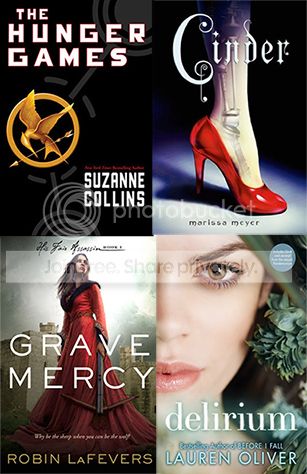
That's the only gender flip I can think of. Modern children's and YA books do have more female protagonists, and I didn't read any of the classic books for younger readers unless forced to for school. In fourth grade, I read Artemis Fowl and immediately latched onto Holly. At around the same age I was reading about Kitty Jones from The Bartimeaus Trilogy, Max from the Maximum Ride series, Ella from Ella Enchanted. When I entered middle school I found Terry Pratchett through Monstrous Regiment and soon grew to love Angua, Cheri, Polly, Susan, Sybil, Granny Weatherwax, Margrat, Tiffany and all his other characters.
Even when I was very young I was lucky enough to grow up with books with female protagonists. My dad read aloud Dealing With Dragons to me before I could read. I read books about girls who were friends with pixies and unicorns. I really wouldn't want to try reading them now, but I liked Avalon: Web of Magic and Unicorns of Balinor a lot at the time. Around third grade, I was reading Eva Ibbotson, who always had female characters in her books.
The only books mentioned in your post that I read were Heidi and Charlotte's Web. Neither made a particular impression. I preferred (and still do) dragons and unicorns and princesses.
I will agree that a lot of the female protagonists in YA recently aren't that impressive. But while the majority of Hunger Games fans are female, it has attracted fans of the other gender in a quantity that other dystopians with female protagonists have failed to. I think there's an assumption (sadly true) that YA books, or any books for that matter, with female protagonists will focus on a romance. And then there's the issue of gendered cover designs. Just compare the cover of The Hunger Games with some others YA books with female protagonists and by female authors.
141kceccato
140: The focus on romance, real and imagined, is the very thing I want to focus on in my Part II, since I think it's the very thing likely to alienate a lot of (though not all) young male readers from girl-centered stories.
True confession: I was born in 1969. I do not recall many good girl-centric fantasies coming out in the 1970s or early 1980s; the only books with girl protagonists I recall from those days were either written by Judy Blume or patterned after her. Had I been born a bit later, I would have been much more fortunate in my options. If my mom and dad had read Dealing with Dragons to me when I was eleven, I don't doubt for a second that it would have been my favorite book. How my younger self would have loved, loved, loved Kazul! Cimorene too, of course, but especially Kazul. Eskarina from Equal Rites would have delighted me as well. But I came upon these works when I was older, during my "I'm sick to death of gender-flipping!" days. I might not have gotten into such a habit of gender-flipping if I'd had good books like this growing up.
A couple I wish I'd heard about during my childhood and early adolescence, that might also have changed the picture for me:
A Wrinkle in Time, The Harper Hall of Pern
Even The Chronicles of Prydain might have been welcome; though Eilonwy wasn't the protagonist, at least she got in on the adventures, and wasn't a "little mother" like Wendy in Peter Pan.
Yet the picture for young girl readers these days is unquestionably better; fewer girls coming up now would need to get into the gender-flipping habit. Even animal fantasy is more female-friendly now, with works like The Sight and Promise of the Wolves. My example is only meant to show that the conventional wisdom that "girls don't mind reading about boys" is problematic, if those girls are/were anything like me and flip the genders of the male characters they like because they want/need a female presence.
A few quick thoughts on current reads:
The Book Thief: I have never read anything quite like this, in terms of style and tone. I love the unique narrative voice. I'm almost 200 pages in and don't feel I know Liesel quite as well as I'm going to, but she intrigues me. Yet I think the thing I appreciate most, so far, is the handling of the adult characters, particularly Hans Hubermann. Liesel may be the book's protagonist, but in many ways (so far, at least), Hans is its hero.
The Silvered just keeps getting better. I'm only a hundred pages from the end and I will be sad to leave its intriguing characters behind. But I have chosen its successor: Caught in Crystal.
Hild: very slow-moving, but very beautifully written, with a smart, imaginative, and perceptive heroine.
These books, and the others that I read these days, leave me with neither the need nor the desire to gender-flip. So yes, indeed, progress has been made.
True confession: I was born in 1969. I do not recall many good girl-centric fantasies coming out in the 1970s or early 1980s; the only books with girl protagonists I recall from those days were either written by Judy Blume or patterned after her. Had I been born a bit later, I would have been much more fortunate in my options. If my mom and dad had read Dealing with Dragons to me when I was eleven, I don't doubt for a second that it would have been my favorite book. How my younger self would have loved, loved, loved Kazul! Cimorene too, of course, but especially Kazul. Eskarina from Equal Rites would have delighted me as well. But I came upon these works when I was older, during my "I'm sick to death of gender-flipping!" days. I might not have gotten into such a habit of gender-flipping if I'd had good books like this growing up.
A couple I wish I'd heard about during my childhood and early adolescence, that might also have changed the picture for me:
A Wrinkle in Time, The Harper Hall of Pern
Even The Chronicles of Prydain might have been welcome; though Eilonwy wasn't the protagonist, at least she got in on the adventures, and wasn't a "little mother" like Wendy in Peter Pan.
Yet the picture for young girl readers these days is unquestionably better; fewer girls coming up now would need to get into the gender-flipping habit. Even animal fantasy is more female-friendly now, with works like The Sight and Promise of the Wolves. My example is only meant to show that the conventional wisdom that "girls don't mind reading about boys" is problematic, if those girls are/were anything like me and flip the genders of the male characters they like because they want/need a female presence.
A few quick thoughts on current reads:
The Book Thief: I have never read anything quite like this, in terms of style and tone. I love the unique narrative voice. I'm almost 200 pages in and don't feel I know Liesel quite as well as I'm going to, but she intrigues me. Yet I think the thing I appreciate most, so far, is the handling of the adult characters, particularly Hans Hubermann. Liesel may be the book's protagonist, but in many ways (so far, at least), Hans is its hero.
The Silvered just keeps getting better. I'm only a hundred pages from the end and I will be sad to leave its intriguing characters behind. But I have chosen its successor: Caught in Crystal.
Hild: very slow-moving, but very beautifully written, with a smart, imaginative, and perceptive heroine.
These books, and the others that I read these days, leave me with neither the need nor the desire to gender-flip. So yes, indeed, progress has been made.
142kceccato
I have finished both Cold Steel and The Silvered, and will be posting the full reviews on Goodreads very soon. For now, I can only say that I enjoyed both novels, and I want to see more of the worlds Elliot and Huff have created.
My envisioned follow-up to The Spiritwalker Trilogy would have a female cold mage as its protagonist. Even at the end of Cold Steel, sexist ideas are still deeply entrenched in the mage Houses, as no woman, however powerful her magic, can ever attain the highest authoritative rank. It's time for a new female protagonist to confront this glass ceiling and break through it. Perhaps one of Andevai's little sisters? We know his grown sister Kayleigh has no mage power, but the little ones just might have some. And those two sisters might prove fitting successors to Cat and Bee.
As for the follow-up to The Silvered, I agree with Sakerfalcon -- it's time for a Hunt Pack heroine. I wonder if Huff's decision to focus almost exclusively on male werewolves in The Silvered might be linked somehow to the werewolves' need to undress when they change into "fur" and their obviously still being naked when they revert to "skin." Would female nudity be more objectionable, more degrading than male? Terry Pratchett handles the matter effectively when he writes about Angua; I would like to see how Huff would deal with it. A Hunt Pack heroine might have a compelling battle to fight. I'd like to see her interact with Reiter, whose story isn't quite finished (for me) at the end of The Silvered. I'd prefer to see him find a new love interest than to see the Tomas-Mirian-Reiter triangle extended further.
Next up: The Way of Kings will follow Cold Steel (I will designate this spot on my rotation "Epic"), and Caught in Crystal will follow The Silvered (this place will be saved for shorter works and/or stand-alones).
More thoughts on The Book Thief:
I tend to think of YA novels, even very good ones, as fast reads. This one isn't. Not only is it meticulously detailed, with its highly unusual narrative voice, but it demands periodic reflection. It is not an adventure to be galloped through. It's a slower and often uneasy journey. Yet it may well be the best YA novel I've ever read, or at least tied for the best, if we designate To Kill a Mockingbird YA. It has some vital things in common with Harper Lee's masterpiece:
1) a smart, curious, often impulsive heroine very prone to the mistakes of youth;
2) a highly admirable father figure (Hans is actually a bit more complex and human than Atticus; Atticus is very exalted, and is actually a more vivid presence in the movie -- thank you, Gregory Peck -- than in the book);
3) a good sense of the way children play, and the way they talk to each other (it's hard to resist male and female best buddies who call each other "Saukerl" and "Saumensch");
4) a strong awareness of the violence and evil that "ordinary people" are capable of.
Yet if ordinary people are capable of evil, they are also capable of great courage and love. The Book Thief actually shows us this even more clearly than To Kill a Mockingbird. In my last post I mentioned that if Liesel is the book's protagonist, Hans Hubermann is its hero. I haven't changed my mind about Hans, but in the pages I've read since then, I've seen Liesel growing into the role of hero, showing reserves of kindness and compassion. "The Standover Man," Max's tribute to Liesel, is surely one of the most moving stories-within-a-story in all contemporary literature.
I'm liking this book so much that I honestly don't know how I'm going to follow it up. Something wildly, radically different. It will have to be.
My envisioned follow-up to The Spiritwalker Trilogy would have a female cold mage as its protagonist. Even at the end of Cold Steel, sexist ideas are still deeply entrenched in the mage Houses, as no woman, however powerful her magic, can ever attain the highest authoritative rank. It's time for a new female protagonist to confront this glass ceiling and break through it. Perhaps one of Andevai's little sisters? We know his grown sister Kayleigh has no mage power, but the little ones just might have some. And those two sisters might prove fitting successors to Cat and Bee.
As for the follow-up to The Silvered, I agree with Sakerfalcon -- it's time for a Hunt Pack heroine. I wonder if Huff's decision to focus almost exclusively on male werewolves in The Silvered might be linked somehow to the werewolves' need to undress when they change into "fur" and their obviously still being naked when they revert to "skin." Would female nudity be more objectionable, more degrading than male? Terry Pratchett handles the matter effectively when he writes about Angua; I would like to see how Huff would deal with it. A Hunt Pack heroine might have a compelling battle to fight. I'd like to see her interact with Reiter, whose story isn't quite finished (for me) at the end of The Silvered. I'd prefer to see him find a new love interest than to see the Tomas-Mirian-Reiter triangle extended further.
Next up: The Way of Kings will follow Cold Steel (I will designate this spot on my rotation "Epic"), and Caught in Crystal will follow The Silvered (this place will be saved for shorter works and/or stand-alones).
More thoughts on The Book Thief:
I tend to think of YA novels, even very good ones, as fast reads. This one isn't. Not only is it meticulously detailed, with its highly unusual narrative voice, but it demands periodic reflection. It is not an adventure to be galloped through. It's a slower and often uneasy journey. Yet it may well be the best YA novel I've ever read, or at least tied for the best, if we designate To Kill a Mockingbird YA. It has some vital things in common with Harper Lee's masterpiece:
1) a smart, curious, often impulsive heroine very prone to the mistakes of youth;
2) a highly admirable father figure (Hans is actually a bit more complex and human than Atticus; Atticus is very exalted, and is actually a more vivid presence in the movie -- thank you, Gregory Peck -- than in the book);
3) a good sense of the way children play, and the way they talk to each other (it's hard to resist male and female best buddies who call each other "Saukerl" and "Saumensch");
4) a strong awareness of the violence and evil that "ordinary people" are capable of.
Yet if ordinary people are capable of evil, they are also capable of great courage and love. The Book Thief actually shows us this even more clearly than To Kill a Mockingbird. In my last post I mentioned that if Liesel is the book's protagonist, Hans Hubermann is its hero. I haven't changed my mind about Hans, but in the pages I've read since then, I've seen Liesel growing into the role of hero, showing reserves of kindness and compassion. "The Standover Man," Max's tribute to Liesel, is surely one of the most moving stories-within-a-story in all contemporary literature.
I'm liking this book so much that I honestly don't know how I'm going to follow it up. Something wildly, radically different. It will have to be.
143kceccato
Goodreads reviews of The Silvered and Cold Steel:
https://www.goodreads.com/review/show/705361135?book_show_action=false
https://www.goodreads.com/review/show/580717940?book_show_action=false
I've started both The Way of Kings and Caught in Crystal.
My impressions of the former: I'm over 100 pages in, but since the book runs over a thousand pages, I would still consider that too early to make much of a judgment. All the same, Sanderson's writing style and the interiority of this characters always absorbs me. The last book I read of his was Warbreaker, which, sadly, disappointed me in the end. But I think I'm going to like this one, and I'm looking forward to seeing the broad, detailed canvas outspread.
My impressions of the latter: in terms of scale, it couldn't be farther from the former if it tried, yet it too boasts an involving and energetic writing style, albeit not quite as ornately detailed as Sanderson's. Kayl is a pleasing heroine. She hasn't gone into action yet, but I can tell that's coming. It's also good to read about a thirtysomething protagonist, a widow who thought all her adventures were in the past. So far the only things to rub me the wrong way are the children. When child characters are the central figures, or at least point-of-view characters, I can enjoy reading about them. Yet I find them irksome as supporting characters.
https://www.goodreads.com/review/show/705361135?book_show_action=false
https://www.goodreads.com/review/show/580717940?book_show_action=false
I've started both The Way of Kings and Caught in Crystal.
My impressions of the former: I'm over 100 pages in, but since the book runs over a thousand pages, I would still consider that too early to make much of a judgment. All the same, Sanderson's writing style and the interiority of this characters always absorbs me. The last book I read of his was Warbreaker, which, sadly, disappointed me in the end. But I think I'm going to like this one, and I'm looking forward to seeing the broad, detailed canvas outspread.
My impressions of the latter: in terms of scale, it couldn't be farther from the former if it tried, yet it too boasts an involving and energetic writing style, albeit not quite as ornately detailed as Sanderson's. Kayl is a pleasing heroine. She hasn't gone into action yet, but I can tell that's coming. It's also good to read about a thirtysomething protagonist, a widow who thought all her adventures were in the past. So far the only things to rub me the wrong way are the children. When child characters are the central figures, or at least point-of-view characters, I can enjoy reading about them. Yet I find them irksome as supporting characters.
144Sakerfalcon
>143 kceccato: Excellent reviews! I decided that Cat's swooning was a reminder of just how young she still is (about 19?) in these books. at least Andevai polishes her boots himself, rather than laying down instructions on how she should do it!
145kceccato
144: Good point about Cat's age. Of course the character does need SOME flaws, and hers are realistic. All the same, I adore the plans for social improvement she's making towards the end.
Elliot needs to write another series set in this world. For my sake, Elliot, please -- just so that I can actually see the University has started to admit female students again. That will make me feel better.
Elliot needs to write another series set in this world. For my sake, Elliot, please -- just so that I can actually see the University has started to admit female students again. That will make me feel better.
146kceccato
Ongoing Issue Part 2: Why Male Readers "Don't Identify with Female Characters"
Why don't men like romance?
sandstone78's blog raised the issue recently, though in a different context (i.e. the suggestion that "something's wrong" with asexual or a-romantic characters and people). Yet the portion of Rachel Aaron's blog she quoted fits with my question as well:
"The whole concept that badasses can’t be in love is one carried over from the hyper-masculine ideal of the stoic, hard as nails hero. This manliest of men is only allowed to feel affection when the object of his love is the prize at the end of his quest or dead. (Sometimes, she’s both at once!) Either way, the relationship between the hero and his love is always a static element while the story is in motion. It has to be, because an evolving romance and all the emotional muddiness and feelings that go along with it is “girl stuff,” which we all know is verboten in manly hero stories. Sex with random women is cool, of course, so long as no significant attachments are formed."
Our pop culture offers signs aplenty of this apparent masculine aversion to romance. Look no further than the multiplex, particularly comedies, which these days seem more strictly divided into "for girls" and "for boys" than any other genre. Comedies "for girls" nearly always center on romantic entanglements and end in engagement or marriage, despite the shake-things-up-a-little presence of movies like "Bridesmaids" and "The Heat" (which, while the goal may be admirable, have problems of their own). Yet if marriage and commitment represent a woman's happy ending, they represent surrender for a man. Marriage is a power gain for women (so our pop culture still tells us), and a power loss for men. Comedies "for boys" (e.g. The Hangover & sequels, This Is The End, The World's End, Wild Hogs, Grown-Ups) feature groups of male friends facing their fears -- and what might those fears be? Maturity. Responsibility. Commitment. Men's goal in these films seems to be the preservation of childhood, symbolized by the treehouse with "No Girls Allowed" painted on the door.
If our popular culture insists on presenting women as the serpent in the paradise of Eternal Childhood, it's little wonder that many men, absorbing the lesson, continue to see "women" as a monolithic entity who are "Not Like Us." These men don't like romantic plots/subplots because that's "for girls," and "for girls" is code for inferior.
It should be obvious why male readers, particularly young male readers, turn up their noses at books with female protagonists while girls will (supposedly) read anything they perceive as well-written or interesting, regardless of the protagonist's gender: even after all the cultural changes that have taken place in the last century, qualities and traits associated with "masculinity" are still presented as ideals to aim for, while those associated with "femininity" are considered weaknesses, liabilities. Girls can identify with boy characters because those boys represent something they should aspire to be. Very rarely do boys perceive female characters this way. They may get a kick out of seeing an Action Girl kick butt -- I have no interest in reading Christopher Paolini's work, but he wins a few points with me for saying he always finds a story more worth reading if it has an Action Girl among its characters -- but even the most formidable of Action Girls are commonly saddled with a love plot (reverting back to "for girls"). See pwaites's regrettably short list of science fiction and fantasy stories with female protagonists that DON'T include a love plot.
Whenever a boy is told he's doing something "like a girl," that means he's doing it badly. How can boys be expected to identify with girl characters as long as this attitude prevails? But then, I'm not telling anybody here anything s/he doesn't already know, right?
Yet the problem, while daunting, is not beyond solution. Positive change is underway, and both men and women are at the front of it, as they seek to create characters that challenge those "masculine" and "feminine" stereotypes. We should never presume to think that male readers absolutely DO NOT identify with female characters. Some male readers do, and as writers they create female characters that every reader can enjoy. Daniel O'Malley and Max Gladstone work alongside Tanya Huff and Melissa Scott to tackle the old assumptions head on -- to give us strong male characters who can fall deeply and sincerely in love, as well as strong female characters who don't HAVE to fall in love.
If only they didn't still have so much work to do.
Why don't men like romance?
sandstone78's blog raised the issue recently, though in a different context (i.e. the suggestion that "something's wrong" with asexual or a-romantic characters and people). Yet the portion of Rachel Aaron's blog she quoted fits with my question as well:
"The whole concept that badasses can’t be in love is one carried over from the hyper-masculine ideal of the stoic, hard as nails hero. This manliest of men is only allowed to feel affection when the object of his love is the prize at the end of his quest or dead. (Sometimes, she’s both at once!) Either way, the relationship between the hero and his love is always a static element while the story is in motion. It has to be, because an evolving romance and all the emotional muddiness and feelings that go along with it is “girl stuff,” which we all know is verboten in manly hero stories. Sex with random women is cool, of course, so long as no significant attachments are formed."
Our pop culture offers signs aplenty of this apparent masculine aversion to romance. Look no further than the multiplex, particularly comedies, which these days seem more strictly divided into "for girls" and "for boys" than any other genre. Comedies "for girls" nearly always center on romantic entanglements and end in engagement or marriage, despite the shake-things-up-a-little presence of movies like "Bridesmaids" and "The Heat" (which, while the goal may be admirable, have problems of their own). Yet if marriage and commitment represent a woman's happy ending, they represent surrender for a man. Marriage is a power gain for women (so our pop culture still tells us), and a power loss for men. Comedies "for boys" (e.g. The Hangover & sequels, This Is The End, The World's End, Wild Hogs, Grown-Ups) feature groups of male friends facing their fears -- and what might those fears be? Maturity. Responsibility. Commitment. Men's goal in these films seems to be the preservation of childhood, symbolized by the treehouse with "No Girls Allowed" painted on the door.
If our popular culture insists on presenting women as the serpent in the paradise of Eternal Childhood, it's little wonder that many men, absorbing the lesson, continue to see "women" as a monolithic entity who are "Not Like Us." These men don't like romantic plots/subplots because that's "for girls," and "for girls" is code for inferior.
It should be obvious why male readers, particularly young male readers, turn up their noses at books with female protagonists while girls will (supposedly) read anything they perceive as well-written or interesting, regardless of the protagonist's gender: even after all the cultural changes that have taken place in the last century, qualities and traits associated with "masculinity" are still presented as ideals to aim for, while those associated with "femininity" are considered weaknesses, liabilities. Girls can identify with boy characters because those boys represent something they should aspire to be. Very rarely do boys perceive female characters this way. They may get a kick out of seeing an Action Girl kick butt -- I have no interest in reading Christopher Paolini's work, but he wins a few points with me for saying he always finds a story more worth reading if it has an Action Girl among its characters -- but even the most formidable of Action Girls are commonly saddled with a love plot (reverting back to "for girls"). See pwaites's regrettably short list of science fiction and fantasy stories with female protagonists that DON'T include a love plot.
Whenever a boy is told he's doing something "like a girl," that means he's doing it badly. How can boys be expected to identify with girl characters as long as this attitude prevails? But then, I'm not telling anybody here anything s/he doesn't already know, right?
Yet the problem, while daunting, is not beyond solution. Positive change is underway, and both men and women are at the front of it, as they seek to create characters that challenge those "masculine" and "feminine" stereotypes. We should never presume to think that male readers absolutely DO NOT identify with female characters. Some male readers do, and as writers they create female characters that every reader can enjoy. Daniel O'Malley and Max Gladstone work alongside Tanya Huff and Melissa Scott to tackle the old assumptions head on -- to give us strong male characters who can fall deeply and sincerely in love, as well as strong female characters who don't HAVE to fall in love.
If only they didn't still have so much work to do.
147kceccato
Issue of the Day: Fun With Goodreads Recommendations, or, Why I Will Not Be Reading That
Now that Lent is over, I'm back to my unbridled Goodreads-browsing ways. One place on the site that I always get a special kick out of visiting is my very own little Recommendations Room. I click on the titles, and one of three things can happen: the title goes on my infinite (and growing even more infinite by the month -- yes, I know that's literally-speaking impossible) Want-to-Read list; the title is banished to the Not Interested wasteland; or I decide I need a little more time to ruminate on it. The first option always makes me happy, since adding books to my Future Reads is an inherently optimistic habit. Yet when I find myself sending more books to Not Interested than to Want-to-Read, I have to chuckle.
Goodreads' recommendations are drawn from "common reads": "people who have read THIS often read THAT." Yet the site can't determine WHY I'm reading what I read. I may say, for instance, that I like C.J. Cherryh's Morgaine Cycle, and might add it to my special shelves labeled "Kick-Butt Heroines" and "Magical Heroines" (since Morgaine is both). Then Goodreads hits me with recommendations of a lot of sci-fi and fantasy written around that same time, a lot of it written by men whose idea of a "kick-butt heroine" is a woman in a chainmail bikini who carries a sword but never actually does anything with it, who talks tough but whose eventual fate is to be humbled by, and made to acknowledge the superiority of, the male protagonist. The site doesn't quite get that the powerful and enigmatic Morgaine drew me to the series in the first place. Some of the works that turn up on my "Kick-Butt Heroines" shelf are downright risible. Fritz Leiber! Seriously, Fritz Leiber!
Here's a sampling of works that have turned up in my Recommendations only to be banished to Not Interested:
Beyond the Deepwoods by Paul Stewart:
Anyone who knows anything about me and the books I choose knows that I seek a sympathetic and competent female presence, as a major character if not always as the protagonist. When I saw this review, I knew that this book wasn't for me: "The female characters in this book range from mothers to monsters. The story of Mag, particularly, could be read as a sexist warning about female puberty." Since this was the first book in a series, out of curiosity I looked up the later books, to see if something resembling a heroine might make her way into them. Nope. However, Stewart does create two monstrous female alien races of creature for our stalwart band of male heroes to fight. They're called -- get this -- Shrykes and Termagants. Darn, these books might as well be locked with an enormous padlock reading "NOT FOR YOU."
The Unincorporated Man by Dani Kollin
This one turned up on my Rec list because I liked Robert J. Sawyer's W.W.W.: Wake series (the first two books, anyway; haven't read the third yet). My favorite thing about the books is the wonderfully nerdy teenage heroine. Yet Goodreads doesn't know that. A couple of statements from the reviews: "The women are all of course helpless and dazzled by their immensely more capable lovers." "I'm pretty sure that at some point someone is actually told not to worry her pretty little head about something. Seriously?"
The Violent Century by Lavie Tidhar
Reviews reveal this one as a bromance in which female characters are afterthoughts or obstacles. If a British superhero's love interest has a German name and the setting is World War II, it's probably a good idea not to get attached to the character, unless perhaps she turns out to be Jewish. (See my post # 86, "Why I Don't Dig Villainesses.") A positive review has this to say: "My only quibble is the female characters just seem to be a backdrop to men's more important issues." Welcome to Not Interested, Mr. Tidhar.
The Dying Earth by Jack Vance
Review: "The only strong woman is an aberrant creation who is easily talked down to and made to change her mind." Vance, I believe, actually admitted he had a problem writing female characters in a complex and believable non-wish-fulfillment way, when he was confronted about it. At least he's honest, but that honesty doesn't incline me toward his work. (Note to Self: Avoid 90% of the works of male science fiction and fantasy writers published prior to 1980. Possible exceptions are named Lewis, Tolkien, and MacDonald.)
Isle of the Dead by Roger Zelazny
See "Note to Self" above.
The Devil You Know by Mike Carey
Is it me, or are most male urban-fantasy writers who write from the perspective of male protagonist trying very hard to be Jim Butcher? (Not all, but most.) I didn't read many complaints about sexism in the reviews for this one, but I did find one thing off-putting from the outset: I'm a bit tired of urban-fantasy mysteries that kick off with the horribly brutal murder of a beautiful young girl. Don't supernatural serial killers ever target guys?
Hard Spell by Justin Gustainis
Another one trying very hard to be Jim Butcher. I'm not keen on reading Butcher's Dresden Files series either (and Storm Front was another Recommendation I consigned to Not Interested), but at least that series has one substantial, tough and competent female figure in Karrin Murphy. There is no such presence in Gustainis's work. Women appear, but they have very little to do.
That's enough, for now. I have many more examples I could cite.
And I don't mean to pick on Goodreads. I love the site (albeit in a slightly different way from LT; I go there to read lists, but I come here to discuss). And I've found many Want-to-Read titles there, that I might otherwise never have heard of. I just find these kinds of Recommendations amusing. They are so "un-me."
Now that Lent is over, I'm back to my unbridled Goodreads-browsing ways. One place on the site that I always get a special kick out of visiting is my very own little Recommendations Room. I click on the titles, and one of three things can happen: the title goes on my infinite (and growing even more infinite by the month -- yes, I know that's literally-speaking impossible) Want-to-Read list; the title is banished to the Not Interested wasteland; or I decide I need a little more time to ruminate on it. The first option always makes me happy, since adding books to my Future Reads is an inherently optimistic habit. Yet when I find myself sending more books to Not Interested than to Want-to-Read, I have to chuckle.
Goodreads' recommendations are drawn from "common reads": "people who have read THIS often read THAT." Yet the site can't determine WHY I'm reading what I read. I may say, for instance, that I like C.J. Cherryh's Morgaine Cycle, and might add it to my special shelves labeled "Kick-Butt Heroines" and "Magical Heroines" (since Morgaine is both). Then Goodreads hits me with recommendations of a lot of sci-fi and fantasy written around that same time, a lot of it written by men whose idea of a "kick-butt heroine" is a woman in a chainmail bikini who carries a sword but never actually does anything with it, who talks tough but whose eventual fate is to be humbled by, and made to acknowledge the superiority of, the male protagonist. The site doesn't quite get that the powerful and enigmatic Morgaine drew me to the series in the first place. Some of the works that turn up on my "Kick-Butt Heroines" shelf are downright risible. Fritz Leiber! Seriously, Fritz Leiber!
Here's a sampling of works that have turned up in my Recommendations only to be banished to Not Interested:
Beyond the Deepwoods by Paul Stewart:
Anyone who knows anything about me and the books I choose knows that I seek a sympathetic and competent female presence, as a major character if not always as the protagonist. When I saw this review, I knew that this book wasn't for me: "The female characters in this book range from mothers to monsters. The story of Mag, particularly, could be read as a sexist warning about female puberty." Since this was the first book in a series, out of curiosity I looked up the later books, to see if something resembling a heroine might make her way into them. Nope. However, Stewart does create two monstrous female alien races of creature for our stalwart band of male heroes to fight. They're called -- get this -- Shrykes and Termagants. Darn, these books might as well be locked with an enormous padlock reading "NOT FOR YOU."
The Unincorporated Man by Dani Kollin
This one turned up on my Rec list because I liked Robert J. Sawyer's W.W.W.: Wake series (the first two books, anyway; haven't read the third yet). My favorite thing about the books is the wonderfully nerdy teenage heroine. Yet Goodreads doesn't know that. A couple of statements from the reviews: "The women are all of course helpless and dazzled by their immensely more capable lovers." "I'm pretty sure that at some point someone is actually told not to worry her pretty little head about something. Seriously?"
The Violent Century by Lavie Tidhar
Reviews reveal this one as a bromance in which female characters are afterthoughts or obstacles. If a British superhero's love interest has a German name and the setting is World War II, it's probably a good idea not to get attached to the character, unless perhaps she turns out to be Jewish. (See my post # 86, "Why I Don't Dig Villainesses.") A positive review has this to say: "My only quibble is the female characters just seem to be a backdrop to men's more important issues." Welcome to Not Interested, Mr. Tidhar.
The Dying Earth by Jack Vance
Review: "The only strong woman is an aberrant creation who is easily talked down to and made to change her mind." Vance, I believe, actually admitted he had a problem writing female characters in a complex and believable non-wish-fulfillment way, when he was confronted about it. At least he's honest, but that honesty doesn't incline me toward his work. (Note to Self: Avoid 90% of the works of male science fiction and fantasy writers published prior to 1980. Possible exceptions are named Lewis, Tolkien, and MacDonald.)
Isle of the Dead by Roger Zelazny
See "Note to Self" above.
The Devil You Know by Mike Carey
Is it me, or are most male urban-fantasy writers who write from the perspective of male protagonist trying very hard to be Jim Butcher? (Not all, but most.) I didn't read many complaints about sexism in the reviews for this one, but I did find one thing off-putting from the outset: I'm a bit tired of urban-fantasy mysteries that kick off with the horribly brutal murder of a beautiful young girl. Don't supernatural serial killers ever target guys?
Hard Spell by Justin Gustainis
Another one trying very hard to be Jim Butcher. I'm not keen on reading Butcher's Dresden Files series either (and Storm Front was another Recommendation I consigned to Not Interested), but at least that series has one substantial, tough and competent female figure in Karrin Murphy. There is no such presence in Gustainis's work. Women appear, but they have very little to do.
That's enough, for now. I have many more examples I could cite.
And I don't mean to pick on Goodreads. I love the site (albeit in a slightly different way from LT; I go there to read lists, but I come here to discuss). And I've found many Want-to-Read titles there, that I might otherwise never have heard of. I just find these kinds of Recommendations amusing. They are so "un-me."
148kceccato
A few quick Thoughts on Current Reads:
I'm close to the end of Caught in Crystal. The children annoy me far less now, since I understand their place in the plot, and I appreciate the number and the complexity of female characters in this story (one of the things I found regrettable about The Raven Ring was that Eleret was "surrounded by dudes" for the most part, the only significant women other than herself being her dead mother and her dangerous enemy). Only one thing still bothers me. I'm less than fifty pages from the end, and I'm thinking, "All right, when is Kayl going to whip out her sword and kick some major butt?" She's a smart, sympathetic heroine, but she's still an Action Girl without any Action! Please, Wrede, please have her put that sword to effective use before the end! (Now, if this were a Tamora Pierce novel, I would know for certain the butt-kicking scene was coming...)
I've managed to find most of the other Lyra novels, including Shadow Magic and Daughter of Witches, at various used bookstores. I like this series and mean to read them all. But I need to transition into The Siren Depths next so I can get in on May's group discussion. I loved The Cloud Roads, but I found The Serpent Sea slightly disappointing because it veered away from the detailed exploration of Raksura culture. Hopefully the third book will focus more securely on the Raksura colonies, without a branch-off to a leviathan city.
I'm close to the end of The Book Thief. I may need a little bit of time in a dark room when this one is finished. I'm glad I've been taking my time with it, as Liesel and Hans and Rudy and Rosa and Max are too valuable to be quickly left behind. I've been thinking of following it up with Enchantress from the Stars, which should be starkly different enough.
I'm still not far enough into The Way of Kings to make too much comment about it, except that 1) man, it's huge, and 2) it's quite absorbing. I love the way Sanderson weaves his world-building deftly into the plot without undue exposition. So far, I'm interested in Kaladin and Syl, don't really care about Dalinar and his sons (though this may change), and wish the book could have more than one female POV character. I don't dislike Shallan -- I like that she's an artistic heroine -- but I find Jasnah more interesting, and wish we could get her POV instead (or better still, in addition to).
Hild is definitely a long haul book. It's gorgeously written, and I like the protagonist immensely, but it is soooooo veeeerrrry sloooooow. Not every book has to be fast-paced, and I am enjoying it, but I may seek something light and frivolous for my next Kindle read.
I'm close to the end of Caught in Crystal. The children annoy me far less now, since I understand their place in the plot, and I appreciate the number and the complexity of female characters in this story (one of the things I found regrettable about The Raven Ring was that Eleret was "surrounded by dudes" for the most part, the only significant women other than herself being her dead mother and her dangerous enemy). Only one thing still bothers me. I'm less than fifty pages from the end, and I'm thinking, "All right, when is Kayl going to whip out her sword and kick some major butt?" She's a smart, sympathetic heroine, but she's still an Action Girl without any Action! Please, Wrede, please have her put that sword to effective use before the end! (Now, if this were a Tamora Pierce novel, I would know for certain the butt-kicking scene was coming...)
I've managed to find most of the other Lyra novels, including Shadow Magic and Daughter of Witches, at various used bookstores. I like this series and mean to read them all. But I need to transition into The Siren Depths next so I can get in on May's group discussion. I loved The Cloud Roads, but I found The Serpent Sea slightly disappointing because it veered away from the detailed exploration of Raksura culture. Hopefully the third book will focus more securely on the Raksura colonies, without a branch-off to a leviathan city.
I'm close to the end of The Book Thief. I may need a little bit of time in a dark room when this one is finished. I'm glad I've been taking my time with it, as Liesel and Hans and Rudy and Rosa and Max are too valuable to be quickly left behind. I've been thinking of following it up with Enchantress from the Stars, which should be starkly different enough.
I'm still not far enough into The Way of Kings to make too much comment about it, except that 1) man, it's huge, and 2) it's quite absorbing. I love the way Sanderson weaves his world-building deftly into the plot without undue exposition. So far, I'm interested in Kaladin and Syl, don't really care about Dalinar and his sons (though this may change), and wish the book could have more than one female POV character. I don't dislike Shallan -- I like that she's an artistic heroine -- but I find Jasnah more interesting, and wish we could get her POV instead (or better still, in addition to).
Hild is definitely a long haul book. It's gorgeously written, and I like the protagonist immensely, but it is soooooo veeeerrrry sloooooow. Not every book has to be fast-paced, and I am enjoying it, but I may seek something light and frivolous for my next Kindle read.
149kceccato
My Goodreads review of The Book Thief:
https://www.goodreads.com/review/show/583053175?book_show_action=false
https://www.goodreads.com/review/show/583053175?book_show_action=false
150kceccato
Issue of the Day: Favorite Male Characters
Most of my posts are about female characters -- when and why I like them, when and why I don't like them, what I like or hate about their portrayals in general. I make no apologies for that. These days, female characters get most of my attention, since I've spent a good many years feeling forced to identify with male characters (or gender-flip them, as I mentioned in post 139), and I've grown weary of it, and have taken to choosing which books I will or won't read based on whether I think I'll like the women in them.
But in the wake of The Book Thief, I've decided it's time for me to give a little attention to the male characters I like and admire -- the ones I like and admire AS MEN, and do not feel any impulse to gender-flip. Looking at the books in my library, I've come up with quite a few, and it will take me more than one post to list them all. I'll start with three I have particular fondness for.
1. Hans Hubermann, The Book Thief
The tall, silver-eyed man who paints houses, plays the accordion, and keeps a debt to an old friend at great personal risk to himself is one of the most admirable, honorable characters I have read about in a long time. He is just about everything a good man ought to be -- a good husband (to a wife who makes that difficult), a good father (even though Liesel is not his blood kin, he treats her as if she were), and a good friend. Yet he has his doubts. He has moments where he wishes he did NOT have such a quick instinct for doing the good, compassionate thing, since his behavior is so starkly at odds with the world around him and might just get him killed. These doubts give him a flesh-and-blood reality we don't quite see in the well-known character he so resembles, Atticus Finch in To Kill a Mockingbird. As I say in my review, I feel privileged to have spent time in his company.
2. Sam Vimes, Guards! Guards! et. seq.
Ah, Sir Samuel Vimes, Duke of Ankh-Morpork, you are my favorite copper in all literature. This excerpt from Men at Arms may give you some idea why:
"The young Assassin tried to sneer.
'Hah! Your uniform doesn't scare ME,' he said.
Vimes looked down at his battered breastplate and worn mail.
'You're right,' he said. 'This is not a scary uniform. I'm sorry. Forward, Corporal Carrot and Lance-Constable Detritus.'
The Assassin was suddenly aware of the sunlight being blocked out.
'Now THESE, I think you'll agree,' said Vimes, from somewhere behind the eclipse, 'are scary uniforms.'" (52)
Men at Arms was the first Discworld book I read. (I had to go back and pick up Guards! Guards! later.) When I read this passage, I fell wholeheartedly in love with Vimes and knew I would want to read every single Discworld book in which he featured. Men at Arms isn't even the best of them (that honor, I think, is shared between Feet of Clay and The Fifth Elephant), but it was my first, so it stays with me. Why do I love Vimes so much? Because of his deathless sense of sarcasm and his sense of fair play which at times stands at odds with his starkly cynical demeanor. There's no stopping him in his pursuit of justice, and his way with words (see above) makes this pursuit especially fun and satisfying to watch.
3. DEATH, Mort et. seq.
Again my recent experience of The Book Thief comes into play. Death narrates Zusak's book, and as I got a feel for who he was, I realized that despite the vast difference in circumstance and type of plot, his Zusak's vision of Death and Pratchett's are very much the same. Both are endlessly fascinated by the humans with whom they deal, and both have a strong moral sense. Both are surprisingly sympathetic figures. Of course, the ironic humor that animates Pratchett's Death would be completely out of place in Zusak's story, but my familiarity with Pratchett's Death made me feel as if I was encountering an old friend when I began to read Zusak's book. It didn't really take the edge off the tragedy, but somehow I knew all the characters would be in good hands, whatever befell.
Pratchett's Death knows right from wrong, even if he can't always do anything about it. Pratchett's Death rescues little girls from burning buildings (in Reaper Man). Pratchett's Death studies humor in the hope that a well-timed joke will help the souls he's come for feel a little better. Pratchett's Death delivers presents to the good little children at Hogswatch. And when just-dead people recognize him and say things like, "You're Death, aren't you?" he replies, "IT'S THE SCYTHE, ISN'T IT? PEOPLE ALWAYS NOTICE THE SCYTHE." (Can't remember which book that's from, but I remember laughing really loudly when I read it.)
I've mentioned before that I think Pratchett writes women better than almost any other male writer. It may not be too much of a stretch to say he writes MEN better than almost any writer, male or female, I can think of.
More on other great male characters later.
Most of my posts are about female characters -- when and why I like them, when and why I don't like them, what I like or hate about their portrayals in general. I make no apologies for that. These days, female characters get most of my attention, since I've spent a good many years feeling forced to identify with male characters (or gender-flip them, as I mentioned in post 139), and I've grown weary of it, and have taken to choosing which books I will or won't read based on whether I think I'll like the women in them.
But in the wake of The Book Thief, I've decided it's time for me to give a little attention to the male characters I like and admire -- the ones I like and admire AS MEN, and do not feel any impulse to gender-flip. Looking at the books in my library, I've come up with quite a few, and it will take me more than one post to list them all. I'll start with three I have particular fondness for.
1. Hans Hubermann, The Book Thief
The tall, silver-eyed man who paints houses, plays the accordion, and keeps a debt to an old friend at great personal risk to himself is one of the most admirable, honorable characters I have read about in a long time. He is just about everything a good man ought to be -- a good husband (to a wife who makes that difficult), a good father (even though Liesel is not his blood kin, he treats her as if she were), and a good friend. Yet he has his doubts. He has moments where he wishes he did NOT have such a quick instinct for doing the good, compassionate thing, since his behavior is so starkly at odds with the world around him and might just get him killed. These doubts give him a flesh-and-blood reality we don't quite see in the well-known character he so resembles, Atticus Finch in To Kill a Mockingbird. As I say in my review, I feel privileged to have spent time in his company.
2. Sam Vimes, Guards! Guards! et. seq.
Ah, Sir Samuel Vimes, Duke of Ankh-Morpork, you are my favorite copper in all literature. This excerpt from Men at Arms may give you some idea why:
"The young Assassin tried to sneer.
'Hah! Your uniform doesn't scare ME,' he said.
Vimes looked down at his battered breastplate and worn mail.
'You're right,' he said. 'This is not a scary uniform. I'm sorry. Forward, Corporal Carrot and Lance-Constable Detritus.'
The Assassin was suddenly aware of the sunlight being blocked out.
'Now THESE, I think you'll agree,' said Vimes, from somewhere behind the eclipse, 'are scary uniforms.'" (52)
Men at Arms was the first Discworld book I read. (I had to go back and pick up Guards! Guards! later.) When I read this passage, I fell wholeheartedly in love with Vimes and knew I would want to read every single Discworld book in which he featured. Men at Arms isn't even the best of them (that honor, I think, is shared between Feet of Clay and The Fifth Elephant), but it was my first, so it stays with me. Why do I love Vimes so much? Because of his deathless sense of sarcasm and his sense of fair play which at times stands at odds with his starkly cynical demeanor. There's no stopping him in his pursuit of justice, and his way with words (see above) makes this pursuit especially fun and satisfying to watch.
3. DEATH, Mort et. seq.
Again my recent experience of The Book Thief comes into play. Death narrates Zusak's book, and as I got a feel for who he was, I realized that despite the vast difference in circumstance and type of plot, his Zusak's vision of Death and Pratchett's are very much the same. Both are endlessly fascinated by the humans with whom they deal, and both have a strong moral sense. Both are surprisingly sympathetic figures. Of course, the ironic humor that animates Pratchett's Death would be completely out of place in Zusak's story, but my familiarity with Pratchett's Death made me feel as if I was encountering an old friend when I began to read Zusak's book. It didn't really take the edge off the tragedy, but somehow I knew all the characters would be in good hands, whatever befell.
Pratchett's Death knows right from wrong, even if he can't always do anything about it. Pratchett's Death rescues little girls from burning buildings (in Reaper Man). Pratchett's Death studies humor in the hope that a well-timed joke will help the souls he's come for feel a little better. Pratchett's Death delivers presents to the good little children at Hogswatch. And when just-dead people recognize him and say things like, "You're Death, aren't you?" he replies, "IT'S THE SCYTHE, ISN'T IT? PEOPLE ALWAYS NOTICE THE SCYTHE." (Can't remember which book that's from, but I remember laughing really loudly when I read it.)
I've mentioned before that I think Pratchett writes women better than almost any other male writer. It may not be too much of a stretch to say he writes MEN better than almost any writer, male or female, I can think of.
More on other great male characters later.
151kceccato
Up and ready: My Goodreads review of Caught in Crystal:
https://www.goodreads.com/review/show/653498541?book_show_action=false
I do want to read further in the Lyra series, as I've said before... but to those of you who have read the other books in the series: do we meet with ANY halfway decent female magicians in these books? The uniformly negative portrayal of female magicians in this novel got on my nerves, just as it did in the otherwise lovely The Raven Ring -- particularly since the main male magician was portrayed sympathetically in both books. Do good female wizards exist in Lyra? (I would like the next Lyra novel I read to have a magical heroine, if such a character does indeed exist.) The absence of heroic female magicians from these two books seems very odd, considering their prevalence in Wrede's other work.
Three books I acquired yesterday:
Burning Bright by Melissa Scott
Debris by Jo Anderton
Taming the Forest King by Claudia J. Edwards
I'm especially eager to read the first of these, as I've read sandstone78 and others I trust speak well of it. I found them at the Books for Less in Buford near Atlanta, after their Alpharetta location closed down. Because I can't say it enough: we must love and value our used bookstores.
https://www.goodreads.com/review/show/653498541?book_show_action=false
I do want to read further in the Lyra series, as I've said before... but to those of you who have read the other books in the series: do we meet with ANY halfway decent female magicians in these books? The uniformly negative portrayal of female magicians in this novel got on my nerves, just as it did in the otherwise lovely The Raven Ring -- particularly since the main male magician was portrayed sympathetically in both books. Do good female wizards exist in Lyra? (I would like the next Lyra novel I read to have a magical heroine, if such a character does indeed exist.) The absence of heroic female magicians from these two books seems very odd, considering their prevalence in Wrede's other work.
Three books I acquired yesterday:
Burning Bright by Melissa Scott
Debris by Jo Anderton
Taming the Forest King by Claudia J. Edwards
I'm especially eager to read the first of these, as I've read sandstone78 and others I trust speak well of it. I found them at the Books for Less in Buford near Atlanta, after their Alpharetta location closed down. Because I can't say it enough: we must love and value our used bookstores.
152kceccato
Whew! My Goodreads review of Hild:
https://www.goodreads.com/review/show/755544254?book_show_action=false
https://www.goodreads.com/review/show/755544254?book_show_action=false
153kceccato
Thoughts on Current Reads:
From the "Never-would-have-heard-of-it-except-for-Goodreads" Department: Vera Nazarian's Cobweb Bride.
What would happen if Death went on strike? Plenty of authors have tried to answer this intriguing question, with varying degrees of success. My personal favorite is Terry Pratchett's Reaper Man, which deals not only with Death's exploration of humanity but with the people who were supposed to die, but didn't -- confused souls living on literally borrowed time. "Windle Poons went back to Windle Poons." Plus, my favorite zombie character EVER, Reg Shoe, makes his first appearance here, a Dead Rights activist sporting a Glad to Be Gray badge.
Cobweb Bride is the epic/historical fantasy version of Reaper Man -- a lot more serious, and a lot more gory.
I'm 33% in, and Death has not yet emerged as a character. But this book presents us with characters who know they ought to be dead, including a military duke and an assassinated princess, but find their souls refuse to leave their bodies. What are they supposed to do now? The duke wants to remain non-alive for as long as possible; the princess (who will go on my "Princesses I Actually Find Tolerable" mental list) wants to understand why she was killed. Meanwhile, we have soldiers whose bodies have been hacked to pieces yet somehow manage to live on -- a gruesome yet moving image. These men understand what's happening to them. They are not the mindless, shambling, murderous zombies of The Walking Dead. (For a closer picture, check out the very good 1936 Boris Karloff film of the same name -- one of the most sympathetic performances Karloff ever gave.) This zombie apocalypse inspires as much curiosity and compassion as terror.
Then we have our female protagonist, Percy. That Percy is short for Persephone should give anyone familiar with Greek mythology a major clue as to her eventual role in the story. Familiarity with fairy tales also helps: Percy is one of three sisters, the unwanted and undervalued one whose potential lies hidden and so is bound to emerge as the heroine. I'm only just getting to know her, so I can't say much about her at this point. But I look forward to seeing her real strengths emerge.
So far, I'm quite pleased with this read.
Enchantress from the Stars:
This book serves as a strong reminder of why I should never turn up my nose at YA. It presents an intriguing idea, a confrontation of three different civilizations at different levels of development. The most advanced has a duty to help the least advanced (the "Younglings") reach their potential; the middle one is operating on the "conquer and colonize" principle. The writing for the top two is clearly sci-fi, yet for the Younglings, technology is magic, so when the central character from that society takes over the point of view, the style shifts into fantasy.
The title character is, in her own eyes, a young girl on her first mission, bright with ideals yet trembling with insecurities. Yet in the eyes of Georyn, the central Youngling, she is an all powerful sorceress, a guide who knows all the answers. It's an interesting shift. Elana is a likable figure, a heroine with strong principles, though I do find my patience waning a little during her lengthy debates with her father (who, of course, is always right -- my, how YA has changed since this book was written!).
Yet my main issue with the book is the unwelcome factor of Highlander Syndrome. I'd been managing to avoid it in most of my recent reads; even in The Book Thief, though Liesel has no female friends her own age, she interacts frequently with the older women in her neighborhood, as well as with her foster mother. But in Engdahl's book, every important character besides Elana, good or bad, is male. Another woman shows up on Elana's ship at the very beginning of the book -- for about two minutes. After that, it's Elana and the XY Gang, all the time. No named female characters exist in Georyn's world, and no women from the "middle world" are present at all. It only serves to remind me how strongly I dislike Highlander Syndrome, even though I'm otherwise enjoying the book.
I may try McIntyre's Dreamsnake next.
From the "Never-would-have-heard-of-it-except-for-Goodreads" Department: Vera Nazarian's Cobweb Bride.
What would happen if Death went on strike? Plenty of authors have tried to answer this intriguing question, with varying degrees of success. My personal favorite is Terry Pratchett's Reaper Man, which deals not only with Death's exploration of humanity but with the people who were supposed to die, but didn't -- confused souls living on literally borrowed time. "Windle Poons went back to Windle Poons." Plus, my favorite zombie character EVER, Reg Shoe, makes his first appearance here, a Dead Rights activist sporting a Glad to Be Gray badge.
Cobweb Bride is the epic/historical fantasy version of Reaper Man -- a lot more serious, and a lot more gory.
I'm 33% in, and Death has not yet emerged as a character. But this book presents us with characters who know they ought to be dead, including a military duke and an assassinated princess, but find their souls refuse to leave their bodies. What are they supposed to do now? The duke wants to remain non-alive for as long as possible; the princess (who will go on my "Princesses I Actually Find Tolerable" mental list) wants to understand why she was killed. Meanwhile, we have soldiers whose bodies have been hacked to pieces yet somehow manage to live on -- a gruesome yet moving image. These men understand what's happening to them. They are not the mindless, shambling, murderous zombies of The Walking Dead. (For a closer picture, check out the very good 1936 Boris Karloff film of the same name -- one of the most sympathetic performances Karloff ever gave.) This zombie apocalypse inspires as much curiosity and compassion as terror.
Then we have our female protagonist, Percy. That Percy is short for Persephone should give anyone familiar with Greek mythology a major clue as to her eventual role in the story. Familiarity with fairy tales also helps: Percy is one of three sisters, the unwanted and undervalued one whose potential lies hidden and so is bound to emerge as the heroine. I'm only just getting to know her, so I can't say much about her at this point. But I look forward to seeing her real strengths emerge.
So far, I'm quite pleased with this read.
Enchantress from the Stars:
This book serves as a strong reminder of why I should never turn up my nose at YA. It presents an intriguing idea, a confrontation of three different civilizations at different levels of development. The most advanced has a duty to help the least advanced (the "Younglings") reach their potential; the middle one is operating on the "conquer and colonize" principle. The writing for the top two is clearly sci-fi, yet for the Younglings, technology is magic, so when the central character from that society takes over the point of view, the style shifts into fantasy.
The title character is, in her own eyes, a young girl on her first mission, bright with ideals yet trembling with insecurities. Yet in the eyes of Georyn, the central Youngling, she is an all powerful sorceress, a guide who knows all the answers. It's an interesting shift. Elana is a likable figure, a heroine with strong principles, though I do find my patience waning a little during her lengthy debates with her father (who, of course, is always right -- my, how YA has changed since this book was written!).
Yet my main issue with the book is the unwelcome factor of Highlander Syndrome. I'd been managing to avoid it in most of my recent reads; even in The Book Thief, though Liesel has no female friends her own age, she interacts frequently with the older women in her neighborhood, as well as with her foster mother. But in Engdahl's book, every important character besides Elana, good or bad, is male. Another woman shows up on Elana's ship at the very beginning of the book -- for about two minutes. After that, it's Elana and the XY Gang, all the time. No named female characters exist in Georyn's world, and no women from the "middle world" are present at all. It only serves to remind me how strongly I dislike Highlander Syndrome, even though I'm otherwise enjoying the book.
I may try McIntyre's Dreamsnake next.
154Sakerfalcon
Glad you are enjoying Cobweb bride; it is waiting for me on my kindle. I think I found it by looking up Norilana Press on amazon, having enjoyed their Clockwork phoenix anthologies and wanting to see what else they published.
I thought Enchantress from the stars was a very good book, and my friend's teenage goddaughters have enjoyed it too. But I agree, why oh why can we not have more than one female character in a book? It would be nice if we could say "Well, Enchantress was written 20 years ago; things are better now" but it just isn't true, as we frequently note. *sigh*
I thought Enchantress from the stars was a very good book, and my friend's teenage goddaughters have enjoyed it too. But I agree, why oh why can we not have more than one female character in a book? It would be nice if we could say "Well, Enchantress was written 20 years ago; things are better now" but it just isn't true, as we frequently note. *sigh*
155JannyWurts
I read Enchantress from the Stars years ago - KEEPER! Awesome book, thoughtfully written - and (for me) encountered at a time and age where I was not yet so worldly - when my Dad did in fact 'know everything' and his wisdom was the guideline that (in hindsight) taught me so well to solve problems. I didn't find that viewpoint to be a setback, but appropriate to the audience the book was geared for.
In an ideal world, every daughter should be gifted with such a father .... and such an idyllic picture, before full maturity.
Supposing the book had written in a different view of 'Dad' - it would have changed, perhaps even detracted from the main thrust and focus of the story, which I thought was well and purposefully drawn.
Perhaps my individual view is quite different - I did not relate well or have close women friends, growing up; more like, my differences were painfully ridiculed by them. Therefore I found the heroine in this book very level headed, practical, and refreshing - vastly different than many written - it has to be??? - more than 20 years ago.
I checked: the copyright date on my hardback is 1970, which puts it closer to 45 years ago (date actually written, prior to pub date).
In an ideal world, every daughter should be gifted with such a father .... and such an idyllic picture, before full maturity.
Supposing the book had written in a different view of 'Dad' - it would have changed, perhaps even detracted from the main thrust and focus of the story, which I thought was well and purposefully drawn.
Perhaps my individual view is quite different - I did not relate well or have close women friends, growing up; more like, my differences were painfully ridiculed by them. Therefore I found the heroine in this book very level headed, practical, and refreshing - vastly different than many written - it has to be??? - more than 20 years ago.
I checked: the copyright date on my hardback is 1970, which puts it closer to 45 years ago (date actually written, prior to pub date).
156kceccato
154, 155:
The father/daughter conversations may go on a little long for my taste, but I do agree -- it's good that he IS presented as a wise authority figure, when far too many parents in contemporary YA literature (if they're even there) are written as idiots.
I also agree that Elana is a much stronger heroine than many we find in YA lit these days; just because female protagonists may be more plentiful in today's literature doesn't necessarily make them better characters -- quality does not always follow quantity. Certain YA writers can nearly always be relied on to give us worthwhile heroines (e.g. Patricia C. Wrede, Tamora Pierce, Robin McKinley). But we still have to deal with Stephenie Meyer's influence. It may take us a decade to recover fully.
As I've mentioned before, one of my favorite qualities in a heroine, aside from intelligence (I don't really enjoy reading about stupid characters, of either gender), is INTEGRITY -- a strong sense of right and wrong, and a moral purpose. This quality Elana definitely has.
Here's a blog by Vera Nazarian that my friends here may find worth a read. I will definitely be seeking out more of her work.
http://www.fantasybookcafe.com/2013/04/women-in-sff-month-vera-nazarian/
The father/daughter conversations may go on a little long for my taste, but I do agree -- it's good that he IS presented as a wise authority figure, when far too many parents in contemporary YA literature (if they're even there) are written as idiots.
I also agree that Elana is a much stronger heroine than many we find in YA lit these days; just because female protagonists may be more plentiful in today's literature doesn't necessarily make them better characters -- quality does not always follow quantity. Certain YA writers can nearly always be relied on to give us worthwhile heroines (e.g. Patricia C. Wrede, Tamora Pierce, Robin McKinley). But we still have to deal with Stephenie Meyer's influence. It may take us a decade to recover fully.
As I've mentioned before, one of my favorite qualities in a heroine, aside from intelligence (I don't really enjoy reading about stupid characters, of either gender), is INTEGRITY -- a strong sense of right and wrong, and a moral purpose. This quality Elana definitely has.
Here's a blog by Vera Nazarian that my friends here may find worth a read. I will definitely be seeking out more of her work.
http://www.fantasybookcafe.com/2013/04/women-in-sff-month-vera-nazarian/
157sandstone78
>153 kceccato: Both Enchantress of the Stars and The Far Side of Evil are in my reread stack- I didn't notice the things you mentioned back when I read them, so I'd be curious to see what I think now. The Far Side of Evil places Elana somewhat in the position her father is in in Enchantress, on the side of authority with a less experienced male agent who has fallen in love with a local woman and wants to get involved.
You might be interested in the novels of H.M. Hoover, who also wrote "juvenile" science fiction novels in the 70s, for comparison, though towards the later end of the decade- I read and enjoyed a number of them from the library, but remember them only vaguely. I managed to find a copy of The Rains of Eridan, which has a young heroine who befriends a female biologist, and look forward to sitting down and rereading it. I don't think Hoover's novels have the philosophical/ethical component, though, from what I remember.
>156 kceccato: Ah, that article... I read it as part of the Women in SFF month series, and had sharply mixed feelings about it.
I empathized with Nazarian's childhood stories, having fantasized of course about swordswomen and sorceresses having fantastic adventures myself (though I was pretty sure I would never qualify, not having the requisite "boyish" or "waifish" figure- it would have taken quite a lot of work for me to pass as a boy given my build and features), but it broke my heart when Nazarian talked about her female character from an early novel:
I'm disappointed as well by the last paragraph, because again, like I keep coming back to (and everybody is no doubt tired of) with masculine women, there is no epidemic of cocky swashbuckling heroine pushing out self-effacing vulnerable heroines- the latter is the norm rather than a radical exception. And why can't there be more than one right way to write female warriors?
You might be interested in the novels of H.M. Hoover, who also wrote "juvenile" science fiction novels in the 70s, for comparison, though towards the later end of the decade- I read and enjoyed a number of them from the library, but remember them only vaguely. I managed to find a copy of The Rains of Eridan, which has a young heroine who befriends a female biologist, and look forward to sitting down and rereading it. I don't think Hoover's novels have the philosophical/ethical component, though, from what I remember.
>156 kceccato: Ah, that article... I read it as part of the Women in SFF month series, and had sharply mixed feelings about it.
I empathized with Nazarian's childhood stories, having fantasized of course about swordswomen and sorceresses having fantastic adventures myself (though I was pretty sure I would never qualify, not having the requisite "boyish" or "waifish" figure- it would have taken quite a lot of work for me to pass as a boy given my build and features), but it broke my heart when Nazarian talked about her female character from an early novel:
She was Elzarán, a perfect Mary Sue character who was beautiful, intelligent, brave, proud, tall, swashbuckling and cocky like Errol Flynn, wonderful, noble, wielded a sword and all manner of weapons, rode a horse, dueled, fought in the Legion and rescued innocents, and made the hero and everyone else fall in love with her.I want to read about Elzarán! I want to read about a swashbuckling, cocky, noble, competent, swoonworthy heroine! And yet such traits are always put down as "Mary Sue traits" in writing advice, and these female characters are left unwritten, even making writers feel ashamed because they are supposedly "too awesome," or "too perfect"!
I'm disappointed as well by the last paragraph, because again, like I keep coming back to (and everybody is no doubt tired of) with masculine women, there is no epidemic of cocky swashbuckling heroine pushing out self-effacing vulnerable heroines- the latter is the norm rather than a radical exception. And why can't there be more than one right way to write female warriors?
158kceccato
157: Precisely why I have never liked the term "Mary Sue." Too many writers are so afraid of that term that they don't want to make their female characters "too good" at anything. I also agree that "self-effacing and vulnerable" is the norm rather than the exception, because somewhere along the line, we've been told that such characters are more "likable" and "relatable."
Whenever I'm browsing Goodreads reviews, and I find multiple reviewers praise a female lead for being so "normal" -- that is, having no outstanding or extraordinary traits of any kind -- I know the book is not for me. I'm not interested in Ordinary High School Girls (TM), or in hapless adult heroines who somehow stumble and fall into a pit of Mysterious Doings and find themselves surrounded by a host of kick-ass supernatural characters, mostly male. Let the woman be the extraordinary one, for once! Or maybe even more than once!
Still, I found much to like in the article, especially when Nazarian says she makes a point out of creating heroines that challenge common notions of female attractiveness/desirability. We do need that. (But I, too, would have enjoyed reading about that heroine who never came to life because her author decided she was too perfect.)
Whenever I'm browsing Goodreads reviews, and I find multiple reviewers praise a female lead for being so "normal" -- that is, having no outstanding or extraordinary traits of any kind -- I know the book is not for me. I'm not interested in Ordinary High School Girls (TM), or in hapless adult heroines who somehow stumble and fall into a pit of Mysterious Doings and find themselves surrounded by a host of kick-ass supernatural characters, mostly male. Let the woman be the extraordinary one, for once! Or maybe even more than once!
Still, I found much to like in the article, especially when Nazarian says she makes a point out of creating heroines that challenge common notions of female attractiveness/desirability. We do need that. (But I, too, would have enjoyed reading about that heroine who never came to life because her author decided she was too perfect.)
159pwaites
156> I've added Lords of Rainbow to my To Read list. I liked her descriptions of women warriors. The character she described might not necessarily be a Mary Sue. I define it (or a Gary Sue) as a character who is perfect at everything and instantly loved by all other characters upon two minutes of meeting her - there's more to the definition, and I think it's rarer than thought. The term itself was created to describe and mock bad fan fiction, and it is almost never applicable to good writing or published works.
But I'll agree that the stigma does scare authors away and that it does impact female characters much more than male characters.
This writing advice article gives a good definition of a Mary Sue - a character who's traits are all created to attract attention to her. The author prefaces the article with a warning along the lines of what you were complaining about:
While she's not speaking specifically about female characters, it does express the stigma that goes along with the term.
But I'll agree that the stigma does scare authors away and that it does impact female characters much more than male characters.
This writing advice article gives a good definition of a Mary Sue - a character who's traits are all created to attract attention to her. The author prefaces the article with a warning along the lines of what you were complaining about:
"Internet communities often lash out at writers who create Mary Sues. Declaring the writing to be below their standards, they proceed to punish the creators. They mock the characters, verbally abuse the writers, and write hyperbolically about how much they wish the characters would die.
Bullying writers (who may be very young) is only going to make them afraid to write—and therefore improve—or share their work. Not only that, but it discourages other writers from speaking for fear of public mockery, and it may silence the voices that could someday become great."
While she's not speaking specifically about female characters, it does express the stigma that goes along with the term.
160kceccato
Fantasy Cafe, A New "Site That Ate My Life"
I should have started browsing Fantasy Cafe long ago. Now that I've gotten into it, I find it hard to get off the darn thing.
Thanks to their reviews and their "Leaning Pile of Books" feature, my Goodreads Want-to-Read list is mushrooming. In the past hour, I've added Kameron Hurley's The Mirror Empire, Elisabeth Vonarburg's The Silent City, and Karen Lord's The Best of All Possible Worlds -- and I've barely begun scouring their Archives.
But best of all is their "Women in Sci-Fi and Fantasy Month," which, even if I don't agree with everything the chosen guests say in their blogs, always brings into focus ideas I'm keen to read about. Here's a link to a blog by Beth Bernobich, addressing the issue of the number of female characters we generally encounter in genre fiction, and the problem of "male as default gender":
http://www.fantasybookcafe.com/2014/04/women-in-sff-month-beth-bernobich/
I haven't yet read any of Bernobich's work, but now I certainly intend to.
This post is a short one, because I'm still browsing this past April's blogs...
I should have started browsing Fantasy Cafe long ago. Now that I've gotten into it, I find it hard to get off the darn thing.
Thanks to their reviews and their "Leaning Pile of Books" feature, my Goodreads Want-to-Read list is mushrooming. In the past hour, I've added Kameron Hurley's The Mirror Empire, Elisabeth Vonarburg's The Silent City, and Karen Lord's The Best of All Possible Worlds -- and I've barely begun scouring their Archives.
But best of all is their "Women in Sci-Fi and Fantasy Month," which, even if I don't agree with everything the chosen guests say in their blogs, always brings into focus ideas I'm keen to read about. Here's a link to a blog by Beth Bernobich, addressing the issue of the number of female characters we generally encounter in genre fiction, and the problem of "male as default gender":
http://www.fantasybookcafe.com/2014/04/women-in-sff-month-beth-bernobich/
I haven't yet read any of Bernobich's work, but now I certainly intend to.
This post is a short one, because I'm still browsing this past April's blogs...
161LolaWalser
>159 pwaites:
From my limited experience, I agree with you. "Mary Sue" wasn't originally (and is it now?) the concept of a "strong female character" but rather a hallmark of poor writing, especially as accompanied by immaturity (hello, fanfic). I was amused years ago when I read the definition and some examples--it might have been on Wikipedia--because it brought back some of my most embarrassing childhood fantasies.
Around the age 11-12 I had a fantasy alter ego who was--in no particular order but everything on the highest order--a drop dead gorgeous genius mathematician swordswoman chess master heiress to the thrones of several planets everyone succumbed to on sight. She spoke all the languages and had a strangely soothing effect on fiercest beasts, she played seven instruments like a virtuoso, she was the best dancer in the universe, and she routinely leaped over canyons on the back of her marvellous horse, she was a daredevil driver, a mountain climber, karate judo kung fu master, consummate painter, engineer, spy, and on her fate hinged the fate of all the known worlds etc. THAT is a Mary Sue.
Agree, though, that it seems to be increasingly used as a sneer against any female character who exhibits strength, independence, multifarious talents etc. so I can understand why people might feel it needs "reclaiming".
Pity, as the original concept was useful in pointing to a very common psychological and creative pitfall.
From my limited experience, I agree with you. "Mary Sue" wasn't originally (and is it now?) the concept of a "strong female character" but rather a hallmark of poor writing, especially as accompanied by immaturity (hello, fanfic). I was amused years ago when I read the definition and some examples--it might have been on Wikipedia--because it brought back some of my most embarrassing childhood fantasies.
Around the age 11-12 I had a fantasy alter ego who was--in no particular order but everything on the highest order--a drop dead gorgeous genius mathematician swordswoman chess master heiress to the thrones of several planets everyone succumbed to on sight. She spoke all the languages and had a strangely soothing effect on fiercest beasts, she played seven instruments like a virtuoso, she was the best dancer in the universe, and she routinely leaped over canyons on the back of her marvellous horse, she was a daredevil driver, a mountain climber, karate judo kung fu master, consummate painter, engineer, spy, and on her fate hinged the fate of all the known worlds etc. THAT is a Mary Sue.
Agree, though, that it seems to be increasingly used as a sneer against any female character who exhibits strength, independence, multifarious talents etc. so I can understand why people might feel it needs "reclaiming".
Pity, as the original concept was useful in pointing to a very common psychological and creative pitfall.
162JannyWurts
I see Mary Sue/Gary Stu increasingly aimed to denigrate characters with a strong ethic - did a Thoughtful Thursday bit on that very subject at fantasyliterature.com, awhile back. It's probably in their archives.
163kceccato
Here is my review of Enchantress from the Stars (warning: Spoilers):
https://www.goodreads.com/review/show/632998487?book_show_action=false
One of my issues with the Mary Sue label is that people can't seem to agree on what it means. Some claim it refers to "authorial insertion," when an author uses a fictional character as his/her stand-in. By this standard, Jo March and Anne Shirley are Mary Sues. It doesn't matter a bit. I still love them.
Others claim it has to do with how other characters react to him/her. If the character is loved by all the other good guys, and hated only by the bad guys, the character must be a Mary Sue/ Gary Stu. But wait... what if we're dealing with a character who DESERVES the admiration and affection of those who surround him/her? Someone like, say, Oskar Schindler, or Father O'Flaherty (the latter portrayed on screen by Gregory Peck in "The Scarlet and the Black")? Is that character still a Mary Sue?
Then, of course, we have the definition of a character who excels at a number of things. Here's where women get the term more than men. The scholarly action hero Indiana Jones is rarely referred to as a "Gary Stu," but if we meet with a Renaissance woman, a scholar or scientist who knows several languages and still kicks butt with the best of them, she's called Mary Sue. This is the definition I have the biggest problem with, because it suggests we're somehow less comfortable with excellence when it comes in female guise than when it comes in male.
The one definition I can sorta-kinda accept is that of the blank slate character, deliberately left featureless so that any reader can plug her (sadly, it's usually "her") own features into the character and thus identify. Here is the character who is adored by everyone around her for no discernible reason, the character who says and does little or nothing to earn their affection. But gullible readers can enjoy this admiration.
https://www.goodreads.com/review/show/632998487?book_show_action=false
One of my issues with the Mary Sue label is that people can't seem to agree on what it means. Some claim it refers to "authorial insertion," when an author uses a fictional character as his/her stand-in. By this standard, Jo March and Anne Shirley are Mary Sues. It doesn't matter a bit. I still love them.
Others claim it has to do with how other characters react to him/her. If the character is loved by all the other good guys, and hated only by the bad guys, the character must be a Mary Sue/ Gary Stu. But wait... what if we're dealing with a character who DESERVES the admiration and affection of those who surround him/her? Someone like, say, Oskar Schindler, or Father O'Flaherty (the latter portrayed on screen by Gregory Peck in "The Scarlet and the Black")? Is that character still a Mary Sue?
Then, of course, we have the definition of a character who excels at a number of things. Here's where women get the term more than men. The scholarly action hero Indiana Jones is rarely referred to as a "Gary Stu," but if we meet with a Renaissance woman, a scholar or scientist who knows several languages and still kicks butt with the best of them, she's called Mary Sue. This is the definition I have the biggest problem with, because it suggests we're somehow less comfortable with excellence when it comes in female guise than when it comes in male.
The one definition I can sorta-kinda accept is that of the blank slate character, deliberately left featureless so that any reader can plug her (sadly, it's usually "her") own features into the character and thus identify. Here is the character who is adored by everyone around her for no discernible reason, the character who says and does little or nothing to earn their affection. But gullible readers can enjoy this admiration.
164LolaWalser
>163 kceccato:
I think it's all connected--the impossibly perfect Mary Sue that other characters admire/fall for/succumb to, tends to be the author's narcissistic projection. There's a term in child development for it, "grandiose image" or something like it.
But I never heard about Mary Sue being a "blank slate" before.
The most OTT/worst/funniest example of a Gary Stu I've come across recently is Douglas Preston's and Lee Child's Special Agent Pendergast. I think they did it deliberately, though.
From what I recall, he's a stunningly good looking (in an unusual fashion, not reminiscent of ordinary blokey handsomeness) polymath and genius, rich and aristocratic (sort of--he's American after all, so the cachet is bestowed by a New Orleans connection), master of martial arts and yoga (in fact, he seems to have gained "mystick" arts in Tibet, a la Dr. Strange), with a magnetic personality and charisma that tames and awes, superior strategic and deductive intelligence etc. etc.
It makes one nostalgic for the days of "thinking machines" detectives who were only very, very bright, and lacking in every other department.
I think it's all connected--the impossibly perfect Mary Sue that other characters admire/fall for/succumb to, tends to be the author's narcissistic projection. There's a term in child development for it, "grandiose image" or something like it.
But I never heard about Mary Sue being a "blank slate" before.
The most OTT/worst/funniest example of a Gary Stu I've come across recently is Douglas Preston's and Lee Child's Special Agent Pendergast. I think they did it deliberately, though.
From what I recall, he's a stunningly good looking (in an unusual fashion, not reminiscent of ordinary blokey handsomeness) polymath and genius, rich and aristocratic (sort of--he's American after all, so the cachet is bestowed by a New Orleans connection), master of martial arts and yoga (in fact, he seems to have gained "mystick" arts in Tibet, a la Dr. Strange), with a magnetic personality and charisma that tames and awes, superior strategic and deductive intelligence etc. etc.
It makes one nostalgic for the days of "thinking machines" detectives who were only very, very bright, and lacking in every other department.
165kceccato
Issue of the Day: Why the "fake geek girl" issue matters
I'm going to let Seanan McGuire have the first words on this subject:
http://www.fantasybookcafe.com/2013/04/women-in-sff-month-seanan-mcguire/
My own definition of the term "geek" is "a person with a strong interest in, and enthusiasm for, a particular area of knowledge." A geek is someone with an unabashed passion for something; whatever that something is, he or she will relentlessly pursue and absorb as much information about it as possible. There are sports geeks who can describe in detail more than a decade's worth of Super Bowl plays. There are history geeks who could tell you what soap Jean-Paul Marat was using when Charlotte Corday stabbed him in the bathtub. Science geeks, literature geeks... There are countless species of geeks, and they have but two things in common: passion and knowledge.
I'm an old movie geek. I have reference books galore on classic films. Probably not a lot of people know that "The Walking Dead" is not only a hit TV show about zombies in the South, but also a film made in 1936, starring Boris Karloff, about a wrongfully executed man brought back to life by a well-meaning scientist (played by Edmund Gwenn, best known as Kris Kringle from 1947's "Miracle on 34th Street"). But I do. I love knowing things like that. I love knowing that Claude Rains was James Whale's first choice for "The Invisible Man" even though Universal Studios didn't want to take a chance on an unknown. I love knowing that Bette Davis fought hard for the role of the gentle, sympathetic governess in 1940's "All This and Heaven Too" because she wanted to convince the studio as well as her fans that she could play a genuinely good woman just as well as she could play an anti-heroine like Julie Marsden in "Jezebel." I just love this stuff.
My sci-fi and fantasy geekdom has grown by degrees. I loved "Star Wars" when it first came out in '77. I devoured "Star Trek" in syndication early in my teens. I have ALWAYS loved fairy tales. Late in high school, I caught on to the classic "Doctor Who" episodes airing on my PBS station, though I have to admit that my enthusiasm for the show waned a little bit once the Tom Baker episodes were done. (I still maintain Tom Baker was the best Doctor because he had the best Companions. I wanted to be Romana when I grew up.) But I really think my full-fledged sci-fi and fantasy geekdom began when I became a serious reader of fantasy in my early twenties. The Hobbit and The Lord of the Rings got me through the door, but interestingly enough, it was Tad Williams' Memory, Sorrow, and Thorn that pushed me all the way in. Since then, there's been no going back. Now I have to make a point of reading the occasional book that ISN'T fantasy or sci-fi. Thanks to my husband and a good mutual friend of ours, I'm catching up on comic books and graphic novels, reading the stuff I would have relished as a teenager if only it had been available -- stuff like Meridian and Single Green Female and Princess Knight.
So when I hear female geeks called "fake," I take it personally. Very personally.
My husband watches "The Big Bang Theory." I enjoyed it for a little while, but it started to wear thin. Now, when he's watching it, I'm usually busy on the computer, browsing LT or other of my favorite websites, sharing the room with him but not paying close attention to the show. Every now and then, however, something will catch my attention, and one of the most recent things that bugged me to infinity was a subplot on the "Star Wars Day" episode, in which Bernadette and Amy -- the nerdy female scientists, created (I think) to throw a bone to female audiences who wanted characters who would show, "Hey, girls can like science too" -- baked a cake shaped like the Death Star for the guys, solely so they could get out of actually watching the movies. This is the very kind of tactic ascribed to the "fake geek girl." Evidently the show's creators believe that girls can be scientists, but not that they can be science fiction fans. In fact, that show perpetuates the "fake geek girl" stereotype in a number of ways. A running gag is that girls don't read comic books, that girls never darken the door of a comic book store.
Sure, it's just one show, but it's the best known show that claims to depict "geek culture." Plenty of people get their ideas about geeks and geekdom from shows like this. Meanwhile, when I visit DragonCon, I see just as many women there as men, not only attending discussion panels but leading discussion panels. A few weeks ago, my husband and I celebrated Free Comic Book Day with a trip to GalacticQuest in Buford. The comics store, as you might expect, was packed. The ratio of male to female customers was just about even; just as many young girls as young boys were eagerly browsing the comics.
Reality just doesn't match the idea that the media, particularly the Internet, seems so keen to put out there. Sci fi, fantasy, and comics have an abundance of genuine, honest-to-God female fans. And learning that someone like Seanan McGuire, with a long string of highly regarded urban fantasy novels to her credit, would have her credibility as a geek called into question pushes my Outrage Button.
Here's the question:
Why are so many male fans apparently eager to dismiss female fans as "fakes"? Wouldn't your average guy LIKE to find a girl who shares his interests and enthusiasms? Wouldn't someone smart enough to appreciate the best in speculative fiction be open to friendships with fellow fans of both genders? I don't get it. The fact that my husband first started to notice me when he learned that I'd read Jerry Beck's Looney Tunes and Merrie Melodies, and realized I was as big a "cartoon geek" as he was, makes it even harder for me to understand.
One of the most damaging things about the "fake geek girl" stereotype is that it lets writers and creators "off the hook" when it comes to female characters. If female geeks are "fakes," if they don't really watch or read sci-fi and fantasy and comics, or only pretend to do so in order to catch guys' attention (God, what narcissism!), then writers and creators don't have to worry about appealing to them. Instead of striving for a big tent, they can go on writing for an exclusive male club, and depicting female characters (when they depict them at all) as stereotypes rather than fully realized individuals. The stereotype makes it less likely that I, the female geek, will meet with the kinds of heroines I hope to see, in quality and quantity.
Here's some more outrage fodder:
http://www.themarysue.com/david-goyer-calls-she-hulk-sex-fantasy/
I've read Single Green Female, he obviously hasn't, and I'm the fake? (sarcasm) Yeah, THIS is the guy I really trust to bring Wonder Woman to the big screen...(sarcasm)
I'm going to let Seanan McGuire have the first words on this subject:
http://www.fantasybookcafe.com/2013/04/women-in-sff-month-seanan-mcguire/
My own definition of the term "geek" is "a person with a strong interest in, and enthusiasm for, a particular area of knowledge." A geek is someone with an unabashed passion for something; whatever that something is, he or she will relentlessly pursue and absorb as much information about it as possible. There are sports geeks who can describe in detail more than a decade's worth of Super Bowl plays. There are history geeks who could tell you what soap Jean-Paul Marat was using when Charlotte Corday stabbed him in the bathtub. Science geeks, literature geeks... There are countless species of geeks, and they have but two things in common: passion and knowledge.
I'm an old movie geek. I have reference books galore on classic films. Probably not a lot of people know that "The Walking Dead" is not only a hit TV show about zombies in the South, but also a film made in 1936, starring Boris Karloff, about a wrongfully executed man brought back to life by a well-meaning scientist (played by Edmund Gwenn, best known as Kris Kringle from 1947's "Miracle on 34th Street"). But I do. I love knowing things like that. I love knowing that Claude Rains was James Whale's first choice for "The Invisible Man" even though Universal Studios didn't want to take a chance on an unknown. I love knowing that Bette Davis fought hard for the role of the gentle, sympathetic governess in 1940's "All This and Heaven Too" because she wanted to convince the studio as well as her fans that she could play a genuinely good woman just as well as she could play an anti-heroine like Julie Marsden in "Jezebel." I just love this stuff.
My sci-fi and fantasy geekdom has grown by degrees. I loved "Star Wars" when it first came out in '77. I devoured "Star Trek" in syndication early in my teens. I have ALWAYS loved fairy tales. Late in high school, I caught on to the classic "Doctor Who" episodes airing on my PBS station, though I have to admit that my enthusiasm for the show waned a little bit once the Tom Baker episodes were done. (I still maintain Tom Baker was the best Doctor because he had the best Companions. I wanted to be Romana when I grew up.) But I really think my full-fledged sci-fi and fantasy geekdom began when I became a serious reader of fantasy in my early twenties. The Hobbit and The Lord of the Rings got me through the door, but interestingly enough, it was Tad Williams' Memory, Sorrow, and Thorn that pushed me all the way in. Since then, there's been no going back. Now I have to make a point of reading the occasional book that ISN'T fantasy or sci-fi. Thanks to my husband and a good mutual friend of ours, I'm catching up on comic books and graphic novels, reading the stuff I would have relished as a teenager if only it had been available -- stuff like Meridian and Single Green Female and Princess Knight.
So when I hear female geeks called "fake," I take it personally. Very personally.
My husband watches "The Big Bang Theory." I enjoyed it for a little while, but it started to wear thin. Now, when he's watching it, I'm usually busy on the computer, browsing LT or other of my favorite websites, sharing the room with him but not paying close attention to the show. Every now and then, however, something will catch my attention, and one of the most recent things that bugged me to infinity was a subplot on the "Star Wars Day" episode, in which Bernadette and Amy -- the nerdy female scientists, created (I think) to throw a bone to female audiences who wanted characters who would show, "Hey, girls can like science too" -- baked a cake shaped like the Death Star for the guys, solely so they could get out of actually watching the movies. This is the very kind of tactic ascribed to the "fake geek girl." Evidently the show's creators believe that girls can be scientists, but not that they can be science fiction fans. In fact, that show perpetuates the "fake geek girl" stereotype in a number of ways. A running gag is that girls don't read comic books, that girls never darken the door of a comic book store.
Sure, it's just one show, but it's the best known show that claims to depict "geek culture." Plenty of people get their ideas about geeks and geekdom from shows like this. Meanwhile, when I visit DragonCon, I see just as many women there as men, not only attending discussion panels but leading discussion panels. A few weeks ago, my husband and I celebrated Free Comic Book Day with a trip to GalacticQuest in Buford. The comics store, as you might expect, was packed. The ratio of male to female customers was just about even; just as many young girls as young boys were eagerly browsing the comics.
Reality just doesn't match the idea that the media, particularly the Internet, seems so keen to put out there. Sci fi, fantasy, and comics have an abundance of genuine, honest-to-God female fans. And learning that someone like Seanan McGuire, with a long string of highly regarded urban fantasy novels to her credit, would have her credibility as a geek called into question pushes my Outrage Button.
Here's the question:
Why are so many male fans apparently eager to dismiss female fans as "fakes"? Wouldn't your average guy LIKE to find a girl who shares his interests and enthusiasms? Wouldn't someone smart enough to appreciate the best in speculative fiction be open to friendships with fellow fans of both genders? I don't get it. The fact that my husband first started to notice me when he learned that I'd read Jerry Beck's Looney Tunes and Merrie Melodies, and realized I was as big a "cartoon geek" as he was, makes it even harder for me to understand.
One of the most damaging things about the "fake geek girl" stereotype is that it lets writers and creators "off the hook" when it comes to female characters. If female geeks are "fakes," if they don't really watch or read sci-fi and fantasy and comics, or only pretend to do so in order to catch guys' attention (God, what narcissism!), then writers and creators don't have to worry about appealing to them. Instead of striving for a big tent, they can go on writing for an exclusive male club, and depicting female characters (when they depict them at all) as stereotypes rather than fully realized individuals. The stereotype makes it less likely that I, the female geek, will meet with the kinds of heroines I hope to see, in quality and quantity.
Here's some more outrage fodder:
http://www.themarysue.com/david-goyer-calls-she-hulk-sex-fantasy/
I've read Single Green Female, he obviously hasn't, and I'm the fake? (sarcasm) Yeah, THIS is the guy I really trust to bring Wonder Woman to the big screen...(sarcasm)
166kceccato
My Goodreads review of Cobweb Bride:
https://www.goodreads.com/review/show/667635357?book_show_action=false
In other news:
1. I've started Dreamsnake. I'm intrigued by the world-building. I also like the use of snakes as figures of medicine; I've always had a thing for snakes, precisely because they're regarded with such general fear and hatred. When a creature is held in universal scorn, I like to see that creature redeemed somehow. The heroine is a powerful figure with a good share of empathy and integrity; I like her, and I'm interested to see what becomes of her. But I haven't seen her personality come to life quite yet.
Another point in the novel's favor is its treatment of crying. We're so used to seeing the shedding of tears depicted as weakness, passivity, cowardice, etc. Here, the ability to cry is a sign of strength, and the problem lies with those who never cry at all (because they can't? or won't?). Any character who weeps constantly is bound to be annoying, but in this novel, very early on, we see scenes where tears are quite appropriate.
2. I'm close to halfway through The Way of Kings. I'm absorbed in the story. I love Kaladin and Bridge Four, so much so that I find myself feeling disappointed when the scene shifts to another group of characters and relieved when we return at last to Teft, Rock, and the gang. I like Dalinar well enough, but I don't care much for Adolin; playboys try my patience. Shallan has been out of the picture for several hundred pages, so I haven't really formed much of an attachment to her (I've heard that I would have to wait for the sequel, Words of Radiance, to see her really come into her own). The points in her favor are two: 1) she's a creative, scholarly type, and I like reading about those; and 2) she's the only important female POV figure in the novel.
Therein likes my problem. This is the most testosterone-heavy Sanderson work I've read yet (the others being Mistborn, Elantris, and Warbreaker). Women are present, but they're in the background. I appreciate that Syl (whom I like) lends a small feminine presence to the masculine goings-on at Bridge Four, but I'm rather sorry that none of the major male characters has a wife, sister, daughter, or living mother -- in other words, that women are not a loved and valued part of any of their lives.
Still, I'm enjoying this novel well enough to be chomping at the proverbial bit for Words of Radiance to come out in paperback, or for an inexpensive used copy of the hardback to come into my hands. I want to read it soon. Very soon.
https://www.goodreads.com/review/show/667635357?book_show_action=false
In other news:
1. I've started Dreamsnake. I'm intrigued by the world-building. I also like the use of snakes as figures of medicine; I've always had a thing for snakes, precisely because they're regarded with such general fear and hatred. When a creature is held in universal scorn, I like to see that creature redeemed somehow. The heroine is a powerful figure with a good share of empathy and integrity; I like her, and I'm interested to see what becomes of her. But I haven't seen her personality come to life quite yet.
Another point in the novel's favor is its treatment of crying. We're so used to seeing the shedding of tears depicted as weakness, passivity, cowardice, etc. Here, the ability to cry is a sign of strength, and the problem lies with those who never cry at all (because they can't? or won't?). Any character who weeps constantly is bound to be annoying, but in this novel, very early on, we see scenes where tears are quite appropriate.
2. I'm close to halfway through The Way of Kings. I'm absorbed in the story. I love Kaladin and Bridge Four, so much so that I find myself feeling disappointed when the scene shifts to another group of characters and relieved when we return at last to Teft, Rock, and the gang. I like Dalinar well enough, but I don't care much for Adolin; playboys try my patience. Shallan has been out of the picture for several hundred pages, so I haven't really formed much of an attachment to her (I've heard that I would have to wait for the sequel, Words of Radiance, to see her really come into her own). The points in her favor are two: 1) she's a creative, scholarly type, and I like reading about those; and 2) she's the only important female POV figure in the novel.
Therein likes my problem. This is the most testosterone-heavy Sanderson work I've read yet (the others being Mistborn, Elantris, and Warbreaker). Women are present, but they're in the background. I appreciate that Syl (whom I like) lends a small feminine presence to the masculine goings-on at Bridge Four, but I'm rather sorry that none of the major male characters has a wife, sister, daughter, or living mother -- in other words, that women are not a loved and valued part of any of their lives.
Still, I'm enjoying this novel well enough to be chomping at the proverbial bit for Words of Radiance to come out in paperback, or for an inexpensive used copy of the hardback to come into my hands. I want to read it soon. Very soon.
167pwaites
166> Hmm, I would classify the first Mistborn trilogy as being most heavily filled with male characters. While Vin might be the protagonist, there aren't really any other female characters at all. WoK has Shallan, Syl, Navani, and Jasnah. Shallan's the only primary viewpoint character among them, but the others are significant in both this book and the sequel (which introduces some more female characters). The world of WoK also seems to include greater roles for women (scribes for instance), whereas even the most minor characters of Mistborn tended to be male, with the only female background characters being court ladies at balls or servants.
Cobweb Bride just leaped onto my TBR pile. It doesn't look as long as a lot of the books I've been reading lately, which is nice.
Cobweb Bride just leaped onto my TBR pile. It doesn't look as long as a lot of the books I've been reading lately, which is nice.
168zjakkelien
>167 pwaites: Agreed, Mistborn has Vin, but that's it. Vin is portrayed quite well, and the rest of the gang don't treat her differently for being female, so that's definitely well done, but it would have been good to have a few more women. There's no good reason not to have them.
169Marissa_Doyle
Just had to say that I totally agree with your feelings about Tom Baker. I remember a wonderful bit where he tries to swipe Romana's sonic screwdriver because she's modified hers and made it better than his. :)
170Meredy
I always thought a Mary Sue was a goody-goody, too perfect to be real, Little Miss Virtue, and stiflingly boring--Rowena in Ivanhoe, for example. These other interpretations are surprising me.
171kceccato
167: Point well taken. Vin is the protagonist of Mistborn, and is central in at least 70% of the scenes (if I'm remembering it right), yet the book does suffer from galloping Highlander Syndrome.
I find the gender roles in The Way of Kings intriguing: yes, they are rigid, but 1) they are as rigid for men as for women (men are ridiculed for wanting to learn to read), and 2) the "separate sphere" designated for women at least gives them a significant role in public life. In that regard, I agree, the book is more woman-hospitable than Mistborn. Where I'm dissatisfied is that while the women are there -- we can believe, when reading of this landscape, that women are actually half the human race -- they are in the background for so much of the book, except the fascinating female Other, Syl. So far, Shallan has gotten very little page time, which means that I have not yet had the chance to get to know the female character I find most intriguing of all: Jasnah.
However, I still have hundreds of pages to go. The picture may change. Even in the meantime, I really like the book.
I find the gender roles in The Way of Kings intriguing: yes, they are rigid, but 1) they are as rigid for men as for women (men are ridiculed for wanting to learn to read), and 2) the "separate sphere" designated for women at least gives them a significant role in public life. In that regard, I agree, the book is more woman-hospitable than Mistborn. Where I'm dissatisfied is that while the women are there -- we can believe, when reading of this landscape, that women are actually half the human race -- they are in the background for so much of the book, except the fascinating female Other, Syl. So far, Shallan has gotten very little page time, which means that I have not yet had the chance to get to know the female character I find most intriguing of all: Jasnah.
However, I still have hundreds of pages to go. The picture may change. Even in the meantime, I really like the book.
172pwaites
171> Shallan does come back in towards the end of WoK, and as you mentioned Words of Radiance is very much her story. Unfortunately, even then we don't see enough of Jasnah - her death is faked near the beginning, and it isn't revealed that she's alive until the epilogue. I was pretty ticked.
173kceccato
Here's my Goodreads review of The Siren Depths. I will post this in the Group Reads thread as well:
https://www.goodreads.com/review/show/928030880?book_show_action=false
Coming up next in this spot on my rotation: Forsyth's Bitter Greens.
One thing I keep noticing on Goodreads, particularly when I read reviews of YA fantasy novels, relates to sandstone78's comments in #157, lamenting Vera Nazarian's rejection of the competent, cocky, swoonworthy heroine in favor of the more "self-effacing" type. The more I think about it, the more I agree with her.
So many reviewers of YA novels with female protagonists praise the heroines for being "ordinary," for NOT having super-powers or magical abilities or standout talents/ambitions. "Ordinary" heroines are apparently more likable, more "relatable," etc. If I read too many reviews of this kind, I exile the book in question to the "Not Interested" pile, and wonder with sadly shaking head: when did ordinariness -- the lack of outstanding traits -- become a virtue? The only time I really enjoy reading about an "ordinary" heroine is when it turns out that she isn't quite as ordinary as she appears at first (Percy from Cobweb Bride being one example that comes to mind). Yet when a heroine is equipped with supernatural abilities or some other remarkable qualities, she's frequently derided as a "special snowflake" (a new term, apparently, for when "Mary Sue" just won't do).
Interestingly, when I read reviews of YA novels with male protagonists, I almost NEVER see those protagonists praised for being "ordinary." Male protagonists, evidently, are supposed to be endowed with supernatural abilities or some other outstanding characteristic that enables them to kick major butt. Wizards like Harry Potter and demigods in the Percy Jackson mold don't get dismissed as "special snowflakes." If ordinariness is some sort of virtue that makes a character easier to relate to, wouldn't we find it so in boys as well as girls?
https://www.goodreads.com/review/show/928030880?book_show_action=false
Coming up next in this spot on my rotation: Forsyth's Bitter Greens.
One thing I keep noticing on Goodreads, particularly when I read reviews of YA fantasy novels, relates to sandstone78's comments in #157, lamenting Vera Nazarian's rejection of the competent, cocky, swoonworthy heroine in favor of the more "self-effacing" type. The more I think about it, the more I agree with her.
So many reviewers of YA novels with female protagonists praise the heroines for being "ordinary," for NOT having super-powers or magical abilities or standout talents/ambitions. "Ordinary" heroines are apparently more likable, more "relatable," etc. If I read too many reviews of this kind, I exile the book in question to the "Not Interested" pile, and wonder with sadly shaking head: when did ordinariness -- the lack of outstanding traits -- become a virtue? The only time I really enjoy reading about an "ordinary" heroine is when it turns out that she isn't quite as ordinary as she appears at first (Percy from Cobweb Bride being one example that comes to mind). Yet when a heroine is equipped with supernatural abilities or some other remarkable qualities, she's frequently derided as a "special snowflake" (a new term, apparently, for when "Mary Sue" just won't do).
Interestingly, when I read reviews of YA novels with male protagonists, I almost NEVER see those protagonists praised for being "ordinary." Male protagonists, evidently, are supposed to be endowed with supernatural abilities or some other outstanding characteristic that enables them to kick major butt. Wizards like Harry Potter and demigods in the Percy Jackson mold don't get dismissed as "special snowflakes." If ordinariness is some sort of virtue that makes a character easier to relate to, wouldn't we find it so in boys as well as girls?
174imyril
>173 kceccato: interesting. If it weren't for the gender divide, I'd try (as an exercise in devil's advocacy, not from any particular conviction) to make a case for the importance of giving children hero(ine)s who are ordinary and achieve great things to instill a belief that we all matter and can all achieve great things.
But if this is a one-sided representation in YA lit (I avoid YA, so I can't comment), this starts to look more insidious (girls can't be special). Although I've worked my brain into a scramble, where girls get examples of ordinary achievers, but boys are told you have to be special. I suspect this isn't how YA actually works, but strikes me as just as poisonous a subtheme as 'girls can't be special'.
But if this is a one-sided representation in YA lit (I avoid YA, so I can't comment), this starts to look more insidious (girls can't be special). Although I've worked my brain into a scramble, where girls get examples of ordinary achievers, but boys are told you have to be special. I suspect this isn't how YA actually works, but strikes me as just as poisonous a subtheme as 'girls can't be special'.
175zjakkelien
I just went to see Maleficent, and loved it. I came here to recommend it, but saw you have already seen it, and that you were not fond of the power dynamics? It's true that Aurora is rather passive, but on the other hand, Maleficent is not evil. Ok, she does one ill-advised thing that cannot really be condoned (perhaps not really spoiler-worthy, it is a well-known fairytale, after all, but well. I'm of course talking of cursing the baby. )Overall I think she's portrayed as good though. The Bad Thing is sort of necessary for the story, I suppose, and I'm not sure I'd believe the few petty little things she does afterwards, but hey, what happened to her was horrible. Overall, she's good, she takes a walk on the bad side, but then she finds herself again. I thought she was magnificent. Truly jealous of those wings...
And don't you love the whole True Love thing?
And don't you love the whole True Love thing?
176kceccato
175: My earlier reference in "Why I Don't Dig Villainesses" was a reference to 1959's "Sleeping Beauty" (a fairy tale I dislike, because there's little way to adapt it without making the titular heroine the ultimate passive damsel), not to the new film. I could just as easily have cited Disney's Snow White vs. Wicked Queen. Active heroines are a relatively new phenomenon in Disney films.
So, no worries; I am open to recommendations of the new film, though I'm disappointed it didn't get a better Rotten Tomato-meter rating.
So, no worries; I am open to recommendations of the new film, though I'm disappointed it didn't get a better Rotten Tomato-meter rating.
177zjakkelien
>176 kceccato: Ah! In that case, I think you might want to try Maleficent. I thought it was quite refreshing. It definitely strays from traditional fairytale paths... Specifically when it comes to the role of women.
178kceccato
Since my last Thoughts on Current Reads, I've started two new books.
Michael West's Poseidon's Children came to my attention on Goodreads, when it turned up on two lists I've been following: "Best 'Strong Female' Fantasy Novels" and "Books with monster heroines" (a list I created). I purchased it cheaply on Kindle, and now I'm over 50% finished with it. My reaction is this: Why am I reading this thing?? It's not fantasy fiction; it's horror fiction, a genre I don't like! It's "Jaws" meets Lovecraft, and unlike almost all my friends in the Atlanta Radio Theatre Company, I HATE Lovecraft!
But I could be all right with it, if I found it actually belonged on either of the lists that called my attention to it. So far, IMO, it doesn't. There are quite a few characters, male and female, but only one of the girls/women could be described as anything like strong -- that is, smart and competent, a woman with agency. I do like this particular woman, a determined archaeologist, but she's barely in the thing. Of the 50% I've read, she's been in, maybe, 10%. Taking up far more page space is another female character we're supposed to see as a "heroine," a total drip, a "little woman" with no aspiration beyond Standing By Her Troubled Man. Breaking the deal for me: the term "femi-nazi" turns up in the interior monologue of a sympathetic character. If one of the villains thought like this, I'd be okay, but somebody we're supposed to like? That doesn't inspire much confidence that this author is much in sympathy with his "strong" female characters.
It does read fast, and I will finish it because I am curious to know how everything will turn out. On these grounds, I could call the book a success. But it lets me down in the very areas that drew me to it in the first place.
Bitter Greens: Now this is more like it. I'm not more than sixty pages in, so I can't go into very much detail, but I'm already engaged by the figure of Charlotte-Rose de la Force. The style is strong, the description vivid. I look forward to seeing the landscape of the tale as well as the teller.
For my Issue of the Day, I'll start with Jacqueline Carey's 2013 post from Fantasy Cafe, since it's highly relevant to my recent Goodreads explorations:
http://www.fantasybookcafe.com/2013/04/women-in-sff-month-jacqueline-carey/
One Goodreads list to which I've given foremost attention lately is "Can't Wait Sci-Fi/Fantasy of 2014"; naturally, I love to see what new books are coming out and which ones I'll want to read. Yet I find it disappointing so far, because I'm having trouble finding books I want to read in my preferred sub-genre, epic fantasy written for adults. As Carey notes, male authors and, even more, male characters are still dominant in that sub-genre. In YA and Urban Fantasy, female protagonists abound (although sadly, they tend to be cast in similar molds; a YA heroine tends to fall into the Katniss camp or the Bella camp, while the UF heroine is generally a Sookie Stackhouse or Anita Blake). Yet if I want to read an epic fantasy like Cameron's The Red Knight or Gwynne's Malice -- which I do -- I'd better be ready for testosterone overload.
I expect male-heavy casts of characters from male authors (although some will give a pleasing amount of attention to female characters -- see my "Male Authors, Awesome Female Characters" thread in FantasyFans). Yet quite a few women, when writing epic fantasy, choose male protagonists. Examples include Gail Z. Martin's Ice Forged, Laura Ann Gilman's Flesh and Fire, Elspeth Cooper's Songs of the Earth series, half the work of Carol Berg, half the work of Robin Hobb (though when Hobb does give us female POV characters, she does an awesome job), and everything by Sarah Monette, K.J. Parker, Naomi Novik, and Courtney Schafer. Of course these authors are free to write about any characters who take their fancy -- one of the first rules of literary criticism is "allow the author his/her subject matter," after all -- yet I can't help frowning at how many authors of both genders insist on putting men at the center of their epic fantasy and relegating women to supporting-role or background status, as if a compelling epic-fantasy world can't be built around a woman's story. When I read the reviews of the epic fantasy offerings coming up in 2014, I lost track of the number of times I read variations of the following: "the only thing I didn't like about this book was the treatment of the female characters -- their scarcity/superficial portrayals/etc."
I'm far from suffering from a lack of books to read. I still have plenty of good epic fantasy on my shelves, including Hobb's Rain Wilds Chronicles, Dexter's The Wind-Witch and The Ring of Allaire, Hambly's Stranger at the Wedding, more of Wrede's Lyra Chronicles, the stories of Hawk and Fisher and Dhulyn and Parno, and plenty of Patricia McKillip. But of the new 2014 offerings -- well, if I want to read an adult-targeted epic fantasy with a smart, sympathetic female lead, there's Sanderson's Words of Radiance and the new Kristen Britain book, but that's about it. The more things change, the more they stay the same.
(Of course, if anybody knows of some good 2013-2014 adult-directed epic fantasies that feature female characters at their center, you all know how much I love recommendations.)
Michael West's Poseidon's Children came to my attention on Goodreads, when it turned up on two lists I've been following: "Best 'Strong Female' Fantasy Novels" and "Books with monster heroines" (a list I created). I purchased it cheaply on Kindle, and now I'm over 50% finished with it. My reaction is this: Why am I reading this thing?? It's not fantasy fiction; it's horror fiction, a genre I don't like! It's "Jaws" meets Lovecraft, and unlike almost all my friends in the Atlanta Radio Theatre Company, I HATE Lovecraft!
But I could be all right with it, if I found it actually belonged on either of the lists that called my attention to it. So far, IMO, it doesn't. There are quite a few characters, male and female, but only one of the girls/women could be described as anything like strong -- that is, smart and competent, a woman with agency. I do like this particular woman, a determined archaeologist, but she's barely in the thing. Of the 50% I've read, she's been in, maybe, 10%. Taking up far more page space is another female character we're supposed to see as a "heroine," a total drip, a "little woman" with no aspiration beyond Standing By Her Troubled Man. Breaking the deal for me: the term "femi-nazi" turns up in the interior monologue of a sympathetic character. If one of the villains thought like this, I'd be okay, but somebody we're supposed to like? That doesn't inspire much confidence that this author is much in sympathy with his "strong" female characters.
It does read fast, and I will finish it because I am curious to know how everything will turn out. On these grounds, I could call the book a success. But it lets me down in the very areas that drew me to it in the first place.
Bitter Greens: Now this is more like it. I'm not more than sixty pages in, so I can't go into very much detail, but I'm already engaged by the figure of Charlotte-Rose de la Force. The style is strong, the description vivid. I look forward to seeing the landscape of the tale as well as the teller.
For my Issue of the Day, I'll start with Jacqueline Carey's 2013 post from Fantasy Cafe, since it's highly relevant to my recent Goodreads explorations:
http://www.fantasybookcafe.com/2013/04/women-in-sff-month-jacqueline-carey/
One Goodreads list to which I've given foremost attention lately is "Can't Wait Sci-Fi/Fantasy of 2014"; naturally, I love to see what new books are coming out and which ones I'll want to read. Yet I find it disappointing so far, because I'm having trouble finding books I want to read in my preferred sub-genre, epic fantasy written for adults. As Carey notes, male authors and, even more, male characters are still dominant in that sub-genre. In YA and Urban Fantasy, female protagonists abound (although sadly, they tend to be cast in similar molds; a YA heroine tends to fall into the Katniss camp or the Bella camp, while the UF heroine is generally a Sookie Stackhouse or Anita Blake). Yet if I want to read an epic fantasy like Cameron's The Red Knight or Gwynne's Malice -- which I do -- I'd better be ready for testosterone overload.
I expect male-heavy casts of characters from male authors (although some will give a pleasing amount of attention to female characters -- see my "Male Authors, Awesome Female Characters" thread in FantasyFans). Yet quite a few women, when writing epic fantasy, choose male protagonists. Examples include Gail Z. Martin's Ice Forged, Laura Ann Gilman's Flesh and Fire, Elspeth Cooper's Songs of the Earth series, half the work of Carol Berg, half the work of Robin Hobb (though when Hobb does give us female POV characters, she does an awesome job), and everything by Sarah Monette, K.J. Parker, Naomi Novik, and Courtney Schafer. Of course these authors are free to write about any characters who take their fancy -- one of the first rules of literary criticism is "allow the author his/her subject matter," after all -- yet I can't help frowning at how many authors of both genders insist on putting men at the center of their epic fantasy and relegating women to supporting-role or background status, as if a compelling epic-fantasy world can't be built around a woman's story. When I read the reviews of the epic fantasy offerings coming up in 2014, I lost track of the number of times I read variations of the following: "the only thing I didn't like about this book was the treatment of the female characters -- their scarcity/superficial portrayals/etc."
I'm far from suffering from a lack of books to read. I still have plenty of good epic fantasy on my shelves, including Hobb's Rain Wilds Chronicles, Dexter's The Wind-Witch and The Ring of Allaire, Hambly's Stranger at the Wedding, more of Wrede's Lyra Chronicles, the stories of Hawk and Fisher and Dhulyn and Parno, and plenty of Patricia McKillip. But of the new 2014 offerings -- well, if I want to read an adult-targeted epic fantasy with a smart, sympathetic female lead, there's Sanderson's Words of Radiance and the new Kristen Britain book, but that's about it. The more things change, the more they stay the same.
(Of course, if anybody knows of some good 2013-2014 adult-directed epic fantasies that feature female characters at their center, you all know how much I love recommendations.)
179pwaites
I probably wouldn't call it epic fantasy, but a book set in the same world as Three Parts Dead comes out on July 15th. It's called Full Fathom and appears to have a female lead.
180pwaites
I ran across text of Kate Elliott's where she's speaking about women in epic fantasy.
I ran across it when I went looking for some epic fantasy with female characters, hopefully like Sanderson's Stormlight Archives. I was having trouble finding books. In post 178, you mention the authors who don't have female protagonists. Who are some authors that do include women in their epic fantasy novels?
I ran across it when I went looking for some epic fantasy with female characters, hopefully like Sanderson's Stormlight Archives. I was having trouble finding books. In post 178, you mention the authors who don't have female protagonists. Who are some authors that do include women in their epic fantasy novels?
181kceccato
180:
I can think of a few off the top of my head, so the picture isn't entirely bleak. In addition to Kate Elliott's Spiritwalker Trilogy, there's also Carey's Kushiel's Dart, Melanie Rawn's The Ruins of Ambrai, Trudi Canavan's Black Magician Trilogy, Jennifer Fallon's Harshini Trilogy and also Wolfblade, Robin Hobb's Liveship Traders and Rain Wilds Chronicles, Kristen Britain's Green Rider series, more than half of Lackey's Valdemar books... Some of these I've read; others I haven't.
Here's a link to a relevant Goodreads list, naming "high fantasy" with female leads:
https://www.goodreads.com/list/show/25044._High_Fantasy_with_Female_Leads_protog...
It's an interesting list, and I found a number of books to add to my Want-to-Read list. But I was dismayed to look through it and notice how many of the books were YA. Again, there is nothing wrong with YA, but the shortage of female leads/protagonists is in adult-targeted epic fantasy, not YA.
Thanks for the link to the Elliott article, btw. She makes some excellent points.
I can think of a few off the top of my head, so the picture isn't entirely bleak. In addition to Kate Elliott's Spiritwalker Trilogy, there's also Carey's Kushiel's Dart, Melanie Rawn's The Ruins of Ambrai, Trudi Canavan's Black Magician Trilogy, Jennifer Fallon's Harshini Trilogy and also Wolfblade, Robin Hobb's Liveship Traders and Rain Wilds Chronicles, Kristen Britain's Green Rider series, more than half of Lackey's Valdemar books... Some of these I've read; others I haven't.
Here's a link to a relevant Goodreads list, naming "high fantasy" with female leads:
https://www.goodreads.com/list/show/25044._High_Fantasy_with_Female_Leads_protog...
It's an interesting list, and I found a number of books to add to my Want-to-Read list. But I was dismayed to look through it and notice how many of the books were YA. Again, there is nothing wrong with YA, but the shortage of female leads/protagonists is in adult-targeted epic fantasy, not YA.
Thanks for the link to the Elliott article, btw. She makes some excellent points.
182pwaites
181> Brandon Sanderson and Sharon Shinn were the only non-YA authors that I'd read on that list. Several other series were on my TBR list - the Valdemar books, Daughter of the Forest, and the The Deed of Paksenarrion, but the majority of books I recognized were YA.
I wonder how much of it is marketing? So many fantasy novels have a young farm boy sort of character, which makes them easy YA crossovers. I know Mistborn just had a YA cross over version released. But I wonder at the number of female fantasy authors and female lead characters who are marketed primarily as YA. For what ever reason, it seems like they are more often marketed at teenagers than male authors and characters.
Thank you for the list! A few of them were already on my TBR, and a number of the ones that weren't jumped on.
Edited to add: The prevalence of YA books on the Goodreads list could have something to do with the average age of the users. There's always seemed to be a substantial number of teenagers or preteens on the site, many of whom seem to read exclusively YA. Plus, it'd explain how books such as Twilight end up on the "Best Magic System" list.
I wonder how much of it is marketing? So many fantasy novels have a young farm boy sort of character, which makes them easy YA crossovers. I know Mistborn just had a YA cross over version released. But I wonder at the number of female fantasy authors and female lead characters who are marketed primarily as YA. For what ever reason, it seems like they are more often marketed at teenagers than male authors and characters.
Thank you for the list! A few of them were already on my TBR, and a number of the ones that weren't jumped on.
Edited to add: The prevalence of YA books on the Goodreads list could have something to do with the average age of the users. There's always seemed to be a substantial number of teenagers or preteens on the site, many of whom seem to read exclusively YA. Plus, it'd explain how books such as Twilight end up on the "Best Magic System" list.
183zjakkelien
I think books are classified as YA too easily, just for having a young protagonist. I would never have put Mistborn in that category, for instance.
184kceccato
Speaking of YA, guys: here's a relevant article -- my daily dose of outrage.
http://www.slate.com/articles/arts/books/2014/06/against_ya_adults_should_be_emb...
http://www.slate.com/articles/arts/books/2014/06/against_ya_adults_should_be_emb...
185pwaites
184> I think the whole issue there is that she dismisses reading for pleasure. It seems to be a typical case of a literary snob. She probably regards all fantasy and science fiction "transparently trashy" as well.
186zjakkelien
>184 kceccato: Oh man. She only worries about books that aim to replace literary fiction. As if that is the only thing adults should be reading. Personally, I avoid literature as much as I can.
But even the myriad defenders of YA fiction admit that the enjoyment of reading this stuff has to do with escapism, instant gratification, and nostalgia.
Yeah, so? What's wrong with that?
“At its heart, YA aims to be pleasurable.”
Oh no! The horror! Just imagine, to read something that might be pleasurable!
These endings are for readers who prefer things to be wrapped up neatly, our heroes married or dead or happily grasping hands, looking to the future. But wanting endings like this is no more ambitious than only wanting to read books with “likable” protagonists.
Again, so? I want to read books about likable protagonists. Why should I read about someone who annoys me? Why does my reading need to be ambitious?
This really does sound like a literary snob.
But even the myriad defenders of YA fiction admit that the enjoyment of reading this stuff has to do with escapism, instant gratification, and nostalgia.
Yeah, so? What's wrong with that?
“At its heart, YA aims to be pleasurable.”
Oh no! The horror! Just imagine, to read something that might be pleasurable!
These endings are for readers who prefer things to be wrapped up neatly, our heroes married or dead or happily grasping hands, looking to the future. But wanting endings like this is no more ambitious than only wanting to read books with “likable” protagonists.
Again, so? I want to read books about likable protagonists. Why should I read about someone who annoys me? Why does my reading need to be ambitious?
This really does sound like a literary snob.
187LolaWalser
>186 zjakkelien:
Oh no! The horror! Just imagine, to read something that might be pleasurable!
To be fair, her point isn't that reading shouldn't be pleasurable, but that adult writing is pleasurable in a different way.
Oh no! The horror! Just imagine, to read something that might be pleasurable!
To be fair, her point isn't that reading shouldn't be pleasurable, but that adult writing is pleasurable in a different way.
188kceccato
As someone who has studied literature for a long time, I have strong personal preferences.
I'll start with what I DO like. I started reading Dickens after I watched "Nicholas Nickleby" (the Tony-winning show broadcast on PBS) for the second time. I was drawn to his work because 1) his characters were quirky and fascinating, and 2) I wanted to immerse myself in a different day and time from the one into which I was born -- specifically, nineteenth-century England. I'd read historical fiction before, but Dickens was different in that he was actually writing contemporary fiction, and I was seeing through the eyes of someone whose everyday life was removed from me by over a century. Plus, he wrote about likable (though sometimes bland) protagonists.
Funny how that doesn't sound all that different from the reading motives that the writer of this article disregards. I wanted likable characters and immersion in another world. Dickens gave them to me. So did the Brontes (though I'm not sure I could have gotten through Wuthering Heights were it not for the at least somewhat likable figure of Nelly Dean) and Jane Austen and, in time, Eliot, Trollope, and Collins. Do I need to mention Les Miserables here? I read an abridged version of this book when I was in middle school; I could not have handled the full. Later on I read the whole thing, strategically becoming my own editor. The powerful central figure of Valjean, a flawed but sympathetic figure, carried me through the book. Yes, I want likable protagonists. Yes, I seek to experience other worlds. I'm drawn to these elements in both literature and genre fiction.
Mostly, I want a good story. Maybe people are drawn to YA because a fair number of writers of "literary fiction" these days are so caught up in their Big Ideas that they forget to create an engaging plot. My interest in literature proper drops off sharply with the emergence of the "modernists" of the twentieth century, who are less interested in a good story than in esoteric experimentation. James Joyce's short stories are all right -- perhaps because the form of the short story demands a certain amount of attention to plot -- but I have no interest whatsoever in his novels. He doesn't give me what I'm looking for. And you know what, Slate writer? That doesn't make me less smart or less wise than you.
I have a practical reason for reading speculative fiction (which I sense this author dismisses altogether, whether YA or adult-targeted): I write it, and I need to read the sorts of novels I want to write. But the bottom line is that I enjoy it. If in doing so, I give up the chance to win this author's respect, then so be it. I'm not sure her respect is much worth earning, anyway.
I'll start with what I DO like. I started reading Dickens after I watched "Nicholas Nickleby" (the Tony-winning show broadcast on PBS) for the second time. I was drawn to his work because 1) his characters were quirky and fascinating, and 2) I wanted to immerse myself in a different day and time from the one into which I was born -- specifically, nineteenth-century England. I'd read historical fiction before, but Dickens was different in that he was actually writing contemporary fiction, and I was seeing through the eyes of someone whose everyday life was removed from me by over a century. Plus, he wrote about likable (though sometimes bland) protagonists.
Funny how that doesn't sound all that different from the reading motives that the writer of this article disregards. I wanted likable characters and immersion in another world. Dickens gave them to me. So did the Brontes (though I'm not sure I could have gotten through Wuthering Heights were it not for the at least somewhat likable figure of Nelly Dean) and Jane Austen and, in time, Eliot, Trollope, and Collins. Do I need to mention Les Miserables here? I read an abridged version of this book when I was in middle school; I could not have handled the full. Later on I read the whole thing, strategically becoming my own editor. The powerful central figure of Valjean, a flawed but sympathetic figure, carried me through the book. Yes, I want likable protagonists. Yes, I seek to experience other worlds. I'm drawn to these elements in both literature and genre fiction.
Mostly, I want a good story. Maybe people are drawn to YA because a fair number of writers of "literary fiction" these days are so caught up in their Big Ideas that they forget to create an engaging plot. My interest in literature proper drops off sharply with the emergence of the "modernists" of the twentieth century, who are less interested in a good story than in esoteric experimentation. James Joyce's short stories are all right -- perhaps because the form of the short story demands a certain amount of attention to plot -- but I have no interest whatsoever in his novels. He doesn't give me what I'm looking for. And you know what, Slate writer? That doesn't make me less smart or less wise than you.
I have a practical reason for reading speculative fiction (which I sense this author dismisses altogether, whether YA or adult-targeted): I write it, and I need to read the sorts of novels I want to write. But the bottom line is that I enjoy it. If in doing so, I give up the chance to win this author's respect, then so be it. I'm not sure her respect is much worth earning, anyway.
189LolaWalser
Yeah, it's a badly written article. And the argument is old, I feel like I've seen a dozen of those already.
190zjakkelien
>187 LolaWalser: You are right. She does say that a little later on in the article.
>188 kceccato: I am prejudiced against literature, I know. As soon as I enjoy a book, it secretly looses the label 'literature' in my mind. But I very much liked Jane Austen, at least, and I read To kill a mockingbird some time ago, and I thought that was good. I strongly dislike it when all a book has got going for it is its turn of phrase. Great if your sentences are beautiful (and to me, pretentious is not beautiful, by the way), but if you forget to actually tell a good story with them, then I'm not interested.
>188 kceccato: I am prejudiced against literature, I know. As soon as I enjoy a book, it secretly looses the label 'literature' in my mind. But I very much liked Jane Austen, at least, and I read To kill a mockingbird some time ago, and I thought that was good. I strongly dislike it when all a book has got going for it is its turn of phrase. Great if your sentences are beautiful (and to me, pretentious is not beautiful, by the way), but if you forget to actually tell a good story with them, then I'm not interested.
191kceccato
190: "Literature" is very varied. I cited some nineteenth-century British fiction because I found in those books the very things the article tells me I'm "immature" if I look for: escape from the Now, and sympathetic characters. Many of these writers were solid and enthusiastic storytellers. (Now, nineteenth-century AMERICAN fiction tends to resemble the literature you dislike -- all theme, all ideas, archetypal characterization, very little plot. Mark Twain is an exception. Herman Melville is an endurance test.)
It's in the twentieth century, I find, that in "literature" the urge to tell a story is cast aside in favor of the need to show off one's ability to turn an esoteric phrase in order to make a point that only a handful of people can actually understand. This is the "literature" I dislike, so we're not so far apart.
(Glad you like To Kill a Mockingbird, by the way. That one has a special place in my heart.)
It's in the twentieth century, I find, that in "literature" the urge to tell a story is cast aside in favor of the need to show off one's ability to turn an esoteric phrase in order to make a point that only a handful of people can actually understand. This is the "literature" I dislike, so we're not so far apart.
(Glad you like To Kill a Mockingbird, by the way. That one has a special place in my heart.)
192kceccato
Here is my review of the very disappointing Poseidon's Children:
https://www.goodreads.com/review/show/689327516?book_show_action=false
The good news is that I love the other three books I'm currently reading. I feel I may have been stingy with my five-star ratings; maybe I need to relax a bit. Dreamsnake, The Way of Kings, and Bitter Greens ALL stand poised to earn five stars from me.
https://www.goodreads.com/review/show/689327516?book_show_action=false
The good news is that I love the other three books I'm currently reading. I feel I may have been stingy with my five-star ratings; maybe I need to relax a bit. Dreamsnake, The Way of Kings, and Bitter Greens ALL stand poised to earn five stars from me.
193kceccato
Much, much better -- my review of Dreamsnake:
https://www.goodreads.com/review/show/548617222
I think I'll tackle Burning Bright next.
https://www.goodreads.com/review/show/548617222
I think I'll tackle Burning Bright next.
194kceccato
Now for a few Thoughts on Current Reads:
Bitter Greens, oh, Bitter Greens, you are a revelation.
I'd read Kate Forsyth's Rhiannon's Ride series, and, faux-Scots accents and all, enjoyed them sufficiently to acquire the first three books of her earlier "Witches" series and add them to the TBR. But I knew the books for what they were: popcorn reads, to be devoured fast and relished, yet nothing that might provoke substantial thought. Yet with Bitter Greens, Forsyth is showing me just how good a writer she actually is.
The style is strong and vivid, wonderfully evoking the times and places the three POV figures inhabit. All three of those POV figures are intriguing, complex women, neither wholly good nor wholly bad (though at this point, Selena Leonelli doesn't seem to understand how wrong it is to kidnap innocent girls to bathe in their blood; many of her targets may "have it coming," but the girls do not). Charlotte-Rose is my favorite, so sharp and witty and imaginative, yet so desperate to carve out some space in the inhospitable world around her where she'll be free to be her authentic self. Like Selena, Charlotte-Rose dabbles in dark magics and flirts with the line between right and wrong; unlike Selena, she does not target innocents. Even with her dark side, I still find her an admirable heroine.
Though it reads very fast, it's not the most comforting of reads. There are moments of cruelty that can make a reader wince -- not just Selena's very obvious cruelty to Margherita, but the smaller but still hurtful cruelties that Charlotte-Rose endures at the hands of her fellow French nobles because 1) she isn't pretty, and 2) she's a Huguenot. This is a very strictly misogynist society, but Forsyth shows us that the heavy restrictions that society places on women bring out the worst in them. Women suffer at each other's hands as well as at the hands of cruel men. It makes quite a contrast to Dreamsnake, in which every single developed relationship between women is cooperative. Yet in its way, it's no less feminist. It's just more -- complicatedly so.
Burning Bright: I haven't gotten very far into this one yet (just over fifty pages), but already I'm wishing for a movie version. It's quite cinematic in its descriptions of setting and in its plotline. I haven't gotten to know Quinn Lioe very well yet, but I like it that Scott takes the time first to establish the conflict into which she will inadvertently walk, and then sends her into it.
I picked this up after Dreamsnake because I knew the group was reading it, but I'm very glad I did because I love that the heroine is a Gamer -- a game designer, no less! -- and it seems that every other week we get another news/social article about hostility toward women in the gaming community. The latest involves a controversy surrounding Ubisoft's "Assassin's Creed: Unity": the game's creators decided not to create a playable female character for this game, ostensibly because it would be too difficult and time-consuming to design one. The news itself actually bothers me less than a lot of male gamers' reaction to it. So many of them have nothing more to say about it than, "Hey, if you don't like what games are out there, why don't you make your own!" They can't wrap their heads around why this would be a problem. Girl gamers are basically told, "If you want to be awesome and get in on the action, you have to change yourself into a boy." Is it really so hard to see what's wrong with that picture?
But Quinn Lioe promises to offer something like an antidote to that poison. I'm looking forward to getting to know her better.
The Way of Kings: Still enjoying this book immensely. Since my last Thoughts, I've had a chance to get to know Shallan better, and Jasnah; they are compelling figures. Kaladin's chapters are still my favorite, as long as he is with Bridge Four (the flashbacks tax my patience a little). But alas, now Dalinar is back. Actually I don't have much of a problem with Dalinar, but if we get Dalinar we have to put up with Adolin as well, and I do NOT like Adolin. George Clooney-esque love-'em-and-leave-'em playboys do not charm me; they annoy me. I know this is not the only facet to Adolin's character, but it's hard for me to get past it. A pity that young man has neither mother nor sister to provide him with a positive female influence. As it is, I hope none of that parade of young women whose feelings we're not meant to care about has actually, honestly fallen in love with him.
I need to get my hands on Words of Radiance, now.
Bitter Greens, oh, Bitter Greens, you are a revelation.
I'd read Kate Forsyth's Rhiannon's Ride series, and, faux-Scots accents and all, enjoyed them sufficiently to acquire the first three books of her earlier "Witches" series and add them to the TBR. But I knew the books for what they were: popcorn reads, to be devoured fast and relished, yet nothing that might provoke substantial thought. Yet with Bitter Greens, Forsyth is showing me just how good a writer she actually is.
The style is strong and vivid, wonderfully evoking the times and places the three POV figures inhabit. All three of those POV figures are intriguing, complex women, neither wholly good nor wholly bad (though at this point, Selena Leonelli doesn't seem to understand how wrong it is to kidnap innocent girls to bathe in their blood; many of her targets may "have it coming," but the girls do not). Charlotte-Rose is my favorite, so sharp and witty and imaginative, yet so desperate to carve out some space in the inhospitable world around her where she'll be free to be her authentic self. Like Selena, Charlotte-Rose dabbles in dark magics and flirts with the line between right and wrong; unlike Selena, she does not target innocents. Even with her dark side, I still find her an admirable heroine.
Though it reads very fast, it's not the most comforting of reads. There are moments of cruelty that can make a reader wince -- not just Selena's very obvious cruelty to Margherita, but the smaller but still hurtful cruelties that Charlotte-Rose endures at the hands of her fellow French nobles because 1) she isn't pretty, and 2) she's a Huguenot. This is a very strictly misogynist society, but Forsyth shows us that the heavy restrictions that society places on women bring out the worst in them. Women suffer at each other's hands as well as at the hands of cruel men. It makes quite a contrast to Dreamsnake, in which every single developed relationship between women is cooperative. Yet in its way, it's no less feminist. It's just more -- complicatedly so.
Burning Bright: I haven't gotten very far into this one yet (just over fifty pages), but already I'm wishing for a movie version. It's quite cinematic in its descriptions of setting and in its plotline. I haven't gotten to know Quinn Lioe very well yet, but I like it that Scott takes the time first to establish the conflict into which she will inadvertently walk, and then sends her into it.
I picked this up after Dreamsnake because I knew the group was reading it, but I'm very glad I did because I love that the heroine is a Gamer -- a game designer, no less! -- and it seems that every other week we get another news/social article about hostility toward women in the gaming community. The latest involves a controversy surrounding Ubisoft's "Assassin's Creed: Unity": the game's creators decided not to create a playable female character for this game, ostensibly because it would be too difficult and time-consuming to design one. The news itself actually bothers me less than a lot of male gamers' reaction to it. So many of them have nothing more to say about it than, "Hey, if you don't like what games are out there, why don't you make your own!" They can't wrap their heads around why this would be a problem. Girl gamers are basically told, "If you want to be awesome and get in on the action, you have to change yourself into a boy." Is it really so hard to see what's wrong with that picture?
But Quinn Lioe promises to offer something like an antidote to that poison. I'm looking forward to getting to know her better.
The Way of Kings: Still enjoying this book immensely. Since my last Thoughts, I've had a chance to get to know Shallan better, and Jasnah; they are compelling figures. Kaladin's chapters are still my favorite, as long as he is with Bridge Four (the flashbacks tax my patience a little). But alas, now Dalinar is back. Actually I don't have much of a problem with Dalinar, but if we get Dalinar we have to put up with Adolin as well, and I do NOT like Adolin. George Clooney-esque love-'em-and-leave-'em playboys do not charm me; they annoy me. I know this is not the only facet to Adolin's character, but it's hard for me to get past it. A pity that young man has neither mother nor sister to provide him with a positive female influence. As it is, I hope none of that parade of young women whose feelings we're not meant to care about has actually, honestly fallen in love with him.
I need to get my hands on Words of Radiance, now.
196imyril
I'm loving Burning Bright (now about 3/4 of the way through), and Bitter Greens has stopped haunting the foothills of Mount TBR and joined the slopes to boost the summit. It sounds fascinating.
197pwaites
On the subject of The Way of Kings and Adolin, I see where you're coming from. I like Renarin a lot more and really feel for the position he's in. He's not and cannot be the sword swinging warrior expected of a man of his class, but because of the strictly assigned gender roles, he can't learn to read or write, which is likely where his aptitude lies.
Edited to add - I think Adolin got a bit better in the next book.
Edited to add - I think Adolin got a bit better in the next book.
198kceccato
197: Good to know, pwaites. Thanks.
Issue of the Day: Don't blame me, or, the ups and downs of recommendations
First, let me assure all my friends on LibraryThing of one important thing: I value all recommendations, even those I end up not caring for when I get around to reading them. When someone tells me, "Oh, you'll love this book," and I find it isn't to my liking, I don't hold it against the person who recommended it. This has to be said, because I've known people who would.
I remember once reading an Amazon.com review of Billy Joel's "Glass Houses," in which the reviewer wrote that a good friend of his recommended the CD to him. He listened to it, and he hated it -- and thereafter he ended the friendship. Such reviews are meant to say something about the product, but I came away with no impression about the CD, good or bad, only with the impression that any person who would end a close friendship over a disagreement about music must be incredibly immature. But this and other similar instances have made me a little gun shy of recommending anything except to my closest friends. If I enjoy a movie, and an acquaintance asks me afterward, "Is it any good?" my response is almost never, "Yes, it is soooo good, and you should go see it right now!" Instead I generally reply, "I liked it."
"I liked it" means exactly what it says. The fact that I liked it is no guarantee that anyone else will do the same. I can go into more detail and explain the reasons why I enjoyed it, the features I thought were most powerful/moving/funny/etc., but still, I cannot assume others will share my response. I know too well that two people can read the same book or see the same movie/TV show and come away with dramatically different and even opposite responses. Even people who love each other dearly and have a great deal in common can disagree about things like this. For example, I love the movie "Shadowlands" (1993), and consider it Debra Winger's best work, far better than the mediocre yet somehow Best Picture-winning "Terms of Endearment." But my husband heartily dislikes it, claiming he found Anthony Hopkins' performance annoyingly hammy. I don't expect to change his mind any more than he could change mine. Our impressions are and remain different.
That's why I don't believe in Dealbreakers -- as in the Goodreads list "Dealbreakers: If you like this book, we won't get along." Almost nothing is a dealbreaker for me. Anyone who has read my posts knows, for example, how much I loathe Twilight and everything it stands for. But guess what? My mom loves those movies. My MOM, who has loved and nurtured and guided me all my life. Should I lose my respect for her over something like this? I don't think so.
On a website like this, I feel a little bit safer making recommendations. Instead of saying simply, "I liked it," I might say, "This is good, and here are the reasons why I think so." Yet even here, I sometimes feel a little uneasy when I learn that my positive review or commentary has moved one of my friends to pick up a book. I have to say again, "Even though I think it's good, you might not think the same." Just yesterday, I came across a website called "Doing In the Wizard." One of the entries was called, "Let's stop reading The Way of Kings." Evidently this was meant to be a group read, and the leader had decided he (she?) had had enough. It was "so incredibly BORING!" As all here know, I don't agree at all; I've been enjoying it, and am thrilled that a copy of Words of Radiance purchased from an Amazon.com subsidiary is on its way to me now. Even so, thinking about that reaction, I find myself seeing very clearly how and why other readers might find it boring. I can understand the negative reaction, yet it in no way compromises my positive one.
I've also said I think Bitter Greens is a great book. It is, for me. But I've read a little bit more in it since my last post, and it has some elements that might alienate other readers. Rape does feature in the story, twice; one incident is viciously brutal, and it happens to a minor character (though one of the major characters is profoundly affected by it), while the other is slightly less violent but in some ways more disturbing, and it happens to a major character. The woman's reaction (without the benefit of modern psychology) is troubling as well, though of course we are MEANT to find it so. Also, there are a couple of lesbian interactions. That in itself isn't a problem, but the way they're presented might be: both these encounters are initiated by characters we are not meant to like, and they are not welcomed by the other party. This might put some readers off. Do I still like the book? Do I still find it an absorbingly vivid depiction of time and place and character? Absolutely! But I like to be aware of reasons why others could react differently.
(Note: I had despaired of ever laying my hands on The Wild Girl, since last year I found Amazon wanted $88 for a used copy. Yet last week, with my liking for Bitter Greens making me regret even more that I couldn't find an affordable copy of The Wild Girl, I checked again. I could get it for under $20! I had to snap it up, and placing that order put me in a happy mood for several hours afterward. Why, oh, why won't these books be published in the US?)
As long as I'm aware, I'll be ready for disagreement.
Issue of the Day: Don't blame me, or, the ups and downs of recommendations
First, let me assure all my friends on LibraryThing of one important thing: I value all recommendations, even those I end up not caring for when I get around to reading them. When someone tells me, "Oh, you'll love this book," and I find it isn't to my liking, I don't hold it against the person who recommended it. This has to be said, because I've known people who would.
I remember once reading an Amazon.com review of Billy Joel's "Glass Houses," in which the reviewer wrote that a good friend of his recommended the CD to him. He listened to it, and he hated it -- and thereafter he ended the friendship. Such reviews are meant to say something about the product, but I came away with no impression about the CD, good or bad, only with the impression that any person who would end a close friendship over a disagreement about music must be incredibly immature. But this and other similar instances have made me a little gun shy of recommending anything except to my closest friends. If I enjoy a movie, and an acquaintance asks me afterward, "Is it any good?" my response is almost never, "Yes, it is soooo good, and you should go see it right now!" Instead I generally reply, "I liked it."
"I liked it" means exactly what it says. The fact that I liked it is no guarantee that anyone else will do the same. I can go into more detail and explain the reasons why I enjoyed it, the features I thought were most powerful/moving/funny/etc., but still, I cannot assume others will share my response. I know too well that two people can read the same book or see the same movie/TV show and come away with dramatically different and even opposite responses. Even people who love each other dearly and have a great deal in common can disagree about things like this. For example, I love the movie "Shadowlands" (1993), and consider it Debra Winger's best work, far better than the mediocre yet somehow Best Picture-winning "Terms of Endearment." But my husband heartily dislikes it, claiming he found Anthony Hopkins' performance annoyingly hammy. I don't expect to change his mind any more than he could change mine. Our impressions are and remain different.
That's why I don't believe in Dealbreakers -- as in the Goodreads list "Dealbreakers: If you like this book, we won't get along." Almost nothing is a dealbreaker for me. Anyone who has read my posts knows, for example, how much I loathe Twilight and everything it stands for. But guess what? My mom loves those movies. My MOM, who has loved and nurtured and guided me all my life. Should I lose my respect for her over something like this? I don't think so.
On a website like this, I feel a little bit safer making recommendations. Instead of saying simply, "I liked it," I might say, "This is good, and here are the reasons why I think so." Yet even here, I sometimes feel a little uneasy when I learn that my positive review or commentary has moved one of my friends to pick up a book. I have to say again, "Even though I think it's good, you might not think the same." Just yesterday, I came across a website called "Doing In the Wizard." One of the entries was called, "Let's stop reading The Way of Kings." Evidently this was meant to be a group read, and the leader had decided he (she?) had had enough. It was "so incredibly BORING!" As all here know, I don't agree at all; I've been enjoying it, and am thrilled that a copy of Words of Radiance purchased from an Amazon.com subsidiary is on its way to me now. Even so, thinking about that reaction, I find myself seeing very clearly how and why other readers might find it boring. I can understand the negative reaction, yet it in no way compromises my positive one.
I've also said I think Bitter Greens is a great book. It is, for me. But I've read a little bit more in it since my last post, and it has some elements that might alienate other readers. Rape does feature in the story, twice; one incident is viciously brutal, and it happens to a minor character (though one of the major characters is profoundly affected by it), while the other is slightly less violent but in some ways more disturbing, and it happens to a major character. The woman's reaction (without the benefit of modern psychology) is troubling as well, though of course we are MEANT to find it so. Also, there are a couple of lesbian interactions. That in itself isn't a problem, but the way they're presented might be: both these encounters are initiated by characters we are not meant to like, and they are not welcomed by the other party. This might put some readers off. Do I still like the book? Do I still find it an absorbingly vivid depiction of time and place and character? Absolutely! But I like to be aware of reasons why others could react differently.
(Note: I had despaired of ever laying my hands on The Wild Girl, since last year I found Amazon wanted $88 for a used copy. Yet last week, with my liking for Bitter Greens making me regret even more that I couldn't find an affordable copy of The Wild Girl, I checked again. I could get it for under $20! I had to snap it up, and placing that order put me in a happy mood for several hours afterward. Why, oh, why won't these books be published in the US?)
As long as I'm aware, I'll be ready for disagreement.
199Sakerfalcon
>198 kceccato: I've learned from experience to use "I liked/didn't like it" when someone asks me for my opinion too. I usually have a pretty good idea of what a friend will like or dislike in a book, but still get caught out, so yes, avoiding an unqualified "This is great!" has proven to be the wisest course sometimes.
I'm very glad you've managed to find an affordable copy of The Wild girl. I liked it even better than Bitter greens.
I'm very glad you've managed to find an affordable copy of The Wild girl. I liked it even better than Bitter greens.
200kceccato
Today is a day of moment in my reading life. I have finished The Way of Kings.
I have made my Goodreads review short and sweet and Spoiler-free:
https://www.goodreads.com/review/show/547134962?book_show_action=false
The Issue of the Day will be: "Why I am eager to read Words of Radiance, and why I wish the book would get here in the darn mail already":
1) I'm anxious to see Shallan take center stage, and interact with other major characters besides Jasnah.
2) I want to spend some more time hanging out with Bridge Four, and to see how Kaladin will operate in his new position.
3) I want to see Dalinar's relationship with Navani develop further; I like seeing a romance develop between two people well past their prime, both of whom have grown children (of the age we usually see involved in romance).
4) I want to see the improvement in Adolin's character that pwaites mentions in post 197.
5) I want to learn more about the Parshendi -- specifically, whether or not they are truly and completely evil. I hope they aren't, because they're at least a culture in which women fight side by side with men. I know from reading Mistborn that Sanderson doesn't have a problem with warrior women; I'd hate to learn that in this series, only evil women know what to do with a sword.
The treatment of gender claims a major part of my attention in every book I pick up. Sometimes I wish I didn't notice it; I wish I could turn off the part of my brain that focuses on it; but I can't quite manage it. Sanderson does an intriguing job of creating separate spheres (though of course, culture history tells us that "separate" can never be truly "equal") that are restrictive for both men and women. If women aren't allowed to fight, or, apparently, to lead or govern, men are not allowed to read. Women's separate sphere does not confine them to invisibility, as it often did in our real-life history; it gives them a role in political and cultural life. They are the artists, thinkers, creators. And interestingly enough, it is the male characters who think and talk from time to time about how interesting it might be to move into that sphere -- that it might be a good thing if men could learn to read and write. I expect some male character (Dalinar, or possibly Renarin) to challenge this restriction before the series is over. I'd like to see this happen.
However, if in the course of the series we start to see a few men move into the sphere set apart for women, I would hope we would likewise see a few women venturing into the men's sphere. While this first book does give us hints that some men might like to try their hands at "women's work" (and this in itself is refreshing -- that "women's work" has a degree of value and status in Alethi culture that it has never quite achieved in our own world), we have seen no similar hints that women -- on the side of Good, anyway -- might venture into the territory set aside for men. It might be good for a man to want to read and think and create, but we see no similar sympathy given to the idea that a woman might want to learn to fight. But the series is still very young, and I'm sure there are some significant figures we have yet to meet.
I have made my Goodreads review short and sweet and Spoiler-free:
https://www.goodreads.com/review/show/547134962?book_show_action=false
The Issue of the Day will be: "Why I am eager to read Words of Radiance, and why I wish the book would get here in the darn mail already":
1) I'm anxious to see Shallan take center stage, and interact with other major characters besides Jasnah.
2) I want to spend some more time hanging out with Bridge Four, and to see how Kaladin will operate in his new position.
3) I want to see Dalinar's relationship with Navani develop further; I like seeing a romance develop between two people well past their prime, both of whom have grown children (of the age we usually see involved in romance).
4) I want to see the improvement in Adolin's character that pwaites mentions in post 197.
5) I want to learn more about the Parshendi -- specifically, whether or not they are truly and completely evil. I hope they aren't, because they're at least a culture in which women fight side by side with men. I know from reading Mistborn that Sanderson doesn't have a problem with warrior women; I'd hate to learn that in this series, only evil women know what to do with a sword.
The treatment of gender claims a major part of my attention in every book I pick up. Sometimes I wish I didn't notice it; I wish I could turn off the part of my brain that focuses on it; but I can't quite manage it. Sanderson does an intriguing job of creating separate spheres (though of course, culture history tells us that "separate" can never be truly "equal") that are restrictive for both men and women. If women aren't allowed to fight, or, apparently, to lead or govern, men are not allowed to read. Women's separate sphere does not confine them to invisibility, as it often did in our real-life history; it gives them a role in political and cultural life. They are the artists, thinkers, creators. And interestingly enough, it is the male characters who think and talk from time to time about how interesting it might be to move into that sphere -- that it might be a good thing if men could learn to read and write. I expect some male character (Dalinar, or possibly Renarin) to challenge this restriction before the series is over. I'd like to see this happen.
However, if in the course of the series we start to see a few men move into the sphere set apart for women, I would hope we would likewise see a few women venturing into the men's sphere. While this first book does give us hints that some men might like to try their hands at "women's work" (and this in itself is refreshing -- that "women's work" has a degree of value and status in Alethi culture that it has never quite achieved in our own world), we have seen no similar hints that women -- on the side of Good, anyway -- might venture into the territory set aside for men. It might be good for a man to want to read and think and create, but we see no similar sympathy given to the idea that a woman might want to learn to fight. But the series is still very young, and I'm sure there are some significant figures we have yet to meet.
201zjakkelien
I see you marked The guardians of destiny books by Jean Johnson as 'want to read' on GR. If you ever get around to them, I'm really curious about your opinion. I recently read (well, re-read) her Theirs not to reason why series (the first three, because the fourth is supposed to come out later this year). That's military SF, not usually my genre, but I found the books quite addictive. In case you don't mind the military or the SF part, these books has a great deal of female kick-ass characters, many of them serving in the army, but also outside of that. The only thing I can see anyone have against it is that Ia, the main character, is really VERY competent, and almost never goes wrong because she is precognitive. It doesn't bother me though: she does make a mistake a time or two, and no matter the fact that she is precognitive, most of her skills are hard earned. When she does make a mistake, she does her utmost to correct it. There is only the littlest amount of romance, and what there is of it is not annoying.
Given all that, I cannot imagine her other books are bad.
Given all that, I cannot imagine her other books are bad.
202kceccato
201: I will let you know soon!
The Guardians of Destiny books are, I know, heavy on the romance. That's not a problem for me, as long as the romance is well done. I picked up "The Tower" because I noticed from the description that the woman is the warrior, and is also taller than her love interest. "Cool!" thinks I. "A book in which an Elli Quinn (Vorkosigan Saga) may actually get the guy!" The star rating on GR wasn't as high as I generally like, but that doesn't always mean much; I will read the book and make up my own mind.
Theirs Not to Reason Why is also on my TBR.
The Guardians of Destiny books are, I know, heavy on the romance. That's not a problem for me, as long as the romance is well done. I picked up "The Tower" because I noticed from the description that the woman is the warrior, and is also taller than her love interest. "Cool!" thinks I. "A book in which an Elli Quinn (Vorkosigan Saga) may actually get the guy!" The star rating on GR wasn't as high as I generally like, but that doesn't always mean much; I will read the book and make up my own mind.
Theirs Not to Reason Why is also on my TBR.
203kceccato
Here it is, gang: my Goodreads review of Bitter Greens:
https://www.goodreads.com/review/show/727188987
Finishing a very good book always gives me a slight feeling of melancholy, but after all, it's in my head forever, and it will be on my shelves for a good long while in case I get the urge to reread.
I am now dipping my toes in the water of Words of Radiance.
I should say a word or two about Burning Bright. I'm finding it slow going. For me, science fiction always reads just a little bit slower than fantasy (don't ask me why; I don't understand it either), but if the book is good, of course I find it well worth the extra time I spend on it. Yet this book isn't absorbing me the way I wish it would. It's full of vivid, detailed descriptions of place and it's nicely spiced with intrigue, yet I find it easier to admire than love. Quinn Lioe has all the raw material of a heroine after my own heart -- she's smart and very good at what she does -- yet somehow, after two hundred pages, I don't KNOW her the way that I felt I knew Charlotte-Rose, Margherita, and even Selena of Bitter Greens. I'm not getting much interiority. (It reminds me a little of the difficulty I had with Sheepfarmer's Daughter.)
Oh, well. I want to know what comes next, and that's the driving force that keeps me reading a book even if I find it a bit disappointing.
https://www.goodreads.com/review/show/727188987
Finishing a very good book always gives me a slight feeling of melancholy, but after all, it's in my head forever, and it will be on my shelves for a good long while in case I get the urge to reread.
I am now dipping my toes in the water of Words of Radiance.
I should say a word or two about Burning Bright. I'm finding it slow going. For me, science fiction always reads just a little bit slower than fantasy (don't ask me why; I don't understand it either), but if the book is good, of course I find it well worth the extra time I spend on it. Yet this book isn't absorbing me the way I wish it would. It's full of vivid, detailed descriptions of place and it's nicely spiced with intrigue, yet I find it easier to admire than love. Quinn Lioe has all the raw material of a heroine after my own heart -- she's smart and very good at what she does -- yet somehow, after two hundred pages, I don't KNOW her the way that I felt I knew Charlotte-Rose, Margherita, and even Selena of Bitter Greens. I'm not getting much interiority. (It reminds me a little of the difficulty I had with Sheepfarmer's Daughter.)
Oh, well. I want to know what comes next, and that's the driving force that keeps me reading a book even if I find it a bit disappointing.
204sandstone78
>203 kceccato: I saw on Amazon that Bitter Greens now has a US release date of September 23 this year- I don't see a US release for The Wild Girl though. This and The Wild Girl do sound quite different to the Forsyth I'd read before, her Witches of Eileanan series which was much more typical genre fantasy with extra (faux-Scottish?) dialect.
I think I would agree that Lioe in Burning Bright is a bit distant, more so than say Ransome or Chauvelin or Chrestil. Scott's female leads that I've read do tend toward the hard to read, strong and silent type in the works of hers I've read too, but I do think that the main female characters are a bit less well-developed than the male characters in this book (there's a bit of discussion specifically about Cella and Roscha in the group read thread, but the thread contains spoilers about character fates that may ruin the interest of finding out what comes next).
I would say too that Scott's work seems to me to use the characters as a vehicle for exploring fascinating settings rather than using interesting setting as a vehicle for exploring character development, often focusing more on the interpersonal dynamics of the characters rather than any kind of internal character growth arcs- the plot of Burning Bright plays out because the characters are who they are, but by and large they're not deeply changed by it because they're already adults who are fairly secure in themselves, it's not really a coming of age or coming into one's own story.
I think I would agree that Lioe in Burning Bright is a bit distant, more so than say Ransome or Chauvelin or Chrestil. Scott's female leads that I've read do tend toward the hard to read, strong and silent type in the works of hers I've read too, but I do think that the main female characters are a bit less well-developed than the male characters in this book (there's a bit of discussion specifically about Cella and Roscha in the group read thread, but the thread contains spoilers about character fates that may ruin the interest of finding out what comes next).
I would say too that Scott's work seems to me to use the characters as a vehicle for exploring fascinating settings rather than using interesting setting as a vehicle for exploring character development, often focusing more on the interpersonal dynamics of the characters rather than any kind of internal character growth arcs- the plot of Burning Bright plays out because the characters are who they are, but by and large they're not deeply changed by it because they're already adults who are fairly secure in themselves, it's not really a coming of age or coming into one's own story.
205kceccato
Issue of the Day: Giving offense in Chattanooga
I enjoyed LibertyCon in Chattanooga this past weekend -- I always enjoy LibertyCon, partly because the Con-goers always seem to enjoy and appreciate the Atlanta Radio Theatre Company's performance, and partly because it's in Chattanooga, the home of McKay's Used Media Paradise (it's just McKay's; I added the rest) -- but I did have an awkward moment. I offended someone. It was after a YA-related panel. A male friend of one of the panelists (who had come up to me afterwards because, interestingly enough, she LIKED something I had said) complained that today's YA literature is too dominated by girl-centric books and there isn't enough for boys to read and enjoy.
My knee-jerk response to this complaint (which I've heard often enough before) is something along the lines of "Cry me a river," but of course I couldn't put it like that. I settled for pointing out that for generation upon generation, boys have been the focus of at least 90% of all science fiction, fantasy, and adventure books for young people, and if girls are now starting to dominate, well, about darn time. We have loads of catching up to do before we reach anywhere near the volume of material that has been written for boys over the past decades. He didn't say much in response to this, but got visibly angry and walked away. I wish now that I had followed him, in the hope of our finding some compromise or some common ground, instead of heading with my husband to another panel. But it's too late now, and I'm left to stew over the questions the encounter raises, about target audiences and writers', fans', and publishers' assumptions about what we want to read.
First, it's true that much of YA speculative fiction these days is written with a female audience in mind. Young girls are reading more than ever, which is a good thing, but young boys are reading less and less, which is a not-so-good thing. But my question is, "Okay, there's a lot out there for girls, but how much of it is GOOD? How much of it is the same Cinderella story being told over and over and over again, just in different costumes? How much is out there for the girl who prefers adventure to romance?" Sadly, it still seems to me that a lot of the time -- not all the time, thank God, but still a lot -- a girl who wants to read a good adventure story would need to read a book with a boy protagonist. Girls whose tastes and interests diverge from the expected are still being asked to identify with male characters.
I've also noticed that on Goodreads, YA books with male protagonists are often praised highly for little more than having male protagonists. One comment I read while checking out the reviews for a book in a male-centric YA fantasy series (can't recall the title now) complained about the inclusion of a female character in this, the series' third volume. Evidently all the important characters in the previous two books were male. The reviewer -- a woman, interestingly enough -- pointed out that this new female character didn't seem necessary, and she was obviously shoehorned into the plot to attract female readers to the series. Yet this woman pointed out that in her experience, "girls like reading about guys." I had to consider for a moment whether this might be true. Certainly, if one looks at the reviews for YA dystopias like Matched or The Selection or fantasies like Tiger's Curse, one will find abundant praise for the male lead characters, much of it along the lines of "he's so HAWT." Often the same reviewers who swoon over the male lead will criticize the female, or else not mention her at all. For these readers, how well or how poorly the female protagonist is developed is irrelevant; their focus is on the Hot Guys. This would seem to confirm the assumption that "girls like reading about guys."
Yet if we accept this -- pardon my slang, but we're screwed. Girls like reading about guys. Guys like reading about guys. Not much incentive there to come up with better material about girls.
A couple of other relevant comments I've come across recently:
Thanks to sandstone78, I've started plundering Foz Meadows' blog. I don't agree with every post, but I do find that in general, her concerns are much the same as mine. She posted a reaction to R. Scott Bakker, whose major series practically defines the current term "grimdark." Bakker had posted in his blog that when he writes, he always assumes that his reader is male. That got me wondering just how many other writers restrict their readership that way. If a writer assumes automatically that all his readers are male, he probably won't write women very well; their characterization will always be filtered through the male perspective. Yet if a writer assumes automatically that all his/her readers are female, won't the depiction of male characters be similarly limited?
What's needed, I believe, are more speculative fiction books with plenty to offer male AND female readers. From a purely business sense, wouldn't writers want to attract as many readers as possible to their books? If both male and female characters are written as individuals, eschewing the worn-out stereotypes, and given vital roles to play in the plot, won't a wider readership seek them out?
I know that I don't like to see either gender portrayed in a stereotypical light. I vastly prefer books in which intriguing, complex characters of both genders feature heavily in the plot. Shove one gender or the other into the background, and most of the time I cry foul. I don't "want to read about guys." I want to read about guys AND girls -- and I suspect most readers would agree with me.
Yet there is another perspective, expressed in a remark I found on IMdB about the HBO series "Game of Thrones." One poster remarked that the show should lay off the "'girls can fight too' business." The emphasis on female warriors, he said (I'm assuming he referred to Arya and Brienne, who happen to be my favorite female characters in the series, though he didn't mention them by name), was driving away male viewers. The male audience, he opined, does not want to see girls who can fight.
Really?!? I have a good number of male friends who are fans of the show, and even male friends who aren't but enjoy other speculative fiction. To a one, they think female fighters are cool! They don't assume that if female characters are good at fighting, it compromises the strength and abilities of male characters. They like to see action sequences involving girls AND guys who can fight. Of course, on the IMdB thread in question, plenty of posters, male and female, chimed in to rebuke the original poster for his backward view. Yet the perspective is still troubling. It seems to come from the idea that the worth and value of a particular activity (in this case, fighting) is irretrievably compromised if girls and women engage in it. If girls can do it, it must not be worth doing. Including girls drives guys away.
For someone like this, a good book that would appeal equally to male and female readers simply doesn't exist. I can only hold out firm hope that he is in the vast minority.
I enjoyed LibertyCon in Chattanooga this past weekend -- I always enjoy LibertyCon, partly because the Con-goers always seem to enjoy and appreciate the Atlanta Radio Theatre Company's performance, and partly because it's in Chattanooga, the home of McKay's Used Media Paradise (it's just McKay's; I added the rest) -- but I did have an awkward moment. I offended someone. It was after a YA-related panel. A male friend of one of the panelists (who had come up to me afterwards because, interestingly enough, she LIKED something I had said) complained that today's YA literature is too dominated by girl-centric books and there isn't enough for boys to read and enjoy.
My knee-jerk response to this complaint (which I've heard often enough before) is something along the lines of "Cry me a river," but of course I couldn't put it like that. I settled for pointing out that for generation upon generation, boys have been the focus of at least 90% of all science fiction, fantasy, and adventure books for young people, and if girls are now starting to dominate, well, about darn time. We have loads of catching up to do before we reach anywhere near the volume of material that has been written for boys over the past decades. He didn't say much in response to this, but got visibly angry and walked away. I wish now that I had followed him, in the hope of our finding some compromise or some common ground, instead of heading with my husband to another panel. But it's too late now, and I'm left to stew over the questions the encounter raises, about target audiences and writers', fans', and publishers' assumptions about what we want to read.
First, it's true that much of YA speculative fiction these days is written with a female audience in mind. Young girls are reading more than ever, which is a good thing, but young boys are reading less and less, which is a not-so-good thing. But my question is, "Okay, there's a lot out there for girls, but how much of it is GOOD? How much of it is the same Cinderella story being told over and over and over again, just in different costumes? How much is out there for the girl who prefers adventure to romance?" Sadly, it still seems to me that a lot of the time -- not all the time, thank God, but still a lot -- a girl who wants to read a good adventure story would need to read a book with a boy protagonist. Girls whose tastes and interests diverge from the expected are still being asked to identify with male characters.
I've also noticed that on Goodreads, YA books with male protagonists are often praised highly for little more than having male protagonists. One comment I read while checking out the reviews for a book in a male-centric YA fantasy series (can't recall the title now) complained about the inclusion of a female character in this, the series' third volume. Evidently all the important characters in the previous two books were male. The reviewer -- a woman, interestingly enough -- pointed out that this new female character didn't seem necessary, and she was obviously shoehorned into the plot to attract female readers to the series. Yet this woman pointed out that in her experience, "girls like reading about guys." I had to consider for a moment whether this might be true. Certainly, if one looks at the reviews for YA dystopias like Matched or The Selection or fantasies like Tiger's Curse, one will find abundant praise for the male lead characters, much of it along the lines of "he's so HAWT." Often the same reviewers who swoon over the male lead will criticize the female, or else not mention her at all. For these readers, how well or how poorly the female protagonist is developed is irrelevant; their focus is on the Hot Guys. This would seem to confirm the assumption that "girls like reading about guys."
Yet if we accept this -- pardon my slang, but we're screwed. Girls like reading about guys. Guys like reading about guys. Not much incentive there to come up with better material about girls.
A couple of other relevant comments I've come across recently:
Thanks to sandstone78, I've started plundering Foz Meadows' blog. I don't agree with every post, but I do find that in general, her concerns are much the same as mine. She posted a reaction to R. Scott Bakker, whose major series practically defines the current term "grimdark." Bakker had posted in his blog that when he writes, he always assumes that his reader is male. That got me wondering just how many other writers restrict their readership that way. If a writer assumes automatically that all his readers are male, he probably won't write women very well; their characterization will always be filtered through the male perspective. Yet if a writer assumes automatically that all his/her readers are female, won't the depiction of male characters be similarly limited?
What's needed, I believe, are more speculative fiction books with plenty to offer male AND female readers. From a purely business sense, wouldn't writers want to attract as many readers as possible to their books? If both male and female characters are written as individuals, eschewing the worn-out stereotypes, and given vital roles to play in the plot, won't a wider readership seek them out?
I know that I don't like to see either gender portrayed in a stereotypical light. I vastly prefer books in which intriguing, complex characters of both genders feature heavily in the plot. Shove one gender or the other into the background, and most of the time I cry foul. I don't "want to read about guys." I want to read about guys AND girls -- and I suspect most readers would agree with me.
Yet there is another perspective, expressed in a remark I found on IMdB about the HBO series "Game of Thrones." One poster remarked that the show should lay off the "'girls can fight too' business." The emphasis on female warriors, he said (I'm assuming he referred to Arya and Brienne, who happen to be my favorite female characters in the series, though he didn't mention them by name), was driving away male viewers. The male audience, he opined, does not want to see girls who can fight.
Really?!? I have a good number of male friends who are fans of the show, and even male friends who aren't but enjoy other speculative fiction. To a one, they think female fighters are cool! They don't assume that if female characters are good at fighting, it compromises the strength and abilities of male characters. They like to see action sequences involving girls AND guys who can fight. Of course, on the IMdB thread in question, plenty of posters, male and female, chimed in to rebuke the original poster for his backward view. Yet the perspective is still troubling. It seems to come from the idea that the worth and value of a particular activity (in this case, fighting) is irretrievably compromised if girls and women engage in it. If girls can do it, it must not be worth doing. Including girls drives guys away.
For someone like this, a good book that would appeal equally to male and female readers simply doesn't exist. I can only hold out firm hope that he is in the vast minority.
206pwaites
205> The comment about "laying off the 'girls can fight too" is ridiculous. All sorts of shows with large male view-ships have warrior women - look at the success of Buffy the Vampire Slayer. The rebooted Battlestar Galactica received all sorts of criticism when it changed the cocky, gun slinging fighter pilot Starbuck to a women. But guess what? The new Starbuck and show are more popular than the old one by far! Or in books there's the Hunger Games, which despite having a female lead has been popular with both genders. It's the one of the only books that a guy friend of mine has read in years (apparently he hasn't been reading the school assigned books, which is common).
There's always going to be some girls who read predominately about guys (in the form of romances). It's a form of wish fulfillment, I guess, but I don't understand why someone dreams about being with someone instead of being someone.
(Relating to that, I have a friend who loves Kaladin from Way of Kings and will gush about how hot he is. She also likes well written female characters like Jashna and Shallan, but apparently hot guys go down well too).
Then there's the female authors who write predominately about men. I have a friend who's my writing buddy, we read and critique each other's work. The vast majority of her characters are boys. She's got one story she's working on with a female narrator, but that narrator is the only girl in the entire story. Then there's another story where the only girl is the narrator's love interest. She got mad when I asked her about the gender ratios, but the reason she gave was that she was trying to write characters different from her and that writing guys was a bigger challenge (also that she was writing for herself, not the industry). That might work for narrators, but it doesn't explain the huge lack of female secondary characters. I know that she's not interested in hot guys, but she has vaguely referred to thinking of feminism as stupid. At a certain point, I just have to except it as incomprehensible and move on.
There's always going to be some girls who read predominately about guys (in the form of romances). It's a form of wish fulfillment, I guess, but I don't understand why someone dreams about being with someone instead of being someone.
(Relating to that, I have a friend who loves Kaladin from Way of Kings and will gush about how hot he is. She also likes well written female characters like Jashna and Shallan, but apparently hot guys go down well too).
Then there's the female authors who write predominately about men. I have a friend who's my writing buddy, we read and critique each other's work. The vast majority of her characters are boys. She's got one story she's working on with a female narrator, but that narrator is the only girl in the entire story. Then there's another story where the only girl is the narrator's love interest. She got mad when I asked her about the gender ratios, but the reason she gave was that she was trying to write characters different from her and that writing guys was a bigger challenge (also that she was writing for herself, not the industry). That might work for narrators, but it doesn't explain the huge lack of female secondary characters. I know that she's not interested in hot guys, but she has vaguely referred to thinking of feminism as stupid. At a certain point, I just have to except it as incomprehensible and move on.
207kceccato
206: "I don't understand why someone dreams about being with someone instead of being someone."
Bravo, pwaites. I could not have said it better.
(Kaladin IS pretty hot. When I read about him, I imagine him as a young Colin Firth. But even though it's nice to read about a hot guy on occasion, the supposed "hotness" of the male lead will mean next to nothing to me if the female lead and female secondary characters are written as colossal drips. That wasn't the issue in The Way of Kings, and I suspect it will be even less of a problem in Words of Radiance -- so I can enjoy Kaladin being hot AND Shallan and Jasnah being awesome.)
Carol Berg, Sarah Monette, K.J. Parker, Courtney Schafer, and Naomi Novik spring to mind immediately when I think about female writers who favor male protagonists and predominantly male casts of characters. Berg, at least, will give us the occasional female protagonist (e.g. Son of Avonar, The Soul Mirror). The others, to my knowledge, have NEVER written novels with sympathetic heroines playing major roles. Parker, in particular, seems to despise her own gender; all her significant female characters, apparently, are some degree of evil sociopath.
I can understand a writer wanting to stretch herself. But will your friend ever write anything I would want to read? I don't mind reading a book with a male protagonist, but the absence of female characters from any significant role (except for villain) would be a dealbreaker for me.
Bravo, pwaites. I could not have said it better.
(Kaladin IS pretty hot. When I read about him, I imagine him as a young Colin Firth. But even though it's nice to read about a hot guy on occasion, the supposed "hotness" of the male lead will mean next to nothing to me if the female lead and female secondary characters are written as colossal drips. That wasn't the issue in The Way of Kings, and I suspect it will be even less of a problem in Words of Radiance -- so I can enjoy Kaladin being hot AND Shallan and Jasnah being awesome.)
Carol Berg, Sarah Monette, K.J. Parker, Courtney Schafer, and Naomi Novik spring to mind immediately when I think about female writers who favor male protagonists and predominantly male casts of characters. Berg, at least, will give us the occasional female protagonist (e.g. Son of Avonar, The Soul Mirror). The others, to my knowledge, have NEVER written novels with sympathetic heroines playing major roles. Parker, in particular, seems to despise her own gender; all her significant female characters, apparently, are some degree of evil sociopath.
I can understand a writer wanting to stretch herself. But will your friend ever write anything I would want to read? I don't mind reading a book with a male protagonist, but the absence of female characters from any significant role (except for villain) would be a dealbreaker for me.
208pwaites
207> Well, she's not writing anything you'd want to read right now. It's not that all her female characters are villainous, it's just that there aren't any. She wrote a hundred page novella where not one line of dialog is said by a woman. I can't say if she'll ever change. She's got most of her life still ahead of her, so who knows?
209kceccato
My review of Burning Bright. It's Spoiler-tagged, but since a number of you have recently read this book, you should be able to enjoy it (or not) anyway.
https://www.goodreads.com/review/show/960822874?book_show_action=false
The nutshell version: this was a book I wanted to like much more than I did. I'm still interested in reading more of Scott's work, because her writing is excellent, but I hope some of Scott's other heroines are a little less emotionally detached than Quinn Lioe turned out to be. This book wins major points for its treatment of homosexual themes, but as refreshing as it may be to read about two women having good and enjoyable sex, I'd prefer reading about two women falling in LOVE, and of course having good and enjoyable sex.
In other news, I'm moving through Words of Radiance -- I can't say quickly, because the book is so vast, but for me, Sanderson does not read slow. This book puts the EPIC in epic fantasy, without all the grimdark squalor favored by so many other writers in the genre these days. I'm glad to see more of Shallan; I'm glad that Kaladin's and Dalinar's plots have intersected; I'm glad that I have so many pages to go. (Some books make me think, "Just END already!" and I have to push myself to get to the last page. With others, I never want the last page to come.)
Yet Sanderson is breaking my heart with a new character, whose first two POV sequences I have just finished reading. Her name is Eshonai.
Eshonai is the sort of female character who could quickly join my pantheon of Awesome Heroines. She has so much that I look for. She's a female Other. She's a female warrior -- not just a warrior, but a war LEADER, the most competent fighter of all her race. She's big, strong, and imposing. But she's also a thinker, driven by curiosity. How could I not love her? There's just one problem.
She's not a heroine. She's the enemy of all the other characters I like. That's what breaks my heart.
I'm looking forward to seeing exactly what Sanderson does with this character. Yet at the same time I will be imagining an alternative book, a book in which a character exactly like Eshonai is the woman we all root for.
https://www.goodreads.com/review/show/960822874?book_show_action=false
The nutshell version: this was a book I wanted to like much more than I did. I'm still interested in reading more of Scott's work, because her writing is excellent, but I hope some of Scott's other heroines are a little less emotionally detached than Quinn Lioe turned out to be. This book wins major points for its treatment of homosexual themes, but as refreshing as it may be to read about two women having good and enjoyable sex, I'd prefer reading about two women falling in LOVE, and of course having good and enjoyable sex.
In other news, I'm moving through Words of Radiance -- I can't say quickly, because the book is so vast, but for me, Sanderson does not read slow. This book puts the EPIC in epic fantasy, without all the grimdark squalor favored by so many other writers in the genre these days. I'm glad to see more of Shallan; I'm glad that Kaladin's and Dalinar's plots have intersected; I'm glad that I have so many pages to go. (Some books make me think, "Just END already!" and I have to push myself to get to the last page. With others, I never want the last page to come.)
Yet Sanderson is breaking my heart with a new character, whose first two POV sequences I have just finished reading. Her name is Eshonai.
Eshonai is the sort of female character who could quickly join my pantheon of Awesome Heroines. She has so much that I look for. She's a female Other. She's a female warrior -- not just a warrior, but a war LEADER, the most competent fighter of all her race. She's big, strong, and imposing. But she's also a thinker, driven by curiosity. How could I not love her? There's just one problem.
She's not a heroine. She's the enemy of all the other characters I like. That's what breaks my heart.
I'm looking forward to seeing exactly what Sanderson does with this character. Yet at the same time I will be imagining an alternative book, a book in which a character exactly like Eshonai is the woman we all root for.
210pwaites
209> I think we're supposed to root for Eshonai though - she's the one that's arguing for peace.
211kceccato
It's been a while! Time for another Thoughts on Current Reads.
My rotation plate is quite full at the moment: a contemporary fantasy, a paranormal romance, two epic fantasies, and a YA time-travel fantasy.
I'll start with the one that frustrates me most: John Gwynne's Malice, which I picked up on Kindle for $1.99. It looked to be a fun epic fantasy read, and I started into it expecting little more. But as I've read further and further -- I've over 70% of the way through it now -- I've found myself wishing I had gotten more anyway. The book is entertaining enough, in its very traditional epic fantasy way, and when I finish it, I will probably rate it three stars. The trouble is that it is so staunchly, determinedly traditional. It breaks no new ground whatsoever. And nowhere is it more traditional than in its treatment of female characters. Gwynne joins the seemingly endless parade of male epic fantasy writers (and some female as well) who can't come up with anything interesting or important for their female characters to do. On the Good side they fall into the usual types of virgin (feisty but incapable), mother (wise and gentle and passive), and crone (eccentric and not quite respected). The story includes several monarchs, but only one of them is a Queen in her own right, and, of course, she's evil. It's also made very clear that on the side of Good, women do not fight, while the bad guys have female soldiers in their ranks; thus, strict gender restrictions are associated with virtue, and gender egalitarianism is linked to vice. Gwynne will show women as villains, but won't let them be heroes. (*slow burn*)
This tendency to make the bad guys more gender-egalitarian than the good guys shows up a little too often for my liking in epic fantasy. For me, it's the most glaring flaw in the otherwise enjoyable Words of Radiance: the society of the Alethi, our heroes, depends on "separate spheres" (although, as I've noted before, the sphere set aside for women is at least shown as important and respected), while the villainous Parshendi, incarnations of evil, allow both men and women to occupy a variety of roles, and are even led by a female war chief. (I've read some unwelcome Spoilers about Eshonai which I will not repeat here.) Bear's and Monette's A Companion to Wolves plays this same card, with the good humans relegating women to second- and even third-class status while the evil man-eating trolls are matriarchal. What are we meant to think? That it's somehow wrong and unnatural for women to fight and/or lead? I want to see something different in my epic fantasy, something that challenges if not outright breaks the usual tropes. Yet my "Good epic fantasy with heroines who matter" thread over on FantasyFans is sadly short, and even there, some of the recommendations are not fantasy but science fiction. Oh, well. Kate Elliot will come out with a new book soon, I'm sure.
I started my other Kindle read, April White's Marking Time, in reaction to the testosterone-heavy Malice. It's pretty good. If I had known it was going to feature a romance between a human girl and a vampire, I would probably not have read it. Fortunately, our human heroine, Saira, is whip-smart and capable; she knows parkour! She may have to get rescued, but she also does some rescuing. The "worst" I can say about it at this point is that it is very much a YA read; Saira, our first-person narrator, speaks fluent teenager-ese. Still, her observations are often sharp and wry, and she has a good heart. She's a heroine I can root for.
My paranormal romance read is Jean Johnson's The Tower. It's a bit more erotic than my usual fare, but that's not necessarily a bad thing, though the touch of BDSM in one crucial sequence might put some readers off. Both the male and female leads are likable, and their relationship is engaging; I wouldn't call it insta-love, because these characters have actually been acquainted for a while before the story begins, but they do connect quickly. My main issue with this one is the dearth of conflict. Apparently there is no central villain, and while our hero and heroine go through a number of adventures together, I never feel like they're in any real danger. That makes this a very light, if enjoyable, read.
Then there's Among Others. I have to admire Jo Walton, for being a writer whose style you don't recognize instantly. Tooth and Claw reads nothing like The King's Peace, which in turn reads absolutely nothing like Among Others. This book actually bears less resemblance to anything else by Walton that I have read, than it does to Neil Gaiman's The Ocean at the End of the Lane. Since I liked the Gaiman book, I'm liking Walton's book as well. Like Gaiman's book, Walton's book has a youthful protagonist but is not YA. It has an underpinning of darkness that can make a reader uneasy. But it's also a tribute to speculative fiction and the power of Story, and how can I not love that? The heroine is standoffish (as well she might be), but also funny and imaginative; I like her a great deal.
That's all, for now.
My rotation plate is quite full at the moment: a contemporary fantasy, a paranormal romance, two epic fantasies, and a YA time-travel fantasy.
I'll start with the one that frustrates me most: John Gwynne's Malice, which I picked up on Kindle for $1.99. It looked to be a fun epic fantasy read, and I started into it expecting little more. But as I've read further and further -- I've over 70% of the way through it now -- I've found myself wishing I had gotten more anyway. The book is entertaining enough, in its very traditional epic fantasy way, and when I finish it, I will probably rate it three stars. The trouble is that it is so staunchly, determinedly traditional. It breaks no new ground whatsoever. And nowhere is it more traditional than in its treatment of female characters. Gwynne joins the seemingly endless parade of male epic fantasy writers (and some female as well) who can't come up with anything interesting or important for their female characters to do. On the Good side they fall into the usual types of virgin (feisty but incapable), mother (wise and gentle and passive), and crone (eccentric and not quite respected). The story includes several monarchs, but only one of them is a Queen in her own right, and, of course, she's evil. It's also made very clear that on the side of Good, women do not fight, while the bad guys have female soldiers in their ranks; thus, strict gender restrictions are associated with virtue, and gender egalitarianism is linked to vice. Gwynne will show women as villains, but won't let them be heroes. (*slow burn*)
This tendency to make the bad guys more gender-egalitarian than the good guys shows up a little too often for my liking in epic fantasy. For me, it's the most glaring flaw in the otherwise enjoyable Words of Radiance: the society of the Alethi, our heroes, depends on "separate spheres" (although, as I've noted before, the sphere set aside for women is at least shown as important and respected), while the villainous Parshendi, incarnations of evil, allow both men and women to occupy a variety of roles, and are even led by a female war chief. (I've read some unwelcome Spoilers about Eshonai which I will not repeat here.) Bear's and Monette's A Companion to Wolves plays this same card, with the good humans relegating women to second- and even third-class status while the evil man-eating trolls are matriarchal. What are we meant to think? That it's somehow wrong and unnatural for women to fight and/or lead? I want to see something different in my epic fantasy, something that challenges if not outright breaks the usual tropes. Yet my "Good epic fantasy with heroines who matter" thread over on FantasyFans is sadly short, and even there, some of the recommendations are not fantasy but science fiction. Oh, well. Kate Elliot will come out with a new book soon, I'm sure.
I started my other Kindle read, April White's Marking Time, in reaction to the testosterone-heavy Malice. It's pretty good. If I had known it was going to feature a romance between a human girl and a vampire, I would probably not have read it. Fortunately, our human heroine, Saira, is whip-smart and capable; she knows parkour! She may have to get rescued, but she also does some rescuing. The "worst" I can say about it at this point is that it is very much a YA read; Saira, our first-person narrator, speaks fluent teenager-ese. Still, her observations are often sharp and wry, and she has a good heart. She's a heroine I can root for.
My paranormal romance read is Jean Johnson's The Tower. It's a bit more erotic than my usual fare, but that's not necessarily a bad thing, though the touch of BDSM in one crucial sequence might put some readers off. Both the male and female leads are likable, and their relationship is engaging; I wouldn't call it insta-love, because these characters have actually been acquainted for a while before the story begins, but they do connect quickly. My main issue with this one is the dearth of conflict. Apparently there is no central villain, and while our hero and heroine go through a number of adventures together, I never feel like they're in any real danger. That makes this a very light, if enjoyable, read.
Then there's Among Others. I have to admire Jo Walton, for being a writer whose style you don't recognize instantly. Tooth and Claw reads nothing like The King's Peace, which in turn reads absolutely nothing like Among Others. This book actually bears less resemblance to anything else by Walton that I have read, than it does to Neil Gaiman's The Ocean at the End of the Lane. Since I liked the Gaiman book, I'm liking Walton's book as well. Like Gaiman's book, Walton's book has a youthful protagonist but is not YA. It has an underpinning of darkness that can make a reader uneasy. But it's also a tribute to speculative fiction and the power of Story, and how can I not love that? The heroine is standoffish (as well she might be), but also funny and imaginative; I like her a great deal.
That's all, for now.
212pwaites
I really don't think that the Parshendi are supposed to be the incarnations of evil. I found them sympathetic. I think the point is that both sides demonize each other without attempting to understand each other. However, as most all of our protagonists are human, we mainly receive their view of events.
I'll check out Marking Time and Among Others - they both sound interesting, if not the sort of thing I normally read.
I'll check out Marking Time and Among Others - they both sound interesting, if not the sort of thing I normally read.
213imyril
I think I ended up loving Among Others more than Ocean; I'm looking forward to revisiting them both. I loved that I couldn't be sure how reliable a narrator I was dealing with: was she genuinely seeing fairies or mythologizing her life to fill the gap left by her twin?
214kceccato
Here is my disappointed review of Malice. I guess I should file this one under "Should Have Known Better Than to Bother."
https://www.goodreads.com/review/show/927000957?book_show_action=false
Among Others is one of the most quotable books I have read in recent days. I keep finding lines I want to use as Facebook status posts (giving credit to Walton, of course). When I'm finished with this one, quotes will feature heavily in my review.
https://www.goodreads.com/review/show/927000957?book_show_action=false
Among Others is one of the most quotable books I have read in recent days. I keep finding lines I want to use as Facebook status posts (giving credit to Walton, of course). When I'm finished with this one, quotes will feature heavily in my review.
215kceccato
Here is my Goodreads review of April White's Marking Time (beware Spoilers):
https://www.goodreads.com/review/show/642328200?book_show_action=false
The book has its flaws, but I can't help regretting this series isn't a bit better known. It's a good, solid YA read. I enjoyed it a heckuva lot more than Scarlet.
https://www.goodreads.com/review/show/642328200?book_show_action=false
The book has its flaws, but I can't help regretting this series isn't a bit better known. It's a good, solid YA read. I enjoyed it a heckuva lot more than Scarlet.
216kceccato
A Facebook friend of mine (I have smart, nerdy Facebook friends) posted the following, which is a male reaction to the idea of the "fake geek girl." It makes clear what I've always suspected -- that men who fear women come in three types: 1) bad, 2) stupid, and 3) bad and stupid. Good, smart men don't fear women, because good, smart people aren't afraid of difference, and good, smart people enjoy the company of other good, smart people regardless of gender.
http://www.upworthy.com/2-nerd-guys-shut-down-the-fake-geek-girl-myth-with-the-k...
Here, also, is my review of Jean Johnson's The Tower:
https://www.goodreads.com/review/show/981358633?book_show_action=false
http://www.upworthy.com/2-nerd-guys-shut-down-the-fake-geek-girl-myth-with-the-k...
Here, also, is my review of Jean Johnson's The Tower:
https://www.goodreads.com/review/show/981358633?book_show_action=false
217kceccato
My review of Among Others:
https://www.goodreads.com/review/show/555541660?book_show_action=false
I regret leaving Morwenna behind. She was very good company.
https://www.goodreads.com/review/show/555541660?book_show_action=false
I regret leaving Morwenna behind. She was very good company.
218imyril
>217 kceccato: I'm glad you enjoyed Among Others - it was one of my top three of 2012, just as Ocean at the End of the Lane was a top three of 2013 - spiritual twins as you say - and I get happy fuzzy warm wriggles every time I see it on my bookshelf. Mori is a delight. Jo Walton still struggles to get published back home in the UK, which drives me to distraction; even the success of Among Others has only seen the Small Change trilogy and Tooth and Claw finally get releases, rather than her more recent work that I don't already have!
219kceccato
One of the big benefits I gained from reading Among Others was the very satisfying validation of my own reading choices. Granted, Morwenna was a sci-fi fan at a time when complex and competent female characters were pitifully rare in the genre, and many of the "touchstones" she mentions have no appeal for me at all on those grounds (though I did like that final shout-out to Gate of Ivrel). Yet I still smile widely when she says:
"If I have to have a book on how to overcome adversity give me Pollyanna over Judy Blume any day, though why anyone would read any of them when the world contains all this SF is beyond me" (240).
In recent days I've found myself questioning my own reading habits, my overwhelming gravitation toward fantasy. I read so much literature during my Auburn University days, and I enjoyed most of it (Collins, Trollope, and even Morwenna's much-loathed Dickens); in the midst of it all I had to carve, with much care, portions of time to indulge my taste for fantasy. Since I left school, I've dived into the fantasy pool and have barely come up for air. On occasion I will force myself to read a "good-for-me" book. A few years back, I waded through Crime and Punishment, since I realized I had never read a Russian novel and thought I should try that one. Then I picked up 1984, since I decided it was high time I learned what/who "Big Brother" truly was. I don't regret reading either. Dostoevsky was, sadly, a slog (maybe I should have taken time to find a better translation), but Orwell's novel was, to quote Morwenna, "really brill." Yet even so, 90% of what I read is fantasy, with the occasional bit of historical fiction thrown in. The last time I tried to read a bit of 19th century British fiction was Hardy's Under the Greenwood Tree. I put it back on the shelf after two chapters of what felt like an ankle-deep walk in wet cement. (Funny how I had no trouble getting into The Mayor of Casterbridge eighteen years ago...)
On the one hand, hey, I'm not in school anymore, and unless I'm reading something for the classes I teach, I can read what I like! On the other hand, when I check out the reading journals of some of my friends here, with choices so much more varied and eclectic than mine, and remember all that I read twelve to fifteen years ago, a tiny, shameful part of me wonders if I might be regressing. Things like my experience with Under the Greenwood Tree and that stupid Slate.com article that proclaimed "adults who read YA should feel ashamed of themselves" do not help at all.
Then Morwenna comes along, and tells me this:
"Even just within books written for children, you can learn way more about growing up and ethical behavior from Space Hostages or Citizen of the Galaxy" (240).
True, these are SF rather than my usual fantasy tipple, but the point still works. The stories I read have value, for many different kinds of readers. And the stories I write because I've read these stories will likewise have value. This doesn't mean I won't read the occasional "good-for-me" book, but when I do, it will be because I'm interested in the story, and not because I'm forcing myself, being afraid of "regressing."
One of the "good-for-me" books I read ten years ago, not long after I'd left Auburn, was Willa Cather's The Song of the Lark. Now THAT's one I liked quite a bit; it centered on a female musician, so I was interested from the get-go, but I also found Cather very readable. As a follow-up to Among Others I'm reading one of Cather's lesser-known books, Shadows on the Rock, also a coming-of-age tale. This one is set in colonial Quebec, and I've never read a book set in colonial Quebec. I'm 42 pages in; the writing is lovely, and I'm going to like it. (The Wild Girl will follow this one.) In addition, I'm catching up with Dhulyn Wolfshead and Parno Lionsmane in The Storm Witch. Why this series isn't better known is a mystery to me.
What am I going to do with myself when I finish Words of Radiance, knowing it could be another year or more before Sanderson publishes another book in this series? I'm considering filling that slot on my rotation with The Broken Crown or Dragon Keeper.
"If I have to have a book on how to overcome adversity give me Pollyanna over Judy Blume any day, though why anyone would read any of them when the world contains all this SF is beyond me" (240).
In recent days I've found myself questioning my own reading habits, my overwhelming gravitation toward fantasy. I read so much literature during my Auburn University days, and I enjoyed most of it (Collins, Trollope, and even Morwenna's much-loathed Dickens); in the midst of it all I had to carve, with much care, portions of time to indulge my taste for fantasy. Since I left school, I've dived into the fantasy pool and have barely come up for air. On occasion I will force myself to read a "good-for-me" book. A few years back, I waded through Crime and Punishment, since I realized I had never read a Russian novel and thought I should try that one. Then I picked up 1984, since I decided it was high time I learned what/who "Big Brother" truly was. I don't regret reading either. Dostoevsky was, sadly, a slog (maybe I should have taken time to find a better translation), but Orwell's novel was, to quote Morwenna, "really brill." Yet even so, 90% of what I read is fantasy, with the occasional bit of historical fiction thrown in. The last time I tried to read a bit of 19th century British fiction was Hardy's Under the Greenwood Tree. I put it back on the shelf after two chapters of what felt like an ankle-deep walk in wet cement. (Funny how I had no trouble getting into The Mayor of Casterbridge eighteen years ago...)
On the one hand, hey, I'm not in school anymore, and unless I'm reading something for the classes I teach, I can read what I like! On the other hand, when I check out the reading journals of some of my friends here, with choices so much more varied and eclectic than mine, and remember all that I read twelve to fifteen years ago, a tiny, shameful part of me wonders if I might be regressing. Things like my experience with Under the Greenwood Tree and that stupid Slate.com article that proclaimed "adults who read YA should feel ashamed of themselves" do not help at all.
Then Morwenna comes along, and tells me this:
"Even just within books written for children, you can learn way more about growing up and ethical behavior from Space Hostages or Citizen of the Galaxy" (240).
True, these are SF rather than my usual fantasy tipple, but the point still works. The stories I read have value, for many different kinds of readers. And the stories I write because I've read these stories will likewise have value. This doesn't mean I won't read the occasional "good-for-me" book, but when I do, it will be because I'm interested in the story, and not because I'm forcing myself, being afraid of "regressing."
One of the "good-for-me" books I read ten years ago, not long after I'd left Auburn, was Willa Cather's The Song of the Lark. Now THAT's one I liked quite a bit; it centered on a female musician, so I was interested from the get-go, but I also found Cather very readable. As a follow-up to Among Others I'm reading one of Cather's lesser-known books, Shadows on the Rock, also a coming-of-age tale. This one is set in colonial Quebec, and I've never read a book set in colonial Quebec. I'm 42 pages in; the writing is lovely, and I'm going to like it. (The Wild Girl will follow this one.) In addition, I'm catching up with Dhulyn Wolfshead and Parno Lionsmane in The Storm Witch. Why this series isn't better known is a mystery to me.
What am I going to do with myself when I finish Words of Radiance, knowing it could be another year or more before Sanderson publishes another book in this series? I'm considering filling that slot on my rotation with The Broken Crown or Dragon Keeper.
220Sakerfalcon
Shadows on the rock is gorgeous, one of my favourite of Cather's. I think its quietness and relative lack of plot have put people off it, dismissing it as "boring". To me it is up there with Country of the pointed firs, books in which you experience life as a woman in a particular time and place; reading them is like a vacation from my everyday life and I don't need drama or romance to stay immersed.
221kceccato
220: I read a bit further into it last night. It has a feel similar to A Tree Grows in Brooklyn, only the style is more lyrical in its description (as well it might be, considering the difference in setting) and, I think, more engaging. Cecile is a very likable character, with an observant eye and a kind heart. I'm looking forward to seeing her progress.
I can already see what the detractors mean by lack of plot, but it doesn't bother me. It's a series of set-pieces and meaningful encounters between characters, and the fact that the majority of the characters we meet are basically decent people is an added bonus.
I will need to check out Country of the Pointed Firs. I'm familiar with Jewett's famous "The White Heron," and A Country Doctor is already on my shelves; like Cather, she has a beautiful descriptive style. Late 19th to early 20th century novels by American women could easily supplant 19th century British fiction as my "literature of choice."
I can already see what the detractors mean by lack of plot, but it doesn't bother me. It's a series of set-pieces and meaningful encounters between characters, and the fact that the majority of the characters we meet are basically decent people is an added bonus.
I will need to check out Country of the Pointed Firs. I'm familiar with Jewett's famous "The White Heron," and A Country Doctor is already on my shelves; like Cather, she has a beautiful descriptive style. Late 19th to early 20th century novels by American women could easily supplant 19th century British fiction as my "literature of choice."
222imyril
>219 kceccato: I went through a period where I worried about my reading getting too narrow (especially compared to some of my friends, who like many of our esteemed friends here have impressively broad diets), although I've always been pretty honest that I loved fantasy best. But over the past couple of years I seem to have accidentally read much more widely, partly from LT book bullets and bookclub, partly from random Kindle deals or charity shop deals - and it does amuse me that during that period I stopped being the geekgirl on public transport reading the epic fantasy books and became the norm with the Kindle, while every other person waded through a George R R Martin doorstop! I don't notice them branching out into other authors though, which is a shame.
I'll also cheerfully admit that looking at the literary fiction that has just arrived from my Mum's basement doesn't fill me with the urge to give my brain a good workout (sorry Virginia). The pulp fantasy on the other hand is almost certainly getting a reread some ReadaThing very soon.
But like you and Morwenna, I'm comfortable with my choices - and it's been a very colourful set of insights :)
I'll also cheerfully admit that looking at the literary fiction that has just arrived from my Mum's basement doesn't fill me with the urge to give my brain a good workout (sorry Virginia). The pulp fantasy on the other hand is almost certainly getting a reread some ReadaThing very soon.
But like you and Morwenna, I'm comfortable with my choices - and it's been a very colourful set of insights :)
223kceccato
Issue of the Day: Dealmakers and Dealbreakers, What I Want and Don't Want in a Protagonist
I'm going to start with a link I found via pwaites's reading journal. It's from the pen of Kate Elliot, whose Spiritwalker Trilogy has cemented her status as one of my top five favorite epic fantasy writers:
http://www.kateelliott.com/wordpress/index.php/2013/03/what-is-your-consensual-s...
Elliot reminds me of the reasons I do appreciate a good romance plot ("good" being the operative word) in my fantasy, even though I don't demand it in every book I read and particularly appreciate seeing female characters front and center of a book that does not revolve around romance. What I'd really like to see is just a tad more romance in books that feature MALE protagonists. While rape is obviously about stripping the victim of any and all power, be that victim male or female, the most rewarding love stories, like consensual sex, empower both men and women.
Now, on to the issue.
Although it's true that I enjoyed (mostly) the first three volumes of A Song of Ice and Fire (though I always breathed a sigh of frustration and regret when I came to another "Davos" chapter, hating hating hating the gender dynamics in his portions of the books), what's often called "grimdark" is not to my taste, for a couple of reasons. First, the authors of "grimdark" have a regrettable tendency to make their stories grim and dark in the very same ways -- that is, to build the most brutally patriarchal fantasy worlds possible, populate those worlds with rapists, and send their female characters down a gauntlet of misogynistic abuse, as if this were the only kind of conflict female characters can face. Second, and my focus here -- I just wouldn't find the characters, male or female, very good company.
In exploring the conversations linked in pwaites's blog (https://www.librarything.com/topic/177175), I discovered that grimdark's defenders and detractors both make very crucial mistakes. The detractors seem to have trouble distinguishing between writing about misogyny and actually being misogynist, and to think that authors who come up with such "crapsack worlds" must be pretty nasty human beings themselves. (For my part, I don't doubt for a minute that Martin and Abercrombie are perfectly nice guys.) Grimdark's defenders, on the other hand, seem to think that readers who don't care for the subgenre are looking for simplistic world views and characters drawn in starkly black-and-white terms, 100% vile or 100% noble. So apparently there are only two options: a bright and shiny idealism bordering on naivete, or a relentless cynicism bordering on nihilism. If those are my choices, I'll take the bright and shiny, thank you very much. But what I really want, and I think what a lot of readers want, is a balance that recognizes our flawed, messy human nature may be capable of great good as well as great evil, a balance that portrays both our best and our worst in realistic terms. The protagonists I like to read about may be quite capable of evil, yet they can consciously -- sometimes reluctantly -- choose to follow their better natures. (Sam Vimes and Granny Weatherwax, I'm looking straight at you. For my money, few writers strike that crucial balance better than Terry Pratchett.)
So, what qualities does a protagonist need to possess, in order to capture my rooting interest?
1) The ability to love -- that is, to form relationships (romantic and/or otherwise) that do not spring entirely from self-interest;
2) The capacity for kindness and empathy -- very closely connected to #1, and probably the biggest reason I don't favor grimdark, as kindness is often considered weakness in such works;
3) At least some glancing acquaintance with the concepts of right and wrong, even if doing right doesn't come very easily to him/her.
What qualities do I LIKE to see in a protagonist?
1) A strong measure of competence;
2) Curiosity -- that is, an interest in the surrounding world, and the tendency to question;
3) Humor (this will win me over more quickly than almost anything.
By contrast, what qualities will alienate me from a character, however hard the author tries to sell me on a redemption arc?
1) Rape. Do not try to sell me a rapist as a hero. I ain't buying. Period.
2) Mistreatment of innocents, especially children. George R.R. Martin may be trying hard to redeem Jamie Lannister, but for me, Jamie is still the man who tried to murder a little boy and has never, to my knowledge, shown the slightest sign of remorse for this act. Maria V. Snyder also annoyed me with her attempt, at the end of Fire Study, to win the reader's forgiveness for a man who went along with the ritual murder of young girls. Sorry. No.
3) Going hand in hand with # 2 -- the inability or unwillingness to distinguish between the innocent and the guilty, and to dismiss harm done to innocents as "collateral damage."
4) Misogyny. (Misandry is as bad; we just don't see quite as much of it in fantasy worlds.) And it doesn't matter if the misogynist is male or female. The main reason I won't touch the Anita Blake series is not that I don't care much for epic fantasy or that Laurell K. Hamilton has come across as a bit of a jerk the times I've seen her at DragonCon. It's that TV Tropes describes Anita as a "female misogynist," basking in the worship of her "harem" of hunky male Others and determined to think the worst of every woman who crosses her path. A woman who loathes other women will never qualify, in my book, as a heroine worth rooting for, no matter how "badass" she may be.
Long enough, huh?
Coming soon: my response to Kate Elliot's "Where goeth epic fantasy?"
I'm going to start with a link I found via pwaites's reading journal. It's from the pen of Kate Elliot, whose Spiritwalker Trilogy has cemented her status as one of my top five favorite epic fantasy writers:
http://www.kateelliott.com/wordpress/index.php/2013/03/what-is-your-consensual-s...
Elliot reminds me of the reasons I do appreciate a good romance plot ("good" being the operative word) in my fantasy, even though I don't demand it in every book I read and particularly appreciate seeing female characters front and center of a book that does not revolve around romance. What I'd really like to see is just a tad more romance in books that feature MALE protagonists. While rape is obviously about stripping the victim of any and all power, be that victim male or female, the most rewarding love stories, like consensual sex, empower both men and women.
Now, on to the issue.
Although it's true that I enjoyed (mostly) the first three volumes of A Song of Ice and Fire (though I always breathed a sigh of frustration and regret when I came to another "Davos" chapter, hating hating hating the gender dynamics in his portions of the books), what's often called "grimdark" is not to my taste, for a couple of reasons. First, the authors of "grimdark" have a regrettable tendency to make their stories grim and dark in the very same ways -- that is, to build the most brutally patriarchal fantasy worlds possible, populate those worlds with rapists, and send their female characters down a gauntlet of misogynistic abuse, as if this were the only kind of conflict female characters can face. Second, and my focus here -- I just wouldn't find the characters, male or female, very good company.
In exploring the conversations linked in pwaites's blog (https://www.librarything.com/topic/177175), I discovered that grimdark's defenders and detractors both make very crucial mistakes. The detractors seem to have trouble distinguishing between writing about misogyny and actually being misogynist, and to think that authors who come up with such "crapsack worlds" must be pretty nasty human beings themselves. (For my part, I don't doubt for a minute that Martin and Abercrombie are perfectly nice guys.) Grimdark's defenders, on the other hand, seem to think that readers who don't care for the subgenre are looking for simplistic world views and characters drawn in starkly black-and-white terms, 100% vile or 100% noble. So apparently there are only two options: a bright and shiny idealism bordering on naivete, or a relentless cynicism bordering on nihilism. If those are my choices, I'll take the bright and shiny, thank you very much. But what I really want, and I think what a lot of readers want, is a balance that recognizes our flawed, messy human nature may be capable of great good as well as great evil, a balance that portrays both our best and our worst in realistic terms. The protagonists I like to read about may be quite capable of evil, yet they can consciously -- sometimes reluctantly -- choose to follow their better natures. (Sam Vimes and Granny Weatherwax, I'm looking straight at you. For my money, few writers strike that crucial balance better than Terry Pratchett.)
So, what qualities does a protagonist need to possess, in order to capture my rooting interest?
1) The ability to love -- that is, to form relationships (romantic and/or otherwise) that do not spring entirely from self-interest;
2) The capacity for kindness and empathy -- very closely connected to #1, and probably the biggest reason I don't favor grimdark, as kindness is often considered weakness in such works;
3) At least some glancing acquaintance with the concepts of right and wrong, even if doing right doesn't come very easily to him/her.
What qualities do I LIKE to see in a protagonist?
1) A strong measure of competence;
2) Curiosity -- that is, an interest in the surrounding world, and the tendency to question;
3) Humor (this will win me over more quickly than almost anything.
By contrast, what qualities will alienate me from a character, however hard the author tries to sell me on a redemption arc?
1) Rape. Do not try to sell me a rapist as a hero. I ain't buying. Period.
2) Mistreatment of innocents, especially children. George R.R. Martin may be trying hard to redeem Jamie Lannister, but for me, Jamie is still the man who tried to murder a little boy and has never, to my knowledge, shown the slightest sign of remorse for this act. Maria V. Snyder also annoyed me with her attempt, at the end of Fire Study, to win the reader's forgiveness for a man who went along with the ritual murder of young girls. Sorry. No.
3) Going hand in hand with # 2 -- the inability or unwillingness to distinguish between the innocent and the guilty, and to dismiss harm done to innocents as "collateral damage."
4) Misogyny. (Misandry is as bad; we just don't see quite as much of it in fantasy worlds.) And it doesn't matter if the misogynist is male or female. The main reason I won't touch the Anita Blake series is not that I don't care much for epic fantasy or that Laurell K. Hamilton has come across as a bit of a jerk the times I've seen her at DragonCon. It's that TV Tropes describes Anita as a "female misogynist," basking in the worship of her "harem" of hunky male Others and determined to think the worst of every woman who crosses her path. A woman who loathes other women will never qualify, in my book, as a heroine worth rooting for, no matter how "badass" she may be.
Long enough, huh?
Coming soon: my response to Kate Elliot's "Where goeth epic fantasy?"
224kceccato
Finished a little Kindle read called Sir Thomas the Hesitant. It's pure fluff -- Terry Pratchett lite -- set in Arthurian climes. It's good fun, and not to be taken good seriously. Its heart is in the right place.
However, I think I'm done with Arthurian fantasy, for a good long while at least. I have one more novel on my Kindle, The Forgotten Queen, that I bought very cheaply, that falls into this category, but I'm not in much of a hurry to read it. The trouble is that none of the women who populate those legends in their original forms come off looking very good; Isolde probably comes the closest to being a genuine heroine. And we have to deal with Morgan le Fay, who embodies the principle that while men might be trusted with magic, magic in the hands of a woman is automatically a destructive force. "Wicked is women's magic," indeed. While Marion Zimmer Bradley might radically revise the legends to make this problematic figure a flawed protagonist, most writers of Arthurian fantasy stick closer to the original themes. "Woman + Magic = Evil."
More Thoughts on Current Reads:
Still deep in Words of Radiance; I am now past the halfway point, getting close to p. 700. I'm still relishing the adventure and enjoying the characters; even Adolin is growing on me. I do have a couple of teeny-tiny problems, though, issues that really aren't so much flaws in the story as they are minor sore points with me:
1) Elantris notwithstanding, Sanderson really does seem to like his Huge Guy/ Tiny Girl pairings: Elend and Vin in Mistborn, Susebron and Siri in Warbreaker, Adolin and Shallan here (and if she should chance to end up with Kaladin by the series' finish, he's an even Huger Guy than Adolin). Thank goodness Dalinar and Navani don't fall into this pattern, being physically more evenly matched. Now that Jasnah isn't around -- and I really, really miss this character -- I find myself latching onto Navani and welcoming her when she appears on the page. I love that she is a capable engineer, the closest I've ever seen to a female da Vinci. And I love it that she's on the upper end of middle age, and still awesome. Hopefully her awesomeness will come into play more often as the series progresses.
2) I've mentioned before that I appreciate, in general, the way women are portrayed in this novel, and that we see a plentiful variety of female characters, in a variety of roles (except warrior, on the human side). However, I have noticed one bothersome thing: the only female characters with any actual authority -- Eshonai, Tyn, highjudge Brightness Istow -- are starkly unsympathetic. Here, Sanderson will let women be capable and sympathetic heroines, as long as they are not in charge. (Contrast the portrayal of authoritative women with that of Dalinar, that exemplar of heroic male authority.) The closest thing we've seen to a sympathetic woman in authority is Jasnah, and... well...
Still, these are quibbles. I love the book.
Speaking of women in authority, Sir Thomas the Hesitant almost alienated me with the following line: "Weddings are the kind of thing that happens when you put girls in charge." Shades of Robert Jordan, and not in a good way. I really need to read something with a sympathetic female leader soon. A few works in my TBR pile that might qualify:
Servant of the Empire
The Queen of Attolia
The Broken Crown
The Hidden City
However, I think I'm done with Arthurian fantasy, for a good long while at least. I have one more novel on my Kindle, The Forgotten Queen, that I bought very cheaply, that falls into this category, but I'm not in much of a hurry to read it. The trouble is that none of the women who populate those legends in their original forms come off looking very good; Isolde probably comes the closest to being a genuine heroine. And we have to deal with Morgan le Fay, who embodies the principle that while men might be trusted with magic, magic in the hands of a woman is automatically a destructive force. "Wicked is women's magic," indeed. While Marion Zimmer Bradley might radically revise the legends to make this problematic figure a flawed protagonist, most writers of Arthurian fantasy stick closer to the original themes. "Woman + Magic = Evil."
More Thoughts on Current Reads:
Still deep in Words of Radiance; I am now past the halfway point, getting close to p. 700. I'm still relishing the adventure and enjoying the characters; even Adolin is growing on me. I do have a couple of teeny-tiny problems, though, issues that really aren't so much flaws in the story as they are minor sore points with me:
1) Elantris notwithstanding, Sanderson really does seem to like his Huge Guy/ Tiny Girl pairings: Elend and Vin in Mistborn, Susebron and Siri in Warbreaker, Adolin and Shallan here (and if she should chance to end up with Kaladin by the series' finish, he's an even Huger Guy than Adolin). Thank goodness Dalinar and Navani don't fall into this pattern, being physically more evenly matched. Now that Jasnah isn't around -- and I really, really miss this character -- I find myself latching onto Navani and welcoming her when she appears on the page. I love that she is a capable engineer, the closest I've ever seen to a female da Vinci. And I love it that she's on the upper end of middle age, and still awesome. Hopefully her awesomeness will come into play more often as the series progresses.
2) I've mentioned before that I appreciate, in general, the way women are portrayed in this novel, and that we see a plentiful variety of female characters, in a variety of roles (except warrior, on the human side). However, I have noticed one bothersome thing: the only female characters with any actual authority -- Eshonai, Tyn, highjudge Brightness Istow -- are starkly unsympathetic. Here, Sanderson will let women be capable and sympathetic heroines, as long as they are not in charge. (Contrast the portrayal of authoritative women with that of Dalinar, that exemplar of heroic male authority.) The closest thing we've seen to a sympathetic woman in authority is Jasnah, and... well...
Still, these are quibbles. I love the book.
Speaking of women in authority, Sir Thomas the Hesitant almost alienated me with the following line: "Weddings are the kind of thing that happens when you put girls in charge." Shades of Robert Jordan, and not in a good way. I really need to read something with a sympathetic female leader soon. A few works in my TBR pile that might qualify:
Servant of the Empire
The Queen of Attolia
The Broken Crown
The Hidden City
225sandstone78
>224 kceccato: I wonder if your point 2 isn't a symptom of protagonists in the SFF genre always having to Fight The Establishment. When it's a matriarchal society, and women are The Establishment, well...
226kceccato
225: The society here isn't matriarchal. Men actually hold most of the power. True, most of them are swine, but at least Sanderson gives us ONE truly noble authority figure in Dalinar. Only a very few women are shown to have authority, and not a one of them is cast in that noble mold.
Point well taken, though. That accounts for so many of the matriarchal societies we do see in SFF being written as evil and corrupt.
Point well taken, though. That accounts for so many of the matriarchal societies we do see in SFF being written as evil and corrupt.
227pwaites
224> I still disagree about Eshonai and don't see how she's unsympathetic. She loves her sister and her people, and she's trying to end the war. What's unsympathetic about that?
If you're basing your thoughts on whenshe tries a new form and suddenly becomes destructive, it's clear that it isn't the true her. She's completely different - the form's overpowered her, and she even says she feels a voice inside her screaming, which leads me to believe that the true her is still in there somewhere. I only hope she can eventually break free.
Sanderson's also released a sort additional section from Jasnah's section, but it's spoilerly for what you haven't read yet. Then again,you might be glad to know that Jasnah survives the attack and is still alive.
If you're basing your thoughts on when
Sanderson's also released a sort additional section from Jasnah's section, but it's spoilerly for what you haven't read yet. Then again,
228kceccato
227: That does please me. (I confess to being a bit of a Spoiler junkie.)
Regarding Eshonai, I really hope you are right.
Regarding Eshonai, I really hope you are right.
229kceccato
Issue of the Day: Where Goeth Epic Fantasy? Or, I Wanna Play Part 1
First, I must link Kate Elliot's original article:
http://www.kateelliott.com/wordpress/index.php/2013/03/where-goeth-epic-fantasy/
Not only does it contain very interesting links, but the comments are quite worth reading as well. It may be that they haven't really left me anything new to say -- but what the hell, I'll say it anyway. If I tried to address all the questions in this entry, my post would be much too long, so I'll start with the first ones.
1) Do you read epic fantasy? Never, sometimes, often, depends?
Often. The first fantasy novels I fell in love with as a child were animal fantasies, but those didn't inspire me to seek out fantasy fiction during my teenage years. The Lord of the Rings was my initiation point, when I was in college -- yet I really think I didn't begin to seek out fantasy more actively until after I read Tad Williams' Memory, Sorrow, and Thorn. Epic was the first kind of fantasy I fell in love with, and I have never really gotten over it, despite my frustration with the minimal roles that many epic fantasy authors give to their female characters. I can't bring myself to embrace Urban Fantasy as an alternative, even though it's ostensibly more female-friendly. (I'm not sure about that assertion, either. When I read about Urban Fantasies with female protagonists on Goodreads and elsewhere, I detect a regrettable sameness in those protagonists. At least 90% of them are the hot human paranormal investigator with either one hot supernatural lover or a whole string of them. Kudos to Kelley Armstrong and Patricia Briggs for at least trying to do something a little different, by making their female protagonists non-human.)
2) What do you think epic fantasy does well?
I read epic fantasy because, quite bluntly and unashamedly, I like escapism. Entirely too often, escapism gets dismissed as lazy and unproductive, when nothing could be further from the truth. When we escape, we are stretching our imaginations to fit around a world quite different from our own, and characters who may not be quite like ourselves (indeed, who may not even be human). We face the challenge of constructing landscapes we will never see with our own eyes, and understand social and political systems that may resemble the ones we know, but are nonetheless distinct from what we read in a history or political science textbook. In these "unrecognizable" settings we may find recognizable truths about human nature and human interaction. The best epic fantasy gives us a new way of looking at people, and at problems, and at people problems.
I tell my Composition students that one statement with which I have little patience is, "I can't relate." Those who throw this phrase around have a pitifully narrow concept of "relevance." First, often they assume that nothing "old" -- that is, no book, movie, music, or TV show made over twenty years ago -- could possibly have anything worthwhile to say to them. Second, they can only engage with fictional worlds exactly like their own, that is, if they bother to engage with fictional worlds at all. An experienced reader of high-quality epic fantasy wouldn't need this objectionable phrase. He/she would have plenty of practice "relating" outside the generational bubble.
Epic fantasy gives me the opportunity to find myself in unusual places, and see bits of myself in people with life histories wildly different from my own. The moment in Words of Radiance, for example, when Shallan feels the wild urge to draw as a highstorm approaches, I'm right there with her. When Cat Barahal thinks of how she can put her experiences to good use in Cold Steel, I like to think I would emerge from such an adventure with my sense of optimism similarly intact. When Mirian realizes the nature of her power in The Silvered, when Senneth protects a newborn mystic and his mother in Mystic and Rider, when Alleya realizes she can be awesome whether or not she's Archangel in Jovah's Angel, when Margherita and Charlotte-Rose exercise their creative potential in Bitter Greens, when Bronwen proves herself to be more than "her mother's daughter" in the Rhiannon's Ride series -- their triumphs are (just a little bit) my own. Sure, I am far too old to need role models, but I doubt I will ever be too old to find fictional characters inspiring when they display a level of courage, kindness, and capability I would hope to find in myself. Somehow, I find them all the more inspiring because their worlds are not my world, their problems not my problems.
So let's hear it for escapism.
First, I must link Kate Elliot's original article:
http://www.kateelliott.com/wordpress/index.php/2013/03/where-goeth-epic-fantasy/
Not only does it contain very interesting links, but the comments are quite worth reading as well. It may be that they haven't really left me anything new to say -- but what the hell, I'll say it anyway. If I tried to address all the questions in this entry, my post would be much too long, so I'll start with the first ones.
1) Do you read epic fantasy? Never, sometimes, often, depends?
Often. The first fantasy novels I fell in love with as a child were animal fantasies, but those didn't inspire me to seek out fantasy fiction during my teenage years. The Lord of the Rings was my initiation point, when I was in college -- yet I really think I didn't begin to seek out fantasy more actively until after I read Tad Williams' Memory, Sorrow, and Thorn. Epic was the first kind of fantasy I fell in love with, and I have never really gotten over it, despite my frustration with the minimal roles that many epic fantasy authors give to their female characters. I can't bring myself to embrace Urban Fantasy as an alternative, even though it's ostensibly more female-friendly. (I'm not sure about that assertion, either. When I read about Urban Fantasies with female protagonists on Goodreads and elsewhere, I detect a regrettable sameness in those protagonists. At least 90% of them are the hot human paranormal investigator with either one hot supernatural lover or a whole string of them. Kudos to Kelley Armstrong and Patricia Briggs for at least trying to do something a little different, by making their female protagonists non-human.)
2) What do you think epic fantasy does well?
I read epic fantasy because, quite bluntly and unashamedly, I like escapism. Entirely too often, escapism gets dismissed as lazy and unproductive, when nothing could be further from the truth. When we escape, we are stretching our imaginations to fit around a world quite different from our own, and characters who may not be quite like ourselves (indeed, who may not even be human). We face the challenge of constructing landscapes we will never see with our own eyes, and understand social and political systems that may resemble the ones we know, but are nonetheless distinct from what we read in a history or political science textbook. In these "unrecognizable" settings we may find recognizable truths about human nature and human interaction. The best epic fantasy gives us a new way of looking at people, and at problems, and at people problems.
I tell my Composition students that one statement with which I have little patience is, "I can't relate." Those who throw this phrase around have a pitifully narrow concept of "relevance." First, often they assume that nothing "old" -- that is, no book, movie, music, or TV show made over twenty years ago -- could possibly have anything worthwhile to say to them. Second, they can only engage with fictional worlds exactly like their own, that is, if they bother to engage with fictional worlds at all. An experienced reader of high-quality epic fantasy wouldn't need this objectionable phrase. He/she would have plenty of practice "relating" outside the generational bubble.
Epic fantasy gives me the opportunity to find myself in unusual places, and see bits of myself in people with life histories wildly different from my own. The moment in Words of Radiance, for example, when Shallan feels the wild urge to draw as a highstorm approaches, I'm right there with her. When Cat Barahal thinks of how she can put her experiences to good use in Cold Steel, I like to think I would emerge from such an adventure with my sense of optimism similarly intact. When Mirian realizes the nature of her power in The Silvered, when Senneth protects a newborn mystic and his mother in Mystic and Rider, when Alleya realizes she can be awesome whether or not she's Archangel in Jovah's Angel, when Margherita and Charlotte-Rose exercise their creative potential in Bitter Greens, when Bronwen proves herself to be more than "her mother's daughter" in the Rhiannon's Ride series -- their triumphs are (just a little bit) my own. Sure, I am far too old to need role models, but I doubt I will ever be too old to find fictional characters inspiring when they display a level of courage, kindness, and capability I would hope to find in myself. Somehow, I find them all the more inspiring because their worlds are not my world, their problems not my problems.
So let's hear it for escapism.
230imyril
>229 kceccato: I have 2 (not necessarily constructive) answers to 'I can't relate': 'Poor you' and 'Try harder'. If they can't reach outside the bubble of their own experience to embrace their own culture's past, how can they come to understand the broader frame of reference of the world we live in? And in this modern globalised world, how can they afford not to? Learning to understand ourselves (and where we come from) is surely a step towards understanding others... and epic fantasy is a joyous way to learn to do both.
Of course, I grew up in a small European country inside an integrated community of foreigners, so I have a particular perspective on this... plus, I started reading epic fantasy aged about 7 (Tolkien and Tamora Pierce hit me early). So I am utterly biased anyway in my complete agreement with you!
Of course, I grew up in a small European country inside an integrated community of foreigners, so I have a particular perspective on this... plus, I started reading epic fantasy aged about 7 (Tolkien and Tamora Pierce hit me early). So I am utterly biased anyway in my complete agreement with you!
231Marissa_Doyle
Thank you for point # 2 on escapism.
232kceccato
Issue of the Day: Where Goeth Epic Fantasy? Or, I Wanna Play, Part 2
The next questions really belong together: What do you think is missing from epic fantasy? What would you like to see more of?
The general answers will be obvious to anyone who knows me:
1) More female characters of significance, and
2) A greater variety of roles for said characters.
I'm not telling anybody anything he/she doesn't already know, right? Been there, done that. But I might get a shade more specific: I think what the genre really needs is a radical re-imagining of the KINDS of stories that can be told with and about a female lead. Writers, even female writers, still seem to have a distressingly narrow vision of what a female lead can and should do. The following link appeared in "Books about the female Other" over on FantasyFans; I'm linking it here because it offers a good example of this mindset in action:
http://www.simegen.com/school/workshop/WORKFemaleArchetypes.html
So, apparently new feminist archetypes are not possible. Our roles will never stretch beyond Virgin, Mother, and Crone; everything that can be done with female archetypes has already been done, and we'd just better learn to live with these roles we have been given. Did I read that right?
As long as this mindset is in control, little if anything will change.
Just as I'd like to see a broadening of the kinds of stories that could be imagined with a female lead, I'd like to see a broadening of the kinds of CHARACTERS that we can imagine as female. It's very hard -- no, impossible -- for me to lay aside the writer in me completely when I settle down to read. No matter how much I'm enjoying a story or a character, I find myself thinking, "Now, how would I have done it?" Sometimes, the more purely "masculine" a character seems to be in the mind of his author, the more I wonder what a female version of that character might be like. (This is more speculation than out-and-out gender-flipping.) Rock in Sanderson's Stormlight Archive, for example -- big, bluff, boisterous, funny, good-natured. How would those qualities come across in female guise? It's not easy to picture. The curious could visit TV Tropes and look up "Boisterous Bruiser" and "Genius Bruiser," and see just how few female examples exist. (Tazendra from The Phoenix Guards probably comes closest. Whatever other issues Steven Brust might have, I have to give him substantial props for envisioning this character as female.) Then there is Wit -- wise, sharp, mysterious, creative. I wouldn't necessarily have wanted Sanderson to make this character female; rather, I wish we could see a few female characters like him.
Sadly, I wonder how many writers hold themselves back from imagining certain kinds of characters as female when the Tropes are usually, or almost always, male, because they don't want to be accused of creating a "man with boobs."
I'd like to see more female Boisterous Bruisers/ Genius Bruisers.
I'd like to see more female Holy Fools.
I'd like to see more young male protagonists guided and educated by kick-ass female mentors. (On this note, I would love to see more close non-romantic relationships between male and female characters. See Scriber for an example of epic fantasy that does this really well.)
I'd like to see more female protagonists whose stories do not center on romance. (I have noticed some improvement on this score, with The Rook and Three Parts Dead, but regrettably, those aren't epic fantasy. Epic fantasy has some catching up to do.)
I'd like to see the occasional sympathetic female lead who is vocal about having no interest in motherhood, and does not end up changing her mind by the story's conclusion.
I'd like to see more friendships between female characters, and more supportive relationships between female relatives (sisters, mother/daughter).
I'd like to see more "Battle Couples," along the lines of Simon R. Green's Hawk & Fisher (which I still need to read) and Violette Malan's Dhulyn and Parno.
I'd like to see more gender-egalitarian fantasy worlds, so that female characters would not constantly have to face the usual "disregarded/underestimated/persecuted because she's a girl" conflict. There are other battles a female character can fight.
Those are just a few things I'd like to see. Next I have to tackle the flip side, what I'd like to see less of.
The next questions really belong together: What do you think is missing from epic fantasy? What would you like to see more of?
The general answers will be obvious to anyone who knows me:
1) More female characters of significance, and
2) A greater variety of roles for said characters.
I'm not telling anybody anything he/she doesn't already know, right? Been there, done that. But I might get a shade more specific: I think what the genre really needs is a radical re-imagining of the KINDS of stories that can be told with and about a female lead. Writers, even female writers, still seem to have a distressingly narrow vision of what a female lead can and should do. The following link appeared in "Books about the female Other" over on FantasyFans; I'm linking it here because it offers a good example of this mindset in action:
http://www.simegen.com/school/workshop/WORKFemaleArchetypes.html
So, apparently new feminist archetypes are not possible. Our roles will never stretch beyond Virgin, Mother, and Crone; everything that can be done with female archetypes has already been done, and we'd just better learn to live with these roles we have been given. Did I read that right?
As long as this mindset is in control, little if anything will change.
Just as I'd like to see a broadening of the kinds of stories that could be imagined with a female lead, I'd like to see a broadening of the kinds of CHARACTERS that we can imagine as female. It's very hard -- no, impossible -- for me to lay aside the writer in me completely when I settle down to read. No matter how much I'm enjoying a story or a character, I find myself thinking, "Now, how would I have done it?" Sometimes, the more purely "masculine" a character seems to be in the mind of his author, the more I wonder what a female version of that character might be like. (This is more speculation than out-and-out gender-flipping.) Rock in Sanderson's Stormlight Archive, for example -- big, bluff, boisterous, funny, good-natured. How would those qualities come across in female guise? It's not easy to picture. The curious could visit TV Tropes and look up "Boisterous Bruiser" and "Genius Bruiser," and see just how few female examples exist. (Tazendra from The Phoenix Guards probably comes closest. Whatever other issues Steven Brust might have, I have to give him substantial props for envisioning this character as female.) Then there is Wit -- wise, sharp, mysterious, creative. I wouldn't necessarily have wanted Sanderson to make this character female; rather, I wish we could see a few female characters like him.
Sadly, I wonder how many writers hold themselves back from imagining certain kinds of characters as female when the Tropes are usually, or almost always, male, because they don't want to be accused of creating a "man with boobs."
I'd like to see more female Boisterous Bruisers/ Genius Bruisers.
I'd like to see more female Holy Fools.
I'd like to see more young male protagonists guided and educated by kick-ass female mentors. (On this note, I would love to see more close non-romantic relationships between male and female characters. See Scriber for an example of epic fantasy that does this really well.)
I'd like to see more female protagonists whose stories do not center on romance. (I have noticed some improvement on this score, with The Rook and Three Parts Dead, but regrettably, those aren't epic fantasy. Epic fantasy has some catching up to do.)
I'd like to see the occasional sympathetic female lead who is vocal about having no interest in motherhood, and does not end up changing her mind by the story's conclusion.
I'd like to see more friendships between female characters, and more supportive relationships between female relatives (sisters, mother/daughter).
I'd like to see more "Battle Couples," along the lines of Simon R. Green's Hawk & Fisher (which I still need to read) and Violette Malan's Dhulyn and Parno.
I'd like to see more gender-egalitarian fantasy worlds, so that female characters would not constantly have to face the usual "disregarded/underestimated/persecuted because she's a girl" conflict. There are other battles a female character can fight.
Those are just a few things I'd like to see. Next I have to tackle the flip side, what I'd like to see less of.
233sandstone78
>232 kceccato: Ah, that article. (No female wizards! Come on, even Robert Jordan's Wheel of Time series- not exactly noted for its lack of sexist tropes and misogyny- has a female wizard, Moiraine. Obviously Moiraine was my favorite character, but female wizards in general are ridiculously scarce- Tamora Pierce's Circle of Magic is good, but I want more, especially ones that aren't "extraordinarily powerful but ditzy"- looking at you, Amberglas and 12640::Anthora- or kind and motherly- hello, Themila Gan Lin.)
I have a few choice words I could say about archetypes (few of them surpassing four letters), but instead I'll point out an insight I gained from Merry Wiesner-Hanks Women and Gender in Early Modern Europe which I read for a class a couple of years ago- the various stages of life for men since at least the Ancient Greeks have focused around gaining status and advancing in a profession, while the stages of life for women are virgin, wife, or widow, or daughter, wife, and mother- why hello there maiden, matron, crone! Tracking these so-called "archetypes" back to their historical origins debunks the idea that they are from some deep unconscious- rather, they have the weight of history behind them.
I want to say there was a female boisterous bruiser in Loren J. MacGregor's The Net (the author is male, for what it's worth), but I don't believe things turned out well for her- as often happens to non-typical female characters. I would have to re-read for more specifics and to see how well she fit the trope. Brust spoilerThings don't go well for Tazendra either- it's justified as Dzurs' tendency toward heroism not often going well for them, but I was not happy.
Melisa Michaels' Skyrider may be of interest to you- not a romance (for the first four books, and then not exactly a romance despite appearances in the fifth), the Skyrider is the typical brawling cocky pilot with the skills to back it up that you hardly ever see as a woman, and a platonic buddy relationship with a male pilot, Jamin. If I recall, I don't think she's interested in having children herself either, but she does have a soft spot for Jamin's foster son Collis. (She ends up being more of a cool aunt figure than a mother figure to Collis.)
I've been thinking a lot lately about what I want as far as female characters, and I realized that I really just want more female characters whose plot arc isn't "learning to love/be vulnerable/open up/enjoy life/make friends/realize life isn't all about (their career/their hobby/etc)." Sure, I can agree to some extent that these are good things to do, but after a while, it starts to seem like the plotting equivalent of telling women to smile.
I have a few choice words I could say about archetypes (few of them surpassing four letters), but instead I'll point out an insight I gained from Merry Wiesner-Hanks Women and Gender in Early Modern Europe which I read for a class a couple of years ago- the various stages of life for men since at least the Ancient Greeks have focused around gaining status and advancing in a profession, while the stages of life for women are virgin, wife, or widow, or daughter, wife, and mother- why hello there maiden, matron, crone! Tracking these so-called "archetypes" back to their historical origins debunks the idea that they are from some deep unconscious- rather, they have the weight of history behind them.
I want to say there was a female boisterous bruiser in Loren J. MacGregor's The Net (the author is male, for what it's worth), but I don't believe things turned out well for her- as often happens to non-typical female characters. I would have to re-read for more specifics and to see how well she fit the trope. Brust spoiler
Melisa Michaels' Skyrider may be of interest to you- not a romance (for the first four books, and then not exactly a romance despite appearances in the fifth), the Skyrider is the typical brawling cocky pilot with the skills to back it up that you hardly ever see as a woman, and a platonic buddy relationship with a male pilot, Jamin. If I recall, I don't think she's interested in having children herself either, but she does have a soft spot for Jamin's foster son Collis. (She ends up being more of a cool aunt figure than a mother figure to Collis.)
I've been thinking a lot lately about what I want as far as female characters, and I realized that I really just want more female characters whose plot arc isn't "learning to love/be vulnerable/open up/enjoy life/make friends/realize life isn't all about (their career/their hobby/etc)." Sure, I can agree to some extent that these are good things to do, but after a while, it starts to seem like the plotting equivalent of telling women to smile.
234Sakerfalcon
>232 kceccato: Somehow I'd managed to miss that article when it was originally linked to. How thoroughly depressing that attitude is and how limited a genre fantasy and SF would be if every author thought and wrote that way. Thank goodness for those who do dare to break away from "archetypes" and write real characters of both sexes who break the mould. As you say, there is still a long way to go though.
235kceccato
My review of Shadows on the Rock -- short and sweet, like the book itself:
https://www.goodreads.com/review/show/1014145138?book_show_action=false
I managed to finish this and start The Wild Girl last night. Forsyth's book is making a very favorable first impression on me.
I'll be back later for the next "Where Goeth Epic Fantasy" entry.
https://www.goodreads.com/review/show/1014145138?book_show_action=false
I managed to finish this and start The Wild Girl last night. Forsyth's book is making a very favorable first impression on me.
I'll be back later for the next "Where Goeth Epic Fantasy" entry.
236kceccato
Issue of the Day: Where Goeth Epic Fantasy? or, I Wanna Play, Part III
What would I like to see LESS of in epic fantasy? What sorts of things am I just plain tired of?
1) "Magical guy/ mundane girl" pairings, especially romantic liaisons between a male supernatural Other (vampire, dragon shifter, etc.) and a plucky female human whose distinguishing characteristic is being brave enough to understand/embrace the beast. This one I've talked about fairly often in the past, but darn it, it bothers me, particularly as it suggests that "ordinariness" is something we expect, if not relish, in female leads, while we like our male leads to be out-of-this-world. I won't soon forget my brief discussion with the girl I met at the Larry Smith Bookseller table at DragonCon, who told me that she liked for the male lead to be the supernatural one because it made him the more powerful one, and the male should always be more powerful. (Such things come of "Twilight" worship.)
2) Speaking of it -- vampires. Others, in response to Elliot's original article, mentioned they would like to see fewer dragons, elves, werewolves, etc. Well, I love dragons, I don't have a problem with elves, and werewolves likewise don't bother me. Vampires are the only supernatural creature I would like to see given a long rest. I know the topic here is Epic Fantasy, but honestly, is there even one well-known Urban Fantasy series that does not have a vampire in it somewhere?
3) "Faux action girls." You know the ones. They're touted as strong and capable, and throughout much of the story we're led to believe this. But when real danger surfaces, they're completely ineffectual, and their main function is to be rendered helpless at the story's climax so the male hero can rescue them.
4) Princesses. Just as 70% of the male leads of epic fantasy are the "orphan farm boy," 70% of the female leads are princesses. This would be less of a problem if more of them were being groomed for actual leadership. But no; their function is usually to find themselves threatened with a politically advantageous arranged marriage, which they will then flee in disguise (often as a boy) only to encounter the stalwart orphan farm boy hero and fall in love. Said stalwart orphan farm boy will then marry the princess and rise to kingship, while the princess remains what she has always been: a beautiful symbol, little (if anything) more.
(Queens, on the other hand, I would actually like to see MORE of, as long as they are competent rulers and are painted in a somewhat sympathetic light, as opposed to fitting in the "God Save Us From the Queen" TV Trope. Ysandre from Kushiel's Dart would be a good example.)
5) Epic fantasies in which women are background noise, if they're there at all. When an epic or historical fantasy pops up among my Recommendations on Goodreads, I'm always keen to read the reviews -- but when I find that none of those reviews mention a female character by name, I generally consign the title to my Not Interested pile. I'm still waiting for the majority of epic fantasy writers to figure out how to give women important things to do, besides of course serve as the Evil Temptress who leads the male hero(es) astray.
6) Brutally patriarchal cultures -- the usual means by which epic fantasy authors either consign female characters to the sidelines, or put them in the same tired conflicts ("Capable Girl Must Prove Herself to a Misogynistic World that Doubts Her").
7) Contrast between the badass villainess and the passive, incapable heroine. #86, "Why I Don't Dig Villainesses," elaborates on this.
8) Arthurian fiction, usually because the contrast between the badass villainess and the passive, incapable heroine often features in such fiction. We see occasional exceptions (e.g. The Mists of Avalon, which I really need to commit to sitting down and reading someday), but the Arthurian legends can be a playground for misogynists. Think a minute: how many of the female characters in the original stories are portrayed as even remotely sympathetic? Guinevere the adulteress? Morgause and Morgan and Vivien/Nimue the evil witches? Lynette the shrew? Isolde may actually be heroine material, but other than her, the only woman I can think of who is presented sympathetically is Elaine, the passive beauty who dies of a broken heart.
Funny thing, I used to love this stuff. Now I think the epic fantasy genre can back away from it.
9) Heroes and heroines who triumph more by luck than by skill or other active traits.
10) "Rape as wallpaper" -- description of the culture of A Song of Ice and Fire, which can be applied to too many epic fantasies nowadays.
11) Womanizing male leads. When creating an anti-hero, authors have an infinite number of questionable traits to choose from, but so many of them fall back on "womanizing." The problem is that the womanizing male lead is likely to objectify every halfway attractive woman who crosses his path (and will often dismiss out of hand any woman he doesn't find attractive). Plus, if he's a first-person narrator, it can prove tricky to distinguish between his attitudes toward women and the author's own. Worthwhile heroines not easy to come by in stories that focus on James Bond-type "heroes."
That's all I can think of, for the moment.
What would I like to see LESS of in epic fantasy? What sorts of things am I just plain tired of?
1) "Magical guy/ mundane girl" pairings, especially romantic liaisons between a male supernatural Other (vampire, dragon shifter, etc.) and a plucky female human whose distinguishing characteristic is being brave enough to understand/embrace the beast. This one I've talked about fairly often in the past, but darn it, it bothers me, particularly as it suggests that "ordinariness" is something we expect, if not relish, in female leads, while we like our male leads to be out-of-this-world. I won't soon forget my brief discussion with the girl I met at the Larry Smith Bookseller table at DragonCon, who told me that she liked for the male lead to be the supernatural one because it made him the more powerful one, and the male should always be more powerful. (Such things come of "Twilight" worship.)
2) Speaking of it -- vampires. Others, in response to Elliot's original article, mentioned they would like to see fewer dragons, elves, werewolves, etc. Well, I love dragons, I don't have a problem with elves, and werewolves likewise don't bother me. Vampires are the only supernatural creature I would like to see given a long rest. I know the topic here is Epic Fantasy, but honestly, is there even one well-known Urban Fantasy series that does not have a vampire in it somewhere?
3) "Faux action girls." You know the ones. They're touted as strong and capable, and throughout much of the story we're led to believe this. But when real danger surfaces, they're completely ineffectual, and their main function is to be rendered helpless at the story's climax so the male hero can rescue them.
4) Princesses. Just as 70% of the male leads of epic fantasy are the "orphan farm boy," 70% of the female leads are princesses. This would be less of a problem if more of them were being groomed for actual leadership. But no; their function is usually to find themselves threatened with a politically advantageous arranged marriage, which they will then flee in disguise (often as a boy) only to encounter the stalwart orphan farm boy hero and fall in love. Said stalwart orphan farm boy will then marry the princess and rise to kingship, while the princess remains what she has always been: a beautiful symbol, little (if anything) more.
(Queens, on the other hand, I would actually like to see MORE of, as long as they are competent rulers and are painted in a somewhat sympathetic light, as opposed to fitting in the "God Save Us From the Queen" TV Trope. Ysandre from Kushiel's Dart would be a good example.)
5) Epic fantasies in which women are background noise, if they're there at all. When an epic or historical fantasy pops up among my Recommendations on Goodreads, I'm always keen to read the reviews -- but when I find that none of those reviews mention a female character by name, I generally consign the title to my Not Interested pile. I'm still waiting for the majority of epic fantasy writers to figure out how to give women important things to do, besides of course serve as the Evil Temptress who leads the male hero(es) astray.
6) Brutally patriarchal cultures -- the usual means by which epic fantasy authors either consign female characters to the sidelines, or put them in the same tired conflicts ("Capable Girl Must Prove Herself to a Misogynistic World that Doubts Her").
7) Contrast between the badass villainess and the passive, incapable heroine. #86, "Why I Don't Dig Villainesses," elaborates on this.
8) Arthurian fiction, usually because the contrast between the badass villainess and the passive, incapable heroine often features in such fiction. We see occasional exceptions (e.g. The Mists of Avalon, which I really need to commit to sitting down and reading someday), but the Arthurian legends can be a playground for misogynists. Think a minute: how many of the female characters in the original stories are portrayed as even remotely sympathetic? Guinevere the adulteress? Morgause and Morgan and Vivien/Nimue the evil witches? Lynette the shrew? Isolde may actually be heroine material, but other than her, the only woman I can think of who is presented sympathetically is Elaine, the passive beauty who dies of a broken heart.
Funny thing, I used to love this stuff. Now I think the epic fantasy genre can back away from it.
9) Heroes and heroines who triumph more by luck than by skill or other active traits.
10) "Rape as wallpaper" -- description of the culture of A Song of Ice and Fire, which can be applied to too many epic fantasies nowadays.
11) Womanizing male leads. When creating an anti-hero, authors have an infinite number of questionable traits to choose from, but so many of them fall back on "womanizing." The problem is that the womanizing male lead is likely to objectify every halfway attractive woman who crosses his path (and will often dismiss out of hand any woman he doesn't find attractive). Plus, if he's a first-person narrator, it can prove tricky to distinguish between his attitudes toward women and the author's own. Worthwhile heroines not easy to come by in stories that focus on James Bond-type "heroes."
That's all I can think of, for the moment.
237pwaites
1) It's noticeable how few books go the other way as "magical girl/mundane guy." If there is a female Other as a protagonist, she'll usually end up with a guy of her own species. The only exception that springs to mind is Seraphina.
2) You're right on target about vampires in urban fantasy. I can think of a few urban fantasy books without vampires. But those cases are usually when the book's focusing on only one type of creature (Bitten and werewolves say), or don't have any magical creatures at all, or are iffy on being categorized as urban fantasy (I've seen The Golem and the Jinni listed as urban fantasy, but it didn't strike me that way). And too often the vampires we do see are Misunderstood Monsters who are just waiting to become a love interest.
4) And if she's not a princess or nobility, it's likely because the love interest is and it's a Cinderella type situation. Which, come to think of it, is similar in some respects to point number one.
10) That's a really good way to describe grim-dark fantasy in general. I should remember that one.
I think in general fantasy tends to fall in to gender stereotypes. Guys are almost always sword swinging warriors, and if you get one who's initially not, he'll likely become one (Eland in the Mistborn trilogy). Female characters tend to be either Action Girls or Damsels in Distress with not much room in between.
2) You're right on target about vampires in urban fantasy. I can think of a few urban fantasy books without vampires. But those cases are usually when the book's focusing on only one type of creature (Bitten and werewolves say), or don't have any magical creatures at all, or are iffy on being categorized as urban fantasy (I've seen The Golem and the Jinni listed as urban fantasy, but it didn't strike me that way). And too often the vampires we do see are Misunderstood Monsters who are just waiting to become a love interest.
4) And if she's not a princess or nobility, it's likely because the love interest is and it's a Cinderella type situation. Which, come to think of it, is similar in some respects to point number one.
10) That's a really good way to describe grim-dark fantasy in general. I should remember that one.
I think in general fantasy tends to fall in to gender stereotypes. Guys are almost always sword swinging warriors, and if you get one who's initially not, he'll likely become one (Eland in the Mistborn trilogy). Female characters tend to be either Action Girls or Damsels in Distress with not much room in between.
238Sakerfalcon
>236 kceccato:, >237 pwaites: In response to 2) Seanan McGuire's Incryptid books, which start with Discount Armageddon, avoid all the usual Others in favour of more unusual species, including some very powerful female characters, who work together rather than competing for male attention. I'm pretty sure that McGuire's other main series, the October Daye books, don't have any vampires either, though I've only read the first 2. They seem to focus on more faery-like Others.
239kceccato
237: Sadly, I can't claim credit for the quote. I came across it while I was exploring some links on the subject of grimdark fantasy. You're right, though -- it pretty much sums up the treatment of women in grimdark fantasy in general. Even if a heroine in grimdark does emerge as competent and powerful, with a fair degree of agency, she's likely to have rape in her backstory somewhere. This was my main problem with The King's Peace (not really grimdark, and an "Arthurian novel" I actually like).
I also agree that gender stereotypes tend to be prevalent for both male and female characters in epic fantasy, and I think I know why: apparently, you can't have an epic fantasy without War. If a war isn't in progress at the beginning of the story, it will be by the end of it. So naturally, knights and soldiers and other types of warriors tend to claim leading roles. Women who can't summon strength in battle end up being the Prizes In Need of Rescue, because these seem to be the only two ways they can be important in wartime.
(Again, I have to praise Words of Radiance for doing something different. Alethi women aren't warriors, but they are shown as important to the war effort and their presence is significant. Navani's engineering skills are as crucial as the male characters' battle prowess. See there, other epic fantasy writers? You CAN find ways to make women -- and non-combatant men -- important in a wartime setting, if you try hard enough.)
238: I am still trying to acquire more of a taste for urban fantasy, though it will never be my first love. (I was actually quite shocked at how much I enjoyed The Rook.) McGuire's InCryptid series does look like something I should check out. The lack of vampires is a selling point; a likable heroine with a sense of humor that isn't overly mired in excessive cynicism is an even bigger selling point.
I also agree that gender stereotypes tend to be prevalent for both male and female characters in epic fantasy, and I think I know why: apparently, you can't have an epic fantasy without War. If a war isn't in progress at the beginning of the story, it will be by the end of it. So naturally, knights and soldiers and other types of warriors tend to claim leading roles. Women who can't summon strength in battle end up being the Prizes In Need of Rescue, because these seem to be the only two ways they can be important in wartime.
(Again, I have to praise Words of Radiance for doing something different. Alethi women aren't warriors, but they are shown as important to the war effort and their presence is significant. Navani's engineering skills are as crucial as the male characters' battle prowess. See there, other epic fantasy writers? You CAN find ways to make women -- and non-combatant men -- important in a wartime setting, if you try hard enough.)
238: I am still trying to acquire more of a taste for urban fantasy, though it will never be my first love. (I was actually quite shocked at how much I enjoyed The Rook.) McGuire's InCryptid series does look like something I should check out. The lack of vampires is a selling point; a likable heroine with a sense of humor that isn't overly mired in excessive cynicism is an even bigger selling point.
240Marissa_Doyle
I'm not a big urban fantasy fan either, but I did enjoy Discount Armageddon and the second book in the series, Midnight Blue-light Special--they're not perfect, but they're fun and light-hearted. I've bogged down on the third in the series, Half-off Ragnarok, which has a change in narrator (the brother of the main character from the first two books)--the voice is not sufficiently different to be convincing, and it appears that the love interest, despite being a big-cat biologist, requires rescuing. Sigh.
I'm still not sure I'd classify The Rook as urban fantasy, though. I think I'd call it contemporary fantasy, because urban fantasy has a certain set of expectations with it that The Rook doesn't plug into.
I'm still not sure I'd classify The Rook as urban fantasy, though. I think I'd call it contemporary fantasy, because urban fantasy has a certain set of expectations with it that The Rook doesn't plug into.
241pwaites
240> What would you say the set of expectations are? For me, it's got to be set in this world or an alternative that's very close to it and take place primarily in a city. It also has to be clearly fantastical - not magical realism. Besides those requirements, I have to play it by ear.
242Marissa_Doyle
Not just take place in a city, but the city itself almost becomes a character in the story. Also, I think there's usually a gritty, darker quality to the storytelling and/or plotline. Even in the often humorous InCryptid books there's murder and violence and some blood and gore.
244kceccato
242, 243: I thought London was pretty important, but the main thing I enjoyed about O'Malley's novel was that Myfanwy's narrative voice was refreshingly different from that bitterly cynical, wisecracking "noir" style that I find so off-putting, that unfortunately characterizes (as far as I can tell) about 90% of urban/contemporary fantasy. I thought, "Here is an urban fantasy I can like!" But if it doesn't qualify as urban fantasy, then I have to go back to my original assertion: I've never read an urban fantasy that I've really liked.
Oh, well. Getting stuck on labels can be counter-productive; whatever it can be called, it's still a good book.
I still may want to check out the InCryptid books, though, particularly as they feature cooperative relationships between female characters. Another thing I dislike about urban fantasy in general is its tendency to surround its female protagonists with an intimate all-male circle of supporting characters, all of whom want to have sex with her. Other women are either regarded as intrusive rivals (as I've heard is the case in the Anita Blake series) or are absent altogether (as in Armstrong's Bitten). It's good to know McGuire takes a different path.
Oh, well. Getting stuck on labels can be counter-productive; whatever it can be called, it's still a good book.
I still may want to check out the InCryptid books, though, particularly as they feature cooperative relationships between female characters. Another thing I dislike about urban fantasy in general is its tendency to surround its female protagonists with an intimate all-male circle of supporting characters, all of whom want to have sex with her. Other women are either regarded as intrusive rivals (as I've heard is the case in the Anita Blake series) or are absent altogether (as in Armstrong's Bitten). It's good to know McGuire takes a different path.
245kceccato
I wanted to do a long rant about endings, but I came back here and deleted most of my post. I do not know how to Spoiler mark, and even though I may be a Spoiler junkie, I have to respect the fact that not everyone else is. In fact, most people aren't.
Instead I will say what's on my mind in a non-specific way:
I have seen one too many "faux action girls" -- that is, heroines whom we are TOLD are major-league badasses, but whom we are SHOWN, at the climax, proving ineffectual and in need of rescue. I have had it with these kinds of characters. I'm tired of being taken in by them, reading their stories all the way through waiting for a Crowning Moment of Awesome (TV Tropes has given me a whole new language) that never comes.
I need to ask for a Spoiler, for anyone who has read Words of Radiance to its conclusion:
Does Shallan prove incapable and helpless at the end, or does she actually get to be the badass she's been built up to be? Sanderson has disappointed me in this area before, and I'd hate to have that happen here.
For the record, I just finished a Kindle read that had this problem: a female lead who was described as competent and powerful, but who, when it counted, proved to be just another Distressed Damsel. That's why this is on my mind. Most of the book I'd considered a pleasant diversion, nothing to rouse my passion, good or bad. By the end, however, I was grinding my teeth to the nub. I can't understand why some writers, particularly female writers, have such a hard time writing a capable, powerful heroine like they MEAN it!
Instead I will say what's on my mind in a non-specific way:
I have seen one too many "faux action girls" -- that is, heroines whom we are TOLD are major-league badasses, but whom we are SHOWN, at the climax, proving ineffectual and in need of rescue. I have had it with these kinds of characters. I'm tired of being taken in by them, reading their stories all the way through waiting for a Crowning Moment of Awesome (TV Tropes has given me a whole new language) that never comes.
I need to ask for a Spoiler, for anyone who has read Words of Radiance to its conclusion:
Does Shallan prove incapable and helpless at the end, or does she actually get to be the badass she's been built up to be? Sanderson has disappointed me in this area before, and I'd hate to have that happen here.
For the record, I just finished a Kindle read that had this problem: a female lead who was described as competent and powerful, but who, when it counted, proved to be just another Distressed Damsel. That's why this is on my mind. Most of the book I'd considered a pleasant diversion, nothing to rouse my passion, good or bad. By the end, however, I was grinding my teeth to the nub. I can't understand why some writers, particularly female writers, have such a hard time writing a capable, powerful heroine like they MEAN it!
246sandstone78
>245 kceccato: Agreed.
Foz Meadows calls this The Kickass Damsel and has a good deconstruction of it:
Only tangentially related, I had a conversation with a friend about the way that recent kids' movies targeted at girls that I've seen seem to be examining and deconstructing these tropes- Brave, Frozen, Tangled in the Disney area- in favor of a mother, sister, and love interest in distress respectively- while movies targeted at boys that I've seen seem to be playing them completely straight- the Lego movie, How to Train Your Dragon 2 for example. Wreck-It Ralph is a possible exception, there's a lot of mutual saving going on there.
(This is setting aside the somewhat creepy "father and male love interest bond and father decides male love interest is acceptable mate for daughter" plot in Hotel Transylvania and The Croods.)
Judging from the Trinity Syndrome article, the same seems to be true in fantasy films targeted at adult men, but I'm not sure there is really a corresponding genre of SFF films targeted at adult women to compare with- the closest might be the YA adaptations targeted at teenaged girls. (I tend to prefer animated movies to live-action, so I'm not so familiar with what's out in live action.)
I wonder if the same is true with books targeted at male versus female readers- I think "target audience" is by and large a much less useful category for books in the SFF genre than it is for movies, though.
Foz Meadows calls this The Kickass Damsel and has a good deconstruction of it:
Crucially, her decision to go alone into danger is always praised as bravery or self-sacrifice – a species of gendered martyrdom – or else couched in a language designed to give the impression that, however foolish her actions might seem in retrospect, they were wholly justified at the time: by anger, by urgency, by the unavailability or physical distance of allies. Ultimately, though, these excuses are all just component parts of a narrative sleight-of-hand trick constructed for a single purpose: to make us forget, or to disbelieve, that the heroine was ever really a Damsel.Compare with Trinity Syndrome, where instead of appearing competent and being reduced to just a love interest, a female character appears competent and is reduced to being just motivation for the male hero.
Only tangentially related, I had a conversation with a friend about the way that recent kids' movies targeted at girls that I've seen seem to be examining and deconstructing these tropes- Brave, Frozen, Tangled in the Disney area- in favor of a mother, sister, and love interest in distress respectively- while movies targeted at boys that I've seen seem to be playing them completely straight- the Lego movie, How to Train Your Dragon 2 for example. Wreck-It Ralph is a possible exception, there's a lot of mutual saving going on there.
(This is setting aside the somewhat creepy "father and male love interest bond and father decides male love interest is acceptable mate for daughter" plot in Hotel Transylvania and The Croods.)
Judging from the Trinity Syndrome article, the same seems to be true in fantasy films targeted at adult men, but I'm not sure there is really a corresponding genre of SFF films targeted at adult women to compare with- the closest might be the YA adaptations targeted at teenaged girls. (I tend to prefer animated movies to live-action, so I'm not so familiar with what's out in live action.)
I wonder if the same is true with books targeted at male versus female readers- I think "target audience" is by and large a much less useful category for books in the SFF genre than it is for movies, though.
247pwaites
245> You spoiler mark by putting at the beginning and spoiler ) at the end (without the spaces).
Shallan's not what I'd call an action girl, but she's capable and necessary at the end. I can't remember as much as I'd like, but her contributions rely more on her intelligence and magical abilities than on fighting and action.
246> I think girl targeted YA adaptions might be better than the norm. It depends on what you're talking about. Hunger Games is, Twilight is most certainly not. From what I saw of the trailer, the Mortal Instruments movie specifically changed a scene where the female protagonist kills a monster to where the love interest saves her from it. I can't remember any rescue scenarios in Divergent, but from what I remember it did fine. I wouldn't recommend watching it though - they did the best they could, but the plot's still ludicrous.
Shallan's not what I'd call an action girl, but she's capable and necessary at the end. I can't remember as much as I'd like, but her contributions rely more on her intelligence and magical abilities than on fighting and action.
246> I think girl targeted YA adaptions might be better than the norm. It depends on what you're talking about. Hunger Games is, Twilight is most certainly not. From what I saw of the trailer, the Mortal Instruments movie specifically changed a scene where the female protagonist kills a monster to where the love interest saves her from it. I can't remember any rescue scenarios in Divergent, but from what I remember it did fine. I wouldn't recommend watching it though - they did the best they could, but the plot's still ludicrous.
248sandstone78
>245 kceccato: Yes, it should look like this <spoiler>your spoiler text here</spoiler>, and when you preview your post it should show up as a spoiler tag.
>247 pwaites: I was thinking more, possibly Maleficent (which I want to see but haven't yet) would be a fantasy movie targeted at adult women? I've heard that it does fairly non-stereotypical things with gender as well.
I think the live-action Alice in Wonderland from a few years back (which I liked despite the presence of Johnny Depp whose one-note quirky!! random!! characters always irritate me, because Alice with a sword fighting the monster and no actual romance- still mad that all of the marketing treated it as if Depp was the main character, though) might qualify as well, though that's probably more for a teenage audience?
Sounds like the YA adaptations are rather mixed, then, as I might expect- many of them are romance-heavy, especially Twilight, and romance tends to be the most fraught area when it comes to dodgy stereotypes and character dynamics. I am shaking my head at the change you mention in Mortal Instruments, but honestly not that surprised.
>247 pwaites: I was thinking more, possibly Maleficent (which I want to see but haven't yet) would be a fantasy movie targeted at adult women? I've heard that it does fairly non-stereotypical things with gender as well.
I think the live-action Alice in Wonderland from a few years back (which I liked despite the presence of Johnny Depp whose one-note quirky!! random!! characters always irritate me, because Alice with a sword fighting the monster and no actual romance- still mad that all of the marketing treated it as if Depp was the main character, though) might qualify as well, though that's probably more for a teenage audience?
Sounds like the YA adaptations are rather mixed, then, as I might expect- many of them are romance-heavy, especially Twilight, and romance tends to be the most fraught area when it comes to dodgy stereotypes and character dynamics. I am shaking my head at the change you mention in Mortal Instruments, but honestly not that surprised.
249Jim53
>239 kceccato: Epic fantasy has typically been a myth-oriented genre, with very few well-developed individual characters. It puts stereotypical role-fillers into standard scenarios and watches how they work things out. That's one of the great contributions of Tolkien: in Frodo* (and to a lesser extent in other characters), he gives us a fully fleshed individual, not a typical warrior, wizard, rogue, etc.
* LeGuin has a great essay on this; she insists that Sam and Gollum must be considered as parts of the Frodo character. I agree strongly on Gollum, but not really on Sam.
* LeGuin has a great essay on this; she insists that Sam and Gollum must be considered as parts of the Frodo character. I agree strongly on Gollum, but not really on Sam.
250imyril
>249 Jim53: that's... an interesting take on Frodo. I might have to dig up that essay.
251Jim53
>250 imyril: I think it was in The Language of the Night.
My thought is that Gollum is to Frodo what Bertha Mason Rochester is to Jane Eyre: a separate character who also represents an internal hurdle to be surpassed by accepting that what the character represents is essential in order to complete the "task." Frodo must accept Gollum and follow him; Gollum is Frodo's dark side, without which he cannot reach Mount Doom. LeGuin does something similar herself in A Wizard of Earthsea,when Ged must turn and chase the shadow from which he's been running, recognizing and accepting it as part of himself.
My thought is that Gollum is to Frodo what Bertha Mason Rochester is to Jane Eyre: a separate character who also represents an internal hurdle to be surpassed by accepting that what the character represents is essential in order to complete the "task." Frodo must accept Gollum and follow him; Gollum is Frodo's dark side, without which he cannot reach Mount Doom. LeGuin does something similar herself in A Wizard of Earthsea,
252kceccato
Here is my Goodreads review of The Storm Witch:
https://www.goodreads.com/review/show/607092951
Next up in this slot on my rotation: Holly Lisle's Fire in the Mist.
https://www.goodreads.com/review/show/607092951
Next up in this slot on my rotation: Holly Lisle's Fire in the Mist.
253kceccato
I have good news to share: For the first time, I have seen my pen name on Amazon.com. (I'm "Nan Monroe," a combination of my parents' first names.)
I have a short story in an anthology called "Haunted Tales of Spirit Lake." It just appeared on Amazon today, in time for DragonCon. Sadly, it doesn't yet show up as a link here, but it should, soon enough.
My reading news is good. I am less than two hundred pages away from the end of Words of Radiance, and I've found my other reads -- Eolyn, Fire in the Mist, and The Wild Girl -- quite enjoyable so far. Eolyn, in particular, is a pleasant surprise, since it is my Kindle read, and my Kindle reads have been hit or miss. Some, like Scriber, have been superb, but a few of them, like King's Envoy, have been disappointments, and others have been sloppily edited self-published books so full of grammatical errors and typos that it's hard to appreciate the story. At this point, Eolyn falls near the "superb" end of the scale, with its lyrical style and its likable heroine. Here's a quote some of my friends might find interesting, considering how a girl's first sexual encounter is thought of:
"'Experienced a proper awakening'?... Nobody talks about it that way anymore. It's all about losing now. You can lose your virginity or you can lose your innocence or you can lose your lily. In the process, you will lose your reputation or at the very least you will lose respect. And it's always the women who seem to be losing. Nowadays the men are born without anything to lose at all. It's enough to make a woman lose her mind, if you ask me."
I don't have time for a thorough post today -- gearing up for DragonCon, celebrating my pen name's first appearance on Amazon -- but I believe my next Issue of the Day will be "Women and Magic," since every single one of my current reads features a heroine who practices magic. Even Dortchen Wild from The Wild Girl, a book which is more historical fiction than fantasy, dabbles in "hearth magic." It does me good to see this in opposition to the now-outdated principle spelled out in A Wizard of Earthsea: "weak is women's magic"/ "wicked is women's magic."
I have a short story in an anthology called "Haunted Tales of Spirit Lake." It just appeared on Amazon today, in time for DragonCon. Sadly, it doesn't yet show up as a link here, but it should, soon enough.
My reading news is good. I am less than two hundred pages away from the end of Words of Radiance, and I've found my other reads -- Eolyn, Fire in the Mist, and The Wild Girl -- quite enjoyable so far. Eolyn, in particular, is a pleasant surprise, since it is my Kindle read, and my Kindle reads have been hit or miss. Some, like Scriber, have been superb, but a few of them, like King's Envoy, have been disappointments, and others have been sloppily edited self-published books so full of grammatical errors and typos that it's hard to appreciate the story. At this point, Eolyn falls near the "superb" end of the scale, with its lyrical style and its likable heroine. Here's a quote some of my friends might find interesting, considering how a girl's first sexual encounter is thought of:
"'Experienced a proper awakening'?... Nobody talks about it that way anymore. It's all about losing now. You can lose your virginity or you can lose your innocence or you can lose your lily. In the process, you will lose your reputation or at the very least you will lose respect. And it's always the women who seem to be losing. Nowadays the men are born without anything to lose at all. It's enough to make a woman lose her mind, if you ask me."
I don't have time for a thorough post today -- gearing up for DragonCon, celebrating my pen name's first appearance on Amazon -- but I believe my next Issue of the Day will be "Women and Magic," since every single one of my current reads features a heroine who practices magic. Even Dortchen Wild from The Wild Girl, a book which is more historical fiction than fantasy, dabbles in "hearth magic." It does me good to see this in opposition to the now-outdated principle spelled out in A Wizard of Earthsea: "weak is women's magic"/ "wicked is women's magic."
254imyril
>253 kceccato: congratulations! That is worthy of a celebration indeed :)
256Sakerfalcon
Congratulations, that is terrific news! I'm now off to amazon to look for Eolyn and for you!
257Marissa_Doyle
>253 kceccato: Awesome!! Many congratulations to you!
259sandstone78
>253 kceccato: Congratulations!
260hfglen
>253 kceccato: Congratulations!
261kceccato
Here is my review of Eolyn: https://www.goodreads.com/review/show/786200043?book_show_action=false
This kicks off my Issue of the Day: Women and Magic
Unlike a lot of readers, when I open a book and enter a fantasy realm, or even a "real" world in which magic is possible, I don't want to be the Ordinary Girl -- you know, the one who's supposedly so easy to identify with, the hapless human swept along by forces both literally and figuratively beyond her control and ends up getting the goodies at the end (particularly the Hot Guy) despite having exerted little or no effort on her own behalf. No, I want to be the woman with power, the one who can shape forces rather than being swept along by them. I want to be the woman with magic. And these days, I just might get to exercise my powers for Good.
But it wasn't always so.
When, in A Wizard of Earthsea, Ursula K. LeGuin set the rules for magic in her world to exclude the possibility of sympathetic female wizards -- the infamous "weak is women's magic" and "wicked is women's magic" -- she wasn't being ironic. She was unconsciously inculcating ideas about women and magic that she had absorbed unconsciously from all the stories that had come before. Let's look at what she had to work with: Arthurian legends, which gave us the contrast between the (sometimes) benevolent Merlin and the pure-evil Morgan le Fay, Morgause, and Nimue/Vivien; Greek mythology, which gave us the venomous child-murdering Medea; The Mabinogion, which gave us the Morgan le Fay-like Arianrhod; the multitudinous wicked witches of folklore, set down by the Brothers Grimm and others; and then, more modern works -- The Chronicles of Narnia, which gave us the White Witch and the Green Witch as emissaries of evil; The Chronicles of Prydain, which gave us the evil Achren and the not-quite-evil but still-not-to-be-trusted Orddu, Orwen, and Orgoch. Tolkien doesn't quite merit a mention here, but that's because in The Hobbit and The Lord of the Rings, his wizards, both good and evil, are male. Where are the good female magic-wielders? We do have the occasional benevolent fairy showing up in the fairy tales of the Ancien Regime (e.g. the fairy who mitigates her evil sister's curse in "The Sleeping Beauty"). We also have the good witches from the Land of Oz. There is George MacDonald's magnificent North Wind, probably my favorite. Yet what sticks in my mind most is that in those days, if a heroine should show signs of possessing magical power, she had to show her commitment to goodness by giving up that "dangerous" power at the book's end. I won't name examples because Spoilers; I'll settle for saying it happened more than once.
Yet in time, LeGuin realized she made a mistake in devaluing female magic, and tried to amend the portrayal with Tehanu and subsequent works set in Earthsea. When the original trilogy appeared, there was no room for a good witch as a heroine or a major character. But by the time of Tehanu, there was. When and how did things change? When did the fantasy genre start to make room for the magical heroine? Bradley's The Mists of Avalon, with its radical rewriting of the good/evil/magic dynamic of the Arthurian stories, surely played a role. Barbara Hambly and Mercedes Lackey made their contributions as well. McKillip's The Forgotten Beasts of Eld should not be, well, forgotten. (I particularly love McKillip's use of "wizard" as a gender-neutral term.) Even Engdahl's Enchantress from the Stars deserves a mention here, since the hero perceives the heroine as a benevolent enchantress even though we readers know her "power" comes from science and technology rather than magic.
Whatever the roots of the change, we readers of fantasy can reap the benefits of it. So many of my favorite heroines of the genre have been magic-wielders. (Almost none of them have been Ordinary Girls.) I've mentioned Pratchett's Granny Weatherwax, Sharon Shinn's Senneth, Lois McMaster Bujold's Ista, and Elizabeth Bear's Samarkar elsewhere in my blog. But here are a few more to whom I'd like to tip my hat:
Mirian and Danika, The Silvered; the four Elemental Queens, The Oran Trilogy; Tara Abernathy, Three Parts Dead; Dhulyn Wolfshead, The Sleeping God et. seq.; Sonea, The Black Magician Trilogy; Maerad, The Books of Pellinor; Rhapsody, Symphony of Ages; Rennyn Clare, Stained Glass Monsters; Sorcha, Geist; Snow, The Stepsister Scheme; Nessa, Wolfskin; all the heroines of Lackey's Elemental Masters series; Elena, Fairy Godmother; Juniper, Wise Child and Juniper; Isabeau and Rhiannon, Rhiannon's Ride; Elda, Olga, and Claudia, Year of the Griffin.
As I'm always keen to encounter more magical heroines, I welcome any suggestions; what are some of your favorites? (Stranger at the Wedding and The Wind-Witch are already high on my list, along with more McKillip.)
This kicks off my Issue of the Day: Women and Magic
Unlike a lot of readers, when I open a book and enter a fantasy realm, or even a "real" world in which magic is possible, I don't want to be the Ordinary Girl -- you know, the one who's supposedly so easy to identify with, the hapless human swept along by forces both literally and figuratively beyond her control and ends up getting the goodies at the end (particularly the Hot Guy) despite having exerted little or no effort on her own behalf. No, I want to be the woman with power, the one who can shape forces rather than being swept along by them. I want to be the woman with magic. And these days, I just might get to exercise my powers for Good.
But it wasn't always so.
When, in A Wizard of Earthsea, Ursula K. LeGuin set the rules for magic in her world to exclude the possibility of sympathetic female wizards -- the infamous "weak is women's magic" and "wicked is women's magic" -- she wasn't being ironic. She was unconsciously inculcating ideas about women and magic that she had absorbed unconsciously from all the stories that had come before. Let's look at what she had to work with: Arthurian legends, which gave us the contrast between the (sometimes) benevolent Merlin and the pure-evil Morgan le Fay, Morgause, and Nimue/Vivien; Greek mythology, which gave us the venomous child-murdering Medea; The Mabinogion, which gave us the Morgan le Fay-like Arianrhod; the multitudinous wicked witches of folklore, set down by the Brothers Grimm and others; and then, more modern works -- The Chronicles of Narnia, which gave us the White Witch and the Green Witch as emissaries of evil; The Chronicles of Prydain, which gave us the evil Achren and the not-quite-evil but still-not-to-be-trusted Orddu, Orwen, and Orgoch. Tolkien doesn't quite merit a mention here, but that's because in The Hobbit and The Lord of the Rings, his wizards, both good and evil, are male. Where are the good female magic-wielders? We do have the occasional benevolent fairy showing up in the fairy tales of the Ancien Regime (e.g. the fairy who mitigates her evil sister's curse in "The Sleeping Beauty"). We also have the good witches from the Land of Oz. There is George MacDonald's magnificent North Wind, probably my favorite. Yet what sticks in my mind most is that in those days, if a heroine should show signs of possessing magical power, she had to show her commitment to goodness by giving up that "dangerous" power at the book's end. I won't name examples because Spoilers; I'll settle for saying it happened more than once.
Yet in time, LeGuin realized she made a mistake in devaluing female magic, and tried to amend the portrayal with Tehanu and subsequent works set in Earthsea. When the original trilogy appeared, there was no room for a good witch as a heroine or a major character. But by the time of Tehanu, there was. When and how did things change? When did the fantasy genre start to make room for the magical heroine? Bradley's The Mists of Avalon, with its radical rewriting of the good/evil/magic dynamic of the Arthurian stories, surely played a role. Barbara Hambly and Mercedes Lackey made their contributions as well. McKillip's The Forgotten Beasts of Eld should not be, well, forgotten. (I particularly love McKillip's use of "wizard" as a gender-neutral term.) Even Engdahl's Enchantress from the Stars deserves a mention here, since the hero perceives the heroine as a benevolent enchantress even though we readers know her "power" comes from science and technology rather than magic.
Whatever the roots of the change, we readers of fantasy can reap the benefits of it. So many of my favorite heroines of the genre have been magic-wielders. (Almost none of them have been Ordinary Girls.) I've mentioned Pratchett's Granny Weatherwax, Sharon Shinn's Senneth, Lois McMaster Bujold's Ista, and Elizabeth Bear's Samarkar elsewhere in my blog. But here are a few more to whom I'd like to tip my hat:
Mirian and Danika, The Silvered; the four Elemental Queens, The Oran Trilogy; Tara Abernathy, Three Parts Dead; Dhulyn Wolfshead, The Sleeping God et. seq.; Sonea, The Black Magician Trilogy; Maerad, The Books of Pellinor; Rhapsody, Symphony of Ages; Rennyn Clare, Stained Glass Monsters; Sorcha, Geist; Snow, The Stepsister Scheme; Nessa, Wolfskin; all the heroines of Lackey's Elemental Masters series; Elena, Fairy Godmother; Juniper, Wise Child and Juniper; Isabeau and Rhiannon, Rhiannon's Ride; Elda, Olga, and Claudia, Year of the Griffin.
As I'm always keen to encounter more magical heroines, I welcome any suggestions; what are some of your favorites? (Stranger at the Wedding and The Wind-Witch are already high on my list, along with more McKillip.)
262pwaites
261> Very interesting post!
Looking at my favorites, a lot of the heroines are magical. I have some that overlap with your list (Tara, the griffins, all of Pratchett's witches).
There's Nita, Dairine, and a number of others (plus Carmilla, who's wonderful even if she's never shown any propensities towards magic) in The Young Wizards series; Sunshine, Sunshine (and pretty much all the other McKinley heroines with magic); Myfanwy Thomas, The Rook; Hermione Granger from Harry Potter; a number of the different Sanderson heroines; Jane and Ferris, A College of Magics; Sabriel, Sabriel; Kate Daniels, Magic Bites.
Looking at the list, I do notice that there's not many of the straight spell casting variety. Sabriel and Tara deal specifically with necromancy, Kate tends to use magic as a supplement to fighting, and several others have one ability or power (Sunshine, Myfanwy). The Young Wizards, Hermione, the Pratchett witches and Jane and Ferris are the only straight-up traditional sort of wizards.
There's a few more, like Cimorene from Dealing with Dragons or Sophie Hatter from Howl's Moving Castle who didn't feel magical enough for the list. Cimorene rarely uses magic, and Sophie doesn't come into her own until after the main book, when she's seen through different characters' eyes.
Looking at my favorites, a lot of the heroines are magical. I have some that overlap with your list (Tara, the griffins, all of Pratchett's witches).
There's Nita, Dairine, and a number of others (plus Carmilla, who's wonderful even if she's never shown any propensities towards magic) in The Young Wizards series; Sunshine, Sunshine (and pretty much all the other McKinley heroines with magic); Myfanwy Thomas, The Rook; Hermione Granger from Harry Potter; a number of the different Sanderson heroines; Jane and Ferris, A College of Magics; Sabriel, Sabriel; Kate Daniels, Magic Bites.
Looking at the list, I do notice that there's not many of the straight spell casting variety. Sabriel and Tara deal specifically with necromancy, Kate tends to use magic as a supplement to fighting, and several others have one ability or power (Sunshine, Myfanwy). The Young Wizards, Hermione, the Pratchett witches and Jane and Ferris are the only straight-up traditional sort of wizards.
There's a few more, like Cimorene from Dealing with Dragons or Sophie Hatter from Howl's Moving Castle who didn't feel magical enough for the list. Cimorene rarely uses magic, and Sophie doesn't come into her own until after the main book, when she's seen through different characters' eyes.
263kceccato
(sigh) I had to finish it sometime. Here is my review of Words of Radiance (warning: Spoiler tagged):
https://www.goodreads.com/review/show/580716779
I know we disagree on the issue of Eshonai, pwaites -- and I would really, really love it if you turned out to be right.
I think I may read something a little shorter and lighter before I dip into another epic. I know only this: I'm not ready to go back to A Song of Ice and Fire yet.
https://www.goodreads.com/review/show/580716779
I know we disagree on the issue of Eshonai, pwaites -- and I would really, really love it if you turned out to be right.
I think I may read something a little shorter and lighter before I dip into another epic. I know only this: I'm not ready to go back to A Song of Ice and Fire yet.
264pwaites
263> I think Eshonai's supposed to be sympathetic, but I also think her story's likely to be a tragedy. My prediction is that she'll eventually escape from the war like form and regain her true self, but that it will be shortly before death and only give her time to make one last, dramatic sacrifice. After which, everyone will think "hey, she wasn't so bad after all," but she'll still be dead. I'd also bet that this will happen towards the end of the series, so it'll probably be years before I find out if I'm right or not.
The gender roles are interesting, and I do think that under the chaos of the Everstorm they'll start to dissolve. I think one of Dalinar's visions shows a hint of this. He sees a female shard bearer at one point. Of course, he's very surprised, but I think that with the end of the world looming they'll need everyone they can get, and that includes the female shard bearers which are already popping up.
Also, apparently Lift will become a more important character later on. I'm very happy about this.I was likewise happy to learn that Jasnah lived. Right after she "died" I still held out hope that she'd somehow lived. As hundreds of pages went by and there was still no sign of her, I resigned myself to her death. And then she showed up again in the epilogue! I was thrilled that she was alive but also annoyed that she hadn't been in the rest of the book.
The gender roles are interesting, and I do think that under the chaos of the Everstorm they'll start to dissolve.
Also, apparently Lift will become a more important character later on. I'm very happy about this.
265kceccato
Issue of the Day: DragonCon Post-Mortem
Plenty of people go to DragonCon for the celebrity sightings and signings. I go to DragonCon for two reasons: 1) the Atlanta Radio Theatre Company show (I'm always performing in at least one of them), and 2) the literary discussion panels, in which I often get to hear well-known and admired authors discuss their process. There is a triangle of rooms at the Hyatt Regency Hotel, the "Embassy Level." To one side you have the Writer's Track; to the other side you find the Science Fiction Literature and the Fantasy Literature Tracks. (These used to be one single track, but the Con Powers That Be decided to split them up.) I could gladly spend the entirety of my Con going back and forth among these three rooms.
Because I just had a short story published and have a novel coming out at the end of the month, I got to sit on a couple of panels at the Writer's Track; one was "Writing for the Young Adult Market," with Cinda Williams Chima among the panelists, and the other was "Werewolves, Vampires, Demons, and Dragons," with Gail Z. Martin. I want to single out Martin, because she has been very friendly and gracious to me at two Cons this year -- LibertyCon in Chattanooga, then DragonCon. At LibertyCon I stopped by her launch party for her new urban fantasy novel Deadly Curiosities and we had a brief conversation, but I doubted seriously she would remember me. Then at DragonCon, she recognized me and hugged my neck!
Whenever authors are friendly to me at DragonCon, I make it a point to read their books. I read Chima's The Demon King and C.L. Wilson's Lord of the Fading Lands for that reason. So I'm going to read Martin's The Summoner next, and save Deadly Curiosities for later.
Books I picked up at the Con:
Grudgebearer, a new title from Pyr. This one interested me because the major characters, including the female lead, are non-human.
The Leopard, by K.V. Johansen, another author who was nice to me. I still need to read Blackdog.
Califia's Daughters. I just found out that Leigh Richards is also Laurie R. King, which increases my interest in this book.
Stormwarden. I also met Janny Wurts. She signed this book for me. I also saw her on a very "star-heavy" Writer's Track panel which included, among others, Peter David, Gene Wolfe, and Jim Butcher. Though I'm not as keen on reading Butcher and Wolfe (though I will go back to the Codex Alera series eventually), I have to acknowledge they had interesting and even inspirational things to say. (The panel was called "I have this idea...") Stormwarden I intend to read very soon.
Yes, the Con was a very happy place for me this year, in spite of the crowd congestion (or maybe even a little bit because of it).
In other news, I've read further into Fire in the Mist, and so far I'm enjoying it much more than the other Holly Lisle book I've read, Diplomacy of Wolves. I love the marvelously flawed heroine. The fact that she isn't always likable (grief, after all, can be a very selfish emotion) makes me like her more. I did appreciate Kait in Diplomacy of Wolves, but I wasn't happy that she had no trustworthy female friends, since all the other female characters were painted in a negative light. Fortunately this isn't a problem in Fire in the Mist; our female protagonist has a female mentor, a heroine in her own right and, in fact, the main character in the series' second volume. Also, Fire in the Mist doesn't have that icky stalkery "love" plot that I could spot coming in Diplomacy of Wolves. I will eventually return to the Secret Texts series, because I'm interested enough in Kait to follow her story to its conclusion (after all, she does have that female-Other thing working for her). But it's good to see that the issues I had with that one book aren't typical of the rest of her work. I'll probably read all three volumes of the Fire in the Mist series before I get back around to Vengeance of Dragons.
I purchased The Mirror Empire because I have a lot of respect and admiration for Kameron Hurley because of her blog. I like the idea of an epic fantasy in which the majority of the characters are women; however, some of the Goodreads reviews make me hesitate, as they point out that most of those characters are starkly unsympathetic. Has anybody read this one?
Plenty of people go to DragonCon for the celebrity sightings and signings. I go to DragonCon for two reasons: 1) the Atlanta Radio Theatre Company show (I'm always performing in at least one of them), and 2) the literary discussion panels, in which I often get to hear well-known and admired authors discuss their process. There is a triangle of rooms at the Hyatt Regency Hotel, the "Embassy Level." To one side you have the Writer's Track; to the other side you find the Science Fiction Literature and the Fantasy Literature Tracks. (These used to be one single track, but the Con Powers That Be decided to split them up.) I could gladly spend the entirety of my Con going back and forth among these three rooms.
Because I just had a short story published and have a novel coming out at the end of the month, I got to sit on a couple of panels at the Writer's Track; one was "Writing for the Young Adult Market," with Cinda Williams Chima among the panelists, and the other was "Werewolves, Vampires, Demons, and Dragons," with Gail Z. Martin. I want to single out Martin, because she has been very friendly and gracious to me at two Cons this year -- LibertyCon in Chattanooga, then DragonCon. At LibertyCon I stopped by her launch party for her new urban fantasy novel Deadly Curiosities and we had a brief conversation, but I doubted seriously she would remember me. Then at DragonCon, she recognized me and hugged my neck!
Whenever authors are friendly to me at DragonCon, I make it a point to read their books. I read Chima's The Demon King and C.L. Wilson's Lord of the Fading Lands for that reason. So I'm going to read Martin's The Summoner next, and save Deadly Curiosities for later.
Books I picked up at the Con:
Grudgebearer, a new title from Pyr. This one interested me because the major characters, including the female lead, are non-human.
The Leopard, by K.V. Johansen, another author who was nice to me. I still need to read Blackdog.
Califia's Daughters. I just found out that Leigh Richards is also Laurie R. King, which increases my interest in this book.
Stormwarden. I also met Janny Wurts. She signed this book for me. I also saw her on a very "star-heavy" Writer's Track panel which included, among others, Peter David, Gene Wolfe, and Jim Butcher. Though I'm not as keen on reading Butcher and Wolfe (though I will go back to the Codex Alera series eventually), I have to acknowledge they had interesting and even inspirational things to say. (The panel was called "I have this idea...") Stormwarden I intend to read very soon.
Yes, the Con was a very happy place for me this year, in spite of the crowd congestion (or maybe even a little bit because of it).
In other news, I've read further into Fire in the Mist, and so far I'm enjoying it much more than the other Holly Lisle book I've read, Diplomacy of Wolves. I love the marvelously flawed heroine. The fact that she isn't always likable (grief, after all, can be a very selfish emotion) makes me like her more. I did appreciate Kait in Diplomacy of Wolves, but I wasn't happy that she had no trustworthy female friends, since all the other female characters were painted in a negative light. Fortunately this isn't a problem in Fire in the Mist; our female protagonist has a female mentor, a heroine in her own right and, in fact, the main character in the series' second volume. Also, Fire in the Mist doesn't have that icky stalkery "love" plot that I could spot coming in Diplomacy of Wolves. I will eventually return to the Secret Texts series, because I'm interested enough in Kait to follow her story to its conclusion (after all, she does have that female-Other thing working for her). But it's good to see that the issues I had with that one book aren't typical of the rest of her work. I'll probably read all three volumes of the Fire in the Mist series before I get back around to Vengeance of Dragons.
I purchased The Mirror Empire because I have a lot of respect and admiration for Kameron Hurley because of her blog. I like the idea of an epic fantasy in which the majority of the characters are women; however, some of the Goodreads reviews make me hesitate, as they point out that most of those characters are starkly unsympathetic. Has anybody read this one?
266JannyWurts
Wish you'd mentioned who you were (regarding your presence here) when you stopped by the table! I had no idea you were there. (And so many people! pass by in the Artshow, it's difficult to track them all).
Star heavy panel you referred to was scheduled for 10 am Monday morning - amazed no one noticed the glaze over the eyes, fourth day morning of an intense con.
Pleased to note your presence in hindsight - and sure hope you enjoy the book!
Star heavy panel you referred to was scheduled for 10 am Monday morning - amazed no one noticed the glaze over the eyes, fourth day morning of an intense con.
Pleased to note your presence in hindsight - and sure hope you enjoy the book!
267Sakerfalcon
Sounds like you had a wonderful time. Thanks for telling us all about it!
268kceccato
Thoughts on Current Reads, and "Anita Blake Syndrome"
At this moment, Fire in the Mist is my favorite among my current reads, while The Wild Girl is the best written. I'm finding that I can't quite race through The Wild Girl as I did Bitter Greens, perhaps because the former is more historical fiction than fantasy. It's a fascinating read but not always a comfortable one. Sexual abuse is not among my favorite things to read about. But the main thing that keeps me reading is that Dortchen Wild, unlike Lolita Haze or Pecola Breedlove, is quite clearly and emphatically a survivor. Dortchen is not highly sophisticated and educated like Charlotte-Rose de La Force, but she is no less imaginative and admirable. I hope to see Forsyth take up the story of another female teller of tales very soon; when she does, I'll be there ready to hand over money.
Fire in the Mist just kicks butt. I find it so many worlds better than Diplomacy of Wolves, though it's not too hard to tell the same author wrote them. There's plenty of grit and violence in both stories, and those not comfortable with gruesomeness should stay well away. But I love the two female leads. The fact that Faia is often prickly and not always likeable makes me like her more, and I have come to admire and root for Medwind Song just as much. (I'm glad to see she steps into the lead role in the next book. I might just have to read this series straight through.)
I have already communicated my thoughts on Thorn in the thread designated for such.
The Summoner is a brisk read, an "old-fashioned" epic fantasy with plenty of action and magic. The heroine, Princess Kiara, packs quite a bit of awesome; I'm willing to overlook the fact that she's a princess, especially since she seems prepared to wield some authority as opposed to being simply a Prince's gracious and elegant wife. The flaw: the interiority isn't quite as powerful as I'd like it to be. I know more about what Martris Drayke DOES than about who he IS. But I'm still not halfway through it yet, and I expect he will grow. I have already picked up the next book in the series.
Ghost Planet is one of my Kindle reads. I chose it because I needed a little sci-fi in my life, and I haven't read much of what's called "sci-fi romance." Moreover, the heroine is a female Other, something to which everyone knows I'm drawn. But I came close to losing my patience with this book, because of something that irritates me even more than "magical guy/ mundane girl":
Anita Blake Syndrome.
That's what I've decided to call it. It's not that the character has lots and lots and lots of sex. That I could deal with, though I would hope the character had some other purpose in life. No, Anita Blake Syndrome is a variant on Highlander Syndrome/ The Smurfette Principle. In Anita Blake Syndrome, we DO see other female characters besides our protagonist. The problem is that they are all the protagonist's enemies. There is not one, not ONE friendship or positive interaction between said protagonist and another female character.
For almost the entire first half of the book, I had to see the heroine, Elizabeth, strike up congenial relationships with almost every male character she meets, yet to find a rival and/or foe in every female character who crosses her path. Finally, at the halfway point, I have seen the possibility that she might just have found a female friend after all, and that moves me to continue with the book. But my experience with the book's first half just reminds me of how strongly I dislike this tendency of authors -- often female authors -- to paint every relationship between two women as hostile at worst, superficial at best. In such books we're meant to think that God made exactly one competent, decent, trustworthy female human being, and that is the protagonist. No matter how steeped in Awesome that protagonist may be, I can't find her story remotely satisfying as a feminist work. The most feminist books, to my way of thinking, are those that show women helping each other -- like, say, Dreamsnake, probably the most purely feminist book I've read this year. Thorn, though I have some issues with its gender roles, qualifies as feminist from this standpoint, since Thorn does have female friends, and they've shown themselves to be staunch champions.
I can enjoy a book with Highlander Syndrome, though I might wish it were different. Anita Blake Syndrome, however, is a dealbreaker for me.
At this moment, Fire in the Mist is my favorite among my current reads, while The Wild Girl is the best written. I'm finding that I can't quite race through The Wild Girl as I did Bitter Greens, perhaps because the former is more historical fiction than fantasy. It's a fascinating read but not always a comfortable one.
Fire in the Mist just kicks butt. I find it so many worlds better than Diplomacy of Wolves, though it's not too hard to tell the same author wrote them. There's plenty of grit and violence in both stories, and those not comfortable with gruesomeness should stay well away. But I love the two female leads. The fact that Faia is often prickly and not always likeable makes me like her more, and I have come to admire and root for Medwind Song just as much. (I'm glad to see she steps into the lead role in the next book. I might just have to read this series straight through.)
I have already communicated my thoughts on Thorn in the thread designated for such.
The Summoner is a brisk read, an "old-fashioned" epic fantasy with plenty of action and magic. The heroine, Princess Kiara, packs quite a bit of awesome; I'm willing to overlook the fact that she's a princess, especially since she seems prepared to wield some authority as opposed to being simply a Prince's gracious and elegant wife. The flaw: the interiority isn't quite as powerful as I'd like it to be. I know more about what Martris Drayke DOES than about who he IS. But I'm still not halfway through it yet, and I expect he will grow. I have already picked up the next book in the series.
Ghost Planet is one of my Kindle reads. I chose it because I needed a little sci-fi in my life, and I haven't read much of what's called "sci-fi romance." Moreover, the heroine is a female Other, something to which everyone knows I'm drawn. But I came close to losing my patience with this book, because of something that irritates me even more than "magical guy/ mundane girl":
Anita Blake Syndrome.
That's what I've decided to call it. It's not that the character has lots and lots and lots of sex. That I could deal with, though I would hope the character had some other purpose in life. No, Anita Blake Syndrome is a variant on Highlander Syndrome/ The Smurfette Principle. In Anita Blake Syndrome, we DO see other female characters besides our protagonist. The problem is that they are all the protagonist's enemies. There is not one, not ONE friendship or positive interaction between said protagonist and another female character.
For almost the entire first half of the book, I had to see the heroine, Elizabeth, strike up congenial relationships with almost every male character she meets, yet to find a rival and/or foe in every female character who crosses her path. Finally, at the halfway point, I have seen the possibility that she might just have found a female friend after all, and that moves me to continue with the book. But my experience with the book's first half just reminds me of how strongly I dislike this tendency of authors -- often female authors -- to paint every relationship between two women as hostile at worst, superficial at best. In such books we're meant to think that God made exactly one competent, decent, trustworthy female human being, and that is the protagonist. No matter how steeped in Awesome that protagonist may be, I can't find her story remotely satisfying as a feminist work. The most feminist books, to my way of thinking, are those that show women helping each other -- like, say, Dreamsnake, probably the most purely feminist book I've read this year. Thorn, though I have some issues with its gender roles, qualifies as feminist from this standpoint, since Thorn does have female friends, and they've shown themselves to be staunch champions.
I can enjoy a book with Highlander Syndrome, though I might wish it were different. Anita Blake Syndrome, however, is a dealbreaker for me.
269kceccato
I found this article by Peter V. Brett and felt I should share it in my blog, as it speaks directly to issues of great concern to me:
http://www.themarysue.com/peter-v-brett-dc-comics-justice-league-axis-of-villain...
It's good that more and more people -- particularly important people in our "geeky" genres -- are calling attention to our market-driven pop culture's shabby treatment of the female geek. Talking is the first step on the road to Doing. Yet as much as I admire those articles, they frustrate me, because I see so little progress in the areas of (especially) movies and (to a lesser extent) television. Last fall, at least, we had "Frozen" and "Catching Fire" making major ripples in the big-screen pool. This fall, we have "Mockingjay Part 1," and that's it. Every other mainstream release I saw as I browsed "Coming Soon" on IMdB has a male lead. I did notice a few indie and art-house releases with female leads, so maybe I will go to the movies more than once this fall, but indie and art-house releases don't often make a big enough impression to change the Big Picture.
For a particularly disheartening example, look at the marketing for "Big Hero 6." Disney has a pretty good recent track record when it comes to female characters and a willingness to include the young female audience in their marketing, with "Wreck-It Ralph" and the box-office juggernaut "Frozen." According to wikipedia (yes, I know), the source material for "Big Hero 6" is about a six-member superhero team, two of whom are girls. But when you watch the trailer, you would never know there were any girls in the movie, except as walk-on parts. The trailer, commercials, and everything else I've seen connected with this movie are aimed squarely at the Boy Market, which means that signs of a female presence in the movie must be shrunk down to almost nothing. Hasn't Disney learned from experience by now that they CAN make money marketing to girls?? That they don't have to leave girls out of the picture in order to get boys into the theater?? Why would they want to cut girls' roles down to bit parts when they were an important part of the source material?
Brett makes several salient points in his article, my favorite of which is that if the Comics Industry caters solely to boys, then only boys will buy their stuff, and thus the assumption becomes a kind of self-fulfilling prophecy that girls have little to no hope of breaking. (Darn, but that's pessimistic, but I can so see how he's right.) The article makes me want to read Brett's work, although some of the comments attached to the article warn me away, suggesting that his new-found consciousness of the need for better representations of women doesn't really inform his treatment of the female characters in the Demon Cycle books. If that's true, it's a darn shame.
The comments, too, make a number of interesting points. One commenter noted with regret that Brett was "yet another man" who realized the under-representation and misrepresentation of girls was a problem only after he had a daughter. I realize that when I research male authors, I tend to be more inclined to read their books if their Goodreads bio mentions they have at least one daughter. I tend to trust them more -- but then, this doesn't always hold true, as we see with Piers Anthony, whose experience as the father of two daughters does absolutely nothing for his depiction of female characters in his work. Likewise, one of the books that turned up in one of my Goodreads recommendation rooms looked cool, but then I clicked on the author's bio and saw that he was the father of four sons and no daughters, and immediately afterward I clicked "Not Interested." This is an unfair stereotype, I know, but I can't help thinking that a man with daughters would have a much greater vested interest in seeing, and writing, worthwhile heroines in sci-fi and fantasy than a man who has only sons.
On a much more positive note, my local library is holding its annual "Huge Book Sale" this weekend. I was just there, and I picked up the following:
Grass
The Assassins of Tamurin
Kingdom of the Grail
Castle Waiting
The Prize in the Game
Book of a Thousand Days
Incantation
I agree with Jo Walton in Among Others: as long as there are still plenty of books you haven't read yet, life will always have savor.
http://www.themarysue.com/peter-v-brett-dc-comics-justice-league-axis-of-villain...
It's good that more and more people -- particularly important people in our "geeky" genres -- are calling attention to our market-driven pop culture's shabby treatment of the female geek. Talking is the first step on the road to Doing. Yet as much as I admire those articles, they frustrate me, because I see so little progress in the areas of (especially) movies and (to a lesser extent) television. Last fall, at least, we had "Frozen" and "Catching Fire" making major ripples in the big-screen pool. This fall, we have "Mockingjay Part 1," and that's it. Every other mainstream release I saw as I browsed "Coming Soon" on IMdB has a male lead. I did notice a few indie and art-house releases with female leads, so maybe I will go to the movies more than once this fall, but indie and art-house releases don't often make a big enough impression to change the Big Picture.
For a particularly disheartening example, look at the marketing for "Big Hero 6." Disney has a pretty good recent track record when it comes to female characters and a willingness to include the young female audience in their marketing, with "Wreck-It Ralph" and the box-office juggernaut "Frozen." According to wikipedia (yes, I know), the source material for "Big Hero 6" is about a six-member superhero team, two of whom are girls. But when you watch the trailer, you would never know there were any girls in the movie, except as walk-on parts. The trailer, commercials, and everything else I've seen connected with this movie are aimed squarely at the Boy Market, which means that signs of a female presence in the movie must be shrunk down to almost nothing. Hasn't Disney learned from experience by now that they CAN make money marketing to girls?? That they don't have to leave girls out of the picture in order to get boys into the theater?? Why would they want to cut girls' roles down to bit parts when they were an important part of the source material?
Brett makes several salient points in his article, my favorite of which is that if the Comics Industry caters solely to boys, then only boys will buy their stuff, and thus the assumption becomes a kind of self-fulfilling prophecy that girls have little to no hope of breaking. (Darn, but that's pessimistic, but I can so see how he's right.) The article makes me want to read Brett's work, although some of the comments attached to the article warn me away, suggesting that his new-found consciousness of the need for better representations of women doesn't really inform his treatment of the female characters in the Demon Cycle books. If that's true, it's a darn shame.
The comments, too, make a number of interesting points. One commenter noted with regret that Brett was "yet another man" who realized the under-representation and misrepresentation of girls was a problem only after he had a daughter. I realize that when I research male authors, I tend to be more inclined to read their books if their Goodreads bio mentions they have at least one daughter. I tend to trust them more -- but then, this doesn't always hold true, as we see with Piers Anthony, whose experience as the father of two daughters does absolutely nothing for his depiction of female characters in his work. Likewise, one of the books that turned up in one of my Goodreads recommendation rooms looked cool, but then I clicked on the author's bio and saw that he was the father of four sons and no daughters, and immediately afterward I clicked "Not Interested." This is an unfair stereotype, I know, but I can't help thinking that a man with daughters would have a much greater vested interest in seeing, and writing, worthwhile heroines in sci-fi and fantasy than a man who has only sons.
On a much more positive note, my local library is holding its annual "Huge Book Sale" this weekend. I was just there, and I picked up the following:
Grass
The Assassins of Tamurin
Kingdom of the Grail
Castle Waiting
The Prize in the Game
Book of a Thousand Days
Incantation
I agree with Jo Walton in Among Others: as long as there are still plenty of books you haven't read yet, life will always have savor.
270pwaites
269> Disney did something similar with it's advertisements for Frozen, which almost seemed to center around Olaf. Or look at Tangled, which was specifically renamed from Rapunzel to help sell it to boys.
In terms of female lead movies, there was also Maleficent, Divergent and Lucy this summer and spring. There was also Gravity last year. But besides Mockingjay, I can't think of any new science fiction or fantasy films with female leads. I also think it's notable that it's the same studio (Lionsgate) that made Hunger Games, Divergent, and even the Twilight movies. They're the only studio that seems to be aiming movies at the teenage girl market, and they've been reaping the profits. Hopefully other movie studios will take the hint.
I'm not familiar with the other books with the other books on your list, but I have good memories of Book of a Thousand Days.
In terms of female lead movies, there was also Maleficent, Divergent and Lucy this summer and spring. There was also Gravity last year. But besides Mockingjay, I can't think of any new science fiction or fantasy films with female leads. I also think it's notable that it's the same studio (Lionsgate) that made Hunger Games, Divergent, and even the Twilight movies. They're the only studio that seems to be aiming movies at the teenage girl market, and they've been reaping the profits. Hopefully other movie studios will take the hint.
I'm not familiar with the other books with the other books on your list, but I have good memories of Book of a Thousand Days.
271kceccato
270: True, there's plenty of precedent for the company's pandering to the Boy Market, the change from "Rapunzel" to "Tangled" and the over-emphasis on Olaf in the marketing of "Frozen" being very clear examples. But at least in that marketing, a curious viewer could tell that girls played somewhat significant roles in those movies, even if their status as lead characters was downplayed. From the marketing for "Big Hero 6," you'd hardly know girls were in the movie at all. So I'm ready to call it a new low for Disney in Boy Market pandering.
272kceccato
My Spoiler-tagged review of Fire in the Mist:
https://www.goodreads.com/review/show/611936913?book_show_action=false
My opinion of Ghost Planet has gone up quite a bit in the last few pages. Our intrepid heroine now has not one female ally, but two --and one of them is smitten with the other. .
https://www.goodreads.com/review/show/611936913?book_show_action=false
My opinion of Ghost Planet has gone up quite a bit in the last few pages. Our intrepid heroine now has not one female ally, but two --
273kceccato
Here is my Goodreads review of The Wild Girl:
https://www.goodreads.com/review/show/574660045?book_show_action=false
In other news, I have started The Steel Seraglio. This one may take me a while. I'm intrigued by the frisson of the Arabian Nights in the book's style as well as its setting, and I look forward to getting to know its characters. (I haven't quite reached p. 50 yet.) I doubt it has much hope of supplanting my current favorite fantasy series with a Middle Eastern setting, that being Elizabeth Bear's Broken Sky series. But I'm interested to see where it goes.
https://www.goodreads.com/review/show/574660045?book_show_action=false
In other news, I have started The Steel Seraglio. This one may take me a while. I'm intrigued by the frisson of the Arabian Nights in the book's style as well as its setting, and I look forward to getting to know its characters. (I haven't quite reached p. 50 yet.) I doubt it has much hope of supplanting my current favorite fantasy series with a Middle Eastern setting, that being Elizabeth Bear's Broken Sky series. But I'm interested to see where it goes.
274Marissa_Doyle
Oh, The Steel Seraglio sounds good. I'll be interested to hear your report. :)
275kceccato
Now, at long last, my review of Thorn. It is Spoiler-tagged, since I can't discuss my feelings about this book without bringing up the climax:
https://www.goodreads.com/review/show/991183608?book_show_action=false
I'm looking forward to Sunbolt, but as I understand this is going to be a series of novellas, I may wait until the second volume comes out before I invest in it. Short stories and novellas are generally not my thing. I enjoy teaching them in my composition classes, but when it comes to reading them for pleasure, not so much. If I like the characters and their world at all, I can't help regretting that I don't get to spend more time with them. Nonetheless, I want to see more of Ms. Khanani's work.
https://www.goodreads.com/review/show/991183608?book_show_action=false
I'm looking forward to Sunbolt, but as I understand this is going to be a series of novellas, I may wait until the second volume comes out before I invest in it. Short stories and novellas are generally not my thing. I enjoy teaching them in my composition classes, but when it comes to reading them for pleasure, not so much. If I like the characters and their world at all, I can't help regretting that I don't get to spend more time with them. Nonetheless, I want to see more of Ms. Khanani's work.
276kceccato
Thoughts on Current Reads:
The Steel Seraglio is the most sophisticated, the most "good-for-you," of the books currently in my rotation. It's historical fantasy (I think) but it reads like a "literary" novel. I don't mean to say this like it's a bad thing. I'm enjoying the evocative Arabian Nights style. It is not, as I suspected, quite after my own heart in the way of Elizabeth Bear's trilogy beginning with Range of Ghosts, but it is nice to read well-written fantasy that thinks outside the pseudo-European box.
I'm not quite halfway through it yet, and so far my main problem is that the male characters have been uniformly horrible. ALL of them are terrified of women; ALL of them are brutally determined to assert their dominance. Issi and Anwar Das might turn out to be slightly decent, but I still feel as though I'm reading a fantasy version of "The Women of Brewster Place," in which men in general are not to be trusted half an inch, let alone liked or loved. I never like it much when an entire group of people is vilified; variations within that group are natural and welcome. A fair number of writers -- John Norman, Robert Newcomb, and Robert Jordan, for example -- tend to paint women with the same black brush, to give readers the impression that Women (the poisonous plural) cannot be understood and aren't to be trusted. I don't like it when they do it, and I really don't like it any better when other writers do the same thing to men. (I stopped watching "Masters of Sex" halfway through the first season because of this. Every single male character on that show was actively engaged in making at least one woman's life miserable; I particularly hated the way Masters treated his wife, a character I hadn't expected to sympathize with. Some of my friends told me, "Hey, it's set in the 1960s," as if that made it okay. Really? Weren't there ANY halfway decent guys around in the 1960s?)
Gail Z. Martin's The Summoner is good fun. I look forward to seeing Ms. Martin again and having her sign it for me. I like the characters. They don't strike me as especially deep at this point, but I can see them acquiring greater depth and complexity as the series goes on. My only quibble is that the most powerful female presence in the novel is the sorceress Bava K'aa --who is dead . The male protagonist is an insanely powerful mage, while the two main women, each admirable in her own way, have only minor magics. It makes me miss Mirian from The Silvered.
Finishing out Robert J. Sawyer's Webmind series with W.W.W.: Wonder. Caitlin is the female nerd I always love to read about. I wish the other female characters in the book came up to her level, but hey, I'll take what I can get.
I finished Ghost Planet. I need to post that review. Sadly, I came out of it lukewarm. The book did improve when it came to depictions of women not the heroine, but I still got an uncomfortable impression of Anita Blake Syndrome, especially sincethe main female whom we THOUGHT was the heroine's friend turned out to be a traitor at the end, and the author gave us no closure with her whatsoever . Love triangles that really didn't need to be there also diminished the book in my mind. It's a three-star book. I don't regret reading it, but I won't need to revisit it.
Next up on Kindle, I have a couple. I just started Lindsay Buroker's Balanced on the Blade's Edge, because I'm trying to learn more about Steampunk (I've written Steampunk plays, but I'm not yet quite versed enough in the genre to attempt a novel). I also have a guilty pleasure tucked away on Kindle, a splendidly fun middle-grade fantasy adventure called Frostborn. I know, I KNOW I'm not in the book's target audience, but when I stumbled onto it on Goodreads and read about its female-Other heroine (a half-breed giantess, no less), I knew I had to read it anyway. Thianna is charming me just as much as I thought she would.
The Steel Seraglio is the most sophisticated, the most "good-for-you," of the books currently in my rotation. It's historical fantasy (I think) but it reads like a "literary" novel. I don't mean to say this like it's a bad thing. I'm enjoying the evocative Arabian Nights style. It is not, as I suspected, quite after my own heart in the way of Elizabeth Bear's trilogy beginning with Range of Ghosts, but it is nice to read well-written fantasy that thinks outside the pseudo-European box.
I'm not quite halfway through it yet, and so far my main problem is that the male characters have been uniformly horrible. ALL of them are terrified of women; ALL of them are brutally determined to assert their dominance. Issi and Anwar Das might turn out to be slightly decent, but I still feel as though I'm reading a fantasy version of "The Women of Brewster Place," in which men in general are not to be trusted half an inch, let alone liked or loved. I never like it much when an entire group of people is vilified; variations within that group are natural and welcome. A fair number of writers -- John Norman, Robert Newcomb, and Robert Jordan, for example -- tend to paint women with the same black brush, to give readers the impression that Women (the poisonous plural) cannot be understood and aren't to be trusted. I don't like it when they do it, and I really don't like it any better when other writers do the same thing to men. (I stopped watching "Masters of Sex" halfway through the first season because of this. Every single male character on that show was actively engaged in making at least one woman's life miserable; I particularly hated the way Masters treated his wife, a character I hadn't expected to sympathize with. Some of my friends told me, "Hey, it's set in the 1960s," as if that made it okay. Really? Weren't there ANY halfway decent guys around in the 1960s?)
Gail Z. Martin's The Summoner is good fun. I look forward to seeing Ms. Martin again and having her sign it for me. I like the characters. They don't strike me as especially deep at this point, but I can see them acquiring greater depth and complexity as the series goes on. My only quibble is that the most powerful female presence in the novel is the sorceress Bava K'aa --
Finishing out Robert J. Sawyer's Webmind series with W.W.W.: Wonder. Caitlin is the female nerd I always love to read about. I wish the other female characters in the book came up to her level, but hey, I'll take what I can get.
I finished Ghost Planet. I need to post that review. Sadly, I came out of it lukewarm. The book did improve when it came to depictions of women not the heroine, but I still got an uncomfortable impression of Anita Blake Syndrome, especially since
Next up on Kindle, I have a couple. I just started Lindsay Buroker's Balanced on the Blade's Edge, because I'm trying to learn more about Steampunk (I've written Steampunk plays, but I'm not yet quite versed enough in the genre to attempt a novel). I also have a guilty pleasure tucked away on Kindle, a splendidly fun middle-grade fantasy adventure called Frostborn. I know, I KNOW I'm not in the book's target audience, but when I stumbled onto it on Goodreads and read about its female-Other heroine (a half-breed giantess, no less), I knew I had to read it anyway. Thianna is charming me just as much as I thought she would.
277kceccato
My review of The Summoner:
https://www.goodreads.com/review/show/682344615?book_show_action=false
Next up in this rotation spot: Robin Hobb's Dragon Keeper. I've read the first 81 pages and am already delighted with it. I've been suffering from a stomach virus and I know it's an odd choice for a comfort read, but hey, it did the job.
https://www.goodreads.com/review/show/682344615?book_show_action=false
Next up in this rotation spot: Robin Hobb's Dragon Keeper. I've read the first 81 pages and am already delighted with it. I've been suffering from a stomach virus and I know it's an odd choice for a comfort read, but hey, it did the job.
278kceccato
Here is my Goodreads review of Frostborn:
https://www.goodreads.com/review/show/1019979986?book_show_action=false
This book is just plain FUN. Every now and then I need a book in my rotation that aspires, quite purely and simply, to entertain. Why shouldn't I enjoy a good middle-grade adventure once in a while? As I say in my review, I would be interested to see how a series of adventures with the two protagonists might develop. Might the books grow more mature as the characters do? Might they graduate from middle-grade to YA, as the Harry Potter series did? Maybe; perhaps not; I don't really care, as long as future books promise more fun.
More thoughts on current reads:
Since I last posted on The Steel Seraglio, I've laid aside my reservations on the depiction of male characters. I've seen since that they are NOT uniformly unsympathetic. I particularly admire Issi, a good husband and father and a good friend. I've also met Rashad, whowelcomes the women's triumphant return to the city ; he also shines in a good light. The women, meanwhile, continue to impress. I love the sheer diversity in their number; the sequence in which they discover and develop talents through which they can earn money, in particular, made me smile. I would also recommend this book to readers who are weary of heteronormity. There is a central love story in this book, but it's between two women .
The issue of heteronormity also factors into the book now in my Epic Fantasy rotation spot, Hobb's Dragon Keeper. This book is hitting me where I live in a way that The Summoner didn't quite manage to do (though I have high hopes for that novel's sequels). Hey, it has dragons in it! I know many fantasy readers are tired of dragons, but I have loved them since childhood and I doubt that love will subside anytime soon. I was warned that if I was looking for a dragon heroine, with all the word "heroine" implies, I would have to look elsewhere, and so far this warning is accurate. Sintara, the main dragon character, is hardly "sympathetic" as we would normally think of the word. But her perspective is a very interesting one, and I look forward to seeing how her perspective develops. By contrast, I find the two human heroines, Alise and Thymara, very sympathetic, as both are forced to deal on a regular basis with people who don't know (and don't care to know) their worth.
One plot I do find a little troubling, however. Alise is married to a cold-hearted and emotionally abusive husband who never misses an opportunity to trample her sense of self-worth. It turns out that he is gay; his male secretary is his lover; he is using Alise as his beard, and is putting himself through the chore of having sex with her in the hope that she'll get pregnant and thereafter he won't have to bother with her anymore . Are we supposed to feel sorry for him on some level? Because I don't. I find him repellent, and I would, whether his affair were heterosexual or homosexual. The affair I could understand; his emotional brutality toward his wife, never. . I don't see any justification for his horrible treatment of Alise, and I hope I'm not meant to. A much more sympathetic treatment of this sort of thing can be found in Jennifer Fallon's The Gods of Amyrantha; this book's heroine is also married to a closeted homosexual, but he treats her with friendship and respect and does not lay the blame for his impossible situation on her.
https://www.goodreads.com/review/show/1019979986?book_show_action=false
This book is just plain FUN. Every now and then I need a book in my rotation that aspires, quite purely and simply, to entertain. Why shouldn't I enjoy a good middle-grade adventure once in a while? As I say in my review, I would be interested to see how a series of adventures with the two protagonists might develop. Might the books grow more mature as the characters do? Might they graduate from middle-grade to YA, as the Harry Potter series did? Maybe; perhaps not; I don't really care, as long as future books promise more fun.
More thoughts on current reads:
Since I last posted on The Steel Seraglio, I've laid aside my reservations on the depiction of male characters. I've seen since that they are NOT uniformly unsympathetic. I particularly admire Issi, a good husband and father and a good friend. I've also met Rashad, who
The issue of heteronormity also factors into the book now in my Epic Fantasy rotation spot, Hobb's Dragon Keeper. This book is hitting me where I live in a way that The Summoner didn't quite manage to do (though I have high hopes for that novel's sequels). Hey, it has dragons in it! I know many fantasy readers are tired of dragons, but I have loved them since childhood and I doubt that love will subside anytime soon. I was warned that if I was looking for a dragon heroine, with all the word "heroine" implies, I would have to look elsewhere, and so far this warning is accurate. Sintara, the main dragon character, is hardly "sympathetic" as we would normally think of the word. But her perspective is a very interesting one, and I look forward to seeing how her perspective develops. By contrast, I find the two human heroines, Alise and Thymara, very sympathetic, as both are forced to deal on a regular basis with people who don't know (and don't care to know) their worth.
One plot I do find a little troubling, however. Alise is married to a cold-hearted and emotionally abusive husband who never misses an opportunity to trample her sense of self-worth. It turns out that
279kceccato
My Goodreads review of The Steel Seraglio. I Spoiler-tagged it, but it doesn't really include major spoilers; I don't give away any plot points. Yet I have taken to Spoiler-tagging all my reviews these days, because some readers are much more sensitive and have a much broader idea of what constitutes a Spoiler.
https://www.goodreads.com/review/show/953342958?book_show_action=false
Next for this rotation spot, I think, will be Lackey and Mallory's Crown of Vengeance. Granted, I have not read their other collaborations. I haven't been drawn to the Obsidian Trilogy because it struck me as a little too male-led for my liking, though there may come a time when that will bother me less; The Enduring Flame trilogy has that "good male dragon vs. evil female dragon" thing that I find darn near intolerable, so I'll probably go on avoiding that one. (At least, in Dragon Keeper, the male dragons around Sintara aren't much better than she is.) Yet I have it on authority that Crown of Vengeance can be read and enjoyed without having read the other books first. I'm trusting that authority. If I get too confused, I'll lay it aside and move on.
https://www.goodreads.com/review/show/953342958?book_show_action=false
Next for this rotation spot, I think, will be Lackey and Mallory's Crown of Vengeance. Granted, I have not read their other collaborations. I haven't been drawn to the Obsidian Trilogy because it struck me as a little too male-led for my liking, though there may come a time when that will bother me less; The Enduring Flame trilogy has that "good male dragon vs. evil female dragon" thing that I find darn near intolerable, so I'll probably go on avoiding that one. (At least, in Dragon Keeper, the male dragons around Sintara aren't much better than she is.) Yet I have it on authority that Crown of Vengeance can be read and enjoyed without having read the other books first. I'm trusting that authority. If I get too confused, I'll lay it aside and move on.
280kceccato
I need help! Someone more knowledgeable than I in matters technical, please give me some advice.
I believe my Goodreads account has been hacked. I just saw a Like for a review I "posted" -- for a book I haven't read yet! Something is clearly wrong. What is the procedure for cleaning this up?
I believe my Goodreads account has been hacked. I just saw a Like for a review I "posted" -- for a book I haven't read yet! Something is clearly wrong. What is the procedure for cleaning this up?
281sandstone78
I would log in and change your password immediately (and do the same at every account that may use the same password) and then contact Goodreads' technical support.
282kceccato
I looked all over that website for the METHOD to change my password, and found nothing. There are instructions on how to reset an existing password, but no instructions at all on how to change it. They're hiding it somewhere. Where is it?
I am very fearful I may have to delete my account altogether, and lose all the reviews I've taken such time and care to write, along with my vast Want-to-Read list.
*EDITED* False alarm. Turned out to be nothing. I completely misunderstood the message.
HOWEVER, it would be a good idea to know how to change my password if the next time were NOT a false alarm.
I am very fearful I may have to delete my account altogether, and lose all the reviews I've taken such time and care to write, along with my vast Want-to-Read list.
*EDITED* False alarm. Turned out to be nothing. I completely misunderstood the message.
HOWEVER, it would be a good idea to know how to change my password if the next time were NOT a false alarm.
283sandstone78
>282 kceccato: Thank goodness! If your account were to get hacked, you would likely be able to regain control of it by working with Goodreads support rather than having to delete everything.
If a hacker was trying to use your account to review books favorably, they'd likely want to preserve as much of your content as possible so as to trade off your reputation, but it's possible it could just be someone randomly malicious that would try to delete as much as possible too.
I believe it's possible to "back up" your Goodreads data with some sort of an export feature to protect against this unlikely scenario- I remember seeing discussion about this in Talk when a lot of people moved from Goodreads to LT when Amazon bought Goodreads. If you keep a backup, you could potentially import it back into Goodreads or import it into LibraryThing if anything were to happen to your account.
I'm afraid I'm not a Goodreads user myself, so I can't help you out with that, but it seems odd to me that they wouldn't make that a prominent feature in something like a "user profile" section. Do you log in through Goodreads through another account, like Facebook? If so, Goodreads may not store a password for you, but instead rely on a successful login through your other account.
If a hacker was trying to use your account to review books favorably, they'd likely want to preserve as much of your content as possible so as to trade off your reputation, but it's possible it could just be someone randomly malicious that would try to delete as much as possible too.
I believe it's possible to "back up" your Goodreads data with some sort of an export feature to protect against this unlikely scenario- I remember seeing discussion about this in Talk when a lot of people moved from Goodreads to LT when Amazon bought Goodreads. If you keep a backup, you could potentially import it back into Goodreads or import it into LibraryThing if anything were to happen to your account.
I'm afraid I'm not a Goodreads user myself, so I can't help you out with that, but it seems odd to me that they wouldn't make that a prominent feature in something like a "user profile" section. Do you log in through Goodreads through another account, like Facebook? If so, Goodreads may not store a password for you, but instead rely on a successful login through your other account.
284kceccato
283: Thanks, sandstone78.
Goodreads is a site dear to my heart, but I hold them responsible for my brief panic earlier today. Here's how it happened:
I went onto the site and saw that a friend of mine had "Liked" my review of a book. Since I knew I hadn't yet read the book in question, I went into panic mode. Who the heck could possibly be reviewing books in my name? What I should have done immediately was the thing I stopped myself from doing -- clicking on the "See Review" link. I didn't want to see the review, as I imagined that anyone who hijacked my account would post a very, well, un-me review. I should have trusted my friend enough to know she would hardly have "Liked" something like that, or anything obviously not written by me. But for a while I went on panicking, without the courage to click "See Review."
At last I clicked it, and I found that the "Review" actually consisted of my having labeled the book in question "To-Read" -- which I did. So, no sign that anyone other than myself had done anything with my account.
My first thought: incredible relief.
My second thought: THAT's a review? It never would have occurred to me that Goodreads would label a "To-Read" status as an actual review! No wonder I panicked. "To-Read" is a status, not a review, and if Goodreads had just called it what it is, I wouldn't have worried.
Ah, well. I can put this whole thing down to a lesson learned.
Goodreads is a site dear to my heart, but I hold them responsible for my brief panic earlier today. Here's how it happened:
I went onto the site and saw that a friend of mine had "Liked" my review of a book. Since I knew I hadn't yet read the book in question, I went into panic mode. Who the heck could possibly be reviewing books in my name? What I should have done immediately was the thing I stopped myself from doing -- clicking on the "See Review" link. I didn't want to see the review, as I imagined that anyone who hijacked my account would post a very, well, un-me review. I should have trusted my friend enough to know she would hardly have "Liked" something like that, or anything obviously not written by me. But for a while I went on panicking, without the courage to click "See Review."
At last I clicked it, and I found that the "Review" actually consisted of my having labeled the book in question "To-Read" -- which I did. So, no sign that anyone other than myself had done anything with my account.
My first thought: incredible relief.
My second thought: THAT's a review? It never would have occurred to me that Goodreads would label a "To-Read" status as an actual review! No wonder I panicked. "To-Read" is a status, not a review, and if Goodreads had just called it what it is, I wouldn't have worried.
Ah, well. I can put this whole thing down to a lesson learned.
285Sakerfalcon
>278 kceccato: Re: the husband in Dragon keeper don't worry, we are definitely not expected to find him sympathetic in any way. In fact, he's painted a little too black IMO to be really convincing as a character.
286kceccato
Here is my review of Balanced on the Blade's Edge:
https://www.goodreads.com/review/show/999108237
Despite my issues with the book, I did find it engaging on the whole and am interested in the sequels. Actually, reading about the sequels on Goodreads made me more interested in them than I was at the time I wrote the review. The second book, Deathmaker, introduces another female protagonist, and in the third book, the casts of characters from the first two books intersect. Dare I hope the two female leads might actually become friends? I'm not Spoiler-tagging the question because I really have no idea. But I am curious to see.
The absence of solid female friendship from a book is troublesome to me these days. The Smurfette Principle isn't quite a dealbreaker for me; I can often manage to find much to enjoy in a book afflicted with it; yet I find myself tempted to take off at least one star because of it. Soulless, for example, might well have earned five stars from me if its heroine, Alexia, had at least one worthy female friend, as opposed to the nincompoop she hangs out with presumably just to reinforce her sense of superiority. (I've read that Carriger actually does correct that problem in the sequels; I'll be interested in seeing that happen.)
That brings me to Dragon Keeper. I'm still enjoying this book quite a bit; Robin Hobb certainly knows how to draw me in and hold me. This book has no shortage of female characters. Not just Sintara but several of the dragons are female. We get to catch up with both Althea and Malta from The Liveship Traders. The ship "Tarman" where we spend much of our time has two women on its crew. Then, of course, we have our two female leads. Yet for all these female characters, we see no friendship among them. None. Sintara pretty much hates everyone who isn't Sintara, be they dragon or human. Alise and Thymara, our protagonists, detest each other on sight, and both of them have mothers who treat them like crap; Thymara is jealous of one of the other girls in her group of dragon-tenders, and indifferent to the other. Althea and Malta, we may presume, no longer despise each other as they did in the first trilogy, but with limited points of view, we don't get to see them interact. (Malta does make a small gesture of friendship in Alise's direction, but there's no time for follow-through.) Likewise, we don't see the women on the ship interact with each other. The book does pass the Bechdel Test, but it would be nice to see a little more interaction between female characters that is not hostile.
Much better in this regard is another of my Current Reads, Who Fears Death. A discussion came up in pwaites' reading thread, regarding how many "strong female characters" are actually feminists. A vast number of exceptional women who break their society's rules regarding gender and chart their own course with determination are not in the least interested in freeing anyone but themselves from those restrictions. They want greater freedom, but rarely, if ever, do they look around themselves and question whether other women might also long for greater freedom, and whether they might do anything to help them. (Entirely too often, these exceptional women hold other, more "normal" women in contempt, and vice versa.) Can a work be truly feminist if it never shows women supporting and aiding each other? How many of the works I've read recently feature a female lead who's interested in improving the picture for women in general, rather than just herself?
Let's see: The Ladies of Mandrigyn qualifies. Dreamsnake also qualifies. I saw a little bit of this in Fires of the Faithful as well. And of course, The Steel Seraglio qualifies in spades. And now, it's looking as if Who Fears Death might qualify, as our female lead butts her head repeatedly against a wall of male privilege, yet is still aware of the girls and women around her. She has a circle of female friends, and I'm interested to see how her relationship with them might evolve.
https://www.goodreads.com/review/show/999108237
Despite my issues with the book, I did find it engaging on the whole and am interested in the sequels. Actually, reading about the sequels on Goodreads made me more interested in them than I was at the time I wrote the review. The second book, Deathmaker, introduces another female protagonist, and in the third book, the casts of characters from the first two books intersect. Dare I hope the two female leads might actually become friends? I'm not Spoiler-tagging the question because I really have no idea. But I am curious to see.
The absence of solid female friendship from a book is troublesome to me these days. The Smurfette Principle isn't quite a dealbreaker for me; I can often manage to find much to enjoy in a book afflicted with it; yet I find myself tempted to take off at least one star because of it. Soulless, for example, might well have earned five stars from me if its heroine, Alexia, had at least one worthy female friend, as opposed to the nincompoop she hangs out with presumably just to reinforce her sense of superiority. (I've read that Carriger actually does correct that problem in the sequels; I'll be interested in seeing that happen.)
That brings me to Dragon Keeper. I'm still enjoying this book quite a bit; Robin Hobb certainly knows how to draw me in and hold me. This book has no shortage of female characters. Not just Sintara but several of the dragons are female. We get to catch up with both Althea and Malta from The Liveship Traders. The ship "Tarman" where we spend much of our time has two women on its crew. Then, of course, we have our two female leads. Yet for all these female characters, we see no friendship among them. None. Sintara pretty much hates everyone who isn't Sintara, be they dragon or human. Alise and Thymara, our protagonists, detest each other on sight, and both of them have mothers who treat them like crap; Thymara is jealous of one of the other girls in her group of dragon-tenders, and indifferent to the other. Althea and Malta, we may presume, no longer despise each other as they did in the first trilogy, but with limited points of view, we don't get to see them interact. (Malta does make a small gesture of friendship in Alise's direction, but there's no time for follow-through.) Likewise, we don't see the women on the ship interact with each other. The book does pass the Bechdel Test, but it would be nice to see a little more interaction between female characters that is not hostile.
Much better in this regard is another of my Current Reads, Who Fears Death. A discussion came up in pwaites' reading thread, regarding how many "strong female characters" are actually feminists. A vast number of exceptional women who break their society's rules regarding gender and chart their own course with determination are not in the least interested in freeing anyone but themselves from those restrictions. They want greater freedom, but rarely, if ever, do they look around themselves and question whether other women might also long for greater freedom, and whether they might do anything to help them. (Entirely too often, these exceptional women hold other, more "normal" women in contempt, and vice versa.) Can a work be truly feminist if it never shows women supporting and aiding each other? How many of the works I've read recently feature a female lead who's interested in improving the picture for women in general, rather than just herself?
Let's see: The Ladies of Mandrigyn qualifies. Dreamsnake also qualifies. I saw a little bit of this in Fires of the Faithful as well. And of course, The Steel Seraglio qualifies in spades. And now, it's looking as if Who Fears Death might qualify, as our female lead butts her head repeatedly against a wall of male privilege, yet is still aware of the girls and women around her. She has a circle of female friends, and I'm interested to see how her relationship with them might evolve.
287Sakerfalcon
>286 kceccato: I'm glad to see that you're enjoying Who fears death, as a copy has somehow found its way onto Mount Tbr.
288kceccato
My reading blog has lain dormant for too long. So, what shall I say about my current reads?
I finished Dragon Keeper, but I won't be posting a detailed review until I have finished at least the second book. (After the second book I may be ready for a detour into another epic series -- perhaps Kate Elliot's The King's Dragon, since my admiration for Elliot is considerable in the wake of The Spiritwalker Trilogy -- but then, Michelle West's The Broken Crown is in the mix as well -- darn it, every time I choose a book, it means another book has to wait!) I have hopes that some of the problems I had with the first book (most notably the lack of positive interaction between female characters) may be cleared up in the second. Dragon Haven is off to a pretty good start.
Who Fears Death is gorgeously written and darn difficult to read. The lead character is fascinatingly complex, though not always sympathetic; my interest in her and Okorafor's vivid writing style keep me moving forward. My difficulties are twofold. 1) The level of misogyny in this book is downright unpleasant. The world Onyesonwu inhabits actually makes the rapey-rapey crapsack world George R.R. Martin created for A Song of Ice and Fire seem downright enlightened and egalitarian by comparison. Onye battles with all her might, and I am rooting for her, but it frustrates me just how MANY of her problems stem, not from her being a member of an outcast race (a child two enemy tribes, conceived through rape) or her being a sorceress, but rather from her lack of a Y chromosome. 2) I can see the tragic ending coming a mile away. I'm not Spoiler-tagging because I honestly don't know the particulars, but I know, I just know, this book is not going to end well. All the same, this one will earn a good review, and I'll be seeking out more of Okorafor's work. Maybe I'll try Akata Witch in the near future. It's YA, so hopefully it won't be quite as unremittingly dark as Who Fears Death.
Crown of Vengeance is my first experience with Mercedes Lackey's collaborations with James Mallory. I'm still very keen to read The House of Four Winds, but I'm not sure about the previous Lackey/Mallory trilogies. I would say I'm about half enjoying Crown of Vengeance. When the focus is on the specific characters and their dilemmas and conflicts, I'm intrigued. Also, the Gender Is No Object world that our female protagonist, Viellessar, inhabits is a refreshing break from the relentless misogyny of Who Fears Death; sure, Vielle has quite a lot of barriers to break through, but none of them are tied specifically to her lack of Y chromosome. Vielle is a complex figure with a touch of the anti-heroine about her; I like watching to see what she'll do next. But I have my issues with this one, too:
1) A third of the book reads more like a history book than like a novel. I get impatient.
2) Names. I've heard plenty of people say they avoid fantasy fiction because they don't like the weird names. One Goodreads reviewer of Sanderson's The Way of Kings complained the book was hard to get into because its characters had names like Dalinar, Ehlokar, and Sadeas. I don't like to imagine what that reviewer would think if he/she were confronted with the parade of incomprehensible names in Crown of Vengeance. I've never had a problem with "fantasy names." Names like Dalinar, Ehlokar, and Sadeas don't bother me in the slightest. But in Lackey & Mallory's work, EVERY CHARACTER except maybe one (Thurion) has a multisyllable jawbreaker of a name. (I'd offer a few examples, but I don't have my copy with me at the moment, and I would never in a billion years be able to spell them correctly from memory.) My inability to pronounce those names in my head holds me at a bit of a distance from these characters and their world.
One more piece of news: My second published work is due out next week. The anthology is called "A Stone Mountain Christmas," and my story, "Christmas Rose," is an adaptation of a piece I wrote for the Atlanta Radio Theatre Company.
I finished Dragon Keeper, but I won't be posting a detailed review until I have finished at least the second book. (After the second book I may be ready for a detour into another epic series -- perhaps Kate Elliot's The King's Dragon, since my admiration for Elliot is considerable in the wake of The Spiritwalker Trilogy -- but then, Michelle West's The Broken Crown is in the mix as well -- darn it, every time I choose a book, it means another book has to wait!) I have hopes that some of the problems I had with the first book (most notably the lack of positive interaction between female characters) may be cleared up in the second. Dragon Haven is off to a pretty good start.
Who Fears Death is gorgeously written and darn difficult to read. The lead character is fascinatingly complex, though not always sympathetic; my interest in her and Okorafor's vivid writing style keep me moving forward. My difficulties are twofold. 1) The level of misogyny in this book is downright unpleasant. The world Onyesonwu inhabits actually makes the rapey-rapey crapsack world George R.R. Martin created for A Song of Ice and Fire seem downright enlightened and egalitarian by comparison. Onye battles with all her might, and I am rooting for her, but it frustrates me just how MANY of her problems stem, not from her being a member of an outcast race (a child two enemy tribes, conceived through rape) or her being a sorceress, but rather from her lack of a Y chromosome. 2) I can see the tragic ending coming a mile away. I'm not Spoiler-tagging because I honestly don't know the particulars, but I know, I just know, this book is not going to end well. All the same, this one will earn a good review, and I'll be seeking out more of Okorafor's work. Maybe I'll try Akata Witch in the near future. It's YA, so hopefully it won't be quite as unremittingly dark as Who Fears Death.
Crown of Vengeance is my first experience with Mercedes Lackey's collaborations with James Mallory. I'm still very keen to read The House of Four Winds, but I'm not sure about the previous Lackey/Mallory trilogies. I would say I'm about half enjoying Crown of Vengeance. When the focus is on the specific characters and their dilemmas and conflicts, I'm intrigued. Also, the Gender Is No Object world that our female protagonist, Viellessar, inhabits is a refreshing break from the relentless misogyny of Who Fears Death; sure, Vielle has quite a lot of barriers to break through, but none of them are tied specifically to her lack of Y chromosome. Vielle is a complex figure with a touch of the anti-heroine about her; I like watching to see what she'll do next. But I have my issues with this one, too:
1) A third of the book reads more like a history book than like a novel. I get impatient.
2) Names. I've heard plenty of people say they avoid fantasy fiction because they don't like the weird names. One Goodreads reviewer of Sanderson's The Way of Kings complained the book was hard to get into because its characters had names like Dalinar, Ehlokar, and Sadeas. I don't like to imagine what that reviewer would think if he/she were confronted with the parade of incomprehensible names in Crown of Vengeance. I've never had a problem with "fantasy names." Names like Dalinar, Ehlokar, and Sadeas don't bother me in the slightest. But in Lackey & Mallory's work, EVERY CHARACTER except maybe one (Thurion) has a multisyllable jawbreaker of a name. (I'd offer a few examples, but I don't have my copy with me at the moment, and I would never in a billion years be able to spell them correctly from memory.) My inability to pronounce those names in my head holds me at a bit of a distance from these characters and their world.
One more piece of news: My second published work is due out next week. The anthology is called "A Stone Mountain Christmas," and my story, "Christmas Rose," is an adaptation of a piece I wrote for the Atlanta Radio Theatre Company.
289Sakerfalcon
Congratulations on your latest publication! That's great news.
I read one of the Lackey/Mallory collaborations - it might have been the first book of their first trilogy - and wasn't impressed. I've really gone off Lackey's prose style and was disappointed that Mallory's contribution didn't improve it in any way. I also wasn't impressed with the romance, though I can't remember why now.
I read one of the Lackey/Mallory collaborations - it might have been the first book of their first trilogy - and wasn't impressed. I've really gone off Lackey's prose style and was disappointed that Mallory's contribution didn't improve it in any way. I also wasn't impressed with the romance, though I can't remember why now.
290kceccato
289: The earlier Lackey/Mallory collaborations, Obsidian Mountain and The Enduring Flame, struck me as too heavily male-oriented for my liking, so I haven't bothered with them. I seized upon Crown of Vengeance because it looked like that rarity of rarities: a Very Epic Fantasy with a female protagonist. I am enjoying the Epic aspects of it, for the most part. The world-building is more intricate than in Lackey's Valdemar books, but as I mentioned before, sometimes a little stilted, a little too history-book.
I've also noticed that Lackey's style changes subtly when she's working on different series. I've only read a few of her Valdemar books, and I like them all right, at least well enough to explore the series further. But they never drew me in and held me as The Serpent's Shadow, Phoenix and Ashes, and The Wizard of London did. For some reason -- hard to put my finger on it -- I respond more to the writing in the Elemental Masters series. I also liked Fairy Godmother and The Snow Queen (though the latter did suffer a little in comparison with the Joan D. Vinge book of the same name). So her non-Valdemar books are more accessible to me than her Valdemar ones.
I still have high hopes for House of Four Winds.
I've also noticed that Lackey's style changes subtly when she's working on different series. I've only read a few of her Valdemar books, and I like them all right, at least well enough to explore the series further. But they never drew me in and held me as The Serpent's Shadow, Phoenix and Ashes, and The Wizard of London did. For some reason -- hard to put my finger on it -- I respond more to the writing in the Elemental Masters series. I also liked Fairy Godmother and The Snow Queen (though the latter did suffer a little in comparison with the Joan D. Vinge book of the same name). So her non-Valdemar books are more accessible to me than her Valdemar ones.
I still have high hopes for House of Four Winds.
291kceccato
My review of Who Fears Death:
https://www.goodreads.com/review/show/553626780?book_show_action=false
A beautifully written book, but nearly as depressing as 1984. I want to see what else this author has done. Akata Witch will be worth a look, I think; it's YA, so it should be a touch more hopeful.
In other news: I'm thinking of giving up on Crown of Vengeance, or at least laying it aside and returning to it later. I enjoyed the first third of the book; I was interested in Vielliessar and her struggles and her eventual rise to power. Lately, however, I find myself growing more and more detached from the story. We spend less time in Vielliessar's head. The story of the individual is being swallowed up by that almost history-book like concern for politics and battles. Now, nothing is inherently wrong with politics and battles (after all, I enjoyed the first three volumes of A Song of Ice and Fire, though I still need to get around to picking up the fourth), yet I find Lackey/Mallory's descriptions of them more dense than intriguing. I hate dropping a book halfway through, but I keep thinking of other things I could be reading. The only thing that keeps me going is my hope that the story of the individual may come to the fore again, eventually.
How many pages should you give a book before dropping it in favor of something else?
https://www.goodreads.com/review/show/553626780?book_show_action=false
A beautifully written book, but nearly as depressing as 1984. I want to see what else this author has done. Akata Witch will be worth a look, I think; it's YA, so it should be a touch more hopeful.
In other news: I'm thinking of giving up on Crown of Vengeance, or at least laying it aside and returning to it later. I enjoyed the first third of the book; I was interested in Vielliessar and her struggles and her eventual rise to power. Lately, however, I find myself growing more and more detached from the story. We spend less time in Vielliessar's head. The story of the individual is being swallowed up by that almost history-book like concern for politics and battles. Now, nothing is inherently wrong with politics and battles (after all, I enjoyed the first three volumes of A Song of Ice and Fire, though I still need to get around to picking up the fourth), yet I find Lackey/Mallory's descriptions of them more dense than intriguing. I hate dropping a book halfway through, but I keep thinking of other things I could be reading. The only thing that keeps me going is my hope that the story of the individual may come to the fore again, eventually.
How many pages should you give a book before dropping it in favor of something else?
292reading_fox
>288 kceccato: - names. I know what you mean. I'll cope with almost all names. BUT please make them distinct. There's easily 20 or so first syllables that can be unique, and few books have that many characters that you need to remember. So make them different.
293kceccato
Sheesh, but I've fallen behind!
Still struggling a bit with Crown of Vengeance, but I've chosen to persevere. There's enough in it to keep me curious about the fate these characters will meet.
Still enjoying Dragon Haven, andI no longer have to worry that Hobb is asking me to sympathize with Hest on some level. He is a sociopathic abuser who just happens to be gay, and Sedric and Alise are the victims caught in his orbit. All the characters are intriguingly flawed.
Since I hadn't read any good historical fiction since The Wild Girl, I picked up Lynn Cullen's Mrs. Poe, since Edgar Allan Poe has always fascinated me in a twisted sort of way. So far I'm enjoying the book. Despite the title, the protagonist is not the mysterious child-wife Virginia Poe but Frances Osgood, an aspiring poet; I'm enjoying her voice, and her descriptions of the world of letters in which she moves. (Margaret Fuller and Fanny Kemble are supporting characters.)
A few new books I've picked up on my Black Friday shopping excursion to McKay in Chattanooga:
Baker, The Anvil of the World
Hambly, Sisters of the Raven, Circle of the Moon, and Bride of the Rat God
Wurts, Sorcerer's Legacy
Brenchley, Bridge of Dreams
Baudino, Gossamer Axe (somehow I like urban fantasy better if the heroine is a rock musician)
Clemens, Shadowfall
Bradshaw, Horses of Heaven
Other recent acquisitions:
Shinn, Royal Airs (follow-up to the much-liked Troubled Waters)
Lindsey, The Bloodbound
Clayton, Drinker of Souls
Now I just have to find time to read them all... (or at least imagine I will)
Coming soon: My Best of 2014
Still struggling a bit with Crown of Vengeance, but I've chosen to persevere. There's enough in it to keep me curious about the fate these characters will meet.
Still enjoying Dragon Haven, and
Since I hadn't read any good historical fiction since The Wild Girl, I picked up Lynn Cullen's Mrs. Poe, since Edgar Allan Poe has always fascinated me in a twisted sort of way. So far I'm enjoying the book. Despite the title, the protagonist is not the mysterious child-wife Virginia Poe but Frances Osgood, an aspiring poet; I'm enjoying her voice, and her descriptions of the world of letters in which she moves. (Margaret Fuller and Fanny Kemble are supporting characters.)
A few new books I've picked up on my Black Friday shopping excursion to McKay in Chattanooga:
Baker, The Anvil of the World
Hambly, Sisters of the Raven, Circle of the Moon, and Bride of the Rat God
Wurts, Sorcerer's Legacy
Brenchley, Bridge of Dreams
Baudino, Gossamer Axe (somehow I like urban fantasy better if the heroine is a rock musician)
Clemens, Shadowfall
Bradshaw, Horses of Heaven
Other recent acquisitions:
Shinn, Royal Airs (follow-up to the much-liked Troubled Waters)
Lindsey, The Bloodbound
Clayton, Drinker of Souls
Now I just have to find time to read them all... (or at least imagine I will)
Coming soon: My Best of 2014
294kceccato
2014: My Reading Year in Review, Part 1
So, December is upon us, and I note that the list of books I've read during this past year hardly matches the list back at #5. But then, I suspected it wouldn't, and the books on that list that I've yet to read are still high on my list -- though other books may have leaped over them. A To-Read pile is always in flux.
The "Couldn't Put It Down" Award:
The Way of Kings and Words of Radiance. Sometimes it's difficult to pinpoint exactly why certain books hit the proverbial sweet spot. You may be reading better-written and/or more profound books at the same time, but somehow you keep thinking about THIS one. That was my experience reading these books. When I finished them, they left a hole.
These books include the Character I'd Most Like to Get to Know Better:
Jasnah Kholin . Even though I like Shallan, I can't help wishing that brilliant, mature, fierce, and complex Jasnah were the central female character instead. I would SO read a book that centered on her.
The "Good, Yet Not So Good" Award:
Thorn. The book wins points for having a flawed heroine who finds her strength and courage over the course of the book andends up saving her love interest . But the juxtaposition of the good women, all of whom follow traditional-female caregiver roles, with the evil sorceress/warrior/queen still sits ill with me even after all these months. If Thorn could have had one, even one, powerful and substantive female friend/ally, that would have saved the situation for me. Sadly, that opportunity went missed.
The "Where Have You Been All My Life" Science Fiction Classics Award:
Shared between Dreamsnake and Enchantress from the Stars.
Most Admirable Heroine:
I've met with some formidable heroines this year, including Onyesonwu of Who Fears Death, Morwenna of Among Others, and Mirian from The Silvered, but this honor goes to Snake of Dreamsnake, a gifted healer with a brave spirit and a generous heart. Her take-no-prisoners kindness won me completely.
The "If I Were a Boy/Man, I Would Absolutely Love This" Award:
Malice, the first novel in a new epic fantasy. It's fun, intriguing, and All About the Dudes. I may find myself reading the sequel in the near future, because I am curious to learn what will happen next in its troubled world, but I'll probably find myself resorting to the old gender-flipping habits of my childhood and reading one of the male characters as female, because if Gwynne won't give me a halfway capable heroine, I'll have to make one instead.
The "Lie Down In a Dark Room" Award for Most Devastating Read:
Shared between Who Fears Death and The Book Thief.
Part 2 Coming Soon
So, December is upon us, and I note that the list of books I've read during this past year hardly matches the list back at #5. But then, I suspected it wouldn't, and the books on that list that I've yet to read are still high on my list -- though other books may have leaped over them. A To-Read pile is always in flux.
The "Couldn't Put It Down" Award:
The Way of Kings and Words of Radiance. Sometimes it's difficult to pinpoint exactly why certain books hit the proverbial sweet spot. You may be reading better-written and/or more profound books at the same time, but somehow you keep thinking about THIS one. That was my experience reading these books. When I finished them, they left a hole.
These books include the Character I'd Most Like to Get to Know Better:
The "Good, Yet Not So Good" Award:
Thorn. The book wins points for having a flawed heroine who finds her strength and courage over the course of the book and
The "Where Have You Been All My Life" Science Fiction Classics Award:
Shared between Dreamsnake and Enchantress from the Stars.
Most Admirable Heroine:
I've met with some formidable heroines this year, including Onyesonwu of Who Fears Death, Morwenna of Among Others, and Mirian from The Silvered, but this honor goes to Snake of Dreamsnake, a gifted healer with a brave spirit and a generous heart. Her take-no-prisoners kindness won me completely.
The "If I Were a Boy/Man, I Would Absolutely Love This" Award:
Malice, the first novel in a new epic fantasy. It's fun, intriguing, and All About the Dudes. I may find myself reading the sequel in the near future, because I am curious to learn what will happen next in its troubled world, but I'll probably find myself resorting to the old gender-flipping habits of my childhood and reading one of the male characters as female, because if Gwynne won't give me a halfway capable heroine, I'll have to make one instead.
The "Lie Down In a Dark Room" Award for Most Devastating Read:
Shared between Who Fears Death and The Book Thief.
Part 2 Coming Soon
295kceccato
Here is my review of Crown of Vengeance:
https://www.goodreads.com/review/show/1087277551?book_show_action=false
Next up: Stranger at the Wedding.
Not much time for a long post today; I still need to finish my Year in Review. But I want to mention that my first novel "Atterwald" is available on Kindle on Amazon. I can't link it because I know that would be frowned upon and earn me flags. But if you should go to Amazon and type "Nan Monroe" into the Search box, you'd find me.
https://www.goodreads.com/review/show/1087277551?book_show_action=false
Next up: Stranger at the Wedding.
Not much time for a long post today; I still need to finish my Year in Review. But I want to mention that my first novel "Atterwald" is available on Kindle on Amazon. I can't link it because I know that would be frowned upon and earn me flags. But if you should go to Amazon and type "Nan Monroe" into the Search box, you'd find me.
296DCavin
>293 kceccato: https://www.librarything.com/topic/163635#4939466
"A few new books I've picked up on my Black Friday shopping excursion to McKay in Chattanooga:"
Every time I drive through Chattanooga I want to stop at that McKay, there are always a ton of cars there, it must be good. One of these days I will.
Still can't figure out how to do a link.
"A few new books I've picked up on my Black Friday shopping excursion to McKay in Chattanooga:"
Every time I drive through Chattanooga I want to stop at that McKay, there are always a ton of cars there, it must be good. One of these days I will.
Still can't figure out how to do a link.
297kceccato
My review of Dragon Haven:
https://www.goodreads.com/review/show/680768821?book_show_action=false
It's Spoiler-tagged, but the Spoilers are not that severe. I've taken to Spoiler-tagging most of my Goodreads reviews these days, because people have widely different ideas about what constitutes a Spoiler; for some, ANY specific detail about a book would constitute a Spoiler, even if the book jacket mentions it.
I like this series quite a bit, but I'm taking a break from it. The lack of friendships between women, or supportive interaction between females of any kind, does stick in my proverbial craw, forgive my Southernism. As I mention in my review, I'm wondering if this might be typical of Hobb's writing. Obviously when she's writing from the first-person POV of a man, as in the Fitz books, it would be next to impossible to work a female friendship into the story. But what I remember about The Liveship Traders suggests there wasn't much woman-to-woman support in that story, either.As much as I appreciated Malta's redemption arc, it did not involve her becoming closer to her female relatives or learning to appreciate them, as far as I can remember. She and Althea actively hated each other (and Althea had good reason). Althea's own sister Keffria was so jealous of her that she killed any chance of a good relationship between them by telling Althea she brought her rape on herself (and I could not bring myself to like Keffria in any way, shape, or form after I read that, since she never atoned for it). Vivacia hates Etta and has little to no feeling for Althea. Just as Alise can only really count on Leftrin, Althea can only really count on Brashen Trell and the male liveship Paragon. Keffria, that hateful shrew, does have her mother Ronica's friendship and support, but that's the only instance of positive female interaction between two women that I can remember from those books.
I think Hobb wants us to see feminist messages in her Rain Wilds Chronicles series, but I find it hard to think of a work as feminist if friendship between women is so conspicuously absent. Is there a good example of female friendship elsewhere in Hobb's work?
Next up: The Broken Crown, which, if the reviews do not mislead me, WILL depict some positive interactions between women. Stranger at the Wedding is already impressing me in that regard, as Kyra's sister Alix has remained loyal to her when the rest of her family has rejected her. Even though Kyra is my favorite, I appreciate that Alix, the "girlier" of the sisters, has some substance to her as well; Kyra thinks she's frivolous, but Hambly is careful to drop hints here and there that there's a bit more to her.
https://www.goodreads.com/review/show/680768821?book_show_action=false
It's Spoiler-tagged, but the Spoilers are not that severe. I've taken to Spoiler-tagging most of my Goodreads reviews these days, because people have widely different ideas about what constitutes a Spoiler; for some, ANY specific detail about a book would constitute a Spoiler, even if the book jacket mentions it.
I like this series quite a bit, but I'm taking a break from it. The lack of friendships between women, or supportive interaction between females of any kind, does stick in my proverbial craw, forgive my Southernism. As I mention in my review, I'm wondering if this might be typical of Hobb's writing. Obviously when she's writing from the first-person POV of a man, as in the Fitz books, it would be next to impossible to work a female friendship into the story. But what I remember about The Liveship Traders suggests there wasn't much woman-to-woman support in that story, either.
I think Hobb wants us to see feminist messages in her Rain Wilds Chronicles series, but I find it hard to think of a work as feminist if friendship between women is so conspicuously absent. Is there a good example of female friendship elsewhere in Hobb's work?
Next up: The Broken Crown, which, if the reviews do not mislead me, WILL depict some positive interactions between women. Stranger at the Wedding is already impressing me in that regard, as Kyra's sister Alix has remained loyal to her when the rest of her family has rejected her. Even though Kyra is my favorite, I appreciate that Alix, the "girlier" of the sisters, has some substance to her as well; Kyra thinks she's frivolous, but Hambly is careful to drop hints here and there that there's a bit more to her.
This topic was continued by K's Reading and Stuff 2015.

