
lyzard's list: letting the numbers take care of themselves - Part 4
This is a continuation of the topic lyzard's list: letting the numbers take care of themselves - Part 3.
This topic was continued by lyzard's list: letting the numbers take care of themselves - Part 5.
Talk 75 Books Challenge for 2014
This group has been archived. Find out more.
Join LibraryThing to post.
1lyzard


The common heath is a shrub found across the coastal regions and foothills of New South Wales, Victoria and South Australia. It commonly grows to a height of about one metre, and produces clusters of elongated, bell-shaped flowers. The flowers come in white, red, and a variety of shades of pink; the pink variant (shown left) was adopted as the floral emblem of the state of Victoria in 1958, and was the first official Australian floral emblem.
2lyzard
WELCOME TO 2014!
Hello, all, and welcome to my 2014 thread. I'm Liz, and this will be my fourth full year in the 75-ers group, after joining towards the end of 2010.
Because of the relative obscurity of many of the books I read, I tend to get less visitors / conversation than many of the 75-ers, so anyone who drops by this thread can be certain of a welcome bordering on the hysterical.
In 2013 I set myself a target of 150 books for the year, and while I reached it (yay!), I was feeling constrained with my reading towards the end; avoiding chunksters and so on, out of consciousness of time and numbers. So this year I've decided to take a more relaxed approached to things, and let the numbers take care of themselves.
Usually, I have several main reading "themes". I read for a blog project; I have more ongoing series than I can count; I am reading early detective fiction to examine the evolution of the genre; and I am fortunate enough to be involved in various group and tutored reads, chiefly of 19th century literature. My tastes run to the old, obscure and forgotten - which is fun for me, but tends to restrict conversation!
This year, however, I want to shake things up a bit by reading through some of my long untouched books, with a view to pruning my collection. This will be predominantly horror, fantasy and crime fiction from the mid-1990s (I was going through "a phase").
Similarly, I may finally tackle some of the many classics I have accumulated over the years but never actually gotten around to reading.
I have a blog, A Course Of Steady Reading, where the main thrust is the examination of the development of the English novel, from 1660 onwards. In addition, I am looking at the roots of the Gothic novel, reading certain 18th and 19th century authors in depth, and reviewing novels published between 1751 - 1930 selected randomly from my wishlist.
This year I will be undertaking a new project which will involve working through as-yet unread Virago Press releases in chronological order by original publication date. I am delighted to say that Heather (souloftherose) will be joining me for at least some of this project, and anyone else who cares to join in would be most welcome!
Another of my obsessions is "books from a particular year". Towards the end of last year I more or less wrapped up 1931, and will soon be launching into - yes, you guessed it! - 1932.
I am also one of several people working through the detective fiction of Agatha Christie, and the historical romances of Georgette Heyer - another project where anyone is welcome. This is a leisurely pursuit involving one of each per month, on average. These are re-reads for me, while others are just discovering these two authors.
This may also be the year I finally get around to reading the Harry Potter books...
So to summarise:
Main reading themes for 2014:
* Blog reading
* Series and sequels
* Early detective fiction
* Chronological Virago
* Books off the shelves
* 1932
* Agatha Christie / Georgette Heyer re-reads
* Group / tutored reads
Hello, all, and welcome to my 2014 thread. I'm Liz, and this will be my fourth full year in the 75-ers group, after joining towards the end of 2010.
Because of the relative obscurity of many of the books I read, I tend to get less visitors / conversation than many of the 75-ers, so anyone who drops by this thread can be certain of a welcome bordering on the hysterical.
In 2013 I set myself a target of 150 books for the year, and while I reached it (yay!), I was feeling constrained with my reading towards the end; avoiding chunksters and so on, out of consciousness of time and numbers. So this year I've decided to take a more relaxed approached to things, and let the numbers take care of themselves.
Usually, I have several main reading "themes". I read for a blog project; I have more ongoing series than I can count; I am reading early detective fiction to examine the evolution of the genre; and I am fortunate enough to be involved in various group and tutored reads, chiefly of 19th century literature. My tastes run to the old, obscure and forgotten - which is fun for me, but tends to restrict conversation!
This year, however, I want to shake things up a bit by reading through some of my long untouched books, with a view to pruning my collection. This will be predominantly horror, fantasy and crime fiction from the mid-1990s (I was going through "a phase").
Similarly, I may finally tackle some of the many classics I have accumulated over the years but never actually gotten around to reading.
I have a blog, A Course Of Steady Reading, where the main thrust is the examination of the development of the English novel, from 1660 onwards. In addition, I am looking at the roots of the Gothic novel, reading certain 18th and 19th century authors in depth, and reviewing novels published between 1751 - 1930 selected randomly from my wishlist.
This year I will be undertaking a new project which will involve working through as-yet unread Virago Press releases in chronological order by original publication date. I am delighted to say that Heather (souloftherose) will be joining me for at least some of this project, and anyone else who cares to join in would be most welcome!
Another of my obsessions is "books from a particular year". Towards the end of last year I more or less wrapped up 1931, and will soon be launching into - yes, you guessed it! - 1932.
I am also one of several people working through the detective fiction of Agatha Christie, and the historical romances of Georgette Heyer - another project where anyone is welcome. This is a leisurely pursuit involving one of each per month, on average. These are re-reads for me, while others are just discovering these two authors.
This may also be the year I finally get around to reading the Harry Potter books...
So to summarise:
Main reading themes for 2014:
* Blog reading
* Series and sequels
* Early detective fiction
* Chronological Virago
* Books off the shelves
* 1932
* Agatha Christie / Georgette Heyer re-reads
* Group / tutored reads
3lyzard

********************************************************
Currently reading:

Phineas Finn by Anthony Trollope (1869)
4lyzard
January:
1. Munster Abbey, A Romance: Interspersed With Reflections On Virtue And Morality by Sir Samuel Egerton Leigh (1797)
2. The Senator's Lady by Mathilde Eiker (1932)
3. The Girl, The Gold Watch & Everything by John D. MacDonald (1962)
4. The Admirable Carfew by Edgar Wallace (1914)
5. The Talisman Ring by Georgette Heyer (1936)
6. The House By The Road by Charles J. Dutton (1924)
7. The Gray Phantom by Herman Landon (1921)
8. The Million-Dollar Suitcase by Alice MacGowan and Perry Newberry (1922)
9. The Prisoner Of Zenda by Anthony Hope (1894)
10. Trilby by George Du Maurier (1894)
11. Partners In Crime by Agatha Christie (1929)
February:
12. May It Please Your Lordship by E. S. Turner (1971)
13. Bernard Leslie; or, A Tale Of The Last Ten Years by William Gresley (1942)
14. Japanese Tales Of Mystery And Imagination by Egogawa Rampo (1956)
15. Inspector French's Greatest Case by Freeman Wills Crofts (1924)
16. Suffer And Be Still: Women In The Victorian Age by Martha Vicinus (ed.) (1972)
17. Thank Heaven Fasting by E. M. Delafield (1932)
18. The Man In The Dark by John Alexander Ferguson (1928)
19. An Infamous Army by Georgette Heyer (1937)
20. The Secret Of Father Brown by G. K. Chesterton (1927)
21. The History Of The Nun; or, The Fair Vow-Breaker by Aphra Behn (1689)
22. The Mysterious Mr Quin by Agatha Christie (1930)
March:
23. The Last Chronicle Of Barset by Anthony Trollope (1867)
24. The Noose by Philip MacDonald (1930)
25. Yesterday's Woman: Domestic Realism In The English Novel by Vineta Colby (1974)
26. As We Are: A Modern Revue by E. F. Benson (1932)
27. The Princess Of All Lands by Russell Kirk (1979)
28. The Claverton Mystery by John Rhode (1933)
29. The Death Of A Millionaire by G. D. H. and Margaret Cole (1925)
30. The Murder At The Vicarage by Agatha Christie (1930)
31. A Modern Hero by Louis Bromfield (1932)
1. Munster Abbey, A Romance: Interspersed With Reflections On Virtue And Morality by Sir Samuel Egerton Leigh (1797)
2. The Senator's Lady by Mathilde Eiker (1932)
3. The Girl, The Gold Watch & Everything by John D. MacDonald (1962)
4. The Admirable Carfew by Edgar Wallace (1914)
5. The Talisman Ring by Georgette Heyer (1936)
6. The House By The Road by Charles J. Dutton (1924)
7. The Gray Phantom by Herman Landon (1921)
8. The Million-Dollar Suitcase by Alice MacGowan and Perry Newberry (1922)
9. The Prisoner Of Zenda by Anthony Hope (1894)
10. Trilby by George Du Maurier (1894)
11. Partners In Crime by Agatha Christie (1929)
February:
12. May It Please Your Lordship by E. S. Turner (1971)
13. Bernard Leslie; or, A Tale Of The Last Ten Years by William Gresley (1942)
14. Japanese Tales Of Mystery And Imagination by Egogawa Rampo (1956)
15. Inspector French's Greatest Case by Freeman Wills Crofts (1924)
16. Suffer And Be Still: Women In The Victorian Age by Martha Vicinus (ed.) (1972)
17. Thank Heaven Fasting by E. M. Delafield (1932)
18. The Man In The Dark by John Alexander Ferguson (1928)
19. An Infamous Army by Georgette Heyer (1937)
20. The Secret Of Father Brown by G. K. Chesterton (1927)
21. The History Of The Nun; or, The Fair Vow-Breaker by Aphra Behn (1689)
22. The Mysterious Mr Quin by Agatha Christie (1930)
March:
23. The Last Chronicle Of Barset by Anthony Trollope (1867)
24. The Noose by Philip MacDonald (1930)
25. Yesterday's Woman: Domestic Realism In The English Novel by Vineta Colby (1974)
26. As We Are: A Modern Revue by E. F. Benson (1932)
27. The Princess Of All Lands by Russell Kirk (1979)
28. The Claverton Mystery by John Rhode (1933)
29. The Death Of A Millionaire by G. D. H. and Margaret Cole (1925)
30. The Murder At The Vicarage by Agatha Christie (1930)
31. A Modern Hero by Louis Bromfield (1932)
5lyzard
April:
32. The Corinthian by Georgette Heyer (1940)
33. The Scandal Of Father Brown by G. K. Chesterton (1935)
34. Venusberg by Anthony Powell (1932)
35. The Adventures Of Miss Sophia Berkley by Anonymous (1760)
36. The Silver-Fork School: Novels Of Fashion Preceding Vanity Fair by Matthew Whiting Rosa (1936)
37. The Ultimate Werewolf by Byron Preiss (ed.) (1992)
38. Victorian People And Ideas: A Companion For The Modern Reader Of Victorian Literature by Richard D. Altick (1973)
39. Miss Pinkerton by Mary Roberts Rinehart (1932)
40. Mr Fortune's Trials by H. C. Bailey (1925)
41. The Sittaford Mystery by Agatha Christie (1931)
42. Contango by James Hilton (1932)
43. Murder At School by James Hilton (1931)
44. Prince Of The Moon by Louise Platt Hauck (1931)
May:
45. The Italian by Ann Radcliffe (1797)
46. The Donnington Affair by G. K. Chesterton and Max Pemberton (1914)
47. The Vampire Of The Village by G. K. Chesterton (1936)
48. The Mask Of Midas by G. K. Chesterton (1936)
49. Holidays At Roselands by Martha Finley (1868)
50. Pamela's Daughters by Robert Paltrey Utter and Gwendolyn Bridges Needham (1936)
51. Faro's Daughter by Georgette Heyer (1941)
52. Have His Carcase by Dorothy L. Sayers (1932)
53. Pietr-le-Letton by Georges Simenon (1931)
54. The Best Circles: Society, Etiquette And The Season by Leonore Davidoff (1973)
55. Conjure Wife by Fritz Leiber (1943 / 1952)
56. The Heart Of Princess Osra by Anthony Hope (1896)
57. Thirty Clocks Strike The Hour And Other Stories by Vita Sackville-West (1932)
58. Haunted Lady by Mary Roberts Rinehart (1942)
59. Hudson River Bracketed by Edith Wharton (1929)
June:
60. Three Men And A Maid by Robert Fraser (Louis Tracy and M. P. Shiel) (1907)
61. Three Houses by Angela Thirkell (1931)
62. The Fourteenth Key by Carolyn Wells (1924)
63. The Forge by T. S. Stribling (1931)
64. Our Lady Of Darkness by Fritz Leiber (1977)
65. The Social Novel In England 1830-1850: Dickens, Disraeli, Mrs Gaskell, Kingsley by Louis François Cazamian (1903)
66. Peril At End House by Agatha Christie (1932)
67. A Bid For Fortune: or, Dr Nikola's Vendetta by Guy Newell Boothby (1895)
68. Friday's Child by Georgette Heyer (1944)
32. The Corinthian by Georgette Heyer (1940)
33. The Scandal Of Father Brown by G. K. Chesterton (1935)
34. Venusberg by Anthony Powell (1932)
35. The Adventures Of Miss Sophia Berkley by Anonymous (1760)
36. The Silver-Fork School: Novels Of Fashion Preceding Vanity Fair by Matthew Whiting Rosa (1936)
37. The Ultimate Werewolf by Byron Preiss (ed.) (1992)
38. Victorian People And Ideas: A Companion For The Modern Reader Of Victorian Literature by Richard D. Altick (1973)
39. Miss Pinkerton by Mary Roberts Rinehart (1932)
40. Mr Fortune's Trials by H. C. Bailey (1925)
41. The Sittaford Mystery by Agatha Christie (1931)
42. Contango by James Hilton (1932)
43. Murder At School by James Hilton (1931)
44. Prince Of The Moon by Louise Platt Hauck (1931)
May:
45. The Italian by Ann Radcliffe (1797)
46. The Donnington Affair by G. K. Chesterton and Max Pemberton (1914)
47. The Vampire Of The Village by G. K. Chesterton (1936)
48. The Mask Of Midas by G. K. Chesterton (1936)
49. Holidays At Roselands by Martha Finley (1868)
50. Pamela's Daughters by Robert Paltrey Utter and Gwendolyn Bridges Needham (1936)
51. Faro's Daughter by Georgette Heyer (1941)
52. Have His Carcase by Dorothy L. Sayers (1932)
53. Pietr-le-Letton by Georges Simenon (1931)
54. The Best Circles: Society, Etiquette And The Season by Leonore Davidoff (1973)
55. Conjure Wife by Fritz Leiber (1943 / 1952)
56. The Heart Of Princess Osra by Anthony Hope (1896)
57. Thirty Clocks Strike The Hour And Other Stories by Vita Sackville-West (1932)
58. Haunted Lady by Mary Roberts Rinehart (1942)
59. Hudson River Bracketed by Edith Wharton (1929)
June:
60. Three Men And A Maid by Robert Fraser (Louis Tracy and M. P. Shiel) (1907)
61. Three Houses by Angela Thirkell (1931)
62. The Fourteenth Key by Carolyn Wells (1924)
63. The Forge by T. S. Stribling (1931)
64. Our Lady Of Darkness by Fritz Leiber (1977)
65. The Social Novel In England 1830-1850: Dickens, Disraeli, Mrs Gaskell, Kingsley by Louis François Cazamian (1903)
66. Peril At End House by Agatha Christie (1932)
67. A Bid For Fortune: or, Dr Nikola's Vendetta by Guy Newell Boothby (1895)
68. Friday's Child by Georgette Heyer (1944)
6lyzard
Books in transit:
On interlibrary loan / storage request:
The Good Earth by Pearl S. Buck
Purchased and shipped:
On loan:
Love-Letters Between A Nobleman And His Sister by Aphra Behn (04/07/2014)
*Pamela's Daughters by Robert Palfrey Utter and Gwendolyn Bridges Needham (04/07/2014)
The Early Victorians At Home by Elizabeth Burton (04/07/2014)
*The Social Novel In England, 1830-1850 by Louis François Cazamian, translated by Martin Fido (04/07/2014)
*Three Houses by Angela Thirkell (17/07/2014)
The Man Of Property by John Galsworthy (17/07/2014)
The Gods Arrive by Edith Wharton (17/07/2014)
Death Under Sail by C. P. Snow (26/09/2014)
Track down:
Handfasted by Catherine Helen Spence {interlibrary loan}
Quintus Servinton by Henry Savery (aka The Bitter Bread Of Banishment) {Fisher Library / storage & new edition}
The Final War by Louis Tracy {Internet Archive}
Guilty Bonds by William Le Queux {Project Gutenberg}
An Australian Heroine by Rosa Praed {Internet Archive}
The Last Lemurian by G. Firth Scott {Project Gutenberg Australia}
An Australian Girl by Catherine Martin {interlibrary loan}
On interlibrary loan / storage request:
The Good Earth by Pearl S. Buck
Purchased and shipped:
On loan:
Love-Letters Between A Nobleman And His Sister by Aphra Behn (04/07/2014)
*Pamela's Daughters by Robert Palfrey Utter and Gwendolyn Bridges Needham (04/07/2014)
The Early Victorians At Home by Elizabeth Burton (04/07/2014)
*The Social Novel In England, 1830-1850 by Louis François Cazamian, translated by Martin Fido (04/07/2014)
*Three Houses by Angela Thirkell (17/07/2014)
The Man Of Property by John Galsworthy (17/07/2014)
The Gods Arrive by Edith Wharton (17/07/2014)
Death Under Sail by C. P. Snow (26/09/2014)
Track down:
Handfasted by Catherine Helen Spence {interlibrary loan}
Quintus Servinton by Henry Savery (aka The Bitter Bread Of Banishment) {Fisher Library / storage & new edition}
The Final War by Louis Tracy {Internet Archive}
Guilty Bonds by William Le Queux {Project Gutenberg}
An Australian Heroine by Rosa Praed {Internet Archive}
The Last Lemurian by G. Firth Scott {Project Gutenberg Australia}
An Australian Girl by Catherine Martin {interlibrary loan}
7lyzard
Ongoing series and sequels:
(1866 - 1876) **Emile Gaboriau - Monsieur Lecoq - The Widow Lerouge (1/6) {ManyBooks}
(1867 - 1905) **Martha Finley - Elsie Dinsmore - Elsie's Girlhood (3/28) {ManyBooks}
(1878 - 1917) **Anna Katharine Green - Ebenezer Gryce - Behind Closed Doors (5/12) {Book Depository}
(1896 - 1909) **Melville Davisson Post - Randolph Mason - The Corrector Of Destinies (3/3) {Internet Archive}
(1894 - 1898) **Anthony Hope - Ruritania - Rupert Of Hentzau (3/3) {Project Gutenberg}
(1895 - 1901) **Guy Newell Boothby - Dr Nikola - Dr Nikola (2/5) {ManyBooks}
(1897 - 1900) **Anna Katharine Green - Amelia Butterworth - That Affair Next Door (1/3) {Fisher Library}
(1900 - 1974) *Ernest Bramah - Kai Lung - The Wallet Of Kai Lung (1/6) {ManyBooks}
(1901 - 1919) **Carolyn Wells - Patty Fairfield - Patty's Summer Days (4/17) {ManyBooks}
(1903 - 1904) **Louis Tracy - Reginald Brett - A Fatal Legacy (aka The Stowmarket Mystery) (1/2) {ManyBooks}
(1904 - ????) *Louis Tracy - Winter and Furneaux - The Albert Gate Mystery (1/?) {ManyBooks}
(1905 - 1925) **Baroness Orczy - The Old Man In The Corner - Unravelled Knots (3/3) {Project Gutenberg Australia}}
(1905 - 1928) **Edgar Wallace - The Just Men - The Just Men Of Cordova (3/6) {ManyBooks}
(1906 - 1930) **John Galsworthy - The Forsyte Saga - The Man Of Property (1/11) {Fisher Library}
(1907 - 1912) **Carolyn Wells - Marjorie - Marjorie's Vacation (1/6) {ManyBooks}
(1907 - 1942) *R. Austin Freeman - Dr John Thorndyke - The D'Arblay Mystery (13/26) {Feedbooks}
(1907 - 1941) *Maurice Leblanc - Arsene Lupin - Arsene Lupin, Gentleman Burglar (1/21) {ManyBooks}
(1908 - 1924) **Margaret Penrose - Dorothy Dale - Dorothy Dale: A Girl Of Today (1/13) {ManyBooks}
(1909 - 1942) *Carolyn Wells - Fleming Stone - Raspberry Jam (11/49) {ManyBooks}
(1910 - 1936) *Arthur B. Reeve - Craig Kennedy - The Social Gangster (5/11) {ManyBooks}
(1910 - 1946) A. E. W. Mason - Inspector Hanaud - They Wouldn't Be Chessmen (4/5) {AbeBooks}
(1910 - ????) *Edgar Wallace - Inspector Smith - Kate Plus Ten (3/?) {Project Gutenberg Australia}
(1910 - 1930) **Edgar Wallace - Inspector Elk - The Fellowship Of The Frog (2/6?) {ebook}
(1910 - ????) *Thomas Hanshew - Cleek - Cleek's Government Cases (3/?) {Internet Archive / Mobilereads}
(1910 - 1918) *John McIntyre - Ashton-Kirk - Ashton-Kirk: Investigator (1/4) {ManyBooks / Project Gutenberg}
(1910 - 1931) *Grace S. Richmond - Red Pepper Burns - Red Pepper Burns (1/6) {ManyBooks}
(1911 - 1935) *G. K. Chesterton - Father Brown - The Scandal Of Father Brown (5/5) {branch transfer}
(1911 - 1937) *Mary Roberts Rinehart - Letitia Carberry - Tish Plays The Game (4/5) {GooglePlay}
(1913 - 1934) *Alice B. Emerson - Ruth Fielding - Ruth Fielding At Sunrise Farm (7/30) {Project Gutenberg}
(1913 - 1973) Sax Rohmer - Fu-Manchu - The Mask Of Fu-Manchu (5/14) {interlibrary loan}
(1914 - 1950) Mary Roberts Rinehart - Hilda Adams - Episode Of The Wandering Knife (5/5) Better World Books}
(1914 - 1934) *Ernest Bramah - Max Carrados - The Eyes Of Max Carrados (2/4) {interlibrary loan}
(1916 - 1941) John Buchan - Edward Leithen - Sick Heart River (5/5) {Fisher Library}
(1916 - 1917) **Carolyn Wells - Alan Ford - Faulkner's Folly (2/2) {Book Depository}
(1918 - 1923) **Carolyn Wells - Pennington Wise - The Room With The Tassels (1/8) {Internet Archive / Book Depository}
(1919 - 1966) *Lee Thayer - Peter Clancy - The Sinister Mark (5/60) {owned}
(1920 - 1939) E. F. Benson - Mapp And Lucia - Lucia's Progress (5/6) {Fisher Library}
(1920 - 1948) *H. C. Bailey - Reggie Fortune - Mr Fortune, Please (4/23) {academic loan}
(1920 - 1949) William McFee - Spenlove - The Beachcomber - (3/6) {AbeBooks}
(1920 - 1932) *Alice B. Emerson - Betty Gordon - Betty Gordon At Bramble Farm (1/15) {ManyBooks}
(1920 - 1975) *Agatha Christie - Hercule Poirot - Peril At End House (7/39) {owned}
(1921 - 1929) **Charles J. Dutton - John Bartley - The Second Bullet (5/9) {expensive}
(1921 - 1925) **Herman Landon - The Gray Phantom - The Gray Phantom's Return (2/5) {Project Gutenberg}
(1922 - 1973) *Agatha Christie - Tommy and Tuppence - N. Or M.? (3/5) {owned}
(1922 - 1927) *Alice MacGowan and Perry Newberry - Jerry Boyne - The Mystery Woman (2/5) {Amazon, eBay?}
(1923 - 1937) Dorothy L. Sayers - Lord Peter Wimsey - Have His Carcase (8/15) {Fisher Library}
(1923 - 1924) **Carolyn Wells - Lorimer Lane - The Fourteenth Key (2/2) {eBay}
(1924 - 1959) * / ***Philip MacDonald - Colonel Anthony Gethryn - Persons Unknown (aka "The Maze") (5/24) {academic loan}
(1924 - 1957) *Freeman Wills Crofts - Inspector French - The Cheyne Mystery (2/30) {Fisher Library}
(1924 - 1935) *Francis D. Grierson - Inspector Sims and Professor Wells - The Limping Man (1/13) {owned}
(1924 - 1940) *Lynn Brock - Colonel Gore - The Deductions Of Colonel Gore (1/12) {owned}
(1924 - 1933) *Herbert Adams - Jimmie Haswell - The Secret Of Bogey House (1/9) {owned}
(1924 - 1944) *A. Fielding - Inspector Pointer - The Eames-Erskine Case (1/23) {owned}
(1925 - 1961) ***John Rhode - Dr Priestley - The Venner Crime (16/72) {owned}
(1925 - 1953) *G. D. H. Cole / M. Cole - Superintendent Wilson - The Blatchington Tangle (3/?) {AbeBooks, expensive}
(1925 - 1937) *Hulbert Footner - Madame Storey - The Under Dogs (1/8) {ebookbrowse / Arthur's Bookshelf}
(1925 - 1932) *Earl Derr Biggers - Charlie Chan - The House Without A Key (1/6) {Internet Archive}
(1925 - 1944) *Agatha Christie - Superintendent Battle - Cards On The Table (3/5) {owned}
(1925 - 1934) *Anthony Berkeley - Roger Sheringham - The Layton Court Mystery (1/10) {owned}
(1925 - 1950) *Anthony Wynne (Robert McNair Wilson) - Dr Eustace Hailey - The Mystery Of The Evil Eye (aka The Sign Of Evil) (1/27) {AbeBooks}
(1926 - 1968) * / ***Christopher Bush - Ludovic Travers - The Perfect Murder Case (2/63) {online}
(1926 - 1939) *S. S. Van Dine - Philo Vance - The Benson Murder Case (1/12) {Fisher Library}
(1926 - 1952) *J. Jefferson Farjeon - Ben the Tramp - No. 17 (1/8) {academic loan}
(1926 - ????) *G. D. H. Cole / M. Cole - Everard Blatchington - The Blatchington Tangle (1/?) {AbeBooks, expensive}
(1927 - 1933) *Herman Landon - The Picaroon - The Green Shadow (1/7) {AbeBooks / eBay}
(1927 - 1932) *Anthony Armstrong - Jimmie Rezaire - Jimmie Rezaire aka The Trail Of Fear (1/5) {AbeBooks}
(1927 - 1937) *Ronald Knox - Miles Bredon - The Three Taps (1/5) {AbeBooks}
(1927 - 1958) *Brian Flynn - Anthony Bathurst - The Billiard-Room Mystery (1/54) {AbeBooks}
(1927 - 1947) *J. J. Connington - Sir Clinton Driffield - Murder In The Maze (1/17) {academic loan}
(1927 - 1935) *Anthony Gilbert (Lucy Malleson) - Scott Egerton - Tragedy At Freyne (1/10) {expensive}
(1928 - 1961) Patricia Wentworth - Miss Silver - The Case Is Closed (2/33) {branch transfer}
(1928 - 1936) ***Gavin Holt - Luther Bastion - The Garden Of Silent Beasts (5/17) {academic loan}
(1928 - ????) Trygve Lund - Weston of the Royal North-West Mounted Police - In The Snow: A Romance Of The Canadian Backwoods (4/?) {AbeBooks}
(1928 - 1936) *Kay Cleaver Strahan - Lynn MacDonald - Death Traps (3/7) {AbeBooks}
(1928 - 1937) *John Alexander Ferguson - Francis McNab - Murder On The Marsh (2/5) {Internet Archive}
(1928 - 1960) *Cecil Freeman Gregg - Inspector Higgins - The Murdered Manservant (1/35) {unavailable}
(1928 - 1959) *John Gordon Brandon - Inspector Patrick Aloysius McCarthy - Red Altars (1/?) {AbeBooks}
(1928 - 1935) *Roland Daniel - Inspector Saville - The Society Of The Spiders (1/?) {Unavailable}
(1928 - 1946) *Francis Beeding - Alistair Granby - The Six Proud Walkers (1/18) {academic loan}
(1929 - 1947) Margery Allingham - Albert Campion - Sweet Danger (5/35) {Fisher Library}
(1929 - 1984) Gladys Mitchell - Mrs Bradley - The Saltmarsh Murders (4/67) {interlibrary loan}
(1929 - 1937) ***Patricia Wentworth - Benbow Smith - Walk With Care (3/4) {expensive}
(1929 - ????) Mignon Eberhart - Nurse Sarah Keate - Murder By An Aristocrat (5/8) {Better World Books}
(1929 - ????) Moray Dalton - Inspector Collier - ???? (3/?) - Death In The Cup {AbeBooks}, The Wife Of Baal {unavailable}
(1929 - ????) * / ***Charles Reed Jones - Leighton Swift - The King Murder (1/?) {Unavailable}
(1929 - 1931) Carolyn Wells - Kenneth Carlisle - Sleeping Dogs (1/3) {Amazon / eBay}
(1929 - 1967) *George Goodchild - Inspector McLean - McLean Of Scotland Yard (1/65) {AbeBooks}
(1929 - 1979) *Leonard Gribble - Anthony Slade - The Case Of The Marsden Rubies (1/33) {AbeBooks}
(1929 - 1932) *E. R. Punshon - Carter and Bell - The Unexpected Legacy (1/5) {expensive}
(1929 - 1971) *Ellery Queen - Ellery Queen - The Roman Hat Mystery (1/40) {interlibrary loan}
(1929 - 1966) *Arthur Upfield - Bony - The Barrakee Mystery (1/29) {Fisher Library}
(1929 - 1931) *Ernest Raymond - Once In England - A Family That Was (1/3) {AbeBooks}
(1929 - 1937) *Anthony Berkeley - Ambrose Chitterwick - The Poisoned Chocolates Case (1/3) {City of Sydney / Fisher Library}
(1929 - 1940) *Jean Lilly - DA Bruce Perkins - The Seven Sisters (1/3) {AbeBooks / expensive shipping}
(1929 - 1935) *N. A. Temple-Ellis (Nevile Holdaway) - Montrose Arbuthnot - The Inconsistent Villains (1/4) {AbeBooks / expensive shipping}
(1929 - 1943) *Gret Lane - Kate Clare Marsh and Inspector Barrin - The Cancelled Score Mystery (1/9) {unavailable?}
(1929 - 1961) *Henry Holt - Inspector Silver - The Mayfair Mystery (aka "The Mayfair Murder") (1/16) {AbeBooks}
(1929 - 1930) *J. J. Connington - Superintendent Ross - The Eye In The Museum (1/2) {AbeBooks}
(1929 - 1941) *H. Maynard Smith - Inspector Frost - Inspector Frost's Jigsaw (1/7) {AbeBooks}
(1929 - ????) *Armstrong Livingston - Jimmy Traynor - The Doublecross (1/?) {AbeBooks}
(1930 - ????) Moray Dalton - Hermann Glide - ???? (3/?) {see above}
(1930 - 1932) Hugh Walpole - The Herries Chronicles - The Fortress (3/4) {Fisher Library}
(1930 - 1932) Faith Baldwin - The Girls Of Divine Corners - Myra: A Story Of Divine Corners (4/4) {owned}
(1930 - 1960) ***Miles Burton - Desmond Merrion - The Milk-Churn Murder (10/61) {Munsey's}
(1930 - 1933) Roger Scarlett - Inspector Kane - Murder Among The Angells (4/5) {online shopping}
(1930 - 1941) *Harriette Ashbrook - Philip "Spike" Tracy - The Murder Of Sigurd Sharon (3/7) {AbeBooks}
(1930 - 1943) Anthony Abbot - Thatcher Colt - About The Murder Of The Night Club Lady (3/8) {AbeBooks}
(1930 - ????) * / ***David Sharp - Professor Henry Arthur Fielding - My Particular Murder (2/?) {AbeBooks}
(1930 - 1950) *H. C. Bailey - Josiah Clunk - Garstons aka The Garston Murder Case (1/11) {AbeBooks}
(1930 - 1968) *Francis Van Wyck Mason - Captain North - Seeds Of Murder (1/41) {rare, expensive}
(1930 - 1976) *Agatha Christie - Miss Jane Marple - The Body In The Library (2/12) {owned}
(1930 - ????) *Anne Austin - James "Bonnie" Dundee - Murder Backstairs (1/?) - {AbeBooks}
(1930 - 1950) *Leslie Ford (as David Frome) - Mr Pinkerton and Inspector Bull - The Hammersmith Murders (1/11) {AbeBooks}
(1930 - 1935) *"Diplomat" (John Franklin Carter) - Dennis Tyler - Murder In The State Department (1/7) {expensive}
(1930 - 1962) *Helen Reilly - Inspector Christopher McKee - The Diamond Feather (1/31) {AbeBooks / expensive shipping}
(1930 - 1933) *Mary Plum - John Smith - The Killing Of Judge MacFarlane (1/4) {AbeBooks}
(1931 - 1940) Bruce Graeme - Superintendent Stevens and Pierre Allain - The Imperfect Crime (2/8) {AbeBooks}
(1931 - 1951) Phoebe Atwood Taylor - Asey Mayo - Death Lights A Candle (2/24) {interlibrary loan}
(1931 - 1933) ***Martin Porlock - Charles Fox-Browne - Mystery In Kensington Gore (2/3) {unavailable}
(1931 - 1955) Stuart Palmer - Hildegarde Withers - Murder On Wheels (2/18) {AbeBooks}
(1931 - 1951) Olive Higgins Prouty - The Vale Novels - Lisa Vale (2/5) {academic loan}
(1931 - 1933) Sydney Fowler - Inspector Cleveland - Crime &. Co. (2/4) {owned}
(1931 - 1934) J. H. Wallis - Inspector Wilton Jacks - Murder By Formula (1/6) {Amazon}
(1931 - ????) Paul McGuire - Inspector Cummings - Daylight Murder (3/5) {academic loan}
(1931 - 1937) Carlton Dawe - Leathermouth - The Sign Of The Glove (2/13) {academic loan}
(1931 - 1947) R. L. Goldman - Asaph Clume and Rufus Reed - The Murder Of Harvey Blake (1/6) {AbeBooks}
(1931 - 1959) E. C. R. Lorac (Edith Caroline Rivett) - Inspector Robert Macdonald - The Murder On The Burrows (1/46) {rare, expensive}
(1931 - ????) Clifton Robbins - Clay Harrison - Dusty Death (1/?) {AbeBooks}
(1931 - 1972) Georges Simenon - Inspector Maigret - Le Charretier de la Providence (2/75) {owned}
(1931 - 1934) T. S. Stribling - The Vaiden Trilogy - The Store (2/3) {academic loan}
(1932 - 1954) Sydney Fowler - Inspector Cambridge and Mr Jellipot - The Bell Street Murders (1/11) {AbeBooks}
(1932 - 1935) Murray Thomas - Inspector Wilkins - Buzzards Pick The Bones (1/3) {AbeBooks / expensive}
(1932 - ????) R. A. J. Walling - Philip Tolefree - The Fatal Five Minutes (1/?) {academic loan}
(1932 - 1962) T. Arthur Plummer - Detective-Inspector Andrew Frampton - Shadowed By The C. I. D. (1/50) {unavailable?}
(1932 - 1936) John Victor Turner - Amos Petrie - Death Must Have Laughed (1/7) {unavailable?}
(1932 - 1944) Nicholas Brady (John Victor Turner) - Ebenezer Buckle - The House Of Strange Guests (1/4) {unavailable?}
(1932 - 1932) Lizette M. Edholm - The Merriweather Girls - The Merriweather Girls And The Mystery Of The Queen's Fan (1/4) {ManyBooks}
(1933 - 1959) John Gordon Brandon - Arthur Stukeley Pennington - West End! (1/?) {AbeBooks}
(1933 - 1940) Lilian Garis - Carol Duncan - The Ghost Of Melody Lane (1/9) {AbeBooks}
(1933 - 1934) Peter Hunt (George Worthing Yates and Charles Hunt Marshall) - Allan Miller - Murders At Scandal House (1/3) {AbeBooks / Amazon}
(1933 - 1968) John Dickson Carr - Gideon Fell - Hag's Nook (1/23) {Better World Books}
(1933 - 1939) Gregory Dean - Deputy Commissioner Benjamin Simon - The Case Of Marie Corwin (1/3) {AbeBooks / Amazon}
(1933 - 1956) E. R. Punshon - Detective-Sergeant Bobby Owen - Information Received (1/35) {academic loan}
(1933 - 1970) Dennis Wheatley - Duke de Richlieu - The Forbidden Territory (1/11) {Fisher Library}
(1933 - 1934) Jackson Gregory - Paul Savoy - A Case For Mr Paul Savoy (1/3) {AbeBooks}
(1934 - 1936) Storm Jameson - The Mirror In Darkness - Company Parade (1/3) {Fisher Library}
(1934 - 1953) Leslie Ford (Zenith Jones Brown) - Colonel John Primrose and Grace Latham - The Clock Strikes Twelve (aka "The Supreme Court Murder") (NB: novella)
(1934 - 1949) Richard Goyne - Paul Templeton - Strange Motives (1/13) {unavailable?}
(1934 - 1941) N. A. Temple-Ellis (Nevile Holdaway) - Inspector Wren - Three Went In (1/3)
(1934 - 1953) Carter Dickson (John Dickson Carr) - Sir Henry Merivale - The Plague Court Murders (1/22) {Fisher Library}
(1934 - 1968) Dennis Wheatley - Gregory Sallust - Black August (1/11)
(1935 - 1939) Francis Beeding - Inspector George Martin - The Norwich Victims (1/3) {AbeBooks / Book Depository}
(1935 - 1976) Nigel Morland - Palmyra Pym - The Moon Murders (1/28) {unavailable?}
(1935 - 1941) Clyde Clason - Professor Theocritus Lucius Westborough - The Fifth Tumbler (1/10) {unavailable?}
(1935 - ????) G. D. H. Cole / M. Cole - Dr Tancred - Dr Tancred Begins (1/?) (AbeBooks, expensive}
(1947 - 1974) Dennis Wheatley - Roger Brook - The Launching Of Roger Brook (1/12) {Fisher Library storage}
(1953 - 1960) Dennis Whealey - Molly Fountain and Colonel Verney - To The Devil A Daughter (1/2) {Fisher Library storage}
*** Incompletely available series
** Series complete pre-1931
* Present status pre-1931
(1866 - 1876) **Emile Gaboriau - Monsieur Lecoq - The Widow Lerouge (1/6) {ManyBooks}
(1867 - 1905) **Martha Finley - Elsie Dinsmore - Elsie's Girlhood (3/28) {ManyBooks}
(1878 - 1917) **Anna Katharine Green - Ebenezer Gryce - Behind Closed Doors (5/12) {Book Depository}
(1894 - 1898) **Anthony Hope - Ruritania - Rupert Of Hentzau (3/3) {Project Gutenberg}
(1895 - 1901) **Guy Newell Boothby - Dr Nikola - Dr Nikola (2/5) {ManyBooks}
(1897 - 1900) **Anna Katharine Green - Amelia Butterworth - That Affair Next Door (1/3) {Fisher Library}
(1900 - 1974) *Ernest Bramah - Kai Lung - The Wallet Of Kai Lung (1/6) {ManyBooks}
(1901 - 1919) **Carolyn Wells - Patty Fairfield - Patty's Summer Days (4/17) {ManyBooks}
(1903 - 1904) **Louis Tracy - Reginald Brett - A Fatal Legacy (aka The Stowmarket Mystery) (1/2) {ManyBooks}
(1904 - ????) *Louis Tracy - Winter and Furneaux - The Albert Gate Mystery (1/?) {ManyBooks}
(1905 - 1928) **Edgar Wallace - The Just Men - The Just Men Of Cordova (3/6) {ManyBooks}
(1906 - 1930) **John Galsworthy - The Forsyte Saga - The Man Of Property (1/11) {Fisher Library}
(1907 - 1912) **Carolyn Wells - Marjorie - Marjorie's Vacation (1/6) {ManyBooks}
(1907 - 1942) *R. Austin Freeman - Dr John Thorndyke - The D'Arblay Mystery (13/26) {Feedbooks}
(1907 - 1941) *Maurice Leblanc - Arsene Lupin - Arsene Lupin, Gentleman Burglar (1/21) {ManyBooks}
(1908 - 1924) **Margaret Penrose - Dorothy Dale - Dorothy Dale: A Girl Of Today (1/13) {ManyBooks}
(1909 - 1942) *Carolyn Wells - Fleming Stone - Raspberry Jam (11/49) {ManyBooks}
(1910 - 1936) *Arthur B. Reeve - Craig Kennedy - The Social Gangster (5/11) {ManyBooks}
(1910 - 1946) A. E. W. Mason - Inspector Hanaud - They Wouldn't Be Chessmen (4/5) {AbeBooks}
(1910 - ????) *Edgar Wallace - Inspector Smith - Kate Plus Ten (3/?) {Project Gutenberg Australia}
(1910 - 1930) **Edgar Wallace - Inspector Elk - The Fellowship Of The Frog (2/6?) {ebook}
(1910 - ????) *Thomas Hanshew - Cleek - Cleek's Government Cases (3/?) {Internet Archive / Mobilereads}
(1910 - 1918) *John McIntyre - Ashton-Kirk - Ashton-Kirk: Investigator (1/4) {ManyBooks / Project Gutenberg}
(1910 - 1931) *Grace S. Richmond - Red Pepper Burns - Red Pepper Burns (1/6) {ManyBooks}
(1911 - 1937) *Mary Roberts Rinehart - Letitia Carberry - Tish Plays The Game (4/5) {GooglePlay}
(1913 - 1934) *Alice B. Emerson - Ruth Fielding - Ruth Fielding At Sunrise Farm (7/30) {Project Gutenberg}
(1913 - 1973) Sax Rohmer - Fu-Manchu - The Mask Of Fu-Manchu (5/14) {interlibrary loan}
(1914 - 1950) Mary Roberts Rinehart - Hilda Adams - Episode Of The Wandering Knife (5/5) Better World Books}
(1914 - 1934) *Ernest Bramah - Max Carrados - The Eyes Of Max Carrados (2/4) {interlibrary loan}
(1916 - 1917) **Carolyn Wells - Alan Ford - Faulkner's Folly (2/2) {Book Depository}
(1918 - 1923) **Carolyn Wells - Pennington Wise - The Room With The Tassels (1/8) {Internet Archive / Book Depository}
(1919 - 1966) *Lee Thayer - Peter Clancy - The Sinister Mark (5/60) {owned}
(1920 - 1939) E. F. Benson - Mapp And Lucia - Lucia's Progress (5/6) {Fisher Library}
(1920 - 1948) *H. C. Bailey - Reggie Fortune - Mr Fortune, Please (4/23) {academic loan}
(1920 - 1949) William McFee - Spenlove - The Beachcomber - (3/6) {AbeBooks}
(1920 - 1932) *Alice B. Emerson - Betty Gordon - Betty Gordon At Bramble Farm (1/15) {ManyBooks}
(1920 - 1975) *Agatha Christie - Hercule Poirot - Peril At End House (7/39) {owned}
(1921 - 1929) **Charles J. Dutton - John Bartley - The Second Bullet (5/9) {expensive}
(1921 - 1925) **Herman Landon - The Gray Phantom - The Gray Phantom's Return (2/5) {Project Gutenberg}
(1922 - 1973) *Agatha Christie - Tommy and Tuppence - N. Or M.? (3/5) {owned}
(1922 - 1927) *Alice MacGowan and Perry Newberry - Jerry Boyne - The Mystery Woman (2/5) {Amazon, eBay?}
(1923 - 1937) Dorothy L. Sayers - Lord Peter Wimsey - Have His Carcase (8/15) {Fisher Library}
(1924 - 1959) * / ***Philip MacDonald - Colonel Anthony Gethryn - Persons Unknown (aka "The Maze") (5/24) {academic loan}
(1924 - 1957) *Freeman Wills Crofts - Inspector French - The Cheyne Mystery (2/30) {Fisher Library}
(1924 - 1935) *Francis D. Grierson - Inspector Sims and Professor Wells - The Limping Man (1/13) {owned}
(1924 - 1940) *Lynn Brock - Colonel Gore - The Deductions Of Colonel Gore (1/12) {owned}
(1924 - 1933) *Herbert Adams - Jimmie Haswell - The Secret Of Bogey House (1/9) {owned}
(1924 - 1944) *A. Fielding - Inspector Pointer - The Eames-Erskine Case (1/23) {owned}
(1925 - 1961) ***John Rhode - Dr Priestley - The Venner Crime (16/72) {owned}
(1925 - 1953) *G. D. H. Cole / M. Cole - Superintendent Wilson - The Blatchington Tangle (3/?) {AbeBooks, expensive}
(1925 - 1937) *Hulbert Footner - Madame Storey - The Under Dogs (1/8) {ebookbrowse / Arthur's Bookshelf}
(1925 - 1932) *Earl Derr Biggers - Charlie Chan - The House Without A Key (1/6) {Internet Archive}
(1925 - 1944) *Agatha Christie - Superintendent Battle - Cards On The Table (3/5) {owned}
(1925 - 1934) *Anthony Berkeley - Roger Sheringham - The Layton Court Mystery (1/10) {owned}
(1925 - 1950) *Anthony Wynne (Robert McNair Wilson) - Dr Eustace Hailey - The Mystery Of The Evil Eye (aka The Sign Of Evil) (1/27) {AbeBooks}
(1926 - 1968) * / ***Christopher Bush - Ludovic Travers - The Perfect Murder Case (2/63) {online}
(1926 - 1939) *S. S. Van Dine - Philo Vance - The Benson Murder Case (1/12) {Fisher Library}
(1926 - 1952) *J. Jefferson Farjeon - Ben the Tramp - No. 17 (1/8) {academic loan}
(1926 - ????) *G. D. H. Cole / M. Cole - Everard Blatchington - The Blatchington Tangle (1/?) {AbeBooks, expensive}
(1927 - 1933) *Herman Landon - The Picaroon - The Green Shadow (1/7) {AbeBooks / eBay}
(1927 - 1932) *Anthony Armstrong - Jimmie Rezaire - Jimmie Rezaire aka The Trail Of Fear (1/5) {AbeBooks}
(1927 - 1937) *Ronald Knox - Miles Bredon - The Three Taps (1/5) {AbeBooks}
(1927 - 1958) *Brian Flynn - Anthony Bathurst - The Billiard-Room Mystery (1/54) {AbeBooks}
(1927 - 1947) *J. J. Connington - Sir Clinton Driffield - Murder In The Maze (1/17) {academic loan}
(1927 - 1935) *Anthony Gilbert (Lucy Malleson) - Scott Egerton - Tragedy At Freyne (1/10) {expensive}
(1928 - 1961) Patricia Wentworth - Miss Silver - The Case Is Closed (2/33) {branch transfer}
(1928 - 1936) ***Gavin Holt - Luther Bastion - The Garden Of Silent Beasts (5/17) {academic loan}
(1928 - ????) Trygve Lund - Weston of the Royal North-West Mounted Police - In The Snow: A Romance Of The Canadian Backwoods (4/?) {AbeBooks}
(1928 - 1936) *Kay Cleaver Strahan - Lynn MacDonald - Death Traps (3/7) {AbeBooks}
(1928 - 1937) *John Alexander Ferguson - Francis McNab - Murder On The Marsh (2/5) {Internet Archive}
(1928 - 1960) *Cecil Freeman Gregg - Inspector Higgins - The Murdered Manservant (1/35) {unavailable}
(1928 - 1959) *John Gordon Brandon - Inspector Patrick Aloysius McCarthy - Red Altars (1/?) {AbeBooks}
(1928 - 1935) *Roland Daniel - Inspector Saville - The Society Of The Spiders (1/?) {Unavailable}
(1928 - 1946) *Francis Beeding - Alistair Granby - The Six Proud Walkers (1/18) {academic loan}
(1929 - 1947) Margery Allingham - Albert Campion - Sweet Danger (5/35) {Fisher Library}
(1929 - 1984) Gladys Mitchell - Mrs Bradley - The Saltmarsh Murders (4/67) {interlibrary loan}
(1929 - 1937) ***Patricia Wentworth - Benbow Smith - Walk With Care (3/4) {expensive}
(1929 - ????) Mignon Eberhart - Nurse Sarah Keate - Murder By An Aristocrat (5/8) {Better World Books}
(1929 - ????) Moray Dalton - Inspector Collier - ???? (3/?) - Death In The Cup {AbeBooks}, The Wife Of Baal {unavailable}
(1929 - ????) * / ***Charles Reed Jones - Leighton Swift - The King Murder (1/?) {Unavailable}
(1929 - 1931) Carolyn Wells - Kenneth Carlisle - Sleeping Dogs (1/3) {Amazon / eBay}
(1929 - 1967) *George Goodchild - Inspector McLean - McLean Of Scotland Yard (1/65) {AbeBooks}
(1929 - 1979) *Leonard Gribble - Anthony Slade - The Case Of The Marsden Rubies (1/33) {AbeBooks}
(1929 - 1932) *E. R. Punshon - Carter and Bell - The Unexpected Legacy (1/5) {expensive}
(1929 - 1971) *Ellery Queen - Ellery Queen - The Roman Hat Mystery (1/40) {interlibrary loan}
(1929 - 1966) *Arthur Upfield - Bony - The Barrakee Mystery (1/29) {Fisher Library}
(1929 - 1931) *Ernest Raymond - Once In England - A Family That Was (1/3) {AbeBooks}
(1929 - 1937) *Anthony Berkeley - Ambrose Chitterwick - The Poisoned Chocolates Case (1/3) {City of Sydney / Fisher Library}
(1929 - 1940) *Jean Lilly - DA Bruce Perkins - The Seven Sisters (1/3) {AbeBooks / expensive shipping}
(1929 - 1935) *N. A. Temple-Ellis (Nevile Holdaway) - Montrose Arbuthnot - The Inconsistent Villains (1/4) {AbeBooks / expensive shipping}
(1929 - 1943) *Gret Lane - Kate Clare Marsh and Inspector Barrin - The Cancelled Score Mystery (1/9) {unavailable?}
(1929 - 1961) *Henry Holt - Inspector Silver - The Mayfair Mystery (aka "The Mayfair Murder") (1/16) {AbeBooks}
(1929 - 1930) *J. J. Connington - Superintendent Ross - The Eye In The Museum (1/2) {AbeBooks}
(1929 - 1941) *H. Maynard Smith - Inspector Frost - Inspector Frost's Jigsaw (1/7) {AbeBooks}
(1929 - ????) *Armstrong Livingston - Jimmy Traynor - The Doublecross (1/?) {AbeBooks}
(1930 - ????) Moray Dalton - Hermann Glide - ???? (3/?) {see above}
(1930 - 1932) Hugh Walpole - The Herries Chronicles - The Fortress (3/4) {Fisher Library}
(1930 - 1932) Faith Baldwin - The Girls Of Divine Corners - Myra: A Story Of Divine Corners (4/4) {owned}
(1930 - 1960) ***Miles Burton - Desmond Merrion - The Milk-Churn Murder (10/61) {Munsey's}
(1930 - 1933) Roger Scarlett - Inspector Kane - Murder Among The Angells (4/5) {online shopping}
(1930 - 1941) *Harriette Ashbrook - Philip "Spike" Tracy - The Murder Of Sigurd Sharon (3/7) {AbeBooks}
(1930 - 1943) Anthony Abbot - Thatcher Colt - About The Murder Of The Night Club Lady (3/8) {AbeBooks}
(1930 - ????) * / ***David Sharp - Professor Henry Arthur Fielding - My Particular Murder (2/?) {AbeBooks}
(1930 - 1950) *H. C. Bailey - Josiah Clunk - Garstons aka The Garston Murder Case (1/11) {AbeBooks}
(1930 - 1968) *Francis Van Wyck Mason - Captain North - Seeds Of Murder (1/41) {rare, expensive}
(1930 - 1976) *Agatha Christie - Miss Jane Marple - The Body In The Library (2/12) {owned}
(1930 - ????) *Anne Austin - James "Bonnie" Dundee - Murder Backstairs (1/?) - {AbeBooks}
(1930 - 1950) *Leslie Ford (as David Frome) - Mr Pinkerton and Inspector Bull - The Hammersmith Murders (1/11) {AbeBooks}
(1930 - 1935) *"Diplomat" (John Franklin Carter) - Dennis Tyler - Murder In The State Department (1/7) {expensive}
(1930 - 1962) *Helen Reilly - Inspector Christopher McKee - The Diamond Feather (1/31) {AbeBooks / expensive shipping}
(1930 - 1933) *Mary Plum - John Smith - The Killing Of Judge MacFarlane (1/4) {AbeBooks}
(1931 - 1940) Bruce Graeme - Superintendent Stevens and Pierre Allain - The Imperfect Crime (2/8) {AbeBooks}
(1931 - 1951) Phoebe Atwood Taylor - Asey Mayo - Death Lights A Candle (2/24) {interlibrary loan}
(1931 - 1933) ***Martin Porlock - Charles Fox-Browne - Mystery In Kensington Gore (2/3) {unavailable}
(1931 - 1955) Stuart Palmer - Hildegarde Withers - Murder On Wheels (2/18) {AbeBooks}
(1931 - 1951) Olive Higgins Prouty - The Vale Novels - Lisa Vale (2/5) {academic loan}
(1931 - 1933) Sydney Fowler - Inspector Cleveland - Crime &. Co. (2/4) {owned}
(1931 - 1934) J. H. Wallis - Inspector Wilton Jacks - Murder By Formula (1/6) {Amazon}
(1931 - ????) Paul McGuire - Inspector Cummings - Daylight Murder (3/5) {academic loan}
(1931 - 1937) Carlton Dawe - Leathermouth - The Sign Of The Glove (2/13) {academic loan}
(1931 - 1947) R. L. Goldman - Asaph Clume and Rufus Reed - The Murder Of Harvey Blake (1/6) {AbeBooks}
(1931 - 1959) E. C. R. Lorac (Edith Caroline Rivett) - Inspector Robert Macdonald - The Murder On The Burrows (1/46) {rare, expensive}
(1931 - ????) Clifton Robbins - Clay Harrison - Dusty Death (1/?) {AbeBooks}
(1931 - 1972) Georges Simenon - Inspector Maigret - Le Charretier de la Providence (2/75) {owned}
(1931 - 1934) T. S. Stribling - The Vaiden Trilogy - The Store (2/3) {academic loan}
(1932 - 1954) Sydney Fowler - Inspector Cambridge and Mr Jellipot - The Bell Street Murders (1/11) {AbeBooks}
(1932 - 1935) Murray Thomas - Inspector Wilkins - Buzzards Pick The Bones (1/3) {AbeBooks / expensive}
(1932 - ????) R. A. J. Walling - Philip Tolefree - The Fatal Five Minutes (1/?) {academic loan}
(1932 - 1962) T. Arthur Plummer - Detective-Inspector Andrew Frampton - Shadowed By The C. I. D. (1/50) {unavailable?}
(1932 - 1936) John Victor Turner - Amos Petrie - Death Must Have Laughed (1/7) {unavailable?}
(1932 - 1944) Nicholas Brady (John Victor Turner) - Ebenezer Buckle - The House Of Strange Guests (1/4) {unavailable?}
(1932 - 1932) Lizette M. Edholm - The Merriweather Girls - The Merriweather Girls And The Mystery Of The Queen's Fan (1/4) {ManyBooks}
(1933 - 1959) John Gordon Brandon - Arthur Stukeley Pennington - West End! (1/?) {AbeBooks}
(1933 - 1940) Lilian Garis - Carol Duncan - The Ghost Of Melody Lane (1/9) {AbeBooks}
(1933 - 1934) Peter Hunt (George Worthing Yates and Charles Hunt Marshall) - Allan Miller - Murders At Scandal House (1/3) {AbeBooks / Amazon}
(1933 - 1968) John Dickson Carr - Gideon Fell - Hag's Nook (1/23) {Better World Books}
(1933 - 1939) Gregory Dean - Deputy Commissioner Benjamin Simon - The Case Of Marie Corwin (1/3) {AbeBooks / Amazon}
(1933 - 1956) E. R. Punshon - Detective-Sergeant Bobby Owen - Information Received (1/35) {academic loan}
(1933 - 1970) Dennis Wheatley - Duke de Richlieu - The Forbidden Territory (1/11) {Fisher Library}
(1933 - 1934) Jackson Gregory - Paul Savoy - A Case For Mr Paul Savoy (1/3) {AbeBooks}
(1934 - 1936) Storm Jameson - The Mirror In Darkness - Company Parade (1/3) {Fisher Library}
(1934 - 1953) Leslie Ford (Zenith Jones Brown) - Colonel John Primrose and Grace Latham - The Clock Strikes Twelve (aka "The Supreme Court Murder") (NB: novella)
(1934 - 1949) Richard Goyne - Paul Templeton - Strange Motives (1/13) {unavailable?}
(1934 - 1941) N. A. Temple-Ellis (Nevile Holdaway) - Inspector Wren - Three Went In (1/3)
(1934 - 1953) Carter Dickson (John Dickson Carr) - Sir Henry Merivale - The Plague Court Murders (1/22) {Fisher Library}
(1934 - 1968) Dennis Wheatley - Gregory Sallust - Black August (1/11)
(1935 - 1939) Francis Beeding - Inspector George Martin - The Norwich Victims (1/3) {AbeBooks / Book Depository}
(1935 - 1976) Nigel Morland - Palmyra Pym - The Moon Murders (1/28) {unavailable?}
(1935 - 1941) Clyde Clason - Professor Theocritus Lucius Westborough - The Fifth Tumbler (1/10) {unavailable?}
(1935 - ????) G. D. H. Cole / M. Cole - Dr Tancred - Dr Tancred Begins (1/?) (AbeBooks, expensive}
(1947 - 1974) Dennis Wheatley - Roger Brook - The Launching Of Roger Brook (1/12) {Fisher Library storage}
(1953 - 1960) Dennis Whealey - Molly Fountain and Colonel Verney - To The Devil A Daughter (1/2) {Fisher Library storage}
*** Incompletely available series
** Series complete pre-1931
* Present status pre-1931
8lyzard
Timeline of detective fiction:
Pre-history:
Things As They Are; or, The Adventures Of Caleb Williams by William Godwin (1794)
Mademoiselle de Scudéri by E.T.A. Hoffmann (1819)
Richmond: Scenes In The Life Of A Bow Street Officer by Anonymous (1827)
Memoirs Of Vidocq by Eugene Francois Vidocq (1828)
Le Pere Goriot by Honore de Balzac (1835)
Passages In The Secret History Of An Irish Countess by J. Sheridan Le Fanu (1838); The Purcell Papers (1880)
The Murders In The Rue Morgue: The Dupin Tales by Edgar Allan Poe {interlibrary loan} (1841, 1842, 1845)
Serials:
The Mysteries Of Paris by Eugene Sue (1842 - 1843)
The Mysteries Of London - Paul Feval (1844) (no translation?)
The Mysteries Of London - George Reynolds (1844 - 1848)
The Mysteries Of The Court Of London - George Reynolds (1848 - 1856)
John Devil by Paul Feval (1861)
Early detective novels:
Recollections Of A Detective Police-Officer by "Waters" (William Russell) (1856)
The Widow Lerouge by Emile Gaboriau (1866)
Under Lock And Key by T. W. Speight (1869)
Checkmate by J. Sheridan LeFanu (1871)
Is He The Man? by William Clark Russell (1876)
Devlin The Barber by B. J. Farjeon (1888)
Mr Meeson's Will by H. Rider Haggard (1888)
The Mystery Of A Hansom Cab by Fergus Hume (1889)
The Queen Anne's Gate Mystery by Richard Arkwright (1889)
The Ivory Queen by Norman Hurst (1889) (Check Julius H. Hurst 1899)
The Big Bow Mystery by Israel Zangwill (1892)
Female detectives:
The Diary Of Anne Rodway by Wilkie Collins (1856)
The Female Detective by Andrew Forrester (1864)
Revelations Of A Lady Detective by William Stephens Hayward (1864)
Madeline Payne; or, The Detective's Daughter by Lawrence L. Lynch (Emma Murdoch Van Deventer) (1884)
Mr Bazalgette's Agent by Leonard Merrick (1888)
Moina; or, Against The Mighty by Lawrence L. Lynch (Emma Murdoch Van Deventer) (sequel to Madeline Payne?) (1891)
The Experiences Of Loveday Brooke, Lady Detective by Catherine Louisa Pirkis (1893)
Dorcas Dene, Detective by George Sims (1897)
- Amelia Butterworth series by Anna Katharine Grant (1897 - 1900)
Miss Cayley's Adventures by Grant Allan (1899)
Hilda Wade by Grant Allan (1900)
Dora Myrl, The Lady Detective by M. McDonnel Bodkin (1900)
Lady Molly Of Scotland Yard by Baroness Orczy (1910)
Related mainstream works:
Adventures Of Susan Hopley by Catherine Crowe (1841)
Men And Women; or, Manorial Rights by Catherine Crowe (1843)
Hargrave by Frances Trollope (1843)
Clement Lorimer by Angus Reach (1849)
True crime:
Clues: or, Leaves from a Chief Constable's Note Book by Sir William Henderson (1889)
Dreadful Deeds And Awful Murders by Joan Lock
Pre-history:
Serials:
The Mysteries Of Paris by Eugene Sue (1842 - 1843)
The Mysteries Of London - Paul Feval (1844) (no translation?)
The Mysteries Of London - George Reynolds (1844 - 1848)
The Mysteries Of The Court Of London - George Reynolds (1848 - 1856)
John Devil by Paul Feval (1861)
Early detective novels:
Recollections Of A Detective Police-Officer by "Waters" (William Russell) (1856)
The Widow Lerouge by Emile Gaboriau (1866)
Under Lock And Key by T. W. Speight (1869)
Checkmate by J. Sheridan LeFanu (1871)
Is He The Man? by William Clark Russell (1876)
Devlin The Barber by B. J. Farjeon (1888)
Mr Meeson's Will by H. Rider Haggard (1888)
The Mystery Of A Hansom Cab by Fergus Hume (1889)
The Queen Anne's Gate Mystery by Richard Arkwright (1889)
The Ivory Queen by Norman Hurst (1889) (Check Julius H. Hurst 1899)
The Big Bow Mystery by Israel Zangwill (1892)
Female detectives:
The Diary Of Anne Rodway by Wilkie Collins (1856)
The Female Detective by Andrew Forrester (1864)
Revelations Of A Lady Detective by William Stephens Hayward (1864)
Madeline Payne; or, The Detective's Daughter by Lawrence L. Lynch (Emma Murdoch Van Deventer) (1884)
Mr Bazalgette's Agent by Leonard Merrick (1888)
Moina; or, Against The Mighty by Lawrence L. Lynch (Emma Murdoch Van Deventer) (sequel to Madeline Payne?) (1891)
The Experiences Of Loveday Brooke, Lady Detective by Catherine Louisa Pirkis (1893)
Dorcas Dene, Detective by George Sims (1897)
- Amelia Butterworth series by Anna Katharine Grant (1897 - 1900)
Miss Cayley's Adventures by Grant Allan (1899)
Hilda Wade by Grant Allan (1900)
Dora Myrl, The Lady Detective by M. McDonnel Bodkin (1900)
Lady Molly Of Scotland Yard by Baroness Orczy (1910)
Related mainstream works:
Men And Women; or, Manorial Rights by Catherine Crowe (1843)
Hargrave by Frances Trollope (1843)
Clement Lorimer by Angus Reach (1849)
True crime:
Clues: or, Leaves from a Chief Constable's Note Book by Sir William Henderson (1889)
Dreadful Deeds And Awful Murders by Joan Lock
9lyzard
2013 stats:
Books read: 151
Oldest work: A True Relation Of A Horrid Murder Committed upon the Person of Thomas Kidderminster of Tupsley in the County of Hereford, Gent. by Anonymous (1688)
Newest work: Detective Piggott's Casebook: True Tales Of Murder, Madness And The Rise Of Forensic Science by Kevin John Morgan (2012), Women Writing Crime Fiction, 1860-1880: Fourteen American, British And Australian Authors by Kate Watson (2012)
Male authors: 77 (50.6%)
Female authors: 72 (47.4%)
Anonymous: 3 (2.0%)
New-to-me authors: 62 (40.8%)
Re-reads: 25 (16.6%)
Series reads: 62 (41.1%)
TIOLI: 146 (96.7%)
1931: 37 (24.5%)
Mysteries / thrillers: 70.5 (46.7%)
Classics*: 19 (12.6%)
Contemporary drama: 13 (8.6%)
Historical romance: 13 (8.6%)
Non-fiction: 11 (7.3%)
Young adult: 7 (4.6%)
Memoirs: 5.5 (3.6%)
Humour: 4 (2.6%)
Science fiction: 4 (2.6%)
Romance: 2 (1.4%)
Adventure: 1 (0.7%)
Fantasy: 1 (0.7%)
(*Anything published before 1900 not classified as mystery / thriller / adventure / science fiction / memoir)
Best in class (for categories >10 lyzard: books read):
Mysteries / thrillers:
Hand And Ring: The Story Of A Mysterious Crime by Anna Katharine Green (1883)
The Man Of Last Resort; or, The Clients Of Randolph Mason by Melville Davisson Post (1897)
Vicky Van by Carolyn Wells (1918)
The Shadow Of The Wolf by R. Austin Freeman (1925)
*The Murder Of Roger Ackroyd by Agatha Christie (1926)
The Incredulity Of Father Brown by G. K. Chesterton (1926)
Footprints by Kay Cleaver Strahan (1929)
From This Dark Stairway by Mignon Eberhart (1931)
The Missing Money-Lender by W. Stanley Sykes (1931)
Murder Incidental by Keith Trask (1931)
Three Dead Men by Paul McGuire (1931)
The Detectives' Album: Stories Of Crime And Mystery From Colonial Australia by Mary Fortune (2003)
Classics:
*Things As They Are; or, The Adventures Of Caleb Williams by William Godwin (1794)
Le Père Goriot by Honore de Balzac (translated by Burton Raffel) (1835)
Adventures Of Susan Hopley; or, Circumstantial Evidence by Catharine Crowe (1841)
*Framley Parsonage by Anthony Trollope (1861)
*Can You Forgive Her? by Anthony Trollope (1865)
Historical romance:
Captain Blood by Rafael Sabatini (1922)
*The Masqueraders by Georgette Heyer (1928)
The True Heart by Sylvia Townsend Warner (1929)
Dragonwyck by Anya Seton (1944)
Non-fiction:
Silver Fork Society: Fashionable Life And Literature From 1814-1840 by Alison Adburgham (1983)
'Lesser Breeds': Racial Attitudes In Popular British Culture, 1890-1940 by Michael Diamond (2006)
The Invention Of Murder: How The Victorians Revelled In Death And Detection And Created Modern Crime by Judith Flanders (2011)
Women Writing Crime Fiction, 1860-1880: Fourteen American, British And Australian Authors by Kate Watson (2012)
Contemporary drama:
Painted Clay by Capel Boake (1917)
Friends And Relations by Elizabeth Bowen (1931)
Good fun:
Castle Of Wolfenbach: A German Story by Eliza Parsons (1793)
The Four Just Men by Edgar Wallace (1905)
The Man Of The Forty Faces by Thomas W. Hanshew (1910)
*The Secret Of Chimneys by Agatha Christie (1925)
Crime & Co. by Sydney Fowler (1931)
70,000 Witnesses by Cortland Fitzsimmons (1931)
Devil's Cub by Georgette Heyer (1932)
Ew!
The Court Secret by Peter Belon (1689)
Elsie Dinsmore by Martha Finley (1867)
The Sign Of The Spider by Bertram Mitford (1897)
The Devil Doctor by Sax Rohmer (Arthur Henry Sarsfield Ward) (1916)
Leathermouth by Carlton Dawe (1931)
Lovers Of Janine by Denise Robins (1931)
The Reckoning by Joan Conquest (1931)
*/**Sanctuary by William Faulkner (1931)
The Singular Anomaly: Women Novelists Of The Nineteenth Century by Vineta Colby (1970)
Discoveries:
Catharine Crowe
Mary Helena Fortune
Thomas W. Hanshew
Paul McGuire
Rosa Praed
W. Stanley Sykes
*Re-read
**Part of me feels I owe Faulkner an apology for putting him in this company; the other part of me feels he had it coming.
Books read: 151
Oldest work: A True Relation Of A Horrid Murder Committed upon the Person of Thomas Kidderminster of Tupsley in the County of Hereford, Gent. by Anonymous (1688)
Newest work: Detective Piggott's Casebook: True Tales Of Murder, Madness And The Rise Of Forensic Science by Kevin John Morgan (2012), Women Writing Crime Fiction, 1860-1880: Fourteen American, British And Australian Authors by Kate Watson (2012)
Male authors: 77 (50.6%)
Female authors: 72 (47.4%)
Anonymous: 3 (2.0%)
New-to-me authors: 62 (40.8%)
Re-reads: 25 (16.6%)
Series reads: 62 (41.1%)
TIOLI: 146 (96.7%)
1931: 37 (24.5%)
Mysteries / thrillers: 70.5 (46.7%)
Classics*: 19 (12.6%)
Contemporary drama: 13 (8.6%)
Historical romance: 13 (8.6%)
Non-fiction: 11 (7.3%)
Young adult: 7 (4.6%)
Memoirs: 5.5 (3.6%)
Humour: 4 (2.6%)
Science fiction: 4 (2.6%)
Romance: 2 (1.4%)
Adventure: 1 (0.7%)
Fantasy: 1 (0.7%)
(*Anything published before 1900 not classified as mystery / thriller / adventure / science fiction / memoir)
Best in class (for categories >10 lyzard: books read):
Mysteries / thrillers:
Hand And Ring: The Story Of A Mysterious Crime by Anna Katharine Green (1883)
The Man Of Last Resort; or, The Clients Of Randolph Mason by Melville Davisson Post (1897)
Vicky Van by Carolyn Wells (1918)
The Shadow Of The Wolf by R. Austin Freeman (1925)
*The Murder Of Roger Ackroyd by Agatha Christie (1926)
The Incredulity Of Father Brown by G. K. Chesterton (1926)
Footprints by Kay Cleaver Strahan (1929)
From This Dark Stairway by Mignon Eberhart (1931)
The Missing Money-Lender by W. Stanley Sykes (1931)
Murder Incidental by Keith Trask (1931)
Three Dead Men by Paul McGuire (1931)
The Detectives' Album: Stories Of Crime And Mystery From Colonial Australia by Mary Fortune (2003)
Classics:
*Things As They Are; or, The Adventures Of Caleb Williams by William Godwin (1794)
Le Père Goriot by Honore de Balzac (translated by Burton Raffel) (1835)
Adventures Of Susan Hopley; or, Circumstantial Evidence by Catharine Crowe (1841)
*Framley Parsonage by Anthony Trollope (1861)
*Can You Forgive Her? by Anthony Trollope (1865)
Historical romance:
Captain Blood by Rafael Sabatini (1922)
*The Masqueraders by Georgette Heyer (1928)
The True Heart by Sylvia Townsend Warner (1929)
Dragonwyck by Anya Seton (1944)
Non-fiction:
Silver Fork Society: Fashionable Life And Literature From 1814-1840 by Alison Adburgham (1983)
'Lesser Breeds': Racial Attitudes In Popular British Culture, 1890-1940 by Michael Diamond (2006)
The Invention Of Murder: How The Victorians Revelled In Death And Detection And Created Modern Crime by Judith Flanders (2011)
Women Writing Crime Fiction, 1860-1880: Fourteen American, British And Australian Authors by Kate Watson (2012)
Contemporary drama:
Painted Clay by Capel Boake (1917)
Friends And Relations by Elizabeth Bowen (1931)
Good fun:
Castle Of Wolfenbach: A German Story by Eliza Parsons (1793)
The Four Just Men by Edgar Wallace (1905)
The Man Of The Forty Faces by Thomas W. Hanshew (1910)
*The Secret Of Chimneys by Agatha Christie (1925)
Crime & Co. by Sydney Fowler (1931)
70,000 Witnesses by Cortland Fitzsimmons (1931)
Devil's Cub by Georgette Heyer (1932)
Ew!
The Court Secret by Peter Belon (1689)
Elsie Dinsmore by Martha Finley (1867)
The Sign Of The Spider by Bertram Mitford (1897)
The Devil Doctor by Sax Rohmer (Arthur Henry Sarsfield Ward) (1916)
Leathermouth by Carlton Dawe (1931)
Lovers Of Janine by Denise Robins (1931)
The Reckoning by Joan Conquest (1931)
*/**Sanctuary by William Faulkner (1931)
The Singular Anomaly: Women Novelists Of The Nineteenth Century by Vineta Colby (1970)
Discoveries:
Catharine Crowe
Mary Helena Fortune
Thomas W. Hanshew
Paul McGuire
Rosa Praed
W. Stanley Sykes
*Re-read
**Part of me feels I owe Faulkner an apology for putting him in this company; the other part of me feels he had it coming.
10lyzard
Group reads, tutored reads, everybody's-welcome reads:
Tutored read of Pride And Prejudice (completed - thread here)
Group read of The Last Chronicle Of Barset (completed - thread here)
Tutored read of Sense And Sensibility (completed - thread here)
Tutored read of The Italian (ongoing - here)
Tutored read of Love-Letters Between A Nobleman And His Sister (beginning after The Italian)
Georgette Heyer (May): Friday's Child
Agatha Christie (May): Peril At End House
Tutored read of Pride And Prejudice (completed - thread here)
Group read of The Last Chronicle Of Barset (completed - thread here)
Tutored read of Sense And Sensibility (completed - thread here)
Tutored read of The Italian (ongoing - here)
Tutored read of Love-Letters Between A Nobleman And His Sister (beginning after The Italian)
Georgette Heyer (May): Friday's Child
Agatha Christie (May): Peril At End House
11lyzard
...and since I'm setting up a new thread, I would like to take the opportunity to highlight that a tutored read of Ann Radcliffe's The Italian will be beginning next weekend - participants and lurkers most welcome!
14AuntieClio
Hi Liz, your reading always intrigues me, as do your lists
15Smiler69
>13 lyzard: Are you sure?
I don't know if you'd seen one of my last comments on the S&S thread (https://www.librarything.com/topic/171523#4646230) but I was mentioning I would quite like having a tutorial for the next Austen novel in the publishing order, Mansfield Park. Might you feel inclined to fit that it sometime this year?
I don't know if you'd seen one of my last comments on the S&S thread (https://www.librarything.com/topic/171523#4646230) but I was mentioning I would quite like having a tutorial for the next Austen novel in the publishing order, Mansfield Park. Might you feel inclined to fit that it sometime this year?
16Cobscook
Your discussion of "silver fork" novels from the previous thread was very interesting Liz. Thanks for the enlightenment!
17souloftherose
Happy new thread Liz! I do like the opening pictures of the common heath.
Thanks for your answer to my question and the recommendation of Amanda Vickery's books - my library has two of her books in its reserve stock and I have just reserved The Gentleman's Daughter: Women's Lives in Georgian England.
I also really enjoyed your comments on The Silver Fork School particularly as it relates to Vanity Fair: I started rereading VF earlier this year and although I've been enjoying it in many ways, I seem to keep stalling.
And congratulations on finishing the Father Brown series (subject to possibly reading those last few short stories)!
>11 lyzard: Looking forward to it!
>15 Smiler69: Mansfield Park! Especially as it's the bicentennary of its original publication....
Thanks for your answer to my question and the recommendation of Amanda Vickery's books - my library has two of her books in its reserve stock and I have just reserved The Gentleman's Daughter: Women's Lives in Georgian England.
I also really enjoyed your comments on The Silver Fork School particularly as it relates to Vanity Fair: I started rereading VF earlier this year and although I've been enjoying it in many ways, I seem to keep stalling.
And congratulations on finishing the Father Brown series (subject to possibly reading those last few short stories)!
>11 lyzard: Looking forward to it!
>15 Smiler69: Mansfield Park! Especially as it's the bicentennary of its original publication....
19CDVicarage
I'm looking forward to both those tutored threads, Liz, The Italian and, especially, Mansfield Park.
20ronincats
Hi, Liz. I finished Faro's Daughter yesterday, but haven't written it up yet.
21lyzard
Hi, Ilana, Steph, Heidi, Heather, Carrie, Kerry, Roni - thank you all so much for stopping by!
Okayyyyyy...apparently we're doing Mansfield Park at some point!? :D
>14 AuntieClio: If you like lists, you've come to the right place! :)
>15 Smiler69: Since that point seems to have been settled, I will pop back to the S&S thread and put a note there.
>16 Cobscook: Thanks, Heidi, much appreciated!
>17 souloftherose: Another book I should have mentioned is Joanna Martin's Wives And Daughters: Women And Children In The Georgian Country House, which I read several years ago. I look forward to your comments on the Vickery book.
The trouble with the silver-fork novel studies is that I really want to add Catherine Gore to my "authors in depth" blog section...and another author on that list is the last thing I need! Oh, well... :)
It turns out that the Chesterton volumes with the short stories are only available as *two* academic loans (i.e. $16.50 a pop), so unless I can find them in electronic form, that will indeed be that.
It will be lovely to have you join us for The Italian, Heather - AND Mansfield Park...
>18 cbl_tn: Hi, Carrie - glad you like the flowers!
>19 CDVicarage: Looking forward to having you there, Kerry!
>20 ronincats: Hi, Roni - you've skipped ahead of me: I'm not sure if I'll get to Faro's Daughter before next month now.
Okayyyyyy...apparently we're doing Mansfield Park at some point!? :D
>14 AuntieClio: If you like lists, you've come to the right place! :)
>15 Smiler69: Since that point seems to have been settled, I will pop back to the S&S thread and put a note there.
>16 Cobscook: Thanks, Heidi, much appreciated!
>17 souloftherose: Another book I should have mentioned is Joanna Martin's Wives And Daughters: Women And Children In The Georgian Country House, which I read several years ago. I look forward to your comments on the Vickery book.
The trouble with the silver-fork novel studies is that I really want to add Catherine Gore to my "authors in depth" blog section...and another author on that list is the last thing I need! Oh, well... :)
It turns out that the Chesterton volumes with the short stories are only available as *two* academic loans (i.e. $16.50 a pop), so unless I can find them in electronic form, that will indeed be that.
It will be lovely to have you join us for The Italian, Heather - AND Mansfield Park...
>18 cbl_tn: Hi, Carrie - glad you like the flowers!
>19 CDVicarage: Looking forward to having you there, Kerry!
>20 ronincats: Hi, Roni - you've skipped ahead of me: I'm not sure if I'll get to Faro's Daughter before next month now.
22lyzard
I have written a blog post on Aphra Behn's The History Of The Nun: or, The Fair Vow-Breaker - it is here.
26Smiler69
I'm ready for Mansfield Park when you are! :-)
28lyzard
Finished Prince Of The Moon for TIOLI #5.
And that will be me done for April.
Now re-reading The Italian by Ann Radcliffe, in preparation for the tutored read starting this weekend - whoo!!
And that will be me done for April.
Now re-reading The Italian by Ann Radcliffe, in preparation for the tutored read starting this weekend - whoo!!
29lyzard

The Ultimate Werewolf - This 1992 anthology edited by Byron Preiss collects twenty short stories on the theme of lycanthropy, all but one, Harlan Ellison's award-winning Adrift Just Off The Islets Of Langherhans, commissioned for this volume. As might be anticipated, the stories offer a wild variety of approaches and tones, from the overtly humorous to the genuinely horrifying. Overall, and particularly for the horror buff, much of this anthology's interest lies in watching modern writers play with traditional werewolf lore (most reject the silver bullet; almost all retain the power of the full moon); many of them also engage with the practical details of being a contemporary werewolf. While Ellison's story is the best-known, and offers some startling ideas, it becomes in the end somewhat self-indulgent. The strongest stories here are Mel Gilden's Moonlight On The Gazebo, which combines werewolfery with magic realism, Pat Murphy's South Of Oregon City (the third of a trio of short stories featuring the central werewolf, I understand), which brilliantly envisages someone caught between the human and animal worlds, and A. C. Crispin and Kathleen O'Malley's Pure Silver, which is harrowing for reasons that have very little to do with lycanthropy.
Adrift Just Off The Islets Of Langherans (Harlen Ellison) - No longer able to tolerate his inability to die, Larry Talbot the Wolfman seeks the help of his friend, Victor Frankenstein Jr, in undertaking a journey to the geographical location of his soul.
Wolf, Iron, Moth (Philip José Farmer) - A Park Avenue doctor retires to a small rural town when he contracts lycanthropy, feeling that there he can commit his depredations without being noticed. The local sheriff, however, is a man of more imagination than he anticipated...
Angels' Moon (Kathe Koja) - A brilliant young writer turned homeless outcast struggles with an impaired memory, the loss of his ability to write, and the bitter awareness that he is somehow different from other people.
Unleashed (Nina Kiriki Hoffman) - A werewolf who has come to terms with his condition assists a young woman terrified and disgusted by what is let loose during her own transformation.
The Mark of the Beast (Kim Antieau) - A young man visiting a chateau in the French countryside struggles to understand his aristocratic host's cruel treatment of his lovely young wife.
At War With The Wolf Man (Jerome Charyn) - The Police Commissioner of New York finds himself a political football in the uproar associated with a series of werewolf attacks in the Big Apple.
Day Of The Wolf (Craig Shaw Gardner) - A werewolf who has found a temporary refuge in suburbia is tracked and captured by his neighbours. Unfortunately for them, however, they do not understand his condition - or how it is transmitted.
Moonlight On The Gazebo (Mel Gilden) - A small American town finds a practical use for its resident werewolf, using him to excute condemned criminals in wildly popular public events. But when the girl the werewolf loves is accused of causing a death through witchcraft, the town is headed for big trouble...
Raymond (Nancy A. Collins) - A boy who suffers miseries at school for his peculiarities is taken in by the proprietor of a wild animal show in a travelling carnival, who understands his troubles only too well.
There’s A Wolf In My Time Machine (Larry Niven) - A man sent back in time from a devastated future to collect biological specimens is accidentally diverted into an alternative timestream where evolution has favoured the wolf.
South of Oregon City (Pat Murphy) - A former trapper turned rancher is drawn to a mysterious young woman and convinces her to live with him at his isolated cabin. As his love for her grows, the man realises he must come to terms with the hidden side of her nature...
Special Makeup (Kevin J. Anderson) - An egotistical B-actor makes the mistake of antagonising a gypsy makeup-man.
Pure Silver (A. C. Crispin and Kathleen O’Malley) - An animal control officer whose job breaks her heart night after night becomes aware that something new is prowling the streets of Washington D. C.
Close Shave (Brad Linaweaver) - A travelling barber visits a European village that bears an uncanny resemblance to the sets used in the Universal horror movies, and finds it very properly menaced by a werewolf.
Partners (Robert J. Randis) - A seasoned police officer is reluctant to team with a female partner - but after only weeks on the job he realises that she is a woman of many talents...
Ancient Evil (Bill Prozini) - Three ranchers who have tracked and killed a werewolf discover its diary, which describes to them a terrifying world just out of the sight of man.
And the Moon Shines Full and Bright (Brad Strickland) - In the future, the last surviving werewolf is held in captivity and subjected to physiological - and psychological - testing.
Full Moon Over Moscow (Stuart M. Kaminsky) - A young woman struggling to make a living and survive during the breakdown of the Soviet Union has a terrifying encounter...
Wolf Watch (Robert E. Weinberg) - Laid off after thirty years at the same job, a newly-hired nightwatchman is determined to prove himself to his employers. He gets his chance when a group of youths break into his department store.
The Werewolf Gambit (Robert Silverberg) - Eager to get an attractive young lady back to his apartment, a lothario whose tactics are failing him finally resorts to telling her that he is a werewolf.
30lyzard
Apart from contributing a story, Harlan Ellison wrote a rather peculiar introduction for The Ultimate Werewolf (I know - fancy using the words "Harlan Ellison" and "peculiar" in the same sentence, huh?). Highlighting the release of Universal's The Wolfman (as he rightly points out, the original source of what many people now view as "traditional" werewolf lore), Ellison discusses the year 1941:
Life on this planet was savagely altered... In that year...we went to war in the most massive assemblage of force and brutality since 1237...
I don't suppose Ellison actually thinks WWII started in 1941, but the implication that what happened in the two years previous didn't really matter (not involving Americans) is just a tad...irritating.
Life on this planet was savagely altered... In that year...we went to war in the most massive assemblage of force and brutality since 1237...
I don't suppose Ellison actually thinks WWII started in 1941, but the implication that what happened in the two years previous didn't really matter (not involving Americans) is just a tad...irritating.
31cammykitty
The phrase "tad...irritating" and the name "Harlan Ellison" do go together quite well. ;) Sounds like an interesting anthology though.
32lyzard
Hi, Katie - how lovely to get a visit from you! :)
Yes, Harlan does have his idiosyncracies, doesn't he?? It is a pretty good anthology, but of course as such beasties usually are, a bit up and down. A few excellent stories in there, though.
Yes, Harlan does have his idiosyncracies, doesn't he?? It is a pretty good anthology, but of course as such beasties usually are, a bit up and down. A few excellent stories in there, though.
33cammykitty
Liz, wish I had more time for threads! I've been missing some good reviews. Harlan does do naughty boy quite well. Sometimes he makes me laugh and sometimes I want to slap him. The world needs people who are good at shocking people. ;) I'm sort of tempted by the anthology. Alas, I've got the The Weird: A Compendium of Strange and Dark Stories among others to read first!
34scaifea
>28 lyzard: Oof, The Italian has been on my list for a long time. Sigh. Not now, though. But I'll definitely be starring that tutor thread!
35lyzard
>33 cammykitty: Know what you mean about thread-time! That sounds like an interesting anthology, too.
>34 scaifea: Aw, c'mon, Amber: Madeline likes to take it slow and steady, you know, so there'd be plenty of time for you to join in... :)
>34 scaifea: Aw, c'mon, Amber: Madeline likes to take it slow and steady, you know, so there'd be plenty of time for you to join in... :)
36Cobscook
>29 lyzard: A book from 1992...that is exceedingly modern of you Liz! I am usually disappointed by anthologies like these. I like a lot more character building than the format allows for.
37lyzard
Hi, Heidi! Yes, I'm reading through a collection of genre works from the early nineties that I haven't touched for quite a while, with a view to setting a few of them free in the wild. I'm actually surprised at how many collections of short stories I've accumulated, since I tend to find them a bit unsatisfying too; although that said, I have a vague notion this one may have been passed on to me by my brother.
38cbl_tn
I've got several classic mysteries on my May reading list. I'm glad I was able to fit a couple of them into your TIOLI challenge! Yours is one of the few other libraries with a copy of Bengal Fire. It's the only book I could come up with that fit both the 2014 Category Challenge's May MysteryCAT (classic/Golden Age mysteries) and the GeoCAT (South Asia).
39lyzard
Hi, Carrie - glad to be of service! I look forward to hearing your thoughts on Bengal Fire. Blochman's novels sound interesting, but I haven't gotten around to them - yet. :)
40cbl_tn
This one was first published in 1937, and I think you're somewhere around 1932? I'm also reading this one out of series order. *Ducks head in shame.*
41lyzard
{...*swoons dramatically*...}
I believe this series started in 1934, so I'm not that far off (only about another five years' reading, I'm sure!).
I believe this series started in 1934, so I'm not that far off (only about another five years' reading, I'm sure!).
42cbl_tn
>41 lyzard: {...*swoons dramatically*...}
You do know you can die from that, don't you? Oh dear, I don't want to be responsible for a fatal swoon! ;)
You do know you can die from that, don't you? Oh dear, I don't want to be responsible for a fatal swoon! ;)
44souloftherose
>30 lyzard: "Life on this planet was savagely altered... In that year...we went to war in the most massive assemblage of force and brutality since 1237..."
My history knowledge is not great - what happened in 1237?
>42 cbl_tn: & >43 lyzard: What would be even better is if one person ran mad and the other fainted. Or, both of you could faint alternately.
My history knowledge is not great - what happened in 1237?
>42 cbl_tn: & >43 lyzard: What would be even better is if one person ran mad and the other fainted. Or, both of you could faint alternately.
45lyzard
He's referring to Genghis Khan's conquering of a fair chunk of the known world, although he may have his dates wrong about that, too.
both of you could faint alternately
Someone get me a sofa - STAT!
both of you could faint alternately
Someone get me a sofa - STAT!
46rosalita
A terrible thing happened, Liz. I accidentally unstarred your thread! Oh, the humanity! This is how I felt when I realized what had happened:


48lyzard
>46 rosalita: You felt unbearably cute!?
>47 cbl_tn: I hear that running mad is an exercise to the Body and if not too violent, is, I dare say, conducive to Health in its consequences...
>47 cbl_tn: I hear that running mad is an exercise to the Body and if not too violent, is, I dare say, conducive to Health in its consequences...
50Smiler69
>46 rosalita: That's so ridiculously cute it's unendurable! :-)
eta: I just had to pin it to my "pure cuteness" board.
Liz, will you be advertising the The Italian thread when you put it up? And by advertising I mean put up a link here on your thread?
eta: I just had to pin it to my "pure cuteness" board.
Liz, will you be advertising the The Italian thread when you put it up? And by advertising I mean put up a link here on your thread?
51lyzard
I will be, Ilana. Note, though, that Madeline wants a few days' grace before starting: she's ended up participating in / hosting an LT meet-up this weekend and so is booked up in another way! I will probably put the thread up anyway, but she doesn't anticipate being ready to start before next Wednesday.
BTW, though it is not at Gutenberg, The Italian is available from various other online sources, if you wanted an e-version.
BTW, though it is not at Gutenberg, The Italian is available from various other online sources, if you wanted an e-version.
52rosalita
>48 lyzard: Yes, Liz, I felt unbearably cute! Also a little topsy-turvy. :-)
>50 Smiler69: Ilana, I'm glad you like it. It is pretty adorable, isn't it?
>50 Smiler69: Ilana, I'm glad you like it. It is pretty adorable, isn't it?
53Smiler69
I'm actually relieved the tutorial won't be starting right away, which will give me time to finish at least one book I've started in the meantime. I already have a kindle copy of it, which I got in the Horrid collection (did you see the cover I designed for it on my last thread?), but I was looking for the online version simply so I could do a rapid word count. Now I think of it, it's probably possible to do that on the Kindle too. Hmmm...
>52 rosalita: I really like it. It makes me smile wide every time I look at it!
>52 rosalita: I really like it. It makes me smile wide every time I look at it!
54souloftherose
>46 rosalita: Oh no! Cute, swooning sloths!
55scaifea
>35 lyzard: Okay, well, now, see, this is embarrassing. I was being pulled into agreeing to follow along, so I thought maybe I could justify reading it now if I hadn't yet read a book from its publication year. So, I looked that up and then checked my Books By Year list, and guess what's listed in the 1797 row? Ayep, I've read it already. Ha! I was thinking Udolpho - I always mix up those two titles! Sheesh. Whelp, I'll likely follow along, as it has been awhile (clearly) since I read it, and it would be a great refresher...
56lyzard
>53 Smiler69: I did see your cover - it's fabulous!
>54 souloftherose: Once again I am reminded how to lure in more thread-visitors...
>55 scaifea: This is the one with the Wicked Monk, not the Wicked Step-Uncle. :)
BTW, there's some debate about the publication date of The Italian: like several of Jane Austen's novels, it was published late one year (1796) but copyrighted the next (1797); although the 1797 revised second edition became the definitive text, so most people use that date regardless.
>54 souloftherose: Once again I am reminded how to lure in more thread-visitors...
>55 scaifea: This is the one with the Wicked Monk, not the Wicked Step-Uncle. :)
BTW, there's some debate about the publication date of The Italian: like several of Jane Austen's novels, it was published late one year (1796) but copyrighted the next (1797); although the 1797 revised second edition became the definitive text, so most people use that date regardless.
57lyzard
Finished The Italian for TIOLI #1.
It turns out that the three stray Father Brown stories are all available online, so I shall be reading those next, although not attempting to list them for TIOLI. (Though on the back of a chunkster, I don't feel bad about listing them as "works read"!)
It turns out that the three stray Father Brown stories are all available online, so I shall be reading those next, although not attempting to list them for TIOLI. (Though on the back of a chunkster, I don't feel bad about listing them as "works read"!)
58lyzard
Finished the final Father Brown stories:
The Donnington Affair by G. K. Chesterton and Max Pemberton (1914)
The Vampire Of The Village by G. K. Chesterton (1936)
The Mask Of Midas by G. K. Chesterton (1936)
Now reading Holidays At Roselands by Martha Finley.
The Donnington Affair by G. K. Chesterton and Max Pemberton (1914)
The Vampire Of The Village by G. K. Chesterton (1936)
The Mask Of Midas by G. K. Chesterton (1936)
Now reading Holidays At Roselands by Martha Finley.
59lyzard
I have started the thread for the tutored read of Ann Radcliffe's The Italian - it is here. As noted above, we will probably not be starting the tutoring proper until Wednesday, due to Madeline's commitments. Everyone is welcome, so if you have any interest in 18th century novels generally, or Gothic novels in particular, please drop in!
60lyzard
Finished Holidays At Roselands for TIOLI #2.
Now reading Pamela's Daughters by Robert Palfrey Utter and Gwendolyn Bridges Needham.
Now reading Pamela's Daughters by Robert Palfrey Utter and Gwendolyn Bridges Needham.
61lyzard
Hmm. Apparently I am controlled by my OCD even when I don't realise it.
You might remember that a few weeks back I read John Rhode's The Claverton Mystery, the 15th in his Dr Priestley series, making a point of mentioning I was reading it - gasp! - out of order.
Except that it now turns out that all the books between that and where I was up to are either outright unavailable or prohibitively expensive.
So it turns out that as far as possible, I was reading in order after all...
(Skipping, therefore:
Tragedy On The Line - #10
The Hanging Woman - #11
Mystery At Greycombe Farm - #12
Dead Men At The Folly - #13
The Motor Rally Mystery - #14)
You might remember that a few weeks back I read John Rhode's The Claverton Mystery, the 15th in his Dr Priestley series, making a point of mentioning I was reading it - gasp! - out of order.
Except that it now turns out that all the books between that and where I was up to are either outright unavailable or prohibitively expensive.
So it turns out that as far as possible, I was reading in order after all...
(Skipping, therefore:
Tragedy On The Line - #10
The Hanging Woman - #11
Mystery At Greycombe Farm - #12
Dead Men At The Folly - #13
The Motor Rally Mystery - #14)
63lyzard
:D
I don't feel either at the moment. There was I preening myself on having briefly broken the shackles of my OCD, and... Oh, well!
I don't feel either at the moment. There was I preening myself on having briefly broken the shackles of my OCD, and... Oh, well!
64lyzard
Finished Pamela's Daughters for TIOLI #3 - which turns out to be my 50th book (or at least, 50th work) of the year.
Now reading Faro's Daughter by Georgette Heyer.
Now reading Faro's Daughter by Georgette Heyer.
67lyzard
Finished Faro's Daughter for TIOLI #3.
Now reading - after many months of neglect; that's what you get for extending your series past 1931!* - Have His Carcase by Dorothy L. Sayers.
(*Lord Peter's certainly not alone in dropping off my radar: I'm expecting to reacquaint myself shortly with Albert Campion, Mrs Bradley, Hildegarde Withers and Asey Mayo, among others...)
Now reading - after many months of neglect; that's what you get for extending your series past 1931!* - Have His Carcase by Dorothy L. Sayers.
(*Lord Peter's certainly not alone in dropping off my radar: I'm expecting to reacquaint myself shortly with Albert Campion, Mrs Bradley, Hildegarde Withers and Asey Mayo, among others...)
68lyzard
Oh dear lord!
Remember those pulp fiction covers for reissued 20s ands 30s mysteries I was posting, as an illustration of WRONG!!!!-?.
Turns out there are many ways of being WRONG!!!! - and this cover captures just about all of them. What we have here is a text-book example of an illustrator not bothering to read the book...
(Which, by the way, is Georgian, not Regency.)

Remember those pulp fiction covers for reissued 20s ands 30s mysteries I was posting, as an illustration of WRONG!!!!-?.
Turns out there are many ways of being WRONG!!!! - and this cover captures just about all of them. What we have here is a text-book example of an illustrator not bothering to read the book...
(Which, by the way, is Georgian, not Regency.)

69lyzard
Because it I found it strangely difficult to find a copy of Have His Carcase, I ended up borrowing it in an omnibus edition, with Unnatural Death and Strong Poison, both of which I've already read.
Perhaps I'm not the only one who's had trouble getting hold of this particular novel - the omnibus version looks very much like someone has tried to remove the middle novel of the three...
Perhaps I'm not the only one who's had trouble getting hold of this particular novel - the omnibus version looks very much like someone has tried to remove the middle novel of the three...
70SandDune
>68 lyzard: I used to be very interested in historical costume, which has left me reasonably good at dating costumes. So it's a pet hate of mine when the book cover shows the heroine wearing a dress that no one in that period would actually wear. And I'm not sure in what period at all anyone would be wearing a dress like that pink one!
71lyzard
Yes, that aggravates me too.
But it's only one item on a long list of things that aggravate me about this particular cover! :)
But it's only one item on a long list of things that aggravate me about this particular cover! :)
72lyzard

Victorian People And Ideas: A Companion For The Modern Reader Of Victorian Literature - Richard D. Altick's 1973 examination of Victorian England is an unusual work inasmuch as, in creating a context for the study of Victorian literature, it talks about everything but Victorian literature. Altick is frank about this approach upfront: his introduction compares his book to a recording of a concerto, in which the orchestra is present but the solo instrument absent. His aim, he clarifies, is to provide that information that an author in Victorian times would have rightly assumed in his reader, but which the modern reader may not have, or have in an inaccurate or incomplete manner. The result is a framework of the Victorian era, into which its novels, famous or forgotten, may be slotted. The overarching point made in Victorian People And Ideas is that "Victorianism", as it is generally thought of these days, lasted for only two decades of Victoria's sixty-year reign, the 1850s and the 1860s. Either side of this essentially stable twenty-year period, Altick contends, were years of disruption, change and confrontation. Therefore, to approach all literature that may be described as "Victorian" with a single, simplistic view of the era is to misunderstand and overlook many of the driving forces that resulted in that literature.
The book opens with an overview of the transition from the "Romantic Period" to the "Victorian Era", highlighting the various pressures that would shape the first decades of Victoria's rule: the passing of the First Reform Bill in 1832 (pre-Victoria, but the consequences were felt during her reign); the coming of the railways; the increasing industrialisation of England and its overwhelming impact upon the working-classes; and the rise of the Oxford Movement in the 1830s, which brought religion back into the forefront of consciousness. The period of relative peace mid-century then came to an end with the passing of the Second Reform Bill in 1867, which brought a second wave of political and social upheaval. Altick emphasises the breakdown of the traditional relationship between landowners and tenants and the shift from an agricultural on an industrial economy, which had devastating consequences for many and created an ever-increasing distance between the "haves" and the "have nots", and traces the evolution of political thought and action, and society's shifting attitudes to money, property, and class. Chapters are devoted to the rise of the middle classes; different schools of political thought; the role and status of religion; the effects of increasing literacy and access to education; the impact of the theory of evolution and scientific progress; the consequences of increasing mechanisation; and Victorian views on literature and art. The book concludes with an examination of the subsequent backlash against "Victorianism" and all that it stood for - or was believed to stand for - which came with astonishing swiftness after the passing of Victoria herself.
There is much of value in Victorian People And Ideas. Richard Altick has a clear, concise writing style, and a gift for making the links between different events and social phenomena evident. He aims this book at "the modern reader", and in this sense its greatest achievement is its attempt to readdress some misapprehensions about the Victorian period that the modern reader may have absorbed if Victorian literature is their only source of information. For example, Altick points out that although the 19th century factory workers and mill-hands are generally regarded as the most disadvantaged of workers, in reality the upheavals of the time disadvantaged all workers equally, but in different ways: the factory workers suffered the physical miseries of their employment, while agricultural workers suffered miseries because there was no employment to be had. The difference in modern perception is that the factory workers captured the imagination of various authors, in works such as Elizabeth Gaskell's Mary Barton and North And South, and this "privileging" of their situation was carried forward to the readers of a later day. In this way, Victorian People And Ideas achieves its goal of creating a backdrop of essential knowledge for the modern readers, paving the way for a greater understanding and appreciation of the literature of a time more turbulent than is often recognised or admitted.
The balance sheet is constantly changing, and of course there will never be a definitive judgement on the Victorian age; its reputation will continue to endure vicissitudes as the values of successive generations change... Meanwhile, as the process of revaluating the Victorians continues, it is worthwhile to bear this in mind: If the Victorians had been the fools the Stracheyan generation thought they were, grossly incompetent in their conduct of life both personal and public, their society would have collapsed in utter chaos, leaving little room for subsequent laughter. If, on the other hand, their leading figures were the colossi of wisdom some of their contemporaries took them to be, they would not have left the twentieth century quite so daunting a heritage of unsolved problems. But if they failed, it was not for want of trying, for, faced as they were by an experience with which nothing in the history of the race had prepared them to deal, they did their human best...
73lyzard

Miss Pinkerton - A reluctant Nurse Hilda Adams is sent by her detective-partner, Inspector Patton, to the Mitchell house - the home of the elderly and bedridden Miss Juliet Mitchell and her until-recently estranged nephew, Herbert Wynne. The Mitchells were once a prominent family, but financial reverse have seen them fall upon hard times. Arriving at the Mitchell house, Hilda finds it blazing with lights, and a police car at the front door. In the garden, she is accosted by a girl, obviously frightened, who demands to know what is wrong; when Hilda asks for her name she vanishes into the darkness. Inside, Hilda learns that her ostensible job is to nurse Miss Mitchell, who is in shock after the apparent suicide of her nephew - even though she has been told he accidentally shot himself while cleaning his gun. The housekeeper, indeed, speaks scornfully of the idea of a coward like Herbert Wynne killing himself. Hilda herself is confused by the presence on the scene of the homicide squad. Patton explains that Wynne's death may be neither accident nor suicide, but murder: though the gun was found by his side, their were no powder marks around the wound, making it unlikely he shot himself. Moreover, unless Wynne was kneeling when he was shot, the trajectory of the bullet suggests that the body was moved. Yet the only occupants of the house are Miss Mitchell and two servants almost as old as she; the house was locked up on the ground floor; so how could a killer get in? Is this a suicide made to look like an accident? Or murder made to look like suicide?
Although it was Mignon Eberhart who first placed the figure in a novel, in her series featuring Nurse Sarah Keate, credit for creation of the nurse-detective goes to Mary Roberts Rinehart, whose Hilda Adams - aka "Miss Pinkerton", Inspector Patton's admiring nickname for her - first appeared in two long short stories published in 1914, The Buckled Bag and Locked Doors. For reasons only known to Mrs Rinehart, she then retired the character for a full eighteen years, bringing her back in the novel-length Miss Pinkerton in 1932. Comparisons between Hilda and Sarah are informative: Sarah is an older woman, pragmatic and grounded; deliberately anti-romantic, in fact, with the relationship between herself and her police contact, Lance O'Leary, is more like that of siblings, antagonistic yet affectionate. Hilda is younger, with a tendency towards over-imagination that (rather too often) can lead to panic; a tendency, too, to let her emotions dictate her conclusions over guilt or innocence - and her subsequent behaviour. She and Inspector Patton are more of an age, and the conclusion of Miss Pinkerton finds him making clear his desire for a closer relationship; though the opening of the narrative - which, like all of Hilda's stories to date, finds her looking back over a varied and often dangerous career - intimates that she continued to choose her career over marriage. The main similarity between Hilda Adams and Sarah Keate is that they both declare - and rightly - that they are not detectives at all. Rather, they are intelligent women whose professional training has made them sharp observers and good judges of human nature; their job is to watch and report, and for both, always the nursing comes first.
Hilda Adams is most commonly deployed by Inspector Patton in situations in which something criminal may or may not have occurred, when a matter is not necessarily - or not yet - a matter for the police. The Mitchell case is somewhat different, in that violent death has certainly occurred---but opinions vary as to its nature. Holding off a District Attorney determined to take any kudos attached to the case for himself, Patton uses his friendship with the Medical Examiner to get Hilda into the house, certain that its occupants, whether guilty or not, know a great deal more about Herbert Wynne's death than they are telling. Hilda soon agrees with him: while police interest centres on the manservant, Hugo, Hilda herself becomes aware of something conspiratorial between Miss Mitchell and the housekeeper, Mary, who is also Hugo's wife. When it is discovered that Herbert Wynne carried heavy life-insurance, enough to relieve his aunt of her financial difficulties, suspicion focuses inside the house; if it was suicide, action may have been taken to make it look like an accident; yet as an exasperated Patton admits, the physical evidence actually points in the opposite direction. Hilda, however, re-encounters the girl from the garden, and learns that Wynne had a secret life quite unknown to his family; one which certainly precluded suicide. Moreover, Hilda's own investigation reveals a jealous love-triangle - two jealous love-triangles - that may well have led to murder. At the same time, it becomes increasingly clear that Miss Mitchell has something preying on her mind: at last she insists upon calling for her lawyer, Mr Glenn, and privately dictating to him what she calls "her confession". The ordeal leaves her exhausted, so that Dr Stewart prescribes injections for her heart condition. The result is not relief, but painful death; and suddenly Hilda finds herself neither a nurse nor a detective, but a suspect...
"Apparently the boy belonged to a pistol club at college; he knew how to handle a gun. And most accidents of that sort occur when the cleaning is going on; not two or three hours later. He'd cleaned that gun before he went out, and left the oil and the rags on top of his bureau. But here's another thing. How do you get an accident with all the earmarks of suicide? Gun on the floor, bent knees as though he might have knelt in front of the mirror, and a bullet straight through the forehead? Straight, I'm telling you. Where was the gun and where was he, in that case?"
"If you're asking me," I said mildly, "I haven't any idea... What does the Medical Examiner think?"
"He's guessing accident. Stewart is guessing suicide."
"And you?"
"Just at the moment, I'm guessing murder..."
74lyzard

Mr Fortune's Trials - This collection of six long short stories is the third entry in H. C. Bailey's series featuring Scotland Yard medical consultant and amateur detective Reggie Fortune. There is a curious and ultimately unnerving shifting of tone throughout this work. Bailey himself was clearly having some fun here, teasing the reader by echoing Dr John Watson's habit of referring tantalisingly to past cases of Sherlock Holmes but never giving the details: in this instance, we are given passing references to Reggie's involvement in such legal tangles as "the case of the wrong false teeth", "proving the Baron's daughter innocent of the assault on the abominable Romanian fiddler" and, perhaps most notably, "the inquest on Zuleika the lemur - a strange, sad case". Yet this air of facetiousness emphasises rather than undermines the trademark of the Reggie Fortune series, a profound interest in aberrant psychology that was pioneering at the time, and had a strong impact upon Bailey's contemporaries.
In The Furnished Cottage, Reggie's quest for peace and quiet almost ends in him finding it permanently, as the vengeful family of a man he helped to convict of murder lures him into a deadly trap... In The Young God, Douglas Charlbury, a well-bred young athlete and sportsman, is tried for the murder of his uncle, the dissolute and dishonest Sir Rodney Trale, but found not guilty. Afterwards, Charlbury confesses - but Reggie has his own ideas about that... In The Only Son, a passing remark from an angry acquaintance and a chance meeting with a disturbed young man draw Reggie into a case of undue influence, attempted murder, and long-plotted revenge... In The Hermit Crab, a vastly unpopular professional philanthropist who has been given an undeserved government appointment complains that she is being persecuted and threatened by someone on her staff. Miss Platt Robinson has enough political pull to force the police to look into her case, though they hardly take it seriously - at least, not until she disappears... In The Long Barrow, Joseph Larkin, an archaeologist, and his secretary, Isabel Woodall, separately consult Superintendent Lomas and Reggie Fortune about incidents that have been plaguing the excavation of a barrow. Reggie discovers that the persecution is real enough - but that behind it is another mystery altogether... In The Profiteers, a father and son who made vast wealth through arms manufacturing during the war re-purchase an estate lost to their ancestors many years before. Soon afterwards, both of them are found dead, seemingly of natural causes - but in Reggie's opinion, the causes were very unnatural indeed...
Mr Fortune's Trials is, in the end, quite an uncomfortable book. The tone throughout varies enormously, from the deadly serious to the rather mocking; so too the content, from fairly light-hearted logic problems to an apparent - and straight-faced - venture into the realm of the supernatural. I may say that I was a little disappointed in the minor role played in this collection by the new Mrs Reginald Fortune, who I like in her own right, but also because Reggie tends to be at his best in her presence, losing or toning down his annoying idiosyncrasies. (Reggie is yet another of this era's apparently silly, actually razor-sharp amateur detectives, although to be fair he pre-dates Lord Peter Wimsey and in fact may have influenced his creation.) However, these irritations are offset by the overall strength of the collection. Psychological disturbance is unmasked in the most unlikely places, and what should be close emotional ties and high aspirations - family honour, a desire for scientific progress, the relationship between mother and son - become the motive for murder. Over the course of these stories, Reggie Fortune complains repeatedly that people who aren't "nice and normal" give him nerves; the cumulative effect of this collection is to give the reader nerves, too, with its implication that a mask of normality can hide a frightening range of neuroses and obsessions. Revenge is a recurrent motif, from a punishment that suits the crime - as in the explanation for Miss Platt Robinson's disappearance - to dark plots nursed over many years, leading to violence and death. By the end, the reader can hardly blame Reggie for his desire to escape into the peace and quiet of the country at every opportunity: the world he inhabits is a disturbing and often deadly place...
"An act of God. That's a pretty awful idea, sir."
"Yes, yes. Not much mercy for him, was there, in the end?"
Bell shuddered. "I reckon it's the merciful that get mercy," he said.
"And we're policemen. What's our chance?"
75lyzard

The Sittaford Mystery (US title: Murder At Hazelmoor) - Sittaford is an isolated village on the edge of the moors; still more isolated is Sittaford House, usually the home of its builder, Captain Joseph Trevelyan, but now rented out to two South Africans, Mrs Willett and her daughter, Violet, who are eager to experience a real English "white Christmas". Having taken a cottage in Exhampton, a larger residential town, for the winter, Captain Trevelyan sturdily rejects the overtures from the Willetts, maintaining his usual narrow social routine of exchanging visits with his life-long friend and fellow sportsman, Major John Burnaby, a resident of Sittaford; the two taciturn men do puzzles and enter newspaper competitions. Burnaby, however, finds himself accepting invitations to Sittaford House. One snowy Friday night he takes tea with the Willetts, along with Mr Duke and Mr Rycroft, two fellow Sittaford residents, and Ronnie Garfield, who is visiting his aunt, Miss Percehouse. Afterwards, the group decides upon table-turning. Only Mr Rycroft, who has an interest in psychic phenomena, takes it seriously, but the group is in for a surprise: the rocking table suddenly spells out a message for Major Burnaby - that Captain Trevelyan is dead; murdered... What has been mere silly fun suddenly seems horribly real. With no phone at Sittaford House, Burnaby declares his intention of walking the six miles to Exhampton, to check on his friend; nothing the others can say about the growing snowstorm can dissuade him. Two and a half hours later, accompanied by P.C. Graves and Dr Warren, Burnaby enters Trevelyan's rented house to find his friend dead on the floor of his study; he has been struck down from behind. Questioned by Burnaby, the doctor agrees that 5.25pm is a likely time of death - exactly the time of the strange message...
The Sittaford Mystery is something unusual in the Christie canon: a genuinely standalone mystery, without so much as a guest appearances from one of her established characters, not even a name-check. Instead she introduces two rival detectives, one professional and one amateur, neither of whom reappears in a later book - disappointingly, actually, because both of them are engaging. The murder of Joseph Trevelyan is assigned to Inspector Narracott of Exeter, a local man whose quiet demeanour and drawling voice disguise a sharp mind and great patience. Narracott sees quickly enough that there was no break-in at Trevelyan's house: the "forced" door was damaged to make it seem so. This points to someone known to the victim. It does not take Inspector Narracott long to get on the trail of James Pearson, a nephew of Captain Trevelyan who, along with his sister, brother and aunt, stands to profit from his death. Evidence indicates that Pearson paid an unexpected and brief visit to his uncle close to his time of death, before leaving Exhamption by the first possible train. Brought in for questioning, the weak young man all but collapses; his floundering answers seem to proclaim his guilt, in spite of his panicked denials, and he is arrested and charged. This brings to the scene Pearson's fiancée, Emily Trefusis, an intelligent young woman with all the strength of character that Pearson himself is lacking. Convinced of his innocence - "You haven't got the guts, darling," she comments affectionately - Emily sets to work, determined to clear his name by finding the real killer of Captain Trevelyan.
Emily Trefusis is, in fact, more than just determined: in her pursuit of a murderer, she reveals herself as both ruthless and unscrupulous, albeit that she hides these qualities behind a pretty face and a helplessly feminine manner. Her stock line, "It's so wonderful to feel there is someone on whom one can really rely!" proves amazingly effective: its initial victim is Charles Enderby, an ambitious young journalist who, by a stroke of good fortune, is first on the scene: in fact, he is there to present a cheque for five thousand pounds to Major Burnaby, a prize in a newspaper competition. This naturally gives him a foot in Burnaby's door, something Emily is quick to take advantage of, offering him an exclusive interview with her - "You can make me say anything you think your readers will like" - in exchange for his help. Moreover, though she and Inspector Narracott are at first antagonistic, each comes to recognise that the other is a valuable ally. Narracott is not as certain as he would like to be of Jim Pearson's guilt, and as he observes Emily's talent for ingratiating herself where he could not and winning the confidence of the people she talks to, he begins to treat her as a colleague. Emily, in turn, sensibly accepts that Narracott's professional powers can do much that she cannot. The circumstances of Captain Trevelyan's death open up two lines of inquiry: the only people who seem to profit from his death are his relatives, from whom he was estranged; while the isolation of his surroundings suggest, conversely, that a local person was responsible. As the parallel investigations proceed, the attention of both Inspector Narracott and Emily becomes focused upon the Willetts, whose presence in Sittaford seems inadequately explained, and who appear more affected than they should be by the death of a stranger. Inconsistencies in their stories continue to emerge, yet no direct relationship between them and Captain Trevelyan can be established. An indirect connection, however, is another matter; possibly with one of those to profit from the murder? Meanwhile, the strange incident of the table-turning continues to haunt those who were present...
"To go back to Brian Pearson fulfilling the conditions," said Emily. "We've done two, motive and opportunity, and there's the third---the one that in a way I think is the most important of all... I have felt from the beginning that we couldn't ignore that queer business of the table-turning. I have tried to look at it as logically and clear-sightedly as possible. There are just three solutions of it. (1) That it was supernatural. Well, of course, that may be so, but personally I am ruling it out. (2) That it was deliberate---someone did it on purpose, but as one can't arrive at any conceivable reason, we can rule that out also. (3) Accidental. Someone gave themselves away without meaning to do so---indeed quite against their will. An unconscious piece of self-revelation. If so, someone among those six people either knew definitely that Captain Trevelyan was going to be killed at a certain time that afternoon, or that someone was having an interview with him from which violence might result. None of those six people could have been the actual murderer, but one of them must have been in collusion..."
77lyzard
While I continue to be annoyed over the use of alternative titles in the touchstones, I also find myself puzzling over why American publishers in the 1920s and 1930s were so intent upon re-titling almost everything out of Britain - even books by established authors. Why, for instance, should a novel by Agatha Christie sell better as Murder At Hazelmoor than as The Sittaford Mystery? ("Hazelmoor" is the name of Captain Trevelyan's rented house, a mere detail in the text and perfectly unimportant.) The only thing I can think of it that it was believed that Americans were more likely to buy a book with the word "murder" in the title than one with simply "mystery"...but in that case, why not "The Sittaford Murder"?
78rosalita
Liz, the alternate title thing is uber-annoying whether it's in the touchstones or on the bookshelf. I just went looking for that book at Kobo, and found it under the original UK title. Which probably makes sense since Kobo is a Canadian entity. But I did first search under the US title and got nothing.
Edited to add: Well, this is interesting. I just looked over at Amazon, and the print versions of the book are all called "Murder at Hazelmoor". But the Kindle version is called "The Sittaford Mystery". Curious.
Edited to add: Well, this is interesting. I just looked over at Amazon, and the print versions of the book are all called "Murder at Hazelmoor". But the Kindle version is called "The Sittaford Mystery". Curious.
79lyzard
>76 rosalita: Hi, Julia! Yes, it's an interesting and unusual mystery.
It's also one of those that was completely rewritten for TV, to the extent of changing the killer's identity (she said, clenching her teeth in aggravation).
>78 rosalita: {...*still more teeth clenching*...}
It's also one of those that was completely rewritten for TV, to the extent of changing the killer's identity (she said, clenching her teeth in aggravation).
>78 rosalita: {...*still more teeth clenching*...}
80lyzard

Contango (US title: Ill Wind) - Published in 1932, this novel by James Hilton is in fact a series of interlocking short stories, in which a supporting character in one story becomes the central character in the next, or vice versa; often the succeeding story throws a whole new light upon its predecessor. At first I was somewhat disappointed to realise this, as I found the opening story quite gripping, and wanted more; but in the end I very much enjoyed this unusual work. The stories take the reader literally around the world, from the luxurious heights of Hollywood to the depths of the Amazonian jungle, from a British rubber concern in South-East Asia to Europe in the wake of the Russian Revolution. The prevailing tone is one of irony: the British title, Contango, is a stock market term indicating a price paid now to secure the deferral of payment in full; a usage whose application to the characters becomes progressively more obvious.
Charles Gathergood - When a planter is killed, the British Agent for the small rubber-producing colony in Cuava alienates his fellow white men by refusing to assume the guilt of a native. When the planters take matters into their own hands and resort to lawless violence, Gathergood finds himself the scapegoat...
Florence Faulkner - A schoolteacher who is having a paid holiday as a tour guide in Switzerland becomes convinced that a man staying at a hotel under the name "Mr Brown" is in fact the notorious Charles Gathergood, who she regards as a political martyr, and becomes entranced by a vision of herself as a martyr's wife...
Stuart Brown - Fleeing the attentions of an almost hysterically persistent woman, the agent of a British engineering firm encounters a young Romanian who reminds him painfully of his son who was killed in the war, and who speaks passionately of an idea for revolutionising aviation...
Sylvia Seydel - Once Hollywood's brightest star, the actress Sylvia Seydel's career is under threat from younger rivals and the coming of talking pictures. Encountering an audacious young confidence trickster who passes himself off as a Romanian nobleman, she sees an opportunity to reclaim her throne...
Nicholas Palescu - Fleeing both the Hollywood stardom and the marriage that have become intolerably stifling to him, Raphael Rassova aka Nicholas Palescu sets out impulsively for South America. Encountering a missionary whose sense of purpose fascinates him, Nicholas begs to be allowed to accompany him into the jungle - only for both men to be caught in a devastating earthquake...
Leon Mirsky - A Russian aristocrat in exile following the Revolution, Leon Mirsky is scraping a living as an art critic and journalist when he is sent to South America to cover the Marumba earthquake. When he discovers that the film star Raphael Rassova has been killed, he realises that he has stumbled over an exclusive that might secure his future - but with communications cut off, his only hope of transmitting the story is a dangerous journey through the jungle...
Max Oetzler - After dinner at the home of the newspaper magnate Max Oetzler, an author-explorer tells a terrible story of his near-fatal encounter with a white man gone insanely native in the wilds of the Amazon...
Paula Courvier - Having escaped the Russian Revolution and hidden her identity through marriage to a Frenchman, Paula Courvier's widowhood forces her to take work as a maid in a Parisian hotel, where a political convention is to be held. As she waits in growing fear for news of her missing brother, Leon, Paula is made acutely uncomfortable by the kindness and interest in her shown her by one of the Soviet delegates - and appalled by the realisation that she is attracted to him...
Henry Elliott - As he campaigns for re-election in his constituency, the M.P. Henry Elliott is horrified to hear of the attempted assassination of the Soviet politician, Tribourev, on whom many have placed their hopes for an ongoing European peace...
81rosalita
Doggone it, that one sounds really good, too! I really wish you'd read some crappy books and give my wishlist a break, Liz. :-)
83lyzard

Prince Of The Moon - The product of a loving and comfortable but not wealthy home, Page Copeland finds herself moving in higher social circles when her involvement in a drama club leads to an invitation to the luxurious Kansas City home of her friend, Gertrude Wentworth. On the final night of her visit, Page attends a costume party - and has an almost impossibly romantic moonlight encounter with a young man whose identity she does not know. After this, she has some trouble settling back into her normal home life, and the job in her father's real estate office, the main purpose of which is to save the expense of a secretary. Disruption comes soon enough again when the young man - Courtney Packard, the scion of a prominent Kansas City family - follows her to St Joseph. Handsome, wealthy and sophisticated, Court has no trouble sweeping Page off her feet; he is no less smitten with her. Within a month the two are engaged. Mr and Mrs Copeland are worried by the swiftness of the relationship, while it soon becomes clear that Mrs Packard may have her doubts, too: her first reaction to the news of the engagement is to carry Court along with her on a business trip to Canada. When they return a month later, Mrs Packard comes to call. Page is disturbed by her air of distance, while Mrs Copeland recognises her instantly as the enemy. Nevertheless, to Page's surprise she encourages her daughter to accept Mrs Packard's offer to stay with herself and Court - and to keep the engagement secret in the meantime. Arriving in Kansas City, Page is dismayed and rather intimidated to discover that the Packards are even wealthier than she imagined, but being a sensible, well-brought-up girl she soon adjusts to her surroundings. The slow realisation that Mrs Packard regards her as an under-bred intruder hurts and offends Page, but she is able to stand her ground; her ongoing discovery of the weaknesses and flaws in Court's character is another, and far more serious, matter...
Louise Platt Hauck's 1931 novel is a pleasant albeit predictable romance built around a love-triangle. Its central plot could hardly be more familiar, with a girl caught between a rich, glamorous stranger and the poor but hard-working local man who she has known all her life and tends to take for granted. However, the novel is redeemed somewhat by its strong regional atmosphere, some nice touches amongst the supporting cast, and an occasional tough-minded detail which serves to rescue it from complete obviousness. The novel also scores points by having Page admit the strong attraction that the Packards' wealth and social position hold for her, which interferes with her attempts to see things as they really are. Living in close proximity to Court, Page grows increasingly aware of his self-centredness, his over-dependence on his mother, and his shunning of anything resembling work. She slowly becomes certain that she cannot be happy living the kind of life her proposes - but then, she is equally uncertain of her own ability to wean him away from the lazy luxury that is all he has ever known. Two disruptive events bring matters to a crisis: Mrs Packard invites to the house Court's ex-fiancée, the daughter of a distinguished Boston family, of whose existence Page was previously unaware; while Page herself openly defies the direct commands of Court and his mother by involving herself in the dirty politics surrounding the election campaign of her friend and rejected lover, Bruce Evarts, and drawing upon herself a measure of newspaper scandal...
While there is never much doubt about how Prince Of The Moon will resolve itself, the journey has a few points of interest. The rupturing of the engagement comes earlier than we might anticipate, and Hauck treats seriously Page's lingering feelings for Court, which fight back against her cooler awareness that they could not be happy together. She is also surprisingly frank about the part played in Page's struggles by her intense physical attraction to Court. One of the novel's most welcome touches is the character of Monette Allingham who, rather than the rich bitch cliché, is a clever, rather ironical girl who, regardless of the role that Mrs Packard expects her to play, takes a genuine liking to Page and declines to interfere, even though she does want Court back. Another character who is both a pleasant surprise and a bit of a disappointment is Jo Tait, a brisk, no-nonsense, big-hearted, forty-something career woman who storms through this novel looking like the practical alternative to all this romantic angst, but who ends up being married off anyway. Jo takes a dislike to Court at first sight, and is all for his disregarded rival, Bruce, whose devotion to Page everyone is aware of but Page herself. The antithesis of Court, Bruce has been working since being orphaned at fifteen and has put himself through law-school; from his position as Assistant District Attorney he campaigns against the incumbent and the corrupt political machine that backs him. (That he loses his election is one of the novel's pleasingly level-headed details.) Wrapped up in her misery after breaking her engagement, Page is grateful for Bruce's silent attentions but gives no thought to anything besides friendship - at least until Jo Tait intervenes by inviting to St Joseph her new husband's pretty young niece, and asking Bruce to show her a good time...
Page's own wrath was simmering. The smooth surface of Mrs Packard's courtesy had cracked and the girl had glimpsed the fires of hostility which lay below. They had talked her over upstairs, mother and son, and had come down united in their determination to make Page feel that she had disgraced them all.
Court's mother was a bully. There it was, in plain words. And Court---Court was almost entirely under her thumb. His one independent act had been to engage himself to Page without Mrs Packard's sanction. She was fully determined to prevent the marriage. These were good hard facts to bite on, Page thought; like the figures in a contractor's estimate. You knew where you stood when you had facts, not a vague and uncomfortable feeling that something was wrong.
84lyzard
Yay!! April reviews done!!
April stats:
Books read: 13
TIOLI: 13
Mystery / thriller: 5
Non-fiction: 2
Contemporary drama: 2
Classic: 1
Horror: 1
Historical romance: 1
Contemporary romance: 1
Series works: 4
Potential decommission: 1
1932: 3
Owned: 6
Library: 5
Ebooks: 2
Male : female authors: 8 : 5
Oldest work: The Adventures Of Miss Sophia Berkley by Anonymous (1760)
Newest work: The Ultimate Werewolf by Byron Preiss (ed.) (1992)
April stats:
Books read: 13
TIOLI: 13
Mystery / thriller: 5
Non-fiction: 2
Contemporary drama: 2
Classic: 1
Horror: 1
Historical romance: 1
Contemporary romance: 1
Series works: 4
Potential decommission: 1
1932: 3
Owned: 6
Library: 5
Ebooks: 2
Male : female authors: 8 : 5
Oldest work: The Adventures Of Miss Sophia Berkley by Anonymous (1760)
Newest work: The Ultimate Werewolf by Byron Preiss (ed.) (1992)

86Smiler69
>85 lyzard: :-D
Thanks for that Liz. Those sloths always put me in a good mood!
I watched the 1995 film version of Sense and Sensibility on Friday evening and really loved it. Another Jane Austen first for me. They really made the most out of Willoughby's rescue of Marianne, had to laugh!
Congrats on completing your April reviews!
Thanks for that Liz. Those sloths always put me in a good mood!
I watched the 1995 film version of Sense and Sensibility on Friday evening and really loved it. Another Jane Austen first for me. They really made the most out of Willoughby's rescue of Marianne, had to laugh!
Congrats on completing your April reviews!
87rosalita
>82 lyzard: Free, you say? I haven't found it for free yet, but I'll keep looking. Thank you for slipping in a mediocre book to give me a break.
And ... sloth!!!
And ... sloth!!!
88cbl_tn
>85 lyzard: A sloth sighting! Is it just me, or does he look a bit like Winston Churchill?
89lyzard
>86 Smiler69: You're very welcome! It's a lovely film but (as you would now be in a position to appreciate!) it does tamper with the text a bit.
Thank you! I dropped a long way behind so catching up by only the 11th May is a relief.
>87 rosalita: Julia, it's available for free here: http://www.mobileread.com/forums/showthread.php?t=190453
This site is a bit odd in that it breaks up its e-books by format, so if you need an alternative to ePub you'll have to hunt around.
Certainly SLOTH!! :)
>88 cbl_tn: Hi, Carrie! The lower lip? Otherwise, I would have to say that this sloth is much more handsome and refined.
Thank you! I dropped a long way behind so catching up by only the 11th May is a relief.
>87 rosalita: Julia, it's available for free here: http://www.mobileread.com/forums/showthread.php?t=190453
This site is a bit odd in that it breaks up its e-books by format, so if you need an alternative to ePub you'll have to hunt around.
Certainly SLOTH!! :)
>88 cbl_tn: Hi, Carrie! The lower lip? Otherwise, I would have to say that this sloth is much more handsome and refined.
90lyzard
Finished Have His Carcase for TIOLI #10.
Now reading Pietr-le-Letton, the first in the series by Georges Simenon featuring Inspector Maigret.
Now reading Pietr-le-Letton, the first in the series by Georges Simenon featuring Inspector Maigret.
91PaulCranswick
>85 lyzard: The sloth would accurately describe my own performance around the threads recently Liz. I am finally getting around to catching up and almost in time to wish you a happy Mother's Day.
Interested to see that you are reading the first Maigret book. I have read a number over the years but there are simply too many of them and so many of them have similar storylines that it is difficult to keep track with them all. Georges Simenon was one of the most prolific writers of all time wasn't he?
Interested to see that you are reading the first Maigret book. I have read a number over the years but there are simply too many of them and so many of them have similar storylines that it is difficult to keep track with them all. Georges Simenon was one of the most prolific writers of all time wasn't he?
92lyzard
Hi, Paul! Oh, I'm not going to say anything - I've been horribly slack about thread visiting lately. :(
It's amazing how many writers during the 20s and 30s started a series and then kept it up for decades. The Maigret stories are probably the most intimidating because all of them seem to be available, which is not necessarily the case with Simenon's main rivals in this respect (namely, John Rhode and Freeman Wills Crofts).
It's amazing how many writers during the 20s and 30s started a series and then kept it up for decades. The Maigret stories are probably the most intimidating because all of them seem to be available, which is not necessarily the case with Simenon's main rivals in this respect (namely, John Rhode and Freeman Wills Crofts).
93PaulCranswick
>92 lyzard: The other problem with the Maigret books is in different and differing translations resulting in the same story having different titles in various translations and I have read the same book more than once and being bewildered as I am usually proud of my memory in such things.
94lyzard
Oh, yes - there's nothing you can tell me about the horrors of re-titling!! :D
I'm trying to stick to the original French titles in my records, though of course all of the Maigret books that didn't have such a title to start with were re-worked to include the word "Maigret".
Even from the first book in the series we can see all the potential pitfalls; Pietr-le-Letton translates to "Peter the Lett" or "Peter the Latvian", but the book is now generally known as "Maigret and the Enigmatic Lett". I wonder where "enigmatic" came from!?
And of course, with prolificacy comes the added issue of correct publication order: Simenon published three Maigret books in 1931...
I'm trying to stick to the original French titles in my records, though of course all of the Maigret books that didn't have such a title to start with were re-worked to include the word "Maigret".
Even from the first book in the series we can see all the potential pitfalls; Pietr-le-Letton translates to "Peter the Lett" or "Peter the Latvian", but the book is now generally known as "Maigret and the Enigmatic Lett". I wonder where "enigmatic" came from!?
And of course, with prolificacy comes the added issue of correct publication order: Simenon published three Maigret books in 1931...
95rosalita
It's amazing how many writers during the 20s and 30s started a series and then kept it up for decades.
Like Rex Stout, who started writing Nero Wolfe mysteries in the 1930 and didn't quit until he died in 1975. It's an amazing feat.
Like Rex Stout, who started writing Nero Wolfe mysteries in the 1930 and didn't quit until he died in 1975. It's an amazing feat.
96lyzard
Yes, I haven't even dared look at Nero Wolfe yet. :)
In fact there are only ("only"!) 30 books in Crofts' Inspector French series; the champions are Francis Van Wyck Mason with 41 books about Captain North (most of which can't be had for love or money; not the early ones, anyway), Carolyn Wells with 49 Fleming Stone books, Lee Thayer with 60 books in her Peter Clancy series, Christopher Bush with 63 about Ludovic Travers, and John Rhode, with 72 (!!!!) about Dr Priestley and - writing as Miles Burton - 61 (!!!!) about Desmond Merrion.
In fact there are only ("only"!) 30 books in Crofts' Inspector French series; the champions are Francis Van Wyck Mason with 41 books about Captain North (most of which can't be had for love or money; not the early ones, anyway), Carolyn Wells with 49 Fleming Stone books, Lee Thayer with 60 books in her Peter Clancy series, Christopher Bush with 63 about Ludovic Travers, and John Rhode, with 72 (!!!!) about Dr Priestley and - writing as Miles Burton - 61 (!!!!) about Desmond Merrion.
97lyzard
D'OH!!!!!
I just realised that I skipped straight over one of my April reads and have not, in fact, finished my reviews...
OH, NO - PREMATURE SLOTHINESS!!!!!!!!!!
I just realised that I skipped straight over one of my April reads and have not, in fact, finished my reviews...
OH, NO - PREMATURE SLOTHINESS!!!!!!!!!!
98cbl_tn
>89 lyzard: It must be that lower lip. Although premature slothiness could explain the expression, too!

103scaifea
>75 lyzard: Lovely review - I remember very much enjoying that one when I read it a few years ago.
>97 lyzard: *snork!*
>100 rosalita: *SNORK!*
>97 lyzard: *snork!*
>100 rosalita: *SNORK!*
105lyzard
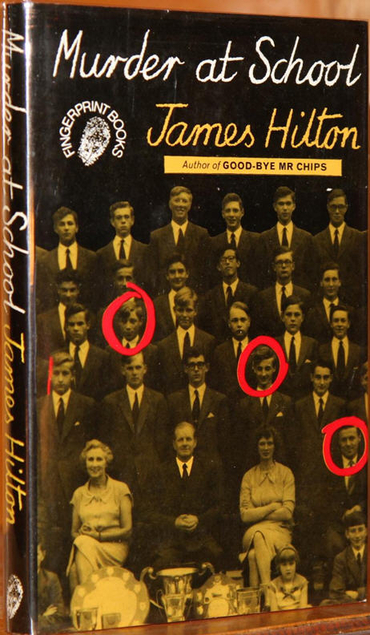
Murder At School (US title: Was It Murder?) - While at Oxford, Colin Revell dabbled in amateur detection, winning a reputation of sorts by tracing a valuable manuscript that had gone missing. Now, some years later, a dilettante-ish young man who dabbles in journalism and literature, Revell is flattered to receive a letter from the headmaster of his former school, Oakington, recalling that early triumph and asking him to look into another mystery. He finds Dr Roseveare to be a new sort of headmaster from the kind he is accustomed to - not a clergyman, for one thing, and an administrator rather than an academic. Roseveare explains that a boy at the school, Robert Marshall, was tragically killed when a heavy gas-fitting gave way and fell onto his bed. At the time the coroner's verdict was "Accidental Death". However, while packing up the boy's things under instructions from his guardian, who is in India, Roseveare discovered a childish will beginning, If anything happens to me---, and began to wonder what put the thought of dying into his mind... Encouraged to poke around, Revell learns that the housemaster of the dormitory where Marshall was killed, Thomas Ellington, is also his cousin - and, after an elder brother, heir to the money held in trust for him. Revell takes a dislike to Ellington, finding him bad-tempered and aggressive, and harsh towards his pretty young wife. In spite of a few suggestive circumstances, Revell finds no evidence of murder---yet he is rather chagrined when Roseveare not only agrees, but apologises for overreacting and wasting his time. Taking the hint, Revell returns to London---where, three months later, a short newspaper report informs him that Wilbraham Marshall, the surviving brother, has also died in a bizarre accident at the school, apparently from head injuries sustained after diving into an empty swimming-pool in the dark...
Though his greatest success was yet to come, by 1932 James Hilton was an established and popular mainstream author, which may or may not account for the fact that his only venture into the realm of detective fiction was originally published under the pseudonym "Glen Trevor". In Murder At School, Hilton comments via Colin Revell that, "England expects that every young man some day will write a novel"; in the 1920s and 1930s, it might have been more accurate to say, "That every author will sooner or later write a mystery." Yet the very fact that Hilton was not a mystery writer and, apparently, had only a passing interest in the genre, gives an interesting tone to Murder At School, which is simultaneously an engaging mystery, and a critique of the British passion for the amateur detective. There is an underlying note of burlesque to the characterisation of Colin Revell, a clever young man - though not nearly so clever as he thinks he is - who fancies himself as a real-life version of that beloved fictional construct, the casual dabbler who nevertheless shows up the professional detective. Revell is interestingly handled by Hilton: if the reader was asked to take him at his own estimation, he would be intolerable; but instead his overconfidence, which simply begs to be punctured, generally is; while his various (and not infrequent) blunders are presented in a detached manner that makes him sympathetic. But at the same time, Revell is not wholly a failure as a detective; he does make some contributions towards the solving of Wilbraham Marshall's murder - which is, in time, proved unmistakeably to be murder. It's just that he has an unfortunate tendency to be distracted from the matter at hand---particularly by a pretty face...
The death of Wilbraham Marshall sends Revell flying back to Oakington, where he is confused and annoyed by the shift in attitude of Dr Roseveare who, after getting into a panic over what was almost certainly an accident, now seems strangely blasé about what might well be murder. It is presumed that the dead boy, on the eve of a swimming-display, slipped into the swimming pavilion in the dark to have some private practice. Revell, however, visiting the pavilion in the dark, realises instantly the visual and aural difference between a full and an empty pool; the boy could not have made such a mistake. Why, then, was he on the diving-platform from which he apparently jumped - or fell? On the basis of the testimony of the school doctor, who examined the body, the verdict is again "Accidental Death", but not for long: in the course of his own poking and prying, Revell encounters another man on the same mission---Inspector Guthrie of Scotland Yard, who tells him that the verdict was arranged for, and that on the strength of evidence found (he declines to say what), the boy's body was exhumed and properly autopsied. The cause of death was not head injuries, but a bullet in the brain, which the crushing of the skull succeeded in disguising. A third death follows hard upon this revelation, one which affects Revell personally. One of the schoolmasters, Max Lambourne, who suffered ill-health due to war injuries and shell-shock, is found dead of an overdose. A deeply distressed Mrs Ellington, a close friend of Lambourne, tells the police that he confessed to her the night before and that his death must be suicide. Revell, who had also befriended Lambourne, is shocked and sickened by this outcome. His only thought is to get away from Oakington as quickly as possible---until he meets Geoffrey Lambourne, who convinces him that his brother, too, is a victim...
"What evidence have you?" said Lambourne.
"None that would stand a moment's examination in a court of law. None at all, really. Just the coincidence of the two accidents, and the Head's puzzling attitude, and my own feeling about it. It's all queer, to say the least."
"As you say, to say the least. Why not say a little more and call it a double murder committed with diabolical ingenuity?"
"What?" Revell gasped. "I suppose you're joking---"
"Not at all. As a mere matter of theory, isn't it possible? Isn't the really successful murder not merely the one whose perpetrator never gets found out, but the murder that doesn't even get suspected of being a murder?"

108rosalita
Thanks for the link to Contango, Liz. I downloaded it to my Kobo. Looking forward to it.
And congrats on finishing your April reviews again. :-)
And congrats on finishing your April reviews again. :-)
109lyzard
I'll be interested to hear what you think of it, Julia.
Yes, AGAIN. :D
(Wow, spammed; is that a mark of success??)
Yes, AGAIN. :D
(Wow, spammed; is that a mark of success??)
110rosalita
And to think at the beginning of the year you said you don't get many visitors! Now you are up to Thread #4 and you are getting spammed. You must be doing something right.
111AuntieClio
Nothing to say, just "hullo."
112lyzard
>110 rosalita: Whatever it is, if it's going to lead to spam perhaps I should stop!? :)
>111 AuntieClio: Hi, Steph - "hullo" is just fine!
>111 AuntieClio: Hi, Steph - "hullo" is just fine!
113lyzard
Finished Pietr-le-Letton for TIOLI #10.
Now reading The Best Circles: Society, Etiquette And The Season by Leonore Davidoff.
Now reading The Best Circles: Society, Etiquette And The Season by Leonore Davidoff.
114CDVicarage
I started with the famous James Hilton novels - Goodbye Mr Chips and Lost Horizon and now I'm working my way, slowly, through the others. Only Random Harvest so far but I have the others on my kindle ready. I was fooled by the alternative titles so there aren't quite as many as I first thought!
115lyzard
Hi, Kerry! Of course I did the reverse. :) Although he was popular through the 1920s Hilton became a bestseller in 1933 with Lost Horizon.
Alternative titles---AAAAAAAAARRRRRGGGGGHHHHH!!!!! {*tears hair, froths at mouth*}
Alternative titles---AAAAAAAAARRRRRGGGGGHHHHH!!!!! {*tears hair, froths at mouth*}
116lyzard
Finished The Best Circles: Society, Etiquette And The Season for TIOLI #5.
Now reading Conjure Wife by Fritz Leiber.
Now reading Conjure Wife by Fritz Leiber.
117lyzard
The three stray Father Brown stories, all of which deal with false identity and the use of a position of unassailable respectability to commit a serious crime:
The Donnington Affair (1914) - This is a confusing story, thanks to its origins. Sir Max Pemberton published the opening of it in Premiere magazine, inviting other writers to solve the mystery described. G. K. Chesterton responded by turning it into a Father Brown story. However, he kept on with Pemberton's oblique, "insider" style, so that on a first reading it is hardly clear that a murder has been committed, far less why - or even who. A second reading reveals a tangled tale of wrongful imprisonment, the ties of blood and love, and murder in the family.
The Mask Of Midas (1936) - A fish-out-of-water young American is suspected of illegal doings from behind the façade of a curiosity shop, so it is not surprising that the authorities are keeping an eye on him. What is surprising - at least to Inspector Beltrane and Father Brown, who witness the scene and know the usually taciturn man well - is that the Chief Constable, Colonel Grimes, chooses to announce his suspicions loudly, in the middle of the street, as well as his intention of gaining the two magistrates' signatures needed for a search warrant. It soon becomes clear to Father Brown that it is actually one of the magistrates who has aroused the Colonel's suspicions, and that this is his way of throwing up a smokescreen; but it takes the insight of the priest to unmask two masqueraders...
The Vampire Of The Village (1936) - When Father Brown accompanies his friend Dr Mulborough to the isolated village of Potter's Pond, populated by elderly spinsters, retired admirals, and a clergyman with lofty notions, he gets a strange feeling that he has been transported back into the 19th century. Some time previously an extravagantly dressed man named Maltravers was apparently beaten to death by a disgruntled local. Malborough confides that the injuries couldn't have killed him, and that he is to oversee an exhumation conducted on suspicion of poison. In the wake of Maltravers' death, his widow took up residence in the village and, in her own right and because she is an actress, becomes the focus of gossip and scandal - being suspected in particular of bleeding the parson's son dry. Father Brown makes it his business to meet as many of the villagers as possible - and finally points an accusing finger in the most unlikely direction...
*********************************
You might remember that when I reviewed The Scandal Of Father Brown, The Vampire Of The Village was praised in its introduction as the strongest of the stories - even though it did not happen to be contained in that particular edition. (D'oh!) Having now read it, I agree that it is easily the three best of these (mostly) uncollected stories, though I have to confess that I enjoyed it for reasons unrelated to the story itself:
On the back of trying to get my head around the 19th century High Church / Low Church divisions, partly because of the Barchester books and partly because of my grim tussles with a couple of religious / didactic novels of opposing philosophy, William Leslie; or, A Tale Of The Last Ten Years and Steepleton; or, High Church And Low Church, I was greatly amused to find that The Vampire Of The Village turns on just this point. The guilty party is the parson - or "parson". Father Brown spots him as an imposter at once, because although supposedly High Church, he spouts Low Church doctrine. Outsiders may think that one clergyman is very like another, but of course the priest knows better...
The Donnington Affair (1914) - This is a confusing story, thanks to its origins. Sir Max Pemberton published the opening of it in Premiere magazine, inviting other writers to solve the mystery described. G. K. Chesterton responded by turning it into a Father Brown story. However, he kept on with Pemberton's oblique, "insider" style, so that on a first reading it is hardly clear that a murder has been committed, far less why - or even who. A second reading reveals a tangled tale of wrongful imprisonment, the ties of blood and love, and murder in the family.
The Mask Of Midas (1936) - A fish-out-of-water young American is suspected of illegal doings from behind the façade of a curiosity shop, so it is not surprising that the authorities are keeping an eye on him. What is surprising - at least to Inspector Beltrane and Father Brown, who witness the scene and know the usually taciturn man well - is that the Chief Constable, Colonel Grimes, chooses to announce his suspicions loudly, in the middle of the street, as well as his intention of gaining the two magistrates' signatures needed for a search warrant. It soon becomes clear to Father Brown that it is actually one of the magistrates who has aroused the Colonel's suspicions, and that this is his way of throwing up a smokescreen; but it takes the insight of the priest to unmask two masqueraders...
The Vampire Of The Village (1936) - When Father Brown accompanies his friend Dr Mulborough to the isolated village of Potter's Pond, populated by elderly spinsters, retired admirals, and a clergyman with lofty notions, he gets a strange feeling that he has been transported back into the 19th century. Some time previously an extravagantly dressed man named Maltravers was apparently beaten to death by a disgruntled local. Malborough confides that the injuries couldn't have killed him, and that he is to oversee an exhumation conducted on suspicion of poison. In the wake of Maltravers' death, his widow took up residence in the village and, in her own right and because she is an actress, becomes the focus of gossip and scandal - being suspected in particular of bleeding the parson's son dry. Father Brown makes it his business to meet as many of the villagers as possible - and finally points an accusing finger in the most unlikely direction...
*********************************
You might remember that when I reviewed The Scandal Of Father Brown, The Vampire Of The Village was praised in its introduction as the strongest of the stories - even though it did not happen to be contained in that particular edition. (D'oh!) Having now read it, I agree that it is easily the three best of these (mostly) uncollected stories, though I have to confess that I enjoyed it for reasons unrelated to the story itself:
118AuntieClio
>117 lyzard: Liz, that reminded me of this. Emo Phillips' "Once I was in San Francisco." It's a long buildup to a heretical punchline, which I find very amusing.
119lyzard

Holidays At Roselands (reissue title: Elsie's Holidays At Roselands) - I'm going to take this first sequel in Martha Finley's Elsie Dinsmore series in parts, and out of order. Overall this entry gives the impression that Miss Finley wrote continuously, and that her publisher chopped the result up into appropriate lengths without much consideration given to dramatic rhythm: this book starts in the middle of one scene, Elsie waking up after crying herself to sleep over the distant prospect that her father might marry the objectionable Miss Stevens, and ends in the middle of another, Elsie out for a walk with her father and the anything but objectionable Miss Rose Allison. The back end of the book deals first with Elsie and Horace moving out of the family home and into a house of their own, but also features them travelling extensively in the North for Elsie's health. Otherwise, it's pretty much business as usual, with creepy Mr Travilla lurking on the sidelines (
Also to be fair, there are a couple of genuinely nice touches in this book - including a scene in which Elsie actually behaves like a normal little girl for once, taking off her shoes and stockings, playing in a brook, and getting her dress dirty. If there was more of this, Elsie would be easier to swallow. There's also a visit to the home of the Allison family who, despite being this series' other model Christians (and therefore presumably doing something right), are as bemused and bothered by Horace Dinsmore's smotheringly rigid parenting as everybody else. Mr Allison, head of a numerous family, observes drily that controlling every aspect of your child's life may be feasible when she's the only one, but by the time the eighth or ninth has appeared, it's all too much trouble...
Though on the whole Holidays At Roselands continues its predecessor's refusal to acknowledge that its perfect little Christian is a slave-owner, we get two scenes in this book where Elsie visits "the quarter", and another when the white folks look on at "the negroes' dinner" one Christmas. What caught my attention, though, was the carefully worded description, or non-description, of Horace and Elsie's new home, which is indeed called "a plantation". We hear what lies on three sides of the house - the sea, the woods, a garden; presumably the fourth side is occupied by something literally unmentionable.
Most of Holidays At Roselands, however, is taken up with Elsie's ongoing struggle to please both her father and Jesus, a conflict which by this point has developed into a sort of sick love-triangle, with Horace profoundly resenting the "other man" in Elsie's life. Horace Dinsmore, we gather, is the kind of Christian who absorbs one particular precept that happens to suit him, in this case the 5th Commandment, and ignores all the others that don't. When Elsie fearfully but steadfastly makes it clear to him that Jesus comes first, Horace goes berserk.
In fact, what Martha Finley does in Holidays At Roselands is take the notorious piano scene from Elsie Dinsmore and expand it to novella length. This time, the bone of contention is Elsie's refusal to read a novel to her father on a Sunday. Horace is outraged by this piece of disobedience, and makes up his mind that Elsie must be broken down into a state of utter subjection to his will.
Now---I want to be clear that I do understand what Martha Finley is doing here: I understand that Elsie is supposed to lead her father to Jesus; that her sufferings are supposed to wean her off earthly connections and teach her to lean on God alone. I get that; I do.
The trouble is, Finley's attempt to describe an eight-year-old girl clinging heroically to her faith manifests as 100 straight pages of child abuse. Horace Dinsmore wields both the carrot and the stick here, tempting Elsie with what she wants most desperately, the two of them to have a home of their own, and punishing her consecutively with withdrawal of his love / approval / company, confinement to her room, arranging for the silent treatment from the family, forbidding her all treats, stopping her correspondence with Miss Rose, threatening to send her to boarding-school - or worse - and separating her from Aunt Chloe (her "mammy", who raised her after her mother's death); all of it punctuated by reminders, first in person, then by letter or message, that all she has to do is give in... The cumulative effect of all this psychological torture is to make the reader wish Horace would follow through on his overarching threat and simply beat Elsie into submission. It would be a lot less painful.
I should be ashamed to admit, I suppose, that in the midst of all these horrors---and it is horrifying to read---I found something to laugh at. Perhaps the most diabolical of all Horace's twisted punishments is when he commands Elsie to stop crying; as you might anticipate, she doesn't quite manage to obey him. And finally, in light of all the inter-factional religious brawling that has been such a feature of my blog reading for the past few years, I couldn't help giggling when, having failed to break Elsie by all other means, Horace finally threatens her with---Catholicism!!
"He says that if you continue obdurate, he has quite determined to send you to a convent to be educated."
As Adelaide made this announcement, she pitied the child from the bottom of her heart; for she knew that much of Elsie's reading had been on the subject of Popery and Papal Institutions; that she had pored over histories of the terrible tortures of the Inquisition and stories of martyrs and captive nuns, until she had imbibed an intense horror and dread of everything connected with that form of error and superstition. Yet, knowing all this, Adelaide was hardly prepared for the effect of her communication.
"Oh, Aunt Adelaide!" almost shrieked the little girl, throwing her arms around her aunt's neck, and clinging to her, as if in mortal terror, "save me! save me!"
This is the final blow for Elsie: she finally collapses under the weight of her mental suffering, into a state of fever and delirium so severe that her doctor begins to fear for her life. Horace has taken himself off before this as part of his punishment regime, and Adelaide must send frantic letters after him, warning him that if he does not come at once, he may never see his daughter alive again. He comes in time, but...
The doctor...suddenly laid his finger on her pulse for an instant; then turned to his fellow-watchers with a look that there was no mistaking...
And so---albeit a tad belatedly, perhaps---Elsie's prayers are answered. In the wake of this tragedy the scales fall from Horace's eyes. He sees his sinfulness and cruelty for what it is, and Elsie's steadfast faith for what that is, and so finds his way to Jesus...
And then Elsie gets better.
Yes, you heard me: Elsie Dinsmore dies...and then rises again.
Hmm...
There was silence for a moment, and then her father said: "Elsie, I expect from my daughter entire, unquestioning obedience, and until you render it, I shall cease to treat you as my child. I shall banish you from my presence, and my affections. This is the alternative I set before you. I will give you ten minutes to consider it. At the end of that time, if you are ready to obey me, well and good---if not, you will leave this room, not to enter it again until you are ready to acknowledge your fault, ask forgiveness, and promise implicit obedience in the future."
A low cry of despair broke from Elsie's lips, as she thus heard her sentence pronounced in tones of calm, stern determination; and, hiding her face on the bed, she sobbed convulsively.
121SandDune
I found this as an aside on my revision forum and thought of you:
http://www.theguardian.com/books/interactive/2014/may/09/reading-gothic-novel-pi...
http://www.theguardian.com/books/interactive/2014/may/09/reading-gothic-novel-pi...
124kiwiflowa
Hi Liz, popping in to say hi and thank you!
I just read Persuasion, the only novel of Austen that I hadn't read and had been putting off for years, I read it in one day it was so wonderful (I'm gushing because Austen is awesome). The reason why I'm thanking you is that I found your tutored read from 2012 with Ilana and read it along with the book. It was truly fantastic to have that kind of resource available and added a lot of pleasure to the reading experience.
I just read Persuasion, the only novel of Austen that I hadn't read and had been putting off for years, I read it in one day it was so wonderful (I'm gushing because Austen is awesome). The reason why I'm thanking you is that I found your tutored read from 2012 with Ilana and read it along with the book. It was truly fantastic to have that kind of resource available and added a lot of pleasure to the reading experience.
126Smiler69
>124 kiwiflowa: Lisa, so cool that you referred to our tutorial thead! I'm really happy when those become reference tools for others to benefit from. I'm slowly rereading the JA canon more or less in publication order, so when I get back to Persuasion I'll probably refer to that thread again too. Still waiting on Liz to say when she'd be happiest to cover Mansfield Park with me... *not so subtle hint!* :-)
127kiwiflowa
I also wanted to thank you Ilana as you asked the exact same questions I had about the text, and a lot I didn't think about but should have. The Henry and Emma reference (and all the poem references) especially I was just too keen to keep going with the book to bother looking up - but you guys had done it for me!
Persuasion is my favourite Austen now I think. I love that the main character wasn't a young 18-20 year old but a mature woman. I love how even though her earlier decision made her unhappy she didn't think she had made the wrong decision and spoke up and said that! I love that the end of the book implied that Anne wouldn't have a happy life if another war started (did it?). I watched the 2007 movie straight after last night and was really happy with the pick of actor for Anne and the portrayal (and her father Sir Walter! spot on!) but wasn't happy about how they changed and reorganised key scenes.
I have a soft spot for Mansfield Park as I first read it when I was about 12 on holiday and didn't know that it was an adult classic by the great and mighty Austen (the main protagonist is a child at the beginning of the novel). A lot of it did go over my head at that age, the second half especially, but I still finished it and liked it. (I now really want to reread Mansfield Park, Emma and Sense and Sensibility).
Persuasion is my favourite Austen now I think. I love that the main character wasn't a young 18-20 year old but a mature woman. I love how even though her earlier decision made her unhappy she didn't think she had made the wrong decision and spoke up and said that! I love that the end of the book implied that Anne wouldn't have a happy life if another war started (did it?). I watched the 2007 movie straight after last night and was really happy with the pick of actor for Anne and the portrayal (and her father Sir Walter! spot on!) but wasn't happy about how they changed and reorganised key scenes.
I have a soft spot for Mansfield Park as I first read it when I was about 12 on holiday and didn't know that it was an adult classic by the great and mighty Austen (the main protagonist is a child at the beginning of the novel). A lot of it did go over my head at that age, the second half especially, but I still finished it and liked it. (I now really want to reread Mansfield Park, Emma and Sense and Sensibility).
128lyzard
England and America had a largely naval war between 1812 and 1815, over a variety of things including control of the Great Lakes, so it is likely Wentworth would have been involved in that. After 1815 conflicts became more sporadic but there were various naval expeditions mounted for different purposes.
So Anne's "quick alarm" as a naval wife was warranted.
We will be doing a tutored read of Mansfield Park later on in the year...or SO I'M TOLD. :)
So Anne's "quick alarm" as a naval wife was warranted.
We will be doing a tutored read of Mansfield Park later on in the year...or SO I'M TOLD. :)
130casvelyn
Still waiting on Liz to say when she'd be happiest to cover Mansfield Park with me... *not so subtle hint!* :-)
I second the motion!
I second the motion!
132lyzard
Finished The Heart Of Princess Osra for TIOLI #2.
Now reading Thirty Clocks Strike The Hour And Other Stories by Vita Sackville-West.
Now reading Thirty Clocks Strike The Hour And Other Stories by Vita Sackville-West.
133rosalita
Howdy, Liz! Glad to see you've finished off Father Brown — er, so to speak. I've still not gotten back to The Man Who Knew Too Much after starting it a few months ago. For some reason it just wasn't holding my attention, but I'll give it another try someday.
134souloftherose
Hi Liz!
I know you're not really looking at French detective novels at the moment but I saw this article about a possible inspiration for Sherlock Holmes and thought you might be interested.
>73 lyzard: Enjoyed your reviews as always. Victorian People And Ideas has gone on the wishlist.
>74 lyzard: And you've reminded me that I really need to read Mary Roberts Rinehart.
>85 lyzard: :-)
>90 lyzard: Dang it! Your dastardly plan to make me start another series has worked! *wonders if she can squeeze in the first Maigret book this month*
>97 lyzard: & >100 rosalita: *snork*
>105 lyzard: Bother, Murder at School also sounds interesting.
>119 lyzard: Liz, I don't know whether to be impressed or horrified that you subjected yourself to another Elsie Dinsmore book. I don't think I could stand it. Your review was very entertaining though!
>73 lyzard: Enjoyed your reviews as always. Victorian People And Ideas has gone on the wishlist.
>74 lyzard: And you've reminded me that I really need to read Mary Roberts Rinehart.
>85 lyzard: :-)
>90 lyzard: Dang it! Your dastardly plan to make me start another series has worked! *wonders if she can squeeze in the first Maigret book this month*
>97 lyzard: & >100 rosalita: *snork*
>105 lyzard: Bother, Murder at School also sounds interesting.
>119 lyzard: Liz, I don't know whether to be impressed or horrified that you subjected yourself to another Elsie Dinsmore book. I don't think I could stand it. Your review was very entertaining though!
135lyzard
>133 rosalita:
Thanks, Julia! It was nice to properly wrap up a series, though I'm sad to report that as a mere five books, it remains the longest I've managed to wrap up.
>134 souloftherose:
Hi, Heather! Hope you had a lovely holiday. :)
Thank you for that link. I know there's a lot of important French works out there but so few have been translated it all seems like a can of worms I do not need to be opening. A one-off work in translation, however, is another matter... (Apropos, I keep meaning to get to Eugene Sue's Mysteries Of Paris, but for some reason it ends up slipping off the TBR...)
So three book bullets in one batch of reviews? {Monty Burns} "Excellent!" {/Monty Burns}
If you can find a copy of Pietr-le-Letton, it's a short read, though quite intense.
Ah, dear Elsie... Every now and then I get an impulse. Invariably I regret it. :D
Thanks, Julia! It was nice to properly wrap up a series, though I'm sad to report that as a mere five books, it remains the longest I've managed to wrap up.
>134 souloftherose:
Hi, Heather! Hope you had a lovely holiday. :)
Thank you for that link. I know there's a lot of important French works out there but so few have been translated it all seems like a can of worms I do not need to be opening. A one-off work in translation, however, is another matter... (Apropos, I keep meaning to get to Eugene Sue's Mysteries Of Paris, but for some reason it ends up slipping off the TBR...)
So three book bullets in one batch of reviews? {Monty Burns} "Excellent!" {/Monty Burns}
If you can find a copy of Pietr-le-Letton, it's a short read, though quite intense.
Ah, dear Elsie... Every now and then I get an impulse. Invariably I regret it. :D
136kiwiflowa
awww poor Anne - North America is so far away too unless she went with him? Need to find some fan fiction to read what could have happened next! Mansfield Park tutorial I'll happily lurk and read along - I'll make sure to get a copy of Mansfield Park ready to go....
137lyzard
Unlikely if he was going into a war situation. Officers could sometimes take their families if they were being posted to a certain area for any length of time, but not if they were going directly into a conflict.
I'll make sure to get a copy of Mansfield Park ready to go....
No hurry! Seriously, no hurry...
I'll make sure to get a copy of Mansfield Park ready to go....
No hurry! Seriously, no hurry...
138lyzard
Finished Thirty Clocks Strike The Hour And Other Stories for TIOLI #16.
Now reading Haunted Lady by Mary Roberts Rinehart.
Now reading Haunted Lady by Mary Roberts Rinehart.
142lyzard
Finished Haunted Lady for TIOLI #20.
And now I guess I'm not reading anything, because I started The Gods Arrive by Edith Wharton, and then found out that it is a sequel - GARRRRRRR!!!!!!
Fortunately my academic library has a copy of Hudson River Bracketed, so now it's just a question of whether I get a chance to slip out of work...
And now I guess I'm not reading anything, because I started The Gods Arrive by Edith Wharton, and then found out that it is a sequel - GARRRRRRR!!!!!!
Fortunately my academic library has a copy of Hudson River Bracketed, so now it's just a question of whether I get a chance to slip out of work...
143rosalita
Oh dear, i hope you hadn't gotten too far in the Wharton book. Also that you can get yourself to the library t get the one you need. Can you run an errand for your boss or something? :-)
144lyzard

Have His Carcase - Two years after her acquittal on a charge of murder, mystery novelist Harriet Vane continues to hold Lord Peter Wimsey at arm's-length while she focuses upon her career, to which her notoriety has been a boost. Combining a solitary walking holiday in the south of England with an effort to finish her latest book, after a post-lunch doze in an isolated cove Harriet continues her walk along the shore, passing around a rocky point and into the adjoining bay. At the far end of it she sees a large angled rock jutting out of the water; curiously, a man seems to be asleep upon it. But as she draws near, Harriet sees that he is not asleep at all... Realising that before long the rising tide will cover the rock and sweep the body away, Harriet steels herself to investigate the scene. The man's throat has been cut; his blood is still running over the edge of the rock. Harriet recovers a razor from the water below, photographs both the dead man and the single row of footprints along the sand, and takes several items from his accessible pockets before hurrying away to find help. This proves an exasperatingly difficult and time-consuming task, as none of the nearby cottages have a phone and few people are at home in the middle of the day. Hours later she finds a small village from where she calls the police. Then, realising that she can either wait to be exposed or pre-empt the inevitable, Harriet calls the newspapers... Word that "your Miss Vane" is involved in another murder sends Lord Peter headlong to the seaside resort of Wilvercombe, where Harriet is staying. He finds the local police inclining to a theory of suicide, which is not unexpected: since the victim's blood was still liquid when Harriet found him, he could not have died more than scant minutes before she rounded the point - and she saw no-one. It becomes clear, however, that the dead man went to considerable effort to reach the rock---why, if he meant to kill himself? And why was he wearing gloves? Would a man with a permanent beard even own a razor? - and would he go to the trouble of converting pounds into gold first? All of Lord Peter's instincts cry murder, but he knows that this theory brings danger with it, because apart from the dead man the only person definitely on the scene was Harriet...
The eighth entry in Dorothy L. Sayers Lord Peter Wimsey series, Have His Carcase is a curious book. In many ways it is kissing cousins to the hair-tearingly complicated Five Red Herrings, in that it devotes endless pages to scenes of its detectives going over and over the same ground, picking apart alibis and trying to determine how anyone could have committed murder in what the evidence suggests was no more than a five-minute window - and then get away without leaving a trace of having been there. On top of this we have what everyone seems to agree is far too much time given over to the cracking of a coded letter prepared using the Playfair cipher: the explanation for how this cipher works is fine, but we didn't need to go through every tiny step in the decoding of the letter. (It seems that Dorothy Sayers needed help with this aspect of her novel from John Rhode, who gets both an acknowledgement and a name-check in the text.) Another slightly uncomfortable aspect to Have His Carcase is the back-story of the victim, Paul Alexis, who, it appears, had delusions of grandeur about his connection to the overthrown Russian aristocracy - or were they delusions? - and when his distraught fiancée suggests that he was targeted by the Bolsheviks, everyone's first impulse is to roll their eyes. This in an amusingly meta-moment from Sayers, who was perfectly well aware of the prevailing tendency of English mystery and thriller writers at the time to treat this subject matter jokily, or at best use it as a MacGuffin. But on the other hand, there really were displaced Russian aristocrats, and there really were Bolsheviks: "My God! Shall I be reduced, at my time of life, to hunting for a Boshevik gang?" comments Lord Peter bemusedly when it turns out that Mrs Weldon, the fiancée, just might have been right after all. Nor is this the only meta-moment: we also find Harriet Vane trying to think like her fictional detective, Robert Templeton - and discovering just how much authorial assistance Templeton usually gets.
And yet despite these difficulties and detours, Have His Carcase is a consistently engaging novel. As a work of detective fiction, its main strength is that it is, effectively, a "locked-room mystery"...but one in which the murder is committed right out in the open, and in the middle of the day, and under circumstances that make it next to impossible that it should have been committed at all. Otherwise, the charm of this novel lies, of course, in the fact that, wound all the way through the alibi-testing and the code-breaking and even the hunt for Bolsheviks, we have the tense dynamic between Lord Peter and Harriet, who truthfully do rather better as collaborating detectives than as potential romantic partners. The conditions under which they are reunited serve chiefly to rebuild walls that Lord Peter has been very patiently trying to tear down. Harriet is quick to realise both that her improbable discovery of the body makes her the prime suspect, and that she owes the forbearance of the police to the intervention of Lord Peter. Still carrying the emotional scars of her earlier ordeal, and mortified at finding herself once more having to rely upon Lord Peter's protection, Harriet raises her defences, and keeps them up; though of course, she's grateful... Lord Peter, meanwhile, having spent two years in an unavailing battle against Harriet's mixed emotions and sensitivity, has learned to hate the very sound of the word "gratitude". It's just as well, really, that the two of them have a murder to investigate...
Or do they? The spectre of suicide never entirely recedes, but there is no question that there was one person, at least, who stood to benefit enormously from the death of Paul Alexis. Displaced arisocrat or not, Paul was earning a living as a professional dancer - and, possibly, a gigolo - at a Wilvercombe hotel when he attracted the attention of Mrs Weldon, a widow more than twenty years his senior. She, having found romance after a lifetime of disappointment, is oblivious to any possible objections - including those of her son, Henry, who stood to lose the inheritance he had always counted upon. When it is revealed that Henry Weldon, who supposedly came to town after the murder to support his grieving mother, was in Wilvercombe beforehand under a false identity and keeping his eye upon her, he seems a ready-made suspect - except that when his movements are accounted for, there simply could not have been time for him to reach the scene of the crime. Other suspects do appear, although none so satisfactory: the girl Paul Alexis broke with to take up with Mrs Weldon - but who is not the girl in the photograph in his pocket; a depressed itinerant barber proved to have had the razor in his possession; and a jittery back-packer who Harriet encounters soon after her discovery of the body, and who slips away as soon as the police are mentioned. When it turns out that Henry Weldon is not the only one masquerading under a false identity, Lord Peter is forced to call upon a variety of resources - the theatrical agent, Isaac Sullivan, for one, and his manservant, Bunter, for another, who proves a simply brilliant surveillance man. Yet again and again, alibis block the road; and while they may have been faked, breaking them down is no easy matter. At length Lord Peter notices something strange about those alibis: they all seem to focus upon a time earlier in the day; as if the killer, or killers, didn't know when the murder was committed...
There was a strained pause, while Wimsey painfully recalled the terms of the message that had originally reached him from Salcombe Hardy of the Morning Star - Hardy, a little drunk and wholly derisory, announcing over the telephone, "I say, Wimsey, that Vane woman of yours has got herself mixed up in another queer story." Then his own furious and terrified irruption into Fleet Street, and the violent bullying of a repentent and sentimental Hardy, till the Morning Star report was hammered into a form that set the tone for the comments of the press. Then the return home to find that the Wilvercombe police were already besieging him, in the politest and most restrained manner, for information as to Miss Harriet Vane's recent movements and behaviour. And finally, the certainty that the best way out of a bad situation was to brazen it out - Harriet's word - even if it meant making a public exhibition of his feelings, and the annihilation of all the delicate structure of confidence which he had been so cautiously toiling to build up between this scathed and embittered woman and himself.
He said nothing, but watched the wreck of his fortune in Harriet's stormy eyes...
145lyzard
>143 rosalita: Hi, Julia! No, only a chapter or two - it's just disappointing because obviously the opening of The Gods Arrive is set up at the end of Hudson River Bracketed.
But on the upside, I get to read two Wharton Virago instead of one.
It's a day studded with meetings, so hopefully everyone will be so busy preparing that I can sneak out unnoticed in between... :)
But on the upside, I get to read two Wharton Virago instead of one.
It's a day studded with meetings, so hopefully everyone will be so busy preparing that I can sneak out unnoticed in between... :)
148lyzard
You shouldn't encourage me. :)
It is a chunkster, though - I wouldn't have wanted to pick it up any later, if I'm supposed to have it done by the end of May.
It is a chunkster, though - I wouldn't have wanted to pick it up any later, if I'm supposed to have it done by the end of May.
149rosalita
You are the last person to be complaining about someone else enabling a reading habit, Miss Liz! Many's the warble I've listened to from you, so I think turnabout's more than fair play. :-)
151rosalita
Well, let's see. There's Georgette Heyer, of course, who I had never read and probably never would have without hearing about her from you. There's your inspiring me to dive back into Agatha Christie after not having read any for years and years. There's Ill Wind or Contango or whatever the hell it's called, which I've downloaded based on your review. I'm sure I could come up with more examples of your warbling. :-)
OH! And the sloths! You are the sloth warbler, for sure.
OH! And the sloths! You are the sloth warbler, for sure.
152souloftherose
Waving to the sloth warbler! And just to say I have the new Penguin translation of Pietr the Latvian on my kindle which I'm pretty sure I will get to before the end of the month.
I enjoyed Have His Carcase and the inverse locked room mystery. I was going to comment on how different it would be today with mobile phones but even staying near a very large town in the South of England earlier this month it was still really difficult to get a signal a lot of the time.
I enjoyed Have His Carcase and the inverse locked room mystery. I was going to comment on how different it would be today with mobile phones but even staying near a very large town in the South of England earlier this month it was still really difficult to get a signal a lot of the time.
153casvelyn
Is a sloth warbler anything like a dog whisperer?
Also, my brother was 10 feet away from a sloth at a zoo in Lima, Peru, and DIDN'T TAKE A PICTURE!!!
Also, my brother was 10 feet away from a sloth at a zoo in Lima, Peru, and DIDN'T TAKE A PICTURE!!!
154Smiler69
You remind me I'm much overdue for some Dorothy L. Sayers. I've really enjoyed the first 3 books in the Peter Wimsey series and in fact have them all in my tbr, including two collections from Folio. Next one up for me is Lord Peter Views the Body which as you probably know is a short story collection, and I don't know why I didn't think of this sooner, but of course I could fit in a short story here and there between other things... off to add the book to my bedside pile! :-)
155CDVicarage
>144 lyzard: I enjoyed Have his carcase recently but I did skip over the code breaking!
156lyzard
>151 rosalita: Sloth warbler! I can definitely live with that! :D
>152 souloftherose: Ooh, another shared read - excellent! I was wondering whether I could fit Friday's Child in before the end of the month, but I don't think it's going to happen.
Re: Have His Carcase, having read a lot of English mysteries and thrillers from the 20s and 30s, I was very entertained by the fact thatthe whole "lost Russian aristocrat" thing turned out to be true to the point of giving him haemophilia! Talk about a double bluff!
Oh, the mobile phone! - the bane of modern mystery and horror writers! I wish I had a dollar for every recent horror film I've seen that includes a no signal / battery dead / broken phone scene. :)
>153 casvelyn: BROTHERS!!??
A sloth warbler is someone who uses pictures of sloths to draw visitors to her thread. :)
>154 Smiler69: Like a lot of short story collections, Lord Peter Views The Body is a bit of a mixed bag - and actually, probably best taken in small doses - but we do have the pleasure of meeting Peter's nephew. :)
>155 CDVicarage: While I, naturally, felt compelled to read every word. {*grits teeth*}
>152 souloftherose: Ooh, another shared read - excellent! I was wondering whether I could fit Friday's Child in before the end of the month, but I don't think it's going to happen.
Re: Have His Carcase, having read a lot of English mysteries and thrillers from the 20s and 30s, I was very entertained by the fact that
Oh, the mobile phone! - the bane of modern mystery and horror writers! I wish I had a dollar for every recent horror film I've seen that includes a no signal / battery dead / broken phone scene. :)
>153 casvelyn: BROTHERS!!??
A sloth warbler is someone who uses pictures of sloths to draw visitors to her thread. :)
>154 Smiler69: Like a lot of short story collections, Lord Peter Views The Body is a bit of a mixed bag - and actually, probably best taken in small doses - but we do have the pleasure of meeting Peter's nephew. :)
>155 CDVicarage: While I, naturally, felt compelled to read every word. {*grits teeth*}
157lyzard
I have finished blogging The Adventures Of Miss Sophia Berkley, a proto-Gothic novel from 1760 which I read last month:
Part 1 - here.
Part 2 - here.
Part 1 - here.
Part 2 - here.
158Cobscook
>119 lyzard: What a fantastic review of what sounds like a dreadful book! I assume this was written for children too? Horrifying!
I'd love to read along with a tutored read of Mansfield Park.... Just sayin'..... :)
I'd love to read along with a tutored read of Mansfield Park.... Just sayin'..... :)
159lyzard
Thanks, Heidi! It's pretty painful, all right. And oh, yes, these were intended for children (and are still being given to them, though I gather they've been revised to side-step the slavery issue).
I'd love to read along with a tutored read of Mansfield Park
{*whimper*}
I'd love to read along with a tutored read of Mansfield Park
{*whimper*}
160Cobscook
>159 lyzard: LOL! No pressure! Really, any time you get around to it is good for me. Its not like there are no other books to read!
161souloftherose
>157 lyzard: I enjoyed those blog posts very much :-)
163lyzard
Finished Hudson River Bracketed for TIOLI #8.
And that is May done and dusted.
Except for the review writing.
Sigh.
Now reading Three Men And A Maid by "Robert Fraser" (Louis Tracy and M. P. Shiel).
And that is May done and dusted.
Except for the review writing.
Sigh.
Now reading Three Men And A Maid by "Robert Fraser" (Louis Tracy and M. P. Shiel).

166lkernagh
>164 souloftherose: - What a great pic and article. I love how the sloths managed to put one past the zookeepers. ;-)
169rosalita
I wish I could send you an mp3, Liz. I was listening to a children's folk album today, making a mix tape for a friend's daughter, and one of the songs is called ... you guessed it, "The Sloth". :-)
170lyzard

Faro's Daughter - Summoned urgently to the house of his aunt, Max Ravenscar learns to his disgust and disbelief that his young nephew, Lord Mablethorpe, has become romantically entangled with a woman who presides over the tables of a gaming-house. The danger is real and imminent: Mablethorpe is only months short of attaining his majority and being free to marry who he chooses. The only silver lining Ravenscar can see is that the woman in question, who he concludes is doing her best to trap a wealthy prize, may be willing to be bought off... The lovely Deborah Grantham was only seventeen when she began to appear in the gambling-rooms of the house owned by her aunt, Lady Bellingham. Conscious of her debt to her aunt, who in spite of her straitened circumstances welcomed her orphaned nephew and niece some ten years before, Deb took this step deliberately, knowing that he presence at the tables would be an added attraction for the gambling clientele. Now, eight years later, Deb is thoroughly tired of the life, and particularly of the unwanted advances of those who assume that her circumstances make her easy prey. However, Lady Bellingham's spiralling debts make it impossible for Deb to withdraw her assistance. Used to summing up men fairly quickly, Deb's interest is caught when she finds herself unable to "place" Max Ravenscar upon his first visit to Lady Bellingham's. Forced to spend much time and tact warding off both Lord Mablethorpe, who presses for marriage, and the Earl of Ormskirk, who has a very different role in mind for her, Deb finds Ravenscar's apparent indifference to her charms something of a relief, and willingly accepts his challenge to test her skill at cards against his. When he calls the next day to invite her out driving, she is startled and pleased---at least until she finds herself being offered money to relinquish her hold on Mablethorpe. Between her painful disappointment in Ravenscar and her outrage at the insulting implications of the offer, Deb becomes furiously angry, swearing to herself that she will be revenged. The result is an escalating battle of wits and strategem between herself and Ravenscar, she determined to humble his pride, he equally determined not to be beaten by one of faro's daughters...
Although it is almost invariably tagged "Regency", this 1941 novel by Georgette Heyer is fact set in the late Georgian period; a passing reference to "Mr Pitt's iniquitous tax on hair-powder" places the action around 1795. This detail is important to a proper understanding of the novel: Faro's Daughter is a story of an earlier, harsher, less mannered time, and a society where violence was a normal part of life. This backdrop shows itself in the narrative - in addition to actual moments of violence - via such details as the fate that threatens young Phoebe Laxton, Lady Bellingham's pragmatic attitude to the possibility of her niece becoming a kept woman, and even in the adversarial relationship that develops between the novel's hero and heroine, each of whom seems quite as interested in acquiring a sparring-partner as a lover. There is very little tenderness on display here. Deb Grantham, whatever her romantic yearnings, has learned to hide them from the world behind a combination of ease of manner and emotional armour-plating; while Max Ravenscar is known, and often disliked, as a hard-headed, uncompromising individual, who shows his softer side only to his much younger half-sister, Arabella, a minx whose romantic adventures keeps her family on their toes. It is perhaps not altogether surprising that the relationship that develops in the wake of Ravenscar's comprehensive misjudgement of Deb and her motives resembles a contest more than a courtship, nor that the two of them learn to understand one another through a series of confrontations. But if the prevailing conditions of Georgian London produce a most distorted romance, on the other hand it is those same conditions that make the romance possible at all: twenty years later, not even Max Ravenscar's wealth and social standing would have been sufficient to rehabilitate the reputation of "a wench out of a gaming-house".
Caught between the improper suggestions of the Earl of Ormskirk, who she despises but cannot spurn since her aunt is in debt to him, and the honourable proposal of Lord Mablethorpe, whose calf-love she is too kind to take advantage of, for Deb Grantham the attempt to buy her off is the absolute final straw. Furious, insulted and hurt, she seeks for a way to punish Ravenscar, although - her better nature reasserting itself - without hurting Mablethorpe in the process. A startling display of misconduct at Ranelagh, designed to show Ravenscar how she might behave if she were indeed the "vulgar harpy" he believes, leads to complications when Deb learns of the plight of Phoebe Laxton, who is being forced by her avaricious parents into marriage with Sir James Filey, a jaded roué some thirty years older than she. Finding the terrified girl sobbing her heart out in a secluded nook, Deb spirits her away to Lady Bellingham's house where, seeing her shy attraction to Mablethorpe, it occurs to Deb to play match-maker... Phoebe's stay is not without its perils: Sir James is a frequent visitor to the house, his ordinarily violent temper growing worse as rumours of Phoebe's flight begin to spread. The baronet's nerves are further strained by his upcoming match-race against Ravenscar, his new team of bays against Ravenscar's famous greys to which he lost once before, on which enormous sums of money are being bet. Meanwhile, learning that Lord Ormskirk has acquired a number of bills and a mortgage of Lady Bellingham's, which he intends to use to pressure Deb into becoming his mistress, Ravenscar succeeds in winning the papers from him during an all-night gambling session. When Deb realises that these bills are in the hands of her enemy, she steels herself for desperate measures: in fact, nothing short of kidnapping. With the only too willing (and somewhat dishonest) assistance of Lucius Kennet, a soldier-of-fortune who was once the friend and companion of the Granthams' father, and ex-prizefighter Silas Wantage, now Lady Bellingham's porter, Deb succeeds in having Ravenscar abducted and confined in the cellar of her aunt's house---on the eve of the match-race against Sir James, on which both money and pride are riding...
"If I were a man you would not escape so lightly!"
"I dare say I should not. Or even if you had a man to protect you."
"You need not sneer at Kit! To be sure, it is the height of folly for him to be falling in love with your sister, but he could not help that! Give me your other hand!"
He held it out. "You are a remarkable woman, Miss Grantham."
"Thank you, I have heard enough about myself from you!" she retorted.
"Jade and Jezebel," said Mr Ravenscar, grinning. "Harpy."
171lyzard
>169 rosalita: Sounds like a chart-topper! :)
173Smiler69
I need to fit in some Georgette Heyer this month. I suggested a whole bunch of her titles to the library recently for purchase (on audio) and they accepted to look into half of them, so now I have to wait and see... Friday's Child was among my requests which were ok'd... so I'd rather not purchase it in case they eventually get it, but I DO have Frederica already...
>164 souloftherose: Too, too cute!
>164 souloftherose: Too, too cute!
174ronincats
So, I just posted on someone's thread that I thought was yours the question as to whether Friday's Child is next. But I appreciated your review of Faro's Daughter, which is not one of my favorites. I had always wondered at Deb's potential acceptance back into society, not understanding it but knowing Heyer did not get such things wrong. You have now explained it.
Friday's Child, on the other hand, is my favorite of Heyer's books with the very young heroine (Horatia is second), and that is in large part due to the wonderful trio of Gil, Ferdy and George.
Friday's Child, on the other hand, is my favorite of Heyer's books with the very young heroine (Horatia is second), and that is in large part due to the wonderful trio of Gil, Ferdy and George.
175rosalita
I picked up Black Sheep in an e-sale today so I'll be starting that one soon. Looking forward to it.
176Smiler69
>175 rosalita: Julia, thanks for pointing out that e-sale, I just checked Amazon.ca for Georgette Heyer titles and see there are several offered on special.
eta: I didn't see any specific promotion for this, but just found out that several Kindle Georgette Heyer titles are offered on sale, at least on Amazon.ca, all at around $3:
These Old Shades
The Corinthian
Cotillion
Venetia
The Quiet Gentleman
The Black Moth
Black Sheep
The Foundling
Royal Escape
eta: I didn't see any specific promotion for this, but just found out that several Kindle Georgette Heyer titles are offered on sale, at least on Amazon.ca, all at around $3:
These Old Shades
The Corinthian
Cotillion
Venetia
The Quiet Gentleman
The Black Moth
Black Sheep
The Foundling
Royal Escape
177rosalita
Thanks for the heads-up, Ilana! I just saw your post over on the booksale alert thread and checked Kindle US. All of those except The Foundling are also on sale at Kindle US. Only Black Sheep is available at Kobo, which is my preferred e-book vendor. I keep getting an error message when I try to access barnesandnoble.com, so I can't check their availability on Nook.
178lyzard
Hey, just move in, you guys!! :D
(Just kidding! It's lovely to have sufficient visitors for a thread hijack!)
>173 Smiler69: It would be great if you could join us for Friday's Child, Ilana, but no worries if not - it's not like we stick to a rigid schedule! It sounds like you have a nice cooperative library. Frederica is a general favourite amongst Heyerites.
>174 ronincats: Yeah, I find that people do have issues with Faro's Daughter which is why I went down that path. For instance, I've seen a review of it pointing out all the "mistakes" (Heyer? not likely!) because of misunderstanding of its setting. It has more in common with books like The Convenient Marriage and The Talisman Ring, which have quite a lot of casual violence.
So yes, the next book in the chronology is Friday's Child - and I agree absolutely that this one's very much about the supporting cast. (I'd add Isabella to the list; I love her final scene!)
(Just kidding! It's lovely to have sufficient visitors for a thread hijack!)
>173 Smiler69: It would be great if you could join us for Friday's Child, Ilana, but no worries if not - it's not like we stick to a rigid schedule! It sounds like you have a nice cooperative library. Frederica is a general favourite amongst Heyerites.
>174 ronincats: Yeah, I find that people do have issues with Faro's Daughter which is why I went down that path. For instance, I've seen a review of it pointing out all the "mistakes" (Heyer? not likely!) because of misunderstanding of its setting. It has more in common with books like The Convenient Marriage and The Talisman Ring, which have quite a lot of casual violence.
So yes, the next book in the chronology is Friday's Child - and I agree absolutely that this one's very much about the supporting cast. (I'd add Isabella to the list; I love her final scene!)
179rosalita
Sorry, Liz. *sheepish smile*
I enjoyed your review of Faro's Daughter and I'm glad to know the details you mentioned about the time periodin case when I get around to reading it. That's the sort of thing that would have had me scratching my head.
I enjoyed your review of Faro's Daughter and I'm glad to know the details you mentioned about the time period
181lyzard
Here's a glitch that others may be able to help me with:
On my stats page it says I've rated a book. I don't give star ratings, so if I've rated anything, it was by accident. How would I go about (i) tracking down the book I rated, and (ii) removing the rating?
On my stats page it says I've rated a book. I don't give star ratings, so if I've rated anything, it was by accident. How would I go about (i) tracking down the book I rated, and (ii) removing the rating?
182cbl_tn
>181 lyzard: You can add your rating to your "Your Books" profile and then sort your catalog by that field. It should show up at the top of your list.
184CDVicarage
I rushed to Amazon.uk but there's no Georgette Heyer sale there or on Kobo.uk
185lyzard
>182 cbl_tn: That worked, Carrie - thanks! That was a weird one - somehow I'd rated a book I've never touched other than to add it to the Wishlist.
>184 CDVicarage: You should sue for discrimination, Kerry - bad luck! :)
>184 CDVicarage: You should sue for discrimination, Kerry - bad luck! :)
186cbl_tn
>185 lyzard: I'm glad that worked! I've been known to do one or two strange things like that, especially if I'm using my iPad instead of my laptop.
188lyzard
Finished The Fourteenth Key, probably for Challenge #5 when "old" rolls around.
And with that, I HAVE FI---
(...hmm...can you call it a series if it's only two books?...I guess it's really only a sequel...but she meant it to be a series, it just didn't catch on...oh, too bad...)
---NISHED A SERIES!!!
Now reading The Forge by T. S. Stribling.
And with that, I HAVE FI---
(...hmm...can you call it a series if it's only two books?...I guess it's really only a sequel...but she meant it to be a series, it just didn't catch on...oh, too bad...)
---NISHED A SERIES!!!
Now reading The Forge by T. S. Stribling.
191AuntieClio
Wait .... finished a series? Well done Liz! :-D
193lyzard
I thank you! - but I'm not sure all that many congratulations are warranted, under the circumstances... :D
194rosalita
>190 lyzard: Thanks for taking one for the team!
195souloftherose
A two book series definitely counts as a series - well done!
>190 lyzard: I look forward to the review :-)
>190 lyzard: I look forward to the review :-)
196lyzard
Okay, then - thanks. :)
Hmm, dunno about that: Carolyn Wells wrote some good books, but this one is pretty weak.
Hmm, dunno about that: Carolyn Wells wrote some good books, but this one is pretty weak.
199lyzard
But the REALLY important thing is, I haven't added another series to the list for, ooh, days!
201lyzard
How are the Shardlakes going, by the way? Still devouring, or have you managed to take a break?
202Smiler69
No, no break. :-)
I'm about to jump back into book 5, Heartstone in a minute. Am exactly 73% of the way in, and will probably finish within the next couple of days. THEN I won't have a choice, but to take a break, until the latest title is released sometime in October or February, depending on whether the Canadian release is matched with UK or US markets.
I'm about to jump back into book 5, Heartstone in a minute. Am exactly 73% of the way in, and will probably finish within the next couple of days. THEN I won't have a choice, but to take a break, until the latest title is released sometime in October or February, depending on whether the Canadian release is matched with UK or US markets.
203souloftherose
>196 lyzard: I meant I look forward to the review because I enjoy your reviews of bad books so much! Perhaps knowing they're not adding to my wishlist helps....
>202 Smiler69: Amazon UK have changed the listing I saw for the 6th Shardlake book. It now just says 'Untitled Sansom Book 8'. I may have been celebrating too early :-(
>202 Smiler69: Amazon UK have changed the listing I saw for the 6th Shardlake book. It now just says 'Untitled Sansom Book 8'. I may have been celebrating too early :-(
204lyzard
Waiting for the next book in a series to be written / published is one thing I never have to deal with, anyway...
205Smiler69
>204 lyzard: :-D
eta: >203 souloftherose: I just checked the date on the UK site for 15053444::Lamentation again when I saw your message yesterday Heather and it was still saying October 2014.... here (scroll down to "product details").
eta2: and here's an article from Mulholand Books about it: http://www.mulhollandbooks.com/books/fallwinter-20142015/lamentation/
eta3: Sorry about the thread hijack again Liz! :-)xx
eta: >203 souloftherose: I just checked the date on the UK site for 15053444::Lamentation again when I saw your message yesterday Heather and it was still saying October 2014.... here (scroll down to "product details").
eta2: and here's an article from Mulholand Books about it: http://www.mulhollandbooks.com/books/fallwinter-20142015/lamentation/
eta3: Sorry about the thread hijack again Liz! :-)xx
207souloftherose
>205 Smiler69: Thank you! (Sorry Liz)
208PaulCranswick
>199 lyzard: Hahaha Liz. I am a little nervous about visiting my pages on the fictfact site to dabble and see how many bloody series I have added since I was last updating there.
Have a great Sunday.
Have a great Sunday.
209lyzard
>207 souloftherose: Not a problem, Heather!
>208 PaulCranswick: Thanks, Paul! What tends to happen to me is that I start researching the next obscure book in my 1932 list and find out that it's actually the eighteenth book in a series that started in 1910... :)
>208 PaulCranswick: Thanks, Paul! What tends to happen to me is that I start researching the next obscure book in my 1932 list and find out that it's actually the eighteenth book in a series that started in 1910... :)
210lyzard

Pietr-le-Letton (translation / reissue titles: The Strange Case Of Peter The Lett, Maigret And The Enigmatic Lett) - It is often contended that the American "hardboiled" school of crime writing was born during the late 1920s in reaction to the "murder as light entertainment" attitude of English cosy mysteries; a line of argument which conveniently ignores the fact that many American mysteries of this period were even "lighter" than their English counterparts. While the hardboiled genre is undoubtedly more violent than was typical in crime writing to that point, it may be questioned whether the stories were actually any more realistic, or merely unrealistic in the opposite way. Neither school of writing had much truck with the detail of actual police work - very few American mysteries and thrillers focus on the police - and although the police procedural had appeared in England, in the work of Freeman Wills Crofts, its development was hampered by a prevailing cultural reluctance to depict the violence associated with police work. (A policeman was not shot in an English film until 1949.)
In the end it was the French who took the bull by the horns in the depiction of the dreary, exhausting, underappreciated and occasionally fatal world of the career policeman---though to be correct, it should be pointed out that while his most famous character was French, Georges Simenon was Belgian. He started his writing career as a journalist, including much crime reporting, and published his first novel in 1921. Ten years later, by then living in Paris, Simenon wrote a short story featuring a French police inspector named Jules Maigret, and followed it with a short novel, Pietr-le-Letton. Over the next forty-one years, Maigret would appear in an astonishing seventy-five novels and twenty-eight short stories.
At the outset of Pietr-le-Letton, the Sûreté is alerted by Interpol to the movements of Pietr the Lett, a notorious swindler, forger and confidence trickster who has so far evaded the authorities - more than once because of his victims dropping their charges in exchange for a partial recoup of their loss. Inspector Maigret is at the Gare du Nord to meet the train believed to be carrying Pietr. He spots his quarry in the disembarking crowd, noting point by point his resemblance to the detailed physical description with which he has been provided. Pietr does nothing to hide himself: on the contrary, well-groomed and expensively tailored, he heads for one of the most luxurious Parisian hotels, where he is later found in the company of a well-known American businessman and millionaire. Maigret's attention is divided between noting Pietr's destination and the realisation that something is wrong on the train. Worried railway officials greet the inspector's advent with relief. Crammed into the toilet of one of the compartments is the body of a man who has been shot dead; a man who, Maigret observes, bears a remarkable resemblance to Pietr himself...
The difference in tone and attitude between even this first Maigret novel and most contemporary crime stories - English and American - is jolting. Crime is an ugly, sordid thing, even when tied to the wealthy denizons of the Majestic Hotel, but it is dealt with matter-of-factly, as are such related matters as illicit sex and drug abuse. The European setting, too, casts an entirely different light upon the commission and investigation of crime, as Maigret's pursuit of Pietr takes him from the luxury of the Majestic into the grim backstreets, bars and seedy apartments of Paris, to an isolated villa near a fishing community. The narrative dwells on the physical discomforts of Maigret's work - at one point, with no other option, he maintains surveillance by standing motionless in the rain for hour after hour - and even at this early stage we have learned to feel for Madame Maigret who, usually with no idea of where he husband is or when or if he will be home, tries always to have a hot meal ready for him. There is also just a hint of class conflict, with Maigret's mere physical presence at the Majestic being taken as an insult by its employees and guests - even its criminal guests - as Maigret himself is perfectly well aware. Maigret's pursuit of Pietr finds him growing ever more deeply interested in this chameleon-like individual, who can move from the heights to the depths of Parisian life and disappear equally into each role; and he must reach deeply into Pietr's past before he can fully comprehend what motivates him. But the threat of violence is never far away, and Maigret will suffer both personal injury and personal loss before he runs his quarry to earth...
When a crime or felony is committed, it is dealt with on the strength of various more or less impersonal data. It is a problem with one - or more - unknown factors, to be solved, if possible, in the light of reason.
Maigret used the same procedure as anyone else. And like everyone else he employed the wonderful techniques devised by Bertillon, Reiss, Locard and others, which have turned police work into a science. But above all he sought for, waited for, and pounced on the chink. In other words, the moment when the human being showed through the gambler.
At the Majestic he had been confronted by the gambler. Here, he sensed a difference. This quiet, neat villa was not one of the pawns in the game that Pietr the Lett was playing. That young woman, and the children Maigret had glimpsed and heard, belonged to an entirely different material and moral universe.
211rosalita
A policeman was not shot in an English film until 1949.
Wow, that's an amazing stat. I wonder how that compares to other countries?
Wow, that's an amazing stat. I wonder how that compares to other countries?
212lyzard
You can find policemen slaughtered by the dozen in American crime films of the early 1930s, I can tell you that. :)
There was certainly pressure on English film-makers to tread very carefully in this area, but also there were some significant cultural differences anyway between the two countries, such as English policemen not carrying guns.
There was certainly pressure on English film-makers to tread very carefully in this area, but also there were some significant cultural differences anyway between the two countries, such as English policemen not carrying guns.
214lit_chick
Liz, thanks so much for your post about Our Mutual Friend; I'm definitely using the old GR thread : ).
I LOVE the photos of the heath at the top of your thread. Beautiful! And all natural ...
I LOVE the photos of the heath at the top of your thread. Beautiful! And all natural ...
215lyzard
Thanks, Nancy! Yes, they grow wild across the south-eastern states.
Always nice to hear an old thread is still useful. :)
Always nice to hear an old thread is still useful. :)
216lyzard
Finished Our Lady Of Darkness for TIOLI #19.
Now reading The Social Novel In England 1830-1850: Dickens, Disraeli, Mrs Gaskell, Kingsley by Louis François Cazamian.
Now reading The Social Novel In England 1830-1850: Dickens, Disraeli, Mrs Gaskell, Kingsley by Louis François Cazamian.
217lyzard
And a shout-out to our Trollopians:
Because of the specialised political content in Phineas Finn, it is being proposed that we go ahead as a tutored read rather than a group read; Heather has very generously agreed to be our tutee.
We have discussed beginning this in July - for those planning on reading along, is this enough warning? Is this convenient? If not, could you please indicate (either here or at The Last Chronicle Of Barset thread) when you would prefer to start.
Because of the specialised political content in Phineas Finn, it is being proposed that we go ahead as a tutored read rather than a group read; Heather has very generously agreed to be our tutee.
We have discussed beginning this in July - for those planning on reading along, is this enough warning? Is this convenient? If not, could you please indicate (either here or at The Last Chronicle Of Barset thread) when you would prefer to start.
218ronincats
And what did you think of Our Lady of Darkness?
219lyzard
I'm a bit torn over it. I love the ideas but I wasn't convinced by the execution. On the other hand I was revelling in all the literary, meta-fictional references.
If I ever get my reviews caught up - you know, in a year or two - I might have a bit more to say! :)
If I ever get my reviews caught up - you know, in a year or two - I might have a bit more to say! :)
220CDVicarage
>217 lyzard: Suits me, I have my audio versions ready and I'm looking forward to hearing Timothy West's dulcet tones again.
221Cobscook
I am ready to read along with Phineas Finn in July. Yay!
Thanks for the great review of Faro's Daughter. I guess had read that one and now I remember that I liked it very much. Your explanation of the time period of the story was helpful in my understanding of the events of the story.
Thanks for the great review of Faro's Daughter. I guess had read that one and now I remember that I liked it very much. Your explanation of the time period of the story was helpful in my understanding of the events of the story.
222ronincats
Good! You appreciated it even if it wasn't perfect! I do think it is one of Leiber's best.
223Smiler69
>217 lyzard: Fine with me too. I also have the Timothy West audio version to look forward to.
224lyzard

Conjure Wife - Although he chafes at the restrictions and conventions associated with life at conservative Hempnell College, Norman Saylor's career as Professor of Sociology is blossoming; in fact, he has every reason to anticipate being appointed chair of his department. Having completed a significant piece of work, Norman finds himself in a mood to celebrate by doing something foolish - perhaps committing a minor transgression. He settles for poking around the dressing-room of his wife, Tansy, secure that as the two of them have no secrets, he will make no discovery. But to his shock and dismay, Norman finds evidence that Tansy has been practising something like witchcraft... When Tansy's return home reveals Norman's prying, it is debatable which of the two is the more embarrassed. Tansy confesses that, struggling with the stifling atmosphere of Hempnell, she began dabbling in charms as a way of maintaining control of her life. Then it began to seem to her that not only was this exercise of power bettering their lives - witness Norman's professional successes - but also holding at bay malign influences. Arguing impatiently that from the assistance she has given him in his work, Tansy should know very well how delusions such as that begin and take hold, Norman makes her promise to destroy every single charm; the last of them - a tiny charm on his watch, a gift from Tansy - he himself finds and destroys later. And then, coincidentally - it is just a coincidence, Norman assures himself - things start to go wrong. Norman receives a threatening phonecall from a student he was forced to fail; word of a scandalous party attended by Tansy and himself during their last trip to New York belatedly reaches the Hempnell trustees; a junior female college employee accuses Norman of sexual harassment; and one of Norman's colleagues turns up a forgotten thesis that suggests that Norman's own may be plagiarised. Though Norman deals with each of these issues in turn, cumultatively they are sufficient to cost him the department chair. But these are, at least, real-world problems: slowly, reluctantly, Norman becomes convinced that the carved stone dragon that sits over the main gateway at Hempnell is somehow moving...
Fritz Leiber's Conjure Wife was published in its original form in 1943, in the magazine Unknown Worlds; a revised and expanded version was published in novel form in 1952, and this has since become the standard text. Leiber's take on witchcraft in the modern world is an often gripping yet not entirely satisfactory work. By its very nature the novel is as much about the relations of the sexes and the place of women in the world as it is about the travails of the Saylors following Tansy's enforced renunciation of her secret practices. Though undoubtedly Leiber was trying to be generous in his handling of the gender aspects of his plot, and though his own sex is often the target of his satire, ultimately he both over- and under-reaches. His premise is that all women know about, if not practice, witchcraft; and that while men go blindly through life, foolishly assuming that they are in charge, all around them a secret yet sometimes deadly battle for control is being fought. Yet with all the power in the world at their disposal - the power, in fact, to change the world - most women choose not to exercise it because "they don't want the responsibility". From this unfulfilled vision of limitless possibilities, Conjure Wife shrivels down to give us a handful of women who can't think of anything more important - or more personal - to do with their powers than influence their husbands' careers, in order to bask in the reflected glory; we get the impression that Leiber was unable actually to visualise women breaking away from a conventional existence - or even really wanting to. This narrow execution of so broad a vision is exasperating. Conjure Wife would probably have been a stronger work if it had confined itself to its most successful aspect, its satirical take on academic life, with frustrated, bitter faculty wives struggling violently for control behind the backs of their oblivious husbands. (Which, from memory, is how the most successful film adaptation of this novel, 1962's Burn, Witch, Burn, handled things.)
None of these criticisms mean that Conjure Wife is not an enjoyable read, nor that it fails in all of its ambitions. There are some seriously creepy moments in this book, as well as some disturbing ones (though I was less bothered by the fate of the human characters than by what happens to Tansy's cat). The story is told from the perspective of Norman Saylor, and the progressive deconstruction of his cocksure attitude lies at the heart of the novel. At the outset Norman is the epitome of the smug, know-it-all male, much given to bolstering his own feelings of superiority by psychoanalysing those around him, and to condescending Isn't that just like a woman? thoughts. The revelation that not only has Tansy been practising witchcraft under his very nose, but that she sincerely believes that he owes a good measure of his professional success to it, is an affront to Norman on more levels than one. Yet there is no getting away from the fact that the moment he forces Tansy to give up her practices, much of their hitherto comfortable existence begins to go wrong. Worse still---it seems that the tearing down of Tansy's protections has made the two of them vulnerable to outside forces; Tansy in particular... Having spent his entire professional life exploring and debunking myth and superstition, the suggestion that he surrounded by invisible yet dangerous influences is a challenge to everything Norman believes; yet when a vicious psychic attack upon Tansy leaves her under the control of an irresistible suicidal impulse, Norman has no choice other than to put aside everything he thought he knew about the world and throw himself into the practice of witchcraft. But can he bring himself to do so in time...?
Norman sat there looking at the stuff. It was hard for him to begin. It would have been different, he told himself, if he were doing it for a joke or a thrill, or if he were one of those people who dope up their minds with morbid supernaturalism---who like to play around with magic because it's medieval and because illuminated manuscripts look pretty. But to tackle it in dead seriousness, to open your mind deliberately to superstition---that was to join hands with the forces pushing the world back into the dark ages, to cancel the term "science" out of the equation.
But, behind Tansy, he had seen that thing. Of course it had been an hallucination. But when hallucinations start behaving like realities, with a score of coincidences to back them up, even a scientist has to face the possibility that he may have to treat them like realities. And when hallucinations begin to threaten you and yours in a direct physical way---
225lyzard

The Best Circles: Society, Etiquette, And The Season - This turns out to be yet another academic study from the early 1970s that feels compelled to start out by apologising for its own existence: a tendency which is beginning to give me unpleasant ideas about how stiflingly narrow much of academia must have been prior to that time. We note, likewise, that it is usually female authors who feel compelled to apologise for "straying". In the case of Leonore Davidoff's 1973 work, the author begins by explaining that her slender volume should be considered in the nature of an "introductory essay", or as a framework for further study, rather than as a work complete in itself---not, she hastens to add, that it without substance of its own. Her slender volume does indeed raise a series of intriguing propositions, but as intimated tends to content itself with having asked pertinent questions, rather than attempting to answer them. Almost by definition, this is a book that leaves the reader wanting more.
In The Best Circles, Davidoff contends that what we think of, in 19th century terms, as "society" was not a naturally evolving phenomenon but a largely artificial construct created in response to a shifting class structure and the increasing power and prominence of the middle classes, which was intended to bolster up an aristocracy that viewed itself as under threat, and to allow it to maintain a sense - real or imagined - of its own superiority. From a relatively small social elite in the 18th century, the upper classes began to change in the 19th century both as a result of decreased childhood mortality - families grew steadily bigger across the century, until ideas about birth control began to be entertained, if not publicly acknowledged - and a greater fluidity around the class barriers, as money began to challenge birth as a passport to social success, both in its own right and as a basis for marriage. Davidoff argues the complex myriad of rules and rituals that increasingly regimented behaviour, particularly female behaviour, as the century wore on were analagous to to the password of a secret association, intended to guard the doors and keep outsiders in their place. Davidoff is particularly interested in how a variety of pressures not only created an extraordinarily narrow set of acceptable female behaviours and pastimes, but in effect made women the maintainers and reinforcers of their own rigidly limited world.
The Best Circles traces the evolution of "the Season" over the 19th and early 20th century, describing the movement - we might say "migration" - of the upper classes from London to the country to watering-places to hunting territories and back again over the course of a given year. Likewise, it details the shifting importance of different kinds of social gatherings, such as balls and dinner-parties, the mimicking of London life (with a few significant differences) in provinicial areas, and the steps taken by those who felt their way of life under threat to keep it exclusive. The study also highlights a few of the contradictions created by the imposition of artificial measures of success---for example, middle-class businessmen feeling compelled to purchase country estates that they didn't want or subsequently enjoy. Overall, and particularly given how it defines its remit in its introduction, The Best Circles strays a little too far out of its own boundaries by dwelling as much upon the eventual breakdown of social ritual in the early decades of the 20th century as upon how those rituals came into effect in the first place. However, when it remains on focus it provides a wealth of intriguing details about 19th century society, and perhaps is at its best in its minutiae. Anyone who ever scratched their head while reading a 19th century novel over the mysteries of leaving cards, precedence at dinner, and morning calls paid at three in the afternoon may find this a valuable read.
The traditional aristocracy, both nobility and gentry, had had little need to seek a legitimating ideology for their continued rule. But such certainty, shaken by the events of the 1830s and 1840s, needed a more explicit framework, especially in the case of the relative newcomers to wealth and power. The justification for their way of life, partially derived from the renewed emphasis on a Christian ethic, was in terms of a vague but complex idea of 'social duty': duty to themselves, their families, their social strata and the community as a whole. One strand in this ideal derived from simple economic ideas about the benefits of middle-class consumption in providing work for other classes. But beyond this, it was the duty of the middle- and upper-class family to maintain an establishment on the most elaborate scale they could afford, in order to entertain and interact in a civilised way, as an example to the barbarous customs of the native lower class and natives overseas.
226SandDune
>225 lyzard: That picture of the woman in the pink dress shot me right back to age seven or eight. As a child I was very interested in historical costume and that dress was an illustration in ... maybe the Ladybird Book of Costume ... or it might have been from a set of PG Tips cards on British Costume that I had. Now it's annoying me that I can't remember which - although I remember the dress perfectly!
227lyzard
Sounds like you were the same sort of junior nerd that I was. :)
I forget the name of the painting that detail is from (that's not the cover of my edition), but it is a very commonly reproduced image and popular cover visual, so I'm not surprised that you know it from yet another context. I'm sure I have it on a completely different book.
I forget the name of the painting that detail is from (that's not the cover of my edition), but it is a very commonly reproduced image and popular cover visual, so I'm not surprised that you know it from yet another context. I'm sure I have it on a completely different book.
228souloftherose
>210 lyzard: Great review of Pietr-le-letton, Liz.
>224 lyzard: Conjure Wife sounds interesting, frustrating and probably a bit too scary for me (I'm not good at things happening to people's pets).
>225 lyzard: Oh dear, that's another nonfiction book added to my wishlist.
>224 lyzard: Conjure Wife sounds interesting, frustrating and probably a bit too scary for me (I'm not good at things happening to people's pets).
>225 lyzard: Oh dear, that's another nonfiction book added to my wishlist.
229lyzard
Thanks, Heather!
Conjure Wife is a bit uneven but it does work well as Norman's story. And yes, unfortunately it's one of those books where you know from the moment an animal is mentioned that something is going to happen to it. :(
You could probably give this one a pass - it's much more insubstantial than some of the others we've discussed, though it has its moments.
Conjure Wife is a bit uneven but it does work well as Norman's story. And yes, unfortunately it's one of those books where you know from the moment an animal is mentioned that something is going to happen to it. :(
You could probably give this one a pass - it's much more insubstantial than some of the others we've discussed, though it has its moments.
230swynn
I think the cover is taken from James Tissot's "Too Early":
http://www.wikiart.org/en/james-tissot/too-early
Excellent takes on Conjure Wife and Pietr-le-Letton, Liz. I've read the first half-dozen Maigret novels, and look forward to your thoughts on the next. It's one of, oh, three series you're reading, right? Thousand, I mean.
http://www.wikiart.org/en/james-tissot/too-early
Excellent takes on Conjure Wife and Pietr-le-Letton, Liz. I've read the first half-dozen Maigret novels, and look forward to your thoughts on the next. It's one of, oh, three series you're reading, right? Thousand, I mean.
231lyzard

The Forge - Thomas Sigismund Stribling was born in Tennessee and grew up in Alabama, the product of a family that twenty years earlier had been caught both geographically and philosophically between the North and the South. During his young adulthood Stribling worked as first a teacher, then a lawyer, but his desire to write saw him give up both professions and support himself by writing short fiction for the magazines while honing his skills as a novelist. After dividing his time between adventure stories and more serious, socially conscious works that reflected his understanding of the issues confronting the southern states, in 1930 Stribling began work on what would become a trilogy of novels about the after-effects of the Civil War. While the second of the three, The Store, would win the 1933 Pulitzer Prize, the first, The Forge, was a failure at the time of its release, but nevertheless remained the work closest to its author's heart. Set in Alabama, The Forge is heavily biographical, with many of its characters based upon members of Stribling's family and its plot and incidents drawn from the stories and anecdotes upon which he grew up.
Stribling's trilogy follows the Vaiden family, originally out of South Carolina but now settled in Alabama. The Vaidens themselves are a strange, disconnected family, each of its members feeling isolated from the others and living in a state of permanent misapprehension. Old Jimmie is a fire-eater, a violent, pig-headed, hot-tempered man whose greatest pleasure is religious disputation; his wife, Laura, is a quiet, withdrawn, rather mystical individual who goes her own way in spite of her husband's rages and demands. The children of this mis-matched couple came in two waves. Of the eldest, only daughter Cassandra remains at home, stubbornly pursuing the improvement of her mind, as she terms it; Miltiades Vaiden, the pride of his family, is the overseer of the area's wealthiest landowners, the Lacefields, and engaged to Drusilla Lacefield. Youngest daughter Marcia, meanwhile, is courted by A. Gray Lacefield, but while she enjoys visions of herself as the gracious chatelaine of the Lacefield estate, her real interest is divided between aspiring politician Emory Crowninshield, who appeals to her romantic side, and Tennessee hill-farmer Jerry Catlin, whose frank admiration of her offsets (at least in Marcia's opinion) his various inferiorities. The Vaidens are slave-owners, but in their peculiar way consider their slaves as family, never dreaming of selling or trading their workers. When, with rumours of war in the air, the local storekeeper, Alex BeShears, sells his slaves as an economic precaution - one of them being Solomon, the husband of the Vaidens' house-slave, Gracie - it sets in motion a chain of increasingly violent events which will have repercussions through the war years and beyond...
Though it may be classified as "a Civil War novel", The Forge reflects its characters' reality by staying for the most part at a distance from the war itself. There is relayed word of the firing of Fort Sumter and the Battle of Manassas; Miltiades, Polycarp and Augustus Vaiden all enlist for the South, in various capacities; but the narrative jumps abruptly from the Battle of Shiloh (not named in the text) to the aftermath of the conflict, and for the Vaidens and their neighbours the war is felt chiefly in its consequences. This novel is focused upon the passing of a way of life, and the Vaidens' angry, bewildered and ultimately futile struggle against the combined aftershocks of emancipation and Reconstruction. There is a curious tone to this novel. The Northerners are certainly seen with a very jaundiced eye, the rhetoric surrounding the freeing of the slaves stripped away to reveal cynical self-interest and a grab for power and property beyond; yet the handling of the Southerners is no less deliberately deromanticised. Indeed, although Stribling's declared purpose in writing The Forge was to "preserve" what was passing, and although in other contexts he spoke admiringly of the people on whom his characters were based, the lack of editorialisation in his writing makes his novel seem to the modern reader an act of denunciation. The degrading realities of slavery, even in the context of the comparatively humane Vaidens, are made plain. Again and again the slaves are dismissed as something less than human; while the last living act of Jimmie Vaiden is to spurn, both physically and verbally, the mixed-blood daughter he has never acknowledged. Meanwhile, Miltiades Vaiden, "the pride of the family", begins the narrative as a rapist and ends it as Grand Dragon of the Ku Klux Klan; he is the first to grasp the bitter reality of the New South, making a calculatedly mercenary marriage and abandoning the traditional agrarian life. Not all of the Vaidens survive through this period of violent upheaval; but Miltiades, with his single-minded, cold-blooded determination to get ahead, is made for the new world...
"These formalities, sir, are not a superficial matter of word or gesture; they look to the most intimate mental processes of the actors. Upon them have depended in the past, and will depend in the future, that dignity of port, that purity of breed, that aristocracy of thought which have, until the fatal hour of Sumter, made the South the directress of this nation.
"It is impossible, your honour, for the Northern people, in a section of our country where only one class obtains, to realise in the remotest degree the supreme necessity of maintaining the minutiae of the difference in rank and race. This instinct is not a reasoned part of the Southern mind, it supersedes and conditions that reasoning. Some sort of caste system has been the condition of every great civilisation under the sun, and only the Northern states of America, where historic chance has by accident grafted only one caste, could dream that human worth and culture could spring from any other shoot. The Northern people, in their short-sightedness, in their lack of spiritual penetration, have by force of arms broken into the temple and flung its doors open to the mob..."
232lyzard
>230 swynn: Quite right, Steve! - and my memory's just kicked in: I have a copy of the Wordsworth Classics edition of George Meredith's The Egoist, which uses that as its cover image:

Thanks for the kind words...if not for reminding me that I may be just slightly over-committed... :D

Thanks for the kind words...if not for reminding me that I may be just slightly over-committed... :D
233rosalita
As I delve more deeply in Georgette Heyer's oeuvre, I can see that The Best Circles would be an invaluable reference!
234lyzard
I don't think Georgette makes you work too hard in that respect - it's the 19th century writers who took it all for granted that leave you hanging! :)
235Smiler69
The Best Circles sounds really interesting Liz. That image certainly gets around! Audible has just made the complete Miss Silver series by Patricia Wentworth available. I only mention it because I saw that author in your catalogue and thought if I get any of them, we'll actually have a few more books in common, even though most of you Wentworth books are all in you wishlist!
236lyzard

The Heart Of Princess Osra - Following the enormous success of The Prisoner Of Zenda, in 1896 Anthony Hope published what can only be described as a prequel - a novel, or more correctly a series of interconnected short stories, dealing with some of the ancestors of Rudolf V of Ruritania. Set in the early 18th century, these stories initially find the throne of Ruritania occupied by King Henry, known as the Lion, and centre upon his difficulties with his children, Rudolf (later King Rudolf III, he whose misbehaviour resulted in a blood connection between the House of Elphberg and the English Rassendyll family), Henry and Osra. While Rudolf, upon inheriting the throne, makes a prudent political marriage, and Henry, defying his family, elopes with the lady of his choice - well-born, but not royal, and therefore ineligible for an Elphberg - Osra frets over the possibility of being forced by her ruthless male relatives into a loveless alliance. Many men have loved her - some have even died for her - but her heart remains untouched...
I don't think that I was the right audience for The Heart Of Princess Osra, which managed to rub me up the wrong way in two different directions. Although, in keeping with the "Fate doesn't always make the right men kings" moral of The Prisoner Of Zenda, the royals of The Heart Of Princess Osra are anything but perfect, there is still enough starry-eyed romanticism in this work's attitude to royalty per se to make me clench my teeth in irritation. Osra herself is pretty much the embodiment of offensive entitlement, smugly certain of her own innate superiority and matchless beauty, and considering it an unforgiveable affront if any man sees her without immediately falling in love with her. A horrifying number of men die because of Osra over the course of this book, either willing sacrifices or because they have literally gone mad with love; all of which she takes quite serenely as her due; although we note that none of them know much about her beyond the fact that she has a pretty face. Not that this seems to bother her - on the contrary: when an insane artist comes at her with a knife, Osra's first reaction is not, "Don't kill me!" but "Not my face!" I'm sure when this was written all this was supposed to make Osra seem all properly regal and princessy, but these days the reader is rather inclined to diagnose her with Narcissistic Personality Disorder.
But I don't want to be guilty of taking this too seriously. The Heart Of Princess Osra is chiefly an exercise in romantic escapism, set in a world occupied equally by royalty and rogues, with plenty of intrigue and swashbuckling. There are also a scattering of amusing meta-references: for example, we hear of the founding of the family of von Tarlenheim; Fritz von Tarlenheim being a major character in The Prisoner Of Zenda, and the narrator of its sequel, Rupert Of Hentzau. And to be fair - both to Osra and to Anthony Hope - there is a story arc operating across this work, with the vain, self-centred princess finally learning a lesson or two in humility, and as a result beginning to develop a deeper, more compassionate view of life. Not surprisingly, perhaps, I found the two stories in which Osra gets her cold dose of reality the strongest in the book; though it should be noted that they could hardly be more different from one another in content and tone. The first, The Indifference Of The Miller Of Hofbrau, is a broadly comic tale in which, as a result of a wager with her brother, Rudolf, Osra disguises herself as a villager and lays siege to the heart of the eponymous miller, notorious as a man completely unmoved by female charms; though he allows that women may be of some use... The second, however, The Love Of The Prince Of Glottenberg, is a dark and rather tragic tale. Osra's hand is sought in marriage by the young Prince of Glottenberg, who is everything she has dreamed of - not only of royal birth, but handsome, cultured, intelligent and gentle. But he does not love her; she knows he does not love her; and then rumour whispers to her that she has a rival... The lessons learned during these two encounters pave the way for Osra to fall in love in good earnest - and she has some hard decisions to make when it seems she must choose between her throne and her heart...
"Gertrude is well enough," said the miller, looking at her contentedly. "She is very strong and willing."
Then, while Gertrude stood wondering and staring with wide eyes in the doorway, the Princess swept up to the miller, and leant over him, and cried: "Look at my face, look at my face! What manner of face is it?"
"It is well enough, said the miller. "But Gertrude is---"
There was a crash on the floor, and the six hundred crowns rolled out of the purse, and scattered, spinning and rolling hither and thither all over the floor and into every corner of the room. And Princess Osra cried: "Have you no eyes?" and then she turned away: for her lip was quivering...
237lyzard
>235 Smiler69: Hi, Ilana! Yes, you'd think that there would be enough paintings out there that publishers wouldn't have to reuse images! :)
The Miss Silver books jump from 1928 to 1937, so after the reading the first one, I ended up putting them aside for a while; but they are still on The List and I will get back to them one of these days...
As I recall, I enjoyed Grey Mask, but its "hero" is a bit of a dick.
The Miss Silver books jump from 1928 to 1937, so after the reading the first one, I ended up putting them aside for a while; but they are still on The List and I will get back to them one of these days...
As I recall, I enjoyed Grey Mask, but its "hero" is a bit of a dick.
238rosalita
>234 lyzard: Maybe for you, Liz, but I've done my share of frantic Googling of "on-dits" and "ton" and "curricle" and I don't know what all. Not that I wasn't able to pick up the general gist of things, but I always find myself interested and wanting to know more about how things worked. Like in Black Sheep, which I just read, why was it acceptable to for an unmarried woman to go with a single man to a ball or a concert, but to go with him to the theater was apparently scandalous? To my 21st century sensibility, that sounds cuckoo but I'm sure there was a reason. And I didn't need to know what the reason was to enjoy the book, but I'm nosy and I want to know. :-)
239lyzard
And quite right too! :)
No, I do understand what you mean. I suppose I've absorbed so much of this stuff over the years that I can lose sight of what a barrier it can be in the first place. But this is exactly why I encourage the asking of all questions when we do tutored reads, because that sort of knowledge can make a big difference to the enjoyment of not only the work in question, but a wide range of fiction and non-fiction.
(The short answer to your question would be, it mostly depended on whether the function was public or private, or at least privately arranged; also on the ages of the people in question.)
No, I do understand what you mean. I suppose I've absorbed so much of this stuff over the years that I can lose sight of what a barrier it can be in the first place. But this is exactly why I encourage the asking of all questions when we do tutored reads, because that sort of knowledge can make a big difference to the enjoyment of not only the work in question, but a wide range of fiction and non-fiction.
(The short answer to your question would be, it mostly depended on whether the function was public or private, or at least privately arranged; also on the ages of the people in question.)
240rosalita
You've read so many of them it's a wonder you don't call people ninnyhammers and slow-tops all around LT. I often find if I read several books set in a particular location or time period in a row, my regular speech gets confused with the stuff I read in books. So that I start saying that something is right up my street instead of my alley, or use some other out-of-place slang or words.
And yes, I meant to add that this is precisely the sort of thing that makes the tutored read threads so invaluable not just to the tutee but also those of us who wander along months later and find someone else has already asked all the questions we have. It's such a pleasure to read with the thread at hand. :-)
And yes, I meant to add that this is precisely the sort of thing that makes the tutored read threads so invaluable not just to the tutee but also those of us who wander along months later and find someone else has already asked all the questions we have. It's such a pleasure to read with the thread at hand. :-)
241lyzard
Well, I may not call people ninnyhammers and slow-tops, but yes, my speech and grammar often do have the favour of 19th century literature. I get a lot of puzzled looks... (You should have been there the day I used the word "infelicitous"!)
Glad to hear you're finding the threads of value after the event, though of course I'd much rather have you along for the ride. (SUBTLE HINT)
Glad to hear you're finding the threads of value after the event, though of course I'd much rather have you along for the ride. (SUBTLE HINT)
242rosalita
*whap*
Sorry, I just got hit in the face with that SUBTLE HINT. :-D So, pardon me for not keeping good track but what's the next tutored read that you've got planned?
Sorry, I just got hit in the face with that SUBTLE HINT. :-D So, pardon me for not keeping good track but what's the next tutored read that you've got planned?
243lyzard
We're debating the timing of the next of Trollope's Palliser novels, Phineas Finn, at the moment, and I've been told that we WILL be doing Mansfield Park later in the year, so there's that too.
(Hmm. I was supposed to be doing Love-Letters Between A Nobleman And His Sister with Heather and Ilana, too, but that seems to have fallen off the radar...)
(Hmm. I was supposed to be doing Love-Letters Between A Nobleman And His Sister with Heather and Ilana, too, but that seems to have fallen off the radar...)
244Smiler69
I'm waiting on you and Heather for LLBaNaHS. As for Mansfield Park, we don't HAVE to do it if you're not up to it! And if you are, you get to decide when. I'll be there for Phineas Finn.
245lyzard
Oh, I imagine we'll fit it in somewhere! :)
It would be very nice to have you on board for all three. I think you had one of your bouts of ill-health the last time we discussed LLBaNaHS, so we put it aside for a while. From my own point of view I'd be okay doing the three back-to-back, but I don't want to overload anyone else.
It would be very nice to have you on board for all three. I think you had one of your bouts of ill-health the last time we discussed LLBaNaHS, so we put it aside for a while. From my own point of view I'd be okay doing the three back-to-back, but I don't want to overload anyone else.
246kiwiflowa
Have a great weekend Liz :)
>238 rosalita: I think I know the answer to this... Theatres had boxes where people would sit to watch and they were like private rooms with balconies facing the stage so while they were public they could be very private too. People in other boxes could see who was with whom but not much else, and so the worst would be assumed (unless the lady had a chaperone to watch out for her and vouch for her conduct). Balls and concerts had loads of people with no opportunity to be alone so the couple would always be in public.
247souloftherose
>236 lyzard: I've never heard of The Heart of Princess Osra before but having read your review I don't think I'll want to read it. I'll just reread The Prisoner of Zenda instead!
>243 lyzard: I was supposed to be doing Love-Letters Between A Nobleman And His Sister with Heather and Ilana, too, but that seems to have fallen off the radar...
Ahem! It hadn't slipped off my radar, although saying that, I don't exactly know when we could fit it in... August? Or in the autumn?
>243 lyzard: I was supposed to be doing Love-Letters Between A Nobleman And His Sister with Heather and Ilana, too, but that seems to have fallen off the radar...
Ahem! It hadn't slipped off my radar, although saying that, I don't exactly know when we could fit it in... August? Or in the autumn?
248lyzard
Hi, Heather!
I'll just reread The Prisoner of Zenda instead!
Very sensible! :)
No, it's been a tricky year for scheduling for a number of reasons. Shall we agree to go straight from Phineas Finn to Love-Letters? That works for me if it works for you.
I'll just reread The Prisoner of Zenda instead!
Very sensible! :)
No, it's been a tricky year for scheduling for a number of reasons. Shall we agree to go straight from Phineas Finn to Love-Letters? That works for me if it works for you.
249lyzard
Finished The Social Novel In England 1830-1850: Dickens, Disraeli, Mrs Gaskell, Kingsley, and all I have to say is PHEW.
This was for TIOLI #14, and very presciently placed on my part, too!
Now relaxing with Peril At End House by Agatha Christie.
This was for TIOLI #14, and very presciently placed on my part, too!
Now relaxing with Peril At End House by Agatha Christie.
250lyzard

Thirty Clocks Strike The Hour And Other Stories - This collection of shorter works by Vita Sackville-West was first published in the US in 1932. Curiously, it never received a British edition in its original form, although the two longest of the stories, The Death Of Noble Godavary and Gottfried Künstler, which are novella-length, were extracted and published in Britain as a single volume. While the stories collected here are wide-ranging both in subject matter and tone, overall the effect of this collection is one of sadness; the stories that have a modicum of humour are generally also the most painful. However, the book ends on an unexpectedly whimsical note with The Unborn Visitant, an amusing take on the generation gap which also dabbles in the supernatural. (Or at least, relativity; blame Einstein.) The title story is a brief memoir of an incident from Sackville-West's childhood.
Thirty Clocks Strike The Hour - A child gains a greater understanding of her elderly and frail but formidable great-grandmother when, from a hiding place, she observes her enjoying a ritualistic communion with her collection of clocks.
The Death Of Noble Godavary - An estranged family reunites following the death of its patriarch, Noble Godavary. The tensions inside the house between the two possible heirs, the children of Godavary's first and second marriages, are matched and heightened by the violent storm building out on the moors...
Gottfried Künstler - In a medieval German village, the local workers ice-skate in their few leisure hours for exercise and pleasure. When Gottfried Künstler falls and hits his head, Anna Rothe has him carried to her small cottage where he slowly recovers. Anna's isolated existence has already made her the subject of gossip, and when in the wake of his accident Künstler acquires a completely different personality, whispers start of witchcraft...
The Poet - An Englishman travelling in Italy encounters a compatriot, a poet, who is dying. He is made the young man's literary executor, and discovers in his writings a terrible secret...
Pomodoro: A Sketch - A young Englishmen who has "gone native" amongst the simple inhabitants of a fishing-village in Italy decides to make his assimilation complete by marrying one of the local girls - only to discover that she has very different ideas about what constitutes a desirable partner...
Elizabeth Higginbottom - A spinster who longs for marriage chiefly as a way of changing her surname is both tempted and torn when she falls in love with a man whose name is as unappealing as her own...
Up Jenkins - Four young people, two men and two women, have been perfect friends, confidants, and travelling companions - until love intrudes and ruins everything...
The Unborn Visitant: An Edwardian Story - After receiving a proposal of marriage, a woman is inexplicably visited by a girl who insists that she is the daughter of the marriage-to-be, and who gives her mother a glimpse of a future world both terrifying and entrancing...
The apparition was unperturbed by this denial of its existence. "Oh, not yet, naturally," it replied, blowing a thread of smoke, "but you soon will have. You'll be engaged to Evan tomorrow... Evan Sinclair---my father. He proposed to you this evening, didn't he? A nice man, I'm glad you chose him. But please do buck up about it, because I'm in a terrible hurry to get born. When I've finished talking to you, I'll run along to his room and give him the same message. Which room is he in, do you know?"
Elsa, to her own consternation, found herself answering as though she were carrying on an ordinary dialogue. "I most certainly don't know where Mr Sinclair's room is"---("No," said the apparition with a sigh, "I suppose you wouldn't")---"and in any case," Elsa added severely, "if Mr Sinclair is really your father, you have no business to speak of him by his Christian name. Where have you been brought up?"
251Smiler69
Perhaps I should look this one up? I absolutely ADORED All Passion Spent, which I intend to reread again and again, and liked The Edwardians a lot, and of course am intrigued by the woman herself. Looks like that edition might be difficult to find, however.
Again, I don't mean to pressure, but if you aren't too booked up in July... might we considering reading Mansfield Park together for a tutorial? Just chose that month out of the blue since it's my b-day, but again, no pressure! *demure smile*
Again, I don't mean to pressure, but if you aren't too booked up in July... might we considering reading Mansfield Park together for a tutorial? Just chose that month out of the blue since it's my b-day, but again, no pressure! *demure smile*
252lyzard
Hi, Ilana. Yes, this is not one of her better known books, and you might have some difficulty getting hold of a copy. I don't think there was ever a second edition, although the excerpted version was reprinted later.
I am booked up in July, I'm afraid - we've got Phineas Finn on the table, though we're still finalising the starting date - sorry! But Mansfield Park is definitely on the agenda.
I am booked up in July, I'm afraid - we've got Phineas Finn on the table, though we're still finalising the starting date - sorry! But Mansfield Park is definitely on the agenda.
253souloftherose
>248 lyzard:, >251 Smiler69:, >252 lyzard:
"Shall we agree to go straight from Phineas Finn to Love-Letters?"
That would be fine with me, but I'd also be happy for you to do Mansfield Park between the two if that's what others would prefer?
>249 lyzard: "Now relaxing with Peril At End House by Agatha Christie." :-D
ETA: It's a shame Thirty Clocks Strike The Hour And Other Stories is quite hard to come by but I have a copy of The Edwardians which I'm looking forward to.
"Shall we agree to go straight from Phineas Finn to Love-Letters?"
That would be fine with me, but I'd also be happy for you to do Mansfield Park between the two if that's what others would prefer?
>249 lyzard: "Now relaxing with Peril At End House by Agatha Christie." :-D
ETA: It's a shame Thirty Clocks Strike The Hour And Other Stories is quite hard to come by but I have a copy of The Edwardians which I'm looking forward to.
254rosalita
>246 kiwiflowa: Thank you for the explanation! That makes perfect sense now that I think about it and remember how I've seen theaters of that type portrayed in photos and movies.
255rosalita
I have learned that my university library has Love Letters and strangely, it doesn't seem to be checked out. :-) So once it looks like that read is getting close I'll request it and be ready to go!
I also have a copy of Mansfield Park so I'm set there, too. I think I'll skip following along in real time with Phineas Finn since I am still working my way through the Barset series and haven't tackled any Palliser yet.
I also have a copy of Mansfield Park so I'm set there, too. I think I'll skip following along in real time with Phineas Finn since I am still working my way through the Barset series and haven't tackled any Palliser yet.
256Smiler69
>252 lyzard: >253 souloftherose: >255 rosalita: I'm happy to follow along with Phineas Finn in July (have it on audio narrated by Timothy West), and would be delighted if we could do MP after that if Heather doesn't mind (would you be following along with the Austen too Heather?)... didn't we already push back LLBaNahS because it was a bit too substantial for Spring reading, or is that a mistaken impression I have? I'll go with what the majority decides, how's that?
I'd never have believed you if you'd told me even just a couple of years ago that I'd be pressuring anyone to read Jane Austen! Ha!
I'd never have believed you if you'd told me even just a couple of years ago that I'd be pressuring anyone to read Jane Austen! Ha!
257souloftherose
>256 Smiler69: "would you be following along with the Austen too Heather?"
Yes! Although I'm very, very bad at commenting when I'm following along...
Yes! Although I'm very, very bad at commenting when I'm following along...
258CDVicarage
I have my audio version of Phineas Finn ready, too, and I would love to follow a tutored/group read of Mansfield Park.
259lyzard
Okay!!!!
I'm making a firm declaration - first Phineas Finn, then Love-Letters, then Mansfield Park. Be there or be square! :D
>253 souloftherose: Hey, I enjoy a bit of relaxing peril!
>255 rosalita: We would love to have you join us for whatever you can, Julia. I support your decision to keep going with the Barchester novels, however I would also suggest that you do as the group did, and slot in Can You Forgive Her? before The Last Chronicle Of Barset, as that better maintains Trollope's overall chronology.
>256 Smiler69: We've shifted Love-Letters around for a few different reasons - at one point we'd scheduled it when you were having a particularly bad battle with migraines and we figured that 17th century prose was the last thing you needed. :)
Delighted to see you slavering for more Austen, of course!
>257 souloftherose: You do such a heroic job when you are "tutee" that I think you're entitled to leave the commenting up to others when following along.
>258 CDVicarage: Excellent, Kerry!
I'm making a firm declaration - first Phineas Finn, then Love-Letters, then Mansfield Park. Be there or be square! :D
>253 souloftherose: Hey, I enjoy a bit of relaxing peril!
>255 rosalita: We would love to have you join us for whatever you can, Julia. I support your decision to keep going with the Barchester novels, however I would also suggest that you do as the group did, and slot in Can You Forgive Her? before The Last Chronicle Of Barset, as that better maintains Trollope's overall chronology.
>256 Smiler69: We've shifted Love-Letters around for a few different reasons - at one point we'd scheduled it when you were having a particularly bad battle with migraines and we figured that 17th century prose was the last thing you needed. :)
Delighted to see you slavering for more Austen, of course!
>257 souloftherose: You do such a heroic job when you are "tutee" that I think you're entitled to leave the commenting up to others when following along.
>258 CDVicarage: Excellent, Kerry!
261lyzard
So, to reiterate:
(1) We will be beginning the tutored read of Phineas Finn in mid-July, probably the weekend of the 19th / 20th; a compromise date to allow those with prior commitments to catch up and join in. After that we will undertake---
(2) A tutored read of Aphra Behn's Love-Letters Between A Nobleman And His Sister (or at least, the first volume of it; the extent of the commitment may need to be debated, since this is basically three different books squished together). And once that - or part of that - is under our belts, we will be doing---
(3) A tutored read of Mansfield Park...
...which should just about bring us to the natural scheduling time for The Eustace Diamonds.
And now I think I'll go have a quiet nervous breakdown... :D
(1) We will be beginning the tutored read of Phineas Finn in mid-July, probably the weekend of the 19th / 20th; a compromise date to allow those with prior commitments to catch up and join in. After that we will undertake---
(2) A tutored read of Aphra Behn's Love-Letters Between A Nobleman And His Sister (or at least, the first volume of it; the extent of the commitment may need to be debated, since this is basically three different books squished together). And once that - or part of that - is under our belts, we will be doing---
(3) A tutored read of Mansfield Park...
...which should just about bring us to the natural scheduling time for The Eustace Diamonds.
And now I think I'll go have a quiet nervous breakdown... :D
263cammykitty
I've been meaning to read Vita Sackville-West for quite some time. Thirty Clocks looks like a good place to start. Interesting synopses.
264lyzard
Hi, Katie! Thirty Clocks is interesting, but I'm not sure it is necessarily the best place to start - it is quite different from many of Sackville-West's other works and feels as if she was experimenting with styles. All Passion Spent was my own introduction, and I can certainly recommend that.
265CDVicarage
>261 lyzard: Excellent, that gives me time for one more short/light audio book before I start Phineas Finn and I shall then be on holiday from school so I should be able to read/listen to more than one chapter a day before falling asleep.
267lyzard
Finished Peril At End House for TIOLI #11.
Now reading A Bid For Fortune: or, Dr Nikola's Vendetta by Guy Newell Boothby, the first in his series featuring master criminal Dr Nikola.
Now reading A Bid For Fortune: or, Dr Nikola's Vendetta by Guy Newell Boothby, the first in his series featuring master criminal Dr Nikola.
268lyzard

Haunted Lady - For some time, old Mrs Fairbanks has been claiming that she sees things in her room - bats, mice, birds - that could not possibly be there, as there is no way in. Now, however, she insists that she has proof: she has caught a bat. Though the matter is hardly criminal, Inspector Patton is worried; and so, albeit reluctantly, Nurse Hilda Adams allows herself to be drawn into the situation. The Fairbanks house is not a happy one, with the marriage of Mrs Fairbanks' only daughter ending in bitter divorce after the exposure of a relationship between Frank Garrison and the family's governess, and Janice, her grand-daughter, caught between her still-warring parents. Also living with his mother is Carlton Fairbanks, whose own wife, Susie, is disapproved of as being "the wrong sort", and who is desperate to break away---if only he could afford it. Mrs Fairbanks herself turns out to be a feisty old woman, if also stubborn, opinionated and domineering; and she has indeed caught a real bat; though for all her careful searching, Hilda is unable to discover how the animal could have got into the sealed room. Clearly something strange is going on---though Hilda is hardly prepared for Mrs Fairbanks' further assertion that, three months earlier, someone tried to poison her by putting arsenic in the sugar. Mrs Fairbanks explains that for fear of scandal she did not report this incident to the police, but refers the doubting Hilda to young Dr Brooke, whose professional rooms are just across the street - and who, Hilda soon realises, is in love with Janice. When a rat inexplicably appears in the old lady's bedroom, this is more than enough for Hilda, who carries the full story - and a live bat in a shoe-box - to Inspector Patton. Under the circumstances, Patton can only send Hilda back in to keep watch: a job made both difficult and uncomfortable by Mrs Fairbanks' insistence on Hilda keeping her vigil from a chair in the corridor. Hilda's presence in the house gives her plenty of opportunity to absorb the many tensions and hatreds that grip the family. They escalate even more when the second Mrs Frank Garrison is forced to spend a night at the house; she reveals that her ill-health is due to her pregnancy, a bitter blow to her predecessor, Marian. But all of this in-fighting and ill-will fades into insignificance when Hilda discovers that, somehow, someone has entered Mrs Fairbanks' bedroom and stabbed the old lady to death...
After fourteen years were allowed to pass between the first and second appearances of Nurse Hilda Adams, a further ten elapsed between Miss Pinkerton and Haunted Lady, which was published in 1942. It is puzzling that Mary Roberts Rinehart treated so cavalierly a character we must assume (Rinehart having been a nurse herself before she took up writing) to have been close to her heart; but perhaps she felt that Mignon Eberhart's far more active Nurse Sarah Keate had stolen her thunder. In any case, the existing gap allows the reader to feel the passage of time, both internally and externally---the former in such details as casual (albeit mild) profanities becoming more frequent in the text, and far more intrisically in its handling of its protagonist. At this point, Hilda is unashamedly thirty-eight years old (all the stories are told "looking back", so that's not a chronological error), and her hair is touched with grey; facts at odds with her overall "cherub-like" appearance, which gives her an air, as Inspector Patton puts it, of "Looking like she thought the stork brought babies." Clearly Hilda rejected the proposal of marriage with which Miss Pinkerton closed in favour of her career; Patton, nevertheless, having made up his mind long since that she was the only woman for him, is still trying his luck; and Hilda herself proves not averse to a little romantic sparring, albeit that these scenes usually occur when an exhausting case has worn down her resistence. But, after all, she is first and foremost a nurse...though it must be said that she does more actual detecting here than in her previous outings, and plays a far more concrete role in the resolution of the story.
The other significant sense of time passing comes from Rinehart's own changing attitudes. In her earlier writings there was (as is true of her contemporary, Carolyn Wells) a distinct air of "The rich are better than us". If by this time Rinehart's stories are still predomuinantly set amongst the rich, one would hesitate to call those people "better". The extended Fairbanks family, on the contrary, proves itself the repository of any amount of bad behaviour and evil impulses. Even Mrs Fairbanks herself, though a victim of those impulses, is selfish both materially and personally, holding doggedly to the family wealth and refusing to grant her relatives any independence, taking advantage of Janice's affection for her and keeping the girl in a stifling existence, and trying to "buy off" Eileen Garrison. Susie Fairbanks, on the other hand, who is despised by her in-laws for coming from "the wrong side of the tracks", might indeed be uncultured and uneducated, and her behaviour occasionally questionable, but she has strength of character and is also a devoted wife; while Carlton is likewise devoted to her, in spite of his family's efforts to poison his mind.
Grasping all this, Hilda is forced to admit that the Fairbankses have good reason to resent the stubborn old matriarch---though no-one is more shocked than she when that resentment expresses itself via a knife in the ribs... Of course, the overriding question is how someone got into Mrs Fairbanks' room to commit the murder in the first place? The music emanating from her radio, later switched off, indicates that she was alive when Hilda took up her post in the corridor. Hilda is forced to wrack her memory regarding her few scant absences from her post: was she really gone long enough for murder to be committed?---and who else was in the vicinity at that time? And was the mysterious introduction of animals into Mrs Fairbanks' room, apparently intended as a shock to her weak heart, were part of the same campaign that ended in murder, or a different sort of attack altogether?
Hilda did not go downstairs at once. She went to the bed and touched the thin old arm and hand. They were already cool. An hour, she thought. Maybe more. She had sat outside and eaten her supper, and already death had been in this room, in this body.
Automatically she looked at her wrist watch. It showed a quarter after two. Then her eyes, still dazed, surveyed the room. Nothing was changed. The card table and rocking chair were still by the empty hearth. The door to the closet with the safe was open only an inch or two, and when she went to it, being careful not to touch the knob, the safe itself was closed. Nothing had disturbed the window screens. They were fastened tight. And yet, into this closed and guarded room, someone had entered that night and murdered an old woman.
269souloftherose
>259 lyzard:, >261 lyzard: Sounds like a plan! (But please, no nervous breakdowns!)
>268 lyzard: Sigh. I will get to Mary Roberts Rinehart one day.
>268 lyzard: Sigh. I will get to Mary Roberts Rinehart one day.
270cammykitty
All Passions Spent it is then.
271lyzard
>269 souloftherose: I've heard that one before! :)
>270 cammykitty: I hope you enjoy it; I'll be interested to hear your thoughts.
>270 cammykitty: I hope you enjoy it; I'll be interested to hear your thoughts.
272lyzard
Finished A Bid For fortune: or, Dr Nikola's Vendetta for TIOLI #1.
Now reading Friday's Child by Georgette Heyer...and struggling to the finish line...
Now reading Friday's Child by Georgette Heyer...and struggling to the finish line...
273lyzard
...but made it: finished Friday's Child for TIOLI #8.
Now re-reading Phineas Finn for next month's tutored read.
("Ahhhh," she said, sinking into Anthony Trollope like a comfy armchair...)
Now re-reading Phineas Finn for next month's tutored read.
("Ahhhh," she said, sinking into Anthony Trollope like a comfy armchair...)
274souloftherose
>273 lyzard: Just under the wire! I was getting worried about losing a shared read... :-)
275lyzard
Oh, I know! I get so few of those that I was really starting to panic!
Can't see myself winning "Top Newt" any time soon...and I like newts...*sniff*... :D
Can't see myself winning "Top Newt" any time soon...and I like newts...*sniff*... :D
276Smiler69
Can't see myself winning "Top Newt" any time soon...and I like newts...*sniff*
Your poor thing. *pat pat*
Your poor thing. *pat pat*
277lyzard

Hudson River Bracketed - Though expected to follow his father into the real estate business, Vance Weston has ambitions as a writer. At length Vance persuades his family to let him make a start on a local newspaper, but before he can begin he suffers a collapse after discovering a family secret that impacts upon him personally. Desperate to get away from home, Vance tries to persuade his parents to let him travel; they compromise so far as allowing him to visit some almost-forgotten cousins who live in the Hudson Valley of New York State. Vance is delighted to be so close to New York City, which he views as the proper place to begin a literary career, but completely taken aback by hand-to-mouth existence and general lethargy of his relatives. Bred to measure success in terms of money and promotion, Vance feels a deep scorn for these apparently defeated people - until he meets the Spear family, whose own poverty is offset by a standard of education and culture that is both alien and intimidating to the brash young Vance. Three profound shocks follow, which which completely change the course of Vance's life: he is taken to the Willows, an old house of the style known as Hudson River bracketed, which for the first time gives him an understanding of history and personal roots; he is given access to a real library, built over many years with love and care; and he meets Heloise Spear, known as "Halo", who recognises Vance's genuine if crude and untapped literary talent, and becomes his muse...
Published in 1929, Hudson River Bracketed is in many ways a difficult work, even for Edith Wharton. Though there is much to appreciate in this lengthy novel, it is by no means a completely enjoyable read, not least because of its problematic protagonist and the way in which Wharton chooses to present him. To a large extent this is a "portrait of the artist as a young man" - the notes in the Virago edition of Hudson River Bracketed suggest that Vance is a sketch of the young Tom Wolfe, while some critics argue he is based on ???? - and some of the novel's most important and heartfelt passages deal with the literary process, as Vance begins to harness his talents and understand his own art. Yet Wharton's vision of Vance is a divided one. Clearly in sympathy with him and his ambitions, and also equally offended not merely by the commercialisation of literature but by the manoeuvring and compromise of professional writing, Wharton nevertheless periodically pulls back to show the reader the damage done by Vance to the people around him in his single-minded pursuit of his art, which increasingly becomes an excuse for selfishness that tips over into cruelty. The most painful aspect of the novel is the subplot dealing with Vance's lovely but clinging and dependent wife, Laura Lou, who he marries on impulse only to discover not only that are they intellectually incompatible, but that the need to provide for her is the single biggest stumbling block to his literary success. Around this swirls a morass of moral compromise, as Vance neglects his job on a periodical because he finds it "stifling", takes money for hack-work he cannot bring himself to carry out, and ignores Laura Lou and the demands of her failing health on the rationalised grounds that by concentrating on his writing he is building a better future for both of them. Underlying many of the ugliest scenes involving Vance we get a bitter sense of Wharton thinking, A female writer would never get away with behaving like that. Yet Wharton also infuses certain moments with a profound sense of fellow-feeling: no reader, no-one who loves books, could forget the passages dealing with Vance's first entry into the library of the Willows, when he is emotionally and intellectually overwhelmed by the riches with which he finds himself surrounded.
Hudson River Bracketed sets Vance Weston's literary struggles against a deeply critical portrait of the America of the 1920s: a world of change for the sake of change, relentless fad-ism and success built on superficial achievement. Yet although she clearly disliked much of this new reality, Wharton was not blind to the sins of the earlier world: Halo's parents, symbols of gracious living and culture, essentially sell their daughter so that they can maintain their lifestyle; while throughout the novel Vance is sharply contrasted with Bunty Hayes, a relentless, unrepentent huckster who starts out as a symbol of everything wrong with modern America, yet emerges as both more honest and more sympathetic than Vance himself. The new world, however, lacks the compensations of the past. It is significant that the characters who carry much of the moral weight of this novel are, in wordly terms, failures. Both the midwestern life that spawns Vance and the New York literary scene that destroys most of his illusions are treated satirically: Wharton finds value elsewhere. Significantly, for the people familiar with such things, the library at the Willows is no extraordinary thing, but a common example of what was expected of a well-bred family in earlier days. The library, and the house that contains it, awaken Vance for the first time to a sense of the past; of history, of continuity, of roots. Similarly, Halo Spear becomes for him the living symbol of this hitherto unsuspected world, where beauty, education, art and literature are the stuff of life. Halo herself is insufficiently talented to build a career out of her art, but she has the gift of facilitating others; in Vance she sees raw yet exciting possibilities. His first novel, an historical fiction built around an ancestor of Halo's, a previous owner of the Willows, is both an expression of Vance's new values and a work of passionate if platonic collaboration. Halo, like Vance, is married unsatisfactorily, if more comfortably. Lewis Tarrant is a thin-skinned, absorbingly egotistical aesthete; Halo's main marital duty is propping up his sense of self-worth, and putting up with it when he steals her ideas. As Halo increasingly finds freedom and excitement in Vance's work, an uneasy triangle develops, with Vance's writing becoming both a threat and a weapon...
It was a warped unsightly branch on a neglected tree, but so charged with life, so glittering with fruit, that it looked like a dead stick set with rubies. The sky behind was of the densest autumnal blue, a solid fact of a sky. Against it the sgruken rusty leaves lay like gilt bronze, each fruit carved in some hard rare substance. It might have been the very Golden Bough he had been reading about in one of the books he had carried off when he and Laura Lou left New York.
Whatever happened to Vance on the plane of practical living, in the muddled world where bills must be paid, food provided, sick or helpless people looked after, there still came to him this mute swinging wide of the secret doors. He never knew when or how it would happen: it sometimes seemed that he was no more than the latch which an unseen hand raised to throw open the gates of Heaven. And here he was, inside! No mere latch, after all, but the very king for whom the gates had been lifted up... In the early days that flash of mysterious light used to blot out everything else; but with the growing mastery of his craft he noticed, on the contrary, that when the gates swung open the illumination fell on his daily foreground as well as on the heavenly distances. Mental confusion ceased for him from the moment when the inner lucidity declared itself, and this sense of developing power gave him a feeling of security, of an inviolable calm in the heart of turmoil.

279lyzard
May reviews finished on the 1st July...sigh.
If there's an upside to June having been a poor reading month, it's surely that I'm only seven reviews (and two blog posts) behind.
"Only"...
If there's an upside to June having been a poor reading month, it's surely that I'm only seven reviews (and two blog posts) behind.
"Only"...
280lyzard
And the dreadful Georgette Heyer covers just keep coming!
What the hell is this?

And in context, the audiobook image is no better:
Who are these people!?

What the hell is this?

And in context, the audiobook image is no better:
Who are these people!?

281cammykitty
They decided to make the artwork do double duty: Friday's Child & The Scarlet Letter. Or else they were pieces done for a contest, spot the anachronism, but the publishers mistook them for real covers.
Top newt? Makes me think of Gussy Finknottle - you've met Gussy through Jeeves and Wooster already, yes?
Top newt? Makes me think of Gussy Finknottle - you've met Gussy through Jeeves and Wooster already, yes?
282lyzard
:D
I have! - though not recently. {Must...resist temptation to...add Wodehouse...to Wishlist...}
I have! - though not recently. {Must...resist temptation to...add Wodehouse...to Wishlist...}
283lyzard
May* stats:
(*I can't get over how sad that is...)
Works read: 15
TIOLI: 12, across 10 different challenges
Mystery / thriller: 6
Non-fiction: 2
Classic: 1
Horror: 1
Historical romance: 2
Contemporary (i.e. at time of publication) drama: 1
Children's fiction: 1
Short stories: 1
Series works: 8
Potential decommision: 1
1932: 2
Owned: 6
Library: 4
Ebook: 5
Male : female authors: 8 : 9
Oldest work: The Italian by Ann Radcliffe (1797)
Newest work: The Best Circles: Society, Etiquette And The Season by Leonore Davidoff (1973)
(*I can't get over how sad that is...)
Works read: 15
TIOLI: 12, across 10 different challenges
Mystery / thriller: 6
Non-fiction: 2
Classic: 1
Horror: 1
Historical romance: 2
Contemporary (i.e. at time of publication) drama: 1
Children's fiction: 1
Short stories: 1
Series works: 8
Potential decommision: 1
1932: 2
Owned: 6
Library: 4
Ebook: 5
Male : female authors: 8 : 9
Oldest work: The Italian by Ann Radcliffe (1797)
Newest work: The Best Circles: Society, Etiquette And The Season by Leonore Davidoff (1973)
284cammykitty
Heavens! I don't mean to make your WL explode! I'm sure it's reaching critical mass.
This topic was continued by lyzard's list: letting the numbers take care of themselves - Part 5.

