lyzard's list: letting the numbers take care of themselves - Part 7
This is a continuation of the topic lyzard's list: letting the numbers take care of themselves - Part 6.
Talk 75 Books Challenge for 2014
This group has been archived. Find out more.
Join LibraryThing to post.
1lyzard


Sturt's desert rose was proclaimed the floral emblem of the Northern Territory in 1961. The species was discovered by Charles Sturt (after whom the emblem of South Australia, Sturt's desert pea, is also named) in 1844. The main variation is found across the states and territories in the arid regions of Australia; a second, less common variant, is restricted to NSW and Queensland. The desert rose is a woody shrub related to the cotton family; flowers vary from pale pink to dark shades of purple and maroon.
2lyzard

********************************************************
Currently reading:

Italian Mysteries by Francis Lathom (1820)
3lyzard
January:
1. Munster Abbey, A Romance: Interspersed With Reflections On Virtue And Morality by Sir Samuel Egerton Leigh (1797)
2. The Senator's Lady by Mathilde Eiker (1932)
3. The Girl, The Gold Watch & Everything by John D. MacDonald (1962)
4. The Admirable Carfew by Edgar Wallace (1914)
5. The Talisman Ring by Georgette Heyer (1936)
6. The House By The Road by Charles J. Dutton (1924)
7. The Gray Phantom by Herman Landon (1921)
8. The Million-Dollar Suitcase by Alice MacGowan and Perry Newberry (1922)
9. The Prisoner Of Zenda by Anthony Hope (1894)
10. Trilby by George Du Maurier (1894)
11. Partners In Crime by Agatha Christie (1929)
February:
12. May It Please Your Lordship by E. S. Turner (1971)
13. Bernard Leslie; or, A Tale Of The Last Ten Years by William Gresley (1942)
14. Japanese Tales Of Mystery And Imagination by Egogawa Rampo (1956)
15. Inspector French's Greatest Case by Freeman Wills Crofts (1924)
16. Suffer And Be Still: Women In The Victorian Age by Martha Vicinus (ed.) (1972)
17. Thank Heaven Fasting by E. M. Delafield (1932)
18. The Man In The Dark by John Alexander Ferguson (1928)
19. An Infamous Army by Georgette Heyer (1937)
20. The Secret Of Father Brown by G. K. Chesterton (1927)
21. The History Of The Nun; or, The Fair Vow-Breaker by Aphra Behn (1689)
22. The Mysterious Mr Quin by Agatha Christie (1930)
March:
23. The Last Chronicle Of Barset by Anthony Trollope (1867)
24. The Noose by Philip MacDonald (1930)
25. Yesterday's Woman: Domestic Realism In The English Novel by Vineta Colby (1974)
26. As We Are: A Modern Revue by E. F. Benson (1932)
27. The Princess Of All Lands by Russell Kirk (1979)
28. The Claverton Mystery by John Rhode (1933)
29. The Death Of A Millionaire by G. D. H. and Margaret Cole (1925)
30. The Murder At The Vicarage by Agatha Christie (1930)
31. A Modern Hero by Louis Bromfield (1932)
1. Munster Abbey, A Romance: Interspersed With Reflections On Virtue And Morality by Sir Samuel Egerton Leigh (1797)
2. The Senator's Lady by Mathilde Eiker (1932)
3. The Girl, The Gold Watch & Everything by John D. MacDonald (1962)
4. The Admirable Carfew by Edgar Wallace (1914)
5. The Talisman Ring by Georgette Heyer (1936)
6. The House By The Road by Charles J. Dutton (1924)
7. The Gray Phantom by Herman Landon (1921)
8. The Million-Dollar Suitcase by Alice MacGowan and Perry Newberry (1922)
9. The Prisoner Of Zenda by Anthony Hope (1894)
10. Trilby by George Du Maurier (1894)
11. Partners In Crime by Agatha Christie (1929)
February:
12. May It Please Your Lordship by E. S. Turner (1971)
13. Bernard Leslie; or, A Tale Of The Last Ten Years by William Gresley (1942)
14. Japanese Tales Of Mystery And Imagination by Egogawa Rampo (1956)
15. Inspector French's Greatest Case by Freeman Wills Crofts (1924)
16. Suffer And Be Still: Women In The Victorian Age by Martha Vicinus (ed.) (1972)
17. Thank Heaven Fasting by E. M. Delafield (1932)
18. The Man In The Dark by John Alexander Ferguson (1928)
19. An Infamous Army by Georgette Heyer (1937)
20. The Secret Of Father Brown by G. K. Chesterton (1927)
21. The History Of The Nun; or, The Fair Vow-Breaker by Aphra Behn (1689)
22. The Mysterious Mr Quin by Agatha Christie (1930)
March:
23. The Last Chronicle Of Barset by Anthony Trollope (1867)
24. The Noose by Philip MacDonald (1930)
25. Yesterday's Woman: Domestic Realism In The English Novel by Vineta Colby (1974)
26. As We Are: A Modern Revue by E. F. Benson (1932)
27. The Princess Of All Lands by Russell Kirk (1979)
28. The Claverton Mystery by John Rhode (1933)
29. The Death Of A Millionaire by G. D. H. and Margaret Cole (1925)
30. The Murder At The Vicarage by Agatha Christie (1930)
31. A Modern Hero by Louis Bromfield (1932)
4lyzard
April:
32. The Corinthian by Georgette Heyer (1940)
33. The Scandal Of Father Brown by G. K. Chesterton (1935)
34. Venusberg by Anthony Powell (1932)
35. The Adventures Of Miss Sophia Berkley by Anonymous (1760)
36. The Silver-Fork School: Novels Of Fashion Preceding Vanity Fair by Matthew Whiting Rosa (1936)
37. The Ultimate Werewolf by Byron Preiss (ed.) (1992)
38. Victorian People And Ideas: A Companion For The Modern Reader Of Victorian Literature by Richard D. Altick (1973)
39. Miss Pinkerton by Mary Roberts Rinehart (1932)
40. Mr Fortune's Trials by H. C. Bailey (1925)
41. The Sittaford Mystery by Agatha Christie (1931)
42. Contango by James Hilton (1932)
43. Murder At School by James Hilton (1931)
44. Prince Of The Moon by Louise Platt Hauck (1931)
May:
45. The Italian by Ann Radcliffe (1797)
46. The Donnington Affair by G. K. Chesterton and Max Pemberton (1914)
47. The Vampire Of The Village by G. K. Chesterton (1936)
48. The Mask Of Midas by G. K. Chesterton (1936)
49. Holidays At Roselands by Martha Finley (1868)
50. Pamela's Daughters by Robert Paltrey Utter and Gwendolyn Bridges Needham (1936)
51. Faro's Daughter by Georgette Heyer (1941)
52. Have His Carcase by Dorothy L. Sayers (1932)
53. Pietr-le-Letton by Georges Simenon (1931)
54. The Best Circles: Society, Etiquette And The Season by Leonore Davidoff (1973)
55. Conjure Wife by Fritz Leiber (1943 / 1952)
56. The Heart Of Princess Osra by Anthony Hope (1896)
57. Thirty Clocks Strike The Hour And Other Stories by Vita Sackville-West (1932)
58. Haunted Lady by Mary Roberts Rinehart (1942)
59. Hudson River Bracketed by Edith Wharton (1929)
June:
60. Three Men And A Maid by Robert Fraser (Louis Tracy and M. P. Shiel) (1907)
61. Three Houses by Angela Thirkell (1931)
62. The Fourteenth Key by Carolyn Wells (1924)
63. The Forge by T. S. Stribling (1931)
64. Our Lady Of Darkness by Fritz Leiber (1977)
65. The Social Novel In England 1830-1850: Dickens, Disraeli, Mrs Gaskell, Kingsley by Louis François Cazamian (1903)
66. Peril At End House by Agatha Christie (1932)
67. A Bid For Fortune: or, Dr Nikola's Vendetta by Guy Newell Boothby (1895)
68. Friday's Child by Georgette Heyer (1944)
32. The Corinthian by Georgette Heyer (1940)
33. The Scandal Of Father Brown by G. K. Chesterton (1935)
34. Venusberg by Anthony Powell (1932)
35. The Adventures Of Miss Sophia Berkley by Anonymous (1760)
36. The Silver-Fork School: Novels Of Fashion Preceding Vanity Fair by Matthew Whiting Rosa (1936)
37. The Ultimate Werewolf by Byron Preiss (ed.) (1992)
38. Victorian People And Ideas: A Companion For The Modern Reader Of Victorian Literature by Richard D. Altick (1973)
39. Miss Pinkerton by Mary Roberts Rinehart (1932)
40. Mr Fortune's Trials by H. C. Bailey (1925)
41. The Sittaford Mystery by Agatha Christie (1931)
42. Contango by James Hilton (1932)
43. Murder At School by James Hilton (1931)
44. Prince Of The Moon by Louise Platt Hauck (1931)
May:
45. The Italian by Ann Radcliffe (1797)
46. The Donnington Affair by G. K. Chesterton and Max Pemberton (1914)
47. The Vampire Of The Village by G. K. Chesterton (1936)
48. The Mask Of Midas by G. K. Chesterton (1936)
49. Holidays At Roselands by Martha Finley (1868)
50. Pamela's Daughters by Robert Paltrey Utter and Gwendolyn Bridges Needham (1936)
51. Faro's Daughter by Georgette Heyer (1941)
52. Have His Carcase by Dorothy L. Sayers (1932)
53. Pietr-le-Letton by Georges Simenon (1931)
54. The Best Circles: Society, Etiquette And The Season by Leonore Davidoff (1973)
55. Conjure Wife by Fritz Leiber (1943 / 1952)
56. The Heart Of Princess Osra by Anthony Hope (1896)
57. Thirty Clocks Strike The Hour And Other Stories by Vita Sackville-West (1932)
58. Haunted Lady by Mary Roberts Rinehart (1942)
59. Hudson River Bracketed by Edith Wharton (1929)
June:
60. Three Men And A Maid by Robert Fraser (Louis Tracy and M. P. Shiel) (1907)
61. Three Houses by Angela Thirkell (1931)
62. The Fourteenth Key by Carolyn Wells (1924)
63. The Forge by T. S. Stribling (1931)
64. Our Lady Of Darkness by Fritz Leiber (1977)
65. The Social Novel In England 1830-1850: Dickens, Disraeli, Mrs Gaskell, Kingsley by Louis François Cazamian (1903)
66. Peril At End House by Agatha Christie (1932)
67. A Bid For Fortune: or, Dr Nikola's Vendetta by Guy Newell Boothby (1895)
68. Friday's Child by Georgette Heyer (1944)
5lyzard
July:
69. Phineas Finn by Anthony Trollope (1869)
70. Death Under Sail by C. P. Snow (1932)
71. Le Charretier de 'La Providence' by Georges Simenon (1931)
72. The Limping Man by Francis D. Grierson (1924)
73. Voices From The Dust by Jeffery Farnol (1932)
74. The Deductions Of Colonel Gore by Lynn Brock (1924)
75. The Mysterious Wife by "Gabrielli" (1797)
August:
76. Jenny Wren by E. H. Young (1932)
77. The Early Victorians At Home 1837-1861 by Elizabeth Burton (1972)
78. The Under Dogs by Hulbert Footner (1925)
79. The Wallet Of Kai Lung by Ernest Bramah (1900)
80. The Case Of Constance Kent by John Rhode (1928)
81. A Fatal Legacy by Louis Tracy (1903)
82. Patty's Summer Days by Carolyn Wells (1906)
83. The Broad Highway by Jeffery Farnol (1910)
84. The Thirteen Problems by Agatha Christie (1932)
85. The Reluctant Widow by Georgette Heyer (1946)
September:
86. The Amours Of The Sultana Of Barbary by Anonymous (1689)
87. Carrie by Stephen King (1974)
88. The Gods Arrive by Edith Wharton (1932)
89. Episode Of The Wandering Knife by Mary Roberts Rinehart (1950)
90. The Merriweather Girls And The Mystery Of The Queen's Fan by Lizette M. Edholm (1932)
91. The Just Men Of Cordova by Edgar Wallace (1917)
92. As We Were: A Victorian Peep-Show by E. F. Benson (1930)
93. M. Gallet Décédé by Georges Simenon (1931)
94. The Secret Of Bogey House by Herbert Adams (1924)
95. The Eames-Erskine Case by A. Fielding (1924)
96. The Venner Crime by John Rhode (1933)
97. The House Without A Key by Earl Derr Biggers (1925)
98. Charmian, Lady Vibart by Jeffery Farnol (1932)
99. The Albert Gate Mystery by Louis Tracy (1904)
69. Phineas Finn by Anthony Trollope (1869)
70. Death Under Sail by C. P. Snow (1932)
71. Le Charretier de 'La Providence' by Georges Simenon (1931)
72. The Limping Man by Francis D. Grierson (1924)
73. Voices From The Dust by Jeffery Farnol (1932)
74. The Deductions Of Colonel Gore by Lynn Brock (1924)
75. The Mysterious Wife by "Gabrielli" (1797)
August:
76. Jenny Wren by E. H. Young (1932)
77. The Early Victorians At Home 1837-1861 by Elizabeth Burton (1972)
78. The Under Dogs by Hulbert Footner (1925)
79. The Wallet Of Kai Lung by Ernest Bramah (1900)
80. The Case Of Constance Kent by John Rhode (1928)
81. A Fatal Legacy by Louis Tracy (1903)
82. Patty's Summer Days by Carolyn Wells (1906)
83. The Broad Highway by Jeffery Farnol (1910)
84. The Thirteen Problems by Agatha Christie (1932)
85. The Reluctant Widow by Georgette Heyer (1946)
September:
86. The Amours Of The Sultana Of Barbary by Anonymous (1689)
87. Carrie by Stephen King (1974)
88. The Gods Arrive by Edith Wharton (1932)
89. Episode Of The Wandering Knife by Mary Roberts Rinehart (1950)
90. The Merriweather Girls And The Mystery Of The Queen's Fan by Lizette M. Edholm (1932)
91. The Just Men Of Cordova by Edgar Wallace (1917)
92. As We Were: A Victorian Peep-Show by E. F. Benson (1930)
93. M. Gallet Décédé by Georges Simenon (1931)
94. The Secret Of Bogey House by Herbert Adams (1924)
95. The Eames-Erskine Case by A. Fielding (1924)
96. The Venner Crime by John Rhode (1933)
97. The House Without A Key by Earl Derr Biggers (1925)
98. Charmian, Lady Vibart by Jeffery Farnol (1932)
99. The Albert Gate Mystery by Louis Tracy (1904)
6lyzard
October:
100. Le Pendu de Saint-Pholien by Georges Simenon (1931)
101. La Vendée by Anthony Trollope (1850)
102. The Foundling by Georgette Heyer (1948)
103. Barford Abbey, A Novel. In A Series Of Letters by Susannah Gunning (1768)
104. Behind Closed Doors by Anna Katharine Green (1888)
105. Before The Fact by Francis Iles (1932)
106. Myra: A Story Of Divine Corners by Faith Baldwin (1932)
107. The D'Arblay Mystery by R. Austin Freeman (1926)
108. The Good Earth by Pearl S. Buck (1931)
November:
109. Starship Troopers by Robert A. Heinlein (1959)
110. Enter Sir John by Clemence Dane and Helen Simpson (1928)
111. Loveliest Of Friends! by G. Sheila Donisthorpe (1931)
112. An Apology For The Life Of Major General Gunning by Gerrish Gray (ed.) (1792)
113. The Mysteries Of Paris (Volume I) by Eugène Süe (1842 - 1843)
114. The Man Of Property by John Galsworthy (1906)
115. Footsteps In The Dark by Georgette Heyer (1932)
116. Murder Intended by Francis Beeding (1932)
117. Watergate: The Full Inside Story by Lewis Chester, Cal McCrystal, Stephen Aris and William Shawcross (1973)
118. Lord Edgware Dies by Agatha Christie (1933)
119. The Histories Of Lady Frances S-, And Lady Caroline S- by Margaret and Susannah Minifie (1763)
120. A Mysterious Disappearance by Louis Tracy (1905)
121. Egoism And Self-Discovery In The Victorian Novel by John Halperin (1974)
December:
122. The Mysteries Of Paris (Volume II) by Eugène Süe (1842 - 1843)
123. The Mysteries Of Paris (Volume III) by Eugène Süe (1842 - 1843)
124. The Mysteries Of Paris (Volume IV) by Eugène Süe (1842 - 1843)
125. The Mysteries Of Paris (Volume V) by Eugène Süe (1842 - 1843)
126. The Mysteries Of Paris (Volume VI) by Eugène Süe (1842 - 1843)
127. District Nurse by Faith Baldwin (1932)
128. Dimpled Racketeer by Alma Sioux Scarberry (1931)
129. The Layton Court Mystery by Anthony Berkeley (1925)
130. The Exorcist by William Peter Blatty (1971)
131. The Black Pigeon by Anne Austin (1929)
132. Arsène Lupin, Gentleman Cambrioleur by Maurice Leblanc (1907)
133. The Lucky Mistake by Aphra Behn (1689)
134. Madeline Payne, The Expert's Daughter by Lawrence L. Lynch (1883)
135. The Tragedy Of X by Barnaby Ross (1932)
136. Relative Creatures: Victorian Women In Society And The Novel 1837-67 by Françoise Basch (1974)
137. The Rival Princesses: or, The Colchian Court: A Novel by Anonymous (1689)
138. Italian Mysteries by Francis Lathom (1820)
100. Le Pendu de Saint-Pholien by Georges Simenon (1931)
101. La Vendée by Anthony Trollope (1850)
102. The Foundling by Georgette Heyer (1948)
103. Barford Abbey, A Novel. In A Series Of Letters by Susannah Gunning (1768)
104. Behind Closed Doors by Anna Katharine Green (1888)
105. Before The Fact by Francis Iles (1932)
106. Myra: A Story Of Divine Corners by Faith Baldwin (1932)
107. The D'Arblay Mystery by R. Austin Freeman (1926)
108. The Good Earth by Pearl S. Buck (1931)
November:
109. Starship Troopers by Robert A. Heinlein (1959)
110. Enter Sir John by Clemence Dane and Helen Simpson (1928)
111. Loveliest Of Friends! by G. Sheila Donisthorpe (1931)
112. An Apology For The Life Of Major General Gunning by Gerrish Gray (ed.) (1792)
113. The Mysteries Of Paris (Volume I) by Eugène Süe (1842 - 1843)
114. The Man Of Property by John Galsworthy (1906)
115. Footsteps In The Dark by Georgette Heyer (1932)
116. Murder Intended by Francis Beeding (1932)
117. Watergate: The Full Inside Story by Lewis Chester, Cal McCrystal, Stephen Aris and William Shawcross (1973)
118. Lord Edgware Dies by Agatha Christie (1933)
119. The Histories Of Lady Frances S-, And Lady Caroline S- by Margaret and Susannah Minifie (1763)
120. A Mysterious Disappearance by Louis Tracy (1905)
121. Egoism And Self-Discovery In The Victorian Novel by John Halperin (1974)
December:
122. The Mysteries Of Paris (Volume II) by Eugène Süe (1842 - 1843)
123. The Mysteries Of Paris (Volume III) by Eugène Süe (1842 - 1843)
124. The Mysteries Of Paris (Volume IV) by Eugène Süe (1842 - 1843)
125. The Mysteries Of Paris (Volume V) by Eugène Süe (1842 - 1843)
126. The Mysteries Of Paris (Volume VI) by Eugène Süe (1842 - 1843)
127. District Nurse by Faith Baldwin (1932)
128. Dimpled Racketeer by Alma Sioux Scarberry (1931)
129. The Layton Court Mystery by Anthony Berkeley (1925)
130. The Exorcist by William Peter Blatty (1971)
131. The Black Pigeon by Anne Austin (1929)
132. Arsène Lupin, Gentleman Cambrioleur by Maurice Leblanc (1907)
133. The Lucky Mistake by Aphra Behn (1689)
134. Madeline Payne, The Expert's Daughter by Lawrence L. Lynch (1883)
135. The Tragedy Of X by Barnaby Ross (1932)
136. Relative Creatures: Victorian Women In Society And The Novel 1837-67 by Françoise Basch (1974)
137. The Rival Princesses: or, The Colchian Court: A Novel by Anonymous (1689)
138. Italian Mysteries by Francis Lathom (1820)
7lyzard
Books in transit:
On interlibrary loan / storage request:
Purchased and shipped:
On loan:
The Victorian House: Domestic Life From Childbirth To Deathbed by Judith Flanders (09/01/2015)
Quintus Servinton by Henry Savery (16/02/2015)
Diary Of A Provincial Lady by E. M. Delafield (16/02/2015)
Boomerang by Helen Simpson (16/02/2015)
An Introduction To The Australian Novel, 1830-1930 by Barry Argyle (16/02/2015)
Virtue In Distress by R. F. Brissenden (16/02/2015)
*Relative Creatures by Francoise Basch (16/02/2015)
**Egoism And Self-Discovery In The Victorian Novel by John Halperin (16/02/2015)
The Fortnight In September by R. C. Sherriff (27/02/2015)
The Australian Novel, 1830-1980 by John Scheckter (27/02/2015)
The Language Of Meditation by John Halperin (27/02/2015)
Track down:
Handfasted by Catherine Helen Spence {interlibrary loan}
The Final War by Louis Tracy {Internet Archive}
Guilty Bonds by William Le Queux {Project Gutenberg}
An Australian Heroine by Rosa Praed {Internet Archive}
The Last Lemurian by G. Firth Scott {Project Gutenberg Australia}
An Australian Girl by Catherine Martin {interlibrary loan}
The Medicine Lady by L. T. Meade {Book Depository}
On interlibrary loan / storage request:
Purchased and shipped:
On loan:
The Victorian House: Domestic Life From Childbirth To Deathbed by Judith Flanders (09/01/2015)
Quintus Servinton by Henry Savery (16/02/2015)
Diary Of A Provincial Lady by E. M. Delafield (16/02/2015)
Boomerang by Helen Simpson (16/02/2015)
An Introduction To The Australian Novel, 1830-1930 by Barry Argyle (16/02/2015)
Virtue In Distress by R. F. Brissenden (16/02/2015)
*Relative Creatures by Francoise Basch (16/02/2015)
**Egoism And Self-Discovery In The Victorian Novel by John Halperin (16/02/2015)
The Fortnight In September by R. C. Sherriff (27/02/2015)
The Australian Novel, 1830-1980 by John Scheckter (27/02/2015)
The Language Of Meditation by John Halperin (27/02/2015)
Track down:
Handfasted by Catherine Helen Spence {interlibrary loan}
The Final War by Louis Tracy {Internet Archive}
Guilty Bonds by William Le Queux {Project Gutenberg}
An Australian Heroine by Rosa Praed {Internet Archive}
The Last Lemurian by G. Firth Scott {Project Gutenberg Australia}
An Australian Girl by Catherine Martin {interlibrary loan}
The Medicine Lady by L. T. Meade {Book Depository}
8lyzard
Ongoing series and sequels:
(1866 - 1876) **Emile Gaboriau - Monsieur Lecoq - The Widow Lerouge (1/6) {ManyBooks}
(1867 - 1905) **Martha Finley - Elsie Dinsmore - Elsie's Girlhood (3/28) {ManyBooks}
(1867 - 1872) **George MacDonald - The Seaboard Parish - Annals Of A Quiet Neighbourhood (1/3) {ManyBooks}
(1878 - 1917) **Anna Katharine Green - Ebenezer Gryce - A Matter Of Millions (6/12) {owned}
(1896 - 1909) **Melville Davisson Post - Randolph Mason - The Corrector Of Destinies (3/3) {Internet Archive}
(1894 - 1898) **Anthony Hope - Ruritania - Rupert Of Hentzau (3/3) {Project Gutenberg}
(1895 - 1901) **Guy Newell Boothby - Dr Nikola - Dr Nikola (2/5) {ManyBooks}
(1897 - 1900) **Anna Katharine Green - Amelia Butterworth - That Affair Next Door (1/3) {Fisher Library}
(1899 - 1909) **E. W. Hornung - Raffles - Raffles: The Amateur Cracksman (1/4) {ManyBooks}
(1900 - 1974) *Ernest Bramah - Kai Lung - Kai Lung's Golden Hours (2/6) {ManyBooks}
(1901 - 1919) **Carolyn Wells - Patty Fairfield - Patty In Paris (5/17) {ManyBooks}
(1903 - 1904) **Louis Tracy - Reginald Brett - A Fatal Legacy (aka The Stowmarket Mystery) (1/2) {ManyBooks}
(1904 - ????) *Louis Tracy - Winter and Furneaux - A Mysterious Disappearance (1/?) {ManyBooks}
(1905 - 1925) **Baroness Orczy - The Old Man In The Corner - Unravelled Knots (3/3) {Project Gutenberg Australia}}
(1905 - 1928) **Edgar Wallace - The Just Men - The Law Of The Four Just Men (4/6) {Project Gutenberg Australia}
(1906 - 1930) **John Galsworthy - The Forsyte Saga - Indian Summer Of A Forsyte (short story) (2/11) {Project Gutenberg}
(1907 - 1912) **Carolyn Wells - Marjorie - Marjorie's Vacation (1/6) {ManyBooks}
(1907 - 1942) *R. Austin Freeman - Dr John Thorndyke - The Magic Casket (14/26) {mobilereads}
(1907 - 1941) *Maurice Leblanc - Arsene Lupin - Arsène Lupin contre Herlock Sholmès (2/21) {ManyBooks}
(1908 - 1924) **Margaret Penrose - Dorothy Dale - Dorothy Dale: A Girl Of Today (1/13) {ManyBooks}
(1909 - 1942) *Carolyn Wells - Fleming Stone - Raspberry Jam (11/49) {ManyBooks}
(1910 - 1936) *Arthur B. Reeve - Craig Kennedy - The Social Gangster (5/11) {ManyBooks}
(1910 - 1946) A. E. W. Mason - Inspector Hanaud - They Wouldn't Be Chessmen (4/5) {AbeBooks}
(1910 - ????) *Edgar Wallace - Inspector Smith - Kate Plus Ten (3/?) {Project Gutenberg Australia}
(1910 - 1930) **Edgar Wallace - Inspector Elk - The Fellowship Of The Frog (2/6?) {ebook}
(1910 - ????) *Thomas Hanshew - Cleek - Cleek's Government Cases (3/?) {Internet Archive / Mobilereads}
(1910 - 1918) *John McIntyre - Ashton-Kirk - Ashton-Kirk: Investigator (1/4) {ManyBooks / Project Gutenberg}
(1910 - 1931) *Grace S. Richmond - Red Pepper Burns - Red Pepper Burns (1/6) {ManyBooks}
(1910 - ????) *Jeffery Farnol - The Vibarts - The Way Beyond (3/?) {Project Gutenberg Canada}
(1911 - 1935) *G. K. Chesterton - Father Brown - The Scandal Of Father Brown (5/5) {branch transfer}
(1911 - 1937) *Mary Roberts Rinehart - Letitia Carberry - Tish Plays The Game (4/5) {GooglePlay}
(1911 - 1919) **Alfred Bishop Mason - Tom Strong - Tom Strong, Washington's Scout (1/5) {Internet Archive}
(1913 - 1934) *Alice B. Emerson - Ruth Fielding - Ruth Fielding At Sunrise Farm (7/30) {Project Gutenberg}
(1913 - 1973) Sax Rohmer - Fu-Manchu - The Mask Of Fu-Manchu (5/14) {interlibrary loan}
(1913 - 1952) *Jeffery Farnol - Jasper Shrig - The Amateur Gentleman (1/9) {Fisher Library storage}
(1914 - 1950) Mary Roberts Rinehart - Hilda Adams - Episode Of The Wandering Knife (5/5) Better World Books}
(1914 - 1934) *Ernest Bramah - Max Carrados - The Eyes Of Max Carrados (2/4) {interlibrary loan}
(1916 - 1941) John Buchan - Edward Leithen - Sick Heart River (5/5) {Fisher Library}
(1915 - 1936) *John Buchan - Richard Hannay - The Thirty-Nine Steps (1/5) {Fisher Library / Project Gutenberg}
(1916 - 1917) **Carolyn Wells - Alan Ford - Faulkner's Folly (2/2) {Book Depository}
(1916 - 1927) **Natalie Sumner Lincoln - Inspector Mitchell - I Spy (1/10) {Project Gutenberg}
(1917 - 1929) **Henry Handel Richardson - Dr Richard Mahony - Australia Felix (1/3) {interlibrary loan}
(1918 - 1923) **Carolyn Wells - Pennington Wise - The Room With The Tassels (1/8) {Internet Archive / Book Depository}
(1918 - ????) *Valentine Williams - Okewood / Clubfoot - The Man With The Clubfoot (1/?) {ManyBooks}
(1919 - 1966) *Lee Thayer - Peter Clancy - The Sinister Mark (5/60) {owned}
(1920 - 1939) E. F. Benson - Mapp And Lucia - Lucia's Progress (5/6) {Fisher Library}
(1920 - 1948) *H. C. Bailey - Reggie Fortune - Mr Fortune, Please (4/23) {academic loan}
(1920 - 1949) William McFee - Spenlove - The Beachcomber - (3/6) {AbeBooks / Better World Books}
(1920 - 1932) *Alice B. Emerson - Betty Gordon - Betty Gordon At Bramble Farm (1/15) {ManyBooks}
(1920 - 1975) Agatha Christie - Hercule Poirot - Lord Edgware Dies (8/39) {owned}
(1920 - 1921) **Natalie Sumner Lincoln - Ferguson - The Red Seal (1/2) {Project Gutenberg}
(1921 - 1929) **Charles J. Dutton - John Bartley - The Second Bullet (5/9) {expensive}
(1921 - 1925) **Herman Landon - The Gray Phantom - The Gray Phantom's Return (aka "The Gray Phantom's Defense") (2/5) {Project Gutenberg}
(1922 - 1973) *Agatha Christie - Tommy and Tuppence - N. Or M.? (3/5) {owned}
(1922 - 1927) *Alice MacGowan and Perry Newberry - Jerry Boyne - The Mystery Woman (2/5) {Amazon, eBay?}
(1923 - 1937) Dorothy L. Sayers - Lord Peter Wimsey - Hangman's Holiday (9/15) {Fisher Library}
(1923 - 1924) **Carolyn Wells - Lorimer Lane - The Fourteenth Key (2/2) {eBay}
(1923 - 1931) *Agnes Miller - The Linger-Nots - The Linger-Nots And The Mystery House (1/5) {AbeBooks / Amazon}
(1924 - 1959) * / ***Philip MacDonald - Colonel Anthony Gethryn - Persons Unknown (aka "The Maze") (5/24) {academic loan}
(1924 - 1957) *Freeman Wills Crofts - Inspector French - The Cheyne Mystery (2/30) {Fisher Library}
(1924 - 1935) *Francis D. Grierson - Inspector Sims and Professor Wells - The Double Thumb (2/13) {rare, expensive}
(1924 - 1940) *Lynn Brock - Colonel Gore - Colonel Gore's Second Case (2/12) {AbeBooks}
(1924 - 1933) *Herbert Adams - Jimmie Haswell - The Crooked Lip (2/9) {rare, expensive}
(1924 - 1944) *A. Fielding - Inspector Pointer - The Charteris Mystery (2/23) {AbeBooks}
(1925 - 1961) ***John Rhode - Dr Priestley - The Robthorne Mystery (17/72) {expensive}
(1925 - 1953) *G. D. H. Cole / M. Cole - Superintendent Wilson - The Blatchington Tangle (3/?) {AbeBooks, expensive}
(1925 - 1937) *Hulbert Footner - Madame Storey - Madame Storey (2/10) {mobilereads / Project Gutenberg Canada}
(1925 - 1932) *Earl Derr Biggers - Charlie Chan - The Chinese Parrot (2/6) {feedbooks}
(1925 - 1944) *Agatha Christie - Superintendent Battle - Cards On The Table (3/5) {owned}
(1925 - 1934) *Anthony Berkeley - Roger Sheringham - The Wychford Poisoning (2/10) {rare, expensive}
(1925 - 1950) *Anthony Wynne (Robert McNair Wilson) - Dr Eustace Hailey - The Mystery Of The Evil Eye (aka The Sign Of Evil) (1/27) {ordered}
(1926 - 1968) * / ***Christopher Bush - Ludovic Travers - The Perfect Murder Case (2/63) {online}
(1926 - 1939) *S. S. Van Dine - Philo Vance - The Benson Murder Case (1/12) {Fisher Library}
(1926 - 1952) *J. Jefferson Farjeon - Ben the Tramp - No. 17 (1/8) {academic loan}
(1926 - ????) *G. D. H. Cole / M. Cole - Everard Blatchington - The Blatchington Tangle (1/?) {AbeBooks, expensive}
(1927 - 1933) *Herman Landon - The Picaroon - The Green Shadow (1/7) {AbeBooks / eBay}
(1927 - 1932) *Anthony Armstrong - Jimmie Rezaire - Jimmie Rezaire aka The Trail Of Fear (1/5) {AbeBooks}
(1927 - 1937) *Ronald Knox - Miles Bredon - The Three Taps (1/5) {AbeBooks}
(1927 - 1958) *Brian Flynn - Anthony Bathurst - The Billiard-Room Mystery (1/54) {AbeBooks}
(1927 - 1947) *J. J. Connington - Sir Clinton Driffield - Murder In The Maze (1/17) {academic loan}
(1927 - 1935) *Anthony Gilbert (Lucy Malleson) - Scott Egerton - Tragedy At Freyne (1/10) {expensive}
(1928 - 1961) Patricia Wentworth - Miss Silver - The Case Is Closed (2/33) {branch transfer}
(1928 - 1936) ***Gavin Holt - Luther Bastion - The Garden Of Silent Beasts (5/17) {academic loan}
(1928 - ????) Trygve Lund - Weston of the Royal North-West Mounted Police - In The Snow: A Romance Of The Canadian Backwoods (4/?) {AbeBooks}
(1928 - 1936) *Kay Cleaver Strahan - Lynn MacDonald - Death Traps (3/7) {AbeBooks}
(1928 - 1937) *John Alexander Ferguson - Francis McNab - Murder On The Marsh (2/5) {Internet Archive}
(1928 - 1960) *Cecil Freeman Gregg - Inspector Higgins - The Murdered Manservant (1/35) {unavailable}
(1928 - 1959) *John Gordon Brandon - Inspector Patrick Aloysius McCarthy - Red Altars (1/?) {AbeBooks}
(1928 - 1935) *Roland Daniel - Inspector Saville - The Society Of The Spiders (1/?) {Unavailable}
(1928 - 1946) *Francis Beeding - Alistair Granby - The Six Proud Walkers (1/18) {academic loan}
(1929 - 1947) Margery Allingham - Albert Campion - Sweet Danger (5/35) {Fisher Library}
(1929 - 1984) Gladys Mitchell - Mrs Bradley - The Saltmarsh Murders (4/67) {interlibrary loan}
(1929 - 1937) ***Patricia Wentworth - Benbow Smith - Walk With Care (3/4) {expensive}
(1929 - ????) Mignon Eberhart - Nurse Sarah Keate - Murder By An Aristocrat (5/8) {Better World Books}
(1929 - ????) Moray Dalton - Inspector Collier - ???? (3/?) - Death In The Cup {AbeBooks}, The Wife Of Baal {unavailable}
(1929 - ????) * / ***Charles Reed Jones - Leighton Swift - The King Murder (1/?) {Unavailable}
(1929 - 1931) Carolyn Wells - Kenneth Carlisle - Sleeping Dogs (1/3) {Amazon / eBay}
(1929 - 1967) *George Goodchild - Inspector McLean - McLean Of Scotland Yard (1/65) {AbeBooks}
(1929 - 1979) *Leonard Gribble - Anthony Slade - The Case Of The Marsden Rubies (1/33) {AbeBooks}
(1929 - 1932) *E. R. Punshon - Carter and Bell - The Unexpected Legacy (1/5) {expensive}
(1929 - 1971) *Ellery Queen - Ellery Queen - The Roman Hat Mystery (1/40) {interlibrary loan}
(1929 - 1966) *Arthur Upfield - Bony - The Barrakee Mystery (1/29) {Fisher Library}
(1929 - 1931) *Ernest Raymond - Once In England - A Family That Was (1/3) {AbeBooks}
(1929 - 1937) *Anthony Berkeley - Ambrose Chitterwick - The Poisoned Chocolates Case (1/3) {City of Sydney / Fisher Library}
(1929 - 1940) *Jean Lilly - DA Bruce Perkins - The Seven Sisters (1/3) {AbeBooks / expensive shipping}
(1929 - 1935) *N. A. Temple-Ellis (Nevile Holdaway) - Montrose Arbuthnot - The Inconsistent Villains (1/4) {AbeBooks / expensive shipping}
(1929 - 1943) *Gret Lane - Kate Clare Marsh and Inspector Barrin - The Cancelled Score Mystery (1/9) {unavailable?}
(1929 - 1961) *Henry Holt - Inspector Silver - The Mayfair Mystery (aka "The Mayfair Murder") (1/16) {AbeBooks}
(1929 - 1930) *J. J. Connington - Superintendent Ross - The Eye In The Museum (1/2) {AbeBooks}
(1929 - 1941) *H. Maynard Smith - Inspector Frost - Inspector Frost's Jigsaw (1/7) {AbeBooks}
(1929 - ????) *Armstrong Livingston - Jimmy Traynor - The Doublecross (1/?) {AbeBooks}
(1929 - 1932) *Clemence Dane and Helen Simpson - Sir John Saumarez - Enter Sir John (1/3) {interlibrary loan}
(1929 - 1940) *Rufus King - Lieutenant Valcour - Murder By The Clock (1/11) {AbeBooks / omnibus}
(1929 - 1933) *Will Levinrew (Will Levine) - Professor Brierly - The Poison Plague (1/5) {rare, expensive}
(1930 - ????) Moray Dalton - Hermann Glide - ???? (3/?) {see above}
(1930 - 1932) Hugh Walpole - The Herries Chronicles - The Fortress (3/4) {Fisher Library}
(1930 - 1932) Faith Baldwin - The Girls Of Divine Corners - Myra: A Story Of Divine Corners (4/4) {owned}
(1930 - 1960) ***Miles Burton - Desmond Merrion - The Milk-Churn Murder (10/61) {Munsey's}
(1930 - 1933) Roger Scarlett - Inspector Kane - Murder Among The Angells (4/5) {online shopping}
(1930 - 1941) *Harriette Ashbrook - Philip "Spike" Tracy - The Murder Of Sigurd Sharon (3/7) {AbeBooks}
(1930 - 1943) Anthony Abbot - Thatcher Colt - About The Murder Of The Night Club Lady (3/8) {AbeBooks}
(1930 - ????) * / ***David Sharp - Professor Henry Arthur Fielding - My Particular Murder (2/?) {AbeBooks}
(1930 - 1950) *H. C. Bailey - Josiah Clunk - Garstons aka The Garston Murder Case (1/11) {AbeBooks}
(1930 - 1968) *Francis Van Wyck Mason - Captain North - Seeds Of Murder (1/41) {rare, expensive}
(1930 - 1976) *Agatha Christie - Miss Jane Marple - The Thirteen Problems (2/12) {owned}
(1930 - ????) *Anne Austin - James "Bonnie" Dundee - The Avenging Parrot (1/?) - {AbeBooks, expensive shipping}
(1930 - 1950) *Leslie Ford (as David Frome) - Mr Pinkerton and Inspector Bull - The Hammersmith Murders (1/11) {AbeBooks}
(1930 - 1935) *"Diplomat" (John Franklin Carter) - Dennis Tyler - Murder In The State Department (1/7) {expensive}
(1930 - 1962) *Helen Reilly - Inspector Christopher McKee - The Diamond Feather (1/31) {AbeBooks / expensive shipping}
(1930 - 1933) *Mary Plum - John Smith - The Killing Of Judge MacFarlane (1/4) {AbeBooks}
(1930 - 1945) *Hulbert Footner - Amos Lee Mappin - The Mystery Of The Folded Paper (aka The Folded Paper Mystery (1/10) {mobilereads / omnibus}
(1930 - 1940) *E. M. Delafield - The Provincial Lady - Diary Of A Provincial Lady (1/4) {Fisher Library}
(1931 - 1940) Bruce Graeme - Superintendent Stevens and Pierre Allain - The Imperfect Crime (2/8) {AbeBooks}
(1931 - 1951) Phoebe Atwood Taylor - Asey Mayo - Death Lights A Candle (2/24) {interlibrary loan}
(1931 - 1933) Philip MacDonald (as Martin Porlock) - Charles Fox-Browne - Mystery In Kensington Gore (aka Escape) (2/3) {Better World Books}
(1931 - 1955) Stuart Palmer - Hildegarde Withers - Murder On Wheels (2/18) {AbeBooks}
(1931 - 1951) Olive Higgins Prouty - The Vale Novels - Lisa Vale (2/5) {academic loan}
(1931 - 1933) Sydney Fowler - Inspector Cleveland - Crime &. Co. (2/4) {owned}
(1931 - 1934) J. H. Wallis - Inspector Wilton Jacks - Murder By Formula (1/6) {Amazon}
(1931 - ????) Paul McGuire - Inspector Cummings - Daylight Murder (3/5) {academic loan}
(1931 - 1937) Carlton Dawe - Leathermouth - The Sign Of The Glove (2/13) {academic loan}
(1931 - 1947) R. L. Goldman - Asaph Clume and Rufus Reed - The Murder Of Harvey Blake (1/6) {AbeBooks}
(1931 - 1959) E. C. R. Lorac (Edith Caroline Rivett) - Inspector Robert Macdonald - The Murder On The Burrows (1/46) {rare, expensive}
(1931 - ????) Clifton Robbins - Clay Harrison - Dusty Death (1/?) {AbeBooks}
(1931 - 1972) Georges Simenon - Inspector Maigret - La Tête d'un Homme (5/75) {interlibrary loan}
(1931 - 1934) T. S. Stribling - The Vaiden Trilogy - The Store (2/3) {academic loan}
(1931 - 1935) Pearl S. Buck - The House Of Earth - Sons (2/3) {Fisher Library}
(1932 - 1954) Sydney Fowler - Inspector Cambridge and Mr Jellipot - The Bell Street Murders (1/11) {AbeBooks}
(1932 - 1935) Murray Thomas - Inspector Wilkins - Buzzards Pick The Bones (1/3) {AbeBooks / expensive}
(1932 - ????) R. A. J. Walling - Philip Tolefree - The Fatal Five Minutes (1/?) {academic loan}
(1932 - 1962) T. Arthur Plummer - Detective-Inspector Andrew Frampton - Shadowed By The C. I. D. (1/50) {unavailable?}
(1932 - 1936) John Victor Turner - Amos Petrie - Death Must Have Laughed (1/7) {unavailable?}
(1932 - 1944) Nicholas Brady (John Victor Turner) - Ebenezer Buckle - The House Of Strange Guests (1/4) {unavailable?}
(1932 - 1932) Lizette M. Edholm - The Merriweather Girls - The Merriweather Girls On Campers' Trail (2/4) {AbeBooks}
(1932 - 1933) Barnaby Ross (aka Ellery Queen) - Drury Lane - The Tragedy Of Y (2/4) {Internet Archive}
(1932 - 1952) D. E. Stevenson - Mrs Tim - Mrs Tim Of The Regiment (1/5) {interlibrary loan}
(1933 - 1959) John Gordon Brandon - Arthur Stukeley Pennington - West End! (1/?) {AbeBooks}
(1933 - 1940) Lilian Garis - Carol Duncan - The Ghost Of Melody Lane (1/9) {AbeBooks}
(1933 - 1934) Peter Hunt (George Worthing Yates and Charles Hunt Marshall) - Allan Miller - Murders At Scandal House (1/3) {AbeBooks / Amazon}
(1933 - 1968) John Dickson Carr - Gideon Fell - Hag's Nook (1/23) {Better World Books}
(1933 - 1939) Gregory Dean - Deputy Commissioner Benjamin Simon - The Case Of Marie Corwin (1/3) {AbeBooks / Amazon}
(1933 - 1956) E. R. Punshon - Detective-Sergeant Bobby Owen - Information Received (1/35) {academic loan}
(1933 - 1970) Dennis Wheatley - Duke de Richlieu - The Forbidden Territory (1/11) {Fisher Library}
(1933 - 1934) Jackson Gregory - Paul Savoy - A Case For Mr Paul Savoy (1/3) {AbeBooks}
(1934 - 1936) Storm Jameson - The Mirror In Darkness - Company Parade (1/3) {Fisher Library}
(1934 - 1953) Leslie Ford (Zenith Jones Brown) - Colonel John Primrose and Grace Latham - The Clock Strikes Twelve (aka "The Supreme Court Murder") (NB: novella) {owned}
(1934 - 1949) Richard Goyne - Paul Templeton - Strange Motives (1/13) {unavailable?}
(1934 - 1941) N. A. Temple-Ellis (Nevile Holdaway) - Inspector Wren - Three Went In (1/3)
(1934 - 1953) Carter Dickson (John Dickson Carr) - Sir Henry Merivale - The Plague Court Murders (1/22) {Fisher Library}
(1934 - 1968) Dennis Wheatley - Gregory Sallust - Black August (1/11)
(1935 - 1939) Francis Beeding - Inspector George Martin - The Norwich Victims (1/3) {AbeBooks / Book Depository}
(1935 - 1976) Nigel Morland - Palmyra Pym - The Moon Murders (1/28) {unavailable?}
(1935 - 1941) Clyde Clason - Professor Theocritus Lucius Westborough - The Fifth Tumbler (1/10) {unavailable?}
(1935 - ????) G. D. H. Cole / M. Cole - Dr Tancred - Dr Tancred Begins (1/?) (AbeBooks, expensive}
(1947 - 1974) Dennis Wheatley - Roger Brook - The Launching Of Roger Brook (1/12) {Fisher Library storage}
(1953 - 1960) Dennis Wheatley - Molly Fountain and Colonel Verney - To The Devil A Daughter (1/2) {Fisher Library storage}
*** Incompletely available series
** Series complete pre-1931
* Present status pre-1931
(1866 - 1876) **Emile Gaboriau - Monsieur Lecoq - The Widow Lerouge (1/6) {ManyBooks}
(1867 - 1905) **Martha Finley - Elsie Dinsmore - Elsie's Girlhood (3/28) {ManyBooks}
(1867 - 1872) **George MacDonald - The Seaboard Parish - Annals Of A Quiet Neighbourhood (1/3) {ManyBooks}
(1878 - 1917) **Anna Katharine Green - Ebenezer Gryce - A Matter Of Millions (6/12) {owned}
(1894 - 1898) **Anthony Hope - Ruritania - Rupert Of Hentzau (3/3) {Project Gutenberg}
(1895 - 1901) **Guy Newell Boothby - Dr Nikola - Dr Nikola (2/5) {ManyBooks}
(1897 - 1900) **Anna Katharine Green - Amelia Butterworth - That Affair Next Door (1/3) {Fisher Library}
(1899 - 1909) **E. W. Hornung - Raffles - Raffles: The Amateur Cracksman (1/4) {ManyBooks}
(1900 - 1974) *Ernest Bramah - Kai Lung - Kai Lung's Golden Hours (2/6) {ManyBooks}
(1901 - 1919) **Carolyn Wells - Patty Fairfield - Patty In Paris (5/17) {ManyBooks}
(1903 - 1904) **Louis Tracy - Reginald Brett - A Fatal Legacy (aka The Stowmarket Mystery) (1/2) {ManyBooks}
(1904 - ????) *Louis Tracy - Winter and Furneaux - A Mysterious Disappearance (1/?) {ManyBooks}
(1905 - 1928) **Edgar Wallace - The Just Men - The Law Of The Four Just Men (4/6) {Project Gutenberg Australia}
(1906 - 1930) **John Galsworthy - The Forsyte Saga - Indian Summer Of A Forsyte (short story) (2/11) {Project Gutenberg}
(1907 - 1912) **Carolyn Wells - Marjorie - Marjorie's Vacation (1/6) {ManyBooks}
(1907 - 1942) *R. Austin Freeman - Dr John Thorndyke - The Magic Casket (14/26) {mobilereads}
(1907 - 1941) *Maurice Leblanc - Arsene Lupin - Arsène Lupin contre Herlock Sholmès (2/21) {ManyBooks}
(1908 - 1924) **Margaret Penrose - Dorothy Dale - Dorothy Dale: A Girl Of Today (1/13) {ManyBooks}
(1909 - 1942) *Carolyn Wells - Fleming Stone - Raspberry Jam (11/49) {ManyBooks}
(1910 - 1936) *Arthur B. Reeve - Craig Kennedy - The Social Gangster (5/11) {ManyBooks}
(1910 - 1946) A. E. W. Mason - Inspector Hanaud - They Wouldn't Be Chessmen (4/5) {AbeBooks}
(1910 - ????) *Edgar Wallace - Inspector Smith - Kate Plus Ten (3/?) {Project Gutenberg Australia}
(1910 - 1930) **Edgar Wallace - Inspector Elk - The Fellowship Of The Frog (2/6?) {ebook}
(1910 - ????) *Thomas Hanshew - Cleek - Cleek's Government Cases (3/?) {Internet Archive / Mobilereads}
(1910 - 1918) *John McIntyre - Ashton-Kirk - Ashton-Kirk: Investigator (1/4) {ManyBooks / Project Gutenberg}
(1910 - 1931) *Grace S. Richmond - Red Pepper Burns - Red Pepper Burns (1/6) {ManyBooks}
(1910 - ????) *Jeffery Farnol - The Vibarts - The Way Beyond (3/?) {Project Gutenberg Canada}
(1911 - 1937) *Mary Roberts Rinehart - Letitia Carberry - Tish Plays The Game (4/5) {GooglePlay}
(1911 - 1919) **Alfred Bishop Mason - Tom Strong - Tom Strong, Washington's Scout (1/5) {Internet Archive}
(1913 - 1934) *Alice B. Emerson - Ruth Fielding - Ruth Fielding At Sunrise Farm (7/30) {Project Gutenberg}
(1913 - 1973) Sax Rohmer - Fu-Manchu - The Mask Of Fu-Manchu (5/14) {interlibrary loan}
(1913 - 1952) *Jeffery Farnol - Jasper Shrig - The Amateur Gentleman (1/9) {Fisher Library storage}
(1914 - 1934) *Ernest Bramah - Max Carrados - The Eyes Of Max Carrados (2/4) {interlibrary loan}
(1915 - 1936) *John Buchan - Richard Hannay - The Thirty-Nine Steps (1/5) {Fisher Library / Project Gutenberg}
(1916 - 1917) **Carolyn Wells - Alan Ford - Faulkner's Folly (2/2) {Book Depository}
(1916 - 1927) **Natalie Sumner Lincoln - Inspector Mitchell - I Spy (1/10) {Project Gutenberg}
(1917 - 1929) **Henry Handel Richardson - Dr Richard Mahony - Australia Felix (1/3) {interlibrary loan}
(1918 - 1923) **Carolyn Wells - Pennington Wise - The Room With The Tassels (1/8) {Internet Archive / Book Depository}
(1918 - ????) *Valentine Williams - Okewood / Clubfoot - The Man With The Clubfoot (1/?) {ManyBooks}
(1919 - 1966) *Lee Thayer - Peter Clancy - The Sinister Mark (5/60) {owned}
(1920 - 1939) E. F. Benson - Mapp And Lucia - Lucia's Progress (5/6) {Fisher Library}
(1920 - 1948) *H. C. Bailey - Reggie Fortune - Mr Fortune, Please (4/23) {academic loan}
(1920 - 1949) William McFee - Spenlove - The Beachcomber - (3/6) {AbeBooks / Better World Books}
(1920 - 1932) *Alice B. Emerson - Betty Gordon - Betty Gordon At Bramble Farm (1/15) {ManyBooks}
(1920 - 1975) Agatha Christie - Hercule Poirot - Lord Edgware Dies (8/39) {owned}
(1920 - 1921) **Natalie Sumner Lincoln - Ferguson - The Red Seal (1/2) {Project Gutenberg}
(1921 - 1929) **Charles J. Dutton - John Bartley - The Second Bullet (5/9) {expensive}
(1921 - 1925) **Herman Landon - The Gray Phantom - The Gray Phantom's Return (aka "The Gray Phantom's Defense") (2/5) {Project Gutenberg}
(1922 - 1973) *Agatha Christie - Tommy and Tuppence - N. Or M.? (3/5) {owned}
(1922 - 1927) *Alice MacGowan and Perry Newberry - Jerry Boyne - The Mystery Woman (2/5) {Amazon, eBay?}
(1923 - 1937) Dorothy L. Sayers - Lord Peter Wimsey - Hangman's Holiday (9/15) {Fisher Library}
(1923 - 1931) *Agnes Miller - The Linger-Nots - The Linger-Nots And The Mystery House (1/5) {AbeBooks / Amazon}
(1924 - 1959) * / ***Philip MacDonald - Colonel Anthony Gethryn - Persons Unknown (aka "The Maze") (5/24) {academic loan}
(1924 - 1957) *Freeman Wills Crofts - Inspector French - The Cheyne Mystery (2/30) {Fisher Library}
(1924 - 1935) *Francis D. Grierson - Inspector Sims and Professor Wells - The Double Thumb (2/13) {rare, expensive}
(1924 - 1940) *Lynn Brock - Colonel Gore - Colonel Gore's Second Case (2/12) {AbeBooks}
(1924 - 1933) *Herbert Adams - Jimmie Haswell - The Crooked Lip (2/9) {rare, expensive}
(1924 - 1944) *A. Fielding - Inspector Pointer - The Charteris Mystery (2/23) {AbeBooks}
(1925 - 1961) ***John Rhode - Dr Priestley - The Robthorne Mystery (17/72) {expensive}
(1925 - 1953) *G. D. H. Cole / M. Cole - Superintendent Wilson - The Blatchington Tangle (3/?) {AbeBooks, expensive}
(1925 - 1937) *Hulbert Footner - Madame Storey - Madame Storey (2/10) {mobilereads / Project Gutenberg Canada}
(1925 - 1932) *Earl Derr Biggers - Charlie Chan - The Chinese Parrot (2/6) {feedbooks}
(1925 - 1944) *Agatha Christie - Superintendent Battle - Cards On The Table (3/5) {owned}
(1925 - 1934) *Anthony Berkeley - Roger Sheringham - The Wychford Poisoning (2/10) {rare, expensive}
(1925 - 1950) *Anthony Wynne (Robert McNair Wilson) - Dr Eustace Hailey - The Mystery Of The Evil Eye (aka The Sign Of Evil) (1/27) {ordered}
(1926 - 1968) * / ***Christopher Bush - Ludovic Travers - The Perfect Murder Case (2/63) {online}
(1926 - 1939) *S. S. Van Dine - Philo Vance - The Benson Murder Case (1/12) {Fisher Library}
(1926 - 1952) *J. Jefferson Farjeon - Ben the Tramp - No. 17 (1/8) {academic loan}
(1926 - ????) *G. D. H. Cole / M. Cole - Everard Blatchington - The Blatchington Tangle (1/?) {AbeBooks, expensive}
(1927 - 1933) *Herman Landon - The Picaroon - The Green Shadow (1/7) {AbeBooks / eBay}
(1927 - 1932) *Anthony Armstrong - Jimmie Rezaire - Jimmie Rezaire aka The Trail Of Fear (1/5) {AbeBooks}
(1927 - 1937) *Ronald Knox - Miles Bredon - The Three Taps (1/5) {AbeBooks}
(1927 - 1958) *Brian Flynn - Anthony Bathurst - The Billiard-Room Mystery (1/54) {AbeBooks}
(1927 - 1947) *J. J. Connington - Sir Clinton Driffield - Murder In The Maze (1/17) {academic loan}
(1927 - 1935) *Anthony Gilbert (Lucy Malleson) - Scott Egerton - Tragedy At Freyne (1/10) {expensive}
(1928 - 1961) Patricia Wentworth - Miss Silver - The Case Is Closed (2/33) {branch transfer}
(1928 - 1936) ***Gavin Holt - Luther Bastion - The Garden Of Silent Beasts (5/17) {academic loan}
(1928 - ????) Trygve Lund - Weston of the Royal North-West Mounted Police - In The Snow: A Romance Of The Canadian Backwoods (4/?) {AbeBooks}
(1928 - 1936) *Kay Cleaver Strahan - Lynn MacDonald - Death Traps (3/7) {AbeBooks}
(1928 - 1937) *John Alexander Ferguson - Francis McNab - Murder On The Marsh (2/5) {Internet Archive}
(1928 - 1960) *Cecil Freeman Gregg - Inspector Higgins - The Murdered Manservant (1/35) {unavailable}
(1928 - 1959) *John Gordon Brandon - Inspector Patrick Aloysius McCarthy - Red Altars (1/?) {AbeBooks}
(1928 - 1935) *Roland Daniel - Inspector Saville - The Society Of The Spiders (1/?) {Unavailable}
(1928 - 1946) *Francis Beeding - Alistair Granby - The Six Proud Walkers (1/18) {academic loan}
(1929 - 1947) Margery Allingham - Albert Campion - Sweet Danger (5/35) {Fisher Library}
(1929 - 1984) Gladys Mitchell - Mrs Bradley - The Saltmarsh Murders (4/67) {interlibrary loan}
(1929 - 1937) ***Patricia Wentworth - Benbow Smith - Walk With Care (3/4) {expensive}
(1929 - ????) Mignon Eberhart - Nurse Sarah Keate - Murder By An Aristocrat (5/8) {Better World Books}
(1929 - ????) Moray Dalton - Inspector Collier - ???? (3/?) - Death In The Cup {AbeBooks}, The Wife Of Baal {unavailable}
(1929 - ????) * / ***Charles Reed Jones - Leighton Swift - The King Murder (1/?) {Unavailable}
(1929 - 1931) Carolyn Wells - Kenneth Carlisle - Sleeping Dogs (1/3) {Amazon / eBay}
(1929 - 1967) *George Goodchild - Inspector McLean - McLean Of Scotland Yard (1/65) {AbeBooks}
(1929 - 1979) *Leonard Gribble - Anthony Slade - The Case Of The Marsden Rubies (1/33) {AbeBooks}
(1929 - 1932) *E. R. Punshon - Carter and Bell - The Unexpected Legacy (1/5) {expensive}
(1929 - 1971) *Ellery Queen - Ellery Queen - The Roman Hat Mystery (1/40) {interlibrary loan}
(1929 - 1966) *Arthur Upfield - Bony - The Barrakee Mystery (1/29) {Fisher Library}
(1929 - 1931) *Ernest Raymond - Once In England - A Family That Was (1/3) {AbeBooks}
(1929 - 1937) *Anthony Berkeley - Ambrose Chitterwick - The Poisoned Chocolates Case (1/3) {City of Sydney / Fisher Library}
(1929 - 1940) *Jean Lilly - DA Bruce Perkins - The Seven Sisters (1/3) {AbeBooks / expensive shipping}
(1929 - 1935) *N. A. Temple-Ellis (Nevile Holdaway) - Montrose Arbuthnot - The Inconsistent Villains (1/4) {AbeBooks / expensive shipping}
(1929 - 1943) *Gret Lane - Kate Clare Marsh and Inspector Barrin - The Cancelled Score Mystery (1/9) {unavailable?}
(1929 - 1961) *Henry Holt - Inspector Silver - The Mayfair Mystery (aka "The Mayfair Murder") (1/16) {AbeBooks}
(1929 - 1930) *J. J. Connington - Superintendent Ross - The Eye In The Museum (1/2) {AbeBooks}
(1929 - 1941) *H. Maynard Smith - Inspector Frost - Inspector Frost's Jigsaw (1/7) {AbeBooks}
(1929 - ????) *Armstrong Livingston - Jimmy Traynor - The Doublecross (1/?) {AbeBooks}
(1929 - 1932) *Clemence Dane and Helen Simpson - Sir John Saumarez - Enter Sir John (1/3) {interlibrary loan}
(1929 - 1940) *Rufus King - Lieutenant Valcour - Murder By The Clock (1/11) {AbeBooks / omnibus}
(1929 - 1933) *Will Levinrew (Will Levine) - Professor Brierly - The Poison Plague (1/5) {rare, expensive}
(1930 - ????) Moray Dalton - Hermann Glide - ???? (3/?) {see above}
(1930 - 1932) Hugh Walpole - The Herries Chronicles - The Fortress (3/4) {Fisher Library}
(1930 - 1960) ***Miles Burton - Desmond Merrion - The Milk-Churn Murder (10/61) {Munsey's}
(1930 - 1933) Roger Scarlett - Inspector Kane - Murder Among The Angells (4/5) {online shopping}
(1930 - 1941) *Harriette Ashbrook - Philip "Spike" Tracy - The Murder Of Sigurd Sharon (3/7) {AbeBooks}
(1930 - 1943) Anthony Abbot - Thatcher Colt - About The Murder Of The Night Club Lady (3/8) {AbeBooks}
(1930 - ????) * / ***David Sharp - Professor Henry Arthur Fielding - My Particular Murder (2/?) {AbeBooks}
(1930 - 1950) *H. C. Bailey - Josiah Clunk - Garstons aka The Garston Murder Case (1/11) {AbeBooks}
(1930 - 1968) *Francis Van Wyck Mason - Captain North - Seeds Of Murder (1/41) {rare, expensive}
(1930 - 1976) *Agatha Christie - Miss Jane Marple - The Thirteen Problems (2/12) {owned}
(1930 - ????) *Anne Austin - James "Bonnie" Dundee - The Avenging Parrot (1/?) - {AbeBooks, expensive shipping}
(1930 - 1950) *Leslie Ford (as David Frome) - Mr Pinkerton and Inspector Bull - The Hammersmith Murders (1/11) {AbeBooks}
(1930 - 1935) *"Diplomat" (John Franklin Carter) - Dennis Tyler - Murder In The State Department (1/7) {expensive}
(1930 - 1962) *Helen Reilly - Inspector Christopher McKee - The Diamond Feather (1/31) {AbeBooks / expensive shipping}
(1930 - 1933) *Mary Plum - John Smith - The Killing Of Judge MacFarlane (1/4) {AbeBooks}
(1930 - 1945) *Hulbert Footner - Amos Lee Mappin - The Mystery Of The Folded Paper (aka The Folded Paper Mystery (1/10) {mobilereads / omnibus}
(1930 - 1940) *E. M. Delafield - The Provincial Lady - Diary Of A Provincial Lady (1/4) {Fisher Library}
(1931 - 1940) Bruce Graeme - Superintendent Stevens and Pierre Allain - The Imperfect Crime (2/8) {AbeBooks}
(1931 - 1951) Phoebe Atwood Taylor - Asey Mayo - Death Lights A Candle (2/24) {interlibrary loan}
(1931 - 1933) Philip MacDonald (as Martin Porlock) - Charles Fox-Browne - Mystery In Kensington Gore (aka Escape) (2/3) {Better World Books}
(1931 - 1955) Stuart Palmer - Hildegarde Withers - Murder On Wheels (2/18) {AbeBooks}
(1931 - 1951) Olive Higgins Prouty - The Vale Novels - Lisa Vale (2/5) {academic loan}
(1931 - 1933) Sydney Fowler - Inspector Cleveland - Crime &. Co. (2/4) {owned}
(1931 - 1934) J. H. Wallis - Inspector Wilton Jacks - Murder By Formula (1/6) {Amazon}
(1931 - ????) Paul McGuire - Inspector Cummings - Daylight Murder (3/5) {academic loan}
(1931 - 1937) Carlton Dawe - Leathermouth - The Sign Of The Glove (2/13) {academic loan}
(1931 - 1947) R. L. Goldman - Asaph Clume and Rufus Reed - The Murder Of Harvey Blake (1/6) {AbeBooks}
(1931 - 1959) E. C. R. Lorac (Edith Caroline Rivett) - Inspector Robert Macdonald - The Murder On The Burrows (1/46) {rare, expensive}
(1931 - ????) Clifton Robbins - Clay Harrison - Dusty Death (1/?) {AbeBooks}
(1931 - 1972) Georges Simenon - Inspector Maigret - La Tête d'un Homme (5/75) {interlibrary loan}
(1931 - 1934) T. S. Stribling - The Vaiden Trilogy - The Store (2/3) {academic loan}
(1931 - 1935) Pearl S. Buck - The House Of Earth - Sons (2/3) {Fisher Library}
(1932 - 1954) Sydney Fowler - Inspector Cambridge and Mr Jellipot - The Bell Street Murders (1/11) {AbeBooks}
(1932 - 1935) Murray Thomas - Inspector Wilkins - Buzzards Pick The Bones (1/3) {AbeBooks / expensive}
(1932 - ????) R. A. J. Walling - Philip Tolefree - The Fatal Five Minutes (1/?) {academic loan}
(1932 - 1962) T. Arthur Plummer - Detective-Inspector Andrew Frampton - Shadowed By The C. I. D. (1/50) {unavailable?}
(1932 - 1936) John Victor Turner - Amos Petrie - Death Must Have Laughed (1/7) {unavailable?}
(1932 - 1944) Nicholas Brady (John Victor Turner) - Ebenezer Buckle - The House Of Strange Guests (1/4) {unavailable?}
(1932 - 1932) Lizette M. Edholm - The Merriweather Girls - The Merriweather Girls On Campers' Trail (2/4) {AbeBooks}
(1932 - 1933) Barnaby Ross (aka Ellery Queen) - Drury Lane - The Tragedy Of Y (2/4) {Internet Archive}
(1932 - 1952) D. E. Stevenson - Mrs Tim - Mrs Tim Of The Regiment (1/5) {interlibrary loan}
(1933 - 1959) John Gordon Brandon - Arthur Stukeley Pennington - West End! (1/?) {AbeBooks}
(1933 - 1940) Lilian Garis - Carol Duncan - The Ghost Of Melody Lane (1/9) {AbeBooks}
(1933 - 1934) Peter Hunt (George Worthing Yates and Charles Hunt Marshall) - Allan Miller - Murders At Scandal House (1/3) {AbeBooks / Amazon}
(1933 - 1968) John Dickson Carr - Gideon Fell - Hag's Nook (1/23) {Better World Books}
(1933 - 1939) Gregory Dean - Deputy Commissioner Benjamin Simon - The Case Of Marie Corwin (1/3) {AbeBooks / Amazon}
(1933 - 1956) E. R. Punshon - Detective-Sergeant Bobby Owen - Information Received (1/35) {academic loan}
(1933 - 1970) Dennis Wheatley - Duke de Richlieu - The Forbidden Territory (1/11) {Fisher Library}
(1933 - 1934) Jackson Gregory - Paul Savoy - A Case For Mr Paul Savoy (1/3) {AbeBooks}
(1934 - 1936) Storm Jameson - The Mirror In Darkness - Company Parade (1/3) {Fisher Library}
(1934 - 1953) Leslie Ford (Zenith Jones Brown) - Colonel John Primrose and Grace Latham - The Clock Strikes Twelve (aka "The Supreme Court Murder") (NB: novella) {owned}
(1934 - 1949) Richard Goyne - Paul Templeton - Strange Motives (1/13) {unavailable?}
(1934 - 1941) N. A. Temple-Ellis (Nevile Holdaway) - Inspector Wren - Three Went In (1/3)
(1934 - 1953) Carter Dickson (John Dickson Carr) - Sir Henry Merivale - The Plague Court Murders (1/22) {Fisher Library}
(1934 - 1968) Dennis Wheatley - Gregory Sallust - Black August (1/11)
(1935 - 1939) Francis Beeding - Inspector George Martin - The Norwich Victims (1/3) {AbeBooks / Book Depository}
(1935 - 1976) Nigel Morland - Palmyra Pym - The Moon Murders (1/28) {unavailable?}
(1935 - 1941) Clyde Clason - Professor Theocritus Lucius Westborough - The Fifth Tumbler (1/10) {unavailable?}
(1935 - ????) G. D. H. Cole / M. Cole - Dr Tancred - Dr Tancred Begins (1/?) (AbeBooks, expensive}
(1947 - 1974) Dennis Wheatley - Roger Brook - The Launching Of Roger Brook (1/12) {Fisher Library storage}
(1953 - 1960) Dennis Wheatley - Molly Fountain and Colonel Verney - To The Devil A Daughter (1/2) {Fisher Library storage}
*** Incompletely available series
** Series complete pre-1931
* Present status pre-1931
9lyzard
Timeline of detective fiction:
Pre-history:
Things As They Are; or, The Adventures Of Caleb Williams by William Godwin (1794)
Mademoiselle de Scudéri by E.T.A. Hoffmann (1819)
Richmond: Scenes In The Life Of A Bow Street Officer by Anonymous (1827)
Memoirs Of Vidocq by Eugene Francois Vidocq (1828)
Le Pere Goriot by Honore de Balzac (1835)
Passages In The Secret History Of An Irish Countess by J. Sheridan Le Fanu (1838); The Purcell Papers (1880)
The Murders In The Rue Morgue: The Dupin Tales by Edgar Allan Poe (1841, 1842, 1845)
Serials:
The Mysteries Of Paris by Eugene Sue (1842 - 1843)
The Mysteries Of London - Paul Feval (1844) (no translation?)
The Mysteries Of London - George Reynolds (1844 - 1848)
The Mysteries Of The Court Of London - George Reynolds (1848 - 1856)
John Devil by Paul Feval (1861)
Early detective novels:
Recollections Of A Detective Police-Officer by "Waters" (William Russell) (1856)
The Widow Lerouge by Emile Gaboriau (1866)
Under Lock And Key by T. W. Speight (1869)
Checkmate by J. Sheridan LeFanu (1871)
Is He The Man? by William Clark Russell (1876)
Devlin The Barber by B. J. Farjeon (1888)
Mr Meeson's Will by H. Rider Haggard (1888)
The Mystery Of A Hansom Cab by Fergus Hume (1889)
The Queen Anne's Gate Mystery by Richard Arkwright (1889)
The Ivory Queen by Norman Hurst (1889) (Check Julius H. Hurst 1899)
The Big Bow Mystery by Israel Zangwill (1892)
Female detectives:
The Diary Of Anne Rodway by Wilkie Collins (1856)
The Female Detective by Andrew Forrester (1864)
Revelations Of A Lady Detective by William Stephens Hayward (1864)
The Law And The Lady by Wilkie Collins (1875)
Madeline Payne; or, The Detective's Daughter by Lawrence L. Lynch (Emma Murdoch Van Deventer) (1884)
Mr Bazalgette's Agent by Leonard Merrick (1888)
Moina; or, Against The Mighty by Lawrence L. Lynch (Emma Murdoch Van Deventer) (sequel to Madeline Payne?) (1891)
The Experiences Of Loveday Brooke, Lady Detective by Catherine Louisa Pirkis (1893)
Dorcas Dene, Detective by George Sims (1897)
- Amelia Butterworth series by Anna Katharine Grant (1897 - 1900)
Miss Cayley's Adventures by Grant Allan (1899)
Hilda Wade by Grant Allan (1900)
Dora Myrl, The Lady Detective by M. McDonnel Bodkin (1900)
The Investigators by J. S. Fletcher (1902)
Lady Molly Of Scotland Yard by Baroness Orczy (1910)
Related mainstream works:
Adventures Of Susan Hopley by Catherine Crowe (1841)
Men And Women; or, Manorial Rights by Catherine Crowe (1843)
Hargrave by Frances Trollope (1843)
Clement Lorimer by Angus Reach (1849)
True crime:
Clues: or, Leaves from a Chief Constable's Note Book by Sir William Henderson (1889)
Dreadful Deeds And Awful Murders by Joan Lock
Pre-history:
Serials:
The Mysteries Of Paris by Eugene Sue (1842 - 1843)
The Mysteries Of London - Paul Feval (1844) (no translation?)
The Mysteries Of London - George Reynolds (1844 - 1848)
The Mysteries Of The Court Of London - George Reynolds (1848 - 1856)
John Devil by Paul Feval (1861)
Early detective novels:
Recollections Of A Detective Police-Officer by "Waters" (William Russell) (1856)
The Widow Lerouge by Emile Gaboriau (1866)
Under Lock And Key by T. W. Speight (1869)
Checkmate by J. Sheridan LeFanu (1871)
Is He The Man? by William Clark Russell (1876)
Devlin The Barber by B. J. Farjeon (1888)
Mr Meeson's Will by H. Rider Haggard (1888)
The Mystery Of A Hansom Cab by Fergus Hume (1889)
The Queen Anne's Gate Mystery by Richard Arkwright (1889)
The Ivory Queen by Norman Hurst (1889) (Check Julius H. Hurst 1899)
The Big Bow Mystery by Israel Zangwill (1892)
Female detectives:
The Diary Of Anne Rodway by Wilkie Collins (1856)
The Female Detective by Andrew Forrester (1864)
Revelations Of A Lady Detective by William Stephens Hayward (1864)
Madeline Payne; or, The Detective's Daughter by Lawrence L. Lynch (Emma Murdoch Van Deventer) (1884)
Mr Bazalgette's Agent by Leonard Merrick (1888)
Moina; or, Against The Mighty by Lawrence L. Lynch (Emma Murdoch Van Deventer) (sequel to Madeline Payne?) (1891)
The Experiences Of Loveday Brooke, Lady Detective by Catherine Louisa Pirkis (1893)
Dorcas Dene, Detective by George Sims (1897)
- Amelia Butterworth series by Anna Katharine Grant (1897 - 1900)
Miss Cayley's Adventures by Grant Allan (1899)
Hilda Wade by Grant Allan (1900)
Dora Myrl, The Lady Detective by M. McDonnel Bodkin (1900)
The Investigators by J. S. Fletcher (1902)
Lady Molly Of Scotland Yard by Baroness Orczy (1910)
Related mainstream works:
Men And Women; or, Manorial Rights by Catherine Crowe (1843)
Hargrave by Frances Trollope (1843)
Clement Lorimer by Angus Reach (1849)
True crime:
Clues: or, Leaves from a Chief Constable's Note Book by Sir William Henderson (1889)
Dreadful Deeds And Awful Murders by Joan Lock
10lyzard
Group reads, tutored reads, everybody's-welcome reads:
Tutored read of Pride And Prejudice (completed - thread here)
Group read of The Last Chronicle Of Barset (completed - thread here)
Tutored read of Sense And Sensibility (completed - thread here)
Tutored read of The Italian (completed - thread here)
Tutored read of Phineas Finn (completed - thread here)
Tutored read of Love-Letters Between A Nobleman And His Sister (completed - first thread here)
Georgette Heyer re-read: Arabella
Agatha Christie re-read: The Hound Of Death
Tutored read of Pride And Prejudice (completed - thread here)
Group read of The Last Chronicle Of Barset (completed - thread here)
Tutored read of Sense And Sensibility (completed - thread here)
Tutored read of The Italian (completed - thread here)
Tutored read of Phineas Finn (completed - thread here)
Tutored read of Love-Letters Between A Nobleman And His Sister (completed - first thread here)
Georgette Heyer re-read: Arabella
Agatha Christie re-read: The Hound Of Death


12lyzard
Alas, that it should have come to this!---a tradition of beginning a new thread with the remark:
Now all I need to do is get some reviews written...
Now all I need to do is get some reviews written...
13thornton37814
Happy new thread!
14lyzard
>12 lyzard: Thank you, Lori!
15lyzard
Actually, before we get started (oh, lord, making excuses already!), I just wanted to give a heads-up about some activities being planned for the New Year:
At the moment it looks as if we will be having:
- a tutored read of the Gothic novel Italian Mysteries by Francis Lathom in January
- a group read of The Eustace Diamonds by Anthony Trollope in February
- a tutored read of Mansfield Park by Jane Austen in March
The latter two are not set in stone yet, so if anyone really wants to join in but really can't at the nominated times, please say so.
As always, both active participants and lurkers are very welcome!
At the moment it looks as if we will be having:
- a tutored read of the Gothic novel Italian Mysteries by Francis Lathom in January
- a group read of The Eustace Diamonds by Anthony Trollope in February
- a tutored read of Mansfield Park by Jane Austen in March
The latter two are not set in stone yet, so if anyone really wants to join in but really can't at the nominated times, please say so.
As always, both active participants and lurkers are very welcome!
16lyzard
Hmm...
It seems I will shortly be wading into the murky waters of Lake Romance. Funny how things purchased / requested at different times and from different sources always turn up together: yesterday I found waiting for me:
District Nurse by Faith Baldwin
Self-Made Woman by Faith Baldwin
The Silver Wedding by Ethel M. Dell
Ethel Dell's romances are nearly always "love vs duty"; Faith Baldwin was the queen of "love vs career".
And check out this cover, just if we were in any doubt:

It seems I will shortly be wading into the murky waters of Lake Romance. Funny how things purchased / requested at different times and from different sources always turn up together: yesterday I found waiting for me:
District Nurse by Faith Baldwin
Self-Made Woman by Faith Baldwin
The Silver Wedding by Ethel M. Dell
Ethel Dell's romances are nearly always "love vs duty"; Faith Baldwin was the queen of "love vs career".
And check out this cover, just if we were in any doubt:

17Crazymamie
Happy new thread, Liz! I have been absent a lot of this year but am finally catching up with some of the threads. I am very interested in your tutored read of Mansfield Park, so whenever you do that, I am in! Also, didn't you do a tutored read of Northanger Abbey? My daughter and I are going to read that this December, and I thought that I remembered that you had tutored it - is that right, or am I completely off base?
18lyzard

La Vendée - Anthony Trollope's career as a novelist got off to what many commentators consider a false start: while living in Ireland and working as a postal surveyor's clerk, Trollope published The Macdermots Of Ballycloran and The Kellys And The O'Kellys, two works whose evident sympathy with the Irish (albeit from a distinctly English point of view) attracted criticism and alienated many potential readers. In what may have been an act of muted rebellion, or conversely a textbook case of missing the point, for his third novel Trollope turned to another unpopular genre, the historical romance, which had gone very much out of fashion since the heady days of Walter Scott. This time Trollope barely made it into print: Henry Colburn took his manuscript for a mere twenty pounds upfront, with a promise of additional payment if certain sales levels were met. He then sat on the manuscript for some time, eventually putting out a small, unheralded edition that attracted little attention and made fewer sales; although as far as the critics did notice it, the reviews were positive. Today, La Vendée remains perhaps the least known and least appreciated of Trollope's very numerous works of fiction, generally being treated as either an anomaly or an afterthought. And as a matter of fact, this was one of the very few of Trollope's works which I had not previously read.
(And a shout-out to Rebecca, whose review of Victor Hugo's Ninety-Three, which deals with some of the same subject matter, and the subsequent discussion on her thread of 19th century historical fiction, finally brought this novel into my sights.)
The unavoidably dark nature of its subject matter probably worked against La Vendée finding a wider audience, then or now: the novel deals with the gallant but self-evidently doomed 1793 Royalist rebellion against the Revolutionary government of France. It is a story that cannot and does not have a happy ending, but Trollope does his best: his text is bookended by the first and last triumphs of the Vendean army; the eventual brutal suppression of the rebellion is dealt with only in an oblique final chapter looking back across the years. The territory that became known as La Vendée was a farming and wine-growing district on the west coast of France. It had remained largely untouched by the French Revolution, except for the enforced (and mostly resisted) interference with the local clergy. In this district the landowning aristocrats were an exception to the rule, remaining on their estates all year round, cultivating the land and enjoying a relationship of mutual benefit with their tenants. The rebellion itself was a spontaneous act, not against the Revolutionary government as such, but against the forced conscription of the area's peasants into the government's army, which was waging war on several fronts against English, Austrian and Prussian forces. When a small Revolutionary force entered the village of St Florent to collect the designated conscripts, they were resisted, and then driven out. Word of the uprising spread, and in several other areas a similar display of resistance took place. Recognising that it was only a matter of time before the government sent in an increased force, the local aristocrats gathered the peasantry into a small, undisciplined but ferocious army, and began waging guerrilla warfare against the Revolutionary forces already stationed in the area. For six months the Vendeans achieved a surprising success, but it could not last. The rebellion's greatest strength was also its greatest weakness: the peasants fought to stay on their land; they did not want to be led away from home as an army. As casualties rose, the remaining men began to scatter and return to their farms. Support was expected all along in the form of British troops, but this never eventuated. When the Revolutionary troops finally, inevitably, arrived in force, there was little opposition left---which did not prevent a retaliatory massacre that some commentators do not hesitate to call genocide.
La Vendée is consistently interesting, but there is a certain stiffness about the story-telling that suggests an author out of his comfort zone. Trollope's main source of information, as he acknowledges in a preface, was the Memoires de la Marquise de la Rochejaquelin sur la Guerre le de Vendée, written by the widow of one of the rebellion's aristocratic leaders, the Marquis de Lescure. (The Marquise later married the younger brother of the novel's other hero, the Comte de la Rochejaquelein, and was widowed a second time during the second Vendean War of 1815.) For the most part Trollope stays close to the truth, if perhaps not the unbiased truth; but he supports his main, historical characters with some problematic fictional additions. He gives each of his heroes a sister, in order to add some conventional romance to the story; but he also adds a third young man, Adolphe Denot, who carries the narrative into the realm of frank melodrama when, having suffered the double humiliation of being rejected by Agatha de la Rochejaquelin and then failing to show the expected courage under fire, Denot undergoes a personal revolt and defects to the Revolutionary forces. As a work of historical fiction, one of the main problems with La Vendée is Trollope's black-and-white handling of the Revolution, and his evident belief that the reader must think as he does. (He closes the novel, written in 1850, with a hope that the French will yet "come to their senses" and restore the monarchy.) Nevertheless, if it is not entirely a successful work, La Vendée does point the way forward for Anthony Trollope, whose greatest strength as a novelist was perhaps his ability to put himself inside the head of people he profoundly disagreed with. In an early manifestation of the talent he would later develop so strongly, Trollope suddenly shifts his narrative to Paris, to spend two chapters inside the consciousness of Maximilien de Robespierre, at a time when his increasing isolation and growing paranoia were on the verge of unleashing a bloodbath. These chapters are interesting, but there is a sense of self-consciousness about Trollope's sketch of this public figure. Better, because more relaxed and natural, is an accompanying portrait of the former (and future) brewer, General Antoine Santerre, who was notorious for overseeing the execution of Louis XVI, but who proved insufficiently bloodthirsty to get the job done in La Vendée.
There were at this time thousands, and tens and hundreds of thousand, in France who would gladly have welcomed the extinction of the fearful republic which domineered over them, had not every man feared to express his opinion. The republic had declared that opposition to its behests, in deed, or in word, or even in thought, as far as thoughts could be surmised, should be punished with death; and by adhering to the purport of this horrid decree, the voice of a nation returning to its senses was subdued. Men feared to rise against the incubus which oppressed them, lest others more cowardly than themselves should not join them; and the Committee of Public Safety felt that their prolonged existence depended on their being able to perpetuate this fear. It determined, therefore, to strike terror into the nation by exhibiting a fearful example in La Vendée. After all consideration, the committee absolutely resolved to exterminate the inhabitants of the country---utterly to destroy them all, men, women, and children---to burn every town, every village, and every house---to put an end of all life in the doomed district...
19lyzard
>17 Crazymamie: Hi, Mamie - thanks!
We would love to have you join us for Mansfield Park! You are quite right: I did a tutored read of Northanger Abbey with Madeline a couple of years ago - the thread is here. Please do access the thread if you think it might be helpful, and feel free to add any more questions or comments.
We would love to have you join us for Mansfield Park! You are quite right: I did a tutored read of Northanger Abbey with Madeline a couple of years ago - the thread is here. Please do access the thread if you think it might be helpful, and feel free to add any more questions or comments.
20ronincats
Wow, that flower looks almost exactly like the Rose of Sharon shrub here:

It's common in the midwest of the USA, even though it originated in east Asia.

It's common in the midwest of the USA, even though it originated in east Asia.
21lyzard
Hi, Roni! Yes, they do look rather alike, but I don't think they're related. I've never actually seen a Rose of Sharon before, though of course I know the name. Is it a Hibiscus? It has that sort of look.
(Interesting that neither of our "roses" are roses!)
(Interesting that neither of our "roses" are roses!)
23CDVicarage
>15 lyzard: Goody, goody! I've been waiting for all of these.
24Crazymamie
>19 lyzard: Oh, thanks for that, Liz! I'll go drop my star right now.
25Smiler69
Yes yes, Mansfield Park in March, consider it DONE. I'm setting it in stone! It's been floating about too long now and I will definitely, absolutely beyond any doubt be finished with War and Peace by then. I've been really looking forward to picking up the next Jane Austen with you and I'll be roaring to go by then, I assure you! May we please, pretty pretty please with a bow on top set it in stone? *bats eyelashes in a most engaging manner*
Happy New Thread Liz!
Happy New Thread Liz!
26Helenliz
I was thinking they looked awfully like a Mallow. But then I don't have green fingers, be impressed I recognised it as a flower.
I've been tempted by The Eustace Diamonds on audiobook in the library - does it matter that this wold be the first Trollope I'd have read? CK seems to indicate it's the middle of a series. In which case I may continue looking at it until February.
I've been tempted by The Eustace Diamonds on audiobook in the library - does it matter that this wold be the first Trollope I'd have read? CK seems to indicate it's the middle of a series. In which case I may continue looking at it until February.
27souloftherose
Hi Liz!
>15 lyzard: A woot for 2015 tutored read plans! I'm happy with that plan :-)
>18 lyzard: Someone (and it may have been you) once pointed out to me that most 19th century authors tried their hand at an historical novel (a la Walter Scott) and with a few exceptions these are now their least well known works. I can't remember the titles but I think Wilkie Collins and George Eliot both wrote one.
I wonder if there's something about non-contemporary historical fiction that is harder to read - not only are you trying to understand the viewpoint of someone writing in the 19th century but you're also trying to understand the viewpoint of the time they're presenting (or their view of that viewpoint)?
>25 Smiler69: War and Peace??
>15 lyzard: A woot for 2015 tutored read plans! I'm happy with that plan :-)
>18 lyzard: Someone (and it may have been you) once pointed out to me that most 19th century authors tried their hand at an historical novel (a la Walter Scott) and with a few exceptions these are now their least well known works. I can't remember the titles but I think Wilkie Collins and George Eliot both wrote one.
I wonder if there's something about non-contemporary historical fiction that is harder to read - not only are you trying to understand the viewpoint of someone writing in the 19th century but you're also trying to understand the viewpoint of the time they're presenting (or their view of that viewpoint)?
>25 Smiler69: War and Peace??
28lyzard
Hi, Amber, Kerry, Ilana and Helen - thank you for dropping in!
>23 CDVicarage: Glad to hear you'll be joining in, Kerry!
>24 Crazymamie: Welcome, Mamie - I hope you find it useful.
>25 Smiler69: Not floating about - looking for the right spot: between pre-commitments and other difficulties, there just wasn't really a break in the schedule this year. March is fine for me, so if it's fine for you we'll consider it a lock. :)
>26 Helenliz: Looking at some pictures, I do see a resemblance to a mallow - this must be an effective flower design to be so widespread.
Regarding The Eustace Diamonds, that's hard to say, Helen - and it might boil down to how obsessive you are about "in order". (I am very obsessive, as you will soon realise!) The main plot introduces a whole clutch of new characters and doesn't really touch on what has come before in the series, but the supporting characters and subsidiary plotlines do pick up what has been going on before, which might cause you some confusion.
>23 CDVicarage: Glad to hear you'll be joining in, Kerry!
>24 Crazymamie: Welcome, Mamie - I hope you find it useful.
>25 Smiler69: Not floating about - looking for the right spot: between pre-commitments and other difficulties, there just wasn't really a break in the schedule this year. March is fine for me, so if it's fine for you we'll consider it a lock. :)
>26 Helenliz: Looking at some pictures, I do see a resemblance to a mallow - this must be an effective flower design to be so widespread.
Regarding The Eustace Diamonds, that's hard to say, Helen - and it might boil down to how obsessive you are about "in order". (I am very obsessive, as you will soon realise!) The main plot introduces a whole clutch of new characters and doesn't really touch on what has come before in the series, but the supporting characters and subsidiary plotlines do pick up what has been going on before, which might cause you some confusion.
29lyzard
>27 souloftherose: Oops, cross-post!
Hi, Heather - thanks for visiting. If you're happy with that schedule we might as well set it in stone.
That was true in England, less so in other European countries where historical fiction was more of a generally accepted genre. The English (and increasingly over the 19th century) seem to have felt that the "proper" subject of a novel was their own society. It wasn't until after WWI, when nostalgia for the past became an importance influence, that the historical novel really revived in England.
Yes, I think that's true - you have to understand where the novelist sits and how that influences their view of past events.
Oh, yes, Ilana is taking The Big Leap. :)
Hi, Heather - thanks for visiting. If you're happy with that schedule we might as well set it in stone.
That was true in England, less so in other European countries where historical fiction was more of a generally accepted genre. The English (and increasingly over the 19th century) seem to have felt that the "proper" subject of a novel was their own society. It wasn't until after WWI, when nostalgia for the past became an importance influence, that the historical novel really revived in England.
Yes, I think that's true - you have to understand where the novelist sits and how that influences their view of past events.
Oh, yes, Ilana is taking The Big Leap. :)
34Helenliz
I'm trying my first Heyer and it's great fun. I picked The Black moth on CD and I adore Jack, Miles is lovely, Richard needs a good seeing to and Tracy is a monstrous scoundrel who (I hope) will get his comeuppance. My mum had an entire shelf of Heyer books and I never tried them as a teen -I think I was put off by the romance thing (although I tried Angelique, so I'm clearly also inconsistent).
I was persuaded to try it by your last thread, and I'm already browsing the library catalogue to decide what to have next...
I was persuaded to try it by your last thread, and I'm already browsing the library catalogue to decide what to have next...
35lyzard
>33 Smiler69: And all it takes is for you to get your own way! :D
>34 Helenliz: Welcome to the Heyer fan-club, Helen! There is generally much less "romance" in Heyer, so you're safer with her than most writers in that genre. A few of us are currently reading through her historical romances (not at this time her straight historical fiction) in chronological order, and if you would care to join us we would love to have you along for the ride. :)
(ETA: And speaking of which...)
>34 Helenliz: Welcome to the Heyer fan-club, Helen! There is generally much less "romance" in Heyer, so you're safer with her than most writers in that genre. A few of us are currently reading through her historical romances (not at this time her straight historical fiction) in chronological order, and if you would care to join us we would love to have you along for the ride. :)
(ETA: And speaking of which...)
36lyzard

The Foundling - Adolphus Gillespie Vernon Ware, Duke of Sale, has been an orphan since the moment of his premature birth. A small, sickly child whose life was often despaired of, "Gilly", as he is called, has grown up surrounded by a veritable army of nervous, watchful relatives and servants, each and every one of them convinced of his helplessness and fragility. In particular, though he is now twenty-four years old and on the verge of coming into full inheritance of his vast wealth and estates, Lord Lionel Ware, Gilly's uncle and guardian, is quite certain the young man is incapable of looking after himself, let alone of taking charge of his possessions---and such has been the suffocating privilege of Gilly's life, he isn't sure Lord Lionel isn't right... For some time Gilly has been aware of a growing urge to rebel, and when he learns that a marriage has been arranged for him without his being consulted - and that the matter has progressed so far, and so publically, that he cannot in honour draw back - it is the final straw. However, his upbringing has instilled in Gilly both a rigid sense of duty and a dread of being unkind, and consequently, although reluctantly, he travels to London to formalise his betrothal to the Lady Harriet Presteigne. That night, Gilly dines with two of his cousins, Captain Gideon Ware, of the Lifeguards, and young Matthew Ware. Feeling depressed and frustrated, Gilly voices his longing to escape from his smothering existence, and to try life as a nonentity: as "plain Mr Dash of Nowhere In Particular". When Matthew is brought to confide in him about his own troubles - a threatened breach of promise action, on the basis of some compromising letters - Gilly sees an opportunity for a small adventure. He is certain in his heart that he is capable of dealing with a blackmailer, as he assumes Matthew's threatened litigant to be; the difficult part will be escaping from his own servants...
Georgette Heyer's 1948 novel is not a romance but rather a Bildungsroman about an inexperienced young man trying to break away from his sheltered upbringing in order to discover whether or not he is capable of standing on his own two feet. At the same time, The Foundling is one of Heyer's most sustained comedies, finding humour equally in Gilly's dealings with the often dangerous and confusing world that exists outside of the high walls of his palatial estates, and the hysterical and panicked reaction of his entourage to his sudden disappearance. Interestingly, the fact that this is not a conventional romance allows Heyer to dissect a few of that genre's most cherished conventions; conventions, we need hardly say, that she herself hardly ever indulged in. The perils of using physical attractiveness as the pre-eminent measure of female desirability become painfully clear in the character of Belinda, the foundling of the title, who is the most "radiantly beautiful" girl any of the other characters have ever seen, but also - as those unfortunate enough to spend any time in her company soon discover - "the most tiresome girl imaginable". Finding himself with this lovely but wholly unintelligent young woman upon his hands, Gilly must fend off the condemnation of a world that automatically thinks the worst while trying to find a safe refuge for a girl whose leading characteristic is a tendency to off with any man who promises her a purple silk gown. At his wit's end, Gilly at last turns to Lady Harriet, to whom he has most unwillingly engaged himself: whatever he thinks of her as his future wife, the two have always been good friends. In the wake of her mother's lectures about not expecting love in marriage and looking the other way when her husband takes a mistress, Harriet regards her engagement with even deeper dismay than Gilly himself; but as she becomes ever more deeply embroiled in her fiancé's efforts to keep Belinda safe - and himself out of jail - it becomes evident that the young couple's parents and guardians may have done exactly the right thing in arranging their marriage - albeit for all the wrong reasons...
Gilly is right in his assumption that the threatened breach of promise action against Matthew Ware is a covert attempt at blackmail: Matthew himself has nothing - except, of course, a very wealthy cousin. Having braved the horrors of the mail-coach and a public inn, Gilly manages to track down the uncle - so-called - of the girl Matthew is supposed to have jilted, and comes off from their encounter wholly triumphant, having obtained Matthew's compromising letters without paying a penny. However, the confrontation between Gilly and the man who calls himself Swithin Liversedge is not without a variety of serious consequences. For one thing, Gilly finds himself lumbered with Belinda after she misinterprets his wish that he might help her; for another, a handkerchief dropped at the scene informs Liversedge that the insignificant young man whom he took to be Matthew Ware was in fact the Duke of Sale---which turns his thoughts from blackmail to kidnapping, or possibly even murder - if the price is right... Meanwhile, Gilly's disappearance has thrown his household into an uproar and become Polite Society's leading topic of gossip. Having been taken some way into his cousin's confidence, Gideon Ware steadfastly denies any knowledge of his whereabouts. However, when it emerges that Gideon and Gilly dined together the night before he disappeared - and when that disappearance coincides with the announcement of Gilly's forthcoming marriage - Gideon finds himself the focus of a growing suspicion... Eventually, various interested parties converge upon the small town of Baldock, Gilly's last known destination, collectively convinced that the young duke is in some terrible danger from they must extricate him. What they find at the end of their journey is not their quarry, but wild stories about someone who bears no resemblance whatsoever to the Gilly they know: a wicked young man who brazenly flaunted his mistress in the face of respectable society; who cleared out a nest of thieves by burning down the inn in which they were in the habit of congregating; and who fled Baldock for fear of the law, having kidnapped the schoolboy son of a wealthy ironmonger...
"She is a foundling," the Duke replied. "Oh, I shall have to tell you the whole story! You will think I have run mad!"
But although Harriet was considerably astonished by the tale unfolded to her, she did not think he had run mad. She listened to him in breathless silence, her colour fluctuating as she heard of the dangers which had threatened him. But as the tale proceeded she began to perceive that his adventures had subtly altered him. She had never seen him look so well, or known him to be so gay; and there clung to him an air of assurance he had previously lacked. He chose to turn it all into a jest, and to laugh at himself for falling into such pitfalls, but it was plain to Harriet that this diffident young man to whom she was betrothed had quite an unexpected strength of character, and was very well able to take care of himself. She glowed, and although she could not help laughing at the absurdity of his position, she admired him too, and would have accepted a dozen foundlings at his hands without uttering a word of reproach.
39lyzard
>37 Matke: Hi, Gail - how nice to have you back amongst us! :) (And absolutely you should "read what you want" - I was never a big fan of "should" reads either...)
>38 Helenliz: I hope you enjoy it, Helen!
>38 Helenliz: I hope you enjoy it, Helen!
40SandDune
>35 lyzard: Oh I love The Foundling
41lyzard
Hi, Rhian! Yes, I think it's a book that tends to take people by surprise - in a good way, of course. :)
42lyzard
Fun fact: The Foundling is the latest set of all Georgette Heyer's historical romances - the detail that Gilly is reading Frankenstein places the action in the autumn of 1818.
44lyzard
Honestly... What exactly is this cover supposed to convey?
I'm guessing someone had a tough time accepting that this was a novel by Georgette Heyer and yet *not* a romance. (Not that I find smoking very romantic, but be that as it may):

I'm guessing someone had a tough time accepting that this was a novel by Georgette Heyer and yet *not* a romance. (Not that I find smoking very romantic, but be that as it may):

45lyzard

Behind Closed Doors - With his wedding to Genevieve, daughter and heiress of the wealthy and prominent Mr Gretorex, only hours away, Dr Walter Cameron is forced to admit to himself that all is not well. Although during their last meeting, Genevieve was more demonstrably affectionate than at any other time in their courtship, for a full week since she has refused to see him. Despite his vague fears, nothing can prepare Dr Cameron for the story brought to him by Detective Ebenezer Gryce of the New York police, who breaks to him the news that Genevieve has been absent from her home for the past week, no-one knows where. Since she left behind a letter assuring her mother that she would return in time for the wedding she is not technically missing; however, given that she left without a word to her parents and that nothing has been heard from her since, a worried Mrs Gretorex was moved to call the police. In fact, Gryce is going against Mrs Gretorex's direct orders in telling Dr Cameron, but he needs the doctor's help: in a shabby hotel downtown, registered under the name of "Mildred Farley", there is a young woman whom Gryce thinks - but is not sure - is Genevieve Gretorex. At the hotel, enabled to see the young woman without being seen, Dr Cameron confirms it is Genevieve. Worse is to follow: the men learn that another wedding has been arranged, to take place that evening, between "Miss Farley" and a Dr Julius Molesworth. Stunned, Cameron reluctantly agrees to accompany Gryce to the Gretorex mansion where, to his horror, he finds that his own wedding has not yet been called off. The two men meet with Mrs Gretorex who, furious with Gryce for disobeying her orders, informs him frostily that Genevieve returned home some hours earlier, and is upstairs getting ready...
Although this 1888 work by Anna Katharine Green is the fifth entry in her series featuring the police detective Ebenezer Gryce, it is more of a sensation novel than a mystery. Behind Closed Doors is by far the longest of Green's novels to this point in her career and, in the tradition established in England by Wilkie Collins and Mary Elizabeth Braddon, it offers a convoluted tale of secrets and misdoings amongst the upper classes. There is a mystery at the heart of its narrative, and a death that may be murder; but these are only two threads amongst the many that must be untangled. Readers who pick up Behind Closed Doors expecting a conventional detective story will probably be frustrated and even bored by its circumlocutions; those willing to go with the flow - and who have sufficiently high tolerance levels for unrestrained melodrama - are likely to be hugely entertained. The main problem that I have with this novel is its attitude; not that this was unexpected. Typical of the time and place in which she was writing, Anna Katharine Green (much like her literary descendent, Carolyn Wells) genuinely *did* believe that the rich were better than other people. Implicit in her novels is the assumption that the wealthy are naturally interesting and sympathetic; and that what would be shocking transgressions in lesser mortals are only minor vagaries when committed by the socially prominent. In Behind Closed Doors, this viewpoint is associated chiefly with Dr Cameron. It is clear from the outset that for this ladder-climbing young doctor, Genevieve Gretorex's wealth and social standing are the main attractions she holds for him; yet at the same time, he expects her to love him. When he and Gryce learn of Genevieve's involvement with Julius Molesworth, Dr Cameron's reaction is not a broken heart, but a combination of thwarted ambition and wounded pride. Yet clearly we are expected to feel sorry for him---to the point where, via Gryce, the narrative keeps insisting upon his "nobility" (!). It is true enough that terrible things happen to Dr Cameron over the course of this novel; but it is also true that they are, by and large, his own damn fault; and Behind Closed Doors would be a stronger book if only it were willing to acknowledge that Dr Cameron is getting pretty much what he deserves.
Despite his discovery that his fiancée is in love with another man, Dr Cameron goes through the wedding; not even flinching when the ceremony is disrupted by a terrible scream from somewhere inside the Gretorex mansion. Though the scream is explained away as a fit of hysterics on the part of a servant, the wedding indeed becomes progressively nightmarish. Genevieve's behaviour is erratic, swinging from emotional extreme to emotional extreme, and she insists on the two of them leaving the house much earlier than originally planned, in fact as early as it can be arranged. As their carriage pulls away, she faints upon her husband's shoulder... Ebenezer Gryce, meanwhile, thoroughly discomposed and embarrassed by his false identification of the woman downtown as Genevieve Gretorex, sets out to discover just who Mildred Farley is. He calls again at the hotel, where he learns that the second planned wedding did not take place: the bride ran away, leaving behind a latter for Dr Molesworth. Gryce's next stop is the doctor's home, a boarding-house, where he shows the landlady a photograph of Genevieve: his bruised feelings are soothed by her immediate identification of the girl as Mildred Farley, a dressmaker, who also boards with her. The conversation between the two is shockingly interrupted when Dr Molesworth arrives bearing Mildred in his arms: she is dead, a suicide... According to Molesworth, the two had planned to marry, but Mildred was evidently ill; she fled the hotel, leaving behind a garbled letter that gave him fears for her safety. He found her in the street, still alive but having taken prussic acid. However, Gryce's subsequent investigation of the matter suggests murder---while his inquiries into the dead dressmaker's life yields the interesting fact that she made Genevieve's trousseau. More interesting again is that, when questioned on this point, Genevieve denies that she knew Mildred Farley...
Why did the detective remain silent? Did he own a thought or a suspicion he was fain to conceal? Dr Cameron felt his heart stand still. Could it be that they did not believe his wife? - that he had roused rather than allayed the doubts they cherished? He leaned forward and forced the detective to look at him.
"I am an unhappy man," he declared. "I have a wife whose testimony you doubt, and that wife is laid up with almost a mortal sickness. What shall I do to prove my trust in her word? It is absolute, I assure you---so absolute that if ten persons told me they saw her give the poison to Mildred Farley, and she told me that Mildred Farley took it out of her jewel-casket or any other mysterious place, I would believe her and not them, and this without doubt or hesitation."
46lyzard

Before The Fact - Unmarried at twenty-eight and expected to remain so by everyone who knows her, Lina McLaidlaw is simultaneously thrilled, bewildered and suspicious when she finds herself being pursued by the dangerously attractive Johnnie Aysgarth. Though Johnnie has a reputation as "a bit of a rotter", this does not put Lina off: on the contrary, she begins to cherish dreams of reclaiming him with her love. Lina's parents are not pleased with the proposed match, but having suffered under the knowledge that she has always been considered a disappointment compared with her younger, prettier sister, Lina has no intention of giving Johnnie up... Though blissfully happy in her marriage, as early as the honeymoon Lina discovers that Johnnie has some worrying habits. He is, for one thing, dishonest in small things - though he seems to consider getting away with certain transgressions simply as a good joke; for another, he seems altogether too comfortable with the idea of living on his wife's money. However, Lina comes to accept that it is her job to turn Johnnie into the man he could be; that she will have to be a sort of mother to him, as well as his wife. His evident need of her makes her love him all the more. Gradually, through love and coaxing - mixed with judicious nagging and scolding - Lina begins to alter Johnnie's behaviour. He gets a good job; he gives up his bad habits, such as betting on the races; he lives quietly and soberly, and willingly attends various staid but proper social functions. He becomes, in short, the husband Lina has always dreamed of. But then Lina begins to make discoveries about Johnnie: that he has sometimes lied to her about his whereabouts; that he is in debt; that he may have been unfaithful... To all this Lina manages to turn a blind eye, reminding herself that she married Johnnie to reform him. Even in the face of evidence of actual crime she remains steadfast. But what happens when Lina discovers that Johnnie has committed murder, perhaps more than one? - and what should she do when she realises he may be planning another..?
One of the best-kept secrets of the Golden Age of mysteries was the identity of "Francis Iles", who came to prominence with his critically-acclaimed crime novels of the early 1930s: his publisher expertly tantalised the reading public on this point, hinting vaguely at all sorts of possible identities before it was eventually revealed that "Iles" was actually Anthony Berkeley Cox, an established and popular author of the mystery series featuring amateur detective Roger Sheringham. Sheringham, when he appeared, was supposed to be a parody of the officious amateur: the novels often turn on this brilliant and self-satisfied detective making an embarrassing blunder; not that it ever deflates his ego. However, the joke got a bit close to the bone: too often Sheringham comes across as simply genuinely obnoxious. Cox's tendency towards cynicism and bitter character portraiture found more scope in his "Francis Iles" novels, which are psychological thrillers rather than mysteries. Malice Aforethought, the first of them, is told from the perspective of a man planning to murder his inconvenient wife; Before The Fact, conversely, is the story of a wife who comes to believe that she will be murdered. The latter is now famous as the basis for the problematic Alfred Hitchcock thriller, Suspicion; though prospective readers should be aware that in spite of the kerfuffle over the film's altering of the novel's ending, the most significant changes are with respect to the central character, Lina Aysgarth, who is made very much more sympathetic. Both of these novels suggest that Anthony Berkeley Cox was a misanthrope, but in the latter an unmistakeable misogyny comes to the fore. What could have been a commentary upon the social mores of the time and the narrowness of women's lives becomes instead an unsympathetic deconstruction of one particular woman. Before The Fact is not merely an exercise in blaming the victim, though it certainly does that; rather, it creates a scenario in which it is impossible to do anything but blame the victim.
The opening third of Before The Fact offers an interesting psychological portrait of a woman who is an odd mixture of egotism and low self-esteem. In a society in which a woman's worth is measured solely in terms of her ability to "catch a husband", we both understand and sympathise with Lina's desperate grasping at the opportunity to marry, even though we see clearly enough that "a bit of a rotter" is an understatement. Even when Johnnie's habitual dishonesty and his talent for manipulation are laid bared, we can appreciate Lina's impulse to make excuses; to do anything but look the other way would be to expose herself as the failure she was always believed to be. But as Before The Fact progresses it becomes harder and harder to sympathise with Lina---and in fact, we're not intended to. Eventually Lina's own behaviour crosses the line from "excusing" to "enabling", as she continues to cover for Johnnie even when crimes rather than misdemeanours begin to be exposed; while for the reader, looking on, Lina ceases to be merely pathetic and becomes unforgivably stupid in her refusal to see - or, if seeing, to act upon - what is under her nose. Her capacity for self-delusion and her desperate mantra that nothing matters as long as Johnnie loves her, and he does love her, he must love her, receive their ultimate challenge when Lina discovers evidence that Johnnie may have committed murder; but even this cannot force her into action, though the victim is her own father. A second such "accident", which also brings a timely influx of cash, pushes Lina to indirectly confront Johnnie. He seems to take the hint, and for a time the two live a quiet, happy life together; so much so, that Lina is slow to grasp the significance of Johnnie's sudden interest in in planning for the future, at least in the matter of insurance, or of the many hours he spends in the company of their new neighbour, a mystery novelist who specialises in murder...
Johnnie had murdered her own father, as certainly and as carefully as if he had shot him through the heart across his own dining table. She could not cry, yet. This shock was too great for tears. Johnnie... And she - incredibly she - could have Johnnie hanged. Hanged by the neck until he was dead. Johnnie... She had only to take that notebook out of her suitcase, into which she had thrown it, and go with it to Scotland Yard. They would not refuse to recognise what she had known in her heart all the time but would not admit to her reason...
Lina tugged the heavy case down from the rack, delved into it to find the notebook, pulled out the pages and tore them into little bits, and threw the scraps out of the window.
47lyzard

Myra: A Story Of Divine Corners - Having finished high school, Myra Hawkins finds herself lonely and at a loose end, uncertain what to do with her life. She has always wanted to write, and dreams of going away to study her craft, but her status as only child and her notorious absent-mindedness make the idea of being on her own in the city too much for her anxious, watchful parents. At length an opportunity presents itself in Divine Corners. Horace Carson, the editor of the Corners News, gives Myra a chance on two fronts: as a rookie reporter writing titbits of local news, and as his typewriter-editor as he begins to prepare his memoirs. Though Myra must work hard for her small remuneration, the positions begin to teach her the discipline which she has always lacked. Myra is dismayed when Mr Carson announces he is retiring from the newspaper, and that his nephew, Collin Fisher, will be coming to town to take over. She assumes that this means the end of her days as a reporter, but as it happens Collin quickly spots that Myra has real talent. He keeps her on the paper, and encourages her other writing. Furthermore, Collin has contacts in the movie business: his friends, who have formed a small, independent production unit, choose Divine Corners as the location of their shoot. The small town is in a ferment of excitement, particularly with various people being chosen to act as extras; and when Myra is given the chance to contribute to the script, it opens up for her a whole new vista...
The fourth and final volume in Faith Baldwin's charming young adult series set in a small New York State town focuses upon Myra Hawkins, the youngest of the central clique. As she wraps up her series, Baldwin allows herself a little fun: we suspect that there is a measure of self-portraiture in the character of the dreamy, impractical Myra; although as the dedication at the beginning of her novel makes clear, in Myra Baldwin was writing in response to that part of her young fan-base who also had ambitions to write. Through Myra, Baldwin makes clear the ups and downs of the profession: the long hours of work with no certainty of financial reward; the many painful rejections; the need, particularly at the outset, to bite the bullet and write for the market, not necessarily as you might want to write. Myra is talented, but lacks application and tends to lose focus. Thus, though neither her reporting nor her secretarial work is what she wants to be doing, both prove valuable training grounds for her. Through Collin Fisher, who quickly takes an interest in her, both in her own right and because of his uncle's recommendation, Myra is put in touch with an agent who begins to sell her stories to a girls' magazine. Myra is thrilled at first - but then must come to terms with the necessity of deadlines and more stories in the same vein, when she longs to be doing something different. And this is Myra's main shortcoming as an aspiring writer: she always wants to be doing something different. Through her young avatar, Faith Baldwin shows that writing is a job like any other, with its boredoms and frustrations and failures; that in addition to talent, a writer needs dedication, persistence - and the capacity to grit the teeth and get the work done. And quite often even this isn't enough...
Though Myra's early career development is the main plot thread of this novel, Faith Baldwin brings back her recurring characters for the usual scenes of summer fun in Divine Corners - although this time, the shooting of the film occupies everyone's attention. In parallel with her spasmodic success in writing for the magazines, Myra gains the opportunity to assist in a minor capacity with the screenplay of the film being shot in Divine Corners. Initially her task is script continuity, but her suggestions for various character touches impresses the film's young producer, Norman Landor. The film in question turns out to be a critical, though not commercial, success, and its participants find themselves in demand. Norman is offered a job in with a production company based in New York, and when he keeps a promise made in parting and offers Myra a job as a reader and developer of "treatments", it is time for some serious decisions to be made. Myra is eager to make the most of the opportunity and though her parents are unable to imagine her alone in the big city, Collin, who has reasons of his own for not wanting Myra to leave Divine Corners, unselfishly encourages her to pursue her ambition. Forced to fend for herself for the first time in her life, Myra discovers to her satisfaction that she is quite capable of standing on her own two feet. Taking rooms in a boarding-house for young women involved in the arts, her days are spent at the film production unit, her nights meeting her obligations to the magazines. It is a regimen that requires both hard work and a fair measure of self-sacrifice---but there is time for some adventures, too, and for her friends, both new and old - and for a little romance...
Her failure had taught her one thing. It had taught her to pay more attention to her routine work, to measure things more carefully and to learn from the mistakes of other people. It taught her, too, to put aside vain dreams and to apply herself more sternly and with more enthusiasm to the thing she could do. At first, the thought of the series of stories for the girls' magazine had thrilled her. Her initial acceptance had made her feel as if the world were at her feet. But as soon as the novelty had worn off she was anxious to do other things. She confessed as much to Miss Mackenzie and Miss Mackenzie smiled and understood perfectly.
"Just because I had two stories accepted," Myra said, ruefully, "and an order for more, I began to think I was the world's most successful author or something and could---oh, do things more easily and without so much thought and effort. Just sort of mark time until I went on to something else. And how silly that was!" she concluded.
48souloftherose
>36 lyzard: Great review of The Foundling, Liz. I'm considering whether it's become my favourite Heyer rather than one of my favourites. And I loved the references to Frankenstein.
>45 lyzard: 'those willing to go with the flow - and who have sufficiently high tolerance levels for unrestrained melodrama - are likely to be hugely entertained'
I suppose my tolerance for unrestrained melodrama must be fairly high by now :-)
>45 lyzard: 'those willing to go with the flow - and who have sufficiently high tolerance levels for unrestrained melodrama - are likely to be hugely entertained'
I suppose my tolerance for unrestrained melodrama must be fairly high by now :-)
49lyzard
Hi, Heather - thanks! It's in the top ranks for sure.
I suppose my tolerance for unrestrained melodrama must be fairly high by now
Apparently mine is almost limitless. Just as well, too, considering some of the stuff I read. :)
I was very amused by how much was left unresolved at the end of Behind Closed Doors:did they ever tell her parents the truth??
Touchstones out of whack this morning, sigh...
(ETA: Fixed, yay!)
I suppose my tolerance for unrestrained melodrama must be fairly high by now
Apparently mine is almost limitless. Just as well, too, considering some of the stuff I read. :)
I was very amused by how much was left unresolved at the end of Behind Closed Doors:
Touchstones out of whack this morning, sigh...
(ETA: Fixed, yay!)
50Smiler69
I just reported the touchstones issue on Bug Collectors, surprising how few people have done so so far, please join in: http://www.librarything.com/topic/183104
52lyzard
Finished Murder Intended for TIOLI #20.
Now reading Watergate: The Full Inside Story by Lewis Chester, Cal McCrystal, Stephen Aris and William Shawcross (1973)
Now reading Watergate: The Full Inside Story by Lewis Chester, Cal McCrystal, Stephen Aris and William Shawcross (1973)
53lyzard

The D'Arblay Mystery - Stephen Gray, a newly qualified doctor about to begin his first appointment as a locum, spends his last day of freedom walking in the woods and collecting scientific specimens. However, his outing is appallingly interrupted when he discovers in a pond the body of a man... Earlier that day, on the fringe of the woods, Gray's eye was caught by a beautiful girl who seemed to be looking for something - or someone. Reluctantly, Gray breaks to her the news of his discovery, and the grief-stricken girl identifies the dead man as her father, Julius D'Arblay. Having supported Miss D'Arblay through the police formalities, Gray carries his story to his former lecturer, Dr John Thorndyke. He explains that while D'Arblay was in the habit of walking through the woods from his house to the studio where he worked as a modeller and sculptor, the pond was in a secluded area away from the path, and too shallow to be a likely site of an accidental drowning. Gray adds that there seems to be no reason to suspect suicide. Thorndyke agrees that the circumstances are odd, and arranges to be present at D'Arblay's post-mortem, which consequently reveals that he was poisoned with an injection of aconitine... No-one is able to suggest any reason why Julius D'Arblay should have been murdered, and the police investigation makes little progress. Their one interesting discovery is a gold guinea dating from 1663, which is found when the pond is dragged. It did not belong to D'Arblay, and while there is no proof it was dropped by the murderer, Inspector Follett argues that anyone but the guilty man would have taken steps to retrieve such a valuable item. Inquiries at the British Museum reveal two vital facts: the coin from the pond is a fake, an electrotype copy; and its original is not merely valuable, but unique. It was last owned by an American collector called Van Zellen, who was the victim of a shocking robbery-homicide committed by a professional criminal notorious for covering his tracks with murder. When Marion D'Arblay finds in her father's studio a fragment of the mould that was used to make the electrotype, a motive for his death is finally clear; but this discovery is almost the last of Marion's life...
Published in 1926, The D'Arblay Mystery is the thirteenth entry in R. Austin Freeman's series featuring Dr John Thorndyke, and manages to be simultaneously quite typical of the series and quite atypical. Unusually, and somewhat disappointingly, this novel offers comparatively little by the way of medicine or science. There is, however, yet another rumination upon the conditions under which cremation was permitted at the time, evidently a medico-legal bugbear; while the reader (who may be grateful or otherwise) is also offered a glimpse into the contemporary process of exhumation. The main narrative, meanwhile, hangs upon the art of model-making and related activities, which Polton, Thorndyke's lab assistant and devoted Man Friday, sets himself to learn from Marion D'Arblay, and which prove vital in the elucidation of the mystery. As far as its structure goes, The D'Arblay Mystery could hardly be more typical: a young doctor, just starting out as a locum, stumbles over a mystery and carries it to his mentor; he then acts as sidekick-narrator for the duration, in the process falling in love with a girl who is somehow involved. The Thorndyke books are often highlighted by strong female characters, but in spite of her artistic ability, Marion D'Arblay is not particularly interesting, merely beautiful. More engagingly, in this novel Freeman seems to be working to correct a previous weakness in his series: his plots often involve two completely divorced sets of actions and characters, which (in a coincidence that generally takes some swallowing) turn out to be connected after all. Initially it looks as if The D'Arblay Mystery is going down the same path, with Stephen Gray's involvement in the investigation of the murder of Julius D'Arblay broken up with reports of his medical attendance upon a dying man, Simon Bendelow, who has terminal cancer; but as it turns out, Gray has been retained as Bendelow's medical attendant precisely because he is involved in the D'Ablay case. He doesn't know it, but in every house-call he is walking into the lion's den...
Overall, however, the most unusual thing about The D'Arblay Mystery is that Thorndyke and his collaborators are in pursuit, not of the usual amateur, but a ruthless career criminal, a thief who is also a murderer by instinct. Once the electrotype mould is discovered, it is evident to the investigators that, probably as the basis for fraudulent sales of the supposed rare guinea, the murderer hired Julius D'Arblay to copy the real coin for him, before silencing him via a murder which would almost certainly have been ruled an accident had Thorndyke not intervened. When two attempts upon Marion's life follows, it becomes clear that something about her father's studio is of vital importance to the killer. As Thorndyke stresses, it is this very inability to leave things alone, to stop trying to tie up loose ends, that makes the criminal vulnerable, both by preventing him from making good his escape, and by allowing his pursuers to anticipate his next move. On the other hand, it means that each of them is in danger... When Marion realises that the studio has been searched, Thorndyke and Gray set themselves to determine what it is that could be bringing their adversary back to the scene. What they find is a discarded plaster mould, used to make a wax mask, which Gray identifies as the face of Mr Morris, in whose house Simon Bendelow lived out his last days. With the assistance of his old friend, Superintendent Miller of Scotland Yard, Thorndyke obtains access to the facts of the Van Zellen case. To Gray's astonishment, the wanted man was the recently deceased Simon Bendelow; still more bewildering, his partner in crime was one Jonathan Crile, whose strikingly similar death from cancer a medical colleague of Gray's has just overseen. This is too much of a coincidence for anyone's comfort. While Bendelow was cremated, Crile was buried; and Thorndyke persuades Superintendent Miller to support his request for an exhumation. It is Thorndyke's contention that the relevant coffin does not contain the body of Jonathan Crile. It does not...nor indeed anyone else's...
Delighted with my success, I corked the tube, put it away and brought out another, with which I took a fresh dip. This was less successful; but with the naturalist's ardour and the collector's cupidity being thoroughly aroused, I persevered, gradually enriching my collection and working my way slowly around the margin of the pond, forgetful of everything---even of the mysterious maiden---but the objects of my search: indeed, so engrossed was I with my pursuit of the minute denizens of this watery world that Failed to observe a much larger object which must have been in view most of the time. Actually, I did not see it until I was right over it. Then, as I was stooping to clear away the duckweed for a fresh dip, I found myself confronted by a human face, just below the surface and half-concealed by the pondweed...
54lyzard
Finished Watergate: The Full Inside Story for TIOLI #1.
Now reading Lord Edgware Dies by Agatha Christie.
Now reading Lord Edgware Dies by Agatha Christie.
55lyzard
Finished Lord Edgware Dies for TIOLI #7.
Now reading The Histories Of Lady Frances S-, And Lady Caroline S- by Margaret and Susannah Minifie (later Susannah Gunning).
Now reading The Histories Of Lady Frances S-, And Lady Caroline S- by Margaret and Susannah Minifie (later Susannah Gunning).
56AuntieClio
hi :=)
59Helenliz
>58 lyzard: we could always enforce the rule I suffered under when I first went to school. I would read loads, but refused to write. Just wouldn't do it. I could tell you what I did at the weekend, why did I have to write my News down? So in the afternoon, when we had a "free choice" (of reading, writing, or drawing, I think) I wasn't given any choice, I had to do writing. For a whole term. Do you have any idea how long that is when you're only 5? It was forever!
If you were banned from reading until you'd caught up on writing, might you catch up a little bit quicker? >:-o
If you were banned from reading until you'd caught up on writing, might you catch up a little bit quicker? >:-o
60lyzard
:D
Yes, I've actually tried that. Unfortunately I've only managed to enforce it so far as "You can't read the next book in the series until you've reviewed the last one you read."
Yes, I've actually tried that. Unfortunately I've only managed to enforce it so far as "You can't read the next book in the series until you've reviewed the last one you read."
61lyzard
Finished The Histories Of Lady Frances S-, And Lady Caroline S- for TIOLI #12.
Now reading A Mysterious Disappearance by "Gordon Holmes" (Louis Tracy).
Now reading A Mysterious Disappearance by "Gordon Holmes" (Louis Tracy).
62lyzard
Finished A Mysterious Disappearance for TIOLI #6.
Now reading Egoism And Self-Discovery In The Victorian Novel by John Halperin.
Now reading Egoism And Self-Discovery In The Victorian Novel by John Halperin.
63lyzard
You'll notice those reviews are not getting written...
Ugh. Had a low-level headache for a day and a half now; not bad, just there. I suspect it's just end-of-year tiredness creeping in, rather than anything actually wrong, but it's making work hard enough without more computer when I get home.
I feel like I need to sleep for about a week...
Ugh. Had a low-level headache for a day and a half now; not bad, just there. I suspect it's just end-of-year tiredness creeping in, rather than anything actually wrong, but it's making work hard enough without more computer when I get home.
I feel like I need to sleep for about a week...
64souloftherose
>63 lyzard: Sorry to hear about the headache :-( Do you have any time off over Christmas/New Year?
65lyzard
Hi, Heather - thanks! I do, and you can bet I'm counting the minutes. Also manoeuvring to get tomorrow off, but it depends whether I can complete a piece of work today.
67Helenliz
>63 lyzard: - we had...
I'm not desperately looking forward to Christmas - I'm never going to get everything done in time and I don't really want that trip to the US first week back.
Mind you, as soon as we finish for the holidays, I'll be as happy as a sandboy - I love Christmas, but only when it actually is Christmas. hmm, need to decide what my Christmas chunkster will be...
I'm not desperately looking forward to Christmas - I'm never going to get everything done in time and I don't really want that trip to the US first week back.
Mind you, as soon as we finish for the holidays, I'll be as happy as a sandboy - I love Christmas, but only when it actually is Christmas. hmm, need to decide what my Christmas chunkster will be...
68lyzard
I'll have to get it together over the weekend, though: I have four unreviewed library books due back next week.
{*Girds loins*}
{*Girds loins*}
69lyzard
>67 Helenliz: Hi, Helen! You too? I'm not particularly looking forward to Christmas per se (there has been a recent bereavement in the extended family so it's going to be difficult rather than pleasant), but I definitely am looking forward to time off.
I have a kind of Christmas chunkster, too! - a lengthy 19th century novel that I'm going to have to read on my computer, which I hate doing but don't really have a choice about. This sort of reading is becoming an odd sort of tradition for me in the Christmas / New Year week.
I have a kind of Christmas chunkster, too! - a lengthy 19th century novel that I'm going to have to read on my computer, which I hate doing but don't really have a choice about. This sort of reading is becoming an odd sort of tradition for me in the Christmas / New Year week.
70lyzard
Yike! I dug my copy of The Exorcist out of the box this morning and it literally fell to pieces.
Sticky-tape, STAT!!
Sticky-tape, STAT!!
72lyzard

The Good Earth - Wang Lung, the son of a farmer, approaches his wedding-day with some ambivalence. Although it is a great thing to be able to afford a wife at all, Wang Lung is disappointed that he must take a slave out of the House of Hwang, the great landowners of the district, and even more so that his father has insisted that the slave be strong and a good worker, rather than pretty. When confronted by O-Lan, Wang Lung is rather dismayed: she is plain and big-boned, and her feet have not been bound; but he consoles himself with the thought that at least he will have a woman for his own use, and will no longer be expected to perform menial household tasks himself. Before long, however, Wang Lung is able to congratulate himself on his marriage. The silent, self-effacing O-Lan manages the household with great efficiency, and when needed works beside her husband in the fields. Best of all, she bears sons, two in rapid succession; though she disappoints her menfolk by producing a girl after that. For some years all is well with the family: the land, which Wang Lung tends with passionate and loving care, produces a rich bounty, and the family is able to both live in comfort, and save for the future. Suddenly, however, the earth seems to turn upon them. The rains do not come; the crops shrivel; and the land becomes hard and unyielding. Due to O-Lan's management, the family survives longer than most, but at last their resources are exhausted. As the spectre of starvation draws ever nearer, Wang Lung must make the most difficult decision of his life: to leave the land and lead his family to the cities of the south...
Published in 1931, and that year's Pulitzer Prize-winning novel, Pearl S. Buck's story of Chinese farmers in the first decades of the 20th century is a work that has provoked a wide range of reactions, being both hailed as a masterpiece and condemned as a perpetuator of stereotypes; though either way, it can hardly be accused of a lack of sincerity; while the novel's spare language, reflective of the characters narrow experience, provides a narrative deceptive in its simplicity. In particular, the modern reader is likely to note the muted but doggedly sustained protest against the treatment of women in the society described, of which foot-binding is only the most visible symbol. Girls are repeatedly deplored as a nuisance and a burden, something to be disposed of by whatever means necessary---whether by selling them into prostitution or slavery, as O-Lan was sold by her parents, or even worse: in the novel's most horrifying touch, it is implied that Wang Lung's uncle and his wife survive the drought by killing and eating their daughters. Even the selfless O-Lan, who works ceaselessly from morning to night, and who rises from her bed on the same day that she has given birth in order to toil in the fields with Wah Lung, is soon taken for granted, eventually suffering the ultimate insult of being set aside for a younger, prettier woman. But this is far in the future; when we are first introduced to Wang Lung and his family, their focus is simply survival. Though its events are not explicitly dated, various markers in the narrative of The Good Earth place the narrative as occurring between approximately 1910 and 1930, that is, concurrent with the Revolution of 1911, the overthrow of the Qing Dynasty and the establishment of the Beiyang Government. However, these tumultuous events affect Wang Lung and his family only in the most indirect of ways: while in the city, Wang Lung finds himself in danger of forced conscription and must hide from the roving bands of soldiers who carry away less wary men to the distant and confusing thing called "war".
But although the glimpses of city life and the hints of a vast world beyond the family's comprehension offered to the reader through the bewildered prism of the family's perception are moving and evocative, there is no question that the most powerful passages of The Good Earth are those describing the profound, symbiotic relationship between the farmers and the land. The first years of Wang Lung's marriage seem blessed. His father's land is fruitful, as is O-Lan; and Wang Lung begins to dream of owning land himself. His dreams are shattered, however, when conditions finally drive them not only from the land itself, but into the frightening tangle of life in the city. As his father, wife and children learn to beg, Wang Lung finds work as a rickshaw driver; their combined efforts are sufficient, just, for the family to survive. To his horror, Wang Lung discovers that his sons have learned to steal and defraud. At first he rejects the fruits of their dishonesty, but the pragmatic O-Lan makes use of whatever comes to the family, however it comes. Ironically, it is through a far greater dishonesty that the family is rescued from their hand-to-mouth existence. Swept almost without volition into an uprising against the local aristocracy, Wang Lung and O-Lan emerge from the plundering of a nearby estate in possession of a bag of jewels. This bounty allows them to travel home and re-establish themselves; while Wang Lung achieves his ambition of gaining possession of the lands being sold off by the House of Hwang. But even as he takes advantage of the collapse of "the great house", brought to ruin by the luxurious tastes of its members and the ceaseless demands for money made by its sons, Wang Lung fails to learn from its fate. As his wealth grows, he ceases to work the land himself, considering it beneath his dignity; but with more time on his hands than he knows how to fill, he too begins to indulge himself in strange luxuries---including the women who occupy the rooms upstairs at a certain tea house. Wang Lung becomes obsessed with a girl called Lotus until, unable to bear the thought of other men touching her, he buys her and brings her home as a second wife---thus initiating a series of events that will end in tragedy...
The sun beat down upon them, for it was early summer, and O-Lan's face was soon dripping with her sweat. Wang Lung had his coat off and his back bare, but she worked with her thin garment covering her shoulders and it grew wet and clung to her like skin. Moving together in a perfect rhythm, without a word, hour after hour, he fell into a union with her which took the pain from his labour. He had no articulate thought of anything; there was only this perfect sympathy of movement, of turning this earth of theirs over and over to the sun, this earth which formed their home and fed their bodies and made their gods. The earth lay rich and dark, and fell apart lightly under the points of their hoes. Sometimes they turned up a bit of brick, a splinter of wood. It was nothing. Some time, in some age, bodies of men and women had been buried there, houses had stood there, had fallen, and gone back into the earth. So would also their house, some time, return into the earth, their bodies also. Each had his turn at this earth. They worked on, moving together---together---producing the fruit of this earth---speechless in their movement together.
73lyzard
Ah, well... At least I finished the October reviews in November.
October stats:
Works read: 9
TIOLI: 9, in 6 different challenges
Mystery / thriller: 4
Contemporary drama: 1
Historical romance: 1
Historical fiction: 1
Young adult: 1
Classics: 1
Series works: 4
Blog reads: 1
1932: 1
Owned: 4
Library: 3
Ebook: 2
Male : female author: 4 : 5
Oldest work: Barford Abbey, A Novel. In A Series Of Letters by Susannah Gunning (1768)
Newest work: The Foundling by Georgette Heyer (1948)
October stats:
Works read: 9
TIOLI: 9, in 6 different challenges
Mystery / thriller: 4
Contemporary drama: 1
Historical romance: 1
Historical fiction: 1
Young adult: 1
Classics: 1
Series works: 4
Blog reads: 1
1932: 1
Owned: 4
Library: 3
Ebook: 2
Male : female author: 4 : 5
Oldest work: Barford Abbey, A Novel. In A Series Of Letters by Susannah Gunning (1768)
Newest work: The Foundling by Georgette Heyer (1948)

75lyzard
Finished Egoism And Self-Discovery In The Victorian Novel for TIOLI #19, which is me done for November.
Now reading Volume II of Eugène Süe's The Mysteries Of Paris.
Now reading Volume II of Eugène Süe's The Mysteries Of Paris.

78cbl_tn
>74 lyzard: He does look like a reader!
79lyzard

Footsteps In The Dark - Three siblings, Peter and Margaret Forescue and Celia Malcolm, inherit a charming but dilapidated country house. Somewhat to the dismay of Charles, Celia's solicitor-husband, early plans to repair the property for sale give way to an extended occupation of the house; Celia insisting that Charles needs a holiday anyway. Moving in with their aunt, Lilian Bosanquet, the four young people are equally thrilled and unnerved to discover that the Priory has a reputation as a haunted house. Charles in particular scoffs at the notion, and is surprised and a little contemptuous when the local publican, Wilkes, an otherwise pragmatic individual, expresses belief in the local stories of a ghostly monk; and he is confirmed in his scepticism when Colonel Ackerley, their neighbour, dismisses the stories as nonsense. Yet it is Charles who first hears the sound of footsteps in the Priory, though there is no-one else there... More frightening occurrences follow: eerie groans seems to emanate from beneath the floorboards; a falling painting reveals a hidden priest-hole that conceals a skeleton; while Aunt Lilian's middle-of-the-night quest for a book brings her face to face with the monk... Charles remain stubbornly sceptical, convinced that someone is trying to drive them out of the Priory. His suspicions fall upon Michael Strange, who is staying at the local inn for what he claims is a fishing holiday, but who is twice spotted in the Priory grounds. Margaret is reluctant to entertain this suggestion: unknown to her family she has had one or two private encounters with Strange, and finds herself strongly attracted to him. Another trespasser is the entomologist Mr Titmarsh, although the family has difficulty imagining that the absent-minded moth-collector could be behind their apparent haunting. A third unexpected encounter puts Charles on what he believes is the right track. A French artist called Duval rants to him about "the Monk"; and while his ravings almost certainly drug-induced, they convince Charles, not that the Priory is haunted, but that some sort of criminal enterprise is centred in the vicinity. When Duval is later found hanged at his cottage, it looks like suicide---but the police investigation finds evidence of murder...
Published in 1932, Georgette Heyer's first mystery novel is likely to undercut itself with the modern reader due to what these days we can only call its "Scooby-Doo-ish" qualities---although there is a certain saving grace in the protagonists' disbelief in the ghostly monk - and in their conclusion that a real human being wandering their house and grounds for some unknown purpose, coming and going by ways unknown to the house's occupants themselves, is far more to be feared than a supernatural manifestation. By keeping its characters' feet on the ground - mostly - Footsteps In The Dark manages to have it both ways, producing some genuinely eerie scenes while quietly insisting that there is another explanation altogether... Perhaps a more significant shortcoming than the novel's ghost is its central quartet. While this is to an extent the fault of the novel's accurate reflection of its social milieu - it can be difficult these days not to get annoyed by depictions of "the leisure class", with its calm assumption of superiority and so much privilege taken for granted - the fact is that none of this novel's characters is particularly likeable; while the behavioural split between the men and women, with the former cool-headed and rational and the latter given to tears and fainting, becomes increasingly hard to swallow. In addition, the supporting cast is made up stereotypes---albeit a fairly wide variety of stereotypes: progressively mixed up in the mysterious doings at the Priory we have an absent-minded professor, a bluff old military man, a pontificating vicar and his nosy, gossiping wife, an over-emotional, untrustworthy foreigner (doubling as a pretentious artist), a dim-witted local constable, several hysterical servants and various credulous locals. And let's not forget the tall, dark, handsome stranger who simply can't explain his behaviour so you'll just have to trust him, and the woman who covers up for him regardless because she's fallen in love with him almost at first sight...
After all this, you might be surprised to learn that Footsteps In The Dark is worth a read after all. In spite of everything, it does manage to keep the creepiness and the surprises coming - in some respects, this is more like a Gothic novel than a straight mystery - and even after it becomes evident what is actually going on, there are still the urgent questions of who and how? The realisation that the Priory's medieval origins probably mean that there really are hidden ways into the house and secret passages by which anyone could be gaining access to the property is almost - not quite - enough to frighten its occupants back to London. Charles and Peter, however, grow increasingly determined to get to the bottom of the matter; while Margaret, though barely admitting it to herself, let alone to the others, has her own reasons for wanting to know the truth. Celia, meanwhile, although genuinely frightened by her situation, refuses to leave without Charles; while Mrs Bosanquet, having alone concluded that the haunting is genuine, sets herself to the task of exorcising a restless spirit. The drug-hazed ramblings of Louis Duval first put Charles on the right track, since his brooding insistence that one day he will have power over the Monk hardly suggest a supernatural agency; although, if "the Monk" is the criminal that Charles suspects, the artist's repeated claim that no-one who has seen his face has lived to tell of it takes on an even more ominous implication when Duval himself is the next to die. As Charles suspects, there is nothing supernatural about it: the physical evidence shows that Duval was smothered with a chloroform-soaked pad before being hung up and left to die... The next breakthrough occurs entirely by accident. While Charles and Celia dine out, Peter and Margaret spend what they hope will be a quiet evening at home---but which turns out to be anything but. Margaret discovers a concealed set of stairs leading into the bowels of the Priory, but allows the door to swing shut behind her. A horrified Peter, hearing her cries from behind the panelling in the library, rushes unthinkingly to the rescue---with the result that both find themselves at the mercy of the Monk...
Margaret flung herself forward, but she was too late. The panel had closed, and she was in utter darkness. In the terror of finding herself a prisoner she lost her head and shrieked for her brother, beating wildly on the back of the panel, trying to tear it open. She only succeeded in breaking a finger-nail, and her panic grew. She screamed, "Help! help! Peter, Peter, Peter!"
Somewhere below her she heard a soft, padding step, and the hush of a robe brushing against the wall. Like a mad woman she clawed at the panel. "Quick! oh quick! Peter, help!"
Then in the darkness a gloved hand stole across her mouth, and an arm in a wide sleeve was round her, holding her in a vice...
80lyzard
>78 cbl_tn: Hi, Carrie! I wonder how often we all strike that pose without even realising it? :)
81cbl_tn
>80 lyzard: Like when we're reading LT threads?! I just caught myself in that pose!
82lyzard

Murder Intended - Every year on the birthday of the elderly Agatha Delft, her family gathers for a dinner. It is not, however, a celebration but a punishment devised by the late Jaspar Delft, who left very explicit instructions in his will. The "guests" dislike the enforced gathering and deeply resent having their actions controlled; but - since the centrepiece of each birthday evening is the presentation of a cheque for two hundred pounds to each of them - none of them can afford to stay away. This year there are two unexpected developments: the first is the presence of a newcomer, Dr Alex Pinsent, who has recently become engaged to Daphne Wigham; the second is that Mrs Delft herself does not attend the dinner. Pleading ill-health, she sends a message by her timid companion, Miss Peebles, that the dinner should go ahead as usual---including the presentation of the cheques with the pre-dinner sherry, and a toast drunk to Mrs Delft's health in her late husband's port at the conclusion of the meal. The absence of Mrs Delft provokes a strange mood in her relatives. The conversation, led by Rupert Delft - notorious for ending a previous dinner by creeping downstairs in the middle of the night and consuming the contents of the whiskey decanter - turns almost obsessively upon murder and how to get away with it---and how common murder would be if there was a guarantee of no consequences. Dr Pinsent comments wryly that, in their own case, it would be profitable to bump off a few of the co-heirs before murdering the old woman herself. At the end of dinner, for the first time ever, the port is declined... A distressed Miss Peebles repeats to her employer the dinner-table conversation, convinced that not only would each and every one of the guests like to see Agatha Delft dead, but would bring her death about if they dared... The party breaks up as early, although Rupert, Daphne and Dr Pinsent have arranged to spend the night. Soon, history repeats: having consumed his own, secret supply, Rupert makes his way downstairs in search of more to drink. To his hazy delight, he discovers that the port has been left on the sideboard... Next morning, Mrs Delft's manservant, Rush, is horrified to discover Rupert's body: evidently he collapsed on the decanter and cut an artery on the broken glass. Though it is a shock, no-one is surprised or particularly grieved by Rupert's death, taking it for the accident it appears to be---at least until a fortnight later, when another relative, Lucy Reading, falls from the balcony of her small apartment, and the autopsy reveals that she was drugged before she fell...
This 1932 mystery by "Francis Beeding" (joint pseudonym of crime writers Hilary St George Saunders and John Palmer) is a worthy follow-up to the previous year's landmark novel, Death Walks In Eastrepps, which was one of the first works, possibly the first, to deal with a serial killer in the modern sense of the term (though the term itself had not then been invented). Like the earlier work, Murder Intended is both original and rather shocking---although not without a certain perverse sense of humour. Unlike its predecessor, which kept the identity of its murderer concealed to the conclusion, Murder Intended functions as an "inverted mystery", revealing to the reader about halfway through who it is that seems to have made up their mind to prune away the number of co-heirs under Jaspar Delft's will. The investigation---investigations, both professional and amateur---into the deaths of Rupert Delft and Lucy Reading then run in parallel with the activities of their killer, which include finding someone else to pin the murders on... This split vision generates a considerable amount of suspense, as the reader is even more aware than the investigators of exactly how difficult the task of exposing the real killer will be, and how very good a job the killer is doing not only in covering their tracks, but in framing someone else. None of the investigators believes that person is guilty, but they evidence - or rather, "evidence" - is too compelling to be ignored. An arrest follows, as it must. And of course, in 1932 a conviction for murder meant execution by hanging---which in the killer's overall scheme of things will be just one more successful murder...
In the wake of Rupert Delft's death, convinced that the dinner-table talk was not just talk, a frightened Miss Peebles makes her way to Scotland Yard to report her suspicions, even though it means disobeying her employer to do it. Inspector Pilcock is used to dealing with hysterical members of the public, and listens as patiently as he can to the rambling, incoherent narrative that spills from Miss Peebles, but thinks nothing of it until the death of Lucy Reading, when he cannot help but wonder... It is, ironically enough, another Delft relative - although not one of those destined to profit under Jaspar Delft's will - who first breaks the case open. Young Peter Doubleday, a struggling reporter and aspiring playwright, is sent to cover the inquest into the death of Rupert Delft, and comes away suspecting that there was more to it than has been revealed. Peter's vivid word-sketch of Agatha Delft, black-clad, upright, uncompromising in giving her evidence even when it reflects poorly upon herself, wins the approval of his editor, and he is given the task of writing a follow-up article. Consequently he takes tea with Mrs Delft who, to his surprise, commends the accuracy of his report - if not its existence - but is unable to add anything to her official testimony. More profitable is the time spent by Peter in company with Rush and his wife, where he learns to his satisfaction that, as he suspected, events did not play out exactly as reported on the night of Rupert's death. More importantly still, Peter manages to steal from a washing-basket one of the napkins used to clean up the scene of Rupert's death. This he gives to his friend, Inspector Pilcock: the subsequent analysis of the mixture of blood and port proves that Rupert was drugged with sulphonal---the same drug found in the body of Lucy Reading. This evidence focuses suspicion upon Dr Pinsent, the only suspect with access to the drug. It was he, moreover, who proposed the plan of killing off the co-heirs, and he was one of those who spent the night of the dinner at Agatha Delft's house. Pinsent's arrest is a stunning blow to Daphne, who enlists herself in the ranks of the investigators, determined to do whatever it takes to prove her fiancé's innocence---even if she must risk her own life to do it...
Miss Peebles looked round the great Victorian bed-chamber. The memory of that talk at dinner---cruel, cynical, giving form to the desires of those who had borne their part in it---haunted her still. Haunted... It seemed as though spectral presences lingered all about her... Oliver Delft with his high, gleaming forehead and thick lips; his shrill wife, with the silken bodice stretched tight across her emphatic bust; Lucy Reading, thin, eager---spinsterly despite her twenty-two years of marriage with the Reverend Aloysius; Daphne Wigham, avid for love of her doctor, most dangerous of all, perhaps---for youth must be served; John Wigham, broad and slow as an ox, strong, primitive and perilous. Finally...the drunken Rupert, who had spoken for them all. She had been aware of their vigilance, as she had recounted their infamous talk. It had seemed as though they had striven to block the truth, to strangle it in her throat, to silence her. But she had delivered her warning as in duty bound, while her mistress had listened with bent head, her eyes in shadow...
83lyzard
All due-back library books reviewed---yay!!
Not to mention, oh my God, two November reads reviewed in November...
Not to mention, oh my God, two November reads reviewed in November...
84souloftherose
>71 lyzard: Oh no! But I am impressed that you managed to write so many good reviews with a bad cold.
>72 lyzard: The Good Earth has been on the list of books I really should read for a while - great review.
>79 lyzard: Footsteps in the Dark sounds worth a read.
>82 lyzard: Death Walks in Eastrepps is also on the list and I guess Murder Intended should be if I can find a copy.
>83 lyzard: Woo hoo!
>72 lyzard: The Good Earth has been on the list of books I really should read for a while - great review.
>79 lyzard: Footsteps in the Dark sounds worth a read.
>82 lyzard: Death Walks in Eastrepps is also on the list and I guess Murder Intended should be if I can find a copy.
>83 lyzard: Woo hoo!
85Helenliz
>83 lyzard: well done >:-)
The Foundling is done and adored. What do I read next??? *eager beaver face*
The Foundling is done and adored. What do I read next??? *eager beaver face*
86lyzard
>84 souloftherose:
Hi, Heather - thanks!
That response to your question on the Love-Letters thread was written at 4.30am when between coughing and congestion I couldn't sleep. :(
My colds always cycle, so because it's now down in my throat and chest my head's clear enough to be functional. Night-time is always the worst.
I feel very silly that after spending so long "reading 1931", I managed to miss the Pulitzer Prize winner from that year!
Footsteps In The Dark has some issues but it is still quite entertaining.
Death Walks In Eastrepps was recently reissued as part of a low-price "classic crime" series here, so perhaps you got that too?* Murder Intended was a lot harder to get hold of, but you might find a copy in a library (I did, though at academic loan prices, sigh). They are both worth tracking down.
(*I could send you a copy if you have trouble finding one.)
>85 Helenliz:
Hi, Helen, thanks a lot!
Well done on The Foundling; I'm glad you enjoyed it. It's never any use asking me "What next?", though, because the only answer I ever give is "In order!" (Isn't that right, Heather??)
But if you're not as neurotic as I am, perhaps a better answer would be "It's all good". People have a lot of different favourites with Heyer, so you can't go too far wrong. What kind of stories / settings do you prefer?
Hi, Heather - thanks!
That response to your question on the Love-Letters thread was written at 4.30am when between coughing and congestion I couldn't sleep. :(
My colds always cycle, so because it's now down in my throat and chest my head's clear enough to be functional. Night-time is always the worst.
I feel very silly that after spending so long "reading 1931", I managed to miss the Pulitzer Prize winner from that year!
Footsteps In The Dark has some issues but it is still quite entertaining.
Death Walks In Eastrepps was recently reissued as part of a low-price "classic crime" series here, so perhaps you got that too?* Murder Intended was a lot harder to get hold of, but you might find a copy in a library (I did, though at academic loan prices, sigh). They are both worth tracking down.
(*I could send you a copy if you have trouble finding one.)
>85 Helenliz:
Hi, Helen, thanks a lot!
Well done on The Foundling; I'm glad you enjoyed it. It's never any use asking me "What next?", though, because the only answer I ever give is "In order!" (Isn't that right, Heather??)
But if you're not as neurotic as I am, perhaps a better answer would be "It's all good". People have a lot of different favourites with Heyer, so you can't go too far wrong. What kind of stories / settings do you prefer?
87lyzard

Starship Troopers - With his wealthy background and a career in his father's business for the asking, "Johnnie" Rico has no intention of serving the term of Federal Service offered to all upon their completion of high school; but when his best friend, Carl, announces his plan to sign up immediately and pursue a career in electronics, Johnnie decides that he will enlist too. His parents are horrified, trying to dissuade him by stressing the dangers of the service and the meaninglessness of the privileges won through it, and conversely by offering him gifts such as a holiday on Mars. Johnnie - perhaps with Carl's quiet insistence that "Your father won't let you" in his ears - holds stubbornly to his declared purpose. Having passed his physical and sat for all the necessary aptitude tests, Johnnie finds himself a member of the Mobile Infantry and is soon on his way to begin basic training: a physically and emotionally gruelling experience that not everyone survives. Some can't take it and quit; some are killed in accidents along the way; and a few violate regulations with catastrophic consequences. Johnnie, somehow, hangs on---and begins to understand what will be demanded of him when he is out in space. In the final section of his training, Johnnie learns to master a powered suit that will be his greatest advantage and most formidable weapon in battle. During this period, the Terran Federation moves from "peace" to a "state of emergency" and then to state of "war". Though several alien races have become "the enemy" since mankind began expanding through space, at the present time the Federal Service is locked in conflict with an insectoid race known simply as "the bugs". After a bug attack on Earth leaves Buenos Aires in ruins, there is rapid retaliation from the Terran Federation, and Johnnie finds himself taking part what the history books would one day call the First Battle of Klendathu---but which the military prefers to call "Operation Bughouse"...
I admit that I was expecting when I picked it up to have a few issues with Robert A. Heinlein's famous story of "grunts in space", but I can't say I was expecting it to have quite so many issues with me. I was surprised and a little dismayed to discover that Starship Troopers repeatedly violates what I have always considered one of the fundamental rules of science fiction: it leaves its readers with no opportunity to think for themselves. As Johnnie Rico passes from high school to boot camp to officer's training he is subjected to a series of lectures, literal lectures, and consequently so are we: he / we are told what to think and why to think it and how if you think anything else you're just plain wrong; there is a constant, exasperating implication that if these things are obvious to a grunt like Johnnie, then how stupid must you be not to see it? Put simply, if you can't buy into Robert Heinlein's personal vision of utopia-through-violence, then Starship Troopers hasn't much time for you. This novel is so certain that it is right about everything, it seems oblivious to various points at which it undermines its own arguments---my favourite being the discussion of how much better off everyone is under a military government. The excellence of this system, we are told, is evident in the fact that there has never been an uprising against the arrangement: an assertion completely undercut by one participant's placid observation that, "We've got all the guns." It is not difficult to understand why Paul Verhoeven succumbed to the temptation of filming Starship Troopers as a satire: with moments like that, it almost begs for such treatment. On the back of all this talk, it is a relief when Johnnie and the troops finally go into action, and the novel stops telling and starts showing. The attack upon the bug encampment, with the soldiers forced to pursue the enemy into its underground retreats, is taut and suspenseful; we could have done with a lot more of this.
Given the status of Starship Troopers as classic "speculative fiction", it was disappointing to discover how entirely this novel seems mired in the mindset of the time of its writing - that is, when America was dusting itself off after Korea and gearing up for Vietnam. I say "America" advisedly: evidently the future of the Earth is going to be very American indeed; it isn't entirely clear where the rest of are going to end up, although the word "assimilation" comes to mind. The narrative is frustratingly vague about the state of the world and how it got like that; as it is about how man got into space and what he is doing out there. In fact, strip away the spaceships and the power suits and the alien enemy, and Starship Troopers seems to me chiefly an exercise in what Robert Heinlein could not imagine. While quite a number of his narrative choices make this point, two in particular caught my attention. Not surprisingly, perhaps, I found myself slightly fixated upon Heinlein's treatment of the female sex in this novel. He is, I suppose, to be commended for not succumbing to a disease all too common amongst male science fiction writers of the 50s and 60s, a sheer inability to picture any female role other than that of "the little woman". Heinlein, conversely, takes the philosophically opposed but little less annoying tack of making women "equal" and then ignoring them. There are certainly women in the Federal Service, but after a couple of early speeches about how they make the best pilots because they have the best reflexes, we learn nothing about their lives---nothing about why they join the service, or what jobs they do, or what their training consists of, or whether they have a role to play in government after their service; they're just out there somewhere, kept strictly segregated from the men except for occasional officers' dinners. (Which, we learn, are "good for the men's morale"; of course we're given no hint of how the women feel about it.) Nothing here hints at the increased and hands-on role of women in the modern military. But it is within the novel's closing passages that its most significant failure of imagination occurs. It is only too obvious that Heinlein intended his last-minute revelation of his protagonist's Filipino heritage to be a surprise to the reader, if not a genuine shock; welcome to "the future", where even people who aren't Caucasian can succeed! Clearly we can add the direction of the United States' socio-ethnic development to the list of things Robert Heinlein failed to predict. Rather than being at all surprised, these days the reader is more likely to be left pondering why Juan Rico puts up with the constant Anglicisation of his first name.
There are a dozen different ways of delivering destruction in impersonal wholesale, via ships and missiles of one sort or another, catastrophes so widespread, so unelective, that the war is over because that nation or planet has ceased to exist. What we do is entirely different. We make war as personal as a punch in the nose. We can be selective, applying precisely the required amount of pressure at the specified point at a designated time---we've never been told to go down and kill of capture all left-handed redheads in a particular area, but if they tell us to, we can. We will.
We are the boys who go to a particular place, at H-hour, occupy a designated terrain, stand on it, dig the enemy out of their holes, force them then and there to surrender or die. We're the bloody infantry, the doughboy, the duckfoot, the foot soldier who goes where the enemy is and takes him on in person. We've been doing it, with changes in weapons but very little change in our trade, at least since the time five thousand years ago when the foot sloggers of Sargon the Great forced the Sumerians to cry "Uncle!"
88lyzard

Enter Sir John - Novello Markham, stage-manager of Gordon Druce's stock acting troop, and his wife, the actress Miss Doucebell Dear, are woken in the middle of the night by frantic knocking at the front door of the lodging-house two doors down. After a moment, Markham recognises Gordon Druce himself, who has clearly been drinking; he begins loudly demanding his wife. The racket attracts the local constable. With a sinking heart, Markham hurries into his clothes and goes out to see if he can help. Mrs Markham also gets dressed, expecting from experience that Markham will steer Druce into their rooms to recover himself. Instead, in the wake of a despairing scream from down the road, Markham himself reappears with a horrifying story: Edna Warwick, otherwise Mrs Druce, has been murdered, and all signs points to the guilt of Martella Baring, with whom she was dining. At least, Martella has been found at the scene in a dazed condition and with the bloody poker at her feet; she says she doesn't remember what happened, but supposes she did it... Martella's trial goes badly, not least because she antagonises the jury with her indignant attitude, and she is convicted and condemned. The entire proceedings have been watched by Sir John Saumarez, England's pre-eminent actor-manager - at least in his own estimation - who recommended Martella to Druce's company in the first place. Sir John comes away from the trial convinced of Martella's innocence, though he can hardly say why. He is strangely impressed with her refusal to defend herself with anything but a bald statement of the facts, however; he begins to ponder the implication if she were telling the simple truth. Much was made of the professional and personal rivalry between the two women, as it was of an empty brandy flask at the scene: the prosecution's argument was that, in a drunken rage, Martella struck and killed her rival, her intoxication accounting for her loss of memory. But what if she were telling the truth when she insisted that neither she nor Edna Warwick drank the brandy..? What he can do in the few weeks remaining before Martella Baring's execution he does not know, but Sir John tells himself that he must at least try...
In 1928, the friends and fellow-novelists "Clemence Dane" (Winifred Ashton) and Helen Simpson published the first of their three co-authored mystery novels, Enter Sir John. It is hardly surprising to find the two adopting an actor as their amateur detective: Clemence Dane was a playwright and a screenwriter as well as a novelist, while Helen Simpson also did some writing for the screen. Sir John is one of the many "silly ass" detectives of the era, who probably owe their existence to the popularity of Lord Peter Wimsey; and in mentioning Lord Peter, it may occur to the fan of the Golden Age mystery that the plot of Enter Sir John bears a remarkable resemblance to that of Dorothy Sayers' Strong Poison, each having their detective falling in love with a woman on trial for murder and having to race against time to save her life---but Enter Sir John was published two years before Strong Poison. Also in common with his model, Lord Peter, Sir John is not nearly as much of an ass as he appears. He is, rather, completely self-absorbed, given over to his life's work of "playing himself" off as well as on the stage. The intrusion into his ordered and artistic life of Martella Baring is a terrible upset, to the point where he must take action in order to regain his habitual sense of serene self-satisfaction. And of course, simply being Sir John Saumarez gives him access to all sorts of people and all sorts of people. In particular, Sir John joins forces with the Markhams, who are likewise convinced of Martella's innocence. Knowing actors and their ways, Sir John is soon certain that the truth of the murder lies in the relationships between the members of Gordon Druce's company. With the assistance of Novello Markham, he begins to delve into the events that led up to the murder, and to examine more closely Martella's version of what happened that night...
Ah, dear. For about two-thirds of its length, Enter Sir John is an entertaining and amusing mystery---but then the reason for the murder is exposed, and the novel takes on an entirely new and entirely unwelcome aspect. Of course, when reading novels from this period it is often necessary to "make allowances"---or even to grit your teeth, hold your nose, and wade on through---but I've come across few instances as distasteful as this. It isn't just the attitudes of the so-called "nice" people that are the problem, but rather the underlying implication that having those attitudes is what make the "nice" people so "nice" in the first place. When the killer's motive is revealed, you may well find yourself not so much horrified by the murder of Edna Warwick as sorry that the killer didn't take a moment to clonk Martella Baring with the poker, too. Martella becomes more and more unlikeable over the course of the novel, and this tends to colour our reaction to Sir John, who falls in love with her. However--- There are still a number of positive aspects to Enter Sir John, including the wry detachment with which it handles its egotistical yet strangely charming leading man, for whom, most truly, "all the world's a stage". The narrative also makes excellent use of the theatrical milieu, while the strongest point of the novel is perhaps its sympathetic and affectionate characterisations of Novello Markham and his wife, who are partners in the fullest sense of the word. The dreams, struggles, intrigues and thwarted ambitions of the stock-company players are handled gently, even when the actors themselves are rather less than admirable. As he begins to grasp the various tensions that gripped the members of Grodon Druce's company, Sir John believes he has identified the murderer---but proving it will be something else again. He decides to set a trap, inviting the killer to audition for a leading role in a new play he is developing; a play which just happens to be based on the Martella Baring case...
"Call me a fool," finished Sir John triumphantly, "if that girl isn't telling the exact truth about the whole business as she remembers it: and nobody had the sense to see it...except the poor player. Even so." He smiled at her. "We players, Delia, we have our faults, but---we do observe..."
Delia Simmonds dug her sharp little chin into her fist. "But she confessed," she said, unconvinced.
"Forgive me, my dear, that's just what she didn't do. She said there'd been a row and a struggle, and that the other woman flung herself at her: and that the next thing she knew was seeing Edna Druce lying dead on the sofa, and so she supposed she'd done it. Sowerby Sims nearly threw up the case when she said that, and no wonder? It gave the case away. But suppose, nevertheless, it were true..."
89lyzard

Loveliest Of Friends! - Eek, lesbians!! After the scandal associated with the publication of Radclyffe Hall's The Well Of Loneliness in 1928, and its condemnation in the courts as "obscene", I find myself very surprised to learn that as early as 1931, another English publisher took a chance with a novel about homosexuality; although perhaps the hand-wringing negativity of G. Sheila Donisthorpe's story was considered to be its own justification. This tale of young woman - not gay; there is no implication that she is and doesn't know it - who is seduced into a lesbian affair is simultaneously hilariously funny and terribly sad, an example of the worst kind of "booga-booga" scare tactic. It even comes with a prefatory warning against bi-curiosity:
To all the contemplating Audreys of this world the message in this book is offered...
Audrey is our protagonist, a supposedly happily married young woman who finds herself attracted to Kim Sherrill, who is back in England from South Africa due to her husband's need for specialist care when his broken leg fails to respond to treatment. Kim is a friend of a friend - or rather, a "friend" of a "friend"; it is soon obvious to the reader, if not to the naïve Audrey, that there was once something between Kim and Rosamund Steele that the latter, at least, is not yet over - and Audrey does the right social thing, inviting her to lunch and to dinner and to the theatre.
(Pardon a digression: one of this novel's great unanswered questions is---what is the relationship between Kim and her husband? While he occasionally expresses resentment about the way Kim's time is absorbed by her "friends", we get no real idea of whether or not he is aware that he is her beard.)
Perhaps the first real surprise for the reader is the revelation that lipstick lesbianism is not in the least a new phenomenon: the meetings between Kim and Audrey are smotheringly romantic, filled with hand-holding and eye-gazing and champagne by candlelight and adorable little love notes and bouquets of flowers on a daily basis. Audrey remains oblivious to what's going on for far longer than is credible, although at length even she must recognise her attraction towards Kim for what it is. At last she agrees to form one of a small party at a seaside hotel, where she and Kim have adjoining bedrooms...
The problem with Loveliest Of Friends!---well, okay, it has lots of problems. The overriding one is that it mis-positions its threat. The issue here is not that Kim is a lesbian: it's that she's a sociopath, a charming, conscienceless individual who gets her kicks by exerting her power over people, first luring her partners on until they are not merely in love with her, but obsessed by her, then dumping them in order to enjoy their heartbreak and desperation. As with most sexual predators, for Kim it's all about the chase; and the greater the resistance to seduction, the greater the eventual triumph. Her seduction of happily married, happily heterosexual Audrey is almost a work of art.
Here we have another of the novel's significant problems. Although we are assured that in its early days, Audrey's marriage was properly "passionate", by the time we're introduced to her and John they're in the routine, not-much-left-to-say phase of marriage, spending little time in one another's company and pursuing different interests. Kim is at first simply a welcome new diversion for Audrey, who welcomes from her the attentions that her husband has ceased to pay. When the relationship between the two becomes physical - and while the text is not explicit, it is clear the two women are having sex - there is likewise the sense that Audrey has had little action in that department recently, either.
In fact, the impression that the reader is left with, even after the affair turns sour, is that Audrey's relationship with Kim was much more exciting and fulfilling than her marriage ever was. This, clearly, was not what Sheila Donisthorpe was going for, and she is forced to resort to ugly stereotypes and unabashed melodrama in order to try and erase the positive feelings left behind. Emphasising the "predatory lesbian" trope, first she trots out Honey, a venomously fluttery, pseudo-helpless girl-child who becomes Audrey's immediate rival for Kim's attentions; and then she follows up with Ernestine Falk, who is an outrageous caricature of a bull-dyke. Confronted with "the true face of lesbianism" (eek!), Audrey can only flee in horror...but "tainted" as she is by her affair, where can she go..? And as if this isn't enough, the novel concludes with an hysterical rant that was obviously intended to horrify, but which reduced this reader to a helpless giggling fit.
I'm pretty sure that wasn't what Sheila Donisthorpe was going for, either...
This, then, is the product of lesbianism. This is the result of dipping the fingers of vice into a sex-welter whose deadly force crucifies in a slow, eternal bleeding.
And yet there are those who hug as a martyrdom these sadistic habits, who clamour for the recognition of the sinister group who practise them, those crooked, twisted freaks of Nature who stagnate in dark and muddy waters, and are so choked with the weeds of viciousness and selfish lust that, drained of all pity, they regard their victims as mere stepping-stones to their further pleasure. With flower-sweet finger-tips they crush the grape of evil till it is exquisite, smooth and luscious to the taste, stirring up a subconscious responsiveness, intensifying all that has been, all that follows, leaving their prey gibbering, writhing, sex-sodden shadows of their former selves, conscious only of one ambition, one desire in mind and body, which, ever festering, ever destroying, slowly saps them of life and sanity...
90lyzard
Sigh.
What I wouldn't give to be left a gibbering, writhing, sex-sodden shadow of my former self...
What I wouldn't give to be left a gibbering, writhing, sex-sodden shadow of my former self...
91rosalita
>90 lyzard: Ha! Funny, that's the same reaction I had as I read that excerpt. Not about you, though! ;-)
One of the things I appreciate about the horrid books you read is that much like Tolstoy's families, they are all horrid in their own special way. It's quite entertaining from this side of the page. :-)
One of the things I appreciate about the horrid books you read is that much like Tolstoy's families, they are all horrid in their own special way. It's quite entertaining from this side of the page. :-)
92lyzard
Aw, I'm crushed! :D
I can think of it as a self-inflicted book-bullet, then? And this one was almost hypnotically horrid. I wonder what the first "happy lesbian" book was?
I can think of it as a self-inflicted book-bullet, then? And this one was almost hypnotically horrid. I wonder what the first "happy lesbian" book was?
93rosalita
A self-inflicted book bullet — I like it!
That's a good question about the first "happy lesbian" book. Things (at least here in the U.S.) have changed so suddenly and so recently that I suspect it wasn't as long ago as I'd like to think.
I don't suppose old Sheila Donishtorne is still on this side of the dirt, but I always wonder what people who wrote those sorts of "{fill-in-the-blank social/ethnic group} is evil" books think as societal values change and adapt. Were they writing them out of conviction or because that was what sold at the time?
That's a good question about the first "happy lesbian" book. Things (at least here in the U.S.) have changed so suddenly and so recently that I suspect it wasn't as long ago as I'd like to think.
I don't suppose old Sheila Donishtorne is still on this side of the dirt, but I always wonder what people who wrote those sorts of "{fill-in-the-blank social/ethnic group} is evil" books think as societal values change and adapt. Were they writing them out of conviction or because that was what sold at the time?
94lyzard
There's not much information out there about Loveliest Of Friends! (which suggests that the book didn't have much of a shelf-life), but I found one article suggesting that Sheila Donisthorne Donisthorpe (beg her pardon) tended to write from life and may have been using the novel to work through an incident from her own experience. That put an interesting slant on it. (I wonder if Audrey is meant to be a self-portrait?)
95rosalita
That does put an interesting perspective on it, Liz. (Between the two of us we managed to mangle poor Sheila's name six ways from Sunday, didn't we?) I like the idea that the book didn't have much of a shelf life; if only we could say the same for other misguided literary efforts.
96lyzard
I guess even the titillation factor* in this novel, which is significant, wasn't enough to give it legs.
(*Hypocrisy much?)
(*Hypocrisy much?)
97lyzard
Dang. Dang, dang, dang, dang, dang.
I just realised I skipped over one of my October reviews.
I just realised I skipped over one of my October reviews.
98DorsVenabili
You're killing me with amazing content!
>72 lyzard: I put Pearl Buck on my ignored Author Challenge list, as it seems odd that I've never read her. This is a helpful review.
>87 lyzard: Amazing review!! I've not read this one, but some of what you say could apply to Stranger in a Strange Land as well, although it sounds like women were treated a bit better in Starship Troopers.
It is not difficult to understand why Paul Verhoeven succumbed to the temptation of filming Starship Troopers as a satire I was unaware of this. It actually makes me somewhat curious about the film.
>89 lyzard: This is the result of dipping the fingers of vice into a sex-welter whose deadly force crucifies in a slow, eternal bleeding. Ummm...I'm speechless.
>72 lyzard: I put Pearl Buck on my ignored Author Challenge list, as it seems odd that I've never read her. This is a helpful review.
>87 lyzard: Amazing review!! I've not read this one, but some of what you say could apply to Stranger in a Strange Land as well, although it sounds like women were treated a bit better in Starship Troopers.
It is not difficult to understand why Paul Verhoeven succumbed to the temptation of filming Starship Troopers as a satire I was unaware of this. It actually makes me somewhat curious about the film.
>89 lyzard: This is the result of dipping the fingers of vice into a sex-welter whose deadly force crucifies in a slow, eternal bleeding. Ummm...I'm speechless.
99lyzard
Hi, Kerri! Well, I certainly don't want to do that. I don't get so many visitors I can afford to kill them off! :)
Thanks and thanks. It's always astonishing to contemplate all the "obvious books" that we just haven't got to. I'm in the reverse position from you, I haven't read Stranger In A Strange Land. If I do, I will take your warning under advisement!
The film of Starship Troopers is designed to make everything overtly fascist---and then this "perfect society" goes out and gets slaughtered by a bunch of bugs. :)
I'm speechless
Hey, Julia - I think we've got another member of the Loveliest Of Friends! fan-club! :D
Thanks and thanks. It's always astonishing to contemplate all the "obvious books" that we just haven't got to. I'm in the reverse position from you, I haven't read Stranger In A Strange Land. If I do, I will take your warning under advisement!
The film of Starship Troopers is designed to make everything overtly fascist---and then this "perfect society" goes out and gets slaughtered by a bunch of bugs. :)
I'm speechless
Hey, Julia - I think we've got another member of the Loveliest Of Friends! fan-club! :D
100DorsVenabili
Oh! I was so wrapped up in Heinlein bashing that I forgot about this conversation: I've heard The Price of Salt was the first remotely positive f-f novel (I refrain from saying lesbian, because the characters might be better described as bisexual. AHEM.) And that's actually a pretty grim book, but still...
Also, I'd like to put it out there that The Well Of Loneliness is (1) A fantastic, page-turner (it's true!) and (2) Actually more a transgender novel, than a lesbian novel.
Also, I'd like to put it out there that The Well Of Loneliness is (1) A fantastic, page-turner (it's true!) and (2) Actually more a transgender novel, than a lesbian novel.
101lyzard
Hey, it's very easy to get carried away with Heinlein bashing... :)
Thank you for the heads-up on The Price Of Salt. It's been a lot of years since I read The Well Of Loneliness so I can't comment on that, but I have heard a number of people put that same interpretation upon it. I imagine I'll be re-reading it One Of These Days...
ETA: Apparently there's a film version of The Price Of Salt coming out next year under its alternative title, "Carol".
Thank you for the heads-up on The Price Of Salt. It's been a lot of years since I read The Well Of Loneliness so I can't comment on that, but I have heard a number of people put that same interpretation upon it. I imagine I'll be re-reading it One Of These Days...
ETA: Apparently there's a film version of The Price Of Salt coming out next year under its alternative title, "Carol".
102ronincats
So, Arabella is next on the Heyer reading list? Not one of my favorites, although perhaps one of the most prototypical of what came to be seen later as the Regency romance genre. But then after that we get to experience the Grand Sophy!
103DorsVenabili
>99 lyzard: Ok. Please do not read Stranger in a Strange Land. You must have some closets that need cleaning, or something. That is all.
Apparently there's a film version of The Price Of Salt coming out next year under its alternative title, "Carol". Really? I didn't know that! Well then. I'll be seeing that then, I suppose.
Apparently there's a film version of The Price Of Salt coming out next year under its alternative title, "Carol". Really? I didn't know that! Well then. I'll be seeing that then, I suppose.
104scaifea
Chiming in to say that I thought the movie version of Starship Troopers was fantastic(ly horrible). I absolutely *love* bad movies - so much fun. And for some reason, all the lecturing in the book didn't bother me so much. I guess I was in a pat-him-on-the-head-and-humor-the-poor-author kind of mood then... Also, I though Stranger in the Strange Land was a hoot, although a weird one.
105souloftherose
>86 lyzard: "That response to your question on the Love-Letters thread was written at 4.30am when between coughing and congestion I couldn't sleep. :("
Oh no! :-( I hope you're starting to feel better now?
The library has Death Walks In Eastrepps or it's available fairly cheaply as an ebook or print book. Murder Intended is, as you say, a lot harder to get hold of. Given how many books I have on my list I'll be content with reading Eastrepps :-)
"because the only answer I ever give is "In order!" (Isn't that right, Heather??)"
Yep! :-D
>85 Helenliz: Of the other Heyers I've read I thought Talisman Ring was enjoyable in a similar way to The Foundling - more comic and less romantic than some other Heyers.
>87 lyzard: Hmm. I think I'll still leave Starship Troopers and Stranger in a Strange Land on my reading list despite your reservations. Just to try and see if I dislike them as much as you did! I did see the Starship Troopers film many years ago but I was on an aeroplace so wasn't paying that much attention (tiny screen).
>89 lyzard: Wow! Thank you for sharing the quote which made me giggle but I think this is a novel I can happily not add to my list.
>91 rosalita: "One of the things I appreciate about the horrid books you read is that much like Tolstoy's families, they are all horrid in their own special way."
Yes! :-D
Oh no! :-( I hope you're starting to feel better now?
The library has Death Walks In Eastrepps or it's available fairly cheaply as an ebook or print book. Murder Intended is, as you say, a lot harder to get hold of. Given how many books I have on my list I'll be content with reading Eastrepps :-)
"because the only answer I ever give is "In order!" (Isn't that right, Heather??)"
Yep! :-D
>85 Helenliz: Of the other Heyers I've read I thought Talisman Ring was enjoyable in a similar way to The Foundling - more comic and less romantic than some other Heyers.
>87 lyzard: Hmm. I think I'll still leave Starship Troopers and Stranger in a Strange Land on my reading list despite your reservations. Just to try and see if I dislike them as much as you did! I did see the Starship Troopers film many years ago but I was on an aeroplace so wasn't paying that much attention (tiny screen).
>89 lyzard: Wow! Thank you for sharing the quote which made me giggle but I think this is a novel I can happily not add to my list.
>91 rosalita: "One of the things I appreciate about the horrid books you read is that much like Tolstoy's families, they are all horrid in their own special way."
Yes! :-D
106lyzard
UGH.
I thought I had shaken off this cold but yesterday it came roaring back for Round 2.
Not feeling fit for anything else, I bundled up with Eugène Süe's The Mysteries Of Paris, an enormous tome offering a bizarre mixture of crime and social criticism. The Mysteries Of Paris was originally published as a magazine serial that ran for nearly two years. There is no definitive edition: every time it was reissued in book form it was broken up into a different number of volumes according to the marketplace. I'm reading the six-volume edition of 1899, and since each of the individual volumes is 250-300 pages, I have been treating them as separate works. I am currently about one-third of the way through Volume V (in which the wicked but seductive octoroon is used as a weapon of revenge against the publically pious but secretly criminal notary).
I thought I had shaken off this cold but yesterday it came roaring back for Round 2.
Not feeling fit for anything else, I bundled up with Eugène Süe's The Mysteries Of Paris, an enormous tome offering a bizarre mixture of crime and social criticism. The Mysteries Of Paris was originally published as a magazine serial that ran for nearly two years. There is no definitive edition: every time it was reissued in book form it was broken up into a different number of volumes according to the marketplace. I'm reading the six-volume edition of 1899, and since each of the individual volumes is 250-300 pages, I have been treating them as separate works. I am currently about one-third of the way through Volume V (in which the wicked but seductive octoroon is used as a weapon of revenge against the publically pious but secretly criminal notary).
107lyzard
>102 ronincats:
Hi, Roni! Yes, Arabella is next - I rather like it for its "rescue" of its hero from the danger of boredom and selfishness (rather like Frederica), rather more realistic than reforming a rake! :)
>103 DorsVenabili: & >104 scaifea:
Dueling opinions, hey? Perhaps I will read Stranger In A Strange Land if it comes my way, but not go looking for it??
Kerri, such is my hatred of housework...I would rather read Heinlein. :D
You're much more tolerant than I am, Amber! My read was punctuated with exasperated sighs and mutterings of, "Oh, shut up!"
>105 souloftherose:
Anyway, Heather, if you've read my review of Starship Troopers (or at least the quote) you'll understand why I asked you if you were left-handed. :)
There's just no end to the uses that Tolstoy quote can be put to, is there??
Hi, Roni! Yes, Arabella is next - I rather like it for its "rescue" of its hero from the danger of boredom and selfishness (rather like Frederica), rather more realistic than reforming a rake! :)
>103 DorsVenabili: & >104 scaifea:
Dueling opinions, hey? Perhaps I will read Stranger In A Strange Land if it comes my way, but not go looking for it??
Kerri, such is my hatred of housework...I would rather read Heinlein. :D
You're much more tolerant than I am, Amber! My read was punctuated with exasperated sighs and mutterings of, "Oh, shut up!"
>105 souloftherose:
Anyway, Heather, if you've read my review of Starship Troopers (or at least the quote) you'll understand why I asked you if you were left-handed. :)
There's just no end to the uses that Tolstoy quote can be put to, is there??
108ronincats
Liz, let's just say that when we long-haired hippies read Stranger in a Strange Land in the 60s, we totally grokked it. However, it has not aged particularly well.
Heinleins I can still read without wincing include The Star Beast and Glory Road.
Heinleins I can still read without wincing include The Star Beast and Glory Road.
109lyzard

Le Pendu de Saint-Pholien (translation / reissue titles: The Hanging Man Of Saint Pholien, Maigret And The Hundred Gibbets, The Crime Of Inspector Maigret) - Having wrapped up a job in Belgium earlier than expected, Inspector Maigret relaxes in a small café, where his attention is caught by a shabby-looking individual in an obvious state of nerves, who is bundling up a surprisingly large sum of money for the ordinary post. Having time on his hands and with his curiosity roused, Maigret follows the nervous stranger as he buys a cheap suitcase, briefly visits an obscure hotel, and then takes the most convoluted route possible from Brussels to Bremen. Still trying to penetrate the meaning of the nervous man's behaviour, Maigret manages to swap his suitcase for an identical one. He does not anticipate that his actions will precipitate a tragedy... Aghast and remorseful at the outcome of what was no more to him than an amusement, Maigret is totally bewildered when he discovers that the stranger's suitcase contains nothing more than a stained suit, two old shirts, and a dirty collar; yet for the loss of these trivial items, it seems, a man has killed himself...
While the Inspector Maigret series by Georges Simenon is well-known for its bleak view of the world and its moral complexity, this fourth book in the series plunges from the outset into a realm of unusual darkness when Maigret inadvertently drives a man to suicide. That his light-hearted exercise in character study should come to such an abrupt and ghastly end is both painful and challenging for Maigret, who can only come to terms with his culpability in the tragedy by learning its deeper meaning; hoping - needing - to prove that dead man was indeed involved in criminal activities, in order to mitigate his feelings of guilt. Yet in pursuing his own absolution, Maigret ends up dragging into the light of day another tragedy altogether, one that has likewise haunted those touched by it for almost ten years. As he relentlessly delves into the past, seeking for the roots of the stranger's suicide, Maigret discovers that his efforts to heal his own wounds may mean the destruction of numerous other lives; that he may be bringing misery and shame upon innocent wives and children. It is hardly surprising, then, that those threatened by Maigret take desperate action in retaliation...
Maigret has little trouble convincing the German authorities, who have little time to spare for the suicide of a vagrant, to allow him to conduct the investigation. His initial examination of the dead man and his meagre possessions turns up three important, if confusing, facts: that the suit over which the man apparently committed suicide was too big to have been his; that he was carrying a forged passport; and that the name on the passport was that of the person to whom the bundle of money that first caught Maigret's interest was posted. Blackmail suggests itself, but clearly the dead man was not using the money for his own benefit, whatever its source. On the contrary: his room in Paris is as shabby as he was, and in the small grate Maigret finds evidence that another such bundle of bank notes has been deliberately burned... As the details of his case begin to come together, Maigret realises that everything points to the Belgian town of Liège. The dead man, a native of Liège, was really Jean Lecoq d'Arneville. A promising young man pursuing a university career, ten years ago d'Arneville's entire personality changed. He became morose and pessimistic, and began to suffer bouts of alcoholism and depression. Shifting his investigation to Belgium, Maigret discovers to his frustration that someone is a step ahead of him, attempting to remove something from the public record. Working around the missing records, Maigret identifies two events of note: ten years previously, in December, Liège suffered a terrible flood, in which lives were lost; and in the following February, a young man named Émile Klein hanged himself on the doors of the Church of Saint-Pholien...
When the body had been taken away, wrapped naked in a sheet and lifted into an official van, and after it had been examined, photographed, and studied from the soles of its feet to the crown of its head, the Inspector had shut himself up in his room. His face was drawn. Though he filled his pipe, as he always did, with little prods of his thumb, it was purely and simply to try and convince himself that he was calm.
The agonised face of the dead man preyed on his mind. He could see him again and again snapping his fingers and then straight away opening his mouth wide and firing a shot into it. This sense of distress, almost of remorse, was so strong that he hesitated before touching the fibre suitcase.
Yet this suitcase must contain something to justify what he had done. Would he find evidence that the man, for whom he had been weak enough to feel sorry, was a crook or a dangerous criminal, perhaps even a murderer?
111lyzard

The Man Of Property - Alhough his astonishingly fecund literary career as a novelist, a playwright and a poet was one of many achievements, there is no doubt that John Galsworthy's multivolume, multigenerational tale of the Forsyte family was the most significant factor in his awarding of the Nobel Prize for Literature in 1932. In addition to the detailed, insightful portrait of an upper-middle class English family, the series presents in conjunction an extraordinary panorama of history in the making, with the action moving from the late Victorian period through the early decades of the 20th century. The novels offer a detailed and often deeply critical analysis of the mores of the time, while some critics have interpreted the fate of the Forsytes as symbolic of the direction of the British Empire itself. Yet although the series would eventually extend to three linked trilogies and two "interludes", when the Forsytes first appeared upon the scene on 1906's The Man Of Property there was every indication that the novel was intended as a standalone work; even though it concludes in a state of deeply distressing irresolution. It was not until after the end of WWI that John Galsworthy picked up the threads of his tale, first in the short story, Indian Summer Of A Forsyte, and then in the second novel, In Chancery. By this time he was writing not merely from personal experience, and with an insider's eye, but with the knowledge of the horrors into which the Edwardians rushed so blindly.
The Forsytes themselves are, collectively, the very distillation of their world's values; though one or two of them occasionally show distressing symptoms of independent thought. One of those to do so is young June Forsyte, who has defiantly engaged herself to Philip Bosinney, an architect of promise but without a steady income, still less any solid property. But then, June is not the only member of her family to behave in a manner unbefitting a Forsyte: fifteen years earlier her father ran away with his children's governess. At that time, Old Jolyon, the patriarch of the numerous family, forced to choose between his son and his granddaughter, aligned himself with the latter and cut the former out of his life altogether. Now, faced with June's marriage and a solitary old age, Old Jolyon finds himself in the grip of a deep yearning for his banished son... As the Forsytes gather to inspect June's strange choice, the girl pointedly introduces her fiancé to Irene, the wife of Old Jolyon's nephew, Soames Forsyte. It is known, though discussed only in hushed voices, that Soames' marriage is not a success - indeed, there are even scandalous whispers of separate bedrooms - and June, in what her relatives consider evidence of her sheer perverseness, has openly allied herself with Irene. Watching his wife respond with open friendliness to June and Bosinney, Soames is aware of anger and resentment mixed with bewilderment. For a jumble of reasons he can hardly articulate, but in which the need to declare his standing to the world in no uncertain terms and an even greater one to separate Irene from what he vaguely thinks of as "undesirable influences", Soames commissions Bosinney to build him a country house---unwittingly setting events in motion that will end in tragedy and rock the Forsytes to their foundations...
From the outset of The Man Of Property, with the gathering of the extended family at the home Old Jolyon, the philosophy of the Forsytes, wherein all that truly matters in life may be measured in terms of property, is presented with a certain sardonic humour; yet as this novel progresses this philosophy takes on increasingly disturbing undertones. The Forsytes, we are told, are the very embodiment of the time and values that produced them: an assertion that amounts to a scathing denunciation of a society lacking in heart and understanding. Through two main yet opposing plot threads, Old Jolyon's secret reconciliation with his estranged son, Young Joylon, and Soames' increasingly desperate yet self-evidently doomed efforts to keep control of Irene, the Forsyte code is put to the test and found wanting at all points. Ultimately, indeed, this code becomes the justification for an appalling act of violence, in a scene so shocking that even John Galsworthy's cool, indirect prose does nothing to mitigate its horror.
If The Man Of Property attracts one particular criticism, it is that we never "know" Irene; yet it is clear that this was an intentional choice by Galsworthy. We see Irene only as the Forsytes see her, strictly from the outside, being left to interpret her feelings and desires only from the most subtle of external clues. Ironically yet tragically, Soames is the least capable of all the family of understanding her; though understanding could bring him no peace of mind. Certain things are anathema to a Forsyte. One is scandal; the other is to suffer the loss of a piece of property; and Soames feels himself threatened with both when Irene reminds him of his promise, made before she agreed to marry him, to release her if their marriage proved unhappy. Although he dismisses the matter as simply an example of the nonsense talked during courtship, the very thought of Irene leaving him unnerves him and intensifies his determination to hold onto her at all costs. When he and Irene married, she had nothing - was almost penniless, dependent upon an unloving stepmother - and though he has since given her everything that money can buy, she remains distant and elusive, unresponsive and unappreciative of the luxury of their lives; an enigma whose solution he fears. Increasingly bitter and resentful, Soames begins to see Irene is an investment that has not paid off. She gives him nothing of herself; yet to others she gives gladly, freely. To Soames this is a form of robbery---an intolerable intrusion upon his rights that finally drives him to what he views simply as the reclamation of his property...
She had no business to make him feel like that---a wife and husband being one person. She had not looked at him since they say down; and he wondered what on earth she had been thinking about all the time. It was hard, when a man worked as he did---yes, and with an ache in his heart---that she should sit there, looking---looking as if she saw the walls of the room closing in...
Could a man own anything prettier than this dining-room table with its deep tints, the starry, soft-petalled roses, the ruby-coloured glass, and quaint silver furnishing; could a man own anything prettier than the woman who sat at it? Gratitude was no virtue amongst the Forsytes, who, competitive, and full of common sense, had no occasion for it, and Soames only experienced a sense of exasperation amounting to pain, that he did not own her as it was his right to own her, that he could not, as by stretching out his hand to pluck that rose, pluck her and sniff the very secrets of her heart.
Out of his other property, out of all the things he had collected, his silver, his pictures, his houses, his investments, he got a secret and intimate feeling; out of her he got none...
112souloftherose
>106 lyzard: Sorry to hear about the continuing cold but The Mysteries of Paris is sounding quite tempting. I have too many long books I'm trying to finish before the end of the year to dive in now though...
>107 lyzard: Somehow I skipped the quote so thank you for drawing my attention to it!
>109 lyzard: Le pendu de Saint-Pholien sounds really good - must get to it soon.
>111 lyzard: Excellent review of The Man of Property - that series is also on my list.
>107 lyzard: Somehow I skipped the quote so thank you for drawing my attention to it!
>109 lyzard: Le pendu de Saint-Pholien sounds really good - must get to it soon.
>111 lyzard: Excellent review of The Man of Property - that series is also on my list.
113lyzard
The Mysteries Of Paris is a weirdly mixed up book but also quite compelling and in spite of its length fairly easy to read (although it's one of those books where everyone has at least three identities). I'm hoping to blog it soon so that might give you a better idea of whether you want to take the plunge or not.
You will appreciate that I was relieved to hear you were not left-handed! :)
Yes, it's very good - very creepy and quite sad.
Thanks!
You will appreciate that I was relieved to hear you were not left-handed! :)
Yes, it's very good - very creepy and quite sad.
Thanks!
114lyzard
Phew!
So I finished The Mysteries Of Paris, all six volumes of it, and bundled the lot into TIOLI #14.
This burst of steady reading also encompassed #125 for the year!
Now reading District Nurse by Faith Baldwin.
So I finished The Mysteries Of Paris, all six volumes of it, and bundled the lot into TIOLI #14.
This burst of steady reading also encompassed #125 for the year!
Now reading District Nurse by Faith Baldwin.
115lyzard
I'm struggling to choose a cover image for District Nurse. This is the copy I own, but I can't deal with either the expression on the second guy's face or our alleged heroine's false eyelashes (very professional!). One wonders how much actual nursing this individual manages to get done. Then again, slander-by-cover-artist isn't a particularly uncommon fate. We'll see:

Oh, and then there's this one---is it just me, or is Guy On The Left much more interested in Guy On The Right than in Our Heroine?
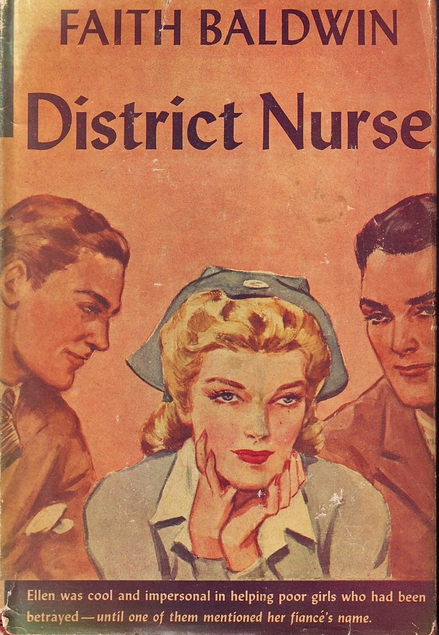

Oh, and then there's this one---is it just me, or is Guy On The Left much more interested in Guy On The Right than in Our Heroine?
117lyzard
A run in a pair of silk stockings changed her hum-drum life overnight to one of mystery and wild adventure.
---cover blurb for Dimpled Racketeer
---cover blurb for Dimpled Racketeer
118casvelyn
Only after I put runs in all my nylons did you bother to tell me that mystery and adventure requires SILK stockings!?! Clothing. I've been doing it wrong.
119lyzard
Evidently much that is inadequate in my life can be explained by my shameful lack of stockings.
120Helenliz
I own a pair of silk stockings. A single pair. Infrequently worn. The price I paid for them there ain't no way I'm going adventuring in them!
121lyzard
Never owned a pair of silk stockings. If they lead to the sorts of things that happen in this book, I don't WANT to own a pair of silk stockings...
(...and speaking of which...)
(...and speaking of which...)
123souloftherose
Just had a major session downloading things from Project Gutenberg - I knew Eugene Sue's The Mysteries of Paris was six volumes but I didn't realise quite how long each volume was!
125lyzard
So as I like to do this time of year, I've maxed out my academic library card (ten books / "Community Borrower") to make sure I have a steady back-up supply when I am on leave and away from work and therefore from the public library I generally use, my "local" ones being inconveniently unlocal. Interestingly, without planning it I've ended up with a predominance of non-fiction, all of them "books on books" (and the makings of a new reading project):
Fiction:
Quintus Servinton by Henry Savery (16/02/2015)
Diary Of A Provincial Lady by E. M. Delafield (16/02/2015)
Boomerang by Helen Simpson (16/02/2015)
The Fortnight In September by R. C. Sherriff (27/02/2015)
Non-Fiction:
Egoism And Self-Discovery In The Victorian Novel by John Halperin (16/02/2015)
The Language Of Meditation by John Halperin (27/02/2015)
Virtue In Distress by R. F. Brissenden (16/02/2015)
Relative Creatures by Francoise Basch (16/02/2015)
An Introduction To The Australian Novel, 1830-1930 by Barry Argyle (16/02/2015)
The Australian Novel, 1830-1980 by John Scheckter (27/02/2015)
Fiction:
Quintus Servinton by Henry Savery (16/02/2015)
Diary Of A Provincial Lady by E. M. Delafield (16/02/2015)
Boomerang by Helen Simpson (16/02/2015)
The Fortnight In September by R. C. Sherriff (27/02/2015)
Non-Fiction:
Egoism And Self-Discovery In The Victorian Novel by John Halperin (16/02/2015)
The Language Of Meditation by John Halperin (27/02/2015)
Virtue In Distress by R. F. Brissenden (16/02/2015)
Relative Creatures by Francoise Basch (16/02/2015)
An Introduction To The Australian Novel, 1830-1930 by Barry Argyle (16/02/2015)
The Australian Novel, 1830-1980 by John Scheckter (27/02/2015)
126lyzard

Watergate: The Inside Story - Thanks to a politico-historically inclined brother (and his need for a sounding board), I've acquired over the years an abiding interest in Watergate and the fall of the Nixon administration, a scandal so breathtakingly bizarre that the story loses none of its fascination with the passing of time. I've read a variety of books on the subject, from Bob Woodward and Carl Bernstein's All The President's Men to the accounts offered after the event by the various participants (which vary from the hilariously self-serving to the almost shockingly honest), and can say that - as far as it goes - Watergate: The Inside Story is one of the best. Two qualities make this particular book stand out from the pack. Firstly, it was the joint work of the political correspondents of the London Sunday Times, which gives the narrative the quality of the "outsider eye" and a sense of proportion not always found in home-grown accounts of the scandal; and secondly, it chooses a starting point much earlier than most other such works. Co-authors Lewis Chester, Cal McCrystal, Stephen Aris and William Shawcross begin their account of Watergate many years before Watergate itself, showing the chain of events that led up to the breaking of this perfect political storm. My earlier qualifier, "as far as it goes", refers to no shortcoming in the book itself, but to the fact that it terminates at the end of 1973---when the existence of certain secret recordings was known, but the magnitude of the issue was yet to be realised, and the beginning of the fight to make the content of the tapes public still some months away.
One of the main strengths of Watergate: The Inside Story is that it does not merely describe what did happen, but attempts to explain how it could have happened. The Watergate break-in occurs upon page 156 of this 267 page work: preceding this, twelve chapters are devoted to tracing the Nixon administration from the 1968 election onwards, the gathering of Nixon's "team", the state of affairs in Vietnam and the shifting national feeling about the war, and the lead-up to the 1972 presidential election. The authors put particular stress upon the nature of the men surrounding Nixon during this period, emphasising that, firstly, most of them had a background in business, with very little experience in politics - least of all Washington politics - and secondly, most of them owed their appointments to some particular interaction with Richard Nixon himself. Consequently, the main loyalty of this men was not to "government", or to "the President", but to Nixon as an individual. It is repeatedly and persuasively argued that the combination of personalities around Nixon was one of the main facilitators of the Watergate scandal: all of those close to him wanted to please Nixon, personally, and in attempting to do so they progressively adopted his increasingly irrational view of the world outside the Oval Office, which amounted to, Those who are not with me are against me. Opponents were considered enemies, and attacks upon Richard Nixon treated as attacks upon America; conversely, anything done in retaliation was defending America and therefore - plus ça change - justifiable as a matter of national security. As infectious paranoia spread through the administration, spying, phone-tapping and bugging became a matter of daily business, all paid for with campaign donations that had been laundered through Mexico. By 1972, the White House Special Investigations Unit - the "Plumbers" - had long since ceased fulfil its overt function of hunting down leaks, and had become a covert intelligence gathering operation; and in June of that year, five men broke into the Democratic National Committee headquarters in the Watergate Complex...
Perhaps the most remarkable quality of Watergate: The Inside Story is its clarity. This is a highly complex story with dozens and dozens of characters, and yet the authors never lose their thread of the narrative, nor fail to make clear the intricate web of connections tying one aspect of the story to another---even when dealing with the subsequent cover-up and the inevitable morass of contradictions, accusations and lies. Furthermore, perhaps because of their own outsider status, the authors have a good grasp of when and where more explanation or background is required on a particular topic. They also do a fine job in weaving the threads of Watergate into the bigger picture---for example, showing how the political manoeuvring around the secret bombing of Cambodia and Laos helped to create the state of mind that resulted in the founding of the Plumbers, or how the success of the "dirty tricks" campaign in undermining Ed Muskie inspired further covert attacks upon the Democrats. Also noteworthy is the tone of the narrative. Although, understandably, the occasional snarky remark creeps in (after describing the creation of Nixon's infamous "enemies" list, the narration resumes, After outlining these proposals for providing specified American citizens with inequality before the Federal bureaucracy and the law...), on the whole the authors refrain from editorialisation, and allow the story to speak for itself. And while this is inarguably a bewildering, painful and often disheartening account of the abuse of power, Watergate: The Inside Story finishes on an unexpectedly positive note, with the authors pointing out that while under what they call the "monolithic" Nixon administration, public bodies from the press to the Supreme Court to Congress itself had become moribund and dysfunctional, the events of Watergate served to galvanise them into new life, and remind them of their place under the Constitution and the abiding need for government under law.
At this point, Magruder, LaRue, and Mitchell should, as law-abiding citizens, have taken the nearest cab down to the nearest police precinct and reported that they had evidence that might be needed in connection with a burglary committed the previous night; and that three other men called John Dean, then employed as legal counsel to the President of the United States, E. Howard Hunt, then employed as a White House consultant, and G. Gordon Liddy, then general counsel to the Committee to Re-elect, might also be in a position to provide further information. They might also have added the names of Charles Colson, the President's special counsel, Bob Haldeman, the President's chief of staff, and Gordon Strachan, a White House assistant, all of whom had, to their collective knowledge, been apprised of an expensive intelligence-gathering operation, that seemed to have ended unlawfully in Watergate. The thought does not appear to have occurred to them.
Over the next year many thousands of man-hours and millions of words were devoted to an attempt to answer the question: who ordered the Watergate cover-up? As it turned out it was one of history's most irrelevant questions. For it all became so obvious after Jeb Magruder's testimony before the Senate Watergate Committee in June, 1973. "I don't think," said Magruder, with a puzzled frown, "there was ever any discussion that there would not be a cover-up." It was instinctive from the very beginning---and once started, there was no way back...
129AuntieClio
>87 lyzard: I had to stop reading Heinlein precisely because of his attitude about women. They can be as smart as the men, but they still have ti look good while willingly serving drinks by the pool. I also think his writing is terrible.
130DorsVenabili
>126 lyzard: Ooh, this does sound good! I've never actually read an entire book about the scandal, so I'll have nothing to compare it to, but I think I'll put this on my wishlist.
131rosalita
>126 lyzard: Nice review of the Watergate book, Liz.
while under what they call the "monolithic" Nixon administration, public bodies from the press to the Supreme Court to Congress itself had become moribund and dysfunctional, the events of Watergate served to galvanise them into new life, and remind them of their place under the Constitution and the abiding need for government under law.
Too bad none of the lessons learned turned out to be lasting ones. You could say the same thing about all those institutions in 2014, and worse. It's a depressing thought, I tell ya.
while under what they call the "monolithic" Nixon administration, public bodies from the press to the Supreme Court to Congress itself had become moribund and dysfunctional, the events of Watergate served to galvanise them into new life, and remind them of their place under the Constitution and the abiding need for government under law.
Too bad none of the lessons learned turned out to be lasting ones. You could say the same thing about all those institutions in 2014, and worse. It's a depressing thought, I tell ya.
132lyzard
>128 souloftherose:
Because, hey - if there's one thing I need - ! :)
>129 AuntieClio:
Hi, Steph. Perhaps it's a positive thing about Starship Troopers, that we don't see the women? They're just {*waves arms vaguely*} over there somewhere, in a different part of the war.
There's so much lecturing in this novel that it's hard to judge Heinlein's ability as a story-teller.
>130 DorsVenabili:
Actually, Kerri, it is a book I'd recommend to someone looking for a good place to start. It's a shame it stops so early in the story. I was hoping to find there was a "sequel" published about eighteen months later, but it seems not.
>131 rosalita:
Hi, Julia - thanks!
Yes, I was thinking that while I was copying that quote. We suffer something of the same thing here (though thankfully on a much smaller and less damaging scale), with stand-offs and a tendency to lurch from one extreme to the other instead of finding some productive middle ground. Our crises tend to be along the lines of natural disasters rather than political ones, but you see the same pattern---a heartening rising to the occasion, followed by a depressing slump back into mediocrity.
Because, hey - if there's one thing I need - ! :)
>129 AuntieClio:
Hi, Steph. Perhaps it's a positive thing about Starship Troopers, that we don't see the women? They're just {*waves arms vaguely*} over there somewhere, in a different part of the war.
There's so much lecturing in this novel that it's hard to judge Heinlein's ability as a story-teller.
>130 DorsVenabili:
Actually, Kerri, it is a book I'd recommend to someone looking for a good place to start. It's a shame it stops so early in the story. I was hoping to find there was a "sequel" published about eighteen months later, but it seems not.
>131 rosalita:
Hi, Julia - thanks!
Yes, I was thinking that while I was copying that quote. We suffer something of the same thing here (though thankfully on a much smaller and less damaging scale), with stand-offs and a tendency to lurch from one extreme to the other instead of finding some productive middle ground. Our crises tend to be along the lines of natural disasters rather than political ones, but you see the same pattern---a heartening rising to the occasion, followed by a depressing slump back into mediocrity.
134lyzard
Finished The Black Pigeon for TIOLI #21.
Now reading Arsène Lupin, Gentleman Cambrioleur by Maurice Leblanc.
Now reading Arsène Lupin, Gentleman Cambrioleur by Maurice Leblanc.
135lyzard
Finished Arsène Lupin, Gentleman Cambrioleur for TIOLI #3.
Now reading The Lucky Mistake by Aphra Behn.
Now reading The Lucky Mistake by Aphra Behn.
136CDVicarage
Thought you might be intereested in this, Liz. The BBC discusses the Gothic novel:
http://www.bbc.co.uk/news/magazine-30313775
http://www.bbc.co.uk/news/magazine-30313775
137lyzard

Lord Edgware Dies (US title: Thirteen At Dinner) - Hercule Poirot and Arthur Hastings find themselves moving in celebrity circles when they are invited to a supper party given by the actress Jane Wilkinson. Another guest is Carlotta Adams, an American taking London by storm with her one-woman show which, among other sketches, includes a wickedly accurate impression of Jane Wilkinson. Somewhat to her friends' surprise, as she is notorious for her egotism and vanity, the actress is amused and delighted, rather than offended, by the way Carlotta hits off her mannerisms. Characteristically, Jane has an ulterior motive for her invitation to Hercule Poirot: explaining that she has exhausted all other avenues of negotiation, she wants Poirot to see her husband, Lord Edgware, and persuade him to agree to a divorce so that she can marry the Duke of Merton. She adds recklessly that if he will not divorce her, she will be forced to resort to murder to get him out of her way. Poirot objects that such a task is hardly in his usual line of work but, no more proof against the actress's charm than anyone else, he finally agrees to undertake the uncomfortable mission. However, to his surprise he has barely stated the object of his visit when Lord Edgware announces coldly that he agreed to a divorce some six months earlier, and wrote to tell his wife so. As the bemused Poirot and Hastings beat a hasty retreat, the latter catches a glimpse of the nobleman with his face convulsed with rage... Jane Wilkinson is delighted with the outcome of Poirot's mission, dismissing unconcernedly both the question of the missing letter, and why her previously obdurate husband should suddenly have given in. Poirot continues to muse over these points until his attention is caught by a far more serious matter: Lord Edgware is found murdered, stabbed in the base of the brain; and both his butler and his secretary insist that the last person to see him alive was his wife...
This 1933 mystery is, in Hercule Poirot's own estimation, one of his failures---he says, because it takes not merely deduction but a chance overheard remark to put him on the right track. In fact, it takes two stray remarks - and two more murders - before Poirot is able to lay the killer by the heels. What turns out to one of Poirot's more difficult cases starts out appearing almost absurdly easy. Not only do two eyewitnesses place Jane Wilkinson at the scene of her husband's murder, but Poirot was not the only person to whom she announced her intention of removing Lord Edgware from her path, should he continue to refuse her a divorce. To Inspector Japp, Jane's guilt could hardly be more certain, and those who know the ruthless self-absorption of the actress are inclined to agree. Indeed, when Jane's former lover, the actor Bryan Martin, first hears of the murder, he immediately exclaims, "She's done it, then!" Inspector Japp waves away Poirot's counter-argument that the actress had no motive, and is more than ready to arrest her when she produces a cast-iron alibi: at the time of the murder she was attending a dinner-party, and there are a dozen other people able to swear to her whereabouts. Though this revelation leaves Inspector Japp stunned, Poirot's attention is caught by Jane's comment that her attendance at the party was a last-minute decision: she had widely declared that she would not go, but preferred to stay home and nurse a bad headache instead. Had she done so, of course, she would have had no alibi at all...
Convinced against his will that Jane cannot be guilty, Inspector Japp goes back to the drawing-board, trying to determine who might have had a motive to murder Lord Edgware, and finds no lack of people who might have wanted him dead. A man of vicious habits and unsavoury habits, the late nobleman not only drove away two wives, but made his young daughter's life hell, and turned his penniless nephew out of his house. Ronald Marsh tops Japp's new list of suspects, but he too has an alibi for the murder. However, after his experience with Jane Wilkinson, the inspector takes nothing for granted, and soon finds that the new Lord Edgware may not be on such solid ground as it first appeared... As soon as Jane Wilkinson's alibi is confirmed, Poirot's focus switches to the only other person who could have been mistaken for the actress. This thought is followed instantly by another---one which sends Poirot on a desperate race against time. He is, however, too late: Carlotta Adams has been found dead, apparently of an overdose of veronal---taken accidentally or otherwise. Amongst her possessions are a blonde wig and the outfit that the witnesses to "Jane Wilkinson"'s call upon Lord Edgware have described. Though Carlotta herself may have, for reasons unknown, murdered Lord Edgware, Poirot considers it more likely that someone else took advantage of her professional skills. When he learns that almost the last thing Carlotta did was post a letter to her young sister, he arranges for a copy of the text to be transmitted by the American authorities. The letter reveals that, as he suspected, an unnamed man hired Carlotta to impersonate Jane. Poirot finds himself wondering whether the murder of Lord Edgware was merely the means to an end---and who hated Jane Wilkinson enough to frame her for murder...
She clasped her hands, her husky voice dropped. She looked like an angel about to give vent to thoughts of exquisite holiness. "I've been thinking. It all seems so miraculous, if you know what I mean. Here I am---all my troubles over... Things happen right for me," said Jane in a sort of awed whisper. "I've thought and I've thought lately---if Edgware were to die. And there---he's dead! It's---it's almost like an answer to prayer."
Poirot cleared his throat. "I cannot say I look at it quite like that, Madame. Somebody killed your husband."
She nodded. "Why, of course."
"Has it not occurred to you to wonder who that someone was?"
She stared at him. "Does it matter?"
138lyzard

A Mysterious Disappearance - Now, here's a novel to test out my OCD! Regular visitors may be aware that I have started on a mystery series by Louis Tracy featuring the barrister and amateur detective, Reginald Brett. Tracy was a prolific writer of serial stories in the late 19th and early 20th century, and keeping up with his output - and his use of pseudonyms - is quite a difficult task. There is little solid information out there about the Reginald Brett stories, beyond the fact that the barrister seems to have been overtaken in popularity by his Scotland Yard whipping-boy, Inspector Winter, who would go on to appear in a much longer-running series in which he was teamed up with his colleague, Superintendent Furneaux. Nevertheless, A Fatal Legacy, the first Reginald Brett novel - or what I thought was the first Reginald Brett novel - was widely trumpeted as being so, as if the public was already supposed to know who Brett was. And now, it seems, the public was. Published in book form in 1905, A Mysterious Disappearance first appeared as a magazine serial in 1901, under the title The Strange Disappearance Of Lady Delia. At that time it featured the actual first appearance of Reginald Brett, and of Inspector Winter. Subsequently, however, its author "Gordon Holmes" - Louis Tracy - revised the text and, for reasons known only to himself, not only changed the title of his story but the names of all his leading characters, too---among others, turning Reginald Brett into "Claude Bruce", and Inspector Winter into "Inspector White"---and in the process removing this novel from the Reginald Brett series. "Mysterious" is right. However, as far as the difference between "Reginald Brett" and "Claude Bruce" goes, it's really only a matter of boxers or briefs. The two are (not surprisingly) almost indistinguishable, which unfortunately means we are once again in the company of a smug, sneering, patronising pain in the butt.
Claude Bruce's involvement in the case of Lady Dyke is a matter of coincidence. On the evening of her disappearance, at which time London is enveloped in an almost impenetrable fog, Bruce happens to encounter Lady Dyke at Victoria Station. Although he gets the impression that she is annoyed to have met someone she knows, Lady Dyke readily accounts for having ventured out in the fog, explaining that she is on her way to Richmond to visit her sister. Bruce waits with her until her train to Richmond arrives. It is the last that anyone sees of her... Though Sir Charles and Lady Dyke were not happily married, his wife's disappearance has a devastating effect upon the formally rather thoughtless young baronet, who blames himself for their estrangement. Bruce describes to Sir Charles his chance encounter with Lady Dyke, and learns that she never arrived at her sister's house; if indeed she was really going there. Reluctantly, Sir Charles puts the matter in the hands of the police, though at the same time he keeps the truth a secret from the public at large by placing a paragraph about his wife visiting friends in the society papers. Inspector White soon reports that although she bought a ticket for Richmond, Lady Dyke got off the train at Sloan Square, asking at the station for directions to a block of apartments known as Raleigh Mansions. White assures Sir Charles that this lead will be followed up, but since there are seventy-two apartments in the complex, it may take some time. Before anything definite results from the inquiry, however, a woman's body is found in the river at Putney, wedged under a drainage pipe. The cause of death is not drowning, but a blow to the head: a small piece of metal is found embedded in the skull. The woman's clothes are of poor quality, yet her undergarments are a fine and expensive make. The body is too disfigured for easy identification, and neither Sir Charles nor Lady Dyke's maid is able to recognise the dead woman. Claude Bruce, however, is certain that the victim is Lady Dyke, and swears to himself that he will find her killer...
Like the other mysteries featuring
The barrister's mobile face softened with pity as he looked at his afflicted friend. In four days Sir Charles Dyke had aged many years in appearance. No one who was acquainted with him in the past would have imagined that the loss of his wife could so affect him.
"I have done all that was possible, yet it is very little," said Bruce after a pause. "You are aware that I am supposed to be an adept at solving curious or criminal investigations of an unusual class. But in this case, partly, I suspect, because I myself am the last person who, to our common knowledge, saw Lady Dyke alive on Tuesday night, I am faced by a dead wall of impenetrable fact, through which my intellect cannot pierce. Yet I am sure that some day this wretched business will be intelligible. I will find her if living; I will find her murderer if she be dead..."
139lyzard
>136 CDVicarage: Hi, Kerry - thanks! Very interesting, although I'm not sure how Twilight ended up in that article. :)
140lyzard

Egoism And Self-Discovery In The Victorian Novel - Another of the first wave of literary reassessments that marked the early 1970s, John Halperin's 1974 study is an interesting and encouragingly positive examination of a number of key 19th century novels. Subtitled "Studies in the ordeal of knowledge in the nineteenth century", Egoism And Self-Discovery traces what Halperin asserts to be a major theme of the 19th century novel, the gaining of self-knowledge through suffering. Although declaredly about the Victorian novel, this study is bookended by two novelists whose works lie outside its purview, Jane Austen and Henry James. Halperin positions Jane Austen as the pivotal transitional figure in the history of the English novel, arguing that her elegant, deceptively simple novels were the most significant influence in the move from the plot-heavy and emotionally overwrought works of the 18th century to the more subtle works of the 19th, the best of which are notable for their focus upon character and their psychological complexity. He also identifies Austen as the progenitor of the novel of self-discovery. Halperin makes his general argument by discussing two of Austen's egoists, Elizabeth Bennet and Emma Woodhouse, both of whom must take a painful journey from a state of self-satisfaction and prejudicial blindness to one of understanding and awareness, both of themselves and of others. Elizabeth's famous cry, "Till this moment I never knew myself", becomes the catchphrase of this entire study of what John Halperin calls "the ordeal of education". Sometimes the egoists in question emerge from their ordeal better and stronger people; sometimes they are destroyed by it; sometimes they destroy others.
Using a number of selected texts, John Halperin illustrates his thesis by showing how the protagonists of a significant number of 19th century novels follow in the footsteps of Elizabeth and Emma. Some of his choices are self-evident, while others may strike the reader as somewhat counter-intuitive. In the latter category we can place Halperin's examination of Vanity Fair, which concentrates on Amelia Sedley rather than Becky Sharp; his reading of Daniel Deronda, which ignores Daniel and focuses upon Gwendolen Harleth; and, perhaps most perversely of all, his choice to put aside George Meredith's The Egoist in favour of The Ordeal Of Richard Feverel: partly because the former is a comedy (albeit one with a sting in the tail) and the latter a tragedy, but chiefly because Sir Willoughby Patterne, the titular egoist, proves the exception to Halperin's rule by never learning anything. In support of his argument that the ordeal of learning was one of the major themes of the Victorian novel, Halperin goes on to show that all of the major novelists used this plot at least once, with some of them returning to it again and again. From the works of Anthony Trollope, Halperin singles out Mark Robarts, the overly socially ambitious young clergyman of Framley Parsonage; from Dickens we have, inevitably, Philip Pirrip of Great Expectations, but also Paul Dombey of Dombey And Son; George Eliot's novels offer Adam Bede and Dorothea Brooke of Middlemarch in addition to Gwendolen Harleth; while those of Thomas Hardy yield Bathsheba Everdene of Far From The Madding Crowd, Michael Henchard of The Mayor Of Casterbridge and Angel Clare of Tess Of The D'Urbervilles. His reading of Jane Eyre (an exception to the general rule) finds its heroine caught between two equally dangerous if philosophically opposed egoists, Edward Rochester and St John Rivers, each of whom is quite capable of destroying a young woman of less self-knowledge than Jane. Halperin closes his study by showing how this particular tradition was inherited by Henry James, choosing The Portrait Of A Lady as the most fully embodied example of the "ordeal of education" amongst the many works in which James examined the expanding moral sensibility of an individual.
Although we might be inclined to protest the inference that it is only by suffering through an "ordeal" that the individual can arrive at self-knowledge, it is hard to refute John Halperin's contention that one of the major obsessions of the Victorian novelist was the journey of self-discovery. But whether we agree or disagree with Halperin's thesis, his Egoism And Self-Discovery is a most enjoyable read for anyone with a love of 19th century literature. Unlike some of these early 70s studies, which give the impression that the only thing that the author would rather do less than read Victorian novels is write about them, John Halperin's passion for his subject matter is evident throughout. He clearly knows the novels he is examining and their characters inside and out, and whether or not we agree with his arguments, he has the ability to make the reader stop and think about books they think they know. In this respect, for example, we may find him unexpectedly hard on Dorothea Brooke, in particular; or rather, he shows us that George Eliot was more detached, less sympathetic towards "Dodo" than it may appear on a first reading. As Professor Walter Allen remarks in his introduction to this volume, "It is the sign of a good critic...that he can show you what you have missed in a book."
The formula for the psychic development of fictional personages varies from author to author, for each of the writers, as might be expected, has his or her own perspective on the world; moral education means something different to each. And yet there is at least a superficial similarity among these writers as far as the psychic stages through which their characters pass is concerned. In virtually all the novels under consideration in this study, a major protagonist begins in egoism or some related stage of self-absorption, a condition whose major results are likely to be both deficient self-understanding and blindness to the real nature of other people. Through a series of educational jolts to the ego and thus to the self-perspective, the character begins to doubt his bases for judging himself and others, and eventually attains to a state of relative self-consciousness, which takes the form of a new lack of self-confidence and the revision of previously unshakable opinions of himself and others. This leads to the third and final stage of character development---that of self-discovery, in which the educational process reaches its climax in a new perspective on self and a correspondingly clearer vision and understanding of others...
141lyzard
November reviews finished on only the 14th December!!??----GASP!!!!
November stats:
Works read: 13
TIOLI: 13, in 13 different challenges (a new record!!)
Mystery / thriller: 5
Classics: 3
Non-fiction: 2
Contemporary drama: 1
Historical drama: 1
Science fiction: 1
Series works: 3
Blog reads: 3
1932: 2
Owned: 4
Library: 6
Ebook: 3
Male : female author: 11 : 7
Oldest work: The Histories Of Lady Frances S-, And Lady Caroline S- by Margaret and Susannah Minifie (1763)
Newest work: Egoism And Self-Discovery In The Victorian Novel by John Halperin (1974)
November stats:
Works read: 13
TIOLI: 13, in 13 different challenges (a new record!!)
Mystery / thriller: 5
Classics: 3
Non-fiction: 2
Contemporary drama: 1
Historical drama: 1
Science fiction: 1
Series works: 3
Blog reads: 3
1932: 2
Owned: 4
Library: 6
Ebook: 3
Male : female author: 11 : 7
Oldest work: The Histories Of Lady Frances S-, And Lady Caroline S- by Margaret and Susannah Minifie (1763)
Newest work: Egoism And Self-Discovery In The Victorian Novel by John Halperin (1974)

144lyzard
Hey, I read lots of several books from the 70s! (That's when my non-fiction wishlist starts!)
Should I have posted a warning?---
CUTE OVERLOAD!!!!!!!!!!
Should I have posted a warning?---
CUTE OVERLOAD!!!!!!!!!!
145lyzard

District Nurse - Years before the Adams family owned the entire large New York brownstone in which they have always lived. Now, however, following the death of Mr Adams, and with finances growing more and more difficult as the Depression increases, the Adams women have been forced to sell the house, and now occupy one set of rooms that has been converted into an apartment. Mrs Adams' health is poor, and her daughters, Ellen and Nancy, care for her around the clock on "shift": Nancy works nights at the telephone exchange, while Ellen is attached to the local Visiting Nurse Association, making house-calls upon those who cannot afford regular medical care. It is work that is often exhausting and heartbreaking, but vital and satisfying too. Ellen is well-known and popular in the neighbourhood, and no-one hesitates to call upon her when they need help. One morning on her way to work, Ellen becomes involved when a local boy's dog is hit by a car. Fortunately it is not badly injured and the driver, Frank Bartlett, offers to take Bill and his pet to the veterinarian. Frank takes a shine to the blunt and streetwise young Bill, and completely smitten with Ellen. Learning from Bill that she works for the VNA, he makes it his business to see her again. Ellen, too, is drawn to Frank, but both her commitment to her mother and her knowledge of the darker side of life make her wary of romantic involvement. However, finally she agrees to spend some time with him. Before long Ellen finds herself falling in love with Frank, and realises that she has some serious decisions to make...
During the 1930s, Faith Baldwin became the leading exponent of "marriage vs career" romances; and while in her novels marriage usually did win out, her grasp of the attractions and satisfactions of work for young women gave her novels a substance that most of their competitors lacked. Managing herself to combine a long career with marriage and motherhood, Baldwin understood better than most that for many young women, work was not merely something you did until you caught a husband, but a necessary and fulfilling part of life; and that the assumption that marriage meant the end of career forced many working women to make a difficult and painful choice. District Nurse is a textbook example of this romance subgenre. On one hand Ellen Adams must work, in order to support her widowed mother; but on her other she is a skilled and devoted nurse who finds deep personal satisfaction in her job. The work that she does, however, makes her acutely aware of the struggle and suffering that goes on around her every day. Perhaps the most surprising aspect of District Nurse is its bluntness in dealing with some of these issues. Though the language used is not at all explicit by today's standards, Baldwin pulls no punches in describing the effects of the Depression, and the living conditions of the poor: lack of water, lack of heating, lack of sanitation. In Ellen's particular line of nursing, it is usually women and children to whom she is called, and she knows only too well the roll-on effects of poverty: not only disease, but violence and cruelty. In the ordinary course of her duties she must give assistance in situations of unwanted pregnancy, rape, and attempted suicide.
Ellen is perhaps not consciously aware of it, but her daily contact with these painful scenes has made her wary of emotional involvement and a little cynical about romantic love. She has seen too often to what such "love" can lead, not only in her job but in her own home, where the elopement of the eldest of the sisters, Coral, with a married man has left scars that will not heal. Nancy, the youngest of the Adams girls, likes to have a good time and has a steady boyfriend, but she jeers whenever marriage is mentioned, marvelling that any woman should choose to give up her independence. Ellen, meanwhile, tends to keep to herself. For many years she has been pursued by Jim O'Connor, a local boy she has known all her life; but although she likes him as a friend, Ellen feels nothing for Jim that might make her choose him over her career. It is not until she meets Frank Bartlett that such questions begin to enter her mind. Ellen's attraction to Frank is immediate and strong, and she enjoys his company more than any man's she has ever known; but still her instinctive wariness remains. Nothing she learns about Frank gives her any reason to doubt him - nor does she doubt the sincerity of his feeling for her - but the unseen damage done to Ellen's faith in men shows itself in the willingness with which she believes the worst when, attempting to assist a girl who has been impregnated and abandoned, she discovers that the name of the girl's lover is Frank Bartlett...
The house was frankly tenement. The spring sunshine had no power there. Dim gas jets flickered on the dirty landings casting eerie shadows. In each hallway, as she passed, was the disgrace of an open toilet. She went on upstairs, feeling her way, not touching the filthy banisters. Presently, she knocked. Two rooms: littered with dogs, with cats, with stale food, with children. In the back room her patient, a flu case. A three-year-old child playing on the littered floor, a year-old baby lying sucking at an indescribable rag of a pacifier...
The last place she had left was a basement, a den. That human beings lived there she had complete evidence but somehow now out in the open air, tainted as it was, it seemed almost incredible. She thought...there's so much more to this than nursing, so much more. She thought further that it was not astonishing that so many women connected with work of this type turned almost fiercely radical, seeing what they must see...
146lyzard
Finished The Lucky Mistake for TIOLI #3.
Now reading Madeline Payne, The Expert's Daughter by Lawrence L. Lynch (Emma Murdock Van Deventer).
Now reading Madeline Payne, The Expert's Daughter by Lawrence L. Lynch (Emma Murdock Van Deventer).
147lyzard

Dimpled Racketeer - Her widowed mother's death leaves seventeen-year-old Rosalie March all alone and needing to fend for herself---something her strict upbringing has not well equipped her to do, as it has left her ignorant of the world and rather young for her age. Furthermore, Rosalie's position as the daughter of the town's dressmaker has seen her excluded from many social groups and without many close friends. Indeed, it is finally Kenessa Du Barry - formally Mabel O'Dare - who comes to Rosalie's assistance in the wake of her mother's death. Having left town to earn a living on the stage, Kenessa is shunned by her home town. Rosalie, however, receives nothing but kindness and sound advice from the older girl, who points out that there is no way she can support herself in the small Pennsylvania town and urges her to move to Philadelphia, offering to find her rooms there. Deciding to take Kenessa's advice, Rosalie relocates to a boarding-house in the city. At first she finds her surroundings depressing and rather frightening, as well as solitary, but - as Kenessa knew would be the case - the proprietor, the motherly Mrs Murphy, immediately takes the girl to her heart. Rosalie soon gains another friend in the shape of fourteen-year-old newspaper boy, Tim O'Hara, who advises her on how to go about getting a job. Rosalie applies for a sales position at Boggs and Clarke's department store, and is hired to work at the hosiery counter. She is delighted by what she views as her good fortune, and blissfully unaware of how much her lovely face and air of innocence had to do with her hiring. Excited by what she views as the beginning of her new life, Rosalie dresses for her first day of work, but receives an immediate setback when she discovers a run in her only pair of silk stockings. In dismay, Rosalie is forced to exchange the delicate silken garment for a stout and rather ugly pair of cotton stockings---never dreaming how this simple act will change the entire course of her life...
A run in a pair of silk stockings changed her hum-drum life overnight to one of mystery and wild adventure, reads the blurb for Dimpled Racketeer, suggesting a rather light-hearted romantic romp---which this really, really isn't. In fact, it's a very strange book indeed. The plot of Dimpled Racketeer requires the reader to accept that Rosalie March, in addition to being unusually beautiful, is completely innocent and, indeed, as ignorant of the world as it is possible for a girl of seventeen to be; otherwise, the mistakes she makes - and makes, and makes - would be both unbelievable and unforgiveable. The novel's back-story stresses her upbringing by a mother who disapproved of almost everything modern, and therefore kept Rosalie secluded from much that others her age experience as a matter of course---such as dances and dating. A recurrent plot-point is one character or another assuming that Rosalie is a consummate little actress / con-artist, since nobody could really be that naïve. (When the boy she has a crush on takes her out for a drive and tries to ply her with bootleg liquor in order to make her "relax", Rosalie has no idea what is really in his hip-flask and accepts his explanation that it is simply a particularly bitter kind of lemonade.) Rosalie's very innocence ends up causing her untold amounts of trouble because, although she is used, tricked and deluded again and again, no-one believes that she was. However---while we may or may not choose to believe that Rosalie's youth and inexperience could really lead her into the untold amounts of trouble that the plot of Dimpled Racketeer has in store for her, to my mind the real problem with this novel lies elsewhere: in the single impulsive act that sets events in motion---an act that makes a mockery of the narrative's insistence upon both her innocence and her strict, deeply religious upbringing. Ridiculed by her fellow sales-girls for her small-town cotton stockings, Rosalie responds by stealing a pair of silk stockings...
Rosalie's first day at work turns out to be epoch-making in more ways than one. She has barely succeeded in concealing her illicit stockings under her dress when she finds herself confronted by a dangerously attractive young man. He is Roy Clarke Andrews, the nephew and heir of Boggs and Clarke's owner, and the target of every ambitious sales-girl in the store. To date none of them have succeeded in winning his interest---but so different is Rosalie from the hard-boiled, wise-cracking sales-girls around her that she immediately catches his eye. Drawn to each other, but knowing that their relationship must be kept a strict secret - not least because Peter Clarke, Roy's uncle, would hit the roof if he knew - the two begin meeting after work. It takes Roy a little time to accept that Rosalie is exactly what she seems, but when he does, he finds himself falling in love with her. Rosalie, too, is in love, and when Roy asks her to marry him she overwhelmed with joy - and grief: for Rosalie has a desperate secret... As she leaves the store at the end of her first day, to her horror Rosalie lets slips her stolen stockings---and is caught by a store detective. When he takes her aside she fears being charged as a thief, but the reality is even worse. Martino is part of a gang stealing on a large scale from Boggs and Clarke, and Rosalie is not the first girl blackmailed into helping. Too frightened of the consequences if she refuses, Rosalie allows Martino and his men to store their stolen goods in her rooms, concealed in suitcases beneath the bed. She is trying to work up the courage to confess the whole truth to Roy when her life takes yet another bewildering turn---and she finds herself caught in a terrifying nightmare of kidnapping and murder...
Rowdy heard a boy calling "extra" and sent for a paper:
ROSALIE MARCH ROOM LOOT HIDE-OUT
Racketeer Shot in Alleyway with Suitcases of Stolen Goods from Boggs and Clarke's Store
Seventeen-Year-Old Girl Now Seen as Flapper Racketeer
148lyzard
Finished Madeline Payne, The Expert's Daughter for TIOLI #1.
Now reading The Tragedy Of X by "Barnaby Ross" (Ellery Queen).
Now reading The Tragedy Of X by "Barnaby Ross" (Ellery Queen).
149lyzard
Sigh.
What sort of sadistic publisher prints a book's introduction in large, easy-to-read font, and the actual text in teeny-weeny, almost-impossible-to-read font?
What sort of sadistic publisher prints a book's introduction in large, easy-to-read font, and the actual text in teeny-weeny, almost-impossible-to-read font?
150lyzard
Research question for 2015:
When did authors (particularly writers of mysteries) stop insisting that women faint at the drop of a hat?
When did authors (particularly writers of mysteries) stop insisting that women faint at the drop of a hat?
151Samantha_kathy
Oh, that's an interesting question! I'm looking forward to finding that out, although I'm guessing it would be around or after WW1... I remember reading Agatha Christie's autobiography where she says her mother 'played' the weak, frail woman, because that was just the done thing in that time (for those households where the woman didn't need to work), while she was definitely not like that - nor were her friends. And she was late teens, early twenties during WW1.
152Matke
>150 lyzard: Quick answer: Not soon enough.
153DorsVenabili
>149 lyzard: Oh, that's awful! I never used to think about font size, until I recently started experiencing middle-age eyesight deterioration, and now I just LOVE those books with the larger font and 1.5 space between lines. It's the best!
154lyzard
>151 Samantha_kathy: Hi, Samantha! I actually suspect it wasn't until post-WWII. It certainly hadn't happened by 1932, in fact I'm coming across a ridiculous number of novels from that year with fainting scenes. Possibly a perceived decline in "proper" feminine behaviour in the real world was being overcompensated for in novels?
>152 Matke: Hi, Gail! Quite right!! :D
>153 DorsVenabili: Oh, Kerri, me too, I'm sad to say. I've always had eyesight issues but these days I'm really noticing a problem with font size and artificial lighting. I even find myself racking the font in ePub books up to 'L' rather than 'M'.
I think this particular book is the result of trying to supply a lengthy work at a bargain price, so I can kind of forgive them. Kind of.
>152 Matke: Hi, Gail! Quite right!! :D
>153 DorsVenabili: Oh, Kerri, me too, I'm sad to say. I've always had eyesight issues but these days I'm really noticing a problem with font size and artificial lighting. I even find myself racking the font in ePub books up to 'L' rather than 'M'.
I think this particular book is the result of trying to supply a lengthy work at a bargain price, so I can kind of forgive them. Kind of.
155lyzard
Finished The Tragedy Of X for TIOLI #17.
Now reading Relative Creatures: Victorian Women In Society And The Novel 1837-67 by Françoise Basch (1974)
Now reading Relative Creatures: Victorian Women In Society And The Novel 1837-67 by Françoise Basch (1974)
156lyzard
Why, oh why, oh why...
...would The Tragedy Of X by Ellery Queen bring up the touchstone for The Great Gatsby by F. Scott Fitzgerald????
(While the next choices on the list are The Complete Works Of Oscar Wilde and Shakespeare's Antony And Cleopatra!?)
...would The Tragedy Of X by Ellery Queen bring up the touchstone for The Great Gatsby by F. Scott Fitzgerald????
(While the next choices on the list are The Complete Works Of Oscar Wilde and Shakespeare's Antony And Cleopatra!?)
157lyzard

The Layton Court Mystery - Author Roger Sheringham is one of the guests at Layton Court, the rented country house of Victor Stanworth, a self-made man whose genial hospitality is partly inspired by a desire to surround himself with celebrities and the upper classes. For Roger's good friend, Alec Grierson, the house party is one of extremely mixed emotions. He is barely coming to terms with the joy of having his proposal of marriage accepted by Barbara Shannon when she tells him tearfully that she cannot marry him after all, but refuses to give a reason. Alec's thoughts, as well as those of the rest of the party, are turned in a shocking new direction when, after their host does not appear at breakfast, he is found dead of a gunshot in his library. In spite of the wound being in the middle of the dead man's forehead, as all the doors and windows were locked it is taken for granted that his death was suicide, particularly as terse, typewritten note to that effect is found near the body. However, Roger Sheringham isn't convinced... His interest caught, Sheringham notices some strange behaviour amongst some of the other guests: Lady Cynthia Stanworth, the dead man's widowed sister-in-law, is almost unmoved by the tragedy; Mrs Plant, a young woman whose diplomat husband is posted overseas, shows an inordinate interest in Stanworth's safe, explaining awkwardly that she asked him to keep her jewels; while Sheringham catches Major Jefferson, Stanworth's secretary, searching the dead man's pockets. When Inspector Mansfield speaks of opening the safe, both Mrs Plant and Jefferson seem alarmed, with the latter explaining hurriedly that he does not know the combination. The doctor called to examine the body confirms that there was no medical reason why Stanworth may have taken his own life. Sheringham points out to the Inspector that some papers have recently been destroyed in the fireplace, suggesting that the reason for Stanworth's suicide might have been in the burnt papers. However, he doesn't really believe it. Taking Alec Grierson to one side, Sheringham startles him with a suggestion that Stanworth was murdered...
Anthony Berkeley Cox, who published as "Anthony Berkeley" and under the pseudonym "Francis Isles", was one of the more idiosyncratic of the Golden Age's mystery writers. While his passion for bending, twisting and occasionally breaking the "rules" of mystery writing, which were taken so oddly seriously at the time, is admirable, other aspects of Berkeley's writing make his novels extremely difficult to swallow. Berkeley was a misanthrope, whose books tend to be populated by very unpleasant people; he was even more a misogynist, frequently side-tracking into screeds against the female sex for the heinous crime of being the female sex; and - and perhaps strangely, this is often the most annoying aspect of his books - he had no feel for when a joke had gone too far. Which brings us to the subject of Roger Sheringham. It is evident that Berkeley intended Sheringham as a parody of the leisure-class amateur detective so beloved of English mystery readers in the 20s and 30s, who was never too busy with an arcane hobby to find a moment to show up a hard-working but painfully unimaginative police inspector: a literary construct that annoyed Anthony Berkeley to no end. Berkeley's retaliatory joke is that Sheringham, with all the egoism and self-satisfaction that annoyed his author so much in other writers' detectives, invariably stumbles and blunders his way through his cases, constantly drawing false conclusions and suspecting people who turn out to be innocent; although he generally hits on the truth in the end. However, while intended as a humorous caricature of the obnoxiously self-satisfied amateur, Sheringham far too often crosses the line and becomes genuinely obnoxious.
In The Layton Court Mystery, his first outing, most of Roger Sheringham's less attractive qualities are more muted than they would be in later books; all but one: he never stops talking. He is even given a Watson-esque side-kick, Alec Grierson, whose main task is to act as an audience substitute in this respect, groaning and wincing as he finds himself on the receiving end of most of Sheringham's blather. Grierson's other task - extraordinary in an amateur detective novel, though no less futile than his efforts to stop Sheringham talking - is to try and keep the overly enthusiastic amateur within reasonable bounds. Grierson is both shocked and sceptical when Sheringham confides his belief that Victor Stanworth was murdered, but agrees to assist him in his investigation---at least up to a point. Again and again, when he feels that Sheringham is being "ungentlemanly" - pressing the distressed Mrs Plant too hard in his questioning, for instance - Grierson intervenes and cuts him off, much to Sheringham's disgust. However, in spite of being lumbered with a pessimistic and unadmiring Watson, Sheringham persists. Convinced that Stanworth did not shoot himself, he examines the library from that viewpoint, and makes two critical discoveries: a second bullet buried in the wall, indicating an exchange of shots, and that one of the room's windows can be manipulated so as to close and lock from the outside. Apart from these practical discoveries, Sheringham also notices an unexplained change in the attitudes of the other members of the household. Barbara Shannon, quiet and depressed after breaking her engagement, seems in better spirits; while both Jefferson and Mrs Plant, clearly on edge in the immediate wake of the body's discovery, are suddenly calm and unconcerned, even when Inspector Mansfield takes steps to have the safe opened. Consequently, Sheringham is not surprised when nothing incriminating is found within---although Mrs Plant quietly reclaims her jewels. The verdict at the inquest is suicide, and to most people the matter is closed; but Sheringham knows someone is lying. He was awake late on the night of Stanworth's death and heard footsteps, meaning that someone was out of their room---contradicting the evidence given. What's more, he finds evidence of a woman's presence in the library that night...
"You'll let me know anything you may find out as you go along?" asked Alec suspiciously. "Not keep things up your sleeve, like Holmes did to old Watson?"
"Of course not, my dear chap! If it comes to that, I don't suppose I could if I wanted to. I must have somebody to confide in."
"You'll make a rotten detective, Roger," Alec grinned. "You gas too much. The best detectives are thin-lipped, hatchet-faced devils who creep about the place not saying a word to anybody."
"In the story-books. You bet they don't in real life. I expect they talk their heads off to their seconds-in-command. It's so jolly helpful. Holmes must have missed an awful lot by not letting himself go to Watson. For one thing, the very act of talking helps one clarify one's own ideas and suggests further ones."
"Your ideas ought to be pretty clear then," said Alec rudely.
158lyzard
Speaking of just how obnoxious the Roger Sheringham books could be...
It seems I may have a little difficulty progressing immediately with the series. All the books within it have been reissued fairly recently---all but one: the second entry, The Wychford Poisoning Case. Curtis Evans at The Mystery File chalks this up to what he calls the novel's "rampant sexism"; other reviewers have exclaimed in horrified disbelief at the novel's attitude, including its treatment of one character, an "emancipated" young woman, who apparently spends the first half of the book being given spankings that various men feel she richly deserves for her "unfeminine" behaviour. Meanwhile, Our Hero sums up his feelings about the female sex as follows:
"Nearly all women...are idiots; charming idiots, delightful idiots, adorable idiots, if you like, but always idiots, and mostly damnable idiots as well; most women are potential devils, you know. They live entirely by their emotions, both in thought and deed, they are fundamentally incapable of reason and their one idea in life is to appear attractive to men."
As a consequence of all this, The Wychford Poisoning Case has become something of a perverse collector's item---you can't find a copy for much under $200.
I hardly know whether to be glad or sorry...
It seems I may have a little difficulty progressing immediately with the series. All the books within it have been reissued fairly recently---all but one: the second entry, The Wychford Poisoning Case. Curtis Evans at The Mystery File chalks this up to what he calls the novel's "rampant sexism"; other reviewers have exclaimed in horrified disbelief at the novel's attitude, including its treatment of one character, an "emancipated" young woman, who apparently spends the first half of the book being given spankings that various men feel she richly deserves for her "unfeminine" behaviour. Meanwhile, Our Hero sums up his feelings about the female sex as follows:
"Nearly all women...are idiots; charming idiots, delightful idiots, adorable idiots, if you like, but always idiots, and mostly damnable idiots as well; most women are potential devils, you know. They live entirely by their emotions, both in thought and deed, they are fundamentally incapable of reason and their one idea in life is to appear attractive to men."
As a consequence of all this, The Wychford Poisoning Case has become something of a perverse collector's item---you can't find a copy for much under $200.
I hardly know whether to be glad or sorry...
159Samantha_kathy
>154 lyzard: Well, I do know that prevailing social attitudes towards women didn't change after until WW2, so perhaps the literature would reflect that.
160lyzard
The Exorcist - Actress Chris MacNeil takes a house in Georgetown for herself and her twelve-year-old daughter, Regan, while she completes the location shooting for her new film. Although she spends as much time with her daughter as she can, and her personal assistant, Sharon Spencer, doubles as Regan's tutor and companion during the day, Chris worries that the girl is alone too much---particularly when she finds her playing with a Ouija board and talking to what Chris takes to be an imaginary friend. Odd phenomena begin to trouble the household: Chris hears noises in the attic for which she can find no source, and more than once Regan comes into her bed, complaining that her own is shaking. But these details are lost in the worry of a sudden shift in Regan's health and behaviour. Shortly after her birthday, and her absent father's failure to call, Regan begins suffering insomnia and hyperactivity, and to have fits of violent temper. Chris takes her to a doctor, and she shocked to learn that the girl responded to her examination by screaming obscenities. Regan continues to deteriorate both physically and psychologically, but despite a battery of tests the medical experts can find nothing wrong; while psychiatric assessment notes that Regan seems convinced that there is "someone else" inside of her... Father Damien Karras, a Jesuit attached to the Georgetown Seminary, finds himself struggling with the loss of his faith, particularly following the death of his mother, alone in her dilapidated New York apartment. A trained psychiatrist, Karras finds helping other priests deal with their crises of faith too much to bear, and requests a transfer to a teaching position at the university. He is startled when Chris MacNeil contacts him and requests his help, and even more so when he learns the nature of Regan's illness. No more than Chris does Karras believe that Regan is actually possessed - he agrees with the diagnosis of her lay psychiatrists, that her symptoms are an extreme manifestation of "acting out" - but as he undertakes his examination of the girl he begins to wonder...
When a novel becomes overwhelmed by its film adaptation, offering a fair assessment of the book itself can be a tricky business. William Peter Blatty's The Exorcist was a runaway best-seller in 1971, but its success pales beside that of William Friedkin's adaptation, which is one of those film's that people "know" even if they haven't seen it. Blatty's source novel, although not brilliantly written (Friedkin was right to junk some of the subplots), remains a gripping and disturbing tale, with some significant differences from the film to which it gave rise---most notably and intriguingly, its protracted resistance to the idea that Regan is possessed in the Judeo-Christian sense. It is not uncommon for readers / viewers to react to The Exorcist in terms of their own beliefs, but in fact, in its manner of telling its story, the novel - as opposed to the film, which is forced to tip its hand and show us - remains to the last ambiguous about the nature of Regan's situation. Consequently, it allows the individual reader to find their own level---offering both a rumination upon good and evil in the religious sense, and a painful account of someone forced to watch, helpless, as a loved one becomes, through degenerating illness, effectively a stranger. The horror of The Exorcist is therefore both spiritual and physical. There is no lack of the latter, and the narrative dwells in repellent detail upon the effects of Regan's situation, including, most notoriously, her brutal assaults upon her own body. Beyond this, however, lies the still more brutal possibility of a cosmic battle for supremacy in which Regan is no more than a pawn to be used, abused, and discarded.
The ambiguity of Regan's situation remains even after Chris MacNeil turns for help to the Catholic church. Although its title refers overtly to Father Lankaster Merrin, the "philosopher-priest" eventually called in by the Catholic hierarchy, Damien Karras's scepticism and his painful battle with his returning faith forms the heart of The Exorcist's narrative. The conclusion of Regan's doctors is that the girl's illness is psychosomatic, a severe form of self-punishment, blame for which she has "displaced" upon a second personality. They recommend an exorcism not because they believe she is actually possessed, but because she believes it. Chris's appeal for help finds Damien in a slough of personal misery, his mother's death occurring in the wake of a crisis of faith that has left him unable to perform his duties as Jesuit counsellor. He approaches his assessment of Regan far more as a psychiatrist than as a priest, refusing to entertain the notion of possession not just because of his secular training, but because of the intense suffering caused by his loss of faith. He has had his heart broken once, and shies away from opening himself up to be hurt once again. His assessment of Regan is open to interpretation and he is able to find an alternative explanation for all the associated phenomena---even as he struggles to suppress an inner voice that demands he believe again... Unknown to Damien, a previous, protracted exorcism some years before has left Father Merrin with debilitating health problems, though the elder priest neither mentions this nor allows his condition to interfere with his duty. However, when the second exorcism proves too much for him, Damien is left to confront a situation that makes the ultimate demand upon his faith...
"Look, I don't know about all these theories and stuff," Chris interrupted in a low, intense voice. "But I'll tell you something, Father; you show me Regan's identical twin: same face, same voice, same smell, same everything down to the way she dots her i's, and still I'd know in a second that it wasn't really her! I'd know it! I'd know in my gut and I'm telling you I know that thing upstairs is not my daughter! I know it! I know!"
She leaned back, drained. "Now you tell me what to do," she challenged. "Go ahead: you tell me that you know for a fact there's nothing wrong with my daughter except for in her head; that you know for a fact that she doesn't need an exorcism; that you know it wouldn't do her any good. Go ahead! You tell me! You tell me what to do!"
For long, troubled seconds, the priest was still. Then he answered softly, "Well, there's little in this world that I know for a fact..."

162lyzard

The Black Pigeon - When her father, respected and successful criminal lawyer Colby Lester dies, leaving little for her support, Ruth Lester must find her own means of support. After leaving several positions in which she is harassed because of her looks, Ruth takes the drastic step of disguising herself, wearing her hair and clothing unbecomingly and hiding behind unattractive glasses. In this way she is able to function safely as secretary to "Handsome" Harry Borden, a stock broker whose personal and professional reputations are equally questionable. In spite of her appearance, Ruth attracts John Hayward, an insurance agent with an office in the same building. It is not until they are engaged that she strips away her disguise and stuns him with her natural beauty. But in her new happiness, Ruth makes the mistake of attending the office in the same state---and Harry Borden's reaction is everything she initially feared... Borden's manhandling of Ruth attracts fury from two different quarters. Benny Smith, the office boy, who has a crush on Ruth is outraged, but his anger is nothing compared to that of John Hayward, whose office windows are opposite Borden's across a narrow courtyard. Ruth manages to sooth both of the men so eager to defend her, and goes back to attending to some of her more distasteful duties: drawing the cheque for the support of Mrs Borden and her children, from whom Borden is legally separated - he humiliates her by forcing her to come to the office each month and ask for it - and making arrangements for Borden's weekend away with his latest girlfriend, the dancer Rita Dubois. She must also deflect a phone-call from another woman, one with a distinctive contralto voice, who Borden steadfastly avoids. At last Ruth escapes from the office, but her evening out with John is not what she anticipated: he is morose and distracted, and they separate early. Come Monday morning, Ruth returns to the office planning to resign, but someone has forestalled her: she finds Harry Borden in his office, shot dead...
The first novel by Anne Austin, who found success writing mysteries in the 20s and 30s, The Black Pigeon is both enjoyable and exasperating. On the plus side, it offers something quite unusual by way of an amateur detective. Ruth Lester was her father's friend and companion as well as his daughter, and was raised on a diet of criminal law and evidentiary argument; Colby Lester, himself an outstanding defence lawyer, often praised her for her attention to detail and ability to reason logically. When John Hayward falls under suspicion of Harry Borden's murder, Ruth's deductive powers are all that stands between her fiancé and a prison cell. In charge of the case is Detective-Sergeant McMann, an aggressive, unsubtle police officer with great faith in the so-called "third degree"---but who knew and respected the late Colby Lester, and finds himself paying more attention than he feels he ought to Ruth's interpretation of events. The initially antagonistic, increasingly respectful relationship between Ruth and McCann is at the heart of The Black Pigeon, as Ruth is forced to put her theoretical powers of deduction and interpretation into practice in defence of the man she loves, and the overbearing McMann is progressively won over by her logical arguments, at least far enough that Hayward is not immediately arrested and charged. He remains the prime suspect, however, and Ruth must go to extremes in order to prove his innocence... When it focuses upon Ruth Lester's investigation of Harry Borden's murder and her interaction with Inspector McMann, The Black Pigeon is both original and entertaining. Unfortunately, however, it seems that Anne Austin may have been worried that readers would find her amateur detective insufficiently "feminine", and so offsets - or undercuts - Ruth's various displays of the powers of her mind by harping on her physical attractions, and by having her repeatedly "overcome by emotion"---collapsing in tears and/or battling hysteria. It's tiresome, and it spoils an otherwise intriguing characterisation.
Though she cries out in anger and indignation when Inspector McMann accuses John Hayward of murder, when Ruth first discovers Harry Borden's body she too is gripped by the fear that John may have killed him. However, the circumstances soon reassure her, even without John's solemn word. Borden had many enemies, both personal and professional. Apart from hiring a bodyguard, he was careful to restrict access to his office. Knowing that he would never have admitted John, Ruth is relieved to see that the window of Borden's office is closed, proving that John could not have fired a gun at him across the courtyard from his own office. Her relief is short-lived, however. When the police examine the scene, they find tiny footprints in blood on the windowsill and the ledge outside, left by one of the semi-tame pigeons that live around the office building: proof that the window was open at the time of the crime and closed at a later time. Moreover, the gun that John Hayward kept in his office desk is not only the right calibre, but - or so he insists - has gone missing... The desperate Ruth is able to keep McMann from arresting John immediately with the force of her counter-arguments, and she has no trouble identifying alternative suspects. Borden's borderline business practices have been the ruin of any number of investors - hence the bodyguard - while his past is littered with discarded women: not only his long-suffering wife, but two previous mistresses, Cleo Gilman and Martha Manning. The latter, who turns out to be the person Ruth thinks of as "the woman with the contralto voice", is also the mother of Borden's illegitimate son, who was pursuing him to make good his promise to divorce his wife and marry her, or at least provide for their child---both of which Borden declined to do. The investigation is further complicated by the question of who possessed keys to Borden's office, of what happened to not one but two missing guns, and how and when the killer could have got in and out of the building without being seen: a puzzle that taxes Ruth's ingenuity and powers of deduction to the utmost...
McMann regarded the girl steadily through narrowed eyes, and slowly a smile twisted at his grim mouth. "You're a new experience to me, Ruth Lester! You'd give your life to save Jack Hayward's, if it comes to that, but you won't throw the weight of a word against any other person that you don't believe is guilty."
"I want the truth to save Jack," Ruth answered quietly. "I know he is innocent, but I can't blame you for suspecting he is guilty---except for one thing. All this long, dreadful day, Mr McMann, no matter how much I wanted to help Jack, I have told you the truth, and have suppressed nothing---nothing! And I ask you now not to forget that I have corroborated Jack's alibi---that he rejoined me at the McAlpin Hotel at ten minutes after two, and did not leave me again. According to Bill Cowan's story, Borden was alive and talking over the telephone at ten minutes after two---"
"With Jack Hayward!" McMann reminded her, with curious gentleness.
"No!" Ruth cried desperately. "Perhaps with someone in Jack Hayward's office, but not with Jack Hayward!"
164swynn
>160 lyzard: I'm an enthusiastic fan of the Friedkin film, but have never been tempted to read the book. How interesting that the nature of Regan's possession is anbiguous.
165lyzard
Hi, Steve! Yes, far more ambiguous than the film because there's more focus in the first instance on the opinion of the doctors treating her (the "illness" is more protracted and the medical testing far more drawn out), and then more particularly because for that aspect of the narrative we stay within Damien's consciousness and get everything filtered through his doubts and scepticism and his resistance to letting himself believe that it could be true; and we stay there until very close to the end of the book.
Interestingly, too, right at the end the narrative cuts to Chris and Sharon downstairs, who only hear what happens; there is no witness to it.
If people had trouble interpreting the end of the film (as WPB was dismayed to find they did), they certainly wouldn't like the ending of the novel. :)
Interestingly, too, right at the end the narrative cuts to Chris and Sharon downstairs, who only hear what happens; there is no witness to it.
If people had trouble interpreting the end of the film (as WPB was dismayed to find they did), they certainly wouldn't like the ending of the novel. :)
166lyzard

Arsène Lupin, Gentleman Cambrioleur (translation / reissue titles: Arsène Lupin, Gentleman Burglar, The Exploits Of Arsène Lupin, The Extraordinary Adventures Of Arsène Lupin) - In 1905, Maurice Leblanc's editor asked him to create a recurrent story character that was hoped would be as popular with readers as England's Sherlock Holmes. What Leblanc came up with, however, was not a detective but something more akin to E. W. Hornung's Raffles (though evidently Leblanc had not at the time read Hornung's stories), a gentleman-burglar whose daring and skill captures the public's imagination and frustrates and exasperates the law---particularly his bête noire, Detective Ganimard. Arsène Lupin, Gentleman Cambrioleur collects the first nine Arsène Lupin stories, which were originally published between 1905 and 1907. The tone of the stories varies markedly, with the strongest ones being those in which Lupin uses his reputation to "psych out" his intended targets and make them his accomplices in their own downfall.
The Arrest Of Arsène Lupin - The passengers on a transatlantic luxury liner are startled and alarmed when word spreads that the notorious burglar, Arsène Lupin, is in their midst. Meanwhile, Lupin finds himself distracted from his work - and his need to evade Detective Ganimard - by his attraction to an American heiress, Miss Nelly Underdown...
Arsène Lupin In Prison - The owner of a feudal castle situated upon a small island in the Seine is notified by Arsène Lupin that he intends to steal the Baron's collection of paintings and other objets d'art. The fact that Lupin is currently in prison is considered no safeguard...
The Escape Of Arsène Lupin - Though held in what is considered one of France's most impregnable prisons, Arsène Lupin informs the authorities that they will not hold him long enough to make him stand trial...
The Mysterious Traveller - Much to his indignation, both personal and professional, Arsène Lupin finds himself the victim of a train-robber and finds himself acting on the side of the law...more or less...
The Queen's Necklace - Some episodes in the personal history of Arsène Lupin are revealed, including the profound effect upon his life of the notorious "Queen's Necklace" of Marie Antoinette...
The Seven Of Hearts - Arsène Lupin works to thwart a scheme to steal and sell the plans for a new design of submarine, and also finds himself defending a lady against attempted blackmail...
Madame Imbert's Safe - Arsène Lupin recounts a story of his beginnings as a burglar, in which he was thoroughly outwitted by a pair of amateurs...
The Black Pearl - Discovering that someone has forestalled his attempted theft of a famous black pearl - and committed murder to get it - Arsène Lupin works to identify his rival criminal...
Sherlock Holmes Arrives Too Late - When the family treasures of Georges Devanne become the target of Arsène Lupin, Devanne decides that the only person who can stop France's greatest burglar is England's greatest detective...
167lyzard

The Tragedy Of X - Published in 1932, this mystery first appeared as by Barnaby Ross. Subsequently it was revealed that "Barnaby Ross" was a pseudonym, and that The Tragedy Of X was actually the work of Ellery Queen---"Ellery Queen" being, of course, the pseudonym of the writer-cousins, Frederic Dannay and Manfred Lee. The novel is the first in a series featuring former stage actor, Drury Lane---a concept far more in the English tradition of the eccentric amateur detective than the kind of character usually found in American mysteries of this period. Born into a theatrical family and celebrated worldwide as an actor, particularly for his Hamlet, Drury Lane's stage career comes to a premature end when he begins to lose his hearing. Retiring to his faux-Elizabethan mansion, "The Hamlet", which overlooks the Hudson River (and in which all mod cons are present but carefully concealed), Lane devotes himself to learning to lip-read, works tirelessly at the art of stage presentation, and develops a new hobby: the theoretical investigation of crime. Working from newspaper reports alone, he sends to the New York County District Attorney Walter Bruno a proposed solution to a headline-grabbing murder, which turns out to be exactly correct. So it is that when Bruno and Inspector Thumm find themselves stumped by the baffling murder of investment broker Harley Longstreet, they take the radical step of laying the case before the former actor...
Plenty of people had reason to want Longstreet dead---including almost every member of the party forcibly collected to mark the broker's engagement to the actress Cherry Browne. In particular, Longstreet compels his business partner, John DeWitt, his wife, Fern - with whom Longstreet once had an affair - and DeWitt's daughter, Jeanne, to whom he more than once made improper advances, to attend. Though they are partners, Longstreet and DeWitt loathe one another, while certain knowledge gives the crude, conscienceless Longstreet the power to torment his more refined associate. Deciding to move the rather uncomfortable party from his hotel suite to his house in West Englewood, New Jersey, Longstreet gathers his guests - who also include Christopher Lord, Jeanne DeWitt's fiancé; Michael Collins, a client of the brokerage; Franklin Ahearn and Louis Imperiale, friends of DeWitt's; and "The Great Pollux", an old friend of Cherry Browne - and herds them out in the direction of the train station. However, a sudden downpour forces the entire party onto an already crowded streetcar. In the middle of the journey, Harley Longstreet suddenly collapses, dead. The streetcar conductors summon a policeman while preventing any of the passengers from leaving. At a carbarn at the end of the line, Inspector Thumm takes charge of the investigation. He discovers that Longstreet's left hand is covered with small, inflamed puncture wounds; in his pocket is a deadly home-made device, a cork impaled with needles dipped in a poison that turns out to be concentrated nicotine. Careful inquiry into Longstreet's movements proves conclusively that the fatal object must have been slipped into his pocket after his party boarded the streetcar...
Two more murders are committed before the identity and motive of the killer in The Tragedy Of X are revealed---one on a ferry and one on a train---allowing "Barnaby Ross" to dub them with rather mordant humour "the commuter murders". This aspect of this mystery is both fascinating and frustrating, as while the details of the public transport system in New York and New Jersey in the 1930s are a significant factor in the story, it can sometimes be difficult for the modern reader to envisage the milieu of the crimes as clearly as is necessary to make sense of the plot. The other notable factor here is the emphasis given to the physical details of the murder (particularly the ferry killing, where the victim is crushed to death), where an increasing tendency to the graphic points forward to the development of the "hard-boiled" school of American crime writing. Drury Lane himself, conversely, is something of a throwback. Having only previously corresponded with the actor, Walter Bruno is dismayed and embarrassed by the extravagances of "The Hamlet" and the flamboyance of the would-be detective; but having asked for Lane's help, he and Inspector Thumm feel obliged to proceed, with Thumm giving a circumstantial account of Harley Longstreet's murder. The two officials are more annoyed than gratified - not to mention deeply sceptical - when, at the conclusion of Thumm's account, Lane announces that he knows who the murderer is, but would prefer not to say anything until he can prove it. Mentally dismissing the former actor as a poseur, Bruno and Thumm revert to their straightforward methods of investigation, while Drury Lane pursues his own course of action: one that exercises his expertise in makeup, costume and mimicry to the full...
"Peace, Inspector Thumm," murmured Drury Lane. "Like the ghost of Hamlet's father, you start 'like a guilty thing upon a fearful summons.' Yes, gentlemen, the course is clear. If everything Inspector Thumm has told me is true, then I believe the guilt lies in one direction... I said---I believe I know. You will have to take me on trust, Mr Bruno."
"Oh!" said both men in one relieved voice. They calmed at once and exchanged significant glances.
"I appreciate your suspicions, gentlemen, but on my word they are unfounded." Lane's voice became charming, persuasive; he handled it like a rapier. "I prefer for pressing reasons not to commit myself further at this time on the possible identity of your unknown quarry---shall we call him X from now on?---and that, gentlemen, despite the fact that I could make what seems to me a positive disclosure of complicity..."
168lyzard
Finished Relative Creatures: Victorian Women In Society And The Novel 1837-67 for TIOLI #19.
Now reading The Rival Princesses: or, The Colchian Court: A Novel, an anonymous work from 1689.
Now reading The Rival Princesses: or, The Colchian Court: A Novel, an anonymous work from 1689.
169ronincats
So, no sloth Christmas-themed stuff, I'm afraid, Liz. You know I'm into cats.
It's Chrismas Eve's eve, and so I am starting the rounds of wishing my 75er friends the merriest of Christmases or whatever the solstice celebration of their choice is.

It's Chrismas Eve's eve, and so I am starting the rounds of wishing my 75er friends the merriest of Christmases or whatever the solstice celebration of their choice is.

170lyzard
Sloths + cats = my very favourite-ist thread visitor! :D
Thanks, Roni - all the best to you and yours!
Thanks, Roni - all the best to you and yours!
171cammykitty
Drury Lane sounds like a good character! I still haven't read a "real" Ellery Queen. Have a good Xmas!
173lyzard
>171 cammykitty: Thanks, Katie - you too!
I haven't read a "real" Ellery Queen either but a glance at The Endless Lists suggests it won't be too much longer.
>172 scaifea: Thank you, Amber! Best wishes to you and your family. :)
I haven't read a "real" Ellery Queen either but a glance at The Endless Lists suggests it won't be too much longer.
>172 scaifea: Thank you, Amber! Best wishes to you and your family. :)


178AuntieClio

Liz, I'm so happy to have made your acquaintance this year. Your reading fascinates, as does your fascination with sloths. I'm so grateful to have you in my life.
179lkernagh
>166 lyzard: - That one appeals to me!
I have enjoyed following your reading and pretty much everything else posted here in 2014. Stopping by to wish you and your loved ones a happy holiday season and all the best in 2015!

I have enjoyed following your reading and pretty much everything else posted here in 2014. Stopping by to wish you and your loved ones a happy holiday season and all the best in 2015!

180lyzard
Thank you for all your kind wishes, Rhian, Carrie, Julia, Peggy, Steph and Lori - my very best to you and yours!
>175 cbl_tn: Group read of The Eustace Diamonds in February, Carrie! :)
>176 rosalita: Now that's a Santa I can believe in!
>178 AuntieClio: I hope that 2015 turns out to be a kinder year, Steph.
>179 lkernagh: It's available as a free ebook, Lori.
>175 cbl_tn: Group read of The Eustace Diamonds in February, Carrie! :)
>176 rosalita: Now that's a Santa I can believe in!
>178 AuntieClio: I hope that 2015 turns out to be a kinder year, Steph.
>179 lkernagh: It's available as a free ebook, Lori.
181lyzard

A heartfelt thank you to all of my thread visitors for 2014, and very best wishes for the holiday season!
182lyzard
Finished The Rival Princesses: or, The Colchian Court for TIOLI #12.
Now reading Italian Mysteries by Francis Lathom.
Now reading Italian Mysteries by Francis Lathom.
183lyzard
Still more wacky touchstones:
Italian Mysteries by Francis Lathom brings up Catch-22 by Joseph Hiller!?
Italian Mysteries by Francis Lathom brings up Catch-22 by Joseph Hiller!?
184cbl_tn
The Eustace Diamonds in February? Count me in!
187lyzard
Relative Creatures: Victorian Women In Society And The Novel 1837-67 - This 1974 publication by Françoise Basch is another example of the French tendency not to analyse literature for its own sake, but to use it as the basis of sociological studies. In this instance, Basch examines the distance between women's lives in reality in Victorian England and the way that those same lives were depicted - or not - in the novels of the same time. Her work is divided into two sections, the first dealing with "Wives And Daughters", the second with "Fallen Women". And as so many seem compelled to do, Basch takes her title from Sarah Stickney Ellis's Daughters Of England - also the source of the notorious comment, Woman...whose highest duty is so often to suffer, and be still - which further asserts that, Woman...has nothing, and is nothing, of herself: she is someone's daughter, someone's sister, someone's wife, someone's mother. She has no individuality; she is merely a "relative creature". Basch goes on to show that this sweeping assertion was to a painful extent true, but also traces the efforts of political reformers and feminist campaigners to highlight abuses of all sorts and to alter for the better the circumstances of Victorian women of all classes and in all situations.
Though it is never uninteresting, I did not find Relative Creatures to be an entirely successful work. There is a sense of the higgledy-piggedly about it, a tendency to wander from subject to subject; while the literary component of the book is not particularly well integrated with its sociological aspects. However, perhaps the real issue was that I found myself frequently disagreeing with Basch's reading of her texts. For example, in her discussion of Vanity Fair, Basch states of Amelia Sedley, "One cannot doubt that she is meant to be a positive character". Actually, one can, and one does. (And not just "one": in John Halperin's Egoism And Self-Discovery, which I read recently, Amelia is classed amongst the 19th century's monstrous egoists, condemned for her selfishness and self-absorption) I also found myself shaking my head over Basch's reading of the character development of Bella Wilfer in Our Mutual Friend - "The doll becomes an adult". I would say exactly the opposite is true: that over the course of the novel, a believably flawed girl becomes an unconvincing doll-woman. In her analysis of Elizabeth Gaskell's novels, Basch oddly classes the author amongst those who used their writing to argue for a woman's place being in the home and, while acknowledging that she was one of the few to write about the working-classes at all, criticises the tepidness of her portraits---apparently unaware of Gaskell's constant battles with censorious editors in going as far as she did. At the same time, Basch praises Disraeli for his portraits of the working-classes, even though she admits he gained his information not from personal experience, like Gaskell, but straight out of Parliamentary reports. Most peculiarly of all, however - and as you may imagine, this did nothing to endear this book to me! - in the chapter titled, A More Realistic Portrayal By Elizabeth Gaskell, Trollope And Disreali, Basch does not discuss Anthony Trollope at all!
However, while the literary analysis is a matter of opinion, the sociological content of Relative Creatures is worthwhile---and infuriating. At the level of the middle class Basch discusses the consequences of women literallyceasing to exist under the law upon marrying, and the yawning gulf between the idealised "angel in the house" with her mystical purity and influence, and the reality of wives who found themselves powerless, ignored and dispossessed. However, these sad realities pale beside the horrors suffered by working-class women in pursuit of a starvation wage. Basch dwells upon the legal debate in this area, showing how laissez-faire industrialists arguing for "an adult's right to choose" wanted women's work unregulated because their wages were so much lower than men's, while conversely, those protesting the hours and conditions inflicted upon working-class women often didn't want them "protected", but out of the workforce altogether and confined to the home. Basch's discussion of women in the new industries addressing the beginnings of professionalism in areas such as nursing and teacing before segueing into a lengthy consideration of "the fallen women" in reality and fiction. Basch is on surer ground here, showing the almost incredible extent of prostitution in the 19th century, but also showing that here, even more so than with respect to the "angel in the house", literature was simply unable to address reality. In the Victorian novel, the only two fates permitted the "fallen woman" were emigration or death: Basch traces this trend in works by Dickens (in particular), Gaskell and Eliot, contrasting the inevitably grim fates meted out in novels to figures demonstrating that a very high proportion of women who turned to prostitution out of economic necessity either returned to ordinary work when conditions improved, or married---a pragmatic truth in stark contrast to the unabashedly melodramatic depiction of "the wages of sin" that infected the 19th century novel, and to which even the best and bravest novelists occasionally succumbed.
At a time when some still denied the dignity of the novel which was relatively recent compared with poetry, novelists often felt obliged to defend themselves. Dickens, Thackeray, Charlotte Bronte, Mrs Gaskell, George Eliot and Trollope all proclaimed their faithfulness to reality. Dickens, it may be remembered, wanted to portray authentic thieves and criminals in Oliver Twist; Thackeray, to create a novel without a hero, in Vanity Fair, without the usual poetic justice at the end; Elizabeth Gaskell, to depict sectors of urban and industrial life till then unknown in literature; Charlotte Bronte, to create heroines of a new type, independent and impassioned... But while disapproving the didactic tendencies, that is to say the direct transmission of an intellectual mission or a moral teaching, criticism generally agreed that the novel should be serious. We have seen that as regards female characters the real could not be separated off from the ideal. The forces limiting the faithful reproduction of contemporary reality were indeed powerful...
188lyzard
...and with that (and acknowledging several outstanding blog posts), I have caught up my reviewing---WHOO!!!!
189cbl_tn
>188 lyzard: Well done Liz! You deserve an adorable sloth reward. I don't know where others find those incredible sloth photos or I would post one here. The best I can do is adorable Shih Tzu:


190PaulCranswick

Liz, have a lovely holiday.
191lyzard
>189 cbl_tn: Awww...! Very happy to have an adorable Shih Tzu, Carrie! :)
>190 PaulCranswick: Thanks, Paul - all the best for the holidays to you and your family!
>190 PaulCranswick: Thanks, Paul - all the best for the holidays to you and your family!
192Helenliz
>188 lyzard: ohhh, well done you! just caught up in time to start the new year.
When you have set up home for the next year, do let us know - I know I'd like to follow you further.
When you have set up home for the next year, do let us know - I know I'd like to follow you further.
193lyzard
Thanks, Helen - it's been great having you as a visitor! I see you've decided to join Club Read for next year; I look forward to dropping in on you there. :)
I will be setting up my 2015 thread shortly, there were a few things I wanted to take care of first...
I will be setting up my 2015 thread shortly, there were a few things I wanted to take care of first...
194lyzard
Finished Italian Mysteries for TIOLI #7.
I have also caught up a couple of blog posts:
- The Rival Princesses: or, The Colchian Court, an anonymous work from 1689 - here
- The Lucky Mistake by Aphra Behn, also from 1689 - here
...and that, I think, is me done for 2014 at #138, a little down on my usual total due to my July slump.
I think I'll save up my stats until I've got my new digs...
I have also caught up a couple of blog posts:
- The Rival Princesses: or, The Colchian Court, an anonymous work from 1689 - here
- The Lucky Mistake by Aphra Behn, also from 1689 - here
...and that, I think, is me done for 2014 at #138, a little down on my usual total due to my July slump.
I think I'll save up my stats until I've got my new digs...
196swynn
>187 lyzard: It's unlikely I'll read Relative creatures, but I'm tremendously grateful for your characteristically thorough and thoughtful summary and review. I'll definitely hang out on your thread next year for more. (Plus, sloths.)
197souloftherose
Belated Christmas wishes and happy New Year Liz! Looking forward to following your reading again in 2015.
>145 lyzard: I don't read many romances but District Nurse sounds quite interesting.
>157 lyzard: Well, The Layton Court Mystery and subsequent books sound like a series I can happily avoid.
>188 lyzard: Well done!
>194 lyzard: Off to check out your blog posts. I'm not venturing into the 2015 group until tomorrow...
I'm planning to read Lathom's Italian Mysteries in January. Do you know if it was originally published in parts?
>145 lyzard: I don't read many romances but District Nurse sounds quite interesting.
>157 lyzard: Well, The Layton Court Mystery and subsequent books sound like a series I can happily avoid.
>188 lyzard: Well done!
>194 lyzard: Off to check out your blog posts. I'm not venturing into the 2015 group until tomorrow...
I'm planning to read Lathom's Italian Mysteries in January. Do you know if it was originally published in parts?
198lyzard
>196 swynn: Hi, Steve - thank you! I'll look forward to having you drop in at my new thread - there will be sloths...
>197 souloftherose: Hi, Heather - settled in again after all your visiting? How is the weather in your neck of the woods?
Of the proliferating romances of that era, I think Baldwin's are probably the ones most worth reading.
Several of Berkeley's other books are supposed to be excellent, though I'm not totally convinced the mysteries will outweigh the associated crap.
Always very grateful for any visit to the blog! :)
Italian Mysteries is a three-volume novel from 1820, so it would certainly have been published originally as three separate volumes, yes. I'm delighted to hear that you will be joining us! - I'll probably be setting up the thread on Thursday.
>197 souloftherose: Hi, Heather - settled in again after all your visiting? How is the weather in your neck of the woods?
Of the proliferating romances of that era, I think Baldwin's are probably the ones most worth reading.
Several of Berkeley's other books are supposed to be excellent, though I'm not totally convinced the mysteries will outweigh the associated crap.
Always very grateful for any visit to the blog! :)
Italian Mysteries is a three-volume novel from 1820, so it would certainly have been published originally as three separate volumes, yes. I'm delighted to hear that you will be joining us! - I'll probably be setting up the thread on Thursday.
199souloftherose
>198 lyzard: 'How is the weather in your neck of the woods?'
Flipping freezing! Our fleecey throw/blanket is currently my favourite thing.
Ah, so Italian Mysteries could fit TIOLI challenge #13 then.
Flipping freezing! Our fleecey throw/blanket is currently my favourite thing.
Ah, so Italian Mysteries could fit TIOLI challenge #13 then.
200lyzard
We've swung from unseasonably cool to uncomfortably hot in the past couple of days; today is still making up its mind.
If you're listing Italian Mysteries, check with Madeline so you guys can have a shared read. :)
If you're listing Italian Mysteries, check with Madeline so you guys can have a shared read. :)

