This topic is currently marked as "dormant"—the last message is more than 90 days old. You can revive it by posting a reply.
1London_StJ
Hello, everyone! I went hunting, and I'm glad I found you.
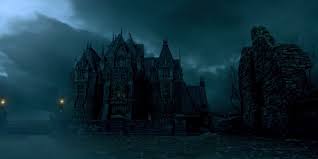
Crimson Peak
Every new year I list the books I've read, and include here a brief description of "Major Events" to help me put my reading in perspective. Chances are my social skills will be as poor as last year, but I like lurking around and throwing my hat in the ring from time to time, so I'm going to keep my thread up and running. Hello to all who pop by.
The List of Links
Biblio Beau, the second home for all my reviews
Books Read in 2015 (75 Books. Major Events: Four semesters of PhD coursework (spring, two summer, fall); published two reviews, spoke and organized at two conferences; taught 20+ credits a semester; bought a house; didn't forget the names of my children or partner; costumed like the enthusiastic amateur I am)
Books Read in 2014 (96 Books. Major Events: First two semesters of PhD coursework; published three papers, two reviews, spoke at two conferences, and organized two conference panels; taught at two schools simultaneously and did my first (and last) stint in a writing center.)
Books Read in 2013 (87 Books. Major Events: Published two papers!)
Books Read in 2012 (81 Books. Major Events: New - additional - Teaching Position, Moving, Surgery)
Books Read in 2011 (101 Books. Major Events: Birth of Third Monster, Poor health and a death in the family)
Books Read in 2010 (100 Books. Major Event: Second Adjunct Position Obtained)
Books Read in 2009 (145 Books. Major Event: Birth of Second Monster)
Books Read in 2008 (61 Books. Major Events: Birth of First Monster, First Adjunct Position Obtained)
Books Read in 2007 (85 Books. Major Event: Finished my MA in English Lit)
Books Read in 2016
1. Skin Trade by Laurell K. Hamilton. Vampires. 1.3.16. Bah.
2. Blood Noir by Laurell K. Hamilton. Vampires. 1.6.16. ****
3. Are You My Mother? by Alison Bechdel. Graphic Autobiography. 1.12.16. ****
4. The Missionary by Sydney Owenson. Victorian Oriental Fiction. 1.13.16. *
5. Through the Woods by Emily Carroll. Graphic Ghost Stories. 1.14.16. ****
6. Medea by Euripides. Greek Drama. 1.16.16. ****
7. Manhood in America by Michael Kimmel. Masculinity Studies. 1.22.16. ***
8. Lady Susan by Jane Austen. Nineteenth-Century. 1.24.16. *****
9. Jack Sheppard by William Harrison Ainsworth. Newgate fiction. 2.1.16. ****
10. The Politics of Gender in Victorian Britain: Masculinity, Political Culture and the Struggle for Women's Rights by Ben Griffin. Masculinity Studies. 2.5.16. ***
11. One Flew Over the Cuckoo's Nest by Ken Kesey. Fiction. 2.10.16. *****
12. Manliness & Civilization by Gail Bederman. Masculinity. 2.20.16. ***1/2
13. We Have Always Lived in the Castle by Shirley Jackson. Gothic Satire. 2.23.16. ****
14. Victorian Masculinities: Manhood and Masculine Poetics in Early Victorian Literature and Art by Herbert Sussman. Masculinities. 3.4.16. ***1/2
15. Houdini, Tarzan, and the Perfect Man: The White Male Body and the Challenge of Modernity in America by John F. Kasson. Masculinities. 3.4.16. ****
16. Fire Touched by Patricia Briggs. Urban Fantasy. 3.9.16. ***
17. Masculinity, Crime and Self-Defence in Victorian Literature: Duelling with Danger by Emelyne Godfrey. Masculinities. 3.19.16. ****
18. The Joker: Death of the Family by Scott Snyder and Greg Capullo. Comics. 3.20.16. *****
19. The Man Who Laughs by Ed Brubaker. Comics. 3.21.16. ****
20. Primary source readings in Victorian Gender. 3.27.16. *****
21. Manning the Race by Marlon B Ross. Sexuality and Masculinity. 4.1.16. ***1/2
22. The Hobbit by J.R.R. Tolkien. Fantasy. 4.5.16. *****
23. Batman Detective Comics #1: Faces of Death by Tony S. Daniel. Comics. 4.2.16. *****
24. Batman/Houdini: The Devil's Workshop by Howard Chaykin. Comic. 4.7.16. **
25. From Hell by Alan Moore. Comic. 4.8.16. ***
26. Batman #1 by Bob Cane. Comic. 4.9.16. ****
27. The Nigger's Opera; or, The Darkie That Walked in Her Sleep by William Brough. Drama. 4.9.16. ***
28. The Gypsy Maid by William Brough. Drama. 4.10.16. **
29. Beowulf trans. Seamus Heaney. Anglo-Saxon. 4.14.16. *****
30. Lady Audley's Secret by Mary Elizabeth Braddon. Victorian. 4.17.16. *****
31. North and South by Elizabeth Gaskell. Victorian. 4.17.16. ***
32. 200+ Pages of Student Research Papers. Work. 4.21.16.
33. The Island of Doctor Moreau by H.G. Wells. Scientific Romance. 4.25.16. *****
34. Selections from A Question of Manhood Vol. 2 by various. Masculinity. 4.34.16. ****
35. Over 300 pages of student essays. Work. 5.3.15.
36. The Maiden Tribute of Modern Babylon by W.T. Stead. Journalism. 5.5.16. *****
37. Poetry selections from the Broadview Anthology by Various. Spring 2016. *****
38. Nonfiction selections from Victorian Prose and Victorian Prose by various. Spring 2016. *****
39. The Woman in White by Wilkie Collins. Victorian Gothic. Spring 2016. ******
40. The Odd Women by George Gissing. Victorian Fiction. 5.6.16. ****
41. The God, The Bad, and the Emus by Donna Andrews. Cozy Mystery. 5.8.16. ***
42. The Nightingale Before Christmas by Donna Andrews. Cozy Mystery. 5.10.16. **1/2
43. Lord of the Wings by Donna Andrews. Cozy Mystery. 5.12.16. ***1/2
44. American Vampire by Scott Snyder, Rafael Albuquerque, and Stephen King. Graphic Novel. 5.12.16. ***1/2
45. Wytches by Scot Snyder, Joch, Hollingsworth, and Robins. Graphic Novel. 5.13.16. *****
46. Coffin Hill Volume 1 by Caitlin Kittredge. Graphic Novel. 5.13.16. ***1/2
47. The Astonishing X-Men by Joss Whedon. Graphic Novel. 5.18.16. ****
48. Instructions for American Servicemen in Britain, 1942 by the United States War Department. Historical Guide. 5.20.16. ****
49. Batman Year One by Frank Miller and David Mazzucchelli. Comic Books. 5.28.16. ****
50. A Discovery of Witches by Deborah Harkness. Fantasy. 5.2016. **
51. Extraordinary X-Men: X-Haven by Lemire and Ramos. Comics. 5.2016. **
52. The Bullet-Catcher's Daughter by Rod Duncan. Fantasy. 6.9.16. **
53. Amazing X-Men: The Quest for Nighcrawler by Jason Aaron. Comic. 6.17.16. ***
54. Batman: The Court of Owls by Scott Snyder. Comic. 6.18.2016. ****
55. Burial Rites by Hannah Kent. Historical Fiction. 6.0.16. *****
56. The G-String Murders by Gypsy Rose Lee. Pulp. 6.23.16. *****
57. Mother Finds a Body by Gypsy Rose Lee. Pulp. 6.25.16. ***
58. Sex Criminals: Vol. 1 by Matt Fraction. Comic. 6.27.16. ***
59. Lost Girls: Vol. 1 by Alan Moore. Graphic Novel. 6.16.16. ****
60. Lost Girls: Vol. 2 by Alan Moore. Graphic Novel. 6.17.16. ****
61. The Female Detective by Andrew Forrester. Detective Novel. 7.5.16. ***
62. Clean Room by Gail Simone. Graphic Novel. 7.6.16. *****
63. Flirt by Laurell K. Hamilton. Urban Fantasy. 7.10.16. **
64. Monstress by Marjorie Liu and Sana Takeda. Graphic Novel. 7.12.16. *****
65. Lost Girls: Vol. 3 by Alan More. Graphic Novel. 7.14.16. ***1/2
66. Hit List by Laurell K. Hamilton. Urban Fantasy. 7.12.16. *
67. Kiss the Dead by Laurell K. Hamilton. Urban Fantasy. 7.18.16. **
68. Affliction by Laurell K. Hamilton. Urban Fantasy. 7.25.16. ****
69. Dead Ice by Laurell K. Hamilton. Urban Fantasy. 7.28.16. ***
70. Batman: The City of Owls by Scott Snyder. Comic. 8.2.16. ***
71. The Joker: Endgame by Scott Snyder. Comic. 8.3.16. ******
72. Pretty Deadly by Kelly Sue Deconnick. Comic. 8.3.16. ***1/2
73. The Saga of the Swamp Thing by Alan Moore. Comic. 8.8.16. ***
74. 300 by Frank Miller. Comic. 8.9.16. ***
75. Catwoman: A Celebration of 75 Years by Frank Miller. Comic. 8.9.16. ***
76. Suicide Squad: Trial by Fire by John Ostrander. Comic. 8.2016. ****
77. The Perfect Gentleman: The Pursuit of Timeless Elegance and Style in London. by James Sherwood. Fashion History. 8.2016. ****
78. Suicide Squad: The Nightshade Odyssey by John Ostrander, Luke McDonnell, and Bob Lewis. Comic. 9.2.16. **
79. Gotham City Central: In the Line of Duty by Greg Rucka, Ed Brubaker. Comic 9.17.16. ****
80. Gotham City Central: Jokers and Madmen by Greg Rucka, Ed Brubaker. Comic. 9.19.16. ****
81. Catwoman: Selina's Big Score by Darwyn Cooke. Comic. 9.20.16. ***1/2
82. Catwoman: Vol. 1 Th Game by Judd Winick. Comic. 9.21.16. ***
83. Victorian Fashion by Jayne Shrimpton. Fashion History. 9.23.16. ***
84. Victoriana by James Laver. Material Culture, History. 9.25.16. ***
85. Dark Night by Paul Dini. Graphic Memoir. 10.2016. **
86. Fashioning Gothic Bodies by Catherine Spooner. Fashion and Literary Theory. 10.2016. *****
87. Dress Culture in Late Victorian Women's Fiction by Christine Bayles Kortsch. Fashion, Gender, and Literary Theory. 10.2016. *****
88. Hidden Destiny by Carrie Ann Ryan. Supernatural Romance. 11.2.16. ***
89. Tattered Loyalties by Carrie Ann Ryan. Supernatural Romance. 11.3.16. ***
90. Bodies by Si Spencer, et al. Graphic Novel. 11.4.16. ***
91. The Colour of Magic by Terry Pratchett. Fantasy. 11.7.16. ***
92. The Long Halloween by Jeoph Loeb. Comic. 11.8.16. ***1/2
93. The Light Fantastic by Terry Pratchett. Fantasy. 11.13.16. ***
94. Equal Rites by Terry Pratchett. Fantasy. 11.16.16. ****
95. Mort by Terry Pratchett. Fantasy. 11.17.16. *****
96. Sourcery by Terry Pratchett. Fantasy. 11.23.16. ***
97. Die Like an Eagle by Donna Andrews. Cozy Mystery. 11.25.16. ****
98. Wyrd Sisters by Terry Pratchett. Fantasy. 11.27.16. ****
99. Pyramids by Terry Pratchett. Fantasy. 11.29.16. ***
100. Guards! Guards! by Terry Pratchett. Fantasy. 12.7.16. *****
101. Eric by Terry Pratchett. Fantasy. 12.10.16. **
102. The Girl With All the Gifts by M.R. Carey. Science Fiction. **
103. The Bad Beginning by Lemony Snicket. Children's. 12.12.16. ****
104. Moving Pictures by Terry Pratchett. Fantasy. 12.18.16. ****
105. The Reptile Room by Lemony Snicket. Children's. 12,19.16. ****
106. Hyperbole and a Half by Allie Brosh. Graphic Memoir. 12.20.16. ****
107. A Christmas Carol by Charles Dickens. Ghost Story. 12.22.16. *****
108. Reaper Man by Terry Pratchett. Fantasy. 12.29.2016. ****
Crimson Peak
Every new year I list the books I've read, and include here a brief description of "Major Events" to help me put my reading in perspective. Chances are my social skills will be as poor as last year, but I like lurking around and throwing my hat in the ring from time to time, so I'm going to keep my thread up and running. Hello to all who pop by.
The List of Links
Biblio Beau, the second home for all my reviews
Books Read in 2015 (75 Books. Major Events: Four semesters of PhD coursework (spring, two summer, fall); published two reviews, spoke and organized at two conferences; taught 20+ credits a semester; bought a house; didn't forget the names of my children or partner; costumed like the enthusiastic amateur I am)
Books Read in 2014 (96 Books. Major Events: First two semesters of PhD coursework; published three papers, two reviews, spoke at two conferences, and organized two conference panels; taught at two schools simultaneously and did my first (and last) stint in a writing center.)
Books Read in 2013 (87 Books. Major Events: Published two papers!)
Books Read in 2012 (81 Books. Major Events: New - additional - Teaching Position, Moving, Surgery)
Books Read in 2011 (101 Books. Major Events: Birth of Third Monster, Poor health and a death in the family)
Books Read in 2010 (100 Books. Major Event: Second Adjunct Position Obtained)
Books Read in 2009 (145 Books. Major Event: Birth of Second Monster)
Books Read in 2008 (61 Books. Major Events: Birth of First Monster, First Adjunct Position Obtained)
Books Read in 2007 (85 Books. Major Event: Finished my MA in English Lit)
Books Read in 2016
1. Skin Trade by Laurell K. Hamilton. Vampires. 1.3.16. Bah.
2. Blood Noir by Laurell K. Hamilton. Vampires. 1.6.16. ****
3. Are You My Mother? by Alison Bechdel. Graphic Autobiography. 1.12.16. ****
4. The Missionary by Sydney Owenson. Victorian Oriental Fiction. 1.13.16. *
5. Through the Woods by Emily Carroll. Graphic Ghost Stories. 1.14.16. ****
6. Medea by Euripides. Greek Drama. 1.16.16. ****
7. Manhood in America by Michael Kimmel. Masculinity Studies. 1.22.16. ***
8. Lady Susan by Jane Austen. Nineteenth-Century. 1.24.16. *****
9. Jack Sheppard by William Harrison Ainsworth. Newgate fiction. 2.1.16. ****
10. The Politics of Gender in Victorian Britain: Masculinity, Political Culture and the Struggle for Women's Rights by Ben Griffin. Masculinity Studies. 2.5.16. ***
11. One Flew Over the Cuckoo's Nest by Ken Kesey. Fiction. 2.10.16. *****
12. Manliness & Civilization by Gail Bederman. Masculinity. 2.20.16. ***1/2
13. We Have Always Lived in the Castle by Shirley Jackson. Gothic Satire. 2.23.16. ****
14. Victorian Masculinities: Manhood and Masculine Poetics in Early Victorian Literature and Art by Herbert Sussman. Masculinities. 3.4.16. ***1/2
15. Houdini, Tarzan, and the Perfect Man: The White Male Body and the Challenge of Modernity in America by John F. Kasson. Masculinities. 3.4.16. ****
16. Fire Touched by Patricia Briggs. Urban Fantasy. 3.9.16. ***
17. Masculinity, Crime and Self-Defence in Victorian Literature: Duelling with Danger by Emelyne Godfrey. Masculinities. 3.19.16. ****
18. The Joker: Death of the Family by Scott Snyder and Greg Capullo. Comics. 3.20.16. *****
19. The Man Who Laughs by Ed Brubaker. Comics. 3.21.16. ****
20. Primary source readings in Victorian Gender. 3.27.16. *****
21. Manning the Race by Marlon B Ross. Sexuality and Masculinity. 4.1.16. ***1/2
22. The Hobbit by J.R.R. Tolkien. Fantasy. 4.5.16. *****
23. Batman Detective Comics #1: Faces of Death by Tony S. Daniel. Comics. 4.2.16. *****
24. Batman/Houdini: The Devil's Workshop by Howard Chaykin. Comic. 4.7.16. **
25. From Hell by Alan Moore. Comic. 4.8.16. ***
26. Batman #1 by Bob Cane. Comic. 4.9.16. ****
27. The Nigger's Opera; or, The Darkie That Walked in Her Sleep by William Brough. Drama. 4.9.16. ***
28. The Gypsy Maid by William Brough. Drama. 4.10.16. **
29. Beowulf trans. Seamus Heaney. Anglo-Saxon. 4.14.16. *****
30. Lady Audley's Secret by Mary Elizabeth Braddon. Victorian. 4.17.16. *****
31. North and South by Elizabeth Gaskell. Victorian. 4.17.16. ***
32. 200+ Pages of Student Research Papers. Work. 4.21.16.
33. The Island of Doctor Moreau by H.G. Wells. Scientific Romance. 4.25.16. *****
34. Selections from A Question of Manhood Vol. 2 by various. Masculinity. 4.34.16. ****
35. Over 300 pages of student essays. Work. 5.3.15.
36. The Maiden Tribute of Modern Babylon by W.T. Stead. Journalism. 5.5.16. *****
37. Poetry selections from the Broadview Anthology by Various. Spring 2016. *****
38. Nonfiction selections from Victorian Prose and Victorian Prose by various. Spring 2016. *****
39. The Woman in White by Wilkie Collins. Victorian Gothic. Spring 2016. ******
40. The Odd Women by George Gissing. Victorian Fiction. 5.6.16. ****
41. The God, The Bad, and the Emus by Donna Andrews. Cozy Mystery. 5.8.16. ***
42. The Nightingale Before Christmas by Donna Andrews. Cozy Mystery. 5.10.16. **1/2
43. Lord of the Wings by Donna Andrews. Cozy Mystery. 5.12.16. ***1/2
44. American Vampire by Scott Snyder, Rafael Albuquerque, and Stephen King. Graphic Novel. 5.12.16. ***1/2
45. Wytches by Scot Snyder, Joch, Hollingsworth, and Robins. Graphic Novel. 5.13.16. *****
46. Coffin Hill Volume 1 by Caitlin Kittredge. Graphic Novel. 5.13.16. ***1/2
47. The Astonishing X-Men by Joss Whedon. Graphic Novel. 5.18.16. ****
48. Instructions for American Servicemen in Britain, 1942 by the United States War Department. Historical Guide. 5.20.16. ****
49. Batman Year One by Frank Miller and David Mazzucchelli. Comic Books. 5.28.16. ****
50. A Discovery of Witches by Deborah Harkness. Fantasy. 5.2016. **
51. Extraordinary X-Men: X-Haven by Lemire and Ramos. Comics. 5.2016. **
52. The Bullet-Catcher's Daughter by Rod Duncan. Fantasy. 6.9.16. **
53. Amazing X-Men: The Quest for Nighcrawler by Jason Aaron. Comic. 6.17.16. ***
54. Batman: The Court of Owls by Scott Snyder. Comic. 6.18.2016. ****
55. Burial Rites by Hannah Kent. Historical Fiction. 6.0.16. *****
56. The G-String Murders by Gypsy Rose Lee. Pulp. 6.23.16. *****
57. Mother Finds a Body by Gypsy Rose Lee. Pulp. 6.25.16. ***
58. Sex Criminals: Vol. 1 by Matt Fraction. Comic. 6.27.16. ***
59. Lost Girls: Vol. 1 by Alan Moore. Graphic Novel. 6.16.16. ****
60. Lost Girls: Vol. 2 by Alan Moore. Graphic Novel. 6.17.16. ****
61. The Female Detective by Andrew Forrester. Detective Novel. 7.5.16. ***
62. Clean Room by Gail Simone. Graphic Novel. 7.6.16. *****
63. Flirt by Laurell K. Hamilton. Urban Fantasy. 7.10.16. **
64. Monstress by Marjorie Liu and Sana Takeda. Graphic Novel. 7.12.16. *****
65. Lost Girls: Vol. 3 by Alan More. Graphic Novel. 7.14.16. ***1/2
66. Hit List by Laurell K. Hamilton. Urban Fantasy. 7.12.16. *
67. Kiss the Dead by Laurell K. Hamilton. Urban Fantasy. 7.18.16. **
68. Affliction by Laurell K. Hamilton. Urban Fantasy. 7.25.16. ****
69. Dead Ice by Laurell K. Hamilton. Urban Fantasy. 7.28.16. ***
70. Batman: The City of Owls by Scott Snyder. Comic. 8.2.16. ***
71. The Joker: Endgame by Scott Snyder. Comic. 8.3.16. ******
72. Pretty Deadly by Kelly Sue Deconnick. Comic. 8.3.16. ***1/2
73. The Saga of the Swamp Thing by Alan Moore. Comic. 8.8.16. ***
74. 300 by Frank Miller. Comic. 8.9.16. ***
75. Catwoman: A Celebration of 75 Years by Frank Miller. Comic. 8.9.16. ***
76. Suicide Squad: Trial by Fire by John Ostrander. Comic. 8.2016. ****
77. The Perfect Gentleman: The Pursuit of Timeless Elegance and Style in London. by James Sherwood. Fashion History. 8.2016. ****
78. Suicide Squad: The Nightshade Odyssey by John Ostrander, Luke McDonnell, and Bob Lewis. Comic. 9.2.16. **
79. Gotham City Central: In the Line of Duty by Greg Rucka, Ed Brubaker. Comic 9.17.16. ****
80. Gotham City Central: Jokers and Madmen by Greg Rucka, Ed Brubaker. Comic. 9.19.16. ****
81. Catwoman: Selina's Big Score by Darwyn Cooke. Comic. 9.20.16. ***1/2
82. Catwoman: Vol. 1 Th Game by Judd Winick. Comic. 9.21.16. ***
83. Victorian Fashion by Jayne Shrimpton. Fashion History. 9.23.16. ***
84. Victoriana by James Laver. Material Culture, History. 9.25.16. ***
85. Dark Night by Paul Dini. Graphic Memoir. 10.2016. **
86. Fashioning Gothic Bodies by Catherine Spooner. Fashion and Literary Theory. 10.2016. *****
87. Dress Culture in Late Victorian Women's Fiction by Christine Bayles Kortsch. Fashion, Gender, and Literary Theory. 10.2016. *****
88. Hidden Destiny by Carrie Ann Ryan. Supernatural Romance. 11.2.16. ***
89. Tattered Loyalties by Carrie Ann Ryan. Supernatural Romance. 11.3.16. ***
90. Bodies by Si Spencer, et al. Graphic Novel. 11.4.16. ***
91. The Colour of Magic by Terry Pratchett. Fantasy. 11.7.16. ***
92. The Long Halloween by Jeoph Loeb. Comic. 11.8.16. ***1/2
93. The Light Fantastic by Terry Pratchett. Fantasy. 11.13.16. ***
94. Equal Rites by Terry Pratchett. Fantasy. 11.16.16. ****
95. Mort by Terry Pratchett. Fantasy. 11.17.16. *****
96. Sourcery by Terry Pratchett. Fantasy. 11.23.16. ***
97. Die Like an Eagle by Donna Andrews. Cozy Mystery. 11.25.16. ****
98. Wyrd Sisters by Terry Pratchett. Fantasy. 11.27.16. ****
99. Pyramids by Terry Pratchett. Fantasy. 11.29.16. ***
100. Guards! Guards! by Terry Pratchett. Fantasy. 12.7.16. *****
101. Eric by Terry Pratchett. Fantasy. 12.10.16. **
102. The Girl With All the Gifts by M.R. Carey. Science Fiction. **
103. The Bad Beginning by Lemony Snicket. Children's. 12.12.16. ****
104. Moving Pictures by Terry Pratchett. Fantasy. 12.18.16. ****
105. The Reptile Room by Lemony Snicket. Children's. 12,19.16. ****
106. Hyperbole and a Half by Allie Brosh. Graphic Memoir. 12.20.16. ****
107. A Christmas Carol by Charles Dickens. Ghost Story. 12.22.16. *****
108. Reaper Man by Terry Pratchett. Fantasy. 12.29.2016. ****
7Berly
Starred again! Last year was certainly a busy one..I wonder what's in store for you this year?!
9London_StJ
Hello everyone! Happy new year!
To kick off the haunted halls I'm sharing an end-of-December review; I think it sets the right tone.
73.
Title: Breed
Author: Chase Novak
Genre: Horror
Medium: Kindle
Acquisition: Conference colleague rec
Date Completed: December 30, 2015
Rating: ****
When a fellow panelist discovered I was the one who put together two panels on Monstrous Maternity, her first reaction was to suggest this book. It's taken me a couple of years to get around to it, but boy, I'm glad I did.
The premise is a familiar (first-world?) problem: fertility. Specifically, the narrative follows a high-powered, old-money New York couple as their struggle to produced the paternally-desired heir drives them to the extreme treatments offered by an Eastern European doctor, who happens to have an astounding success rate. Their initial experiences are shady enough to be cringe-worthy, and the tone of the early chapters is wonderfully ominous, with strong pacing. Immediately after the treatments the couple begins behaving strangely, but they get what they paid for when they have twins (...) five months later. The second half of the novel rediscovers the family ten years later, and explores the side effects of those strange fertility treatments.
The critique of fertility treatments and genetic manipulation is heady stuff, and unabashedly critical; the relationships and cultural institutions that spur the narrative are complex and contentious, giving space for consideration to impetuses both big and small. That said Novak doesn't go to great lengths to drive home social messages, and I'd think the novel could well be enjoyed for the slow creep of a horror it is, without becoming beleaguered by politics.
When I described the plot to my partner, a little more explicitly than here, since I didn't have to worry about spoilers, he responded, "You know why he wrote that book, right? To have it made into a movie." Perhaps - it'd make a really great flick. But it's a pretty good read on its own, and one I'd recommend to readers of modern horror.
To kick off the haunted halls I'm sharing an end-of-December review; I think it sets the right tone.
73.

Title: Breed
Author: Chase Novak
Genre: Horror
Medium: Kindle
Acquisition: Conference colleague rec
Date Completed: December 30, 2015
Rating: ****
When a fellow panelist discovered I was the one who put together two panels on Monstrous Maternity, her first reaction was to suggest this book. It's taken me a couple of years to get around to it, but boy, I'm glad I did.
The premise is a familiar (first-world?) problem: fertility. Specifically, the narrative follows a high-powered, old-money New York couple as their struggle to produced the paternally-desired heir drives them to the extreme treatments offered by an Eastern European doctor, who happens to have an astounding success rate. Their initial experiences are shady enough to be cringe-worthy, and the tone of the early chapters is wonderfully ominous, with strong pacing. Immediately after the treatments the couple begins behaving strangely, but they get what they paid for when they have twins (...) five months later. The second half of the novel rediscovers the family ten years later, and explores the side effects of those strange fertility treatments.
The critique of fertility treatments and genetic manipulation is heady stuff, and unabashedly critical; the relationships and cultural institutions that spur the narrative are complex and contentious, giving space for consideration to impetuses both big and small. That said Novak doesn't go to great lengths to drive home social messages, and I'd think the novel could well be enjoyed for the slow creep of a horror it is, without becoming beleaguered by politics.
When I described the plot to my partner, a little more explicitly than here, since I didn't have to worry about spoilers, he responded, "You know why he wrote that book, right? To have it made into a movie." Perhaps - it'd make a really great flick. But it's a pretty good read on its own, and one I'd recommend to readers of modern horror.
10dk_phoenix
Hello! Dropping off a star, and my oh my, you had quite a busy 2015, didn't you! How fantastic!
I also love the Crimson Peak photo at the top. I tried and tried to get out to see it while it was in theatre but never managed, so I'm hoping to watch it as soon as it's digitally available.
I also love the Crimson Peak photo at the top. I tried and tried to get out to see it while it was in theatre but never managed, so I'm hoping to watch it as soon as it's digitally available.
11London_StJ
10> I preordered it because I, too, missed it in theatres! Such a disappointment.
I realized today that it's been a year since I've updated my reading blog. Whoops. But, in going through my lists I realized that I did in fact read 75 books in 2015, not counting the endless articles for research and coursework, or the 296 student essays for the fall semester. Huzzah for a goal actually met!
This year I have a bit going on: in a few weeks I'll start independent studies in Victorian Literature and Masculinity Studies, and will continue teaching freshman English. My comprehensive exams will be in October, so I'll be reading the summer away, packing my head full of nineteenth-century literature, comics, and theory.
I'm still trying to finish Anita Blake in order. Once that's through I want to read all of Discworld, likewise in order, because I never have.
With any luck I'll finish some sewing before going back to work, including the Crimson Peak inspired Edwardian nightgown, and new quilts for my small gentlemen.
Ah! I need 30-hour days!
I realized today that it's been a year since I've updated my reading blog. Whoops. But, in going through my lists I realized that I did in fact read 75 books in 2015, not counting the endless articles for research and coursework, or the 296 student essays for the fall semester. Huzzah for a goal actually met!
This year I have a bit going on: in a few weeks I'll start independent studies in Victorian Literature and Masculinity Studies, and will continue teaching freshman English. My comprehensive exams will be in October, so I'll be reading the summer away, packing my head full of nineteenth-century literature, comics, and theory.
I'm still trying to finish Anita Blake in order. Once that's through I want to read all of Discworld, likewise in order, because I never have.
With any luck I'll finish some sewing before going back to work, including the Crimson Peak inspired Edwardian nightgown, and new quilts for my small gentlemen.
Ah! I need 30-hour days!
12London_StJ
Joyfully stolen from Stephen:
Books from 2015
Describe yourself: Dracula
Describe how you feel: One Flew Over the Cuckoo's Nest
Describe where you currently live: The Stepford Wives
If you could go anywhere, where would you go: The Picture of Dorian Gray
Your favorite form of transportation: Manners and Mutiny (dirigibles just sound fun)
Your best friend is: The Girl with the Iron Touch
You and your friends are: We Have Always Lived in the Castle
What’s the weather like: Burnt Offerings
You fear: The Cultural Politics of Emotion
What is the best advice you have to give: Waiting for Godot
Thought for the day: Guilty Pleasures
How you would like to die: Carmilla
Your soul’s present condition:Shifting Shadows
Books from 2015
Describe yourself: Dracula
Describe how you feel: One Flew Over the Cuckoo's Nest
Describe where you currently live: The Stepford Wives
If you could go anywhere, where would you go: The Picture of Dorian Gray
Your favorite form of transportation: Manners and Mutiny (dirigibles just sound fun)
Your best friend is: The Girl with the Iron Touch
You and your friends are: We Have Always Lived in the Castle
What’s the weather like: Burnt Offerings
You fear: The Cultural Politics of Emotion
What is the best advice you have to give: Waiting for Godot
Thought for the day: Guilty Pleasures
How you would like to die: Carmilla
Your soul’s present condition:Shifting Shadows
13London_StJ
1. 
Title: Skin Trade
Author: Laurell K. Hamilton
Genre: Vampires
Medium: Hardback
Acquisition: Originally preordered
Date Completed: January 3, 2016
Rating: Bah
In the case of my relationship with Anita Blake, absence makes the heart grow fonder, and after a year of wading through all of her adventures I'm finding her tiresome. The affective saturation of the ongoing Blake narrative has reached a critical mass devolving into an endless parade of anonymous sex and the angst that Blake's puritanical views then inspires. I find Richard loathsome, Anita unreasonable, and the introduction of new lovers tiresome. This novel in particular seems stagnant; Anita realizes the use value of Jason when she agrees to accompany him home to face his physically abusive father who is dying from cancer. This relationship, if actually developed, would have been far more compelling than the shallow circus of doppelgangers and a high-profile wedding.
This novel is a low point for me, but I've already pushed through and started Blood Noir, in which Anita regains her professional status, is not entirely shedding her identity anxiety.

Title: Skin Trade
Author: Laurell K. Hamilton
Genre: Vampires
Medium: Hardback
Acquisition: Originally preordered
Date Completed: January 3, 2016
Rating: Bah
In the case of my relationship with Anita Blake, absence makes the heart grow fonder, and after a year of wading through all of her adventures I'm finding her tiresome. The affective saturation of the ongoing Blake narrative has reached a critical mass devolving into an endless parade of anonymous sex and the angst that Blake's puritanical views then inspires. I find Richard loathsome, Anita unreasonable, and the introduction of new lovers tiresome. This novel in particular seems stagnant; Anita realizes the use value of Jason when she agrees to accompany him home to face his physically abusive father who is dying from cancer. This relationship, if actually developed, would have been far more compelling than the shallow circus of doppelgangers and a high-profile wedding.
This novel is a low point for me, but I've already pushed through and started Blood Noir, in which Anita regains her professional status, is not entirely shedding her identity anxiety.
14dragonaria
>13 London_StJ: I loved her novels until right about here. I still read them, hoping she'll get back to the interesting bits. I just have to laugh at the deep emotional/philosophical discussions she gets into at "intimate" moments.
So, Hi! Dropping a star and planning to lurk!
So, Hi! Dropping a star and planning to lurk!
15London_StJ
>14 dragonaria: dragonaria: Hello! Happy to have you lurking! I'm with you on the series - this is where it drops, at least momentarily. (I've read everything but the most recent, but never read them in order before now, and am reading them all again.) Blood Noir is a bit better, because Anita jumps ship to work; a bit better, but not perfect. I'm still working up to Dead Ice, which I have, but haven't yet read.
16London_StJ
I don't actually remember mentioning our baby girl last year, but this fall we brought home our new darling, Sibyl Vane:

She is our love, fondly called "Fluffy Yup." We just got back from her first training class, and I'm so excited!

She is our love, fondly called "Fluffy Yup." We just got back from her first training class, and I'm so excited!
17FAMeulstee
>16 London_StJ: Wasn't around last year, so I would have missed anyway, "Fluffy Yup" looks adorable, how old is she?
18London_StJ
>17 FAMeulstee: Just over five months. This was the day of her first haircut, and she's still wonderfully fluffy. I was around last year, but barely made it beyond my own thread for all the work I always had to do.
20lkernagh
>16 London_StJ: - At only 5 months I can go with the comment I wanted to make: PUPPY! So sweet.
21London_StJ
>20 lkernagh: I have a feeling we will be calling her PUPPY or "aww, baby girl" until she's 15. ;)
>19 ronincats: She's a standard poodle, and has some good size in her bloodlines. I wanted a huge dog, but my partner doesn't like their short life spans, and I wasn't sure I could deal with the fur of most of my favorite breeds. Poodles were the only dogs that hit all of my "must haves" - no (or little) shedding, big-ish, smart, and can run with me. So far she's been the perfect choice, and we're thinking about finding a sister for her to complete our family.
And another of the furbabies, from November's family photos:

2.
Title: Blood Noir
Author: Laurell K. Hamilton
Genre: Vampires
Medium: Hardback
Acquisition: Originally preordered, re-read
Date Completed: January 6, 2016
Rating: ****
Blood Noir is, like most Anita Blake books, filled with angst, but of a different sort than we see in the books immediately preceding - this angst is professional, and how the monster-hunter manages to both love and murder the supernatural. When a serial-killing vampire reappears in Vegas, Anita takes off while Jean Claude is still asleep, the better to slip away. The bounty hunters Edward, Bernardo, and Olaf are back, and Anita navigates local supernatural politics, local law enforcement, and her own killer instincts as she seeks out a real, material threat. Anita is a better vampire hunter than she is a partner or a lover, and I appreciate when the books find a balance of the two. This book earns four stars from me less for its actual content, and more for the welcome change from the last one.
>19 ronincats: She's a standard poodle, and has some good size in her bloodlines. I wanted a huge dog, but my partner doesn't like their short life spans, and I wasn't sure I could deal with the fur of most of my favorite breeds. Poodles were the only dogs that hit all of my "must haves" - no (or little) shedding, big-ish, smart, and can run with me. So far she's been the perfect choice, and we're thinking about finding a sister for her to complete our family.
And another of the furbabies, from November's family photos:

2.

Title: Blood Noir
Author: Laurell K. Hamilton
Genre: Vampires
Medium: Hardback
Acquisition: Originally preordered, re-read
Date Completed: January 6, 2016
Rating: ****
Blood Noir is, like most Anita Blake books, filled with angst, but of a different sort than we see in the books immediately preceding - this angst is professional, and how the monster-hunter manages to both love and murder the supernatural. When a serial-killing vampire reappears in Vegas, Anita takes off while Jean Claude is still asleep, the better to slip away. The bounty hunters Edward, Bernardo, and Olaf are back, and Anita navigates local supernatural politics, local law enforcement, and her own killer instincts as she seeks out a real, material threat. Anita is a better vampire hunter than she is a partner or a lover, and I appreciate when the books find a balance of the two. This book earns four stars from me less for its actual content, and more for the welcome change from the last one.
22dk_phoenix
DOGGERS!!! This influx of critter photos on the thread is making my week. I've heard poodles make fantastic family pets!
23London_StJ
>22 dk_phoenix: Well, the monsters love her nearly as much as I do!
24Donna828
It's so good to find your thread, Luxx. Thanks for keeping us up-to-date with the Major Events in your BUSY life! Love the pictures of "Fluffy Yup" -- too bad you cut off the heads of your sweet boys, who I'm certain have entered the age of handsome young men! Happy Reading in 2016 and best of luck with earning your doctorate.
25lycomayflower
>16 London_StJ: What a nice looking dog!
>1 London_StJ: I love your idea of listing major events along with books read in a year for the perspective. I have to remind myself constantly that smaller reading numbers don't necessarily mean I'm not reading "enough"--it's just life, and that's good!
>1 London_StJ: I love your idea of listing major events along with books read in a year for the perspective. I have to remind myself constantly that smaller reading numbers don't necessarily mean I'm not reading "enough"--it's just life, and that's good!
26London_StJ
>24 Donna828: Donna! It's great to see you! I am rather fond of those monsters, and I'm so thrilled that 2/3 can now read. They love it just as much as their mama.
>25 lycomayflower: I have to remind myself, too. Ironically, reading was a bit easier before I started school!
The semester started for real today (i.e. it was my first day teaching), which means I need to start on my independent studies, and lectures begin anew. Tomorrow we're reading Marlowe and Raleigh, and then it's onward to Sappho.
I've also decided to join the charity organization Pinups for Pitbulls, and will be working my first event this Saturday! It's going to be a long weekend - First Born is turning eight, and we're throwing his first friends birthday party - but it'll be a good one.
>25 lycomayflower: I have to remind myself, too. Ironically, reading was a bit easier before I started school!
The semester started for real today (i.e. it was my first day teaching), which means I need to start on my independent studies, and lectures begin anew. Tomorrow we're reading Marlowe and Raleigh, and then it's onward to Sappho.
I've also decided to join the charity organization Pinups for Pitbulls, and will be working my first event this Saturday! It's going to be a long weekend - First Born is turning eight, and we're throwing his first friends birthday party - but it'll be a good one.
27Whisper1
Monsters? Monsters? Where are photos of the monsters? It is so good to find your thread. BIG hugs to you.
28LovingLit
>1 London_StJ: lol, didn't forget your kids names AND all the rest!? Well done you :)
>9 London_StJ: interesting! I read Rosemary's Baby last year and loved it....I only mention that in relation to this as it is practically the only horror book I have ever read. I don't necessarily dislike 'horror', just unnecessary gore or suspense. Maybe I need to broaden my reading....(I always say that and sometimes even act on it!)
Good luck with your busy start to the semester. Mine starts Feb 17 when I have made myself available to assist in a 'mature students' seminar for those returning to study. I also foolishly said I (might be) available for some more admin work for a department other than my own *shock* (is it the case everywhere that other departments are like a foreign land?). Anyway, if it is offered, I might have to politely decline as will have only 2 weeks of relative freedom while the kids are in school/kindy and I have yet to start class.
>9 London_StJ: interesting! I read Rosemary's Baby last year and loved it....I only mention that in relation to this as it is practically the only horror book I have ever read. I don't necessarily dislike 'horror', just unnecessary gore or suspense. Maybe I need to broaden my reading....(I always say that and sometimes even act on it!)
Good luck with your busy start to the semester. Mine starts Feb 17 when I have made myself available to assist in a 'mature students' seminar for those returning to study. I also foolishly said I (might be) available for some more admin work for a department other than my own *shock* (is it the case everywhere that other departments are like a foreign land?). Anyway, if it is offered, I might have to politely decline as will have only 2 weeks of relative freedom while the kids are in school/kindy and I have yet to start class.
29London_StJ
>28 LovingLit: - I think it's like that within the same schools (i.e. Arts and Letters), but I can't imagine any wider. I'm also a distance student, which means I both miss numerous opportunities, and such obligations. That break is precious, though, and I know my own 10-day span wasn't nearly long enough this time around.
>27 Whisper1: So glad you made it back! BIG hugs to you, too!
I really, really think I missed a book before this one, but I can't for the life of me think of what it could be. Whoops.
3.
Title: Are You My Mother?: A Comic Drama
Author: Alison Bechdel
Genre: Autobiography
Medium: Hardback
Acquisition: Library book
Date Completed: January 12, 2016
Rating: ****
Alison Bechdel is a compelling American comic artist known for her strip "Dykes to Watch Out For", and whose 2006 graphic memoir Fun Home, describing her relationship with her father before his suicide, was produced as a wonderfully successful Broadway musical in 2013. The show has won fifteen awards to date, including five Tony awards in 2015. The complexity and spirit of Fun Home is moving and engaging, drawing a parallel course between the author's own coming out as a lesbian and her closeted father's attempts to pass and remain buried in one of the ornate closets of his painstakingly-restored Victorian house. There's a tension in Bechdel's writing, given the highly personal content of her work, and an awareness of the potential conflict which will arise when she succinctly outs her father, whose life is successfully secreted until her book. There's much to say, but not here, because this is a review of her second parental examination, and not a return to Bechdel's father.
Are You My Mother? claims to be the companion of Bechdel's earlier memoir, illuminating her mother where she once examined her father. Frequently claims to be, I'll emphasize, as Bechdel repeatedly reminds the reader that she is writing this "book about her mother," and even finishes the text with her mother claiming subjectivity. This constant reminder is required, though, because the book is not truly about Bechdel's mother - indeed, she is physically and subjectively absent for much of the story, perhaps reflecting her ornamental role in the false narrative of her deceased husband. What Bechdel shares of her mother is both a repetition of what is shared in Fun Home, and almost completely overshadowed by Bechdel's psychoanalytic readings of why her relationship with her mother is so emotionally difficult for the comic. The book isn't about Bechdel's mother - it's about Bechdel herself, and her attempts to find a spiritual mother, to come to terms with her decision to not be a mother, to make peace with her sense of failing in the eyes of her mother. It begs for approval much like Bechdel herself seeks her mother's approval, but it makes no space for the purported subject of her narrative - her mother is influential, but peripheral. The psychoanalytic saturation of the content is burdensome, distracting from the humanity of the story, and distancing the text from the actual relationships - a distance that I think Bechdel may feel she needs, whether or not she does this purposefully. Whereas the house of Fun Home stands as a foreboding and constant symbol of Bechdel's father, whose stoic face is nearly constantly present, the dominant image of Are You My Mother? is Bechdel's own profile as she seeks reassurance from other women in her life - most frequently her therapists, but also her mother, heard most often over the phone. The pages are saturated in an eerie orange-red, the tangee lipstick of her mother forecasting the turmoil and aggressive potential of the story, the color rendering even the most ordinary of scenes slightly ominous. Though Bechdel's father is described as having the temper in her childhood home, her mother's red suggests she is a far greater threat to the developing artist, and literally and figuratively colors each of their interactions, succinctly marking them as aggressive and hostile.
So why four stars? I enjoy reading about Bechdel as much as I would have enjoyed actually reading about her mother, and found the book engaging and entertaining, even with its endless citations of Virginia Woolf and Winicott. This may not be for everyone, but it was still for me, and I'm looking forward to going into the details in the not-too-distant future.
>27 Whisper1: So glad you made it back! BIG hugs to you, too!
I really, really think I missed a book before this one, but I can't for the life of me think of what it could be. Whoops.
3.

Title: Are You My Mother?: A Comic Drama
Author: Alison Bechdel
Genre: Autobiography
Medium: Hardback
Acquisition: Library book
Date Completed: January 12, 2016
Rating: ****
Alison Bechdel is a compelling American comic artist known for her strip "Dykes to Watch Out For", and whose 2006 graphic memoir Fun Home, describing her relationship with her father before his suicide, was produced as a wonderfully successful Broadway musical in 2013. The show has won fifteen awards to date, including five Tony awards in 2015. The complexity and spirit of Fun Home is moving and engaging, drawing a parallel course between the author's own coming out as a lesbian and her closeted father's attempts to pass and remain buried in one of the ornate closets of his painstakingly-restored Victorian house. There's a tension in Bechdel's writing, given the highly personal content of her work, and an awareness of the potential conflict which will arise when she succinctly outs her father, whose life is successfully secreted until her book. There's much to say, but not here, because this is a review of her second parental examination, and not a return to Bechdel's father.
Are You My Mother? claims to be the companion of Bechdel's earlier memoir, illuminating her mother where she once examined her father. Frequently claims to be, I'll emphasize, as Bechdel repeatedly reminds the reader that she is writing this "book about her mother," and even finishes the text with her mother claiming subjectivity. This constant reminder is required, though, because the book is not truly about Bechdel's mother - indeed, she is physically and subjectively absent for much of the story, perhaps reflecting her ornamental role in the false narrative of her deceased husband. What Bechdel shares of her mother is both a repetition of what is shared in Fun Home, and almost completely overshadowed by Bechdel's psychoanalytic readings of why her relationship with her mother is so emotionally difficult for the comic. The book isn't about Bechdel's mother - it's about Bechdel herself, and her attempts to find a spiritual mother, to come to terms with her decision to not be a mother, to make peace with her sense of failing in the eyes of her mother. It begs for approval much like Bechdel herself seeks her mother's approval, but it makes no space for the purported subject of her narrative - her mother is influential, but peripheral. The psychoanalytic saturation of the content is burdensome, distracting from the humanity of the story, and distancing the text from the actual relationships - a distance that I think Bechdel may feel she needs, whether or not she does this purposefully. Whereas the house of Fun Home stands as a foreboding and constant symbol of Bechdel's father, whose stoic face is nearly constantly present, the dominant image of Are You My Mother? is Bechdel's own profile as she seeks reassurance from other women in her life - most frequently her therapists, but also her mother, heard most often over the phone. The pages are saturated in an eerie orange-red, the tangee lipstick of her mother forecasting the turmoil and aggressive potential of the story, the color rendering even the most ordinary of scenes slightly ominous. Though Bechdel's father is described as having the temper in her childhood home, her mother's red suggests she is a far greater threat to the developing artist, and literally and figuratively colors each of their interactions, succinctly marking them as aggressive and hostile.
So why four stars? I enjoy reading about Bechdel as much as I would have enjoyed actually reading about her mother, and found the book engaging and entertaining, even with its endless citations of Virginia Woolf and Winicott. This may not be for everyone, but it was still for me, and I'm looking forward to going into the details in the not-too-distant future.
30London_StJ
Thanks to Berly for posting this on her own thread. Bold = have read, Italics = want to read
David Bowie's Top 100 Reads:
Interviews With Francis Bacon by David Sylvester
Billy Liar by Keith Waterhouse
Room At The Top by John Braine
On Having No Head by Douglass Harding
Kafka Was The Rage by Anatole Broyard
A Clockwork Orange by Anthony Burgess I've started this before, but never managed it.
City Of Night by John Rechy
The Brief Wondrous Life Of Oscar Wao by Junot Diaz
Madame Bovary by Gustave Flaubert
Iliad by Homer
As I Lay Dying by William Faulkner
Tadanori Yokoo by Tadanori Yokoo
Berlin Alexanderplatz by Alfred Döblin
Inside The Whale And Other Essays by George Orwell
Mr. Norris Changes Trains by Christopher Isherwood
Halls Dictionary Of Subjects And Symbols In Art by James A. Hall
David Bomberg by Richard Cork
Blast by Wyndham Lewis
Passing by Nella Larson
Beyond The Brillo Box by Arthur C. Danto
The Origin Of Consciousness In The Breakdown Of The Bicameral Mind by Julian Jaynes
In Bluebeard’s Castle by George Steiner
Hawksmoor by Peter Ackroyd
The Divided Self by R. D. Laing
The Stranger by Albert Camus
Infants Of The Spring by Wallace Thurman
The Quest For Christa T by Christa Wolf
The Songlines by Bruce Chatwin
Nights At The Circus by Angela Carter
The Master And Margarita by Mikhail Bulgakov
The Prime Of Miss Jean Brodie by Muriel Spark
Lolita by Vladimir Nabokov
Herzog by Saul Bellow
Puckoon by Spike Milligan
Black Boy by Richard Wright
The Great Gatsby by F. Scott Fitzgerald
The Sailor Who Fell From Grace With The Sea by Yukio Mishima
Darkness At Noon by Arthur Koestler
The Waste Land by T.S. Elliot
McTeague by Frank Norris
Money by Martin Amis
The Outsider by Colin Wilson
Strange People by Frank Edwards
English Journey by J.B. Priestley
A Confederacy Of Dunces by John Kennedy Toole
The Day Of The Locust by Nathanael West
1984 by George Orwell
The Life And Times Of Little Richard by Charles White
Awopbopaloobop Alopbamboom: The Golden Age of Rock by Nik Cohn
Mystery Train by Greil Marcus
Beano (comic, ’50s)
Raw (comic, ’80s)
White Noise by Don DeLillo
Sweet Soul Music: Rhythm And Blues And The Southern Dream Of Freedom by Peter Guralnick
Silence: Lectures And Writing by John Cage
Writers At Work: The Paris Review Interviews edited by Malcolm Cowley
The Sound Of The City: The Rise Of Rock And Roll by Charlie Gillete
Octobriana And The Russian Underground by Peter Sadecky
The Street by Ann Petry
Wonder Boys by Michael Chabon
Last Exit To Brooklyn By Hubert Selby, Jr.
A People’s History Of The United States by Howard Zinn
The Age Of American Unreason by Susan Jacoby
Metropolitan Life by Fran Lebowitz
The Coast Of Utopia by Tom Stoppard
The Bridge by Hart Crane
All The Emperor’s Horses by David Kidd
Fingersmith by Sarah Waters
Earthly Powers by Anthony Burgess
The 42nd Parallel by John Dos Passos
Tales Of Beatnik Glory by Ed Saunders
The Bird Artist by Howard Norman
Nowhere To Run The Story Of Soul Music by Gerri Hirshey
Before The Deluge by Otto Friedrich
Sexual Personae: Art And Decadence From Nefertiti To Emily Dickinson by Camille Paglia
The American Way Of Death by Jessica Mitford
In Cold Blood by Truman Capote
Lady Chatterly’s Lover by D.H. Lawrence
Teenage by Jon Savage
Vile Bodies by Evelyn Waugh
The Hidden Persuaders by Vance Packard
The Fire Next Time by James Baldwin
Viz (comic, early ’80s)
Private Eye (satirical magazine, ’60s – ’80s)
Selected Poems by Frank O’Hara
The Trial Of Henry Kissinger by Christopher Hitchens
Flaubert’s Parrot by Julian Barnes
Maldoror by Comte de Lautréamont
On The Road by Jack Kerouac
Mr. Wilson’s Cabinet of Wonder by Lawrence Weschler
Zanoni by Edward Bulwer-Lytton
Transcendental Magic, Its Doctrine and Ritual by Eliphas Lévi
The Gnostic Gospels by Elaine Pagels
The Leopard by Giusseppe Di Lampedusa
Inferno by Dante Alighieri
A Grave For A Dolphin by Alberto Denti di Pirajno
The Insult by Rupert Thomson
In Between The Sheets by Ian McEwan
A People’s Tragedy by Orlando Figes
Journey Into The Whirlwind by Eugenia Ginzburg
David Bowie's Top 100 Reads:
Interviews With Francis Bacon by David Sylvester
Billy Liar by Keith Waterhouse
Room At The Top by John Braine
On Having No Head by Douglass Harding
Kafka Was The Rage by Anatole Broyard
A Clockwork Orange by Anthony Burgess I've started this before, but never managed it.
City Of Night by John Rechy
The Brief Wondrous Life Of Oscar Wao by Junot Diaz
Madame Bovary by Gustave Flaubert
Iliad by Homer
As I Lay Dying by William Faulkner
Tadanori Yokoo by Tadanori Yokoo
Berlin Alexanderplatz by Alfred Döblin
Inside The Whale And Other Essays by George Orwell
Mr. Norris Changes Trains by Christopher Isherwood
Halls Dictionary Of Subjects And Symbols In Art by James A. Hall
David Bomberg by Richard Cork
Blast by Wyndham Lewis
Passing by Nella Larson
Beyond The Brillo Box by Arthur C. Danto
The Origin Of Consciousness In The Breakdown Of The Bicameral Mind by Julian Jaynes
In Bluebeard’s Castle by George Steiner
Hawksmoor by Peter Ackroyd
The Divided Self by R. D. Laing
The Stranger by Albert Camus
Infants Of The Spring by Wallace Thurman
The Quest For Christa T by Christa Wolf
The Songlines by Bruce Chatwin
Nights At The Circus by Angela Carter
The Master And Margarita by Mikhail Bulgakov
The Prime Of Miss Jean Brodie by Muriel Spark
Lolita by Vladimir Nabokov
Herzog by Saul Bellow
Puckoon by Spike Milligan
Black Boy by Richard Wright
The Great Gatsby by F. Scott Fitzgerald
The Sailor Who Fell From Grace With The Sea by Yukio Mishima
Darkness At Noon by Arthur Koestler
The Waste Land by T.S. Elliot
McTeague by Frank Norris
Money by Martin Amis
The Outsider by Colin Wilson
Strange People by Frank Edwards
English Journey by J.B. Priestley
A Confederacy Of Dunces by John Kennedy Toole
The Day Of The Locust by Nathanael West
1984 by George Orwell
The Life And Times Of Little Richard by Charles White
Awopbopaloobop Alopbamboom: The Golden Age of Rock by Nik Cohn
Mystery Train by Greil Marcus
Beano (comic, ’50s)
Raw (comic, ’80s)
White Noise by Don DeLillo
Sweet Soul Music: Rhythm And Blues And The Southern Dream Of Freedom by Peter Guralnick
Silence: Lectures And Writing by John Cage
Writers At Work: The Paris Review Interviews edited by Malcolm Cowley
The Sound Of The City: The Rise Of Rock And Roll by Charlie Gillete
Octobriana And The Russian Underground by Peter Sadecky
The Street by Ann Petry
Wonder Boys by Michael Chabon
Last Exit To Brooklyn By Hubert Selby, Jr.
A People’s History Of The United States by Howard Zinn
The Age Of American Unreason by Susan Jacoby
Metropolitan Life by Fran Lebowitz
The Coast Of Utopia by Tom Stoppard
The Bridge by Hart Crane
All The Emperor’s Horses by David Kidd
Fingersmith by Sarah Waters
Earthly Powers by Anthony Burgess
The 42nd Parallel by John Dos Passos
Tales Of Beatnik Glory by Ed Saunders
The Bird Artist by Howard Norman
Nowhere To Run The Story Of Soul Music by Gerri Hirshey
Before The Deluge by Otto Friedrich
Sexual Personae: Art And Decadence From Nefertiti To Emily Dickinson by Camille Paglia
The American Way Of Death by Jessica Mitford
In Cold Blood by Truman Capote
Lady Chatterly’s Lover by D.H. Lawrence
Teenage by Jon Savage
Vile Bodies by Evelyn Waugh
The Hidden Persuaders by Vance Packard
The Fire Next Time by James Baldwin
Viz (comic, early ’80s)
Private Eye (satirical magazine, ’60s – ’80s)
Selected Poems by Frank O’Hara
The Trial Of Henry Kissinger by Christopher Hitchens
Flaubert’s Parrot by Julian Barnes
Maldoror by Comte de Lautréamont
On The Road by Jack Kerouac
Mr. Wilson’s Cabinet of Wonder by Lawrence Weschler
Zanoni by Edward Bulwer-Lytton
Transcendental Magic, Its Doctrine and Ritual by Eliphas Lévi
The Gnostic Gospels by Elaine Pagels
The Leopard by Giusseppe Di Lampedusa
Inferno by Dante Alighieri
A Grave For A Dolphin by Alberto Denti di Pirajno
The Insult by Rupert Thomson
In Between The Sheets by Ian McEwan
A People’s Tragedy by Orlando Figes
Journey Into The Whirlwind by Eugenia Ginzburg
31LovingLit
>30 London_StJ: no way! I just wrote- like, you know, with pen and paper ;)- this list down in my book of lists yesterday!!!
32London_StJ
>31 LovingLit: I'm a fan of old-fashioned tech: I write all of my term papers in spiral notebooks, in cursive. It seems to be the only way I can think!
33dragonaria
>29 London_StJ: excellent review! I have no idea who this person is, but I'd like to read this book and find out.
>31 LovingLit: Hey! I keep a "book of lists" too! My Buddy laughs at me when I whip it out in the middle of the store because there's something I need to look up or look into when I get home. I have a separate notebook for "to reads". Actually, several notebooks full of books I mean to read... I really need to go through those and put them in one place. Like on LT.
>31 LovingLit: Hey! I keep a "book of lists" too! My Buddy laughs at me when I whip it out in the middle of the store because there's something I need to look up or look into when I get home. I have a separate notebook for "to reads". Actually, several notebooks full of books I mean to read... I really need to go through those and put them in one place. Like on LT.
34London_StJ
>33 dragonaria: The strip and/or Fun Home would be a good place to start - I first read the memoir of her father as a MA student, and loved it. I read it again this past term, and ended up writing about it a bit.
4.
Title: The Missionary
Author: Sydney (Lady Mary) Owenson
Genre: Victorian Novel
Medium: Broadview Paperback
Acquisition: Independent Study
Date Completed: January 13, 2016
Rating: *
Early Gothic novels rely on a consistent series of tropes in order to relate horror and excitement in readers, without challenging their own identities or standard morals. In order to protect the British sense of propriety, Gothic tales are most often set in foreign environments (allowing for the assertion that such nefariousness could never happen "here"), historically (to protect a sense of progress), and often draw on themes of religious extremity or superstition - evil monks, threatening monasteries, and the Devil himself. Sydney Owenson's The Missionary pulls heavily on these traditions, placing a Portuguese Franciscan by the name of Hilarion in India in the seventeenth-century, where he seeks to save the poor pagans from their heretical beliefs. Ownenson's work is not intended as a Gothic, however, and where the later will draw on long descriptive passages to increase tension and enjoyable anxiety in the reader, Owenson saturates page after page with purple prose of the missionary's piety and divine dedication, preaching a perfection of soul and religious fervor which rankles the modern sense of imperialism, racism, and intolerance. It is, in a word, abysmal.
Hilarion meets his match in the Brahmian prophetess and priestess Luxima, whose perfection in her own faith and culture is a match for the missionary's; as such, an Indian guide suggests to Hilarion that her conversion to Christianity will be the ultimate conquest, and through her the missionary may reach multitudes who otherwise placate the monk with polite smiles and nothing more. Taking this advice, Hilarion engages in what I'll describe a series of tactical assaults on the young woman, challenging her not just philosophically, but directly violating the tenants of her religion by touching her and seeking her out in the place of her most intimate worship. Luxima's challenges to Hilarion are the only passages I found engaging, as Owenson captures Luxima's own sense of certainty in the face of Christian assurances, allowing the "rude pagan" the same eloquence and superiority of her would-be converter.
Though I did not enjoy the novel, and would only recommend it to scholars interested in studying Orientalism and Victorian imperialism, I managed to tease a potential thread related to my own research, and potentially a final project - the fetishization of the priestess, most notably her hair and her veil.
5.
Title: Through the Woods
Author: Emily Carroll
Genre: Graphic
Medium: Hardback
Acquisition: Library Book
Date Completed: January 14, 2016
Rating: ****
I have extremely vivid memories of reading Scary Stories to Tell in the Dark when I was eight years old. I checked out the books from our school library, and devoured them. I can trace much of who I am today to those books, as they inspired a love and fascination with the macabre and the frightening (and also a fear of the dark). Like many, I'd wager, what has stuck with me through the years is less the narrative than the dripping India-ink illustrations made of nightmares and dark whispers. Today, when I picked up Emily Carroll's Through the Woods I was brought back to that first viewing of Schwartz's ghost stories, and gleefully devoured the entire thing in one sitting.
This is not to say that Carroll's illustrations are the same - far from it, Carroll's art is more similar to the graphic genre in which she writes. But like Scary Stories, Through the Woods often relies on imagery which draws from a sense of Freudian uncanny- the familiar becoming unfamiliar, and thus horrific. The stories are beautifully executed and precisely constructed, and it was a sweet joy to read.
4.

Title: The Missionary
Author: Sydney (Lady Mary) Owenson
Genre: Victorian Novel
Medium: Broadview Paperback
Acquisition: Independent Study
Date Completed: January 13, 2016
Rating: *
Early Gothic novels rely on a consistent series of tropes in order to relate horror and excitement in readers, without challenging their own identities or standard morals. In order to protect the British sense of propriety, Gothic tales are most often set in foreign environments (allowing for the assertion that such nefariousness could never happen "here"), historically (to protect a sense of progress), and often draw on themes of religious extremity or superstition - evil monks, threatening monasteries, and the Devil himself. Sydney Owenson's The Missionary pulls heavily on these traditions, placing a Portuguese Franciscan by the name of Hilarion in India in the seventeenth-century, where he seeks to save the poor pagans from their heretical beliefs. Ownenson's work is not intended as a Gothic, however, and where the later will draw on long descriptive passages to increase tension and enjoyable anxiety in the reader, Owenson saturates page after page with purple prose of the missionary's piety and divine dedication, preaching a perfection of soul and religious fervor which rankles the modern sense of imperialism, racism, and intolerance. It is, in a word, abysmal.
Hilarion meets his match in the Brahmian prophetess and priestess Luxima, whose perfection in her own faith and culture is a match for the missionary's; as such, an Indian guide suggests to Hilarion that her conversion to Christianity will be the ultimate conquest, and through her the missionary may reach multitudes who otherwise placate the monk with polite smiles and nothing more. Taking this advice, Hilarion engages in what I'll describe a series of tactical assaults on the young woman, challenging her not just philosophically, but directly violating the tenants of her religion by touching her and seeking her out in the place of her most intimate worship. Luxima's challenges to Hilarion are the only passages I found engaging, as Owenson captures Luxima's own sense of certainty in the face of Christian assurances, allowing the "rude pagan" the same eloquence and superiority of her would-be converter.
Though I did not enjoy the novel, and would only recommend it to scholars interested in studying Orientalism and Victorian imperialism, I managed to tease a potential thread related to my own research, and potentially a final project - the fetishization of the priestess, most notably her hair and her veil.
5.

Title: Through the Woods
Author: Emily Carroll
Genre: Graphic
Medium: Hardback
Acquisition: Library Book
Date Completed: January 14, 2016
Rating: ****
I have extremely vivid memories of reading Scary Stories to Tell in the Dark when I was eight years old. I checked out the books from our school library, and devoured them. I can trace much of who I am today to those books, as they inspired a love and fascination with the macabre and the frightening (and also a fear of the dark). Like many, I'd wager, what has stuck with me through the years is less the narrative than the dripping India-ink illustrations made of nightmares and dark whispers. Today, when I picked up Emily Carroll's Through the Woods I was brought back to that first viewing of Schwartz's ghost stories, and gleefully devoured the entire thing in one sitting.
This is not to say that Carroll's illustrations are the same - far from it, Carroll's art is more similar to the graphic genre in which she writes. But like Scary Stories, Through the Woods often relies on imagery which draws from a sense of Freudian uncanny- the familiar becoming unfamiliar, and thus horrific. The stories are beautifully executed and precisely constructed, and it was a sweet joy to read.
35LovingLit
>32 London_StJ: Cool! Please, oh pretty please can you take a pic of one of your papers written in cursive. Wonderful! Our papers need to be typed, and there is even a recommendation given for font, and size, and margin width....
36London_StJ
>35 LovingLit: Well, I have to type them to submit them, but I hand write the first drafts. ;)
37LovingLit
Wow, so cool. I love that. I write mine on computer so that I can cut and paste a thousand times.....before computers (as an undergrad) I found it really hard to rearrange sections all the time.
38London_StJ
>37 LovingLit: I number mine! I don't write linearly, so I write big numbers next to paragraphs, and then piece them together later.
39dragonaria
>35 LovingLit: ACK!! Horrid memories of my brief time as a legal secretary! Briefs submitted to the Appeals court had to be New Courier, 12 point, 1 inch full margin, with 4.5 inch index margins. By the time I submitted that thing I was chanting the instructions like a mantra!
40dk_phoenix
Have you heard that Del Toro is planning to adapt Scary Stories to Tell in the Dark for film? If anyone can do it, he's the one...
41thornton37814
>36 London_StJ: I still hand-write a lot of things. I'm getting better about taking notes on my laptop when I'm researching in a genealogical library, but I still love writing things on paper. I find that I remember things better when I do it that way!
42London_StJ
>40 dk_phoenix: I heard that just the other day! I'm not sure how I feel about it - I feel like the static images are what really make the art.
>41 thornton37814: I type lectures and things from the start, but I refuse to give up my notebooks. :) You're right - I remember better that way, too
>39 dragonaria: I teach freshman English, so I, too, chant the instructions like a mantra!
>41 thornton37814: I type lectures and things from the start, but I refuse to give up my notebooks. :) You're right - I remember better that way, too
>39 dragonaria: I teach freshman English, so I, too, chant the instructions like a mantra!
43Berly
>30 London_StJ: I am so glad Bowie made his list and that you found it on my thread! I am reading As I Lay Dying with Megan (IreadthereforeIam) from the list, starting today. And then maybe In Cold Blood. You have read the first and want to read the second and I think Mark wants to join in on that one. Maybe in February?
44LovingLit
>43 Berly: and the Bowie list is up on LT lists, all 100 of 'em. Thanks to Ilana (smiler69).
I have my copy of As I Lay Dying and am going to dive in tonight for exactly as long as I can keep my eyes open....
I have my copy of As I Lay Dying and am going to dive in tonight for exactly as long as I can keep my eyes open....
45London_StJ
Whoops, almost forgot to add one:
6.
Title: Medea
Author: Euripides
Genre: Drama
Medium: Kindle
Acquisition:
Date Completed: January 16, 2016
Rating: *****
Euripides' Medea, first performed in 431 BCE, is a drama revealing the lethal consequences of abandonment and jealousy, following Jason's preferment of his new bride, the daughter of Creon, over his former wife, the titular Medea. Though the play can be easily appreciated without familiarity with the general mythology (as I myself approached it), Medea has a longer narrative in Greek mythology than that of Euripides' drama. In the play, Medea seeks revenge against both Jason and Creon for her current abandonment in a gendered cacophony of spite, manipulation, a woman's method of murder (poison), and magic. It is a complicated meditation on the idea of atonement and punishment, and the tenuous position of the forgotten wife. Though Jason is, to modern readers, clearly in the wrong, the character of Medea is complicated, as her actions may prevent contemporary readers from sympathizing with her plight, while opening the character as a fascinating object of study for gender and agency.
I reread Medea specifically to inform a reading of another text, and it lost none of its fascination in a second reading.
6.

Title: Medea
Author: Euripides
Genre: Drama
Medium: Kindle
Acquisition:
Date Completed: January 16, 2016
Rating: *****
Euripides' Medea, first performed in 431 BCE, is a drama revealing the lethal consequences of abandonment and jealousy, following Jason's preferment of his new bride, the daughter of Creon, over his former wife, the titular Medea. Though the play can be easily appreciated without familiarity with the general mythology (as I myself approached it), Medea has a longer narrative in Greek mythology than that of Euripides' drama. In the play, Medea seeks revenge against both Jason and Creon for her current abandonment in a gendered cacophony of spite, manipulation, a woman's method of murder (poison), and magic. It is a complicated meditation on the idea of atonement and punishment, and the tenuous position of the forgotten wife. Though Jason is, to modern readers, clearly in the wrong, the character of Medea is complicated, as her actions may prevent contemporary readers from sympathizing with her plight, while opening the character as a fascinating object of study for gender and agency.
I reread Medea specifically to inform a reading of another text, and it lost none of its fascination in a second reading.
46London_StJ
>43 Berly: I will try my best to join you for In Cold Blood!
47dk_phoenix
>45 London_StJ: Medea is probably one of my favorite Greek plays...it's just so visceral, I'm horrified and fascinated every single time. I saw the National Theatre Live production of it in 2014(?) during one of their live cinema broadcasts and it was marvelous. There is a part of me that has a deep-rooted desire to rewrite the story for a modern audience, but I realize how difficult and, well, agonizing it might be. Maybe someday.
48Berly
>44 LovingLit: LT Lists? What is this of which you speak?
49London_StJ
>47 dk_phoenix: Oh! Actually seeing it?! It must have been a horrible kind of magic. Have you seen the adaptation in Graphic Comics? I like it, but it absolutely renders Medea as unsympathetic.
50Ape
Kim: She speaks of these LT lists, of course. If you contribute to a list by making your own, you can view your indicidual lists, everyone else's lists individually, and a collective list that is sorted by popularity. Try adding your books read this year to the "books read in 2016" list if you want to get the hang of it. You should see my name in there too. :)
51London_StJ
7. 
Title: Manhood in America: A Cultural History
Author: Michael Kimmel
Genre: Masculinity
Medium: Paperback
Acquisition: IS Book 1
Date Completed: January 22, 2016
Rating: ***
In the introduction to Manhood in America: A Cultural Study, Michael Kimmel outlines the work of his book as seeking “how the definition of masculinity has changed over time” and how those definitions and experiences have “shaped the activities of American men” (1). He admittedly focuses on the definitions and assertions of “straight white men” as “the dominant version” of manhood in order to forward an understanding of just one of many masculinities (4-5). In this way, Kimmel’s book is a broad, informative, and deeply flawed text, articulating the historical anxiety of dominant white male masculinity with neither nuance nor great insight. Kimmel’s research is both extensive and limited – he well-documents masculine definitions and demonstrations from significant and varied primary sources, but with an eye towards the extreme expostulations and anecdotal that (I believe) ultimately detract from his ethos. The project seeks to generate a history of dominant American manhood, and does so by moving between historical periods, and finding the “real men” in each period’s cultural artifacts.

Title: Manhood in America: A Cultural History
Author: Michael Kimmel
Genre: Masculinity
Medium: Paperback
Acquisition: IS Book 1
Date Completed: January 22, 2016
Rating: ***
In the introduction to Manhood in America: A Cultural Study, Michael Kimmel outlines the work of his book as seeking “how the definition of masculinity has changed over time” and how those definitions and experiences have “shaped the activities of American men” (1). He admittedly focuses on the definitions and assertions of “straight white men” as “the dominant version” of manhood in order to forward an understanding of just one of many masculinities (4-5). In this way, Kimmel’s book is a broad, informative, and deeply flawed text, articulating the historical anxiety of dominant white male masculinity with neither nuance nor great insight. Kimmel’s research is both extensive and limited – he well-documents masculine definitions and demonstrations from significant and varied primary sources, but with an eye towards the extreme expostulations and anecdotal that (I believe) ultimately detract from his ethos. The project seeks to generate a history of dominant American manhood, and does so by moving between historical periods, and finding the “real men” in each period’s cultural artifacts.
52London_StJ
8. 
Title: Lady Susan
Author: Jane Austen
Genre: Nineteenth Century
Medium: Paperback
Acquisition: IS Book 2
Date Completed: January 25, 2016
Rating: *****
Lady Susan is a manuscript work from Jane Austen, published posthumously by her family. A short epistolary novel, Lady Susan follows the actions (and reprisals) of the titular character, who becomes a widow just before the novel's opening, and is unapologetically and thoroughly a Flirt, much to the approbation of society and family, save the approval of one friend.
Lady Susan's letters to her dear friend Alicia fully demonstrate her true character, as much as her letters to family and suitors demonstrate her dedication to social manipulation. Lady Susan, and Alicia, not only accept the label of "Flirt," but revel in it, and glory in their ability to influence, gain hearts, and destroy proposals. Lady Susan woos men not for true interest, but because she believes she should be adored, and figuratively collects the hearts of her lovers not unlike Margaret of Valois.
The novel clearly tries to present Lady Susan as repugnant for her social faux pas and her maternal failings, but I think there's something more to be said about a woman of her confidence and beauty, in the time and society in which she's found. It's a delightful romp, and certainly one for any who enjoy Austen.

Title: Lady Susan
Author: Jane Austen
Genre: Nineteenth Century
Medium: Paperback
Acquisition: IS Book 2
Date Completed: January 25, 2016
Rating: *****
Lady Susan is a manuscript work from Jane Austen, published posthumously by her family. A short epistolary novel, Lady Susan follows the actions (and reprisals) of the titular character, who becomes a widow just before the novel's opening, and is unapologetically and thoroughly a Flirt, much to the approbation of society and family, save the approval of one friend.
Lady Susan's letters to her dear friend Alicia fully demonstrate her true character, as much as her letters to family and suitors demonstrate her dedication to social manipulation. Lady Susan, and Alicia, not only accept the label of "Flirt," but revel in it, and glory in their ability to influence, gain hearts, and destroy proposals. Lady Susan woos men not for true interest, but because she believes she should be adored, and figuratively collects the hearts of her lovers not unlike Margaret of Valois.
The novel clearly tries to present Lady Susan as repugnant for her social faux pas and her maternal failings, but I think there's something more to be said about a woman of her confidence and beauty, in the time and society in which she's found. It's a delightful romp, and certainly one for any who enjoy Austen.
53London_StJ
9. 
Title: Jack Sheppard
Author: William Harrison Ainsworth
Genre: Nineteenth Century
Medium: Paperback
Acquisition: IS Book 3
Date Completed: February 1, 2016
Rating: *****
Murder, revenge, daring escapes, and a fashionable anti-hero: an indulgent recipe for not just movies and comic books, but a nineteenth-century "Newgate novel" that fictionally recounts the history of a notorious eighteenth-century thief. Jack Sheppard, published serially by William Aisnworth between January 1839 and February 1840, capitalizes on the sensational reputation of an historical figure, presenting to the Victorian audience an escape artist and "master housebreaker" caught in over twenty years of revenge and mistaken identities. The novel is grand in its style, for all of its melodrama, and perfectly delicious (especially for those who are likewise inclined).
As a character, Jack is highly romantic, identifying his turn to crime as a response to the denial of affection in his youth, but maintaining a marginal loyalty to all in the household that extends to the novel's conclusion. Within the novel Jack is as desirable a character as he must have seemed to his nineteenth century readers - well dressed and well groomed, his attractive features win him the admiration of women, and his daring escapades win him the respect of lower-class men. Ainsworth portrays him as a victim of fate and criminal machinations, offering readers the excuse for sympathy and fondness which would otherwise be denied a notorious criminal. For my own part, of course, I am endlessly fascinated to the attention to material details - the extent to which Ainsworth describes the physical features, and dress, of particular characters (i.e. not all receive the same attention). This one is certainly a keeper.
Enjoy stories of heists or cowboys or pirates or other adventuring sorts? Then this one is for you.

Title: Jack Sheppard
Author: William Harrison Ainsworth
Genre: Nineteenth Century
Medium: Paperback
Acquisition: IS Book 3
Date Completed: February 1, 2016
Rating: *****
Murder, revenge, daring escapes, and a fashionable anti-hero: an indulgent recipe for not just movies and comic books, but a nineteenth-century "Newgate novel" that fictionally recounts the history of a notorious eighteenth-century thief. Jack Sheppard, published serially by William Aisnworth between January 1839 and February 1840, capitalizes on the sensational reputation of an historical figure, presenting to the Victorian audience an escape artist and "master housebreaker" caught in over twenty years of revenge and mistaken identities. The novel is grand in its style, for all of its melodrama, and perfectly delicious (especially for those who are likewise inclined).
As a character, Jack is highly romantic, identifying his turn to crime as a response to the denial of affection in his youth, but maintaining a marginal loyalty to all in the household that extends to the novel's conclusion. Within the novel Jack is as desirable a character as he must have seemed to his nineteenth century readers - well dressed and well groomed, his attractive features win him the admiration of women, and his daring escapades win him the respect of lower-class men. Ainsworth portrays him as a victim of fate and criminal machinations, offering readers the excuse for sympathy and fondness which would otherwise be denied a notorious criminal. For my own part, of course, I am endlessly fascinated to the attention to material details - the extent to which Ainsworth describes the physical features, and dress, of particular characters (i.e. not all receive the same attention). This one is certainly a keeper.
Enjoy stories of heists or cowboys or pirates or other adventuring sorts? Then this one is for you.
54LovingLit
>51 London_StJ: sounds like he tackled too big a project for the scope of that book. The nature of NZ masculinity is a very interesting topic to me lately, as it seems to have changed a lot in my lifetime. The metro-sexual man and the hipster are acceptable these days where previously it was the farm bloke, all grunts and sweat that was the most accepted version of man.
55London_StJ
>54 LovingLit: That's fairly in line with what Kimmel observes in the US. One of the problems I had with the text is that it named several traits as "exclusively American," when I know them to be found at the same time in the UK. His saturation of sources seems is likewise all cherry-picking - coming up with the ideas and finding support, rather than finding patterns and ideas in the material. Still, it's a good groundwork, and offers a couple of ideas which will be useful moving forward.
ETA: I'd be very interested to see what scholars have to say about NZ, by means of comparison!
ETA: I'd be very interested to see what scholars have to say about NZ, by means of comparison!
56London_StJ
10. 
Title: The Politics of Gender in Victorian Britain: Masculinity, Political Culture and the Struggle for Women's Rights
Author: Ben Griffin
Genre: Masculinity Studies
Medium: Paperback
Acquisition: IS Book 2
Date Completed: February 5, 2016
Rating: ****
The Politics of Gender in Victorian Britain takes for its subject the culture of gender in the Victorian Parliament, seeking to understand the negotiations of masculinity and feminisms to consider how the established patriarchy supported, opposed, and legitimized early feminist movements as a law-making body. Griffin forwards that “the gendered identities of politicians shaped particular legislative outcomes” (7), and that “an anatomy of a patriarchal state” may help breach artificial limitations of research in historical feminism which, while not incorrect, “hermetically seals} the subject from other cultural contexts (8). Griffin’s efforts are to place feminist history more broadly in Victorian culture by examining patriarchal responses to suffragists, feminists, and the changing cultural space in which they operate. Griffin’s project is achieved through an examination of Parliamentary reports published in three reputable newspapers, which were themselves the early sources of Parliamentary records. These papers serve as efficient cultural artifacts, having preserved the discourses essentially in real time, without the editorial efforts of Parliamentary secretaries.
“Why did so many men change their minds about women’s suffrage?” Griffin asks, as he outlines his project (17). The answers, he posits, help break the isolation and aggregation of traditional feminist studies by examining the culture at large through the study of the ruling body of wealthy white men. “…Debates about women’s rights were often also debates about masculinity, and … politicians’ actions were fundamentally shaped by the identities that they constructed as men” (309). Like Kimmel, Griffin identifies a shift in gendered culture with the American Revolution; as Kimmel describes early American masculinity forming as a rejection of the oppressive father, British masculinity retreated into the home, seeking to reestablish the patriarchy through the authority of the family unit. In chapter two, Griffin discusses “The domestic ideology of Victorian patriarchy,” and the gendered spheres of the Victorians which are largely familiar. Griffin states, however, that these separate spheres do not provide a space of power for women; rather, one’s domestic authority (largely related to property rights and the financial maintenance of the family) is a performance of one’s masculinity, and thus greater political authority. Questions of marital unity, and the definition thereof, are discussed, with their cultural and religious definitions. This leads directly to two major points of discourse in the Victorian parliament, and Griffin’s study: domestic abuse and property rights. For nineteenth-century MPs, the two become inherently linked.
The question of how and why a powerful body would relinquish control of a marginalized class is a significant one, especially as even partial liberation requires and acknowledgment of failure on the part of the rulers. This is initially achieved through the vilification of working class men; Griffin recounts that the earliest acquiescence are allowed when MPs consider the plight of honest working-class women being victimized by drunken scoundrel husbands. By law, these women are without protection, and Parliament recognizes that a husband’s rule may in face be detrimental when the husband in question is willing to, say, beat his pregnant wife in order to take the money she’s saved for her confinement, for drink. Chapter three examines the class lines of masculinity, and how the characterization of lower class “tyrannical” (88) husbands as drunken and bestial allow MPs to artificially divorce their own masculinity from these brutes, and pass laws chivalrously protecting women of lower classes by allowing them to control their own incomes, while retaining their own household authority and preserving the myth that domestic abuse and moral lapse are conditions of the poor.
Chapter four shifts to a reading of religious changes in the mid- to late-nineteenth-century which challenge the earlier understanding of women as “naturally” (i.e. Biblically) subservient to men, who are made to serve as the ruling class. Changes in religious thought, such as the belief that the Bible cannot actually be taken as a word-for-word historically-accurate text, allow for Victorians to challenge assumptions of sex. St. Paul, who is often cited by anti-suffragists, is now read as a product of his times rather than a direct guide to gendered expectations forwarded by the church, and the masculinity is redefined to include necessitous care and compassion for wives, as opposed to draconian control.
These cultural tug-of-wars continue throughout the book, and Griffin demonstrates how lawmakers wade through evolving cultural and religious beliefs to acknowledge cases of necessitous female autonomy (in property rights, maternal rights, etc). For my own research purposes, I found chapters five and six most interesting – those concerning paternal rights (which concerns the “natural” parenting qualities of women) and the performance of masculinity within Parliament itself (especially dress, mannerisms, and self-control).
Recommended for anyone interested in legal and cultural history, feminism, masculinity, and/or the Victorians.

Title: The Politics of Gender in Victorian Britain: Masculinity, Political Culture and the Struggle for Women's Rights
Author: Ben Griffin
Genre: Masculinity Studies
Medium: Paperback
Acquisition: IS Book 2
Date Completed: February 5, 2016
Rating: ****
The Politics of Gender in Victorian Britain takes for its subject the culture of gender in the Victorian Parliament, seeking to understand the negotiations of masculinity and feminisms to consider how the established patriarchy supported, opposed, and legitimized early feminist movements as a law-making body. Griffin forwards that “the gendered identities of politicians shaped particular legislative outcomes” (7), and that “an anatomy of a patriarchal state” may help breach artificial limitations of research in historical feminism which, while not incorrect, “hermetically seals} the subject from other cultural contexts (8). Griffin’s efforts are to place feminist history more broadly in Victorian culture by examining patriarchal responses to suffragists, feminists, and the changing cultural space in which they operate. Griffin’s project is achieved through an examination of Parliamentary reports published in three reputable newspapers, which were themselves the early sources of Parliamentary records. These papers serve as efficient cultural artifacts, having preserved the discourses essentially in real time, without the editorial efforts of Parliamentary secretaries.
“Why did so many men change their minds about women’s suffrage?” Griffin asks, as he outlines his project (17). The answers, he posits, help break the isolation and aggregation of traditional feminist studies by examining the culture at large through the study of the ruling body of wealthy white men. “…Debates about women’s rights were often also debates about masculinity, and … politicians’ actions were fundamentally shaped by the identities that they constructed as men” (309). Like Kimmel, Griffin identifies a shift in gendered culture with the American Revolution; as Kimmel describes early American masculinity forming as a rejection of the oppressive father, British masculinity retreated into the home, seeking to reestablish the patriarchy through the authority of the family unit. In chapter two, Griffin discusses “The domestic ideology of Victorian patriarchy,” and the gendered spheres of the Victorians which are largely familiar. Griffin states, however, that these separate spheres do not provide a space of power for women; rather, one’s domestic authority (largely related to property rights and the financial maintenance of the family) is a performance of one’s masculinity, and thus greater political authority. Questions of marital unity, and the definition thereof, are discussed, with their cultural and religious definitions. This leads directly to two major points of discourse in the Victorian parliament, and Griffin’s study: domestic abuse and property rights. For nineteenth-century MPs, the two become inherently linked.
The question of how and why a powerful body would relinquish control of a marginalized class is a significant one, especially as even partial liberation requires and acknowledgment of failure on the part of the rulers. This is initially achieved through the vilification of working class men; Griffin recounts that the earliest acquiescence are allowed when MPs consider the plight of honest working-class women being victimized by drunken scoundrel husbands. By law, these women are without protection, and Parliament recognizes that a husband’s rule may in face be detrimental when the husband in question is willing to, say, beat his pregnant wife in order to take the money she’s saved for her confinement, for drink. Chapter three examines the class lines of masculinity, and how the characterization of lower class “tyrannical” (88) husbands as drunken and bestial allow MPs to artificially divorce their own masculinity from these brutes, and pass laws chivalrously protecting women of lower classes by allowing them to control their own incomes, while retaining their own household authority and preserving the myth that domestic abuse and moral lapse are conditions of the poor.
Chapter four shifts to a reading of religious changes in the mid- to late-nineteenth-century which challenge the earlier understanding of women as “naturally” (i.e. Biblically) subservient to men, who are made to serve as the ruling class. Changes in religious thought, such as the belief that the Bible cannot actually be taken as a word-for-word historically-accurate text, allow for Victorians to challenge assumptions of sex. St. Paul, who is often cited by anti-suffragists, is now read as a product of his times rather than a direct guide to gendered expectations forwarded by the church, and the masculinity is redefined to include necessitous care and compassion for wives, as opposed to draconian control.
These cultural tug-of-wars continue throughout the book, and Griffin demonstrates how lawmakers wade through evolving cultural and religious beliefs to acknowledge cases of necessitous female autonomy (in property rights, maternal rights, etc). For my own research purposes, I found chapters five and six most interesting – those concerning paternal rights (which concerns the “natural” parenting qualities of women) and the performance of masculinity within Parliament itself (especially dress, mannerisms, and self-control).
Recommended for anyone interested in legal and cultural history, feminism, masculinity, and/or the Victorians.
57Berly
Luxx--I just started reading In Cold Blood. The thread is here...
http://www.librarything.com/topic/218310#5466008.
http://www.librarything.com/topic/218310#5466008.
58LovingLit
>56 London_StJ: love your review! Funny that your two blue letters in it link to the Catcher in the Rye and Three Cups of Tea! I couldn't resist looking.
I am not so much interested in that period, but am interested in the institutional power that masculinity so often affords that sex.
I am not so much interested in that period, but am interested in the institutional power that masculinity so often affords that sex.
59London_StJ
>57 Berly: Thanks! I don't think I'll be able to make it - I'm drowning in school work - but it's still high on my list
>58 LovingLit: Oh my, I didn't even think about that - I was just changing the letters!
>58 LovingLit: Oh my, I didn't even think about that - I was just changing the letters!
60London_StJ
11. 
Title: One Flew Over the Cuckoo's Nest
Author: Ken Kesey
Genre: Fiction
Medium: Paperback
Acquisition: Work Text
Date Completed: February 10, 2016
Rating: *****
Last spring, I concluded my Kesey lectures offering a defense of Nurse Ratched, suggesting that gender politics and perspective potentially color her unfairly; this semester my current studies in Masculinity inspired me to take another look at Dale Harding, and I spent a wonderfully heated morning discussing with students whether or not Harding may be the true antagonist. I'm not sure if I won everyone over, but it was a fantastic exercise, both for the gender studies potential, and to encourage students to push back and become active participants in discourse, especially when they disagree with the rhetorical "authority" figure.
Now, on to North and South, Manliness and Civilization, and We Have Always Lived in the Castle.

Title: One Flew Over the Cuckoo's Nest
Author: Ken Kesey
Genre: Fiction
Medium: Paperback
Acquisition: Work Text
Date Completed: February 10, 2016
Rating: *****
Last spring, I concluded my Kesey lectures offering a defense of Nurse Ratched, suggesting that gender politics and perspective potentially color her unfairly; this semester my current studies in Masculinity inspired me to take another look at Dale Harding, and I spent a wonderfully heated morning discussing with students whether or not Harding may be the true antagonist. I'm not sure if I won everyone over, but it was a fantastic exercise, both for the gender studies potential, and to encourage students to push back and become active participants in discourse, especially when they disagree with the rhetorical "authority" figure.
Now, on to North and South, Manliness and Civilization, and We Have Always Lived in the Castle.
61Whisper1
>56 London_StJ: What a great review!!! Your class from last spring sounds like one I would have loved.
Writing here on your thread makes me realize how out of touch I've been. I vow to visit here more often.
Much love!
Writing here on your thread makes me realize how out of touch I've been. I vow to visit here more often.
Much love!
62London_StJ
>61 Whisper1: It's wonderful to hear from you! I had the same feeling last night, but was a bit worried that I'd missed too much on your thread - I was waiting for the next one. I'm slowly trying to creep back in myself, because I always miss my LT friends when I drift away.
63London_StJ
12. 
Title: Manliness & Civilization: A Cultural History of Gender and Race in the United States, 1880-1917
Author: Gail Bederman
Genre: Masculinity Studies
Medium: Paperback
Acquisition: IS Book 3
Date Completed: February 20, 2016
Rating: ***1/2
The concluding remark of Gail Bederman’s Manliness and Civilization is thus: “This study suggests that neither sexism nor racism will be rooted out unless both sexism and racism are rooted out together” (239), articulating the thesis which connects the previous readings of Ida B. Wells, G. Stewart Hall, Charlotte Perkins Gilman, T. Roosevelt, and Tarzan. These rhetor’s, Bederman asserts in her introduction, articulate the various “remakings” of masculinity in America at the turn of the century, each considering the role of civilization, race, and gender in defining ideological manhood. Central to the text is the interconnectivity of race and gender, echoing the “othering” likewise central to Kimmel, and the class divide demonstrated by MPs in Griffin.
Bederman’s introduction begins with a literal fight, between Jack Johnson and the “white hope” Jim Jeffries, and the cultural and journalistic violence that erupts when Johnson wins the heavyweight match. Johnson’s performances illustrate warring masculinities, and well introduces Ida B. Wells’ efforts against lynching culture and the figure of the primal rapist, which becomes central to the entire volume. Writes Bederman, “Lynching, as whites understood it, was necessary because black men were uncivilized, unmanly rapists, unable to control their sexual desires” (46).
Chapter one on “Remaking Manhood” defines expectations of manhood versus masculinity at the turn of the century, detailing the struggles between men and feminizing civilization, the women’s movement, and savages. Biology and evolutionary theory are used to argue that Anglo-Saxons are more evolved, and therefore better suited to power and gender constructions; “savage” races lack strong gender distinctions, therefore marking their inferiority. The White City and the World’s Fair become a strong backdrop for their historic construction, as races and gender are strictly and literally regulated in the organization of the event; to add to this history I’d like to bring up H. H. Holmes, the “first” American serial killer who took advantage of the spectacle of the fair as he murdered women and sold their remains as skeletal medical specimens.
The second chapter details the efforts of Ida B. Wells and her anti-lynching campaign, in which she rejected the horrific image of the “Negro rapist” (48). In her campaign, Wells compellingly asserts that white lynchers are less evolved and less mainly for their savage violence, proving their black victims are superior in gender and culture (58, 59, 73). Gender is crucial to both sides of this discourse, as definitions of manliness are at stake, in direct relation to the violation or protection of femininity (specifically, white womanhood).
Unfortunately, Wells’ efforts fail, as chapter three and the discussion of G. Stanley Hall demonstrates. As a researcher in education, Hall advocates for savage boyhood as a cure for the white cultural ailment of neurasthenia. Hall subscribes to the belief of recapitulations, and his work seeks out the “super-man” – he who demonstrates the cultural and intellectual superiority of the Anglo-Saxon, and draws on the physical health and strength that comes from a “Savage” youth encouraged in violence and untamed physical exertion. In Bederman’s reading of Hall I see Kimmel’s aggressive American masculinity, and the prizing of the capacity for brutality that continues today.
Though the writing is highly repetitive, I find these first chapters to be thoughtful and compelling, and can well place Bederman’s reading in larger gender discourses of which I’m aware. The following chapter on Gilman though, is deeply problematic. Specifically, Bederman’s readings of Gilman’s experiences with Dr. Mitchell and the rest cure. According to Bederman, Gilman is diagnosed with neurasthenia following her marriage, for which Dr. Mitchell prescribes the infamous rest-cure. Bederman forces this history into her own narrative, failing to identify the malady as post-partum depression, Gilman’s maternal experiences, her violent rejection of the treatment, and her literary attacks on Dr. Mitchell, to whom she sends a copy of “The Yellow Wallpaper.” This short story goes far in discrediting the rest cure, but does not fit Bederman’s readings of neurasthenia, and so is left out. From my perspective this feels careless, and leads me to question conclusions about which I am less familiar. That said, the racial/gender binaries which Gilman forwards are both shocking and historically grounded, and she thus serves as a persuasive example of American feminism’s contentious relationship with racial minorities.
The conclusion, focusing on Tarzan and drawing on Roosevelt’s performative masculinity from chapter five, marries each of these chapters to show they are not disparate ideas, but a larger rewriting of turn-of-the-century masculinity. And it is here that most of my discussion points focus, as I’d like to consider Tarzan of the book, Tarzan as a Disney character, and manhood as performed for contemporary children. I’d also like to go back and think of Jack Johnson in light of the development of the whole, and H. H. Holmes of Devil in the White City.

Title: Manliness & Civilization: A Cultural History of Gender and Race in the United States, 1880-1917
Author: Gail Bederman
Genre: Masculinity Studies
Medium: Paperback
Acquisition: IS Book 3
Date Completed: February 20, 2016
Rating: ***1/2
The concluding remark of Gail Bederman’s Manliness and Civilization is thus: “This study suggests that neither sexism nor racism will be rooted out unless both sexism and racism are rooted out together” (239), articulating the thesis which connects the previous readings of Ida B. Wells, G. Stewart Hall, Charlotte Perkins Gilman, T. Roosevelt, and Tarzan. These rhetor’s, Bederman asserts in her introduction, articulate the various “remakings” of masculinity in America at the turn of the century, each considering the role of civilization, race, and gender in defining ideological manhood. Central to the text is the interconnectivity of race and gender, echoing the “othering” likewise central to Kimmel, and the class divide demonstrated by MPs in Griffin.
Bederman’s introduction begins with a literal fight, between Jack Johnson and the “white hope” Jim Jeffries, and the cultural and journalistic violence that erupts when Johnson wins the heavyweight match. Johnson’s performances illustrate warring masculinities, and well introduces Ida B. Wells’ efforts against lynching culture and the figure of the primal rapist, which becomes central to the entire volume. Writes Bederman, “Lynching, as whites understood it, was necessary because black men were uncivilized, unmanly rapists, unable to control their sexual desires” (46).
Chapter one on “Remaking Manhood” defines expectations of manhood versus masculinity at the turn of the century, detailing the struggles between men and feminizing civilization, the women’s movement, and savages. Biology and evolutionary theory are used to argue that Anglo-Saxons are more evolved, and therefore better suited to power and gender constructions; “savage” races lack strong gender distinctions, therefore marking their inferiority. The White City and the World’s Fair become a strong backdrop for their historic construction, as races and gender are strictly and literally regulated in the organization of the event; to add to this history I’d like to bring up H. H. Holmes, the “first” American serial killer who took advantage of the spectacle of the fair as he murdered women and sold their remains as skeletal medical specimens.
The second chapter details the efforts of Ida B. Wells and her anti-lynching campaign, in which she rejected the horrific image of the “Negro rapist” (48). In her campaign, Wells compellingly asserts that white lynchers are less evolved and less mainly for their savage violence, proving their black victims are superior in gender and culture (58, 59, 73). Gender is crucial to both sides of this discourse, as definitions of manliness are at stake, in direct relation to the violation or protection of femininity (specifically, white womanhood).
Unfortunately, Wells’ efforts fail, as chapter three and the discussion of G. Stanley Hall demonstrates. As a researcher in education, Hall advocates for savage boyhood as a cure for the white cultural ailment of neurasthenia. Hall subscribes to the belief of recapitulations, and his work seeks out the “super-man” – he who demonstrates the cultural and intellectual superiority of the Anglo-Saxon, and draws on the physical health and strength that comes from a “Savage” youth encouraged in violence and untamed physical exertion. In Bederman’s reading of Hall I see Kimmel’s aggressive American masculinity, and the prizing of the capacity for brutality that continues today.
Though the writing is highly repetitive, I find these first chapters to be thoughtful and compelling, and can well place Bederman’s reading in larger gender discourses of which I’m aware. The following chapter on Gilman though, is deeply problematic. Specifically, Bederman’s readings of Gilman’s experiences with Dr. Mitchell and the rest cure. According to Bederman, Gilman is diagnosed with neurasthenia following her marriage, for which Dr. Mitchell prescribes the infamous rest-cure. Bederman forces this history into her own narrative, failing to identify the malady as post-partum depression, Gilman’s maternal experiences, her violent rejection of the treatment, and her literary attacks on Dr. Mitchell, to whom she sends a copy of “The Yellow Wallpaper.” This short story goes far in discrediting the rest cure, but does not fit Bederman’s readings of neurasthenia, and so is left out. From my perspective this feels careless, and leads me to question conclusions about which I am less familiar. That said, the racial/gender binaries which Gilman forwards are both shocking and historically grounded, and she thus serves as a persuasive example of American feminism’s contentious relationship with racial minorities.
The conclusion, focusing on Tarzan and drawing on Roosevelt’s performative masculinity from chapter five, marries each of these chapters to show they are not disparate ideas, but a larger rewriting of turn-of-the-century masculinity. And it is here that most of my discussion points focus, as I’d like to consider Tarzan of the book, Tarzan as a Disney character, and manhood as performed for contemporary children. I’d also like to go back and think of Jack Johnson in light of the development of the whole, and H. H. Holmes of Devil in the White City.
64Berly
Hi Luxx--I must say, your book analysis is so insightful and in-depth! Thanks for sharing your thoughts here. Maybe someday I will have the time and brain ban width to attempt the same. Right now, it's not happening! But I can appreciate it here. : )
65LovingLit
>60 London_StJ: I love how often you read /teach this, and how many ways you can look at it! In my ideal world, I would re-read plenty of books, trying to see things from different perspectives as I went.
66London_StJ
>64 Berly: - Oh! Twice a month I submit summaries to my independent study adviser to prepare for our discussions, and I decided to post these responses as my reviews. I'm not always/can't always be so thoughtful, but for academic texts I think the extended response is useful.
>65 LovingLit: It's been a wonderful unintentional experience. I don't know that I could do the same with every book, but there are a few gems that are more and more interesting the more I read them.
>65 LovingLit: It's been a wonderful unintentional experience. I don't know that I could do the same with every book, but there are a few gems that are more and more interesting the more I read them.
67London_StJ
I am bone weary. I am newborn tired.
Why?
Well, because we brought home a new baby on Saturday.
Unlike her big sister (who is only six months old), Penny Dreadful is a screamer - she's kept us up for two whole (and I mean whole) nights screaming. Ugh. I know it's a passing phase, but holy cow was it hard to get up for work today.
Why?
Well, because we brought home a new baby on Saturday.
Unlike her big sister (who is only six months old), Penny Dreadful is a screamer - she's kept us up for two whole (and I mean whole) nights screaming. Ugh. I know it's a passing phase, but holy cow was it hard to get up for work today.
68London_StJ
13. 
Title: Victorian Masculinities: Manhood and Masculine Poetics in Early Victorian Literature and Art
Author: Herbert Sussman
Genre: Masculinity Studies
Medium: Paperback
Acquisition: IS Book 4
Date Completed: March 4, 2016
Rating: ***1/2
A driving concern of Herbert Sussman’s account of early Victorian artistic grappling with gender is the recognition of a spectrum of masculinity, even within the confines of white bourgeois normativity. In introducing his primary representative symbol, Sussman suggests that “the monk becomes the extreme or limit case of the central problematic in the Victorian practice of masculinity … the figure through whom Victorian men in a mode of historicized psychology could argue their widely varied views about self-discipline, the management of male sexuality, and the function of repression” (3), and through subsequent chapters illustrates the myriad of readings of this symbol by early Victorian artists as they articulate their own anxieties and definitions of manliness and its cultural/social/biological constructions. More important than these individual readings is what Sussman endeavors to show as whole: that, though prevalent, “compulsory heterosexuality and compulsory matrimony” as touted by the moral middle class is not the only estimation of Victorian manliness, and that even this normativity is “exceedingly difficult to maintain” (13).
Like Kimmel, griffin, and Bederman before, Sussman begins by identifying tensions and anxieties which necessitate an Othering, in order to affirm a sense of selfhood and positive identity. But unlike these other texts, Sussman does not seem to forward a grand narrative of masculinity for his chosen object (the early Victorian white bourgeois man), and instead demonstrates variance which illuminates cultural uncertainty. Sussman is taking Kimmel’s pervasive homosociality, and perhaps the heroic artisan, and broadening its scope.
Topics of interest:
On page 82 Sussman cites the fears of poets such as Browning that their literary work, though definitively masculine in the nineteenth century, is somehow still “women’ work,” and that they are in fact feminizing themselves through their interiority – by staying within their own heads. This “within” reminds me of Griffin’s descriptions of the Victorian household, and the contentious space of the home in Kimmel: that man should be the ruler of the domestic space, but that this space ultimately threatens his masculinity. I am interested in the potential connection here to the earlier argument that “For Browning, pornography exemplifies the driving of male desire into the inner cloister of the mind, the warping of virility by the puritanical constrains of bourgeois England” (75). Body versus mind (neurasthenia? – Bederman 84), industry versus domesticity.
14.
Title: Houdini, Tarzan, and the Perfect Man: The White Male Body and the Challenge of Modernity in America
Author: John F. Kasson
Genre: Masculinity Studies
Medium: Paperback
Acquisition: IS Book 5
Date Completed: March 4, 2016
Rating: ****
First, I’ll just say that I really enjoyed the narratives offered by Kasson; Sandow, Houdini, and Burroughs are engaging representations of nineteenth-century popular culture, and the biographic attention to each was certainly entertaining. However, I hesitate to agree with the lavish praise Linda K. Kerber gives on the book’s cover.
John K. Kasson’s Houdini, Tarzan, and the Perfect Man explores the bodily construction of late-nineteenth century American masculinity, forwarding Kimmel’s readings of bodily control and construction and reading the performances of manhood in both the acts and flesh of three exemplary popular figures. The book purports to “help us understand more about how the shift to an advancing technological civilization was communicated to an apprehended by publics in North America and abroad. They tell us about how modernity was understood in terms of the body…” (19), but is more intimately concerned with the white male body in popular culture, and how manliness was constricted by others than just Roosevelet (moving beyond Bederman to the “Othered” class of Kimmelian self-made middle class men). Kasson’s text is either too short, or too long; extensive biographies could be trimmed to become a strong lecture, or the accounts could be more fully developed to link the reader’s gaze to the larger gestures made in the introduction to modernity and technology.
The chapters on Sandow, Houdini, and Tarzan each offer the stripped bodies of performing men to represent linear constructions of manhood in struggle – against self, against institutions, against biology and race. That two invite bodily contact – and even penetration/invasion – as assertions of their value raises interesting implications; that they likewise manipulate and make use of popular culture to forward their careers demonstrates a kind of masculinity which moves beyond strong white bodies.
In thinking of the popular culture of the strong white male body, I find myself connecting Sandow to freak shows, and Houdini as a anachronistic reminder of the entertaining deviant – the acceptable vigilante who upholds his own moral bounds and flirts with the destruction of institutions (jail breaking and mad-house escaping, and, ok, Batman – and I’ve just ordered The Devil’s Workshop).

Title: Victorian Masculinities: Manhood and Masculine Poetics in Early Victorian Literature and Art
Author: Herbert Sussman
Genre: Masculinity Studies
Medium: Paperback
Acquisition: IS Book 4
Date Completed: March 4, 2016
Rating: ***1/2
A driving concern of Herbert Sussman’s account of early Victorian artistic grappling with gender is the recognition of a spectrum of masculinity, even within the confines of white bourgeois normativity. In introducing his primary representative symbol, Sussman suggests that “the monk becomes the extreme or limit case of the central problematic in the Victorian practice of masculinity … the figure through whom Victorian men in a mode of historicized psychology could argue their widely varied views about self-discipline, the management of male sexuality, and the function of repression” (3), and through subsequent chapters illustrates the myriad of readings of this symbol by early Victorian artists as they articulate their own anxieties and definitions of manliness and its cultural/social/biological constructions. More important than these individual readings is what Sussman endeavors to show as whole: that, though prevalent, “compulsory heterosexuality and compulsory matrimony” as touted by the moral middle class is not the only estimation of Victorian manliness, and that even this normativity is “exceedingly difficult to maintain” (13).
Like Kimmel, griffin, and Bederman before, Sussman begins by identifying tensions and anxieties which necessitate an Othering, in order to affirm a sense of selfhood and positive identity. But unlike these other texts, Sussman does not seem to forward a grand narrative of masculinity for his chosen object (the early Victorian white bourgeois man), and instead demonstrates variance which illuminates cultural uncertainty. Sussman is taking Kimmel’s pervasive homosociality, and perhaps the heroic artisan, and broadening its scope.
Topics of interest:
On page 82 Sussman cites the fears of poets such as Browning that their literary work, though definitively masculine in the nineteenth century, is somehow still “women’ work,” and that they are in fact feminizing themselves through their interiority – by staying within their own heads. This “within” reminds me of Griffin’s descriptions of the Victorian household, and the contentious space of the home in Kimmel: that man should be the ruler of the domestic space, but that this space ultimately threatens his masculinity. I am interested in the potential connection here to the earlier argument that “For Browning, pornography exemplifies the driving of male desire into the inner cloister of the mind, the warping of virility by the puritanical constrains of bourgeois England” (75). Body versus mind (neurasthenia? – Bederman 84), industry versus domesticity.
14.

Title: Houdini, Tarzan, and the Perfect Man: The White Male Body and the Challenge of Modernity in America
Author: John F. Kasson
Genre: Masculinity Studies
Medium: Paperback
Acquisition: IS Book 5
Date Completed: March 4, 2016
Rating: ****
First, I’ll just say that I really enjoyed the narratives offered by Kasson; Sandow, Houdini, and Burroughs are engaging representations of nineteenth-century popular culture, and the biographic attention to each was certainly entertaining. However, I hesitate to agree with the lavish praise Linda K. Kerber gives on the book’s cover.
John K. Kasson’s Houdini, Tarzan, and the Perfect Man explores the bodily construction of late-nineteenth century American masculinity, forwarding Kimmel’s readings of bodily control and construction and reading the performances of manhood in both the acts and flesh of three exemplary popular figures. The book purports to “help us understand more about how the shift to an advancing technological civilization was communicated to an apprehended by publics in North America and abroad. They tell us about how modernity was understood in terms of the body…” (19), but is more intimately concerned with the white male body in popular culture, and how manliness was constricted by others than just Roosevelet (moving beyond Bederman to the “Othered” class of Kimmelian self-made middle class men). Kasson’s text is either too short, or too long; extensive biographies could be trimmed to become a strong lecture, or the accounts could be more fully developed to link the reader’s gaze to the larger gestures made in the introduction to modernity and technology.
The chapters on Sandow, Houdini, and Tarzan each offer the stripped bodies of performing men to represent linear constructions of manhood in struggle – against self, against institutions, against biology and race. That two invite bodily contact – and even penetration/invasion – as assertions of their value raises interesting implications; that they likewise manipulate and make use of popular culture to forward their careers demonstrates a kind of masculinity which moves beyond strong white bodies.
In thinking of the popular culture of the strong white male body, I find myself connecting Sandow to freak shows, and Houdini as a anachronistic reminder of the entertaining deviant – the acceptable vigilante who upholds his own moral bounds and flirts with the destruction of institutions (jail breaking and mad-house escaping, and, ok, Batman – and I’ve just ordered The Devil’s Workshop).
69Berly
>67 London_StJ: Are you adopting? I definitely missed something here...! More info please. : ) Hope you get sleep tonight.
70London_StJ
>69 Berly: We brought home another poodle puppy. :) My original post included a picture; not sure where it went...
71Berly
Ahhhh! That makes much more sense. LOL. I think you should find a way to get that picture to post. And her name makes me laugh. Penny Dreadful. : )
72FAMeulstee
Congratulations on the new addition!

74London_StJ

My girls are Sibyl Vane (The Picture of Dorian Gray) and Penny Dreadful; my big guy (aka my nine-year-old, 12-pound mutt) is Hugo. When we picked up Sibyl I wore my (existing) poodle skirt, and for Penny's homecoming I made a new circle skirt to represent them all.
75London_StJ
Whoops, missed one.
15.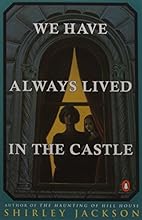
Title: We Have Always Lived in the Castle
Author: Shirley Jackson
Genre: Gothic Satire
Medium: Paperback
Acquisition: Work Text
Date Completed: February 23, 2016
Rating: ****
I teach Shirley Jackson's last (and, in my opinion, best) novel as a companion to One Flew Over the Cuckoo's Nest for a unit on madness which explores the complications of "untrustworthy" narrators, the labeling of mental illness, social commentary, and perspective. Mary Katherine Blackwood is undoubtedly different; though her actions aren't condoned in the "real" world, the satire of the text offers her a compelling sense of sympathy which makes for a curious and enjoyable reading experience. My students are often surprised when I bring up what they already know - MK identifies her age as 18 within the first paragraph, but students often gloss over this in reading her tone, which is much younger - and are quick to vilify her for her aggressive fantasies (i.e. wishing death and pain on the townsfolk she is forced to interact with twice a week). They toss around the work "psychopath," no doubt because of our fist reading of Kesey, and so this time around I found the "test" for psychopathic disorder, and we systematically checked her behaviors against the list, with two other prominent characters - with wonderfully surprising results. I won't say more, so as to avoid spoilers, but actually attempting to diagnose the characters provided a unique perspective on the text, and brought the satire into sharp focus.
15.
Title: We Have Always Lived in the Castle
Author: Shirley Jackson
Genre: Gothic Satire
Medium: Paperback
Acquisition: Work Text
Date Completed: February 23, 2016
Rating: ****
I teach Shirley Jackson's last (and, in my opinion, best) novel as a companion to One Flew Over the Cuckoo's Nest for a unit on madness which explores the complications of "untrustworthy" narrators, the labeling of mental illness, social commentary, and perspective. Mary Katherine Blackwood is undoubtedly different; though her actions aren't condoned in the "real" world, the satire of the text offers her a compelling sense of sympathy which makes for a curious and enjoyable reading experience. My students are often surprised when I bring up what they already know - MK identifies her age as 18 within the first paragraph, but students often gloss over this in reading her tone, which is much younger - and are quick to vilify her for her aggressive fantasies (i.e. wishing death and pain on the townsfolk she is forced to interact with twice a week). They toss around the work "psychopath," no doubt because of our fist reading of Kesey, and so this time around I found the "test" for psychopathic disorder, and we systematically checked her behaviors against the list, with two other prominent characters - with wonderfully surprising results. I won't say more, so as to avoid spoilers, but actually attempting to diagnose the characters provided a unique perspective on the text, and brought the satire into sharp focus.
77LovingLit
Woah, I had a moment then too, thinking you now had three boys and two baby girls?! Even my basic maths skills told be that a 6 month old and a newborn wasn't feasible ;)
I hope Penny D has settled!
I hope Penny D has settled!
78London_StJ
16. 
Title: Fire Touched
Author: Patricia Briggs
Genre: Urban Fantasy
Medium: Hardback
Acquisition: Pre-Ordered
Date Completed: March 9, 2016
Rating: ***
The latest in the Mercy Thompson series, Fire Touched has received rave reviews on LibraryThing. Though I, too, share much of the enthusiasm as these readers, I have to beg to differ on their love of this latest. To be direct, I found it to be an incredible disappointment.
Why? Because nothing happens.
I've long looked to Briggs as a consistent fantasy author whose work I know will deliver a certain level of entertainment. She writes interesting characters, and is consistent throughout, developing each personality in linear (i.e. believable) ways. Her protagonist is compelling and sympathetic, and the whole work has a strong mix of reality versus fantasy that makes it both familiar and escapist. However, the active arc of Fire Touched is dry and mechanical as compared to much of the series thus far. From the first, Mercy and the wolf pack are used as an extension of the police force, and their presence is more like a weapon than sentient participants. Something bad happens, the wolves are called in, and everything is resolved. Even the social conflict between fae and the rest is glossed over, and very little is done to build this tension. There are so many moments which could have been entertainingly (but consistently!) dramatic, but things are neatly and quietly resolved in the blink of an eye.
Despite the title there is very little fiery about this story.

Title: Fire Touched
Author: Patricia Briggs
Genre: Urban Fantasy
Medium: Hardback
Acquisition: Pre-Ordered
Date Completed: March 9, 2016
Rating: ***
The latest in the Mercy Thompson series, Fire Touched has received rave reviews on LibraryThing. Though I, too, share much of the enthusiasm as these readers, I have to beg to differ on their love of this latest. To be direct, I found it to be an incredible disappointment.
Why? Because nothing happens.
I've long looked to Briggs as a consistent fantasy author whose work I know will deliver a certain level of entertainment. She writes interesting characters, and is consistent throughout, developing each personality in linear (i.e. believable) ways. Her protagonist is compelling and sympathetic, and the whole work has a strong mix of reality versus fantasy that makes it both familiar and escapist. However, the active arc of Fire Touched is dry and mechanical as compared to much of the series thus far. From the first, Mercy and the wolf pack are used as an extension of the police force, and their presence is more like a weapon than sentient participants. Something bad happens, the wolves are called in, and everything is resolved. Even the social conflict between fae and the rest is glossed over, and very little is done to build this tension. There are so many moments which could have been entertainingly (but consistently!) dramatic, but things are neatly and quietly resolved in the blink of an eye.
Despite the title there is very little fiery about this story.
79London_StJ
>76 lkernagh: Thank you! It makes me smile (as do the pooches who inspired it).
>77 LovingLit: Ms. Dreadful is living up to her name. Ok, she's not, but I like to tease her that she is. Hugo (our old mutt) is not such a fan, but it took him awhile to warm up to Sibyl, so we're not stressed. The rest of us love her, but none more so than Sibyl, so is an amazing big sister. Everything we hoped for when we brought home a second poodle has come to fruition. Now, if only we could a) get her to sleep through the night (my partner is the only one to get up with her, but I feel bad about it), and b) actually housebreak her (which will come with time, but ugh).
This week starts my spring break, which will end with my birthday. Huzzah! I have some strict plans: to finish as much as possible of the Tudor wedding clothes I'm making for a beautiful couple, and to catch up on my IS reading. I have three half-finished Victorian novels which should have been done weeks ago. Yikes!
>77 LovingLit: Ms. Dreadful is living up to her name. Ok, she's not, but I like to tease her that she is. Hugo (our old mutt) is not such a fan, but it took him awhile to warm up to Sibyl, so we're not stressed. The rest of us love her, but none more so than Sibyl, so is an amazing big sister. Everything we hoped for when we brought home a second poodle has come to fruition. Now, if only we could a) get her to sleep through the night (my partner is the only one to get up with her, but I feel bad about it), and b) actually housebreak her (which will come with time, but ugh).
This week starts my spring break, which will end with my birthday. Huzzah! I have some strict plans: to finish as much as possible of the Tudor wedding clothes I'm making for a beautiful couple, and to catch up on my IS reading. I have three half-finished Victorian novels which should have been done weeks ago. Yikes!
80Berly
>75 London_StJ: So intrigued by your class discussion of this book and the checklist for psychopathic disorder--may have to do a re-read someday!!
>78 London_StJ: Ignoring this one since I haven't read it read.
Love the poodle skirt! : )
>78 London_StJ: Ignoring this one since I haven't read it read.
Love the poodle skirt! : )
81London_StJ
>80 Berly: Thanks! x2
17.
Title: Masculinity, Crime and Self-Defence in Victorian Literature: Duelling with Danger
Author: Emelyne Godfrey
Genre: Masculinity, Victtorian, History
Medium: Paperback
Acquisition: IS Book 6
Date Completed: March 19, 2016
Rating: ****
In Masculinity, Crime, and Self-Defence in Victorian Literature, Emelyn Godfrey approaches shifting cultural values of manliness and the reading of violent reaction to crime through an examination of communicative cultural objects – the literature, plays, newspapers, and commercial advertisements which both reflect and direct the responses of the audience. For Godfrey’s project, manliness is particularly defined by gentlemanliness, recalling the restraint and abhorrence of violence described by Ben Griffin in The Politics of Gender. The principles of the “savage” and the “natural” violence of men, so often cited as a conscious interest for Victorians, is acknowledged as the “other” against which gentlemen are defined – they who have morally evolved past such brutishness to restrained morality. This dichotomy is reflected in the “blood men” – i.e. those who respond violently – and their more thoughtful counterparts (Holmes is a strong example used by Godfrey). But what of chivalry and manliness? Of self-defense? Godfrey’s work details how such necessary violence is defined by Victorians in response to the uncivilized brutes (i.e. criminal lower classes, or “blood men”), and whether or not self-defense and even retaliation are manly.
I admit that I find myself a bit distracted by Godfrey’s source material – specifically the material goods offered to promote the successful manliness of gentlemen, and their reversal of symbolism as they fall out of favor (handguns, for example). I’ve long worked with the material construction of identity of female characters in literature, and Godfrey’s accoutrements offer tantalizing possibilities to carry this over to masculine characters (oh, the anti-garroting collars! Life-preservers! The “monstrous fashion” for handguns! p.119).
In a more broad sense, Godfrey’s work on the “average” (i.e. white, middle-class, male) citizen offers a lens through which one can read popular vigilante heroes in novels, media, comics, and our own sensationalized news.
I really enjoyed this book for both its methods, and its histories. While the readings of the Whitechapel Murders were pointedly shallow and seemingly insignificant to the project, tangentially related for being of a time and sensationalized in the press, the readings of literature as reflective of a reaction to the perception of criminal threat were pointed and thoughtful, offering strong conclusions and suggesting areas of further research.
17.

Title: Masculinity, Crime and Self-Defence in Victorian Literature: Duelling with Danger
Author: Emelyne Godfrey
Genre: Masculinity, Victtorian, History
Medium: Paperback
Acquisition: IS Book 6
Date Completed: March 19, 2016
Rating: ****
In Masculinity, Crime, and Self-Defence in Victorian Literature, Emelyn Godfrey approaches shifting cultural values of manliness and the reading of violent reaction to crime through an examination of communicative cultural objects – the literature, plays, newspapers, and commercial advertisements which both reflect and direct the responses of the audience. For Godfrey’s project, manliness is particularly defined by gentlemanliness, recalling the restraint and abhorrence of violence described by Ben Griffin in The Politics of Gender. The principles of the “savage” and the “natural” violence of men, so often cited as a conscious interest for Victorians, is acknowledged as the “other” against which gentlemen are defined – they who have morally evolved past such brutishness to restrained morality. This dichotomy is reflected in the “blood men” – i.e. those who respond violently – and their more thoughtful counterparts (Holmes is a strong example used by Godfrey). But what of chivalry and manliness? Of self-defense? Godfrey’s work details how such necessary violence is defined by Victorians in response to the uncivilized brutes (i.e. criminal lower classes, or “blood men”), and whether or not self-defense and even retaliation are manly.
I admit that I find myself a bit distracted by Godfrey’s source material – specifically the material goods offered to promote the successful manliness of gentlemen, and their reversal of symbolism as they fall out of favor (handguns, for example). I’ve long worked with the material construction of identity of female characters in literature, and Godfrey’s accoutrements offer tantalizing possibilities to carry this over to masculine characters (oh, the anti-garroting collars! Life-preservers! The “monstrous fashion” for handguns! p.119).
In a more broad sense, Godfrey’s work on the “average” (i.e. white, middle-class, male) citizen offers a lens through which one can read popular vigilante heroes in novels, media, comics, and our own sensationalized news.
I really enjoyed this book for both its methods, and its histories. While the readings of the Whitechapel Murders were pointedly shallow and seemingly insignificant to the project, tangentially related for being of a time and sensationalized in the press, the readings of literature as reflective of a reaction to the perception of criminal threat were pointed and thoughtful, offering strong conclusions and suggesting areas of further research.
82ronincats
Hope you had a great week off! I'll bet the dogs enjoyed having you around. Very interesting reading going on here.
83London_StJ
>82 ronincats: Thanks! My old pooch needed dental surgery, so HE was certainly happy for some extra attention.
84London_StJ
I'm not sure what counts as spoilers for comics readers; I tend to treat them like Shakespeare and other classic literature, in which the conclusion is already widely known, even by those who haven't actually read the book. I don't think I've "given away" anything extraordinary here, but my apologies to any who disagree.
18.
Title: Death of the Family
Author: Scott Snyder and Greg Capullo
Genre: Comics
Medium: Paperback
Acquisition: IS Research
Date Completed: March 20, 2016
Rating: *****
I'm finding it difficult to review this book casually; every time I begin writing I come to conclusions and observations I wish to save for the paper I'm crafting, and so I come back to square one. The basics are straight forward: this New 52 title is a play on its predecessor, Death in the Family in which the Joker violently beats Jason Todd to death (at the encouragement of fans who voted, if I'm not mistaken). Though this may read, and in the moment does, as a hugely significant narrative moment, for the Joker death is just another day at work, and play. His history is tumultuous, with a few constants: mayhem, Arkham Asylum, and Batman.
In this new arc the Joker escapes one and uses another in order to achieve the full attention of the third, targeting the "Bat family" in the belief that they have sentimentalized Batman, and therefore made him weak, and thus less of a capable adversary. For an antagonist who identifies so intensely with his protagonist, this holds serious implications, and a year after disappearing from the asylum he sets out to "right" their dynamic through exceptional violence worthy of the most psychotic Joker arcs.
I sought out this book specifically looking for a moment of violence - when the Joker has his face removed by the Dollmaker, leaving it on a wall as a bloody calling card; this is apparently viewed as a moment of "rebirth" for the figure, and it's pertinent to my current research to think about what this means. This moment proceeds the current book, but that doesn't detract from its interest. One point of contention I have is a major missing story - that of Catwoman. Though the Joker singles her out as a member of the "family," she is suspiciously missing from the final reunion.
Most of my conclusions and observations will (hopefully) end up in a paper this term, so I'll just end simply: I liked it. More so, I think, than The Killing Joke, and certainly more than Death in the Family.
18.

Title: Death of the Family
Author: Scott Snyder and Greg Capullo
Genre: Comics
Medium: Paperback
Acquisition: IS Research
Date Completed: March 20, 2016
Rating: *****
I'm finding it difficult to review this book casually; every time I begin writing I come to conclusions and observations I wish to save for the paper I'm crafting, and so I come back to square one. The basics are straight forward: this New 52 title is a play on its predecessor, Death in the Family in which the Joker violently beats Jason Todd to death (at the encouragement of fans who voted, if I'm not mistaken). Though this may read, and in the moment does, as a hugely significant narrative moment, for the Joker death is just another day at work, and play. His history is tumultuous, with a few constants: mayhem, Arkham Asylum, and Batman.
In this new arc the Joker escapes one and uses another in order to achieve the full attention of the third, targeting the "Bat family" in the belief that they have sentimentalized Batman, and therefore made him weak, and thus less of a capable adversary. For an antagonist who identifies so intensely with his protagonist, this holds serious implications, and a year after disappearing from the asylum he sets out to "right" their dynamic through exceptional violence worthy of the most psychotic Joker arcs.
I sought out this book specifically looking for a moment of violence - when the Joker has his face removed by the Dollmaker, leaving it on a wall as a bloody calling card; this is apparently viewed as a moment of "rebirth" for the figure, and it's pertinent to my current research to think about what this means. This moment proceeds the current book, but that doesn't detract from its interest. One point of contention I have is a major missing story - that of Catwoman. Though the Joker singles her out as a member of the "family," she is suspiciously missing from the final reunion.
Most of my conclusions and observations will (hopefully) end up in a paper this term, so I'll just end simply: I liked it. More so, I think, than The Killing Joke, and certainly more than Death in the Family.
85London_StJ
19. 
Title: Batman: The Man Who Laughs
Author: Ed Brubaker
Genre: Comics
Medium: Paperback
Acquisition: IS Research
Date Completed: March 21, 2016
Rating: ****
One of the constant draws of The Joker is the uncertainty of his past; though narratives are offered from time to time (*cough*AlanMoore*cough*), even these "definitive" stories are challenged by the ambiguity of the character himself: he is literally not to be trusted. Ever. Even in the naming of his own past. This is one of the characteristics which makes him a memorable, and lasting, antagonist. The Man Who Laughs is purportedly a re-telling (re-inking, re-publishing?) of the original 1940 comic, which saw the introduction of a strange jester. I say "purportedly" only because I have not yet managed to read Batman #1, though I will. In his first introduction, the Joker is all chaos - and nameless, given his famous moniker by the press as he mysteriously poisons Gotham elite (and anyone else who is inconveniently placed). Arkham Asylum has not yet opened when the Joker first murders a reporter and cameraman in front of its gates, leaving an impression inside and out before he ever takes up residence.
As a story, it is a bit lackluster, given all the Joker will come to do. As an origin, it's successful, providing the first and only really trustworthy beginning point of the villain who becomes Batman's mirror.

Title: Batman: The Man Who Laughs
Author: Ed Brubaker
Genre: Comics
Medium: Paperback
Acquisition: IS Research
Date Completed: March 21, 2016
Rating: ****
One of the constant draws of The Joker is the uncertainty of his past; though narratives are offered from time to time (*cough*AlanMoore*cough*), even these "definitive" stories are challenged by the ambiguity of the character himself: he is literally not to be trusted. Ever. Even in the naming of his own past. This is one of the characteristics which makes him a memorable, and lasting, antagonist. The Man Who Laughs is purportedly a re-telling (re-inking, re-publishing?) of the original 1940 comic, which saw the introduction of a strange jester. I say "purportedly" only because I have not yet managed to read Batman #1, though I will. In his first introduction, the Joker is all chaos - and nameless, given his famous moniker by the press as he mysteriously poisons Gotham elite (and anyone else who is inconveniently placed). Arkham Asylum has not yet opened when the Joker first murders a reporter and cameraman in front of its gates, leaving an impression inside and out before he ever takes up residence.
As a story, it is a bit lackluster, given all the Joker will come to do. As an origin, it's successful, providing the first and only really trustworthy beginning point of the villain who becomes Batman's mirror.
86LovingLit
Your independent study reading.... do you mean independent research, for some future publication or thesis?
87Whisper1
>74 London_StJ:.. I want to jump and shout Luxx is back, Luxx is back. When I saw the lovely poodle skirt you made, it made me happy to remember your incredible talent.
Oh, it is so delightful to visit you once again.
Oh, it is so delightful to visit you once again.
88London_StJ
>86 LovingLit: I'm finishing my PhD coursework with two independent studies - Masculinities and Victorian Literature (i.e. I went to two faculty members and asked them to oversee independent coursework. I meet with one professor twice a month, and the other whenever I happen to have a question, and read until my eyes cross). The Batman readings are for my course on masculinities, and will likely (hopefully?) inform my dissertation.
>87 Whisper1: I'm always so glad to see you! I'm around; I'm not always able to visit around, but I'm here! I'm peeking! And reading, reading, reading! This summer I will actually be off for the first time in years (no work! no classes! Ok, I'll have to study for comps, but it'll be on my own time!), so I hope to catch up then.
>87 Whisper1: I'm always so glad to see you! I'm around; I'm not always able to visit around, but I'm here! I'm peeking! And reading, reading, reading! This summer I will actually be off for the first time in years (no work! no classes! Ok, I'll have to study for comps, but it'll be on my own time!), so I hope to catch up then.
89PaulCranswick
Have a wonderful Easter.


91LovingLit
>88 London_StJ: aaaaah., Cool. I am hoping to do independent study for my next semester, seeing as the course I had earmarked has two classes a week which both interfere with school pick-up times. I cant justify putting Lenny, as a brand new schoolboy, into after school care, so I am going to see about research assisting some professor, or embarking on some project of my own ....if only I could narrow down a topic!! (I will certainly need to do that if I am to consider Master's next year)
92London_StJ
>91 LovingLit: Would the professors of the unfortunately-missed classes allow you to work through the material independently? Since they're holding the class anyway?
Coming up with a project is really tough. I came into my program with an idea of what I'd do (building on independent research), and dropped it with my first class because something new and shiny caught my eye. I remember one of my professors challenging me when I suggested I not pursue the idea, because I don't know 1/2 of my primary source material. "Why would you want to research something you already know? Where's the fun in that?"
Let's see if I still like that advice when I'm defending my prospectus this time next year. AH!
>90 Berly: Thanks! I'm not really keen on decorating my thread with ancient torture devices, but I'll take all the chocolate you can throw at me. I hope you're enjoying a glorious spring morning!
Coming up with a project is really tough. I came into my program with an idea of what I'd do (building on independent research), and dropped it with my first class because something new and shiny caught my eye. I remember one of my professors challenging me when I suggested I not pursue the idea, because I don't know 1/2 of my primary source material. "Why would you want to research something you already know? Where's the fun in that?"
Let's see if I still like that advice when I'm defending my prospectus this time next year. AH!
>90 Berly: Thanks! I'm not really keen on decorating my thread with ancient torture devices, but I'll take all the chocolate you can throw at me. I hope you're enjoying a glorious spring morning!
93London_StJ
The following notes will serve as annotations on a master bibliography I intend to use for my comprehensive exams this fall. I'm offering them here a) to keep track of them and b) to recognize all that I'm reading this semester, even if it's not a formal "book" this week.
20.
Selections on gender from Victorian Prose (ed. Leighon and Surridge) and Victorian Prose (ed. Mundhenk and Fletcher).
Leighton, Mary Elizabeth and Lisa Surridge. The Broadview Anthology of Victorian Prose: 1832-1901. Ontario: Broadview Press, 2012. Print.
Mundhenk, Rosemary J. and LuAnn McCracken Fletcher. Victorian Prose: An Anthology. New York: Columbia University Press, 1999. Print.
Bodichon, Barabara Leigh Smith. "from A Brief Summary, in Plain Language, of the Most important Laws Concerning Women; Together with a Few Observations Thereon. Leighton and Surridge. 292-8.
A general understanding of the laws which governed the rights of women in nineteenth-century England does not stand to an actual explanation of their place in the legal system. Married women are, very literally, non-persons in the eyes of the Victorian government, instead existing as extensions of their husbands who have full legal rights over their persons, offspring, property, and production. "A man and wife are one person in law; the wife loses all her rights as a single woman, and her existence is entirely absorbed in that of her husband" writes Bodichon, a suffragette and activist. She goes on to detail in her summary the legal justification for marital rape, how no man is obliged to "support his wife" (despite her inability to autonomously support herself 0 294), how she owns not even her own clothing (293), and how she maintains no custody over her children (294). Bodichon further laments that divorce is a luxury for the wealthy patriarch, and in her "Remarks," uses strong language which describes even the most capable of women as "infants" under the care of their husbands (296), the legal robbery at their hands, and the general abuse supported by the system. These are the tumultuous politics which inspired the political movements discussed in The Politics of Gender in Victorian Britain.
Ellis, Sarah Stickney. "The Women of England, Their Social Duties, and Domestic Habits. Victorian Prose. Mundhenk and Fletcher. 53-7. AND Leighton and Surridge 288-92.
According to the editors of the volume, Ellis is one of the central figures responsible for the formulation of the gendered "spheres" for which Victorians are so well known. Author of The Daughters of England, The Mothers of England, The Wives of England, and others, Ellis' writing seeks to direct readers in the proper formulation and execution of gender in support of a culturally-forwarded system of morality and propriety. In this selection Ellis is directly equating the morality of women with the morality of English, which she posits is superior to that of other countries. In the Broadview edition, there is an emphasis on the actual influence of women, as Ellis chastises women who claim they have none. She asserts, "Have they not bound themselves by a sacred and enduring bond, to be to one fellow-traveller along the path of life, a ... guide and a help...? ... Above all, have they not, many of them, had the feeble steps of infancy committed to their care - the pure unsullied page of childhood presented to them for its fist and most durable inscription? - and what have they written there? ... It is therefore not only false in reasoning, but wrong in principle, for women to assert ... that they have no influence"" (290). It is for this influence, then, that Ellis argues in the Mundhenk excerpts, for the exercising of female morality in the improvement of England.
Greg, William Rathbone. “Why Are Women Redundant?” Mundhenk and Fletcher. 157-63.
According to editors, Greg’s “Why Are Women Redundant?” is published in The National Review in 1862 in response to the 1851 census which identifies a large population of women between twenty and forty who are not married. As it is considered the duty of a moral middle class to marry and produce children, the number of unmarried women is identified as a threat to middle class values and expectations, and thus a problem to be solved. Greg’s solution, then, is exportation – the emigration of single women to the colonies which has drawn away large numbers of single men. “Hundreds of women remain single in our distorted civilization because they have never been asked at all,” Greg asserts, and thus wishes to place them in a positon where they may be asked. Evident in his analysis is the material status of women in Victorian culture – he wishes to export a surplus like so many goods, in order to balance the moral and social economy of his country.
Mill, John Stuart. "The Subjection of Women." Mundhenk and Fletcher. 121-31.
Mill’s seminal essay begins succinctly with the assertion of “an opinion which he has held from the very earliest period when he had formed any opinions at all on social or political matters … That the principle which regulates the existing social relations between the two sexes – the legal subordination of one sex to another – is wrong in itself, and now one of the chief hindrances to human improvement; and that it out to be replaced by a principle of perfect equality, admitting no power or privilege on the one side, nor disability on the other” (122). His support is a reading of culture and history which demonstrates that the way things “have always been” is not necessarily the right way to do things – that “the adoption of this system of inequality never was the result of deliberation, or forethought, or any social ideas, or any notion whatever of what conduced to the benefit of humanity or the good order of society” (123) – essentially, that the subordination of women is literally senseless. He attacks the reasoning of a powerful majority by alluding to slavery, and that this abhorrent system is maintained as “a matter of compact among the masters” for their own good, and not the good of the whole. He associates the place of nineteenth century women with this form of bondage by further stating that “it is the primitive state of slavery lasting on” (123), and moves forward to demonstrate that the state of women is not natural, as some politicians claim, but the result of male sentimentality and fear. He argues that in a culture seeking to move forward and evolve as exemplary the state of one women is backwards, and that their legal status is (negatively) unique “in modern legislation” (128). Of the calls for maintenance Mill says that one cannot truly know women because they do not yet have the rights and education to express themselves as thoughtfully and completely as men – that they’ve been denied the powers of full representation, and thus a reading of the female character is an imperfect analysis of an external, limited reader. There is a great deal here useful for the understanding of Victorian culture as a whole, and gender politics specifically.
Nightingale, Florence. "from Suggestions for Thought to the Searchers after Truth among the Artizans of England: Volume 2, Section 5: Cassandra." Leighton and Surridge 298-300.
In excerpts from "Cassandra" in both anthologies, Nightingale uses the language of dreaming, blessings, and saviors to argue for the necessity of offering women full educations in support of their moral, intellectual, and social development. She speaks of women mourning opportunities they never have, and how dreams and thoughts are crushed by the cultural system which denies them the educational opportunities of men. She says women are "petrified into stone ... chained to the bronze pedestal" when, with education, "woman will be the Saviour of her race" (299). Restriction to the domestic sphere kills the ideal philosophical life of the woman, and that "Men are afraid that their houses will not be so comfortable, that their wives will make themselves 'remarkable'" actually makes women "recoil" from domestic expectations - that, in fact, restricting women so vehemently is a greater threat to these gender spheres than educating women may be.
Norton, Caroline. “A Letter to the Queen on Lord Chancellor Cranworth’s Marriage and Divorce Bill.” Mundhenk and Fletcher. 143-55.
Caroline Norton’s unfortunate social and legal position serves as an exemplary case of the abuses of the gendered system of law. In “A Letter to the Queen” she considers the absurdity of her own non-existence in the eyes of the law, as a citizen of a country until the rule of a queen. Many of her complaints are echoes of the other reflections on the unfortunate position of gender, with the additional ethos of a woman who has been directly harmed by this legal imbalance. She writes, for example, that “An English wife has no legal right even to her clothes or ornaments … her husband … is not bound to maintain her … As her husband, he has a right to all that is hers: as his wife, she has no right to anything that is his” (146-7). Like Bodichon, Norton reflects that divorce is a luxury for the wealthy, and that lower classes are still ignorant of their rights and obligations. Her rhetoric maintains much of the tone of Ellis, as she says, “The natural position of woman is inferiority to men. Amen! That is a thing of God’s appointing, not of man’s devising” (150), but begs the law to take consideration of men who are themselves tyrannical: “do not leave me to the mercy of one who has never shewn me mercy” (151). She seeks not superiority, she says, but the legal right of autonomy – to protect herself. Her sentiments are just the sort that are described in The Politics of Gender - a call to the government (patriarchy, really) to allow women protection under that patriarchy from individual deviant husbands.
Ruskin, John. "Lecture 2: Lilies: Of Queen's Gardens." Leighton and Surridge 301-9.
Ruskin's famous lecture on women's education falsely asserts that women are queens of their own domestic spheres in order to maintain that men and women are separate-but-equal in the present system. He scoffs at the idea that man "could be helped effectively by a shadow, or worthily by a slave!" and thus "We are foolish, and without excuse foolish, in speaking of the 'superiority' of one sex to the other, as if they could be compared in similar things" (302). Throughout the lecture he suggests that women's "intellect is ... for sweet ordering, arrangement, and decision," that she's naturally intellectually inclined to the ordering and maintenance of a peaceful and comforting household, and that "within his house, as ruled by her, unless she herself has sought it, need enter no danger" (302). He maintains that women should be educated similarly to men, that they can understand the woes of their husbands, communicate domestic and "sweet" ideas to others in their native tongues, and generally to know "whatever her husband is likely to know ... for daily and helpful use" (304). Thus, a woman's education should be pursued as a boon to her husband, to make her a better helpmate.
Several interesting pronouncements are made within the lecture which are worthy of their own consideration, including: "You bring up your girls as if they were meant for sideboard ornaments, and then complain of their frivolity" (304); "You do not treat the Dean of Christ Church or the Master of Trinity as your inferiors" (and so should not treat governesses in this way - 305); "There is not a war in the world, no, nor an injustice, but you women are answerable for it; not in that you have provoked, but in that you have not hindered" (307).
Ward, Mary Arnold (Mrs. Humphry). “An Appeal Against Female Suffrage.” Mundhenk and Fletcher. 417-422.
In an address signed by 104 female anti-suffragettes, Ward ardently defends the status quo and the relinquishing of rights, decisions, and power to the male sex in support of female decency and morality. Citing “natural” differences between men and women which render women less capable to make political decisions, such as their “natural eagerness and quickness of temper” (419), Ward maintains that women have all the influence they can handle, thank you very much, and their inclusion in “foreign or colonial policy, or of grave constitutional change” would be disastrous as compared to the “sound judgment” of men (419). Several points, however, signify greater cultural judgment as inspiration for the appeal. For example, point three warns that “If votes be given to unmarried women on the same terms as they are given to men, large numbers of women leading immoral lives will be enfranchised on the one hand, while married women, who, as a rule, have passed through more of the practical experiences of life than the unmarried, will be excluded.” But, she continues, giving married women the same vote will be too great of an upset to “family life … which have never been adequately considered” (420). Giving women the vote is “demoralizing” and indicates “a total misconception of woman’s true dignity and special mission” (421).
20.
Selections on gender from Victorian Prose (ed. Leighon and Surridge) and Victorian Prose (ed. Mundhenk and Fletcher).
Leighton, Mary Elizabeth and Lisa Surridge. The Broadview Anthology of Victorian Prose: 1832-1901. Ontario: Broadview Press, 2012. Print.
Mundhenk, Rosemary J. and LuAnn McCracken Fletcher. Victorian Prose: An Anthology. New York: Columbia University Press, 1999. Print.
Bodichon, Barabara Leigh Smith. "from A Brief Summary, in Plain Language, of the Most important Laws Concerning Women; Together with a Few Observations Thereon. Leighton and Surridge. 292-8.
A general understanding of the laws which governed the rights of women in nineteenth-century England does not stand to an actual explanation of their place in the legal system. Married women are, very literally, non-persons in the eyes of the Victorian government, instead existing as extensions of their husbands who have full legal rights over their persons, offspring, property, and production. "A man and wife are one person in law; the wife loses all her rights as a single woman, and her existence is entirely absorbed in that of her husband" writes Bodichon, a suffragette and activist. She goes on to detail in her summary the legal justification for marital rape, how no man is obliged to "support his wife" (despite her inability to autonomously support herself 0 294), how she owns not even her own clothing (293), and how she maintains no custody over her children (294). Bodichon further laments that divorce is a luxury for the wealthy patriarch, and in her "Remarks," uses strong language which describes even the most capable of women as "infants" under the care of their husbands (296), the legal robbery at their hands, and the general abuse supported by the system. These are the tumultuous politics which inspired the political movements discussed in The Politics of Gender in Victorian Britain.
Ellis, Sarah Stickney. "The Women of England, Their Social Duties, and Domestic Habits. Victorian Prose. Mundhenk and Fletcher. 53-7. AND Leighton and Surridge 288-92.
According to the editors of the volume, Ellis is one of the central figures responsible for the formulation of the gendered "spheres" for which Victorians are so well known. Author of The Daughters of England, The Mothers of England, The Wives of England, and others, Ellis' writing seeks to direct readers in the proper formulation and execution of gender in support of a culturally-forwarded system of morality and propriety. In this selection Ellis is directly equating the morality of women with the morality of English, which she posits is superior to that of other countries. In the Broadview edition, there is an emphasis on the actual influence of women, as Ellis chastises women who claim they have none. She asserts, "Have they not bound themselves by a sacred and enduring bond, to be to one fellow-traveller along the path of life, a ... guide and a help...? ... Above all, have they not, many of them, had the feeble steps of infancy committed to their care - the pure unsullied page of childhood presented to them for its fist and most durable inscription? - and what have they written there? ... It is therefore not only false in reasoning, but wrong in principle, for women to assert ... that they have no influence"" (290). It is for this influence, then, that Ellis argues in the Mundhenk excerpts, for the exercising of female morality in the improvement of England.
Greg, William Rathbone. “Why Are Women Redundant?” Mundhenk and Fletcher. 157-63.
According to editors, Greg’s “Why Are Women Redundant?” is published in The National Review in 1862 in response to the 1851 census which identifies a large population of women between twenty and forty who are not married. As it is considered the duty of a moral middle class to marry and produce children, the number of unmarried women is identified as a threat to middle class values and expectations, and thus a problem to be solved. Greg’s solution, then, is exportation – the emigration of single women to the colonies which has drawn away large numbers of single men. “Hundreds of women remain single in our distorted civilization because they have never been asked at all,” Greg asserts, and thus wishes to place them in a positon where they may be asked. Evident in his analysis is the material status of women in Victorian culture – he wishes to export a surplus like so many goods, in order to balance the moral and social economy of his country.
Mill, John Stuart. "The Subjection of Women." Mundhenk and Fletcher. 121-31.
Mill’s seminal essay begins succinctly with the assertion of “an opinion which he has held from the very earliest period when he had formed any opinions at all on social or political matters … That the principle which regulates the existing social relations between the two sexes – the legal subordination of one sex to another – is wrong in itself, and now one of the chief hindrances to human improvement; and that it out to be replaced by a principle of perfect equality, admitting no power or privilege on the one side, nor disability on the other” (122). His support is a reading of culture and history which demonstrates that the way things “have always been” is not necessarily the right way to do things – that “the adoption of this system of inequality never was the result of deliberation, or forethought, or any social ideas, or any notion whatever of what conduced to the benefit of humanity or the good order of society” (123) – essentially, that the subordination of women is literally senseless. He attacks the reasoning of a powerful majority by alluding to slavery, and that this abhorrent system is maintained as “a matter of compact among the masters” for their own good, and not the good of the whole. He associates the place of nineteenth century women with this form of bondage by further stating that “it is the primitive state of slavery lasting on” (123), and moves forward to demonstrate that the state of women is not natural, as some politicians claim, but the result of male sentimentality and fear. He argues that in a culture seeking to move forward and evolve as exemplary the state of one women is backwards, and that their legal status is (negatively) unique “in modern legislation” (128). Of the calls for maintenance Mill says that one cannot truly know women because they do not yet have the rights and education to express themselves as thoughtfully and completely as men – that they’ve been denied the powers of full representation, and thus a reading of the female character is an imperfect analysis of an external, limited reader. There is a great deal here useful for the understanding of Victorian culture as a whole, and gender politics specifically.
Nightingale, Florence. "from Suggestions for Thought to the Searchers after Truth among the Artizans of England: Volume 2, Section 5: Cassandra." Leighton and Surridge 298-300.
In excerpts from "Cassandra" in both anthologies, Nightingale uses the language of dreaming, blessings, and saviors to argue for the necessity of offering women full educations in support of their moral, intellectual, and social development. She speaks of women mourning opportunities they never have, and how dreams and thoughts are crushed by the cultural system which denies them the educational opportunities of men. She says women are "petrified into stone ... chained to the bronze pedestal" when, with education, "woman will be the Saviour of her race" (299). Restriction to the domestic sphere kills the ideal philosophical life of the woman, and that "Men are afraid that their houses will not be so comfortable, that their wives will make themselves 'remarkable'" actually makes women "recoil" from domestic expectations - that, in fact, restricting women so vehemently is a greater threat to these gender spheres than educating women may be.
Norton, Caroline. “A Letter to the Queen on Lord Chancellor Cranworth’s Marriage and Divorce Bill.” Mundhenk and Fletcher. 143-55.
Caroline Norton’s unfortunate social and legal position serves as an exemplary case of the abuses of the gendered system of law. In “A Letter to the Queen” she considers the absurdity of her own non-existence in the eyes of the law, as a citizen of a country until the rule of a queen. Many of her complaints are echoes of the other reflections on the unfortunate position of gender, with the additional ethos of a woman who has been directly harmed by this legal imbalance. She writes, for example, that “An English wife has no legal right even to her clothes or ornaments … her husband … is not bound to maintain her … As her husband, he has a right to all that is hers: as his wife, she has no right to anything that is his” (146-7). Like Bodichon, Norton reflects that divorce is a luxury for the wealthy, and that lower classes are still ignorant of their rights and obligations. Her rhetoric maintains much of the tone of Ellis, as she says, “The natural position of woman is inferiority to men. Amen! That is a thing of God’s appointing, not of man’s devising” (150), but begs the law to take consideration of men who are themselves tyrannical: “do not leave me to the mercy of one who has never shewn me mercy” (151). She seeks not superiority, she says, but the legal right of autonomy – to protect herself. Her sentiments are just the sort that are described in The Politics of Gender - a call to the government (patriarchy, really) to allow women protection under that patriarchy from individual deviant husbands.
Ruskin, John. "Lecture 2: Lilies: Of Queen's Gardens." Leighton and Surridge 301-9.
Ruskin's famous lecture on women's education falsely asserts that women are queens of their own domestic spheres in order to maintain that men and women are separate-but-equal in the present system. He scoffs at the idea that man "could be helped effectively by a shadow, or worthily by a slave!" and thus "We are foolish, and without excuse foolish, in speaking of the 'superiority' of one sex to the other, as if they could be compared in similar things" (302). Throughout the lecture he suggests that women's "intellect is ... for sweet ordering, arrangement, and decision," that she's naturally intellectually inclined to the ordering and maintenance of a peaceful and comforting household, and that "within his house, as ruled by her, unless she herself has sought it, need enter no danger" (302). He maintains that women should be educated similarly to men, that they can understand the woes of their husbands, communicate domestic and "sweet" ideas to others in their native tongues, and generally to know "whatever her husband is likely to know ... for daily and helpful use" (304). Thus, a woman's education should be pursued as a boon to her husband, to make her a better helpmate.
Several interesting pronouncements are made within the lecture which are worthy of their own consideration, including: "You bring up your girls as if they were meant for sideboard ornaments, and then complain of their frivolity" (304); "You do not treat the Dean of Christ Church or the Master of Trinity as your inferiors" (and so should not treat governesses in this way - 305); "There is not a war in the world, no, nor an injustice, but you women are answerable for it; not in that you have provoked, but in that you have not hindered" (307).
Ward, Mary Arnold (Mrs. Humphry). “An Appeal Against Female Suffrage.” Mundhenk and Fletcher. 417-422.
In an address signed by 104 female anti-suffragettes, Ward ardently defends the status quo and the relinquishing of rights, decisions, and power to the male sex in support of female decency and morality. Citing “natural” differences between men and women which render women less capable to make political decisions, such as their “natural eagerness and quickness of temper” (419), Ward maintains that women have all the influence they can handle, thank you very much, and their inclusion in “foreign or colonial policy, or of grave constitutional change” would be disastrous as compared to the “sound judgment” of men (419). Several points, however, signify greater cultural judgment as inspiration for the appeal. For example, point three warns that “If votes be given to unmarried women on the same terms as they are given to men, large numbers of women leading immoral lives will be enfranchised on the one hand, while married women, who, as a rule, have passed through more of the practical experiences of life than the unmarried, will be excluded.” But, she continues, giving married women the same vote will be too great of an upset to “family life … which have never been adequately considered” (420). Giving women the vote is “demoralizing” and indicates “a total misconception of woman’s true dignity and special mission” (421).
94Berly
I see you are reading fluff again! Not!! I am so glad I don't live back then, when women were nothing outside of their husband. Grrrr.
95LovingLit
>92 London_StJ: ancient torture devices
Ha! (well, not, actually). I thought the same but
appreciated the sentiment at the same time :)
The class next semester is a mixed class of third year under-grads and post-graduate students. A numbers thing I think. That is another reason I am not that keen on taking it, I get the feeling I'd be called on in group work to basically teach. I want to learn and discuss concepts and theory at my level (post-grad). I'm hoping the advisor will come up with a project for me to assist with, she had that idea last time I thought I couldn't find a class to fit m schedule, it was very tantalising then!
Ha! (well, not, actually). I thought the same but
appreciated the sentiment at the same time :)
The class next semester is a mixed class of third year under-grads and post-graduate students. A numbers thing I think. That is another reason I am not that keen on taking it, I get the feeling I'd be called on in group work to basically teach. I want to learn and discuss concepts and theory at my level (post-grad). I'm hoping the advisor will come up with a project for me to assist with, she had that idea last time I thought I couldn't find a class to fit m schedule, it was very tantalising then!
96London_StJ
>95 LovingLit: I'm also not a fan of blended group projects. I took a history of rhetoric class my very first semester of my PhD program; I'm not a rhetorician, and had no experience with the content whatsoever. There was a large group work assignment, and I was placed in a group with two end-of-program MA students. The whole thing ended up being a nightmare because I had to teach and guide and order them into doing work - at their request. I was trying to be diplomatic and make suggestions or ask questions, until it came to a point when I asked, "Guys, do you just want me to tell you what to do?"
They said yes. Actually said yes. And their excuse was that I was a PhD student.
It never made any sense to me, because I was just starting and they were finishing their degrees, which meant I had literally six more graduate credits than they. That's it.
They said yes. Actually said yes. And their excuse was that I was a PhD student.
It never made any sense to me, because I was just starting and they were finishing their degrees, which meant I had literally six more graduate credits than they. That's it.
97London_StJ
21. 
Title: Manning the Race: Reforming Black Men in the Jim Crow Era
Author: Marlong B. Ross
Genre: Masculinity, Sexual Cultures
Medium: Paperback
Acquisition: IS Book 7
Date Completed: April 1, 2016
Rating: ***1/2
I told my adviser that I'm afraid I'm missing the forest for the trees right now. I found Ross’ writing difficult to follow at times, especially in his introductions; he favors long “if not…., then …..” statements, and I often came to the conclusion of an assertion forgetting how it began. I mention this as a bit of a caveat, because I do not fully trust my understanding of the project. This is not to say that I didn’t gain anything from the reading – I found here a perspective I was looking for in an otherwise grand-narrative-dominated reading list – but that I don’t yet think I have the whole picture.
Manning the Race is an examination of the cultural and rhetorical ways African American men seek to assert a position of masculinity during Jim Crow bigotry as an infallible mark of cultural progress; a kind of racial re-branding used to humanize men of color, and reject the notion of their evolutionary inferiority. Ross seeks cultural texts such as albums and anthologies, literary narratives, intellectual discourse, autobiography, and the men themselves to serve as representations of the myriad ways in which intelligent and creative individuals sought to become (or were named as) patrons of the race, cultivating their own achievements while bolstering the whole to stand against charges of racial adolescence.
Central to Ross’ reading is movement and migration. People move from rural to urban, South to North, and between expressive arts seeking something better, and confronting assumptions and cultural hurdles all the while. Leaders within the African American community seek to move out from under the “inferior place” to which Jim Crow assigns them (93), establishing and embracing normativity and masculinity as symbols of personhood.
In selecting this book I was hoping to find another voice to counter the white patriarchal narrative of anxiety and othering in the definition and maintenance of manliness, and Ross offers just that in what seems to be a consistent idea throughout the text: leadership, and patronage. Many of the texts we’ve read this term forward examples of desirable masculinity in the form of isolated representations: Roosevelt, post-ranch; Tarzan; Atlas and/or Sandow; the cowboy. These individuals glory in their representations of masculinity, holding themselves as superior to “lesser” men for their own possession of superior characteristics, and allowing others to attempt to replicate their manliness. There is an inherentness that seems to follow most of these characters (Roosevelt had to find his manhood on a ranch, and Atlas had to develop a routine, but they both show gumption and drive to do so), and an antagonistic other against which they can be measured.
Ross’ narrative paints a far different picture – a desire to uplift/uphold/encourage a racial majority to their own improvement so that it may better reflect on the whole. White men are obsessed with their own sense of superiority, but the singular examples held up perform a kind of anxious individual assertion of self – an anxiety that sets members within against one another, and then against the ultimate other. Ross’ leaders, however, are invest in modernity, progressive cultural shifts, and the man as part of a whole who can either continue to upward migration, or condemn communities to a fall. I’m not sure I’m articulating clearly the difference that I see, and this is something that I’d like to try to talk through – the relationship of the representative to the populace.
Similarly, I was very interested in the idea of the “cool post” – a deviant and dangerous phenomenon which must brought under control (92), but which also signifies (or is read as) a performance and a mask. It is a shadow threat onto which the fearful may project their anxieties, but one the text suggests is an appropriation of the figure so often identified in readings of American manliness – the cowboy.

Title: Manning the Race: Reforming Black Men in the Jim Crow Era
Author: Marlong B. Ross
Genre: Masculinity, Sexual Cultures
Medium: Paperback
Acquisition: IS Book 7
Date Completed: April 1, 2016
Rating: ***1/2
I told my adviser that I'm afraid I'm missing the forest for the trees right now. I found Ross’ writing difficult to follow at times, especially in his introductions; he favors long “if not…., then …..” statements, and I often came to the conclusion of an assertion forgetting how it began. I mention this as a bit of a caveat, because I do not fully trust my understanding of the project. This is not to say that I didn’t gain anything from the reading – I found here a perspective I was looking for in an otherwise grand-narrative-dominated reading list – but that I don’t yet think I have the whole picture.
Manning the Race is an examination of the cultural and rhetorical ways African American men seek to assert a position of masculinity during Jim Crow bigotry as an infallible mark of cultural progress; a kind of racial re-branding used to humanize men of color, and reject the notion of their evolutionary inferiority. Ross seeks cultural texts such as albums and anthologies, literary narratives, intellectual discourse, autobiography, and the men themselves to serve as representations of the myriad ways in which intelligent and creative individuals sought to become (or were named as) patrons of the race, cultivating their own achievements while bolstering the whole to stand against charges of racial adolescence.
Central to Ross’ reading is movement and migration. People move from rural to urban, South to North, and between expressive arts seeking something better, and confronting assumptions and cultural hurdles all the while. Leaders within the African American community seek to move out from under the “inferior place” to which Jim Crow assigns them (93), establishing and embracing normativity and masculinity as symbols of personhood.
In selecting this book I was hoping to find another voice to counter the white patriarchal narrative of anxiety and othering in the definition and maintenance of manliness, and Ross offers just that in what seems to be a consistent idea throughout the text: leadership, and patronage. Many of the texts we’ve read this term forward examples of desirable masculinity in the form of isolated representations: Roosevelt, post-ranch; Tarzan; Atlas and/or Sandow; the cowboy. These individuals glory in their representations of masculinity, holding themselves as superior to “lesser” men for their own possession of superior characteristics, and allowing others to attempt to replicate their manliness. There is an inherentness that seems to follow most of these characters (Roosevelt had to find his manhood on a ranch, and Atlas had to develop a routine, but they both show gumption and drive to do so), and an antagonistic other against which they can be measured.
Ross’ narrative paints a far different picture – a desire to uplift/uphold/encourage a racial majority to their own improvement so that it may better reflect on the whole. White men are obsessed with their own sense of superiority, but the singular examples held up perform a kind of anxious individual assertion of self – an anxiety that sets members within against one another, and then against the ultimate other. Ross’ leaders, however, are invest in modernity, progressive cultural shifts, and the man as part of a whole who can either continue to upward migration, or condemn communities to a fall. I’m not sure I’m articulating clearly the difference that I see, and this is something that I’d like to try to talk through – the relationship of the representative to the populace.
Similarly, I was very interested in the idea of the “cool post” – a deviant and dangerous phenomenon which must brought under control (92), but which also signifies (or is read as) a performance and a mask. It is a shadow threat onto which the fearful may project their anxieties, but one the text suggests is an appropriation of the figure so often identified in readings of American manliness – the cowboy.
98London_StJ
22. 
Title: The Hobbit
Author: J.R.R. Tolkien
Genre: Fantasy
Medium: Paperback
Acquisition: Teaching Text
Date Completed: April 5, 2016
Rating: *****

Title: The Hobbit
Author: J.R.R. Tolkien
Genre: Fantasy
Medium: Paperback
Acquisition: Teaching Text
Date Completed: April 5, 2016
Rating: *****
99LovingLit
>97 London_StJ: I am loving learning more about this interesting topic through your reviews.
>96 London_StJ: that does sound annoying. In my semester 1 class last year there were loads of students with English as their second (or third for all I know!) language. We did a bit of group work, mainly to take the pressure off the teacher I think! And in the face of stone-cold silence I stepped up to offer ideas about where we might go, as soon as I did, I was in charge- there was no discussion. Everyone just looked to me! I did offer specific help to a couple who were clearly struggling, and they really appreciated it which was nice, but I pretty much just held back after that and got on with my own work. I could have done it differently, but my grades would have suffered as a result, Im sure.
>96 London_StJ: that does sound annoying. In my semester 1 class last year there were loads of students with English as their second (or third for all I know!) language. We did a bit of group work, mainly to take the pressure off the teacher I think! And in the face of stone-cold silence I stepped up to offer ideas about where we might go, as soon as I did, I was in charge- there was no discussion. Everyone just looked to me! I did offer specific help to a couple who were clearly struggling, and they really appreciated it which was nice, but I pretty much just held back after that and got on with my own work. I could have done it differently, but my grades would have suffered as a result, Im sure.
100London_StJ
>99 LovingLit: I take it as a lesson, and never ever require my students to work in groups/pairs.
101London_StJ
23. 
Title: Batman Detective Comics: Faces of Death
Author: Tony S. Daniel
Genre: Comics
Medium: Paperback
Acquisition: Primary Source for IS
Date Completed: April 2, 2016
Rating: *****
This is the comic I was looking for - the pivotal moment when Joker has his face removed by the Dollmaker at which point they both proclaim they are "reborn." Though the Joker himself plays a minimal active role in the book, this specific moment is a catalyst for the arc to come, and for my own reading of his masculinity. The artwork is stunning.

Title: Batman Detective Comics: Faces of Death
Author: Tony S. Daniel
Genre: Comics
Medium: Paperback
Acquisition: Primary Source for IS
Date Completed: April 2, 2016
Rating: *****
This is the comic I was looking for - the pivotal moment when Joker has his face removed by the Dollmaker at which point they both proclaim they are "reborn." Though the Joker himself plays a minimal active role in the book, this specific moment is a catalyst for the arc to come, and for my own reading of his masculinity. The artwork is stunning.
102London_StJ
24. 
Title: Batman/Houdini: The Devil's Workshop
Author: Howard Chaykin
Genre: Comics
Medium: Paperback
Acquisition:
Date Completed: April 7, 2016
Rating: **
The only thing redeeming this ridiculous comic is the visual representation of a Joker-like character, which happens to be beautiful and eerie. The story is flat, the characters are useless, and the whole thing was really a dud. It doesn't in any way live up to the legends of Houdini or Batman.
Great cover, though.

Title: Batman/Houdini: The Devil's Workshop
Author: Howard Chaykin
Genre: Comics
Medium: Paperback
Acquisition:
Date Completed: April 7, 2016
Rating: **
The only thing redeeming this ridiculous comic is the visual representation of a Joker-like character, which happens to be beautiful and eerie. The story is flat, the characters are useless, and the whole thing was really a dud. It doesn't in any way live up to the legends of Houdini or Batman.
Great cover, though.
103London_StJ
25. 
Title: From Hell
Author: Alan Moore
Genre: Comics
Medium: Paperback
Acquisition: IS Primary Source
Date Completed: April 8, 2016
Rating: ***
I am of two minds about this Ripper conspiracy theory from comics behemoth Alan Moore, and my rating reflects only half of that mind. The divide comes from its purpose and use-value: as a popular text intended to entertain, titillate, and thrill, and as a cultural object of study that reflects and forwards theories and perspectives useful for a continuing discourse on social, political, and values.
From Hell is Moore's foray into what is (actually!) known as Ripperology - the study of Jack the Ripper and the infamous Whitechapel murders of 1888, which remain officially unsolved to this day. From the time of their act to now the spectacular case has drawn a great deal of interest, and serves as a modern whodunnit which holds the real-world promise of a spectacular resolution, if only someone finds, reads, and understands the right clues. The brutality of the crimes, the development of modern detection, and the sensationalism of nineteenth-century newspapers all add to the fervor, and from these real brutal slayings has come mountains of scholarship of varying levels of credibility, performance, art, and literature.
Moore's book forwards one particular conspiracy theory, based on his own reading of Ripperologists and historical research. The solution offered defies nearly all logic and reason, but such is often the case with conspiracy theories, and this isn't something I hold against Moore.* Ultimately, however, I did not find the book to be entertaining. Despite the sensational subject material, the plot is plodding, and long chapters seem extraneous to the movement of the narrative; though I understand why the author may have included such prolonged ravings and devoted espousals, they weigh down the text as opposed to building tension and anxious incredulity or curiosity. In short, I found Ripper himself to be exceptionally dull, as are nearly all of the characters revolving around him, and the actions at hand. An observation contrary to this criticism: one consistent trope in Moore's books, which seemed particularly successful in this text, is his explicit illustration of sex and sexuality. While I've found it unnecessarily gratuitous in other works (i.e. external to the plot), I thought the attention to human intimacy and sex to be compelling and forthright, and very well represented.
Despite my boredom with the graphic novel as a work of entertainment, I believe it is a useful, compelling, and thoughtful artifact which clearly articulates cultural values and systems worthy (and in need of ) deeper introspection. For my present purpose, I found From Hell to represent a constant negotiation of gender, particularly masculinities, illustrating conventions, beliefs, and ramifications, both as these definitions are upheld and as they are challenged. It promises to be a fascinating object of study, and so I am actually very excited to continue working with it.
* I don't really wish to spoil anything, but the fact that certain people would feel themselves completely powerless against the person who is Ripper is literally inconceivable; the ultimate end the murderer finds could have been implemented after the first death, with similar success. That the instigator would not recall commands goes against all historical demonstration and documentation of character, decision, and action, and the final conclusion that it doesn't really work shows the frivolity of it all.

Title: From Hell
Author: Alan Moore
Genre: Comics
Medium: Paperback
Acquisition: IS Primary Source
Date Completed: April 8, 2016
Rating: ***
I am of two minds about this Ripper conspiracy theory from comics behemoth Alan Moore, and my rating reflects only half of that mind. The divide comes from its purpose and use-value: as a popular text intended to entertain, titillate, and thrill, and as a cultural object of study that reflects and forwards theories and perspectives useful for a continuing discourse on social, political, and values.
From Hell is Moore's foray into what is (actually!) known as Ripperology - the study of Jack the Ripper and the infamous Whitechapel murders of 1888, which remain officially unsolved to this day. From the time of their act to now the spectacular case has drawn a great deal of interest, and serves as a modern whodunnit which holds the real-world promise of a spectacular resolution, if only someone finds, reads, and understands the right clues. The brutality of the crimes, the development of modern detection, and the sensationalism of nineteenth-century newspapers all add to the fervor, and from these real brutal slayings has come mountains of scholarship of varying levels of credibility, performance, art, and literature.
Moore's book forwards one particular conspiracy theory, based on his own reading of Ripperologists and historical research. The solution offered defies nearly all logic and reason, but such is often the case with conspiracy theories, and this isn't something I hold against Moore.* Ultimately, however, I did not find the book to be entertaining. Despite the sensational subject material, the plot is plodding, and long chapters seem extraneous to the movement of the narrative; though I understand why the author may have included such prolonged ravings and devoted espousals, they weigh down the text as opposed to building tension and anxious incredulity or curiosity. In short, I found Ripper himself to be exceptionally dull, as are nearly all of the characters revolving around him, and the actions at hand. An observation contrary to this criticism: one consistent trope in Moore's books, which seemed particularly successful in this text, is his explicit illustration of sex and sexuality. While I've found it unnecessarily gratuitous in other works (i.e. external to the plot), I thought the attention to human intimacy and sex to be compelling and forthright, and very well represented.
Despite my boredom with the graphic novel as a work of entertainment, I believe it is a useful, compelling, and thoughtful artifact which clearly articulates cultural values and systems worthy (and in need of ) deeper introspection. For my present purpose, I found From Hell to represent a constant negotiation of gender, particularly masculinities, illustrating conventions, beliefs, and ramifications, both as these definitions are upheld and as they are challenged. It promises to be a fascinating object of study, and so I am actually very excited to continue working with it.
* I don't really wish to spoil anything, but the fact that certain people would feel themselves completely powerless against the person who is Ripper is literally inconceivable; the ultimate end the murderer finds could have been implemented after the first death, with similar success. That the instigator would not recall commands goes against all historical demonstration and documentation of character, decision, and action, and the final conclusion that it doesn't really work shows the frivolity of it all.
104London_StJ
26. 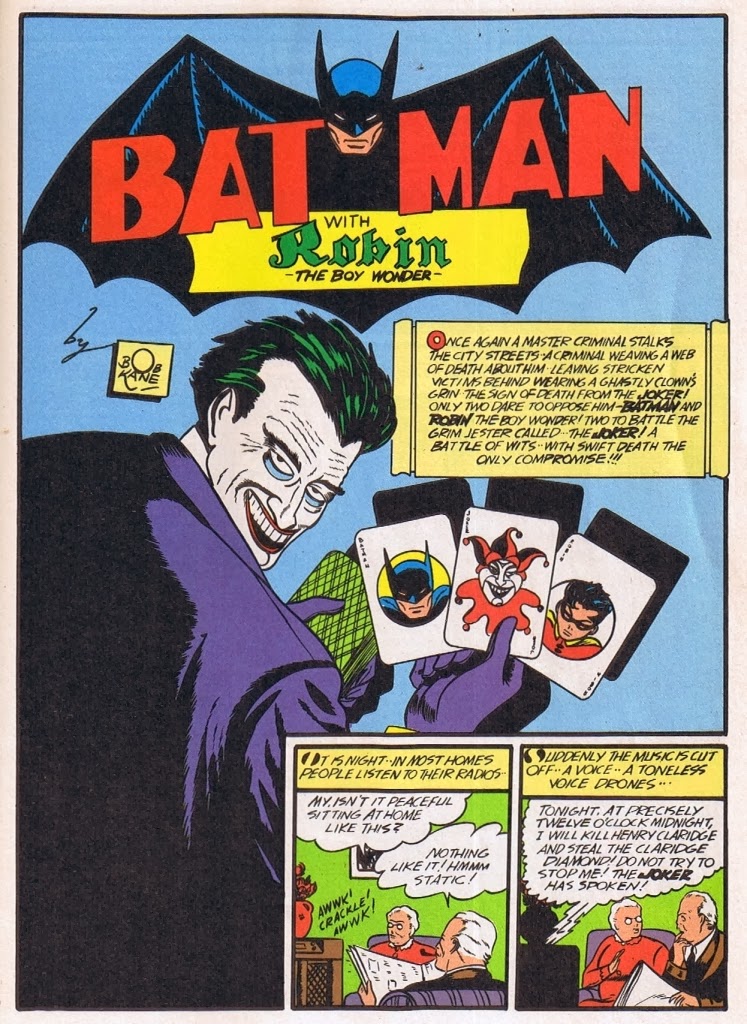
Title: Batman #1
Author: Bob Kane
Genre: Comics
Medium: Paperback
Acquisition: IS Primary Source
Date Completed: April 9, 2016
Rating: ****
To support my research, and to serve as a primary source, I sought out the very first introduction of The Joker, which happens to be in the 1940s Batman #1, when Batman earns his own book outside of Detective Comics. The mystery begins when a strange voice over the radio predicts the death of a wealthy citizen, and the theft of his property; this prophecy is fulfilled to the letter, despite police presence and protection. The mystery continues when a second ominous message is relayed, and again fulfilled, though through slightly different methods. The perpetrator gains the attention of police and criminals alike - the police for their bafflement, and the criminal underworld for this man's usurpation of heists unofficially claimed by other thieves. Of course, Batman is needed to apprehend this unusual figure - before one gang or another is able to take him out. The premise of this book is as the later rewriting has promised, to an extent - ominous predictions of death and theft, and even the methods of execution. The original text, though, takes more time in the explication of the crimes, and thus offers a portrait of the Joker not as a madman bent on wreaking havoc, but as a calculating and cunning thief with an unusual calling card. The Joker's costume is as much a performance as Batman's himself, and the two appear to be on much more even footing. This is what strikes me most about his first appearance - the Joker is not yet the madman of modern narrative, but a stealthy (and relatively traditional) criminal whose motives are capitalistically understood.
Title: Batman #1
Author: Bob Kane
Genre: Comics
Medium: Paperback
Acquisition: IS Primary Source
Date Completed: April 9, 2016
Rating: ****
To support my research, and to serve as a primary source, I sought out the very first introduction of The Joker, which happens to be in the 1940s Batman #1, when Batman earns his own book outside of Detective Comics. The mystery begins when a strange voice over the radio predicts the death of a wealthy citizen, and the theft of his property; this prophecy is fulfilled to the letter, despite police presence and protection. The mystery continues when a second ominous message is relayed, and again fulfilled, though through slightly different methods. The perpetrator gains the attention of police and criminals alike - the police for their bafflement, and the criminal underworld for this man's usurpation of heists unofficially claimed by other thieves. Of course, Batman is needed to apprehend this unusual figure - before one gang or another is able to take him out. The premise of this book is as the later rewriting has promised, to an extent - ominous predictions of death and theft, and even the methods of execution. The original text, though, takes more time in the explication of the crimes, and thus offers a portrait of the Joker not as a madman bent on wreaking havoc, but as a calculating and cunning thief with an unusual calling card. The Joker's costume is as much a performance as Batman's himself, and the two appear to be on much more even footing. This is what strikes me most about his first appearance - the Joker is not yet the madman of modern narrative, but a stealthy (and relatively traditional) criminal whose motives are capitalistically understood.
105London_StJ
27. 
Title: The Nigger's Opera; or, The Darkie That Walked in Her Sleep and accompanying historical context in Broadview edition
Author: William Brough, for Christy's Minstrels
Genre: Drama
Medium: The Broadview Anthology of Nineteenth-Century British Performance, ed. Tracy C. Davis
Acquisition: IS Primary Source
Date Completed: April 9, 2016
Rating: ***
With such an inflammatory title, Brough's The Nigger's Opera requires historical context, though even Davis' thoughtful work cannot dissipate the discomfort of either title or theatrical rhetoric. Thoroughly fascinated by "the primitive other," Victorians have a history of appropriation and exploitation both, which they pursue under the guise of their racial and cultural superiority, and with the assumption that they are benign benefactor's whose mission, as a people chosen by God, is to civilize the world in their own moral image. Of course, the actual practice of these morals is questionable, but that's a different subject for discourse. Here, it is relevant to introduce the subject of the "minstrel," or native musical performances such the British found "pleasing yet 'primitive'" (265). According to Davis, the minstrel performances at Christy's, which introduced actors and actresses in evening clothes and blackface, parodying more serious works of the day, were viewed as wholesome and appropriate entertainment for families; she quotes a February 1862 Morning Chronicle which asserts that the musical performances "are utterly devoid of coarseness or vulgarity, and would not be out of place even in the drawing-room of the most fastidious." Davis further describes the cultural response to this phenomenon when she asserts that "In England, blackface impersonators alluded to a distance culture, separated from English rule for several generations, preserving practices rejected by British law in 1833 and detested long before. ... in Britain Christy's specific brand of it was scrupulously decorous family fare" (266). Questions of content, representation without passing, costuming and makeup, and a whole host of other artistic and cultural influences speak to a modern understanding of the phenomenon, which Davis well presents to readers.
The content of Brough's actual work is as shallow as one might expect. The footnotes relate that this is a "Burlesque of La sonnambula composed by Vincenzo Bellini," and further connect the plot to the original in subsequent annotations. At the heart of the story is a trivial misunderstanding worthy of a Shakespearean romance: Dinah, the principal, is about to be married, but her suitor rejects her after finding the young woman in the rooms of Dolphus, "a heavy swell of color according to his own account a count being empowered by Royal Italian Opera license to change his name to Rodopho." There are significant literary allusions made, such as Jim' statement "I could act Othello's part!" (297), songs sung, and an easy resolution found when Dolphus and Jim together see Dinah sleepwalking, explaining her previous actions (and the title of the play). Not unlike my recent reading of Moore, I did not enjoy Brough's plays. However, I am glad for their inclusion in this anthology to extend my awareness and understanding of theatre in the nineteenth-century, particularly of a genre that I assumed was wholly American.
28.
Title: The Gypsy Maid
Author: William Brough, for Christy's Minstrels
Genre: Drama
Medium: The Broadview Anthology of Nineteenth-Century British Performance, ed. Tracy C. Davis
Acquisition: IS Primary Source
Date Completed: April 10, 2016
Rating: ***
The Gypsy Maid is Burough's burlesque of The Bohemian Girl by Michael William Balfe, and trades on word play to examine race, class, performance and identity. A Count's daughter disappears, for whom he weeps for twelve years before her miraculous reappearance as a gypsy maid (another subjugated class, as Davis says on page 313 that "Until 1856, Gypsies were enslaved in what is now Romania"), and marriage to a "swell" who disguises himself as a gypsy. The plot is even less satisfying than the previous, but offers more intriguing representations of social demarcations and boundaries that speak both to the specifics of the plot and the more general of nineteenth century British life.

Title: The Nigger's Opera; or, The Darkie That Walked in Her Sleep and accompanying historical context in Broadview edition
Author: William Brough, for Christy's Minstrels
Genre: Drama
Medium: The Broadview Anthology of Nineteenth-Century British Performance, ed. Tracy C. Davis
Acquisition: IS Primary Source
Date Completed: April 9, 2016
Rating: ***
With such an inflammatory title, Brough's The Nigger's Opera requires historical context, though even Davis' thoughtful work cannot dissipate the discomfort of either title or theatrical rhetoric. Thoroughly fascinated by "the primitive other," Victorians have a history of appropriation and exploitation both, which they pursue under the guise of their racial and cultural superiority, and with the assumption that they are benign benefactor's whose mission, as a people chosen by God, is to civilize the world in their own moral image. Of course, the actual practice of these morals is questionable, but that's a different subject for discourse. Here, it is relevant to introduce the subject of the "minstrel," or native musical performances such the British found "pleasing yet 'primitive'" (265). According to Davis, the minstrel performances at Christy's, which introduced actors and actresses in evening clothes and blackface, parodying more serious works of the day, were viewed as wholesome and appropriate entertainment for families; she quotes a February 1862 Morning Chronicle which asserts that the musical performances "are utterly devoid of coarseness or vulgarity, and would not be out of place even in the drawing-room of the most fastidious." Davis further describes the cultural response to this phenomenon when she asserts that "In England, blackface impersonators alluded to a distance culture, separated from English rule for several generations, preserving practices rejected by British law in 1833 and detested long before. ... in Britain Christy's specific brand of it was scrupulously decorous family fare" (266). Questions of content, representation without passing, costuming and makeup, and a whole host of other artistic and cultural influences speak to a modern understanding of the phenomenon, which Davis well presents to readers.
The content of Brough's actual work is as shallow as one might expect. The footnotes relate that this is a "Burlesque of La sonnambula composed by Vincenzo Bellini," and further connect the plot to the original in subsequent annotations. At the heart of the story is a trivial misunderstanding worthy of a Shakespearean romance: Dinah, the principal, is about to be married, but her suitor rejects her after finding the young woman in the rooms of Dolphus, "a heavy swell of color according to his own account a count being empowered by Royal Italian Opera license to change his name to Rodopho." There are significant literary allusions made, such as Jim' statement "I could act Othello's part!" (297), songs sung, and an easy resolution found when Dolphus and Jim together see Dinah sleepwalking, explaining her previous actions (and the title of the play). Not unlike my recent reading of Moore, I did not enjoy Brough's plays. However, I am glad for their inclusion in this anthology to extend my awareness and understanding of theatre in the nineteenth-century, particularly of a genre that I assumed was wholly American.
28.
Title: The Gypsy Maid
Author: William Brough, for Christy's Minstrels
Genre: Drama
Medium: The Broadview Anthology of Nineteenth-Century British Performance, ed. Tracy C. Davis
Acquisition: IS Primary Source
Date Completed: April 10, 2016
Rating: ***
The Gypsy Maid is Burough's burlesque of The Bohemian Girl by Michael William Balfe, and trades on word play to examine race, class, performance and identity. A Count's daughter disappears, for whom he weeps for twelve years before her miraculous reappearance as a gypsy maid (another subjugated class, as Davis says on page 313 that "Until 1856, Gypsies were enslaved in what is now Romania"), and marriage to a "swell" who disguises himself as a gypsy. The plot is even less satisfying than the previous, but offers more intriguing representations of social demarcations and boundaries that speak both to the specifics of the plot and the more general of nineteenth century British life.
107London_StJ
Ha! It's all homework - I'm in the home stretch of two independent studies. And still teaching.
109MickyFine
>103 London_StJ: I liked the movie. But that might just be my love for Johnny Depp talking. :P
110London_StJ
>109 MickyFine: I do love Johnny Depp. Unfortunately, I can only remember vague images of the film. I think my opinion of Moore may be like my opinion of King (and Anne Rice) - his narratives make better films than books.
111London_StJ
"Gregor had pressed his forehead against the screen for so long, he could feel a pattern of tiny checks about his eyebrows. He ran his fingers over the bumps and resisted the impulse to let out a primal caveman scream. It was building up in his chest, that long gutteral howl reserved for real emergencies - like when you ran into a saber-toothed tiger without your club, or your fire went out during the Ice Age. He even went so far as to open his mouth and take a deep breath before he banged his head back into the screen with a quiet sound of frustration. ... Mommy, what does this word say?"
*popping my eyes back in my head after listening to Middle Child read this paragraph in his kindergarten halting reading voice, but with no actual mistakes* "Ergh."
"Oh. That's a sound. That's why I didn't know the word."
I knew he had tested well, but I loathe testing so much that I never stopped to think what it meant for his literacy. How about that, reading Gregor the Overlander as a kindergartner.
/Mommy Bragging
*popping my eyes back in my head after listening to Middle Child read this paragraph in his kindergarten halting reading voice, but with no actual mistakes* "Ergh."
"Oh. That's a sound. That's why I didn't know the word."
I knew he had tested well, but I loathe testing so much that I never stopped to think what it meant for his literacy. How about that, reading Gregor the Overlander as a kindergartner.
/Mommy Bragging
113London_StJ
29. 
Title: Beowulf
Author: Trans. Seamus Heaney
Genre: Anglo-Saxon Poetry
Medium: Paperback
Acquisition: Teaching Text
Date Completed: April 14, 2016
Rating: *****
This semester I had a few students who objected to my use of the term "cannibalism" to describe Grendel's transgressions, and my admittedly tongue-in-cheek description of Beowulf's fight with the infamous man-eater. After a day of interesting debate I used our disagreement as an opportunity to more explicitly discuss the problems of translation, as we had briefly addressed in our readings of Sappho and Dante. In my writing on Grendel's mother for a conference in 2014 I came upon an article by Christine Alfono, who directly addresses the inherent bias in Anglo-Saxon translation, specifically as it relates to Grendel's mother and her characterization in the translated poem. As an illustration, I shared with my student's Alfono's offering of five different translations - and their connotations - from the same Anglo-Saxon line, and I further complied a list of ten terms named by Alfono, what she asserts are "literal" translations of the words (a few I confirmed online, for my own curiosity), and Heaney's word choices.
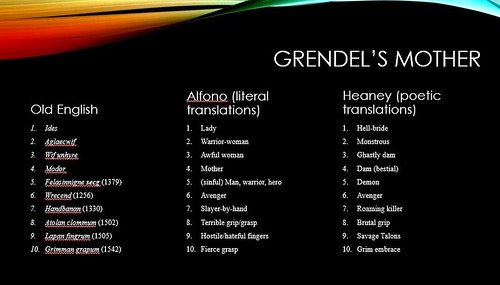
Though I will agree to disagree with my students on our initial difference of understanding, the lecture served its purpose, and we had another lively discussion about why some translations may make sense, and how others belie the cultural prejudices named by Alfono in her own scholarship.
It's been an odd semester, engaged in two separate independent studies. Left to my own devices for one, I found myself reading most of each week's novel before rushing off to the next at the rather frenzied pace I had set for myself. Now I'm finding the time to get to the last few chapters of each as I prepare to write about them all. My reviews here are brief, because I am reserving more specific thoughts and readings for the essay I am preparing.
30.
Title: Lady Audley's Secret
Author: Mary Elizabeth Braddon
Genre: Victorian Sensational FIction
Medium: Broadview Paperback
Acquisition: IS Primary Source
Date Completed: April 17, 2016
Rating: *****
Mary Elizabeth Braddon's sensational 1862 novel was, according to the Broadview edition, "one of the most widely read novels in the Victorian period," and it's certainly clear why. Full of mystery, blackmail, bigamy, and other foul crimes, the text navigates social and gendered spheres with a rapidity that leaves the reader's head spinning with excitement as she follows the lay-about nephew of Sir Audley as he seeks out the truth of his friend's disappearance, and the secrets kept by his childish, doll-like aunt, Lady Audley. The novel exchanges on the Victorian love of mystery and armchair detection, and offers a series of puzzles sure to delight original and contemporary readers.
The back of the Broadview edition further asserts that the novel "creates significant sympathy for the heroine, despite her criminal acts, as she suffers from the injustices of the 'marriage market' and rebels against them." My own reading contradicts this analysis, at least in the first. On the contrary, I found Lady Audley to be repugnant. Early in her life Lady Audley is treated very poorly, and her personal narrative seeks to emphasize the injustices of the gendered systems of nineteenth-century England. She is legitimately a victim a this point, and all sympathy belongs to her, blame falling squarely on the shoulders of he who mistreats her. However, her true character is revealed in how she seeks to improve her conditions, ultimately dissuading the reader from the sympathy Broadview suggests. There is a line of desperation and innocence Bradden could have maintained in order to shift blame and sympathy, but she crosses this. The final explanations serve as a convenient and absurd excuse by a conniving criminal, and the triviality of her actions keep her from becoming even an engaging villain. I am disappointed in Lady Audley, who I was very prepared to adore for her passionate grasping of autonomy and assertion of self, but I found her wanting.
As a whole, I thoroughly enjoyed the book, and found much to write about - so much, in fact, that my difficulty is now in limiting my options.
31.
Title: North and South
Author: Elizabeth Gaskell
Genre: Victorian FIction
Medium: Penguin Paperback
Acquisition: IS Primary Source
Date Completed: April 17, 2016
Rating: ***
For all my disappointment in Lady Audley, however, she remains far more engaging and interesting as a character than Margaret Hale, of Elizabeth Gaskell's 1855 North and South. Upon the marriage of her cousin, Margaret Hale leaves the London house of her aunt, where she had been residing, to return to the utopia of her childhood home, of which she waxes eloquently to all who will hear for much of the early portions of the novel. Unfortunately, this peace is broken by her father's crisis of conscience, and when he gives up his parish post he moves Margaret and her mother with him to a Northern industrial city, where they are forced to take dingy accommodations, breathe polluted air, and lament the lack of society in the city where Mr. Hale has elected to become a private tutor. North and South ruminates on the deplorable living and working conditions of the lower-class employees of mills, as Margaret Hale tries to find her own place in Milton. While the social commentary is thoughtful, and provides a useful perspective in understanding the use and function of the Victorian novel in the popular understanding of such divides and social reform, I could not maintain interest in the protagonist, who is ultimately too perfect to be compelling. I personally prefer characters with texture - or perhaps deviance -but even her transgressions are perfectly situated to emphasize her goodness and adherence to the expectations of proper nineteenth-century middle-class women. Ultimately I was fairly horrified by the connotations of the conclusion of the romantic plot, which I assert promises only misery for Margaret.

Title: Beowulf
Author: Trans. Seamus Heaney
Genre: Anglo-Saxon Poetry
Medium: Paperback
Acquisition: Teaching Text
Date Completed: April 14, 2016
Rating: *****
This semester I had a few students who objected to my use of the term "cannibalism" to describe Grendel's transgressions, and my admittedly tongue-in-cheek description of Beowulf's fight with the infamous man-eater. After a day of interesting debate I used our disagreement as an opportunity to more explicitly discuss the problems of translation, as we had briefly addressed in our readings of Sappho and Dante. In my writing on Grendel's mother for a conference in 2014 I came upon an article by Christine Alfono, who directly addresses the inherent bias in Anglo-Saxon translation, specifically as it relates to Grendel's mother and her characterization in the translated poem. As an illustration, I shared with my student's Alfono's offering of five different translations - and their connotations - from the same Anglo-Saxon line, and I further complied a list of ten terms named by Alfono, what she asserts are "literal" translations of the words (a few I confirmed online, for my own curiosity), and Heaney's word choices.
Though I will agree to disagree with my students on our initial difference of understanding, the lecture served its purpose, and we had another lively discussion about why some translations may make sense, and how others belie the cultural prejudices named by Alfono in her own scholarship.
It's been an odd semester, engaged in two separate independent studies. Left to my own devices for one, I found myself reading most of each week's novel before rushing off to the next at the rather frenzied pace I had set for myself. Now I'm finding the time to get to the last few chapters of each as I prepare to write about them all. My reviews here are brief, because I am reserving more specific thoughts and readings for the essay I am preparing.
30.

Title: Lady Audley's Secret
Author: Mary Elizabeth Braddon
Genre: Victorian Sensational FIction
Medium: Broadview Paperback
Acquisition: IS Primary Source
Date Completed: April 17, 2016
Rating: *****
Mary Elizabeth Braddon's sensational 1862 novel was, according to the Broadview edition, "one of the most widely read novels in the Victorian period," and it's certainly clear why. Full of mystery, blackmail, bigamy, and other foul crimes, the text navigates social and gendered spheres with a rapidity that leaves the reader's head spinning with excitement as she follows the lay-about nephew of Sir Audley as he seeks out the truth of his friend's disappearance, and the secrets kept by his childish, doll-like aunt, Lady Audley. The novel exchanges on the Victorian love of mystery and armchair detection, and offers a series of puzzles sure to delight original and contemporary readers.
The back of the Broadview edition further asserts that the novel "creates significant sympathy for the heroine, despite her criminal acts, as she suffers from the injustices of the 'marriage market' and rebels against them." My own reading contradicts this analysis, at least in the first. On the contrary, I found Lady Audley to be repugnant. Early in her life Lady Audley is treated very poorly, and her personal narrative seeks to emphasize the injustices of the gendered systems of nineteenth-century England. She is legitimately a victim a this point, and all sympathy belongs to her, blame falling squarely on the shoulders of he who mistreats her. However, her true character is revealed in how she seeks to improve her conditions, ultimately dissuading the reader from the sympathy Broadview suggests. There is a line of desperation and innocence Bradden could have maintained in order to shift blame and sympathy, but she crosses this. The final explanations serve as a convenient and absurd excuse by a conniving criminal, and the triviality of her actions keep her from becoming even an engaging villain. I am disappointed in Lady Audley, who I was very prepared to adore for her passionate grasping of autonomy and assertion of self, but I found her wanting.
As a whole, I thoroughly enjoyed the book, and found much to write about - so much, in fact, that my difficulty is now in limiting my options.
31.

Title: North and South
Author: Elizabeth Gaskell
Genre: Victorian FIction
Medium: Penguin Paperback
Acquisition: IS Primary Source
Date Completed: April 17, 2016
Rating: ***
For all my disappointment in Lady Audley, however, she remains far more engaging and interesting as a character than Margaret Hale, of Elizabeth Gaskell's 1855 North and South. Upon the marriage of her cousin, Margaret Hale leaves the London house of her aunt, where she had been residing, to return to the utopia of her childhood home, of which she waxes eloquently to all who will hear for much of the early portions of the novel. Unfortunately, this peace is broken by her father's crisis of conscience, and when he gives up his parish post he moves Margaret and her mother with him to a Northern industrial city, where they are forced to take dingy accommodations, breathe polluted air, and lament the lack of society in the city where Mr. Hale has elected to become a private tutor. North and South ruminates on the deplorable living and working conditions of the lower-class employees of mills, as Margaret Hale tries to find her own place in Milton. While the social commentary is thoughtful, and provides a useful perspective in understanding the use and function of the Victorian novel in the popular understanding of such divides and social reform, I could not maintain interest in the protagonist, who is ultimately too perfect to be compelling. I personally prefer characters with texture - or perhaps deviance -but even her transgressions are perfectly situated to emphasize her goodness and adherence to the expectations of proper nineteenth-century middle-class women. Ultimately I was fairly horrified by the connotations of the conclusion of the romantic plot, which I assert promises only misery for Margaret.
114MickyFine
>113 London_StJ: Apparently I've become the "have you seen the movie?" girl around these parts . :P Richard Armitage's John Thornton in the miniseries version of North and South is worth seeing. I find it very swoony at any rate. I have also read the book, I should say. But my reading of it may have been coloured by watching the miniseries first.
115London_StJ
>114 MickyFine: A colleague also recommended it, and I watched the series not long after finishing the book. I did prefer the screen adaptation of the character to the novel's. The book is not my cuppa for pleasure reading, although it certainly has value for my IS.
116MickyFine
>115 London_StJ: I liked the book enough that I put other Gaskell novels on The List. Which I've been ignoring completely lately in favour of mood/"ooh shiny!" reading.
117London_StJ
>116 MickyFine: My latest "ooh shiny" is the second British female-detective story - Revelations of a Lady Detective
118London_StJ
I need some positivity today. Yesterday, my best friend (since 8th grade!) was diagnosed with "aggressive" cancer. We are 31. After quite a bit of crying I tried to pull myself up with the assertion that "it's not over until the fat physician sings," and now I'm trying to fill my world with happy thoughts and my usually bull-headedness, which has worked out so far.
Positive: we live in an amazing area for medical treatment, spirits are high, and we're stubborn as hell.
Positive: My partner is loving and supportive and wonderful, my children are hilarious and warm and wonderful, and we have a humongous support system that is perfectly happy to gobble everyone up who needs it. And we've started gobbling (in purely positive ways).
Positive: THE SEMESTER IS ALMOST OVER. As of this writing I have seven research papers, 34 literary analysis papers, and five lecture days left. My own professors have given me late (i.e. mid-May) deadlines for my own academic work, so I'm feeling much better about managing all of my brain work. And for the first time I'm not working or taking classes over the summer, so I can read for pleasure and comprehensive exams from mid-May to mid-August. I CAN READ WHATEVER I WANT. I've already ordered a few books.
Positive: We are taking a two-week vacation this summer, and my best friend and her partner were already planning on joining us for nearly all of the second week. So, good timing for quality, relaxing time together.
Positive: This wedding is just ten days away, and come hell or high water I will be done in just ten days. Did I mention that I'm making wedding clothes for my dear friends? They're having a Renaissance wedding, so I am making the bridal gown and groom's suit, each based off of historical garments (hers, his). There were major pattern debacles, and a much-later-than-anticipated start, but things are coming together. I'm staring at two half-dressed dressforms right now, dreaming of all that finishing trim. I'm about 80% done, with fairly easy work left to do. And then I can fix my own wedding clothes for the event, which is a replica of The Rainbow Portrait. I did ask the bride if it was bad manners to show up a) as the queen, and b) as the same queen on which the bridal gown is based. She gave me enthusiastic support, and even offered the bridal chambers at the venue to dress, since my own is so large and complicated.
This is an unflattering picture of me in a dress that needs to be fixed, but here's my first go, from October (with the groom!):

To do: supportaste for my collar, heavier wire for the whisk, additional supports for my French wheel. Essentially, I need to introduce erectile support for my dropping accouterments.
But first, the grading.
I'd rather be sewing. Or reading.
Positive: we live in an amazing area for medical treatment, spirits are high, and we're stubborn as hell.
Positive: My partner is loving and supportive and wonderful, my children are hilarious and warm and wonderful, and we have a humongous support system that is perfectly happy to gobble everyone up who needs it. And we've started gobbling (in purely positive ways).
Positive: THE SEMESTER IS ALMOST OVER. As of this writing I have seven research papers, 34 literary analysis papers, and five lecture days left. My own professors have given me late (i.e. mid-May) deadlines for my own academic work, so I'm feeling much better about managing all of my brain work. And for the first time I'm not working or taking classes over the summer, so I can read for pleasure and comprehensive exams from mid-May to mid-August. I CAN READ WHATEVER I WANT. I've already ordered a few books.
Positive: We are taking a two-week vacation this summer, and my best friend and her partner were already planning on joining us for nearly all of the second week. So, good timing for quality, relaxing time together.
Positive: This wedding is just ten days away, and come hell or high water I will be done in just ten days. Did I mention that I'm making wedding clothes for my dear friends? They're having a Renaissance wedding, so I am making the bridal gown and groom's suit, each based off of historical garments (hers, his). There were major pattern debacles, and a much-later-than-anticipated start, but things are coming together. I'm staring at two half-dressed dressforms right now, dreaming of all that finishing trim. I'm about 80% done, with fairly easy work left to do. And then I can fix my own wedding clothes for the event, which is a replica of The Rainbow Portrait. I did ask the bride if it was bad manners to show up a) as the queen, and b) as the same queen on which the bridal gown is based. She gave me enthusiastic support, and even offered the bridal chambers at the venue to dress, since my own is so large and complicated.
This is an unflattering picture of me in a dress that needs to be fixed, but here's my first go, from October (with the groom!):

To do: supportaste for my collar, heavier wire for the whisk, additional supports for my French wheel. Essentially, I need to introduce erectile support for my dropping accouterments.
But first, the grading.
I'd rather be sewing. Or reading.
120MickyFine
>118 London_StJ: That dress is amazing!
122klobrien2
>118 London_StJ: What a smart thing to do, to list your "positives"! I usually lurk on your thread, but I want to tell you that I'm often amazed at all of the things that you do, and do well, and under pressure! Good job! And keep remembering that soon you will be able to read just for fun.
Karen O.
Karen O.
123Berly
L--So sorry about your best friend. Wishing her and you good luck!
The dress is AMAZING!!!!! I want one. I am floored by your talent.
And come visit my thread if you want to read DiscWorld--Souloftherose posted an image of the books and how they relate and suggestions for starting the series....
The dress is AMAZING!!!!! I want one. I am floored by your talent.
And come visit my thread if you want to read DiscWorld--Souloftherose posted an image of the books and how they relate and suggestions for starting the series....
124London_StJ
>122 klobrien2: Thank you, Karen!
>123 Berly: I saw! Or maybe I saw it posted on Stephen's thread? I think I'm due for some Pratchett this spring.
And thank you. :)
Yesterday I asked the bride and groom if they wanted to be surprised by their final clothes on the day of the wedding ... and they actually said yes. I thought it could be fun, but I could never do it. The bridal gown has already been fitted, and I'm going to blindfold the groom to do his last fitting on Monday. What fun!
ETA: The bride called me a sadist, and accused me of just wanting to make her cry again (she cried when she saw the fabric draped for the first time). I agreed.
>123 Berly: I saw! Or maybe I saw it posted on Stephen's thread? I think I'm due for some Pratchett this spring.
And thank you. :)
Yesterday I asked the bride and groom if they wanted to be surprised by their final clothes on the day of the wedding ... and they actually said yes. I thought it could be fun, but I could never do it. The bridal gown has already been fitted, and I'm going to blindfold the groom to do his last fitting on Monday. What fun!
ETA: The bride called me a sadist, and accused me of just wanting to make her cry again (she cried when she saw the fabric draped for the first time). I agreed.
126London_StJ
Hehehe.
The groom came for his last fitting today (so I know where to put the hook and eyes), and he caved; I blindfolded him, we got him dressed, and once he started feeling the fabric he couldn't hold out. It was worth it, though; I won't be with him when he dresses the day of the wedding, so I got to see his face and tears of joy when he saw his (nearly finished) clothes. Success!
The groom came for his last fitting today (so I know where to put the hook and eyes), and he caved; I blindfolded him, we got him dressed, and once he started feeling the fabric he couldn't hold out. It was worth it, though; I won't be with him when he dresses the day of the wedding, so I got to see his face and tears of joy when he saw his (nearly finished) clothes. Success!
127MickyFine
>126 London_StJ: Huzzah!
128London_StJ
32.
Title: Student Research Papers
Length: Over 215 pages
Date Completed: April 21, 2016
33.
Title: The Island of Doctor Moreau
Author: H.G. Wells
Genre: Scientifc Romance
Medium: Penguin Paperback
Acquisition: Work Text
Date Completed: April 25, 2016
Rating: *****
33.
Title: Selections from A Question of Manhood
Author: Various
Genre: History/Masculinities
Medium: Paperback
Acquisition: IS Final Reading
Date Completed: April 24, 2016
Rating: ****
My chapter choices from A Question of Manhood were directed by personal interest, potential use value for my present project, or the possibility of importance for my ever-looming dissertation. They cover several areas of interest relating to my work, including law and gender, courtship, cultural history, and bodily performance. The first, “For Justice and a Fee: James Milton Turner and the Cherokee Freedmen,” considers an historical conflict of which I knew literally nothing – a dispute over land and tribal rights for the freed African American slaves held by the Cherokee Nation. In this chapter, Gary Kremer tells of a nation within a nation, governed by four social contracts and two governing bodies, and negotiating a system of rights with no precedent. The Cherokee Freedmen want tribal rights and a fair share of land and monies given by the government; the Cherokees who once held the slaves deny their rights to either, and James Turner, an outsider, takes up their mantle and fights with the federal government for their intervention. The whole political and social conflict is nuanced and downright messy, and each decision as the potential to set dangerous precedent.
“Black Policemen in New Orleans During Reconstruction” by Dennis Rousey shares the history of just this – African American men serving in a professional police force at a time when arming their community causes alarm and authority between races is tenuous. Rousey asserts that “The Crescent City’s antebellum tradition in race relation was probably unique,” citing legal circumvention supported by white “employers, policemen, grogshop keepers and professional criminals” for their own purposes and a large Northern population influencing race relations (98). Rousey acknowledges that it is striking to have black officers at all, and further surprising to see them given authority over white citizens, and to see them armed, but that “it became important for the police force to become a microcosm of the whole … community” (99). \
“The African Derivation of the Black Fraternal Orders in the United States,” was not quite what I expected it to be, but rather an explication of the practices and organization of the Independent Order of St. Luke as compared to the social organizations of the Efik and the Igbo of West Africa, justifying the comparison by drawing connections between the American slave trade and these African communities. The chapter itself is a methodical point-by-point analysis of rituals and cultural symbolism, with the goal of breaking the assumption of European heritage in fraternal orders, and illustrating how this American order can in fact be connected to the African communities from which members (or their forefathers) were taken.
Of greatest personal interest were the chapters on courtship and Jackson. In “The Courtship Letters of an African American Couple,” Vicki Howard turns to primary correspondence to evaluate the negotiation of marriage between nineteenth-century African American couples, as they negotiate their roles according to both their own communities (what Howard calls “Black Victoria) and the nineteenth-century cult of Womanhood. The project itself is problematic for its one-sidedness, and the constant necessity of assumption that comes into play when looking at only half of a correspondence (Lucia’s letters have not been saved, while she kept the letters she received from Calvin). A source of discord between the courting couple is Lucia’s desire to continue her education as a teacher, and then to exercise that education professionally; Calvin, also a teacher, initially rejects both desires in deference to the Victorian middle-class cult of womanhood, but eventually yields to Lucia’s desires in order to secure her hand in marriage. Howard speaks of power in this relationship, showing how most belongs to Lucia before they are married, and how Calvin is quick to negotiate when he believes there is a contest for Lucia’s hand. For Lucia’s part, Howard identifies her assertions and desires as exemplary of Black Victoria – a moral but industrious woman who finds fulfillment not just in the home, but in actual occupation that in turn helps to build and support the community.
The final chapter, “Peter Jackson and the Elusive Heavyweight Championship: A Black Athlete’s Struggle Against the Late Nineteenth Century Color-Line” follows the professional career of Peter Jackson from his youth as a sailor to his success as a boxer, and the difficulties he faces in his professional progress due to his race. A superior athlete who first makes his name in Australia, Jackson travels to the United States in order to challenge the title-holder of Heavyweight Champion of the World; John L. Sullivan refuses to cross the color line and meet Jackson in the ring, as do all of the subsequent challengers, literally blocking Jackson from even the chance of gaining the title for himself. David Wiggins details Jackson’s failures with his successes in the ring, narrating his constant and easy successes - and illustrating just why white boxers were afraid to fight him. None wanted to be the champion to lose the belt to him. That Jackson is powerful, skilled, and practiced is never drawn in to question; rather, each rejection is clearly articulated as an upholding of the color-line. Jackson’s failure to achieve the title is not his own, but rather the last front against which these white athletes can uphold their artificial sense of superiority.
Title: Student Research Papers
Length: Over 215 pages
Date Completed: April 21, 2016
33.

Title: The Island of Doctor Moreau
Author: H.G. Wells
Genre: Scientifc Romance
Medium: Penguin Paperback
Acquisition: Work Text
Date Completed: April 25, 2016
Rating: *****
33.

Title: Selections from A Question of Manhood
Author: Various
Genre: History/Masculinities
Medium: Paperback
Acquisition: IS Final Reading
Date Completed: April 24, 2016
Rating: ****
My chapter choices from A Question of Manhood were directed by personal interest, potential use value for my present project, or the possibility of importance for my ever-looming dissertation. They cover several areas of interest relating to my work, including law and gender, courtship, cultural history, and bodily performance. The first, “For Justice and a Fee: James Milton Turner and the Cherokee Freedmen,” considers an historical conflict of which I knew literally nothing – a dispute over land and tribal rights for the freed African American slaves held by the Cherokee Nation. In this chapter, Gary Kremer tells of a nation within a nation, governed by four social contracts and two governing bodies, and negotiating a system of rights with no precedent. The Cherokee Freedmen want tribal rights and a fair share of land and monies given by the government; the Cherokees who once held the slaves deny their rights to either, and James Turner, an outsider, takes up their mantle and fights with the federal government for their intervention. The whole political and social conflict is nuanced and downright messy, and each decision as the potential to set dangerous precedent.
“Black Policemen in New Orleans During Reconstruction” by Dennis Rousey shares the history of just this – African American men serving in a professional police force at a time when arming their community causes alarm and authority between races is tenuous. Rousey asserts that “The Crescent City’s antebellum tradition in race relation was probably unique,” citing legal circumvention supported by white “employers, policemen, grogshop keepers and professional criminals” for their own purposes and a large Northern population influencing race relations (98). Rousey acknowledges that it is striking to have black officers at all, and further surprising to see them given authority over white citizens, and to see them armed, but that “it became important for the police force to become a microcosm of the whole … community” (99). \
“The African Derivation of the Black Fraternal Orders in the United States,” was not quite what I expected it to be, but rather an explication of the practices and organization of the Independent Order of St. Luke as compared to the social organizations of the Efik and the Igbo of West Africa, justifying the comparison by drawing connections between the American slave trade and these African communities. The chapter itself is a methodical point-by-point analysis of rituals and cultural symbolism, with the goal of breaking the assumption of European heritage in fraternal orders, and illustrating how this American order can in fact be connected to the African communities from which members (or their forefathers) were taken.
Of greatest personal interest were the chapters on courtship and Jackson. In “The Courtship Letters of an African American Couple,” Vicki Howard turns to primary correspondence to evaluate the negotiation of marriage between nineteenth-century African American couples, as they negotiate their roles according to both their own communities (what Howard calls “Black Victoria) and the nineteenth-century cult of Womanhood. The project itself is problematic for its one-sidedness, and the constant necessity of assumption that comes into play when looking at only half of a correspondence (Lucia’s letters have not been saved, while she kept the letters she received from Calvin). A source of discord between the courting couple is Lucia’s desire to continue her education as a teacher, and then to exercise that education professionally; Calvin, also a teacher, initially rejects both desires in deference to the Victorian middle-class cult of womanhood, but eventually yields to Lucia’s desires in order to secure her hand in marriage. Howard speaks of power in this relationship, showing how most belongs to Lucia before they are married, and how Calvin is quick to negotiate when he believes there is a contest for Lucia’s hand. For Lucia’s part, Howard identifies her assertions and desires as exemplary of Black Victoria – a moral but industrious woman who finds fulfillment not just in the home, but in actual occupation that in turn helps to build and support the community.
The final chapter, “Peter Jackson and the Elusive Heavyweight Championship: A Black Athlete’s Struggle Against the Late Nineteenth Century Color-Line” follows the professional career of Peter Jackson from his youth as a sailor to his success as a boxer, and the difficulties he faces in his professional progress due to his race. A superior athlete who first makes his name in Australia, Jackson travels to the United States in order to challenge the title-holder of Heavyweight Champion of the World; John L. Sullivan refuses to cross the color line and meet Jackson in the ring, as do all of the subsequent challengers, literally blocking Jackson from even the chance of gaining the title for himself. David Wiggins details Jackson’s failures with his successes in the ring, narrating his constant and easy successes - and illustrating just why white boxers were afraid to fight him. None wanted to be the champion to lose the belt to him. That Jackson is powerful, skilled, and practiced is never drawn in to question; rather, each rejection is clearly articulated as an upholding of the color-line. Jackson’s failure to achieve the title is not his own, but rather the last front against which these white athletes can uphold their artificial sense of superiority.
129London_StJ
Whew! Survived one responsibility; the wedding yesterday was absolutely perfect, and the bride and groom were radiant. Here we are together, in my handiwork:

Now I'm neck-deep in grading, to be followed by frantic reading and research and writing as I wrap up my semester. My first "book" for may is going to be another "Student Essays" addition.

Now I'm neck-deep in grading, to be followed by frantic reading and research and writing as I wrap up my semester. My first "book" for may is going to be another "Student Essays" addition.
130Berly
Fantastic!!! Absolutely breathtaking outfits...and you, too!!! You are truly gifted and they are a very lucky couple to have you as their designer. Wow.
131London_StJ
>130 Berly: Thank you for your kind words! It's not often my hobby is wanted, and I was thrilled to dress them on their very special day.
133London_StJ
>132 Ape: It's amazing that it's finally done. Oy.
Oddly enough it hasn't impacted my desire to sew, I'm just interested in smaller projects. Boy howdy, was it good to actually clean my office. I can walk on the floor! Without stepping around hoop skirts and yards and yards of satin!
Oddly enough it hasn't impacted my desire to sew, I'm just interested in smaller projects. Boy howdy, was it good to actually clean my office. I can walk on the floor! Without stepping around hoop skirts and yards and yards of satin!
134Whisper1
I am so so sorry that your 31 year old friend has an aggressive form of cancer. My dear, long-term friend died at 54 after a six year brave battle with ovarian cancer. I was with her through the end. It was one of the hardest things I've ever done, and yet I would do it all over again.
She taught me so much, especially about facing adversity squarely, head on, in a positive manner.
And, of course, I admire all your sewing projects. How wonderful it is to once again see posts of your incredible talent.
I send all good wishes and gentle hugs to you!
She taught me so much, especially about facing adversity squarely, head on, in a positive manner.
And, of course, I admire all your sewing projects. How wonderful it is to once again see posts of your incredible talent.
I send all good wishes and gentle hugs to you!
135London_StJ
>134 Whisper1: Thank you, my dear
136FAMeulstee
>129 London_StJ: Stunning!
137MickyFine
>129 London_StJ: All three of you look amazing! Fantastic job, Luxx!
Good luck with all the academic madness. :)
Good luck with all the academic madness. :)
138London_StJ
>137 MickyFine: Thanks! The work part is now over.
35.
Title: Student Papers
Length: Over 300 pages
Date Completed: May 3, 2016
And with that I am done grading until August.
35.
Title: Student Papers
Length: Over 300 pages
Date Completed: May 3, 2016
And with that I am done grading until August.
139MickyFine
>138 London_StJ: Huzzah!
140London_StJ
SERVICE ANNOUNCEMENT
Saturday is Free Comic Book Day! Check your local comic shops, and see what they have going on! Ours is hosting an entire festival, complete with free books, sales, signings, a cosplay contest, and a legion of Stormtroopers.
I don't know who is going to have more fun: the monsters, or me.
Saturday is Free Comic Book Day! Check your local comic shops, and see what they have going on! Ours is hosting an entire festival, complete with free books, sales, signings, a cosplay contest, and a legion of Stormtroopers.
I don't know who is going to have more fun: the monsters, or me.
141London_StJ
36. 
Title: The Maiden Tribute of Modern Babylon
Author: William Thomas Stead
Genre: Journalism, History, Victorian
Medium: Paperback
Acquisition: Victorian IS Reading
Date Completed: May 5, 2016
Rating: *****
In 1885, dissatisfied with the lack of protection afforded minors by the law, William Thomas Stead published a four-part work of investigative journalism, exposing the insidious world of child prostitution in London, and specifically the thriving market for virgins supplied through coercion, deceit, and frequently rape. Often posing as a gentlemen in the market for a "maiden," Stead meets with brothel owners and introducers, follows the mistresses and their charges to midwives and doctors for certificates of virginity, and even manages private conversations with girls during which he tries, often unsuccessfully, to more fully explain their situations. Time and time again Stead secures the sale of these young women, for £5, £7, £10 pounds, and hears of patrons who brag of requiring so many virgins a fortnight, or having "ruined" over 3,000 girls in the course of his sexual career. As a body, and with no exception in his writing, Stead views these children and young women as victims of a malicious system that is unchecked by law and instead protected by a judicial system which favors the wealthy men who are its clientele. At a time when a child of thirteen can consent to sexual acts, despite her more common ignorance of sex , the law wholly protects the men who participate in what Stead calls "organized rape" (9). Even when raped, the victims of this industry have no recourse: "No one will believe for story, for when a woman is outraged,by fraud or force, her sworn testimony weighs nothing against the lightest word of the man who perpetrated the crimes" (34).
Stead's publications is both fascinating and heartbreaking. He exposes the machinations of the industry, and brings to light the various methods "introducers" and procuresses use to harvest young women for the commodity of their virginity, most often manipulating them into an arrangement which leaves the young girls ignorant of events to come, and later traps them in a web of prostitution from which very few are ever able to escape. Personal narratives humanize the subject, balancing Stead's observations with purportedly true accounts of women trapped in the industry, at times outright kidnapped, and even sold abroad to European and American brothels. The legal, gendered, and sexual problems that allow for the commercial system Stead so aptly vilifies are far from resolved; though the legal age of consent was eventually raised in the UK, child sexploitation and human trafficking persist, often relying on the same commodification of the young, often female, body, and a gendered system of dominance and abuse. In this way, Stead's accounts are timeless, and serve as a strong historical primary source to understand a bit of a continually contemporary horror.

Title: The Maiden Tribute of Modern Babylon
Author: William Thomas Stead
Genre: Journalism, History, Victorian
Medium: Paperback
Acquisition: Victorian IS Reading
Date Completed: May 5, 2016
Rating: *****
In 1885, dissatisfied with the lack of protection afforded minors by the law, William Thomas Stead published a four-part work of investigative journalism, exposing the insidious world of child prostitution in London, and specifically the thriving market for virgins supplied through coercion, deceit, and frequently rape. Often posing as a gentlemen in the market for a "maiden," Stead meets with brothel owners and introducers, follows the mistresses and their charges to midwives and doctors for certificates of virginity, and even manages private conversations with girls during which he tries, often unsuccessfully, to more fully explain their situations. Time and time again Stead secures the sale of these young women, for £5, £7, £10 pounds, and hears of patrons who brag of requiring so many virgins a fortnight, or having "ruined" over 3,000 girls in the course of his sexual career. As a body, and with no exception in his writing, Stead views these children and young women as victims of a malicious system that is unchecked by law and instead protected by a judicial system which favors the wealthy men who are its clientele. At a time when a child of thirteen can consent to sexual acts, despite her more common ignorance of sex , the law wholly protects the men who participate in what Stead calls "organized rape" (9). Even when raped, the victims of this industry have no recourse: "No one will believe for story, for when a woman is outraged,by fraud or force, her sworn testimony weighs nothing against the lightest word of the man who perpetrated the crimes" (34).
Stead's publications is both fascinating and heartbreaking. He exposes the machinations of the industry, and brings to light the various methods "introducers" and procuresses use to harvest young women for the commodity of their virginity, most often manipulating them into an arrangement which leaves the young girls ignorant of events to come, and later traps them in a web of prostitution from which very few are ever able to escape. Personal narratives humanize the subject, balancing Stead's observations with purportedly true accounts of women trapped in the industry, at times outright kidnapped, and even sold abroad to European and American brothels. The legal, gendered, and sexual problems that allow for the commercial system Stead so aptly vilifies are far from resolved; though the legal age of consent was eventually raised in the UK, child sexploitation and human trafficking persist, often relying on the same commodification of the young, often female, body, and a gendered system of dominance and abuse. In this way, Stead's accounts are timeless, and serve as a strong historical primary source to understand a bit of a continually contemporary horror.
142London_StJ
37. 
Title: Selections from the Broadview Anthology of Victorian Poetry
Author: Various
Genre: Poetry
Medium: Paperback
Acquisition: Victorian IS Reading
Date Completed: Spring 2016
Rating: *****
Tennyson: “The Lady of Shalott”; The Epic Morte d’Arthur, “Morte d’Arthur”
Browning: “My Last Duchess”, “Porphyria’s Lover,” “Count Gismond”
D.G. Rosseti, “The Blessed Damosel”
William Morris: “The Defense of Guinevere”
C. Rossetti: “Goblin Market”
Elizabeth Barrett Browning, from Sonnets from the Portuguese (BA 25-29)
Elizabeth Siddal, all selections (BA 410-11)
Augusta Webster, “A Castaway” (BA 475)
Mill, John Stuart (1806-1873) "What is poetry?"
Ruskin, John (1819-1900) Of the Pathetic Fallacy
Meynell “Robert Browning”
No individual reviews, because I'm neck-deep in writing a paper on all of this material, but a couple of notes: Robert Browning's "My Last Duchess" has long been my favorite poem, but having now read "Porphyria's Lover" I have fallen in love with Browning's macabre all over again. Some of the poetry was a review for me, but Webster's "A Castaway," detailing the narrative of a "fallen woman" was new, engaging, and fantastically assertive. I found the theory to be much less engaging, in part because I find poetry less engaging than fiction.
38.
Title: Selections from the The Broadview Anthology of Victorian Prose and Victorian Prose
Author:Various
Genre: Nonfiction
Medium: Paperback
Acquisition: Victorian IS Reading
Date Completed: Spring 2016
Rating: *****
Dodd from A Narrative of the Experience…
Wilde, from De Profundis
Dickens “A Walk in a Workhouse”
Hill, from “Blank Court”
Booth, from In Darkest England
Carpenter, from Reformatory Schools
Davies, from Higher Education of Women
Maudsley, “Sex in Mind”
Anderson “A Reply”
Collins, “Educational Crisis”
Jameson, from Legends of the Madonna
Wilde, from “Critic as Artist”
Lee, from “Beauty and Ugliness”
Becker, “Study of Science by Women”
Proctor, “A Voyage to the Ringed Planet”
Huxley, “Struggle for Human Existence”
Bates, The Naturalist on the River Amazons
Stanley, How I Found Livingston
Marsden On Sledge and Horseback

Title: Selections from the Broadview Anthology of Victorian Poetry
Author: Various
Genre: Poetry
Medium: Paperback
Acquisition: Victorian IS Reading
Date Completed: Spring 2016
Rating: *****
Tennyson: “The Lady of Shalott”; The Epic Morte d’Arthur, “Morte d’Arthur”
Browning: “My Last Duchess”, “Porphyria’s Lover,” “Count Gismond”
D.G. Rosseti, “The Blessed Damosel”
William Morris: “The Defense of Guinevere”
C. Rossetti: “Goblin Market”
Elizabeth Barrett Browning, from Sonnets from the Portuguese (BA 25-29)
Elizabeth Siddal, all selections (BA 410-11)
Augusta Webster, “A Castaway” (BA 475)
Mill, John Stuart (1806-1873) "What is poetry?"
Ruskin, John (1819-1900) Of the Pathetic Fallacy
Meynell “Robert Browning”
No individual reviews, because I'm neck-deep in writing a paper on all of this material, but a couple of notes: Robert Browning's "My Last Duchess" has long been my favorite poem, but having now read "Porphyria's Lover" I have fallen in love with Browning's macabre all over again. Some of the poetry was a review for me, but Webster's "A Castaway," detailing the narrative of a "fallen woman" was new, engaging, and fantastically assertive. I found the theory to be much less engaging, in part because I find poetry less engaging than fiction.
38.

Title: Selections from the The Broadview Anthology of Victorian Prose and Victorian Prose
Author:Various
Genre: Nonfiction
Medium: Paperback
Acquisition: Victorian IS Reading
Date Completed: Spring 2016
Rating: *****
Dodd from A Narrative of the Experience…
Wilde, from De Profundis
Dickens “A Walk in a Workhouse”
Hill, from “Blank Court”
Booth, from In Darkest England
Carpenter, from Reformatory Schools
Davies, from Higher Education of Women
Maudsley, “Sex in Mind”
Anderson “A Reply”
Collins, “Educational Crisis”
Jameson, from Legends of the Madonna
Wilde, from “Critic as Artist”
Lee, from “Beauty and Ugliness”
Becker, “Study of Science by Women”
Proctor, “A Voyage to the Ringed Planet”
Huxley, “Struggle for Human Existence”
Bates, The Naturalist on the River Amazons
Stanley, How I Found Livingston
Marsden On Sledge and Horseback
143London_StJ
As I prepare for my final term paper I realized that I hadn't yet posted some of my independent study readings.
39.
Title: The Woman in White
Author: Wilkie Collins
Genre: Victorian Gothic
Medium: Broadview Paperback
Acquisition: Victorian IS Reading
Date Completed: Spring 2016
Rating: ******
Wilkie Collins' The Woman in White is a wonderfully gothic sensation novel, rich in themes of morality, madness, deceit, and romance. Walter Hartright (heart - right) is engaged as a drawing instructor in a wealthy country household, and, predictably, falls in love with the beautiful sister, Laura. Thematically consistent is Laura's standing engagement to the reprehensible Sir Percival Glyde, to whom Laura promises herself at her father's deathbed, and to whom she is married in the early course of the novel. Glyde is not what he appears to be, and his repugnant characteristics reveal themselves as a mysterious young woman, Anne, makes herself known as a one-time childhood companion of Laura, devotee to Laura's late mother, and keeper of a secret that threatens Glyde in some mysterious way. Though many of these narrative devices and themes are consistent within the genre, to the point of near-cliche, Collins masterfully builds mystery and suspense, serving his readers both what they expect of the material, while using strong characterization to heighten the reader's engagement with the narrative. The reader will shrink from Glyde, mistrusting his actions, and feeling anxiety over Laura; though traditionally pathetic, Laura's strong character allows for a level of sympathy occasionally denied heroines her her position; Count and Countess Fosco are perhaps even less trustworthy than their friend and host, Gylde, and loom ominously around the edges of the narrative, and so forth. That the romantic lead Walter is a shallow wash of a character does not hinder the plot, but rather allows for the substitution of one's own romantic figure in his place, allowing a personal entry into the narrative for maximum fantasizing.
For my own purposes and writing, Anne is the most engaging character, and her relationship to Laura provides a point of fascination. The titular "woman in white," Anne is both phantom and fleshly, represented as slightly mad and therefore less trustworthy, but a keeper of some of the most extraordinary knowledge in the novel. In reading the material construction of identity, I am struck by the other characters' reading of her blanched wardrobe, and its purported significance, not so far from a time when such choices would be fashionable and romantic. Significant, too, is her status as a doppelganger, and the machinations surrounding this pot device. I find it difficult to go further without spoiling the mystery of the novel, but promise to make good use of these points in my final semester writing.
Highly recommended for fans of the Victorian or the Gothic.
40.
Title: The Odd Women
Author: George Gissing
Genre: Victorian
Medium: Broadview Paperback
Acquisition: Victorian IS Reading
Date Completed: Spring 2016
Rating: ****
The position of women in nineteenth-century England cannot be over-exaggerated: they are victimized at every level of society, and have to fight extraordinary social and political battles to attain even the most basic rights. Gissing's The Odd Women works to illustrate society's failure in relation to unmarried women specifically, Gissing's "odd" women being the "redundant" women of Rathbone's lamentation. The novel opens with the orphaning of the Madden sisters, daughters of a physician of various ages and levels of education, none of whom are prepared for self-support. When Dr. Madden's untimely demise leaves the girls to fend for themselves they, as a rule, fail, and the novel follows the regrettable existence of half of these daughters, along with their bluestocking friend, Rhoda. The text works hard to reveal social ills, and to illustrate the efforts being made to rectify these shortcomings. Critically, Gissing's work feels extraordinary, and is a significant critique that belongs on any introductory English or gender studies syllabus. Personally, I did not enjoy the text; the Madden sisters in their poor state are wooden ad monochromatically pathetic, and so while I lament greatly their position my emotional response comes wholly from my own historical research rather than the narration of the sisters themselves. Similarly, I found Rhoda to be exceptionally abrasiveness, and while I enjoy her position, and can laugh at some of her extremist views, I found her to be ineffective for my own current position. Final thoughts: important and useful social text, but not necessarily an engaging personal read.
39.

Title: The Woman in White
Author: Wilkie Collins
Genre: Victorian Gothic
Medium: Broadview Paperback
Acquisition: Victorian IS Reading
Date Completed: Spring 2016
Rating: ******
Wilkie Collins' The Woman in White is a wonderfully gothic sensation novel, rich in themes of morality, madness, deceit, and romance. Walter Hartright (heart - right) is engaged as a drawing instructor in a wealthy country household, and, predictably, falls in love with the beautiful sister, Laura. Thematically consistent is Laura's standing engagement to the reprehensible Sir Percival Glyde, to whom Laura promises herself at her father's deathbed, and to whom she is married in the early course of the novel. Glyde is not what he appears to be, and his repugnant characteristics reveal themselves as a mysterious young woman, Anne, makes herself known as a one-time childhood companion of Laura, devotee to Laura's late mother, and keeper of a secret that threatens Glyde in some mysterious way. Though many of these narrative devices and themes are consistent within the genre, to the point of near-cliche, Collins masterfully builds mystery and suspense, serving his readers both what they expect of the material, while using strong characterization to heighten the reader's engagement with the narrative. The reader will shrink from Glyde, mistrusting his actions, and feeling anxiety over Laura; though traditionally pathetic, Laura's strong character allows for a level of sympathy occasionally denied heroines her her position; Count and Countess Fosco are perhaps even less trustworthy than their friend and host, Gylde, and loom ominously around the edges of the narrative, and so forth. That the romantic lead Walter is a shallow wash of a character does not hinder the plot, but rather allows for the substitution of one's own romantic figure in his place, allowing a personal entry into the narrative for maximum fantasizing.
For my own purposes and writing, Anne is the most engaging character, and her relationship to Laura provides a point of fascination. The titular "woman in white," Anne is both phantom and fleshly, represented as slightly mad and therefore less trustworthy, but a keeper of some of the most extraordinary knowledge in the novel. In reading the material construction of identity, I am struck by the other characters' reading of her blanched wardrobe, and its purported significance, not so far from a time when such choices would be fashionable and romantic. Significant, too, is her status as a doppelganger, and the machinations surrounding this pot device. I find it difficult to go further without spoiling the mystery of the novel, but promise to make good use of these points in my final semester writing.
Highly recommended for fans of the Victorian or the Gothic.
40.

Title: The Odd Women
Author: George Gissing
Genre: Victorian
Medium: Broadview Paperback
Acquisition: Victorian IS Reading
Date Completed: Spring 2016
Rating: ****
The position of women in nineteenth-century England cannot be over-exaggerated: they are victimized at every level of society, and have to fight extraordinary social and political battles to attain even the most basic rights. Gissing's The Odd Women works to illustrate society's failure in relation to unmarried women specifically, Gissing's "odd" women being the "redundant" women of Rathbone's lamentation. The novel opens with the orphaning of the Madden sisters, daughters of a physician of various ages and levels of education, none of whom are prepared for self-support. When Dr. Madden's untimely demise leaves the girls to fend for themselves they, as a rule, fail, and the novel follows the regrettable existence of half of these daughters, along with their bluestocking friend, Rhoda. The text works hard to reveal social ills, and to illustrate the efforts being made to rectify these shortcomings. Critically, Gissing's work feels extraordinary, and is a significant critique that belongs on any introductory English or gender studies syllabus. Personally, I did not enjoy the text; the Madden sisters in their poor state are wooden ad monochromatically pathetic, and so while I lament greatly their position my emotional response comes wholly from my own historical research rather than the narration of the sisters themselves. Similarly, I found Rhoda to be exceptionally abrasiveness, and while I enjoy her position, and can laugh at some of her extremist views, I found her to be ineffective for my own current position. Final thoughts: important and useful social text, but not necessarily an engaging personal read.
144London_StJ
At 9pm I managed to submit twenty-one pages of reflection on my Victorian Literature independent study, and actually managed to include most of my reading list - a feat I wasn't sure I could manage. A few poems and essays were sacrificed, as well as The Missionary, but I managed to churn out that more or less made logical sense of it all, under the theme of sacrificial daughters. And now I will hold my breath waiting to see if my adviser agrees with my connections.
Oh, and write my other term paper.
For a bit of a breather I gulped down two cozy mysteries.
41.
Title: The Good, The Bad, and the Emus
Author: Donna Andrews
Genre: Cozy Mystery
Medium: Ebook
Acquisition: Library Book
Date Completed: 8 May 2016
Rating: ***
It must be difficult to maintain a cozy mystery series for so long, as small towns and craft fairs can only yield so many bodies. To alleviate some of the body count, and protect the convivial small-town feel of Cearphilly, Andrews sends Meg Langslow into a neighboring community in The Good, The Bad, and the Emus with P.I. Stanley, sent on a mission by her grandfather. After all of this time, and having made the acquaintance of the family he didn't before knew he had, Meg's grandfather has hired Stanley to locate his former lover - only to discover that she is not only dead, but was likely murdered six months before. In an effort to win over the reclusive cousin with whom Cordelia lived before her death, Meg manipulates her grandfather into capturing and re-homing the emus Cordelia and Annabel were recently working to protect, placing them in close proximity and allowing for snooping, cautious family bonding, and bird-rescue. Though the story can feel a bit claustrophobic, and the shallow characters wooden, the plot maintains a consistent pace, and delivers on the promise of the series thus far.
42.
Title: The Nightingale Before Christmas
Author: Donna Andrews
Genre: Cozy Mystery
Medium: Ebook
Acquisition: Library Book
Date Completed: 10 May 2016
Rating: **1/
In an effort to protect her home and peace of mind, Meg volunteers to manage a show house decorated by local professionals as a fundraiser for the historical society - provided the show house isn't her house. This puts Meg into the position in which she does best. No, not blacksmithing - she certainly doesn't have time to work, now that she has twin boys! And no, not parenting those boys - sure, she sneaks off for a couple of outings, but largely leaves their care to other family. She's too busy managing decorators to be bogged down with the children! ... For whom she (apparently?) gave up her job...
I intend to raise no arguments about mothers and work and parenting responsibilities - real life is full enough of those empty debates. Rather, I'm snarking because I am less certain of Meg's priorities, and thus connect less with her as a character. Once very capable, Meg now just seems flighty. If she's going to resolutely pursue one occupation over another, which she seemingly feels she needs to do, I wish she would. I want to see Meg as herself, and less of Meg as a tool for everyone else around her.
At one point in the needless character criticism that makes up Meg Langslow's internal (or in this case, actual) dialogue, she asks if a "self-respecting Goth" would actually carry a coffin purse. This is a passing and relatively insignificant moment, to be sure, and Andrews uses it to offer the suggestion that the character in question has an eye for quality and detail, and could be successful if she outgrows the macabre. It makes a good point of illustration, though, for the trope into which Andrews falls, and one that is beginning to grate so far into the series: wooden stock characters that establish a critical social hierarchy irrelevant to the narrative progress, and reflective of a stodgy world view that masquerades for broad observation. The decorator is not the first victim of this lack of understanding, as before the same could be said about so many, from computer geeks, to New Agers, to theater types. Heck, Meg even paints Michael into a corner before realizing he "defied type" and isn't actually gay. By pigeon-holing characters into cartoon-like personae, Andrews is carelessly coloring her texts and masking a lack of depth, which is problematic in a series that attempts to drive plot through character. Meg herself would bristle at being judged on the surface knowledge of being a blacksmith (not that she works much anymore), so she seems much less reasonable than she's otherwise presented in her poor social readings. This works to challenge the suspension of disbelief, and ultimately renders the book - and the unnecessarily repetitive Christmas plot - tiring.
The fact that I'm so focused on poor character development in a character-driven novel is symptomatic of the lack of surface pleasure I found in reading the book, which is the real reason I pick up cozy mysteries. I don't expect them to be anything more than good fun (and highly value them as such!), and when they're not I start to wonder just why that may be. The holiday theme is exactly like the last. The decorating discussions are what you've seen before. The characters are all recycled. If I didn't have one more book from the library I'd say it was time for me to put down Meg for good, but I'll give it one more shot.
Oh, and write my other term paper.
For a bit of a breather I gulped down two cozy mysteries.
41.

Title: The Good, The Bad, and the Emus
Author: Donna Andrews
Genre: Cozy Mystery
Medium: Ebook
Acquisition: Library Book
Date Completed: 8 May 2016
Rating: ***
It must be difficult to maintain a cozy mystery series for so long, as small towns and craft fairs can only yield so many bodies. To alleviate some of the body count, and protect the convivial small-town feel of Cearphilly, Andrews sends Meg Langslow into a neighboring community in The Good, The Bad, and the Emus with P.I. Stanley, sent on a mission by her grandfather. After all of this time, and having made the acquaintance of the family he didn't before knew he had, Meg's grandfather has hired Stanley to locate his former lover - only to discover that she is not only dead, but was likely murdered six months before. In an effort to win over the reclusive cousin with whom Cordelia lived before her death, Meg manipulates her grandfather into capturing and re-homing the emus Cordelia and Annabel were recently working to protect, placing them in close proximity and allowing for snooping, cautious family bonding, and bird-rescue. Though the story can feel a bit claustrophobic, and the shallow characters wooden, the plot maintains a consistent pace, and delivers on the promise of the series thus far.
42.

Title: The Nightingale Before Christmas
Author: Donna Andrews
Genre: Cozy Mystery
Medium: Ebook
Acquisition: Library Book
Date Completed: 10 May 2016
Rating: **1/
In an effort to protect her home and peace of mind, Meg volunteers to manage a show house decorated by local professionals as a fundraiser for the historical society - provided the show house isn't her house. This puts Meg into the position in which she does best. No, not blacksmithing - she certainly doesn't have time to work, now that she has twin boys! And no, not parenting those boys - sure, she sneaks off for a couple of outings, but largely leaves their care to other family. She's too busy managing decorators to be bogged down with the children! ... For whom she (apparently?) gave up her job...
I intend to raise no arguments about mothers and work and parenting responsibilities - real life is full enough of those empty debates. Rather, I'm snarking because I am less certain of Meg's priorities, and thus connect less with her as a character. Once very capable, Meg now just seems flighty. If she's going to resolutely pursue one occupation over another, which she seemingly feels she needs to do, I wish she would. I want to see Meg as herself, and less of Meg as a tool for everyone else around her.
At one point in the needless character criticism that makes up Meg Langslow's internal (or in this case, actual) dialogue, she asks if a "self-respecting Goth" would actually carry a coffin purse. This is a passing and relatively insignificant moment, to be sure, and Andrews uses it to offer the suggestion that the character in question has an eye for quality and detail, and could be successful if she outgrows the macabre. It makes a good point of illustration, though, for the trope into which Andrews falls, and one that is beginning to grate so far into the series: wooden stock characters that establish a critical social hierarchy irrelevant to the narrative progress, and reflective of a stodgy world view that masquerades for broad observation. The decorator is not the first victim of this lack of understanding, as before the same could be said about so many, from computer geeks, to New Agers, to theater types. Heck, Meg even paints Michael into a corner before realizing he "defied type" and isn't actually gay. By pigeon-holing characters into cartoon-like personae, Andrews is carelessly coloring her texts and masking a lack of depth, which is problematic in a series that attempts to drive plot through character. Meg herself would bristle at being judged on the surface knowledge of being a blacksmith (not that she works much anymore), so she seems much less reasonable than she's otherwise presented in her poor social readings. This works to challenge the suspension of disbelief, and ultimately renders the book - and the unnecessarily repetitive Christmas plot - tiring.
The fact that I'm so focused on poor character development in a character-driven novel is symptomatic of the lack of surface pleasure I found in reading the book, which is the real reason I pick up cozy mysteries. I don't expect them to be anything more than good fun (and highly value them as such!), and when they're not I start to wonder just why that may be. The holiday theme is exactly like the last. The decorating discussions are what you've seen before. The characters are all recycled. If I didn't have one more book from the library I'd say it was time for me to put down Meg for good, but I'll give it one more shot.
145LovingLit
>143 London_StJ: I stumbled upon The Woman in White years ago, before I was officially a hard-core reader, as something to occupy my time with while waiting to get picked up as a hitchhiker. It was small, hard cover and looked interesting, and I really enjoyed it. Later on I realised it had quite a reputation as an important book, it was weird to come to it out of context...I did the same with White Noise.
Well done on the wedding costume making, marking, reading and IS, oh....and parenting :)
Well done on the wedding costume making, marking, reading and IS, oh....and parenting :)
146London_StJ
>145 LovingLit: Thanks! And what an interesting choice as a hitchhiker. I had heard of it casually myself, but this is the first I've managed to actually read it. It's pretty standard fare, but I really enjoyed it. I've never heard of White Noise...
And I earned an A in my Victorian IS, after a whirlwind of a paper. Now on to the next essay... But first, a few more casual reads.
And I earned an A in my Victorian IS, after a whirlwind of a paper. Now on to the next essay... But first, a few more casual reads.
147London_StJ
43. 
Title: Lord of the Wings
Author: Donna Andrews
Genre: Cozy Mystery
Medium: Ebook
Acquisition: Library Book
Date Completed: 12 May 2016
Rating: ***1/2
Lord of the Wings takes place during another Halloween in Caerphilly, and follows Meg as her volunteer schedule leads her to manage the "Goblin Patrol" for a week-long town festival; when a series of pranks leads to the discovery of a body in the woods the town discovers that there are more sinister plans in place for the week, and work to balance the festivities with a murder investigation. As usual, Meg's primary focus is her "volunteer" work, but this book at least makes an attempt to address some of the problems of priority. Ironically, Meg laments the time her actual job would take from her family, and many of her volunteer responsibilities are given to a new city employee; here Meg tries to balance time with her twins and her time on the festival. But still I'm left to wonder - why spend all of this time volunteering and longing to go back to work? Why not, as nearly every other resident does, focus on her job? Her father works, her husband works, the librarians work, the police all work ... and Meg volunteers instead of working. Strange. An effort is made to rectify this discrepancy at the conclusion, so an even further balance may be found in the next in the series. I'm not sure I'll continue myself - I've grown bored - but more dedicated fans will likely be pleased with the new direction.
44.
Title: American Vampire
Author: Scott Snyder, Rafael Albuquerque, and Stephen King
Genre: Comic
Medium: Paperback
Acquisition:
Date Completed: 12 May 2016
Rating: ***1/2
American Vampire is a fantasy of the Old West and silent film Hollywood, each dominated by tyrannical Old World vampires who own banks and studios, and treat humans ("humes." Yes, actually) as the cattle they are so often read to be within the genre. The Old West sees the birth of Skinner Sweet, whose backstory is penned by Stephen King, and a new, distinctly American race of vampires. Skinner Sweet is no hero - his actions are fairly repugnant, and stereotypically outlaw: theft, rape, and countless murders, including the shooting of a toddler. When he gets into a physical altercation with a vampire whom his gang has robbed a drop of blood gives him new life, and the reader again meets him in 1920s California, acting the same sweets-guzzling creeper that he is in the late nineteenth-century.
While the characters are fairly stock, they're very well-executed, and Skinner Sweet has a ghastly charm that holds attention even as the reader understands that he has no redeeming qualities. Whatsoever. Truly. Pearl shows promise, although she's given little room to be "new," and could develop into something wonderful if given half a chance. The story itself is likewise trite, but not so wooden that it wears thing, more like a familiar and comfortable sweater than a sodden mess, blending genres in a way that firmly grounds the story geographically and culturally, and leaning heavily on beautiful artwork to pull the book through.
Stephen King's introduction nearly ruins the experience before it begins. He opens by saying, "Here's what vampires shouldn't be: pallid detectives who drink Bloody Marys and only work at night; lovelorn southern gentlemen; anorexic teenage girls; boy-toys with big dewy eyes. What should they be? Killers, honey. Stone killers who never get enough of that tasty Type-A. Bad boys, and girls. Hunters. In other words, Midnight America." In typical King fashion he thus demonstrates his blinder-version of genre and characters, asserting his "rightness" over the "wrongs" of other authors in a brazen display of ignorance. Clearly, King is not a fan of Vampire Diaries, Twilight, Interview With a Vampire, or ... one I haven't heard of. Nor will I say he should be - each have their targeted audience, and readers like King are not among them. What King here asserts is exactly what this books is - an assertive rewriting of an ageless figure against overly aggressive American archetypes. Essentially, King is arguing for a distinctly masculine American vampire - a violent and twisted creature that runs parallel with a culture of physical violence as old as our first war of Independence. Vampires begin as sexual creatures, which then evolves into romance - their true origins are as spectral figures raping dreamers and strangling children. In their Victorian hey-day they are feared for their sensuality and sexuality more than their physical violence; they are consumptive figures standing in for the tuberculosis that becomes an epidemic in the nineteenth-century, stealing away beautiful young women and supporting the romantic cult of mourning and death in Victorian England. They are representatives of deviance and inversion - feared for social transgressions rather than outright slaughter. Historically, and personal taste aside, Edward Cullen's theft of Bella is more historically grounded than Skinner Sweet's murderous rampages. But American horror generally doesn't go for subtlety, and the King I've read hasn't ever struck me as slow, creeping horror. For a good, junky, American punch in the gut, King's vampires will do; to suggest what vampires should and shouldn't be is to artificially limit a tradition that has gone on long before, and will thankfully outlast her abusers.
45.
Title: Wytches
Author: Scott Snyder, Joch, Hollingsworth, Robins
Genre: Comic
Medium: Paperback
Acquisition:
Date Completed: 13 May 2016
Rating: *****
Pledged is pledged.
Scott Snyder's Wytches is a stunning and horrific graphic novel perfect for a Friday the 13th, or any day one is looking for a creep. Snyder slowly builds a narrative to come back full circle, drawing on pathos and looming shadows to engage readers as they follow Sailor, and the difficult times she's had. Sailor is an adored only child, and when she is involved in a traumatic incident her family decides to move, hoping a fresh start will give her the peace she needs to recover. In a typical-but-still-enjoyable fashion the new house proves to be less of a fresh start than they believe, and Sailor soon comes face-to-face with a horror story much bigger than she, in which she is enmeshed by the actions of others. It's difficult to be much more clear without ruining the plot, which I certainly don't wish to do - the build and resolution are much better with a veil of uncertainty. I will say that the story is well-paced and fantastically executed, and the dark, sketchy artwork adds perfectly to the tension and the horror. A sure hit for horror fans - I'll even agree with King on this one, as he says on the cover "It's fabulous. A triumph."
46.
Title: Coffin Hill Volume 1: Forest of the Night
Author: Caitlin Kittredge
Genre: Comic
Medium: Paperback
Acquisition:
Date Completed: 13 May 2016
Rating: ***1/2
Moving back and forth through time in a series of exposes, Caitlin Kittredge's first volume of Coffin Hill tells the story of Eve Coffin, the youngest in a line of wealthy witches dating back to Salem. Notoriously selfish, and not balking at evil, Coffin women (Coffin Witches) unapologetically pursue black magic, and when Eve "rebels" she goes straight to the family tradition, leading to a catastrophe that builds for a decade. Eve is a compelling protagonist, deeply flawed but essentially good, with a hand in both worlds that allows her to function in a series of supernatural conflicts. There is a strong suggestion that there is far more to the story than the first volume relates, establishing enjoyable tension and a drive to the second volume. The epilogue seemingly confuses its own genealogy, which is unfortunate, but Eve's narrative itself is compelling. Though less of a thrill than Snyder's Wytches, it's an enjoyable book with a well-paced narrative and attractive art.

Title: Lord of the Wings
Author: Donna Andrews
Genre: Cozy Mystery
Medium: Ebook
Acquisition: Library Book
Date Completed: 12 May 2016
Rating: ***1/2
Lord of the Wings takes place during another Halloween in Caerphilly, and follows Meg as her volunteer schedule leads her to manage the "Goblin Patrol" for a week-long town festival; when a series of pranks leads to the discovery of a body in the woods the town discovers that there are more sinister plans in place for the week, and work to balance the festivities with a murder investigation. As usual, Meg's primary focus is her "volunteer" work, but this book at least makes an attempt to address some of the problems of priority. Ironically, Meg laments the time her actual job would take from her family, and many of her volunteer responsibilities are given to a new city employee; here Meg tries to balance time with her twins and her time on the festival. But still I'm left to wonder - why spend all of this time volunteering and longing to go back to work? Why not, as nearly every other resident does, focus on her job? Her father works, her husband works, the librarians work, the police all work ... and Meg volunteers instead of working. Strange. An effort is made to rectify this discrepancy at the conclusion, so an even further balance may be found in the next in the series. I'm not sure I'll continue myself - I've grown bored - but more dedicated fans will likely be pleased with the new direction.
44.

Title: American Vampire
Author: Scott Snyder, Rafael Albuquerque, and Stephen King
Genre: Comic
Medium: Paperback
Acquisition:
Date Completed: 12 May 2016
Rating: ***1/2
American Vampire is a fantasy of the Old West and silent film Hollywood, each dominated by tyrannical Old World vampires who own banks and studios, and treat humans ("humes." Yes, actually) as the cattle they are so often read to be within the genre. The Old West sees the birth of Skinner Sweet, whose backstory is penned by Stephen King, and a new, distinctly American race of vampires. Skinner Sweet is no hero - his actions are fairly repugnant, and stereotypically outlaw: theft, rape, and countless murders, including the shooting of a toddler. When he gets into a physical altercation with a vampire whom his gang has robbed a drop of blood gives him new life, and the reader again meets him in 1920s California, acting the same sweets-guzzling creeper that he is in the late nineteenth-century.
While the characters are fairly stock, they're very well-executed, and Skinner Sweet has a ghastly charm that holds attention even as the reader understands that he has no redeeming qualities. Whatsoever. Truly. Pearl shows promise, although she's given little room to be "new," and could develop into something wonderful if given half a chance. The story itself is likewise trite, but not so wooden that it wears thing, more like a familiar and comfortable sweater than a sodden mess, blending genres in a way that firmly grounds the story geographically and culturally, and leaning heavily on beautiful artwork to pull the book through.
Stephen King's introduction nearly ruins the experience before it begins. He opens by saying, "Here's what vampires shouldn't be: pallid detectives who drink Bloody Marys and only work at night; lovelorn southern gentlemen; anorexic teenage girls; boy-toys with big dewy eyes. What should they be? Killers, honey. Stone killers who never get enough of that tasty Type-A. Bad boys, and girls. Hunters. In other words, Midnight America." In typical King fashion he thus demonstrates his blinder-version of genre and characters, asserting his "rightness" over the "wrongs" of other authors in a brazen display of ignorance. Clearly, King is not a fan of Vampire Diaries, Twilight, Interview With a Vampire, or ... one I haven't heard of. Nor will I say he should be - each have their targeted audience, and readers like King are not among them. What King here asserts is exactly what this books is - an assertive rewriting of an ageless figure against overly aggressive American archetypes. Essentially, King is arguing for a distinctly masculine American vampire - a violent and twisted creature that runs parallel with a culture of physical violence as old as our first war of Independence. Vampires begin as sexual creatures, which then evolves into romance - their true origins are as spectral figures raping dreamers and strangling children. In their Victorian hey-day they are feared for their sensuality and sexuality more than their physical violence; they are consumptive figures standing in for the tuberculosis that becomes an epidemic in the nineteenth-century, stealing away beautiful young women and supporting the romantic cult of mourning and death in Victorian England. They are representatives of deviance and inversion - feared for social transgressions rather than outright slaughter. Historically, and personal taste aside, Edward Cullen's theft of Bella is more historically grounded than Skinner Sweet's murderous rampages. But American horror generally doesn't go for subtlety, and the King I've read hasn't ever struck me as slow, creeping horror. For a good, junky, American punch in the gut, King's vampires will do; to suggest what vampires should and shouldn't be is to artificially limit a tradition that has gone on long before, and will thankfully outlast her abusers.
45.

Title: Wytches
Author: Scott Snyder, Joch, Hollingsworth, Robins
Genre: Comic
Medium: Paperback
Acquisition:
Date Completed: 13 May 2016
Rating: *****
Pledged is pledged.
Scott Snyder's Wytches is a stunning and horrific graphic novel perfect for a Friday the 13th, or any day one is looking for a creep. Snyder slowly builds a narrative to come back full circle, drawing on pathos and looming shadows to engage readers as they follow Sailor, and the difficult times she's had. Sailor is an adored only child, and when she is involved in a traumatic incident her family decides to move, hoping a fresh start will give her the peace she needs to recover. In a typical-but-still-enjoyable fashion the new house proves to be less of a fresh start than they believe, and Sailor soon comes face-to-face with a horror story much bigger than she, in which she is enmeshed by the actions of others. It's difficult to be much more clear without ruining the plot, which I certainly don't wish to do - the build and resolution are much better with a veil of uncertainty. I will say that the story is well-paced and fantastically executed, and the dark, sketchy artwork adds perfectly to the tension and the horror. A sure hit for horror fans - I'll even agree with King on this one, as he says on the cover "It's fabulous. A triumph."
46.

Title: Coffin Hill Volume 1: Forest of the Night
Author: Caitlin Kittredge
Genre: Comic
Medium: Paperback
Acquisition:
Date Completed: 13 May 2016
Rating: ***1/2
Moving back and forth through time in a series of exposes, Caitlin Kittredge's first volume of Coffin Hill tells the story of Eve Coffin, the youngest in a line of wealthy witches dating back to Salem. Notoriously selfish, and not balking at evil, Coffin women (Coffin Witches) unapologetically pursue black magic, and when Eve "rebels" she goes straight to the family tradition, leading to a catastrophe that builds for a decade. Eve is a compelling protagonist, deeply flawed but essentially good, with a hand in both worlds that allows her to function in a series of supernatural conflicts. There is a strong suggestion that there is far more to the story than the first volume relates, establishing enjoyable tension and a drive to the second volume. The epilogue seemingly confuses its own genealogy, which is unfortunate, but Eve's narrative itself is compelling. Though less of a thrill than Snyder's Wytches, it's an enjoyable book with a well-paced narrative and attractive art.
148Ape
Hmmmm, that's an appealing batch of comics there. I haven't read any in awhile, but those are tempting. :)
149London_StJ
I came across some really interesting lists of comics recently, and I splurged on Free Comic Book Day. I still have four sitting on my desk - Pretty Deadly, Sex Criminals, Batman: Hush, and Batman Vampire, plus the set of Lost Girls a professor let me borrow. It's a relaxing shift from a semester of gender theory and Victorian novels!
151London_StJ
>150 LovingLit: It's a good way to end a term, isn't it?
153London_StJ
>152 Berly: Thank you!
I've given myself a deadline of Friday to turn in my final final paper (my prof. asked for something before the 25th), but I'm having a hard time staying focused. I read this next one during my dinner alone, to try to put me in the right headspace.
47.
Title: The Astonishing X-Men
Author: Joss Whedon and John Cassaday
Genre: Comic
Medium: Paperback
Acquisition: By shop recommendation
Date Completed: 18 May 2016
Rating: ****
All I've ever known of the X-Men is the animated cartoon, which certainly did its job to hold my attention and spark a strong interest. Though I've written two papers on a related subject - specifically, Storm cosplay - I've never read a comic proper, and so during our last comic book store trip I asked an employee to point out a good starter book. His suggestion was the Joss Whedon The Astonishing X-Men, both for the interesting premise of a "cure" for a mutation gene, and more generally for Joss Whedon's decision to parse down the field and focus on a select few characters. After reading I appreciate the employee's care, as I can see how it would be easy to become overwhelmed by the thousands of mutants who appear throughout the lifetime of the property; focusing on a select team makes it easier to think about character development and interpersonal relationships. With the very little knowledge I have of the title I found it easy to navigate the stories of Hope and Danger (and I'll leave my allusions at that, to avoid spoilers), even though a few characters were barely familiar. Whedon does well to focus on quiet tension both within the team and in the world at large, and presents believable personal scenarios that, excuse the term, humanize the tensions and politics ad clearly reflect thematic issues introduced by the subject itself. In short, I found it well done, if not the most compelling comic I've read. Now that I have my foot in the door I feel more confident seeking out particular story lines that have come up in my research - specifically, when Storm steps up as a team leader, and her punk phase. In the cartoon she was always my favorite character, and I think I'd prefer to follow Storm more closely than Emma Frost or Kitty Pryde (who is a bit too fragile-Jean-like for my personal tastes).
I've given myself a deadline of Friday to turn in my final final paper (my prof. asked for something before the 25th), but I'm having a hard time staying focused. I read this next one during my dinner alone, to try to put me in the right headspace.
47.

Title: The Astonishing X-Men
Author: Joss Whedon and John Cassaday
Genre: Comic
Medium: Paperback
Acquisition: By shop recommendation
Date Completed: 18 May 2016
Rating: ****
All I've ever known of the X-Men is the animated cartoon, which certainly did its job to hold my attention and spark a strong interest. Though I've written two papers on a related subject - specifically, Storm cosplay - I've never read a comic proper, and so during our last comic book store trip I asked an employee to point out a good starter book. His suggestion was the Joss Whedon The Astonishing X-Men, both for the interesting premise of a "cure" for a mutation gene, and more generally for Joss Whedon's decision to parse down the field and focus on a select few characters. After reading I appreciate the employee's care, as I can see how it would be easy to become overwhelmed by the thousands of mutants who appear throughout the lifetime of the property; focusing on a select team makes it easier to think about character development and interpersonal relationships. With the very little knowledge I have of the title I found it easy to navigate the stories of Hope and Danger (and I'll leave my allusions at that, to avoid spoilers), even though a few characters were barely familiar. Whedon does well to focus on quiet tension both within the team and in the world at large, and presents believable personal scenarios that, excuse the term, humanize the tensions and politics ad clearly reflect thematic issues introduced by the subject itself. In short, I found it well done, if not the most compelling comic I've read. Now that I have my foot in the door I feel more confident seeking out particular story lines that have come up in my research - specifically, when Storm steps up as a team leader, and her punk phase. In the cartoon she was always my favorite character, and I think I'd prefer to follow Storm more closely than Emma Frost or Kitty Pryde (who is a bit too fragile-Jean-like for my personal tastes).
154Whisper1
Hi Luxx. I'm stopping by to see what you are reading.
The end of the semester is a stressful time, then the students leave and I breath a sigh of relief.
The end of the semester is a stressful time, then the students leave and I breath a sigh of relief.
155London_StJ
>154 Whisper1: You and me both! Thanks for stopping in.
156PaulCranswick
Just stopping by to wish you a lovely weekend, Luxx.
157London_StJ
>156 PaulCranswick: Thank you, dear - it was grand!
This week is going to be awesome. I'm going to finish my last paper, work on (finish?) my best friend's wedding dress, consult on a new tattoo, spend an afternoon at the spa with my favorite pinup, and celebrate 11 years with my darling. Stress is lifting, and I feel amazing.
This week is going to be awesome. I'm going to finish my last paper, work on (finish?) my best friend's wedding dress, consult on a new tattoo, spend an afternoon at the spa with my favorite pinup, and celebrate 11 years with my darling. Stress is lifting, and I feel amazing.
158London_StJ
It's done! My last paper of the semester, a behemoth argument that will hopefully move towards my dissertation, is done!
Ok, I need to proofread. But it's written in its entirety (twice - 27 pages of handwritten cursive, which I transcribed to 20 typed pages this morning).
And paper research led me to this cultural gem:
48.
Title: Instructions for American Servicemen in Britain, 1942
Author: United States War Department.
Genre: Historical Guide
Medium: Web
Acquisition: Read Online
Date Completed: 20 May 2016
Rating: *****
Conduct guides are rich and valuable cultural objects capable of articulating not just the guidance f their intention, but the cultural and social values of a society. Conduct guides allow historians a better understanding of social anxieties and expectations of behavior, and clearly articulate politics of identity at a given time. Such is the case with the 1942 Instructions for American Servicemen in Britain, written and distributed by the US War Department to educate (and correct) American soldiers stationed in Britain after the United States formally enters World War II. Opening with an identification of a joint threat seeking to disrupt a potentially powerful alliance (Hitler), the guide opens with the assertion that this is "No Time to Fight Old Wars," and in the resulting paragraph illustrates the prolonged mistrust of the British by Americans in the 1940s due to the Revolutionary War: "you may think of them as enemy Redcoats who fought against us in the American Revolution and the War of 1812. But there is no time today to fight old wars over again or bring up old grievances... The most evident truth of all is that in their major ways of life the British and American people are much alike. "
The text that follows represents the building of contentious masculinities in the US and UK, constructing a definable American cultural standard even as it seeks to inform Americans of the culture of their new station. "It is militarily stupid to criticize your allies" the guide says. Twice.
There is much to value in this text, which serves as a primary source useful for defining masculinity central to my research. But here are some of my personal favorite quips:
1. "Don't be misled by the British tendency to be soft-spoken and polite. If they need to be, they can be plenty tough. The English language didn't spread across the oceans and over the mountains and jungles and swamps of the world because these people were panty-waists."
2. "You will find that English crowds at football or cricket matches are more orderly and polite to the players than American crowds. If a fielder misses a catch at cricket, the crowd will probably take a sympathetic attitude. They will shout "good try" even if it looks to you like a bad fumble. In America the crowd would probably shout "take him out." This contrast should be remembered."
3. "British churches, particularly the little village churches, are often very beautiful inside and out. Most of them are always open and if you feel like it, do not hesitate to walk in. But do not walk around if a service is going on."
4. "The British welcome you as friends and allies. But remember that crossing the ocean doesn't automatically make you a hero. There are housewives in aprons and youngsters in knee pants in Britain who have lived through more high explosives in air raids than many soldiers saw in first class barrages in the last war."
5. On "British Women at War": "When you see a girl in khaki or air-force blue with a bit of ribbon on her tunic-remember she didn't get it for knitting more socks than anyone else in Ipswich."
6. "The British have phrases and colloquialisms of their own that may sound funny to you. You can make just as many boners in their eyes. "
You can read the conduct guide online here.
Ok, I need to proofread. But it's written in its entirety (twice - 27 pages of handwritten cursive, which I transcribed to 20 typed pages this morning).
And paper research led me to this cultural gem:
48.

Title: Instructions for American Servicemen in Britain, 1942
Author: United States War Department.
Genre: Historical Guide
Medium: Web
Acquisition: Read Online
Date Completed: 20 May 2016
Rating: *****
Conduct guides are rich and valuable cultural objects capable of articulating not just the guidance f their intention, but the cultural and social values of a society. Conduct guides allow historians a better understanding of social anxieties and expectations of behavior, and clearly articulate politics of identity at a given time. Such is the case with the 1942 Instructions for American Servicemen in Britain, written and distributed by the US War Department to educate (and correct) American soldiers stationed in Britain after the United States formally enters World War II. Opening with an identification of a joint threat seeking to disrupt a potentially powerful alliance (Hitler), the guide opens with the assertion that this is "No Time to Fight Old Wars," and in the resulting paragraph illustrates the prolonged mistrust of the British by Americans in the 1940s due to the Revolutionary War: "you may think of them as enemy Redcoats who fought against us in the American Revolution and the War of 1812. But there is no time today to fight old wars over again or bring up old grievances... The most evident truth of all is that in their major ways of life the British and American people are much alike. "
The text that follows represents the building of contentious masculinities in the US and UK, constructing a definable American cultural standard even as it seeks to inform Americans of the culture of their new station. "It is militarily stupid to criticize your allies" the guide says. Twice.
There is much to value in this text, which serves as a primary source useful for defining masculinity central to my research. But here are some of my personal favorite quips:
1. "Don't be misled by the British tendency to be soft-spoken and polite. If they need to be, they can be plenty tough. The English language didn't spread across the oceans and over the mountains and jungles and swamps of the world because these people were panty-waists."
2. "You will find that English crowds at football or cricket matches are more orderly and polite to the players than American crowds. If a fielder misses a catch at cricket, the crowd will probably take a sympathetic attitude. They will shout "good try" even if it looks to you like a bad fumble. In America the crowd would probably shout "take him out." This contrast should be remembered."
3. "British churches, particularly the little village churches, are often very beautiful inside and out. Most of them are always open and if you feel like it, do not hesitate to walk in. But do not walk around if a service is going on."
4. "The British welcome you as friends and allies. But remember that crossing the ocean doesn't automatically make you a hero. There are housewives in aprons and youngsters in knee pants in Britain who have lived through more high explosives in air raids than many soldiers saw in first class barrages in the last war."
5. On "British Women at War": "When you see a girl in khaki or air-force blue with a bit of ribbon on her tunic-remember she didn't get it for knitting more socks than anyone else in Ipswich."
6. "The British have phrases and colloquialisms of their own that may sound funny to you. You can make just as many boners in their eyes. "
You can read the conduct guide online here.
159MickyFine
>158 London_StJ: I love conduct and etiquette guides. They always have such gems in them. Great excerpts! The first one made me crack up.
160London_StJ
>159 MickyFine: I know! The forms of expression are familiar, but to see them in official print is really something. I had a similar reaction to reading suffragist/and-suffragist arguments.
161London_StJ
Our local comic book shop upped the ante on "Free Comic Book Day," and offered "Free Comic Book May," handing out free books to customers every Saturday, and luring us back with the promise of a pound of free comics if our punch cards were full.
And mine was. Huzzah! So today I went back with three goals - Punk Storm ("I need this in my life" I told the clerk), Dominatrix Catwoman (I'm still looking for more of this backstory - the book I bought isn't quite what my research suggested), and free comics. They weighed them and wrapped them in brown paper tied with a string, like a traditional butcher. It was darling, and I have 14-15 new books to check out.
49.
Title: Batman: Year One
Author: Frank Miller and David Mazzucchelli
Genre: Comics
Medium: Paperback
Acquisition: Purchased
Date Completed: 28 May 2016
Rating: ****
According to the introduction of Bstman: Year One, DC Comics decides to revamp their bi names in the 1980s, afraid that the characters had grown stale. Denny O'Neil writes that Wonderwoman and Superman needed new stories, "but Batman was a problem. He was fine just as he was." Thus, the "editors decided, Batman's origin should not be changed. It could be given depth, complexity, a wider context." This is precisely what Frank Miller aims to do in Year One, originally published in 1986, and offering an origins story that fixes Gotham in the cultural imagination, and broadens the task of origin narration to include other significant characters. I haven't yet made it to my omnibus to see how much of, say, Gordon's story is original to Miller, but the book as a whole is dedicated to a consistent level of struggle and searching, looking forward to the characters so well known today. Jim Gordon is transferred to Gotham after past failures, bringing along a newly-pregnant wife and a deep-seated repulsion for his newly assigned city; Bruce Wayne returns from twelve years in Europe, perfectly charming and confident, but in secret plagued with a sense of inadequacy that drives him to work harder and harder. Selina Kyle watches from the shadows before developing her own alternative identity, and pits herself in a contest of reputations with the mysterious Bat.
Batman: Year One does exactly what it promises, returning to the real origins of Batman - not the murder of the Waynes, but when Bruce Wayne seeks out an alternative identity through which to exercise his manic desire for revenge and street justice. What Batman No. 1 does in approximately nine frames Frank Miller details in ninety-six pages of thoughtful development. Bruce Wayne, though wealthy and physically practiced, is uncertain of his means, and blunders in his first days on the street, making mistakes and earning scars - and a nasty official reputation. Gordon, too, has his flaws, not quite the boyscout he is in my head, but with a sense of right stronger than a sense of self-preservation. Selina Kyle isn't given quite the same attention, to my dismay, but it's not her book. Though I found the clipped and awkward narrative jarring and pedestrian, the story itself was well paced, and the visual narrative more than made up for the staccato writing. This is the Batman I've known all my life (I'm only a year older), and it was a pleasure to go back and see where he came from.
And mine was. Huzzah! So today I went back with three goals - Punk Storm ("I need this in my life" I told the clerk), Dominatrix Catwoman (I'm still looking for more of this backstory - the book I bought isn't quite what my research suggested), and free comics. They weighed them and wrapped them in brown paper tied with a string, like a traditional butcher. It was darling, and I have 14-15 new books to check out.
49.

Title: Batman: Year One
Author: Frank Miller and David Mazzucchelli
Genre: Comics
Medium: Paperback
Acquisition: Purchased
Date Completed: 28 May 2016
Rating: ****
According to the introduction of Bstman: Year One, DC Comics decides to revamp their bi names in the 1980s, afraid that the characters had grown stale. Denny O'Neil writes that Wonderwoman and Superman needed new stories, "but Batman was a problem. He was fine just as he was." Thus, the "editors decided, Batman's origin should not be changed. It could be given depth, complexity, a wider context." This is precisely what Frank Miller aims to do in Year One, originally published in 1986, and offering an origins story that fixes Gotham in the cultural imagination, and broadens the task of origin narration to include other significant characters. I haven't yet made it to my omnibus to see how much of, say, Gordon's story is original to Miller, but the book as a whole is dedicated to a consistent level of struggle and searching, looking forward to the characters so well known today. Jim Gordon is transferred to Gotham after past failures, bringing along a newly-pregnant wife and a deep-seated repulsion for his newly assigned city; Bruce Wayne returns from twelve years in Europe, perfectly charming and confident, but in secret plagued with a sense of inadequacy that drives him to work harder and harder. Selina Kyle watches from the shadows before developing her own alternative identity, and pits herself in a contest of reputations with the mysterious Bat.
Batman: Year One does exactly what it promises, returning to the real origins of Batman - not the murder of the Waynes, but when Bruce Wayne seeks out an alternative identity through which to exercise his manic desire for revenge and street justice. What Batman No. 1 does in approximately nine frames Frank Miller details in ninety-six pages of thoughtful development. Bruce Wayne, though wealthy and physically practiced, is uncertain of his means, and blunders in his first days on the street, making mistakes and earning scars - and a nasty official reputation. Gordon, too, has his flaws, not quite the boyscout he is in my head, but with a sense of right stronger than a sense of self-preservation. Selina Kyle isn't given quite the same attention, to my dismay, but it's not her book. Though I found the clipped and awkward narrative jarring and pedestrian, the story itself was well paced, and the visual narrative more than made up for the staccato writing. This is the Batman I've known all my life (I'm only a year older), and it was a pleasure to go back and see where he came from.
162Ape
That's awesome! I've also needed a comic book series in my life for some time (Swamp Thing) and that would have been a great opportunity to snag some of them. :P
164mstrust
Dropping in to say hi, and yea for your new puppy!
Also, glad you liked The Woman In White. It's remarkable.
Also, glad you liked The Woman In White. It's remarkable.
165London_StJ
>164 mstrust: - It truly is.
>163 Berly: Thanks!
I've read a few more things, but nothing that really makes me excited.
50.
Title: Extraordinary X-Men: X-Haven
Author: Lemire and Ramos
Genre: Comics
Medium: Paperback
Acquisition: Purchased
Date Completed: May 2016
Rating: **
The subject of "Punk Storm," as I know her (or "mohawk Storm," as the comic shop clerk called her) first came to my attention when I was researching Storm cosplay and crossplay for a PhD course. At the time my object of study was the cosplay itself, and not the comic, so I spent my time researching backstories and reading images of fan productions. Now, with a few weeks of actual leisure time before me, I decided to seek out the stories in their original forms, and walked into the comic store saying (literally), "I need her in my life." This time, though, the store recommendation did not meet my expectations. In X-Haven, Ororo is the headmistress of the famous school, and is facing down a series of exterior threats to mutant kind, as per the conflict that is familiar to any X-text. Given my limited experience with X-Canon, I had a very difficult time putting things in place; luckily my past research into narrative arcs prepared me for, for example, "Old Man Logan and young Jean Grey," but the story itself would have made next to no sense without that research. The excessive use of dimension transcendence and time travel leads to a sloppy story full of holes and an excess of expressive emotion over character development - what takes the whole book to establish could have been much more deftly done, and with greater interest, if layered with (forgive the pun) a sense of humanity and interiority.
ComicVine.com is quoted on the cover as saying, "A good place for new readers to jump on..." which is grossly inaccurate - those who have a passing understanding of these characters from other popular media (i.e. films and cartoons) will have no clear idea what is going on, and will struggle to put the pieces together as they race through the melodrama. If one is familiar with the larger narrative this book may be more satisfying; however, this is not a "place ... to jump on" for anyone who really wishes to engage with the characters.
51.
Title: A Discovery of Witches
Author: Deborah Harkness
Genre: Fantasy
Medium: Hardcover
Acquisition: Library Book
Date Completed: 352 pages read
Rating: **
A Discovery of Witches is the first novel in a trilogy which follows a plain, grounded young woman who magically captures the interest of a stunning and elusive ancient vampire who finds himself powerlessly drawn to protect her, despite over a thousand years of control and autonomy. He frequently threatens her with the aggressive poetry of his vampiric existence, and she stubbornly refutes all who stand in the way of what she claims can be nothing other than love.
Sound familiar?*
Unlike Twilight, which is in one sense a guide for accepting emotionally-abusive relationships, the protagonist Diana Bishop (of the Salem line) truly has a mind of her own (academically, at least), which she exercises enthusiastically through her research into the history of science and medieval alchemical texts. A brilliant PhD with accolades to spare, Diana finds herself in Oxford conducting research, when she calls a text which seems to have a mind of its own - especially to her (largely suppressed) witch's instincts. Determined to stand by a resolution to avoid magic, a theme that is painstakingly detailed int he book itself, Diana send the book back, unintentionally bringing down the attention of a horde of supernatural creatures who have sought the text for decades, believing it was lost forever. Matthew is one such creature, and shoe-horns his way into her life and trust in search of the book, which he believes holds the secret to their supernatural existence, a question that has informed his genetic research since the nineteenth-century (at least. Perhaps longer? I can no longer remember).
Though I have a deep love of both history and vampires, I had much less for this book, which I found to be poorly paced and overly developed. Though threats, movements, and action are named, most of the 300+ pages I read took place in Diana's thoughts, with only the suggestion of things happening over there. In trying to be both a fantasy novel and an historical novel the book became neither, plodding through historical trivial and assertions of intelligence, stepping once in awhile to vaguely supernatural territory. As I have two dear friends who devoured the trilogy, I'm willing to wager that I'm too much of a "fantasy" (horror) and historical (rather than historical fiction) reader to enjoy what Harkness has done. Having read a short novel's worth and maintaining next to no interest I decided it was best for me to move on.
* Twilight is first published in 2005, and A Discovery of Witches is published in 2011. Although Wikipedia sites a newspaper article in which the authors claims to have never read Twilight (or other popular vampire texts), the resemblance in character dynamics can easily have come from a general awareness of the media franchise. Likewise, given her role as a female academic, I think it's probable she's familiar with at least the feminist critique of the romantic relationship of the series, which may have, at least subconsciously, informed her own writing.
52.
Title: The Bullet-catcher's Daughter
Author: Rod Duncan
Genre: Fantasy
Medium: paperback
Acquisition: Library Book
Date Completed: June 9, 2016
Rating: **
The most creative and engaging aspect of this novel was the cover, over which the author likely had no control nor influence. Elizabeth Barnabas, having fled The Kingdom under the threat of sexual slavery, comes to operate as a private intelligencer in The Republic, utilizing her skills as a transvestite from a youth spent in a travelling show to secure the confidence of customers and the social freedoms of a man in a purportedly nineteenth-century influenced puritanical society. When a creditor threatens to repossess her beloved houseboat, Elizabeth is forced to accept a suspicious assignment to track down a Kingdom aristocrat who fled with a circus with the officials of the all-powerful Patent Office on his, and a mysterious contraption's, tail. Seeing not just the possibility of a mortgage, but the potential to return to the Kingdom a free woman, Elizabeth bullishly follows every lead, and finds herself in frequent hot water.
Elizabeth Barnabas has all the charisma of her traveling case. That is to say, her one distinguishing characteristic, and skill, is her life as a frequent transvestite and her assertion that she transforms into a twin brother in only two minutes (clearly the author has little technical experience with corset busks, breast bindings, or nineteenth-century clothes in general). Though there may be some use in creating an Everywoman protagonist, allowing for the reader's projection of self, there is so little personality in Elizabeth that she becomes a cardboard waif, generating just as much care. The false Victoriana is a drudgery, without the charm and nuance of the real thing, and lacking the fantastical delights of steampunk and alternative history. Given the rich potential of these genres, the author seems almost lazy in both world and character creation, moving the Berlin wall to the UK, and essentially placing a fantastic ahistoric France on once side, and a Puritanical US on the other. There is much to criticize, too, of the casual use of sexual indenture, but even this seems like an afterthought - after all, Duncan had to give his female protagonist something to fear in her homeland. Ultimately, there is too little for suspension of disbelief, and it was a real chore to complete.
>163 Berly: Thanks!
I've read a few more things, but nothing that really makes me excited.
50.

Title: Extraordinary X-Men: X-Haven
Author: Lemire and Ramos
Genre: Comics
Medium: Paperback
Acquisition: Purchased
Date Completed: May 2016
Rating: **
The subject of "Punk Storm," as I know her (or "mohawk Storm," as the comic shop clerk called her) first came to my attention when I was researching Storm cosplay and crossplay for a PhD course. At the time my object of study was the cosplay itself, and not the comic, so I spent my time researching backstories and reading images of fan productions. Now, with a few weeks of actual leisure time before me, I decided to seek out the stories in their original forms, and walked into the comic store saying (literally), "I need her in my life." This time, though, the store recommendation did not meet my expectations. In X-Haven, Ororo is the headmistress of the famous school, and is facing down a series of exterior threats to mutant kind, as per the conflict that is familiar to any X-text. Given my limited experience with X-Canon, I had a very difficult time putting things in place; luckily my past research into narrative arcs prepared me for, for example, "Old Man Logan and young Jean Grey," but the story itself would have made next to no sense without that research. The excessive use of dimension transcendence and time travel leads to a sloppy story full of holes and an excess of expressive emotion over character development - what takes the whole book to establish could have been much more deftly done, and with greater interest, if layered with (forgive the pun) a sense of humanity and interiority.
ComicVine.com is quoted on the cover as saying, "A good place for new readers to jump on..." which is grossly inaccurate - those who have a passing understanding of these characters from other popular media (i.e. films and cartoons) will have no clear idea what is going on, and will struggle to put the pieces together as they race through the melodrama. If one is familiar with the larger narrative this book may be more satisfying; however, this is not a "place ... to jump on" for anyone who really wishes to engage with the characters.
51.

Title: A Discovery of Witches
Author: Deborah Harkness
Genre: Fantasy
Medium: Hardcover
Acquisition: Library Book
Date Completed: 352 pages read
Rating: **
A Discovery of Witches is the first novel in a trilogy which follows a plain, grounded young woman who magically captures the interest of a stunning and elusive ancient vampire who finds himself powerlessly drawn to protect her, despite over a thousand years of control and autonomy. He frequently threatens her with the aggressive poetry of his vampiric existence, and she stubbornly refutes all who stand in the way of what she claims can be nothing other than love.
Sound familiar?*
Unlike Twilight, which is in one sense a guide for accepting emotionally-abusive relationships, the protagonist Diana Bishop (of the Salem line) truly has a mind of her own (academically, at least), which she exercises enthusiastically through her research into the history of science and medieval alchemical texts. A brilliant PhD with accolades to spare, Diana finds herself in Oxford conducting research, when she calls a text which seems to have a mind of its own - especially to her (largely suppressed) witch's instincts. Determined to stand by a resolution to avoid magic, a theme that is painstakingly detailed int he book itself, Diana send the book back, unintentionally bringing down the attention of a horde of supernatural creatures who have sought the text for decades, believing it was lost forever. Matthew is one such creature, and shoe-horns his way into her life and trust in search of the book, which he believes holds the secret to their supernatural existence, a question that has informed his genetic research since the nineteenth-century (at least. Perhaps longer? I can no longer remember).
Though I have a deep love of both history and vampires, I had much less for this book, which I found to be poorly paced and overly developed. Though threats, movements, and action are named, most of the 300+ pages I read took place in Diana's thoughts, with only the suggestion of things happening over there. In trying to be both a fantasy novel and an historical novel the book became neither, plodding through historical trivial and assertions of intelligence, stepping once in awhile to vaguely supernatural territory. As I have two dear friends who devoured the trilogy, I'm willing to wager that I'm too much of a "fantasy" (horror) and historical (rather than historical fiction) reader to enjoy what Harkness has done. Having read a short novel's worth and maintaining next to no interest I decided it was best for me to move on.
* Twilight is first published in 2005, and A Discovery of Witches is published in 2011. Although Wikipedia sites a newspaper article in which the authors claims to have never read Twilight (or other popular vampire texts), the resemblance in character dynamics can easily have come from a general awareness of the media franchise. Likewise, given her role as a female academic, I think it's probable she's familiar with at least the feminist critique of the romantic relationship of the series, which may have, at least subconsciously, informed her own writing.
52.

Title: The Bullet-catcher's Daughter
Author: Rod Duncan
Genre: Fantasy
Medium: paperback
Acquisition: Library Book
Date Completed: June 9, 2016
Rating: **
The most creative and engaging aspect of this novel was the cover, over which the author likely had no control nor influence. Elizabeth Barnabas, having fled The Kingdom under the threat of sexual slavery, comes to operate as a private intelligencer in The Republic, utilizing her skills as a transvestite from a youth spent in a travelling show to secure the confidence of customers and the social freedoms of a man in a purportedly nineteenth-century influenced puritanical society. When a creditor threatens to repossess her beloved houseboat, Elizabeth is forced to accept a suspicious assignment to track down a Kingdom aristocrat who fled with a circus with the officials of the all-powerful Patent Office on his, and a mysterious contraption's, tail. Seeing not just the possibility of a mortgage, but the potential to return to the Kingdom a free woman, Elizabeth bullishly follows every lead, and finds herself in frequent hot water.
Elizabeth Barnabas has all the charisma of her traveling case. That is to say, her one distinguishing characteristic, and skill, is her life as a frequent transvestite and her assertion that she transforms into a twin brother in only two minutes (clearly the author has little technical experience with corset busks, breast bindings, or nineteenth-century clothes in general). Though there may be some use in creating an Everywoman protagonist, allowing for the reader's projection of self, there is so little personality in Elizabeth that she becomes a cardboard waif, generating just as much care. The false Victoriana is a drudgery, without the charm and nuance of the real thing, and lacking the fantastical delights of steampunk and alternative history. Given the rich potential of these genres, the author seems almost lazy in both world and character creation, moving the Berlin wall to the UK, and essentially placing a fantastic ahistoric France on once side, and a Puritanical US on the other. There is much to criticize, too, of the casual use of sexual indenture, but even this seems like an afterthought - after all, Duncan had to give his female protagonist something to fear in her homeland. Ultimately, there is too little for suspension of disbelief, and it was a real chore to complete.
166Berly
Oh my. I enjoyed both of the last two quite a bit more than you did. Sorry they didn't cut it for you. Good luck on the next read?!
167London_StJ
>166 Berly: I'm glad you did! And I've had some real success lately...
53.
Title: Amazing X-Men: The Quest for Nightcrawler
Author: Jason Aaron
Genre: Comic
Medium: paperback
Acquisition: Comic shop suggestion
Date Completed: June 17, 2016
Rating: ***
Like the last X-Men book on my list, The Quest for Nightcrawler is a shop-employee suggestion. In this first volume of Amazing X-Men, strange creatures begin appearing around the school, leading to a portal which suddenly transports a number of X-Men to heaven and hell, where they meet Azazel and a band of demonic pirates on a quest to collect souls and overthrow the afterlife. Nightcrawler, himself deceased and pining for adventure despite his secure place in heaven, leads his former comrades in the fray against his father, literally captaining a hell-ship and defeating the empowered souls of notorious sinners such as Jack the Ripper. At first, the entire plot device smacked of barely-palatable shark jumping, but as the book developed Nightcrawler as a conflicted and nuanced character, and brought the X-Men back from the afterlife to the present reality, it became far more compelling, and holds a promise of something interesting to come. Though a bit clumsy as a whole, the narrative reigns itself in successfully, and delivers appealing artwork to help fans through the rough patches.
54.
Title: Batman: The Court of Owls
Author: Scott Snyder
Genre: Comic
Medium: paperback
Acquisition:
Date Completed: June , 2016
Rating: ****
Batman: The Court of Owls is a dark and thrilling ride through a Gotham both familiar and not, taking well-known characters and complicating them in ways the series has failed to do in the past. A Gotham-known nursery rhyme speaks of a "Court of Owls," a shadowy cabal which controls the city. Having unsuccessfully searched for the court as a child, Batman dismisses the possibility of their existence, even after Bruce Wayne receives threats, and a subsequent assassination attempt, from the death-dealer of the Owls. As the plot unfolds, Batman realizes that he may not know the city quite as well as he thought, and his assertion that the city is "his" is soundly challenged.
One of the great appeals of Batman over supernatural superheroes is his fallibility - the very real possibility that he can fail, physically and intellectually, because he is human - and this first New 52 volume takes full advantage of his undeniable humanity. His struggles with the Court of Owls push him to the very brink psychologically, challenging the hero in ways far more poignant and compelling than brute and brawn. The book is well-paced and carefully developed, and much of the artwork is breathtaking, textured, and dark. This book is a real winner.
55.
Title: Burial Rites
Author: Hannah Kent
Genre: Historical Fantasy
Medium: Hardback
Acquisition: Library Book
Date Completed: June 20, 2016
Rating: *****
Hannah Kent's Burial Rites tells the story of an Icelandic farm family charged with the temporary holding of a condemned murderess, and the difficult and intimate human relationships that are formed when people are forced by circumstance and necessity to occupy the same small spaces for the sake of survival. Agnes, having been tried and convicted of the murder of her lover Natan, is placed with a family in the community in which she was first born, living and working with them more as a hired servant than a condemned criminal for the circumstances of her imprisonment. At first fearful and repulsed by both their charge of keeping and Agnes' proximity to their wholesome, god-fearing family, the members of the household each form individual and nuanced relationships with the young woman, illustrating their own humanity as Agnes' is revealed, and the texture of the human spirit.
The novel as an object is a work of poetry, carefully weaving a tale that draws the reader in, teasing with developing stories, and sharing a realistic space and time clearly informed by careful and extensive research; the novel has a quiet patience that allows relationships to unfold and develop and for an intimacy and depth of character to come forth naturally, echoing the real relationship and community building of such households and villages. . Far from the courts and intrigue that so often inspires the genre of historical fiction, Burial Rites tells the story of ordinary people living ordinary lives, and the extraordinary circumstances that punctuate their existence, and yet fails to change it permanently. Kent's work is thoughtful and beautiful, and Burial Rites is a book that deserves extensive attention.
53.

Title: Amazing X-Men: The Quest for Nightcrawler
Author: Jason Aaron
Genre: Comic
Medium: paperback
Acquisition: Comic shop suggestion
Date Completed: June 17, 2016
Rating: ***
Like the last X-Men book on my list, The Quest for Nightcrawler is a shop-employee suggestion. In this first volume of Amazing X-Men, strange creatures begin appearing around the school, leading to a portal which suddenly transports a number of X-Men to heaven and hell, where they meet Azazel and a band of demonic pirates on a quest to collect souls and overthrow the afterlife. Nightcrawler, himself deceased and pining for adventure despite his secure place in heaven, leads his former comrades in the fray against his father, literally captaining a hell-ship and defeating the empowered souls of notorious sinners such as Jack the Ripper. At first, the entire plot device smacked of barely-palatable shark jumping, but as the book developed Nightcrawler as a conflicted and nuanced character, and brought the X-Men back from the afterlife to the present reality, it became far more compelling, and holds a promise of something interesting to come. Though a bit clumsy as a whole, the narrative reigns itself in successfully, and delivers appealing artwork to help fans through the rough patches.
54.

Title: Batman: The Court of Owls
Author: Scott Snyder
Genre: Comic
Medium: paperback
Acquisition:
Date Completed: June , 2016
Rating: ****
Batman: The Court of Owls is a dark and thrilling ride through a Gotham both familiar and not, taking well-known characters and complicating them in ways the series has failed to do in the past. A Gotham-known nursery rhyme speaks of a "Court of Owls," a shadowy cabal which controls the city. Having unsuccessfully searched for the court as a child, Batman dismisses the possibility of their existence, even after Bruce Wayne receives threats, and a subsequent assassination attempt, from the death-dealer of the Owls. As the plot unfolds, Batman realizes that he may not know the city quite as well as he thought, and his assertion that the city is "his" is soundly challenged.
One of the great appeals of Batman over supernatural superheroes is his fallibility - the very real possibility that he can fail, physically and intellectually, because he is human - and this first New 52 volume takes full advantage of his undeniable humanity. His struggles with the Court of Owls push him to the very brink psychologically, challenging the hero in ways far more poignant and compelling than brute and brawn. The book is well-paced and carefully developed, and much of the artwork is breathtaking, textured, and dark. This book is a real winner.
55.

Title: Burial Rites
Author: Hannah Kent
Genre: Historical Fantasy
Medium: Hardback
Acquisition: Library Book
Date Completed: June 20, 2016
Rating: *****
Hannah Kent's Burial Rites tells the story of an Icelandic farm family charged with the temporary holding of a condemned murderess, and the difficult and intimate human relationships that are formed when people are forced by circumstance and necessity to occupy the same small spaces for the sake of survival. Agnes, having been tried and convicted of the murder of her lover Natan, is placed with a family in the community in which she was first born, living and working with them more as a hired servant than a condemned criminal for the circumstances of her imprisonment. At first fearful and repulsed by both their charge of keeping and Agnes' proximity to their wholesome, god-fearing family, the members of the household each form individual and nuanced relationships with the young woman, illustrating their own humanity as Agnes' is revealed, and the texture of the human spirit.
The novel as an object is a work of poetry, carefully weaving a tale that draws the reader in, teasing with developing stories, and sharing a realistic space and time clearly informed by careful and extensive research; the novel has a quiet patience that allows relationships to unfold and develop and for an intimacy and depth of character to come forth naturally, echoing the real relationship and community building of such households and villages. . Far from the courts and intrigue that so often inspires the genre of historical fiction, Burial Rites tells the story of ordinary people living ordinary lives, and the extraordinary circumstances that punctuate their existence, and yet fails to change it permanently. Kent's work is thoughtful and beautiful, and Burial Rites is a book that deserves extensive attention.
168LovingLit
Lovely review of Burial Rites. You remind me of how much I enjoyed it. She was so young writing it too, and it was her first novel. I wonder if she has written anything else....I must check!
169London_StJ
>167 London_StJ: She would be an author to watch!
170London_StJ
56. 
Title: The G-String Murders
Author: Gypsy Rose Lee
Genre: Pulp
Medium: Paperback
Acquisition: Beach Read
Date Completed: June 23, 2016
Rating: *****
Before there was Dita Von Tese there was Gypsy Rose Lee, a vaudeville performer turned strip teaser who went on to become a cultural icon with fluctuating media success. According to her son’s introduction, Gypsy Rose Lee was never formerly educated, having spent her whole life travelling for the stage, but had a voracious appetite for reading, individual books becoming her tutors and her windows into different worlds and different lives. Lee is no stranger to the pen, either, and in 1941 turns to pulp fiction with her publication of The G-String Murders.
The G-String Murders takes readers behind the scenes of a burlesque theatre, illustrating contentious and complex human relationships between stage performers, which leads to the very real (and welcomed, at times) murders of women with more enemies than back-door Johnnies. Gypsy Rose Lee herself is the protagonist, adding a realistic and identifiable voice to the telling of a series of garish murders, when strip-teasers are found strangled with glittering g-strings in a performance that seems fit for a stage. A classic whodunit, nearly everyone is suspicious, and the animosity between burlesque performers and the police force add a tension to the plot that adds believability to the suggestion that a comic and his dancer girlfriend need to investigate on their own. The scenes backstage and in the dressing rooms are just as grand and engaging as the acts on stage, and the pace runs high and keeps twirling from beginning to end. The G-String Murders will delight fans of mystery, pulp, and cozy-mysteries alike, and would be a real treat for anyone interested in burlesque and strip tease. Strong personalities and an intimate understanding of narrative make this pulp a real winner.
57.
Title: Mother Finds a Body
Author: Gypsy Rose Lee
Genre: Pulp
Medium: Paperback
Acquisition: Beach Read
Date Completed: June 25, 2016
Rating: ***
The sequel to The G-String Murders, Mother Finds a Body directly follows the conclusion of the first, removing Gypsy Rose Lee and a handful of familiar characters from the theatre, and and places burlesque performers in a tenuous position in the "real" world. Outside of the performing space, these characters lose a bit of their polish, and with it the interest of the reader. Though the introduction of Lee's mother as a principal characters adds a layer of enjoyable anxiety, the narrative as a whole is more traditional as a murder mystery, and thus less successful overall, as it is the unique perspective and setting which makes the first such a success. The suspension of disbelief is a bit more difficult, as it's impossible to imagine travelling for several days in a packed trailer with an undiscovered murder victim in a bathtub, and the rest of the story is just as contrived. The saving grace is the character of Gypsy herself, who can still charm readers into going along for the ride. The second book is definitely second-best, but it's worth a look for a quick beach read.
58.
Title: Sex Criminals: Vol. 1
Author: Matt Fraction
Genre: Graphic Novel
Medium: Paperback
Acquisition: Beach Read
Date Completed: June 27, 2016
Rating: ***
The premise of Matt Fraction's Sex Criminals is curious and compelling: a young girl discovers at her sexual awakening that her orgasms stops time for all but her, allowing her variable stretches of experience in what she dubs "the Quiet Place." Faced with grief over the death of her father, and her mother's subsequent withdrawal and alcoholism, the Quiet Place gives Suzie the time and space she needs to heal and come to grips with her life, even as it leaves her feeling extraordinarily isolated and lonely following intimate bodily and emotional connections. Just when se determines that she'll never share this quiet moment with another she meets Jonathan, who has the same ability, albeit with a far more lascivious understanding, and a destructive inclination that leads him to use the time freeze for juvenile delinquency rather than quiet reflection and self-discovery. Together, they decide to use their intimate powers for both harm and good: robbing banks to raise the money to keep Suzie's library out of foreclosure.
For a book that uses sex as its narrative vehicle, Sex Criminals is not itself pornographic, keeping far from Alan Moore's level of sexual revelation, and playing the sex shop for gags rather than titillation. The artwork itself is oddly sweet and cartoonish, setting the tone of the book as approachable and well=meaning, with none of the grit and hard lines of, say, caped comics. However, the introduction of the sex police derail the story, adding an unnecessary layer of conflict and distracting fro the stories already put into motion. This, and the abrupt conclusion of the first volume, keep the book from being a full success, and ultimately will prevent me from seeking the next volume.

Title: The G-String Murders
Author: Gypsy Rose Lee
Genre: Pulp
Medium: Paperback
Acquisition: Beach Read
Date Completed: June 23, 2016
Rating: *****
Before there was Dita Von Tese there was Gypsy Rose Lee, a vaudeville performer turned strip teaser who went on to become a cultural icon with fluctuating media success. According to her son’s introduction, Gypsy Rose Lee was never formerly educated, having spent her whole life travelling for the stage, but had a voracious appetite for reading, individual books becoming her tutors and her windows into different worlds and different lives. Lee is no stranger to the pen, either, and in 1941 turns to pulp fiction with her publication of The G-String Murders.
The G-String Murders takes readers behind the scenes of a burlesque theatre, illustrating contentious and complex human relationships between stage performers, which leads to the very real (and welcomed, at times) murders of women with more enemies than back-door Johnnies. Gypsy Rose Lee herself is the protagonist, adding a realistic and identifiable voice to the telling of a series of garish murders, when strip-teasers are found strangled with glittering g-strings in a performance that seems fit for a stage. A classic whodunit, nearly everyone is suspicious, and the animosity between burlesque performers and the police force add a tension to the plot that adds believability to the suggestion that a comic and his dancer girlfriend need to investigate on their own. The scenes backstage and in the dressing rooms are just as grand and engaging as the acts on stage, and the pace runs high and keeps twirling from beginning to end. The G-String Murders will delight fans of mystery, pulp, and cozy-mysteries alike, and would be a real treat for anyone interested in burlesque and strip tease. Strong personalities and an intimate understanding of narrative make this pulp a real winner.
57.

Title: Mother Finds a Body
Author: Gypsy Rose Lee
Genre: Pulp
Medium: Paperback
Acquisition: Beach Read
Date Completed: June 25, 2016
Rating: ***
The sequel to The G-String Murders, Mother Finds a Body directly follows the conclusion of the first, removing Gypsy Rose Lee and a handful of familiar characters from the theatre, and and places burlesque performers in a tenuous position in the "real" world. Outside of the performing space, these characters lose a bit of their polish, and with it the interest of the reader. Though the introduction of Lee's mother as a principal characters adds a layer of enjoyable anxiety, the narrative as a whole is more traditional as a murder mystery, and thus less successful overall, as it is the unique perspective and setting which makes the first such a success. The suspension of disbelief is a bit more difficult, as it's impossible to imagine travelling for several days in a packed trailer with an undiscovered murder victim in a bathtub, and the rest of the story is just as contrived. The saving grace is the character of Gypsy herself, who can still charm readers into going along for the ride. The second book is definitely second-best, but it's worth a look for a quick beach read.
58.

Title: Sex Criminals: Vol. 1
Author: Matt Fraction
Genre: Graphic Novel
Medium: Paperback
Acquisition: Beach Read
Date Completed: June 27, 2016
Rating: ***
The premise of Matt Fraction's Sex Criminals is curious and compelling: a young girl discovers at her sexual awakening that her orgasms stops time for all but her, allowing her variable stretches of experience in what she dubs "the Quiet Place." Faced with grief over the death of her father, and her mother's subsequent withdrawal and alcoholism, the Quiet Place gives Suzie the time and space she needs to heal and come to grips with her life, even as it leaves her feeling extraordinarily isolated and lonely following intimate bodily and emotional connections. Just when se determines that she'll never share this quiet moment with another she meets Jonathan, who has the same ability, albeit with a far more lascivious understanding, and a destructive inclination that leads him to use the time freeze for juvenile delinquency rather than quiet reflection and self-discovery. Together, they decide to use their intimate powers for both harm and good: robbing banks to raise the money to keep Suzie's library out of foreclosure.
For a book that uses sex as its narrative vehicle, Sex Criminals is not itself pornographic, keeping far from Alan Moore's level of sexual revelation, and playing the sex shop for gags rather than titillation. The artwork itself is oddly sweet and cartoonish, setting the tone of the book as approachable and well=meaning, with none of the grit and hard lines of, say, caped comics. However, the introduction of the sex police derail the story, adding an unnecessary layer of conflict and distracting fro the stories already put into motion. This, and the abrupt conclusion of the first volume, keep the book from being a full success, and ultimately will prevent me from seeking the next volume.
171mstrust
Great review of The G-String Murders. It sounds pleasantly pulpy, so I'll look for it. It's interesting that she had a second career as a novelist.
172London_StJ
>171 mstrust: She apparently wrote quite a bit as a freelancer (and by "quite a bit" I mean frequently enough for it to be noticed, and far more than I'd expect from a burlesque dancer of her generation).
173mstrust
That's interesting. She may have been the first of the celebrity authors that would later include Seinfeld and Ethan Hawke.
174London_StJ
>173 mstrust: She may be the first burlesque dancer to turn celebrity author, but the tradition may be as old as commercial publishing.
175London_StJ
I finished a couple of books before leaving for vacation, and then completely forgot to review them. I've also finished a few more since returning home, including one killer of a graphic novel.
59-60.
Title: Lost Girls: Volume 1 and Lost Girls: Volume 2
Author: Alan Moore
Genre: Graphic Novel
Medium: Hardback
Acquisition: Borrowed from Diss Adviser
Date Completed: June 16-17, 2016
Rating: ****
Alan Moore's three-volume Lost Girls is a pornographic re-visitation of three familiar fairytale characters meeting, and enjoying clandestine affairs, in an unusual hotel. Alice (of Wonderland) is a wealthy elderly lesbian who has been socially shunned from her family - not that she cares much; Wendy (Darling) is a meek and submissive wife still daydreaming of dalliances in the park with a fairy-like young man; Dorthy is a spunky American Westerner spinning yarns of frisky farm life for her European companions. Together, the women share their sexually deviant but fulfilling histories, while enjoying a casual intimacy which is represented as comfortable and engaging, asking nothing and giving everything: the stories known to us as children are represented as metaphors for sexual awakenings and adventures in a very adult world. Realistically, there are some power dynamics which show a tendency towards predatory consumption of young women, and taboos are unapologetically represented as part of the characters histories. In the telling, though, Moore gives each of the characters agency, allowing them the pursuit of pleasure and interesting a way that would have been (and arguable still can be) denied young women, and negates any sense of shame or apology. In a first reading I'd then suggest that this is an intriguingly feminist text, at once acknowledging how society and social groups can take advantage of young women, and how those same young omen can find their own autonomy in the ownership of their sexuality. Moore's take on these traditional female figures captures and articulates the strange in-betweeness of Victorian sexuality - that which shouldn't be, but is undeniably there. It also expresses a keen understanding of intended audience and fairy tales, giving back to adults a space of fantasy and metaphor that the Victorians relinquished to children. The series was recommended to me by one of my dissertation advisers as I first approached a project on gender and Victorian novels and modern comics, and it's something to think about as I move forward with the project.
61.
Title: The Female Detective
Author: Andrew Forrester
Genre: Detective Novel
Medium: Paperback
Acquisition: Beach Read
Date Completed: July 5, 2016
Rating: ***
Andrew Forrester's The Female Detective, published in 1864, is the first of its kind*, introducing a female protagonist in a relatively new genre. Using the name of Mrs. Gladden, although never actually recognizing this as her legal name, the female detective in question introduces the occupation to her readers in a series of narratives, both justifying her position and actions and relating the specifics of a series of "cases" in which she is involved. As a whole, the novel is clumsy and unsure of itself, using bracketed asides and footnotes to try to direct and clarify and generally justify the text, characters, and occupation itself. Interestingly, a true organization of occupation familiar to modern readers (and anyone familiar with police procedurals!) is missing, and Mrs. G reads more like a busybody with police connections than a competent professional; for example, in one significant case she takes it upon herself to research the strange adoption of a young girl, whose household presence secures a financial legacy, ultimately revealing the results of her investigation because it is "required" of her position, though she was hired of no one and her investigation threatens to bring true harm to very good people. Her works seems more like that of cozy mystery protagonists than a professional detective, which has interesting gender implications for the genre itself. Not good in its own right, Forrester's novel is nonetheless an interesting cultural object for the study of Victorian culture, and the evolution of the genre.
*Like many "firsts", this is a bit contentious. However, despite the existence of Ruth the Betrayer from 1862/3, I'll maintain for my own purposes that Forrester's novel is "first." My own personal justification for this is that Ellis' text is a serial penny dreadful, a different form of publication from Forrester's formal novel publication. Therefore, Ellis' spy may be the first female detective in English, but Forrester's novel is the first female detective novel.
62.
Title: Clean Room
Author: Gail Simone
Genre: Graphic Novel
Medium: Paperback
Acquisition: Pre-ordered
Date Completed: July 6, 2016
Rating: *****
A well-written, strongly-illustrated, highly-compelling graphic novel. Clean Room takes a Scientology-esque institution and places it into productive action, revealing an alternative awareness of the world which both enlightens and terrifies those who know. Astrid Mueller is a horror writer turned self-help guru who has attracted a large umber of devoted followers, including nearly all of Hollywood, who attend weekly "readings" and espouse her wisdom. The organization is also cited in a number of suicides, calling into question Mueller's intentions and control, and whether or not her "help" is really positive. When a reporter's fiance falls under Mueller's spell, and kills himself suddenly, she makes it her mission to expose Mueller and take down the organization. Of course, there is far more to the story than she imagines, which she discovers after being allowed a rare glimpse into the "clean room" that is Astrid's true command center. The book is a creative take on alternative social communities and suggestive of a real horror that will leave readers on edge. The character development is strong and largely believable, making the fantastic all the more possible. Very well done.
59-60.

Title: Lost Girls: Volume 1 and Lost Girls: Volume 2
Author: Alan Moore
Genre: Graphic Novel
Medium: Hardback
Acquisition: Borrowed from Diss Adviser
Date Completed: June 16-17, 2016
Rating: ****
Alan Moore's three-volume Lost Girls is a pornographic re-visitation of three familiar fairytale characters meeting, and enjoying clandestine affairs, in an unusual hotel. Alice (of Wonderland) is a wealthy elderly lesbian who has been socially shunned from her family - not that she cares much; Wendy (Darling) is a meek and submissive wife still daydreaming of dalliances in the park with a fairy-like young man; Dorthy is a spunky American Westerner spinning yarns of frisky farm life for her European companions. Together, the women share their sexually deviant but fulfilling histories, while enjoying a casual intimacy which is represented as comfortable and engaging, asking nothing and giving everything: the stories known to us as children are represented as metaphors for sexual awakenings and adventures in a very adult world. Realistically, there are some power dynamics which show a tendency towards predatory consumption of young women, and taboos are unapologetically represented as part of the characters histories. In the telling, though, Moore gives each of the characters agency, allowing them the pursuit of pleasure and interesting a way that would have been (and arguable still can be) denied young women, and negates any sense of shame or apology. In a first reading I'd then suggest that this is an intriguingly feminist text, at once acknowledging how society and social groups can take advantage of young women, and how those same young omen can find their own autonomy in the ownership of their sexuality. Moore's take on these traditional female figures captures and articulates the strange in-betweeness of Victorian sexuality - that which shouldn't be, but is undeniably there. It also expresses a keen understanding of intended audience and fairy tales, giving back to adults a space of fantasy and metaphor that the Victorians relinquished to children. The series was recommended to me by one of my dissertation advisers as I first approached a project on gender and Victorian novels and modern comics, and it's something to think about as I move forward with the project.
61.

Title: The Female Detective
Author: Andrew Forrester
Genre: Detective Novel
Medium: Paperback
Acquisition: Beach Read
Date Completed: July 5, 2016
Rating: ***
Andrew Forrester's The Female Detective, published in 1864, is the first of its kind*, introducing a female protagonist in a relatively new genre. Using the name of Mrs. Gladden, although never actually recognizing this as her legal name, the female detective in question introduces the occupation to her readers in a series of narratives, both justifying her position and actions and relating the specifics of a series of "cases" in which she is involved. As a whole, the novel is clumsy and unsure of itself, using bracketed asides and footnotes to try to direct and clarify and generally justify the text, characters, and occupation itself. Interestingly, a true organization of occupation familiar to modern readers (and anyone familiar with police procedurals!) is missing, and Mrs. G reads more like a busybody with police connections than a competent professional; for example, in one significant case she takes it upon herself to research the strange adoption of a young girl, whose household presence secures a financial legacy, ultimately revealing the results of her investigation because it is "required" of her position, though she was hired of no one and her investigation threatens to bring true harm to very good people. Her works seems more like that of cozy mystery protagonists than a professional detective, which has interesting gender implications for the genre itself. Not good in its own right, Forrester's novel is nonetheless an interesting cultural object for the study of Victorian culture, and the evolution of the genre.
*Like many "firsts", this is a bit contentious. However, despite the existence of Ruth the Betrayer from 1862/3, I'll maintain for my own purposes that Forrester's novel is "first." My own personal justification for this is that Ellis' text is a serial penny dreadful, a different form of publication from Forrester's formal novel publication. Therefore, Ellis' spy may be the first female detective in English, but Forrester's novel is the first female detective novel.
62.

Title: Clean Room
Author: Gail Simone
Genre: Graphic Novel
Medium: Paperback
Acquisition: Pre-ordered
Date Completed: July 6, 2016
Rating: *****
A well-written, strongly-illustrated, highly-compelling graphic novel. Clean Room takes a Scientology-esque institution and places it into productive action, revealing an alternative awareness of the world which both enlightens and terrifies those who know. Astrid Mueller is a horror writer turned self-help guru who has attracted a large umber of devoted followers, including nearly all of Hollywood, who attend weekly "readings" and espouse her wisdom. The organization is also cited in a number of suicides, calling into question Mueller's intentions and control, and whether or not her "help" is really positive. When a reporter's fiance falls under Mueller's spell, and kills himself suddenly, she makes it her mission to expose Mueller and take down the organization. Of course, there is far more to the story than she imagines, which she discovers after being allowed a rare glimpse into the "clean room" that is Astrid's true command center. The book is a creative take on alternative social communities and suggestive of a real horror that will leave readers on edge. The character development is strong and largely believable, making the fantastic all the more possible. Very well done.
176London_StJ
63. 
Title: Flirt
Author: Laurell K. Hamilton
Genre: Urban Fantasy
Medium: Hardback
Acquisition: Probably Pre-ordered once upon a time
Date Completed: July 10, 2016
Rating: **
Flirt, a novella in the Anita Blake series, loosely uses the premise of flirtation as a personality trait to direct a melodrama of love, desire, loss, and violence. Opening with two uncomfortable professional interviews, in which Anita has to deny each client their request for the animation of their deceased spouses, Anita contemplates the flirtatious drives of a handful of her loved ones before being unceremoniously kidnapped by mercenary werelions. When someone can't take no for an answer, things get ugly, with fairly predictable Anita Blake results. The book introduces a character I find exceptionally interesting - namely, Nicky - but in such a way that the conclusion is overly obvious from the very first. The story is weak and poorly planned, rushing to the climax (pun intended) without joy or enthusiasm. If you've missed this one you're not missing much, and experience has shown me that the character is better explored later in the series.
64.
Title: Monstress
Author: Marjorie Liu and Sana Takeda
Genre: Graphic Novel
Medium: Paperback
Acquisition: Pre-ordered
Date Completed: July 12, 2016
Rating: *****
Monstress tells the tale of Maika Halfwolf, an Arcanic searching for answers to her own existence in the aftermath of a holy war which sees a tenuous peace between humans and Arcanics, which still allows for the slavery of the later by the former. Of curiously unknown half-human half-Ancient origin, Arcanics are fantastic humanoid characters of highly variable appearances, treated as beasts by humans, and literally consumed by witches who use their flesh for the production of illium, a magical solution. Mysteriously more powerful than expected, and carrying a dark presence even she is unaware of at the first, Maika is driven by the death of her mother, the secrets the woman took with her, and a hunger that frightens both herself and the characters around her. The narrative offers careful world and story-building, showing bits of history interspersed with the present to maintain the enjoyable uncertainty of the story without wholly confusing the reader. Complex characters with strong histories and motivations drive the story, and the fantasy of the time and place encourages immersion in a place that is entirely other, but eerily family and thus seemingly possible. The cover offers Neil Gaiman's critique that the book is "Remarkable: a beautifully told story of magic and fear," and I wholeheartedly agree. Well done.

Title: Flirt
Author: Laurell K. Hamilton
Genre: Urban Fantasy
Medium: Hardback
Acquisition: Probably Pre-ordered once upon a time
Date Completed: July 10, 2016
Rating: **
Flirt, a novella in the Anita Blake series, loosely uses the premise of flirtation as a personality trait to direct a melodrama of love, desire, loss, and violence. Opening with two uncomfortable professional interviews, in which Anita has to deny each client their request for the animation of their deceased spouses, Anita contemplates the flirtatious drives of a handful of her loved ones before being unceremoniously kidnapped by mercenary werelions. When someone can't take no for an answer, things get ugly, with fairly predictable Anita Blake results. The book introduces a character I find exceptionally interesting - namely, Nicky - but in such a way that the conclusion is overly obvious from the very first. The story is weak and poorly planned, rushing to the climax (pun intended) without joy or enthusiasm. If you've missed this one you're not missing much, and experience has shown me that the character is better explored later in the series.
64.

Title: Monstress
Author: Marjorie Liu and Sana Takeda
Genre: Graphic Novel
Medium: Paperback
Acquisition: Pre-ordered
Date Completed: July 12, 2016
Rating: *****
Monstress tells the tale of Maika Halfwolf, an Arcanic searching for answers to her own existence in the aftermath of a holy war which sees a tenuous peace between humans and Arcanics, which still allows for the slavery of the later by the former. Of curiously unknown half-human half-Ancient origin, Arcanics are fantastic humanoid characters of highly variable appearances, treated as beasts by humans, and literally consumed by witches who use their flesh for the production of illium, a magical solution. Mysteriously more powerful than expected, and carrying a dark presence even she is unaware of at the first, Maika is driven by the death of her mother, the secrets the woman took with her, and a hunger that frightens both herself and the characters around her. The narrative offers careful world and story-building, showing bits of history interspersed with the present to maintain the enjoyable uncertainty of the story without wholly confusing the reader. Complex characters with strong histories and motivations drive the story, and the fantasy of the time and place encourages immersion in a place that is entirely other, but eerily family and thus seemingly possible. The cover offers Neil Gaiman's critique that the book is "Remarkable: a beautifully told story of magic and fear," and I wholeheartedly agree. Well done.
177Berly
Catching up here. Great reviews! I really get a strong sense of each book. And you've been enjoying most of them. : )
178London_StJ
>177 Berly: It's been a good summer! And I just left my university with a (literal) suitcase of books, so dissertation reading will be making an appearance from this point out.
179London_StJ
65.
Title: Lost Girls: Volume 3
Author: Alan Moore
Genre: Graphic Novel
Medium: Hardback
Acquisition: Borrowed from Diss Adviser
Date Completed: July 14, 2016
Rating: ***1/2
66.
Title: Hit List
Author: Laurell K. Hamilton
Genre: Urban Fantasy
Medium: Hardback
Acquisition: Probably Pre-ordered once upon a time
Date Completed: July 12, 2016
Rating: **
This may be the most hideous book cover ever used by a professional publisher. The ethos of the book is immediately destroyed by this visual presentation, and the book itself does nothing to recover.
67.
Title: Kiss the Dead
Author: Laurell K. Hamilton
Genre: Urban Fantasy
Medium: Hardback
Acquisition: Probably Pre-ordered once upon a time
Date Completed: July 18, 2016
Rating: **
Neither of these books in the Anita Blake series is especially engaging, forgettable nearly as soon as they're put aside. I've missed Bullet in my straight-through attempt at a series, because a friend had my copy, and I'm currently deciding whether I want to go back to it, or skip it entirely; apparently I wasn't very impressed the first time around. I know the story picks up a bit in later books, so I'm tempted to just keep looking forward.
Title: Lost Girls: Volume 3
Author: Alan Moore
Genre: Graphic Novel
Medium: Hardback
Acquisition: Borrowed from Diss Adviser
Date Completed: July 14, 2016
Rating: ***1/2
66.

Title: Hit List
Author: Laurell K. Hamilton
Genre: Urban Fantasy
Medium: Hardback
Acquisition: Probably Pre-ordered once upon a time
Date Completed: July 12, 2016
Rating: **
This may be the most hideous book cover ever used by a professional publisher. The ethos of the book is immediately destroyed by this visual presentation, and the book itself does nothing to recover.
67.

Title: Kiss the Dead
Author: Laurell K. Hamilton
Genre: Urban Fantasy
Medium: Hardback
Acquisition: Probably Pre-ordered once upon a time
Date Completed: July 18, 2016
Rating: **
Neither of these books in the Anita Blake series is especially engaging, forgettable nearly as soon as they're put aside. I've missed Bullet in my straight-through attempt at a series, because a friend had my copy, and I'm currently deciding whether I want to go back to it, or skip it entirely; apparently I wasn't very impressed the first time around. I know the story picks up a bit in later books, so I'm tempted to just keep looking forward.
180London_StJ
68. 
Title: Affliction
Author: Laurell K. Hamilton
Genre: Urban Fantasy
Medium: Hardback
Acquisition: Probably Pre-ordered once upon a time
Date Completed: July 25, 2016
Rating: ****
I enjoyed Affliction both for its character development (finally!), and for the balance of romance and action. When Micah's sheriff father is struck with a strange disease in the line of duty, his mother calls Anita, and the principle menage-a-trois travels home so Micah can say goodbye. Coming home for the first time since falling under the tyranny of Chimera, Micah's stress is increased by both his former efforts to alienate his family for their protection, and a fanatical family branch who literally has his worst interest at heart. Introducing himself as a functioning member of a polyamorous relationship is the icing on the social cake, and ultimately this introduction serves to further the otherwise stagnant personal relationships that run Anita's household.There's more than initially meets the eye in nearly every social interaction, and resolution is found. Anita gets back to work, with Edward on board, and seeing her in the field helps re-center the character in her non-amorous life (though, as other readers said, the social tension she encounters in these professional situations is repetitive to the point of pointlessness, no longer offering useful tension but adding a layer of annoyance to the plot lines. Not every secondary or tertiary character should serve as a therapeutic revelation and positive assertion of self). As an urban fantasy/romance the story is reasonably engaging, and provided just the entertainment I hoped for.
I struggle with the series from a number of critical perspectives, particularly as it clashes with my own theoretical allegiances. However, I don't read these as objects of study - I read them to check out and indulge, and Affliction lead me back to doing just that.

Title: Affliction
Author: Laurell K. Hamilton
Genre: Urban Fantasy
Medium: Hardback
Acquisition: Probably Pre-ordered once upon a time
Date Completed: July 25, 2016
Rating: ****
I enjoyed Affliction both for its character development (finally!), and for the balance of romance and action. When Micah's sheriff father is struck with a strange disease in the line of duty, his mother calls Anita, and the principle menage-a-trois travels home so Micah can say goodbye. Coming home for the first time since falling under the tyranny of Chimera, Micah's stress is increased by both his former efforts to alienate his family for their protection, and a fanatical family branch who literally has his worst interest at heart. Introducing himself as a functioning member of a polyamorous relationship is the icing on the social cake, and ultimately this introduction serves to further the otherwise stagnant personal relationships that run Anita's household.There's more than initially meets the eye in nearly every social interaction, and resolution is found. Anita gets back to work, with Edward on board, and seeing her in the field helps re-center the character in her non-amorous life (though, as other readers said, the social tension she encounters in these professional situations is repetitive to the point of pointlessness, no longer offering useful tension but adding a layer of annoyance to the plot lines. Not every secondary or tertiary character should serve as a therapeutic revelation and positive assertion of self). As an urban fantasy/romance the story is reasonably engaging, and provided just the entertainment I hoped for.
I struggle with the series from a number of critical perspectives, particularly as it clashes with my own theoretical allegiances. However, I don't read these as objects of study - I read them to check out and indulge, and Affliction lead me back to doing just that.
181Berly
Hmmmm...Yes, I am thinking this is "check out" material and not dissertation stuff!! LOL. Glad you enjoyed that last one.
182London_StJ
69. 
Title: Dead Ice
Author: Laurell K. Hamilton
Genre: Urban Fantasy
Medium: Hardback
Acquisition: Pre-ordered
Date Completed: July 28, 2016
Rating: ***
Dead Ice, the Anita Blake installment of last summer, is a classic case of Laurell K. Hamilton's misdirection: promotional materials would have readers believe that the novel focuses on a case involving zombie porn, and the "apparent" (i.e. everyone can "tell") capturing and reinsertion of soul into the zombies being manipulation for the purposes of pornography. Smacking of a badie from before, Anita's anxiety spikes as she attempts to discern the identity of the animator, and just how he can accomplish this vile act once managed by only one priestess in the world.
Except ... the case barely registers. As per usual, the circumstances of Anita's involvement in an FBI case are marginal to her personal confrontations, which in this book involves her ball-busting new guards and trying to do something with the disaster that is Asher (and Kane). The original case is a wonderful premise, and one worthy of development, but the novel completely fails this plot in favor of watching Anita stomp around the Circus asserting her big-doggedness and gaining even more metaphysical power.
I've come to realize that rereading the series in order was perhaps not the best decision if I wanted to maintain my casual fandom: these books are much more entertaining in isolated bursts of quick entertainment, and do not stand up to the test of extended development in synchronous reads. Though I love many of the characters, Anita is not one, and I'm finding myself more relieved than entertained that I've now finished the available series. I'm hanging on for the wedding, because it seems like the one true moment of progress I've seen, but I'm not nearly as excited as I was a year ago.

Title: Dead Ice
Author: Laurell K. Hamilton
Genre: Urban Fantasy
Medium: Hardback
Acquisition: Pre-ordered
Date Completed: July 28, 2016
Rating: ***
Dead Ice, the Anita Blake installment of last summer, is a classic case of Laurell K. Hamilton's misdirection: promotional materials would have readers believe that the novel focuses on a case involving zombie porn, and the "apparent" (i.e. everyone can "tell") capturing and reinsertion of soul into the zombies being manipulation for the purposes of pornography. Smacking of a badie from before, Anita's anxiety spikes as she attempts to discern the identity of the animator, and just how he can accomplish this vile act once managed by only one priestess in the world.
Except ... the case barely registers. As per usual, the circumstances of Anita's involvement in an FBI case are marginal to her personal confrontations, which in this book involves her ball-busting new guards and trying to do something with the disaster that is Asher (and Kane). The original case is a wonderful premise, and one worthy of development, but the novel completely fails this plot in favor of watching Anita stomp around the Circus asserting her big-doggedness and gaining even more metaphysical power.
I've come to realize that rereading the series in order was perhaps not the best decision if I wanted to maintain my casual fandom: these books are much more entertaining in isolated bursts of quick entertainment, and do not stand up to the test of extended development in synchronous reads. Though I love many of the characters, Anita is not one, and I'm finding myself more relieved than entertained that I've now finished the available series. I'm hanging on for the wedding, because it seems like the one true moment of progress I've seen, but I'm not nearly as excited as I was a year ago.
183London_StJ
>181 Berly: You'd be surprised! My dissertation is half "popular" material. But no, I'm not writing about Anita Blake. I'm not even sure I want to read her anymore. ;)
184London_StJ
70. 
Title: Batman: The City of Owls
Author: Scott Snyder
Genre: Comic
Medium: Paperback
Acquisition: Comic Store
Date Completed: August 2, 2016
Rating: ***
A sequel to the incredible Court of Owls, The City of Owls follows Batman as he seeks revenge on the Court, penetrating their previously impervious boundaries and hunting for those in true control. Secondary stories follow Dr. Freeze and his "romantic" mission against Wayne Enterprises, the teenage electrician Harper Row, and Alfred's father's confrontation with the Court of Owls. Like teh second in many popular trilogies, The City of Owls feels most like a filler book, offering narrative and development without great engagement with developing plot points.
71.
Title: The Joker: Endgame
Author: Scott Snyder
Genre: Comic
Medium: Paperback
Acquisition: Comic Store
Date Completed: August 3, 2016
Rating: ******
This. This. This book is a spectacular epic following the Joker's grand masterpiece of a final act, ultimately infecting over 90% of Gotham city and pushing Batman to his true limits. Woven throughout the book are teaser biographies of who the Joker "really is," whispered and shared by escaped Arkham Asylum inmates, their psychiatrist, and even boarding school students hiding from the madness of the chemical warfare beyond their school gates. These biographies illustrate the reach and influence o Joker not just within the Batman canon, but in popular culture as a whole, demonstrating the hunger comic readers have for the "truth" behind the Joker's mystery, and the power of myth to grow and morph and promise and deny throughout telling. As a whole, it is suspenseful and creepy, matching action with what amounts to ghost stories, and the ultimate twists are deeply satisfying and well written for such a spectacular character. Following the arc of Death of the Family I couldn't fathom what DC or Scott Snyder could do with the Clown Prince, and I for one am quite satisfied with their creative choices - and I'm thrilled for it analytic potential for my current research.
72.
Title: Pretty Deadly
Author: Deconnick, Brios, Bellaire, Cowles
Genre: Comic
Medium: Paperback
Acquisition: Comic Store
Date Completed: August 3, 2016
Rating: ***1/2
Pretty Deadly is a fictional Western in which a young girl, Sissy, travels with her adoptive paternal figure, performing the story of Deathface Ginny as her own mysterious past unfolds around her. When Death comes to release a Beauty from her Mason husband, who has jealously locked her away in a tower, Death himself falls in love with the young woman, and together they produce a daughter, whom Death names Ginny. This mythology is the clearest narrative in the entire book, which as a whole teasingly places Sissy in the story, and slowly reveals the truth of the fairy tale, and the parts played by the characters included. The artwork is lovely, but the story feels clumsy, especially after reading Monstress; had I read Pretty Deadly first I may have rated it more favorably, but after such a great book this one falls a bit flat.

Title: Batman: The City of Owls
Author: Scott Snyder
Genre: Comic
Medium: Paperback
Acquisition: Comic Store
Date Completed: August 2, 2016
Rating: ***
A sequel to the incredible Court of Owls, The City of Owls follows Batman as he seeks revenge on the Court, penetrating their previously impervious boundaries and hunting for those in true control. Secondary stories follow Dr. Freeze and his "romantic" mission against Wayne Enterprises, the teenage electrician Harper Row, and Alfred's father's confrontation with the Court of Owls. Like teh second in many popular trilogies, The City of Owls feels most like a filler book, offering narrative and development without great engagement with developing plot points.
71.

Title: The Joker: Endgame
Author: Scott Snyder
Genre: Comic
Medium: Paperback
Acquisition: Comic Store
Date Completed: August 3, 2016
Rating: ******
This. This. This book is a spectacular epic following the Joker's grand masterpiece of a final act, ultimately infecting over 90% of Gotham city and pushing Batman to his true limits. Woven throughout the book are teaser biographies of who the Joker "really is," whispered and shared by escaped Arkham Asylum inmates, their psychiatrist, and even boarding school students hiding from the madness of the chemical warfare beyond their school gates. These biographies illustrate the reach and influence o Joker not just within the Batman canon, but in popular culture as a whole, demonstrating the hunger comic readers have for the "truth" behind the Joker's mystery, and the power of myth to grow and morph and promise and deny throughout telling. As a whole, it is suspenseful and creepy, matching action with what amounts to ghost stories, and the ultimate twists are deeply satisfying and well written for such a spectacular character. Following the arc of Death of the Family I couldn't fathom what DC or Scott Snyder could do with the Clown Prince, and I for one am quite satisfied with their creative choices - and I'm thrilled for it analytic potential for my current research.
72.

Title: Pretty Deadly
Author: Deconnick, Brios, Bellaire, Cowles
Genre: Comic
Medium: Paperback
Acquisition: Comic Store
Date Completed: August 3, 2016
Rating: ***1/2
Pretty Deadly is a fictional Western in which a young girl, Sissy, travels with her adoptive paternal figure, performing the story of Deathface Ginny as her own mysterious past unfolds around her. When Death comes to release a Beauty from her Mason husband, who has jealously locked her away in a tower, Death himself falls in love with the young woman, and together they produce a daughter, whom Death names Ginny. This mythology is the clearest narrative in the entire book, which as a whole teasingly places Sissy in the story, and slowly reveals the truth of the fairy tale, and the parts played by the characters included. The artwork is lovely, but the story feels clumsy, especially after reading Monstress; had I read Pretty Deadly first I may have rated it more favorably, but after such a great book this one falls a bit flat.
185London_StJ
Three more graphic novels bring me to my initial goal!
73.
Title: The Saga of the Swamp Thing
Author: Alan Moore
Genre: Comic
Medium: Paperback
Acquisition: Library Book
Date Completed: August 8, 2016
Rating: ***
Alan Moore's Swamp Thing is a canonical graphic novel that breaks new ground and shepherds the genre into new themes and ideas, abandoning caped crusaders to follow philosophical conundrums posed by the creation and existence of the humanoid character now known as Swamp Thing. I know this, and I knew it going into the book, but ultimately the entire text felt like an unfortunate chore - how I'm sure some high school freshman unfortunately feel when forced to read Romeo and Juliet because "it's a classic." I have no intention of debating Moore's influence on the genre, nor his prolific, and often intriguing productions. His narratives don't click for me as a general rule, and this book is no exception. While it was suggested to me both for its cannonical status and for its narrative on Othering and villainy, I didn't find anything that isn't likewise represented in texts I find more enjoyable to work with. A good box to check, but not a favorite for me.
74.
Title: 300
Author: Frank Miller
Genre: Comic
Medium: Hardback
Acquisition: Library Book
Date Completed: August 9, 2016
Rating: ***
I saw the film 300 long before I knew the story was based on a graphic novel, and snagged it off the library shelf on a whim just recently. What I found was a treat of a story, paced and illustrated much like the kind of mythology which inspires its tale, and brief in its development and execution. The art style is a strong voice in the overall telling of the Spartan warriors willing to sacrifice their lives for their king and his stand for autonomy against an arrogant but powerful imperialist interloper. I couldn't help but let my imagination and the film fill in the narrative holes left in the original story, and I'm not quite sure that's a bad thing - there's certainly more to be said, and more one wants to hear about this march of men.
75.
Title: Catwoman: A Celebration of 75 Years
Author: Frank Miller
Genre: Comic
Medium: Hardback
Acquisition: Library Book
Date Completed: August 9, 2016
Rating: ***
This collection of Catwoman stories is the second I've read of its kind, and the editors select largely different representative stories, which allows me a stronger understanding of where the character has been, and where she may be going. Most valuable, though, are the editor's own descriptive introductions, placing the comics and the character into a larger cultural narrative, the better to understand her full development and impact; they speak of shows and movies, trends and cultural artifacts, and work to illustrate how she is a product of her time, while also timeless. Though I haven't yet found what I'm looking for in terms of primary source material, I'd say that this anthology is a great introduction to a classic anti-hero/villain/opportunist nearly as old as Batman, and just as dark and compelling.
73.

Title: The Saga of the Swamp Thing
Author: Alan Moore
Genre: Comic
Medium: Paperback
Acquisition: Library Book
Date Completed: August 8, 2016
Rating: ***
Alan Moore's Swamp Thing is a canonical graphic novel that breaks new ground and shepherds the genre into new themes and ideas, abandoning caped crusaders to follow philosophical conundrums posed by the creation and existence of the humanoid character now known as Swamp Thing. I know this, and I knew it going into the book, but ultimately the entire text felt like an unfortunate chore - how I'm sure some high school freshman unfortunately feel when forced to read Romeo and Juliet because "it's a classic." I have no intention of debating Moore's influence on the genre, nor his prolific, and often intriguing productions. His narratives don't click for me as a general rule, and this book is no exception. While it was suggested to me both for its cannonical status and for its narrative on Othering and villainy, I didn't find anything that isn't likewise represented in texts I find more enjoyable to work with. A good box to check, but not a favorite for me.
74.

Title: 300
Author: Frank Miller
Genre: Comic
Medium: Hardback
Acquisition: Library Book
Date Completed: August 9, 2016
Rating: ***
I saw the film 300 long before I knew the story was based on a graphic novel, and snagged it off the library shelf on a whim just recently. What I found was a treat of a story, paced and illustrated much like the kind of mythology which inspires its tale, and brief in its development and execution. The art style is a strong voice in the overall telling of the Spartan warriors willing to sacrifice their lives for their king and his stand for autonomy against an arrogant but powerful imperialist interloper. I couldn't help but let my imagination and the film fill in the narrative holes left in the original story, and I'm not quite sure that's a bad thing - there's certainly more to be said, and more one wants to hear about this march of men.
75.

Title: Catwoman: A Celebration of 75 Years
Author: Frank Miller
Genre: Comic
Medium: Hardback
Acquisition: Library Book
Date Completed: August 9, 2016
Rating: ***
This collection of Catwoman stories is the second I've read of its kind, and the editors select largely different representative stories, which allows me a stronger understanding of where the character has been, and where she may be going. Most valuable, though, are the editor's own descriptive introductions, placing the comics and the character into a larger cultural narrative, the better to understand her full development and impact; they speak of shows and movies, trends and cultural artifacts, and work to illustrate how she is a product of her time, while also timeless. Though I haven't yet found what I'm looking for in terms of primary source material, I'd say that this anthology is a great introduction to a classic anti-hero/villain/opportunist nearly as old as Batman, and just as dark and compelling.
187London_StJ
Thanks!
188FAMeulstee
Belated congratulations on reaching 75!
191London_StJ
I haven't been very good about my resolution to keep up, have I?
My own classes start on Monday, so it's back in the academic game for me. I'm currently reading Gothic Bodies and a book on mens' fashion, while spreading out some comics which might inform my final research.
And sewing. I'm sewing everything. All the things.
I read the first Suicide Squad, but it's been so many days that I don't really remember when I finished it. Whoops.
76.
Title: Suicide Squad: Trial by Fire
Author: John Ostrander
Genre: Comic
Medium: Hardback
Acquisition: Library Book
Date Completed: August something, 2016
Rating: ****
I liked the movie. Honestly, I thoroughly enjoyed it - I left the theatre smiling and giggling and overall pleased with what I had seen. I enjoyed the comic-like dialog, thought the music was well paired, and enjoyed the creative representations of most of the characters. I hated the Enchantress plotline, but thought it clever and engaging that the true antagonist of the film is the industrial military complex of an American system devoid of checks and balances. As a scholar deeply involved in identity studies, I appreciated and followed the subtle discourse on villainy, its meaning and meaning makers, and its denoters. And I especially like Harley Quinn - yes, really. I know that there are many "fans" who love to hate Margo Robbie's presentation, but the arguments seem so shallow - I have a good friend, for example, who only wants HQ in her "real" Jester suit, when she hasn't donned the hideous thing in ages. Someone has been avoiding anything but the 1990s cartoon, methinks. The film recognizes that even in insanity Dr. Quinzle is a highly educated woman, who loses her sanity but not her intelligence. It also clearly recognizes that her actions are very much so a conscious performance, explicitly engineered to enable her a specific social and group standing. I won't go into specifics, but I'll point to the car in the rain - there's a lot of depth in that scene. I also think it adds an interesting element to the Joker/Quinn romance, actually allowing them one, and making space for Quinn not as an abuse victim, but a willing participant in a nonnormative relationship. I think there's more there.
I have plenty more to say about the movie, but so does everyone else in the US right now, and mine is just another shout in the wind. What's pertinent here is that these detractors lead me to actually read the comic which inspires the film, and I equally loved it. And the comic is everything the movie haters love to criticize about the film.
One complaint about the film was awkward exposition, which I'll say is entirely fair - and completed grounded in the comic, which does exactly the same thing. Boomerang and Enchantress are equally weak characters, and some of the awkward dialog and assertions of self are right there in the pages. The first comic describes the building of the team, Amanda Waller's motivation and the consequences of her actions, and the murky morality of everyone involved. It's an interesting premise, believable in the world in which it takes place, and makes great space for a creative reintegration of well known villains. Worth a read, I say.
My own classes start on Monday, so it's back in the academic game for me. I'm currently reading Gothic Bodies and a book on mens' fashion, while spreading out some comics which might inform my final research.
And sewing. I'm sewing everything. All the things.
I read the first Suicide Squad, but it's been so many days that I don't really remember when I finished it. Whoops.
76.

Title: Suicide Squad: Trial by Fire
Author: John Ostrander
Genre: Comic
Medium: Hardback
Acquisition: Library Book
Date Completed: August something, 2016
Rating: ****
I liked the movie. Honestly, I thoroughly enjoyed it - I left the theatre smiling and giggling and overall pleased with what I had seen. I enjoyed the comic-like dialog, thought the music was well paired, and enjoyed the creative representations of most of the characters. I hated the Enchantress plotline, but thought it clever and engaging that the true antagonist of the film is the industrial military complex of an American system devoid of checks and balances. As a scholar deeply involved in identity studies, I appreciated and followed the subtle discourse on villainy, its meaning and meaning makers, and its denoters. And I especially like Harley Quinn - yes, really. I know that there are many "fans" who love to hate Margo Robbie's presentation, but the arguments seem so shallow - I have a good friend, for example, who only wants HQ in her "real" Jester suit, when she hasn't donned the hideous thing in ages. Someone has been avoiding anything but the 1990s cartoon, methinks. The film recognizes that even in insanity Dr. Quinzle is a highly educated woman, who loses her sanity but not her intelligence. It also clearly recognizes that her actions are very much so a conscious performance, explicitly engineered to enable her a specific social and group standing. I won't go into specifics, but I'll point to the car in the rain - there's a lot of depth in that scene. I also think it adds an interesting element to the Joker/Quinn romance, actually allowing them one, and making space for Quinn not as an abuse victim, but a willing participant in a nonnormative relationship. I think there's more there.
I have plenty more to say about the movie, but so does everyone else in the US right now, and mine is just another shout in the wind. What's pertinent here is that these detractors lead me to actually read the comic which inspires the film, and I equally loved it. And the comic is everything the movie haters love to criticize about the film.
One complaint about the film was awkward exposition, which I'll say is entirely fair - and completed grounded in the comic, which does exactly the same thing. Boomerang and Enchantress are equally weak characters, and some of the awkward dialog and assertions of self are right there in the pages. The first comic describes the building of the team, Amanda Waller's motivation and the consequences of her actions, and the murky morality of everyone involved. It's an interesting premise, believable in the world in which it takes place, and makes great space for a creative reintegration of well known villains. Worth a read, I say.
192London_StJ
You know you have a friend for life when he sees a book called Jack the Ripper: The Light-Hearted Friend, arguing that Louis Carroll is Jack the Ripper, and thinks of you. It's on my nightstand, taunting me as I wade through scholarship. Surely I could make my own case for reading it as research? Ripper does show up in my writing from time to time...
193MickyFine
>192 London_StJ: Friends who know your reading tastes are the best. :)
194Sace
I just love your opening post. This speaks to me since I am the same."...but I like lurking around and throwing my hat in the ring from time to time." Only I barge in on stranger's threads. :-)
And I found so many books to add to my wishlist!!
And I found so many books to add to my wishlist!!
195London_StJ
>193 MickyFine: Added bonus: it's shockingly relevant to my dissertation research. I WIN.
>194 Sace: Welcome! Enjoy!
>194 Sace: Welcome! Enjoy!
196MickyFine
>195 London_StJ: Sweet!
Oh hey! You're a lady scholar. Have you listened to Witch, Please? It's a podcast by two female academics about the Harry Potter series and it's great. You should give it a listen. You know, if you have time in amongst all the awesome stuff that keeps you so crazy busy.
Oh hey! You're a lady scholar. Have you listened to Witch, Please? It's a podcast by two female academics about the Harry Potter series and it's great. You should give it a listen. You know, if you have time in amongst all the awesome stuff that keeps you so crazy busy.
197London_StJ
>196 MickyFine: I've actually never listened to a podcast, but it sounds like a fun one on which to cut my teeth. Thanks for the suggestion!
Classes have kicked in, and life is crazy as I try to keep my house in order and prepare for my fall candidacy exams. I realized today that they're about six weeks away.
!!!!!
My current favorite thing in the world is Dress culture in late Victorian women's fiction, but I swear I'm going to have to give up sleep to get my pre-comps research done.
I'm fairly sure I've finished reading something between my last post and now, but I'm in such a state I can't even remember what I have on my shelf. I think I'll dig into some Catwoman tonight (for research!), if only to clear out some of my library books! They want those back sooner, rather than later.
Classes have kicked in, and life is crazy as I try to keep my house in order and prepare for my fall candidacy exams. I realized today that they're about six weeks away.
!!!!!
My current favorite thing in the world is Dress culture in late Victorian women's fiction, but I swear I'm going to have to give up sleep to get my pre-comps research done.
I'm fairly sure I've finished reading something between my last post and now, but I'm in such a state I can't even remember what I have on my shelf. I think I'll dig into some Catwoman tonight (for research!), if only to clear out some of my library books! They want those back sooner, rather than later.
198London_StJ
Oh! Oh! I remember what I've read, good and bad.
77.
Title: The Perfect Gentleman: the Pursuit of Timeless Elegance and Style in London
Author: James Sherwood
Genre: Fashion History
Medium: Hardback
Acquisition: Library Book
Date Completed: August something, 2016
Rating: ****
The introduction to The Perfect Gentleman develops a personal narrative which clearly situates the subject of the volume with the author's own experiences and romanticization of his subject (which is not, I should clarify, a criticism of the author or his text, but rather a recognition of a personal investment which often seems to drive fashion historians). Recognizing the role of materiality and commercialization in the establishment and maintenance of the identity of a British gentleman, Sherwod offers in his volume a series of brief histories of accouterments now closely aligned with the social role, so as to be indistinguishable from the signified. Though Sherwood asserts that the text is academic - and no doubt his research itself was an academic endeavor - the volume produced is much more of a fleshy coffee-table book - a collection of stories and histories interesting to fashion enthusiasts, but not deeply academic or useful for true research. Thus, it illustrates, but does not advance, the field. I loved the trivia it offers, such as the origins of the expression "mad hatter," but theses stories are more delightful quips than actually useful to the project at hand. Still, if you're interested in gloves and hats and tobacco, and just why certain brands are associated with high class gender construction, this is a fun book to pour over. Recommended for pleasure, but not research.
78.
Title: Suicide Squad: The Nighshade Odyssey
Author: John Ostrander, Luke McDonnell, Bob Lewis
Genre: Comic
Medium: Paperback
Acquisition: Library Book
Date Completed: September 2, 2016
Rating: **
The Suicide Squad is built on the premise, as Amanda Waller is so fond of repeating, that its members are expendable; criminals are sent on dangerous missions of questionable integrity by a manipulative government, upon which relies their freedom and their lives. Literally sent to die in some cases, they fight not for integrity or a sense of right and wrong (despite the assertions of their "leader," who is given a cheap form of guilt morality), but for a chance to escape confinement, or to win aid in unfortunate personal trials. The premise itself remains intriguing, as it brings into question the assertion of villainous identities - who is named a villain, who names villains, and who can really determine what is "right" - but the second volume clearly believes its characters are just as expendable as Waller asserts. Without characterization, without any level of humanity, without any interest these blank humanoid figures are sent out and recalled, fight and share horrible snippets of melodramatic dialog, perhaps with a moment of personal angst from a figure or two. They are, nearly to a one, nothing, and there is very little to engage the reader. I'm actually glad now that the series has caught popular attention, because it means DC will take the property more seriously, and therefore produce stronger books with a great idea.
77.

Title: The Perfect Gentleman: the Pursuit of Timeless Elegance and Style in London
Author: James Sherwood
Genre: Fashion History
Medium: Hardback
Acquisition: Library Book
Date Completed: August something, 2016
Rating: ****
The introduction to The Perfect Gentleman develops a personal narrative which clearly situates the subject of the volume with the author's own experiences and romanticization of his subject (which is not, I should clarify, a criticism of the author or his text, but rather a recognition of a personal investment which often seems to drive fashion historians). Recognizing the role of materiality and commercialization in the establishment and maintenance of the identity of a British gentleman, Sherwod offers in his volume a series of brief histories of accouterments now closely aligned with the social role, so as to be indistinguishable from the signified. Though Sherwood asserts that the text is academic - and no doubt his research itself was an academic endeavor - the volume produced is much more of a fleshy coffee-table book - a collection of stories and histories interesting to fashion enthusiasts, but not deeply academic or useful for true research. Thus, it illustrates, but does not advance, the field. I loved the trivia it offers, such as the origins of the expression "mad hatter," but theses stories are more delightful quips than actually useful to the project at hand. Still, if you're interested in gloves and hats and tobacco, and just why certain brands are associated with high class gender construction, this is a fun book to pour over. Recommended for pleasure, but not research.
78.
Title: Suicide Squad: The Nighshade Odyssey
Author: John Ostrander, Luke McDonnell, Bob Lewis
Genre: Comic
Medium: Paperback
Acquisition: Library Book
Date Completed: September 2, 2016
Rating: **
The Suicide Squad is built on the premise, as Amanda Waller is so fond of repeating, that its members are expendable; criminals are sent on dangerous missions of questionable integrity by a manipulative government, upon which relies their freedom and their lives. Literally sent to die in some cases, they fight not for integrity or a sense of right and wrong (despite the assertions of their "leader," who is given a cheap form of guilt morality), but for a chance to escape confinement, or to win aid in unfortunate personal trials. The premise itself remains intriguing, as it brings into question the assertion of villainous identities - who is named a villain, who names villains, and who can really determine what is "right" - but the second volume clearly believes its characters are just as expendable as Waller asserts. Without characterization, without any level of humanity, without any interest these blank humanoid figures are sent out and recalled, fight and share horrible snippets of melodramatic dialog, perhaps with a moment of personal angst from a figure or two. They are, nearly to a one, nothing, and there is very little to engage the reader. I'm actually glad now that the series has caught popular attention, because it means DC will take the property more seriously, and therefore produce stronger books with a great idea.
199MickyFine
>197 London_StJ: Nora, is really the queen of podcasts around here. I only listen to a handful, most of which are about pop culture things I love (namely, The West Wing and Hamilton).
Best of luck with the prep for your comps!
Best of luck with the prep for your comps!
200London_StJ
>199 MickyFine: Thanks!
201London_StJ
>199 MickyFine: The Podcast has been a big hit in my crowd! I haven't had a chance to listen, but I've passed along the information, and it's been enthusiastically received.
I'm in the point of the semester when I'm reading constantly, and have nothing to add to my list because I'm technically not finishing much. I'm partway through four or five different texts, and I'm literally staring at a shelf of material I need to at least touch on before October. Ouch. But I did finish a comic on Saturday, and I nearly finished another last night. Good stuff, too.
79.
Title: Gotham City Central: In the Line of Duty
Author: Greg Rucka, Ed Brubaker
Genre: Comic
Medium: Paperback
Acquisition: Library Book
Date Completed: September 17, 2016
Rating: ****
Rucka and Brubaker's Gotham City Central occupies the mundane world of Batman's Gotham City, taking a step back from the extraordinary of masked antiheroes and villains to develop an understanding of a police force faced with both typical and atypical crime, and a compatriot they don't exactly like, but understand they must call in when the atypical runs amok. These are the men and women who serve as Gotham City detectives, investigating rape and murder and abductions, and who are faced with the terrifying reality of supervillains from time to time. Though Batman exists in the text, he's on the fringe of the narrative - a looming necessary evil that the squads resent, and try to limit, but nonetheless needs to be called in from time to time. Though almost entirely missing the iconic figure of The Bat, Gotham Central is far from dull, and works well to show readers that Gotham itself, and the people who inhabit this fictional New York, can br just as compelling, and are far more than fodder in the extravagant fight of masks and capes. There are triumphs and failures, prejudices and personal lives, and a negotiation between morals and expectations. The artwork is grim and compelling, avoiding flashy colors and elaborate scenes for the texture of a place you expect to find in reality. A well done work, and a wonderful addition to the Batman canon.
I'm in the point of the semester when I'm reading constantly, and have nothing to add to my list because I'm technically not finishing much. I'm partway through four or five different texts, and I'm literally staring at a shelf of material I need to at least touch on before October. Ouch. But I did finish a comic on Saturday, and I nearly finished another last night. Good stuff, too.
79.

Title: Gotham City Central: In the Line of Duty
Author: Greg Rucka, Ed Brubaker
Genre: Comic
Medium: Paperback
Acquisition: Library Book
Date Completed: September 17, 2016
Rating: ****
Rucka and Brubaker's Gotham City Central occupies the mundane world of Batman's Gotham City, taking a step back from the extraordinary of masked antiheroes and villains to develop an understanding of a police force faced with both typical and atypical crime, and a compatriot they don't exactly like, but understand they must call in when the atypical runs amok. These are the men and women who serve as Gotham City detectives, investigating rape and murder and abductions, and who are faced with the terrifying reality of supervillains from time to time. Though Batman exists in the text, he's on the fringe of the narrative - a looming necessary evil that the squads resent, and try to limit, but nonetheless needs to be called in from time to time. Though almost entirely missing the iconic figure of The Bat, Gotham Central is far from dull, and works well to show readers that Gotham itself, and the people who inhabit this fictional New York, can br just as compelling, and are far more than fodder in the extravagant fight of masks and capes. There are triumphs and failures, prejudices and personal lives, and a negotiation between morals and expectations. The artwork is grim and compelling, avoiding flashy colors and elaborate scenes for the texture of a place you expect to find in reality. A well done work, and a wonderful addition to the Batman canon.
202MickyFine
>201 London_StJ: Oh yay! I'm glad the podcast has found more fans. :)
203London_StJ
80. 
Title: Gotham City Central: Jokers and Madmen
Author: Greg Rucka, Ed Brubaker
Genre: Comic
Medium: Paperback
Acquisition: Library Book
Date Completed: September 19, 2016
Rating: ****
Th second volume of Gothic City Central is just as compelling a the first, carefully blending the genres of caped comics and police procedurals and ending up with a strong, character-driven book that develops carefully and with the drama and action appropriate to each, without jumping the shark (or nuking the fridge? What are we going with these days?). Well done, and a pleasure to read.

Title: Gotham City Central: Jokers and Madmen
Author: Greg Rucka, Ed Brubaker
Genre: Comic
Medium: Paperback
Acquisition: Library Book
Date Completed: September 19, 2016
Rating: ****
Th second volume of Gothic City Central is just as compelling a the first, carefully blending the genres of caped comics and police procedurals and ending up with a strong, character-driven book that develops carefully and with the drama and action appropriate to each, without jumping the shark (or nuking the fridge? What are we going with these days?). Well done, and a pleasure to read.
204Berly
Your schedule sounds crazy busy--hang in there!!! Note to self--I really should go see the Suicide Squad movie...
205London_StJ
>204 Berly: It's good fun. And if that's what you expect (a fun superhero-universe movie), I'd be willing to bet you'd enjoy it.
My schedule is full, but it's entirely enjoyable right now. I'm sewing up a storm, spending lots of time on my feet, researching galore, and reading away. And I'm no doing any work on weekends! Which is good, because I have just three more before my PhD exams.
81.
Title: Catwoman: Selina's Big Score
Author: Darwyn Cooke
Genre: Comic
Medium: Paperback
Acquisition: Library Book
Date Completed: September 20, 2016
Rating: ***1/2
A re-read, with some interesting history
82.
Title: Catwoman: Vol. 1 the Game
Author: Judd Winick
Genre: Comic
Medium: Paperback
Acquisition: Library Book
Date Completed: September 21, 2016
Rating: ***
Another reread.
83
Title: Victorian Fashion
Author: Jayne Shrimpton
Genre: Fashion History
Medium: Paperback
Acquisition: Library Book
Date Completed: September 23, 2016
Rating: ***
Jayne Shrimpton's slim volume is a brief introduction to the forms and functions of fashion; its greatest value is that it does not limit its object of study to women's fashion, as is common, but rather extends her subject to men and children as well. Some interesting trivia is included for the more-familiar, such as the inspiration for men's facial hair, and the origins of the term "crinoline," but the text is more greatly geared towards the curious but uninformed. While it does not suit my current purposes, it is a charming little book.
84.
Title: Victoriana
Author: James Laver
Genre: Material Culture, History
Medium: Hardback
Acquisition: Library Book
Date Completed: September 25, 2016
Rating: ***
James Laver’s Victoriana is a companion history for aspiring collectors of Victorian kitsch, broadly identifying artistic movements and points of taste. The content of the book is a glossing of material culture, more useful for its illustrative presumptions and suppositions, often reading objects at face value (such as fashion plates representing “real” life) and thereby articulating cultural beliefs that may run contrary to the lived experiences of even the Victorian middle class. Much of this use value is expressed in Laver’s introduction, which both defines “Victoriana,” and offers such keen insights as “the collapse of Victorianism …{and} the end of the Patriarchal System” thanks to the “New Woman” (25), and “the result {of the emancipation of the servant class is} that all women are now back at the kitchen sink” (25). That these two statements occur in parallel paragraphs speaks pretty greatly to the cultural moment of the 1960s, and undoes the argument that Victorianism and the Patriarchal system have collapsed.
My schedule is full, but it's entirely enjoyable right now. I'm sewing up a storm, spending lots of time on my feet, researching galore, and reading away. And I'm no doing any work on weekends! Which is good, because I have just three more before my PhD exams.
81.

Title: Catwoman: Selina's Big Score
Author: Darwyn Cooke
Genre: Comic
Medium: Paperback
Acquisition: Library Book
Date Completed: September 20, 2016
Rating: ***1/2
A re-read, with some interesting history
82.

Title: Catwoman: Vol. 1 the Game
Author: Judd Winick
Genre: Comic
Medium: Paperback
Acquisition: Library Book
Date Completed: September 21, 2016
Rating: ***
Another reread.
83

Title: Victorian Fashion
Author: Jayne Shrimpton
Genre: Fashion History
Medium: Paperback
Acquisition: Library Book
Date Completed: September 23, 2016
Rating: ***
Jayne Shrimpton's slim volume is a brief introduction to the forms and functions of fashion; its greatest value is that it does not limit its object of study to women's fashion, as is common, but rather extends her subject to men and children as well. Some interesting trivia is included for the more-familiar, such as the inspiration for men's facial hair, and the origins of the term "crinoline," but the text is more greatly geared towards the curious but uninformed. While it does not suit my current purposes, it is a charming little book.
84.

Title: Victoriana
Author: James Laver
Genre: Material Culture, History
Medium: Hardback
Acquisition: Library Book
Date Completed: September 25, 2016
Rating: ***
James Laver’s Victoriana is a companion history for aspiring collectors of Victorian kitsch, broadly identifying artistic movements and points of taste. The content of the book is a glossing of material culture, more useful for its illustrative presumptions and suppositions, often reading objects at face value (such as fashion plates representing “real” life) and thereby articulating cultural beliefs that may run contrary to the lived experiences of even the Victorian middle class. Much of this use value is expressed in Laver’s introduction, which both defines “Victoriana,” and offers such keen insights as “the collapse of Victorianism …{and} the end of the Patriarchal System” thanks to the “New Woman” (25), and “the result {of the emancipation of the servant class is} that all women are now back at the kitchen sink” (25). That these two statements occur in parallel paragraphs speaks pretty greatly to the cultural moment of the 1960s, and undoes the argument that Victorianism and the Patriarchal system have collapsed.
206London_StJ
85. 
Title: Dark Night
Author: Paul Dini
Genre: Graphic memoir
Medium: Hardback
Acquisition: purchased
Date Completed: October 2016
Rating: **
To call this a "True Batman Story" is figurative, and does the job of disguising the genre through the application of the author's profession. The book describes, as promised a dark night, and the author's brutal and violent beating that left him physically devastated and emotionally crippled. The author, it happens, was a writer for the then-running Batman cartoon, and in his ennui he struggles with why his favorite fictional property "wasn't there." In his own mind, the author retreats to a society of cartoon and comic characters, using dialogue to try to work through his own psychological trauma and depression. The characters appear, but are not themselves, looming familiarly but unfamiliarity, as they are imagined by one of their authors, but represented for his sole purpose.
His experience is a terrible one, and the therapeutic power of the creation of the book is undeniable. He writes that he hopes his story may give others hope, who may identify with his life or experience. As a reader who does not, I felt badly for his experience, but found the book as a whole indulgent and of little personal value.
86.
Title: Fashioning Gothic Bodies
Author: Catherine Spooner
Genre: Fashion and Literary Theory
Medium: Hardback
Acquisition: Library
Date Completed: October 2016
Rating: *****
As amazing as I find this book, I won't be able to properly review it until long after my comprehensive exam (in which it features heavily) ... which begins tomorrow.
87.
Title: Dress Culture in Late Victorian Women's Fiction
Author: Christine Bayles Kortsch
Genre: Fashion, Gender, and Literary Theory
Medium: Hardback
Acquisition: Library
Date Completed: October 2016
Rating: *****
Equally as amazing as Spooner, equally as important, with the same looming deadline that leaves me unable to write anything but my exam answers.
I'm still reading. Quite a bit, actually. But it's entirely research at this point, and my exam begins in 24 hours and 20 minutes.
!!!

Title: Dark Night
Author: Paul Dini
Genre: Graphic memoir
Medium: Hardback
Acquisition: purchased
Date Completed: October 2016
Rating: **
To call this a "True Batman Story" is figurative, and does the job of disguising the genre through the application of the author's profession. The book describes, as promised a dark night, and the author's brutal and violent beating that left him physically devastated and emotionally crippled. The author, it happens, was a writer for the then-running Batman cartoon, and in his ennui he struggles with why his favorite fictional property "wasn't there." In his own mind, the author retreats to a society of cartoon and comic characters, using dialogue to try to work through his own psychological trauma and depression. The characters appear, but are not themselves, looming familiarly but unfamiliarity, as they are imagined by one of their authors, but represented for his sole purpose.
His experience is a terrible one, and the therapeutic power of the creation of the book is undeniable. He writes that he hopes his story may give others hope, who may identify with his life or experience. As a reader who does not, I felt badly for his experience, but found the book as a whole indulgent and of little personal value.
86.

Title: Fashioning Gothic Bodies
Author: Catherine Spooner
Genre: Fashion and Literary Theory
Medium: Hardback
Acquisition: Library
Date Completed: October 2016
Rating: *****
As amazing as I find this book, I won't be able to properly review it until long after my comprehensive exam (in which it features heavily) ... which begins tomorrow.
87.

Title: Dress Culture in Late Victorian Women's Fiction
Author: Christine Bayles Kortsch
Genre: Fashion, Gender, and Literary Theory
Medium: Hardback
Acquisition: Library
Date Completed: October 2016
Rating: *****
Equally as amazing as Spooner, equally as important, with the same looming deadline that leaves me unable to write anything but my exam answers.
I'm still reading. Quite a bit, actually. But it's entirely research at this point, and my exam begins in 24 hours and 20 minutes.
!!!
208FAMeulstee
Good luck with the exam!
209PaulCranswick
I am sure that you are halfway through your exams by now Luxx. Best of luck, my dear.
Have a good weekend between the piles of revision papers. xx
Have a good weekend between the piles of revision papers. xx
210London_StJ
Thanks, you guys. I'm still waiting on results, but I'm confident I did my best. Next up is the prospectus, and all the sewing I've missed out on during exam prep.
I'm desperate for a good, junky, non-degree-related read, and I'm about to see what my library has in the way of light e-books.
I'm desperate for a good, junky, non-degree-related read, and I'm about to see what my library has in the way of light e-books.
211London_StJ
88. 
Title: Hidden Destiny
Author: Carrie Ann Ryan
Genre: Supernatural Romance
Medium: Kindle E-book
Acquisition: Purchased
Date Completed: November 2, 2016
Rating: ***
Still in social and intellectual recovery from October, I said to a friend on Wednesday that "what I really need is a smutty novel and a bath bomb." And then I immediately looked up a series I had read once-upon-a-time, and had a relaxing soak.
89.
Title: Tattered Loyalties
Author: Carrie Ann Ryan
Genre: Supernatural Romance
Medium: Kindle E-book
Acquisition: Purchased
Date Completed: November 3, 2016
Rating: ***
And then, even though the last one wasn't really that great, I downloaded another, which kept me occupied while I stood in line for early voting.
Tonight I'm working on the introduction of my dissertation prospectus, and then plan to treat myself to Bodies, which arrived today, and looks to be very promising.

Title: Hidden Destiny
Author: Carrie Ann Ryan
Genre: Supernatural Romance
Medium: Kindle E-book
Acquisition: Purchased
Date Completed: November 2, 2016
Rating: ***
Still in social and intellectual recovery from October, I said to a friend on Wednesday that "what I really need is a smutty novel and a bath bomb." And then I immediately looked up a series I had read once-upon-a-time, and had a relaxing soak.
89.

Title: Tattered Loyalties
Author: Carrie Ann Ryan
Genre: Supernatural Romance
Medium: Kindle E-book
Acquisition: Purchased
Date Completed: November 3, 2016
Rating: ***
And then, even though the last one wasn't really that great, I downloaded another, which kept me occupied while I stood in line for early voting.
Tonight I'm working on the introduction of my dissertation prospectus, and then plan to treat myself to Bodies, which arrived today, and looks to be very promising.
212LovingLit
Is a dissertation prospectus in any way like a thesis proposal?
Good luck for the exam results. What part of the PhD was the exam for? I am presently writing my scholarship application for Masters for next year. Now that I really want it, I'm best to put in a good proposal!
Good luck for the exam results. What part of the PhD was the exam for? I am presently writing my scholarship application for Masters for next year. Now that I really want it, I'm best to put in a good proposal!
213London_StJ
>212 LovingLit: Yup, that's exactly what it is - a 30-ish page paper describing what I want to do, which requires approval from my committee before I can actually write the 300-page dissertation.
The exam was my candidacy exam, i.e. a demonstration that I'm ready to conclude coursework and write my dissertation. Once I receive notice of my passing I will no longer be considered a "student" (some colleges require the successful defense of a prospectus to achieve the status of "candidate" over "student," but mine uses the exam).
Good luck with your application! You've really been rocking your degree program. All going well?
The exam was my candidacy exam, i.e. a demonstration that I'm ready to conclude coursework and write my dissertation. Once I receive notice of my passing I will no longer be considered a "student" (some colleges require the successful defense of a prospectus to achieve the status of "candidate" over "student," but mine uses the exam).
Good luck with your application! You've really been rocking your degree program. All going well?
214London_StJ
90. 
Title: Bodies
Author: Si Spencer, et al.
Genre: Comic
Medium: Paperback
Acquisition: Purchased
Date Completed: November 4, 2016
Rating: ***
At four points in time, but presumably the same space, a mutilated body is found, and an unusual murder investigation begins. Thrice, the detectives in charge demonstrate integrity which positively marks them, and once the very deviance of the detective generates strong interest in the reader. As the audience skips from point to point, seeing the parallels lost to the characters in the story, they are treated to sympathetic and interesting characters, fantastic and varied artwork, and an engaging pace which builds and threads from four corners all to a central point. Unfortunately, once that point is reached the strength of the text dissolves, along with any semblance of originality, and not even the compelling protagonists can pull it through. Taking strong cues from the ridiculous moves and conclusion of From Hell, which is similarly smart and interesting until taking this turn for the worst, the narrative dissolves into the ridiculous, and is so close to Alan Moore's take on Jack the Ripper that its adaptation walks the line of direct mimicry. Those who enjoyed the conclusion of From Hell would likely enjoy Bodies just as much, and I'd encourage them to do so. For others, I'd say that the early development and artwork are reason enough to pick it up, but would caution anyone from growing too invested in the book's conclusion.

Title: Bodies
Author: Si Spencer, et al.
Genre: Comic
Medium: Paperback
Acquisition: Purchased
Date Completed: November 4, 2016
Rating: ***
At four points in time, but presumably the same space, a mutilated body is found, and an unusual murder investigation begins. Thrice, the detectives in charge demonstrate integrity which positively marks them, and once the very deviance of the detective generates strong interest in the reader. As the audience skips from point to point, seeing the parallels lost to the characters in the story, they are treated to sympathetic and interesting characters, fantastic and varied artwork, and an engaging pace which builds and threads from four corners all to a central point. Unfortunately, once that point is reached the strength of the text dissolves, along with any semblance of originality, and not even the compelling protagonists can pull it through. Taking strong cues from the ridiculous moves and conclusion of From Hell, which is similarly smart and interesting until taking this turn for the worst, the narrative dissolves into the ridiculous, and is so close to Alan Moore's take on Jack the Ripper that its adaptation walks the line of direct mimicry. Those who enjoyed the conclusion of From Hell would likely enjoy Bodies just as much, and I'd encourage them to do so. For others, I'd say that the early development and artwork are reason enough to pick it up, but would caution anyone from growing too invested in the book's conclusion.
215MickyFine
Good luck with the prospectus writing. Reading about all the work you've been doing makes me so glad I could do a course-based program for my MLIS. Hope you get more relaxation time in this weekend before you go back to the mental grindstone.
216London_StJ
>215 MickyFine: Thanks! At this point the work is nearly all stuff I love, i.e. researching my dissertation rather than meeting general requirements. My colleagues' dissertations all sound like far more work than mine.
217LovingLit
>213 London_StJ: aaaah. I had no idea that the process was so different around the world. My scholarship application requires a 'research statement', for which I will just recycle the proposal I did for my last masters paper. My two referees already have their forms in, and mine is due in ten days, so I will be fine.
I am glad to be over my course work now, I was chasing the grades by the end, and that wasn't nearly as fun as the learning.
I am glad to be over my course work now, I was chasing the grades by the end, and that wasn't nearly as fun as the learning.
218London_StJ
>217 LovingLit: It's different around the world, and even institutions. MA students at my school are required to take oral examinations, but when I finished my MA (at another institution) I had no exams, and instead had to defend a final paper to a panel of three. Many schools require oral PhD exams that cover the entirety of the program of study, but my exam was written, consisting of questions related to my proposed dissertation.
And I agree - finishing coursework is a wonderful relief!
And I agree - finishing coursework is a wonderful relief!
219London_StJ
91. 
Title: The Colour of Magic
Author: Terry Pratchett
Genre: Satiric Fantasy
Medium: Kindle
Acquisition: Purchased
Date Completed: November 7, 2016
Rating: ***
The Colour of Magic, first in Terry Pratchett's Discworld series, introduces readers to A'tuin, AnkhMorpork, and a genre for which Pratchett will come to be known, mixing fantastic elements with wit, charm, and cultural awareness to create a space that is both humorously foreign and delightfully familiar. In this the first, AnkhMorpork is introduced to something entirely new - a tourist, who has purposefully left his prosperous continent in order to experience "everything" the twin cities have to offer, and beyond. Having the fortunate misfortune of giving this poor sap a linguistic hand at a tavern, Rincewind is consequently charged with protecting the tourist by the Patrician himself, and what follows is a series of struggles from cultural and personality clashes. The joyful absurdity that is the Luggage makes its first appearance, and Twoflower and Rincewind are engaging protagonists different enough to inspire the narrative, but not so dissimilar that it's unclear how they could come to be companions. Ultimately, though, this is not the Discworld I know and love - having read The Truth first, many many years ago, and enjoying all of the later novels, returning to the first (for the first time) was a bit jarring, as the book lacks the polish and charm of the later productions. Little is seen of AnkMorpork proper, there's too much going on in the plot with too great reliance on magic to move from space to space and, most tragically, Death is not the character he comes to be.
If this had been the first Pratchett I had read I don't know that I would have continued; it's very much a first-novel, and as a reader who doesn't actually favor fantasy I don't know that it holds much for me. However, as an actual fan it's interesting to go back to a beginning of which I was unaware. And so begins my project of reading the entire run, in order.

Title: The Colour of Magic
Author: Terry Pratchett
Genre: Satiric Fantasy
Medium: Kindle
Acquisition: Purchased
Date Completed: November 7, 2016
Rating: ***
The Colour of Magic, first in Terry Pratchett's Discworld series, introduces readers to A'tuin, AnkhMorpork, and a genre for which Pratchett will come to be known, mixing fantastic elements with wit, charm, and cultural awareness to create a space that is both humorously foreign and delightfully familiar. In this the first, AnkhMorpork is introduced to something entirely new - a tourist, who has purposefully left his prosperous continent in order to experience "everything" the twin cities have to offer, and beyond. Having the fortunate misfortune of giving this poor sap a linguistic hand at a tavern, Rincewind is consequently charged with protecting the tourist by the Patrician himself, and what follows is a series of struggles from cultural and personality clashes. The joyful absurdity that is the Luggage makes its first appearance, and Twoflower and Rincewind are engaging protagonists different enough to inspire the narrative, but not so dissimilar that it's unclear how they could come to be companions. Ultimately, though, this is not the Discworld I know and love - having read The Truth first, many many years ago, and enjoying all of the later novels, returning to the first (for the first time) was a bit jarring, as the book lacks the polish and charm of the later productions. Little is seen of AnkMorpork proper, there's too much going on in the plot with too great reliance on magic to move from space to space and, most tragically, Death is not the character he comes to be.
If this had been the first Pratchett I had read I don't know that I would have continued; it's very much a first-novel, and as a reader who doesn't actually favor fantasy I don't know that it holds much for me. However, as an actual fan it's interesting to go back to a beginning of which I was unaware. And so begins my project of reading the entire run, in order.
220London_StJ
92. 
Title: The Long Halloween
Author: Jeph Loeb
Genre: Comic
Medium: Paperback
Acquisition: Library Book
Date Completed: November 8, 2016
Rating: ****
The Long Halloween tell the story of a mob-drenched Gotham City, and Batman's tenuous relationship with Gordon and Dent as the triad attempts to subvert the control of professional criminals. But when these criminals start dying by assassination, the media dubbing the serial killer "Holiday" for his/her preferred time of executions, doubt begins to creep in, and even the more colorful rogues of Gotham show interest in putting things to rights. The primary characters of interest here are the mobsters and Dent, the focus being the struggles against principles and necessitous action carrying the narrative through, with only brief interventions of the cowled hero in a well-paced examination of right versus wrong. The success of the book hinges on its careful pacing and strong characterization, ultimately rendering the book a success for its development of the Batman canon, and resistance to relying on the ex machina of the titular character.

Title: The Long Halloween
Author: Jeph Loeb
Genre: Comic
Medium: Paperback
Acquisition: Library Book
Date Completed: November 8, 2016
Rating: ****
The Long Halloween tell the story of a mob-drenched Gotham City, and Batman's tenuous relationship with Gordon and Dent as the triad attempts to subvert the control of professional criminals. But when these criminals start dying by assassination, the media dubbing the serial killer "Holiday" for his/her preferred time of executions, doubt begins to creep in, and even the more colorful rogues of Gotham show interest in putting things to rights. The primary characters of interest here are the mobsters and Dent, the focus being the struggles against principles and necessitous action carrying the narrative through, with only brief interventions of the cowled hero in a well-paced examination of right versus wrong. The success of the book hinges on its careful pacing and strong characterization, ultimately rendering the book a success for its development of the Batman canon, and resistance to relying on the ex machina of the titular character.
221London_StJ
Just received word that I passed my exam! As of December 5 (the conclusion of a dissertation preparatory course) I will officially be ABD.
It is a small moment of happiness in a very emotionally difficult week, but I'll take all the small happiness I can right now.
It is a small moment of happiness in a very emotionally difficult week, but I'll take all the small happiness I can right now.
223London_StJ
Thanks!
224scaifea
>223 London_StJ: I've been thinking of you off and on today - I remember that giddy feeling right after those exams. Wonderful - enjoy!
225FAMeulstee
>221 London_StJ: Congratulations on passing your exam!
228London_StJ
Thanks everyone! It's a wonderful relief. And now the fun can really start...
229London_StJ
93. 
Title: The Light Fantastic
Author: Terry Pratchett
Genre: Satiric Fantasy
Medium: Kindle
Acquisition: Purchased
Date Completed: November 13, 2016
Rating: ***
In the first Discworld novel, The Colour of Magic, readers are introduced to Rincewind, a failed wizard whose head holds a spell so frightening that all of the other spells he attempts to learn are too frightened to be remembered. This one of Eight Great Spells serves as a major catalyst for The Light Fantastic, which sees Rincewind on his return journey with companion-tourist Twoflower, as a blazing read star appears and frightens the inhabitants of their space-swimming world.
Rincewind is not one of my favorite characters, but the cast that Pratchett builds is already beginning to resemble the Discworld inhabitants I know and love so much - most notably, Cohen the barbarian. With strong pacing and good comic timing, The Light Fantastic is already a narrative improvement over the first, and shows the promise that the series will develop by its end.

Title: The Light Fantastic
Author: Terry Pratchett
Genre: Satiric Fantasy
Medium: Kindle
Acquisition: Purchased
Date Completed: November 13, 2016
Rating: ***
In the first Discworld novel, The Colour of Magic, readers are introduced to Rincewind, a failed wizard whose head holds a spell so frightening that all of the other spells he attempts to learn are too frightened to be remembered. This one of Eight Great Spells serves as a major catalyst for The Light Fantastic, which sees Rincewind on his return journey with companion-tourist Twoflower, as a blazing read star appears and frightens the inhabitants of their space-swimming world.
Rincewind is not one of my favorite characters, but the cast that Pratchett builds is already beginning to resemble the Discworld inhabitants I know and love so much - most notably, Cohen the barbarian. With strong pacing and good comic timing, The Light Fantastic is already a narrative improvement over the first, and shows the promise that the series will develop by its end.
230London_StJ
I have both a lit review (prospectus) and an article due next week, but I'm finding it really difficult to write post-exams. The article is a response to a question of fandom and remakes, and should be good fun, once I actually put my swirling ideas down on paper. The brain work is there, but the drafting will start today.
I started a new tattoo on Wednesday, and finished a Pratchett book during the two hours it took the artist to sketch (it'll be worth it in the end, but it was unexpected), and got through another half during the actual work.
94.
Title: Equal Rites
Author: Terry Pratchett
Genre: Satiric Fantasy
Medium: Kindle
Acquisition: Purchased
Date Completed: November 16, 2016
Rating: ****
The Eighth Son of an Eighth Son is destined to become a wizard, and a dying wizard may choose, as he nears death, to pass on his magical lineage to another when such a one is born. Equal Rites opens with a wizard traveling with just such a behest in mind, approaching a blacksmith as the blacksmith's wife is busy bringing their eighth child into the world. Thinking that it wouldn't be such a bad thing to have a wizard in the family, the blacksmith doesn't hesitate to drag the midwife out with her bundle the moment the child is born, and neither man listens as she protests the rites of magical staff passage to the infant, followed by the wizard's immediate and expected demise. And thus the first female wizard is made, Granny Weatherwax is quick to retort, huffing at the mess these men have made.
At a time and place where witches are (women) useful members of society, curing ills, serving as midwives, and generally seeing to the natural order of things, and wizards are (men) magical intellectuals fretting about ceremonies and dinners and copious amounts of tobacco, a young girl starts to shake things up. Caring for her, Granny Weatherwax at first takes on the girl to train her as a witch, but as her powers grow Granny sees that Unseen University, the school of wizardry, is really the one place for her to learn to control her powers.
Equal Rites is the first book in the series to introduce Discworld Witches, Granny Weatherwax specifically, and the small communities of the Ramtops. It tackles gendered professionalism and education with wit and understanding, and establishes immediately and lastingly one of the biggest personalities of the series, who will continue to be a favorite throughout the sub-genre of Witch novels. With each novel the Discworld becomes more refined and just a tad sharper, and as the novels focus on characterization the charm of the canon is quickly developed. A great read.
95.
Title: Mort
Author: Terry Pratchett
Genre: Satiric Fantasy
Medium: Kindle
Acquisition: Purchased
Date Completed: November 17, 2016
Rating: *****
On a cold night in a small town Death approaches the last remaining boy seeking an apprenticeship, just moments before the hiring day concludes. Seeing the ANTHROPOMORPHIC PERSONIFICATION as he truly is, the boy Mort nonetheless accepts the offered indenture, as his father less-clearly agrees to allow his son to accept an apprenticeship as a mortician. Flying away on Death's magnificent horse Binky, Mort sets off on an adventure that takes him from AnkhMorpork to Klatch to Death's own realm, learning the scythe, shoveling horse manure, and generally bickering with Death's adopted human daughter, Ysabel. Hijinks, adventure, and general comedy ensue.
The character of Death, not unlike Granny Weatherwax of the last, is a great favorite of the series, here growing from his earlier abrupt appearances into a distant yet invested figure at once separate from humanity, and yet occasionally curious about the human condition. Taking on an apprentice sets him adrift, and as Mort struggles to find his dead-sea-legs, in the business, Death finds himself with time off for the first time, and tries to figure out what all the hullabaloo of life is really about.
This is the first of my re-reads as I work though Discworld in order of publication, and I was just as charmed the second time as the first. Death is likely my favorite character in the series, so it was a relief to come to the character I know, as opposed to the far more aggressive figure in the early Rincewind novels.
I started a new tattoo on Wednesday, and finished a Pratchett book during the two hours it took the artist to sketch (it'll be worth it in the end, but it was unexpected), and got through another half during the actual work.
94.

Title: Equal Rites
Author: Terry Pratchett
Genre: Satiric Fantasy
Medium: Kindle
Acquisition: Purchased
Date Completed: November 16, 2016
Rating: ****
The Eighth Son of an Eighth Son is destined to become a wizard, and a dying wizard may choose, as he nears death, to pass on his magical lineage to another when such a one is born. Equal Rites opens with a wizard traveling with just such a behest in mind, approaching a blacksmith as the blacksmith's wife is busy bringing their eighth child into the world. Thinking that it wouldn't be such a bad thing to have a wizard in the family, the blacksmith doesn't hesitate to drag the midwife out with her bundle the moment the child is born, and neither man listens as she protests the rites of magical staff passage to the infant, followed by the wizard's immediate and expected demise. And thus the first female wizard is made, Granny Weatherwax is quick to retort, huffing at the mess these men have made.
At a time and place where witches are (women) useful members of society, curing ills, serving as midwives, and generally seeing to the natural order of things, and wizards are (men) magical intellectuals fretting about ceremonies and dinners and copious amounts of tobacco, a young girl starts to shake things up. Caring for her, Granny Weatherwax at first takes on the girl to train her as a witch, but as her powers grow Granny sees that Unseen University, the school of wizardry, is really the one place for her to learn to control her powers.
Equal Rites is the first book in the series to introduce Discworld Witches, Granny Weatherwax specifically, and the small communities of the Ramtops. It tackles gendered professionalism and education with wit and understanding, and establishes immediately and lastingly one of the biggest personalities of the series, who will continue to be a favorite throughout the sub-genre of Witch novels. With each novel the Discworld becomes more refined and just a tad sharper, and as the novels focus on characterization the charm of the canon is quickly developed. A great read.
95.

Title: Mort
Author: Terry Pratchett
Genre: Satiric Fantasy
Medium: Kindle
Acquisition: Purchased
Date Completed: November 17, 2016
Rating: *****
On a cold night in a small town Death approaches the last remaining boy seeking an apprenticeship, just moments before the hiring day concludes. Seeing the ANTHROPOMORPHIC PERSONIFICATION as he truly is, the boy Mort nonetheless accepts the offered indenture, as his father less-clearly agrees to allow his son to accept an apprenticeship as a mortician. Flying away on Death's magnificent horse Binky, Mort sets off on an adventure that takes him from AnkhMorpork to Klatch to Death's own realm, learning the scythe, shoveling horse manure, and generally bickering with Death's adopted human daughter, Ysabel. Hijinks, adventure, and general comedy ensue.
The character of Death, not unlike Granny Weatherwax of the last, is a great favorite of the series, here growing from his earlier abrupt appearances into a distant yet invested figure at once separate from humanity, and yet occasionally curious about the human condition. Taking on an apprentice sets him adrift, and as Mort struggles to find his dead-sea-legs, in the business, Death finds himself with time off for the first time, and tries to figure out what all the hullabaloo of life is really about.
This is the first of my re-reads as I work though Discworld in order of publication, and I was just as charmed the second time as the first. Death is likely my favorite character in the series, so it was a relief to come to the character I know, as opposed to the far more aggressive figure in the early Rincewind novels.
231ronincats
What fun, to listen to you reading through the Pratchetts from the beginning! I'm enjoying this!
232FAMeulstee
>219 London_StJ: The color of magic was the first Pratchett I read in 2011, I haven't read any other since.
I might reconsider after your reviews of the next books...
I might reconsider after your reviews of the next books...
233London_StJ
>232 FAMeulstee: I strongly favor later books, so I wouldn't let the first one colour your opinion (pun fully intended). The first I read was The Truth, and I loved it. All Pratchett readers I know favor one sub-series or another, my best friend liking the Witches books, my partner liking the Guards books best, etc.
>231 ronincats: I can't wait to see what I pick up on, now that I'm actually reading them as they were written. It's certainly not necessary, but it's fun so far!
>231 ronincats: I can't wait to see what I pick up on, now that I'm actually reading them as they were written. It's certainly not necessary, but it's fun so far!
234London_StJ
BEST MONDAY EVER.
My best friend was diagnosed with stage-four sino/nasal cancer at the end of April. We are 31. But it responded really well to chemo, and then she was accepted into a clinical trial which could suspend the cancer (I'm not up to snuff on the technicals), while being a little more kind to her body in general.
She started two months ago. And today she received word that not only is it working, it's working far better than they ever hoped. For anyone. In the whole trial.
She's a superhero, and I'm on cloud 9.
My best friend was diagnosed with stage-four sino/nasal cancer at the end of April. We are 31. But it responded really well to chemo, and then she was accepted into a clinical trial which could suspend the cancer (I'm not up to snuff on the technicals), while being a little more kind to her body in general.
She started two months ago. And today she received word that not only is it working, it's working far better than they ever hoped. For anyone. In the whole trial.
She's a superhero, and I'm on cloud 9.
235MickyFine
>234 London_StJ: I'm glad to hear such good news, Luxx! *tosses celebratory confetti*
236FAMeulstee
>235 MickyFine: That is great news, Luxx!
237avatiakh
>234 London_StJ: That's great news.
I know you read graphic novels and thought you might like to check out Notes on a Thesis by Tiphaine Rivière which is based on a blog she kept when doing her PhD on Kafka, a comic look at the trials and tribulations of the French PhD academic.
I know you read graphic novels and thought you might like to check out Notes on a Thesis by Tiphaine Rivière which is based on a blog she kept when doing her PhD on Kafka, a comic look at the trials and tribulations of the French PhD academic.
238London_StJ
Thanks, everyone! We're breathing a sigh of relief over here; hopefully 2017 won't be nearly as trying as 2016.
>237 avatiakh: That sounds ... amazing. Absolutely amazing. I'm running off to check it out now. Thanks for sharing! ETA: requested through Interlibrary loan. :)
>237 avatiakh: That sounds ... amazing. Absolutely amazing. I'm running off to check it out now. Thanks for sharing! ETA: requested through Interlibrary loan. :)
240London_StJ
With any luck it'll get here after Dec 5, which is the end of the term, and the end of my last course - ever. I've developed a strong love for our ILL system; I'm at a distance from my campus, and not a week goes by without UPS bringing me library books.
241LovingLit
>230 London_StJ: new tattoo? Do tell...
Glad to hear your friend is relatively in the clear. I so often forget that health is everything.
Glad to hear your friend is relatively in the clear. I so often forget that health is everything.
242scaifea
Oh, wonderful news about your friend, Luxx. Yes, here's to the hope that 2017 won't be the absolute shit-storm that 2016 has been, eh?
243London_StJ
>241 LovingLit: I'm getting a large peacock on my hip, with a fanned tail and skeletal body, with the quote "she is a peacock in everything but beauty" beneath it. So far the body is done, and I'm fondly calling him Oscar. He gets his feathers and script on Dec. 7. He makes ... 15 tattoos? I think? Yup, just counted.
>242 scaifea: Here here!
It's a great week. I met with my dissertation chair today to discuss my exam, and moving forward. She had wonderful things to say about the work I produced in October, telling me it "bodes well" for my dissertation project as a whole. She also approves of my plans for defending my prospectus in the spring, and working with the goal of graduating in 2018. Huzzah!
Things are shaping up nicely, and I'm hoping to continue on an upswing after a rough academic year. I've had one conference paper accepted (for March), and am waiting to hear on two more. I have a book chapter due in January (which I've already written), a survey response going live on November 29, and a CFP sitting on my desk that seems like a great opportunity for a paper I've written on the medievalisms of midwifery.
I've also started volunteering at the SPCA, and absolutely love it. The work is literally restricted to petting and walking dogs, or snuggling cats. It's a tough gig.
>242 scaifea: Here here!
It's a great week. I met with my dissertation chair today to discuss my exam, and moving forward. She had wonderful things to say about the work I produced in October, telling me it "bodes well" for my dissertation project as a whole. She also approves of my plans for defending my prospectus in the spring, and working with the goal of graduating in 2018. Huzzah!
Things are shaping up nicely, and I'm hoping to continue on an upswing after a rough academic year. I've had one conference paper accepted (for March), and am waiting to hear on two more. I have a book chapter due in January (which I've already written), a survey response going live on November 29, and a CFP sitting on my desk that seems like a great opportunity for a paper I've written on the medievalisms of midwifery.
I've also started volunteering at the SPCA, and absolutely love it. The work is literally restricted to petting and walking dogs, or snuggling cats. It's a tough gig.
244MickyFine
Glad life things are going well. That does sound like a seriously fantastic volunteering gig.
245London_StJ
>244 MickyFine: The only downside is that my favorite dog is still there week after week. But it's a no-kill shelter, so at least there's no real anxiety over his well-being.
96.
Title: Sourcery
Author: Terry Pratchett
Genre: Satiric Fantasy
Medium: Kindle
Acquisition: Purchased
Date Completed: November 23, 2016
Rating: ***
Here we go again... Everyone knows that Wizards must avoid relations with women ... unless they're cooking their food or working stains out of their laundry, of course. But some years ago a wizard fell in love, was booted from Unseen University, and proceeded to father eight sons.
And thus Coin, the first sourcerer in thousands of years, is born, and the magic of Discworld threatens to return to its earlier state.
A third Rincewind novel, this follows his adventures with new but not entirely unfamiliar company, as propelling forces, including his own conscience, lead him in an awkward attempt to save the Disc from the disaster of the previous Mage wars. Like other Rincewind novels, and perhaps Wizard novels in general, the novel fell a bit flat for me. Though the humor is better than the earliest books, I think I just can't find interest inpeople Wizards behaving stupidly, even when they demonstrate their own better knowledge.
The rising action, climax, and conclusion are all resoundingly familiar, following the same pattern as the other Rincewind novels, and collectively showing very little development in character or narrative complexity. Unless one is a strong fan of Rincewind or Disc wizards generally, I wouldn't enthusiastically recommend this installment.
96.

Title: Sourcery
Author: Terry Pratchett
Genre: Satiric Fantasy
Medium: Kindle
Acquisition: Purchased
Date Completed: November 23, 2016
Rating: ***
Here we go again... Everyone knows that Wizards must avoid relations with women ... unless they're cooking their food or working stains out of their laundry, of course. But some years ago a wizard fell in love, was booted from Unseen University, and proceeded to father eight sons.
And thus Coin, the first sourcerer in thousands of years, is born, and the magic of Discworld threatens to return to its earlier state.
A third Rincewind novel, this follows his adventures with new but not entirely unfamiliar company, as propelling forces, including his own conscience, lead him in an awkward attempt to save the Disc from the disaster of the previous Mage wars. Like other Rincewind novels, and perhaps Wizard novels in general, the novel fell a bit flat for me. Though the humor is better than the earliest books, I think I just can't find interest in
The rising action, climax, and conclusion are all resoundingly familiar, following the same pattern as the other Rincewind novels, and collectively showing very little development in character or narrative complexity. Unless one is a strong fan of Rincewind or Disc wizards generally, I wouldn't enthusiastically recommend this installment.
246PaulCranswick
I am thankful for your presence in the group, Luxx.
Congratulations on your exams.
247London_StJ
>246 PaulCranswick: Thank you, and happy Thanksgiving to you as well!
248Berly
Luxx--Good news about your friend. Hope all continues well for her. Just wanted to pop in and catch up here. Hope you have a wonderful day with friend and family. :)


250London_StJ
Thanks, all! We enjoyed a great celebration with friends, came home at a decent time, and wrapped up the night watching Batman with the monsters. Perfection.
This morning I submitted my promised survey response (which will appear here on Nov 29), and am thinking about cleaning and putting up our holiday tree. At some point a grocery run is needed, because I promised to make a birthday cake for a Friendsgiving this evening.
I also finished another goofy fun read!
97.
Title: Die Like an Eagle
Author: Donna Andrews
Genre: Cozy Mystery
Medium: Kindle
Acquisition: Library Book
Date Completed: November 25, 2016
Rating: ****
It's time for Meg Langslow's twins to start baseball, and who else would step in as team mom, as Michael coaches the young Eagles? New to the league, Meg and Michael are quick to learn of the reigning terror of Biff Brown, whose Draconian mismanagement of the league and grounds has caused quite a bit of disquiet. When Biff's brother ends up dead in a ball field outhouse everyone assumes the killer got the wrong guy - or that Biff himself may have done the deed.
In the past I've had some difficulty reconciling Meg's constant movements and subsequent detachment from her immediate family, from whom she spouses her identity derives. This book, though, does much better in establishing a sense of reality, improving the suspension of disbelief needed in fiction, and further humanizing many of the characters. Although the neighborhood is growing in a series already saturated with big personalities, many of Meg's family fall back to make room, and Andrews establishes a good balance of old and new characters without overwhelming the reader. The mystery, too, is very well paced, and offered some turns and developments I did not expect, even given my experience with the series. A fun mystery, and one I'd recommend for fans of the series.
This morning I submitted my promised survey response (which will appear here on Nov 29), and am thinking about cleaning and putting up our holiday tree. At some point a grocery run is needed, because I promised to make a birthday cake for a Friendsgiving this evening.
I also finished another goofy fun read!
97.

Title: Die Like an Eagle
Author: Donna Andrews
Genre: Cozy Mystery
Medium: Kindle
Acquisition: Library Book
Date Completed: November 25, 2016
Rating: ****
It's time for Meg Langslow's twins to start baseball, and who else would step in as team mom, as Michael coaches the young Eagles? New to the league, Meg and Michael are quick to learn of the reigning terror of Biff Brown, whose Draconian mismanagement of the league and grounds has caused quite a bit of disquiet. When Biff's brother ends up dead in a ball field outhouse everyone assumes the killer got the wrong guy - or that Biff himself may have done the deed.
In the past I've had some difficulty reconciling Meg's constant movements and subsequent detachment from her immediate family, from whom she spouses her identity derives. This book, though, does much better in establishing a sense of reality, improving the suspension of disbelief needed in fiction, and further humanizing many of the characters. Although the neighborhood is growing in a series already saturated with big personalities, many of Meg's family fall back to make room, and Andrews establishes a good balance of old and new characters without overwhelming the reader. The mystery, too, is very well paced, and offered some turns and developments I did not expect, even given my experience with the series. A fun mystery, and one I'd recommend for fans of the series.
252London_StJ
>251 Berly: What fun! Enjoy!
253London_StJ
Feeling super cruddy, so after a morning of chores I finished this one in the bath. And as soon as I drained the tub my partner came dashing in to tell me that a pipe has busted, pouring my bath water all over the bathroom below.
Sigh.
98.
Title: Wyrd Sisters
Author: Terry Pratchett
Genre: Satiric Fantasy
Medium: Kindle
Acquisition: Purchased
Date Completed: November 27, 2016
Rating: ****
It's particularly easy to describe the plot of Pratchett's Wyrd Sisters: it's Macbeth. Largely. With humor, big personalities, and a whole different kind of magic. Granny Weatherwax, Nanny Ogg, and Margrat are three Ramtops witches held together in a familiar but not always warm friendship that is inevitable when mixing big personalities and trying to introduce new ideas to traditionalists. But when a king is murdered, and the land makes it clear that the new ruler is unacceptable, the makeshift coven works together to try to set things, if not to rights, at least back to a familiar peace.
A master of character-driven narratives, Pratchett gives readers a cast that is nearly uncanny - familiar, and yet apt to behave differently than one would expect. The hijinks are enjoyable, and the familiar story is made surprisingly cheerful and humorous for a plot of murder, intrigue, and madness. While not my favorite, the witch books generally do not disappoint.
Sigh.
98.

Title: Wyrd Sisters
Author: Terry Pratchett
Genre: Satiric Fantasy
Medium: Kindle
Acquisition: Purchased
Date Completed: November 27, 2016
Rating: ****
It's particularly easy to describe the plot of Pratchett's Wyrd Sisters: it's Macbeth. Largely. With humor, big personalities, and a whole different kind of magic. Granny Weatherwax, Nanny Ogg, and Margrat are three Ramtops witches held together in a familiar but not always warm friendship that is inevitable when mixing big personalities and trying to introduce new ideas to traditionalists. But when a king is murdered, and the land makes it clear that the new ruler is unacceptable, the makeshift coven works together to try to set things, if not to rights, at least back to a familiar peace.
A master of character-driven narratives, Pratchett gives readers a cast that is nearly uncanny - familiar, and yet apt to behave differently than one would expect. The hijinks are enjoyable, and the familiar story is made surprisingly cheerful and humorous for a plot of murder, intrigue, and madness. While not my favorite, the witch books generally do not disappoint.
254Berly
>250 London_StJ: Ha! I am hooked. I borrowed them on my Kindle from the library and I am already on my third one! Wait-listed for the fourth. LOL
Sorry about the broken pipe--yikes!
Sorry about the broken pipe--yikes!
255London_StJ
>254 Berly: Have you not read any Meg Langslow before? I think the series is good fun. Some are stinkers, but as a whole they're pretty consistent. I'm glad you're enjoying them!
Plumber is coming on Wednesday. Not worrying about it - these things happen, and we live in an older house, so they're bound to happen more. At least the roof and windows are new(er), and the HVAC checks out.
I'm still feeling cruddy, and have no energy to do any of the things that need to be done today. In an effort to make myself feel better I'm wearing my new Discworld guild shirt.

It's working, at least a little.
Plumber is coming on Wednesday. Not worrying about it - these things happen, and we live in an older house, so they're bound to happen more. At least the roof and windows are new(er), and the HVAC checks out.
I'm still feeling cruddy, and have no energy to do any of the things that need to be done today. In an effort to make myself feel better I'm wearing my new Discworld guild shirt.

It's working, at least a little.
256MickyFine
>255 London_StJ: Fantastic outfit, Luxx!
257London_StJ
>256 MickyFine: Thanks! I'm digging it.
258Berly
>254 Berly: Nope. Never read the series before, so a big thanks for sucking me into Meg's world. : ) Loving the outfit and the hair!! Hope you feel better.
259London_StJ
>258 Berly: Thanks x2. My prof's internet has crashed, so it looks like I'm getting out of class tonight - all the better to curl up in bed with a cuppa and a book. I love silly cozy mysteries, and capable Meg is a good fit for me.
261FAMeulstee
>255 London_StJ: WOW! You look great!
262LovingLit
>255 London_StJ: ditto. Plumber, I mean ;)
Great outfit! Did you make your skirt? It it absolutely rammed full of taffeta to get it standing out like that? Or do all the gathers at the waist help? (I'm not even sure I am using the correct terms there, but I hope you get my meaning)
Great outfit! Did you make your skirt? It it absolutely rammed full of taffeta to get it standing out like that? Or do all the gathers at the waist help? (I'm not even sure I am using the correct terms there, but I hope you get my meaning)
264London_StJ
>260 Berly: I did! And then I had a sudden burst of energy, and managed to finally cut out a santa suit for my 9-foot Jack Skellington. With any luck I'll get some stitching in today.
>261 FAMeulstee: >263 ronincats: Thank you!
>262 LovingLit: Yup, I know just what you mean. I've made plenty of circle skirts, but not this one - it came from The Oblong Box Shop. The skirt itself would be slightly fluffier than a pencil skirt, but needs help for the right shape. I wear petticoats to make them fluffy - this is the one I wore that particular day.
Here's a fit and flare I made recently:

One of my tasks for today is updating my website with some of my more recent projects. I'll share my Halloween dress, once I get it posted, just for fun. :)
>261 FAMeulstee: >263 ronincats: Thank you!
>262 LovingLit: Yup, I know just what you mean. I've made plenty of circle skirts, but not this one - it came from The Oblong Box Shop. The skirt itself would be slightly fluffier than a pencil skirt, but needs help for the right shape. I wear petticoats to make them fluffy - this is the one I wore that particular day.
Here's a fit and flare I made recently:

One of my tasks for today is updating my website with some of my more recent projects. I'll share my Halloween dress, once I get it posted, just for fun. :)
265MickyFine
>264 London_StJ: I am perpetually in awe of your sewing talent, lady.
266London_StJ
>265 MickyFine: The trick is always being willing to fail, and try again!
267MickyFine
>266 London_StJ: I think I'd have to master sewing in a straight line first. ;)
268London_StJ
>267 MickyFine: There's a reason why I don't make quilts... ;)
269London_StJ
I've done everything but stitch and read today, and at least the latter is still to come. I managed to get to get the guys off to school with all their bits and bobs, got to the courthouse, UPS, post office, and Home Depot, walked six dogs for my volunteer gig, picked up the monsters and whisked them off for hair cuts, made dinner, decorated the holiday tree (as a family), stamped cards, and updated a fall's worth of production for my website.
Sometimes this "stay-at-home-scholar" gig has less home-staying, and less scholarship. I did have to move some of my research books for a cloche to wear out in the rain, so they haven't been entirely "untouched."
I'm struggling with my current read, which is another Pratchett, and not a particularly good one - Pyramids. I think I need to mix it up with something next, and may turn to a Victorian serial killer book I've mostly read, or some of the canonical comics I've been told I "have" to read (Sandman, for example, which also isn't keeping my attention).
Sometimes this "stay-at-home-scholar" gig has less home-staying, and less scholarship. I did have to move some of my research books for a cloche to wear out in the rain, so they haven't been entirely "untouched."
I'm struggling with my current read, which is another Pratchett, and not a particularly good one - Pyramids. I think I need to mix it up with something next, and may turn to a Victorian serial killer book I've mostly read, or some of the canonical comics I've been told I "have" to read (Sandman, for example, which also isn't keeping my attention).
270scaifea
I hear you on the not-having-time-for-work-at-home business. I'm in the middle of co-writing a textbook with a colleague and I'm definitely feeling the guilt, as I've not had time to touch it in a goodly while... Same for sewing.
271London_StJ
99. 
Title: Pyramids
Author: Terry Pratchett
Genre: Satiric Fantasy
Medium: Kindle
Acquisition: Purchased
Date Completed: November 29, 2016
Rating: ***
This rather plodding and repetitive novel follows Teppic, the prince and later kind of a strip of dessert kingdom known for building pyramids, never changing, and being the one division between two far larger and more prosperous countries. Following the request of his deceased wife, Teppic's father allows his son to attend the School for Assassins in Ankh Morpork, where wealthy citizens often send their children, as the school boasts an excellent and thorough education - for those who survive. After Teppic's final exam mystic events call him back to the country of his birth, which he recognizes as exceptionally backwards and uncomfortable, especially under the control of the head priest Dios, who resists change like the proverbial unmovable object. Though Teppic may be sympathetic for his role as young leader with new ideas, facing the same obstacles as every other younger generation attempting to wrest control and inspire change from the last, his only interesting qualities come from his role as an assassin, which is far too limited. The book as a whole is entirely predictable, and not in an overly enjoyable way, with most of the interest being left behind once Teppic journeys home. I'm not sure if I dislike this book as much as I dislike the first two, but it's not one I'd want to return to a third time, and serves here as only a checked box in my determination to read all of Discworld in order. It still earns three stars for being a Pratchett, which means fantastic one-liners, and general superiority to others of the genre.
ETA. Looks like I'm on track to reach my second-highest read count ever, second only to 145 in 2009. I haven't broken 100 in four or five years!

Title: Pyramids
Author: Terry Pratchett
Genre: Satiric Fantasy
Medium: Kindle
Acquisition: Purchased
Date Completed: November 29, 2016
Rating: ***
This rather plodding and repetitive novel follows Teppic, the prince and later kind of a strip of dessert kingdom known for building pyramids, never changing, and being the one division between two far larger and more prosperous countries. Following the request of his deceased wife, Teppic's father allows his son to attend the School for Assassins in Ankh Morpork, where wealthy citizens often send their children, as the school boasts an excellent and thorough education - for those who survive. After Teppic's final exam mystic events call him back to the country of his birth, which he recognizes as exceptionally backwards and uncomfortable, especially under the control of the head priest Dios, who resists change like the proverbial unmovable object. Though Teppic may be sympathetic for his role as young leader with new ideas, facing the same obstacles as every other younger generation attempting to wrest control and inspire change from the last, his only interesting qualities come from his role as an assassin, which is far too limited. The book as a whole is entirely predictable, and not in an overly enjoyable way, with most of the interest being left behind once Teppic journeys home. I'm not sure if I dislike this book as much as I dislike the first two, but it's not one I'd want to return to a third time, and serves here as only a checked box in my determination to read all of Discworld in order. It still earns three stars for being a Pratchett, which means fantastic one-liners, and general superiority to others of the genre.
ETA. Looks like I'm on track to reach my second-highest read count ever, second only to 145 in 2009. I haven't broken 100 in four or five years!
272London_StJ
>270 scaifea: Oh, the academic guilt! Never ending, isn't it? I just discovered that the chapter I thought was due at the end of December is actually due at the end of January ... which means I'm not touching it until after the holidays. Which isn't as bad as it sounds, because I'm editing down an essay that is already technically complete, but still...
273PaulCranswick
>272 London_StJ: Why do for today what you can put off for tomorrow? Most of my work has proceeded on that basis with the idea that I am more focused the closer i get to a deadline. xx
274London_StJ
>273 PaulCranswick: I do work well under pressure!
Another one finished in the tattoo chair (literally):
100.
Title: Guards! Guards!
Author: Terry Pratchett
Genre: Satiric Fantasy
Medium: Kindle
Acquisition: Purchased
Date Completed: December 7, 2016
Rating: *****
Some of the most memorable characters in AnkhMorpork are on the Watch, and this is the first novel which introduces them to readers. Sam Vimes is the mostly-drunk Captain of the Night Watch, whose primary function is to yell "all is well!," and who quickly run the other way when it isn't. Vimes, though, possesses an ingrained sense of "right" which is at war with his drunken lethargy, inspired by the cruel mistress that is the city he loves, and which is ultimately brought to the forefront by an enthusiastic new recruit, Carrot, and the Patrician's assurance that the (extinct/imaginary) dragon Vimes claims to have seen could only be a large wading bird. And that's the tip of the iceberg.
As Vimes attempts to unravel the mystery of the dragon, readers follow the actions of secret societies, watch a developing monarchy, and meet Sybil Ruskin, the posh warrior-esque woman who raises small swamp dragons. Full of wit and satire, and driven by strong characters, Guards! Guards! is a particularly enjoyable Discworld novel, and a clear favorite for fans.
Another one finished in the tattoo chair (literally):
100.

Title: Guards! Guards!
Author: Terry Pratchett
Genre: Satiric Fantasy
Medium: Kindle
Acquisition: Purchased
Date Completed: December 7, 2016
Rating: *****
Some of the most memorable characters in AnkhMorpork are on the Watch, and this is the first novel which introduces them to readers. Sam Vimes is the mostly-drunk Captain of the Night Watch, whose primary function is to yell "all is well!," and who quickly run the other way when it isn't. Vimes, though, possesses an ingrained sense of "right" which is at war with his drunken lethargy, inspired by the cruel mistress that is the city he loves, and which is ultimately brought to the forefront by an enthusiastic new recruit, Carrot, and the Patrician's assurance that the (extinct/imaginary) dragon Vimes claims to have seen could only be a large wading bird. And that's the tip of the iceberg.
As Vimes attempts to unravel the mystery of the dragon, readers follow the actions of secret societies, watch a developing monarchy, and meet Sybil Ruskin, the posh warrior-esque woman who raises small swamp dragons. Full of wit and satire, and driven by strong characters, Guards! Guards! is a particularly enjoyable Discworld novel, and a clear favorite for fans.
275London_StJ
Link courtesy of my dissertation chair: Victorian Christmas cards!
Here are some of my particular favorites:

Here are some of my particular favorites:

276MickyFine
I'm a little baffled by the murderous festive frogs. Are they making a dig at the French?
277London_StJ
> 276 I have no idea, but it's always a good bet with the British.
278London_StJ
101. 
Title: Eric
Author: Terry Pratchett
Genre: Satiric Fantasy
Medium: Paperback
Acquisition: Purchased
Date Completed: December 10, 2016
Rating: **
The most favorable feature of this books is its length, coming in at just 197 pages and utilizing a larger-than-usual font. A young demonologist tries to call a hell-bound slave to satisfy his three wishes, and in a plot twist never believably developed ends up with the lamentable Rincewind instead. Rincewind is a coward, dislikes the current situation, and tries to run. The end.

Title: Eric
Author: Terry Pratchett
Genre: Satiric Fantasy
Medium: Paperback
Acquisition: Purchased
Date Completed: December 10, 2016
Rating: **
The most favorable feature of this books is its length, coming in at just 197 pages and utilizing a larger-than-usual font. A young demonologist tries to call a hell-bound slave to satisfy his three wishes, and in a plot twist never believably developed ends up with the lamentable Rincewind instead. Rincewind is a coward, dislikes the current situation, and tries to run. The end.
279London_StJ
102. 
Title: The Girl With All the Gifts
Author: M.R. Carey
Genre: science fiction
Medium: hardback
Acquisition: Library
Date Completed: Gave up after 250 pages
Rating: **
Released as a film in September of 2016, Carey's The Girl With All the Gifts seemed to be a fresh take on the dystopian zombie genre, offering fresh ideas and dynamic characters in a thoroughly saturated market. The protagonist is Melanie, a young girl with no memories other than the compound in which she lives, and understanding the world outside only through the lessons she and her fellow children receive from a handful of questionably-qualified instructors. As the novel progresses, or if the audience has already seen the trailer, it becomes clear that Melanie is actually a zombie child, and that the facility is testing zombie children who retain some semblance of mental prowess in order to distill an antidote, or vaccine. The strength of Carey's novel is in Melanie herself, whose complexity is balanced with her naturally childlike innocence and demeanor - here is a zombie one would want to shelter and protect, whose IQ is higher than most of the living adults around her. She's fascinating, and not just to the likely-psychopathic Dr. Caldwell who has collected these zombie children as test subjects to be dissected and discarded.
And after 250 pages I just couldn't push through any further. I really wanted to like this book - it holds such promise. Ultimately, though, I found the secondary characters to be wooden, the plot plodding, and the push for differentiating too ludicrous. Take, for example, the vocabulary of this dystopian world: zombies are called hungries. Hungries. Because the obvious "zombies" is too ... banal? And "hungries" is so much more ... I have no idea. It's a juvenile departure from canon that disrupts the attempts at scientific and humanistic approach, suggesting a sophomoric and nearly hispter approach that is unnecessary for the progress of the text. The characters are trite to the point of exhaustion, and after so long I just couldn't care any longer. While I would love to know what happens to Melanie, I just couldn't invest any more time in the book.
A point of curiosity from the film preview: they've swapped races. Melanie, blonde-haired and blue-eyed in the novel, is played by Sennia Nanua; Helen Justineau, described as an overwhelmingly beautiful woman of African descent in the novel, is portrayed by Gemma Arterton. While I'm inclined to posit theories and offer cultural analysis, I'm resisting the temptation without seeing the film. Still, it seems like a potentially charged decision to change the race of the captive, dangerous, at-times bestial zombie, held in captivity by militant white figures.

Title: The Girl With All the Gifts
Author: M.R. Carey
Genre: science fiction
Medium: hardback
Acquisition: Library
Date Completed: Gave up after 250 pages
Rating: **
Released as a film in September of 2016, Carey's The Girl With All the Gifts seemed to be a fresh take on the dystopian zombie genre, offering fresh ideas and dynamic characters in a thoroughly saturated market. The protagonist is Melanie, a young girl with no memories other than the compound in which she lives, and understanding the world outside only through the lessons she and her fellow children receive from a handful of questionably-qualified instructors. As the novel progresses, or if the audience has already seen the trailer, it becomes clear that Melanie is actually a zombie child, and that the facility is testing zombie children who retain some semblance of mental prowess in order to distill an antidote, or vaccine. The strength of Carey's novel is in Melanie herself, whose complexity is balanced with her naturally childlike innocence and demeanor - here is a zombie one would want to shelter and protect, whose IQ is higher than most of the living adults around her. She's fascinating, and not just to the likely-psychopathic Dr. Caldwell who has collected these zombie children as test subjects to be dissected and discarded.
And after 250 pages I just couldn't push through any further. I really wanted to like this book - it holds such promise. Ultimately, though, I found the secondary characters to be wooden, the plot plodding, and the push for differentiating too ludicrous. Take, for example, the vocabulary of this dystopian world: zombies are called hungries. Hungries. Because the obvious "zombies" is too ... banal? And "hungries" is so much more ... I have no idea. It's a juvenile departure from canon that disrupts the attempts at scientific and humanistic approach, suggesting a sophomoric and nearly hispter approach that is unnecessary for the progress of the text. The characters are trite to the point of exhaustion, and after so long I just couldn't care any longer. While I would love to know what happens to Melanie, I just couldn't invest any more time in the book.
A point of curiosity from the film preview: they've swapped races. Melanie, blonde-haired and blue-eyed in the novel, is played by Sennia Nanua; Helen Justineau, described as an overwhelmingly beautiful woman of African descent in the novel, is portrayed by Gemma Arterton. While I'm inclined to posit theories and offer cultural analysis, I'm resisting the temptation without seeing the film. Still, it seems like a potentially charged decision to change the race of the captive, dangerous, at-times bestial zombie, held in captivity by militant white figures.
280London_StJ
103. 
Title: A Series of Unfortunate Events: The Bad Beginning
Author: Lemony Snicket
Genre: Children's
Medium: Kindle
Acquisition: Library
Date Completed: 12.12.16
Rating: ****
The Baudelaire children, Violet (14), Klaus (12), and Sunny, are privileged, intelligent, and loyal figures who are very quickly orphaned by a catastrophic fire, and whisked off to live with a previously-unknown relative, Count Olaf. Olaf, of course, has eyes only for their fortune, and begins some dreadful scheming as soon as the bank solicitor Mr. Poe informs him that no one can tough the fortune until Violet is of age. Intended for early readers, the plot of this novel is quick and simple, without being simplistic - Lemony Snicket does not make the mistake of underestimating his readers, and instead shows that he believes children can handle unsavory narratives and new vocabulary with just a little help. The story is built on themes such as sibling bonding, research, self-sufficiency, and the absolutely ludicrous culture of adulthood which favors strange legalities over happy endings. I will certainly suggest this one to my own offspring, and will seek out the second for myself.

Title: A Series of Unfortunate Events: The Bad Beginning
Author: Lemony Snicket
Genre: Children's
Medium: Kindle
Acquisition: Library
Date Completed: 12.12.16
Rating: ****
The Baudelaire children, Violet (14), Klaus (12), and Sunny, are privileged, intelligent, and loyal figures who are very quickly orphaned by a catastrophic fire, and whisked off to live with a previously-unknown relative, Count Olaf. Olaf, of course, has eyes only for their fortune, and begins some dreadful scheming as soon as the bank solicitor Mr. Poe informs him that no one can tough the fortune until Violet is of age. Intended for early readers, the plot of this novel is quick and simple, without being simplistic - Lemony Snicket does not make the mistake of underestimating his readers, and instead shows that he believes children can handle unsavory narratives and new vocabulary with just a little help. The story is built on themes such as sibling bonding, research, self-sufficiency, and the absolutely ludicrous culture of adulthood which favors strange legalities over happy endings. I will certainly suggest this one to my own offspring, and will seek out the second for myself.
281MickyFine
>280 London_StJ: I feel like I should read at least a few of these now as the forthcoming Netflix series with NPH looks so delightful.
282London_StJ
>281 MickyFine: It does look quite good, doesn't it? I've read a deal of Lemony Snicket to the monsters, including The Composer is Dead and another mystery series, and his holiday books The Lump of Coal and The Latke Who Couldn't Stop Screaming are some of my favorites. It was about time I got around to Unfortunate Events.
284London_StJ
>283 Ape: I'll see the movie ;)
285PaulCranswick
>278 London_StJ: & >279 London_StJ: Both of those are on the shelves, Luxx; yikes!
Have a great weekend.
Have a great weekend.
286London_StJ
>285 PaulCranswick: Stephen really enjoyed The Girl with All the Gifts, I think, and Pratchett is generally a winner. I just finished Moving Pictures, and while it's not my favorite I certainly liked it better than I like Rincewind novels.
287PaulCranswick
>286 London_StJ: I am going to read Terry Pratchett come what may next year, Luxx, as I have put him in the British Author Challenge.
I saw the film of The Girl With All the Gifts and thought that the book may have something (apart from a bad smell that is!)
I saw the film of The Girl With All the Gifts and thought that the book may have something (apart from a bad smell that is!)
288London_StJ
104. 
Title: Moving Pictures
Author: Terry Pratchett
Genre: Satiric Fantasy
Medium: Paperback
Acquisition: Purchased
Date Completed: December 18, 2016
Rating: ****
105.
Title: The Reptile Room
Author: Lemony Snicket
Genre: Children's
Medium: Kindle
Acquisition: Library
Date Completed: 12.19.16
Rating: ****
106.
Title: Hyperbole and a Half
Author: Allie Brosh
Genre: Graphic Memoirs
Medium: Paperback
Acquisition: Library
Date Completed: 12.20.16
Rating: ****
107.
Title: A Christmas Carol
Author: Charles Dickens
Genre: Ghost Story
Medium: Hardback
Acquisition:
Date Completed: 12.22.16
Rating: *****
Too tired for reviews, but didn't want to let the list slip. May come back to edit later...

Title: Moving Pictures
Author: Terry Pratchett
Genre: Satiric Fantasy
Medium: Paperback
Acquisition: Purchased
Date Completed: December 18, 2016
Rating: ****
105.

Title: The Reptile Room
Author: Lemony Snicket
Genre: Children's
Medium: Kindle
Acquisition: Library
Date Completed: 12.19.16
Rating: ****
106.

Title: Hyperbole and a Half
Author: Allie Brosh
Genre: Graphic Memoirs
Medium: Paperback
Acquisition: Library
Date Completed: 12.20.16
Rating: ****
107.

Title: A Christmas Carol
Author: Charles Dickens
Genre: Ghost Story
Medium: Hardback
Acquisition:
Date Completed: 12.22.16
Rating: *****
Too tired for reviews, but didn't want to let the list slip. May come back to edit later...
289PaulCranswick

Wouldn't it be nice if 2017 was a year of peace and goodwill.
A year where people set aside their religious and racial differences.
A year where intolerance is given short shrift.
A year where hatred is replaced by, at the very least, respect.
A year where those in need are not looked upon as a burden but as a blessing.
A year where the commonality of man and woman rises up against those who would seek to subvert and divide.
A year without bombs, or shootings, or beheadings, or rape, or abuse, or spite.
2017.
Festive Greetings and a few wishes from Malaysia!
290MickyFine
>288 London_StJ: Glad to see Hyperbole and a Half was a good read for you.
291ronincats
This is the Christmas tree at the end of the Pacific Beach Pier here in San Diego, a Christmas tradition.

To all my friends here at Library Thing, I want you to know how much I value you and how much I wish you a very happy holiday, whatever one you celebrate, and the very best of New Years!

To all my friends here at Library Thing, I want you to know how much I value you and how much I wish you a very happy holiday, whatever one you celebrate, and the very best of New Years!
293London_StJ
>289 PaulCranswick: Great wishes indeed!
>290 MickyFine: It was quite good fun - thanks for the recommendation.
>291 ronincats: Beautiful! And the same to you.
>292 Berly: Very happy holidays to you and yours.
>290 MickyFine: It was quite good fun - thanks for the recommendation.
>291 ronincats: Beautiful! And the same to you.
>292 Berly: Very happy holidays to you and yours.
294London_StJ
Back to write reviews, because the holiday is over and now I can.
104.
Title: Moving Pictures
Author: Terry Pratchett
Genre: Satiric Fantasy
Medium: Paperback
Acquisition: Purchased
Date Completed: December 18, 2016
Rating: ****
Moving Pictures is the first in the "industry" sub-genre of Discworld, and satirizes the rise and fall of aHollywoodHoly Wood empire. The Alchemists have learned how to turn light, not lead, into gold, and set out into the desert, away from the oppressive gaze of Wizards who may call it magic, to do just that. Around the Discworld others feel the pull and draw of Holy Wood, and set out to fill their niches. What none realize, however, is that the untimely death of a hermit priest, who never found time to train a successor, has released an unusual magic into the social sphere, and its this menacing force which is luring people out and into a world of fantasy.
The sarcasm and satire of Moving Pictures carries a narrative of forgettable characters, and serves as a solid stand-alone book for those who enjoy old Hollywood, and Pratchett's brand of snark.
105.
Title: The Reptile Room
Author: Lemony Snicket
Genre: Children's
Medium: Kindle
Acquisition: Library
Date Completed: 12.19.16
Rating: ****
After the discovery of Count Olaf's nefarious theatrical plans, the orphans are withdrawn from the proffered peace of a life with the Judge, and instead taken out into the countryside to another very distant and hitherto unknown relative. They are relieved to find that this relative is rather well suited to their emotional and intellectual care, as a portly scientist who is rather fond of movies. Violet, Klaus, and Sunny feel almost guilty in their relief and happiness, and look forward to the expedition on which they are scheduled to depart with their cheerful new guardian.
That is, until the new assistant arrives.
The second installment of Unfortunate Events is perhaps even more charming than the first. Reading much like a short story to an adult audience, the pacing is strong, the narrative voice is compelling, and the predictability contributes rather than detracts from the story's overall success.
106.
Title: Hyperbole and a Half
Author: Allie Brosh
Genre: Graphic Memoirs
Medium: Paperback
Acquisition: Library
Date Completed: 12.20.16
Rating: ****
Even readers who are unfamiliar with likely know the work of Allie Brosh, if only for the saturation of meme culture and the use of her "All the Things."
The Original:
.png)
And homages/appropriations:



Brosh's book is a collection of short essays and narratives, most (if not all? I'm not entirely sure) available on her blog, but perhaps more satisfying in physical textual form for reasons only my nerdy-lizard-hind brain understands. Her self-awareness and self-deprecation serve as both a point of sympathy and understanding for the reader, and as a defense mechanism for the author, and the end product is a collection of narratives which turns discomfort into something ultimately positive. No knowledge of her blog is necessary to enjoy Brosh's writing, and it may make an interesting segue into the world of graphic texts/memoirs for those who are not traditionally fans of the genre.
107.
Title: A Christmas Carol
Author: Charles Dickens
Genre: Ghost Story
Medium: Hardback
Acquisition:
Date Completed: 12.22.16
Rating: *****
In deference to long nights, foreboding weather, and a general desire to cozy up to their fellows, the Victorians enjoyed a publication tradition perhaps a bit unusual today, but one which I would love to see revived: they marketed ghost stories for Christmas. Literary magazines would publish special "extra" editions in December, and featured both serialized and whole works of fiction of the gothic or horrific bent, like Robert Louis Stevenson's "The Body Snatcher," published in December of 1884. The popularity of the macabre is a well-known nineteenth-century cultural institution, and as they invented Christmas as we largely understand the celebration today the Victorians maintained their investment in the cult of mourning, the macabre, and a hyper-awareness of the tenuous nature of life.
Charles Dickens' short novel A Christmas Carol is a fantastically constructed cultural capsule, delightful in its prose, familiar in its story, and charming in its narrative. It is the Christmas Victoriana known and assumed today, and while Victoriana is itself far more complicated than this, one could do worse than Scrooge, ghosts, and a Dickensian Christmas. I attempt to read the book every December, and it's no laborious task - and I'm not one who generally enjoys Dickens.
104.
Title: Moving Pictures
Author: Terry Pratchett
Genre: Satiric Fantasy
Medium: Paperback
Acquisition: Purchased
Date Completed: December 18, 2016
Rating: ****
Moving Pictures is the first in the "industry" sub-genre of Discworld, and satirizes the rise and fall of a
The sarcasm and satire of Moving Pictures carries a narrative of forgettable characters, and serves as a solid stand-alone book for those who enjoy old Hollywood, and Pratchett's brand of snark.
105.
Title: The Reptile Room
Author: Lemony Snicket
Genre: Children's
Medium: Kindle
Acquisition: Library
Date Completed: 12.19.16
Rating: ****
After the discovery of Count Olaf's nefarious theatrical plans, the orphans are withdrawn from the proffered peace of a life with the Judge, and instead taken out into the countryside to another very distant and hitherto unknown relative. They are relieved to find that this relative is rather well suited to their emotional and intellectual care, as a portly scientist who is rather fond of movies. Violet, Klaus, and Sunny feel almost guilty in their relief and happiness, and look forward to the expedition on which they are scheduled to depart with their cheerful new guardian.
That is, until the new assistant arrives.
The second installment of Unfortunate Events is perhaps even more charming than the first. Reading much like a short story to an adult audience, the pacing is strong, the narrative voice is compelling, and the predictability contributes rather than detracts from the story's overall success.
106.
Title: Hyperbole and a Half
Author: Allie Brosh
Genre: Graphic Memoirs
Medium: Paperback
Acquisition: Library
Date Completed: 12.20.16
Rating: ****
Even readers who are unfamiliar with likely know the work of Allie Brosh, if only for the saturation of meme culture and the use of her "All the Things."
The Original:
.png)
And homages/appropriations:


Brosh's book is a collection of short essays and narratives, most (if not all? I'm not entirely sure) available on her blog, but perhaps more satisfying in physical textual form for reasons only my nerdy-lizard-hind brain understands. Her self-awareness and self-deprecation serve as both a point of sympathy and understanding for the reader, and as a defense mechanism for the author, and the end product is a collection of narratives which turns discomfort into something ultimately positive. No knowledge of her blog is necessary to enjoy Brosh's writing, and it may make an interesting segue into the world of graphic texts/memoirs for those who are not traditionally fans of the genre.
107.
Title: A Christmas Carol
Author: Charles Dickens
Genre: Ghost Story
Medium: Hardback
Acquisition:
Date Completed: 12.22.16
Rating: *****
In deference to long nights, foreboding weather, and a general desire to cozy up to their fellows, the Victorians enjoyed a publication tradition perhaps a bit unusual today, but one which I would love to see revived: they marketed ghost stories for Christmas. Literary magazines would publish special "extra" editions in December, and featured both serialized and whole works of fiction of the gothic or horrific bent, like Robert Louis Stevenson's "The Body Snatcher," published in December of 1884. The popularity of the macabre is a well-known nineteenth-century cultural institution, and as they invented Christmas as we largely understand the celebration today the Victorians maintained their investment in the cult of mourning, the macabre, and a hyper-awareness of the tenuous nature of life.
Charles Dickens' short novel A Christmas Carol is a fantastically constructed cultural capsule, delightful in its prose, familiar in its story, and charming in its narrative. It is the Christmas Victoriana known and assumed today, and while Victoriana is itself far more complicated than this, one could do worse than Scrooge, ghosts, and a Dickensian Christmas. I attempt to read the book every December, and it's no laborious task - and I'm not one who generally enjoys Dickens.
295MickyFine
I have to admit I've only read Christmas Carol once or twice. But I watch the Muppet version every year. :D
296London_StJ
>295 MickyFine: We watched the Muppet version with the monsters the same day I started rereading the book. ;) The dialogue is spot-on.

298London_StJ
>297 MickyFine: Fantastic!
299London_StJ
On my 2017 thread I preemptively listed 108 books for 2016, so I'm glad I sat down with this one before NYE.
108.
Title: Reaper Man
Author: Terry Pratchett
Genre: Satiric Fantasy
Medium: Paperback
Acquisition: Purchased
Date Completed: December 29, 2016
Rating: ****
The character of Death in Terry Pratchett's Discworld is a fan-favorite, just outside of human existence enough to ask probing existential questions, just robotic enough to be interestingly uncanny, yet familiar and human enough to garner sympathy and interest. Death is not something (or someone) to fear, but a force (and personality) that is simply there, no matter what. Reaper Man is the book in which this personality is most fully developed for the first time, building on his last appearance as a master taking an apprentice, and focusing on Death as a primary character.
Concerned about his force of personality - the fact that he is a he at all - the Auditors of the universe decide to force Death's retirement, introducing his own life timer, and sending Discworld into undead disarray. With time on his hands for the first, well, time, Death rides off to experience life, settling in as a farm hand while trying to work out this whole existence thing. Meanwhile, the rest of Discworld is noticing a stasis of life, with people and things dying ... but not going anywhere. Such is the case with Windle Poons, a wizard who achieves 130 years and dies on appointment, only to get up a bit later when the afterlife isn't quite what he expected. After all, there's nothing there, and for the first time in awhile he has the force of will to walk and talk.
Under the care of Archchancellor Ridcully, the wizards are far more endearing and entertaining, a first look at the undead offers a good chuckle to fans of horror, and the true character of Death shines.
The book puts me in mind of another piece of Pratchett's writing: his 2010 essay My Case for a Euthanasia Tribunal. I used this in the college classroom to teach rhetoric, which Pratchett uses beautifully, but I also enjoy his writing for the thing itself. It also speaks to how and why Pratchett creates his Death character as he does.
108.

Title: Reaper Man
Author: Terry Pratchett
Genre: Satiric Fantasy
Medium: Paperback
Acquisition: Purchased
Date Completed: December 29, 2016
Rating: ****
The character of Death in Terry Pratchett's Discworld is a fan-favorite, just outside of human existence enough to ask probing existential questions, just robotic enough to be interestingly uncanny, yet familiar and human enough to garner sympathy and interest. Death is not something (or someone) to fear, but a force (and personality) that is simply there, no matter what. Reaper Man is the book in which this personality is most fully developed for the first time, building on his last appearance as a master taking an apprentice, and focusing on Death as a primary character.
Concerned about his force of personality - the fact that he is a he at all - the Auditors of the universe decide to force Death's retirement, introducing his own life timer, and sending Discworld into undead disarray. With time on his hands for the first, well, time, Death rides off to experience life, settling in as a farm hand while trying to work out this whole existence thing. Meanwhile, the rest of Discworld is noticing a stasis of life, with people and things dying ... but not going anywhere. Such is the case with Windle Poons, a wizard who achieves 130 years and dies on appointment, only to get up a bit later when the afterlife isn't quite what he expected. After all, there's nothing there, and for the first time in awhile he has the force of will to walk and talk.
Under the care of Archchancellor Ridcully, the wizards are far more endearing and entertaining, a first look at the undead offers a good chuckle to fans of horror, and the true character of Death shines.
The book puts me in mind of another piece of Pratchett's writing: his 2010 essay My Case for a Euthanasia Tribunal. I used this in the college classroom to teach rhetoric, which Pratchett uses beautifully, but I also enjoy his writing for the thing itself. It also speaks to how and why Pratchett creates his Death character as he does.

