wandering_star's new old things in 2022
This topic was continued by wandering_star's new old things in 2022, part 2.
Talk Club Read 2022
Join LibraryThing to post.
1wandering_star

I'm very fond of Grant Snider/incidental comics' New Year's Resolutions comics, and this year's is particularly speaking to me. Reading old books is certainly something I am planning to do!
I will come back to this thread next year to talk a bit more about my reading loves and my plans, but for the moment, Happy New Year everyone, and all best wishes for a better 2022. I look forward to sharing my reading, and hearing about everyone else's, in my 14th year (!) of Club Read.
2lisapeet
>1 wandering_star: I like that comic a lot! That all sounds good to me.
3DieFledermaus
Looking forward to see what you are reading!
4labfs39
Wow, fourteen years on Club Read, that means you were one of the original members. I wonder how many founding members are still here: you, Lois, Michael, Dan, Kay, Kat, Darryl? You guys should have stars next to your names. ;-)
Happy reading!
Happy reading!
5SassyLassy
>1 wandering_star: That's a great intro, and long live old books!
6arubabookwoman
Happy New Year! I'm looking forward to discovering what you will be reading this year!
7wandering_star
Oh hey hello everybody! Lovely to see you all here.
>4 labfs39: I think you are right! I actually had to double-check before I posted because 14 years seemed like a ridiculous amount of time. (That said, a while back I had to put my date of birth into a form on a website which then came up with my age, for confirmation, and I looked at it and thought - they are ten years out! - before I realised that it was in fact me who was ten years out with my own age....)
As for my plans for the year - I don't like to make plans that are too detailed, partly because it's the sort of rabbit hole I could spend hours on, and partly because once anything is planned it instantly becomes less appealing to me. But I do have some general reading goals, which are:
- to read fewer very new books. This is partly because (once again!) I would like to buy fewer books this year, and honestly I already own plenty; it's also partly because many books have a lot of buzz around them when they come out but don't necessarily have a lot of staying power. I am sure I will read some books that come out this year, not least because my library is very good at getting new and interesting books in, but I am going to try and read fewer reviews of new books so I don't get too sucked in. My favourite book recommenders read a lot of not-new books, anyway!
- to read more serious non-fiction, particularly history and current affairs/issues (I'm thinking in particular about several books I've bought about things like AI). I do tend to get a bit stuck on non-fiction, although this doesn't stop me from buying things which look interesting - so this is definitely a 'shop my bookshelves' project.
- last year I planned to read The Dream of the Red Chamber as my 'big' reading project. I read and enjoyed the first book (of five) but fizzled out early in the second. This is something I would like to get back into.
Other than that, I have pretty broad interests - probably horror and YA are the only types of fiction I don't have much of - and I struggle with stuff that is too experimental, but otherwise it's a total mish-mash!
>4 labfs39: I think you are right! I actually had to double-check before I posted because 14 years seemed like a ridiculous amount of time. (That said, a while back I had to put my date of birth into a form on a website which then came up with my age, for confirmation, and I looked at it and thought - they are ten years out! - before I realised that it was in fact me who was ten years out with my own age....)
As for my plans for the year - I don't like to make plans that are too detailed, partly because it's the sort of rabbit hole I could spend hours on, and partly because once anything is planned it instantly becomes less appealing to me. But I do have some general reading goals, which are:
- to read fewer very new books. This is partly because (once again!) I would like to buy fewer books this year, and honestly I already own plenty; it's also partly because many books have a lot of buzz around them when they come out but don't necessarily have a lot of staying power. I am sure I will read some books that come out this year, not least because my library is very good at getting new and interesting books in, but I am going to try and read fewer reviews of new books so I don't get too sucked in. My favourite book recommenders read a lot of not-new books, anyway!
- to read more serious non-fiction, particularly history and current affairs/issues (I'm thinking in particular about several books I've bought about things like AI). I do tend to get a bit stuck on non-fiction, although this doesn't stop me from buying things which look interesting - so this is definitely a 'shop my bookshelves' project.
- last year I planned to read The Dream of the Red Chamber as my 'big' reading project. I read and enjoyed the first book (of five) but fizzled out early in the second. This is something I would like to get back into.
Other than that, I have pretty broad interests - probably horror and YA are the only types of fiction I don't have much of - and I struggle with stuff that is too experimental, but otherwise it's a total mish-mash!
8wandering_star
Cross-posting from my 2021 thread with the top reads of the year.
Top three fiction (not counting short stories or crime, which are getting categories of their own):
- Lean Fall Stand - a novel about someone having, then recovering from, a stroke, but also about how we communicate (or not) with each other, through language or in other ways
- Golden Hill - historical novel about the early days of New York. A re-read, almost accidentally - I heard an interview with the author about the book, and something he said made me want to re-read the start of the book. I did that and then couldn't put it down.
- Persuasion - although it always feels odd to put 'classics' into these sorts of ratings against contemporary books!
Top five non-fiction:
- A Swim In The Pond In The Rain - although this is a collection of short stories, I am putting it into non-fiction because I enjoyed and learnt from George Sanders' analysis of the classic Russian short stories more than I enjoyed the stories themselves!
- Entangled Life - about the unexpectedly rich world of fungi
- Lady Fanshawe’s Receipt Book - social history of the English Civil War, which touches in particular on the role of women and the history of food and medicine, through a close analysis of a handwritten book of food and medicine recipes kept by a Royalist family
- Consider the Fork - more social history, this time focusing on the technology around food, from forks to jelly moulds
- The Land Where Lemons Grow - beautifully written and evocative, almost a travel book, about citrus fruit in Italy
Top five crime/thriller:
- This Thing of Darkness
- The Survivors
- The Searcher
- Long Bright River
- Nine Perfect Strangers (if this counts as crime/thriller - there are crimes committed and police turn up; if not I could sub in Based on a True Story, a very meta story about someone who tries to steal the life of the book's author)
Top five short story collections:
- Likes
- Too Much Happiness
- The Office Of Historical Corrections
- Exhalation
- Land of Big Numbers
And special mention, for books which weren't the highest rated, but which I remember being interesting and would be most likely to recommend, seek out others by the author etc.
- Dreamland
- The Little Hotel
- The Liar’s Dictionary
- Mama Day
- Mexican Gothic
Top three fiction (not counting short stories or crime, which are getting categories of their own):
- Lean Fall Stand - a novel about someone having, then recovering from, a stroke, but also about how we communicate (or not) with each other, through language or in other ways
- Golden Hill - historical novel about the early days of New York. A re-read, almost accidentally - I heard an interview with the author about the book, and something he said made me want to re-read the start of the book. I did that and then couldn't put it down.
- Persuasion - although it always feels odd to put 'classics' into these sorts of ratings against contemporary books!
Top five non-fiction:
- A Swim In The Pond In The Rain - although this is a collection of short stories, I am putting it into non-fiction because I enjoyed and learnt from George Sanders' analysis of the classic Russian short stories more than I enjoyed the stories themselves!
- Entangled Life - about the unexpectedly rich world of fungi
- Lady Fanshawe’s Receipt Book - social history of the English Civil War, which touches in particular on the role of women and the history of food and medicine, through a close analysis of a handwritten book of food and medicine recipes kept by a Royalist family
- Consider the Fork - more social history, this time focusing on the technology around food, from forks to jelly moulds
- The Land Where Lemons Grow - beautifully written and evocative, almost a travel book, about citrus fruit in Italy
Top five crime/thriller:
- This Thing of Darkness
- The Survivors
- The Searcher
- Long Bright River
- Nine Perfect Strangers (if this counts as crime/thriller - there are crimes committed and police turn up; if not I could sub in Based on a True Story, a very meta story about someone who tries to steal the life of the book's author)
Top five short story collections:
- Likes
- Too Much Happiness
- The Office Of Historical Corrections
- Exhalation
- Land of Big Numbers
And special mention, for books which weren't the highest rated, but which I remember being interesting and would be most likely to recommend, seek out others by the author etc.
- Dreamland
- The Little Hotel
- The Liar’s Dictionary
- Mama Day
- Mexican Gothic
9kidzdoc
Happy New Year, Margaret! I may have to borrow the image in >1 wandering_star: for my Facebook timeline.
10dchaikin
Wish you a wonderful year of reading. I was really intrigued by your post on A Swim In The Pond In The Rain last year...but I don't think I ever said so on your thread. Also, love your opening comic and its sentiment.
11ELiz_M
Too Much Happiness is an excellent collection of stories!
I also should spend less time reading reviews of new books. And should maybe also read the new releases I buy and/or buy fewer.
I also should spend less time reading reviews of new books. And should maybe also read the new releases I buy and/or buy fewer.
12Nickelini
I back and ready to take some book bullets from your always-interesting reading!
Have we really been on CR for 14 years? Yikes! I stopped counting I guess
Have we really been on CR for 14 years? Yikes! I stopped counting I guess
13wandering_star
>9 kidzdoc:, >10 dchaikin:, >11 ELiz_M:, >12 Nickelini: Lovely to see you all here!
On the subject of old books - in another thread I saw a discussion about the oldest books on the TBR. I don’t know exactly what mine are but I looked up the oldest unread books that I entered in my LT catalogue.
When I first started I was only cataloguing books I was reading. In early Sept 2007 I seem to have added all the books I owned as well. Of those, my catalogue tells me I still own, but haven’t read, these:
Non-fiction:
Being Good by Simon Blackburn
Testament of Youth by Vera Brittain
Terra Incognita: Travels in Antarctica by Sara Wheeler
Butter Chicken in Ludhiana
Maximum City: Bombay Lost and Found
Bad Elements
God’s Dust
The Missionary and the Libertine
Liquid City
Monuments and Maidens
Six Records of a Floating Life
Embracing Defeat
Peacemakers
China Pop
China: A New History
A History of the Arab Peoples
Country of My Skull (acquired 9 Dec 2002)
Dancing in Cambodia, At Large in Burma
American Knees
Strangers from a Different Shore
Blake
Notes from China
Mama Lola
London Calling
Captives
Bury The Chains
Designing Pornotopia
The J Curve
States of Denial
Estates: an intimate history
American Project
Jan Wong’s China
Occidentalism
City of Djinns
The Face of War
Treason by the Book
The Lords of Humankind
Five Moral Essays
America’s Boy
Bookless in Baghdad
Decline of the English Murder and other essays
Granta 65: London
Fiction:
The God Of Small Things
The Red Queen by Margaret Drabble
Austerlitz
House of Orphans - acquired 21 August 2007
The Tale of Genji
Train to Pakistan
On Beauty
All About H Hatterr
The Trick of It
Donald Duk
The Rape of Sita
The Village in the Jungle (bought sometime between 2002-5)
The Road from Elephant Pass (ditto)
Selected Poems by Sharon Olds
The West Pier
Invisible Cities
Monkfish Moon
Eating at Arby’s (kindle)
Charlie Chan is Dead
The Lesson of the Master (kindle)
The Artist’s Widow
My Uncle Napoleon
The Ginger Tree
The Solitude of Thomas Cave
Totes Meer
Small Crimes in an Age of Abundance
In the Shape of a Boar
The Pope’s Rhinoceros
The Master of Go
Sorry I ran out of juice to type out all the author names but I have checked that all the touchstones are right.
Goodness, counting that up there are a lot - 42 non-fiction and 29 fiction. Given that one of them is The Tale of Genji that's probably a year's reading right there already... I will try and find these, and at least have a go at reading them or decide to pass them on to someone else who will!
On the subject of old books - in another thread I saw a discussion about the oldest books on the TBR. I don’t know exactly what mine are but I looked up the oldest unread books that I entered in my LT catalogue.
When I first started I was only cataloguing books I was reading. In early Sept 2007 I seem to have added all the books I owned as well. Of those, my catalogue tells me I still own, but haven’t read, these:
Non-fiction:
Being Good by Simon Blackburn
Testament of Youth by Vera Brittain
Terra Incognita: Travels in Antarctica by Sara Wheeler
Butter Chicken in Ludhiana
Maximum City: Bombay Lost and Found
Bad Elements
God’s Dust
The Missionary and the Libertine
Liquid City
Monuments and Maidens
Six Records of a Floating Life
Embracing Defeat
Peacemakers
China Pop
China: A New History
A History of the Arab Peoples
Country of My Skull (acquired 9 Dec 2002)
Dancing in Cambodia, At Large in Burma
American Knees
Strangers from a Different Shore
Blake
Notes from China
Mama Lola
London Calling
Captives
Bury The Chains
Designing Pornotopia
The J Curve
States of Denial
Estates: an intimate history
American Project
Jan Wong’s China
Occidentalism
City of Djinns
The Face of War
Treason by the Book
The Lords of Humankind
Five Moral Essays
America’s Boy
Bookless in Baghdad
Decline of the English Murder and other essays
Granta 65: London
Fiction:
The God Of Small Things
The Red Queen by Margaret Drabble
Austerlitz
House of Orphans - acquired 21 August 2007
The Tale of Genji
Train to Pakistan
On Beauty
All About H Hatterr
The Trick of It
Donald Duk
The Rape of Sita
The Village in the Jungle (bought sometime between 2002-5)
The Road from Elephant Pass (ditto)
Selected Poems by Sharon Olds
The West Pier
Invisible Cities
Monkfish Moon
Eating at Arby’s (kindle)
Charlie Chan is Dead
The Lesson of the Master (kindle)
The Artist’s Widow
My Uncle Napoleon
The Ginger Tree
The Solitude of Thomas Cave
Totes Meer
Small Crimes in an Age of Abundance
In the Shape of a Boar
The Pope’s Rhinoceros
The Master of Go
Sorry I ran out of juice to type out all the author names but I have checked that all the touchstones are right.
Goodness, counting that up there are a lot - 42 non-fiction and 29 fiction. Given that one of them is The Tale of Genji that's probably a year's reading right there already... I will try and find these, and at least have a go at reading them or decide to pass them on to someone else who will!
14arubabookwoman
I loved Train to Pakistan. And I've had The Pope's Rhinocerous on my TBR shelf since 2004.
16wandering_star
>14 arubabookwoman:, >15 dchaikin: Thank you for the encouragement! And >14 arubabookwoman:, we should have a pact to read The Pope's Rhinocerous! I bought it because I really enjoyed Lempriere's Dictionary, so I don't know why it's hung around being unread for so long.
17arubabookwoman
>16 wandering_star: I've also had Lempriere's Dictionary on the shelf a long time, but not as long as the Pope's Dictionary. I think I bought The Pope's Dictionary because I liked the cover, and I bought Lempriere's Dictionary because it sounded interesting and I already had one book by that author, so I'm glad you liked it.
Maybe I could get to the Pope's Rhinocerous sometime this summer (after June anyway).
Maybe I could get to the Pope's Rhinocerous sometime this summer (after June anyway).
18wandering_star
>17 arubabookwoman: That's about how long it'll probably take me to find it... most of my books are in boxes at the moment. If/when I find it I will let you know and you can see how you feel.
19MissBrangwen
>7 wandering_star: The first two points you listed (waiting how new books hold up and buying non-fiction) could have been written by me. Sometimes I'm downright put down by the hype around some books and only read them much later, if ever, if the topic is one that interests me. There are exceptions, of course.
20baswood
The first one on your fiction list The God of all Things I thought was very good. Looking forward to those reviews.
21wandering_star
>20 baswood: *nervous giggle* thanks - I think I posted that long list there to give myself a bit of pressure to actually read them!
22wandering_star
1. The Secret Lives of Church Ladies by Deesha Philyaw
In each of these short stories, somebody is having sex with someone she shouldn't - they are married, a player, or another woman. (The one exception is a story in which a woman refrains from having sex with someone she arguably should).
You might think this would get boring after a while, but the stories manage to have a lot of variation in tone, pace, subject, characters. And they are all very good - it's unusual to read a whole book of stories without a dud.
This was a great reading start to2020 2022.
If Grandma dreams about fish, there is a baby baking inside someone in her life. Everybody talks about how she's only been wrong once, and they chalk it up to the fact that she was in the hospital at the time from complications related to her diabetes and was probably just having wild dreams because she was sick. But Jackie, I'm going to tell you a secret that only our sisters know: I knew that wasn't true. I felt more guilty about ruining Grandma's track record in the eyes of the family than I did about the abortion in the eyes of God.
In each of these short stories, somebody is having sex with someone she shouldn't - they are married, a player, or another woman. (The one exception is a story in which a woman refrains from having sex with someone she arguably should).
You might think this would get boring after a while, but the stories manage to have a lot of variation in tone, pace, subject, characters. And they are all very good - it's unusual to read a whole book of stories without a dud.
This was a great reading start to
If Grandma dreams about fish, there is a baby baking inside someone in her life. Everybody talks about how she's only been wrong once, and they chalk it up to the fact that she was in the hospital at the time from complications related to her diabetes and was probably just having wild dreams because she was sick. But Jackie, I'm going to tell you a secret that only our sisters know: I knew that wasn't true. I felt more guilty about ruining Grandma's track record in the eyes of the family than I did about the abortion in the eyes of God.
23dchaikin
>22 wandering_star: Nice synopsis in the first sentence. I've been a little curious about this. That you liked it so much makes me a lot more curious. And, congrats on book 1 for the year.
24Nickelini
>22 wandering_star:
I've heard only good things about the Church Lady book
I've heard only good things about the Church Lady book
25kidzdoc
Nice review of The Secret Lives of Church Ladies, Margaret. I own a copy of it, and I'll probably read it this year.
26wandering_star
>23 dchaikin: Thank you! It was an easy book to finish. Another book on the go at the moment is The Mere Wife which is shaping up to be very good, but needs a bit of uninterrupted concentration time, which I don't have at the moment so I am putting it aside until a bit later in the month when things settle down.
27AnnieMod
>22 wandering_star: 2020? Well, if you are writing from 2020, we have some news for you…
More seriously - that sounds interesting. :)
More seriously - that sounds interesting. :)
28wandering_star
>27 AnnieMod: Yes I think 2020 is going to be a great year! I have lots of exciting plans - travel, socialising, going to crowded places...
(Clearly because I have no fun memories from the last two years my subconscious doesn't believe it's 2022!)
(Clearly because I have no fun memories from the last two years my subconscious doesn't believe it's 2022!)
30lisapeet
>22 wandering_star: I started this and for some reason it didn't quite feel fully baked and I went on to something else. But it was at a time when I was reading a bunch of short story collections for work and I feel like I might have given it short shrift. Everyone I know has loved it, and I think I need to revisit it now that a little time has passed.
31lilisin
I always let your threads get too long and never end up commenting despite really wanting to. Looking forward to at least lurking again this year, the year of 2022!
32DieFledermaus
>22 wandering_star: - Sounds interesting--and I agree that it's unusual to find a book of stories where they're all good.
33wandering_star
2. In. by Will McPhail
This graphic novel can be divided into two parts. In the first part, we are introduced to Nick, a young man who drifts through life without any real responsibilities or connections to what is going on around him. I have read characters like him in a lot of graphic novels (eg Adrian Tomine) and I usually find them pretty frustrating but for some reason, even from the beginning, I found Nick a more appealing individual.
Nick wants to have more meaningful conversations around him, but is paralysed by social awkwardness. When he does try, he's not very good at it (there is a scene where he is on the phone to his sister and she is talking about her money worries, but he is so concerned about finding something meaningful to say that he isn't really listening to her). But he keeps going. And when someone says something true and meaningful to him, the artwork changes, from black and white line drawings into vivid colour but slightly nightmarish images.
In the second half Nick discovers that his mother is ill, and the story focuses on him and his sister spending time with her through her treatment. This part is almost completely wordless but the artist does a fantastic job of portraying the ups and downs, the moments of togetherness or sadness.
I thought this book was great. It managed the tonal shift well, from the clueless early Nick to the moving second half of the story. And it demonstrated what a graphic novel can do which words can't - such as the way that the facial expressions and body language told much of the story; and the idea of using a different drawing style to convey a sense of being lost in real, but scary, emotions works so well.

This graphic novel can be divided into two parts. In the first part, we are introduced to Nick, a young man who drifts through life without any real responsibilities or connections to what is going on around him. I have read characters like him in a lot of graphic novels (eg Adrian Tomine) and I usually find them pretty frustrating but for some reason, even from the beginning, I found Nick a more appealing individual.
Nick wants to have more meaningful conversations around him, but is paralysed by social awkwardness. When he does try, he's not very good at it (there is a scene where he is on the phone to his sister and she is talking about her money worries, but he is so concerned about finding something meaningful to say that he isn't really listening to her). But he keeps going. And when someone says something true and meaningful to him, the artwork changes, from black and white line drawings into vivid colour but slightly nightmarish images.
In the second half Nick discovers that his mother is ill, and the story focuses on him and his sister spending time with her through her treatment. This part is almost completely wordless but the artist does a fantastic job of portraying the ups and downs, the moments of togetherness or sadness.
I thought this book was great. It managed the tonal shift well, from the clueless early Nick to the moving second half of the story. And it demonstrated what a graphic novel can do which words can't - such as the way that the facial expressions and body language told much of the story; and the idea of using a different drawing style to convey a sense of being lost in real, but scary, emotions works so well.

34Linda92007
>13 wandering_star: >20 baswood: Just yesterday a very well read friend mentioned The God of Small Things as one I should read, and I do just happen to have a copy. After awhile, my TBR pile becomes so large as to be meaningless!
I'm impressed by how long you have been a member of Club Read and have always enjoyed following your thread.
I'm impressed by how long you have been a member of Club Read and have always enjoyed following your thread.
35AlisonY
The church ladies book has been on my wish list for a few months too - I can't remember who's thread made it sound so good last year. Anyway, I remain persuaded by your review as well.
36markon
>22 wandering_star:, 35 I think The secret lives of church ladies is worth a read.
>33 wandering_star: There is a thread for discussing graphic novels this year. Please consider posting your review there as well - I think this is a great description of what graphics can do that printed words can't.
ETA - I see you've already posted there.
>33 wandering_star: There is a thread for discussing graphic novels this year. Please consider posting your review there as well - I think this is a great description of what graphics can do that printed words can't.
ETA - I see you've already posted there.
37avaland
>1 wandering_star: That's fab! (will stop in from time to time to see what you have been reading....
38labfs39
>33 wandering_star: IN. went straight to my wish list. Thanks for posting the photo, it helped me feel what you were describing.
39wandering_star
>34 Linda92007: Thank you! And yes, I know what you mean about the TBR pile...
>36 markon: Thanks, I will add this review there
>38 labfs39: Thanks. How you respond to the drawing style makes so much difference to whether a graphic novel works for you, doesn't it?
>36 markon: Thanks, I will add this review there
>38 labfs39: Thanks. How you respond to the drawing style makes so much difference to whether a graphic novel works for you, doesn't it?
40labfs39
>39 wandering_star: How you respond to the drawing style makes so much difference to whether a graphic novel works for you, doesn't it?
Absolutely, I say quickly. But why? Well, first of all I think of it as an art form, and like with painting or sculpting or anything else, if the artist doesn't move me then I can learn to appreciate it, but not love it. Which leads me to think that although I might read a text book for information or a riveting plot or interesting characters, I read graphic novels mainly to be moved. I might learn things from reading a graphic novel, like I did in Dare to Disappoint, but the parts that really resonated for me were the expressions on Özge's face, like when she couldn't go to school yet, or when she finally did. Seeing Art Spiegelman's drawings of Nazi cats tormenting Jewish mice is affecting in a way that text alone can't convey. Is this true of all graphic stories? I don't know, because I tend to read graphic memoirs (and no I don't mean the explicit kind!), and they have all tended to be very moving.
Absolutely, I say quickly. But why? Well, first of all I think of it as an art form, and like with painting or sculpting or anything else, if the artist doesn't move me then I can learn to appreciate it, but not love it. Which leads me to think that although I might read a text book for information or a riveting plot or interesting characters, I read graphic novels mainly to be moved. I might learn things from reading a graphic novel, like I did in Dare to Disappoint, but the parts that really resonated for me were the expressions on Özge's face, like when she couldn't go to school yet, or when she finally did. Seeing Art Spiegelman's drawings of Nazi cats tormenting Jewish mice is affecting in a way that text alone can't convey. Is this true of all graphic stories? I don't know, because I tend to read graphic memoirs (and no I don't mean the explicit kind!), and they have all tended to be very moving.
41wandering_star
>40 labfs39: That’s really interesting. I haven’t thought about it like that before but I wonder if that’s why I have never really got anywhere with those graphic works that aim to explain something complicated about science or history. It’s true that the emotional impact you get from graphic works can be very immediate, maybe because it bypasses language.
Have you read Understanding Comics by Scott McCloud? I think reading that really helped me to appreciate graphic works, in terms of thinking about how they have their impact and noticing things like what happens between the frames, and the effect of different layouts of the frames across a page.
There isn’t a specific artistic style I like or don’t like - I can think of very sparely drawn comics that I have enjoyed, and also very dense ones - but sometimes I do know at first glance if I’m not going to be engaged by a particular style.
Have you read Understanding Comics by Scott McCloud? I think reading that really helped me to appreciate graphic works, in terms of thinking about how they have their impact and noticing things like what happens between the frames, and the effect of different layouts of the frames across a page.
There isn’t a specific artistic style I like or don’t like - I can think of very sparely drawn comics that I have enjoyed, and also very dense ones - but sometimes I do know at first glance if I’m not going to be engaged by a particular style.
42labfs39
>41 wandering_star: I haven't read Understanding Comics, but I've added it to my wish list. It sounds like it would be good background info for a newbie like me.
I have found that as long as the style of art matches the story, I'm ok with a wide range of styles. For instance, the artwork in War Brothers was very stark with bright red and black. But for that story, it worked.

I have found that as long as the style of art matches the story, I'm ok with a wide range of styles. For instance, the artwork in War Brothers was very stark with bright red and black. But for that story, it worked.

43dchaikin
>40 labfs39: >41 wandering_star: I have Understanding Comics! It's in my wife's collection, but I have never read it. Reading your conversation had me thinking of MetaMaus and Spiegelman's graphic though processes scattered through it.
44wandering_star
3. The Abbess of Crewe by Muriel Spark
Sometimes it’s hard to sum up a book in a sentence, and sometimes it isn’t. This is Watergate, with nuns.
Following the death of the Abbess of Crewe, there are two main candidates to succeed her - close assistant to the late Abbess Alexandra, and young, idealistic Felicity. Alexandra sees herself as the designated successor, and dirty tricks abound - thefts of incriminating documents, secret sale of Abbey assets to fund payoffs, and secret recording devices all over the Abbey. See? Watergate.
I didn't dislike this - but I did quite often wonder why. There is some humour in the incongruity of the Machiavellian plotting of the nuns, but I’m not sure that is enough to hold up the whole novella. Ironically, if it was a little bit less like Watergate, it might have been more relevant to other situations where people want to hold on to power at any costs, and therefore a satire with more bite today.
‘That, of course, is for you two nuns to decide,’ Alexandra says. ‘As a highly obvious candidate for the Abbey of Crewe, plainly I can take no personal part in whatever you have in mind.’ ‘Really, I have nothing in mind,’ Mildred says. ‘Nor I,’ says Walburga. ‘Not as yet.’ ‘It will come to you,’ says Alexandra.
Sometimes it’s hard to sum up a book in a sentence, and sometimes it isn’t. This is Watergate, with nuns.
Following the death of the Abbess of Crewe, there are two main candidates to succeed her - close assistant to the late Abbess Alexandra, and young, idealistic Felicity. Alexandra sees herself as the designated successor, and dirty tricks abound - thefts of incriminating documents, secret sale of Abbey assets to fund payoffs, and secret recording devices all over the Abbey. See? Watergate.
I didn't dislike this - but I did quite often wonder why. There is some humour in the incongruity of the Machiavellian plotting of the nuns, but I’m not sure that is enough to hold up the whole novella. Ironically, if it was a little bit less like Watergate, it might have been more relevant to other situations where people want to hold on to power at any costs, and therefore a satire with more bite today.
‘That, of course, is for you two nuns to decide,’ Alexandra says. ‘As a highly obvious candidate for the Abbey of Crewe, plainly I can take no personal part in whatever you have in mind.’ ‘Really, I have nothing in mind,’ Mildred says. ‘Nor I,’ says Walburga. ‘Not as yet.’ ‘It will come to you,’ says Alexandra.
47dchaikin
>44 wandering_star: Lately Spark is an author I look for at used bookstores and so far have bought everything I have found (3 books) including this one. Too bad. I'll still probably try it.
48DieFledermaus
Honestly, Watergate with nuns is a pretty terrific hook. I like Spark so I might try to read this one.
49wandering_star
>46 dchaikin: Thanks for doing that Dan, here and on the other threads. How vile.
>47 dchaikin: I was puzzled by this book so I looked at some reviews, and there was a comment that Spark likes to write about how people manipulate others. Maybe it would make more sense as part of her overall work.
>48 DieFledermaus: Right! - that's what attracted me to it. In any case it's a pretty quick read so worth giving it a go.
>47 dchaikin: I was puzzled by this book so I looked at some reviews, and there was a comment that Spark likes to write about how people manipulate others. Maybe it would make more sense as part of her overall work.
>48 DieFledermaus: Right! - that's what attracted me to it. In any case it's a pretty quick read so worth giving it a go.
50shadrach_anki
>41 wandering_star: My copy of Understanding Comics appears to have gone on walkabout, and I'm not sure where it wound up. Which is frustrating, because I am wanting to reread it. Of course, as soon as I buy a replacement copy the first one is bound to turn up again, right?
51lisapeet
I've been meaning to read Understanding Comics for years... thanks for the reminder.
And "Watergate with nuns" is an instant click for me.
And "Watergate with nuns" is an instant click for me.
52wandering_star
>50 shadrach_anki: Of course, as soon as I buy a replacement copy the first one is bound to turn up again, right?
Yes - I believe that's how it works!
Yes - I believe that's how it works!
53wandering_star
4. The Human Planet: how we created the Anthropocene by Simon L Lewis and Mark A Maslin
The idea of the 'Anthropocene' is that the world is now in a geological epoch defined by the impact of human activity. This book explains what that impact has been through time, and what it means for our future.
It's a short book (one of the Pelican list, which aim to be accessible introductions to important topics), but very wide ranging. It explains the early formation and development of Earth itself, and then turns to human development, going from prehistory through what the authors argue are the four major shifts in the way that humankind impacted the natural world - the change from hunter-gathering to agriculture, the first wave of globalisation (including colonisations and significant contact between Europe and the Americas), the industrial revolution, and the "Great Acceleration" (post-WWII increases in productivity and economic activity).
There are lots of interesting detours along the way (for example, a discussion on why particular animals were the ones which ended up being domesticated, or the earliest writing about environmental risk going back to the 17th century). But the main argument of the book is that human actions are "a new force of nature": not just in the obvious greenhouse gas emissions but in moving, for example, vast quantities of rocks, minerals and sand around the world. The authors argue that the effect humans have had on the planet goes back much, much further than generally thought - for example, the impact early humans had on the numbers of megafauna. According to the authors, we have been changing the nature of the Earth almost throughout human history. The most shocking thing I learnt about from the book was the 1610 'Orbis Spike', a short but clear dip in atmospheric carbon dioxide as a result of the mass societal collapse in the Americas following the arrival of Europeans and Old World diseases. "The collapse of these societies led to farmland returning to forest over such an extensive area that the growing trees sucked enough carbon dioxide out of the atmosphere to temporarily cool the planet - the last globally cool moment before the onset of the long-term warmth of the Anthropocene."
This book is full of really interesting ideas and information. Sometimes I thought the facts were more engaging than the arguments: as well as being an introduction to the issue, the book is a contribution to an academic debate about whether the Anthropocene exists and if so, when it started. This means that the authors are concerned to marshall every possible piece of evidence about human impact on the world and sometimes I thought they pushed their argument too far. It also took up some space in the book - eg a chapter on the process by which scientists agree shared definitions such as the Anthropocene, and another chapter on why the particular start date supported by these authors is the right one. I skimmed these. But regardless of these issues, a very worthwhile read.
The idea of the 'Anthropocene' is that the world is now in a geological epoch defined by the impact of human activity. This book explains what that impact has been through time, and what it means for our future.
It's a short book (one of the Pelican list, which aim to be accessible introductions to important topics), but very wide ranging. It explains the early formation and development of Earth itself, and then turns to human development, going from prehistory through what the authors argue are the four major shifts in the way that humankind impacted the natural world - the change from hunter-gathering to agriculture, the first wave of globalisation (including colonisations and significant contact between Europe and the Americas), the industrial revolution, and the "Great Acceleration" (post-WWII increases in productivity and economic activity).
There are lots of interesting detours along the way (for example, a discussion on why particular animals were the ones which ended up being domesticated, or the earliest writing about environmental risk going back to the 17th century). But the main argument of the book is that human actions are "a new force of nature": not just in the obvious greenhouse gas emissions but in moving, for example, vast quantities of rocks, minerals and sand around the world. The authors argue that the effect humans have had on the planet goes back much, much further than generally thought - for example, the impact early humans had on the numbers of megafauna. According to the authors, we have been changing the nature of the Earth almost throughout human history. The most shocking thing I learnt about from the book was the 1610 'Orbis Spike', a short but clear dip in atmospheric carbon dioxide as a result of the mass societal collapse in the Americas following the arrival of Europeans and Old World diseases. "The collapse of these societies led to farmland returning to forest over such an extensive area that the growing trees sucked enough carbon dioxide out of the atmosphere to temporarily cool the planet - the last globally cool moment before the onset of the long-term warmth of the Anthropocene."
This book is full of really interesting ideas and information. Sometimes I thought the facts were more engaging than the arguments: as well as being an introduction to the issue, the book is a contribution to an academic debate about whether the Anthropocene exists and if so, when it started. This means that the authors are concerned to marshall every possible piece of evidence about human impact on the world and sometimes I thought they pushed their argument too far. It also took up some space in the book - eg a chapter on the process by which scientists agree shared definitions such as the Anthropocene, and another chapter on why the particular start date supported by these authors is the right one. I skimmed these. But regardless of these issues, a very worthwhile read.
54karspeak
BTW, CR has a thread this year, The Greenhouse, to post about natural history and environmental books, in case that appeals to you.
55dchaikin
I don't know the term Orbis Spike, but I was quite stunned when I learned this was the cause of the Little Ice Age. The book sounds fun.
56shadrach_anki
>52 wandering_star: Borrowing from the library doesn't seem to be enough of a trigger, but it does save me money. Though now I am finding myself asking the question "Who freaking writes in a library book?!?!" The handwriting and spelling are both pretty terrible, too.
57stretch
>53 wandering_star: Interesting. I too didn't know about the Orbis Spike, something to look into.
I'm generally uncomfortable with the idea of the Anthropocene. Not with the idea that humans have had a profound impact of on the planet or even the idea that the Holocene should be divided. I still struggle to wrap my own ideas of the Anthropocene with the rock record. There's no grounding of the end of the Holocene epoch in the rock record, let only the Anthropocene being recorded in the rocks. One of the beautiful things about the record is you can go and touch the boundary between the Jurassic and Cretaceous, not something you can do with the Holocene yet. I hate the idea of a written historical record being what defines future geologist interpretations. This is largely an old man and lawn argument, but I do think it is an interesting debate.
I'm generally uncomfortable with the idea of the Anthropocene. Not with the idea that humans have had a profound impact of on the planet or even the idea that the Holocene should be divided. I still struggle to wrap my own ideas of the Anthropocene with the rock record. There's no grounding of the end of the Holocene epoch in the rock record, let only the Anthropocene being recorded in the rocks. One of the beautiful things about the record is you can go and touch the boundary between the Jurassic and Cretaceous, not something you can do with the Holocene yet. I hate the idea of a written historical record being what defines future geologist interpretations. This is largely an old man and lawn argument, but I do think it is an interesting debate.
58wandering_star
>54 karspeak: Thank you - I will do that
>55 dchaikin: According to The Human Planet the Little Ice Age started some time before the Orbis Spike, but the Orbis Spike may have prolonged it
>57 stretch: I love that image of being able to touch the boundary between two geological periods. The Human Planet does talk about this issue - I was personally a bit less interested in the debate about the definition, so I haven't covered it much in my review, but it sounds as if you would get more from it!
>55 dchaikin: According to The Human Planet the Little Ice Age started some time before the Orbis Spike, but the Orbis Spike may have prolonged it
>57 stretch: I love that image of being able to touch the boundary between two geological periods. The Human Planet does talk about this issue - I was personally a bit less interested in the debate about the definition, so I haven't covered it much in my review, but it sounds as if you would get more from it!
59wandering_star
I don't know if I'll be able to keep this going all year but I like the idea of including notes/reviews on films I have seen in this thread as well. I'm not going to try and get them in the right sequence with the books though.
These are the films I have watched so far this year:
The Lost Daughter (2021)
This is the first film directed by Maggie Gyllenhaal, based on the book by Elena Ferrante (which I haven’t read). I heard an interview with Gyllenhaal where she said she contacted Ferrante about buying the film rights, and Ferrante said that she would only let her have the rights on condition she (Gyllenhaal) directed it and didn't pass it on to another director.
The story - Leda is a literature professor, on holiday in Greece. She is enjoying a peaceful beach when a large, loud clan of Greek-Americans turns up. Leda’s first interaction with them is not positive - she refuses to move her sun lounger to give them more space, and they are not happy - but later, she also helps them find a little girl who has wandered off. Leda is intrigued by the relationship between the little girl and her mother, and this starts to bring up memories of her own early motherhood. We know that there is a bad memory here but we don’t find out for some time what it actually is.
This film was really good at conveying a sense of underlying menace, something unsettling about the holiday (particularly in Leda’s interactions with the family, who we are told should not be crossed), and the way Leda’s motivations and emotions change in reaction to different scenarios. As a writer, Ferrante is excellent at unpicking complicated emotions - the way you can both admire and resent someone, for example, or an urge to do something to damage a relationship which is important to you, because of sudden jealousy or defensiveness. This is not easy to do on the page, and I think it’s probably even harder to do on film, unless you have the most skilled actors. Olivia Coleman (who plays the older Leda) can convey this ambiguity, but I’m not sure the woman who plays her younger self can, so I found the flashback sequences less satisfying. Despite this though it was a very interesting film and I would like to read the book.
An Actor’s Revenge (1963)
The story of this film is rather complex but to boil it right down, it’s about an actor who wants to get revenge on the three men who plotted to ruin his father’s business. There are a myriad of side characters though, and not much stopping to explain things to the viewer - it opens in mid-action and moves quickly.
Yukinojō is an “onnagata”, a male actor who plays the female roles in traditional Japanese kabuki theatre. He has come to Edo with a touring troupe and uses his stardom to get close enough to the men to carry out his revenge. The actor playing the character, Kazuo Hasegawa, also came from a kabuki background (and played the same role in the 1935 film of which this is a remake). I don’t know a lot about kabuki, so I don’t know if the visual style of the film is inspired by it, but I can definitely say that it is visually unlike any other film I have ever seen, and often looks more like a stage play - for example, in a scene where Yukinojō is accosted on a country road at night, nothing of his surroundings are lit up - you can only see him and, occasionally, his assailant. Later on in the same scene when a security patrol lassos a fleeing thief, there is a moment when you just see the lasso stretched out across the screen, the only illuminated thing against a dark background. There are some very dramatic and expressionistic uses of lighting throughout.
This film just blew me away. I feel very lucky that we watched it - neither of us had heard anything about it before, we just picked it out at random from a list of Japanese films on Prime.
The Wandering Earth (2019)
Based (apparently rather loosely) on a novella by Liu Cixin, this is the second-highest grossing film ever in China, and has been picked up by Netflix for international distribution. The background to the story is that to escape imminent catastrophe, the Earth is being moved, through a system of rocket thrusters, to a different part of the solar system. You might be surprised to hear that this does not go entirely according to plan - and one day, the Earth starts to be pulled into a path which means that it will soon collide with Jupiter. Hope is almost lost, but wait! here come a ragtag team of plucky misfits…
This is not a *good* film - it’s too long and too convoluted, the story is preposterous even by the standards of save-the-world disaster movies, and there is a LOT of expositionary dialogue (I mean the sort of thing where one character explains something to someone who definitely already knows it, such as the line from this film, “You haven’t spoken to your son in ten years”).
But it is definitely a good bad film. Although it’s preposterous it is not stupid, it doesn’t objectify its female characters, and there were a lot of things I enjoyed - there are some witty details about life in the future dystopian Beijing, the CGI visuals are pretty stunning even on a small screen, and it was really interesting to see the Hollywood disaster-movie cliches through a Chinese lens. For example the maverick hero defying authority is an interesting character to see in a mainstream Chinese film. And it wasn’t too political in the way that some things produced in China can be (apart from the China saving the world theme, which was not too heavy handed and after all we are used to America saving the world in Hollywood disaster movies). Once I relaxed into it, it was great fun.
These are the films I have watched so far this year:
The Lost Daughter (2021)
This is the first film directed by Maggie Gyllenhaal, based on the book by Elena Ferrante (which I haven’t read). I heard an interview with Gyllenhaal where she said she contacted Ferrante about buying the film rights, and Ferrante said that she would only let her have the rights on condition she (Gyllenhaal) directed it and didn't pass it on to another director.
The story - Leda is a literature professor, on holiday in Greece. She is enjoying a peaceful beach when a large, loud clan of Greek-Americans turns up. Leda’s first interaction with them is not positive - she refuses to move her sun lounger to give them more space, and they are not happy - but later, she also helps them find a little girl who has wandered off. Leda is intrigued by the relationship between the little girl and her mother, and this starts to bring up memories of her own early motherhood. We know that there is a bad memory here but we don’t find out for some time what it actually is.
This film was really good at conveying a sense of underlying menace, something unsettling about the holiday (particularly in Leda’s interactions with the family, who we are told should not be crossed), and the way Leda’s motivations and emotions change in reaction to different scenarios. As a writer, Ferrante is excellent at unpicking complicated emotions - the way you can both admire and resent someone, for example, or an urge to do something to damage a relationship which is important to you, because of sudden jealousy or defensiveness. This is not easy to do on the page, and I think it’s probably even harder to do on film, unless you have the most skilled actors. Olivia Coleman (who plays the older Leda) can convey this ambiguity, but I’m not sure the woman who plays her younger self can, so I found the flashback sequences less satisfying. Despite this though it was a very interesting film and I would like to read the book.
An Actor’s Revenge (1963)
The story of this film is rather complex but to boil it right down, it’s about an actor who wants to get revenge on the three men who plotted to ruin his father’s business. There are a myriad of side characters though, and not much stopping to explain things to the viewer - it opens in mid-action and moves quickly.
Yukinojō is an “onnagata”, a male actor who plays the female roles in traditional Japanese kabuki theatre. He has come to Edo with a touring troupe and uses his stardom to get close enough to the men to carry out his revenge. The actor playing the character, Kazuo Hasegawa, also came from a kabuki background (and played the same role in the 1935 film of which this is a remake). I don’t know a lot about kabuki, so I don’t know if the visual style of the film is inspired by it, but I can definitely say that it is visually unlike any other film I have ever seen, and often looks more like a stage play - for example, in a scene where Yukinojō is accosted on a country road at night, nothing of his surroundings are lit up - you can only see him and, occasionally, his assailant. Later on in the same scene when a security patrol lassos a fleeing thief, there is a moment when you just see the lasso stretched out across the screen, the only illuminated thing against a dark background. There are some very dramatic and expressionistic uses of lighting throughout.
This film just blew me away. I feel very lucky that we watched it - neither of us had heard anything about it before, we just picked it out at random from a list of Japanese films on Prime.
The Wandering Earth (2019)
Based (apparently rather loosely) on a novella by Liu Cixin, this is the second-highest grossing film ever in China, and has been picked up by Netflix for international distribution. The background to the story is that to escape imminent catastrophe, the Earth is being moved, through a system of rocket thrusters, to a different part of the solar system. You might be surprised to hear that this does not go entirely according to plan - and one day, the Earth starts to be pulled into a path which means that it will soon collide with Jupiter. Hope is almost lost, but wait! here come a ragtag team of plucky misfits…
This is not a *good* film - it’s too long and too convoluted, the story is preposterous even by the standards of save-the-world disaster movies, and there is a LOT of expositionary dialogue (I mean the sort of thing where one character explains something to someone who definitely already knows it, such as the line from this film, “You haven’t spoken to your son in ten years”).
But it is definitely a good bad film. Although it’s preposterous it is not stupid, it doesn’t objectify its female characters, and there were a lot of things I enjoyed - there are some witty details about life in the future dystopian Beijing, the CGI visuals are pretty stunning even on a small screen, and it was really interesting to see the Hollywood disaster-movie cliches through a Chinese lens. For example the maverick hero defying authority is an interesting character to see in a mainstream Chinese film. And it wasn’t too political in the way that some things produced in China can be (apart from the China saving the world theme, which was not too heavy handed and after all we are used to America saving the world in Hollywood disaster movies). Once I relaxed into it, it was great fun.
60dchaikin
>57 stretch: I have thoughts around that too. My go this way: What if a dinosaur-ish species developed complex technology and then punted itself out after a couple thousand years... would we be able to tell in the rock record? How would that show up within a thick Cretaceous section?
>59 wandering_star: I was fascinated by your description of The Wandering Earth. Neflix...
>59 wandering_star: I was fascinated by your description of The Wandering Earth. Neflix...
61stretch
>60 dchaikin: Yeah, I to have a lot of thoughts on this kind of line of thinking. It was on a drive to Chicago that I released how minor of a blip all our accomplishments as society really are as species. Being mid-continent all those skyscrapers and infrastructure will one day be eroded away and recycled. The rock types and vestiges an intelligent species leaves behind are something I have hard time imagining. My guess as to some of the evidence is: the accumulation some odd mineral assemblages and a few odd craters from nuclear testing. A conglomerate of concrete, glass, asphalt , and odd bit of plastic, but that would be exceedingly rare. Mines both underground and open pit would be evidenced since that entails removing large portions of actual rock, biotrobiation on an epic scale. The rise in CO2 levels just leaves some carbonates behind. Maybe the odd ship, plane, or car we've lost in the many water bodies might show up as a cast. But largely I see the Earth being largely nonplussed by intelligent life, a massive shruggy emoji. It's a fun thought experiment for sure.
Got cut off in my original post >58 wandering_star: I think I'll need to add the Human Planet to my list for that debate.
Got cut off in my original post >58 wandering_star: I think I'll need to add the Human Planet to my list for that debate.
62wandering_star
5. The Singing Bones by Shaun Tan
This rather lovely book is a collection of photographs of small sculptures made by the comic book artist Shaun Tan. They are, as the subtitle of the book says, "Art inspired by Grimm's fairy tales".
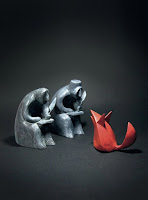
And here the brothers are, taking notes of a story being told to them by a fox.
The bulk of the book consists of 75 images, each shown opposite a paragraph from the story they illustrate (taken from the Jack Zipes translation).
They are brilliant little encapsulations of the stories, which bring a new vividness to familiar stories - as here where a man is about to murder his brother. Somehow this image reminded me that this is a terrible crime and not just one of those things which happen in fairy stories.

There are several more images from the book here.
Of the 75 fairytales, there are of course many that I knew, but plenty of others too - such as ‘the boy who left home to find out about fear’ - The boy went to the gallows, sat down beneath it and waited until evening came. Since he was cold, he made a fire. When the wind knocked the hanged me against each other and they swung back and forth, he thought, They must be freezing up there, I’d better bring them all down to sit by the fire. And so he did, one by one, all seven of them. They sat there beside him without saying a word, without moving, and soon enough their trousers caught on fire. ‘Be careful,’ he said. ‘Otherwise I’ll hang you all back up there!’
There is a short summary of each fairytale in an annex, but really the aim is to encourage the reader to go off and find the full fairytale to read for themselves.
This rather lovely book is a collection of photographs of small sculptures made by the comic book artist Shaun Tan. They are, as the subtitle of the book says, "Art inspired by Grimm's fairy tales".
And here the brothers are, taking notes of a story being told to them by a fox.
The bulk of the book consists of 75 images, each shown opposite a paragraph from the story they illustrate (taken from the Jack Zipes translation).
They are brilliant little encapsulations of the stories, which bring a new vividness to familiar stories - as here where a man is about to murder his brother. Somehow this image reminded me that this is a terrible crime and not just one of those things which happen in fairy stories.

There are several more images from the book here.
Of the 75 fairytales, there are of course many that I knew, but plenty of others too - such as ‘the boy who left home to find out about fear’ - The boy went to the gallows, sat down beneath it and waited until evening came. Since he was cold, he made a fire. When the wind knocked the hanged me against each other and they swung back and forth, he thought, They must be freezing up there, I’d better bring them all down to sit by the fire. And so he did, one by one, all seven of them. They sat there beside him without saying a word, without moving, and soon enough their trousers caught on fire. ‘Be careful,’ he said. ‘Otherwise I’ll hang you all back up there!’
There is a short summary of each fairytale in an annex, but really the aim is to encourage the reader to go off and find the full fairytale to read for themselves.
63LolaWalser
>62 wandering_star:
Gorgeous. Tan is really special.
>59 wandering_star:
An Actor’s Revenge (1963)
Great movie! It's actually a remake of a 1935 version, and the story was also much played on stage. Here's the kicker--it's the same star in the 1935 as in the 1963 film.
Gorgeous. Tan is really special.
>59 wandering_star:
An Actor’s Revenge (1963)
Great movie! It's actually a remake of a 1935 version, and the story was also much played on stage. Here's the kicker--it's the same star in the 1935 as in the 1963 film.
64labfs39
>62 wandering_star: What a fascinating find. Beautiful in their simplicity.
65DieFledermaus
>62 wandering_star: - Wonderful images. I can see that being a fun exhibit somewhere.
66lisapeet
>62 wandering_star: Those are fantastic. He's got such an eye for form, in those and his illustrations.
67ELiz_M
>61 stretch: Have you read The World Without Us? I believe it's the book version of this post. :)
68rhian_of_oz
>62 wandering_star: I don't commonly buy 'picture books' but this was so beautiful I couldn't resist.
69arubabookwoman
>62 wandering_star: Those are beautiful sculptures. I'm wondering if it says anywhere what materials were used? In the photos they look like stone. I too don't usually buy picture books, but I am really tempted.
70wandering_star
>63 LolaWalser: I imagine that in the earlier film, it was a little more credible that all the women fell desperately in love with him on first sight...?
>69 arubabookwoman: The sculptures are between 6cm and 40cm in height and mostly made from papier-mâché and clay. When I started this book I thought I would probably read through it and then pass it on, as I often do with 'picture books', but quite soon I knew I wanted to keep it!
>69 arubabookwoman: The sculptures are between 6cm and 40cm in height and mostly made from papier-mâché and clay. When I started this book I thought I would probably read through it and then pass it on, as I often do with 'picture books', but quite soon I knew I wanted to keep it!
71LolaWalser
>70 wandering_star:
Heh, wasn't that something! I have a dim recollection of reading that some legendary historical onnagatas were having groupies and whatnot but it's a little startling to take in. Lots of gender-bender, queer studies type of questions to be sure. I'm still looking for the old film, I've only seen bits here and there. But you get to see the actor without the kabuki makeup in the double role of the thief! The tomboyish girl-thief even makes a joke that he looks like the actor enough for her to transfer her affections. :)
Heh, wasn't that something! I have a dim recollection of reading that some legendary historical onnagatas were having groupies and whatnot but it's a little startling to take in. Lots of gender-bender, queer studies type of questions to be sure. I'm still looking for the old film, I've only seen bits here and there. But you get to see the actor without the kabuki makeup in the double role of the thief! The tomboyish girl-thief even makes a joke that he looks like the actor enough for her to transfer her affections. :)
73wandering_star
>71 LolaWalser: Fascinating. Not quite the same thing, but I was interested to learn from Geisha in Rivalry that it was quite common for geisha to have a similar sort of relationship with an actor that their patrons had with the geisha.
74wandering_star
And now, two books in a row which retell old stories from a woman's point of view.
6. My Dark Vanessa by Kate Elizabeth Russell
My Dark Vanessa is not a retelling of Lolita, but Vanessa's English teacher does lend her Lolita when she is 15. In the present day, the adult Vanessa still believes that she made her own choices freely, until #metoo, and another former pupil accusing Mr Strane of abuse, cause her to reexamine her memories.
As she does so, we the readers can see every step in the emotional manipulation - the grooming - with which Strane pulls her in, playing off her desire to appear sophisticated, making her believe that this is a great love for the ages, telling her that she has the power and he is the one at risk. But the teenage Vanessa can't see through this, and the story also makes us understand how she believes she was complicit in the abuse, and later blames herself for inviting it.
Vanessa is also hyper alert to any pop culture references which validate the idea of an older man's attraction to a teenage girl, reminding us in passing how many there are.
This book felt long to me, although that might be partly because the subject matter made it tough to read - I can't think of anything in particular I would have cut. A well-told but enraging story.
He says, “That reminded me of you.” Then he reaches behind me and tugs on my ponytail.
I stare at the book as though I’m studying the poem, but the stanzas blur to black smears on a yellow page. I don’t know what I’m supposed to do in response. It feels like I should laugh. I wonder if this is flirting, but it can’t be. Flirting is supposed to be fun and this is too heavy for fun.
In a quiet voice, Mr. Strane asks, “Is it ok that it reminded me of you?”
I lick my lips, lift my shoulders. “Sure.”
“Because the last thing I want is to overstep.”
Overstep. I’m not sure what he means by that, either, but the way he gazes down at me stops me from asking any questions. He suddenly seems both embarrassed and hopeful, like if I told him this wasn’t ok, he might start to cry.
6. My Dark Vanessa by Kate Elizabeth Russell
My Dark Vanessa is not a retelling of Lolita, but Vanessa's English teacher does lend her Lolita when she is 15. In the present day, the adult Vanessa still believes that she made her own choices freely, until #metoo, and another former pupil accusing Mr Strane of abuse, cause her to reexamine her memories.
As she does so, we the readers can see every step in the emotional manipulation - the grooming - with which Strane pulls her in, playing off her desire to appear sophisticated, making her believe that this is a great love for the ages, telling her that she has the power and he is the one at risk. But the teenage Vanessa can't see through this, and the story also makes us understand how she believes she was complicit in the abuse, and later blames herself for inviting it.
Vanessa is also hyper alert to any pop culture references which validate the idea of an older man's attraction to a teenage girl, reminding us in passing how many there are.
This book felt long to me, although that might be partly because the subject matter made it tough to read - I can't think of anything in particular I would have cut. A well-told but enraging story.
He says, “That reminded me of you.” Then he reaches behind me and tugs on my ponytail.
I stare at the book as though I’m studying the poem, but the stanzas blur to black smears on a yellow page. I don’t know what I’m supposed to do in response. It feels like I should laugh. I wonder if this is flirting, but it can’t be. Flirting is supposed to be fun and this is too heavy for fun.
In a quiet voice, Mr. Strane asks, “Is it ok that it reminded me of you?”
I lick my lips, lift my shoulders. “Sure.”
“Because the last thing I want is to overstep.”
Overstep. I’m not sure what he means by that, either, but the way he gazes down at me stops me from asking any questions. He suddenly seems both embarrassed and hopeful, like if I told him this wasn’t ok, he might start to cry.
75wandering_star
7. The Mere Wife by Maria Dahvana Headley
Now this is a retelling of Beowulf, but the feast in the mead hall is a gated community at Christmas, and Grendel's mother is a homeless veteran of brutal foreign wars.
She lives on the mountain and tries to stay away from all the dangers posed by humankind; but she can't teach her young son to be scared of the bright lights and shiny things he sees through the windows of the houses down below. Gren starts to sneak out, and befriends a boy his age living in that antiseptic, appearances-obsessed community.
The story is told through multiple viewpoints - Grendel's mother, Willa (the other little boy's mother), the police officer that Willa calls in, as well as collective voices - the ghosts of the mountain, the police dogs, the phalanx of mothers who maintain the social order in the town (and who have some of the best lines). Everyone is at the centre of their own heroic narrative, and so we can understand the motivation for each step which takes the story towards tragedy.
I love the writing in this book, vivid and compact and sharp, but with rhythms that echo the fable it comes from. It works as a story on its own but because it is Beowulf it's also about the whole history of the way settled communities create monsters, to control those inside the community as much as inspiring fear of those outside.
A phenomenal read.
I sharpen my blades on all of it, everything I can find, until my knife and sword could kill someone without them even noticing they were dying.
The whole time I’m doing it, I’m wondering who I’m planning to protect. Myself? Him? Someone else entirely?
Keep them sharp, I think, because at least I can do that thing. The world is the world and my child wants it. The world is the world and my child will go into it, whether I like it or not. He doesn’t have any magic. I don’t have any either. I have metal. I have to think it’s something, even if it’s not enough.
PS. I forgot to mention that Headley has also published a translation of Beowulf.
Now this is a retelling of Beowulf, but the feast in the mead hall is a gated community at Christmas, and Grendel's mother is a homeless veteran of brutal foreign wars.
She lives on the mountain and tries to stay away from all the dangers posed by humankind; but she can't teach her young son to be scared of the bright lights and shiny things he sees through the windows of the houses down below. Gren starts to sneak out, and befriends a boy his age living in that antiseptic, appearances-obsessed community.
The story is told through multiple viewpoints - Grendel's mother, Willa (the other little boy's mother), the police officer that Willa calls in, as well as collective voices - the ghosts of the mountain, the police dogs, the phalanx of mothers who maintain the social order in the town (and who have some of the best lines). Everyone is at the centre of their own heroic narrative, and so we can understand the motivation for each step which takes the story towards tragedy.
I love the writing in this book, vivid and compact and sharp, but with rhythms that echo the fable it comes from. It works as a story on its own but because it is Beowulf it's also about the whole history of the way settled communities create monsters, to control those inside the community as much as inspiring fear of those outside.
A phenomenal read.
I sharpen my blades on all of it, everything I can find, until my knife and sword could kill someone without them even noticing they were dying.
The whole time I’m doing it, I’m wondering who I’m planning to protect. Myself? Him? Someone else entirely?
Keep them sharp, I think, because at least I can do that thing. The world is the world and my child wants it. The world is the world and my child will go into it, whether I like it or not. He doesn’t have any magic. I don’t have any either. I have metal. I have to think it’s something, even if it’s not enough.
PS. I forgot to mention that Headley has also published a translation of Beowulf.
76labfs39
>74 wandering_star: >75 wandering_star: Those last two both sound very interesting. Nice reviews.
77nancyewhite
>75 wandering_star: Woah. This looks amazing. Added to the wishlist.
78AnnieMod
>75 wandering_star: That sounds wonderful - I can imagine the author trying to translate a particularly hard fragment from the original and allowing their mind to wander into “what if I move that to modern times” scenarios. :)
79lisapeet
>75 wandering_star: Headley did a great panel on translating and updating the classics at the Center for Fiction, with Madeline Miller, (Circe, The Song of Achilles) and Emily Wilson (The Odyssey). Hearing them talk about their choices was really fun and enlightening.
80lilisin
>74 wandering_star:
Definitely an enraging story but so well done. I really enjoyed My Dark Vanessa and wonder if the author will manage to put another book out with as much perfection in story and writing. For some reason I see her struggling to do so.
Definitely an enraging story but so well done. I really enjoyed My Dark Vanessa and wonder if the author will manage to put another book out with as much perfection in story and writing. For some reason I see her struggling to do so.
81Dilara86
The Singing Bones and The Mere Wife are now in my wishlist. Thanks for the reviews!
82Linda92007
>75 wandering_star: I have Seamus Heaney's translation of Beowulf, but have not yet approached reading it seriously. The Mere Wife sounds very interesting. Now I am wondering which to read first - the original or the retelling?
>79 lisapeet: Thanks for posting that link!
>79 lisapeet: Thanks for posting that link!
83dianeham
Grendl by John Gardner is my favorite. A million years ago I saw the book done as a line drawing animated film. Don’t know if that is still around.
Added - The animated film is called Gredl, Grendl, Grendl
https://en.wikipedia.org/wiki/Grendel_Grendel_Grendel
Added - The animated film is called Gredl, Grendl, Grendl
https://en.wikipedia.org/wiki/Grendel_Grendel_Grendel
84avaland
>62 wandering_star: That looks like a terrific book...
>74 wandering_star:, >75 wandering_star: Very interesting....
Soooo hard to believe that some of us are in our 14th year. What a great adventure it turns out to be (and still is!)
>74 wandering_star:, >75 wandering_star: Very interesting....
Soooo hard to believe that some of us are in our 14th year. What a great adventure it turns out to be (and still is!)
85wandering_star
>79 lisapeet: Thank you so much - I watched the video of the discussion on YouTube - fascinating! And it made me realise that there were a lot of details in The Mere Wife which originally came from Beowulf (I have read the Seamus Heaney translation but didn’t remember the ins and outs of the stories.
>80 lilisin: I agree. It seemed from the author’s note that this is a story that she has been wanting to tell/working on for years, so I don’t know what she could follow it up with.
>83 dianeham: That looks like an interesting film!
>84 avaland: I know! I wonder what percentage of my TBR shelves are a direct result of this…
>80 lilisin: I agree. It seemed from the author’s note that this is a story that she has been wanting to tell/working on for years, so I don’t know what she could follow it up with.
>83 dianeham: That looks like an interesting film!
>84 avaland: I know! I wonder what percentage of my TBR shelves are a direct result of this…
86avaland
I was just in Club Read 2009 (the first) and note that you joined November 21, 2008 (during the "seeding" period) and you were the 10th member. This might not be exact, as some members have removed themselves (not everyone wants to see all CR 13 years listed, I suppose)
87MissBrangwen
>75 wandering_star: Fascinating quote from the novel, it goes straight to my wish list!
88qebo
>53 wandering_star: 'Orbis Spike'
New to me too.
New to me too.
89wandering_star
8. The Hollow Man by Oliver Harris
Detective Nick Belsey is a man circling the drain. His drinking and gambling habits have left him penniless, and he's been kicked out of the place he was living. When he is called in on a missing person case, which turns out to be a suicide - of Alexei Devereux, a very wealthy individual with, it seems, no close connections in the UK - he starts staying the night in Devereux's house instead of sleeping rough as he had been. He gets the idea that maybe he can solve his money problems by getting hold of some of Devereux's assets - yes that's right, he is planning to steal from a dead man - but as he looks into the possibility, he discovers all sorts of anomalies, and it soon turns out that things are not as they seem.
Honestly, this is a very good thriller. It's well written, with some nice sharp observations about London; it's satisfyingly twisty but not so much so that it lost me; and it's properly thrilling (if slightly on the ludicrous end of things). But I got a bit stuck on rooting for Belsey. I don't know why - the troubled detective who takes short cuts and annoys the higher-ups but whose heart is devoted to justice, and who gets results, is such a common character in crime fiction - but maybe here it was taken to such extremes that you realise what a problematic idea it is? Or maybe it's just that in 2022 police corruption just isn't funny.
So I feel about this book a bit how I feel about the film La La Land - it's a brilliant film except for the fact that the Ryan Gosling character is clearly a complete tosser. But that's quite a big bit of the film...
The White Hart was one of those ancient, low-ceilinged pubs tucked into the fissures of the city like a parasite attached to its wealth. Workmen and suits drifted in and out of the pub’s dark corners, lying into their phones, having swift pints and office affairs. City of hiding places, Belsey thought.
Detective Nick Belsey is a man circling the drain. His drinking and gambling habits have left him penniless, and he's been kicked out of the place he was living. When he is called in on a missing person case, which turns out to be a suicide - of Alexei Devereux, a very wealthy individual with, it seems, no close connections in the UK - he starts staying the night in Devereux's house instead of sleeping rough as he had been. He gets the idea that maybe he can solve his money problems by getting hold of some of Devereux's assets - yes that's right, he is planning to steal from a dead man - but as he looks into the possibility, he discovers all sorts of anomalies, and it soon turns out that things are not as they seem.
Honestly, this is a very good thriller. It's well written, with some nice sharp observations about London; it's satisfyingly twisty but not so much so that it lost me; and it's properly thrilling (if slightly on the ludicrous end of things). But I got a bit stuck on rooting for Belsey. I don't know why - the troubled detective who takes short cuts and annoys the higher-ups but whose heart is devoted to justice, and who gets results, is such a common character in crime fiction - but maybe here it was taken to such extremes that you realise what a problematic idea it is? Or maybe it's just that in 2022 police corruption just isn't funny.
So I feel about this book a bit how I feel about the film La La Land - it's a brilliant film except for the fact that the Ryan Gosling character is clearly a complete tosser. But that's quite a big bit of the film...
The White Hart was one of those ancient, low-ceilinged pubs tucked into the fissures of the city like a parasite attached to its wealth. Workmen and suits drifted in and out of the pub’s dark corners, lying into their phones, having swift pints and office affairs. City of hiding places, Belsey thought.
90arubabookwoman
>89 wandering_star: I read that one a few years ago and really enjoyed it. I was enough taken with the main character to purchase the second book in the series, but a few years later I still haven't gotten to it.
91AnnieMod
>89 wandering_star: That's what I need - a new series...
92wandering_star
9. An Education by Lynn Barber
I was interested in reading this because of the excellent film, which was inspired by the true story of how sixteen-year old Lynn Barber ended up dating a conman in his late thirties, and stranger still, how her conservative parents not only did not oppose the relationship but ended up almost more charmed by him than she was.
This story takes up one chapter of this memoir - it turns out that Barber first of all wrote a piece in, I think, Granta, which was picked up and turned into the film and was also the reason she was offered a contract to write a memoir.
It is a great chapter - with some interesting echoes of My Dark Vanessa such as the young Barber's desire to be seen as sophisticated.
Simon was adept at not answering questions, but actually he rarely needed to, because I never asked them… Asking questions showed that you were naive and bourgeois; not asking questions showed that you were sophisticated and French. I badly wanted to be sophisticated. And, as it happened, this suited Simon fine.
But then life moves on. The thing Barber is most famous for - interviewing - takes up another chapter later on, and it doesn't have any interesting gossip about her interviewees and only a couple of tips about interviewing. (An early stint doing a weekly short interview with a limited format “taught me always to listen for the differences between people rather than the similarities, and to cherish their idiosyncracies of speech”.)
This is a short book (only 8 chapters) but a lumpy one, not least because of Barber's brisk, no-nonsense approach to her story. It's the things that have stuck in her mind over the course of fifty years, not the things which someone else might be expected to be interested in.
The same goes for the opinions expressed in the book. Barber works out her views for herself rather than following anyone's conventional wisdom and I don't think anyone would read this book without disagreeing with a single line of it.
All this somehow comes together to make the chapter about her beloved husband's illness and death unexpectedly moving. Barber is very honest about her guilt and regrets, particularly the questions she wished she had asked the doctors, and the way that his illness got in the way of them remembering how much they cared about each other, in the final weeks.
Barber's eye for the telling detail also comes through in her descriptions of the hospital bureaucracy so that I could really imagine what it felt like to be there, a tiny cog in a big machine which you don't understand, as decisions which will affect the rest of your life are made and partially communicated to you.
I was interested in reading this because of the excellent film, which was inspired by the true story of how sixteen-year old Lynn Barber ended up dating a conman in his late thirties, and stranger still, how her conservative parents not only did not oppose the relationship but ended up almost more charmed by him than she was.
This story takes up one chapter of this memoir - it turns out that Barber first of all wrote a piece in, I think, Granta, which was picked up and turned into the film and was also the reason she was offered a contract to write a memoir.
It is a great chapter - with some interesting echoes of My Dark Vanessa such as the young Barber's desire to be seen as sophisticated.
Simon was adept at not answering questions, but actually he rarely needed to, because I never asked them… Asking questions showed that you were naive and bourgeois; not asking questions showed that you were sophisticated and French. I badly wanted to be sophisticated. And, as it happened, this suited Simon fine.
But then life moves on. The thing Barber is most famous for - interviewing - takes up another chapter later on, and it doesn't have any interesting gossip about her interviewees and only a couple of tips about interviewing. (An early stint doing a weekly short interview with a limited format “taught me always to listen for the differences between people rather than the similarities, and to cherish their idiosyncracies of speech”.)
This is a short book (only 8 chapters) but a lumpy one, not least because of Barber's brisk, no-nonsense approach to her story. It's the things that have stuck in her mind over the course of fifty years, not the things which someone else might be expected to be interested in.
The same goes for the opinions expressed in the book. Barber works out her views for herself rather than following anyone's conventional wisdom and I don't think anyone would read this book without disagreeing with a single line of it.
All this somehow comes together to make the chapter about her beloved husband's illness and death unexpectedly moving. Barber is very honest about her guilt and regrets, particularly the questions she wished she had asked the doctors, and the way that his illness got in the way of them remembering how much they cared about each other, in the final weeks.
Barber's eye for the telling detail also comes through in her descriptions of the hospital bureaucracy so that I could really imagine what it felt like to be there, a tiny cog in a big machine which you don't understand, as decisions which will affect the rest of your life are made and partially communicated to you.
93avaland
>87 MissBrangwen: I read that Oliver Harris novel in 2017 and seemed to have liked it, I read a 2nd. Gave both 4 stars; however, I never read any more. Fun for a few installments but I didn't want a steady diet of it. Deborah and my reviews were the first two.
94dchaikin
>92 wandering_star: I enjoyed this review, which left me curious about the movie. Cool that a Granta entry led to the movie.
95wandering_star
10. A Conspiracy in Belgravia by Sherry Thomas
I have got myself into a situation where I have several big non-fiction tomes on the go, all very interesting but not relaxing reading! So I turned to this for a palate cleanser. It's the second book in the "Lady Sherlock" series, which imagines that Holmes is a young woman, with the same powers of observation.
It's not easy to summarise the plot as it very quickly becomes convoluted, but here goes. Two men know Charlotte Holmes' secret - a pair of aristocratic brothers. She is in love with one (Lord Ingram) and being courted by the other (Lord Bancroft). When Lady Ingram writes to "Sherlock Holmes" for help with a personal matter, not knowing the true story of "his" connection with her family, Charlotte cannot resist taking the case. At the same time, as part of his courtship Lord Bancroft is giving Charlotte various puzzles for her to crack. She follows one to a location where it turns out a man has recently been murdered.
These are fun reads. I am fond of adventuring Victorian ladies with anachronistic attitudes, and who doesn’t like Sherlock Holmes-inspired stories?
“And while I’m frequently surprised, I’m not usually shocked.” Now Penelope was curious. She had no idea Miss Holmes could be shocked. “So what does shock you?” Miss Holmes thought for a moment. “I’m surprised when people are not me. I’m shocked when they are not them.” “You mean, we are so much who we are that it’s staggering when we do something truly out of character.”
I have got myself into a situation where I have several big non-fiction tomes on the go, all very interesting but not relaxing reading! So I turned to this for a palate cleanser. It's the second book in the "Lady Sherlock" series, which imagines that Holmes is a young woman, with the same powers of observation.
It's not easy to summarise the plot as it very quickly becomes convoluted, but here goes. Two men know Charlotte Holmes' secret - a pair of aristocratic brothers. She is in love with one (Lord Ingram) and being courted by the other (Lord Bancroft). When Lady Ingram writes to "Sherlock Holmes" for help with a personal matter, not knowing the true story of "his" connection with her family, Charlotte cannot resist taking the case. At the same time, as part of his courtship Lord Bancroft is giving Charlotte various puzzles for her to crack. She follows one to a location where it turns out a man has recently been murdered.
These are fun reads. I am fond of adventuring Victorian ladies with anachronistic attitudes, and who doesn’t like Sherlock Holmes-inspired stories?
“And while I’m frequently surprised, I’m not usually shocked.” Now Penelope was curious. She had no idea Miss Holmes could be shocked. “So what does shock you?” Miss Holmes thought for a moment. “I’m surprised when people are not me. I’m shocked when they are not them.” “You mean, we are so much who we are that it’s staggering when we do something truly out of character.”
96rhian_of_oz
>95 wandering_star: Thanks for the BB! You may also enjoy Deanna Raybourn's Veronica Speedwell series.
97DieFledermaus
>74 wandering_star:, >75 wandering_star: - Tempting reviews, although My Dark Vanessa sounds like it would be hard to stomach. A Conspiracy in Belgravia sounds like a lot of fun though!
98wandering_star
>96 rhian_of_oz: oh those look fun!
99wandering_star
11. Istanbul by Orhan Pamuk
A mix of memoir about Pamuk's childhood and early adulthood growing up in Istanbul, with essays about how the city has been interpreted and depicted by its residents and visitors. I have never got on very well with Pamuk's fiction but found this quite charming and evocative, and it’s fun to imagine the young Pamuk sticking up his hand for every question in class and getting them all wrong, or staring at the clouds out of the schoolroom window and disappearing into a daydream.
I listened to this on audiobook, which I think helped me to try and imagine the scenes before me - but when I looked for a particular bit of text to quote, I discovered that the physical book has many photos of Istanbul, which I am sorry to have missed.
I am speaking of the evenings when the sun sets early, of the fathers under the street lamps in the back streets returning home carrying plastic bags. Of the old Bosphorus ferries, moored to deserted stations in the middle of winter, where sleepy sailors scrub the decks, a pail in their hand and one eye on the black-and-white television in the distance; of the old booksellers who lurch from one financial crisis to the next and then wait shivering all day for a customer to appear; of the barbers who complain that men don't shave as much after an economic crisis; of the children who play ball between the cars on cobblestone streets; of the covered women who stand at remote bus stops clutching plastic shopping bags and speaking to no one as they wait for the bus that never arrives; of the empty boathouses of the old Bosphorus villas; of the tea houses packed to the rafters with unemployed men; of the patient pimps striding up and down the city's greatest square on summer evenings in search of one last drunken tourist; the crowds rushing to catch ferries on winter evenings; of the wooden buildings whose every board creaked even when they were pashas’ mansions, and all the more now that they have become municipal headquarters; of the women peeking through the curtains as they wait for husbands who never manage to come home until late at night…
A mix of memoir about Pamuk's childhood and early adulthood growing up in Istanbul, with essays about how the city has been interpreted and depicted by its residents and visitors. I have never got on very well with Pamuk's fiction but found this quite charming and evocative, and it’s fun to imagine the young Pamuk sticking up his hand for every question in class and getting them all wrong, or staring at the clouds out of the schoolroom window and disappearing into a daydream.
I listened to this on audiobook, which I think helped me to try and imagine the scenes before me - but when I looked for a particular bit of text to quote, I discovered that the physical book has many photos of Istanbul, which I am sorry to have missed.
I am speaking of the evenings when the sun sets early, of the fathers under the street lamps in the back streets returning home carrying plastic bags. Of the old Bosphorus ferries, moored to deserted stations in the middle of winter, where sleepy sailors scrub the decks, a pail in their hand and one eye on the black-and-white television in the distance; of the old booksellers who lurch from one financial crisis to the next and then wait shivering all day for a customer to appear; of the barbers who complain that men don't shave as much after an economic crisis; of the children who play ball between the cars on cobblestone streets; of the covered women who stand at remote bus stops clutching plastic shopping bags and speaking to no one as they wait for the bus that never arrives; of the empty boathouses of the old Bosphorus villas; of the tea houses packed to the rafters with unemployed men; of the patient pimps striding up and down the city's greatest square on summer evenings in search of one last drunken tourist; the crowds rushing to catch ferries on winter evenings; of the wooden buildings whose every board creaked even when they were pashas’ mansions, and all the more now that they have become municipal headquarters; of the women peeking through the curtains as they wait for husbands who never manage to come home until late at night…
100wandering_star
12. Are You My Mother? by Alison Bechdel
Fun Home, Bechdel's first memoir, was about her growing up and coming out and also about her father, who turned out to be gay, too, but closeted, and who died in a car accident which may have been a suicide. As you can tell from the title, this volume is about her relationship with her mother - and her reaction to the writing and publication of Fun Home - but it is also about Bechdel's search for a mother figure and the work of a particular psychiatrist that Bechdel is interested in, specifically his theory (which seems to me rather dated) about mother-daughter relationships.
I think Bechdel's mother is summed up particularly well in one episode - in which Bechdel sends her a memoir fragment where she recalls the time when her mother stopped kissing her goodnight, and the impact this had on her. Her mother sends it back, five months later, covered in margin notes - every single one of which turns out to be about her writing style.
So perhaps it’s no wonder that Bechdel spends so much time seeking out alternative mother figures. This book was thought-provoking in places but not as good a read as Fun Home. It's more episodic, because not just about Bechdel's childhood; and I was not particularly absorbed by the sections on the psychiatrist Winnicott.
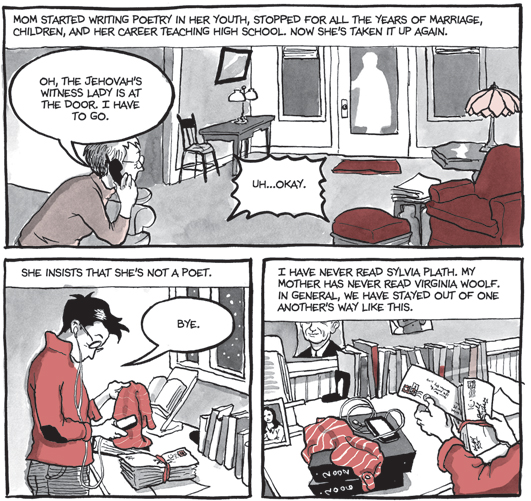
Fun Home, Bechdel's first memoir, was about her growing up and coming out and also about her father, who turned out to be gay, too, but closeted, and who died in a car accident which may have been a suicide. As you can tell from the title, this volume is about her relationship with her mother - and her reaction to the writing and publication of Fun Home - but it is also about Bechdel's search for a mother figure and the work of a particular psychiatrist that Bechdel is interested in, specifically his theory (which seems to me rather dated) about mother-daughter relationships.
I think Bechdel's mother is summed up particularly well in one episode - in which Bechdel sends her a memoir fragment where she recalls the time when her mother stopped kissing her goodnight, and the impact this had on her. Her mother sends it back, five months later, covered in margin notes - every single one of which turns out to be about her writing style.
So perhaps it’s no wonder that Bechdel spends so much time seeking out alternative mother figures. This book was thought-provoking in places but not as good a read as Fun Home. It's more episodic, because not just about Bechdel's childhood; and I was not particularly absorbed by the sections on the psychiatrist Winnicott.
101wandering_star
13. Vital Signs by Tessa McWatt
A book in which a man deals with his wife’s aneurysm-induced aphasia, not by thinking sympathetically about what she might be going through, but by agonising at great length about whether he should tell her about the affair he had. FFS.
Fortunately it was short.
“Sweet keys of sun in the dusk of the toaster,” Anna said one morning at breakfast. I looked up at her, briefly, but made nothing of it, distracted as I was with the morning paper. The day continued quietly as we went about our routines, and other things she said didn’t cause concern. But in the afternoon, as she came in from the garden and wiped her shoes on the mat, she said, without looking up, “Fissures on the hummingbird’s feet.” Although I reasoned with myself that she might be puzzling something out, I felt a quiet alarm.
A book in which a man deals with his wife’s aneurysm-induced aphasia, not by thinking sympathetically about what she might be going through, but by agonising at great length about whether he should tell her about the affair he had. FFS.
Fortunately it was short.
“Sweet keys of sun in the dusk of the toaster,” Anna said one morning at breakfast. I looked up at her, briefly, but made nothing of it, distracted as I was with the morning paper. The day continued quietly as we went about our routines, and other things she said didn’t cause concern. But in the afternoon, as she came in from the garden and wiped her shoes on the mat, she said, without looking up, “Fissures on the hummingbird’s feet.” Although I reasoned with myself that she might be puzzling something out, I felt a quiet alarm.
102wandering_star
Of the 13 books read in Jan, 9 came from my shelves - six of those were acquired last year, and the remaining three in 2020, 2019 and 2015 respectively. It's interesting that the newest books in the backlog always seem the most appealing...
103AnnieMod
>102 wandering_star: Well, the newest is the closest to where you are with your reading these days (people change, tastes change and interests move around after all) so no surprise that it is the most appealing. :)
104raidergirl3
>99 wandering_star: I read Istanbul around 15 years ago, after visiting Turkey on a Mediterranean cruise. I was so impressed, and the memory of the book stuck with me. Very melancholy but what a sense of the city and Turkish life. I still haven’t tried any Pamuk fiction, but I did read a second book of essays by him. Not the same impact. Glad you enjoyed Istanbul too.
105ursula
>99 wandering_star: I know I won't get to rereading this till later this year, but it really makes me want to!
>101 wandering_star: This review made me laugh and laugh. Ruefully. FFS, indeed.
>101 wandering_star: This review made me laugh and laugh. Ruefully. FFS, indeed.
106labfs39
>101 wandering_star: Although I would love to read the parts about aphasia (I had a period of time when I had mild aphasia because of a medication I had to take, my daughter still talks about funny things I said), I am not at all interested in the husband's issues.
107rhian_of_oz
>101 wandering_star: LOL. Thanks for taking one for the team.
109dchaikin
>99 wandering_star: Makes me feel I need to go right now and read Istanbul. Why would I “need” to is not the issue. Anyway, enjoyed your review
>100 wandering_star: Bechdel must have had a tough childhood
>100 wandering_star: Bechdel must have had a tough childhood
110wandering_star
>103 AnnieMod: very true, and a useful thing to remember when I am clearing my shelves (and cupboards!). I already know to watch out for purchases made for an imaginary future me. Good to also consider things which were for no-longer-me...
111wandering_star
More films.
After the Storm (2016)
Directed by Hirokazu Kore-eda, who is becoming one of my favourite directors. I have seen Shoplifters, Afterlife, Like Father Like Son, My Little Sister. Kore-eda is interested in families, particularly fatherhood, and in the lives of the less advantaged in a shiny consumerist culture. Shoplifters is about a loose, non-biological family of people living not quite on the right side of the law - it is great (but also has one of the saddest endings I have ever seen). Like Father Like Son is about two families at opposite ends of the social spectrum who discover that their sons were accidentally switched at birth.
The story of After the Storm is a bit more low-key than these. Our main character, Ryota, wrote an award-winning novel 15 years ago and hasn’t written much since. He is now working for a low-rent detective agency, mostly following people to see if they are having affairs (and then shaking down those people with an offer to destroy the evidence). In his spare time he loses money betting on keirin bicycle racing, and practices his surveillance techniques on his ex-wife and their son, grumbling about the wealthy boyfriend she is seeing.
I enjoyed watching this but when I thought back on it I found some things I didn't like and so it is my least favourite of the Kore-eda films I have seen so far. In particular I found the ending a bit manipulative. What I mean by this isthat Ryota actually does some incredibly sleazy things during the film, so in retrospect I didn't believe the epiphany he experiences at the end, even though I was carried along with it while actually watching the film.
Drive My Car (2021)
Based on a short story by Haruki Murakami. Before I watched the film I wondered how it was possible to spin out a short story into a three-hour film. After watching it I wondered how it would be possible to put as much into a short story as this film contains.
The story centers on Kafuku, an avant garde theatre director, and his production of Uncle Vanya. He casts in the title role a young actor whom he suspects was having an affair with his wife up to the time that she died - a TV star at a loose end who was kicked out from his agency after a sex scandal. The role has a special significance for Kafuku - he was in rehearsals to play Vanya when his wife did, but found the role brought up so much emotion for him that he was unable to go on. During the production Kafuku also comes to know a young woman with pain and grief of her own in her past.
The themes of the film are about dealing with grief and guilt and learning to go on, and the ability of art and stories to cross the incomprehensible gulfs between people.
I would particularly highlight one incredible actress who plays a deaf person, cast as Sonya in the play (I don't know if the actress is deaf) and acts entirely in sign language - she was so compelling to watch.
It is certainly a slow burner - the credits don't roll until 40 minutes into the film, and I think everything that happens up to that point is probably back-story in the original source - but it really carried me away. In the notes I made right after watching it, I said "I thought this was excellent, but am curious to know if it has gone down as well in cultures less emotionally repressed than Japan or the UK". I guess the Oscar nominations answer that question...
I am quite glad I read and watched Uncle Vanya last year - I don’t think you need to know the play to appreciate the film but it adds layers.
One niche point - I have been learning Japanese for the last two years and mostly find that I can’t understand dialogue in films/TV shows because the type of Japanese that people speak with friends and families is so different from the type you speak with people you don’t know. In this film there are almost no scenes of people speaking with friends and family so I was delighted to be able to understand much more than usual!
Water Lilies (2007)
I loved Portrait of a Woman on Fire so much that I have been seeking out other films by the director, Céline Sciamma. This was her first feature (which I remember hearing about at the time). It is about a teenager, Marie, and her friendship with two other girls, gawky Anne who is desperate for boys' attention, and Floriane who looks like a woman and gets treated that way by the young men and teenage boys in the film.
I remember reading somewhere that one of the difficult things about being a teenage girl is that other people respond to you based on how you look in a way which has no relationship to your actual emotional maturity or how you feel inside. That’s where the girls in this film are - and some of them certainly feel that they need to push themselves to behave in the way that they are perceived, to fit in.
I would rate this film about the same as Girlhood, the other Sciamma film which I have watched - interesting, but not at the level of Portrait of a Woman on Fire. I have My Life as a Courgette (which she wrote but didn’t direct) cued up on my Mubi watchlist, and am keen to see her latest film, Petite Maman.
After the Storm (2016)
Directed by Hirokazu Kore-eda, who is becoming one of my favourite directors. I have seen Shoplifters, Afterlife, Like Father Like Son, My Little Sister. Kore-eda is interested in families, particularly fatherhood, and in the lives of the less advantaged in a shiny consumerist culture. Shoplifters is about a loose, non-biological family of people living not quite on the right side of the law - it is great (but also has one of the saddest endings I have ever seen). Like Father Like Son is about two families at opposite ends of the social spectrum who discover that their sons were accidentally switched at birth.
The story of After the Storm is a bit more low-key than these. Our main character, Ryota, wrote an award-winning novel 15 years ago and hasn’t written much since. He is now working for a low-rent detective agency, mostly following people to see if they are having affairs (and then shaking down those people with an offer to destroy the evidence). In his spare time he loses money betting on keirin bicycle racing, and practices his surveillance techniques on his ex-wife and their son, grumbling about the wealthy boyfriend she is seeing.
I enjoyed watching this but when I thought back on it I found some things I didn't like and so it is my least favourite of the Kore-eda films I have seen so far. In particular I found the ending a bit manipulative. What I mean by this is
Drive My Car (2021)
Based on a short story by Haruki Murakami. Before I watched the film I wondered how it was possible to spin out a short story into a three-hour film. After watching it I wondered how it would be possible to put as much into a short story as this film contains.
The story centers on Kafuku, an avant garde theatre director, and his production of Uncle Vanya. He casts in the title role a young actor whom he suspects was having an affair with his wife up to the time that she died - a TV star at a loose end who was kicked out from his agency after a sex scandal. The role has a special significance for Kafuku - he was in rehearsals to play Vanya when his wife did, but found the role brought up so much emotion for him that he was unable to go on. During the production Kafuku also comes to know a young woman with pain and grief of her own in her past.
The themes of the film are about dealing with grief and guilt and learning to go on, and the ability of art and stories to cross the incomprehensible gulfs between people.
I would particularly highlight one incredible actress who plays a deaf person, cast as Sonya in the play (I don't know if the actress is deaf) and acts entirely in sign language - she was so compelling to watch.
It is certainly a slow burner - the credits don't roll until 40 minutes into the film, and I think everything that happens up to that point is probably back-story in the original source - but it really carried me away. In the notes I made right after watching it, I said "I thought this was excellent, but am curious to know if it has gone down as well in cultures less emotionally repressed than Japan or the UK". I guess the Oscar nominations answer that question...
I am quite glad I read and watched Uncle Vanya last year - I don’t think you need to know the play to appreciate the film but it adds layers.
One niche point - I have been learning Japanese for the last two years and mostly find that I can’t understand dialogue in films/TV shows because the type of Japanese that people speak with friends and families is so different from the type you speak with people you don’t know. In this film there are almost no scenes of people speaking with friends and family so I was delighted to be able to understand much more than usual!
Water Lilies (2007)
I loved Portrait of a Woman on Fire so much that I have been seeking out other films by the director, Céline Sciamma. This was her first feature (which I remember hearing about at the time). It is about a teenager, Marie, and her friendship with two other girls, gawky Anne who is desperate for boys' attention, and Floriane who looks like a woman and gets treated that way by the young men and teenage boys in the film.
I remember reading somewhere that one of the difficult things about being a teenage girl is that other people respond to you based on how you look in a way which has no relationship to your actual emotional maturity or how you feel inside. That’s where the girls in this film are - and some of them certainly feel that they need to push themselves to behave in the way that they are perceived, to fit in.
I would rate this film about the same as Girlhood, the other Sciamma film which I have watched - interesting, but not at the level of Portrait of a Woman on Fire. I have My Life as a Courgette (which she wrote but didn’t direct) cued up on my Mubi watchlist, and am keen to see her latest film, Petite Maman.
112labfs39
>111 wandering_star: I love your film reviews. They are always interesting, and although I don't know that I'll watch many of them myself, I enjoy reading about them.
113wandering_star
>112 labfs39: Thank you!
114wandering_star
14. The Magician’s Assistant by Ann Patchett
A magician’s assistant was flatly nothing without a magician. There would never be a night when the assistant took the stage alone. “Look how well she holds the hat,” they would say as she stood there, hat in hand, her face one bright smile.
And yet - the magician's assistant has to know the trick, backwards forwards and inside out - and perhaps they have to do something to make the trick work while the magician charms and distracts the audience.
The magician's assistant of the title is Sabine, widowed in the first words of the story when Parsifal dies of a sudden heart attack. It was a white marriage (is that the right term? - I mean that Parsifal was gay) but it was nevertheless a relationship based on love and companionship, which had lasted over 20 years, and so it is a shock to Sabine to discover that he had never told her the truth about his family, and even more surprising that she starts to develop a relationship with his mother and sister after they come to LA, after Parsifal's death.
This book has a baggy, meandering structure, but comes together beautifully. It is about families - the ones we are born into and the ones we choose - and about love and how we show it, or don't show it. A lot of what is done to build a family, and to show love, is invisible, like the hard work of the magician's assistant. And in magic, as in life, what looks hard is different from what is hard.
I really do like Ann Patchett.
A magician’s assistant was flatly nothing without a magician. There would never be a night when the assistant took the stage alone. “Look how well she holds the hat,” they would say as she stood there, hat in hand, her face one bright smile.
And yet - the magician's assistant has to know the trick, backwards forwards and inside out - and perhaps they have to do something to make the trick work while the magician charms and distracts the audience.
The magician's assistant of the title is Sabine, widowed in the first words of the story when Parsifal dies of a sudden heart attack. It was a white marriage (is that the right term? - I mean that Parsifal was gay) but it was nevertheless a relationship based on love and companionship, which had lasted over 20 years, and so it is a shock to Sabine to discover that he had never told her the truth about his family, and even more surprising that she starts to develop a relationship with his mother and sister after they come to LA, after Parsifal's death.
This book has a baggy, meandering structure, but comes together beautifully. It is about families - the ones we are born into and the ones we choose - and about love and how we show it, or don't show it. A lot of what is done to build a family, and to show love, is invisible, like the hard work of the magician's assistant. And in magic, as in life, what looks hard is different from what is hard.
I really do like Ann Patchett.
115wandering_star
15. New Pompeii by Daniel Godfrey
A twist on the "time-travelling historian" trope, the difference being that rather than sending people into the past to observe it, NovusPart© can bring people forward in time, and have rescued the entire population of Pompeii just before the eruption. They are being housed in a reconstruction of the city, and Nick Houghton, a young historian, is asked to join the team. But NovusPart's stated reasons for what they are doing don't quite stack up, there are conspiracy theories swirling around whether the company is linked to a number of disappearances which have happened in the past, and just because the citizens of Pompeii were born a long time ago, it doesn’t mean they are stupid - as one of the young women asks Nick, “Why are the chickens so large, and the carrots orange?”
Pretty good fun to read (although there is a massive plot twist dump towards the end, as if the author realised that there were things that needed explaining before the final denouement) but I doubt this will leave any impact in my memory in a few months' time.
A twist on the "time-travelling historian" trope, the difference being that rather than sending people into the past to observe it, NovusPart© can bring people forward in time, and have rescued the entire population of Pompeii just before the eruption. They are being housed in a reconstruction of the city, and Nick Houghton, a young historian, is asked to join the team. But NovusPart's stated reasons for what they are doing don't quite stack up, there are conspiracy theories swirling around whether the company is linked to a number of disappearances which have happened in the past, and just because the citizens of Pompeii were born a long time ago, it doesn’t mean they are stupid - as one of the young women asks Nick, “Why are the chickens so large, and the carrots orange?”
Pretty good fun to read (although there is a massive plot twist dump towards the end, as if the author realised that there were things that needed explaining before the final denouement) but I doubt this will leave any impact in my memory in a few months' time.
116wandering_star
16. The Masque of the Red Death by Edgar Allen Poe
I downloaded this as an ebook but it turns out to be a short story - and in fact the entire plot can be told in a sentence (I don’t mean the main plot arc but literally everything that happens).In a time of plague, a group of wealthy nobles hole up in a castle and party decadently, but death comes to the party.
It was effectively done - but the main benefit of reading it for me is that a few years ago I went to an immersive production of it at the Battersea Arts Centre and had absolutely no idea what was going on, and now that I have read the story the theatrical event makes sense in retrospect.
I downloaded this as an ebook but it turns out to be a short story - and in fact the entire plot can be told in a sentence (I don’t mean the main plot arc but literally everything that happens).
It was effectively done - but the main benefit of reading it for me is that a few years ago I went to an immersive production of it at the Battersea Arts Centre and had absolutely no idea what was going on, and now that I have read the story the theatrical event makes sense in retrospect.
117dianeham
>114 wandering_star: I’m a Pacthett fan too but this is one I haven’t read. There some early novels I haven’t gotten to.
118labfs39
>114 wandering_star: I had always been put off by the title for some reason, but that sounds interesting.
119DieFledermaus
>116 wandering_star: - I have always wanted to go to one of those immersive productions. I think Sleep No More is still running in NYC, but I heard you have to wear masks and I wasn't sure how well that would work with glasses (and when I used to go to NYC, my evenings would get booked up pretty quickly). How was the Poe production?
Also, I like this piece by Andre Caplet for harp and string quartet based on that story--I saw it live once and it was a lot of fun
https://www.youtube.com/watch?v=sGNx5ytYOHU
Also, I like this piece by Andre Caplet for harp and string quartet based on that story--I saw it live once and it was a lot of fun
https://www.youtube.com/watch?v=sGNx5ytYOHU
120wandering_star
>119 DieFledermaus: Thank you, I like that piece!
The Poe production was the second immersive theatre thing I had been to and suffered in comparison to the first one, I think. The first one was a production of the Orpheus and Eurydice story, and was done in Stanmer Park in Brighton during the Brighton Arts Festival (the park used to be the gardens of a manor house, so more like a nature reserve than a city park). They set the story at the end of WWI so the first scene was like a village fete to welcome back the returning soldiers, including Orpheus. For each scene the audience was taken to a different place in the park - it was really clever how they used the different spaces, and other things such as nightfall! I had never experienced anything like it before and I loved it.
In contrast the Masque of the Red Death didn’t have a clear narrative line - you just wandered in and out of different rooms where things were happening, so I felt like I must be missing a lot. For example I remember walking into one room where people were gambling and a fight broke out, and I was frustrated trying to understand how the fight might fit into the rest of the story. Now that I have read the story I understand that there probably wasn’t a lot of narrative, just atmosphere! My memories of the performance are just confused flashes of images - for example I definitely remember at one point walking through a fireplace into another room. (You did all get taken into one room for the final scene).
I was looking at Sleep No More for a tentative NYC trip we are planning in the spring, but it sounds a bit more like the second experience than the first.
The Poe production was the second immersive theatre thing I had been to and suffered in comparison to the first one, I think. The first one was a production of the Orpheus and Eurydice story, and was done in Stanmer Park in Brighton during the Brighton Arts Festival (the park used to be the gardens of a manor house, so more like a nature reserve than a city park). They set the story at the end of WWI so the first scene was like a village fete to welcome back the returning soldiers, including Orpheus. For each scene the audience was taken to a different place in the park - it was really clever how they used the different spaces, and other things such as nightfall! I had never experienced anything like it before and I loved it.
In contrast the Masque of the Red Death didn’t have a clear narrative line - you just wandered in and out of different rooms where things were happening, so I felt like I must be missing a lot. For example I remember walking into one room where people were gambling and a fight broke out, and I was frustrated trying to understand how the fight might fit into the rest of the story. Now that I have read the story I understand that there probably wasn’t a lot of narrative, just atmosphere! My memories of the performance are just confused flashes of images - for example I definitely remember at one point walking through a fireplace into another room. (You did all get taken into one room for the final scene).
I was looking at Sleep No More for a tentative NYC trip we are planning in the spring, but it sounds a bit more like the second experience than the first.
121lisapeet
>119 DieFledermaus: Sleep No More is still running—I'm not sure how long it'll be up, but you could probably book for spring. Everything in NYC requires a mask at this point, but if you have something with a fitted nose bridge that will tuck under the rims of your glasses you should be fine—I wear glasses for the movies and theater and haven't had any problem with the mask thing.
122wandering_star
When we first meet Emily Fox-Seton, the heroine of 17. The Making of a Marchioness by Frances Hodgson Burnett, she has just got off the bus and is worrying about how to make her outfit last through another season. Skirts had made one of their appalling changes, and as she walked down Regent Street and Bond Street she had stopped at the windows of more than one shop bearing the sign "Ladies' Tailor and Habit-Maker," and had looked at the tautly attired, preternaturally slim models, her large, honest hazel eyes wearing an anxious expression.
It's the very start of the 20th century and Emily is one of those women from a "good" background but no inheritance, who has essentially no way to make a living other than marrying money. She has not succeeded in doing this so is eking out a precarious lifestyle by doing errands for the wealthy. Now you may have guessed from the title - even before the fabulously eligible marquis, Lord Walderhurst, shows up in the story - that Good Things are going to happen for Emily - and so it proves, although that is only the first part of the story.
I really enjoyed the first part of the story, largely because of the character of Lady Maria, Walderhurst's cousin, who is brilliantly acerbic and witty. "It always amuses me to have Walderhurst {at my parties}. The moment a man like that comes into a room the women begin to frisk about and swim and languish, except those who try to get up interesting conversations they think likely to attract his attention." There is also the interesting character of Lady Agatha Slade, a beautiful young woman who has five sisters and is from an aristocratic but desperately poor background - all that the family can scrape together have been spent on her outfits for the season, and if she cannot marry well, there will be no money for her younger sisters to go through the same process.
Unfortunately Emily herself is unbearably sweet-natured and passive, like a lump of uncooked sugary dough, and so once Lady Maria drops out of being a main character in the story, it all gets much more sentimental, so I can’t recommend the rest of the story.
It's the very start of the 20th century and Emily is one of those women from a "good" background but no inheritance, who has essentially no way to make a living other than marrying money. She has not succeeded in doing this so is eking out a precarious lifestyle by doing errands for the wealthy. Now you may have guessed from the title - even before the fabulously eligible marquis, Lord Walderhurst, shows up in the story - that Good Things are going to happen for Emily - and so it proves, although that is only the first part of the story.
I really enjoyed the first part of the story, largely because of the character of Lady Maria, Walderhurst's cousin, who is brilliantly acerbic and witty. "It always amuses me to have Walderhurst {at my parties}. The moment a man like that comes into a room the women begin to frisk about and swim and languish, except those who try to get up interesting conversations they think likely to attract his attention." There is also the interesting character of Lady Agatha Slade, a beautiful young woman who has five sisters and is from an aristocratic but desperately poor background - all that the family can scrape together have been spent on her outfits for the season, and if she cannot marry well, there will be no money for her younger sisters to go through the same process.
Unfortunately Emily herself is unbearably sweet-natured and passive, like a lump of uncooked sugary dough, and so once Lady Maria drops out of being a main character in the story, it all gets much more sentimental, so I can’t recommend the rest of the story.
123wandering_star
18. The Property by Rutu Modan
I first started reading this graphic novel several years ago and put it aside because I found the story too confusing. I have no idea why - it is not confusing at all! This time I breezed through it, with great enjoyment.
In the story a young Israeli woman is travelling to Warsaw with her grandmother. Ostensibly, they are going to see if they can reclaim the family's pre-war property, but it turns out that the grandmother had some secrets from her family, both back in her youth and in the present day, and has other reasons for going back. The two are helped (or hindered) by two men, a young Polish man who runs tours of Jewish Warsaw, and an acquaintance they meet on the plane who seems strangely invested in what they are doing.
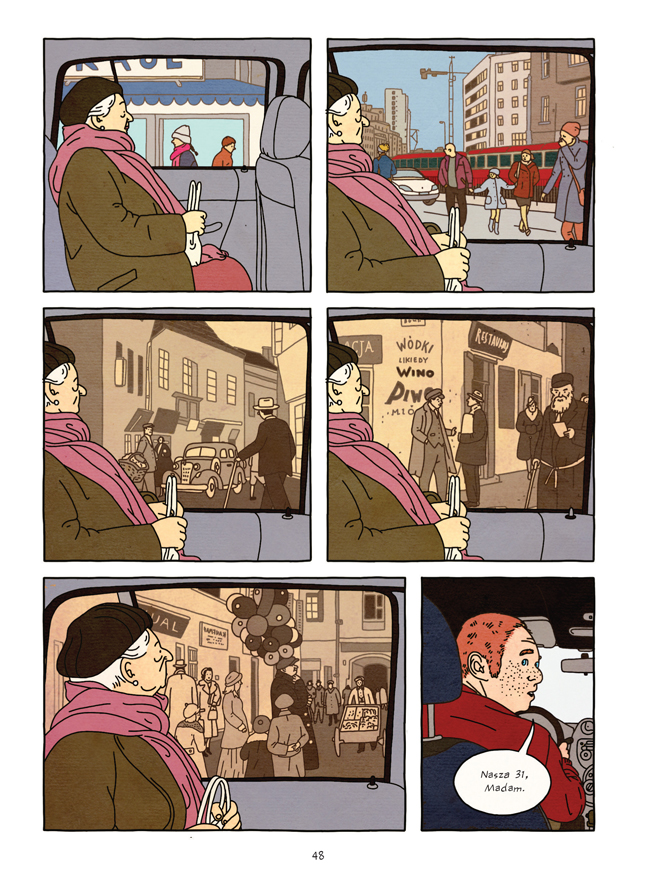
I first started reading this graphic novel several years ago and put it aside because I found the story too confusing. I have no idea why - it is not confusing at all! This time I breezed through it, with great enjoyment.
In the story a young Israeli woman is travelling to Warsaw with her grandmother. Ostensibly, they are going to see if they can reclaim the family's pre-war property, but it turns out that the grandmother had some secrets from her family, both back in her youth and in the present day, and has other reasons for going back. The two are helped (or hindered) by two men, a young Polish man who runs tours of Jewish Warsaw, and an acquaintance they meet on the plane who seems strangely invested in what they are doing.
124SassyLassy
>122 wandering_star: I just reread The Secret Garden, so was wondering about The Making of a Marchioness, but now it doesn't seem as imperative, although you do make at least the first part sound interesting.
125Dilara86
>123 wandering_star: Rutu Modan seems to be having a moment: I also read The Property last week!
126lisapeet
>125 Dilara86: And it's on my wish list thanks to both of you. I like her work a lot, though I've only read short-form pieces and not an entire book.
127dchaikin
Rutu Modan is terrific.
I'm catching up so just catching your post on the immersive theatre, which sounds cool. (Wait, I did a Van Gogh immersion...is kind of fun...is that the same kind of thing? The park thing sounds 1000 times better)
>114 wandering_star: I enjoyed your review of the The Magician’s Assistant. I think by any other author I'm only mildly interesting, but thinking about how Patchett would handle this, it's somehow very appealing.
>115 wandering_star: "NovusPart© can bring people forward in time, and have rescued the entire population of Pompeii just before the eruption. They are being housed in a reconstruction of the city" This seems like such a funny setup to me, like entertaining funny. What you do with all these people, if it really happened?
I'm catching up so just catching your post on the immersive theatre, which sounds cool. (Wait, I did a Van Gogh immersion...is kind of fun...is that the same kind of thing? The park thing sounds 1000 times better)
>114 wandering_star: I enjoyed your review of the The Magician’s Assistant. I think by any other author I'm only mildly interesting, but thinking about how Patchett would handle this, it's somehow very appealing.
>115 wandering_star: "NovusPart© can bring people forward in time, and have rescued the entire population of Pompeii just before the eruption. They are being housed in a reconstruction of the city" This seems like such a funny setup to me, like entertaining funny. What you do with all these people, if it really happened?
128raidergirl3
>114 wandering_star: I finished The Magician's Assistant and I liked it as well. Not much really happened, but it didn't take long to like the family, and want to see what happened in their lives and hope for some happiness for Sabine. I'm just finishing Patchett's essay collection, These Precious Days and it is making me like her all the more. I've got a few more older Patchett's to look forward to this year.
129wandering_star
19. all about love by bell hooks
Given bell hooks' reputation as a trailblazing thinker, this was not really what I expected. I was going to say I was expected something which felt more feminist, but who am I to tell bell hooks what feminism is?! I was certainly expecting something less self-helpy. I don't think I would have bothered finishing it except that I was reading it for my first session in a feminist book group, and I didn’t want to get off to a bad start.
There were definitely some interesting, thought-provoking elements in this, which is essentially a book of essays on the subject of love - but as one of the other participants in the book group said, it was a nugget-y book where you had to plough through quite a lot of repetitive or puzzling parts to get to the insights.
hooks essentially wants to argue that love is the opposite of every bad thing. It is the opposite of individualism, materialism, cynicism; instead it is about building community and interdependence, and overcoming fear through maintaining hope. She argues against the cynicism about love which pervades the modern world, and certainly this part made me examine my own cynicism.
All this is hard to disagree with and I certainly agree that it is good to try and live with compassion, and not let cynicism or fear stop you from doing good. I am less good at recognising my (everyone’s) interdependence with other people, but I can see it is a positive thing to be aware of. I got stuck though when it came to what it actually means to "live with a commitment to a love ethic", as hooks puts it. A lot of the examples seemed to be about prioritising other people’s needs over one’s own - despite the fact that hooks explicitly says this is not what love is about.
It also felt weirdly dated - a couple of times hooks refers to Clinton/Lewinsky and I was jolted into realising that the book was written twenty years later than it felt like. (Some of the others in the book group also found hooks rather sympathetic to Clinton, and unsympathetic to Lewinsky - it didn’t strike me quite like that, but I can see what they meant).
Anyway, we certainly had a good discussion. And when I look back at the quotes which I highlighted on my Kindle, there are some good things there - although perhaps, as I said, a bit self-helpy.
Love does not lead to an end to difficulties, it provides us with the means to cope with our difficulties in ways that enhance our growth.
I think I need to find another bell hooks book to read, which might be more representative of the breadth of her thinking.
Given bell hooks' reputation as a trailblazing thinker, this was not really what I expected. I was going to say I was expected something which felt more feminist, but who am I to tell bell hooks what feminism is?! I was certainly expecting something less self-helpy. I don't think I would have bothered finishing it except that I was reading it for my first session in a feminist book group, and I didn’t want to get off to a bad start.
There were definitely some interesting, thought-provoking elements in this, which is essentially a book of essays on the subject of love - but as one of the other participants in the book group said, it was a nugget-y book where you had to plough through quite a lot of repetitive or puzzling parts to get to the insights.
hooks essentially wants to argue that love is the opposite of every bad thing. It is the opposite of individualism, materialism, cynicism; instead it is about building community and interdependence, and overcoming fear through maintaining hope. She argues against the cynicism about love which pervades the modern world, and certainly this part made me examine my own cynicism.
All this is hard to disagree with and I certainly agree that it is good to try and live with compassion, and not let cynicism or fear stop you from doing good. I am less good at recognising my (everyone’s) interdependence with other people, but I can see it is a positive thing to be aware of. I got stuck though when it came to what it actually means to "live with a commitment to a love ethic", as hooks puts it. A lot of the examples seemed to be about prioritising other people’s needs over one’s own - despite the fact that hooks explicitly says this is not what love is about.
It also felt weirdly dated - a couple of times hooks refers to Clinton/Lewinsky and I was jolted into realising that the book was written twenty years later than it felt like. (Some of the others in the book group also found hooks rather sympathetic to Clinton, and unsympathetic to Lewinsky - it didn’t strike me quite like that, but I can see what they meant).
Anyway, we certainly had a good discussion. And when I look back at the quotes which I highlighted on my Kindle, there are some good things there - although perhaps, as I said, a bit self-helpy.
Love does not lead to an end to difficulties, it provides us with the means to cope with our difficulties in ways that enhance our growth.
I think I need to find another bell hooks book to read, which might be more representative of the breadth of her thinking.
130wandering_star
20. The Mermaid of Black Conch by Monique Roffey
I saw the face of a human woman who once lived centuries past, shining at me. I saw she breasts, under the fine scaly suit. I saw webbed fingers and how they dripped with sargassum seaweed. Her hair was full of seaweed too, black black and long and alive with stinging creatures – like she carry a crown on her head of electricity wires. Every time she raise up her head I watch her hair fly up, like she ketch fire-coral inside it. Then, there was her tail. Oh Laa-aad-o. The things a man could see, especially if he connect with nature, and live close to the sea.
In the 1970s, on the fictional Caribbean island of Black Conch, a mermaid - a human woman from centuries ago, who had been cursed by the other women of her village for being too free with their men - likes to swim up and hear a young fisherman, David, playing his guitar. But one day, the boat she swims up to see is not David, but a group of American sport fishermen, who hook her in and want to show off their prize.
I loved the beginning of this book - there is such poetry and power in the depiction of the mermaid - and it was beautifully read for audiobook by Ben Onwukue (as David and the narrator) and Vivienne Acheampong (short interludes where the mermaid speaks). However, I found that the story gradually lost a lot of power after the mermaid was captured - she disappeared as a character in her own right and became more of a device to drive the plot. I would have loved to hear more from her. (NB most readers on LT seemed to have really enjoyed the whole book so this is a bit of a minority opinion).
I saw the face of a human woman who once lived centuries past, shining at me. I saw she breasts, under the fine scaly suit. I saw webbed fingers and how they dripped with sargassum seaweed. Her hair was full of seaweed too, black black and long and alive with stinging creatures – like she carry a crown on her head of electricity wires. Every time she raise up her head I watch her hair fly up, like she ketch fire-coral inside it. Then, there was her tail. Oh Laa-aad-o. The things a man could see, especially if he connect with nature, and live close to the sea.
In the 1970s, on the fictional Caribbean island of Black Conch, a mermaid - a human woman from centuries ago, who had been cursed by the other women of her village for being too free with their men - likes to swim up and hear a young fisherman, David, playing his guitar. But one day, the boat she swims up to see is not David, but a group of American sport fishermen, who hook her in and want to show off their prize.
I loved the beginning of this book - there is such poetry and power in the depiction of the mermaid - and it was beautifully read for audiobook by Ben Onwukue (as David and the narrator) and Vivienne Acheampong (short interludes where the mermaid speaks). However, I found that the story gradually lost a lot of power after the mermaid was captured - she disappeared as a character in her own right and became more of a device to drive the plot. I would have loved to hear more from her. (NB most readers on LT seemed to have really enjoyed the whole book so this is a bit of a minority opinion).
131wandering_star
21. Interior Chinatown by Charles Yu
This book uses an extended metaphor of the limited number of roles for Asian actors in Hollywood films - and specifically, a bad buddy-cop film set in Chinatown - to satirise and examine the limited expectations faced by Asian-Americans, from wider US culture and from themselves.
The first part of the book I found a bit confused, although I laughed in recognition at some of the on-point bits - but I think Yu manages to pull it all together in the final scenes.
She’d come from a hard background in the old country, and he smiles in recognition, me too, me too, both of them laughing—Striving Immigrant was the only kind of work they could get. Still, they were appreciative. This was a plot that had a shape to it, something understandable. Tiny, anonymous parts for each of them, an undercurrent of social or political relevance. Hard to see the big picture from their vantage point, but they knew that behind them was a historical backdrop, that they were part of a prestigious project, with the sweep and scope of a grand American narrative. So they do what it takes, make the best of a small role, just to get in.
This book uses an extended metaphor of the limited number of roles for Asian actors in Hollywood films - and specifically, a bad buddy-cop film set in Chinatown - to satirise and examine the limited expectations faced by Asian-Americans, from wider US culture and from themselves.
The first part of the book I found a bit confused, although I laughed in recognition at some of the on-point bits - but I think Yu manages to pull it all together in the final scenes.
She’d come from a hard background in the old country, and he smiles in recognition, me too, me too, both of them laughing—Striving Immigrant was the only kind of work they could get. Still, they were appreciative. This was a plot that had a shape to it, something understandable. Tiny, anonymous parts for each of them, an undercurrent of social or political relevance. Hard to see the big picture from their vantage point, but they knew that behind them was a historical backdrop, that they were part of a prestigious project, with the sweep and scope of a grand American narrative. So they do what it takes, make the best of a small role, just to get in.
132wandering_star
And that takes me to the end of my February reads - 8 books, all from my shelves. Two bought in 2016, one in 2020, three from 2021 and two from this year.
133dchaikin
Good tbr work.
(Bell Hooks and Marianne Williams both seem to have very optimistic ideas of love to save the world, but I wonder if either is able to define what the %@&* they mean with the word. I couldn’t define it, certainly not on a cultural level. My brain wants to replace “love” with “blind willful optimism and hope”, which perhaps is a way to overcome practical cynicism. Sorry, obscure rant.)
(Bell Hooks and Marianne Williams both seem to have very optimistic ideas of love to save the world, but I wonder if either is able to define what the %@&* they mean with the word. I couldn’t define it, certainly not on a cultural level. My brain wants to replace “love” with “blind willful optimism and hope”, which perhaps is a way to overcome practical cynicism. Sorry, obscure rant.)
134LolaWalser
>129 wandering_star:
I had the same impression about that and agree that it's probably atypical for her main body of work. It's been a while but if IRC, she writes about a personal love crisis that made her think about relationships etc. I suppose the book served to process those feelings.
I had the same impression about that and agree that it's probably atypical for her main body of work. It's been a while but if IRC, she writes about a personal love crisis that made her think about relationships etc. I suppose the book served to process those feelings.
135markon
>130 wandering_star: Thank you for this review. I've been on the fence about this one, hmmm, I still am. Don't like the thought of the mermaid's voice not being heard, but am still curious, and enjoyed the authors' first novel The white woman on the green bicycle.
136wandering_star
>133 dchaikin:, 134 - both very good points!
>133 dchaikin: I actually thought this, a lot of the book is about how to live, and I think if that had been more of an explicit focus it would have helped - framing it through the concept of love (a) meant that that concept got reeeeeeeally stretched, and (b) meant that some other stuff, particularly around what >134 LolaWalser: said about a personal crisis, diluted/confused the message.
>133 dchaikin: I actually thought this, a lot of the book is about how to live, and I think if that had been more of an explicit focus it would have helped - framing it through the concept of love (a) meant that that concept got reeeeeeeally stretched, and (b) meant that some other stuff, particularly around what >134 LolaWalser: said about a personal crisis, diluted/confused the message.
137SandDune
>130 wandering_star: i very much enjoyed the The Mermaid of Black Conch - I think for me the return of the mermaid to the sea added to the book rather than detracted from it. I've also read The White Woman on the Green Bicycle, which was one of those books that turned out to be much more thought provoking than it first appeared. I've been looking out for other books by her.
138wandering_star
22. Small Things Like These by Claire Keegan
A short but extremely powerful book. It is set in Ireland, in 1985, though cleverly this is not revealed until the middle of chapter 2 by which time I had concluded that the setting was the 60s or the 70s. I don’t think I want to say too much more about the story - I went in knowing nothing about it, although the book is dedicated to the women and girls who went through the Magdalen laundries, which is a big clue to what the book is about.
What I will say here is that the "small things" of the title are, in part, what people do for each other, the things which make the experience of a good life, or a life full of suffering.
Of late, he was inclined to imagine another life, elsewhere, and wondered if this was not something in his blood; might his own father not have been one of those who had upped, suddenly, and taken the boat for England? It seemed both proper and at the same time deeply unfair that so much of life was left to chance.
A short but extremely powerful book. It is set in Ireland, in 1985, though cleverly this is not revealed until the middle of chapter 2 by which time I had concluded that the setting was the 60s or the 70s. I don’t think I want to say too much more about the story - I went in knowing nothing about it, although the book is dedicated to the women and girls who went through the Magdalen laundries, which is a big clue to what the book is about.
What I will say here is that the "small things" of the title are, in part, what people do for each other, the things which make the experience of a good life, or a life full of suffering.
Of late, he was inclined to imagine another life, elsewhere, and wondered if this was not something in his blood; might his own father not have been one of those who had upped, suddenly, and taken the boat for England? It seemed both proper and at the same time deeply unfair that so much of life was left to chance.
139wandering_star
23. The Listening House by Mabel Seeley
I AM NOT SURE, myself, that I should open the door of Mrs. Garr’s house and let you in. I’m not at all sure that the truth about what happened there is tellable. People keep saying to me that the rumors going around are simply ghoulish, and ought to be laid to rest. But I’ve heard those rumors, some of them at least, and they’re not a bit more nightmarish than the truth. Finally, of course, I gave in to pressure.
So begins this screwball-comedy-crossed-with-mystery-novel. A young woman, temporarily on hard times, moves into a low-rent boarding house. It is a rather creepy house though - she is convinced that the house is, in some way, listening - to her, and to all the other tenants and their secrets.
Before long, mysterious things start to happen, and our plucky heroine starts to do a bit of sleuthing, wise-cracking as she goes, very much in the Hepburn/Grant style we know from films such as Bringing Up Baby (released the year this book was published) and The Philadelphia Story. A bit of a historical curiosity maybe but I really enjoyed it.
I AM NOT SURE, myself, that I should open the door of Mrs. Garr’s house and let you in. I’m not at all sure that the truth about what happened there is tellable. People keep saying to me that the rumors going around are simply ghoulish, and ought to be laid to rest. But I’ve heard those rumors, some of them at least, and they’re not a bit more nightmarish than the truth. Finally, of course, I gave in to pressure.
So begins this screwball-comedy-crossed-with-mystery-novel. A young woman, temporarily on hard times, moves into a low-rent boarding house. It is a rather creepy house though - she is convinced that the house is, in some way, listening - to her, and to all the other tenants and their secrets.
Before long, mysterious things start to happen, and our plucky heroine starts to do a bit of sleuthing, wise-cracking as she goes, very much in the Hepburn/Grant style we know from films such as Bringing Up Baby (released the year this book was published) and The Philadelphia Story. A bit of a historical curiosity maybe but I really enjoyed it.
140Nickelini
>138 wandering_star: Oh, good to hear that Small Things Like These is good. I've heard raves about it from some BookTubers. I considered a copy when I was at Munro's Books in Victoria on Wednesday, but it was $27, so I think that's one I might buy where I can get a discount. $27 seems like a lot for such a small book.
141lisapeet
>129 wandering_star: I had the same reaction to All About Love, which I also read for a feminist book group. It just felt a little self-helpy and, in many places, kind of obvious to me, but the other folks in the group seemed to get more out of it than I did. Maybe it was just the wrong moment for me to read that one, and I'd like to check out some of her other work.
142wandering_star
>140 Nickelini: $27 seems like a lot for such a small book Yes, it does!! Mine was a library copy...
>141 lisapeet: if you do, please let me know! I got a lot from the book group discussion
>141 lisapeet: if you do, please let me know! I got a lot from the book group discussion
143wandering_star
24. Miss Marjoribanks by Margaret Oliphant
After young Miss Marjoribanks finishes her schooling, she returns to her widowed father’s home and shakes up the society in her little village, mainly through the manouevre of throwing the most perfect parties. Like Austen’s Emma, she has many ideas for the best marriage alliances for her friends and acquaintances, and some of these work out better than others.
Although Margaret Oliphant wrote half-a-century later, I was hoping for some Austen-esque social comedy when I picked this up. Did I get it? Sort of... At the start it did make me laugh, and as with Austen I enjoyed the moments when you recognise human nature across the centuries. But every joke in the book was laboured into the ground. For example, Miss M's parties and management of village society are often described in terms of military campaigns. I could see the humour in it the first time but after a few iterations I was really ENOUGH ALREADY. Ditto for the joke that Miss M always says exactly what she thinks and it is treated by everyone around her as a clever witticism.
"I must have a chaperone, you know," she said. "I don't say it is not quite absurd; but then, at first, I always make it a point to give in to the prejudices of society. That is how I have always been so successful," said the experienced Lucilla.
Anyway, despite the many good bits, I really found the book a slog. That meant it took me aaaaaages to read which meant that I got more frustrated with it which meant it took longer to read.......
After young Miss Marjoribanks finishes her schooling, she returns to her widowed father’s home and shakes up the society in her little village, mainly through the manouevre of throwing the most perfect parties. Like Austen’s Emma, she has many ideas for the best marriage alliances for her friends and acquaintances, and some of these work out better than others.
Although Margaret Oliphant wrote half-a-century later, I was hoping for some Austen-esque social comedy when I picked this up. Did I get it? Sort of... At the start it did make me laugh, and as with Austen I enjoyed the moments when you recognise human nature across the centuries. But every joke in the book was laboured into the ground. For example, Miss M's parties and management of village society are often described in terms of military campaigns. I could see the humour in it the first time but after a few iterations I was really ENOUGH ALREADY. Ditto for the joke that Miss M always says exactly what she thinks and it is treated by everyone around her as a clever witticism.
"I must have a chaperone, you know," she said. "I don't say it is not quite absurd; but then, at first, I always make it a point to give in to the prejudices of society. That is how I have always been so successful," said the experienced Lucilla.
Anyway, despite the many good bits, I really found the book a slog. That meant it took me aaaaaages to read which meant that I got more frustrated with it which meant it took longer to read.......
144wandering_star
25. Unmarriageable by Soniah Kamal
Fortunately this book was the perfect antidote - funny and pacy and really good. It is the story of Pride and Prejudice transposed to modern-day Pakistan. Kamal does this well - sticking closely to the original plot but creating characters who work well in their own right, even Jane/Jena who can sometimes seem a bit insipid. Sherry, the Charlotte Lucas character, is really sympathetically portrayed and the importance of their friendship to Elizabeth/Alysba is foregrounded in a way that feels very modern (it may be in the original too - I don’t remember - but I think this is something that many adaptations find difficult to handle). Unlike most adaptations too, Kamal notices Mr Bennett/Binat's responsibility for the state of his family and does not purely make Mrs B the comic butt of the joke.
I loved this, and not just because of how fun it was in contrast to the previous book!
Still, Mrs Binat knew beauty had the potential to defeat the slurs of a jealous relative. Jena had only to sink her hooks into a prospective Rich Man, who would subsequently be so besotted by her looks that he would ignore rumours about her family. Alas, Mrs Binat thought as she smoothed a wrinkle from Jena's pallu, none of her daughters were proficient in the art of hook, reel, grab. In fact, except for Lady, her daughters were discomfited by the very notion of catching a husband, despite the number of times she'd told them that one had to seek out a good proposal as one would a promotion or a comfortable shoe.
Fortunately this book was the perfect antidote - funny and pacy and really good. It is the story of Pride and Prejudice transposed to modern-day Pakistan. Kamal does this well - sticking closely to the original plot but creating characters who work well in their own right, even Jane/Jena who can sometimes seem a bit insipid. Sherry, the Charlotte Lucas character, is really sympathetically portrayed and the importance of their friendship to Elizabeth/Alysba is foregrounded in a way that feels very modern (it may be in the original too - I don’t remember - but I think this is something that many adaptations find difficult to handle). Unlike most adaptations too, Kamal notices Mr Bennett/Binat's responsibility for the state of his family and does not purely make Mrs B the comic butt of the joke.
I loved this, and not just because of how fun it was in contrast to the previous book!
Still, Mrs Binat knew beauty had the potential to defeat the slurs of a jealous relative. Jena had only to sink her hooks into a prospective Rich Man, who would subsequently be so besotted by her looks that he would ignore rumours about her family. Alas, Mrs Binat thought as she smoothed a wrinkle from Jena's pallu, none of her daughters were proficient in the art of hook, reel, grab. In fact, except for Lady, her daughters were discomfited by the very notion of catching a husband, despite the number of times she'd told them that one had to seek out a good proposal as one would a promotion or a comfortable shoe.
145wandering_star
Incidentally my mum read this book before me, and she read it twice in a row - the first time looking out for the parallels with P&P, and the second time to enjoy the story. She reads P&P once a year so I think this is a credit to the book!
146raton-liseur
>144 wandering_star: It sounds nice! M'ni Raton, my daughter, is a fan of Bride and Prejudice, the film that is an transposition in India (or more exactly encounter between Indian culture and the Western culture), so it might be interesting to read a transposition in the neighbouring country!
147wandering_star
>146 raton-liseur: Yes! Also, coincidentally I just watched a Kollywood (ie film industry in Tamil Nadu) film which uses the story of Sense and Sensibility - it's viewable on YouTube here. M'ni Raton might enjoy that too - I thought it was great!
148wandering_star
26. The Seven Doors by Agnes Ravatn
Nordic Noir. A young woman, Mari, goes missing, a few days after an awkward encounter with our protagonist, Nina, and Nina's daughter Ingeborg. (Ingeborg has decided she would like to live in the house which Mari is renting from Nina's husband, and tells Mari so, very un-tactfully).
Nina is a literature professor, who has been in the news after an uncharacteristic outburst at a conference. Asked about the point of studying literature, she argues that literature experts should be used by the police to solve crimes, given their understanding of human nature. Partly because of this, and partly because she feels some responsibility for what has happened to Mari, she starts to dig - and Ravatn creates plenty of clues which are designed to appeal to the literature professor, from the opera that Mari's estranged husband has chosen to conduct, through the articles by Freud that Mari is translating, to a diary in the form of what look like musical jottings. You may also guess from this that Nina's digging does not go entirely to plan...
This was a solid 3.5* read for me - enjoyable while it was happening but with nothing particularly outstanding about it.
She clearly recalls her former students, lined up before her and shining like beacons during her lectures on Greek tragedy. There was a certain respect back then, an interest in the subject, she starts to think, then catches herself. Romanticising former students, the first sure sign that retirement is on the horizon.
Nordic Noir. A young woman, Mari, goes missing, a few days after an awkward encounter with our protagonist, Nina, and Nina's daughter Ingeborg. (Ingeborg has decided she would like to live in the house which Mari is renting from Nina's husband, and tells Mari so, very un-tactfully).
Nina is a literature professor, who has been in the news after an uncharacteristic outburst at a conference. Asked about the point of studying literature, she argues that literature experts should be used by the police to solve crimes, given their understanding of human nature. Partly because of this, and partly because she feels some responsibility for what has happened to Mari, she starts to dig - and Ravatn creates plenty of clues which are designed to appeal to the literature professor, from the opera that Mari's estranged husband has chosen to conduct, through the articles by Freud that Mari is translating, to a diary in the form of what look like musical jottings. You may also guess from this that Nina's digging does not go entirely to plan...
This was a solid 3.5* read for me - enjoyable while it was happening but with nothing particularly outstanding about it.
She clearly recalls her former students, lined up before her and shining like beacons during her lectures on Greek tragedy. There was a certain respect back then, an interest in the subject, she starts to think, then catches herself. Romanticising former students, the first sure sign that retirement is on the horizon.
149wandering_star
27. How High We Go In The Dark by Sequoia Nagamatsu
This book starts with the discovery of an unknown virus in the body of a young prehistoric woman, recently thawed out in the Arctic. It's not a pandemic story, though, or at least not mainly a pandemic story - as each chapter moves forward a decade or more, showing us moments in different people's lives, and in particular how they do or don’t relate to the people around them. The narrative also takes us through catastrophic climate change, and scientific breakthroughs from the production of artificial organs to the development of hyperspeed space travel.
I love the idea of a story which keeps jumping forward in time to show you how the impact of things can ripple forward into the future. But this is not that book. Early on there are a couple of chapters which are more surreal/fantastical - a group of people, suffering from the plague in their real lives, wake up in a mysterious liminal space where they revisit their past memories and eventually work together to rescue a baby; a pig, genetically engineered to produce human organs, learns to talk. This was the first point where I was really interested in the book as I thought, this is going to be more than a pandemic story. But both narratives went absolutely nowhere. There are lots of things which seem like they will be symbolic for later but then aren’t. And similarly, although Nagamatsu is clearly interested in grief, including mass grief and how it affects human relationships, he handles this well in the micro (individual chapters) and badly on the macro (the way the whole world-building develops over time).
After reading the book I heard an interview with Nagamatsu where he said that the book grew out of three separate elements - some stories he had written to examine the idea of grief, in the three cultures he knows well (US, Japan and Asian-American); a failed novel that was intended to be a sci-fi epic, which gives us the overall framing story of How High We Go In The Dark which is revealed in the final chapter; and reading an article about a virus discovered in melting permafrost. This made a lot of sense to me in terms of why the book feels so disconnected. Nagamatsu also talked about his interest in what tech can and can't do in terms of human connections and engagement with others. I can see this is a thread in the book but I don’t think he has anything terribly interesting or original to say about it.
This is rather a long review! But writing it has helped me to work out why I quite enjoyed the book as it was going along but have quite a disappointed/frustrated reaction to it overall. It is a bit like trying to a jigsaw puzzle when you only have a third of the pieces - and the final chapter, which is meant to tie it all together, is like finally getting to see the picture on the box.
One night after helping Mr Leung on my own, I grabbed my bourbon from the dryer and headed to the fire escape. Val was already out there, blowing smoke rings around the silhouette of a ballet dancer projected at the top of the Salesforce Tower. It was advertising the mayor’s Festival of Resilience, meant to boost city morale. Of course, most people just needed better support services - soup kitchens, counseling sessions, government-sponsored funerary packages.
This book starts with the discovery of an unknown virus in the body of a young prehistoric woman, recently thawed out in the Arctic. It's not a pandemic story, though, or at least not mainly a pandemic story - as each chapter moves forward a decade or more, showing us moments in different people's lives, and in particular how they do or don’t relate to the people around them. The narrative also takes us through catastrophic climate change, and scientific breakthroughs from the production of artificial organs to the development of hyperspeed space travel.
I love the idea of a story which keeps jumping forward in time to show you how the impact of things can ripple forward into the future. But this is not that book. Early on there are a couple of chapters which are more surreal/fantastical - a group of people, suffering from the plague in their real lives, wake up in a mysterious liminal space where they revisit their past memories and eventually work together to rescue a baby; a pig, genetically engineered to produce human organs, learns to talk. This was the first point where I was really interested in the book as I thought, this is going to be more than a pandemic story. But both narratives went absolutely nowhere. There are lots of things which seem like they will be symbolic for later but then aren’t. And similarly, although Nagamatsu is clearly interested in grief, including mass grief and how it affects human relationships, he handles this well in the micro (individual chapters) and badly on the macro (the way the whole world-building develops over time).
After reading the book I heard an interview with Nagamatsu where he said that the book grew out of three separate elements - some stories he had written to examine the idea of grief, in the three cultures he knows well (US, Japan and Asian-American); a failed novel that was intended to be a sci-fi epic, which gives us the overall framing story of How High We Go In The Dark which is revealed in the final chapter; and reading an article about a virus discovered in melting permafrost. This made a lot of sense to me in terms of why the book feels so disconnected. Nagamatsu also talked about his interest in what tech can and can't do in terms of human connections and engagement with others. I can see this is a thread in the book but I don’t think he has anything terribly interesting or original to say about it.
This is rather a long review! But writing it has helped me to work out why I quite enjoyed the book as it was going along but have quite a disappointed/frustrated reaction to it overall. It is a bit like trying to a jigsaw puzzle when you only have a third of the pieces - and the final chapter, which is meant to tie it all together, is like finally getting to see the picture on the box.
One night after helping Mr Leung on my own, I grabbed my bourbon from the dryer and headed to the fire escape. Val was already out there, blowing smoke rings around the silhouette of a ballet dancer projected at the top of the Salesforce Tower. It was advertising the mayor’s Festival of Resilience, meant to boost city morale. Of course, most people just needed better support services - soup kitchens, counseling sessions, government-sponsored funerary packages.
150wandering_star
And now some films.
The King of Kong: a fistful of quarters (2007)
A documentary about the rivalry between two men to be recognised as the world's best player of the arcade game Donkey Kong. Quite often you hear documentaries like this described as having stories/impact which goes beyond the subject matter. In this case - this is kind of true? There is a story here about the different chances offered to someone who is a decent man outside the system, compared to someone who has connections and is willing to manipulate them. But this film does not have quite the charm of some of the breakout successes of this particular genre.
Howard's End (1992)
I always think of this kind of period drama as something where the car door closes with a satisfying "thunk" - everything about it screams quality from the sets and costumes to the range of British acting talent on show. I found the story - about the tangled relationship between two wealthy families (one industrial wealth, one more arty/bohemian) and one poor one - very interesting and would like to read the book. But the adaptation and production was really rather ploddy.
Kandukondain Kandukondain (aka I Have Found It) (2000)
As mentioned in >147 wandering_star:, a Tamil language film based on Sense and Sensibility, available to watch in full on YouTube. Not particularly designed for crossover appeal, this is a full-on Indian movie with epic dance numbers - and the meet-cute between the Marianne and Willoughby characters is a memorably over-the-top monsoon-rain-wet-shirts-longing-eyes sequence. This was GREAT.
Shang-Chi and the Legend of the Ten Rings (2021)
Rewatch, when I wasn’t feeling very well, so I fell asleep for a bit in the middle, but I am still going to include it in these notes. I loved this film on first viewing and it definitely holds up. My favourite bit is probably the fabulous fight sequence on a San Francisco bus. But I also really like the fact that a set of characters which started out as pretty racist Oriental stereotypes have been given such an affirming makeover, and the film has drawn elements from Asian and Asian-American cultures which make the narrative stronger and more complex.
The King of Kong: a fistful of quarters (2007)
A documentary about the rivalry between two men to be recognised as the world's best player of the arcade game Donkey Kong. Quite often you hear documentaries like this described as having stories/impact which goes beyond the subject matter. In this case - this is kind of true? There is a story here about the different chances offered to someone who is a decent man outside the system, compared to someone who has connections and is willing to manipulate them. But this film does not have quite the charm of some of the breakout successes of this particular genre.
Howard's End (1992)
I always think of this kind of period drama as something where the car door closes with a satisfying "thunk" - everything about it screams quality from the sets and costumes to the range of British acting talent on show. I found the story - about the tangled relationship between two wealthy families (one industrial wealth, one more arty/bohemian) and one poor one - very interesting and would like to read the book. But the adaptation and production was really rather ploddy.
Kandukondain Kandukondain (aka I Have Found It) (2000)
As mentioned in >147 wandering_star:, a Tamil language film based on Sense and Sensibility, available to watch in full on YouTube. Not particularly designed for crossover appeal, this is a full-on Indian movie with epic dance numbers - and the meet-cute between the Marianne and Willoughby characters is a memorably over-the-top monsoon-rain-wet-shirts-longing-eyes sequence. This was GREAT.
Shang-Chi and the Legend of the Ten Rings (2021)
Rewatch, when I wasn’t feeling very well, so I fell asleep for a bit in the middle, but I am still going to include it in these notes. I loved this film on first viewing and it definitely holds up. My favourite bit is probably the fabulous fight sequence on a San Francisco bus. But I also really like the fact that a set of characters which started out as pretty racist Oriental stereotypes have been given such an affirming makeover, and the film has drawn elements from Asian and Asian-American cultures which make the narrative stronger and more complex.
151raton-liseur
>147 wandering_star: Oh that sounds interesting!
Unfortunately it's not available in French, so M'ni Raton won't be able to watch it, but I am tempted... Thanks for the rec'!
ETA: >150 wandering_star: a memorably over-the-top monsoon-rain-wet-shirts-longing-eyes sequence made me chuckle!
Unfortunately it's not available in French, so M'ni Raton won't be able to watch it, but I am tempted... Thanks for the rec'!
ETA: >150 wandering_star: a memorably over-the-top monsoon-rain-wet-shirts-longing-eyes sequence made me chuckle!
152wandering_star
I am rather behind in my reviews - which means that I can't give my next book the deep review it deserves. (Although it is a classic, so I probably wouldn't have much to add anyway!). It is 28. Passing by Nella Larsen, a novella about two African American women who grew up together and who meet by chance as adults. Both are light-skinned, but one of them, Clare, has decided to "pass" as white (taking her chance in her teens to marry a wealthy, but racist, white man) while Irene is taking an influential social role in Harlem. These choices also reflect the different personalities of the two women - Clare is bold and mercurial, whereas Irene is very risk averse, seeming to believe that she can escape from all the challenges of being an African American in 1927, if she can just keep enough control of her life. It is maybe unsurprising that she finds Clare both alluring and terrifying in the way that she plays with the rules, and the relationship between the two women is a fascinating element and one of the things which keeps the book feeling fresh almost 100 years after it was written.
She was wholly unable to comprehend such an attitude towards danger as she was sure the letter’s contents would reveal; and she disliked the idea of opening and reading it. This, she reflected, was of a piece with all that she knew of Clare Kendry. Stepping always on the edge of danger. Always aware, but not drawing back or turning aside.
For more on the author and the context of the book I recommend kidzdoc's excellent review here.
She was wholly unable to comprehend such an attitude towards danger as she was sure the letter’s contents would reveal; and she disliked the idea of opening and reading it. This, she reflected, was of a piece with all that she knew of Clare Kendry. Stepping always on the edge of danger. Always aware, but not drawing back or turning aside.
For more on the author and the context of the book I recommend kidzdoc's excellent review here.
153wandering_star
29. Lolly Willowes by Sylvia Townsend Warner
Laura Willowes - known universally as "Lolly" since her baby nephew mispronounced her name - is one of those almost invisible women who crops up often in turn-of-the-century British fiction - the spinster relative, who helps out with the family chores but is never really thought about as a person in her own right. But Laura turns out to have her own inner life. At first this only shows up through her little secret indulgences, such as stopping at a second-hand bookshop or a fancy pastry shop on the way back from a domestic errand. She then reveals it to her family when she decides she is going to go off and live in a little cottage in the country. Her brother and his wife, who she has been living with, are not so much scandalised as surprised - they are extremely stolid and conventional people, and have never heard of any such a thing.
Even Henry and Caroline, whom she saw every day, were half hidden under their accumulations – accumulations of prosperity, authority, daily experience. They were carpeted with experience. No new event could set jarring foot on them but they would absorb and muffle the impact. If the boiler burst, if a policeman climbed in at the window waving a sword, Henry and Caroline would bring the situation to heel by their massive experience of normal boilers and normal policemen.
But this is only the beginning for Laura, because after she moves to the village, something extremely surprising happens.
I really don't want to reveal what this is, because I read the book without knowing - a fortunate element of reading it on the Kindle, without the blurb on the back. It doesn't happen until about two-thirds of the way through the book, but when it does it turns a light social comedy into something much stranger. The last part of the book reminded me a lot of the more surreal works of Barbara Comyns, although in fact it made more sense to me than her books do.
I cannot express how much I loved this book. It made me slightly regret every other book I have ever given 5 stars to. I can't quite say it is a book I want to give to everyone, because I think that some people would find it a bit strange, and perhaps find me a bit strange as a result. But for the people who would be open to it, I cannot recommend it highly enough!
Laura Willowes - known universally as "Lolly" since her baby nephew mispronounced her name - is one of those almost invisible women who crops up often in turn-of-the-century British fiction - the spinster relative, who helps out with the family chores but is never really thought about as a person in her own right. But Laura turns out to have her own inner life. At first this only shows up through her little secret indulgences, such as stopping at a second-hand bookshop or a fancy pastry shop on the way back from a domestic errand. She then reveals it to her family when she decides she is going to go off and live in a little cottage in the country. Her brother and his wife, who she has been living with, are not so much scandalised as surprised - they are extremely stolid and conventional people, and have never heard of any such a thing.
Even Henry and Caroline, whom she saw every day, were half hidden under their accumulations – accumulations of prosperity, authority, daily experience. They were carpeted with experience. No new event could set jarring foot on them but they would absorb and muffle the impact. If the boiler burst, if a policeman climbed in at the window waving a sword, Henry and Caroline would bring the situation to heel by their massive experience of normal boilers and normal policemen.
But this is only the beginning for Laura, because after she moves to the village, something extremely surprising happens.
I really don't want to reveal what this is, because I read the book without knowing - a fortunate element of reading it on the Kindle, without the blurb on the back. It doesn't happen until about two-thirds of the way through the book, but when it does it turns a light social comedy into something much stranger. The last part of the book reminded me a lot of the more surreal works of Barbara Comyns, although in fact it made more sense to me than her books do.
I cannot express how much I loved this book. It made me slightly regret every other book I have ever given 5 stars to. I can't quite say it is a book I want to give to everyone, because I think that some people would find it a bit strange, and perhaps find me a bit strange as a result. But for the people who would be open to it, I cannot recommend it highly enough!
154wandering_star
30. They by Kay Dick
More surreality but of a rather bleaker kind in this 1970s dystopian novel. We are given very little information about what has actually happened to create the world our characters live in, a world hostile to all non-conformity including the expression of deep emotion or a desire for beauty. It's not even really clear who the people are who enforce the conformity:
I remembered how they began, a parody for the newspapers. No one wrote about them now. That was too dangerous. They were an ever-possible encounter. A potential menace one had to live with.
In each chapter, the narrator interacts with a different group of friends, all of whom are under threat from the hostile forces, and none of whom come back after the chapter is over. The tone is extremely deadpan and controlled - just things that happen and things that people say. The story is all the more chilling because of this simplicity.
In the face of all this, our narrator and his friends have a range of options open to them: to try and fit in; to keep trying (if your arm has been broken, write with your other hand); to look for, and look out for, people who are resisting like them; and in the end, just to keep on keeping on.
I had mixed feelings about this book. The style is effective in that it is disconcerting to the reader, but it made each chapter feel very samey. And I felt a certain snobbery in the depiction of the hostile forces, for example in their love of amusement arcades over nature. But at the same time there are some unexpected echoes of modern life - the world of Brexit and Trump gives teeth to that comment about how it all started out as a joke, and the policing of emotion is definitely something which has echoes in social media pile-ons:
One morning I ran furiously down the slope to the beach, fell, and twisted my ankle.
‘I can express pain now,’ I said, as the doctor bound it tight.
‘For a fortnight,’ he said.
‘Does it hurt much?’ asked the shopkeeper.
I allowed myself the luxury of going utterly to pieces for forty-eight hours, moving like one demented through the hours, flooding my mind with old memories, metaphorically wailing at the wall of my loss.
...
I wondered what part of my anatomy I could next injure without too much damage when I needed the relief of utterance.
‘You mustn’t get accident-prone,’ the doctor said. ‘They’ve read their psychology.’ It was a friendly warning.
More surreality but of a rather bleaker kind in this 1970s dystopian novel. We are given very little information about what has actually happened to create the world our characters live in, a world hostile to all non-conformity including the expression of deep emotion or a desire for beauty. It's not even really clear who the people are who enforce the conformity:
I remembered how they began, a parody for the newspapers. No one wrote about them now. That was too dangerous. They were an ever-possible encounter. A potential menace one had to live with.
In each chapter, the narrator interacts with a different group of friends, all of whom are under threat from the hostile forces, and none of whom come back after the chapter is over. The tone is extremely deadpan and controlled - just things that happen and things that people say. The story is all the more chilling because of this simplicity.
In the face of all this, our narrator and his friends have a range of options open to them: to try and fit in; to keep trying (if your arm has been broken, write with your other hand); to look for, and look out for, people who are resisting like them; and in the end, just to keep on keeping on.
I had mixed feelings about this book. The style is effective in that it is disconcerting to the reader, but it made each chapter feel very samey. And I felt a certain snobbery in the depiction of the hostile forces, for example in their love of amusement arcades over nature. But at the same time there are some unexpected echoes of modern life - the world of Brexit and Trump gives teeth to that comment about how it all started out as a joke, and the policing of emotion is definitely something which has echoes in social media pile-ons:
One morning I ran furiously down the slope to the beach, fell, and twisted my ankle.
‘I can express pain now,’ I said, as the doctor bound it tight.
‘For a fortnight,’ he said.
‘Does it hurt much?’ asked the shopkeeper.
I allowed myself the luxury of going utterly to pieces for forty-eight hours, moving like one demented through the hours, flooding my mind with old memories, metaphorically wailing at the wall of my loss.
...
I wondered what part of my anatomy I could next injure without too much damage when I needed the relief of utterance.
‘You mustn’t get accident-prone,’ the doctor said. ‘They’ve read their psychology.’ It was a friendly warning.
155lilisin
>152 wandering_star:
Being behind no reviews and no longer being able to do justice to what you've read is a sentiment I greatly share. Passing is on my physical TBR and I'm really look forward to it.
>154 wandering_star:
I had never heard of this book until about a week ago I got it recommended to me. Now it shows up here but seeing your review confirms my suspicions that I might not actually like this book.
Being behind no reviews and no longer being able to do justice to what you've read is a sentiment I greatly share. Passing is on my physical TBR and I'm really look forward to it.
>154 wandering_star:
I had never heard of this book until about a week ago I got it recommended to me. Now it shows up here but seeing your review confirms my suspicions that I might not actually like this book.
156Nickelini
>152 wandering_star: Great comments on Passing. I read it last year before my book club selection, The Vanishing Half, and thought it was so much better than the novel it inspired. A pleasant surprise that had sat on my bookshelf for a long time before I picked it up.
157Nickelini
>153 wandering_star: I had heard of the author but not Lolly Willowes until I came across it when I was down an internet rabbit hole a few months ago. I put it on my wishlist but wasn't sure . . . thanks for confirming it's worth a try! You have great taste in books, so I'll order this after I move.
158lisapeet
>153 wandering_star: Lolly Willowes has been on my shelf (and TBR list) for a long time. That was a great review, and I'm bumping it up a few mental slots.
159SassyLassy
>153 wandering_star: I haven't been overwhelmed by the two Sylvia Townsend Warner's I've read, but this one sounds like something that would definitely work. Third time lucky perhaps. I'll give it a try.
161wandering_star
31. Trent’s Last Case by EC Bentley
An influential early (1913) detective novel, with glowing blurbs from Christie, Chesterton and Sayers. To a certain extent I can see why - the plot is (preposterous but) very clever. I found it a little long-winded, particularly in getting to the eventual reveal.
An influential early (1913) detective novel, with glowing blurbs from Christie, Chesterton and Sayers. To a certain extent I can see why - the plot is (preposterous but) very clever. I found it a little long-winded, particularly in getting to the eventual reveal.
162wandering_star
32. Spring by Ali Smith
The third in Smith's Seasonal Quartet, books she wrote one a year following the Brexit vote, which look hard at elements of modern Britain. This one has a focus on the response to the refugee crisis, with one of the main characters a young woman (Britt) who works in a refugee detention centre. Another character is a girl, Florence, who reputedly walked into the centre and persuaded the management to start treating the refugees slightly better. Florence persuades Britt to go on a long train journey with her, but does Britt follow because she has come to believe Florence's message, or because she wants to help the security company find her?
The other subplot involves a writer who is mourning the loss of a very close friend, who seems to symbolise standing up against some of the imbecilities of the modern world. But I don't think you read Ali Smith for the plots - certainly not the Seasonal Quartet books. You read her for the passion and the humanity and the ideas and all those are definitely here in this book.
They include anger: there are several interludes in the book which satirise the populism in political debate
we want to say loudly over and over again on as many tv and radio shows as possible how they’re silencing us. We need to say all the old stuff like it’s new. We need news to be what we say it is. We need words to mean what we say they mean. We need to deny what we’re saying while we’re saying it. We need it not to matter what words mean.
But being focused on spring, this is also a book about hope and possibility.
Do you think I don’t know about power? You think I was born green?
I was.
Mess up my climate, I’ll fuck with your lives. Your lives are a nothing to me. I’ll yank daffodils out of the ground in December. I’ll block up your front door in April with snow and blow down that tree so it cracks your roof open. I’ll carpet your house with the river.
But I’ll be the reason your own sap’s reviving. I’ll mainline the light to your veins.
What’s under your road surface now?
What’s under your house’s foundations?
What’s warping your doors?
What’s giving your world the fresh colours? What’s the key to the song of the bird? What’s forming the beak in the egg?
What’s sending the thinnest of green shoots through that rock so the rock starts to split?
The third in Smith's Seasonal Quartet, books she wrote one a year following the Brexit vote, which look hard at elements of modern Britain. This one has a focus on the response to the refugee crisis, with one of the main characters a young woman (Britt) who works in a refugee detention centre. Another character is a girl, Florence, who reputedly walked into the centre and persuaded the management to start treating the refugees slightly better. Florence persuades Britt to go on a long train journey with her, but does Britt follow because she has come to believe Florence's message, or because she wants to help the security company find her?
The other subplot involves a writer who is mourning the loss of a very close friend, who seems to symbolise standing up against some of the imbecilities of the modern world. But I don't think you read Ali Smith for the plots - certainly not the Seasonal Quartet books. You read her for the passion and the humanity and the ideas and all those are definitely here in this book.
They include anger: there are several interludes in the book which satirise the populism in political debate
we want to say loudly over and over again on as many tv and radio shows as possible how they’re silencing us. We need to say all the old stuff like it’s new. We need news to be what we say it is. We need words to mean what we say they mean. We need to deny what we’re saying while we’re saying it. We need it not to matter what words mean.
But being focused on spring, this is also a book about hope and possibility.
Do you think I don’t know about power? You think I was born green?
I was.
Mess up my climate, I’ll fuck with your lives. Your lives are a nothing to me. I’ll yank daffodils out of the ground in December. I’ll block up your front door in April with snow and blow down that tree so it cracks your roof open. I’ll carpet your house with the river.
But I’ll be the reason your own sap’s reviving. I’ll mainline the light to your veins.
What’s under your road surface now?
What’s under your house’s foundations?
What’s warping your doors?
What’s giving your world the fresh colours? What’s the key to the song of the bird? What’s forming the beak in the egg?
What’s sending the thinnest of green shoots through that rock so the rock starts to split?
163wandering_star
33. Sawn-off Tales by David Gaffney
The connotations of "sawn-off" for me are: short, high-impact, scattergun. And that fits this collection of stories perfectly. They are very short - around half- to three-quarters of a page, and generally a bit disconcerting. The main characters are almost always men who in some way do not fit into the world around them - in some cases this has made them misanthropic, in others they are trying their unsuccessful best. Some of them made me laugh, some puzzled me.
Here is one in its entirety, entitled "We Like it Here".
THE SORTING HALL was said to be a special department where people with no useful function were sent. No-one knew if it really existed. One lunchtime he scoured Industry House, from the rooftop to the basement, looking for it. He saw suited executives nibbling biscuits, girls tapping at computers, men at drawing boards and, in a room marked Training, a group building a structure with toilet-roll holders. But there was no trace of the sorting hall.
Back at his desk they had already brought the afternoon’s bins. He looked forward to examining the contents as there was always something exciting. He began to classify, measure and catalogue. A tissue, which he placed in a twizzle bag and labelled. A crumpled A4 sheet to be smoothed out and placed in a file. A crisp packet.
He enjoyed his job. He would leave Industry House altogether if anything ever changed.
The connotations of "sawn-off" for me are: short, high-impact, scattergun. And that fits this collection of stories perfectly. They are very short - around half- to three-quarters of a page, and generally a bit disconcerting. The main characters are almost always men who in some way do not fit into the world around them - in some cases this has made them misanthropic, in others they are trying their unsuccessful best. Some of them made me laugh, some puzzled me.
Here is one in its entirety, entitled "We Like it Here".
THE SORTING HALL was said to be a special department where people with no useful function were sent. No-one knew if it really existed. One lunchtime he scoured Industry House, from the rooftop to the basement, looking for it. He saw suited executives nibbling biscuits, girls tapping at computers, men at drawing boards and, in a room marked Training, a group building a structure with toilet-roll holders. But there was no trace of the sorting hall.
Back at his desk they had already brought the afternoon’s bins. He looked forward to examining the contents as there was always something exciting. He began to classify, measure and catalogue. A tissue, which he placed in a twizzle bag and labelled. A crumpled A4 sheet to be smoothed out and placed in a file. A crisp packet.
He enjoyed his job. He would leave Industry House altogether if anything ever changed.
164labfs39
>162 wandering_star: I read and enjoyed Autumn, but didn't care for Winter and gave up on the quartet. Your review has made me want to return and pick up Spring. Perfect time of year for it. I love the quotes.
>163 wandering_star: Another enticing review. Thanks for taking the time to type out the story. "A tissue, which he placed in a twizzle bag and labelled. A crumpled A4 sheet to be smoothed out and placed in a file." I love it. I do dislike when men are men and women are girls though.
>163 wandering_star: Another enticing review. Thanks for taking the time to type out the story. "A tissue, which he placed in a twizzle bag and labelled. A crumpled A4 sheet to be smoothed out and placed in a file." I love it. I do dislike when men are men and women are girls though.
165DieFledermaus
>153 wandering_star: - Agree that Lolly Willowes is an odd but wonderful book! I read it in 2008 mostly because it was an NYRB and loved it. I still vaguely remember that quote about Henry and Caroline (am also thinking of one about Lolly's strange reading habits and the final conversation/the last lines). I've had The Corner that Held Them on the wishlist for a while and Kingdoms of Elfin is actually ordered and on the way. I was about a quarter of the way through Summer Will Show but then got into a reading slump--I was enjoying it so should probably finish it at some point.
166lisapeet
>165 DieFledermaus: A lot of folks I know didn't love The Corner That Held Them... it's probably a bit of an acquired taste in that it's fairly plotless. But I loved it—I thought of it as a slow barge journey down a river, just kind of taking in the sights. Plus I love nuns in the middle ages, so that probably helped.
167wandering_star
>164 labfs39: Good spot about the men/girls language. I would say that many of the men in the stories are misogynistic, in that way that misfitty men can be.
168wandering_star
34. Mothering Sunday by Graham Swift
Mothering Sunday, 1924. Although social expectations are changing in this turbulent post-war period, the Nivens still give their servants a day off. But Jane Fairchild does not have a mother, and so she is planning to spend the day with her lover, the son of her employers' friends - a young man who is engaged to the daughter of yet another local family.
There are hints through the book that Jane is remembering back to this day at the end of her life, a life in which that social change enabled her to leave her position, go to university, and end up a famous writer. I was going to say that this book is mainly about their romance, but there is a lot about Paul that is mysterious to Jane, despite how much they enjoy each other's company.
So - they were really lovers?
Because there was anyway such an intensity and strange gravity to their experimentation, such a consciousness at least that they were doing something wrong (the whole world was in mourning all around them), it had needed some compensating element of levity: giggling. It had sometimes seemed in fact that to get each other giggling was the real aim of it all - a dangerous aim to have when another essential factor was that they should on no account be found out.
This was a pretty easy read, as Jane goes about her day, observing what is happening around her and thinking about her relationship with Paul and the other people around them. There is one shocking event which happens during the day - personally I felt that there was not enough ground laid for this event so it pulls the rug out from under the reader slightly unfairly. But then I suppose in real life shocking events come out of the blue, too.
Mothering Sunday, 1924. Although social expectations are changing in this turbulent post-war period, the Nivens still give their servants a day off. But Jane Fairchild does not have a mother, and so she is planning to spend the day with her lover, the son of her employers' friends - a young man who is engaged to the daughter of yet another local family.
There are hints through the book that Jane is remembering back to this day at the end of her life, a life in which that social change enabled her to leave her position, go to university, and end up a famous writer. I was going to say that this book is mainly about their romance, but there is a lot about Paul that is mysterious to Jane, despite how much they enjoy each other's company.
So - they were really lovers?
Because there was anyway such an intensity and strange gravity to their experimentation, such a consciousness at least that they were doing something wrong (the whole world was in mourning all around them), it had needed some compensating element of levity: giggling. It had sometimes seemed in fact that to get each other giggling was the real aim of it all - a dangerous aim to have when another essential factor was that they should on no account be found out.
This was a pretty easy read, as Jane goes about her day, observing what is happening around her and thinking about her relationship with Paul and the other people around them. There is one shocking event which happens during the day - personally I felt that there was not enough ground laid for this event so it pulls the rug out from under the reader slightly unfairly. But then I suppose in real life shocking events come out of the blue, too.
169wandering_star
35. Happy Stories, Mostly by Norman Erikson Pasaribu
These short stories are inspired by Pasaribu's heritage (he is Batak, an Austronesian people from Indonesia, now largely Christian although he talks in the afterword about the folk religion of his antecedents) and experience as a gay man in Indonesia.
The Bahasa Indonesia word for "almost" is "hampir", and the book starts with a note on this title, noting that hampir is one letter away from "vampir" and asking what it means to be almost happy - almost accepted but not accepted - "So, in a world where we celebrate disneyfied heterosexualities, for queer folks, what is happiness? Often, it becomes the bloodsucking demon, the vampir, the hampir."
I am quoting this because I think it reflects some of the things I thought about this book - the layers of meaning in the writer's head, the questioning of accepted expectations, the reference to something very culturally specific which is hard to get across in translation.
One night, your ex will call you. Don't overthink it. The most likely explanation is that his new boyfriend is working late and he's bored. Keep in mind: His new boyfriend is much "prettier" than you, has Javanese aristocratic blood, and speaks with a fake British accent ... If your ex asks, say you've just returned from a discussion seminar on politics. He's sure to fall silent. Dumping you didn't motivate you to become more like the bare-chested men on his dating app. How sad.
Some of the stories are pretty difficult to summarise. I think the one I liked best was "Deep Brown, Verging On Black", in which the narrator is stalking his ex-boyfriend - but then at the end it turns out that the man is not his ex-boyfriend, and in fact the narrator may not be stalking an ex but an imaginary perfect boyfriend. In "Three Love You, Four Despise You" (one of a few very short stories, or maybe better described as scenes/episodes), the first half of the story is a description of a troubled, impoverished writer, and the second half from the perspective of the broken crucifix which has been tossed under his bed. (It sounds odd, but it is quite moving, as the man on the crucifix talks about being cold and lonely - but I had to read it a few times to work out what was going on).
This was longlisted for this year's International Booker. I can see many interesting things about it but personally, I don't really enjoy this absurdist/offbeat style of writing.
These short stories are inspired by Pasaribu's heritage (he is Batak, an Austronesian people from Indonesia, now largely Christian although he talks in the afterword about the folk religion of his antecedents) and experience as a gay man in Indonesia.
The Bahasa Indonesia word for "almost" is "hampir", and the book starts with a note on this title, noting that hampir is one letter away from "vampir" and asking what it means to be almost happy - almost accepted but not accepted - "So, in a world where we celebrate disneyfied heterosexualities, for queer folks, what is happiness? Often, it becomes the bloodsucking demon, the vampir, the hampir."
I am quoting this because I think it reflects some of the things I thought about this book - the layers of meaning in the writer's head, the questioning of accepted expectations, the reference to something very culturally specific which is hard to get across in translation.
One night, your ex will call you. Don't overthink it. The most likely explanation is that his new boyfriend is working late and he's bored. Keep in mind: His new boyfriend is much "prettier" than you, has Javanese aristocratic blood, and speaks with a fake British accent ... If your ex asks, say you've just returned from a discussion seminar on politics. He's sure to fall silent. Dumping you didn't motivate you to become more like the bare-chested men on his dating app. How sad.
Some of the stories are pretty difficult to summarise. I think the one I liked best was "Deep Brown, Verging On Black", in which the narrator is stalking his ex-boyfriend - but then at the end it turns out that the man is not his ex-boyfriend, and in fact the narrator may not be stalking an ex but an imaginary perfect boyfriend. In "Three Love You, Four Despise You" (one of a few very short stories, or maybe better described as scenes/episodes), the first half of the story is a description of a troubled, impoverished writer, and the second half from the perspective of the broken crucifix which has been tossed under his bed. (It sounds odd, but it is quite moving, as the man on the crucifix talks about being cold and lonely - but I had to read it a few times to work out what was going on).
This was longlisted for this year's International Booker. I can see many interesting things about it but personally, I don't really enjoy this absurdist/offbeat style of writing.
170wandering_star
March reads: 14 books in total, of which four were library books. Of the others, 5 were from 2021, and one each from this year, 2020, 2019, 2017 and 2008 (this was the re-read of Passing).
171wandering_star
36. These Days by Lucy Caldwell
The story of a family living under bombardment in Belfast, 1941 - in particular, the book focuses on the two adult daughters, Audrey and Emma. Audrey, older and more conventional, is engaged to a young doctor, one of her father's colleagues. Emma is having an affair with Sylvia, her senior at the volunteer first aid station. The story is structured around several air-raids which happen, and which shake up the lives of both young women.
Mother - not that she would explicitly say anything, of course, because she manages anyway to make it crystal clear, even by something as seemingly innocuous as the angle of her knitting needles - does not approve of Emma volunteering for the First Aid post. The night shifts, three or four each week, the male wardens, who tend, in Mother's opinion, to be a rough sort – how is Emma ever going to meet anyone suitable there? Then there's the danger of the dawn walk home, even though they do most of it as a group, or in pairs, and there is more often than not a lift to be had from one of the auxiliary drivers. No, she doesn't approve of any of it, and only reluctantly the public service side of it, because surely there are other ways that Emma could contribute to the war effort.
What, says Emma, like knitting?
They never actually have these conversations, of course.
Almost the opposite of the preceding book - well-written, perfectly good, nothing ground-breaking.
The story of a family living under bombardment in Belfast, 1941 - in particular, the book focuses on the two adult daughters, Audrey and Emma. Audrey, older and more conventional, is engaged to a young doctor, one of her father's colleagues. Emma is having an affair with Sylvia, her senior at the volunteer first aid station. The story is structured around several air-raids which happen, and which shake up the lives of both young women.
Mother - not that she would explicitly say anything, of course, because she manages anyway to make it crystal clear, even by something as seemingly innocuous as the angle of her knitting needles - does not approve of Emma volunteering for the First Aid post. The night shifts, three or four each week, the male wardens, who tend, in Mother's opinion, to be a rough sort – how is Emma ever going to meet anyone suitable there? Then there's the danger of the dawn walk home, even though they do most of it as a group, or in pairs, and there is more often than not a lift to be had from one of the auxiliary drivers. No, she doesn't approve of any of it, and only reluctantly the public service side of it, because surely there are other ways that Emma could contribute to the war effort.
What, says Emma, like knitting?
They never actually have these conversations, of course.
Almost the opposite of the preceding book - well-written, perfectly good, nothing ground-breaking.
172wandering_star
37. Post Captain by Patrick O'Brian
The second book in the epic Aubrey-Maturin series. I read the first in 2016 (where does the time go?).
Although I always think of this series being about naval warfare during the Napoleonic Wars, a surprising amount of it was set on land. And then at some point I realised that it was actually a story about male friendship, and I am not sure I have ever read a book about male friendship before. And real friendship too - not comradeship under fire, or "mateship". The two men are so different anyway - bluff bulldoggy naval officer Jack Aubrey, and thoughtful (and free-thinking) Stephen Maturin, and in this book their friendship is also put under strain as they are both attracted to the same woman, a bored and frustrated young widow.
It was not that he did not like the land – capital place; such games, such fun – but the difficulties there, the complications, were so vague and imprecise, reaching one behind another, no end to them: nothing a man could get hold of. Here, although life was complex enough in all conscience, he could at least attempt to cope with anything that turned up.
I enjoyed this and do not intend to wait another 6 years before reading the next one!
The second book in the epic Aubrey-Maturin series. I read the first in 2016 (where does the time go?).
Although I always think of this series being about naval warfare during the Napoleonic Wars, a surprising amount of it was set on land. And then at some point I realised that it was actually a story about male friendship, and I am not sure I have ever read a book about male friendship before. And real friendship too - not comradeship under fire, or "mateship". The two men are so different anyway - bluff bulldoggy naval officer Jack Aubrey, and thoughtful (and free-thinking) Stephen Maturin, and in this book their friendship is also put under strain as they are both attracted to the same woman, a bored and frustrated young widow.
It was not that he did not like the land – capital place; such games, such fun – but the difficulties there, the complications, were so vague and imprecise, reaching one behind another, no end to them: nothing a man could get hold of. Here, although life was complex enough in all conscience, he could at least attempt to cope with anything that turned up.
I enjoyed this and do not intend to wait another 6 years before reading the next one!
173wandering_star
38. A Master of Djinn by P Djeli Clark
Urban fantasy set in an alternative 1910s Cairo, in which Egypt found a way to tap into the ancient magics and use them to expel the colonisers. Now djinn exist, slightly uneasily, alongside human beings - and international oddbods are fascinated by the possibilities opened up ("esoterics and spiritualists had flocked to Egypt—an array of men in odd hats"). One evening, a group of these foreign spiritualists are killed, with what is clearly powerful magic, and our heroine Fatma el-Sha’arawi of the Ministry of Alchemy, Enchantments, and Supernatural Entities, is called in to investigate.
This was a lot of fun. There are some great ideas, such as an illusion which works off what the viewer expects to see. And like The Black God's Drums, the other novella I have read by this author, there are lots of fascinating little snippets about what has happened in the rest of the world with this revival of magic.
Unfortunately, I read this for a book group, and it is really too insubstantial to stand up to that much scrutiny. As we discussed the book its various flaws came to the surface - the characters are not particularly complex, our heroines are swashbuckling women who are basically good at everything, and the book is very right on in a slightly heavy handed way. Also, everyone in the book group guessed the twist. So I was a bit sad about this discussion, really.
She spared an upward glance, where giant iron gears and orbs spun beneath the glass dome, like some clockwork orrery. It was, in fact, the building’s brain: mechanical ingenuity forged by djinn. Smaller replicas allowed aerial trams to self-pilot without the need of a driver. This one helped to run the entire Ministry. The building was alive. She tipped her bowler in good morning to it as well.
Urban fantasy set in an alternative 1910s Cairo, in which Egypt found a way to tap into the ancient magics and use them to expel the colonisers. Now djinn exist, slightly uneasily, alongside human beings - and international oddbods are fascinated by the possibilities opened up ("esoterics and spiritualists had flocked to Egypt—an array of men in odd hats"). One evening, a group of these foreign spiritualists are killed, with what is clearly powerful magic, and our heroine Fatma el-Sha’arawi of the Ministry of Alchemy, Enchantments, and Supernatural Entities, is called in to investigate.
This was a lot of fun. There are some great ideas, such as an illusion which works off what the viewer expects to see. And like The Black God's Drums, the other novella I have read by this author, there are lots of fascinating little snippets about what has happened in the rest of the world with this revival of magic.
Unfortunately, I read this for a book group, and it is really too insubstantial to stand up to that much scrutiny. As we discussed the book its various flaws came to the surface - the characters are not particularly complex, our heroines are swashbuckling women who are basically good at everything, and the book is very right on in a slightly heavy handed way. Also, everyone in the book group guessed the twist. So I was a bit sad about this discussion, really.
She spared an upward glance, where giant iron gears and orbs spun beneath the glass dome, like some clockwork orrery. It was, in fact, the building’s brain: mechanical ingenuity forged by djinn. Smaller replicas allowed aerial trams to self-pilot without the need of a driver. This one helped to run the entire Ministry. The building was alive. She tipped her bowler in good morning to it as well.
174wandering_star
39. There is Nothing For You Here by Fiona Hill
Fiona Hill was senior director for Russia/Europe at the NSC under Trump. I first heard of her when she was on the news testifying during the first impeachment enquiry, and was intrigued by her northern British accent. I clearly wasn't the only one, because she spends a lot of this memoir talking about how her accent and working-class roots meant that she did not have the ability to fulfil her potential in the UK - even after she got to a senior US govt position, she talks about meeting Tony Blair and his difficulty getting his head around the story of how she got from a poor mining town to decision-making (or at least advising) circles in Washington DC.
I call this book a memoir, and that is how it has been packaged and sold, but I get the feeling that Hill wanted to write a less personal story, about how opportunity has been leached away from the poor and working classes in the UK and US as well as in Russia, and the deleterious impacts this may have on our democracies in future. She says she wanted "to interlink my personal storyline with larger political events to explain the origins and nature of America’s current crisis and try to offer solutions."
Sadly this tension creates a rather uneven read. In the memoir sections, Hill talks about the discrimination and prejudice she faced, as well as the people who helped her to get past it. This was shocking, and her descriptions of the UK's political decline and the lack of opportunity people like her faced were very interesting. But as a memoir it doesn't work as we basically learn nothing at all about her as a person. For example, after several decades living in the US married to an American, she has kept her County Durham accent, which is not something which happens by accident - that is something that you have to decide to do.
The sections on working in the Trump administration were also a bit disappointing - about the only new or surprising fact I learnt was that Trump was actually knowledgeable about nuclear disarmament issues: At Helsinki, in his one-on-one meeting with Putin, Trump caught the Russian president making an inaccurate assertion on the terms of extending the 2010 New START agreement. President Trump brought it up at the lunch with cabinet members. Putin was slightly embarrassed and had to walk his comments back and clarify.
The final section is where Hill pulls together her arguments about what she sees as the crisis in the US (and UK) - sadly this section is frustratingly repetitive of the conclusions she highlighted as she wrote about her life experiences.
Hill is a very talented and interesting woman but I would recommend listening to any one of the podcast interviews she did around promoting this book, rather than reading the book itself.
Fiona Hill was senior director for Russia/Europe at the NSC under Trump. I first heard of her when she was on the news testifying during the first impeachment enquiry, and was intrigued by her northern British accent. I clearly wasn't the only one, because she spends a lot of this memoir talking about how her accent and working-class roots meant that she did not have the ability to fulfil her potential in the UK - even after she got to a senior US govt position, she talks about meeting Tony Blair and his difficulty getting his head around the story of how she got from a poor mining town to decision-making (or at least advising) circles in Washington DC.
I call this book a memoir, and that is how it has been packaged and sold, but I get the feeling that Hill wanted to write a less personal story, about how opportunity has been leached away from the poor and working classes in the UK and US as well as in Russia, and the deleterious impacts this may have on our democracies in future. She says she wanted "to interlink my personal storyline with larger political events to explain the origins and nature of America’s current crisis and try to offer solutions."
Sadly this tension creates a rather uneven read. In the memoir sections, Hill talks about the discrimination and prejudice she faced, as well as the people who helped her to get past it. This was shocking, and her descriptions of the UK's political decline and the lack of opportunity people like her faced were very interesting. But as a memoir it doesn't work as we basically learn nothing at all about her as a person. For example, after several decades living in the US married to an American, she has kept her County Durham accent, which is not something which happens by accident - that is something that you have to decide to do.
The sections on working in the Trump administration were also a bit disappointing - about the only new or surprising fact I learnt was that Trump was actually knowledgeable about nuclear disarmament issues: At Helsinki, in his one-on-one meeting with Putin, Trump caught the Russian president making an inaccurate assertion on the terms of extending the 2010 New START agreement. President Trump brought it up at the lunch with cabinet members. Putin was slightly embarrassed and had to walk his comments back and clarify.
The final section is where Hill pulls together her arguments about what she sees as the crisis in the US (and UK) - sadly this section is frustratingly repetitive of the conclusions she highlighted as she wrote about her life experiences.
Hill is a very talented and interesting woman but I would recommend listening to any one of the podcast interviews she did around promoting this book, rather than reading the book itself.
175DieFledermaus
>166 lisapeet: - I'll keep that in mind if I get the book--I usually don't mind plotless.
>173 wandering_star: - I'm wondering if that is a book that a friend described to me awhile back--I vaguely remember alternative history Egypt and magic. Might have to ask her next time I see her. Sounds like a fun read even with the issues you mention.
>174 wandering_star: - Too bad about that one--sounds like it had a lot of potential and she's been doing the news rounds given current events.
>173 wandering_star: - I'm wondering if that is a book that a friend described to me awhile back--I vaguely remember alternative history Egypt and magic. Might have to ask her next time I see her. Sounds like a fun read even with the issues you mention.
>174 wandering_star: - Too bad about that one--sounds like it had a lot of potential and she's been doing the news rounds given current events.
176wandering_star
>175 DieFledermaus: She has been so interesting in all the interviews I have heard, whether they are about the book or about what is going on with Russia now. It's just a pity the book did not convey that so well.
177lisapeet
>174 wandering_star: I'm guessing a book like this, with mixed missions, really depends on the author's voice. It's one of those things that no editor or ghostwriter can completely make up for, and not everyone has it. I've read a few of her interviews, and she has plenty to say, so maybe I'll just leave it there. I think in its review of her (and a couple of other state officials') book, NYRB said something similar.
178wandering_star
>177 lisapeet: Yes, I think that's right. I have definitely read other books which did a better job of stitching together the personal and the wider structural factors. I think she is good in interviews because the interviewer can steer her a little bit towards things the audience might be more interested in.
179wandering_star
40. Arcadia by Iain Pears
I have had mixed experiences with Iain Pears - I loved An Instance of the Fingerpost but gave up on Stone's Fall and The Dream of Scipio because I found them a bit annoying.
Arcadia takes place in three timelines. One is a 1960s England in which an Oxford professor, a member of an Inklings-like group, is working on an epic fantasy novel, although he hasn't got a lot beyond the world-building yet. There is a future authoritarian Britain, hit by climate change, in which a team of scientists is working on developing machines to reach the multiverse. The most brilliant of the scientists realises that she has accidentally built a time machine, but none of her superiors will believe her. When she discovers that her invention is set to be sold to a billionaire businessman instead of being used to benefit humanity, she sends herself back into the past, to give herself enough time to develop the technology for an alternative plan (sabotaging her own machine as she does so, so that she can't be followed). The final timeline is the universe based on our professor's novel, which she uses as a handy shortcut to test the multiverse machine that she believes she has come up with.
This is just the premise so you will forgive me if I don't try and summarise any of the actual plot!
For me part the pleasure of this kind of Inception-style nested timeline is to see how well the complicated intersections of time and place are managed, and I really enjoyed this. It reminded me of one of my favourite fantasy novels, The Anubis Gates which pulls off an even more complicated structure of people jumping between different timelines. I was only sorry that the hints I picked up aboutthe future timeline being built from the dystopian work of another one of the Inkling group did not go anywhere.
She was deluded, of course, but he found her certainty impressive nonetheless. It was so strange to have someone patiently waiting for something which, if it ever happened, would only take place long after they were dead. ‘What if you are wrong?’ ‘Then we would have tried.’
I have had mixed experiences with Iain Pears - I loved An Instance of the Fingerpost but gave up on Stone's Fall and The Dream of Scipio because I found them a bit annoying.
Arcadia takes place in three timelines. One is a 1960s England in which an Oxford professor, a member of an Inklings-like group, is working on an epic fantasy novel, although he hasn't got a lot beyond the world-building yet. There is a future authoritarian Britain, hit by climate change, in which a team of scientists is working on developing machines to reach the multiverse. The most brilliant of the scientists realises that she has accidentally built a time machine, but none of her superiors will believe her. When she discovers that her invention is set to be sold to a billionaire businessman instead of being used to benefit humanity, she sends herself back into the past, to give herself enough time to develop the technology for an alternative plan (sabotaging her own machine as she does so, so that she can't be followed). The final timeline is the universe based on our professor's novel, which she uses as a handy shortcut to test the multiverse machine that she believes she has come up with.
This is just the premise so you will forgive me if I don't try and summarise any of the actual plot!
For me part the pleasure of this kind of Inception-style nested timeline is to see how well the complicated intersections of time and place are managed, and I really enjoyed this. It reminded me of one of my favourite fantasy novels, The Anubis Gates which pulls off an even more complicated structure of people jumping between different timelines. I was only sorry that the hints I picked up about
She was deluded, of course, but he found her certainty impressive nonetheless. It was so strange to have someone patiently waiting for something which, if it ever happened, would only take place long after they were dead. ‘What if you are wrong?’ ‘Then we would have tried.’
180wandering_star
And that gets me to the end of my April reads. 5 books in total, one from the library - and with the ones from my shelves, two were bought this year, the other in 2016!
181wandering_star
41. Our Wives Under the Sea by Julia Armfield
In the sea there's no such thing as a natural horizon, no place for the line of the sky to signify an end. When you sink – which we did, long hours of sinking – you can't see the bottom and you can't see the top and the ocean around you extends on both sides with no obvious limit except the border around your own window. The earth and its certain curvature becomes far less clear underwater.
Miri's wife Leah has just returned - finally - from an undersea expedition in which her diving machine was at the bottom of the sea for many months longer than it was supposed to be, out of contact for most of that time. The story is told in alternating chapters, Miri narrating what is happening now, and Leah describing the long dive.
Leah seems to have been deeply affected by the experience - not eating, not talking, staring into the distance - and she is prone to bleeding and unexplained pains - but the mysterious institute who commissioned the research has told Miri that all kinds of strange behaviour might be simply a physiological response to returning to the surface.
It is a great premise for a book, and you can imagine it going various different ways - from full-on body horror to something more ambiguous, to maybe a realistic imagining of how a relationship might change under these extreme circumstances. The trouble is, the book ends up none of these things. I think part of the problem for me was Miri's voice. I could understand maybe that if something so unsettling happens to your loved one, you might be so floored that you end up not being able to respond at all, but she has the same passively irritated reaction to other things in the book, such as her self-centred best friend, so the novel ended up with a very flat tone - and the suspense of Leah's description of things starting to go wrong during the dive is not enough to overcome this.
(Right after reading this book I started reading Universal Harvester by John Darnielle and had to give it up because I couldn't stand the tension created by the story - even though the events described were much less interesting than the events in Our Wives Under The Sea, just a guy working in a video shop where he gets some odd customer complaints. I could have done with some more of that ability to get into my emotions from this book.)
In the sea there's no such thing as a natural horizon, no place for the line of the sky to signify an end. When you sink – which we did, long hours of sinking – you can't see the bottom and you can't see the top and the ocean around you extends on both sides with no obvious limit except the border around your own window. The earth and its certain curvature becomes far less clear underwater.
Miri's wife Leah has just returned - finally - from an undersea expedition in which her diving machine was at the bottom of the sea for many months longer than it was supposed to be, out of contact for most of that time. The story is told in alternating chapters, Miri narrating what is happening now, and Leah describing the long dive.
Leah seems to have been deeply affected by the experience - not eating, not talking, staring into the distance - and she is prone to bleeding and unexplained pains - but the mysterious institute who commissioned the research has told Miri that all kinds of strange behaviour might be simply a physiological response to returning to the surface.
It is a great premise for a book, and you can imagine it going various different ways - from full-on body horror to something more ambiguous, to maybe a realistic imagining of how a relationship might change under these extreme circumstances. The trouble is, the book ends up none of these things. I think part of the problem for me was Miri's voice. I could understand maybe that if something so unsettling happens to your loved one, you might be so floored that you end up not being able to respond at all, but she has the same passively irritated reaction to other things in the book, such as her self-centred best friend, so the novel ended up with a very flat tone - and the suspense of Leah's description of things starting to go wrong during the dive is not enough to overcome this.
(Right after reading this book I started reading Universal Harvester by John Darnielle and had to give it up because I couldn't stand the tension created by the story - even though the events described were much less interesting than the events in Our Wives Under The Sea, just a guy working in a video shop where he gets some odd customer complaints. I could have done with some more of that ability to get into my emotions from this book.)
182wandering_star
42. The Berlin Exchange by Joseph Kanon
A recent recommendation from RidgewayGirl. An American scientist, who has been in jail for years for passing nuclear secrets to the Soviet Union, is released as part of a swap deal with East Germany. His ex-wife (who had been part of his spy network) and his son live there, and she seems to have pressured the regime to help him get out - or perhaps he was released because his former bosses believe they can still get some use out of him.
This is one of those spy novels that focuses more on the relentless manipulation and betrayal which come with the job, rather than thrilling shoot-outs. It was good at creating this atmosphere, which fitted well in the grey surroundings of East Berlin. I really enjoyed it.
All the others—Kurt, Reverend Hindemith, Sabine, everyone—had gone through the looking glass, into an arbitrary world of euphemism and six impossible things before breakfast, a country that didn’t exist, where people were sold for oranges. Where he was going to spend the rest of his life. He could feel himself sweating under the covers, the way he used to sweat in prison, and he threw them off and went over to the door to make sure it was bolted. That first night he had left it open, but now he felt safer with it locked. What Digby had said, a new prison. But how could he leave? Any of them? Their lives were here. So you made the best of it, pretending it was a real place. Until someone looked you in the eye.
A recent recommendation from RidgewayGirl. An American scientist, who has been in jail for years for passing nuclear secrets to the Soviet Union, is released as part of a swap deal with East Germany. His ex-wife (who had been part of his spy network) and his son live there, and she seems to have pressured the regime to help him get out - or perhaps he was released because his former bosses believe they can still get some use out of him.
This is one of those spy novels that focuses more on the relentless manipulation and betrayal which come with the job, rather than thrilling shoot-outs. It was good at creating this atmosphere, which fitted well in the grey surroundings of East Berlin. I really enjoyed it.
All the others—Kurt, Reverend Hindemith, Sabine, everyone—had gone through the looking glass, into an arbitrary world of euphemism and six impossible things before breakfast, a country that didn’t exist, where people were sold for oranges. Where he was going to spend the rest of his life. He could feel himself sweating under the covers, the way he used to sweat in prison, and he threw them off and went over to the door to make sure it was bolted. That first night he had left it open, but now he felt safer with it locked. What Digby had said, a new prison. But how could he leave? Any of them? Their lives were here. So you made the best of it, pretending it was a real place. Until someone looked you in the eye.
183wandering_star
43. Corrigan by Caroline Blackwood
Corrigan is a charismatic, wheelchair bound Irishman, who suddenly bursts into the life of lonely, grieving widow Mrs Blunt. From the start, the reader feels there is something a bit suspicious about Corrigan's story of collecting money for a home for the severely disabled, but he is a highly charismatic individual, and as he becomes more and more engaged in Mrs Blunt's life, it's clear that her confidence and openness to new experiences are getting broader as a result.
This story is counterpointed with the story of Mrs Blunt's semi-estranged daughter Nadine and her vile husband, who is definitely not a conman (by conventional social norms anyway - he is a newspaper columnist and TV talking head who loves to take up positions to attract attention, make of that what you will) but also definitely shrinks the space that Nadine's life can take up.
This book got me out of a reading rut. I was surprised how much I enjoyed it as the writing is very tell-not-show, which is usually something that irritates me immensely, but somehow I didn't mind it here - maybe because of the cool and slightly ironic tone. For example: "As Sabrina never had any expectation that her liaisons would be conducive to long-term happiness, when they ended she emerged emotionally unscathed for she was never plagued by any sense of disillusionment. She stepped out of her unrewarding love affairs with detachment and dignity, just as she stepped with cool elegance fro the self-created messiness of her flat."
As for the story, I thought it kept a beautiful balance all the way through between my growing concern that Corrigan was a bad'un and the delight of Mrs Blunt's blossoming. The conclusion was both surprising and satisfying.
Corrigan is a charismatic, wheelchair bound Irishman, who suddenly bursts into the life of lonely, grieving widow Mrs Blunt. From the start, the reader feels there is something a bit suspicious about Corrigan's story of collecting money for a home for the severely disabled, but he is a highly charismatic individual, and as he becomes more and more engaged in Mrs Blunt's life, it's clear that her confidence and openness to new experiences are getting broader as a result.
This story is counterpointed with the story of Mrs Blunt's semi-estranged daughter Nadine and her vile husband, who is definitely not a conman (by conventional social norms anyway - he is a newspaper columnist and TV talking head who loves to take up positions to attract attention, make of that what you will) but also definitely shrinks the space that Nadine's life can take up.
This book got me out of a reading rut. I was surprised how much I enjoyed it as the writing is very tell-not-show, which is usually something that irritates me immensely, but somehow I didn't mind it here - maybe because of the cool and slightly ironic tone. For example: "As Sabrina never had any expectation that her liaisons would be conducive to long-term happiness, when they ended she emerged emotionally unscathed for she was never plagued by any sense of disillusionment. She stepped out of her unrewarding love affairs with detachment and dignity, just as she stepped with cool elegance fro the self-created messiness of her flat."
As for the story, I thought it kept a beautiful balance all the way through between my growing concern that Corrigan was a bad'un and the delight of Mrs Blunt's blossoming. The conclusion was both surprising and satisfying.
184lisapeet
>183 wandering_star: This definitely sounds like something I would like. Thanks for the good review!
185wandering_star
44. The Girls of Slender Means by Muriel Spark
The girls of slender means, featured in this novella, are a group of young and not-so-young women, living in the May of Teck Club, a sort of hostel set up for young women of good family who are living on their own in London. It is 1945 - war in Europe is over, and the book finishes on VJ day.
At first the book seems like a witty but rather inconsequential description of a range of different characters trying to make their way in an atmosphere of uncertainty (will their jobs exist once the men are back from the war?) and pettiness (both the regulations of the club they live in, and the depressing grind of rationing and trying to make ends meet). If this was all there was, it would still be worth reading - I loved the throwaway descriptions of the characters, Joanna who loves poetry "rather as it may be assumed a cat loves birds", Tilly who "although she had not exactly been a cabaret dancer" has "a high leg-kicker's spirit".
Through this, though, Muriel Spark builds two narratives - one about the relationships and tensions between the women, and another about a young writer, Nicholas, who is the subject of two flash-forwards in the book - one telling us that many decades later he is killed while working as a missionary in Haiti, and the other that at some point in the May of Teck, he witnesses an act of extreme savagery.
I must say that I found the first of these narratives much more convincing than the second - and funnier too. It particularly pays off in one scene in which Nicholas tries to shock some of the women by talking about sex, and the women instead use this as an opportunity to snipe at each other along well-worn points of dispute.
Nicholas' story worked a bit less well for me, perhaps because the idea of being so shocked by savagery that one becomes a missionary feels much more dated now than, surprisingly, some of the other descriptions of human reactions in the book.
It was not the first instance of a man taking a girl to bed with the aim of converting her soul, but he, in great exasperation, felt that it was, and poignantly, in bed, willed and willed the awakening of her social conscience. After which, he sighed softly into his pillow with a limp sense of achievement, and presently rose to find, with more exasperation than ever, that he had not in the least conveyed his vision of perfection to the girl.
The girls of slender means, featured in this novella, are a group of young and not-so-young women, living in the May of Teck Club, a sort of hostel set up for young women of good family who are living on their own in London. It is 1945 - war in Europe is over, and the book finishes on VJ day.
At first the book seems like a witty but rather inconsequential description of a range of different characters trying to make their way in an atmosphere of uncertainty (will their jobs exist once the men are back from the war?) and pettiness (both the regulations of the club they live in, and the depressing grind of rationing and trying to make ends meet). If this was all there was, it would still be worth reading - I loved the throwaway descriptions of the characters, Joanna who loves poetry "rather as it may be assumed a cat loves birds", Tilly who "although she had not exactly been a cabaret dancer" has "a high leg-kicker's spirit".
Through this, though, Muriel Spark builds two narratives - one about the relationships and tensions between the women, and another about a young writer, Nicholas, who is the subject of two flash-forwards in the book - one telling us that many decades later he is killed while working as a missionary in Haiti, and the other that at some point in the May of Teck, he witnesses an act of extreme savagery.
I must say that I found the first of these narratives much more convincing than the second - and funnier too. It particularly pays off in one scene in which Nicholas tries to shock some of the women by talking about sex, and the women instead use this as an opportunity to snipe at each other along well-worn points of dispute.
Nicholas' story worked a bit less well for me, perhaps because the idea of being so shocked by savagery that one becomes a missionary feels much more dated now than, surprisingly, some of the other descriptions of human reactions in the book.
It was not the first instance of a man taking a girl to bed with the aim of converting her soul, but he, in great exasperation, felt that it was, and poignantly, in bed, willed and willed the awakening of her social conscience. After which, he sighed softly into his pillow with a limp sense of achievement, and presently rose to find, with more exasperation than ever, that he had not in the least conveyed his vision of perfection to the girl.
186rocketjk
>182 wandering_star: That looks like a book I'd enjoy. Thanks for the review. I've read a couple by Kanon. The Good German is excellent, evidently better than the movie version, which I haven't seen, although generally I like George Clooney. Istanbul Passage I found to be more or less standard espionage fare, although still enjoyable if one is a fan of the genre. (I gave it 3 1/2 stars.) I also have The Prodigal Spy on my shelves awaiting attention.
187labfs39
>185 wandering_star: Good review. I love the excerpts. I have never read Muriel Sparks, but if this is an indication of her writing, I should.
>186 rocketjk: Completely agree on Jerry's assessments of The Good German and Istanbul Passage, the two Kanon books I've read as well. I have Alibi on my shelves.
>186 rocketjk: Completely agree on Jerry's assessments of The Good German and Istanbul Passage, the two Kanon books I've read as well. I have Alibi on my shelves.
188SassyLassy
>185 wandering_star: I hope they weren't holding up May of Teck as an exemplar - she would be a hard act to follow!
Some great reviews here.
Some great reviews here.
189lisapeet
>185 wandering_star: I loved The Girls of Slender Means—we read it for my Zoom book club last summer. Spark really knows how to pack a whole lot of text and subtext into a short book... I feel like I could sit down and copy it out and diagram where she does what and learn a lot. In all my spare time.
190DieFledermaus
>183 wandering_star: - Glad you liked that one! It didn't work for me (although it was well written) mostly because I found Corrigan unpleasant and creepy. I loved her Great Granny Webster though.
>185 wandering_star: - I've at least seen that title and wondered what it meant--interesting. Sounds like another worthwhile Spark.
>185 wandering_star: - I've at least seen that title and wondered what it meant--interesting. Sounds like another worthwhile Spark.
191wandering_star
>186 rocketjk:, >187 labfs39: I will look out for The Good German - the synopsis sounds very interesting.
>188 SassyLassy: I did not realise that May of Teck was a real person! In the book, she is the founder of the club.
>189 lisapeet: Yes, I agree about all the subtext! Towards the end of the book I wanted to find the passage which foreshadows the "act of savagery" and as I flicked back through the pages there was so much which had an extra meaning in retrospect.
>190 DieFledermaus: I do see what you mean about Corrigan's creepiness - for me it kept in balance but I was in absolute agonies about the impact that discovering betrayal might have on Mrs Blunt.
>188 SassyLassy: I did not realise that May of Teck was a real person! In the book, she is the founder of the club.
>189 lisapeet: Yes, I agree about all the subtext! Towards the end of the book I wanted to find the passage which foreshadows the "act of savagery" and as I flicked back through the pages there was so much which had an extra meaning in retrospect.
>190 DieFledermaus: I do see what you mean about Corrigan's creepiness - for me it kept in balance but I was in absolute agonies about the impact that discovering betrayal might have on Mrs Blunt.
192wandering_star
45. The Good Lie by Tom Rosenstiel
After a terrorist attack on a US military facility in North Africa kills a senior American general who shouldn't have been there, the DC conspiracy theory mill goes into overdrive. The President, a charismatic centrist Democrat, is halfway through his second term, and candidates from both parties are getting ready to announce, so there is all to play for.
In this febrile atmosphere, the White House quietly asks political investigators Peter Rena and Randi Brooks to do some digging - which can only mean that the President doesn't trust his own team to tell him the truth, or else that he is doubling down on the cover up.
The story develops along two paths - finding out what happened, and watching the way that political ambitions in Washington take advantage of, and distort, the investigation.
This is the second book I have read by Tom Rosenstiel (in the first Rena & Brooks are vetting a Supreme Court nominee). I honestly don't understand why his political thrillers are not better known. I think they should be piled up in airport bookshops and there should be bidding wars over the movie rights! Looking hard for flaws, I can see that they might be a little bit didactic, in terms of carefully explaining the various Washington process, although as a political nerd I personally quite liked this.
"The idea that something is chaotic is just the perception people have when things begin to move faster than they can process them. We get confused and perceive the normal random pat tern of events as things spinning out of control. They were never in control in the first place. Chaos is a constant state. It's just our ability to perceive that changes."
"Well shit, Yoda," Alabama says. "If you really have that video, and you are obstructing Congress from getting it, you and Randi better get lawyers."
It is the new Washington: public service and private lawyers.
After a terrorist attack on a US military facility in North Africa kills a senior American general who shouldn't have been there, the DC conspiracy theory mill goes into overdrive. The President, a charismatic centrist Democrat, is halfway through his second term, and candidates from both parties are getting ready to announce, so there is all to play for.
In this febrile atmosphere, the White House quietly asks political investigators Peter Rena and Randi Brooks to do some digging - which can only mean that the President doesn't trust his own team to tell him the truth, or else that he is doubling down on the cover up.
The story develops along two paths - finding out what happened, and watching the way that political ambitions in Washington take advantage of, and distort, the investigation.
This is the second book I have read by Tom Rosenstiel (in the first Rena & Brooks are vetting a Supreme Court nominee). I honestly don't understand why his political thrillers are not better known. I think they should be piled up in airport bookshops and there should be bidding wars over the movie rights! Looking hard for flaws, I can see that they might be a little bit didactic, in terms of carefully explaining the various Washington process, although as a political nerd I personally quite liked this.
"The idea that something is chaotic is just the perception people have when things begin to move faster than they can process them. We get confused and perceive the normal random pat tern of events as things spinning out of control. They were never in control in the first place. Chaos is a constant state. It's just our ability to perceive that changes."
"Well shit, Yoda," Alabama says. "If you really have that video, and you are obstructing Congress from getting it, you and Randi better get lawyers."
It is the new Washington: public service and private lawyers.
193wandering_star
46. Solo Faces by James Salter
I loved James Salter's The Hunters, about a group of Korean War fighter pilots. Subsequently I tried to read All That Is, a book about a failing marriage, but could not really get along with the way the wife was portrayed.
And so, here is Solo Faces, which focuses on Rand, a young rock climber - his friendly/competitive relationships with other male climbers, his obsession with the peaks, and the many women in his life.
At its best, this book does a great job of conveying the draw of the mountains - their beauty and hostility and the exhilarating toughness of a climber's life. Unfortunately, pretty much every time a woman pops up in the story, it gets very eye-rolly. It seems James Salter is a bit of a reverse Bechdel test - it's only worth reading the bits where men are interacting with each other.
Paris was like a window. On one side there was comfort and well being, on the other everything was cold and bare, the streets, the cafés, the cheap, ascending smoke. He thought of Chamonix and the clear morning air, standing in the station, the weight of a pack upon him and the solemn, reassuring clank of metal from the bandolier of it hung on his shoulder. Here, hardship was misfortune; there, it was the flavor of life.
I loved James Salter's The Hunters, about a group of Korean War fighter pilots. Subsequently I tried to read All That Is, a book about a failing marriage, but could not really get along with the way the wife was portrayed.
And so, here is Solo Faces, which focuses on Rand, a young rock climber - his friendly/competitive relationships with other male climbers, his obsession with the peaks, and the many women in his life.
At its best, this book does a great job of conveying the draw of the mountains - their beauty and hostility and the exhilarating toughness of a climber's life. Unfortunately, pretty much every time a woman pops up in the story, it gets very eye-rolly. It seems James Salter is a bit of a reverse Bechdel test - it's only worth reading the bits where men are interacting with each other.
Paris was like a window. On one side there was comfort and well being, on the other everything was cold and bare, the streets, the cafés, the cheap, ascending smoke. He thought of Chamonix and the clear morning air, standing in the station, the weight of a pack upon him and the solemn, reassuring clank of metal from the bandolier of it hung on his shoulder. Here, hardship was misfortune; there, it was the flavor of life.
194wandering_star
47. The Road from Elephant Pass by Nihal de Silva
I bought this book some time between 2003-2005, so it has taken me a while to get around to!
It was published at a time when a ceasefire had been agreed between the Sri Lankan government and the LTTE ("Tamil Tigers"), and peace talks - which would ultimately be unsuccessful - were going on. The story deals with a Sri Lankan army officer's mission to escort a young Tamil woman to army HQ, where she has information to share. What should have been a simple mission runs into trouble early on, with the result that the two have to undertake a trek through a wild part of Sri Lanka, originally a national park but now essential an outlaw area, where they face threats including running into dangerous animals or humans, and finding enough food and water to live on.
At the start of the journey both people are very conscious that they are travelling with the enemy, but as they face the various dangers together, and talk to each other, they come to be able to co-operate well.
I enjoyed reading this. It was a good adventure story as well as an interesting and I think accurate description of both Sri Lanka's political issues and daily life for many people. In 2003 it won the Gratiaen Prize, an award for fiction in English from Sri Lanka, set up by Michael Ondaatje with his Booker prize money for The English Patient. (Gratiaen was his mother's maiden name).
‘Is this it?’ Velaithan asked. I was tempted to say ‘No’ just for the hell of it but I couldn’t summon up the energy. ‘Yes, we’ll camp here,’ I announced. ‘Wait here while I check out the surroundings.’ She stood up immediately. ‘I’ll come with you,’ she said. ‘Tell me what to look for.’ She was not going to sit around and let me play the dominant male. ‘We must make sure there are no game trails coming onto the sandbank,’ I told her. ‘We don’t want animals stumbling on us in the night.
I bought this book some time between 2003-2005, so it has taken me a while to get around to!
It was published at a time when a ceasefire had been agreed between the Sri Lankan government and the LTTE ("Tamil Tigers"), and peace talks - which would ultimately be unsuccessful - were going on. The story deals with a Sri Lankan army officer's mission to escort a young Tamil woman to army HQ, where she has information to share. What should have been a simple mission runs into trouble early on, with the result that the two have to undertake a trek through a wild part of Sri Lanka, originally a national park but now essential an outlaw area, where they face threats including running into dangerous animals or humans, and finding enough food and water to live on.
At the start of the journey both people are very conscious that they are travelling with the enemy, but as they face the various dangers together, and talk to each other, they come to be able to co-operate well.
I enjoyed reading this. It was a good adventure story as well as an interesting and I think accurate description of both Sri Lanka's political issues and daily life for many people. In 2003 it won the Gratiaen Prize, an award for fiction in English from Sri Lanka, set up by Michael Ondaatje with his Booker prize money for The English Patient. (Gratiaen was his mother's maiden name).
‘Is this it?’ Velaithan asked. I was tempted to say ‘No’ just for the hell of it but I couldn’t summon up the energy. ‘Yes, we’ll camp here,’ I announced. ‘Wait here while I check out the surroundings.’ She stood up immediately. ‘I’ll come with you,’ she said. ‘Tell me what to look for.’ She was not going to sit around and let me play the dominant male. ‘We must make sure there are no game trails coming onto the sandbank,’ I told her. ‘We don’t want animals stumbling on us in the night.
195wandering_star
48. The Dictionary of Lost Words by Pip Williams
The main character of this story, Esme, is the daughter of one of the compilers of the Oxford English Dictionary. (She is an invented character but many of the other people in the book are based on real-life historical characters and events). She is fascinated by the world of the scriptorium, and the words that are sorted and defined there, but as she gets older she starts to realise some of the ways in which the language being collected is not a completely neutral representation, but embodies certain social attitudes.
I enjoyed this a lot - Esme and her friends and family are all lovely characters, and I also loved all the stuff about language and words - both Esme's enjoyment and her eventual rebellion by starting to collect all the kinds of words which are not 'decent' enough to be passed by the OED compilers.
‘Here it is.’ Da took a small pile of slips to the sorting table. ‘Ah, I remember now – I wrote the entry. Latch-keyed means to be furnished with a latch-key.’
‘So, someone who’s latch-keyed can come and go as they please?’
‘That is the suggestion.’
I looked over his shoulder and read the top-slip. There were various definitions in Da’s writing.
Unchaperoned; undisciplined; referring to a young woman with no domestic constraint.
‘All the quotations are from the Daily Telegraph,’ said Da, passing me one.
The main character of this story, Esme, is the daughter of one of the compilers of the Oxford English Dictionary. (She is an invented character but many of the other people in the book are based on real-life historical characters and events). She is fascinated by the world of the scriptorium, and the words that are sorted and defined there, but as she gets older she starts to realise some of the ways in which the language being collected is not a completely neutral representation, but embodies certain social attitudes.
I enjoyed this a lot - Esme and her friends and family are all lovely characters, and I also loved all the stuff about language and words - both Esme's enjoyment and her eventual rebellion by starting to collect all the kinds of words which are not 'decent' enough to be passed by the OED compilers.
‘Here it is.’ Da took a small pile of slips to the sorting table. ‘Ah, I remember now – I wrote the entry. Latch-keyed means to be furnished with a latch-key.’
‘So, someone who’s latch-keyed can come and go as they please?’
‘That is the suggestion.’
I looked over his shoulder and read the top-slip. There were various definitions in Da’s writing.
Unchaperoned; undisciplined; referring to a young woman with no domestic constraint.
‘All the quotations are from the Daily Telegraph,’ said Da, passing me one.
196wandering_star
Those are May's reviews. 8 books - 3 library books, and for the five I own, two are from 2021, two 2009, one (Elephant Pass) pre-2005.
197wandering_star
49. The Cornish Coast Murder by John Bude
One of the Golden Age detective novels republished by the British Library, this one features a vicar, an enthusiastic lover of detective stories, who works with the police to sleuth out the solution to a murder in the village. Perfectly good fun, but forgettable.
The Inspector whistled. He couldn’t see the wood for the trees. Ruth Tregarthan? Ronald Hardy? Ned Salter? Which? They were all under suspicion. They all had a motive for the murder. They had all quarrelled with Tregarthan a few hours before his death. The puzzle was assuming gargantuan proportions.
One of the Golden Age detective novels republished by the British Library, this one features a vicar, an enthusiastic lover of detective stories, who works with the police to sleuth out the solution to a murder in the village. Perfectly good fun, but forgettable.
The Inspector whistled. He couldn’t see the wood for the trees. Ruth Tregarthan? Ronald Hardy? Ned Salter? Which? They were all under suspicion. They all had a motive for the murder. They had all quarrelled with Tregarthan a few hours before his death. The puzzle was assuming gargantuan proportions.
198wandering_star
50. Signal to Noise by Silvia Moreno-Garcia
Silvia Moreno-Garcia is a writer who is doing really interesting things in the area of fantasy/speculative fiction. Her recent books have been feminist, anti-colonial takes on genres such as Gothic horror (Mexican Gothic), historical fantasy (Gods of Jade and Shadow), classic science fiction (The Daughter of Doctor Moreau).
Signal to Noise is the story of what happens when some misfit Mexico City teenagers discover that they are able to tap into magical powers through music. It was Moreno-Garcia's first novel and I think it shows - there are some really interesting elements in the story but as a whole I didn't think it hung together particularly well.
“And they did magic and it worked?” “It did. They cast all sorts of spells.” “If they were so powerful why didn’t they leave the town and become billionaires?” “Oh, magic is more complex than that. You have to give as much as you take. There’s a price to everything.” “What about music? Could there be magic in music?” “There’s magic everywhere, if you look carefully,” her grandmother said. “The trouble is wanting it enough, and holding on to it.” Meche slanted the peeler, slowly stripping the potato. “What if magic...” “Magic will break your heart, Meche,” Mama Dolores said very seriously.
Silvia Moreno-Garcia is a writer who is doing really interesting things in the area of fantasy/speculative fiction. Her recent books have been feminist, anti-colonial takes on genres such as Gothic horror (Mexican Gothic), historical fantasy (Gods of Jade and Shadow), classic science fiction (The Daughter of Doctor Moreau).
Signal to Noise is the story of what happens when some misfit Mexico City teenagers discover that they are able to tap into magical powers through music. It was Moreno-Garcia's first novel and I think it shows - there are some really interesting elements in the story but as a whole I didn't think it hung together particularly well.
“And they did magic and it worked?” “It did. They cast all sorts of spells.” “If they were so powerful why didn’t they leave the town and become billionaires?” “Oh, magic is more complex than that. You have to give as much as you take. There’s a price to everything.” “What about music? Could there be magic in music?” “There’s magic everywhere, if you look carefully,” her grandmother said. “The trouble is wanting it enough, and holding on to it.” Meche slanted the peeler, slowly stripping the potato. “What if magic...” “Magic will break your heart, Meche,” Mama Dolores said very seriously.
199MissBrangwen
I just finished The Lake District Murder by John Bude and did not like it at all, but it seems like The Cornish Coast Murder is better!
The Dictionary of Lost Words sounds very interesting, so I am adding it to my ever-growing wishlist.
The Dictionary of Lost Words sounds very interesting, so I am adding it to my ever-growing wishlist.
200labfs39
>194 wandering_star: This sounds interesting. Note to self. And thanks for the info about the Gratiaen Prize. I've bookmarked it as another source for new books.
201wandering_star
51-54. Why We Hate Cheap Things, Why You Will Marry The Wrong Person, On Confidence and How To Find Love, all published by The School of Life
The School of Life is a shop in London which also does courses on things like how to have good conversations. I have always found their branding a little bit intriguing but mostly annoying (I said this to a friend and she said, that’s Alain de Botton for you - it turns out he was one of the founders).
Anyway, a hotel I stayed in recently had these four books in my room, so I took the opportunity to read them.
If there is an overarching philosophy, it’s that many things about life are difficult and complicated so we should not hold ourself to unrealistic expectations. On Confidence, for example, says that "At the heart of our underconfidence is a skewed picture of how dignified a normal person can be", and argues that we often don't try things because we are afraid of looking ridiculous. If we accept that we *are* ridiculous, "the risk of trying and failing would have its sting substantially removed. The fear of humiliation would no longer stalk us in the shadows of our minds. We would grow free to try things by accepting that failure was the norm. And every so often, amid the many rebuffs we would have factored in from the outset, it would work: we’d get a kiss, we’d make a friend, we’d get a raise."
Why We Hate Cheap Things, meanwhile, points out that many things which would have been magical to our ancestors are taken for granted today, and many things which are wonderful have always been easily available - although we have to "be circumspect in our enthusiasm" about the deliciousness of an egg, for example, if we are not to be thought very weird. "The tragedy for our relationship with money is that the hierarchy operates in favour of the expensive things. This means that we often end up feeling that we can’t afford good things and that our lives are therefore sad and incomplete. The money hierarchy constantly makes us feel impoverished, while the truth is that there are more good things within our grasp than we believe."
None of this is very revolutionary but the books are nicely written, and very short - about the size of a Ladybird book - so the ratio of insights gained to time spent was pretty good.
The School of Life is a shop in London which also does courses on things like how to have good conversations. I have always found their branding a little bit intriguing but mostly annoying (I said this to a friend and she said, that’s Alain de Botton for you - it turns out he was one of the founders).
Anyway, a hotel I stayed in recently had these four books in my room, so I took the opportunity to read them.
If there is an overarching philosophy, it’s that many things about life are difficult and complicated so we should not hold ourself to unrealistic expectations. On Confidence, for example, says that "At the heart of our underconfidence is a skewed picture of how dignified a normal person can be", and argues that we often don't try things because we are afraid of looking ridiculous. If we accept that we *are* ridiculous, "the risk of trying and failing would have its sting substantially removed. The fear of humiliation would no longer stalk us in the shadows of our minds. We would grow free to try things by accepting that failure was the norm. And every so often, amid the many rebuffs we would have factored in from the outset, it would work: we’d get a kiss, we’d make a friend, we’d get a raise."
Why We Hate Cheap Things, meanwhile, points out that many things which would have been magical to our ancestors are taken for granted today, and many things which are wonderful have always been easily available - although we have to "be circumspect in our enthusiasm" about the deliciousness of an egg, for example, if we are not to be thought very weird. "The tragedy for our relationship with money is that the hierarchy operates in favour of the expensive things. This means that we often end up feeling that we can’t afford good things and that our lives are therefore sad and incomplete. The money hierarchy constantly makes us feel impoverished, while the truth is that there are more good things within our grasp than we believe."
None of this is very revolutionary but the books are nicely written, and very short - about the size of a Ladybird book - so the ratio of insights gained to time spent was pretty good.
202lilisin
>201 wandering_star:
I love that you took the time to both read and review books found in your hotel room. Next I'll have to send you to an APA hotel here in Japan so you can read the books written by the hotel owner (he is a legendary Japanese history revisionist).
The paragraph you wrote about Cheap Things is indeed well written. I have often observed that people have forgotten to "appreciate the small things", to borrow a colloquialism. People find it unusual when I praise the quality of a the eggs here in Japan but that's because Americans don't realize that their eggs are horrible, and Japanese have never had to deal with the poor, sickly, borderline-carriers-of-salmonella eggs that we have to deal in the States. I wish people could just enjoy these simple things.
It reminds me also how so many trees are getting cut down here because people "hate having to pick up the leaves". Then just don't pick them up? Let the tree do its thing? These people will then complain that it's too hot in the summer. Well, maybe if they'd stop cutting all the trees down they'd have some nice shade to sit under. Although I doubt they could appreciate that as a leaf could fall on them and ruin the experience. Better to buy one of the many new personal, portable (ie. plastic apparatus requiring batteries) and expensive fans and carry that around your neck all day, adding to the weight you have to carry in the heat.
I love that you took the time to both read and review books found in your hotel room. Next I'll have to send you to an APA hotel here in Japan so you can read the books written by the hotel owner (he is a legendary Japanese history revisionist).
The paragraph you wrote about Cheap Things is indeed well written. I have often observed that people have forgotten to "appreciate the small things", to borrow a colloquialism. People find it unusual when I praise the quality of a the eggs here in Japan but that's because Americans don't realize that their eggs are horrible, and Japanese have never had to deal with the poor, sickly, borderline-carriers-of-salmonella eggs that we have to deal in the States. I wish people could just enjoy these simple things.
It reminds me also how so many trees are getting cut down here because people "hate having to pick up the leaves". Then just don't pick them up? Let the tree do its thing? These people will then complain that it's too hot in the summer. Well, maybe if they'd stop cutting all the trees down they'd have some nice shade to sit under. Although I doubt they could appreciate that as a leaf could fall on them and ruin the experience. Better to buy one of the many new personal, portable (ie. plastic apparatus requiring batteries) and expensive fans and carry that around your neck all day, adding to the weight you have to carry in the heat.
203SassyLassy
>202 lilisin: People who "hate having to pick up the leaves" is a real pet peeve of mine too. This extends further into things like fallen fruit and petals. The Gingko biloba, possibly the oldest deciduous tree on earth, suffers from this. The female trees have nasty smelling fruit once it falls. Many people avoid them for this reason, preferring to buy and plant male trees instead. This has led to breeding efforts to increase the number of male trees, causing an imbalance in the ratio of newly planted trees, all because it upsets some non plant people's senses. As you say, Let the tree do its thing
204lisapeet
>202 lilisin: Now I need to go to Japan and try the eggs, because I'm one of those people who wax rapturous over the ones we have here. I just love eggs, and that's that.
I'm fascinated by de Botton's willingness to just hold out on... anything. I remember liking his Status Anxiety despite its raising any earth-shaking points—but it was just sensible and insightful enough not to provoke any eyerolls, and that cover was worth a bunch of points. Did he write all the School of Life books? I had Calm sitting on my desk, propped up, at work for years, just so I could look at the soothing blue cover and think "calm" to myself whenever I looked up. Now it's on the shelf at home, but I may need to put it back on display because... (waving hands around) all this.
I'm fascinated by de Botton's willingness to just hold out on... anything. I remember liking his Status Anxiety despite its raising any earth-shaking points—but it was just sensible and insightful enough not to provoke any eyerolls, and that cover was worth a bunch of points. Did he write all the School of Life books? I had Calm sitting on my desk, propped up, at work for years, just so I could look at the soothing blue cover and think "calm" to myself whenever I looked up. Now it's on the shelf at home, but I may need to put it back on display because... (waving hands around) all this.
205wandering_star
>202 lilisin: I have once in Japan bought a book from my hotel - it was somewhere in Tohoku, the owners were incredibly friendly and helpful even though we couldn't communicate very easily with each other because of the language barrier, and they were selling a book written by someone who lived locally - if I remember rightly she was a Westerner but had lived in the town for a long time, and the book was based on some of the historical events in that town. Of course, I have no idea where it is now... Not sure about your APA hotel "recommendation" though!!
Also, it's funny that you mention Japanese eggs. One of my top food-related travel memories happened in Kyoto some years ago. I was there with my sister, who has a real compulsion to See All The Things whenever she's on holiday! - and so we had had a day of running around Arashiyama, very little time to stop or rest, and after we left the final site and everything was closed, we passed a little stall by the side of the road which just sold boiled eggs and egg custards. We stopped because we had not really had time to eat anything, even though the "menu" was so short. It was a cute place, with tables in the yard made from tree trunks, and on each one a lump of granite for you to crack your egg on, and some salt. Well, I had a boiled egg, and it was so incredibly delicious I had another one. And then we had to get under way again so I bought an egg custard and ate it as we walked towards the station. It was so good! I really regretted that I had eaten as I walked, if I had eaten it there I would definitely have had a second.
Also, it's funny that you mention Japanese eggs. One of my top food-related travel memories happened in Kyoto some years ago. I was there with my sister, who has a real compulsion to See All The Things whenever she's on holiday! - and so we had had a day of running around Arashiyama, very little time to stop or rest, and after we left the final site and everything was closed, we passed a little stall by the side of the road which just sold boiled eggs and egg custards. We stopped because we had not really had time to eat anything, even though the "menu" was so short. It was a cute place, with tables in the yard made from tree trunks, and on each one a lump of granite for you to crack your egg on, and some salt. Well, I had a boiled egg, and it was so incredibly delicious I had another one. And then we had to get under way again so I bought an egg custard and ate it as we walked towards the station. It was so good! I really regretted that I had eaten as I walked, if I had eaten it there I would definitely have had a second.
206wandering_star
>204 lisapeet: de Botton's willingness to just hold out on... anything. ah yes, to have that kind of confidence!
His name is not on the books - I think they have probably been put together from some of the material the school uses on its courses, so have a lot of his input but were not fully written by him. There is a bit of overlap in the content (How to Find Love contained some of the text from Why You Will Marry The Wrong Person and On Confidence).
His name is not on the books - I think they have probably been put together from some of the material the school uses on its courses, so have a lot of his input but were not fully written by him. There is a bit of overlap in the content (How to Find Love contained some of the text from Why You Will Marry The Wrong Person and On Confidence).
207wandering_star
55. Bluebird Bluebird by Attica Locke
Darren, a Texas Ranger, is on temporary suspension while an investigation is carried out into a murder case where there’s a suspicion he may have helped the suspect, an old friend.
While he has some free time, an FBI friend asks him to look into two murders in the town of Lark. Darren grew up somewhere similar, and there are also echoes between his life and that of one of the murder victims, Michael - they are both African-Americans who got out of small-town East Texas via university and law school.
The other murder victim is a young white woman from Lark. If she had died first, and then Michael, the case would have seemed straightforward - local mob justice picking on an outsider. But the order was the other way around. There are other strange dynamics in Lark - some of which are all too predictable, some of which Michael can't work out.
This is a detective story but for me, the description of the small town and the undercurrents in people’s relationships was a lot better than the crime-solving. I was a bit disappointed that Darren ends up a rather stereotypical troubled detective, with drinking and women problems - this felt unnecessary, as Darren is already an interesting and conflicted person (around how he relates to his job and his background - he was raised by two uncles, one a Ranger himself, the other, who was still alive, a lawyer who keeps trying to persuade Darren to leave law enforcement and finish his legal qualifications)
“This was not his home,” she said. But it was, and Darren understood that in a way Randie didn’t. Not Lark, of course, but this thin slice of the state that had built both of them, Darren and Michael. The red dirt of East Texas ran in both their veins. Darren knew the power of home, knew what it meant to stand on the land where your forefathers had forged your future out of dirt, knew the power of what could be loved up by hand, how a harvest could change a fate. He know what it felt like to stand on the back porch of his family homestead in Camilla and feel the breath of his ancestors in the trees, feel the power of gratitude in every stray breeze.
Darren, a Texas Ranger, is on temporary suspension while an investigation is carried out into a murder case where there’s a suspicion he may have helped the suspect, an old friend.
While he has some free time, an FBI friend asks him to look into two murders in the town of Lark. Darren grew up somewhere similar, and there are also echoes between his life and that of one of the murder victims, Michael - they are both African-Americans who got out of small-town East Texas via university and law school.
The other murder victim is a young white woman from Lark. If she had died first, and then Michael, the case would have seemed straightforward - local mob justice picking on an outsider. But the order was the other way around. There are other strange dynamics in Lark - some of which are all too predictable, some of which Michael can't work out.
This is a detective story but for me, the description of the small town and the undercurrents in people’s relationships was a lot better than the crime-solving. I was a bit disappointed that Darren ends up a rather stereotypical troubled detective, with drinking and women problems - this felt unnecessary, as Darren is already an interesting and conflicted person (around how he relates to his job and his background - he was raised by two uncles, one a Ranger himself, the other, who was still alive, a lawyer who keeps trying to persuade Darren to leave law enforcement and finish his legal qualifications)
“This was not his home,” she said. But it was, and Darren understood that in a way Randie didn’t. Not Lark, of course, but this thin slice of the state that had built both of them, Darren and Michael. The red dirt of East Texas ran in both their veins. Darren knew the power of home, knew what it meant to stand on the land where your forefathers had forged your future out of dirt, knew the power of what could be loved up by hand, how a harvest could change a fate. He know what it felt like to stand on the back porch of his family homestead in Camilla and feel the breath of his ancestors in the trees, feel the power of gratitude in every stray breeze.
208lilisin
>207 wandering_star:
I had bought this book for my mom to read hoping she would enjoy it due to the Texas backdrop but she ended up only caring for it so-so, and has decided she doesn't want to continue the series. I was tempted to try it myself but I'm not a big detective reader to begin with so ended up going ahead and selling it to the used book store when I was back in Texas.
On a side note I just finished an interesting nonfiction on the Texas Rangers at lunch today.
I had bought this book for my mom to read hoping she would enjoy it due to the Texas backdrop but she ended up only caring for it so-so, and has decided she doesn't want to continue the series. I was tempted to try it myself but I'm not a big detective reader to begin with so ended up going ahead and selling it to the used book store when I was back in Texas.
On a side note I just finished an interesting nonfiction on the Texas Rangers at lunch today.
209wandering_star
56. The Western Wind by Samantha Harvey
The year is 1491. Our narrator is John Reve, a young priest. A few days ago, he lost the two friends he had in his village. His beloved sister married a man "as tepid and pleasant as a lettuce" and has moved away with him. And his closest confidant among his parishioners, a man called Thomas Newman, has not been seen since apparently falling into the river, swollen after many days of rain. Newman is the wealthiest man in the village, but also the only one with any vision - of the world outside this tiny corner of Somerset, and of what the village could become with a bit of work.
Early in the morning, Reve is woken by a parishioner who tells him that he saw a body in the river, snagged on a fallen tree, downriver of where Newman is thought to have gone in. By the time they return to the site, though, there is nothing there. Despite the lack of a corpse, though, the local dean is hassling Reve to identify who in the village caused the death, and making dark hints about what will happen to the dead man’s lands (and therefore the welfare of the whole village) if he cannot pin responsibility on someone.
As the day draws to an end, the dean issues Reve an ultimatum. The reader then turns the page to discover that the next section of the book is about the previous day - and this continues, going backwards in time up to the point where Reve last saw Newman. This is not a crime novel though - it’s more of a look at the cycles and progress of time, the question of how you know (and why you believe) what you think you know, and what things people can control - more a story of how Reve got himself into this difficult situation, than the story of working out who was, after all, responsible for Newman's death.
I really enjoyed reading this, but it is a book that you need to give time to - both to sink into the style, and to work out what exactly has happened - I ended up reading parts one, two, three, two, one before reading the final, earliest day - and I still feel that there is a lot that I missed.
“I don’t trust him.” “But you can trust me. Do you think I’d let any harm come to her from the dean?” I heard my own voice hang in the air between us, heavy with confidence. I thought: when he next speaks, he won’t call me John or Reve or John Reve, he’ll call me Father - he has that look of needing somebody to believe. The look of somebody climbing a cliff and dangling his unseen foot, in the hope it finds a hold. “Father - are you sure?” he said. “I wouldn’t say it otherwise.”
The year is 1491. Our narrator is John Reve, a young priest. A few days ago, he lost the two friends he had in his village. His beloved sister married a man "as tepid and pleasant as a lettuce" and has moved away with him. And his closest confidant among his parishioners, a man called Thomas Newman, has not been seen since apparently falling into the river, swollen after many days of rain. Newman is the wealthiest man in the village, but also the only one with any vision - of the world outside this tiny corner of Somerset, and of what the village could become with a bit of work.
Early in the morning, Reve is woken by a parishioner who tells him that he saw a body in the river, snagged on a fallen tree, downriver of where Newman is thought to have gone in. By the time they return to the site, though, there is nothing there. Despite the lack of a corpse, though, the local dean is hassling Reve to identify who in the village caused the death, and making dark hints about what will happen to the dead man’s lands (and therefore the welfare of the whole village) if he cannot pin responsibility on someone.
As the day draws to an end, the dean issues Reve an ultimatum. The reader then turns the page to discover that the next section of the book is about the previous day - and this continues, going backwards in time up to the point where Reve last saw Newman. This is not a crime novel though - it’s more of a look at the cycles and progress of time, the question of how you know (and why you believe) what you think you know, and what things people can control - more a story of how Reve got himself into this difficult situation, than the story of working out who was, after all, responsible for Newman's death.
I really enjoyed reading this, but it is a book that you need to give time to - both to sink into the style, and to work out what exactly has happened - I ended up reading parts one, two, three, two, one before reading the final, earliest day - and I still feel that there is a lot that I missed.
“I don’t trust him.” “But you can trust me. Do you think I’d let any harm come to her from the dean?” I heard my own voice hang in the air between us, heavy with confidence. I thought: when he next speaks, he won’t call me John or Reve or John Reve, he’ll call me Father - he has that look of needing somebody to believe. The look of somebody climbing a cliff and dangling his unseen foot, in the hope it finds a hold. “Father - are you sure?” he said. “I wouldn’t say it otherwise.”
210wandering_star
>208 lilisin: I really liked Locke's book The Cutting Season which I thought integrated the crime story better with the atmospheric description of a place and time. I have one more of her books somewhere which I will read, even though this one did not grab me so much.
211wandering_star
57. The Final Revival of Opal & Nev by Dawnie Walton
The story of a groundbreaking 1970s rock group, told in an oral history format. Nev is a skinny white Brit who teams up with African-American vocal powerhouse Opal Jewel, who I imagine as an early 70s version of Skin from Skunk Anansie - prepared to stand out not just for her voice but also her fabulous looks and her direct opinions.
In the present day, a music journalist (whose father had been the drummer in the band) is interviewing people about their recollections, for a possible book about the band.
I loved this book to start with. Opal is an amazing, compelling character and the oral history format works well, giving you a kaleidoscopic view of how both musical talents were formed and what happened when they got together. I was less bought in to Sunny's story (the journalist) - her interjections all seemed a bit unnecessary.
However, the story did not go quite in the direction I expected. It turns out that for all their influential-ness, Opal and Nev only performed together for a short while, breaking up after a shocking event at one of their concerts, in which Sunny's father was killed by a racist gang. Nev is now a stratospherically famous rock god, while Opal walked away from fame and lives almost reclusively.
And so the narrative turns more into Sunny's story, as she believes she has uncovered the truth about what happened that night. Unfortunately I found this part much less engaging and not particularly credible. I feel a bit bad about this as I think Walton is trying to make a point about different forms of racism and the impact they can have - but it seems a pity to produce as wonderful a character as Opal and then let her story fizzle out.
The story of a groundbreaking 1970s rock group, told in an oral history format. Nev is a skinny white Brit who teams up with African-American vocal powerhouse Opal Jewel, who I imagine as an early 70s version of Skin from Skunk Anansie - prepared to stand out not just for her voice but also her fabulous looks and her direct opinions.
In the present day, a music journalist (whose father had been the drummer in the band) is interviewing people about their recollections, for a possible book about the band.
I loved this book to start with. Opal is an amazing, compelling character and the oral history format works well, giving you a kaleidoscopic view of how both musical talents were formed and what happened when they got together. I was less bought in to Sunny's story (the journalist) - her interjections all seemed a bit unnecessary.
However, the story did not go quite in the direction I expected. It turns out that for all their influential-ness, Opal and Nev only performed together for a short while, breaking up after a shocking event at one of their concerts, in which Sunny's father was killed by a racist gang. Nev is now a stratospherically famous rock god, while Opal walked away from fame and lives almost reclusively.
And so the narrative turns more into Sunny's story, as she believes she has uncovered the truth about what happened that night. Unfortunately I found this part much less engaging and not particularly credible. I feel a bit bad about this as I think Walton is trying to make a point about different forms of racism and the impact they can have - but it seems a pity to produce as wonderful a character as Opal and then let her story fizzle out.
212wandering_star
58. Sorrow and Bliss by Meg Mason
This is a book which is extremely badly served by its cover, which shows a woman in a floofy yellow dress lying on a sofa with her head in her hands. It looks extremely saccharine. But, it had been recommended to me and the friend I was staying with had a copy so I thought I would read a bit and see what it was like.
The story: a woman is telling us about her life. The first chapter is a "flash forward" to the present day - she has a scene with her husband, which ends up with him leaving her - before going back to tell her story from her childhood years on. Her family is rather dominated by the character of her mother, who initially seems quite an admirable character - sharp-witted and sardonic - before the reader gradually realises that she is a towering narcissist who lays waste to all around her in the interests of always being the centre of attention.
(I found it very realistic that something which is initially told like a funny family anecdote can look much darker once you realise what it actually says about the characters in question. Introducing her parents, Martha tells us that her father published a poem in the New Yorker at nineteen, and was called “a male Sylvia Plath”. My mother, who was his girlfriend then, is purported to have said, ‘Do we need a male Sylvia Plath?’ She denies it but it is in the family script. It turns out this is the last poem her father ever published.)
Martha's mother is not the only character we change our minds about - as we read on, we realise that although Martha herself is witty and charming, she is also in many ways a terrible, terrible person. And yet somehow, I did not lose a level of sympathy for her, because of the dysfunctional upbringing, and because she was so self-knowing about her faults, and went through terrible depression and self-hatred when reflecting on how she had behaved.
I see from other reviews on LT though that some readers did have a real problem with this, and certainly if you want to find sympathetic characters in a book, this is probably not the one for you. For me, though, it managed a remarkable balance between being really funny and also very moving.
There were a couple of things I found very underwhelming about the ending (especiallythe fact that in an afterword, Mason says that the mental illness which both Martha and her mother turn out to be suffering from is completely made up, which feels a bit like cheating somehow - allowing the author to make up the symptoms that suit her story best ) but overall I thought this was excellent.
She doesn’t want to be let go. People letting her go has become a theme. For once, she would like to be detained. That is why when they arrive at the cafe and he takes a long, long time over the menu, she isn’t annoyed. Eventually it will annoy her so much that one day she will say, ‘For fuck’s sake, he’ll have the steak,’ and actually grab his menu off him and hand it to the waiter who will look embarrassed for both of them because they had mentioned, as they were sitting down, that it was their wedding anniversary. But that is a long way away.
This is a book which is extremely badly served by its cover, which shows a woman in a floofy yellow dress lying on a sofa with her head in her hands. It looks extremely saccharine. But, it had been recommended to me and the friend I was staying with had a copy so I thought I would read a bit and see what it was like.
The story: a woman is telling us about her life. The first chapter is a "flash forward" to the present day - she has a scene with her husband, which ends up with him leaving her - before going back to tell her story from her childhood years on. Her family is rather dominated by the character of her mother, who initially seems quite an admirable character - sharp-witted and sardonic - before the reader gradually realises that she is a towering narcissist who lays waste to all around her in the interests of always being the centre of attention.
(I found it very realistic that something which is initially told like a funny family anecdote can look much darker once you realise what it actually says about the characters in question. Introducing her parents, Martha tells us that her father published a poem in the New Yorker at nineteen, and was called “a male Sylvia Plath”. My mother, who was his girlfriend then, is purported to have said, ‘Do we need a male Sylvia Plath?’ She denies it but it is in the family script. It turns out this is the last poem her father ever published.)
Martha's mother is not the only character we change our minds about - as we read on, we realise that although Martha herself is witty and charming, she is also in many ways a terrible, terrible person. And yet somehow, I did not lose a level of sympathy for her, because of the dysfunctional upbringing, and because she was so self-knowing about her faults, and went through terrible depression and self-hatred when reflecting on how she had behaved.
I see from other reviews on LT though that some readers did have a real problem with this, and certainly if you want to find sympathetic characters in a book, this is probably not the one for you. For me, though, it managed a remarkable balance between being really funny and also very moving.
There were a couple of things I found very underwhelming about the ending (especially
She doesn’t want to be let go. People letting her go has become a theme. For once, she would like to be detained. That is why when they arrive at the cafe and he takes a long, long time over the menu, she isn’t annoyed. Eventually it will annoy her so much that one day she will say, ‘For fuck’s sake, he’ll have the steak,’ and actually grab his menu off him and hand it to the waiter who will look embarrassed for both of them because they had mentioned, as they were sitting down, that it was their wedding anniversary. But that is a long way away.
213wandering_star
Incidentally the author of Opal & Nev has made a playlist relating to the book, which I have been enjoying.
214wandering_star
59. Good Citizens Need Not Fear by Maria Reva
An enjoyable collection of linked short stories, about the residents of one particular housing block in a small Ukrainian town.
Technically, the block does not exist, as we learn in the first story when one resident tries to complain to the local authorities about the building's faulty heating. But despite this, a range of individuals live cheek by jowl in the block, each one trying to beat the system, some with more success than others.
The stories span the period before and after the fall of the Soviet Union - some things change between those two periods, but many don't. The stories sometimes have a surreal air, which seems appropriate to the time they are describing - it should, after all, be surreal that a bureaucrat denies the very existence of a physical object which can be easily checked, or that a clinic cannot admit a patient with a brain tumour because they don't want to exceed their death quotas - but it is not completely unimaginable.
When Smena had started making bone records, in the fifties, the risks were clear, the boundaries stable. Now and invisible hand was loosening the screws, but it was impossible to tell which screws, and for how long the loosening would last. Although no one got sent to the camps (for now), every citizen was able to imagine more clearly than ever before what might await them in those very camps; the newspapers had begun publishing prisoners’ accounts, down to the gauge of the torture instruments.
(NB: the "bone records" are copies of Western rock LPs which have been recorded onto old x-rays by one of the block's residents, and are being sold on the black market by another.)
An enjoyable collection of linked short stories, about the residents of one particular housing block in a small Ukrainian town.
Technically, the block does not exist, as we learn in the first story when one resident tries to complain to the local authorities about the building's faulty heating. But despite this, a range of individuals live cheek by jowl in the block, each one trying to beat the system, some with more success than others.
The stories span the period before and after the fall of the Soviet Union - some things change between those two periods, but many don't. The stories sometimes have a surreal air, which seems appropriate to the time they are describing - it should, after all, be surreal that a bureaucrat denies the very existence of a physical object which can be easily checked, or that a clinic cannot admit a patient with a brain tumour because they don't want to exceed their death quotas - but it is not completely unimaginable.
When Smena had started making bone records, in the fifties, the risks were clear, the boundaries stable. Now and invisible hand was loosening the screws, but it was impossible to tell which screws, and for how long the loosening would last. Although no one got sent to the camps (for now), every citizen was able to imagine more clearly than ever before what might await them in those very camps; the newspapers had begun publishing prisoners’ accounts, down to the gauge of the torture instruments.
(NB: the "bone records" are copies of Western rock LPs which have been recorded onto old x-rays by one of the block's residents, and are being sold on the black market by another.)
215labfs39
>214 wandering_star: This sounds like something I would like, and I've been wanting to read more Ukrainian authors. Thanks for the enticing review.
216DieFledermaus
>214 wandering_star: - Sounds really interesting--how did you hear about this one?
217wandering_star
>215 labfs39: I am sure you would enjoy it! I should mention that Reva was born in Ukraine and grew up in Canada.
>216 DieFledermaus: Borrowed from the same friend as Sorrow and Bliss and Opal & Nev! I was catsitting for her and had a longer commute than usual so there was extra reading time, and she had very tempting bookshelves.
>216 DieFledermaus: Borrowed from the same friend as Sorrow and Bliss and Opal & Nev! I was catsitting for her and had a longer commute than usual so there was extra reading time, and she had very tempting bookshelves.
218wandering_star
60. The First Person and other stories by Ali Smith
I sit my fourteen-year-old self down opposite me at the table in the lounge so that we can have a conversation, because all she’s done so far, the whole time she’s been here in my house, is ignore me, stare balefully at a spot just about my head, or look me in the eye they look away from me as if I’m the most boring person on the planet.
A short story collection full of the playfulness, passion, surreality and sharp-eyed looking at the world which are Ali Smith’s trademarks. I enjoyed these a lot, as I always enjoy her writing, although almost a month later it is hard to remember any specifics - the stories were often more about mood or about a particular relationship than plot.
I sit my fourteen-year-old self down opposite me at the table in the lounge so that we can have a conversation, because all she’s done so far, the whole time she’s been here in my house, is ignore me, stare balefully at a spot just about my head, or look me in the eye they look away from me as if I’m the most boring person on the planet.
A short story collection full of the playfulness, passion, surreality and sharp-eyed looking at the world which are Ali Smith’s trademarks. I enjoyed these a lot, as I always enjoy her writing, although almost a month later it is hard to remember any specifics - the stories were often more about mood or about a particular relationship than plot.
219wandering_star
So that is my June reading. 11 books, only 4 from my TBR - of which one was bought in 2016, three last year.
220wandering_star
That takes us half-way through the year! I will start a new thread for the second half.
This topic was continued by wandering_star's new old things in 2022, part 2.

