The Chronicles of Wunderkind, Episode II: Attack of the Tomes
Talk 75 Books Challenge for 2009
Join LibraryThing to post.
This topic is currently marked as "dormant"—the last message is more than 90 days old. You can revive it by posting a reply.
1wunderkind
Ha, a Star Wars pun. I make myself laugh sometimes. But not this time.
What I've read so far (as of 6/19):
44. Birds of America: Stories by Lorrie Moore
43. Good-bye, Mr. Chips by James Hilton
42. No One Belongs Here More Than You: Stories by Miranda July
41. The Slide by Kyle Beachy
40. Gods Behaving Badly by Marie Phillips
39. Nip the Buds, Shoot the Kids by Kenzaburo Oe
38. Travel in the Mouth of the Wolf by Paul Fattaruso (reread)
37. Who Will Run the Frog Hospital? by Lorrie Moore
36. Anagrams by Lorrie Moore
35. A High Wind in Jamaica by Richard Hughes
34. The Temptation of the West by Andre Malraux
33. Like Life: Stories by Lorrie Moore
32. The Confidential Clerk by T.S. Eliot
31. A Letter of Mary by Laurie R. King
30. Mollie & Other War Pieces by A.J. Liebling
29. Monsignor Quixote by Graham Greene
28. The Elegance of the Hedgehog by Muriel Barbery
27. Jailbird by Kurt Vonnegut
26. Topper by Thorne Smith
25. you are a little bit happier than i am by Tao Lin
24. The Flame Trees of Thika: Memories of an African Childhood by Elspeth Huxley
23. To the Lighthouse by Virginia Woolf
22. And Where Were You, Adam? by Heinrich Boll
21. I Didn't Do It For You: How the World Betrayed a Small African Nation by Michela Wrong
20. The Slaves of Solitude by Patrick Hamilton
19. Travel in the Mouth of the Wolf by Paul Fattaruso
18. Dirty Snow by Georges Simenon
17. The Young Visiters by Daisy Ashford
16. 1066 and All That by W.C. Sellar and R.J. Yeatman
15. The Strange Case of Dr Jekyll and Mr Hyde by Robert Louis Stevenson
14. Man's Fate by Andre Malraux
13. A Better Angel: Stories by Chris Adrian
12. Entertaining Eric: Letters from the Home Front, 1941-1944 by Maureen Wells
11. CivilWarLand in Bad Decline by George Saunders
10. How to Become Extinct by Will Cuppy
9. You Are a Dog by Terry Bain
8. The Bookshop by Penelope Fitzgerald (reread)
7. Henrietta's War: News from the Home Front, 1939-1942 by Joyce Dennys
6. Epitaph of a Small Winner by Joaquim Maria Machado de Assis
5. God is Dead by Ron Currie, Jr.
4. Drawers and Booths by Ara 13
3. The Harold Nicolson Diaries: 1907-1963 by Harold Nicolson
2. The Magic Christian by Terry Southern
1. The Heart of a Dog by Mikhail Bulgakov
What I've read so far (as of 6/19):
44. Birds of America: Stories by Lorrie Moore
43. Good-bye, Mr. Chips by James Hilton
42. No One Belongs Here More Than You: Stories by Miranda July
41. The Slide by Kyle Beachy
40. Gods Behaving Badly by Marie Phillips
39. Nip the Buds, Shoot the Kids by Kenzaburo Oe
38. Travel in the Mouth of the Wolf by Paul Fattaruso (reread)
37. Who Will Run the Frog Hospital? by Lorrie Moore
36. Anagrams by Lorrie Moore
35. A High Wind in Jamaica by Richard Hughes
34. The Temptation of the West by Andre Malraux
33. Like Life: Stories by Lorrie Moore
32. The Confidential Clerk by T.S. Eliot
31. A Letter of Mary by Laurie R. King
30. Mollie & Other War Pieces by A.J. Liebling
29. Monsignor Quixote by Graham Greene
28. The Elegance of the Hedgehog by Muriel Barbery
27. Jailbird by Kurt Vonnegut
26. Topper by Thorne Smith
25. you are a little bit happier than i am by Tao Lin
24. The Flame Trees of Thika: Memories of an African Childhood by Elspeth Huxley
23. To the Lighthouse by Virginia Woolf
22. And Where Were You, Adam? by Heinrich Boll
21. I Didn't Do It For You: How the World Betrayed a Small African Nation by Michela Wrong
20. The Slaves of Solitude by Patrick Hamilton
19. Travel in the Mouth of the Wolf by Paul Fattaruso
18. Dirty Snow by Georges Simenon
17. The Young Visiters by Daisy Ashford
16. 1066 and All That by W.C. Sellar and R.J. Yeatman
15. The Strange Case of Dr Jekyll and Mr Hyde by Robert Louis Stevenson
14. Man's Fate by Andre Malraux
13. A Better Angel: Stories by Chris Adrian
12. Entertaining Eric: Letters from the Home Front, 1941-1944 by Maureen Wells
11. CivilWarLand in Bad Decline by George Saunders
10. How to Become Extinct by Will Cuppy
9. You Are a Dog by Terry Bain
8. The Bookshop by Penelope Fitzgerald (reread)
7. Henrietta's War: News from the Home Front, 1939-1942 by Joyce Dennys
6. Epitaph of a Small Winner by Joaquim Maria Machado de Assis
5. God is Dead by Ron Currie, Jr.
4. Drawers and Booths by Ara 13
3. The Harold Nicolson Diaries: 1907-1963 by Harold Nicolson
2. The Magic Christian by Terry Southern
1. The Heart of a Dog by Mikhail Bulgakov
3digifish_books
Great title! :D
4lenereadsnok
Very clever. Made me laugh!
7wunderkind
Aw shucks, thanks everybody...
8wunderkind
1) The Heart of a Dog by Mikhail Bulgakov--I read The Master and Margarita last year and liked it a lot, so I thought I'd try this earlier novel by Bulgakov. It's not as good, but it also features anthropomorphic animals and a dubious professor, and it also satirizes the Russian Revolution and communism, although that's not something I care much about. The plot is sort of Frankenstein crossed with Flowers for Algernon with an injection of Bulgakov's own brand of bizarreness, wherein a scientist replaces a dog's pituitary gland with a human's and discovers that the pituitary is the source of the hormones that dictate appearance, or something. The biology is ridiculous, but I guess that's not the point. There's a character named Poligraph Poligraphovich, and I think that sums things up nicely.
"You belong to the lowest possible stage of development," Philip Philipovich shouted him down. "You are still in the formative stage. You are intellectually weak, all your actions are purely bestial. Yet you allow yourself in the presence of two university-educated men to offer advice, with quite intolerable familiarity, on a cosmic scale and of quite cosmic stupidity, on the redistribution of wealth...and at the same time you eat toothpaste..."
Currently reading: The Brothers Karamazov, The Worst Journey in the World, and Aubrey's Brief Lives
"You belong to the lowest possible stage of development," Philip Philipovich shouted him down. "You are still in the formative stage. You are intellectually weak, all your actions are purely bestial. Yet you allow yourself in the presence of two university-educated men to offer advice, with quite intolerable familiarity, on a cosmic scale and of quite cosmic stupidity, on the redistribution of wealth...and at the same time you eat toothpaste..."
Currently reading: The Brothers Karamazov, The Worst Journey in the World, and Aubrey's Brief Lives
9deebee1
interesting book to start the year! i, too enjoyed The M&M, so perhaps i'll try The Heart of a Dog. i see you're reading Cherry-Garrard -- i love that book, definitely one of my best reads of all time. hope you're enjoying it.
10kidzdoc
I've added The Heart of a Dog and The Master and Margarita to my Amazon wish list; thanks!
11alcottacre
. . . And I am putting them both on Continent TBR!
13wunderkind
Yes, the force is strong with me.
I realize now that I have set myself up with a Star Wars theme despite the fact that I haven't watched the original trilogy since I was 12. I'm going to have to rewatch them so I can sprinkle in appropriate quotations.
I realize now that I have set myself up with a Star Wars theme despite the fact that I haven't watched the original trilogy since I was 12. I'm going to have to rewatch them so I can sprinkle in appropriate quotations.
14wunderkind
2) The Magic Christian by Terry Southern--Soooo bad. I happened to buy a copy of this at a used book sale only because I like Penguin paperbacks from the 50s, and later read a review on LT that implied that it would be funny, or at least absurdist. Instead, it's a dated, unfunny, sometimes offensive story of a ridiculously rich guy named Guy who plays a series of practical jokes on the public (e.g., dumping hundred dollar bills into a giant vat of excrement to see how far people will go for money, deliberately running businesses into the ground, staging a cruise ship hijacking), culminating in what I assume was a parody of Senator McCarthy. The whole book was mean-spirited and unpleasant, but apparently it was one of Peter Sellers' favorite books (or maybe that makes sense). Interestingly, it was written a few years before Southern wrote the screenplay for "Dr. Strangelove", which has the same type of humor and unpleasantness. I never really liked that movie much either.
Currently Reading: The Brothers Karamazov, The Worst Journey in the World, and Aubrey's Brief Lives
Currently Reading: The Brothers Karamazov, The Worst Journey in the World, and Aubrey's Brief Lives
15alcottacre
Sounds like one I definitely do not need to add to Continent TBR. Thank you for suffering through it so that I do not have to!
16wunderkind
No problem, it was pretty short.
17mattplozza
That actually sounds a little intriguing. I probably wouldn't like it but after your mini-review I'm interested enough to want to read it myself....
Oh and nice thread title.
Oh and nice thread title.
18wunderkind
>Mattplozza: The idea was good, but the execution was bad (in my opinion). Still, it's pretty short, so it wouldn't be a colossal waste of time to read it.
19wunderkind
3) The Harold Nicolson Diaries by Harold Nicolson--I've got a lot to say about this book, but the short version is that I really enjoyed it. Nicolson (more well-known to some as the husband of Vita Sackville-West, writer and friend of the Bloomsbury Group) was a Foreign Service officer, then a journalist, then a Member of Parliament during WWII, and knew all the politicians and writers and royals of the day, so he was able to comment on just about everything important about British politics and history of the period (1907-1963). To that end, it's really fascinating to hear what he has to say about the famous personalities and events.
But, as with any volume of personal writing, the author's character is hugely important. For the first half of the book, I really liked Nicolson--he was a very nice and intelligent man with a good sense of humor, was unfailingly decent and almost always able to see the best in people and sympathize with those he didn't like when they inevitably received their comeuppance. However, after a while I became increasingly annoyed by his faults, which were relatively minor and mostly a product of his times and upbringing (e.g. snobbishness, racism, a bit of sexism); I never really disliked him, but it did bother me when he would say something that was nearly offensive (only once was he definitely offensive), and I think I was bothered mostly because I had already grown to like him so much. However, I didn't get to that point until I was about 300 pages into it, and after another 100 pages I had come round to accepting his faults and being quite fond of him, which is probably impossible to avoid. He really does seem like a very nice person.
Here are some of his impressions:
on James Joyce: "I suppose he is a real person somewhere, but I feel that I have never spent half-an-hour with anyone and been left with an impression of such brittle and vulnerable strangeness."
on Einstein: "He looks like a child who for fun has put on a mask painted like Einstein. He is a darling."
on the royal children: "The children then come in and are very well-behaved and natural. Prince Charles (aged six) crams his mouth with coffee sugar; Princess Anne (aged four) picks at it delicately."
But, as with any volume of personal writing, the author's character is hugely important. For the first half of the book, I really liked Nicolson--he was a very nice and intelligent man with a good sense of humor, was unfailingly decent and almost always able to see the best in people and sympathize with those he didn't like when they inevitably received their comeuppance. However, after a while I became increasingly annoyed by his faults, which were relatively minor and mostly a product of his times and upbringing (e.g. snobbishness, racism, a bit of sexism); I never really disliked him, but it did bother me when he would say something that was nearly offensive (only once was he definitely offensive), and I think I was bothered mostly because I had already grown to like him so much. However, I didn't get to that point until I was about 300 pages into it, and after another 100 pages I had come round to accepting his faults and being quite fond of him, which is probably impossible to avoid. He really does seem like a very nice person.
Here are some of his impressions:
on James Joyce: "I suppose he is a real person somewhere, but I feel that I have never spent half-an-hour with anyone and been left with an impression of such brittle and vulnerable strangeness."
on Einstein: "He looks like a child who for fun has put on a mask painted like Einstein. He is a darling."
on the royal children: "The children then come in and are very well-behaved and natural. Prince Charles (aged six) crams his mouth with coffee sugar; Princess Anne (aged four) picks at it delicately."
21wunderkind
4) Drawers and Booths by Ara 13--After the staid dignity of the Nicolson diaries, I had an urge to read a book by someone young and contemporary, which isn't an urge I get very often. I ordered Drawers & Booths (touchstone not working, I guess) based on the one review it has here on LT, got it today, and started it twenty minutes later when I should have been paying attention to a lecture on cellular neurobiology (oh well, that's what textbooks are for...).
This book definitely falls into the "metafiction" category, for what it's worth, and I don't know how to describe it without giving away things that should be left for the reader to discover. Let's just say that the story starts at an army MASH unit in a politically unstable country, is hijacked by a character from a different story who's hunting down the ultimate criminal, and culminates in the most important trial in the history of mankind (or does it?!?!? dun dun dunnnn). It's crazy and funny and thought-provoking and I loved it.
Excerpt!!!
"I suppose others thought I was trying to make a hodgepodge of things so the book would never see light of publication."
Marcus continued the reasoning. "The less sense the story made, the less likely an agent or publisher would find it credible?"
"That's the logic."
"In fact, you renamed the book from Displaced People to Drawers & Booths, a nonsense title, merely because the author has trouble pronouncing those words, making it even harder for him to promote."
"I like the new title. It's catchy."
PS--My used copy is signed by the author "Ara XIII, To McBrazil Nut, Thank You!"
This book definitely falls into the "metafiction" category, for what it's worth, and I don't know how to describe it without giving away things that should be left for the reader to discover. Let's just say that the story starts at an army MASH unit in a politically unstable country, is hijacked by a character from a different story who's hunting down the ultimate criminal, and culminates in the most important trial in the history of mankind (or does it?!?!? dun dun dunnnn). It's crazy and funny and thought-provoking and I loved it.
Excerpt!!!
"I suppose others thought I was trying to make a hodgepodge of things so the book would never see light of publication."
Marcus continued the reasoning. "The less sense the story made, the less likely an agent or publisher would find it credible?"
"That's the logic."
"In fact, you renamed the book from Displaced People to Drawers & Booths, a nonsense title, merely because the author has trouble pronouncing those words, making it even harder for him to promote."
"I like the new title. It's catchy."
PS--My used copy is signed by the author "Ara XIII, To McBrazil Nut, Thank You!"
22billiejean
Hi, wunderkind!
What exactly is metafiction?
--BJ
What exactly is metafiction?
--BJ
23wunderkind
Hi billiejean!
I only understand metafiction as a vague concept, so I went to Wikipedia for an actual definition: "Metafiction is a type of fiction that self-consciously addresses the devices of fiction." So there's a lot of breaking of fourth walls, authors stepping into the story, that sort of thing. For instance, in the middle of "Drawers & Booths" the first-person narrator excuses himself to take a cell phone call, at which point there are two completely blank pages before the call ends and the narrator comes back. There's another blank page later after an incidental character, under instructions from the author, invites the reader to jot down any profound thoughts or impressions, with the understanding that anything written on the page will be the copyrighted property of the author, since it's his book.
I only understand metafiction as a vague concept, so I went to Wikipedia for an actual definition: "Metafiction is a type of fiction that self-consciously addresses the devices of fiction." So there's a lot of breaking of fourth walls, authors stepping into the story, that sort of thing. For instance, in the middle of "Drawers & Booths" the first-person narrator excuses himself to take a cell phone call, at which point there are two completely blank pages before the call ends and the narrator comes back. There's another blank page later after an incidental character, under instructions from the author, invites the reader to jot down any profound thoughts or impressions, with the understanding that anything written on the page will be the copyrighted property of the author, since it's his book.
27wunderkind
5) God is Dead by Ron Currie, Jr.--An odd little novel, which I suppose could be described as post-apocalyptic. The story begins with the guilt-ridden God wandering through war-torn Sudan in the guise of a young African woman, before being killed by the Janjaweed. When word gets around that God really is dead, all hell breaks loose, with the formerly ultra-conservative Christians in America turning to worship of their own children, mass suicide of nuns and priests, and, once society gets back on its feet, a war between Evolutionary Psychologists and Post-Modern Anthropologists. And Colin Powell makes an appearance at the beginning in what was apparently a misguided attempt by the (white) author to tap into the guilt felt by assimilationist African-Americans, or something. I'm not sure what that had to do with the rest of the book, but whatever.
Anyway, if all of that sounds interesting and potentially amusing (which is what I thought), I hate to say that something goes moderately wrong in the execution. It's not terrible, but it just doesn't really make sense--I don't mean the part where God dies, but everything that follows. I mean, it's amusing to think of the followers of deterministic Evolutionary Psychology warring with the supposedly liberally open-minded PoMo Anthropologists, but there's very little humor that I could detect in the writing to suggest that it wasn't meant to be taken at least somewhat seriously and I just couldn't suspend my disbelief enough. I also thought it was a shortcoming of the book that it only looked at the aftermath as it occurred in parts of Africa and particularly the United States. What about the rest of the world? And why did God put himself into such a life-threatening situation anyway? Overall, I would say that God is Dead isn't bad, but it is quite unsatisfying in its treatment of a really interesting idea and probably would have benefited from some humor.
Anyway, if all of that sounds interesting and potentially amusing (which is what I thought), I hate to say that something goes moderately wrong in the execution. It's not terrible, but it just doesn't really make sense--I don't mean the part where God dies, but everything that follows. I mean, it's amusing to think of the followers of deterministic Evolutionary Psychology warring with the supposedly liberally open-minded PoMo Anthropologists, but there's very little humor that I could detect in the writing to suggest that it wasn't meant to be taken at least somewhat seriously and I just couldn't suspend my disbelief enough. I also thought it was a shortcoming of the book that it only looked at the aftermath as it occurred in parts of Africa and particularly the United States. What about the rest of the world? And why did God put himself into such a life-threatening situation anyway? Overall, I would say that God is Dead isn't bad, but it is quite unsatisfying in its treatment of a really interesting idea and probably would have benefited from some humor.
28alcottacre
#27: I think I will pass on that one, Erin. I hate it when the author comes up with a sound premise and then fails to deliver!
29wunderkind
Apparently it was the author's first published novel, so maybe next time he'll have the writing chops to match his creativity--I'm definitely willing to give him another chance, if the publishers are.
30wunderkind
6) Epitaph of a Small Winner, aka The Posthumous Memoirs of Bras Cubas by Joaquim Maria Machado de Assis--Together, the variously translated titles of this 19th century Brazilian novel pretty much do the summarizing for me: the (fictional) memoirs of a man who decides to write his life story after he's dead, even though nothing much really happened to him. Bras Cubas is the scion of a wealthy family, so you've got the prodigal youth, the love affairs, the ambition hobbled by laziness, etc. The narrator's voice is entertaining, and even though he's a self-centered, egotistical, irresponsible scoundrel you still kind of root for him, but ultimately I'm just not sure what the point of the novel was. Still, it was enjoyable and the very short chapters kept the story moving. Machado de Assis (or should I say Bras Cubas?) plays around with novelistic conventions too, with titles like "The Defect of This Book", "Not Profound", and "Unnecessary". For example, here is Chapter 55, "The Venerable Dialogue of Adam and Eve", in its entirety:
Braz Cubas: . . . ?
Virgilia: . . . .
Braz Cubas: . . . . . . . . . . . . . . . . . . . . . . . .
Virgilia: . . . . . !
Braz Cubas: . . . . . .
Virgilia: . . . . . . . . . . . . . . . . . . . . . . . . . . . . . . . . . . . . . . . . . . . . . . . . . . . .
Braz Cubas: . . . . . . . . . . . . . .
Virgilia: . . . . .
Braz Cubas: . . . . . . . . . . . . . . . . . . . . . . . . . . . . . . . . . ! . . . . . . . . . ! . . . . . . . . . . . . . . . . . . . . . . . !
Virgilia: . . . . . . . . . . . . . . . . ?
Braz Cubas: . . . . . !
Virgilia: . . . . !
Braz Cubas: . . . ?
Virgilia: . . . .
Braz Cubas: . . . . . . . . . . . . . . . . . . . . . . . .
Virgilia: . . . . . !
Braz Cubas: . . . . . .
Virgilia: . . . . . . . . . . . . . . . . . . . . . . . . . . . . . . . . . . . . . . . . . . . . . . . . . . . .
Braz Cubas: . . . . . . . . . . . . . .
Virgilia: . . . . .
Braz Cubas: . . . . . . . . . . . . . . . . . . . . . . . . . . . . . . . . . ! . . . . . . . . . ! . . . . . . . . . . . . . . . . . . . . . . . !
Virgilia: . . . . . . . . . . . . . . . . ?
Braz Cubas: . . . . . !
Virgilia: . . . . !
32wunderkind
You're welcome. :) Don't worry though, I didn't actually count out the exact number of dots to use--the above is an approximation.
33alcottacre
#30: All I have to say is, that if all the chapters I like that, it makes for a very quick read!
34wunderkind
The chapter "How I Did Not Become a Minister of State" was even shorter: just a block of evenly spaced periods.
35alcottacre
Reminds me of one Catey has home from the library right now - Chapter 1 is nothing but 2 pages of the letter x!
36wunderkind
Took a quiz to find out which book I am and am pretty pleased with the results...
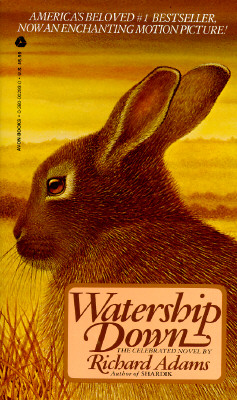
You're Watership Down!
by Richard Adams
Though many think of you as a bit young, even childish, you're
actually incredibly deep and complex. You show people the need to rethink their
assumptions, and confront them on everything from how they think to where they
build their houses. You might be one of the greatest people of all time. You'd
be recognized as such if you weren't always talking about talking rabbits.
Take the Book Quiz
at the Blue Pyramid.
37alcottacre
Thanks for the info about the quiz! It was fun to do - I am Catch-22.
38suslyn
LOL They say I'm a book I've never heard of, and I can't agree with their take on 'me', but: The Guns of August by Barbara Tuchman. Though you're interested in war, what you really want to know is what causes war. You're out to expose imperialism, militarism, and nationalism for what they really are. Nevertheless, you're always living in the past and have a hard time dealing with what's going on today. You're also far more focused on Europe than anywhere else in the world. A fitting motto for you might be "Guns do kill, but so can diplomats."
Hmmm if I feel young instead of old (the answer changes with the day), I'm: A Prayer for Owen Meany by John Irving. Despite humble and perhaps literally small beginnings, you inspire faith in almost everyone you know. You are an agent of higher powers, and you manifest this fact in mysterious and loud ways. A sense of destiny pervades your every waking moment, and you prepare with great detail for destiny fulfilled. When you speak, IT SOUNDS LIKE THIS!
Edited to try again for those touchstones...
Hmmm if I feel young instead of old (the answer changes with the day), I'm: A Prayer for Owen Meany by John Irving. Despite humble and perhaps literally small beginnings, you inspire faith in almost everyone you know. You are an agent of higher powers, and you manifest this fact in mysterious and loud ways. A sense of destiny pervades your every waking moment, and you prepare with great detail for destiny fulfilled. When you speak, IT SOUNDS LIKE THIS!
Edited to try again for those touchstones...
41flissp
#38 suslyn, turns out I'm A Prayer for Owen Meany too...
#39 ronincats, rabbits are eveel ;)
#40 wunderkind, clearly, I'm actually going to have to read A Prayer for Owen Meany this year - everything is pointing me at it - there was even an adaptation playing on the radio when I picked my car up from it's MOT today!
#39 ronincats, rabbits are eveel ;)
#40 wunderkind, clearly, I'm actually going to have to read A Prayer for Owen Meany this year - everything is pointing me at it - there was even an adaptation playing on the radio when I picked my car up from it's MOT today!
42suslyn
>39 ronincats: Well I grew up in Tx... I'd have to say my preference depends on the moment... just like whether or not I feel old...
ETA for a meal, I vote rabbit every time :)
ETA for a meal, I vote rabbit every time :)
44ronincats
Well, a rabbit would have gotten you to Watership Down, so you probably ended up in the right place.
45wunderkind
flissp: hmmm... i wonder what armadillo tastes like?
Like chicken?
Like chicken?
46alcottacre
#43 flissp: Should I run one over and ship it to you so you can report back? Not hard to find them here in Texas . . .
48suslyn
Okay, you asked for it.
How many Aggies does it take to eat an armadillo?
(Aggies, in this question, refer to folks associated with Texas A&M University.)
How many Aggies does it take to eat an armadillo?
(Aggies, in this question, refer to folks associated with Texas A&M University.)
50alcottacre
#48: I do not know, Susan. How many Aggies does it take to eat an armadillo?
54fantasia655
#48 You know I would have said three, one to eat the armadillo, one to keep watch and the other to tell them that they are idiots, and that its not a good idea.
:) Just my opinion: continue talking of books.
:) Just my opinion: continue talking of books.
55wunderkind
I lose internet-access for two days and look what happens to my thread: all this talk of roadkill and rampant Aggie-bashing...tsk tsk. Anyway, back to books:
7) Henrietta's War by Joyce Dennys--Subtitled "News from the Home Front, 1939-1942", this is a collection of fictional letters written during WWII that chronicle the experiences of a woman living in a small town on the coast of Devon, apparently based on the actual experiences of the author. It was wonderfully funny and reminded me very much of Diary of a Provincial Lady, which I read last year, and which apparently has a sequel set during WWII that I would imagine is a lot like Henrietta's War. I'm going to steal a description from the back of the book, because I can't think of a better way to say it: "Dogs, garden tea-parties, bumbling vicars, fierce tweedy ladies who longed for Hitler to land so they could give him what for, and retired colonels--this was the Home Front." I also see from a blurb on the back that there's a second volume, which I'm now going to frantically search for on Abebooks. But first, an excerpt:
The Admiral tells me that we are going to have a new and much louder siren, which is a pity, because I am sure it will make everybody much more frightened of air raids. The one we have now is the sweetest little thing. Nobody hears it except those who, like ourselves, live near to the police station, and even I missed its gentle wheezings this afternoon, because I happened to be boiling a kettle at the time.
7) Henrietta's War by Joyce Dennys--Subtitled "News from the Home Front, 1939-1942", this is a collection of fictional letters written during WWII that chronicle the experiences of a woman living in a small town on the coast of Devon, apparently based on the actual experiences of the author. It was wonderfully funny and reminded me very much of Diary of a Provincial Lady, which I read last year, and which apparently has a sequel set during WWII that I would imagine is a lot like Henrietta's War. I'm going to steal a description from the back of the book, because I can't think of a better way to say it: "Dogs, garden tea-parties, bumbling vicars, fierce tweedy ladies who longed for Hitler to land so they could give him what for, and retired colonels--this was the Home Front." I also see from a blurb on the back that there's a second volume, which I'm now going to frantically search for on Abebooks. But first, an excerpt:
The Admiral tells me that we are going to have a new and much louder siren, which is a pity, because I am sure it will make everybody much more frightened of air raids. The one we have now is the sweetest little thing. Nobody hears it except those who, like ourselves, live near to the police station, and even I missed its gentle wheezings this afternoon, because I happened to be boiling a kettle at the time.
58suslyn
>55 wunderkind: sorry for the hijack
ummm if you are an Ag, and I do bleed maroon, it is perfectly acceptable to tell the jokes ;-> We excel at it!
ummm if you are an Ag, and I do bleed maroon, it is perfectly acceptable to tell the jokes ;-> We excel at it!
59wunderkind
No worries, I've never even been to Texas and thus have no opinion one way or the other, although I only ever hear jokes about Aggies. What about other Texas universities?
60wunderkind
>FAMeulstee: A kindred spirit! I don't know how accurate that quiz is, but I really liked my result (especially the "You might be one of the greatest people of all time" bit :).
61FAMeulstee
I don't know either Erin, but I liked it, both the book and the comment.
You'd be recognized as such if you weren't always talking about talking rabbits.
It would be completely accurate if the rabbits were replaced by dogs or books LOL
Anita
You'd be recognized as such if you weren't always talking about talking rabbits.
It would be completely accurate if the rabbits were replaced by dogs or books LOL
Anita
62suslyn
>59 wunderkind: as far as I know Ags are the butt of all the jokes no matter the university. Works for us :)
63alcottacre
#55: Henrietta's War looks very much like something I would enjoy. If you find the name of the sequel, would you pass it along? I will add them both to the Continent.
64wunderkind
The sequel is called Henrietta Sees It Through--I checked on Abebooks and there are only about half-a-dozen copies available, all of them from bookstores in the UK. Must have been a small print run...
65alcottacre
#64: If that is the case and you can only get it through the UK, check out The Book Depository. They offer free shipping to the US.
Never mind, I look at The Book Depository and the title is 'unavailable'. Rats.
Never mind, I look at The Book Depository and the title is 'unavailable'. Rats.
66wunderkind
Sadly, The Book Depository doesn't have any copies available. Happily, browsing TBD's front page has made me aware of the existence of Peter Cook. So I'm counting that one as a win.
67wunderkind
8) The Bookshop by Penelope Fitzgerald--I read both this and Fitzgerald's Human Voices last year, and both of them had something about them that compelled me to reread them just a few months later. Fitzgerald's style is very much like Beryl Bainbridge's, another favorite of mine, and similar to Barbara Pym, in that they all have a talent for creating a fully-fledged character, scene, or mood with just a few words that cut right to the point without being obvious or predictable. The plot of The Bookshop is about a woman who decides to open a bookshop in a small town in Suffolk in 1959, despite the fact that certain elements in the town seem to be conspiring against her. It's funny, but also quite depressing. I don't think I was quite so saddened last time I read it, but since then I've come across an article online about the demise of the bookstore that just about made me cry, and I think my feelings there got tied up in this. Very good anyway, and I'm glad I reread it.
69FlossieT
>67 wunderkind:: I read this late last year and the "depressing" bit rather overwhelmed me. I don't really enjoy books about bubbly enthusiasts facing the grinding inexorability of small-town status quo. The end made me want to stamp my feet and scream with frustration.
Hasn't put me off Penelope Fitzgerald though! I'm expecting The Gate of Angels through from BookMooch soon....
Hasn't put me off Penelope Fitzgerald though! I'm expecting The Gate of Angels through from BookMooch soon....
70wunderkind
I hadn't heard of that one, but the plot and setting sound really interesting. The only other Fitzgerald I have is Innocence, which I haven't read yet.
71alcottacre
I highly recommend The Blue Flower by Fitzgerald if you have not read that one yet, ladies.
72wunderkind
9) You Are a Dog: Life Through the Eyes of Man's Best Friend by Terry Bain--I read this based on LT reviews saying it was hilarious, but I didn't find it so. It's a dog's perspective on all the important things in life (one's People, Food, Squirrels, etc.), which I imagine is based on the author's observations of his dogs; however, I didn't actually recognize that much of my own dogs in his descriptions, and what I did recognize wasn't anything that I hadn't already thought of before (like most dog owners, I spend a lot of time anthropomorphizing my pets). I don't know why I didn't find it more than slightly amusing, but, since I appear to be the only person on LT who was disappointed, I'm not going to un-recommend it. I'll probably keep my copy and give it as a gift someday.
73billiejean
Hi, wunderkind!
Sorry that it took me so long to find your thread again. I was just thinking the other day, now who was it talking about meta-fiction? Anyway, referring to post #23, thanks so much for the explanation. That sounds like a pretty interesting read. I learn something new everyday on LT. :)
--BJ
Sorry that it took me so long to find your thread again. I was just thinking the other day, now who was it talking about meta-fiction? Anyway, referring to post #23, thanks so much for the explanation. That sounds like a pretty interesting read. I learn something new everyday on LT. :)
--BJ
74wunderkind
In the last week I've made absolutely no progress on the books I've been reading, first due to a Battlestar Galactica marathon that's caught me up to the current season and then due to a grad school visit to Portland (which was amazing). But I did get to read on the plane in between bouts of studying, which resulted in...
10) How to Become Extinct by Will Cuppy--I read Cuppy's The Decline and Fall of Practically Everybody last year and really liked it, and saw this in the Powell's at the airport (!!!). This is a collection of Cuppy's short, ridiculous, and possibly informative essays on various animals. Rather than try to describe why it's hilarious, I'm just going to cut right to the chase and post some excerpts:
"No, I was always like this. Always wondering whether fish think, I mean really think. Even as a child back in Indiana, whenever I took a Butterbelly off the hook I used to ask myself, 'Does this fish think?' I would even ask others, 'Do you suppose this Butterbelly can think?' And all I would get in reply was a look. At the age of eighteen, I left the state."
"The Common Eel has long been known, none too favorably, for his nocturnal wanderings in fields and meadows, where he is said to gorge himself upon green peas, his favorite food. Ichthyologists returning from late parties have often encountered troops of Eels full of green peas in the dawn, scampering homeward to the nearest stream."
"The Gaboon Viper bites you in the Gaboon and then waits around to see how you like it."
"Still and all, Aristotle stimulates you. He keeps you guessing, not only about what he meant but about what he thought he meant. Take what he says about the snake's legs--or lack of legs, rather. He says snakes have no legs because, if they had any, they would only have two or four, and that wouldn't be nearly enough. You can stay up all night figuring that one, snatch a few winks of sleep, and fly at it again the next morning. And you'll be little the wiser. All you'll be is a wreck."
And my personal favorite:
"My readers will hardly expect me to take up all the existing insects in this article, as about 750,000 species have already been described by science and there may be as many as ten million other kinds at large, including the red-eyed, green-whiskered thing that flew into my bedroom one night, buzzed slowly twice around the reading-lamp, and then flew out again, probably on its way back to hell."
10) How to Become Extinct by Will Cuppy--I read Cuppy's The Decline and Fall of Practically Everybody last year and really liked it, and saw this in the Powell's at the airport (!!!). This is a collection of Cuppy's short, ridiculous, and possibly informative essays on various animals. Rather than try to describe why it's hilarious, I'm just going to cut right to the chase and post some excerpts:
"No, I was always like this. Always wondering whether fish think, I mean really think. Even as a child back in Indiana, whenever I took a Butterbelly off the hook I used to ask myself, 'Does this fish think?' I would even ask others, 'Do you suppose this Butterbelly can think?' And all I would get in reply was a look. At the age of eighteen, I left the state."
"The Common Eel has long been known, none too favorably, for his nocturnal wanderings in fields and meadows, where he is said to gorge himself upon green peas, his favorite food. Ichthyologists returning from late parties have often encountered troops of Eels full of green peas in the dawn, scampering homeward to the nearest stream."
"The Gaboon Viper bites you in the Gaboon and then waits around to see how you like it."
"Still and all, Aristotle stimulates you. He keeps you guessing, not only about what he meant but about what he thought he meant. Take what he says about the snake's legs--or lack of legs, rather. He says snakes have no legs because, if they had any, they would only have two or four, and that wouldn't be nearly enough. You can stay up all night figuring that one, snatch a few winks of sleep, and fly at it again the next morning. And you'll be little the wiser. All you'll be is a wreck."
And my personal favorite:
"My readers will hardly expect me to take up all the existing insects in this article, as about 750,000 species have already been described by science and there may be as many as ten million other kinds at large, including the red-eyed, green-whiskered thing that flew into my bedroom one night, buzzed slowly twice around the reading-lamp, and then flew out again, probably on its way back to hell."
76dk_phoenix
Haha... I didn't know there was more out there by Cuppy! (Probably because I never bothered to look...). But after enjoying Decline and Fall of Practically Everybody, I'll definitely look this one up.
77wunderkind
75, 76: Yeah, I think there are a few more out there. Nonpareil Books just published brand-new editions of all of Cuppy's books last year, so they should be easier to find now.
78Whisper1
hi wunderkind
I'm so far behind in reading the posts. I see that as of this morning we have 346 members...oh my.
Yours is a thread that I enjoyed in 2008 and thus I've starred it again for 2009.
You are reading some very interesting books thus far.
I'm so far behind in reading the posts. I see that as of this morning we have 346 members...oh my.
Yours is a thread that I enjoyed in 2008 and thus I've starred it again for 2009.
You are reading some very interesting books thus far.
79wunderkind
Thanks for reading, Whisper! I've been following your thread too.
80wunderkind
11) CivilWarLand in Bad Decline by George Saunders--This is a collection of short stories that could be more accurately called Humanity in Bad Decline. Holy cow, these were the most depressing funny stories I've ever read. The vision of humanity, set in what's either the semi-post-apocalyptic near future or a sort of alternate present, is so negative it's almost off-putting. Saunders describes a place where hedonistic consumerism has run rampant and only the strong or psychotic survive while the decent and weak are used and abused. They're well-written and entertaining, but jeez...Where did all of that disgust come from? Or am I just naive?
81FlossieT
>80 wunderkind:: I wonder about George Saunders.. The Brief and Frightening Reign of Phil is one I keep picking up and putting back down again. When he's on form, he's great; when he's not... well.
82wunderkind
>81 FlossieT:: Yeah, I saw The Brief and Frightening Reign of Phil at the bookstore and was put off by the plot description. I like my satire to be a little more subtle, and subtlety is something Saunders seems to lack.
83wunderkind
12) Entertaining Eric by Maureen Wells--This is a series of letters written during WWII by a young British woman to her fiancee in North Africa (the eponymous Eric). Maureen Wells was a very adventurous and intelligent person who served in many organizations during the war; the book covers her time as a billeting officer, a top secret courier for the WRNS, and then as a Wren stoker. She comes across as a very clever and observant person and the letters are a great window into her wartime experiences. Apparently this was the ninth in a series of books of personal letters from WWII published by the Imperial War Museum, and I'm probably going to track down some of the others.
84VioletBramble
#80-82 I made the mistake of reading four George Saunders books in a row last year. Very depressing. After awhile the stories are redundant also. The Brief and Frightening Reign of Phil was actually the best and the only one I would recommend to anyone.
85wunderkind
VioletBramble: Would you care to say why you recommend "Phil" over his other books? I only ask because it's Saunders' lowest rated book on LT, so your endorsement flies in the face of public opinion. :)
86VioletBramble
I read four of Saunders books ( Phil, CivilWarLand, Pastoralia and In Persuasion Nation) in a row. I have found in the past that it is a bad idea (for me at least) to read an authors works all in a bunch. It has happened with Saunders, Jonathan Carroll and others,that I find authors continually use the same plots, character types, setting or whatever their schtick is, and never really say anything different in subsequent books. If an authors work speaks to me then I can over look some lack of change over time-- ie as that writers style. Sometimes I just say to myself, "Oh no, more of the same" and never read that author again. Saunders is in that category for me. I probably like Phil the best because it was the first book I read of the four and it's very different from the other books. I mentioned above how redundant some of his stories can be. When you read them one after the other that stands out more. Phil is the most abstract in terms of setting. And a big plus for me -- no one works in any kind of amusement park, tourist attraction (which I'm guessing is a Suanders thing). The characters in Phil are more concepts than characters. The whole story takes place on a small section of property. So, I guess I like Phil the best because it's more abstract and it's different than Saunders other books.
I hope that explaination makes sense.
I hope that explaination makes sense.
87wunderkind
And a big plus for me -- no one works in any kind of amusement park, tourist attraction.
That made me laugh, but do you mean he keeps using that setting in his other books?!?! I think I'll take your advice, just read "Phil", and skip the others.
That made me laugh, but do you mean he keeps using that setting in his other books?!?! I think I'll take your advice, just read "Phil", and skip the others.
88VioletBramble
While it's not all he writes about, tourist attraction employees abound in his books. CivilWArLand is one such place and that book is made up of stories that take place there. Pastoralia also contains a few stories that take place in such settings.
89alcottacre
#83: If you find the list of books, I would be very interested, Erin. I think Catey would also be interested because she really enjoys reading books of letters. She has several of Andrew Carroll's books of war letters and correspondence.
90wunderkind
#89: Well, I went digging around on the internet trying to find a specific list of titles, but the best I could come up with was the general book inventory of the Imperial War Museum's online shop. However, just the WWII section alone is making me salivate, and a lot of the books seem to be personal reminiscences. Here's a link (Entertaining Eric is on the second page of results): http://www.iwmshop.org.uk/index.html?action=search&searchtype=catID&quic....
91alcottacre
Thanks! We can drool together now, lol.
92wunderkind
(Aborted) Never Cry Wolf by Farley Mowat--In High Fidelity, there's a scene where Rob lists his five dream jobs (if time and qualifications weren't taken into consideration), which include "Producer, Atlantic Records, 1964-1971". My own number one dream job is probably "Wildlife Biologist, Yellowstone Wolf Reintroduction Project, 1995-2005".
I only mention all of this to emphasize that I should have loved Never Cry Wolf, which is about a Canadian biologist's experiences studying a wolf pack in the late 1940s. Instead, I can't even bring myself to finish it. There's been a lot of controversy over the veracity of the book (for one thing, Mowat writes as though he was all alone when he was actually with two other biologists). But what really, really annoyed me was how inaccurate the book was (see Wikipedia for more details) and, even worse, how he described the wolves: "George had presence. His dignity was unassailable, yet he was by no means aloof. Conscientious to a fault, thoughtful of others, and affectionate within reasonable bounds, he was the kind of father whose idealized image appears in many wistful books of human family reminiscences, but whose real prototype has seldom paced the earth upon two legs. George was, in brief, the kind of father every son longs to acknowledge as his own." George is a wolf, by the way. And lest you think that Mowat was trying to be funny, I really don't think so--there is humor in the book, but it's all self-deprecatory, which would be welcome except that it is sometimes so extreme as to reinforce the claims that the book is more fiction than non-fiction.
I'm spending more words describing a book I didn't like than I have on the ones I did, so in closing: this book really frustrated me. It's very dated and is pretty much useless except as a tool to convince laypeople that wolves are not man-eaters. I understand that it was in fact very successful in this capacity when it came out in the '60s, but even so I don't understand why it's still popular today.
I only mention all of this to emphasize that I should have loved Never Cry Wolf, which is about a Canadian biologist's experiences studying a wolf pack in the late 1940s. Instead, I can't even bring myself to finish it. There's been a lot of controversy over the veracity of the book (for one thing, Mowat writes as though he was all alone when he was actually with two other biologists). But what really, really annoyed me was how inaccurate the book was (see Wikipedia for more details) and, even worse, how he described the wolves: "George had presence. His dignity was unassailable, yet he was by no means aloof. Conscientious to a fault, thoughtful of others, and affectionate within reasonable bounds, he was the kind of father whose idealized image appears in many wistful books of human family reminiscences, but whose real prototype has seldom paced the earth upon two legs. George was, in brief, the kind of father every son longs to acknowledge as his own." George is a wolf, by the way. And lest you think that Mowat was trying to be funny, I really don't think so--there is humor in the book, but it's all self-deprecatory, which would be welcome except that it is sometimes so extreme as to reinforce the claims that the book is more fiction than non-fiction.
I'm spending more words describing a book I didn't like than I have on the ones I did, so in closing: this book really frustrated me. It's very dated and is pretty much useless except as a tool to convince laypeople that wolves are not man-eaters. I understand that it was in fact very successful in this capacity when it came out in the '60s, but even so I don't understand why it's still popular today.
93VisibleGhost
I admire wolves. I rooted for the wolf in Little Red Riding Hood when I was a kid. I didn't like the whiny obnoxious three little pigs and was heartbroken when the third little pig outsmarted the wolf. One of my favorite books last year was Wolf Totem. I didn't so much read the book as experience it. That doesn't happen often to me. And probably won't happen to others. But I still like to mention it when the subject turns to wolves.
94wunderkind
93: Thanks for the recommendation. I didn't recognize the title, but once I saw the cover I realized that I've noticed it several times at bookstores ("wolf" being a sort of buzz word for me). It sounds like something I'd really love, so I'm definitely going to track down a copy.
95FAMeulstee
hi Erin
I saw the movie of Never Cry Wolf long ago and remember I liked it very much. Probably most because of the wonderful images of the wolves ;-)
I do rememer a comment voice speaking those words about George you mentioned above, but that did not bother me at the time.
Anita
I saw the movie of Never Cry Wolf long ago and remember I liked it very much. Probably most because of the wonderful images of the wolves ;-)
I do rememer a comment voice speaking those words about George you mentioned above, but that did not bother me at the time.
Anita
96wunderkind
If the movie's available on DVD I'll probably check it out sometime. I'd also like to read Mowat's The Dog Who Wouldn't Be--his style and humor are fun, but I think he's probably a much better memoirist than straight-forward non-fiction writer.
97wunderkind
13) A Better Angel: Stories by Chris Adrian--This is a book of short stories, published last year, by the author of The Children's Hospital, which is one of my all-time favorite books. Happily, this has turned out to be equally good and is now my all-time favorite book of short stories. I just wrote up a paragraph of why I love Chris Adrian's writing so much, then deleted it all because it was inadequate to express my slavish devotion. I will just give a word of advice: anyone new to Adrian should read The Children's Hospital before A Better Angel; I think the novel works you into his sort of "world-view" more gradually, which makes the short stories even more enjoyable since one is then free to give more focus to the beauty of his writing.
98alcottacre
I have both books on Continent TBR already, but was glad to see your review of them. I will follow your suggestion and get The Children's Hospital first.
99wunderkind
14) Man's Fate by Andre Malraux--This 1933 novel is nominally about the 1927 socialist uprising in China and the following massacre in which the Nationalists purged the Kuomintang of its Communist members. If the historical context makes the novel sound daunting, don't worry--I knew next to nothing about the politics or history of the period when I started reading and it didn't diminish my enjoyment a bit. As the title would suggest, Malraux deals with universal themes through examining the actions and motivations of a few of the people involved, including Communists, politically apathetic opportunists, and a French businessman with purely economic interests in the outcome of the revolution. Malraux writes in such a way that I was completely drawn into the psychology of the characters, while also keeping a near continuous level of subtle suspense that made the book much more exciting than I was expecting it to be. A fantastically well-written novel; I can't wait to read more by Malraux.
ETA: I highly recommend the translation by Haakon M. Chevalier; I obviously don't have any other version to compare it to, but it read very smoothly and naturally.
ETA: I highly recommend the translation by Haakon M. Chevalier; I obviously don't have any other version to compare it to, but it read very smoothly and naturally.
100Whisper1
Hi Erin
I'm simply stopping by to say while I don't post often, I do read your thread. I enjoy your well-written reviews.
I've never heard of Malraux and appreciate your comments regarding Man's Fate.
I'm simply stopping by to say while I don't post often, I do read your thread. I enjoy your well-written reviews.
I've never heard of Malraux and appreciate your comments regarding Man's Fate.
101wunderkind
Whisper: Thanks! I think I bought copies of two of Malraux's books (Man's Fate and The Temptation of the West) without actually knowing who he was, just because I liked the cover art and because his name sounded vaguely familiar. He definitely should be more well-known, if Man's Fate is anything to go by.
102Whisper1
Erin
Thanks for your recommendation. One of the most enjoyable aspects of LT is the discovery of new books and authors. Thanks to you, I now know of Malraux and will read some of his books.
Thanks for your recommendation. One of the most enjoyable aspects of LT is the discovery of new books and authors. Thanks to you, I now know of Malraux and will read some of his books.
103wunderkind
15) The Strange Case of Dr Jekyll and Mr Hyde by Robert Louis Stevenson--This is one of those classics that I didn't think I would ever read because I figured it would be dated and because I thought I knew the story already. Turns out I was wrong on all three counts, happily. It's not dated in the slightest and is a cracking read, and the actual story is way more interesting than the bastardized version that's made its way into popular culture (yeah, I'm looking at you The League of Extraordinary Gentlemen).
104alcottacre
#103: I have never read Dr. Jekyll, so maybe this is the time. I will put it on the Continent.
105wunderkind
16) 1066 and All That by W.C. Sellar and R.J. Yeatman--A pretty hilariously inaccurate guide to all the British history that's worth knowing. It reminded me very much of Will Cuppy's The Decline and Fall of Practically Everybody, and it would be fun to read the two books in tandem. From the preface:
"Histories have previously been written with the object of exalting their authors. The object of this History is to console the reader. No other history does this.
History is not what you thought. It is what you can remember. All other history defeats itself.
This is the only Memorable History of England, because all the History that you can remember is in this book, which is the result of years of research in golf-clubs, gun-rooms, green-rooms, etc.
For instance, two out of the four Dates originally included were eliminated at the last moment, a research done at the Eton and Harrow match having revealed that they are not memorable.
The Editors will be glad of further assistance towards the elimination, in future editions, of any similarly unhistorical matter which, despite their vigilance, may have crept into the text."
"Histories have previously been written with the object of exalting their authors. The object of this History is to console the reader. No other history does this.
History is not what you thought. It is what you can remember. All other history defeats itself.
This is the only Memorable History of England, because all the History that you can remember is in this book, which is the result of years of research in golf-clubs, gun-rooms, green-rooms, etc.
For instance, two out of the four Dates originally included were eliminated at the last moment, a research done at the Eton and Harrow match having revealed that they are not memorable.
The Editors will be glad of further assistance towards the elimination, in future editions, of any similarly unhistorical matter which, despite their vigilance, may have crept into the text."
106alcottacre
#105: I have that one home from the library right now. I will have to save it for when I need a good laugh.
107flissp
Oh I loved 1066 and all that! But I've never met anyone else (who was not a family member) who had read it - I'm so pleased to find I'm not alone! It's one of those books that I find I need to quote and then realise no one else knows what I'm talking about (the bit you've quoted being a prime example - that and something being "a good thing"!)...
108TadAD
>107 flissp:: It came up in a thread in last year's group and I was surprised (since, like you, I had never heard anyone else mention it) at how many people said, "loved it!"
ETA: I, personally, enjoyed the invasions of "Ostrogoths, Visigoths, mere Goths."
ETA: I, personally, enjoyed the invasions of "Ostrogoths, Visigoths, mere Goths."
109wunderkind
107/108: I was in the opposite camp--I'd never heard of it until a few months ago, and then I was surprised to see that a thousand people on LT have it in their libraries. Now whenever Queen Elizabeth comes up in conversation (because, you know, that happens all the time), I will be able to note that she was a Bad Man but a Good Queen.
110blackdogbooks
Yay! Another Jekyll and Hyde convert. Completely agreed with your assessment.
111FlossieT
>105 wunderkind:/106/107: there's a sequel too, called (if memory serves) And Now All This (hurrah, the touchstone confirms it!). Although I can't now remember if it's as good as the original....
112flissp
#111 I think I read And Now All This about the same time as I first read 1066 and All That and it really hasn't stuck in my memory the same way - I've a vague recollection of being a bit disappointed by it...
113wunderkind
17) The Young Visiters by Daisy Ashford--This book, written in 1890 and published in 1919, is "the greatest novel written by a nine-year-old" and chronicles the adventures of Mr. Salteena and his friends Edith and Bernard as the first attempts to climb the social ladder and the latter two fall madly in love. Of course, having been written by a nine-year-old, it's comical in that way that kids can be when they're deadly serious about something. The author evidently incorporated her favorite phrases from books and overheard conversations, but still retained the spelling and grammar of a child, which leads to such sentences as "I am stopping with his Lordship said Mr Salteena and have a set of compartments in the basement so there." The crowning moment of the book comes when Bernard proposes to Edith during a picnic next to a river; Ms. Ashford really pulled out all the stops and packed in just about every 19th century romantic cliche in existence, to hilarious effect. As J.M. Barrie writes in the preface, "It seems to me to be a remarkable work for a child, remarkable even in its length and completeness, for when children turn author they usually stop in the middle, like the kitten when it jumps."
114wunderkind
18) Dirty Snow by Georges Simenon--I read one of Simenon's Maigret detective novels last year (Maigret and the Yellow Dog) and was distinctly unimpressed, but I'd read very favorable reviews about his "psychological" fiction, of which Dirty Snow is apparently the most well-known example. The novel, written in 1948, is set in WWII-era, German-occupied France, although the Occupiers are never identified by name and the story could really be taking place in any real or imaginary oppressed country. The anti-heroic protagonist, Frank, is a young man who is either psychopathic or so downtrodden by the depressing conditions of life in his city that he'll do anything--including murder--to regain a sense of control. After a series of escalating crimes, Frank is picked up by an anonymous branch of authority, and the second half of the novel is a Kafka-esque portrayal of his time in prison, where he is politely interrogated for weeks on end.
This novel reminded me a lot of Graham Greene's Brighton Rock, which I read a couple of years ago; both center on very disturbed young men and are fascinating, if not exactly pleasant to read. Much as I love Graham Greene, I actually think Dirty Snow is quite a bit better--Frank ends up making sense to the reader even if he never quite makes sense of himself, while with Brighton Rock I never really felt like Pinky could have been a real person. The mood that Simenon evokes with his descriptions of the cold, dingy occupied city is also very affecting; to steal a blurb from the back of the book, "Hans Koning has described Dirty Snow as 'one of the very few novels to come out of German-occupied France that gets it exactly right.'" Highly recommended.
This novel reminded me a lot of Graham Greene's Brighton Rock, which I read a couple of years ago; both center on very disturbed young men and are fascinating, if not exactly pleasant to read. Much as I love Graham Greene, I actually think Dirty Snow is quite a bit better--Frank ends up making sense to the reader even if he never quite makes sense of himself, while with Brighton Rock I never really felt like Pinky could have been a real person. The mood that Simenon evokes with his descriptions of the cold, dingy occupied city is also very affecting; to steal a blurb from the back of the book, "Hans Koning has described Dirty Snow as 'one of the very few novels to come out of German-occupied France that gets it exactly right.'" Highly recommended.
115arubabookwoman
This sounds like a good read. I'm putting it on my TBR pile. I hadn't realized that Simenon wrote any other than the mysteries, so you learn something new everyday. :)
116alcottacre
#114: It sounds like an interesting book, Erin. I am adding Dirty Snow to the Continent. Thanks for the recommendation!
117allthesedarnbooks
Have been lurking on your thread and just wanted to say how much I enjoy your reviews and I've added a bunch to my TBR pile. :)
118wunderkind
2-month Status Update
Books Read: 18
*Fiction: 16
*Non-Fiction: 2
*Male Authors: 13
*Female Authors: 5
Century of Origin
*19th: 3
*20th (pre-1950): 8
*20th (post-1950): 3
*21st: 4
Mean date of publication: 1951
Country of Origin
*Britain/Ireland: 7
*USA: 7
*France: 2
*Russia: 1
*Brazil: 1
Books Read: 18
*Fiction: 16
*Non-Fiction: 2
*Male Authors: 13
*Female Authors: 5
Century of Origin
*19th: 3
*20th (pre-1950): 8
*20th (post-1950): 3
*21st: 4
Mean date of publication: 1951
Country of Origin
*Britain/Ireland: 7
*USA: 7
*France: 2
*Russia: 1
*Brazil: 1
119alcottacre
Nice recap, Erin!
120wunderkind
Thanks. I'm a little disappointed in my fiction/non-fiction ratio so far though...
121alcottacre
#120: Mine is out of whack for the year, too. I had set a goal of 150 nonfiction reads for the year, but I am really going to have to step up the pace to make it.
122wunderkind
19) Travel in the Mouth of the Wolf by Paul Fattaruso--The title of this fairly tiny (114-page) book caught my eye at the bookstore and I bought it on a whim. I'm very glad I did, because it's just the sort of book I love to accidentally run across. The plot is quite odd: a recently-deafened man named Iple goes to Antarctica with a group of scientists and finds a frozen brontosaurus named Isabella. The plot isn't really that important, but I still don't want to say much more about what happens lest I ruin the experience for anyone else. The book's very short chapters are generally composed of discreet episodes or thought processes of the various characters, who are interesting and well-drawn despite the brevity of the book--besides Iple and Isabella, an ex-president, a cryobiologist, a microbiologist, a behaviorist psychologist, an Argentinian shortstop, several statisticians, and a little girl with the gift of prediction all make appearances. Fattaruso's writing style is what really makes the book special though; his sentences are relatively simple and unadorned, and reminded me a lot of Penelope Fitzgerald, Barbara Pym, and Beryl Bainbridge. However, Fattaruso's sentences seemed even more delicate somehow, and I don't really know what I mean by that; it could be the distinct lack of cynicism in the book, which gives the writing a child-like quality that I loved. My favorite sentence in the whole book is, "There's a brook Iple watches over, that tells all at once the many interlocking stories of its polliwogs." I wish Travel in the Mouth of the Wolf had been longer, which I suppose is probably the highest praise one can bestow upon a book.
PS--The German title translates to "Isabella's Love of the Flugelhorn".
PS--The German title translates to "Isabella's Love of the Flugelhorn".
123blackdogbooks
Simenon.....try Red Lights. It is in the psychological drama arena. It was one of my favorite reades last year. I got an omnibus of 5 Maigret mysteries and I am going to give them a go. I'm on the lookout now for Dirty Snow
124wunderkind
>123 blackdogbooks:: My local used book store has a bunch of remaindered copies of Red Lights, so at least I won't have to go hunting for it.
125wunderkind
20) The Slaves of Solitude by Patrick Hamilton--This fantastic novel is about a middle-aged Englishwoman, Miss Roach, living in a village boarding house during WWII. The plot revolves almost entirely around her encounters with her fellow boarders and an American Lieutenant. Miss Roach is a solitary, intelligent, very polite woman who is variously bullied, lied to, and taken advantage of until she eventually snaps. To her credit, Miss Roach snaps much later than I would have, as Hamilton creates some spectacularly loathsome--but entirely realistic--antagonists in Mr. Thwaites, an elderly bully, and Vicki Kugelmann, Miss Roach's deceptive and backstabbing "friend". Even though I was so angry at one point that I wanted to stab the book with my pen (as a poor substitute for stabbing Mr. Thwaites), Hamilton is a great writer with a subtle sense of humor, and the story even ends happily, which was nice.
"'But, my dear, this is marvellous!' said Miss Roach, that slight film coming over her eyes which comes over the eyes of those who, while proclaiming intense pleasure, are actually thinking fast."
"The sky had cleared outside, and the sun, low in the sky, now shone into the room with the peculiar yellow brilliance which only a winter sun can achieve. In this hard and revealing light Mr. Thwaites succeeded in looking more immaculately clean and radiantly healthy than ever. There was not even any hope for Miss Roach that Mr. Thwaites would ever die."
"It was not for Albert Brent to know the actual state of affairs. It was not for the piano-tuner to know that in this still, grey, winter-gripped dining-room, this apparent mortuary of desire and passion (in which the lift rumbled and knives and forks scraped upon plates), waves were flowing forward and backward, and through and through, of hellish revulsion and unquenchable hatred! It was not for him to know that between these two women there existed a feud almost unparalleled in boarding-house, or indeed feminine, history--that one of them walked against the wind in De La Rue sunsets with evil, all but murderous thoughts, yet remained blameless in character."
"'But, my dear, this is marvellous!' said Miss Roach, that slight film coming over her eyes which comes over the eyes of those who, while proclaiming intense pleasure, are actually thinking fast."
"The sky had cleared outside, and the sun, low in the sky, now shone into the room with the peculiar yellow brilliance which only a winter sun can achieve. In this hard and revealing light Mr. Thwaites succeeded in looking more immaculately clean and radiantly healthy than ever. There was not even any hope for Miss Roach that Mr. Thwaites would ever die."
"It was not for Albert Brent to know the actual state of affairs. It was not for the piano-tuner to know that in this still, grey, winter-gripped dining-room, this apparent mortuary of desire and passion (in which the lift rumbled and knives and forks scraped upon plates), waves were flowing forward and backward, and through and through, of hellish revulsion and unquenchable hatred! It was not for him to know that between these two women there existed a feud almost unparalleled in boarding-house, or indeed feminine, history--that one of them walked against the wind in De La Rue sunsets with evil, all but murderous thoughts, yet remained blameless in character."
126alcottacre
#125: Looks good! On to the Continent it goes.
128wunderkind
#127: Was your result accurate? From what I can tell, responses seem to be mixed.
129arubabookwoman
I liked Slaves of Solitude very much as well. I have Hamilton's Twenty Thousand Streets Under the Sky waiting its turn on my book shelf, and I'm hoping it's as good. (It's actually a trilogy, so it's much longer than Slaves).
A similar book that I also liked very much is The Lonely Passion of Judith Hearne by Brian Moore--lonely woman in boarding house, but somewhat darker than Slaves.
A similar book that I also liked very much is The Lonely Passion of Judith Hearne by Brian Moore--lonely woman in boarding house, but somewhat darker than Slaves.
130Whisper1
message 105
1066 and All That by W.C. Sellar sounds like something I would like. I've added it to my tbr list.
1066 and All That by W.C. Sellar sounds like something I would like. I've added it to my tbr list.
131wunderkind
21) I Didn't Do It For You: How the World Betrayed a Small African Nation by Michela Wrong--One day, several months ago, I wandered for the first time into the small African history section of my local used bookstore and ended up buying I Didn't Do It For You, mostly because the attractively designed cover caught my eye. Even if I bought it for shallow reasons, I'm so glad I did--this was a fantastic, eye-opening read.
Wrong details the odyssey of Eritrea, the youngest country in Africa, and the subtitle of the book is depressingly accurate. Eritrea was basically invented by the Italians in the late 19th century so that they could have their own colonial empire, carved out of the northern bit of Ethiopia and the southern bit of Egypt. The country was subsequently ransacked by the British during WWII, illegally annexed by Ethiopia while the UN looked the other way (no surprise there), ignored by the entire Western world as it fought an ultimately successful 30-year-long guerilla war for independence in the face of genocide (with first the U.S., then the Soviet Union, then Israel supplying Ethiopia with billions of dollars worth of military equipment and training), only to stumble back into war with Ethiopia after only six years of peace and prosperity as the poster-child for a possible African renaissance. The book was written in 2004 and I immediately looked up Eritrea's Wikipedia article to see what had happened in the last four years, only to find that, among other indictments, Eritrea is currently ranked dead last on Reporters Without Borders' Worldwide Press Freedom Index. Despite the horrible effect that the Eritrean government (ironically composed of some of the very freedom fighters who liberated the country in the first place) has had in the last 10 years, Wrong still holds out hope that the dogged pride and determination of the Eritreans will help the country bounce back. It was a nice note to end on, and the book itself is incredibly interesting and well-written, but the emotional effect of reading it can be summed-up by one of Wrong's own comments: "And you were left in a sulky gray fug of ambiguity, sure of only one thing: everyone had behaved badly, everyone was to blame."
Wrong details the odyssey of Eritrea, the youngest country in Africa, and the subtitle of the book is depressingly accurate. Eritrea was basically invented by the Italians in the late 19th century so that they could have their own colonial empire, carved out of the northern bit of Ethiopia and the southern bit of Egypt. The country was subsequently ransacked by the British during WWII, illegally annexed by Ethiopia while the UN looked the other way (no surprise there), ignored by the entire Western world as it fought an ultimately successful 30-year-long guerilla war for independence in the face of genocide (with first the U.S., then the Soviet Union, then Israel supplying Ethiopia with billions of dollars worth of military equipment and training), only to stumble back into war with Ethiopia after only six years of peace and prosperity as the poster-child for a possible African renaissance. The book was written in 2004 and I immediately looked up Eritrea's Wikipedia article to see what had happened in the last four years, only to find that, among other indictments, Eritrea is currently ranked dead last on Reporters Without Borders' Worldwide Press Freedom Index. Despite the horrible effect that the Eritrean government (ironically composed of some of the very freedom fighters who liberated the country in the first place) has had in the last 10 years, Wrong still holds out hope that the dogged pride and determination of the Eritreans will help the country bounce back. It was a nice note to end on, and the book itself is incredibly interesting and well-written, but the emotional effect of reading it can be summed-up by one of Wrong's own comments: "And you were left in a sulky gray fug of ambiguity, sure of only one thing: everyone had behaved badly, everyone was to blame."
132alcottacre
#131: Looks like a very powerful book and one I am very interested in reading. Thanks for the review.
134wunderkind
It was definitely a powerful reading experience, especially since I know next to nothing about the recent history of Africa. It's pretty shocking to realize how many horrible things are going on in the world that I don't know anything about.
I took a class on 19th century British colonialism, and at one point the professor said that he hated 20th century history because it was too depressing. I didn't quite agree with him at the time, given that so many people were subjugated by British colonialism and I'm pretty sure they weren't very happy about it. However, I'm coming to realize that no matter how racist, injudicious, and violent Africa's colonial period was, it's nothing compared to what's happened since then, so what my professor said makes more sense now (although I think he was referring to European history at the time).
I took a class on 19th century British colonialism, and at one point the professor said that he hated 20th century history because it was too depressing. I didn't quite agree with him at the time, given that so many people were subjugated by British colonialism and I'm pretty sure they weren't very happy about it. However, I'm coming to realize that no matter how racist, injudicious, and violent Africa's colonial period was, it's nothing compared to what's happened since then, so what my professor said makes more sense now (although I think he was referring to European history at the time).
135alcottacre
#134: It was definitely a powerful reading experience, especially since I know next to nothing about the recent history of Africa. It's pretty shocking to realize how many horrible things are going on in the world that I don't know anything about.
I had a similar experience recently when I read House of Stone by Christina Lamb. The most tragic thing about the happenings in Africa seems to be that once in power, the people who are supposed to be liberating the countries are the very ones that end up subjugating them. Zimbabwe is a case in point and it sounds as if Eritrea is as well.
I had a similar experience recently when I read House of Stone by Christina Lamb. The most tragic thing about the happenings in Africa seems to be that once in power, the people who are supposed to be liberating the countries are the very ones that end up subjugating them. Zimbabwe is a case in point and it sounds as if Eritrea is as well.
136wunderkind
22) And Where Were You, Adam? by Heinrich Boll--A novel composed of a series of vignettes about German soldiers and the people living in the countries they occupied during the end of WWII. It's pretty bleak, of course, and Boll writes in a very straight-forward, unembellished style which reinforces the depiction of tired, demoralized people who don't really know why they're involved in a war that's completely disrupted and ruined their lives. I think this is one of Boll's earlier works, although I haven't read anything else by him, and you can sort of tell--it's a good book, but there's nothing particularly remarkable about it, and the ending is fairly predictable and slightly melodramatic. Still, I'm sure his later books are better (he did win the Nobel prize, after all), and I'll definitely be reading more by him.
137allthesedarnbooks
I'm adding I Didn't Do It For You to my wishlist. Thanks for the powerful (to be a parrot!) review,
138arubabookwoman
Group Portrait with Lady is my favorite Boll novel. I highly recommend it. (Haven't read And Where Were You Adam?
139wunderkind
23) To the Lighthouse by Virginia Woolf--I read about one Virginia Woolf book a year, and in between I always forget why I love her so much. I love the way she slows moments down to tease apart the thoughts and feelings of her characters. I love the fact that, twenty pages into To the Lighthouse, I was already in love with the setting and the people and wished that I could step into the story, annoying characters and all. And I love the fact that Woolf is so non-judgmental about her annoying characters--I know she said at some point, possibly in Mrs. Dalloway, something to the effect that hatred should be reserved for ideas, not people, and I love that she holds herself to that in her writing. And finally (I could go on forever, but I'll stop here), I love that Woolf had ideas that I've never come across in any other writer, which is perhaps her best and most important quality.
140kidzdoc
Nice review, wunderkind. For the mini-author theme read I purchased a Borders edition of Woolf's first three novels, which includes The Voyage Out, Night and Day, and Jacob's Room, but I haven't started yet. I'm new to Woolf; would you suggest starting with her first novel, or are there others you would recommend instead?
141wunderkind
I haven't read any of the three you mentioned, so I can't comment on their relative merit. As for starting with her early stuff, on the one hand I think that would be really interesting to see how her style developed; on the other hand, (again, this is speculation since I haven't read her early writing) it wouldn't surprise me if it took a few books for her to really hit on what makes her books so great. I started with Mrs. Dalloway, but I'm sure any of them would be a good introduction to see whether you love her or hate her, as usually seems to be the case.
All this has made me want to read her early writing--I've got Night and Day, so I'll have to move that up the waiting list.
All this has made me want to read her early writing--I've got Night and Day, so I'll have to move that up the waiting list.
142wunderkind
24) The Flame Trees of Thika: Memories of an African Childhood by Elspeth Huxley--With the same setting as Out of Africa (i.e. British East Africa circa the 1910s), this is basically a child's view of what it was like to be a white settler in Africa. It was really excellent and beautifully written, and anyone who loves Isak Dinesen's African stories would love The Flame Trees of Thika. I must say, though, that even though the blurbs on the cover say the story is told "through a child's eyes", the narrator's voice is very much that of a middle-aged woman recalling her childhood. It's better that way, I think, as she is able to beautifully describe things that a child would not have the vocabulary for, as well as portray with empathy the hardy, if flawed, adults who created her African childhood.
ETA: There are sequels! The Mottled Lizard and Out in the Midday Sun.
ETA: There are sequels! The Mottled Lizard and Out in the Midday Sun.
144Whisper1
Isak Dinesen is one of my favorite authors. Thanks for the recommendation of The Flame Trees of Thika. I will read this for sure!
145alcottacre
#142: Yet another book that has been residing on Continent TBR far too long . . .
Thanks for the reminder, Erin. I will bump this one up a bit!
Thanks for the reminder, Erin. I will bump this one up a bit!
146wunderkind
Whisper: Some of the peripheral "characters" from Out of Africa are named in Huxley's book--she mentions a fashion trend set by the Cole brothers and Lord Delamere's habit of trashing his own hotels whenever he wanted a bit of excitement. I'm hoping there's more overlap in the sequels--it's not a big deal, but I was still excited to see their names, like running into an old friend.
147Whisper1
wunderkind
They really were an eccentric bunch of people. I love reading about them and cannot get enough!
They really were an eccentric bunch of people. I love reading about them and cannot get enough!
148Whisper1
Opps, forgot to ask you if you have read
http://www.librarything.com/work/7463028/book/25743430
http://www.librarything.com/work/653540/book/25743210
http://www.librarything.com/work/960411/book/25743443
http://www.librarything.com/work/80609/book/25719339
http://www.librarything.com/work/80611/book/25868812
I highly recommend all of them!
http://www.librarything.com/work/7463028/book/25743430
http://www.librarything.com/work/653540/book/25743210
http://www.librarything.com/work/960411/book/25743443
http://www.librarything.com/work/80609/book/25719339
http://www.librarything.com/work/80611/book/25868812
I highly recommend all of them!
149wunderkind
Whisper1: I was aware of all of those except for Bror's letters--I definitely want to read the Thurman biography!
150wunderkind
3-month Status Update
Books Read: 24
*Fiction: 20
*Non-Fiction: 4
*Male Authors: 16
*Female Authors: 8
Century of Origin
*19th: 3
*20th (pre-1950): 10
*20th (post-1950): 5
*21st: 6
Country of Origin
*Britain/Ireland: 11
*USA: 7
*France: 2
*Russia: 1
*Brazil: 1
*Germany: 1
*Canada: 1
Books Read: 24
*Fiction: 20
*Non-Fiction: 4
*Male Authors: 16
*Female Authors: 8
Century of Origin
*19th: 3
*20th (pre-1950): 10
*20th (post-1950): 5
*21st: 6
Country of Origin
*Britain/Ireland: 11
*USA: 7
*France: 2
*Russia: 1
*Brazil: 1
*Germany: 1
*Canada: 1
152wunderkind
Thanks--whenever I'm feeling guilty for watching TV or movies instead of reading, I make lists like this.
153wunderkind
25) you are a little bit happier than i am by Tao Lin--This is the first book of poetry by the author of Eeeee Eee Eeee and Bed: Stories, both of which I read and liked last year. Lin is 25, three years older than me, and has a way of saying things that I think is probably uniquely appealing only to people in their 20s. I don't know whether or not he is a good writer, in fact I'm leaning toward "not", but the things he writes about are similar to the things I think about and he "speaks" in the voice of the Millennials, if that's what we're being called now. That is why I really loved Bed, which is a collection of short stories, and thought the novel Eeeee Eee Eeee was good, if kind of aimless. I think Lin lacks discipline in his writing, which was partly the problem with his novel and is definitely a problem with his poetry (at least this first volume; another one came out last year, "Cognitive Behavioral Therapy", which I'm not even going to attempt to touchstone). I can imagine that a lot of the poems were half-consciously typed out at 4:00 in the morning, when random sentences seem more profound and clever than they actually are. Still, there are a few good things, and someone who has enjoyed Lin's fiction might want to check his poetry out. He should definitely concentrate on his short stories though.
Here's one of his poems, called "if i get hit a little by a truck tonight i'm okay with that":
in a hospital the painkillers help your mood
at night you feel like a five-year-old
i don't want to be in love or win the national book award
i say, 'just let me live in a hospital for free with a lung problem'
you say, 'be careful what you wish for'
i say, 'um, why should i be careful what i wish for if i'll be happy if i get what i want?'
you say, 'it's hard to tell if you're being sarcastic'
i say, 'a conversation like this would never happen in a hospital'
Here's one of his poems, called "if i get hit a little by a truck tonight i'm okay with that":
in a hospital the painkillers help your mood
at night you feel like a five-year-old
i don't want to be in love or win the national book award
i say, 'just let me live in a hospital for free with a lung problem'
you say, 'be careful what you wish for'
i say, 'um, why should i be careful what i wish for if i'll be happy if i get what i want?'
you say, 'it's hard to tell if you're being sarcastic'
i say, 'a conversation like this would never happen in a hospital'
155girlunderglass
love the last line!
157wunderkind
26) Topper by Thorne Smith--This is the 1920s novel on which the Cary Grant film was based, although I haven't seen the movie yet. The story is about a middle-aged man, Mr. Topper, who's bored with his life and impulsively buys a car that was formerly owned by a fun-loving young couple who died when their car suddenly met a large tree. Topper subsequently becomes haunted by the couple, Marion and George Kerby, who aren't quite done having fun yet.
The first half of the novel was kind of dull, with Topper complaining to himself in between set-pieces where one or both of the Kerbys would make things levitate in front of bewildered passersby. The last half really picks up with the addition of two more ghosts and their ghost dog to the party, and Topper learns how to get drunk and have fun. The ghosts are an amusing bunch, since they can take on a physical form and apparently drink themselves silly without any serious consequences, and I sort of missed them when the book ended.
The first half of the novel was kind of dull, with Topper complaining to himself in between set-pieces where one or both of the Kerbys would make things levitate in front of bewildered passersby. The last half really picks up with the addition of two more ghosts and their ghost dog to the party, and Topper learns how to get drunk and have fun. The ghosts are an amusing bunch, since they can take on a physical form and apparently drink themselves silly without any serious consequences, and I sort of missed them when the book ended.
158wunderkind
Saw this on Tad's thread, who saw it on someone else's:
The BBC apparently believes most people will have only read 6 of the 100 books here:
How do your reading habits stack up? bold those books you've read in their entirety, italicize the ones you started but didn't finish
ETA: On flissp's friend's recommendation, the books I particularly recommend have been marked with asterisks.
1 Pride and Prejudice - Jane Austen
2 The Lord of the Rings - JRR Tolkien
3 Jane Eyre - Charlotte Bronte
4 Harry Potter series - JK Rowling
5 To Kill a Mockingbird - Harper Lee
6 The Bible
7 Wuthering Heights - Emily Bronte*
8 Nineteen Eighty Four - George Orwell*
9 His Dark Materials - Philip Pullman*
10 Great Expectations - Charles Dickens*
11 Little Women - Louisa M Alcott
12 Tess of the D’Urbervilles - Thomas Hardy
13 Catch 22 - Joseph Heller
14 Complete Works of Shakespeare
15 Rebecca - Daphne Du Maurier
16 The Hobbit - JRR Tolkien
17 Birdsong - Sebastian Faulk
18 Catcher in the Rye - JD Salinger
19 The Time Traveller’s Wife - Audrey Niffenegger
20 Middlemarch - George Eliot
21 Gone With The Wind - Margaret Mitchell
22 The Great Gatsby - F Scott Fitzgerald*
23 Bleak House - Charles Dickens*
24 War and Peace - Leo Tolstoy
25 The Hitch Hiker’s Guide to the Galaxy - Douglas Adams
26 Brideshead Revisited - Evelyn Waugh
27 Crime and Punishment - Fyodor Dostoyevsky*
28 Grapes of Wrath - John Steinbeck*
29 Alice in Wonderland - Lewis Carroll*
30 The Wind in the Willows - Kenneth Grahame
31 Anna Karenina - Leo Tolstoy*
32 David Copperfield - Charles Dickens
33 Chronicles of Narnia - CS Lewis
34 Emma - Jane Austen
35 Persuasion - Jane Austen
36 The Lion, The Witch and The Wardrobe
37 The Kite Runner - Khaled Hosseini
38 Captain Corelli’s Mandolin - Louis De Bernieres
39 Memoirs of a Geisha - Arthur Golden
40 Winnie the Pooh - AA Milne*
41 Animal Farm - George Orwell
42 The Da Vinci Code - Dan Brown
43 One Hundred Years of Solitude - Gabriel Garcia Marquez
44 A Prayer for Owen Meaney - John Irving
45 The Woman in White - Wilkie Collins
46 Anne of Green Gables - LM Montgomery
47 Far From The Madding Crowd - Thomas Hardy
48 The Handmaid’s Tale - Margaret Atwood
49 Lord of the Flies - William Golding
50 Atonement - Ian McEwan*
51 Life of Pi - Yann Martel
52 Dune - Frank Herbert
53 Cold Comfort Farm - Stella Gibbons*
54 Sense and Sensibility - Jane Austen
55 A Suitable Boy - Vikram Seth
56 The Shadow of the Wind - Carlos Ruiz Zafon
57 A Tale Of Two Cities - Charles Dickens
58 Brave New World - Aldous Huxley
59 The Curious Incident of the Dog in the Night-time - Mark Haddon
60 Love In The Time Of Cholera - Gabriel Garcia Marquez
61 Of Mice and Men - John Steinbeck
62 Lolita - Vladimir Nabokov
63 The Secret History - Donna Tartt
64 The Lovely Bones - Alice Sebold
65 Count of Monte Cristo - Alexandre Dumas
66 On The Road - Jack Kerouac
67 Jude the Obscure - Thomas Hardy
68 Bridget Jones’s Diary - Helen Fielding
69 Midnight’s Children - Salman Rushdie
70 Moby Dick - Herman Melville
71 Oliver Twist - Charles Dickens
72 Dracula - Bram Stoker
73 The Secret Garden - Frances Hodgson Burnett
74 Notes From A Small Island - Bill Bryson
75 Ulysses - James Joyce
76 The Bell Jar - Sylvia Plath
77 Swallows and Amazons - Arthur Ransome
78 Germinal - Emile Zola
79 Vanity Fair - William Makepeace Thackeray*
80 Possession - AS Byatt.
81 A Christmas Carol - Charles Dickens
82 Cloud Atlas - David Mitchell
83 The Color Purple - Alice Walker
84 The Remains of the Day - Kazuo Ishiguro*
85 Madame Bovary - Gustave Flaubert
86 A Fine Balance - Rohinton Mistry
87 Charlotte’s Web - EB White
88 The Five People You Meet In Heaven - Mitch Albom
89 Adventures of Sherlock Holmes - Sir Arthur Conan Doyle*
90 The Faraway Tree Collection - Enid Blyton
91 Heart of Darkness - Joseph Conrad*
92 The Little Prince - Antoine De Saint-Exupery*
93 The Wasp Factory - Iain Banks
94 Watership Down - Richard Adams
95 A Confederacy of Dunces - John Kennedy Toole
96 A Town Like Alice - Nevil Shute
97 The Three Musketeers - Alexandre Dumas
98 Hamlet - William Shakespeare
99 Charlie and the Chocolate Factory - Roald Dahl
100 Les Miserables - Victor Hugo
Looks like I've read 41. Not bad, not bad.
The BBC apparently believes most people will have only read 6 of the 100 books here:
How do your reading habits stack up? bold those books you've read in their entirety, italicize the ones you started but didn't finish
ETA: On flissp's friend's recommendation, the books I particularly recommend have been marked with asterisks.
1 Pride and Prejudice - Jane Austen
2 The Lord of the Rings - JRR Tolkien
3 Jane Eyre - Charlotte Bronte
4 Harry Potter series - JK Rowling
5 To Kill a Mockingbird - Harper Lee
6 The Bible
7 Wuthering Heights - Emily Bronte*
8 Nineteen Eighty Four - George Orwell*
9 His Dark Materials - Philip Pullman*
10 Great Expectations - Charles Dickens*
11 Little Women - Louisa M Alcott
12 Tess of the D’Urbervilles - Thomas Hardy
13 Catch 22 - Joseph Heller
14 Complete Works of Shakespeare
15 Rebecca - Daphne Du Maurier
16 The Hobbit - JRR Tolkien
17 Birdsong - Sebastian Faulk
18 Catcher in the Rye - JD Salinger
19 The Time Traveller’s Wife - Audrey Niffenegger
20 Middlemarch - George Eliot
21 Gone With The Wind - Margaret Mitchell
22 The Great Gatsby - F Scott Fitzgerald*
23 Bleak House - Charles Dickens*
24 War and Peace - Leo Tolstoy
25 The Hitch Hiker’s Guide to the Galaxy - Douglas Adams
26 Brideshead Revisited - Evelyn Waugh
27 Crime and Punishment - Fyodor Dostoyevsky*
28 Grapes of Wrath - John Steinbeck*
29 Alice in Wonderland - Lewis Carroll*
30 The Wind in the Willows - Kenneth Grahame
31 Anna Karenina - Leo Tolstoy*
32 David Copperfield - Charles Dickens
33 Chronicles of Narnia - CS Lewis
34 Emma - Jane Austen
35 Persuasion - Jane Austen
36 The Lion, The Witch and The Wardrobe
37 The Kite Runner - Khaled Hosseini
38 Captain Corelli’s Mandolin - Louis De Bernieres
39 Memoirs of a Geisha - Arthur Golden
40 Winnie the Pooh - AA Milne*
41 Animal Farm - George Orwell
42 The Da Vinci Code - Dan Brown
43 One Hundred Years of Solitude - Gabriel Garcia Marquez
44 A Prayer for Owen Meaney - John Irving
45 The Woman in White - Wilkie Collins
46 Anne of Green Gables - LM Montgomery
47 Far From The Madding Crowd - Thomas Hardy
48 The Handmaid’s Tale - Margaret Atwood
49 Lord of the Flies - William Golding
50 Atonement - Ian McEwan*
51 Life of Pi - Yann Martel
52 Dune - Frank Herbert
53 Cold Comfort Farm - Stella Gibbons*
54 Sense and Sensibility - Jane Austen
55 A Suitable Boy - Vikram Seth
56 The Shadow of the Wind - Carlos Ruiz Zafon
57 A Tale Of Two Cities - Charles Dickens
58 Brave New World - Aldous Huxley
59 The Curious Incident of the Dog in the Night-time - Mark Haddon
60 Love In The Time Of Cholera - Gabriel Garcia Marquez
61 Of Mice and Men - John Steinbeck
62 Lolita - Vladimir Nabokov
63 The Secret History - Donna Tartt
64 The Lovely Bones - Alice Sebold
65 Count of Monte Cristo - Alexandre Dumas
66 On The Road - Jack Kerouac
67 Jude the Obscure - Thomas Hardy
68 Bridget Jones’s Diary - Helen Fielding
69 Midnight’s Children - Salman Rushdie
70 Moby Dick - Herman Melville
71 Oliver Twist - Charles Dickens
72 Dracula - Bram Stoker
73 The Secret Garden - Frances Hodgson Burnett
74 Notes From A Small Island - Bill Bryson
75 Ulysses - James Joyce
76 The Bell Jar - Sylvia Plath
77 Swallows and Amazons - Arthur Ransome
78 Germinal - Emile Zola
79 Vanity Fair - William Makepeace Thackeray*
80 Possession - AS Byatt.
81 A Christmas Carol - Charles Dickens
82 Cloud Atlas - David Mitchell
83 The Color Purple - Alice Walker
84 The Remains of the Day - Kazuo Ishiguro*
85 Madame Bovary - Gustave Flaubert
86 A Fine Balance - Rohinton Mistry
87 Charlotte’s Web - EB White
88 The Five People You Meet In Heaven - Mitch Albom
89 Adventures of Sherlock Holmes - Sir Arthur Conan Doyle*
90 The Faraway Tree Collection - Enid Blyton
91 Heart of Darkness - Joseph Conrad*
92 The Little Prince - Antoine De Saint-Exupery*
93 The Wasp Factory - Iain Banks
94 Watership Down - Richard Adams
95 A Confederacy of Dunces - John Kennedy Toole
96 A Town Like Alice - Nevil Shute
97 The Three Musketeers - Alexandre Dumas
98 Hamlet - William Shakespeare
99 Charlie and the Chocolate Factory - Roald Dahl
100 Les Miserables - Victor Hugo
Looks like I've read 41. Not bad, not bad.
159wunderkind
27) Jailbird by Kurt Vonnegut--I think this is the sixth Vonnegut novel I've read, and it's tied (with Cat's Cradle) as the best of the bunch. And by "best" I mean that I give it a five-star rating, two thumbs up, unconditionally recommended. I don't know that the plot is important, but it's the life story, told conversationally in bits and pieces, of Walter F. Starbuck, a normal sort of man who gets caught up in the political and economic movements of twentieth century America. What makes it so great is Vonnegut's style and humanism, which are still unique, I think, even after all this time.
160wunderkind
28) The Elegance of the Hedgehog by Muriel Barbery--The best thing about this novel is the title. I found the plot, the characters, and the writing incredibly frustrating to read. I don't know why I bothered to finish it. Oh well.
161alcottacre
#160: I have seen a lot of good reviews of that one, so I will have to try it to see which side of the fence I am on. I just got a copy of it recently.
I still have not read any Vonnegut though. I am going to have to fix that one of these years . . .
I still have not read any Vonnegut though. I am going to have to fix that one of these years . . .
162flissp
#158 I was sent that list by a mate - there are some great books on the list, but it seems to me that it's quite an odd list - eg each Jane Austen is listed independently, but The complete works of Shakespeare (!) are listed as one thing (apart from Hamlet) etc... Ho hum. I've read 55 of the list, and started/read parts of 7 of the others.
The email I was sent suggested that you put an asterisk by those books you have read that you would particularly recommend to others, and a cross by those you've read but really wouldn't recommend...
The email I was sent suggested that you put an asterisk by those books you have read that you would particularly recommend to others, and a cross by those you've read but really wouldn't recommend...
164wunderkind
29) Monsignor Quixote by Graham Greene--I read a ton of Greene's novels last year, but this is the first one I've read in 2009. It's his third-to-last novel, written when he was nearly 80, and I think those circumstances definitely come through in the writing. The story is about a Catholic priest in a small Spanish town who goes on a road trip with the Communist ex-mayor. Along the way, they discuss their personal beliefs, talk about Don Quixote, and have a few run-ins with the law and the church. It's a gentle, contemplative novel that seems like it was written mostly to let the author to work through his purportedly conflicted feelings about his own Catholicism. I don't mean that to imply that it's not a good book, because it is, but it was not one of my favorite of Greene's novels, probably because I am neither religious/Catholic nor a Communist, and the complexities of belief systems are not something I'm particularly interested in. It reminded me a bit of Gilead by Marilynne Robinson.
165alcottacre
#164: Thanks for the review of Monsignor Quixote, Erin. I will take a look at it.
166wunderkind
30) Mollie and Other War Pieces by A.J. Liebling--This is a collection of Liebling's WWII writings for The New Yorker, in which he covers parts of the war in North Africa, the D-Day Landings, and post-invasion France. Liebling has a very readable, intelligent style of writing and he's very interested in understanding and conveying the fears, joys, and personalities of the ordinary people who, in a time of war, experience and accomplish extraordinary things. The book really sucked me in and I can't wait to read more of his war-time reporting. Apparently he also wrote prolifically about boxing, food, and Paris; I'm not particularly interested in any of those things, but I have such confidence in Liebling's writing that I would recommend them sight unseen to anyone who does enjoy those topics.
167deebee1
hi erin,
book #30 reminded me of Martha Gellhorn's The Face of War which i recently read. have you come across it? it's a collection of her reports from the front in various wars, from the Spanish Civil War on to Vietnam. very compelling writing. and what a woman too!
book #30 reminded me of Martha Gellhorn's The Face of War which i recently read. have you come across it? it's a collection of her reports from the front in various wars, from the Spanish Civil War on to Vietnam. very compelling writing. and what a woman too!
168wunderkind
Thanks for the recommendation! I've never heard of Gellhorn or her book, but it would be fascinating to get a woman's perspective on war reporting. The field is saturated with the male point-of-view, in my opinion. :)
169wunderkind
I love questionnaires! This one is from Facebook, via lycomayflower's thread:
1) What author do you own the most books by?
Graham Greene (19)
2) What book do you own the most copies of?
Vanity Fair by William M. Thackeray (4)
3) Did it bother you that both those questions ended with prepositions?
Not in the slightest.
4) What fictional character are you secretly in love with?
He's fictional, but he's not in any books: DCS Foyle from "Foyle's War". As for literary characters, I kind of became infatuated with William Bankes when I read To the Lighthouse, but I think that's mostly because he reminds me of Foyle...
5) What book have you read the most times in your life (excluding picture books read to children; i.e., Goodnight Moon does not count)?
Either Ex Libris by Anne Fadiman or An Awfully Big Adventure by Beryl Bainbridge, both of which I've read at least four times.
6) What was your favorite book when you were ten years old?
Where the Red Fern Grows by Wilson Rawls. I even named a stuffed dog I got for my birthday "Big Dan".
7) What is the worst book you've read in the past year?
The Magic Christian by Terry Southern, followed closely by The London Embassy by Paul Theroux.
8) What is the best book you've read in the past year?
Three-way tie: The Jewel in the Crown by Paul Scott, A Better Angel by Chris Adrian, and To the Lighthouse by Virginia Woolf
9) If you could force everyone to read one book, what would it be?
Gang Leader for a Day by Sudhir Venkatesh or Another Country by James Baldwin
10) Who deserves to win the next Nobel Prize for Literature?
I don't read enough translated literature to have an opinion.
11) What book would you most like to see made into a movie?
The Children's Hospital by Chris Adrian. It could be so good or so terrible.
12) What book would you least like to see made into a movie?
Housekeeping by Marilynn Robinson.
13) Describe your weirdest dream involving a writer, book, or literary character.
I don't think I've ever had any of those kind of dreams, unfortunately.
14) What is the most lowbrow book you've read as an adult?
I tried to read a Nicholas Sparks book once, but I stopped after 20 pages. I think it was A Bend in the Road.
15) What is the most difficult book you've ever read?
Probably Moby Dick, but I was only fourteen at the time (pretentious, I know).
16) What is the most obscure Shakespeare play you've seen?
I've only seen one performed live, Much Ado About Nothing, so I guess that's it. I saw the filmed version of Titus Andronicus, "Titus", starring Anthony Hopkins, which is pretty obscure.
17) Do you prefer the French or the Russians?
The French.
18) Roth or Updike?
I haven't read Updike, but I hate Roth, so Updike wins by default.
19) David Sedaris or Dave Eggers?
David Sedaris.
20) Shakespeare, Milton, or Chaucer?
Shakespeare.
21) Austen or Eliot?
Haven't read Eliot, but I'm not a huge fan of Austen. Therefore, I respectfully abstain.
22) What is the biggest or most embarrassing gap in your reading?
Literature from every country except America and Great Britain.
23) What is your favorite novel?
I can't pick just one, so I'll pick one that I haven't already mentioned: Eating People is Wrong by Malcolm Bradbury.
24) Play?
The Iceman Cometh by Eugene O'Neill
25) Poem?
Probably something by T.S. Eliot, but it's been a while since I read any.
26) Essay?
Walter Benjamin's "Unpacking My Library" or one of Anne Fadiman's essays.
27) Short story?
I'm changing this to "Book of Short Stories", in which case it's either A Better Angel by Chris Adrian or Bed: Stories by Tao Lin.
28) Work of nonfiction?
The Boy Who Fell Out of the Sky by Ken Dornstein
29) Who is your favorite writer?
Probably someone already on this list.
30) Who is the most overrated writer alive today?
I've read and enjoyed the Harry Potter series, but J.K. Rowling is seriously overrated as a YA fantasy writer.
31) What is your desert island book?
The Gormenghast Trilogy by Mervyn Peake (they're published in an omnibus edition, so it counts)
32) And... what are you reading right now?
The Towers of Silence by Paul Scott, The Confessions of Felix Krull by Thomas Mann, Random Harvest by James Hilton, and A Letter of Mary by Laurie R. King.
1) What author do you own the most books by?
Graham Greene (19)
2) What book do you own the most copies of?
Vanity Fair by William M. Thackeray (4)
3) Did it bother you that both those questions ended with prepositions?
Not in the slightest.
4) What fictional character are you secretly in love with?
He's fictional, but he's not in any books: DCS Foyle from "Foyle's War". As for literary characters, I kind of became infatuated with William Bankes when I read To the Lighthouse, but I think that's mostly because he reminds me of Foyle...
5) What book have you read the most times in your life (excluding picture books read to children; i.e., Goodnight Moon does not count)?
Either Ex Libris by Anne Fadiman or An Awfully Big Adventure by Beryl Bainbridge, both of which I've read at least four times.
6) What was your favorite book when you were ten years old?
Where the Red Fern Grows by Wilson Rawls. I even named a stuffed dog I got for my birthday "Big Dan".
7) What is the worst book you've read in the past year?
The Magic Christian by Terry Southern, followed closely by The London Embassy by Paul Theroux.
8) What is the best book you've read in the past year?
Three-way tie: The Jewel in the Crown by Paul Scott, A Better Angel by Chris Adrian, and To the Lighthouse by Virginia Woolf
9) If you could force everyone to read one book, what would it be?
Gang Leader for a Day by Sudhir Venkatesh or Another Country by James Baldwin
10) Who deserves to win the next Nobel Prize for Literature?
I don't read enough translated literature to have an opinion.
11) What book would you most like to see made into a movie?
The Children's Hospital by Chris Adrian. It could be so good or so terrible.
12) What book would you least like to see made into a movie?
Housekeeping by Marilynn Robinson.
13) Describe your weirdest dream involving a writer, book, or literary character.
I don't think I've ever had any of those kind of dreams, unfortunately.
14) What is the most lowbrow book you've read as an adult?
I tried to read a Nicholas Sparks book once, but I stopped after 20 pages. I think it was A Bend in the Road.
15) What is the most difficult book you've ever read?
Probably Moby Dick, but I was only fourteen at the time (pretentious, I know).
16) What is the most obscure Shakespeare play you've seen?
I've only seen one performed live, Much Ado About Nothing, so I guess that's it. I saw the filmed version of Titus Andronicus, "Titus", starring Anthony Hopkins, which is pretty obscure.
17) Do you prefer the French or the Russians?
The French.
18) Roth or Updike?
I haven't read Updike, but I hate Roth, so Updike wins by default.
19) David Sedaris or Dave Eggers?
David Sedaris.
20) Shakespeare, Milton, or Chaucer?
Shakespeare.
21) Austen or Eliot?
Haven't read Eliot, but I'm not a huge fan of Austen. Therefore, I respectfully abstain.
22) What is the biggest or most embarrassing gap in your reading?
Literature from every country except America and Great Britain.
23) What is your favorite novel?
I can't pick just one, so I'll pick one that I haven't already mentioned: Eating People is Wrong by Malcolm Bradbury.
24) Play?
The Iceman Cometh by Eugene O'Neill
25) Poem?
Probably something by T.S. Eliot, but it's been a while since I read any.
26) Essay?
Walter Benjamin's "Unpacking My Library" or one of Anne Fadiman's essays.
27) Short story?
I'm changing this to "Book of Short Stories", in which case it's either A Better Angel by Chris Adrian or Bed: Stories by Tao Lin.
28) Work of nonfiction?
The Boy Who Fell Out of the Sky by Ken Dornstein
29) Who is your favorite writer?
Probably someone already on this list.
30) Who is the most overrated writer alive today?
I've read and enjoyed the Harry Potter series, but J.K. Rowling is seriously overrated as a YA fantasy writer.
31) What is your desert island book?
The Gormenghast Trilogy by Mervyn Peake (they're published in an omnibus edition, so it counts)
32) And... what are you reading right now?
The Towers of Silence by Paul Scott, The Confessions of Felix Krull by Thomas Mann, Random Harvest by James Hilton, and A Letter of Mary by Laurie R. King.
170VioletBramble
> #169 12) Housekeeping has already been made into a movie. A pretty good one IMO. The movie is the reason I read the book.
171wunderkind
Really? I guess I shouldn't be surprised, practically every book ever written has been, or will shortly be, made into a movie. Even if the film version is good (and it looks like it got pretty good reviews, judging by IMDb), I think I'll avoid it anyway. Thanks for enlightening me though!
172wunderkind
31) A Letter of Mary by Laurie R. King--Three years ago I went through an intense Sherlock Holmes phase: I read all of Conan Doyle's stories and novellas, I watched all of the Jeremy Brett Holmes movies, I watched a few other film adaptations that weren't nearly as good and then watched the Brett oeuvre several times again, and I read the first two books in Laurie King's Russell/Holmes series, The Beekeeper's Apprentice and A Monstrous Regiment of Women. For the uninitiated, King's series begins with a teenaged orphan, Mary Russell, accidentally meeting the retired Sherlock Holmes. They eventually go on to form a partnership as the best amateur detectives in England and have all sorts of adventures and stuff. I really enjoyed the first two books, although Russell could be annoying at times, but when it came to reading the third, A Letter of Mary, something told me to stop. So I didn't read it and went on to other phases, until I lent my mom the first two books, rekindling my interest in the series and prompting me to finally read the third book.
Having given all of that unnecessary background, I can give my opinion: I kind of wish I hadn't read it. It wasn't terrible, but it wasn't really worth reading, and I should have just gone with my initial instincts on this one. I liked the Holmes/Russell dynamic more before they got married, Russell was even more annoying than I remembered, King is not a subtle writer, and the mystery itself was uninteresting, with an ending that just sort of collapsed all of the diverging threads into the most basic and boring possibility (although, to Holmes' credit, he also thought the ending was bad). However, it did make me remember all of the things I liked about the first two books, and I think I'll borrow those back from my mom and reread them, so I guess it wasn't a complete waste of time.
Having given all of that unnecessary background, I can give my opinion: I kind of wish I hadn't read it. It wasn't terrible, but it wasn't really worth reading, and I should have just gone with my initial instincts on this one. I liked the Holmes/Russell dynamic more before they got married, Russell was even more annoying than I remembered, King is not a subtle writer, and the mystery itself was uninteresting, with an ending that just sort of collapsed all of the diverging threads into the most basic and boring possibility (although, to Holmes' credit, he also thought the ending was bad). However, it did make me remember all of the things I liked about the first two books, and I think I'll borrow those back from my mom and reread them, so I guess it wasn't a complete waste of time.
173alcottacre
#172: IMO, The Beekeeper's Apprentice is the best in the series, although I enjoyed Justice Hall as well. I will probably continue to read them all, too, just to see if King can match the quality of the first book somewhere down along the line.
174wunderkind
I feel a relapse of the Holmes phase coming on, so I might just read Justice Hall to see how it is. I also want to read O Jerusalem because it takes place in the The Beekeeper's Apprentice timeline, though I've read some negative reviews.
175alcottacre
#174: Erin, you need to read O Jerusalem before Justice Hall any way, since the characters of Justice are introduced in Jerusalem.
176TadAD
>172 wunderkind:: Hmmm. A Letter of Mary is my next one in that series. Since I already bought it, I guess I'll read it...but your review is not encouraging.
177wunderkind
>176 TadAD:: I hope it's not a complete failure for you. I think it all depends on what elements of the series you enjoy--I'm not big into mysteries, so I'm more interested in character development than plot, and I thought that that aspect was lacking. Although I guess I thought the plot was lacking too, but I don't read enough mysteries to really know what I'm talking about there.
178wunderkind
32) The Confidential Clerk by T.S. Eliot--I love Eliot's poetry, but I'm not so sure about his plays. This is the third of his that I've read, after Murder in the Cathedral and The Cocktail Party, and it's my least favorite, although they all share similar faults. It's weird, considering how un-prosaic his poetry is, that his plays, although also written in verse, should be so dull and unsubtle. He either can't create well-drawn characters or he doesn't trust his audience to understand them; he has a tendency to write conversations where Character A tells Character B all about Character B's traits and emotions. Not only is that kind of a cheat, it's also so unrealistic that it just completely takes you out of the play. Eliot has done this in all three of his plays that I've read, but at least the other two had an interesting idea or event behind them; I'm not sure what his point was in The Confidential Clerk though. I would explain, but it doesn't really matter since I don't recommend anyone to read it. Eliot was not a great playwright, but if you want to read one of his plays, read something other than The Confidential Clerk.
179alcottacre
#178: From the sounds of it, I can skip all of his plays. I am, eventually though, going to get to The Waste Land. I am just not sure when eventually is going to be!
180wunderkind
33) Like Life by Lorrie Moore--I read this collection of short stories on the basis of the repeated recommendations Tao Lin (author of Bed: Stories, which I loved) makes on his blog. I can definitely see now how he's modeled his own short story writing on hers, which shows admirable taste, if not originality. Moore writes sad/funny stories about people who don't seem to know how they've ended up being completely indifferent toward their lives. Her characters are bemusedly bewildered by what goes on around them. I loved most of the stories, but was indifferent toward a couple and downright disliked one, as Moore (or at least her character) harped on about Midwestern stereotypes, which is a pet peeve of mine. Highly recommended though, and I'll definitely be reading more by her.
181alcottacre
#180: I read Moore's Birds of America recently and would recommend that book of short stories to you as well.
182wunderkind
34) The Temptation of the West by Andre Malraux--I read this because I loved Malraux's Man's Fate...and I liked the cover art. And it was short. Which was nice, because it wasn't terribly good. It's Malraux's first "novel", published in 1926 when Malraux was 25 years old, and it consists of back-and-forth letters between a Chinese man in Paris and a French guy in Shanghai. They discuss their own and each other's culture, philosophy, etc, blah blah blah. It was probably really intelligent, but I wasn't particularly interested in the subjects being discussed, so the complete lack of plot and characterization was not pleasing. There were a few really good thoughts that I underlined though. I would not recommend this for people who haven't read anything else by Mauraux, because it would give a bad impression, but someone interested in the contrast between Eastern and Western culture might want to check it out.
183wunderkind
35) A High Wind in Jamaica by Richard Hughes--A 1929 novel about a group of children who get kidnapped by unconventional pirates. I think Hughes' point was basically that children are nuts, which I thought was an interesting indication of how the adult view of children has changed over time. Sort of like wondering what kind of inborn language children would develop if they had no influence from adults--what kind of psychological effect is had when they are left to their own devices and infant morality? This was on Modern Library's Top 100 list (although I gather they only picked from their own catalog for that) and is very well-written, with a dash of humor that makes the shocking stuff even more...shocking.
It was Laura who was cured the quickest. She suddenly discovered what a beautiful deep cave her arm-pit made, and decided to keep fairies in it in future. For some time she could think of nothing else.
It was Laura who was cured the quickest. She suddenly discovered what a beautiful deep cave her arm-pit made, and decided to keep fairies in it in future. For some time she could think of nothing else.
184wunderkind
*Books read in April: 11
4-month Status Update
Books Read: 35
*Fiction: 29
*Non-Fiction: 5
*Poetry: 1
*Male Authors: 24
*Female Authors: 11
Century of Origin
*19th: 3
*20th (pre-1950): 14
*20th (post-1950): 10
*21st: 8
Country of Origin
*USA: 14
*Britain/Ireland: 13
*France: 4
*Russia: 1
*Brazil: 1
*Germany: 1
*Canada: 1
4-month Status Update
Books Read: 35
*Fiction: 29
*Non-Fiction: 5
*Poetry: 1
*Male Authors: 24
*Female Authors: 11
Century of Origin
*19th: 3
*20th (pre-1950): 14
*20th (post-1950): 10
*21st: 8
Country of Origin
*USA: 14
*Britain/Ireland: 13
*France: 4
*Russia: 1
*Brazil: 1
*Germany: 1
*Canada: 1
185wunderkind
36) Anagrams by Lorrie Moore--I read this because I really enjoyed Like Life, a collection of short stories by Moore. Anagrams was her first novel and, like her stories, it's about people who are lonely and sad and disconnected, but also funny. At first I didn't really know what Moore was doing with the narrative--Anagrams reads at first like a short story collection where each story is about slightly different versions of the same set of characters and themes. But at the very end I realized what was going on and just about cried. It's an unconventional story told in an unconventional way, and I highly recommend it.
186arubabookwoman
Anagrams sounds like a good read. I am adding it to my pile. I've read a couple of her other books, Birds of America and Who Will Run the Frog Hospital and like her. Thanks for the review.
187VioletBramble
Anagrams is the only Moore book I've read so far -- two more on the TBR list. The big reveal was kinda sad. I liked the little word play bits she sprinkled throughout the book. Although, I can't remember any of them now, I remember liking them.
188wunderkind
>186 arubabookwoman:: Birds of America, Who Will Run the Frog Hospital, and Self-Help are all high on my TBR list. I think that's everything she's written so far, and probably by the time I've read those her new novel will be out. I'm determined to become a Lorrie Moore completist.
189wunderkind
>187 VioletBramble:: You're right, there were a lot of puns. I also liked how fitting the title turned out to be; there was a really good passage on how the different lives you can imagine for yourself are all anagrams of the life you're living, or something, but I forgot to underline it.
190alcottacre
#185: Another one by Lorrie Moore to add to Continent TBR. Thus far, the only one of hers I have read is Birds of America. I will give this one a shot, too. Thanks for the recommendation, Erin!
191wunderkind
>190 alcottacre:: When I got Anagrams from the bookstore, the guy who worked there recommended Birds of America too. I'll probably read that one next.
192FlossieT
Yay for another Lorrie Moore fan! Self-Help is interesting - her first book, I think, and has an interesting angle on some quite 'chick-lit-y' topics. Lots written in the second person.
Her Collected Stories were published in the UK last year, but I don't think it was released in the US. In any case, it only adds three new stories to her complete work: Paper Losses (which you can hear her read on the Guardian website), The Juniper Tree and Debarking (all first published in the New Yorker). There's a great anecdote about the naming of one of the characters in Paper Losses.
I read Anagrams so long ago now I can't remember much about it... I went to hear her read in London last year and had a big re-read session but didn't quite have time to fit Anagrams in before the event. I really hope I look as good as her when I'm 50!!
Her Collected Stories were published in the UK last year, but I don't think it was released in the US. In any case, it only adds three new stories to her complete work: Paper Losses (which you can hear her read on the Guardian website), The Juniper Tree and Debarking (all first published in the New Yorker). There's a great anecdote about the naming of one of the characters in Paper Losses.
I read Anagrams so long ago now I can't remember much about it... I went to hear her read in London last year and had a big re-read session but didn't quite have time to fit Anagrams in before the event. I really hope I look as good as her when I'm 50!!
194wunderkind
I could have sworn I hadn't finished a book in three weeks, but apparently it's only been 11 days. Which is actually even worse, because the reason I haven't been reading much lately is that I discovered the joys of Buffy the Vampire Slayer and abruptly watched every single episode. Which means that I just watched seven years' worth of a TV show in 11 days. Good God.
37) Who Will Run the Frog Hospital? by Lorrie Moore--Moore's second and more recent novel. It's a little different from her other stories that I've read in that it's pretty much a coming-of-age novel that also happens to touch on adult relationships. Berie, the narrator, tells of her adolescent best-friendship with Sils as they grew up in the early 70s (I think). Stuff happens, they maybe learn things, they grow up--that's a reduction of what the book is, of course, but essentially it's like almost every other coming-of-age book I've ever read, which is why I don't like those kind of books. This is not necessarily Moore's (or any other author's) fault, as I am arguably not even done growing up and therefore don't have the perspective with which to enjoy such topics. However, I was also disappointed that this novel didn't read like a Lorrie Moore book until the end, when Berie is talking more about her current life and less about her childhood--it seemed like Moore didn't hit her stride until she was on more familiar territory. So I wouldn't un-recommend Who Will Run the Frog Hospital?, but I wouldn't recommend it as a starting point for Moore's work.
37) Who Will Run the Frog Hospital? by Lorrie Moore--Moore's second and more recent novel. It's a little different from her other stories that I've read in that it's pretty much a coming-of-age novel that also happens to touch on adult relationships. Berie, the narrator, tells of her adolescent best-friendship with Sils as they grew up in the early 70s (I think). Stuff happens, they maybe learn things, they grow up--that's a reduction of what the book is, of course, but essentially it's like almost every other coming-of-age book I've ever read, which is why I don't like those kind of books. This is not necessarily Moore's (or any other author's) fault, as I am arguably not even done growing up and therefore don't have the perspective with which to enjoy such topics. However, I was also disappointed that this novel didn't read like a Lorrie Moore book until the end, when Berie is talking more about her current life and less about her childhood--it seemed like Moore didn't hit her stride until she was on more familiar territory. So I wouldn't un-recommend Who Will Run the Frog Hospital?, but I wouldn't recommend it as a starting point for Moore's work.
195wunderkind
Flossie: I almost bought Self-Help the other day instead of Who Will Run the Frog Hospital? and was only deterred by some damage to the spine, so it's only a matter of time until I get to it (and Birds of America). And then I think that's everything! I saw the omnibus collection online and was kicking myself that I didn't just go straight for it, but maybe I'll get it anyway someday. Now that I think of it, I'm glad I didn't buy it straight off--I tend to get intimidated by large short story collections and never actually read them.
197wunderkind
I watched the first five or six episodes of Firefly, but I didn't like the Western aspect of the space/Western combo. I don't plan on watching Angel because, well, I don't like Angel, but I think I'll probably take a look at Dollhouse sometime. All of which goes to say that I'm not a Whedonite yet, but there's still hope for me.
198flissp
Dollhouse? I've not heard of that... No, I wouldn't class myself as a Whedon fanatic either, but that said, I've enjoyed most of his stuff - Buffy at it's best (when it wasn't trying to be soap opera) was great fun. Re Angel, I did give it a go when it first came out, despite the fact that, like you, I didn't like Angel - and thought it was a bit pants - but my sister (who is a "Wedonite") told me to give it another go - and it does actually get quite a lot better - almost as good as Buffy (apart from a couple of really quite major dips), so if you find yourself with Buffy withdrawal after such an intense period...!
...and now I feel I should say something literary, after spending so much time talking about TV on a book based website, but I'm not sure what... Sorry!
...and now I feel I should say something literary, after spending so much time talking about TV on a book based website, but I'm not sure what... Sorry!
199VioletBramble
Yea, another Buffy fan!! I've only seen two eps of Firefly so I don't have any opinion of that just yet. Angel could be good - when the writting was on. The episode where Angel is turned into a puppet is actually worth sitting through all the previous years. My fav eps were the ones with cross overs from the Buffy cast. I found Dollhouse disturbing. I won't say any more if you plan on watching the show.
Thanks for the review of Who Will Run the Frog Hospital. I have it on the list for this year. Maybe I will bump it back a little.
Thanks for the review of Who Will Run the Frog Hospital. I have it on the list for this year. Maybe I will bump it back a little.
200alcottacre
Seven seasons in 11 days?! Yikes! Are your eyeballs done bleeding yet?
I am adding Who Will Run the Frog Hospital to the Continent.
I am adding Who Will Run the Frog Hospital to the Continent.
201dk_phoenix
My two cents... the first 5 episodes of Dollhouse are cliche and crap (once again, thank you Fox for your brilliant network interference)... but episode 6 (I believe) is excellent and the show stays pretty darn good from there on in. I was losing patience at first, but after ep.6 I was happy and enjoyed the rest of the season.
7 seasons of Buffy in 11 days?!?! I tip my hat to you. That is, if I had a hat to tip... I'm still in my pjs at the moment... lol.
7 seasons of Buffy in 11 days?!?! I tip my hat to you. That is, if I had a hat to tip... I'm still in my pjs at the moment... lol.
202jasmyn9
Dollhouse is a decent show. There are some moments that are quite cheesey, but overall it's an enjoyable show.
#201 I agree that they have gotten much better recently. I enjoy some of the cliche and crap shows, they make me giggle.
#201 I agree that they have gotten much better recently. I enjoy some of the cliche and crap shows, they make me giggle.
203flissp
I looked it up and we don't get it over here at the moment - I'll have to wait until it's released on DVD... :(
204wunderkind
flissp: I'm all for occasionally discussing TV on a book thread--nobody I know watches Buffy (or most of the other TV shows I like) so I have nobody to talk to in real life. :(
VioletBramble: I think I might watch the crossover episodes first, to see if I get into the show. I like how they did the crossovers without any redundant scenes, but it's really a tease for someone who doesn't watch both shows.
Stasia: I know, I can't believe I went through it all that quickly. I'm starting to think my calculations are off and maybe I started watching the show before I finished my previous book. That would make me feel slightly better about myself. :)
dk_phoenix: I just read the same thing yesterday about how Dollhouse gets so much better at the 6th episode, and apparently it just happens to be the first of the episodes that Joss Whedon wrote himself. Coincidence? I think not.
Jasmyn9: I like cheese too. I can see I'm going to have to watch it now.
VioletBramble: I think I might watch the crossover episodes first, to see if I get into the show. I like how they did the crossovers without any redundant scenes, but it's really a tease for someone who doesn't watch both shows.
Stasia: I know, I can't believe I went through it all that quickly. I'm starting to think my calculations are off and maybe I started watching the show before I finished my previous book. That would make me feel slightly better about myself. :)
dk_phoenix: I just read the same thing yesterday about how Dollhouse gets so much better at the 6th episode, and apparently it just happens to be the first of the episodes that Joss Whedon wrote himself. Coincidence? I think not.
Jasmyn9: I like cheese too. I can see I'm going to have to watch it now.
205wunderkind
38) Travel in the Mouth of the Wolf by Paul Fattaruso--This was also my #19 book of the year, so see Message 122 for my first thoughts. This tiny little book left more of an impression on my mind than any other book I've read this year, and since I'd been having little flashbacks to it for the past couple months I decided to read it again. I still love it for its quirkiness, and for how it's full of fantastical little perfectly-formed ideas swimming around like polliwogs in a bucket.
206wunderkind
39) Nip the Buds, Shoot the Kids by Kenzaburo Oe--Set in Japan during WWII, this novel is about a group of juvenile delinquents who have been evacuated to a rural mountain village in order to escape the bombing of the cities. However, almost as soon as they get to the village, they are abandoned there as the occupants leave in the face of a potential plague. The boys are forced to fend for themselves, with mixed results, until the villagers return.
Though there are inevitable comparisons to Lord of the Flies, I think Oe's novel is much more brutal, both in concept and language. He has some truly horrifying descriptions that really vividly convey the childrens' experiences. And unlike Lord of the Flies, which basically posits that children can easily have the veneer of civilization stripped from them, Oe portrays the effects of isolation and anarchy on adults as even more terrible. Needless to say, it's a pretty depressing and troubling book, but well worth reading. I wonder, though, if Oe meant his message to apply universally, or if there was some cultural commentary about the war's effect on the Japanese populace; the latter would be really interesting.
Though there are inevitable comparisons to Lord of the Flies, I think Oe's novel is much more brutal, both in concept and language. He has some truly horrifying descriptions that really vividly convey the childrens' experiences. And unlike Lord of the Flies, which basically posits that children can easily have the veneer of civilization stripped from them, Oe portrays the effects of isolation and anarchy on adults as even more terrible. Needless to say, it's a pretty depressing and troubling book, but well worth reading. I wonder, though, if Oe meant his message to apply universally, or if there was some cultural commentary about the war's effect on the Japanese populace; the latter would be really interesting.
207alcottacre
#206: Nip the Buds looks very good. I will add it to the Continent. Thanks for the recommendation, Erin!
208FlossieT
>203 flissp: flissp, Jonathan Bernstein just covered 'Dollhouse' in his Aerial View of America in the Grauniad Guide this week - not sure if it's on the Grauniad website though, I've never been sure whether that covered the TV guide content as well.
-- writes a woman who reads the Saturday Guardian practically cover-to-cover apart from the sports section...
-- writes a woman who reads the Saturday Guardian practically cover-to-cover apart from the sports section...
209wunderkind
>208 FlossieT:: I found the article online--he brings up some valid points about ridiculousness of the premise (I still haven't watched it myself). But then Buffy sounds ridiculous too, when you just describe the plot basics...But I'm confused--is he reviewing a television show that isn't even airing in Britain?
In the Television Chronicles of Wunderkind, I have now moved on to Anthony Stewart Head's back-catalog and am watching Manchild.
In the Television Chronicles of Wunderkind, I have now moved on to Anthony Stewart Head's back-catalog and am watching Manchild.
210flissp
#204 Good good!
#208 Thanks Rachel - I just googled it. Hmmm. Doesn't look too promising, but then, as wunderkind points out, the premise for 'Buffy' sounds pretty dodgy too - as does 'Firefly', so I'll give it a go :)
#209 wunderkind, I think that if he's commenting on it, it probably means that it'll show up at least on Sky in the UK fairly soon. Joss Whedon's pretty popular, so it can't be far off anyway...
Nip the Buds sounds pretty harrowing - I think it'll be on my 'to be read when I'm feeling brave' pile, along with A Tale of Two Cities!
#208 Thanks Rachel - I just googled it. Hmmm. Doesn't look too promising, but then, as wunderkind points out, the premise for 'Buffy' sounds pretty dodgy too - as does 'Firefly', so I'll give it a go :)
#209 wunderkind, I think that if he's commenting on it, it probably means that it'll show up at least on Sky in the UK fairly soon. Joss Whedon's pretty popular, so it can't be far off anyway...
Nip the Buds sounds pretty harrowing - I think it'll be on my 'to be read when I'm feeling brave' pile, along with A Tale of Two Cities!
211clfisha
I will just delurk to say that Dollhouse is on the sci-fi channel in the UK, second episode airs this week (but no one missed much by not watching the 1st one)
212PiyushC
Going through your thread, found out that you too are a Kurt Vonnegut fan! I liked Cat's Cradle better than Jailbird.
213wunderkind
Piyush: I think I like Cat's Cradle better than Jailbird, but it's been a couple of years since I read it. I remember being completely bowled over by Cat's Cradle, while Jailbird "just" impressed me. I think Jailbird also surprised me by how good it was though, because it's not as frequently discussed as Vonnegut's other books.
214wunderkind
This is a little early, but I know I won't finish any books in the next couple of days annnnd...I'm bored.
*Books read in May: 4 (Ouch)
5-month Status Update
Books Read: 39
*Fiction: 33
*Non-Fiction: 5
*Poetry: 1
*Rereads: 2
*Male Authors: 26
*Female Authors: 13
Century of Origin
*19th: 3
*20th (pre-1950): 14
*20th (post-1950): 13
*21st: 9
Country of Origin
*USA: 16
*Britain/Ireland: 13
*France: 4
*Canada: 2
*Russia: 1
*Brazil: 1
*Germany: 1
*Japan: 1
*Books read in May: 4 (Ouch)
5-month Status Update
Books Read: 39
*Fiction: 33
*Non-Fiction: 5
*Poetry: 1
*Rereads: 2
*Male Authors: 26
*Female Authors: 13
Century of Origin
*19th: 3
*20th (pre-1950): 14
*20th (post-1950): 13
*21st: 9
Country of Origin
*USA: 16
*Britain/Ireland: 13
*France: 4
*Canada: 2
*Russia: 1
*Brazil: 1
*Germany: 1
*Japan: 1
215PiyushC
Erin, w.r.t. #213, my sentiments exactly!
I have read four vonneguts, Bluebeard, Jailbird, Player Piano, Cat's Cradle
Player Piano is another book I very much liked but didn't hear much about it in most forums.
I have read four vonneguts, Bluebeard, Jailbird, Player Piano, Cat's Cradle
Player Piano is another book I very much liked but didn't hear much about it in most forums.
216wunderkind
>215 PiyushC:: I'll have to check out Player Piano soon then. Besides Jailbird and Cat's Cradle, I've read Slaughterhouse-Five, Welcome to the Monkey House, Breakfast of Champions, and Hocus Pocus. The only one I didn't much like was Breakfast of Champions. Interestingly, according to Wikipedia, Vonnegut graded his own books (in relation to each other, not literature in general) as follows:
* Player Piano: B
* The Sirens of Titan: A
* Mother Night: A
* Cat's Cradle: A-plus
* God Bless You, Mr. Rosewater: A
* Slaughterhouse-Five: A-plus
* Welcome to the Monkey House: B-minus
* Happy Birthday, Wanda June: D
* Breakfast of Champions: C
* Slapstick: D
* Jailbird: A
* Palm Sunday: C
* Player Piano: B
* The Sirens of Titan: A
* Mother Night: A
* Cat's Cradle: A-plus
* God Bless You, Mr. Rosewater: A
* Slaughterhouse-Five: A-plus
* Welcome to the Monkey House: B-minus
* Happy Birthday, Wanda June: D
* Breakfast of Champions: C
* Slapstick: D
* Jailbird: A
* Palm Sunday: C
217PiyushC
Now that is quite an unusual thing for an author to do! Thanks for sharing this trivia, Slaughterhouse Five moved up the TBR.
218flissp
...and very interesting! I've been a bit put off Vonnegut by Timequake, which I just didn't get on with - and ended up giving up on (something I hate to do), but I've heard a lot of people say that it's not his best, so I'll try another one at some point - authors own recommendations definitely worth having!!
219wunderkind
40) Gods Behaving Badly by Marie Phillips--I bought this on a whim today and read it this afternoon, and it was a great way to break up the heavier reading that I've been slogging through for the last couple of weeks. Gods Behaving Badly is about the modern-day existence of the Greek gods, who are struggling to get by on limited powers: Artemis walks dogs for a living, Apollo is a TV psychic, Aphrodite runs a phone sex hotline, Eros is a (sort of) born-again Christian, Athena is a befuddled academic, Zeus is crazy in the attic, etc., and they all live in a dilapidated house in London. Then a couple of mortals get stuck in the middle of an immortal feud and end up having to help save the world. It reminded me of Good Omens, but while Gods Behaving Badly doesn't bend over backward trying to be funny with every other sentence, I think it's a more well-written and interesting book (and still funny). It was just light enough to make it fun to read, but not so light that I will immediately forget about it (which happened both times I read Good Omens). To plagiarize from one of the blurbs, Gods Behaving Badly is like a cross between Terry Pratchett and Phillip Pullman, so anyone who likes either of those authors would enjoy reading it.
220alcottacre
#219: I bought that one a while back and loaned it to Catey. I wonder if I can steal it back . . .
221wunderkind
220: Steal it, steal it!
222alcottacre

I am off to get my book back!
223wunderkind
Look at me, fomenting internecine strife--I think the book has had a bad influence on me...
224alcottacre
I have returned from a successful robbery.
Let's hope the book does not have the same influence on me that it had on you, Erin :)
Let's hope the book does not have the same influence on me that it had on you, Erin :)
225wunderkind
If it does, your house will be in an uproar.
226alcottacre
Just what I need - more of an uproar!
227dk_phoenix
A cross between Pratchett and Pullman?!?! If that's the case, I'll probably love it...
228wunderkind
I didn't read that particular blurb until after I'd finished the book, but it totally would have sold me too.
229SpiraledStar
I bought Gods Behaving Badly quite a few months ago, but I haven't picked it up to read yet. With this review (and a favourable comparison to Pratchett), I'll definitely pull it to the top of TBR Tower.
230wunderkind
41) The Slide by Kyle Beachy--This novel was brought to my attention by a clever and self-deprecating quarter-page interview with its author in the Chicago Tribune's cultural newspaper, RedEye. Beachy is a local author and this is his first novel, written several years ago when he was fresh out of college but only recently published. The novel is about Potter Mays, a 22-year-old college graduate who moves home to St. Louis to live with his parents and figure out what to do with himself. Being a 22-year-old college graduate myself, I thought that this might be one of the few times in my life when a book and my personal circumstances would fit together perfectly, thus creating the ideal reading experience.
So it was with incredibly high expectations that I went into this novel (raising the bar even higher was the only review on LT, which says it should be a contender for the Pulitzer next year--high praise, indeed). If this sounds like this is all building up to an admission of disappointment, that's because it kind of is. Because I soon realized that, besides our age and Midwestern roots, I have nothing in common with Potter Mays. Also, he's not a particularly likable person--he's passive-aggressive, self-centered, ambivalent, and pretty pathetic. My mistake was in thinking at first that I would have anything to learn from him--I am, in comparison, a pretty together person.
But that isn't to say the novel as a whole was bad. It took me a while (approximately the first half of the book) to stop being disappointed in all of the characters, but the writing is good and there are some insightful bits near the end. The plot is incidental, or predictable, or both: Potter slouches about in a temp job he doesn't really want, wastes time with friends he doesn't really like, agonizes about his confusing relationship with his girlfriend and another girl who is just a friend, and, following the long tradition of male writers, defines the apex of his story with a thorough physical beating that takes on much more meaning than these things tend to do in real life. And in the end it may or may not have all been for nothing, because Beachy doesn't tritely assure the reader that Potter has derived any lasting meaning from his crappy summer.
I realize that I still sound negative and skeptical, but I'm not really--I would recommend the book, though probably just to youngish people because I'm not sure what a real grown-up would get out of this. If I sound unhappy with it, it's because ultimately The Slide reminded me of the title of another book I saw at the store: People Are Unappealing. In fact, that could be the subtitle of The Slide, and what makes me unhappy is that Beachy hasn't really exaggerated anything. I think he's captured an accurate picture of what it would be like to be in Potter's situation, which is precisely why I didn't move home when I graduated and why I made sure I would have a job I actually wanted. So I liked it, but this book wasn't what I wanted it to be. But I know with absolute certainty that there are a lot of people my age out there who want and need a book just like this. They may not know it yet, but someday someone will have that ideal reading experience that I was looking for, and it will change his (or maybe her) life for at least a few minutes.
So it was with incredibly high expectations that I went into this novel (raising the bar even higher was the only review on LT, which says it should be a contender for the Pulitzer next year--high praise, indeed). If this sounds like this is all building up to an admission of disappointment, that's because it kind of is. Because I soon realized that, besides our age and Midwestern roots, I have nothing in common with Potter Mays. Also, he's not a particularly likable person--he's passive-aggressive, self-centered, ambivalent, and pretty pathetic. My mistake was in thinking at first that I would have anything to learn from him--I am, in comparison, a pretty together person.
But that isn't to say the novel as a whole was bad. It took me a while (approximately the first half of the book) to stop being disappointed in all of the characters, but the writing is good and there are some insightful bits near the end. The plot is incidental, or predictable, or both: Potter slouches about in a temp job he doesn't really want, wastes time with friends he doesn't really like, agonizes about his confusing relationship with his girlfriend and another girl who is just a friend, and, following the long tradition of male writers, defines the apex of his story with a thorough physical beating that takes on much more meaning than these things tend to do in real life. And in the end it may or may not have all been for nothing, because Beachy doesn't tritely assure the reader that Potter has derived any lasting meaning from his crappy summer.
I realize that I still sound negative and skeptical, but I'm not really--I would recommend the book, though probably just to youngish people because I'm not sure what a real grown-up would get out of this. If I sound unhappy with it, it's because ultimately The Slide reminded me of the title of another book I saw at the store: People Are Unappealing. In fact, that could be the subtitle of The Slide, and what makes me unhappy is that Beachy hasn't really exaggerated anything. I think he's captured an accurate picture of what it would be like to be in Potter's situation, which is precisely why I didn't move home when I graduated and why I made sure I would have a job I actually wanted. So I liked it, but this book wasn't what I wanted it to be. But I know with absolute certainty that there are a lot of people my age out there who want and need a book just like this. They may not know it yet, but someday someone will have that ideal reading experience that I was looking for, and it will change his (or maybe her) life for at least a few minutes.
231alcottacre
#230: I think I will give that one a pass. Better luck with your next read, Erin.
232wunderkind
#231: I've got some really good books going (Sometimes a Great Notion, Birds of America, and Middlemarch), they're just taking a while to get through. I can't imagine why, it's not like I'm spreading my reading-attention too thinly or anything...
233alcottacre
If you only have 3 going you are doing better than I am!
234arubabookwoman
As you say, all three are really good, so how do you choose which one to read at what time?
235wunderkind
Well, right now I'm avoiding the decision by marathoning the third season of 30 Rock.
I really watch too much television.
I really watch too much television.
238TheTortoise
>232 wunderkind: Wunderkind, I vote for Middlemarch - simply superb, a five star read. Enjoy all 700 pages!
~ TT
~ TT
239wunderkind
>237 PiyushC:: If it fits your sense of humor, 30 Rock, The Office, and Arrested Development are all fantastic. But I know some people don't find that kind of humor funny.
>238 TheTortoise:: I'm definitely enjoying Middlemarch, although it took me about 50 pages to realize that it was going to be more fun than a Jane Austen novel (not a huge Austen fan here).
>238 TheTortoise:: I'm definitely enjoying Middlemarch, although it took me about 50 pages to realize that it was going to be more fun than a Jane Austen novel (not a huge Austen fan here).
240wunderkind
I normally wouldn't post unrelated things on here, but these kids are so great I feel I have to share:
The PS22 Chorus
Singing something a little more upbeat
The PS22 Chorus
Singing something a little more upbeat
241FlossieT
>239 wunderkind:. I love Middlemarch. And Arrested Development.
242dk_phoenix
We're actually rewatching 30 Rock right now... been through Arrested Development three times and the Office twice... Corner Gas is similar (and cleaner), also very funny!
I'd say watching 30 Rock is a perfect way to avoid any sort of decision-making!
I'd say watching 30 Rock is a perfect way to avoid any sort of decision-making!
243wunderkind
I haven't even heard of Corner Gas. Thanks for the recommendation--procrastination, here we come!
244wunderkind
42) No One Belongs Here More Than You: Stories by Miranda July--This was on my TBR list for a while, but I finally read it because of a recommendation swap with a friend (I told her to read Lorrie Moore). I liked July's story collection, although I don't think it was as good as it could have been; there were a few shorter stories that seemed underdeveloped and maybe should have been left out. I also just didn't identify with July's characters as much as I do with Moore's. I don't know if it's that they're more blatantly screwed-up or that July just writes more bluntly about things that are kind of uncomfortable to read about. There are a couple of stories where the narrator wishes that someone would endlessly ask them questions about themselves. That need to confess one's deepest/darkest secrets is evident in July's writing style and topics; she doesn't shy away from things that other writers might leave unsaid. So while there were some very compelling stories in the collection and I underlined several passages, I personally didn't connect quite as much as I wanted to. Still recommended though for anyone interested in contemporary short stories.
245alcottacre
That one has been on the Planet for a while now. Thanks for the input on it, Erin.
246PiyushC
Erin: I am a big fan of The Office, have watched all 5 seasons, hate the UK version though. I haven't seen Arrested Development, will look for that
Faith: I hadn't heard of Corner Gas either, will check that one out.
My favorite show at the moment is The Big Bang Theory, just love that show.
Faith: I hadn't heard of Corner Gas either, will check that one out.
My favorite show at the moment is The Big Bang Theory, just love that show.
247wunderkind
42) Good-bye, Mr. Chips by James Hilton--I read this because of some very positive reviews on LT. It's a novel that doesn't really have a plot; it's basically the recollections of a very old man on his life as a schoolmaster, from the late 19th century through to the 1930s. It's very gently told and is a feel-good kind of story, I guess. My only disappointment is that it just seems really insubstantial. I read it in about an hour and a half, without rushing. There's nothing wrong with the book, but I'm just surprised that it seems to be so beloved by some people.
248wunderkind
>246 PiyushC:: I'm with you, Piyush, I'm not a huge fan of the UK version. I don't hate it, but I don't think it's nearly as funny. I did see the US version first though, which probably biased me, and I like Ricky Gervais in Extras (also an excellent show).
249flissp
Ah, PC & wunderkind, I loved The (UK) Office - although, it is true, it is very hard to watch at times (with the squirm factor). My problem with the US version was that, for the first series anyway, it just tried to ape the original too much, but for me, it just wasn't as funny. Once they started to do their own thing, I thought the series improved immensely - I really enjoyed the last series I saw.
250dk_phoenix
If you're REALLY into the squirm factor, I'd also recommend Gervais' other series, Extras. Hilarious... but so, so wrong at times...!
251flissp
#250 I've seen the odd one (the episode with David Bowie springs to mind) - agreed, very funny, but for some reason didn't grab me quite as much as The Office - probably because that was so novel at the time. If you like both of those, did you ever listen to Stephen Merchant DJing on 6music (BBC radio)? Sadly, I think he's no longer on though...
252wunderkind
See, I don't think the squirm factor was the problem for me--I loved Extras. And I haven't heard Stephen Merchant DJ, but I've listened to the first season of the Ricky Gervais Show podcasts (with Steve Merchant and Karl Pilkington). They were okay. I think Ricky is funnier when he's scripted; when he's just being himself he's actually pretty obnoxious.
253flissp
Yes, I think I agree about Ricky Gervais - you definitely get the impression that David Brent isn't sooooooo far from the tree... Steve Merchant though was very funny on 6music - maybe he's better without Ricky Gervais! ;)
254dk_phoenix
I've been meaning to listen to the podcasts, but haven't got around to it yet! Apparently they're going to make an animated mini-series based on their conversations with Karl Pilkington... LOL!!! I've read the book they released that transcribed some of those conversations, and found it quite hysterical at points. I can see how Gervais might get obnoxious when he's unscripted, though...
255wunderkind
253: I bet Stephen is funnier solo, when he's not acting the sycophant to Ricky. I read an article Stephen wrote about traveling to Taiwan or some other Asian place, and it was really clever. If he wrote a book, I would definitely buy it.
254: I would watch an animated series, especially since they would probably cull the best bits from the show. Plus, I bet Karl and Steve would look hilarious as cartoons.
254: I would watch an animated series, especially since they would probably cull the best bits from the show. Plus, I bet Karl and Steve would look hilarious as cartoons.
256wunderkind
44) Birds of America: Stories by Lorrie Moore--This was the fourth book by Lorrie Moore that I've read and the second collection of her short stories (after Like Life). It was excellent, of course. This one gets slightly higher ratings on LT than her earlier collections, but I think they're equally great; the only difference I can detect is that Moore's characters seem to age with her, and the people in this collection are firmly entrenched in middle-agedness, while the characters in Like Life seemed to me to be younger. Definitely recommended, along with everything else Moore has written.
257alcottacre
#256: I read that one earlier this year and I agree with you. An excellent collection of short stories. I think there was one that I just did not like out of the bunch, and I cannot remember which one it was now.
BTW - You are up over 250 posts. Perhaps time for a new thread?
BTW - You are up over 250 posts. Perhaps time for a new thread?
