This topic is currently marked as "dormant"—the last message is more than 90 days old. You can revive it by posting a reply.
1kidzdoc
Take 1
Take 2
Take 3
Take 4
Take 5
Take 6
Take 7
Take 8
Take 9
Books Read in 2010:

Books Purchased in 2010:

Currently reading:
Even the Dogs by Jon McGregor
Ralph Ellison in Progress: From "Invisible Man" to "Three Days Before the Shooting..." by Adam Bradley
Journey to Portugal by José Saramago
Completed books:
June:
71. Some Prefer Nettles by Junichiro Tanizaki
70. Troubles by J.G. Farrell
69. Waiting for the Wild Beasts to Vote by Ahmadou Kourouma
68. Philosophy in the Present by Alain Badiou and Slavoj Žižek
67. The World Is What It Is: The Authorized Biography of V.S. Naipaul by Patrick French
66. Paddy Clarke Ha Ha Ha by Roddy Doyle
65. The Thousand Autumns of Jacob de Zoet by David Mitchell
64. Selected Crônicas by Clarice Lispector
63. Medicine in Translation: Journeys with My Patients by Danielle Ofri
May:
62. The Hour of the Star by Clarice Lispector
61. News from Home by Sefi Atta
60. My House by Nikki Giovanni
59. The Siege of Krishnapur by J.G. Farrell
58. The Informers by Juan Gabriel Vásquez
57. Fear by Stefan Zweig
56. A Fortunate Man: The Story of a Country Doctor by John Berger
55. Five Modern Japanese Novelists by Donald Keene
54. Tranquility by Attila Bartis
53. The Death of Artemio Cruz by Carlos Fuentes
52. The Pen and the Sword: Conversations with Edward Said by David Barsamian
51. Season of Ash by Jorge Volpi
50. Letters from London by C.L.R. James
49. Naomi by Junichiro Tanizaki
48. Everything In This Country Must by Colum McCann
47. Piano by Jean Echenoz
46. White Masks by Elias Khoury
April:
45. Black Mamba Boy by Nadifa Mohamed
44. Spain in Our Hearts by Pablo Neruda
43. A Good Man Is Hard to Find and Other Stories by Flannery O'Connor
42. Dread: Poems by Ai
41. Twilight & Moonbeam Alley by Stefan Zweig
40. Bicycles: Love Poems by Nikki Giovanni
39. Three Novellas by Joseph Roth
38. The White Woman on the Green Bicycle by Monique Roffey
37. The Plague by Albert Camus
36. Dreams in a Time of War: A Childhood Memoir by Ngũgĩ wa Thiong'o
35. Morning Haiku by Sonia Sanchez
34. The Women and the Men by Nikki Giovanni
33. An Elegy for Easterly by Petina Gappah
32. Re: Creation by Nikki Giovanni
March:
31. Street of Lost Footsteps by Lyonel Trouillot
30. Albert Camus: A Life by Olivier Todd
29. School Days by Patrick Chamoiseau
28. Aunt Julia and the Scriptwriter by Mario Vargas Llosa
27. Close to Jedenew by Kevin Vennemann
26. Earth and Ashes by Atiq Rahimi
25. The Surrendered by Chang-Rae Lee
24. Selected Stories by Stefan Zweig
23. The Immortal Life of Henrietta Lacks by Rebecca Skloot
22. The Long Song by Andrea Levy
21. Nadirs by Herta Müller
February:
20. Listen! Early Poems by Vladimir Mayakovsky
19. A Life Apart by Neel Mukherjee
18. Black Judgement by Nikki Giovanni
17. Things Seen by Annie Ernaux
16. Georg Letham: Physician and Murderer by Ernst Weiss
15. Ashes of the Amazon by Milton Hatoum
14. Black Feeling Black Talk by Nikki Giovanni
13. The Emperor by Ryszard Kapuściński
12. The Good Doctors: The Medical Committee for Human Rights and the Struggle for Social Justice in Health Care by John Dittmer
11. Wondrak and Other Stories by Stefan Zweig (Austria)
January:
10. Moscardino by Enrico Pea (Italy)
9. Beneath the Lion's Gaze by Maaza Mengiste (Ethiopia)
8. Small Island by Andrea Levy (UK)
7. Amok and Other Stories by Stefan Zweig (Austria)
6. The Making of a Tropical Disease: A Short History of Malaria by Randall M. Packard
5. The Word Book by Kanai Mieko (Japan)
4. Tormented Hope: Nine Hypochondriac Lives by Brian Dillon
3. Matigari by Ngũgĩ wa Thiong'o (Kenya)
2. Monsieur Pain by Roberto Bolaño (Chile)
1. Thelonious Monk: The Life and Times of an American Original by Robin D.G. Kelley
Categories and completed books in my 1010 challenge:
A. 2009-10 Archipelago Books
1. Moscardino by Enrico Pea (Italy)
2. Georg Letham: Physician and Murderer by Ernst Weiss
3. White Masks by Elias Khoury
4. Tranquility by Attila Bartis
B. 2010 Booker Prize longlist and previous winners
1. The Siege of Krishnapur by J.G. Farrell (1973)
2. Paddy Clarke Ha Ha Ha by Roddy Doyle (1993)
3. Troubles by J.G. Farrell (Lost Man Booker Prize)
C. 2010 Orange Prize longlist and previous winners
1. Small Island by Andrea Levy
2. The Long Song by Andrea Levy
3. The White Woman on the Green Bicycle by Monique Roffey
4. Black Mamba Boy by Nadifa Mohamed
D. Medicine, public health and science
1. Tormented Hope: Nine Hypochondriac Lives by Brian Dillon
2. The Making of a Tropical Disease: A Short History of Malaria by Randall M. Packard
3. The Good Doctors: The Medical Committee for Human Rights and the Struggle for Social Justice in Health Care by John Dittmer
4. The Immortal Life of Henrietta Lacks by Rebecca Skloot
5. A Fortunate Man: The Story of a Country Doctor by John Berger
6. Medicine in Translation: Journeys with My Patients by Danielle Ofri
E. African-American/African poetry & literature
1. Matigari by Ngũgĩ wa Thiong'o (Kenya)
2. Beneath the Lion's Gaze by Maaza Mengiste (Ethiopia)
3. Black Feeling Black Talk by Nikki Giovanni (US)
4. Black Judgement by Nikki Giovanni
5. Re: Creation by Nikki Giovanni
6. An Elegy for Easterly by Petina Gappah (Zimbabwe)
7. The Women and the Men by Nikki Giovanni
8. Morning Haiku by Sonia Sanchez
9. Bicycles: Love Poems by Nikki Giovanni
10. Dread: Poems by Ai
11. My House by Nikki Giovanni
12. News from Home by Sefi Atta
13. Waiting for the Wild Beasts to Vote by Ahmadou Kourouma
F. 2010 Author Theme Reads
1. Amok and Other Stories by Stefan Zweig
2. Wondrak and Other Stories by Stefan Zweig
3. Selected Stories by Stefan Zweig
4. Three Novellas by Joseph Roth
5. Twilight & Moonbeam Alley by Stefan Zweig
6. Naomi by Junichiro Tanizaki
7. Fear by Stefan Zweig
8. Some Prefer Nettles by Junichiro Tanizaki
G. Southern US literature (William Faulkner, Flannery O'Connor, Carson McCullers, etc.)
1. A Good Man Is Hard to Find and Other Stories by Flannery O'Connor
H. Asian/Asian-American literature
1. The Word Book by Kanai Mieko (Japan)
2. A Life Apart by Neel Mukherjee
3. The Surrendered by Chang-Rae Lee
4. Earth and Ashes by Atiq Rahimi
I. Biography and History
1. Thelonious Monk: The Life and Times of an American Original by Robin D.G. Kelley
2. The Emperor by Ryszard Kapuściński
3. Albert Camus: A Life by Olivier Todd
4. Dreams in a Time of War: A Childhood Memoir by Ngũgĩ wa Thiong'o
5. The World Is What It Is: The Authorized Biography of V.S. Naipaul by Patrick French
J. Latin-American & Caribbean literature
1. Monsieur Pain by Roberto Bolaño (Chile)
2. Ashes of the Amazon by Milton Hatoum (Brazil)
3. Aunt Julia and the Scriptwriter by Mario Vargas Llosa
4. School Days by Patrick Chamoiseau (Martinique)
5. Street of Lost Footsteps by Lyonel Trouillot (Haiti)
6. Season of Ash by Jorge Volpi (Mexico)
7. The Death of Artemio Cruz by Carlos Fuentes (Mexico)
8. The Informers by Juan Gabriel Vásquez (Colombia)
9. The Hour of the Star by Clarice Lispector (Brasil)
Take 2
Take 3
Take 4
Take 5
Take 6
Take 7
Take 8
Take 9
Books Read in 2010:

Books Purchased in 2010:

Currently reading:
Even the Dogs by Jon McGregor
Ralph Ellison in Progress: From "Invisible Man" to "Three Days Before the Shooting..." by Adam Bradley
Journey to Portugal by José Saramago
Completed books:
June:
71. Some Prefer Nettles by Junichiro Tanizaki
70. Troubles by J.G. Farrell
69. Waiting for the Wild Beasts to Vote by Ahmadou Kourouma
68. Philosophy in the Present by Alain Badiou and Slavoj Žižek
67. The World Is What It Is: The Authorized Biography of V.S. Naipaul by Patrick French
66. Paddy Clarke Ha Ha Ha by Roddy Doyle
65. The Thousand Autumns of Jacob de Zoet by David Mitchell
64. Selected Crônicas by Clarice Lispector
63. Medicine in Translation: Journeys with My Patients by Danielle Ofri
May:
62. The Hour of the Star by Clarice Lispector
61. News from Home by Sefi Atta
60. My House by Nikki Giovanni
59. The Siege of Krishnapur by J.G. Farrell
58. The Informers by Juan Gabriel Vásquez
57. Fear by Stefan Zweig
56. A Fortunate Man: The Story of a Country Doctor by John Berger
55. Five Modern Japanese Novelists by Donald Keene
54. Tranquility by Attila Bartis
53. The Death of Artemio Cruz by Carlos Fuentes
52. The Pen and the Sword: Conversations with Edward Said by David Barsamian
51. Season of Ash by Jorge Volpi
50. Letters from London by C.L.R. James
49. Naomi by Junichiro Tanizaki
48. Everything In This Country Must by Colum McCann
47. Piano by Jean Echenoz
46. White Masks by Elias Khoury
April:
45. Black Mamba Boy by Nadifa Mohamed
44. Spain in Our Hearts by Pablo Neruda
43. A Good Man Is Hard to Find and Other Stories by Flannery O'Connor
42. Dread: Poems by Ai
41. Twilight & Moonbeam Alley by Stefan Zweig
40. Bicycles: Love Poems by Nikki Giovanni
39. Three Novellas by Joseph Roth
38. The White Woman on the Green Bicycle by Monique Roffey
37. The Plague by Albert Camus
36. Dreams in a Time of War: A Childhood Memoir by Ngũgĩ wa Thiong'o
35. Morning Haiku by Sonia Sanchez
34. The Women and the Men by Nikki Giovanni
33. An Elegy for Easterly by Petina Gappah
32. Re: Creation by Nikki Giovanni
March:
31. Street of Lost Footsteps by Lyonel Trouillot
30. Albert Camus: A Life by Olivier Todd
29. School Days by Patrick Chamoiseau
28. Aunt Julia and the Scriptwriter by Mario Vargas Llosa
27. Close to Jedenew by Kevin Vennemann
26. Earth and Ashes by Atiq Rahimi
25. The Surrendered by Chang-Rae Lee
24. Selected Stories by Stefan Zweig
23. The Immortal Life of Henrietta Lacks by Rebecca Skloot
22. The Long Song by Andrea Levy
21. Nadirs by Herta Müller
February:
20. Listen! Early Poems by Vladimir Mayakovsky
19. A Life Apart by Neel Mukherjee
18. Black Judgement by Nikki Giovanni
17. Things Seen by Annie Ernaux
16. Georg Letham: Physician and Murderer by Ernst Weiss
15. Ashes of the Amazon by Milton Hatoum
14. Black Feeling Black Talk by Nikki Giovanni
13. The Emperor by Ryszard Kapuściński
12. The Good Doctors: The Medical Committee for Human Rights and the Struggle for Social Justice in Health Care by John Dittmer
11. Wondrak and Other Stories by Stefan Zweig (Austria)
January:
10. Moscardino by Enrico Pea (Italy)
9. Beneath the Lion's Gaze by Maaza Mengiste (Ethiopia)
8. Small Island by Andrea Levy (UK)
7. Amok and Other Stories by Stefan Zweig (Austria)
6. The Making of a Tropical Disease: A Short History of Malaria by Randall M. Packard
5. The Word Book by Kanai Mieko (Japan)
4. Tormented Hope: Nine Hypochondriac Lives by Brian Dillon
3. Matigari by Ngũgĩ wa Thiong'o (Kenya)
2. Monsieur Pain by Roberto Bolaño (Chile)
1. Thelonious Monk: The Life and Times of an American Original by Robin D.G. Kelley
Categories and completed books in my 1010 challenge:
A. 2009-10 Archipelago Books
1. Moscardino by Enrico Pea (Italy)
2. Georg Letham: Physician and Murderer by Ernst Weiss
3. White Masks by Elias Khoury
4. Tranquility by Attila Bartis
B. 2010 Booker Prize longlist and previous winners
1. The Siege of Krishnapur by J.G. Farrell (1973)
2. Paddy Clarke Ha Ha Ha by Roddy Doyle (1993)
3. Troubles by J.G. Farrell (Lost Man Booker Prize)
C. 2010 Orange Prize longlist and previous winners
1. Small Island by Andrea Levy
2. The Long Song by Andrea Levy
3. The White Woman on the Green Bicycle by Monique Roffey
4. Black Mamba Boy by Nadifa Mohamed
D. Medicine, public health and science
1. Tormented Hope: Nine Hypochondriac Lives by Brian Dillon
2. The Making of a Tropical Disease: A Short History of Malaria by Randall M. Packard
3. The Good Doctors: The Medical Committee for Human Rights and the Struggle for Social Justice in Health Care by John Dittmer
4. The Immortal Life of Henrietta Lacks by Rebecca Skloot
5. A Fortunate Man: The Story of a Country Doctor by John Berger
6. Medicine in Translation: Journeys with My Patients by Danielle Ofri
E. African-American/African poetry & literature
1. Matigari by Ngũgĩ wa Thiong'o (Kenya)
2. Beneath the Lion's Gaze by Maaza Mengiste (Ethiopia)
3. Black Feeling Black Talk by Nikki Giovanni (US)
4. Black Judgement by Nikki Giovanni
5. Re: Creation by Nikki Giovanni
6. An Elegy for Easterly by Petina Gappah (Zimbabwe)
7. The Women and the Men by Nikki Giovanni
8. Morning Haiku by Sonia Sanchez
9. Bicycles: Love Poems by Nikki Giovanni
10. Dread: Poems by Ai
11. My House by Nikki Giovanni
12. News from Home by Sefi Atta
13. Waiting for the Wild Beasts to Vote by Ahmadou Kourouma
F. 2010 Author Theme Reads
1. Amok and Other Stories by Stefan Zweig
2. Wondrak and Other Stories by Stefan Zweig
3. Selected Stories by Stefan Zweig
4. Three Novellas by Joseph Roth
5. Twilight & Moonbeam Alley by Stefan Zweig
6. Naomi by Junichiro Tanizaki
7. Fear by Stefan Zweig
8. Some Prefer Nettles by Junichiro Tanizaki
G. Southern US literature (William Faulkner, Flannery O'Connor, Carson McCullers, etc.)
1. A Good Man Is Hard to Find and Other Stories by Flannery O'Connor
H. Asian/Asian-American literature
1. The Word Book by Kanai Mieko (Japan)
2. A Life Apart by Neel Mukherjee
3. The Surrendered by Chang-Rae Lee
4. Earth and Ashes by Atiq Rahimi
I. Biography and History
1. Thelonious Monk: The Life and Times of an American Original by Robin D.G. Kelley
2. The Emperor by Ryszard Kapuściński
3. Albert Camus: A Life by Olivier Todd
4. Dreams in a Time of War: A Childhood Memoir by Ngũgĩ wa Thiong'o
5. The World Is What It Is: The Authorized Biography of V.S. Naipaul by Patrick French
J. Latin-American & Caribbean literature
1. Monsieur Pain by Roberto Bolaño (Chile)
2. Ashes of the Amazon by Milton Hatoum (Brazil)
3. Aunt Julia and the Scriptwriter by Mario Vargas Llosa
4. School Days by Patrick Chamoiseau (Martinique)
5. Street of Lost Footsteps by Lyonel Trouillot (Haiti)
6. Season of Ash by Jorge Volpi (Mexico)
7. The Death of Artemio Cruz by Carlos Fuentes (Mexico)
8. The Informers by Juan Gabriel Vásquez (Colombia)
9. The Hour of the Star by Clarice Lispector (Brasil)
2alcottacre
Found you again, Doctor Chicken!
4alcottacre
I have to be - I am chasing Super Doctor Chicken!
5kidzdoc
LOL!
Did you watch that cartoon? If I remember right, it was in with "George of the Jungle" and "Tom Slick", and it followed "The Rocky and Bullwinkle Show". I think it was on ABC or CBS in the late 1960s, and then moved to syndication after that.
According to Wikipedia, "George of the Jungle" was on ABC for the latter half of 1967 only. There is also a new version of the cartoon that premiered in 2007 on The Cartoon Network, but "Super Chicken" and "Tom Slick" were not included. I can't imagine that the newer version could hold a candle to the older one.
Did you watch that cartoon? If I remember right, it was in with "George of the Jungle" and "Tom Slick", and it followed "The Rocky and Bullwinkle Show". I think it was on ABC or CBS in the late 1960s, and then moved to syndication after that.
According to Wikipedia, "George of the Jungle" was on ABC for the latter half of 1967 only. There is also a new version of the cartoon that premiered in 2007 on The Cartoon Network, but "Super Chicken" and "Tom Slick" were not included. I can't imagine that the newer version could hold a candle to the older one.
6alcottacre
I never watched "George of the Jungle" when I was a kid. I have never even heard of "Tom Slick."
7Eat_Read_Knit
And I thought UK kids' programmes in the 1980s were odd...
8lauralkeet
Watch out for that tree, Darryl. :)
9elkiedee
You asked about Roddy Doyle
I read Roddy Doyle's most recent novel The Dead Republic earlier this year, and reviewed it for the Bookbag - there's a link to my review at the work page on LT. It's the third in a trilogy (no 2, Oh Play That Thing! features Louis Armstrong as a major character).
I'd suggest though perhaps his short story collection The Deportees about the effects of immigration in Dublin, which has recently and rapidly become much more multicultural. For humour, The Commitments, The Snapper and The Van comprise The Barrytown Trilogy (Barrytown is also where Paddy Clarke is set, and would be a good place to start, I think I should reread after 15 or more years.
I also still want to read The Woman Who Walked Into Doors and its sequel Paula Spencer - I own them both.
I read Roddy Doyle's most recent novel The Dead Republic earlier this year, and reviewed it for the Bookbag - there's a link to my review at the work page on LT. It's the third in a trilogy (no 2, Oh Play That Thing! features Louis Armstrong as a major character).
I'd suggest though perhaps his short story collection The Deportees about the effects of immigration in Dublin, which has recently and rapidly become much more multicultural. For humour, The Commitments, The Snapper and The Van comprise The Barrytown Trilogy (Barrytown is also where Paddy Clarke is set, and would be a good place to start, I think I should reread after 15 or more years.
I also still want to read The Woman Who Walked Into Doors and its sequel Paula Spencer - I own them both.
11Donna828
Thoughts from your previous thread....
I'm also a fan of Eva Cassidy. Thanks to Linda, I'll be listening to her in the car today as I catch up on errands.
Paddy Clarke Ha Ha Ha has been moved up to the top of the triple TBR towers. That title is a pain to type, but I love saying it! It's a short book so maybe I can get it read this month and add it to the TIOLI Challenge.
I'm glad to see The Deportees recommended by elkiedee above -- another one on the TTT!
Finally, the only David Mitchell book I've read is Black Swan Green. Loved it! I own Cloud Atlas and badly want to read The Thousand Autumns of Jacob de Zoet. It was featured in the WSJ's Summer Reading recs and The Kansas City Star called it "summer's big historical novel."
Okay, I'm caught up and ready to roll.
I'm also a fan of Eva Cassidy. Thanks to Linda, I'll be listening to her in the car today as I catch up on errands.
Paddy Clarke Ha Ha Ha has been moved up to the top of the triple TBR towers. That title is a pain to type, but I love saying it! It's a short book so maybe I can get it read this month and add it to the TIOLI Challenge.
I'm glad to see The Deportees recommended by elkiedee above -- another one on the TTT!
Finally, the only David Mitchell book I've read is Black Swan Green. Loved it! I own Cloud Atlas and badly want to read The Thousand Autumns of Jacob de Zoet. It was featured in the WSJ's Summer Reading recs and The Kansas City Star called it "summer's big historical novel."
Okay, I'm caught up and ready to roll.
13kidzdoc
#7: Caty! These are classic, high quality television programs we're talking about. Please show proper respect. ;-)
#8: Ah! A fellow connoisseur of "George of the Jungle", I see.
#9: Thank you for the info about Roddy Doyle, Luci! I enjoyed your review of The Dead Republic, and your comments about The Deportees reminded me that Caryl Phillips had spoken about a book on multicultural Dublin in an episode of The Book Show on Sky Arts several years ago. I had downloaded this short clip from YouTube onto RealPlayer back then; it's no longer available now, but the book he described and recommended was The Deportees. I'm not sure why I didn't do it before, but I'll put it and The Dead Republic at the top of my wish list.
#10: Hi, Kath!
#11: I'm glad that you're caught up for the moment, Donna! I'm glad to see that the Mitchell is getting some recognition in the US; it's on the top 10 bestseller lists for fiction at Foyles (the bookshop in central London) and on Amazon UK. Hopefully it will become popular here, as well.
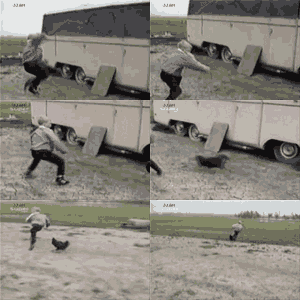
#12: That is hilarious, Linda! Just perfect; a young wannabe ninja boy running away like a scared rabbit from a chicken (Super Chicken?).
#8: Ah! A fellow connoisseur of "George of the Jungle", I see.
#9: Thank you for the info about Roddy Doyle, Luci! I enjoyed your review of The Dead Republic, and your comments about The Deportees reminded me that Caryl Phillips had spoken about a book on multicultural Dublin in an episode of The Book Show on Sky Arts several years ago. I had downloaded this short clip from YouTube onto RealPlayer back then; it's no longer available now, but the book he described and recommended was The Deportees. I'm not sure why I didn't do it before, but I'll put it and The Dead Republic at the top of my wish list.
#10: Hi, Kath!
#11: I'm glad that you're caught up for the moment, Donna! I'm glad to see that the Mitchell is getting some recognition in the US; it's on the top 10 bestseller lists for fiction at Foyles (the bookshop in central London) and on Amazon UK. Hopefully it will become popular here, as well.
#12: That is hilarious, Linda! Just perfect; a young wannabe ninja boy running away like a scared rabbit from a chicken (Super Chicken?).
14elkiedee
You might want to look at A Star Called Henry before The Dead Republic.
15richardderus
*fluffs feathers*
Good. A new thread before I have to hint in my accustomed subtle, gentle way.
Why are you laughing, Darryl?
Good. A new thread before I have to hint in my accustomed subtle, gentle way.
Why are you laughing, Darryl?
16kidzdoc
#14: If I read the trilogy, should I do it in order? Or, are the books not connected, as in J.G. Farrell's Empire Trilogy?
BTW, I'll start Troubles after I finish Waiting for the Wild Beasts to Vote.
#15: Richard! Good to see you. You have me well trained; when my thread gets to 225 posts or so, I start to think about creating a new one.
Why am I laughing? Other than my usual silliness, what are you referring to in particular?
The second match of the day has just ended; Japan defeated Cameroon 1-0, in a dull and poorly played match, IMO. I missed the first match of the day (Netherlands 2, Denmark 0), but I'll definitely watch Italy-Paraguay this afternoon.
BTW, I'll start Troubles after I finish Waiting for the Wild Beasts to Vote.
#15: Richard! Good to see you. You have me well trained; when my thread gets to 225 posts or so, I start to think about creating a new one.
Why am I laughing? Other than my usual silliness, what are you referring to in particular?
The second match of the day has just ended; Japan defeated Cameroon 1-0, in a dull and poorly played match, IMO. I missed the first match of the day (Netherlands 2, Denmark 0), but I'll definitely watch Italy-Paraguay this afternoon.
17elkiedee
The books in the trilogy are connected and probably best read in order, though it's not essential.
18Cariola
Gotcha starred again.
#9, 13: The Deportees was one of my top reads of 2008. It's a truly wonderful and surprising collection.
#9, 13: The Deportees was one of my top reads of 2008. It's a truly wonderful and surprising collection.
19richardderus
>16 kidzdoc: I was hearing derisive laughter at the idea of me being subtle and gentle in my demands for new, shorter threads. It really is a polite thing to do, especially for popular threads like yours and Stasia's, so that even folks trapped in medieval tech like dial-up *delicate shudder* can enjoy with the rest of the twenty-first century. I think you're showing your native good breeding, but then again that's nothing unusual for you.
20arubabookwoman
Nice review of Jacob de Zoet. As you know I generally liked it, but not the part taking place in the creepy monastary, which I thought was out of place, unnecessary and unbelievable. However, I definitely do not agree with the snarky Amazon review referenced by Peter (beach read, plus some much nastier comments).
Re Doyle--Paddy Clarke is by far my favorite. I also loved all the books in The Barrytown Trilogy, and I think they should be read in order. All three of the books were made into relatively good movies. I believe you've said you don't usually watch movies, but I'd really recommend you watch The Committments movie--that's the one involving the Irish kids trying to get an American soul music band going. The movie brings the music alive in a way the book can't. I didn't care for the Paula Spencer books--same setting, but too much bitterness. Haven't read the Star Called Henry trilogy.
I think you will like Empire of the Sun. In some ways, the protagonist is very similar to Paddy Clarke, a kid growing up (in this case in horrendous circumstances in a Japanese POW camp) but with the same combination of innocence, sense of humor and wonder.
And I'll be interested in your take on Cloud Atlas--it's such a different book than de Zoet.
Re Doyle--Paddy Clarke is by far my favorite. I also loved all the books in The Barrytown Trilogy, and I think they should be read in order. All three of the books were made into relatively good movies. I believe you've said you don't usually watch movies, but I'd really recommend you watch The Committments movie--that's the one involving the Irish kids trying to get an American soul music band going. The movie brings the music alive in a way the book can't. I didn't care for the Paula Spencer books--same setting, but too much bitterness. Haven't read the Star Called Henry trilogy.
I think you will like Empire of the Sun. In some ways, the protagonist is very similar to Paddy Clarke, a kid growing up (in this case in horrendous circumstances in a Japanese POW camp) but with the same combination of innocence, sense of humor and wonder.
And I'll be interested in your take on Cloud Atlas--it's such a different book than de Zoet.
21brenzi
Oh I saw The Committments movie a long time ago and loved it for the music. I didn't even know about the book at that time.
22kidzdoc
#18: My local Borders has The Deportees, so I'll definitely pick it up on my next trip there. I was going to go out today, but it's just as hot today as yesterday, and my asthma is flaring up indoors; going outside would not be a good idea for me today. I hate staying inside again, but I'm cool and quite comfortable.
#19: I think you're showing your native good breeding, but then again that's nothing unusual for you.
Actually I think I was showing my cluelessness; on second reading, your message (#15) now makes perfect sense.
#20: I found a useful interview of David Mitchell by John Self, who asked Mitchell about the monastery. His reply:
LT's Sonya Green will be interviewing Mitchell next month, and there is a thread in which LT members can ask questions to be posed to him:
David Mitchell, about The Thousand Autumns of Jacob de Zoet
I've starred this thread, and think of a question or two to post there. The questions must be submitted by July 1st.
Thanks for the comments about Roddy Doyle. I think I'll hold off on the Barrytown Trilogy for now, but I will pick up The Deportees, Empire of the Sun and Cloud Atlas this week.
#21: Although I didn't see it, the story about the movie The Committments is familiar to me; I'll look for it at Borders.
I've finished the first half of the authorized biography, The World Is What it Is, and it is excellent so far. The author is not sympathetic to Naipaul, but he does portray him as a sympathetic and very complex man. It's very readable and interesting, but I still have a way to go (nearly 300 pages). Hopefully I'll finish it by tomorrow, and review it tomorrow or Wednesday.
#19: I think you're showing your native good breeding, but then again that's nothing unusual for you.
Actually I think I was showing my cluelessness; on second reading, your message (#15) now makes perfect sense.
#20: I found a useful interview of David Mitchell by John Self, who asked Mitchell about the monastery. His reply:
Mount Shiranui was the Temple of Atuan from Ursula le Guin’s Earthsea book, The Tombs of Atuan. The idea of a menagerie of disfigured people occurs in José Donoso’s The Obscene Bird of Night.
LT's Sonya Green will be interviewing Mitchell next month, and there is a thread in which LT members can ask questions to be posed to him:
David Mitchell, about The Thousand Autumns of Jacob de Zoet
I've starred this thread, and think of a question or two to post there. The questions must be submitted by July 1st.
Thanks for the comments about Roddy Doyle. I think I'll hold off on the Barrytown Trilogy for now, but I will pick up The Deportees, Empire of the Sun and Cloud Atlas this week.
#21: Although I didn't see it, the story about the movie The Committments is familiar to me; I'll look for it at Borders.
I've finished the first half of the authorized biography, The World Is What it Is, and it is excellent so far. The author is not sympathetic to Naipaul, but he does portray him as a sympathetic and very complex man. It's very readable and interesting, but I still have a way to go (nearly 300 pages). Hopefully I'll finish it by tomorrow, and review it tomorrow or Wednesday.
23tymfos
Found your new thread. I cannot keep up with you!
BTW, I remember George of the Jungle . . . only half a year, was that all?
BTW, I remember George of the Jungle . . . only half a year, was that all?
24kidzdoc
Hi Terri! According to the George of the Jungle page on Wikipedia, the show was only broadcast on Saturday mornings on ABC from September to December of 1967, and only 17 episodes were produced. It went into reruns after that; I seem to remember seeing it on Saturday mornings, but I think the reruns mainly came on during the week, probably on WNEW, WOR, or WPIX in the NYC area. The Rocky & Bullwinkle show was in reruns for years throughout my childhood; George of the Jungle was on the air for several years, but not as long as Bullwinkle.
25phebj
I remember Rocky and Bullwinkle but George of the Jungle is not ringing a bell, probably because I was 13 in 1967. Did you ever see the Fractured Fairy Tales? I used to love those.
26cameling
Finally I've found your new thread! Whew! I loved George of the Jungle .. but thought Bush Jr. looked like him. (sorry no offense all baby Bush fans)
Actually I'm still reeling from a post you wrote in your previous thread where you claim to be a "novice reader"! Clearly you have a different definition of the word 'novice', Darryl! If you're a novice reader, I'm clearly a ....errr..... what's before novice... embryonic? ....reader.
Actually I'm still reeling from a post you wrote in your previous thread where you claim to be a "novice reader"! Clearly you have a different definition of the word 'novice', Darryl! If you're a novice reader, I'm clearly a ....errr..... what's before novice... embryonic? ....reader.
27Chatterbox
Bloody hell. I'm just catching up here.
I think Troubles just arrived. Alas, a cat promptly fell asleep on the box, so I haven't dared open it yet to find out! I may start with Farrell's Singapore book, however, and read backwards.
Novice reader, my rear end.
I think Troubles just arrived. Alas, a cat promptly fell asleep on the box, so I haven't dared open it yet to find out! I may start with Farrell's Singapore book, however, and read backwards.
Novice reader, my rear end.
28kidzdoc
Argh! I'd really like it if Firefox would allow you to save your work before it decides to crash.
Let's try this again...
#25: I do remember the Fractured Fairy Tales, Pat. They used to come in between the halves of each Rocky & Bullwinkle episode, I think.
#26: LOL! That resemblance would make it hard to respect the POTUS.
Unlike my overly harsh criticism of Atlanta, I honestly do think of myself as a novice reader. I never took a college literature course, as I was an engineering major originally, and only had to take a semester of technical writing and another term of public speaking to meet the college's English requirement. My initial book review on LT at the end of 2008 was the first one I've written since my senior year of high school (1978). I probably read more books (162?) last year than I did in entire time between my high school graduation and the middle of 2000, when I began to read again for pleasure after I finished my residency. And, whenever I read certain reviews, written by people who have a stronger background in literature, sometimes my reviews seem high schoolish in comparison.
I'm not trying to bemoan my lack of a better background in literature, and I don't feel inferior to anyone here (for the most part!), but I do feel that I have a lot to learn. And, actually, in a way it's a good thing, as I'm regularly being exposed to great authors who are new to me, so it's kind of exciting and very stimulating. I'm also very happy to be in a supportive environment of fellow readers here on LT!
I think I'm getting a bit moody after staying inside for the past five days; I must go outside tomorrow, regardless of the heat and bad air.
Let's try this again...
#25: I do remember the Fractured Fairy Tales, Pat. They used to come in between the halves of each Rocky & Bullwinkle episode, I think.
#26: LOL! That resemblance would make it hard to respect the POTUS.
Unlike my overly harsh criticism of Atlanta, I honestly do think of myself as a novice reader. I never took a college literature course, as I was an engineering major originally, and only had to take a semester of technical writing and another term of public speaking to meet the college's English requirement. My initial book review on LT at the end of 2008 was the first one I've written since my senior year of high school (1978). I probably read more books (162?) last year than I did in entire time between my high school graduation and the middle of 2000, when I began to read again for pleasure after I finished my residency. And, whenever I read certain reviews, written by people who have a stronger background in literature, sometimes my reviews seem high schoolish in comparison.
I'm not trying to bemoan my lack of a better background in literature, and I don't feel inferior to anyone here (for the most part!), but I do feel that I have a lot to learn. And, actually, in a way it's a good thing, as I'm regularly being exposed to great authors who are new to me, so it's kind of exciting and very stimulating. I'm also very happy to be in a supportive environment of fellow readers here on LT!
I think I'm getting a bit moody after staying inside for the past five days; I must go outside tomorrow, regardless of the heat and bad air.
29Chatterbox
Heavens, yes, get thee out of doors!!!
I didn't take any college lit classes either; I'd had enough of it in high school, where I did the Intl. Baccalaureate and the AP English exams my senior year. I got tired of required reading, and reading in order to parse a text and tease out themes. I wanted to go back to reading for pleasure. And I think every reader has a lot to learn, and we know it -- and that is partly why we read. It's just that the gaps in our knowledge vary wildly.
I didn't take any college lit classes either; I'd had enough of it in high school, where I did the Intl. Baccalaureate and the AP English exams my senior year. I got tired of required reading, and reading in order to parse a text and tease out themes. I wanted to go back to reading for pleasure. And I think every reader has a lot to learn, and we know it -- and that is partly why we read. It's just that the gaps in our knowledge vary wildly.
30kidzdoc
#27: Hey! I missed that smarmy comment, Ms. McGee.
I have Troubles and The Singapore Grip. I'll probably read the latter book in the fall.
I have Troubles and The Singapore Grip. I'll probably read the latter book in the fall.
31Chatterbox
Smarmy?? Moi???? *harumph*
(oh no, I'm starting to sound like Richard...)
(oh no, I'm starting to sound like Richard...)
32bonniebooks
I had a similar conversation with myself today, Darryl, so I understand what you're saying--although I think most people are going to *totally laugh* at your self-analysis of your writing! ;-) I guess some people just have higher expectations of themselves than others do--must be why you're a doctor?! And there are some beautiful writers on LT whose reviews I thoroughly enjoy even when I'm not one bit interested in the book. I, myself, just want to get down some ideas and/or feelings that will be worthwhile for me to read when I go back at the end of the year. But I applaud your goals--we all benefit from them! :-)
33kidzdoc
#29: Normally I hate staying inside on days that I'm off, but weather like this is likely to worsen my asthma. One of my partners at work, who suffers far more with her asthma than I do, was having an attack last week, and I wanted to avoid the same thing. Fortunately I'm off tomorrow and Wednesday, so I can go out when I please.
As I'd mentioned several times last year, my high school literature courses all but killed my love of reading; I doubt that we read more than two or three books in four years that I really enjoyed. After the first couple of years of that, I had no desire to take AP literature courses, and I focused on AP biology, chemistry, physics and math (calculus?).
During my last six months of residency at Emory (Jan-Jul 2000) I had time to read, and wanted to resume reading for pleasure again, after I saw episodes of The Charlie Rose Show that featured discussions of articles in The New Yorker. I started reading the magazine, for the first time, that year, which exposed me to new authors. One of them was Haruki Murakami, and my first read that year was The Wind-Up Bird Chronicle, which knocked my socks off. I read two of his other books immediately afterward, and then read Waiting by Ha Jin, who was teaching at Emory at the time. Later that year, or early the following year, I stumbled upon Blindness by José Saramago, which also blew me away. After that I started to read more novels by international authors, as the American authors I was reading were nowhere near as interesting.
Sorry, that was probably TMI. Back to Mr. Naipaul...
As I'd mentioned several times last year, my high school literature courses all but killed my love of reading; I doubt that we read more than two or three books in four years that I really enjoyed. After the first couple of years of that, I had no desire to take AP literature courses, and I focused on AP biology, chemistry, physics and math (calculus?).
During my last six months of residency at Emory (Jan-Jul 2000) I had time to read, and wanted to resume reading for pleasure again, after I saw episodes of The Charlie Rose Show that featured discussions of articles in The New Yorker. I started reading the magazine, for the first time, that year, which exposed me to new authors. One of them was Haruki Murakami, and my first read that year was The Wind-Up Bird Chronicle, which knocked my socks off. I read two of his other books immediately afterward, and then read Waiting by Ha Jin, who was teaching at Emory at the time. Later that year, or early the following year, I stumbled upon Blindness by José Saramago, which also blew me away. After that I started to read more novels by international authors, as the American authors I was reading were nowhere near as interesting.
Sorry, that was probably TMI. Back to Mr. Naipaul...
34kidzdoc
#31: Smarmy?? Moi???? *harumph*
(oh no, I'm starting to sound like Richard...)
OMG. That was probably the most frightening thing I've read in months. I'll just assume that you took too much Nyquil tonight...
#32: I think you're right, Bonnie. I think I'm my own worst judge, as I'll criticize myself for not reading more medical journal articles or being a better teacher on hospital rounds (despite numerous positive reports from the residents and medical students).
(oh no, I'm starting to sound like Richard...)
OMG. That was probably the most frightening thing I've read in months. I'll just assume that you took too much Nyquil tonight...
#32: I think you're right, Bonnie. I think I'm my own worst judge, as I'll criticize myself for not reading more medical journal articles or being a better teacher on hospital rounds (despite numerous positive reports from the residents and medical students).
35sibylline
Lovely, this discussion, and isn't it strangely reminiscent of stories about 'how I met my true love' that reading a good book, finding a new author, or, er, finding LT, is!?
36bonniebooks
>34 kidzdoc:: Darryl, I used to work for 2 very hard-working, conscientious doctors and they hardly ever had enough time to read their journals (I know because they kept piling up until I eventually filed them, mostly unread) and I imagine it has only gotten worse in the last 35 years! And I can't imagine you not being a good teacher, because you're always so helpful here, sharing relevant medical info. that you think might be helpful to us. But, I'm not trying to reassure you--just sharing my reactions to your comments. Always enjoy how people come to their love of reading.
37elkiedee
This is a really interesting conversation, not TMI at all. My degree did include literature courses, but I didn't study science or maths after 16. You've more than caught up since then. Your writing about books is wonderful and I bet you're a great paediatrician and a great teacher of others. It's a shame that your high school had such a bad impact in terms of turning you against reading for pleasure for 20+ years, though.
38rebeccanyc
#28, 29 This probably isn't fair to say, but you are probably better readers because you didn't take college literature courses! I read a lot in high school (great English department plus my own reading), and my one college lit class (poetry, which I had read a lot of in high school) was a disaster. Too much (for me) on the techniques of poetry, too little on ideas and just what made the poems great to read.
Before everyone jumps all over me, I will say that I know this isn't true of all college literature classes, and many people probably learned a lot in them AND got a lot of enjoyment of reading from them, but not me. I escaped them and preserved my love of reading.
And I will add that one of the benefits of reading (although it's not why I do it) is that we learn with everything we read.
Before everyone jumps all over me, I will say that I know this isn't true of all college literature classes, and many people probably learned a lot in them AND got a lot of enjoyment of reading from them, but not me. I escaped them and preserved my love of reading.
And I will add that one of the benefits of reading (although it's not why I do it) is that we learn with everything we read.
39flissp
Hallo again Darryl! You are one of the many who seem to have started new threads in my absence, so I'm going to read this one first and go back to the last at some point in the future - so appologies in advance if I cover old ground!
Re Roddy Doyle, I'm going to second elkiedee with her recommendation for The Barrytown Trilogy - particularly The Commitments (and the film is how I discovered Roddy Doyle in the first place)...
...and you've reminded me that I need to get The Thousand Autumns of Jacob de Zoet... ...and to take a look at that Q&A...
"The second match of the day has just ended; Japan defeated Cameroon 1-0, in a dull and poorly played match, IMO. I missed the first match of the day (Netherlands 2, Denmark 0), but I'll definitely watch Italy-Paraguay this afternoon." - is this the football we're talking about? I'm very grumpy about that at the moment, because it completely screwed up my tennis viewing (Queens Club, Aegeon ATP Championship) on Saturday by bringing forward a gig I was going to after the tennis to mid-afternoon, so that I missed the best match. Pah!
"Your writing about books is wonderful" seconded! I enjoy your reviews even when I know they're not going to be added to the list Darryl and you read such an eclectic mix - it's very good for me as I tend to get stuck in a rut ;o)
I also haven't studied literature since I was 16 - it wasn't really an option for me with science A-Levels unfortunately and I always knew I'd read the books anyway (and there are some books I didn't want to analyse). My little sister did do English Literature A-Level and it has made me realise how much more you can get out of some books by more constructive reading. One day, I should like to chase that up...
Re Roddy Doyle, I'm going to second elkiedee with her recommendation for The Barrytown Trilogy - particularly The Commitments (and the film is how I discovered Roddy Doyle in the first place)...
...and you've reminded me that I need to get The Thousand Autumns of Jacob de Zoet... ...and to take a look at that Q&A...
"The second match of the day has just ended; Japan defeated Cameroon 1-0, in a dull and poorly played match, IMO. I missed the first match of the day (Netherlands 2, Denmark 0), but I'll definitely watch Italy-Paraguay this afternoon." - is this the football we're talking about? I'm very grumpy about that at the moment, because it completely screwed up my tennis viewing (Queens Club, Aegeon ATP Championship) on Saturday by bringing forward a gig I was going to after the tennis to mid-afternoon, so that I missed the best match. Pah!
"Your writing about books is wonderful" seconded! I enjoy your reviews even when I know they're not going to be added to the list Darryl and you read such an eclectic mix - it's very good for me as I tend to get stuck in a rut ;o)
I also haven't studied literature since I was 16 - it wasn't really an option for me with science A-Levels unfortunately and I always knew I'd read the books anyway (and there are some books I didn't want to analyse). My little sister did do English Literature A-Level and it has made me realise how much more you can get out of some books by more constructive reading. One day, I should like to chase that up...
40flissp
#38 It's interesting you say that Rebecca - poetry is an area I'm horrendously under-read (sp?) in - I just doing "get" it most of the time (there are exceptions) and I've always thought that a bit of technique might make me appreciate more. I suppose anything taught badly is going to be detrimental.
"we learn with everything we read" - definitely true!
"we learn with everything we read" - definitely true!
41kidzdoc
#35: Right you are, Lucy; there are few things more pleasurable than discovering a great new book or author. The novels that had the most impact on me in the past 10+ years include The Wind-Up Bird Chronicle, Blindness, Midnight's Children (Rushdie), Wolf Hall (of course), A House for Mr. Biswas (Naipaul), The Feast of the Goat (Vargas Llosa) and The Remains of the Day (Ishiguro).
#36: I really must do better, starting today. I haven't kept up with the journals as well as I've done in years past.
#37: I had a couple of good literature teachers in high school, including my 9th grade teacher. My guess is that their ability to bring literature alive was severely hampered by the curriculum and the selection of books from the powers that be in the school district. We were fed a bland and repetitive diet of 19th and 20th century Americana from authors like Twain, Steinbeck, F. Scott Fitzgerald, and Salinger; nothing controversial, no books by Faulkner or Hemingway, certainly no books by African American or Latino authors, no books by non-American authors (unlike you count Shakespeare, ick), and I doubt any books by women authors. It was like eating American cheese sandwiches on white bread with mayo every day.
#36: I really must do better, starting today. I haven't kept up with the journals as well as I've done in years past.
#37: I had a couple of good literature teachers in high school, including my 9th grade teacher. My guess is that their ability to bring literature alive was severely hampered by the curriculum and the selection of books from the powers that be in the school district. We were fed a bland and repetitive diet of 19th and 20th century Americana from authors like Twain, Steinbeck, F. Scott Fitzgerald, and Salinger; nothing controversial, no books by Faulkner or Hemingway, certainly no books by African American or Latino authors, no books by non-American authors (unlike you count Shakespeare, ick), and I doubt any books by women authors. It was like eating American cheese sandwiches on white bread with mayo every day.
42kidzdoc
#38: This may not be a fair comparison, and I may be completely wrong, but I see similarities in appreciating literature and music. I didn't take college courses in either subject, and I think I would understand and appreciate both to a higher degree with more formal training. Then again, maybe I would focus too much on analysis, deconstruction and criticism, and enjoy books and music less.
And I will add that one of the benefits of reading (although it's not why I do it) is that we learn with everything we read.
I absolutely agree! I find it difficult to express why I think a knowledge of literature is important to become a sensitive and caring physician, nurse or other health care provider, but I know that many other physicians, including Danielle Ofri and Perri Klass, also feel this way.
#39: Tennis??? It's World Cup time, forget about tennis! I'm watching the New Zealand-Slovakia match now on Univision (Spanish language station in the US), which is also helping with my Spanish comprehension. Portugal and Brasil are playing, in separate matches, later today.
My little sister did do English Literature A-Level and it has made me realise how much more you can get out of some books by more constructive reading. One day, I should like to chase that up...
Exactly. I bought a book a couple of years ago, How to Read Literature Like a Professor, which might be a good first step. I should add that to my list of summer reads. Has anyone read this book?
And I will add that one of the benefits of reading (although it's not why I do it) is that we learn with everything we read.
I absolutely agree! I find it difficult to express why I think a knowledge of literature is important to become a sensitive and caring physician, nurse or other health care provider, but I know that many other physicians, including Danielle Ofri and Perri Klass, also feel this way.
#39: Tennis??? It's World Cup time, forget about tennis! I'm watching the New Zealand-Slovakia match now on Univision (Spanish language station in the US), which is also helping with my Spanish comprehension. Portugal and Brasil are playing, in separate matches, later today.
My little sister did do English Literature A-Level and it has made me realise how much more you can get out of some books by more constructive reading. One day, I should like to chase that up...
Exactly. I bought a book a couple of years ago, How to Read Literature Like a Professor, which might be a good first step. I should add that to my list of summer reads. Has anyone read this book?
43alcottacre
#42: I read it back in 2008, Darryl. I found it very helpful, plus the author does not try and talk down to you like you are an idiot or something.
45sibylline
I was a lucky one - or maybe nothing and nobody could ruin reading for me. Darryl -- In the hands of the right teachers all of those authors could have come to life for you and led the class into serious discussions. I wrote my masters paper (for an MFA in writing) on Gatsby and it is a bottomless masterpiece at every level .... from the question of the trustworthy narrator to the one still very much before us of human greed, arrogance and cruelty --- oh I stop me in my tracks right now -- BUT I am lucky, in middle and high school, yes both private, I read extensively in a wide range -- reading of African American writers, less Latino but some Spanish and plenty of European and Russian and not only Anglo. I don't always think so well of the school I attended for three years near Rochester NY (7th to 9th) but I realize now they had an amazing agenda to clue all of us in on social and ethical matters -- and I remember it -- by 9th grade I'd read How the Other Half Lives, The Autobio. of Malcolm X, The Invisible Man, The Jungle and many many more -- I don't think we were aware of what an intense program the school (private, progressive) had devised, but I loved the reading and it was formative that is for certain. Ironically at that time there were maybe a handful of African American students in the entire school. But all the more reason.
I've been wistfully reading science on the side ever since meeting the last high school science requirement...... so it goes both ways.....
I recommend William Carlos Williams for anyone who is thinking of reading poetry who hasn't read very much and feels nervous about 'getting it'
Forgive me for dithering on! Some days LT gets me a little over-excited.
I've been wistfully reading science on the side ever since meeting the last high school science requirement...... so it goes both ways.....
I recommend William Carlos Williams for anyone who is thinking of reading poetry who hasn't read very much and feels nervous about 'getting it'
Forgive me for dithering on! Some days LT gets me a little over-excited.
46rebeccanyc
I read a wonderful book called Reading Like a Writer by the wonderful Francine Prose. I should probably read it again. The problem for me is that one of the main things she recommends is reading slowly, and I find it so so difficult to do that.
47kidzdoc
I was one of a very small number of African American students in a decent suburban high school (Neshaminy, a name that will be familiar to the Pennsylvanians in this group); my graduating class had over 400 students, but I can count my AfrAm classmates on the fingers of one hand. I don't remember any Latino or Asian students in my class, and there may have been one or two in the entire high school. I enjoyed my high school classmates and teachers, and was treated very well, but I wouldn't call the curriculum progressive. I think that my 9th grade literature teacher did recommend books to me that she thought I would like, including several of the ones you mentioned, Lucy, and I did read some of those books.
I'm ashamed to say that I haven't read anything by William Carlos Williams! Must change that...
All ditherers are welcome on this thread. :)
I'm ashamed to say that I haven't read anything by William Carlos Williams! Must change that...
All ditherers are welcome on this thread. :)
48richardderus
How to Read, and Why is Harold Bloom's entry into the "be a better reader" manual sweepstakes. It's excellent. So is The Closing of the American mind by ALLAN Bloom...not reading is one of the closures.
Remaining a novice is one thing that those who get VERY old have in common. They never decide that they've learned all they need to learn, remain curious and interested in the world, and so are less prone to "giving up" and losing the will to remain involved.
I Grandly Ignore the maligning of my character perpetrated above. It is Beneath One's Notice. *ruffles feathers*
Remaining a novice is one thing that those who get VERY old have in common. They never decide that they've learned all they need to learn, remain curious and interested in the world, and so are less prone to "giving up" and losing the will to remain involved.
I Grandly Ignore the maligning of my character perpetrated above. It is Beneath One's Notice. *ruffles feathers*
49kidzdoc
#46: I forgot that I had read Reading Like a Writer a couple of years ago. I agree with you; I have too many books I want to read to slow my reading speed too much.
#48: I thought I had How to Read and Why. Actually, I'm sure that I have it, probably in one of my boxes of books that I haven't looked at in awhile. I definitely don't have The Closing of the American Mind, though.
Remaining a novice is one thing that those who get VERY old have in common. They never decide that they've learned all they need to learn, remain curious and interested in the world, and so are less prone to "giving up" and losing the will to remain involved.
I love that statement, and couldn't agree with you more.
GOOOOOOOOOOOOOOOOOOOOOOALL!!! New Zealand scored a beautiful goal in the 4th minute of extra time, just seconds before the final whistle, and the New Zealand-Slovakia match ended in a 1-1 draw.
#48: I thought I had How to Read and Why. Actually, I'm sure that I have it, probably in one of my boxes of books that I haven't looked at in awhile. I definitely don't have The Closing of the American Mind, though.
Remaining a novice is one thing that those who get VERY old have in common. They never decide that they've learned all they need to learn, remain curious and interested in the world, and so are less prone to "giving up" and losing the will to remain involved.
I love that statement, and couldn't agree with you more.
GOOOOOOOOOOOOOOOOOOOOOOALL!!! New Zealand scored a beautiful goal in the 4th minute of extra time, just seconds before the final whistle, and the New Zealand-Slovakia match ended in a 1-1 draw.
50Eat_Read_Knit
#28 I'm regularly being exposed to great authors who are new to me, so it's kind of exciting and very stimulating
I definitely agree with you that belonging to this community is excellent in this respect: I can definitely see the changes in my own reading, and in my own critical thinking about my reading material, since I joined LT. Hearing people enthuse about books I wouldn’t have thought of reading has broadened my horizons far more than reading reviews in the press ever did.
#39 I dropped English Lit at 16 too. My teachers weren’t bad enough to put me off books, but I certainly felt then that studying a book removed the joy from it, and I wanted to enjoy books. English lessons certainly put me off poetry.
I barely remember what we studied, but I remember that I didn’t like any of it. I knew there was something depressing about nuclear holocaust. I loathed doing Shakespeare, but in the last couple of years I’ve tried again and found I quite like him.
I did enjoy The Importance of being Ernest, and To Kill a Mockingbird was okay, but I don’t think we were taught enough about the context of either to appreciate them. Then again, having a class of sixteen-year-olds that included barely-literate kids who struggled to read the text and literature-mad future Oxbridge students must have been one heck of a challenge for the teachers, and IMO neither the teachers nor any of the kids nor the books were well served by that arrangement.
#42 I see similarities in appreciating literature and music. … I think I would understand and appreciate both to a higher degree with more formal training.
I think you’re right: I dropped music at 14 after practically no instruction in school whatsoever, and since then I’ve learned enough about it to begin to realise how little I understand. In both cases, I think, it’s possible to appreciate the work with no training, but to gain far more from it with an understanding of the technical skill that’s gone into it and a trained eye/ear for the details.
#45 I've been wistfully reading science on the side ever since meeting the last high school science requirement...... so it goes both ways.....
And me! No science after 16 (unless you count a bit of archaeology), no maths after 18; I really like dipping into geology, physics and natural history, but I do wish I understood more.
All of which is a reminder that we never stop learning, and it’s never too late to fill in the gaps in our education.
ETA: #48 Remaining a novice is one thing that those who get VERY old have in common. They never decide that they've learned all they need to learn, remain curious and interested in the world, and so are less prone to "giving up" and losing the will to remain involved.
You said it better than me!
(That'll teach me to spend 45 minutes simultaneously composing several posts for different threads while I eat lunch, and thereby cross-posting with half the known universe.)
I definitely agree with you that belonging to this community is excellent in this respect: I can definitely see the changes in my own reading, and in my own critical thinking about my reading material, since I joined LT. Hearing people enthuse about books I wouldn’t have thought of reading has broadened my horizons far more than reading reviews in the press ever did.
#39 I dropped English Lit at 16 too. My teachers weren’t bad enough to put me off books, but I certainly felt then that studying a book removed the joy from it, and I wanted to enjoy books. English lessons certainly put me off poetry.
I barely remember what we studied, but I remember that I didn’t like any of it. I knew there was something depressing about nuclear holocaust. I loathed doing Shakespeare, but in the last couple of years I’ve tried again and found I quite like him.
I did enjoy The Importance of being Ernest, and To Kill a Mockingbird was okay, but I don’t think we were taught enough about the context of either to appreciate them. Then again, having a class of sixteen-year-olds that included barely-literate kids who struggled to read the text and literature-mad future Oxbridge students must have been one heck of a challenge for the teachers, and IMO neither the teachers nor any of the kids nor the books were well served by that arrangement.
#42 I see similarities in appreciating literature and music. … I think I would understand and appreciate both to a higher degree with more formal training.
I think you’re right: I dropped music at 14 after practically no instruction in school whatsoever, and since then I’ve learned enough about it to begin to realise how little I understand. In both cases, I think, it’s possible to appreciate the work with no training, but to gain far more from it with an understanding of the technical skill that’s gone into it and a trained eye/ear for the details.
#45 I've been wistfully reading science on the side ever since meeting the last high school science requirement...... so it goes both ways.....
And me! No science after 16 (unless you count a bit of archaeology), no maths after 18; I really like dipping into geology, physics and natural history, but I do wish I understood more.
All of which is a reminder that we never stop learning, and it’s never too late to fill in the gaps in our education.
ETA: #48 Remaining a novice is one thing that those who get VERY old have in common. They never decide that they've learned all they need to learn, remain curious and interested in the world, and so are less prone to "giving up" and losing the will to remain involved.
You said it better than me!
(That'll teach me to spend 45 minutes simultaneously composing several posts for different threads while I eat lunch, and thereby cross-posting with half the known universe.)
51sibylline
It isn't the most comfortable feeling -- that of perennial novice. I read somewhere that particularly people who have achieved a very high level of expertise in a couple of areas fairly early on in life, find it hard to be beginners at anything.
I do not have this problem.
I do not have this problem.
52phebj
Remaining a novice is one thing that those who get VERY old have in common. They never decide that they've learned all they need to learn, remain curious and interested in the world, and so are less prone to "giving up" and losing the will to remain involved.
I love that statement, and couldn't agree with you more.
#48 and #49 Love this comment, Richard, and, like Darryl, couldn't agree more.
I still remember a teacher I had in 4th grade who had us read To Kill a Mockingbird. It's still one of my favorite books and I remember her clearly to this day, whereas most of my teachers were entirely forgettable.
Being a member of several book clubs and of LT, especially, has done much to expand the types of books I read and the enjoyment I get out of them.
And Darryl, I love following you here on LT.
I love that statement, and couldn't agree with you more.
#48 and #49 Love this comment, Richard, and, like Darryl, couldn't agree more.
I still remember a teacher I had in 4th grade who had us read To Kill a Mockingbird. It's still one of my favorite books and I remember her clearly to this day, whereas most of my teachers were entirely forgettable.
Being a member of several book clubs and of LT, especially, has done much to expand the types of books I read and the enjoyment I get out of them.
And Darryl, I love following you here on LT.
53alcottacre
#44: No, I am afraid not. Although I do know that Foster does have another book titled How to Read Novels Like a Professor. My local library does not have that one though, so I have not had a chance to read it yet.
54richardderus
>52 phebj: Pat, in fourth grade one of my forgotten best teachers read The Lion, the Witch, and the Wardrobe aloud to us at rest-time every Spring day. We finished it as the school year was ending. I was so excited by that, and everyone in the room...most of whom I only saw again in high school, since I changed schools for fifth grade...became readers. I saw all of them who remained in our school system in the upper-level English classes all the rest of our school career.
I really think one good teacher made that difference.
I really think one good teacher made that difference.
55Cariola
As someone who regularly teaches a general education Intro to Lit class, I am sad to report that getting students to read ANYTHING is becoming harder and harder. If it's this bad at the college level, I really feel for high school English teachers. My teaching now focuses mostly on simple comprehension and enjoyment, with just some basics regarding development of plot, character, and theme. When they do read, students generally read only for "what happens"; it's extremely hard to get them to consider things like style or patterns, let alone anything more technical.
Every year I try hard to find something new that the students will enjoy--and that I would not feel bored with or be ashamed to teach. Last semester, they read The True Story of Hansel and Gretel, Cold Mountain, and Q & A (aka Slumdog Millionaire). Most of them came to class not only not having read the material but without bringing the book to class for discussion purposes. At the end of the semester, I asked them which book they enjoyed most. Only five chose Cold Mountain, the most "literary" of the books; The True Story of Hansel and Gretel, which had the least to commend it as "literature," was the favorite.
I've been working on a article about the decline of reading for pleasure, based on my experience with last year's freshman placement essays as well as in the classroom. The students were given some excerpts from articles about the young people not reading for pleasure and some of the reasons why, and were asked to respond in a brief essay. The most common reply was, "I've got better things to do" (delineated by such things as hanging with friends, playing video games, checking Facebook). One wrote, "There are no books that interest me"--how could anyone possibly say that? Another comment that I found shocking: "When I was little, I enjoyed reading because it was a challenge, but it got old real fast."
They complained about the books assigned for classes, suggesting that they be allowed to choose their own books. ("Who wants to read Huckleberry Finn when all he does is fish and play marbles?") This may sound good--but think about it. How many would choose a classic or something even remotely of literary value? While I agree that reading the Twilight series is better than not reading at all, do I want to pretend that it is teach-worthy? Do I want to read it so that I can make sense of their book reviews or write exams on it? One of the problems here is that teachers are being told to make material "relevant." Again, this sounds like a good idea; but isn't the role of higher education to expand students' horizons rather than to keep pandering to their 17-year old tastes? And as many of you have noted above, you may not have appreciated a book when in school but went back to it later. There's a reason some books become classics and that others, like crime novels, provide an enjoyable read but rarely have an impact on readers' lives.
OK, enough complaining from the other side of the desk.
Every year I try hard to find something new that the students will enjoy--and that I would not feel bored with or be ashamed to teach. Last semester, they read The True Story of Hansel and Gretel, Cold Mountain, and Q & A (aka Slumdog Millionaire). Most of them came to class not only not having read the material but without bringing the book to class for discussion purposes. At the end of the semester, I asked them which book they enjoyed most. Only five chose Cold Mountain, the most "literary" of the books; The True Story of Hansel and Gretel, which had the least to commend it as "literature," was the favorite.
I've been working on a article about the decline of reading for pleasure, based on my experience with last year's freshman placement essays as well as in the classroom. The students were given some excerpts from articles about the young people not reading for pleasure and some of the reasons why, and were asked to respond in a brief essay. The most common reply was, "I've got better things to do" (delineated by such things as hanging with friends, playing video games, checking Facebook). One wrote, "There are no books that interest me"--how could anyone possibly say that? Another comment that I found shocking: "When I was little, I enjoyed reading because it was a challenge, but it got old real fast."
They complained about the books assigned for classes, suggesting that they be allowed to choose their own books. ("Who wants to read Huckleberry Finn when all he does is fish and play marbles?") This may sound good--but think about it. How many would choose a classic or something even remotely of literary value? While I agree that reading the Twilight series is better than not reading at all, do I want to pretend that it is teach-worthy? Do I want to read it so that I can make sense of their book reviews or write exams on it? One of the problems here is that teachers are being told to make material "relevant." Again, this sounds like a good idea; but isn't the role of higher education to expand students' horizons rather than to keep pandering to their 17-year old tastes? And as many of you have noted above, you may not have appreciated a book when in school but went back to it later. There's a reason some books become classics and that others, like crime novels, provide an enjoyable read but rarely have an impact on readers' lives.
OK, enough complaining from the other side of the desk.
56flissp
"#39: Tennis??? It's World Cup time, forget about tennis! I'm watching the New Zealand-Slovakia match now on Univision" - the thing is Darryl that much of the UK is obsessed with football (to the detriment of all other sports imho) all year round - usually I don't dislike the game (although I don't generally choose to watch it), but during the World Cup, my hackles go up - particularly at this time of year, which is definitely tennis season (Queens last week and Wimbledon starting next week) ;o)
All these "how to read" type books sound interesting - I don't know why, but it's never occurred for me to look for something like that (notes down the whole lot...)
"I really think one good teacher made that difference" - this is why the teaching profession is so important. I had a similar experience (along with parents who used to read to us at bedtime and plied us with their own childhood favourites)
All these "how to read" type books sound interesting - I don't know why, but it's never occurred for me to look for something like that (notes down the whole lot...)
"I really think one good teacher made that difference" - this is why the teaching profession is so important. I had a similar experience (along with parents who used to read to us at bedtime and plied us with their own childhood favourites)
57phebj
#55 The most common reply was, "I've got better things to do" (delineated by such things as hanging with friends, playing video games, checking Facebook). One wrote, "There are no books that interest me"--how could anyone possibly say that?
Wow, Deborah, I have to say this is depressing. I'm always astonished when someone says they never read.
The thing is though you may never know how much you may influence someone as a teacher. I know I never said anything to that 4th grade teacher that had such an impact on me.
Wow, Deborah, I have to say this is depressing. I'm always astonished when someone says they never read.
The thing is though you may never know how much you may influence someone as a teacher. I know I never said anything to that 4th grade teacher that had such an impact on me.
58mckait
I have to say that as much as I agree that one good teacher can make a difference, I believe a bad one, or a series of indifferent ones can to. That is what I see all too often these days, indifference. I do not mean to malign teachers, as I see it in every profession. I believe that teaching should not just be a way to make a living, but an avocation. I also blieve that the inflexible teachers, or those who think that they have nothing left to learn should be promptly ushered out the door. With Fanfare.
59kidzdoc
#45, 50: That reminds me, there are a couple of science books I wanted to read this summer, which were both shortlisted for the Royal Society Prizes for Science Books last year: The Age of Wonder by Richard Holmes, and Bad Science by Ben Goldacre.
This year's longlist for this award should be coming out soon; it came out in late May last year.
#51: Me neither.
#52: Thanks, Pat!
#53: Thanks, Stasia; I wonder how that book differs from his one on literature.
#54: Totally agree; one good teacher (or librarian or other adult figure who reads) can make all the difference. I was a voracious reader as a young child, which started before I attended school. My father reads a lot, but not as much as he did when I was a tyke, and my mother didn't read that much. My paternal grandfather may have been a bigger influence on me; I'll have to ask my mother about this.
The kids that went to our residents' clinic would be given a book as they left. It's so important for kids to be exposed to books at a young age, especially if they come from homes where their parent(s) don't—or frequently can't—read, as was the case for a sizable minority of the families that attended our clinic.
#55: Interesting comments from "the other side", Deborah. I'll probably come back to this later, for additional comments on my experiences in high school.
#56: much of the UK is obsessed with football (to the detriment of all other sports imho) all year round
Ah, good point, Fliss. Football (or any sport) would become tiresome if it was being played or discussed all year long. A lot of the excitement in American sports is the beginning of the seasons, especially for baseball and football (professional and college).
I thought that Brasil was going to dominate North Korea; however, it's a scoreless match at halftime. Brasil seemed tentative, as if its players were probing the North Korean defense for openings rather than attacking the goal. Hopefully the strikers will be more aggressive in the second half.
This year's longlist for this award should be coming out soon; it came out in late May last year.
#51: Me neither.
#52: Thanks, Pat!
#53: Thanks, Stasia; I wonder how that book differs from his one on literature.
#54: Totally agree; one good teacher (or librarian or other adult figure who reads) can make all the difference. I was a voracious reader as a young child, which started before I attended school. My father reads a lot, but not as much as he did when I was a tyke, and my mother didn't read that much. My paternal grandfather may have been a bigger influence on me; I'll have to ask my mother about this.
The kids that went to our residents' clinic would be given a book as they left. It's so important for kids to be exposed to books at a young age, especially if they come from homes where their parent(s) don't—or frequently can't—read, as was the case for a sizable minority of the families that attended our clinic.
#55: Interesting comments from "the other side", Deborah. I'll probably come back to this later, for additional comments on my experiences in high school.
#56: much of the UK is obsessed with football (to the detriment of all other sports imho) all year round
Ah, good point, Fliss. Football (or any sport) would become tiresome if it was being played or discussed all year long. A lot of the excitement in American sports is the beginning of the seasons, especially for baseball and football (professional and college).
I thought that Brasil was going to dominate North Korea; however, it's a scoreless match at halftime. Brasil seemed tentative, as if its players were probing the North Korean defense for openings rather than attacking the goal. Hopefully the strikers will be more aggressive in the second half.
60Whisper1
Deborah
Once again, I'm adding a book that you recommended. My tbr pile is filled with them!
The True Story of Hansel and Gretel sounds like a book I would really like to read.
Once again, I'm adding a book that you recommended. My tbr pile is filled with them!
The True Story of Hansel and Gretel sounds like a book I would really like to read.
61cameling
For anyone who might think they're not reading enough, I'd just direct them to Darryl's or Stasia's threads .... I'll bet they get more reading done on these threads on any single day, then most people do in a given week.
62kidzdoc
Caroline, are you watching Brasil-North Korea? Brasil (the team I like watching more than any other) just scored on an impossible goal, and the offense is playing well.
63labwriter
>55 Cariola:. I'd be curious to know where you teach. I was an "adult student" when I went back to school for a second career. I finished two lit degrees at a city college, BA and MA, so I took a lot of lit classes with students who, as you describe, never read the material and probably never bought the book. In one of my first undergrad lit classes, the professor, bless him, had each student read aloud. He just went down the row and had people read out loud from the short story that had been assigned. He was a brand new "baby doc," which is probably why he did it--he didn't know better--ha. It was quite a revelation to me to learn that there were, quite literally, students in the class who evidently could barely read. What they were doing at the university in the first place is anybody's guess. Then once I got into the Jr. and Sr. level lit classes, who were the WORST students of all for coming to class unprepared with the reading? Did you guess? It was the education majors. Who becomes a teacher if they apparently either dislike or are completely indifferent to school? Yet it was a pattern I saw in many classes. Rant off.
Ed. for fat-finger typing.
Ed. for fat-finger typing.
64souloftherose
#59 I read Bad Science earlier this year and would recommend it. I can't say I enjoyed all of it because it's not that sort of book but I've been recommending and loaning out to lots of people since then.
#61 Very true!
#61 Very true!
65Eat_Read_Knit
#59 I've heard very good things about Bad Science: I'll be interested to discover what you think of that one.
(And this whole conversation reminds me that I must pick up The Earth: an Intimate History again: it was shortlisted for the prize in 2005.)
#55 isn't the role of higher education to expand students' horizons rather than to keep pandering to their 17-year old tastes?
This is probably a rhetorician question, but: Definitely.
I think good teaching can take into account what the kids are interested in, uses it as a hook to get their interest, and move on from there. While it might be okay to start a particular project by looking at something like Twilight, that's only ever as an introduction to exploring, I don't know, Vampire literature from Dracula onward, or the portrayal of male-female romantic relationships in another book, or something.
On the other hand, it might be better to avoid some of the popular stuff altogether. I remember teaching a unit on the sinking of the Titanic that was supposed to teach source analysis, and using* the James Cameron film as a starting point; with hindsight, I think it became more about 'comparing these documents to the film' than about the contemporary evidence. 'Comparing these books to Twilight' probably doesn't help the kids to engage properly with Dracula or Bleak House or whatever.
I think I need to think some more about this.
#63 Who becomes a teacher if they apparently either dislike or are completely indifferent to school?
That baffles me. Having a passion both for the subject AND for sharing your knowledge and love of the subject is an absolute sine qua non as far as I'm concerned.
*This was a unit that the school had in place before I started working there: I had no say in the syllabus or the detail.
(And this whole conversation reminds me that I must pick up The Earth: an Intimate History again: it was shortlisted for the prize in 2005.)
#55 isn't the role of higher education to expand students' horizons rather than to keep pandering to their 17-year old tastes?
This is probably a rhetorician question, but: Definitely.
I think good teaching can take into account what the kids are interested in, uses it as a hook to get their interest, and move on from there. While it might be okay to start a particular project by looking at something like Twilight, that's only ever as an introduction to exploring, I don't know, Vampire literature from Dracula onward, or the portrayal of male-female romantic relationships in another book, or something.
On the other hand, it might be better to avoid some of the popular stuff altogether. I remember teaching a unit on the sinking of the Titanic that was supposed to teach source analysis, and using* the James Cameron film as a starting point; with hindsight, I think it became more about 'comparing these documents to the film' than about the contemporary evidence. 'Comparing these books to Twilight' probably doesn't help the kids to engage properly with Dracula or Bleak House or whatever.
I think I need to think some more about this.
#63 Who becomes a teacher if they apparently either dislike or are completely indifferent to school?
That baffles me. Having a passion both for the subject AND for sharing your knowledge and love of the subject is an absolute sine qua non as far as I'm concerned.
*This was a unit that the school had in place before I started working there: I had no say in the syllabus or the detail.
66Cariola
63> Not sure why you were asking, but I teach in on of the PA State System of Higher Ed universities. Were you guessing that this situation is worse in inner city schools or those with a higher rate of older studnets? Maybe, but I really don't think so. Most returning ("adult") students I've encountered tend to work a lot harder than those who are 18-22. They've been out working in the real world, they're paying for their own education, and they know what a difference it can make.
Our secondary certification majors have to keep a higher GPA than other majors, so most of them are pretty conscientious.
Our secondary certification majors have to keep a higher GPA than other majors, so most of them are pretty conscientious.
67labwriter
>66 Cariola:. No, I was just curious. That's just me--curious. No, I wasn't guessing. I've attended everything from a large state school (U of Colorado, Boulder) to a private Catholic girls' school (College of St. Mary, Omaha) to a city junior college (Tarrant County Jr. College, Fort Worth, TX), to my city college (U of Missouri, St. Louis). --All of that is really hard on the transcript, by the way--ha. I also taught at a smallish "international" university in my own town, (Webster University, St. Louis, MO). What I took from all those experiences, and what I tried to teach my students at UMSL and Webster, is that you can get a good education anywhere you go--it's up to you. And I really believe that. My favorite students were ex-military. They were so pragmatic, they kept their eye on the goal, and they worked hard. I agree with you, "returning" students work harder than the ones who are going at it the first time around. At least for me, they were the most rewarding to teach. Although I would say that I loved all of my students; they tended to be the kind of students who had never really had a decent break in school--miserable public school high school experience, most of them.
68Cariola
While I agree that there are good teachers and bad teachers, I do get discouraged by the attitude that if students aren't engaged, it's the fault of a "bad" teacher. Some of of us have more well over 100 students in our classes and are also dealing with parents, administrators, legislators, plus other expectations (standardized testing, meetings, committee work, required research and scholarship, etc.). I try hard every semester to change the works on my syllabus to more engaging ones and to come up with interesting assignments and exercises: game shows, student presentations, role playing, you name it.
What some folks don't realize is that we are now in a culture that is very anti-intellectual, and that reading is seen by many young people as a waste of time and something that only geeks do. It's pretty tough for a teacher, even one who loves her material and her students, to break through the barrier of peer pressure.
Also, today's students have been raised on technology. While it certainly has its good points, not only has technology affected their ability to concentrate and their attention spans, but it has promoted, for good or for ill, the idea that anything worth doing can be done quickly and easily. Reading takes time--unless you are assigned something you can find summarized on SparkNotes (which is another reason I keep changing my books, and why plagiarism is rampant).
My colleagues and I frequently discuss these problems and share with each other what we are doing to try to get the students more involved. I don't think any of us are bad or uncaring teachers. If we didn't care, we wouldn't be trying so hard. Education is a two-way street--especially in a culture where student centered learning is privileged. We are, in fact, appalled at administration's attempts to raise the caps in a course like Intro to Lit (already at 42), claiming "it's just a lecture class." None of us teach it that way!
65> I actually did a section of Intro to Lit that focused on the supernatural. Among other things, we read Frankenstein (one student informed me that she had read it before, that it was "a really bad book," and that there was nothing I could do to change her mind); Dr. Jekyll and Mr. Hyde (they liked it a little better but it was "old"); The Picture of Dorian Gray (not only "old" but "gay"); and several good contemporary vampire short stories (about which it was still like pulling teeth to get them to talk). I did not stoop to Twilight, however. One of my students asked me at the beginning of every class if we were going to get out early, followed by, "It's not you, I just hate literature."
What some folks don't realize is that we are now in a culture that is very anti-intellectual, and that reading is seen by many young people as a waste of time and something that only geeks do. It's pretty tough for a teacher, even one who loves her material and her students, to break through the barrier of peer pressure.
Also, today's students have been raised on technology. While it certainly has its good points, not only has technology affected their ability to concentrate and their attention spans, but it has promoted, for good or for ill, the idea that anything worth doing can be done quickly and easily. Reading takes time--unless you are assigned something you can find summarized on SparkNotes (which is another reason I keep changing my books, and why plagiarism is rampant).
My colleagues and I frequently discuss these problems and share with each other what we are doing to try to get the students more involved. I don't think any of us are bad or uncaring teachers. If we didn't care, we wouldn't be trying so hard. Education is a two-way street--especially in a culture where student centered learning is privileged. We are, in fact, appalled at administration's attempts to raise the caps in a course like Intro to Lit (already at 42), claiming "it's just a lecture class." None of us teach it that way!
65> I actually did a section of Intro to Lit that focused on the supernatural. Among other things, we read Frankenstein (one student informed me that she had read it before, that it was "a really bad book," and that there was nothing I could do to change her mind); Dr. Jekyll and Mr. Hyde (they liked it a little better but it was "old"); The Picture of Dorian Gray (not only "old" but "gay"); and several good contemporary vampire short stories (about which it was still like pulling teeth to get them to talk). I did not stoop to Twilight, however. One of my students asked me at the beginning of every class if we were going to get out early, followed by, "It's not you, I just hate literature."
69labwriter
I share and also empathize with your discouragement about student attitudes. I absolutely agree with your frustration and have experienced it myself. Many students are so passive. They don't belong at the university, but can't seem to think of anything else to do. I once had a class full of education majors (a writing class) at Webster U, a very "unusual" school, to say the least--if you have $40,000, then you are guaranteed a seat--they seem to specialize in Asperger Syndrome students. I had five of them one semester, although the administration wouldn't tell me anything about them because of "privacy" issues. Whatever. Anyway, most of these 14 students were education majors. Sometime during the middle of the semester, I stopped what I was doing that day and asked them, "Why are you in school?" I pointed out that, as education majors, it only seemed logical that they would eventually be looking to teach somewhere at some point. Why were they majoring in education if they so obviously disliked school? It was like pointing out that the emperor had no clothes. None of them would even look me in the eye. Of course I was called into the dept. head's office for a chat. Actually, I was happy to talk to him about the "reality" of the students the university was graduating as educators in our community. Ach.
70phebj
One of my students asked me at the beginning of every class if we were going to get out early, followed by, "It's not you, I just hate literature."
This is funny but also sad.
I was interested to hear your comments about technology. I've heard some people say that multi-tasking is not a bad thing but it's hard for me to believe you can really concentrate on more than one thing at a time.
This is funny but also sad.
I was interested to hear your comments about technology. I've heard some people say that multi-tasking is not a bad thing but it's hard for me to believe you can really concentrate on more than one thing at a time.
71Cariola
70> A book on the some of the negative effects of technology just came out and has gotten a lot of buzz: The Shallows: What the Internet is Doing to Our Brains by Nicholas Carr. You can read a short NPR interview here.
As to multi-tasking, well, I'm not convinced that it's a good thing. (Aside from it being just plain rude to see students texting in the middle of class.) As soon as class is over, 42 cell phones are whipped out. I get razzed by colleagues because I have a cell phone but never turn it on. I use it to make long distance calls and while traveling, and I carry it with me in case of emergencies. But I don't WANT to be constantly connected. How did we all survive when we didn't have cell phones and not even voicemail or answering machines?
As to multi-tasking, well, I'm not convinced that it's a good thing. (Aside from it being just plain rude to see students texting in the middle of class.) As soon as class is over, 42 cell phones are whipped out. I get razzed by colleagues because I have a cell phone but never turn it on. I use it to make long distance calls and while traveling, and I carry it with me in case of emergencies. But I don't WANT to be constantly connected. How did we all survive when we didn't have cell phones and not even voicemail or answering machines?
72phebj
#71 Thanks for the link, Deborah. I had heard something on NPR about the book. Even the title is a little disturbing: The Shallows.
I also have never gotten into the whole cell phone thing. I have one but mostly use it when I travel.
I also have never gotten into the whole cell phone thing. I have one but mostly use it when I travel.
73cameling
Darryl - unfortunately I had a meeting this afternoon and couldn't watch the Brasil/N.Korea game live but I TIVOed it, and watched the game when I got home. It's always a delight watching Brasil play ... but they weren't very aggressive in this game, I think because they knew it was a given that they'd win, and I think because they wanted to avoid taking unnecessary risks in anyone on their team being injured. But I'm glad the N.Koreans managed to score 1 goal at least ... they looked so happy... not like poor Australia after their 4-0 trouncing by Germany.
74Chatterbox
Normally, I only use my cell when I travel. I don't have a plan, and spend less than $100 in a typical year for my prepaid account. So much more sensible. I don't WANT to be reachable constantly -- but I think that's also a generational thing. Many of those I know in their 20s feel dysfunctional without their gizmos. For me, it's a question of whether the technology is going to enhance my life. So I love my iPod and my Kindle, but have zero interest in an iPad.
75kidzdoc
I've just finished the excellent V.S. Naipaul biography, The World Is What it Is by Patrick French (4-1/2 stars). Tomorrow I will review this large book, and then immediately fly to Trinidad, where I will beat Naipaul to death with it. Afterwards, I'll have every book and article that he has written sent to my jail cell, so that I can read everything he has written.
He has to be one of the most despicable authors of all time. The way he treated his wife, and even his mistress, at the end of the book is beyond belief and understanding.
Deep breath...I'll start Waiting for the Wild Beasts to Vote now, and hopefully finish it tomorrow.
He has to be one of the most despicable authors of all time. The way he treated his wife, and even his mistress, at the end of the book is beyond belief and understanding.
Deep breath...I'll start Waiting for the Wild Beasts to Vote now, and hopefully finish it tomorrow.
76torontoc
Have you read Paul Theroux's book about Naipaul?- Sir Vidia's Shadow? I think that they were friends before this book and Naipaul's second marriage. The artist who is brilliant but horrible in their life is an interesting subject. Look at Picasso!
77Chatterbox
I loved the Theroux book! There's a fine line between people wanting artists to be somehow superhumanly wonderful in ALL dimensions of their life, and the artist who ruthlessly takes advantage of their status to mess with everyone around them and go on an ego trip, feeling entitled to do so because of their talent. It would be lovely to have the talent without the latter, and I wonder if it's possible or if it's just that some v. talented people just happen to be prats, in the same way that some very ordinary people are nincompoops.
Anyway, I loved Enigma of Arrival by Naipaul.
Anyway, I loved Enigma of Arrival by Naipaul.
78alcottacre
#75: Please do not get yourself thrown in jail in Trinidad. I cannot bail you out there!
79kidzdoc
Sorry; I fell asleep just after I posted my comment about the Naipaul biography. I'm not on my way to Trinidad—yet.
#76: I haven't read Theroux's biography; however, this biography discusses Sir Vidia's Shadow and the relationship—I'm not sure that "friendship" is the right word—between Naipaul and Theroux in detail. Theroux apparently worshipped and befriended Naipaul after they initially met in Kenya in the 1970s. Naipaul initially embraced and nurtured this friendship, but distanced himself from Theroux after he left Africa. French analyzes Sir Vidia's Shadow and notes that it is inconsistent and in some places contrived, but he does praise it overall.
I did pick up Picasso: A Biography by Patrick O'Brian after I saw the Picasso exhibit at the Philadelphia Museum of Art this spring (er, I guess it is still spring; it's hard to think of it as spring when it was at least 97 degrees here yesterday!). I had only recently learned that he was also a horrible person. I'll read this later this year, maybe in the fall.
#77: I could forgive Naipaul's treatment of his fellow writers (e.g., Theroux), critics and others around him. However, his treatment of Pat, his first wife, and those closest to him, including his parents and siblings, was disturbing and despicable. For example, at the end of her life, his mother was asked how his son (Vidia) was doing; she replied that she had no son, as he had died, a reference to Vidia's late younger brother Shiva. Let's see...okay, I found the passage, toward the end of the book:
I'll review the book later today, maybe after breakfast.
#78: I've changed my mind. I like the book too much to use it on Naipaul. And the jails there probably don't have A/C or sufficient reading material.
#76: I haven't read Theroux's biography; however, this biography discusses Sir Vidia's Shadow and the relationship—I'm not sure that "friendship" is the right word—between Naipaul and Theroux in detail. Theroux apparently worshipped and befriended Naipaul after they initially met in Kenya in the 1970s. Naipaul initially embraced and nurtured this friendship, but distanced himself from Theroux after he left Africa. French analyzes Sir Vidia's Shadow and notes that it is inconsistent and in some places contrived, but he does praise it overall.
I did pick up Picasso: A Biography by Patrick O'Brian after I saw the Picasso exhibit at the Philadelphia Museum of Art this spring (er, I guess it is still spring; it's hard to think of it as spring when it was at least 97 degrees here yesterday!). I had only recently learned that he was also a horrible person. I'll read this later this year, maybe in the fall.
#77: I could forgive Naipaul's treatment of his fellow writers (e.g., Theroux), critics and others around him. However, his treatment of Pat, his first wife, and those closest to him, including his parents and siblings, was disturbing and despicable. For example, at the end of her life, his mother was asked how his son (Vidia) was doing; she replied that she had no son, as he had died, a reference to Vidia's late younger brother Shiva. Let's see...okay, I found the passage, toward the end of the book:
Despite the photo in the Guardian, Vidia and his mother were not properly reconciled. Not long before she died, Nella went to visit her and said, 'So how is your son?' Ma replied, 'I have no son. The son I had died.'
I'll review the book later today, maybe after breakfast.
#78: I've changed my mind. I like the book too much to use it on Naipaul. And the jails there probably don't have A/C or sufficient reading material.
80kidzdoc
#77: I forgot to mention that I haven't read The Enigma of Arrival yet (do I have it?). This book makes me want to read several of his travelogues and analyses of other cultures, particularly Among the Believers: An Islamic Journey, India: A Million Mutinies Now and The Loss of El Dorado: A Colonial History. I've read all of his novels, except for The Enigma of Arrival, The Mimic Men, and maybe one or two lesser works.
81elkiedee
I look forward to reading your review including the plans to visit Trinidad and the rest. But don't. You probably wouldn't have internet access there either....
82kidzdoc
Book #67: The World Is What it Is: The Authorized Biography of V.S. Naipaul by Patrick French

My rating:
Winner, National Book Critics Circle Award, 2008 (nonfiction)
Shortlist, Samuel Johnson Prize (2008)
First, a little background for those who aren't familiar with the subject of this biography.
Vidiadhar Surajprasad (V.S.) Naipaul (1932-), the winner of the 2001 Nobel Prize for Literature, is one of the most highly regarded authors of the 20th century. He was born in Trinidad, and his ancestors were part of the Indian migration to this Caribbean island in the 19th century. He was awarded a scholarship to Oxford in 1950, where he met his wife, the former Patricia Hale. After his graduation he dedicated his life to becoming a writer, and was financially supported by Pat during his early years of struggle and poverty. He met with critical success starting with his first two novels, The Mystic Masseur (1957) and Miguel Street (1959), and he received international acclaim for A House for Mr. Biswas his 1961 novel which is arguably his best. All of these novels were based in the Indian community of Trinidad that was familiar to him from childhood, and Mr. Biswas is a fictionalized representation of his father.
In the early 1960s, due to disillusionment with life in England, he began to travel abroad, and his later fiction, travelogues, and historical accounts were based in these countries, which included Trinidad and other Caribbean nations, India, Argentina, Uganda and Kenya. He cast a critical and unblinking eye upon the developing world; his books and magazine articles were applauded in Europe and the US, but former friends and colleagues from these lands viewed his work with disdain and a sense of betrayal. His notable later works in this middle period include In a Free State, the winner of the 1971 Booker Prize, India: A Wounded Civilization (1977), A Bend in the River (1979), and Among the Believers: An Islamic Journey (1981).
He finally achieved financial success in the 1980s, and he continued to be a productive and controversial writer in this later period. His most notable works were The Enigma of Arrival (1987) and India: A Million Mutinies Now (1990).
Pat died of breast cancer in 1996, and very soon afterward he married Nadira, a journalist from Pakistan that he met while Pat was terminally ill. His literary output since Patricia's death has been meager and mediocre, and he wrote his last novel, Magic Seeds, in 2004.
(Hmm; a little background?)
Patrick French, an award winning historian and biographer, was given full access to Mr. Naipaul and his papers and those of his first wife, and this extensively researched biography is the result. It follows 10 years after Paul Theroux's memoir Sir Vidia's Shadow, but French's book is more historically accurate and less personal than Theroux's work.
French describes Naipaul as a man who is a citizen of the world, but one who is lost in the places that he has called home. He was a member of the Indian minority in Trinidad, which became isolated from and polarized against its black majority, particularly after Eric Williams became the country's first prime minister after independence, and his relationships with his parents and siblings were distant and strained. He appeared to be most comfortable in England, but racism, a growing anti-immigrant sentiment and financial difficulty deeply affected and wounded him. He was even less comfortable in India, as he was unable to see the country's beauty and opportunity in the face of its crushing poverty and filth, a pattern that would be repeated in subsequent journeys to other countries. This is described in the first portion of the book, as French effectively portrays Naipaul as a sympathetic but difficult man, and demonstrates how this influenced his writing.
In keeping with his upbringing and rootlessness he was irascible and confrontational, and those closest to him, especially Pat, bore the brunt of his frequent tirades. Naipaul's career would not have been possible without Patricia, who tirelessly served him as a personal aide, confidant, and unpaid editor. However, he was not sexually attracted to her, and he began to seek satisfaction elsewhere, initially with prostitutes, and then in a long standing affair with Margaret Gooding, that destroyed Patricia's spirit once she became aware of it. French provides frequent examples of his dalliances and his difficult relationships throughout the second half of the book. Unfortunately, much of this section becomes gossipy and overly personal, and too many pages are spent in the description of Naipaul's affair.
The biography ends with Patricia's death in 1996, as Nadira moves in with Naipaul the day after the funeral.
The World Is What it Is is a richly detailed biography of Mr. Naipaul, as an author and a deeply flawed human being. The overemphasis on Naipaul's affairs and scandalous personal behavior in the second half of the book was a distraction, which added little to our understanding of the man. I would highly recommend this for those who are interested in Naipaul, but only marginally for everyone else.

My rating:

Winner, National Book Critics Circle Award, 2008 (nonfiction)
Shortlist, Samuel Johnson Prize (2008)
First, a little background for those who aren't familiar with the subject of this biography.
Vidiadhar Surajprasad (V.S.) Naipaul (1932-), the winner of the 2001 Nobel Prize for Literature, is one of the most highly regarded authors of the 20th century. He was born in Trinidad, and his ancestors were part of the Indian migration to this Caribbean island in the 19th century. He was awarded a scholarship to Oxford in 1950, where he met his wife, the former Patricia Hale. After his graduation he dedicated his life to becoming a writer, and was financially supported by Pat during his early years of struggle and poverty. He met with critical success starting with his first two novels, The Mystic Masseur (1957) and Miguel Street (1959), and he received international acclaim for A House for Mr. Biswas his 1961 novel which is arguably his best. All of these novels were based in the Indian community of Trinidad that was familiar to him from childhood, and Mr. Biswas is a fictionalized representation of his father.
In the early 1960s, due to disillusionment with life in England, he began to travel abroad, and his later fiction, travelogues, and historical accounts were based in these countries, which included Trinidad and other Caribbean nations, India, Argentina, Uganda and Kenya. He cast a critical and unblinking eye upon the developing world; his books and magazine articles were applauded in Europe and the US, but former friends and colleagues from these lands viewed his work with disdain and a sense of betrayal. His notable later works in this middle period include In a Free State, the winner of the 1971 Booker Prize, India: A Wounded Civilization (1977), A Bend in the River (1979), and Among the Believers: An Islamic Journey (1981).
He finally achieved financial success in the 1980s, and he continued to be a productive and controversial writer in this later period. His most notable works were The Enigma of Arrival (1987) and India: A Million Mutinies Now (1990).
Pat died of breast cancer in 1996, and very soon afterward he married Nadira, a journalist from Pakistan that he met while Pat was terminally ill. His literary output since Patricia's death has been meager and mediocre, and he wrote his last novel, Magic Seeds, in 2004.
(Hmm; a little background?)
Patrick French, an award winning historian and biographer, was given full access to Mr. Naipaul and his papers and those of his first wife, and this extensively researched biography is the result. It follows 10 years after Paul Theroux's memoir Sir Vidia's Shadow, but French's book is more historically accurate and less personal than Theroux's work.
French describes Naipaul as a man who is a citizen of the world, but one who is lost in the places that he has called home. He was a member of the Indian minority in Trinidad, which became isolated from and polarized against its black majority, particularly after Eric Williams became the country's first prime minister after independence, and his relationships with his parents and siblings were distant and strained. He appeared to be most comfortable in England, but racism, a growing anti-immigrant sentiment and financial difficulty deeply affected and wounded him. He was even less comfortable in India, as he was unable to see the country's beauty and opportunity in the face of its crushing poverty and filth, a pattern that would be repeated in subsequent journeys to other countries. This is described in the first portion of the book, as French effectively portrays Naipaul as a sympathetic but difficult man, and demonstrates how this influenced his writing.
In keeping with his upbringing and rootlessness he was irascible and confrontational, and those closest to him, especially Pat, bore the brunt of his frequent tirades. Naipaul's career would not have been possible without Patricia, who tirelessly served him as a personal aide, confidant, and unpaid editor. However, he was not sexually attracted to her, and he began to seek satisfaction elsewhere, initially with prostitutes, and then in a long standing affair with Margaret Gooding, that destroyed Patricia's spirit once she became aware of it. French provides frequent examples of his dalliances and his difficult relationships throughout the second half of the book. Unfortunately, much of this section becomes gossipy and overly personal, and too many pages are spent in the description of Naipaul's affair.
The biography ends with Patricia's death in 1996, as Nadira moves in with Naipaul the day after the funeral.
The World Is What it Is is a richly detailed biography of Mr. Naipaul, as an author and a deeply flawed human being. The overemphasis on Naipaul's affairs and scandalous personal behavior in the second half of the book was a distraction, which added little to our understanding of the man. I would highly recommend this for those who are interested in Naipaul, but only marginally for everyone else.
83torontoc
I read two books by Naipaul's late brother,Shiva. -Beyond the Dragon's Mouth and North of South: an African Journey. Great travel writing!
84cameling
Darryl : You might like his An Area of Darkness and India: A Wounded Civilisation which covers his observations of the Indian culture. I thought they were well written, although at times, I detected notes of condescension which irritated me and made me want to reach out and slap him.
Good game between Spain and Switzerland, so far. I brought my netbook to work and have it set up at the corner of my desk, with the volume on low, so that I could watch the matches while I'm at work.
Good game between Spain and Switzerland, so far. I brought my netbook to work and have it set up at the corner of my desk, with the volume on low, so that I could watch the matches while I'm at work.
85kidzdoc
Thanks for that mention, Cyrel. Shiva (1945-1985) was a great writer in his own right, although he had a hard time escaping the shadow of his older brother. In the Naipaul biography, French describes him as an irresponsible, alcoholic and spoiled, but less irritable and more personable than Vidia. Unfortunately he died of a heart attack at the age of 40.
86Whisper1
Darryl
Many thanks for the background information and great review of a book written by an author unfamiliar to me.
Many thanks for the background information and great review of a book written by an author unfamiliar to me.
87phebj
Darryl, a truly fantastic review! Thumbs-up from me. I have a book club in July that's planning to read A Bend in the River. Have you ever read that and, if so, is it good?
88kidzdoc
#84: ¡GOOOOOOOOOOOOOOOOOOL de Suiza! The Spanish keeper tried to make a tackle in the penalty box, and a Swiss striker put the ball in the goal.
I loved the call by the Univision announcer after the only goal in the Chile-Honduras match:
¡GOOOOOOOOOOOOOOOOOOOOOOL! ¡GOL GOL GOL GOL GOL! ¡Gol de los Chilenos! ¡De La Rosa! ¡De La Rosa! ¡De La Rosa! ¡Miráculo! ¡Excelente!
There were a couple of other effusive adjectives he used that I can't remember now. Great stuff.
Spain is on the attack. The rest of this half should be good. Oh! The Swiss keeper just make a great one on one save on a Spanish thrust.
I have read India: A Wounded Civilization, but not his other books about India, An Area of Darkness and India: A Million Mutinies Now. The one I want to read next is Among the Believers: An Islamic Journey; it was originally criticized as being too pessimistic, as it predicted the rise of Islamic fundamentalism, but he was later proven to be mostly correct.
I loved the call by the Univision announcer after the only goal in the Chile-Honduras match:
¡GOOOOOOOOOOOOOOOOOOOOOOL! ¡GOL GOL GOL GOL GOL! ¡Gol de los Chilenos! ¡De La Rosa! ¡De La Rosa! ¡De La Rosa! ¡Miráculo! ¡Excelente!
There were a couple of other effusive adjectives he used that I can't remember now. Great stuff.
Spain is on the attack. The rest of this half should be good. Oh! The Swiss keeper just make a great one on one save on a Spanish thrust.
I have read India: A Wounded Civilization, but not his other books about India, An Area of Darkness and India: A Million Mutinies Now. The one I want to read next is Among the Believers: An Islamic Journey; it was originally criticized as being too pessimistic, as it predicted the rise of Islamic fundamentalism, but he was later proven to be mostly correct.
89richardderus
Oh Pat, Darryl I ain't, but I have to barge in to remark how very, very good A Bend in the River is. Good, good stuff.
And Darryl, isn't it always a disappointing surprise how rotten a person many a great artist is? Tolstoy's treatment of his wife at the end of his life springs forcefully to mind. Roald Dahl's horrific behavior towards Patricia Neal! Iris Murdoch's unkindness and affairs against poor old John Bayley.
Art does not equal character, sadly.
And Darryl, isn't it always a disappointing surprise how rotten a person many a great artist is? Tolstoy's treatment of his wife at the end of his life springs forcefully to mind. Roald Dahl's horrific behavior towards Patricia Neal! Iris Murdoch's unkindness and affairs against poor old John Bayley.
Art does not equal character, sadly.
90phebj
#89 Thanks, Richard. Barge in anytime. Glad to know you liked A Bend in the River. I'm going to try to get it read in time for the book club discussion.
91kidzdoc
Thanks, Linda and Pat. I did like A Bend in a River, which is a sobering novel about an Indian man in an African country. In the biography, Naipaul was told that there was a "99% chance" that it would win the 1979 Booker Prize; however, the prize was awarded to Offshore by Penelop Fitzgerald, which angered him.
Wow! The Swiss and the Spaniards are taking shots at each other like a prize heavyweight fight. This is the best and most equal action of the World Cup so far, IMO.
Wow! The Swiss and the Spaniards are taking shots at each other like a prize heavyweight fight. This is the best and most equal action of the World Cup so far, IMO.
92alcottacre
#82: Great review as usual, Darryl. One of these days I will actually get around to reading the copy of A House for Mr. Biswas that I have owned for over a year now.
94kidzdoc
A HUGE upset. The Spaniards had plenty of chances, and numerous near misses, including the blast that hit the top post late in the second half. Since Chile also won today, they have to win their two remaning games, against Chile and Honduras, and score plenty of goals.
Who is the overall favorite, Brasil, Spain, Portugal, or someone else?
ETA: Definitely read A House for Mr. Biswas, Stasia; it's my favorite book by Naipaul, and was one of my top 10 novels of the past decade.
Who is the overall favorite, Brasil, Spain, Portugal, or someone else?
ETA: Definitely read A House for Mr. Biswas, Stasia; it's my favorite book by Naipaul, and was one of my top 10 novels of the past decade.
95kidzdoc
Art does not equal character, sadly.
Agreed. Patricia Hale Naipaul has to be one of the more tragic spouses in literary history. I would assume that there are dozens or hundreds of similar spouses in other fields of art, as well.
Agreed. Patricia Hale Naipaul has to be one of the more tragic spouses in literary history. I would assume that there are dozens or hundreds of similar spouses in other fields of art, as well.
96richardderus
Depressingly, she's reasonably typical of the non-divorcing type of artist's spouse.
Ariel Durant, my favorite example, only got credit for her contributions to Will's work late in life. I wonder whose careers we're celebrating now that our grandkids will wince over.
Ariel Durant, my favorite example, only got credit for her contributions to Will's work late in life. I wonder whose careers we're celebrating now that our grandkids will wince over.
97kidzdoc
I wonder whose careers we're celebrating now that our grandkids will wince over.
Mmm, good point.
Mmm, good point.
98brenzi
Great review of the French book Darryl. I have read no Naipaul at all yet so I think I'll start with A House for Mr. Biswas on your recommendation.
99bonniebooks
Reviewers have made this biography of Naipaul sound so good that I want to read it even though I don't think I've read anything by him.
100kidzdoc
Thanks Bonnie and Bonnie! Who is Bonnie 1? How about Bonnie 2?

I just posted this to the Books Brought Home - June 2010 thread, and I thought I'd post it here, as well.
I received two books from New York Review Books today:
The Murderess by Alexandros Papadiamantis: "{A} bone-chilling tale of crime and punishment", about an old woman who lives "on the margins of society and at the outer limits of respectability." She tries to stop her newborn granddaughter from crying, and soon realizes that "there’s nothing worse than being born a woman, and there’s something that she...can do about that." I'll read this for next month Reading Globally monthly theme read (Greece).
All About H. Hatterr by G.V. Desani: One of the "most perfectly eccentric and strangely absorbing works modern English has produced," this novel is about the son of a "European merchant officer and a lady from Penang who has been raised and educated in missionary schools in Calcutta", who searches for enlightment in seven Asian cities from a different sage in each city; it is described as "wildly funny and wonderfully bizarre."

I just posted this to the Books Brought Home - June 2010 thread, and I thought I'd post it here, as well.
I received two books from New York Review Books today:
The Murderess by Alexandros Papadiamantis: "{A} bone-chilling tale of crime and punishment", about an old woman who lives "on the margins of society and at the outer limits of respectability." She tries to stop her newborn granddaughter from crying, and soon realizes that "there’s nothing worse than being born a woman, and there’s something that she...can do about that." I'll read this for next month Reading Globally monthly theme read (Greece).
All About H. Hatterr by G.V. Desani: One of the "most perfectly eccentric and strangely absorbing works modern English has produced," this novel is about the son of a "European merchant officer and a lady from Penang who has been raised and educated in missionary schools in Calcutta", who searches for enlightment in seven Asian cities from a different sage in each city; it is described as "wildly funny and wonderfully bizarre."
101phebj
Never heard of either of these books so thanks for the summaries. Also, another thread I've never heard of (Books Brought Home - June 2010). I'm off to check it out.
102rebeccanyc
I just bought The Murderess yesterday, Darryl, when I dropped into a bookstore (well, I planned my route to go by it). I have All About H. Hatter but it has been on the TBR for several years.
103kidzdoc
#102: Are you planning to read The Murderess next month, Rebecca?
105cameling
Spain is touted the favorite but they have a history of folding in the big matches ... namely the WCs. With this loss, their going to the next round is questionable. They'd need to beat both Honduras and Chile. I think they should be able to beat Honduras, but Chile's pretty strong. And SA just lost to Uruguay, so the only way they're going to the next round is if they were to beat France and for Mexico to lose to both France and Uruguay.
All About H. Hatter sounds like a fun read. I'll have to add this to my obese wish list and look out for it.
All About H. Hatter sounds like a fun read. I'll have to add this to my obese wish list and look out for it.
106JanetinLondon
So disappointed by Spain today. After England, they were my second favorite, but they just didn't do it. I think it's because our hero Fernando Torres cut his hair - he looked so different I wouldn't have recognized him without his name on his shirt. So far, only Germany have really shown much, and they didn't have very strong opposition. Friday night's England v Algeria match should be key in showing what England can do.
Did find time to read your reviews and comments, Darryl, just don't have anything sensible to add.
Did find time to read your reviews and comments, Darryl, just don't have anything sensible to add.
107rebeccanyc
#103, Unlike you, Darryl, I never have any idea when I'm going to read anything! If I ever finish Terra Nostra, my plan for the summer is to delve into the nastier parts of the 20th century with nonfiction and possibly fiction. But like all my plans, this may change on a whim.
108kidzdoc
#107: I was thinking that you were also going to read The Murderess for the Reading Globally theme read next month. I am completely unfamiliar with Greek authors or novels, but I found this on the NYRB web site a week or two ago.
109Chatterbox
Got to talk to an Algerian cab driver yesterday; he is taking the entire day off tomorrow in order to watch the England game, and was tremendously amusing (in a way) about the English team... I may try to catch that game, as I have (wonder of wonders) a FREE DAY.
110kidzdoc
#109: Nice! You deserve a free day (or ten).
Argentina is leading South Korea in the 40th minute—and just missed scoring again. Coach Maradona is dancing along the sideline like an elf on crack—uh, have the FIFA officials done a drug test on him recently?
It's back to work for me today; I have to be in at 10 am. So, my World Cup viewing will have to take a back seat for the next six days. Hopefully I'll have a number of Latino patients, so that I can catch glimpses of the matches in their rooms during the day. Better yet, hopefully it will be quiet, and I can follow along in an empty patient's room now and then. I'll probably be able to watch the afternoon match tomorrow (England vs. Algeria), but I doubt that I'll see much of the US-Slovenia match.
Ah! Messi just missed scoring on a brilliant strike. Have any of the international stars done anything in this World Cup yet?
Argentina is leading South Korea in the 40th minute—and just missed scoring again. Coach Maradona is dancing along the sideline like an elf on crack—uh, have the FIFA officials done a drug test on him recently?
It's back to work for me today; I have to be in at 10 am. So, my World Cup viewing will have to take a back seat for the next six days. Hopefully I'll have a number of Latino patients, so that I can catch glimpses of the matches in their rooms during the day. Better yet, hopefully it will be quiet, and I can follow along in an empty patient's room now and then. I'll probably be able to watch the afternoon match tomorrow (England vs. Algeria), but I doubt that I'll see much of the US-Slovenia match.
Ah! Messi just missed scoring on a brilliant strike. Have any of the international stars done anything in this World Cup yet?
111rebeccanyc
#108, Oh, good point! I guess my brain is mush! Maybe I will read it for the Greek theme read; I don't have anything else by a Greek author unless you go back to Sophocles, and I haven't read him since school. I do have some books on the TBR that take place in Greece, and I might read one of those.
112kidzdoc
#111: As you know, The Murderess is a short novel, and it was written in 1903, so I'd like to read another, more contemporary book by a Greek author.
I finished a short book on the relevance of philosophy in the discussion of current issues, Philosophy in the Present, which consisted of the transcript at a conference at Vienna 2004 that featured two European philosophers, Alain Badiou and Slavoj Žižek. Each philosopher gave a short lecture, and then the two discussed their differences afterward. Although the book was touted for people well versed in philosophy and for a general audience, many of the arguments were difficult for me for follow, and seemed irrelevant to the basic question of whether philosophers, as public intellectuals, should express their opinions on the major political and social topics of the day. Bottom line: yes, there is a role for philosophy in modern society, but philosophers should focus on universal themes, and avoid aligning themselves with political parties or countries. This may be of interest for anyone with a strong interest or background in philosophy, but I wouldn't recommend it for anyone else.
I'm about halfway through Waiting for the Wild Beasts to Vote, a satirical novel about a fictional African dictator, that weaves in different themes about postcolonial African society, the colonial powers, beliefs of different cultural groups, etc. It's quite long, but a quick read; I'll probably give it a mediocre rating unless the second half is much better. I should finish this by Saturday.
I finished a short book on the relevance of philosophy in the discussion of current issues, Philosophy in the Present, which consisted of the transcript at a conference at Vienna 2004 that featured two European philosophers, Alain Badiou and Slavoj Žižek. Each philosopher gave a short lecture, and then the two discussed their differences afterward. Although the book was touted for people well versed in philosophy and for a general audience, many of the arguments were difficult for me for follow, and seemed irrelevant to the basic question of whether philosophers, as public intellectuals, should express their opinions on the major political and social topics of the day. Bottom line: yes, there is a role for philosophy in modern society, but philosophers should focus on universal themes, and avoid aligning themselves with political parties or countries. This may be of interest for anyone with a strong interest or background in philosophy, but I wouldn't recommend it for anyone else.
I'm about halfway through Waiting for the Wild Beasts to Vote, a satirical novel about a fictional African dictator, that weaves in different themes about postcolonial African society, the colonial powers, beliefs of different cultural groups, etc. It's quite long, but a quick read; I'll probably give it a mediocre rating unless the second half is much better. I should finish this by Saturday.
113JanetinLondon
Glad you got to watch Argentina v South Korea before work takes over. Finally, one of the top teams bothers to score a bunch of goals. Hopefully the games will all get better now, as teams really need to win to stay in. I hope you get to see at least some of today/tomorrow's games.
114richardderus
>112 kidzdoc: I'd like to read another, more contemporary book by a Greek author Zorba the Greek!
115rebeccanyc
Sorry Waiting for the Wild Beasts to Vote is disappointing; I ordered it from the Book Depository after you mentioned it earlier, partly because the title is so great!
116kidzdoc
Boven is het stil (The Twin) by Gerbrand Bakker is the winner of the 2010 IMPAC Dublin Literary Award:
Dutch gardener reaps Impac prize
Dutch gardener reaps Impac prize
117kidzdoc
#113: Hopefully the games will all get better now, as teams really need to win to stay in.
Like France (who lost to Mexico today)? I think Les Blues are done.
I saw a few minutes of the Nigeria-Greece match, when it was 1-0 Nigeria, and saw the egregious foul by the Nigerian forward. I see that they lost 2-1, and the father of the baby & I were wondering if that ejection of the Nigerian player would turn the match in favor of Greece. I didn't see any of the other matches today.
#114: (Smacks forehead) Thanks!
#115: Waiting for the Wild Beasts to Vote isn't a bad read, it's just a bit on the long side. It's 445 pages long, but I'll almost certainly read it to the end. I'll be interested on your take if you decide to read it.
Like France (who lost to Mexico today)? I think Les Blues are done.
I saw a few minutes of the Nigeria-Greece match, when it was 1-0 Nigeria, and saw the egregious foul by the Nigerian forward. I see that they lost 2-1, and the father of the baby & I were wondering if that ejection of the Nigerian player would turn the match in favor of Greece. I didn't see any of the other matches today.
#114: (Smacks forehead) Thanks!
#115: Waiting for the Wild Beasts to Vote isn't a bad read, it's just a bit on the long side. It's 445 pages long, but I'll almost certainly read it to the end. I'll be interested on your take if you decide to read it.
118arubabookwoman
For my Greek book, I'm going to read Z by Vassilis Vassilikos, a fictionalized acoount of a true political assasination in Greece in the 60's. I believe the writer was jailed for a while. There was a movie made from the book by Costa Gavras, which was excellent.
119flissp
#118 That film was a special request from my Dad for Christmas (he lived in Greece for a little while around that period in time) - it took quite some tracking down, but I agree, it is excellent (it was family viewing after Christmas!)
PS, I think I'm supposed to say yay for France losing? Is that right?
...hmmm. I'm going to a Hag do (Stag/Hen do cross) that basically involves watching the football all day next weekend - maybe I'll get more excited by it after that...
PS, I think I'm supposed to say yay for France losing? Is that right?
...hmmm. I'm going to a Hag do (Stag/Hen do cross) that basically involves watching the football all day next weekend - maybe I'll get more excited by it after that...
120JanetinLondon
Well, France deserve to go out, because they were lazy, bored-looking and unenthusiastic throughout, including, or maybe especially, their coach - every time they showed him on the sidelines he looked like he was dreaming of his wealthy retirement, which is about to start. Nigeria, on the other hand, oh dear, if only that guy had controlled his temper. They were doing so well, and it would have been so nice to see them stay in. Today, of course, is a big day for most of us here on this site - while I definitely support England, I would still like to see the US come second in that group and get to the next round.
#112 - I see you don't particularly recommend Philosophy in the Present - have you read any recent books which do a good job for the general "well educated but not a philosopher" reader?
#112 - I see you don't particularly recommend Philosophy in the Present - have you read any recent books which do a good job for the general "well educated but not a philosopher" reader?
121kidzdoc
#118: Z sounds interesting. Actually, I forgot that I did place a recent Greek book on my Amazon wish list: Landscape With Dog: And Other Stories by Ersi Sotiropoulos, which was published last November. It's over 500 pages, so I might continue my exploration for other titles by this author and others.
#119, 120: I'm not shedding any tears over France's poor performance.
#120: I have a dozen or more books that fit this category, but I don't think I've read any of them yet. I do want to read Ill Fares the Land, Tony Judt's latest book; if I don't get to it this month I'll certainly read it next month.
#119, 120: I'm not shedding any tears over France's poor performance.
#120: I have a dozen or more books that fit this category, but I don't think I've read any of them yet. I do want to read Ill Fares the Land, Tony Judt's latest book; if I don't get to it this month I'll certainly read it next month.
122mckait
107: rebeccanyc... I am with you.... I read depending on the mood of the moment, or my must review this list.....
:)
:)
123kidzdoc
Correction: Landscape With Dog: And Other Stories is only 168 pages (what was I looking at?). Akeela reviewed it in issue 3 of Belletrista (http://www.belletrista.com/2010/issue3/reviews_4.php), so I'll choose this as my second Greece read.
Germany is losing to Serbia 1-0???
Germany is losing to Serbia 1-0???
124kidzdoc
122: Rebecca & I (and other 75ers) participate in the Reading Globally group, and next month's theme is Greece. That's why I thought that she would probably read The Murderess (which was just reissued by New York Review Books Classics within the past few weeks) next month.
125mckait
I think it is one reason ( of many) that I amnot a good group read candidate.
I suspect that no matter how good the book, or how much I wanted to read it, it wouldn't work for me at that time. I wanted to do the read for
Mists of Avalon, love the book, have read many times. The group read came along and I was just plain not in the mood for it, and couldn't read it at that time..
Character flaw :)
I suspect that no matter how good the book, or how much I wanted to read it, it wouldn't work for me at that time. I wanted to do the read for
Mists of Avalon, love the book, have read many times. The group read came along and I was just plain not in the mood for it, and couldn't read it at that time..
Character flaw :)
126kidzdoc
#125: Well, I share your character flaw then! I was a poor leader for my own group read on The Plague, and I haven't done well with other group reads, except for the Reading Globally monthly read, and Jill's Orange January/July reads.
Off to work...
Off to work...
127mckait
I haven't tried another since then, and think it is better that way, for me.
However, I do enjoy reading what others are thinking of the books they are reading, if it happens to be a book that interests me. But in this group, there are so many good books always under discussion.. and just so many good converstions on so many topics, I just don't have time for other groups :)
I feel so lucky to have stumbled into the 75 ers.
However, I do enjoy reading what others are thinking of the books they are reading, if it happens to be a book that interests me. But in this group, there are so many good books always under discussion.. and just so many good converstions on so many topics, I just don't have time for other groups :)
I feel so lucky to have stumbled into the 75 ers.
128alcottacre
#127: I feel so lucky to have stumbled into the 75 ers.
Me too! I cannot imagine what I would do without this group.
Me too! I cannot imagine what I would do without this group.
129TadAD
I find larger Group Reads don't work for me, either. I'm not in the mood for that book, or I want to read more slowly or more quickly, or whatever.
I find, instead, two-person reads much more enjoyable. You still get the benefits of talking about a book plus it's easier to coordinate. I've done a number with various 75ers and enjoy them a lot.
I find, instead, two-person reads much more enjoyable. You still get the benefits of talking about a book plus it's easier to coordinate. I've done a number with various 75ers and enjoy them a lot.
130brenzi
I did two group reads and I'm probably not doing any more for the same reasons that are being discussed here. The reason Reading Globally and the Orange Jan/July works for me is because there is a lot of choice; everyone isn't reading the same book just books that fall w/in a theme.
131alcottacre
I have enjoyed the group reads I have done here in the group. In several cases, being in the group has given me the impetus to finish a book I have been meaning to read for years, like Moby Dick.
132flissp
I have similar problems. After a very interesting group read of Dangerous Liaisons last year, I've been making a deliberate effort to join in with more group reads this year. Darryl, I did enjoy the group read for The Plague, but, I wasn't really in the right frame of mind for it at the time (which is a shame because I'm more in the right frame of mind now) and so ended up being way behind most of the group and not really leaving any comments.
The same thing happened (and to a much greater degree) with the group read for The Elegance of the Hedgehog - I very much wanted to join in with that discussion (which, although I still haven't finished reading all the comments, I think was quite a good one), but I was way behind most of the group and didn't really want to comment/read the comments until I'd had time to mull it over properly. Now I've got so much to catch up on, I still haven't got round, months later, to putting down my thoughts. I shall do at some point in the not too distant future, but of course the group has been and gone for a while now, so won't really be part of the discussion. Sigh.
I don't know, I think Group reads can just be very hit and miss. They're a very good way to make you think more about what you are reading, but you do have to be in the right frame of mind. I suspect The Elegance of the Hedgehog one would have been very interesting if I'd been on the ball enough at the time. I definitely found the Dangerous Liaisons one so. The Chronicles of Prydain group read however, I really didn't get much out of at all I'm afraid. ...I shall keep trying!
The same thing happened (and to a much greater degree) with the group read for The Elegance of the Hedgehog - I very much wanted to join in with that discussion (which, although I still haven't finished reading all the comments, I think was quite a good one), but I was way behind most of the group and didn't really want to comment/read the comments until I'd had time to mull it over properly. Now I've got so much to catch up on, I still haven't got round, months later, to putting down my thoughts. I shall do at some point in the not too distant future, but of course the group has been and gone for a while now, so won't really be part of the discussion. Sigh.
I don't know, I think Group reads can just be very hit and miss. They're a very good way to make you think more about what you are reading, but you do have to be in the right frame of mind. I suspect The Elegance of the Hedgehog one would have been very interesting if I'd been on the ball enough at the time. I definitely found the Dangerous Liaisons one so. The Chronicles of Prydain group read however, I really didn't get much out of at all I'm afraid. ...I shall keep trying!
133labwriter
I completely agree with Stasia. I participated in a group read earlier this year, The Education of Henry Adams. It was a great experience, one of the highlights of my reading for the year. My experience is that group reads are a lot of work, and I'm thinking that possibly a smaller group has a better chance of having a good experience that a larger group, maybe because the members of a smaller group feel an increased level of accountability for making the group read go. We only had three members reading in the group, and if I hadn't kept up with my reading and posting, I definitely would have felt like I was letting down the other two members. That's not to say I felt like doing the reading and posting whenever it needed to be done. So I guess what I'm saying is, my experience was difficult (especially considering the book, which I would not have finished on my own), but when it was over I felt that it was very worthwhile. I would say, keep trying, because a good group read is well worth the effort!
134rebeccanyc
!25, 126 I'm not really suited for group reads either, but I've been trying to use some of the theme reads that allow us to pick the book we want to read as an excuse to read some books that have been languishing on the TBR. Unfortunately (?), that hasn't stopped me from buying new books for them I'm still working on my May Reading Globally group read, so we'll see about the future.
135kidzdoc
The Nobel Prize winning author José Saramago died earlier today:
Nobel laureate José Saramago dies, aged 87
Nobel laureate José Saramago dies, aged 87
136Chatterbox
Wow, well, he had a good long innings. And was recognized in his lifetime. I think what is probably his final book is coming out this summer or autumn. (Just remember spotting it on a Barnes & Noble upcoming releases list...)
137kidzdoc
#136: Yes, The Elephant's Journey will be published in the US on September 8:
The Elephant's Journey
That isn't his last book, though; Cain was published in 2009, in Spanish.
The Elephant's Journey
That isn't his last book, though; Cain was published in 2009, in Spanish.
138BookAngel_a
If there's an intimidating book that I've always wanted to try but never quite managed it...I will join the group read. It seems to work well for me. But only one or two group reads at once. If it's more than that, it becomes stressful...work...all the things reading shouldn't be!!
I never would have kept plugging away at War and Peace and Moby Dick without the group, and I'm so glad I did!
I never would have kept plugging away at War and Peace and Moby Dick without the group, and I'm so glad I did!
139kidzdoc
#130: The reason Reading Globally and the Orange Jan/July works for me is because there is a lot of choice; everyone isn't reading the same book just books that fall w/in a theme.
I completely agree with Bonnie; this flexibility allows me to choose a book that I'm most interested in within the theme, and to abandon it if it isn't to my liking. I like the TIOLI challenge and the Author Theme reads for the same reason.
I'll still participate in group reads of a single book, particularly the Le Salon du Faulkner planned read of The Sound and the Fury next month.
I was surprised to learn of Saramago's passing, as he had been in relatively good health this year. I'll put down my current planned nonfiction reads, and instead read A Journey to Portugal, which I almost decided to read after the Naipaul biography. I'll definitely read at least one Saramago novel over the next month or two, probably The Gospel According to Jesus Christ and/or Baltasar and Blimunda, which I already own. I'll definitely purchase The Elephant's Journey in September, and read that this coming fall.
I completely agree with Bonnie; this flexibility allows me to choose a book that I'm most interested in within the theme, and to abandon it if it isn't to my liking. I like the TIOLI challenge and the Author Theme reads for the same reason.
I'll still participate in group reads of a single book, particularly the Le Salon du Faulkner planned read of The Sound and the Fury next month.
I was surprised to learn of Saramago's passing, as he had been in relatively good health this year. I'll put down my current planned nonfiction reads, and instead read A Journey to Portugal, which I almost decided to read after the Naipaul biography. I'll definitely read at least one Saramago novel over the next month or two, probably The Gospel According to Jesus Christ and/or Baltasar and Blimunda, which I already own. I'll definitely purchase The Elephant's Journey in September, and read that this coming fall.
140arubabookwoman
The other good thing about Reading Globally is that you get to see all the great books on the country or theme that others are reading, and can come away with lots of interesting new books to read. And if you're a few months behind whenyou post, your post won't be stale, because chances are no one else will have read the same book you did.
141Eat_Read_Knit
#138 I, too, find that I get a lot out of group reads but can only manage one or two at a time. One of my bad habits is to go from "I have to read this book right now" to "I'd love to read it at some point - but right now I want to read this other book" very quickly. If I don't pick group reads and challenges carefully then I don't have a snowball in hell's chance of getting through them - and even then it's sometimes dicey.
The Reading Globally group sounds interesting, though.
*Wanders off to take a look...*
The Reading Globally group sounds interesting, though.
*Wanders off to take a look...*
142deebee1
thanks for your thoughts on the Naipaul biography, darryl. one has to give it to Naipaul, though, that he has never tried to hide his skeletons in the closet. though again, it's difficult to see the connection between the profound humanity in his writings and his despicable behaviour in real life. he is an enigma, in this way. i love his writing, though, and my admiration for his work -- especially his non-fiction is not diminished. if you plan to read Among the Believers, do read as well Beyond Belief, which is about his visit to the same places and peoples 19 years after. You get a better feel of how Islam transformed them in the intervening years. what I would LOVE to see is him writing a follow-up of these books...12 years after the last one. it's just about time, I think...
and now about Saramago...apparently he had been writing a new novel about war. he was about 30 pages into it at the time of his death. although it was quite known that his health had been suffering in the last 2 years, the news of his death was still a shock, and here in Portugal, the government has declared 2 days of mourning. his body has just been flown in from Canarias and is now lying in state at the city hall of Lisbon. we will be paying our respects later in the evening, and may be attending the funeral tomorrow. sad, really sad. this man whose writing and politics gained him admirers and enemies in this country is still deeply loved, and will be sorely missed.
and now about Saramago...apparently he had been writing a new novel about war. he was about 30 pages into it at the time of his death. although it was quite known that his health had been suffering in the last 2 years, the news of his death was still a shock, and here in Portugal, the government has declared 2 days of mourning. his body has just been flown in from Canarias and is now lying in state at the city hall of Lisbon. we will be paying our respects later in the evening, and may be attending the funeral tomorrow. sad, really sad. this man whose writing and politics gained him admirers and enemies in this country is still deeply loved, and will be sorely missed.
143kidzdoc
#142: Right, deebee. It's quite remarkable that Naipaul gave Patrick French free reign to write about the sordid elements of his life. His views towards those in the developing world and minority groups in England and the US were protean and unpredictable, as he could display great sensitivity or utter disdain toward similar groups or individuals. Despite my personal distaste for Naipaul as a man, the biography makes me want to read his books that much more. I'll definitely read Beyond Belief after I finish Among the Believers.
I was shockened and saddened to learn about Saramago's death, as I thought that his health had greatly improved as compared to this time last year. I'd love to learn more about the memorial events that take place in Lisbon. Today's New York Times mentions his death on the front page, and there is a half-page long obituary of him (which I haven't read yet) in the A section.
I'm glad that there are two new novels by Saramago for me to read, but I'm much more saddened at the thought that his pen has been silenced forever.
I was shockened and saddened to learn about Saramago's death, as I thought that his health had greatly improved as compared to this time last year. I'd love to learn more about the memorial events that take place in Lisbon. Today's New York Times mentions his death on the front page, and there is a half-page long obituary of him (which I haven't read yet) in the A section.
I'm glad that there are two new novels by Saramago for me to read, but I'm much more saddened at the thought that his pen has been silenced forever.
144kidzdoc
Wolf Hall was announced as the winner of the inaugural Sir Walter Scott Prize, which selects the best historical novel set at least 60 years prior to publication. Hilary Mantel received the £25,000 award yesterday:
Hilary Mantel wins inaugural historical fiction prize
I finally finished Waiting for the Wild Beasts to Vote by Ahmadou Kourouma, which was a satirical novel about a dictator in a fictitious African country. At 445 pages it was way too long, and I flipped through the last third of the book, as it was getting repetitive and boring. I'll give it 2-1/2 stars for now, and review it later this week.
Hilary Mantel wins inaugural historical fiction prize
I finally finished Waiting for the Wild Beasts to Vote by Ahmadou Kourouma, which was a satirical novel about a dictator in a fictitious African country. At 445 pages it was way too long, and I flipped through the last third of the book, as it was getting repetitive and boring. I'll give it 2-1/2 stars for now, and review it later this week.
145alcottacre
#144: The premise of Waiting for the Wild Beasts to Vote sounds similar to that of Wizard of the Crow. To bad the former book did not match the latter, which was terrific.
146kidzdoc
#146: Right. The reviews of it in the British press were positive, as was eairo's review on his(?) Reading Globally thread, so I had high expectations for it. It didn't come close to meeting those, and it's a poor comparison to the excellent Wizard of the Crow.
147alcottacre
Well, finally I have one on your thread that I can skip!
148deebee1
> i just read in the local papers that Caim will be published in English next year. His last book published early this year is The Notebook, a collection of his blogs from Sept 2008. Below is the book's description from Amazon.
Provocative and lyrical, The Notebook is a record of a year in the life of José Saramago. On the eve of the 2008 US presidential election, the author started jotting down his reflections on the world in which he lives. He evokes life in his beloved city of Lisbon, conversations with friends, and meditations on his favorite authors, often rendered with pointillist detail: precise observations on stories and moments of arresting significance that together comprise an acute view of our times. Characteristically critical and uncompromising, Saramago dissects the financial crisis, deplores Israel’s bombardment of Gaza, traces the ongoing inquiry into the execution of the Brazilian Jean Charles de Menezes on the London Underground, and charts the transition from the era of George W. Bush to that of Barack Obama. Available for the first time in English, The Notebook offers a rare glimpse into the mind of one of the most original writers of our time.
Provocative and lyrical, The Notebook is a record of a year in the life of José Saramago. On the eve of the 2008 US presidential election, the author started jotting down his reflections on the world in which he lives. He evokes life in his beloved city of Lisbon, conversations with friends, and meditations on his favorite authors, often rendered with pointillist detail: precise observations on stories and moments of arresting significance that together comprise an acute view of our times. Characteristically critical and uncompromising, Saramago dissects the financial crisis, deplores Israel’s bombardment of Gaza, traces the ongoing inquiry into the execution of the Brazilian Jean Charles de Menezes on the London Underground, and charts the transition from the era of George W. Bush to that of Barack Obama. Available for the first time in English, The Notebook offers a rare glimpse into the mind of one of the most original writers of our time.
150rebeccanyc
#144, Disappointing about Waiting for the Wild Beasts to Vote -- heading off to the Book Depository to see if I can cancel my order!
ETA Too bad, it's been "dispatched."
ETA Too bad, it's been "dispatched."
151kidzdoc
Sorry to hear about that, Rebecca. If you read it I hope that you like it better than I did.
152kidzdoc
I found out yesterday that Rachael (FlossieT) was hospitalized on Tuesday due to abdominal pain. She was diagnosed with appendicitis the following day, and underwent an appendectomy on Thursday. She was discharged home on Friday, and is attempting to recuperate at home (her kids keep pounding her abdomen where the stitches are!). She said to tell you all hello; she'd appreciate messages on her LT profile page or elsewhere.
153richardderus
Thank you for letting us know, Darryl!
154kidzdoc
You're welcome, Richard. Here's a link to Rachael's profile page:
http://www.librarything.com/profile/FlossieT
http://www.librarything.com/profile/FlossieT
155alcottacre
#152: I appreciate the update regarding Rachael, Darryl!
156flissp
Funny, I'd just been "speaking" with her on facebook... Seems to be recovering OK, although today is her only completely doing nothing day!
How sad to hear about José Saramago - still, I suppose he had a long life. I'm bumping Death at Intervals up my "to-read-next" pile in memoriam. The Notebook sounds fascinating - I shall definitely have to add that to the list...
How sad to hear about José Saramago - still, I suppose he had a long life. I'm bumping Death at Intervals up my "to-read-next" pile in memoriam. The Notebook sounds fascinating - I shall definitely have to add that to the list...
157kidzdoc
Right. I saw a post from her on Facebook on Saturday that mentioned her illness. Unfortunately this past weekend was World Literature Weekend at LRB, which I know that she was looking forward to attending (and I was looking forward to her updates about the event).
The news of José Saramago's death still saddens me. I wonder if anyone has written an autobiography of him; he seems to have led a most interesting life. Fortunately I have at least four books by Saramago left to read at home, including two of his most highly regarded novels, The Gospel According to Jesus Christ and Baltasar and Blimunda.
The news of José Saramago's death still saddens me. I wonder if anyone has written an autobiography of him; he seems to have led a most interesting life. Fortunately I have at least four books by Saramago left to read at home, including two of his most highly regarded novels, The Gospel According to Jesus Christ and Baltasar and Blimunda.
158kidzdoc
Here we go. Two huge World Cup matches are now underway: US vs. Algeria, and England vs. Slovenia. England and the US should both win, and advance to the round of 16, but all four group C teams are still in contention for a spot in the second round.
Why did FIFA decide to have both matches played at the same time? I'm watching the US-Algeria match, but I wanted to watch England today, as well.
Why did FIFA decide to have both matches played at the same time? I'm watching the US-Algeria match, but I wanted to watch England today, as well.
159nancyewhite
I know, Darryl. I'm getting live updates on the US-Algeria game and they will give scoring updates on England. It seems so odd to have scheduled them at the same time since interest is high in both.
160Eat_Read_Knit
They always used to put the last two matches in a group at the same time so that teams generally wouldn't know what they did/didn't need to do to get through, and therefore would be less tempted to play for a draw, rest all their better players because they were through even if they lost 10-0, throw a game to help out another team, etc. etc. The same principle applies in the English and Scottish domestic leagues (and probably lots of others too) - everyone plays their last games at the same time.
I don't know for sure, but I assume that's what they've done this time.
Of course, it doesn't quite work the same in the age of mobile phones when they all know what's happening in the other match(es) all the time.
I don't know for sure, but I assume that's what they've done this time.
Of course, it doesn't quite work the same in the age of mobile phones when they all know what's happening in the other match(es) all the time.
161kidzdoc
Ah! That makes perfect sense, Caty. Thanks for that info.
US-Algeria is still scoreless in the 40th minute. The US has had a number of superb chances, including a goal by Clint Dempsey that was waived off as he was "offsides" (questionable call). The Algerians have had several dangerous balls, including one that hit the top of the post. England leads Slovenia 1-0 in the 40th minute.
If England wins, the US would have to win to advance, and vice versa. Slovenia is in the best position, with four points (1 win, 1 tie), but if the US and England both win, each would have five points (1 win, 2 ties), and Slovenia would be left out. Algeria could still advance if they beat the US and England loses to or ties Slovenia.
US-Algeria is still scoreless in the 40th minute. The US has had a number of superb chances, including a goal by Clint Dempsey that was waived off as he was "offsides" (questionable call). The Algerians have had several dangerous balls, including one that hit the top of the post. England leads Slovenia 1-0 in the 40th minute.
If England wins, the US would have to win to advance, and vice versa. Slovenia is in the best position, with four points (1 win, 1 tie), but if the US and England both win, each would have five points (1 win, 2 ties), and Slovenia would be left out. Algeria could still advance if they beat the US and England loses to or ties Slovenia.
163nancyewhite
>>>160 Eat_Read_Knit:. A scheduling plan that considers the good of the sport rather than television rights? Unheard of in US major sports. Hence the confusion on my part.
164Eat_Read_Knit
#162 In short - a lot of near misses.
165kidzdoc
YESSSSSSSSSSSSSSSSSSSSSSSSS!!!! GOOOOOOOOOOOOOOOOOOOOOOOOOLLLLLLLLLLL!!!!
US scores in the 92nd minute!!!!
US scores in the 92nd minute!!!!
166kidzdoc
It's over!!! US 1, Algeria 0! Landon Donovan scored on a rebound in extra time. England beat Slovenia 1-0. So, the US finishes first in group C, England second, and both advance to the second round. Algeria and Slovenia are eliminated. This was definitely the most exciting and nerve wracking soccer match I've ever watched; my hands are shaking!
168Eat_Read_Knit
Well done to the US for winning the group. I didn't watch all the England match, but I was pleased to see them playing much better today.
Darryl, should we infer on the basis of #165 that you are quite pleased with the result? ;)
Darryl, should we infer on the basis of #165 that you are quite pleased with the result? ;)
170nancyewhite
I gasped out loud watching the ESPN live updates and frightened my co-workers. Unbelievable.
171kidzdoc
#167: Thanks, Akeela!
#168: Um...just a wee bit pleased. I haven't screamed like that while watching a sporting event since the New York Giants scored the winning touchdown against the New England Patriots in the Super Bowl several years ago. It looked all but certain that the match would end in a tie, which would have ended the World Cup for the US; the team would have finished third behind England and Slovenia without that goal.
That goal partially negates the horrendous call that disallowed Clint Dempsey's goal in the first half, the second legitimate goal that an official took off the board. The first one cost us a win against Slovenia, and the second almost eliminated the US from the World Cup. FIFA either needs instant replay or much better officials; they have been horrible so far.
#168: Um...just a wee bit pleased. I haven't screamed like that while watching a sporting event since the New York Giants scored the winning touchdown against the New England Patriots in the Super Bowl several years ago. It looked all but certain that the match would end in a tie, which would have ended the World Cup for the US; the team would have finished third behind England and Slovenia without that goal.
That goal partially negates the horrendous call that disallowed Clint Dempsey's goal in the first half, the second legitimate goal that an official took off the board. The first one cost us a win against Slovenia, and the second almost eliminated the US from the World Cup. FIFA either needs instant replay or much better officials; they have been horrible so far.
172richardderus
One is left to assume that the discussion centers around soccer...?
173Eat_Read_Knit
#172 It does.
I've switched over to watch Wimbledon, where Isner and Mahut are currently at 31 (yes, thirty-one) games all in the fifth set.
I've switched over to watch Wimbledon, where Isner and Mahut are currently at 31 (yes, thirty-one) games all in the fifth set.
174kidzdoc
31 games??? That has to be the longest match in Wimbledon history, right? I remember an epic match years ago, I think it was Borg v. Connors, but I doubt it went that long.
Off to check...
Off to check...
175Eat_Read_Knit
Now 34 all in the final set, 6 hours and 50 minutes, and according to the BBC the longest tennis match in history.
176lauralkeet
>165 kidzdoc:: I wish I'd been able to watch it! I was in a meeting, refreshing scores on my Blackberry every 5 minutes or so. England scored early, but I was fearful they would end up in a draw. In the US match at about 89 minutes it was still 0-0. I refreshed about 5 minutes later and whaaaa??!!! Couldn't believe it.
178JanetinLondon
Now that I'm able to stop biting my nails, I have my hands free to say "whew, that was close". Watching England is always scary, but I'd imagine those of you watching the USA game had it even tougher. Now, we (England) just need Ghana and Serbia to win tonight, so we don't have to play Germany next - I don't think USA would be as nervous playing Germany as England would be, due to our history with them. I do love football, but sometimes I wish it was just all over, as it is so nervewracking.
179kidzdoc
#176, 178: That was very tough to watch, especially toward the last 10 minutes of the second half. By the time it reached stoppage time, I had all but completely given up, and was thinking about the response that would take place after Dempsey's goal was waived off.
This was a great (albeit nerve wracking) result, and I'm thrilled that England also won. However, both teams are going to have to play much better to win their next matches, regardless of who they play. Algeria was one of the lowest ranked teams in the World Cup, and Slovenia wasn't much better.
It's 42-42 now, approaching 8 hours of play.
This was a great (albeit nerve wracking) result, and I'm thrilled that England also won. However, both teams are going to have to play much better to win their next matches, regardless of who they play. Algeria was one of the lowest ranked teams in the World Cup, and Slovenia wasn't much better.
It's 42-42 now, approaching 8 hours of play.
182kidzdoc
#181: Absolutely unbelievable. The name of the US player, John Isner, sounded vaguely familiar to me, and I now know why; he was an all-American at UGA (the University of Georgia, whose campus is an hour east of Atlanta), and the 2007 club that he captained won the NCAA men's tennis championship.
I'm almost 100 pages into Troubles by J.G. Farrell, which is excellent so far.
I'm almost 100 pages into Troubles by J.G. Farrell, which is excellent so far.
183cameling
Isner is also about 10ft tall! Mahut is 6'3" and when they met at the net, Isner made Mahut look like a 12 year old
Can't wait for your review of Troubles. I want to read The Singapore Grip ... a friend of mine read it and loved it ....and unfortunately left her copy in her hotel room when she left.
Can't wait for your review of Troubles. I want to read The Singapore Grip ... a friend of mine read it and loved it ....and unfortunately left her copy in her hotel room when she left.
184Whisper1
Stasia recommended the book Troubles. It is on my tbr pile. I'm anxious to read your comments as well.
185tloeffler
Back to the World Cup discussion: I'm not a big sports fan, so I wasn't watching, but I knew something was up when my 6' 7" generally low-key hulk of a son came leaping (and I seriously mean leaping) out of his room and dancing down the hall. This must be serious stuff. Go, USA!
186Chatterbox
Non sports related: Spotted this while waiting for my NPR intereview, in the NY Observer.
http://www.observer.com/2010/culture/where-have-all-mailers-gone
Thoughts?
http://www.observer.com/2010/culture/where-have-all-mailers-gone
Thoughts?
187kidzdoc
I should finish Troubles either later today or tomorrow. I'm almost 200 pages in, and it's still as good as advertised.
Terri, I hope your hall didn't suffer too much damage after your son's romp. BTW, the World Cup is played every four years, and is the most watched sporting event in the world, even above the Olympic Games. The tournament consists of the national soccer teams of 32 countries, who qualify to play in the World Cup by their play in international matches within their region; the US participates in CONCACAF, which consists of teams from the nations in North America, Central America and the Caribbean. The teams are divided into eight groups of four teams; the teams in each group play each other (three matches), and the top two teams in each group advance to the next round. The win by the US yesterday ensured that the team would advance to the second round, and this is the first time the US has won a group in the World Cup since 1930. Without that last minute goal, the US team would have finished in third place, and been out of the World Cup. So, serious stuff indeed!
The USA's next match will come on Saturday, against Ghana, the runner up in Group D. From that point on, the winners advance and the losers go home. If the US wins, it would play the winner of the Uruguay-South Korea match on July 2. The final takes place on July 11.
Suzanne, my first impression of the Lee Siegel article in the New York Observer is that it is complete rubbish. I'll read it more closely later today, to determine if Siegel's argument that fiction has become culturally irrelevant has any merit.
Terri, I hope your hall didn't suffer too much damage after your son's romp. BTW, the World Cup is played every four years, and is the most watched sporting event in the world, even above the Olympic Games. The tournament consists of the national soccer teams of 32 countries, who qualify to play in the World Cup by their play in international matches within their region; the US participates in CONCACAF, which consists of teams from the nations in North America, Central America and the Caribbean. The teams are divided into eight groups of four teams; the teams in each group play each other (three matches), and the top two teams in each group advance to the next round. The win by the US yesterday ensured that the team would advance to the second round, and this is the first time the US has won a group in the World Cup since 1930. Without that last minute goal, the US team would have finished in third place, and been out of the World Cup. So, serious stuff indeed!
The USA's next match will come on Saturday, against Ghana, the runner up in Group D. From that point on, the winners advance and the losers go home. If the US wins, it would play the winner of the Uruguay-South Korea match on July 2. The final takes place on July 11.
Suzanne, my first impression of the Lee Siegel article in the New York Observer is that it is complete rubbish. I'll read it more closely later today, to determine if Siegel's argument that fiction has become culturally irrelevant has any merit.
188flissp
#183 According to the Wimbledon website, Isner is 6'9"!! That's huge!
Yep, 59 all in the 5th set, with over 6 hours play just yesterday, zillions of records broken - no wonder Isner looked like he was about to keel over. What was amazing was that Mahut looked like he'd just stepped away from a 3 set match - and he's the one playing catch up! You have to admire the determination of both - so many players would have mentally given up. I notice on the Wimbledon website that there is an emphatic "not before 15.30" against the continuation of the game...
#187 ...and England will be playing Germany. Oh dear... Even I (who don't really care much about the football) can see that that is bad news...
Yep, 59 all in the 5th set, with over 6 hours play just yesterday, zillions of records broken - no wonder Isner looked like he was about to keel over. What was amazing was that Mahut looked like he'd just stepped away from a 3 set match - and he's the one playing catch up! You have to admire the determination of both - so many players would have mentally given up. I notice on the Wimbledon website that there is an emphatic "not before 15.30" against the continuation of the game...
#187 ...and England will be playing Germany. Oh dear... Even I (who don't really care much about the football) can see that that is bad news...
189JanetinLondon
Yes, and even worse, if England beat Germany, they will probably have to play Argentina after that. It's just so much harder than it would have been if they won the group (so, easier for USA).
190phebj
#187 Darryl, thanks for that background on the World Cup. I have barely been following your soccer discussions but that helps alot!
191kidzdoc
#188: The German team players are saying that they are underdogs in Sunday's matchup against England:
England are favourites to beat us, say Germany
#189: Argentina looks scary.
#190: You're welcome, Pat!
The group F matches are underway. I'm watching Paraguay-New Zealand, which is scoreless in the 36th minute. Slovakia scored in the 24th minute against Italy; if Italy loses or draws, it may be eliminated from the World Cup, which would be an ignominious exit for the defending champion. Los Paraguayos are the only team in the group with a win, so they are in the best position to advance to the next round.
England are favourites to beat us, say Germany
#189: Argentina looks scary.
#190: You're welcome, Pat!
The group F matches are underway. I'm watching Paraguay-New Zealand, which is scoreless in the 36th minute. Slovakia scored in the 24th minute against Italy; if Italy loses or draws, it may be eliminated from the World Cup, which would be an ignominious exit for the defending champion. Los Paraguayos are the only team in the group with a win, so they are in the best position to advance to the next round.
192bonniebooks
OMG! I recorded the US vs. Algeria Game, and stayed off my computer and the TV until it was all recorded. Turned the recording on and a between-games commentator was saying in an excited voice--right before the U.S. game was going to start--"In the 91st minute, USA ..." I immediately closed my eyes and covered my ears and started, "Lah-Lah-Lahing" but it was too late. I knew the outcome, if not the actual score, before the game even started. Bah!
193kidzdoc
#192: Argh! That's annoying. Was that on ESPN?
The group F matches have just ended: Paraguay and New Zealand played to a 0-0 draw, in the least exciting match I've witnessed so far, and Slovakia held off a furious rally and beat Italy 3-2. So, Paraguay finishes first and Slovakia second; the teams will find out who they'll play later today, when the group E teams play (Netherlands-Cameroon and Japan-Denmark). As the Univision announcer just said, "El campeo es muerto"; Italy, the 2006 World Cup champion, is "dead", having finished in last place.
Okay, back to Troubles...
The group F matches have just ended: Paraguay and New Zealand played to a 0-0 draw, in the least exciting match I've witnessed so far, and Slovakia held off a furious rally and beat Italy 3-2. So, Paraguay finishes first and Slovakia second; the teams will find out who they'll play later today, when the group E teams play (Netherlands-Cameroon and Japan-Denmark). As the Univision announcer just said, "El campeo es muerto"; Italy, the 2006 World Cup champion, is "dead", having finished in last place.
Okay, back to Troubles...
194kidzdoc
Congratulations to John Isner, for winning the epic Wimbledon match with Nicholas Mahut, 70-68 in the fifth set. For that matter, congratulations are in order for Mr. Mahut.
195flissp
#194 Indeed. I'm feeling gutted for poor M. Mahut - I can't imagine how he must be feeling...
196Cariola
Well, I'm not usually into the World Cup, but it was on while I was working out at the gym earlier this week. Argentina v. Greece: I had no idea what was going on, but that was one field full of handsome men! Maybe I'll be watching more games . . . ;)
197kidzdoc
#195: My guess is that he'll be physically and emotionally spent for the next few days. After that, he'll bask in the glory of new found name recognition, which he apparently didn't have before this match. I'm sure that the British and French media will be all over him during the next few days.
198kidzdoc
Interesting article in today's Wall Street Journal, which claims that To Kill a Mockingbird does not deserve its status as a classic American novel. I haven't read it yet, but based on this article I would tend to agree with the author that Flannery O'Connor and Carson McCullers are Southern writers whose works are more deserving of high school reading lists.
What 'To Kill a Mockingbird' Isn't
What 'To Kill a Mockingbird' Isn't
199Whisper1
Interesting article, BUT, To Kill A Mockingbird remains my #1 all-time favorite book since the day I read it - today.
200richardderus
>198 kidzdoc: "It's interesting that all the folks that are buying it don't know they are reading a children's book."
Carson McCullers put her withered digit directly on my problem with the book. Her The Member of the Wedding should be on curricula everywhere.
Carson McCullers put her withered digit directly on my problem with the book. Her The Member of the Wedding should be on curricula everywhere.
201kidzdoc
I'll certainly read To Kill a Mockingbird very soon, probably later this summer, since I'll be on a Southern literature kick in the second half of this year. Next month I'm planning to read The Sound and the Fury by Faulkner and The Heart Is a Lonely Hunter by McCullers, and in August I'll read The Violent Bear it Away by O'Connor and Light in August by Faulkner; both Faulkner novels are for the Le Salon du Soüthern Gothique group (formerly known as Le Salon du Faulkner).
202kidzdoc
#200: I'll get to The Member of the Wedding either later this year, or early next year. I own the Library of America collections by O'Connor and McCullers, and that novel is in the McCullers collection.
203flissp
That's an interesting article. I'm afraid to say I've never heard of Flannery O'Connor or Carson McCullers (but of course shall now investigate at some point...).
However, I read To Kill a Mockingbird for the first time last year, and, irrelevant of whether it is dated, not classic literature, or should be replaced by other books on school reading lists, it's a gripping read and made my top 5 of the year...
However, I read To Kill a Mockingbird for the first time last year, and, irrelevant of whether it is dated, not classic literature, or should be replaced by other books on school reading lists, it's a gripping read and made my top 5 of the year...
204kidzdoc
#203: McCullers and O'Connor were classic Southern gothic writers who were both born in Georgia in the early 20th century, and who both died at young ages in the 1960s due to chronic illness. I haven't read anything by McCullers yet, but I've read O'Connor's first novel , Wise Blood, and her first collection of short stories, A Good Man Is Hard to Find and Other Stories, which were both outstanding. McCullers' most famous work is The Heart Is a Lonely Hunter, and I would imagine that you could easily find that and O'Connor's Wise Blood in Cambridge.
205rebeccanyc
I reread To Kill A Mockingbird last year after reading this thought-provoking article in The New Yorker about the difference between its liberal perspective and the more activist approach of the civil rights movement.
As I said at the time, I found it beautifully written and thought it presented a wonderful portrait of a particular time and place -- so much so that it reflected the perspective of even the liberal white people in the town that the black people were pretty much invisible except when they are working in the homes of the white people. And the few black people we get to know were "exceptional" in some way. Of course, the perspective of the "respectable" white people about the poor white people was just as stereotypical. But I did love Scout's voice and the explorations of the children -- and I am probably one of the only people in the world who finds Atticus insufferable.
In my opinion, Flannery O'Connor is an infinitely better writer, with a much more acid perspective on the South.
As I said at the time, I found it beautifully written and thought it presented a wonderful portrait of a particular time and place -- so much so that it reflected the perspective of even the liberal white people in the town that the black people were pretty much invisible except when they are working in the homes of the white people. And the few black people we get to know were "exceptional" in some way. Of course, the perspective of the "respectable" white people about the poor white people was just as stereotypical. But I did love Scout's voice and the explorations of the children -- and I am probably one of the only people in the world who finds Atticus insufferable.
In my opinion, Flannery O'Connor is an infinitely better writer, with a much more acid perspective on the South.
206cameling
#197 : My heart goes out to Mahut ... more so because not only did he lose after a valiant fight but he's now playing a double match on the same court that he lost to Isner today. Currently he and his Clement (who plays Federer in the singles tomorrow) are down 1 set.
I think it's rather unfair that they moved Isner's double match after he won... he was supposed to play today too and he was expecting to play his doubles match about an hour after his match against Mahut was over.
To Kill a Mockingbird remains one of my favorite books of all time. I also love the black and white movie. Why do you find Atticus insufferable, Rebecca?
I think it's rather unfair that they moved Isner's double match after he won... he was supposed to play today too and he was expecting to play his doubles match about an hour after his match against Mahut was over.
To Kill a Mockingbird remains one of my favorite books of all time. I also love the black and white movie. Why do you find Atticus insufferable, Rebecca?
208rebeccanyc
Caroline, he just seemed SO good, SO calm, SO always reasonable . . . nobody could be like that all the time.
209Eat_Read_Knit
#206 I think the main problem with Isner's doubles match was that at the time it was due, half an hour or an hour after his singles match finished, his doubles partner was in the middle of a singles match of his own. Isner was available, but his partner wasn't.
210kidzdoc
#205: Thanks for posting the link to The New Yorker article, Rebecca; I didn't read that article the first time around. That was an interesting comparison and contrast between the "liberal" view expressed by Big Jim Folsom and Atticus Finch on one side, versus those who participated in the civil rights movement on the other. I can't remember who, but a famous politican - was it LBJ? - said that some piece of legislation or Supreme Court decision would turn the South toward the Republican Party for many years to come.
I've enjoyed the two books I've read by Flannery O'Connor as much as the two best books by any other American writer I've read. It's a shame that she died so young (in 1964, at the age of 39).
Assuming that you've read books by McCullers and Faulkner, which are your favorites?
I'll almost certainly finish Troubles tonight (325 pages read, 134 pages to go), and I'll submit a review tomorrow.
I've enjoyed the two books I've read by Flannery O'Connor as much as the two best books by any other American writer I've read. It's a shame that she died so young (in 1964, at the age of 39).
Assuming that you've read books by McCullers and Faulkner, which are your favorites?
I'll almost certainly finish Troubles tonight (325 pages read, 134 pages to go), and I'll submit a review tomorrow.
211rebeccanyc
I think it was some southern senator or representative (would have to look up who) after LBJ twisted his arm to vote for the Civil Rights Act of 1964 by threatening to close down an army base in his district. Or maybe LBJ said it himself, but I'm pretty sure it was with respect to the Civil Rights Act.
I haven't read any McCullers (but should) and haven't read any Faulkner since high school, when we read The Sound and the Fury. Since I also have Light in August and Sanctuary, I probably read those too, but I have no recollection of any of them, except I know I liked The Sound and the Fury when I read it.
I haven't read any McCullers (but should) and haven't read any Faulkner since high school, when we read The Sound and the Fury. Since I also have Light in August and Sanctuary, I probably read those too, but I have no recollection of any of them, except I know I liked The Sound and the Fury when I read it.
212cameling
#208 : Isn't that funny (nice funny) ... it was those very characteristics that made me really like him, that he was calm, rational, reasonable and patient with Scout and with the people of the town.
215rebeccanyc
#212, 213 It's not that those aren't good characteristics in a father or anyone -- it's just that I don't believe anybody could be that good all the time. And I also think it's good to see that nobody's perfect, that we all can get angry/sad/upset but can learn how to deal with it
216avatiakh
I read McCullers' The heart is a lonely hunter last year and it was one of my memorable reads, I just found all the characters so interesting. It's been too long since I read To kill a mockingbird so I can't really draw a comparison and I still haven't read any Faulkner or O'Connor.
217captainsflat
That was a very interesting article re To Kill A Mockingbird. I especially liked the comment about there being no development - Atticus was good, Tom was innocent, lynching is bad! I have yet to read O'Conner or Faulkner, but they keep coming up as references, so I should hop to it.
218kidzdoc
#212, 213, 215: I've read some comments and critiques of To Kill a Mockingbird, and I'm much less interested in reading it now. Atticus Finch seems overly good and perfect, and the black characters seem to be simplified and faceless. I may read it, to form my own opinion, but not any time in the near future.
I just finished Troubles, and it was fantastic! I agree with Rebecca(?) that it is a bit better that The Siege of Krishnapur, as the characters are more fully developed, and the metaphors are superb. This is definitely a 5 star read, and it may be my favorite book of the year so far.
Next up: The President by the Guatemalan Nobel laureate Miguel Ángel Asturias, a classic dictator novel based on the Guatemalan dictator Manuel Estrada Cabrera which portrays "both totalitarian government and its damaging psychological effects."
I just finished Troubles, and it was fantastic! I agree with Rebecca(?) that it is a bit better that The Siege of Krishnapur, as the characters are more fully developed, and the metaphors are superb. This is definitely a 5 star read, and it may be my favorite book of the year so far.
Next up: The President by the Guatemalan Nobel laureate Miguel Ángel Asturias, a classic dictator novel based on the Guatemalan dictator Manuel Estrada Cabrera which portrays "both totalitarian government and its damaging psychological effects."
219alcottacre
#218: I am glad to see that you liked Troubles, Darryl!
221kidzdoc
#220: You're welcome, Fliss!
I'm placing the FIFA World Cup 2010 logo here so that Richard can keep track:

I started reading Some Prefer Nettles by Junichiro Tanizaki this morning, so I'll finish this before I start The President.
I'm placing the FIFA World Cup 2010 logo here so that Richard can keep track:
I started reading Some Prefer Nettles by Junichiro Tanizaki this morning, so I'll finish this before I start The President.
222mckait
I am so confused. All day yesterday I was hearing about tennis.. and even I know that isn't a tennis logo..
::sighs::
::sighs::
223rebeccanyc
I'm also glad you liked Troubles. I may even reread it; I enjoyed the wicked humor so much.
I wouldn't necessarily encourage you to read TKAM, but it is a quick read. The reason I reread it last year was because I was discussing the New Yorker article and other LTers thought I should reread the book (it has been more than 40 years) so I could comment more intelligently. But it is certainly not either a realistic book or a book that really explores the racism of the time (although it exemplifies some of the attitudes of times). Having said all that, I reiterate that Scout is a wonderful character with a wonderful voice.
I have The President on the way to me too, but I don't think I'll get to it for this month's Reading Globally theme read.
I wouldn't necessarily encourage you to read TKAM, but it is a quick read. The reason I reread it last year was because I was discussing the New Yorker article and other LTers thought I should reread the book (it has been more than 40 years) so I could comment more intelligently. But it is certainly not either a realistic book or a book that really explores the racism of the time (although it exemplifies some of the attitudes of times). Having said all that, I reiterate that Scout is a wonderful character with a wonderful voice.
I have The President on the way to me too, but I don't think I'll get to it for this month's Reading Globally theme read.
224kidzdoc
#222: This is the World Cup/Southern gothic writers/J.G. Farrell fan club thread. Fliss's thread is for soccer haters and Wimbledon lovers.
Speaking of World Cup: there are two HUGE matches today. Portugal plays Brasil at 10:00 am Eastern Time (US), and Chile plays Spain at 2:30 pm. The matches today will conclude group play, and the knockout round begins tomorrow. The US plays Ghana at 2:30 pm tomorrow (hmm...one of my former work partners, who I worked with last weekend is from Ghana, I'll have to find out where he'll be watching the match).
Speaking of World Cup: there are two HUGE matches today. Portugal plays Brasil at 10:00 am Eastern Time (US), and Chile plays Spain at 2:30 pm. The matches today will conclude group play, and the knockout round begins tomorrow. The US plays Ghana at 2:30 pm tomorrow (hmm...one of my former work partners, who I worked with last weekend is from Ghana, I'll have to find out where he'll be watching the match).
225kidzdoc
#223: I'll definitely reread Troubles and The Siege of Krishnapur in the not too distant future, and I'll read The Singapore Grip later this year. I agree; his sense of humor is wicked, and very British.
Have you (or anyone else) read any of Farrell's books other than those that comprise the Empire Trilogy?
Thanks for the comments on TKAM. I'll almost certainly pass on it now.
I definitely want to read The President for the Reading Globally monthly read before the end of the month, as Waiting for the Wild Beasts to Vote was such a disappointment and because The President is supposedly the "first great dictator novel".
Have you (or anyone else) read any of Farrell's books other than those that comprise the Empire Trilogy?
Thanks for the comments on TKAM. I'll almost certainly pass on it now.
I definitely want to read The President for the Reading Globally monthly read before the end of the month, as Waiting for the Wild Beasts to Vote was such a disappointment and because The President is supposedly the "first great dictator novel".
226richardderus
Ooo pretty picture! Wait...that's not a book cover...*puzzled frown*
227profilerSR
Speaking on the reading list issue, I do think there is something to be said for accessibility in books chosen for the middle- and high-school age group. Some flawless Pulitzer-Prize winning novels may be too sophisticated for those age groups. Having bad reading experiences in English classes just sends them running to Twilight and its ilk. To Kill a Mockingbird may not be the perfect book, but the students almost always like it (and will discuss it!). Sometimes it may be a compromise between a literary book that can be useful for teaching and the "perfect book" that students do not understand (and don't read), or worse yet, turns them off reading. Baking Cakes in Kigali and Brooklyn are two other examples of books I think young people would enjoy, which are also well-written.
228kidzdoc
#227, et al: The most unpleasant and uncomfortable experience I had as an African-American student in a nearly all white high school was reading Huckleberry Finn in English class - twice. I was the only black kid in almost all of my classes, and I absolutely hated talking about or reading from this book. Many of my classmates, who treated me very well, were also very uncomfortable with this book, especially with me in the class. I think I would have felt the same level of discomfort in reading To Kill a Mockingbird, especially if it contains more of the "good and perfect" (white) hero and the "ignorant Negroes/Indians/Africans/etc." theme that seems to recur in American books and Hollywood movies.
One of my English teachers in high school (or maybe it was a social science teacher) decided to break with the rigid curriculum set out by the school board, by encouraging us to read Roots by Alex Haley and to discuss the TV drama during its run in the late 1970s, after he noticed that we were all talking about it the day after that week's segment aired.
This isn't to say that books on race shouldn't be discussed in high school; of course they should! But there should be a realistic and sensitive examination of race, or at least a balance of different books about race. The Haley book (which I'm sure the stuffy school board would have frowned upon) was the only book by an African American author that was even discussed in any of my English classes.
One of my English teachers in high school (or maybe it was a social science teacher) decided to break with the rigid curriculum set out by the school board, by encouraging us to read Roots by Alex Haley and to discuss the TV drama during its run in the late 1970s, after he noticed that we were all talking about it the day after that week's segment aired.
This isn't to say that books on race shouldn't be discussed in high school; of course they should! But there should be a realistic and sensitive examination of race, or at least a balance of different books about race. The Haley book (which I'm sure the stuffy school board would have frowned upon) was the only book by an African American author that was even discussed in any of my English classes.
229kidzdoc
I should mention that there was also an absence of books by women or Jewish authors, which one of my best friends, a Jewish girl, brought to our attention (and she was the one that bemoaned the lack of black authors in our classes, not me!).
230Cariola
Hmm, I recall reading The Invisible Man and Native Son in high school, and that was way back in the 1960s.
In the essays I mentioned earlier, one of the books that students most often complained about was To Kill a Mockingbird; they found it "old," "outdated," and "boring."
In the essays I mentioned earlier, one of the books that students most often complained about was To Kill a Mockingbird; they found it "old," "outdated," and "boring."
231richardderus
A "fun" school-days memory was at the end of middle school, which we called "junior high," we read Black Like Me...a lily-white classroom of rich kids...and not one person, me included, had one single thing to say about the book. Zip. The exasperated teacher said "well, you can't have read this and not thought SOMEthing!" I piped up, "Oh yeah?" Laughter, plus a trip to the principal for me.
233Whisper1
Oh, Darryl, can I please ask you to consider reading To Kill a Mockingbird. I very much disagree with the comments that Atticus was "too good" and that Tom Robinson was "faceless."
Please give it a try and see what you think after reading it.
Please give it a try and see what you think after reading it.
234brenzi
Darryl,
You're a much faster reader than me I guess. I still have about 140 pages to go in Troubles but I also love it. His sense of humor is tremendous and I love his writing style. I have The Siege of Krishnapur as I bought them both at the same time but I'll have to get The Singapore Grip.
>231 richardderus: I read Black Like Me in high school too Richard and was bowled over by the book. It stuck with me for a long time. I've read TKAM twice (one in high school and once about 10 years ago) and enjoyed it both times.
You're a much faster reader than me I guess. I still have about 140 pages to go in Troubles but I also love it. His sense of humor is tremendous and I love his writing style. I have The Siege of Krishnapur as I bought them both at the same time but I'll have to get The Singapore Grip.
>231 richardderus: I read Black Like Me in high school too Richard and was bowled over by the book. It stuck with me for a long time. I've read TKAM twice (one in high school and once about 10 years ago) and enjoyed it both times.
235kidzdoc
Brasil and Portugal, two of the favorites to win the World Cup, played to a 0-0 draw. The match did not live up to its billing, as there were very few scoring chances and lots of hard fouls. Fortunately, both teams will advance to the knockout round, with Brasil finishing in first place in group G. The evening games today will decide the final two spots in the round of 16.
(Again, mainly for my own record) Planned reads for July:
The Boy Next Door by Irene Sabatini (Orange July)
The Lacuna by Barbara Kingsolver (Orange July)
The Murderess by Alexandros Papadiamantis (Reading Globally monthly theme read (Greece))
Landscape with Dog and Other Stories by Ersi Sotiropoulos (Reading Globally monthly theme read (Greece))
The Sound and the Fury by William Faulkner (Le Salon du Soüthern Gothique group read)
The Heart Is a Lonely Hunter by Carson McCullers (Southern gothic writers)
Chasing Goldman Sachs by Suzanne McGee
The Makioka Sisters by Junichiro Tanizaki (Author Theme Reads group)
Three Days Before the Shooting... by Ralph Ellison (June-August Read a Tome challenge (Club Read))
Ralph Ellison in Progress: From "Invisible Man" to "Three Days Before the Shooting..." by Adam Bradley
Journey to Portugal by José Saramago
(Again, mainly for my own record) Planned reads for July:
The Boy Next Door by Irene Sabatini (Orange July)
The Lacuna by Barbara Kingsolver (Orange July)
The Murderess by Alexandros Papadiamantis (Reading Globally monthly theme read (Greece))
Landscape with Dog and Other Stories by Ersi Sotiropoulos (Reading Globally monthly theme read (Greece))
The Sound and the Fury by William Faulkner (Le Salon du Soüthern Gothique group read)
The Heart Is a Lonely Hunter by Carson McCullers (Southern gothic writers)
Chasing Goldman Sachs by Suzanne McGee
The Makioka Sisters by Junichiro Tanizaki (Author Theme Reads group)
Three Days Before the Shooting... by Ralph Ellison (June-August Read a Tome challenge (Club Read))
Ralph Ellison in Progress: From "Invisible Man" to "Three Days Before the Shooting..." by Adam Bradley
Journey to Portugal by José Saramago
236kidzdoc
#233: Okay, I'll give it a try. I'm not sure when, though; I am drowning in books that I'm dying to read! Roma Tearne, Kamila Shamsie, Hilary Mantel, J.M.G. Le Clezio, Zadie Smith, Nathan McCall, and a few dozen authors are protesting loudly at being left off of the July list. And V.S. Naipaul is having yet another temper tantrum; he really needs a time out.
#234: I read over 300 pages of Troubles yesterday, and was crushed to come to the end. I may read The Singapore Grip sooner than I had planned, as I've become addicted to Farrell now. Fortunately it's a big book, at nearly 550 pages.
I also liked Black Like Me, which (needless to say) I read outside of my high school English classes.
#234: I read over 300 pages of Troubles yesterday, and was crushed to come to the end. I may read The Singapore Grip sooner than I had planned, as I've become addicted to Farrell now. Fortunately it's a big book, at nearly 550 pages.
I also liked Black Like Me, which (needless to say) I read outside of my high school English classes.
237rebeccanyc
#227, While TKAM doesn't present all African-Americans as ignorant or faceless, the problem with using it as a high school read, as far as I can see, is that it doesn't really allow the kind of meaningful, nuanced discussion of race you advocate. Of course it shows that racism is "bad," but it doesn't recognize any racism except the most obvious lynch mob type. It doesn't recognize that all the white people, even the "good" white people, are prejudiced (partly because they don't think they are) or that the only black people who are given real faces are "exceptional" in some way (e.g., Calpurnia, the African-American maid in the Finch home, is one of the few, maybe the only, black person in town who can read; Tom, the accused rapist, had helped his accuser with chores many times, free of charge, even though he had his own job and his own chores); it minimizes the seriousness of even the "bad" prejudice. In this way it probably represents a realistic portrait of "liberal" white thinking at the time, but I think this is not something most teachers dig into when the teach this book.
I was fortunate that we read a fair amount of interesting African-American literature in high school, including Invisible Man and Native Son, as well as some of the poets and earlier writers. We also read the Kerner Commission report on the riots of the late 60s. I don't recall our class discussions, but there were only two or three African-Americans in my whole grade, and I also don't recall whether any of them were in the particular classes where we read those books. However, we were very tuned in to the politics and issues of the era, though (I graduated from high school in 1971).
I was fortunate that we read a fair amount of interesting African-American literature in high school, including Invisible Man and Native Son, as well as some of the poets and earlier writers. We also read the Kerner Commission report on the riots of the late 60s. I don't recall our class discussions, but there were only two or three African-Americans in my whole grade, and I also don't recall whether any of them were in the particular classes where we read those books. However, we were very tuned in to the politics and issues of the era, though (I graduated from high school in 1971).
238Trifolia
Just a thought: TKAM dates from 1961. Shouldn't it just be considered a very good book in its own time? I can imagine it might be interesting to have high-school-students read both TKAM and a contemporary novel that is more up-to-date and nuanced, just to see how views can change. I think TKAM was quite modern at the time, but now it's not so modern anymore. But then, times change. As a comparison: fortunately women's rights now are different from Jane Austen's time, but that doesn't make Pride and Prejudice a bad book which should be banned as high-schoolliterature...
239Whisper1
JustJoey
Yes, It should be considered a very good book in its own time. There is also another most important element in the book, ie prejudice against people who are different. The character of Boo Radley, a man deemed to have mental illness, and the town's reaction to him, is in my opinion, excellently portrayed as yet another example of the thinking of the time.
Yes, It should be considered a very good book in its own time. There is also another most important element in the book, ie prejudice against people who are different. The character of Boo Radley, a man deemed to have mental illness, and the town's reaction to him, is in my opinion, excellently portrayed as yet another example of the thinking of the time.
240kidzdoc
#238: I certainly think that books like TKAM and Huckleberry Finn are worthy of study by high school students, particularly if, as you say, the views of blacks in these books are compared to books like Native Son, Black Boy and Invisible Man, and to modern books about race. And, I wouldn't, and definitely didn't, suggest "banning" TKAM from high school literature courses! The problem I had with my English classes in high school is that there were no other books about blacks in America that were discussed or read alongside Huckleberry Finn.
#237: I graduated H.S. a few years after you, in 1978, during a time when much of adult America was fatigued with the civil rights movement and discussions about race. Many of the students I hung out with or went to classes with were, as I remember, interested and open minded about race, and felt comfortable asking for my opinions about different topics. Those discussions that we had were far more interesting and enlightening than those we had in the class setting.
The final matches for the group play have just finished. Spain beat Chile 2-1, so both teams advance to the final 16. Switzerland and Honduras played to a scoreless draw, and they are both eliminated from the knockout round.
#237: I graduated H.S. a few years after you, in 1978, during a time when much of adult America was fatigued with the civil rights movement and discussions about race. Many of the students I hung out with or went to classes with were, as I remember, interested and open minded about race, and felt comfortable asking for my opinions about different topics. Those discussions that we had were far more interesting and enlightening than those we had in the class setting.
The final matches for the group play have just finished. Spain beat Chile 2-1, so both teams advance to the final 16. Switzerland and Honduras played to a scoreless draw, and they are both eliminated from the knockout round.
241Trifolia
#240, I can relate to that. I guess only reading Huckleberry Finn as "The" book about blacks in America is inadequate to say the least. Maybe some lit-teachers lack a historical perspective or are just scared to have young people read too many books, but then, maybe as a historian, I'm a bit biased :-)
It seems like high-school literature courses have been inadequate all over the world. In another thread, I pointed out that in my high-school days, it seems literature-teachers were determined to all get us depressed, suicidal or just fed up with reading for the rest of our lives. Fortunately I recovered (I was healed by Jane Austen).
Btw, I like your football-updates :-)
It seems like high-school literature courses have been inadequate all over the world. In another thread, I pointed out that in my high-school days, it seems literature-teachers were determined to all get us depressed, suicidal or just fed up with reading for the rest of our lives. Fortunately I recovered (I was healed by Jane Austen).
Btw, I like your football-updates :-)
242kidzdoc
#241: Maybe some lit-teachers lack a historical perspective or are just scared to have young people read too many books
In my case, I blame the bureaucrats in the school district rather than the literature teachers in deciding which books we read. Several of my English teachers were excellent, especially my 9th grade teacher, who suggested a number of books for me to read on my own, including Invisible Man, The Autobiography of Malcolm X, and Soledad Brother. I enjoyed her enthusiasm and love of literature (and I can still picture her today, with wild red hair, funky clothes, and monstrous glasses, 35 years ago!), and I think the course would have been 10 times more interesting and meaningful if she had been allowed to select which books we read.
it seems literature-teachers were determined to all get us depressed, suicidal or just fed up with reading for the rest of our lives.
Eek. Reading Shakespeare (as I've said several times on my thread) was torture, but I can't say it was that bad!
I'm following the World Cup with increasing interest, especially as I become more familiar with the game. I'll definitely watch most of the matches this weekend, as it's too hot to go outside (currently 96 degrees in Atlanta; I don't think we've had a day where the high temperature hasn't hit 90 degrees in at least two weeks).
In my case, I blame the bureaucrats in the school district rather than the literature teachers in deciding which books we read. Several of my English teachers were excellent, especially my 9th grade teacher, who suggested a number of books for me to read on my own, including Invisible Man, The Autobiography of Malcolm X, and Soledad Brother. I enjoyed her enthusiasm and love of literature (and I can still picture her today, with wild red hair, funky clothes, and monstrous glasses, 35 years ago!), and I think the course would have been 10 times more interesting and meaningful if she had been allowed to select which books we read.
it seems literature-teachers were determined to all get us depressed, suicidal or just fed up with reading for the rest of our lives.
Eek. Reading Shakespeare (as I've said several times on my thread) was torture, but I can't say it was that bad!
I'm following the World Cup with increasing interest, especially as I become more familiar with the game. I'll definitely watch most of the matches this weekend, as it's too hot to go outside (currently 96 degrees in Atlanta; I don't think we've had a day where the high temperature hasn't hit 90 degrees in at least two weeks).
243kidzdoc
Foyles's web page has an article by Jonathan Ruppin, one of the bookshop's "resident fiction experts" and a member of the judging panel for the 2011 Costa Novel Award, who discusses the works of UK fiction that he is most looking forward to in the second half of 2010:
Forthcoming Fiction
Forthcoming Fiction
244Trifolia
especially my 9th grade teacher, who suggested a number of books for me to read on my own That sounds like the kind of teacher I'd like to have had. My choice was between "an alcoholic father", "a dying husband", "a brother who committed suicide", "divorcing parents" and "the rape of a friend". I don't even recall the titles of the books (willful amnesia). Shakespeare in English class was a treat! :-)
246kidzdoc
Book #71: Some Prefer Nettles by Junichiro Tanizaki

My rating:
Some Prefer Nettles (1929), which was loosely based on the author's first marriage, is the story of a Japanese couple who are at the brink of divorce, having fallen out of love with each other. Kaname is no longer physically attracted to his wife Misako, and she begins an affair with a man in a neighboring town. The couple continues to live in a unsteady relationship, held together by their 10 year old son Hiroshi, but they gradually realize that the current situation is untenable.
Tanizaki uses this seemingly simple story in a further exploration of East versus West in pre-World War II Japan, which began in his earlier novel Naomi. However, his portrayal of Misako, as a modern Japanese wife torn between her duty to her husband and family and her own need for love, is much richer and more complex than the shallow and flighty Naomi, and she is a much more sympathetic and likable character. As the marriage disintegrates, Kaname develops a more meaningful relationship with Misako's father, a middle aged man who embodies traditional Japanese culture through his love of puppet theater (bunraku) and the manner in which he treats his young mistress. Kaname begins to understand and appreciate his father-in-law's beliefs and lifestyle; however, his relationship with a Western (Eurasian) prostitute is also titillating and nearly irresistible.
The characters in Some Prefer Nettles exist between Eastern and Western cultures, embracing some elements of each but not fully enmeshed in one or the other. A sense of tension persists throughout the novel, as Kaname and Misako painfully seek to understand their own desires and to resolve their loveless marriage.
This was a sensitive portrayal of unrequited love, as well as a multilayered view of a changing Japanese society and its effects on individuals and their relationships with each other.

My rating:
Some Prefer Nettles (1929), which was loosely based on the author's first marriage, is the story of a Japanese couple who are at the brink of divorce, having fallen out of love with each other. Kaname is no longer physically attracted to his wife Misako, and she begins an affair with a man in a neighboring town. The couple continues to live in a unsteady relationship, held together by their 10 year old son Hiroshi, but they gradually realize that the current situation is untenable.
Tanizaki uses this seemingly simple story in a further exploration of East versus West in pre-World War II Japan, which began in his earlier novel Naomi. However, his portrayal of Misako, as a modern Japanese wife torn between her duty to her husband and family and her own need for love, is much richer and more complex than the shallow and flighty Naomi, and she is a much more sympathetic and likable character. As the marriage disintegrates, Kaname develops a more meaningful relationship with Misako's father, a middle aged man who embodies traditional Japanese culture through his love of puppet theater (bunraku) and the manner in which he treats his young mistress. Kaname begins to understand and appreciate his father-in-law's beliefs and lifestyle; however, his relationship with a Western (Eurasian) prostitute is also titillating and nearly irresistible.
The characters in Some Prefer Nettles exist between Eastern and Western cultures, embracing some elements of each but not fully enmeshed in one or the other. A sense of tension persists throughout the novel, as Kaname and Misako painfully seek to understand their own desires and to resolve their loveless marriage.
This was a sensitive portrayal of unrequited love, as well as a multilayered view of a changing Japanese society and its effects on individuals and their relationships with each other.

248elkiedee
I would have guessed that TKAM was older than that - I guess 1961 was 49 years ago, but still! I don't think it has to be an either/or, I think it's a shame that the set text approach can be so limited to a small number of books. For example, I think it would be useful to read the work of African-American writers when looking at the portrayal of racism and/or a response to it in literature. I remember being very impressed by Invisible Man when I read it as part of a course in my first year at university (on America in the 50s).
I've read some things by Carson McCullers and Flannery O'Connor, but it was so long ago I can't remember what. Perhaps we'll have to have a Southern (US) writing challenge at some point, though not this month - your reading list looks set to keep you busy, Darryl, and I don't think I can do justice to that and Orange and get a PI book fix and join in some other challenges and read some of my library books....
I've read some things by Carson McCullers and Flannery O'Connor, but it was so long ago I can't remember what. Perhaps we'll have to have a Southern (US) writing challenge at some point, though not this month - your reading list looks set to keep you busy, Darryl, and I don't think I can do justice to that and Orange and get a PI book fix and join in some other challenges and read some of my library books....
249kidzdoc
Book #69: Waiting for the Wild Beasts to Vote by Ahmadou Kourouma

My rating:
This is a satirical novel about a fictitious African dictator, which interweaves myth and voodoo with colonial and postcolonial history. I thought it was about 200 pages too long and overly repetitive, particularly in its weaker second half. A much better novel about dictatorship in Africa is the fantastic Wizard of the Crow by Ngugi wa Thiong'o.

My rating:

This is a satirical novel about a fictitious African dictator, which interweaves myth and voodoo with colonial and postcolonial history. I thought it was about 200 pages too long and overly repetitive, particularly in its weaker second half. A much better novel about dictatorship in Africa is the fantastic Wizard of the Crow by Ngugi wa Thiong'o.
250kidzdoc
#247: Thanks, Linda! It's an easily read book, but it has multiple themes and layers that made it more rewarding than I expected.
#249: Perhaps we'll have to have a Southern (US) writing challenge at some point, though not this month
Ha! You read my mind. I am planning to post a TIOLI challenge on Southern gothic writers in the next month or two.
I haven't forgotten about my review of Troubles; I'll do that tomorrow or Sunday.
The first few pages of The President didn't grab me the first time around; so, I'll put it aside for the moment, and I'll start reading Even the Dogs by Jon McGregor, which has been mentioned as a possible candidate for this year's Booker Prize longlist.
#249: Perhaps we'll have to have a Southern (US) writing challenge at some point, though not this month
Ha! You read my mind. I am planning to post a TIOLI challenge on Southern gothic writers in the next month or two.
I haven't forgotten about my review of Troubles; I'll do that tomorrow or Sunday.
The first few pages of The President didn't grab me the first time around; so, I'll put it aside for the moment, and I'll start reading Even the Dogs by Jon McGregor, which has been mentioned as a possible candidate for this year's Booker Prize longlist.
252flissp
Bother! I thought only 15 posts to catch up on wasn't very many...
#224 ;o) ...although I don't actually hate football as such - just at this time of the year. I am fully ready to feel very sorry for everyone at this point!
#246 Fantastic review, as always...
...Right. Let's find this other thread...
#224 ;o) ...although I don't actually hate football as such - just at this time of the year. I am fully ready to feel very sorry for everyone at this point!
#246 Fantastic review, as always...
...Right. Let's find this other thread...
