
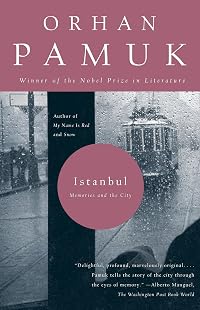
Istanbul: Memories and the City
by Orhan Pamuk
On This Page
Description
A portrait, by turns intimate and panoramic, of one of the world's great cities, by its foremost man of letters. Blending reminiscence with history; family photographs with portraits of poets and pashas; art criticism, metaphysical musing, and, now and again, a fanciful tale, Pamuk invents an ingenious form to evoke his lifelong home, the city that forged his imagination. He begins with his childhood, his first intimations of the melancholy awareness of living in the seat of ruined imperial show more glories, in a country trying to become "modern" at the crossroads of East and West. Against a background of shattered monuments, neglected villas, ghostly backstreets, and, above all, the fabled waters of the Bosphorus, he charts the evolution of a rich imaginative life, which furnished a daydreaming boy refuge from family discord and inner turmoil, and which would continue to serve the famous writer he was to become. --From publisher description. show lessTags
Recommendations








Member Recommendations


Member Reviews
Atmospheric account of Pamuk’s relationship with the city he grew up in and with the Turkish and foreign writers and artists whose works it influenced. There’s a lot about the city’s melancholia — he uses the Turkish word hüzün — and a lot about its odd place, not fitting comfortably into either western or eastern culture, especially since the end of the Ottoman empire. He writes about his own childhood in a bourgeois family in the city, and about how he came to know the city around him, partly through direct exploration and partly through old books, pictures and films. Everything is illustrated with old photographs or reproductions of engravings, echoing the mood he is writing about. A very lovely book, beautifully written show more and translated. But I can easily imagine that Pamuk’s view of the city would not be one that everyone who lives there could easily find themselves in. show less
I bought this book in Ankara just after leaving Istanbul, where I'd stayed for five days. I'd like to start by saying that if you are traveling to Istanbul and want to find out something about it, you should read any other book instead. This is not a book about a city, it's a book about a mood — Orhan Pamuk's favorite mood, melancholy, which he projects onto everything and everyone around him, and which sustains him as an artist. The Istanbul seen through Pamuk's loving but perpetually disappointed eyes is not the Istanbul that exists in the world. Where he sees it as "poor, shabby, and isolated," I found it vibrant, sparkling, and cosmopolitan. To Pamuk, "the city speaks of defeat, destruction, deprivation, melancholy and poverty"; show more to me, it spoke of resilience, regrowth, abundance and commerce. I want to go back, to see more facets of its ever-varied complexity. Pamuk never left, and seems committed to seeing only the Istanbul of his deliciously sad inner eye. Of course I'm not saying that Pamuk is wrong in seeing the city the way he does. But certainly, and obviously to anyone else but Pamuk, I'm sure, Pamuk's way is not the only way to see it.
I haven't read any of Pamuk's other prizewinning work, but I can well imagine that this book has particular value to those who have spent many immersive hours in his fiction. Approach it as its subtitle suggests: not as memories of the city, but as memories AND the city, and especially as a somewhat dreamlike portrait of Pamuk's own self, as reflected in his gloomily dimmed concept of his urban world. show less
I haven't read any of Pamuk's other prizewinning work, but I can well imagine that this book has particular value to those who have spent many immersive hours in his fiction. Approach it as its subtitle suggests: not as memories of the city, but as memories AND the city, and especially as a somewhat dreamlike portrait of Pamuk's own self, as reflected in his gloomily dimmed concept of his urban world. show less
Hüzün; weemoed, een nostalgisch gevoel van verlies en verval. Orhan Pamuk kenschetst er Istanbul en haar bewoners mee, en tevens zichzelf. Istanbul is voor hem de stad van de immer aanwezige Bosporus, maar vóór alles de stad van de vergane glorie. Ooit het bijzondere Constantinopel, later opgesloten tussen de beeldvorming van het valse verwesterde ideaal van Atatürk en het even zozeer vals romantische westerse ideaalbeeld van de sultans en de serail.
Pamuk benadrukt het gevoel nog eens door een enorme hoeveelheid oude zwart-wit foto's die niet het diepe blauw van de magnifieke Bosporus toont, maar het grauwe van de winterdag, de gehaaste voetgangers over de bruggen van de stad. De vervallen buurten, zwervend door de coulissen van de show more stad, weg van de toeristische attracties als de Hagia Sophia, het Topkapi paleis of het Rumelihisari. Pamuk beschrijft Istanbul als stad en dorp tegelijk.
De stad wordt gebruikt als decor voor de opgroeiende Orhan, die zich een verdwaald buitenbeentje voelt in een wereld van rijkdom in verval, zowel persoonlijk als sociaal. Hij mag zich dan wel 'displaced person' voelen, maar Istanbul is tegelijkertijd de enige plek die hij wil kennen en koesteren. Door de verwevenheid met de stad is hij ook verweven met het gevoel van hüzün in zijn eigen innerlijk. De gebeurtenissen in zijn familie zijn als het pars pro toto voor de hele leefgemeenschap. Disfunctioneel maar warm, cultureel rijk en verarmd, verstrengeld in een dans door de essentie van de stad.
Het boek zit vol met lange, meanderende zinnen die de continue gedachtestroom van Pamuk afzetten tegen het door hem gepercipieerde, langzame verval van Istanbul. Uit het boek komt een merkwaardige dichotomie van ontworteling en verknoping naar voren. Orhan Pamuk doet aan zelfonderzoek op dezelfde manier waarop hij Istanbul onderzoekt. Soms lijkt hij in een spagaat te geraken: een voorbeeld daarvan is zijn beschrijving van de Franse schrijvers en kunstenaars uit de 19e eeuw die Istanbul probeerden te vangen in hun reisverhalen en schilderijen. Ze zijn een groot voorbeeld voor hem, maar ontlokken ook kritiek vanwege hun stereotiepe beelden van Oosterse faux romantiek.
Het boek weet de atmosfeer die Pamuk kiest feilloos over te brengen op de lezer. Het is een boeiende slingertocht, afwisselend door Istanbul en door het hoofd van de schrijver. Het is daarmee ook een boek vol stille, niet-opdringerige reflectie die telkens weer naar het volgende hoofdstuk doet verlangen. Een boek dat, als je het uiteindelijk voor de laatste keer sluit, je achterlaat met een gevoel van weemoed: de weemoed van Orhan Pamuk en zijn Istanbul, en de weemoed dat zijn verhaal bij de laatste pagina toch echt is afgelopen. show less
Pamuk benadrukt het gevoel nog eens door een enorme hoeveelheid oude zwart-wit foto's die niet het diepe blauw van de magnifieke Bosporus toont, maar het grauwe van de winterdag, de gehaaste voetgangers over de bruggen van de stad. De vervallen buurten, zwervend door de coulissen van de show more stad, weg van de toeristische attracties als de Hagia Sophia, het Topkapi paleis of het Rumelihisari. Pamuk beschrijft Istanbul als stad en dorp tegelijk.
De stad wordt gebruikt als decor voor de opgroeiende Orhan, die zich een verdwaald buitenbeentje voelt in een wereld van rijkdom in verval, zowel persoonlijk als sociaal. Hij mag zich dan wel 'displaced person' voelen, maar Istanbul is tegelijkertijd de enige plek die hij wil kennen en koesteren. Door de verwevenheid met de stad is hij ook verweven met het gevoel van hüzün in zijn eigen innerlijk. De gebeurtenissen in zijn familie zijn als het pars pro toto voor de hele leefgemeenschap. Disfunctioneel maar warm, cultureel rijk en verarmd, verstrengeld in een dans door de essentie van de stad.
Het boek zit vol met lange, meanderende zinnen die de continue gedachtestroom van Pamuk afzetten tegen het door hem gepercipieerde, langzame verval van Istanbul. Uit het boek komt een merkwaardige dichotomie van ontworteling en verknoping naar voren. Orhan Pamuk doet aan zelfonderzoek op dezelfde manier waarop hij Istanbul onderzoekt. Soms lijkt hij in een spagaat te geraken: een voorbeeld daarvan is zijn beschrijving van de Franse schrijvers en kunstenaars uit de 19e eeuw die Istanbul probeerden te vangen in hun reisverhalen en schilderijen. Ze zijn een groot voorbeeld voor hem, maar ontlokken ook kritiek vanwege hun stereotiepe beelden van Oosterse faux romantiek.
Het boek weet de atmosfeer die Pamuk kiest feilloos over te brengen op de lezer. Het is een boeiende slingertocht, afwisselend door Istanbul en door het hoofd van de schrijver. Het is daarmee ook een boek vol stille, niet-opdringerige reflectie die telkens weer naar het volgende hoofdstuk doet verlangen. Een boek dat, als je het uiteindelijk voor de laatste keer sluit, je achterlaat met een gevoel van weemoed: de weemoed van Orhan Pamuk en zijn Istanbul, en de weemoed dat zijn verhaal bij de laatste pagina toch echt is afgelopen. show less
Orhan Pamuk begins his memoir, Istanbul: Memories and the City, with a meditation on his doppelganger, the other Orhan in his life when he was a young boy. This is both an indication of the budding artist within and a metaphor for the city without, the city in which he was to grow up and live. Capturing a sense of the Istanbul of memory and tradition and juxtaposing it with the Istanbul as seen by outsiders, especially the literary lights that visited Istanbul over the years, Pamuk creates a rich texture for his story of the memories and city. Augmented by literally hundreds of photographs of city, family and history this is a unique look at one of the great centers of civilization.
The memoir is colored by melancholy, a word rooted in show more the Greek melankholia referring to pensive reflection marked by a dark or sad outlook. The Turkish word for melancholy is huzun and it has an Arabic root with a much more nuanced meaning that spans thoughts of both material pleasure and spirtual loss. According to Pamuk:
"The huzun of Istanbul is not just the mood evoked by its music and its poetry, it is a way of looking at life that implicates us all, not only a spiritual state but a state of mind that is ultimately as life-affirming as it is negating." (p 91)
It is this feeling that Pamuk tries to capture in his discussions and digressions on his own experience of Istanbul and that of the others, often from the West, who have observed its life. So we encounter comments and thoughts from writers as diverse as Levi-Strauss, Ruskin, Flaubert, Gide and Gerard de Nerval. But there are also the insights of local writers like the novelist Tanpinar who, influenced by the French poet Theophile Gautier, wrote in a poetic and painterly mode of the vistas of Istanbul and extolled "the painterly style of writers like Stendahl, Balzac, and Zola" (p 227).
While Pamuk discusses the view of Istanbul "Under Western Eyes" (pp 234-44) he also finds the source of this melancholy in the ruins of the old city as seen both in his personal experience and through his reading of Tanpinar and others. He also meditates on the impact and meaning of the Bosporus to himself and his family. The city becomes a dream to which its denizens could aspire. "We might call this dream -- which grew out of the barren, isolated, destitute neighborhoods beyon the city walls -- the 'melancholy of the ruins'" (p 253)
The sum of all these thoughts and more is a brilliant and evocative image of the Istanbul that encourages the reader to read more and the traveller to visit and see for himself. This reader found in this memoir everything that he had come to expect from Pamuk's fiction melded with a passion for family, literature and city. It has become another favorite of mine from the pen of this great writer. show less
The memoir is colored by melancholy, a word rooted in show more the Greek melankholia referring to pensive reflection marked by a dark or sad outlook. The Turkish word for melancholy is huzun and it has an Arabic root with a much more nuanced meaning that spans thoughts of both material pleasure and spirtual loss. According to Pamuk:
"The huzun of Istanbul is not just the mood evoked by its music and its poetry, it is a way of looking at life that implicates us all, not only a spiritual state but a state of mind that is ultimately as life-affirming as it is negating." (p 91)
It is this feeling that Pamuk tries to capture in his discussions and digressions on his own experience of Istanbul and that of the others, often from the West, who have observed its life. So we encounter comments and thoughts from writers as diverse as Levi-Strauss, Ruskin, Flaubert, Gide and Gerard de Nerval. But there are also the insights of local writers like the novelist Tanpinar who, influenced by the French poet Theophile Gautier, wrote in a poetic and painterly mode of the vistas of Istanbul and extolled "the painterly style of writers like Stendahl, Balzac, and Zola" (p 227).
While Pamuk discusses the view of Istanbul "Under Western Eyes" (pp 234-44) he also finds the source of this melancholy in the ruins of the old city as seen both in his personal experience and through his reading of Tanpinar and others. He also meditates on the impact and meaning of the Bosporus to himself and his family. The city becomes a dream to which its denizens could aspire. "We might call this dream -- which grew out of the barren, isolated, destitute neighborhoods beyon the city walls -- the 'melancholy of the ruins'" (p 253)
The sum of all these thoughts and more is a brilliant and evocative image of the Istanbul that encourages the reader to read more and the traveller to visit and see for himself. This reader found in this memoir everything that he had come to expect from Pamuk's fiction melded with a passion for family, literature and city. It has become another favorite of mine from the pen of this great writer. show less
Author Orhan Pamuk writes of his city, Istanbul, where he has lived all his life in this memoir-history-personal history blend.
Reading this book was like taking a meandering walk through the city while Pamuk reflected on his own life in it, moving tangentially from one point to another to discuss his family, the Bosphorus, Istanbul as reflected through the western gaze, the beauty of poor neighborhoods. Pamuk himself refers to the symmetry of it, and there is a sort of symmetry and folding in on itself as some of the topics get repeated in slightly different ways. His love for the city is palpable, even while the story is shot through with melancholy. It was often hard for me to follow, in part because of my lack of knowledge, but also show more because of his habit of writing very long lists and sentences, using multiple semicolons. The audio, read by John Lee, helped me along, especially because I could hear the pronunciation of unfamiliar locations. show less
Reading this book was like taking a meandering walk through the city while Pamuk reflected on his own life in it, moving tangentially from one point to another to discuss his family, the Bosphorus, Istanbul as reflected through the western gaze, the beauty of poor neighborhoods. Pamuk himself refers to the symmetry of it, and there is a sort of symmetry and folding in on itself as some of the topics get repeated in slightly different ways. His love for the city is palpable, even while the story is shot through with melancholy. It was often hard for me to follow, in part because of my lack of knowledge, but also show more because of his habit of writing very long lists and sentences, using multiple semicolons. The audio, read by John Lee, helped me along, especially because I could hear the pronunciation of unfamiliar locations. show less
Estambul es un retrato, en ocasiones panorámico y en otras íntimo y personal, de una de las ciudades más fascinantes de la Europa que mira a Asia. Pero es también una autobiografía, la del propio Orhan Pamuk. La historia da comienzo con el capítulo de su infancia, donde Pamuk nos habla sobre su excéntrica familia y su vida en un polvoriento apartamento –«los apartamentos Pamuk», así los denomina– en el centro de la ciudad. El autor recuerda que fue en aquellos días lejanos cuando tomó conciencia de que le había tocado vivir en un espacio plagado de melancolía: residente de un lugar que arrastra un pasado glorioso y que intenta hacerse un hueco en la «modernidad». Viejos y hermosos edificios en ruinas, estatuas show more valiosas y mutantes, villas fantasmagóricas y callejuelas secretas donde, por encima de todo, destaca el terapéutico Bósforo, que en la memoria del narrador es vida, salud y felicidad. Esta elegía sirve para que el autor introduzca a pintores, escritores y célebres asesinos, a través de cuyos ojos el narrador describe la ciudad. Hermoso retrato de una ciudad y una vida, ambas fascinantes por igual show less
Hüzün and the melancholy city. Quite lovely, and even if this İstanbul ın which I fınd myself now, and which, by not paying proper attention to my Schengen visa requirements and being forced to flee Europe I have doomed forever to be "my" İstanbul, is no longer the city Pamuk writes about, that's kind of nice, actually - the sadness and overwhelming weight of the civilization of the past on the people becomes another layer, another glad rag, with which the modern, modestly resurgent city and its visitor have to decide how to contend.
This book doesn' have the elaborate artfulness of My Name is Red - not to say that it ısn't literary or that craft wasn't a concern, but it's a peculiarly weightless, translucent sort of craft, and show more Pamuk clearly didn't want frippery to get in the way of the record, of finally setting down some things that happened in - with space set aside for the de rıgueur speculation about history and memory and forgetting - the way that they happened. Apparently his father died as he was writing the book, and you can see that influence in the book's family-memoir aspect. The bildungsroman stuff about beıng a writer, I dunno, the individual interpolations are always interesting, I guess, but mostly we've heard that one before.
I've had this book recommended to me more than once by the locals, and without presuming to know İstanbul, I will say that if people here nowadays seem to be a little more game, have a little more pluck, if there's a little more goin' on than Pamuk's long, diffident, Protean struggle with the past, the hüzün is still there, and if people are fond of it it may just be a new permutation - nostalgia for the time when notalgia was our defining trait. It's also likely, as Pamuk says, that they feel the sadness more than all those slow-river inscrutable orientalist-cliche brown people because hell, this was the Ottoman Empire. One thing that deserves more thinkıng about with Turkish history in general and hüzün ın particular is what parallels can be drawn with Japanese history and those orbiting concepts, natsukashii and shikata ga nai.
Also,he says the same thing as me about how all good art makes you want to put your mouth all over it. So I'm endeared to him for that! show less
This book doesn' have the elaborate artfulness of My Name is Red - not to say that it ısn't literary or that craft wasn't a concern, but it's a peculiarly weightless, translucent sort of craft, and show more Pamuk clearly didn't want frippery to get in the way of the record, of finally setting down some things that happened in - with space set aside for the de rıgueur speculation about history and memory and forgetting - the way that they happened. Apparently his father died as he was writing the book, and you can see that influence in the book's family-memoir aspect. The bildungsroman stuff about beıng a writer, I dunno, the individual interpolations are always interesting, I guess, but mostly we've heard that one before.
I've had this book recommended to me more than once by the locals, and without presuming to know İstanbul, I will say that if people here nowadays seem to be a little more game, have a little more pluck, if there's a little more goin' on than Pamuk's long, diffident, Protean struggle with the past, the hüzün is still there, and if people are fond of it it may just be a new permutation - nostalgia for the time when notalgia was our defining trait. It's also likely, as Pamuk says, that they feel the sadness more than all those slow-river inscrutable orientalist-cliche brown people because hell, this was the Ottoman Empire. One thing that deserves more thinkıng about with Turkish history in general and hüzün ın particular is what parallels can be drawn with Japanese history and those orbiting concepts, natsukashii and shikata ga nai.
Also,he says the same thing as me about how all good art makes you want to put your mouth all over it. So I'm endeared to him for that! show less
Members
- Recently Added By
Lists

Biggest Disappointments
606 works; 168 members

The Emergence of the Modern Middle East
289 works; 13 members

Turkey
5 works; 1 member
Author Information

107+ Works 32,885 Members
Orhan Pamuk was born in Istanbul, Turkey on June 7, 1952. After graduating from Robert College in Istanbul, he studied architecture at the Istanbul Technical University. After three years, he decided to become a writer and graduated from the Institute of Journalism at the University of Istanbul in 1976. In 1982, he published his first novel Cevdet show more Bey and His Sons, which received both the Orhan Kemal and Milliyet literary prizes. His novel, My Name Is Red, won the French Prix Du Meilleur Livre Etranger, the 2002 Italian Grinzane Cavour, and the 2003 International IMPAC Dublin Literary Award. He has received numerous Turkish and international literary awards for his works including the 2006 Nobel Prize in Literature. His recent work includes A Strangeness in My Mind. (Bowker Author Biography) Orhan Pamuk is the author of six previous novels, including "The White Castle" & "The New Life". He lives in Istanbul with his family. (Publisher Provided) show less
Some Editions
Awards and Honors
Awards
Distinctions
Series
Belongs to Publisher Series
Common Knowledge
- Canonical title
- Istanbul: Memories and the City
- Original title
- İstanbul: hatıralar ve şehir; Istanbul Hatiralar ve Sehir
- Alternate titles*
- Istanbul : herinneringen en de stad
- Original publication date
- 2003
- People/Characters*
- Orhan Pamuk
- Important places
- Istanbul, Turkey (Constantinople); Constantinople, Turkey
- Epigraph
- The beauty of a landscape resides in its sadness.
Ahmet Rasim - Dedication
- To my father, Gündüz Pamuk (1925-2002)
- First words
- From a very young age, I suspected there was more to my world than I could see: Somewhere in the streets of Istanbul, in a house resembling ours, there lived another Orhan so much like me that he could pass for my twin, even ... (show all)my double.
- Last words
- (Click to show. Warning: May contain spoilers.)"I'm going to be a writer."
- Blurbers
- Malcolm, Noel; Morris, Jim
- Original language
- Turkish
*Some information comes from Common Knowledge in other languages. Click "Edit" for more information.
Classifications
- Genres
- Travel, Biography & Memoir, Nonfiction
- DDC/MDS
- 949.61803092 — History & geography History of Europe Greece, Albania, Yugoslavia, Serbia, Romania, Bulgaria Turkey and the Balkans Turkish Thrace; Istanbul Istanbul
- LCC
- DR723 .P36 — History of Europe, Asia, Africa and Oceania Balkan Peninsula History of Balkan Peninsula Turkey Local history and description (European Turkey) Istanbul (Constantinople)
- BISAC
Statistics
- Members
- 4,007
- Popularity
- 3,893
- Reviews
- 72
- Rating
- (3.75)
- Languages
- 24 — Catalan, Chinese, Czech, Danish, Dutch, English, Finnish, French, German, Greek, Hungarian, Italian, Japanese, Lithuanian, Multiple languages, Norwegian (Bokmål), Polish, Portuguese, Romanian, Russian, Croatian, Spanish, Swedish, Turkish
- Media
- Paper, Audiobook, Ebook
- ISBNs
- 101
- ASINs
- 25