
The Compass Rose
by Ursula K. Le Guin
On This Page
Description
Twenty stories written by the author over the past decade with a wide range of tone and subjects.Tags
Recommendations



























Member Reviews
I looooooved the first story, "The Author of the Acacia Seeds." I wish it was a whole novel.
The rest is a struggle for me. Le Guin is entertaining and thought-provoking. However, there is always something dark and sad and hopeless in her stories. In the world we live in today, there's so much to fret about that also fretting about a world that doesn't exist (yet) is not where I am in my life.
The rest is a struggle for me. Le Guin is entertaining and thought-provoking. However, there is always something dark and sad and hopeless in her stories. In the world we live in today, there's so much to fret about that also fretting about a world that doesn't exist (yet) is not where I am in my life.
This collection of short stories was assembled a few years after the author's "The Wind's Twelve Quarters", which I remember as being uniformly wonderful, although it's been many years since I've read it. Here there was some unevenness, I won't say of quality, but at least in how much I enjoyed each piece.
Nearly every story has a definite Science Fiction or Fantasy bent, which isn't really surprising. What did surprise me was that two of my three favorites ("Gwilan's Harp", and "Two Delays on the Northern Line") aren't SF at all, although their settings contain definite SF elements. My other favorite was the title story, which I found beautiful, sad, and unexpected.
Several themes occur multiple times throughout the collection. Several show more stories are built on the notion of animals having a good deal of intelligence, perhaps equal to (although different from) that of humans. This is tied up with an exploration of the difficulty of inter-species communication. Other stories examine transformations, by turns macabre and moving. Still more consider the relativity of perception, adaptation to environment, and evolution.
I suppose my biggest criticism of the stories as a group is that some of the "science" on which some stories are based is so wildly implausible as to be distracting (examples would probably constitute spoilers, so I'll refrain). I found it necessary to really embrace my suspension of disbelief in order to find enjoyment in those pieces. Still, Le Guin is a wonderful writer, and I'd certainly recommend the collection overall to anyone who's enjoyed her other works. show less
Nearly every story has a definite Science Fiction or Fantasy bent, which isn't really surprising. What did surprise me was that two of my three favorites ("Gwilan's Harp", and "Two Delays on the Northern Line") aren't SF at all, although their settings contain definite SF elements. My other favorite was the title story, which I found beautiful, sad, and unexpected.
Several themes occur multiple times throughout the collection. Several show more stories are built on the notion of animals having a good deal of intelligence, perhaps equal to (although different from) that of humans. This is tied up with an exploration of the difficulty of inter-species communication. Other stories examine transformations, by turns macabre and moving. Still more consider the relativity of perception, adaptation to environment, and evolution.
I suppose my biggest criticism of the stories as a group is that some of the "science" on which some stories are based is so wildly implausible as to be distracting (examples would probably constitute spoilers, so I'll refrain). I found it necessary to really embrace my suspension of disbelief in order to find enjoyment in those pieces. Still, Le Guin is a wonderful writer, and I'd certainly recommend the collection overall to anyone who's enjoyed her other works. show less
Since reading this book, almost everything else that I've read has come to seem Le Guin-like, not because she has one distinctive style but because she has such *range*: of geographies, discourses, characters, tones, worlds. This collection contains some of my favourite of her short stories (as well as some more laboured/dated pieces): it's not as coherent as Birthday of the World, but its ambitious treatment of the six cardinal directions, the echoes of place and theme across the stories, is amazing.
A collection of stories, mostly science fiction. The best are those which you begin assuming a certain set of circumstances: That the narrator is human, that the action takes place on earth, etc. and find near the end you are quite wrong and must read the story again with that twist in mind. Also included are interesting discourses on the subjects of animal linguistics, and the running out of time disguised as scientific studies.
I didn't love all the stories in this collection equally, but damn. Ursula K. LeGuin is a genuis.
There are some really wonderful, mind-cracking stories in here. LeGuin's anthropological and sociological insight on fine display.
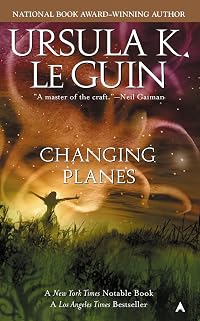
Unlocking the Air is a collection of LeGuin's 'mainstream' short stories. A Fisherman of the Inland Sea is a collection of award-winning stories. The different stories in Changing Planes are held together by Sita Dulip's method, and Four Ways to Forgiveness contains four interconnected novellas. Against this background of cohesive collections, The Compas Rose is not entirely understandable.
Taking each story individually, "The New Atlantis, "The Diary of the Rose", "The Eye Altering", "The Pathways of Desire", "Gwilan's Harp", and "The Wife's Story" are up to LeGuin's usual standards, while "Schrodinger's Cat", "The First Report of the Shipwrecked Foreigner to the Kadanh of Derb", and "Some Approaches to the Problem of the Shortage of show more Time" are not. The rest fall in between. (You can read a much longer review including my story-by-story opinions here.)
LeGuin says in her introduction that the compass premise is meant "to suggest that some pattern or coherence may be perceived in it." Yet though I enjoyed many of the individual stories in this book, there was very little coherence in the entire collection. LeGuin is popular enough that even a hodge-podge collection like this is in demand, but those new to LeGuin's short fiction would do better to try another collection.
Reviews, etc. show less
Taking each story individually, "The New Atlantis, "The Diary of the Rose", "The Eye Altering", "The Pathways of Desire", "Gwilan's Harp", and "The Wife's Story" are up to LeGuin's usual standards, while "Schrodinger's Cat", "The First Report of the Shipwrecked Foreigner to the Kadanh of Derb", and "Some Approaches to the Problem of the Shortage of show more Time" are not. The rest fall in between. (You can read a much longer review including my story-by-story opinions here.)
LeGuin says in her introduction that the compass premise is meant "to suggest that some pattern or coherence may be perceived in it." Yet though I enjoyed many of the individual stories in this book, there was very little coherence in the entire collection. LeGuin is popular enough that even a hodge-podge collection like this is in demand, but those new to LeGuin's short fiction would do better to try another collection.
Reviews, etc. show less
Members
- Recently Added By
Published Reviews
ThingScore 75
Ursula K. Le Guin's novels, The Left Hand of Darkness and The Beginning Place, have made her the hottest name in contemporary scifi. The Compass Rose shows her less a miler than a sprinter. The 20 stories reveal a versatile and far-ranging mind.
added by Shortride
Lists

Best Feminist Science Fiction
188 works; 35 members

Favorite Science Fiction by Women Authors
737 works; 196 members

S.F. Masterworks (Complete)
229 works; 15 members

20th Century Literature
1,161 works; 54 members

Short Story Collections and Anthologies
261 works; 42 members

Shannon's Read-Alikes List
71 works; 8 members

Political Science Fiction
43 works; 3 members

Female Author
1,235 works; 64 members

Speculative Fiction to Read
706 works; 32 members

Stories set in the Polar Regions
33 works; 3 members

Science Fiction Short Story Collections
9 works; 2 members
Author Information

492+ Works 167,056 Members
Ursula K. Le Guin was born Ursula Kroeber in Berkeley, California on October 21, 1929. She received a bachelor's degree from Radcliffe College in 1951 and a master's degree in romance literature of the Middle Ages and Renaissance from Columbia University in 1952. She won a Fulbright fellowship in 1953 to study in Paris, where she met and married show more Charles Le Guin. Her first science-fiction novel, Rocannon's World, was published in 1966. Her other books included the Earthsea series, The Left Hand of Darkness, The Dispossessed: An Ambiguous Utopia, The Lathe of Heaven, Four Ways to Forgiveness, and The Telling. A Wizard of Earthsea received an American Library Association Notable Book citation, a Horn Book Honor List citation, and the Lewis Carroll Shelf Award in 1979. She received the Medal for Distinguished Contribution to American Letters in 2014. She also received the Nebula Award and the Hugo Award. She also wrote books of poetry, short stories collections, collections of essays, children's books, a guide for writers, and volumes of translation including the Tao Te Ching of Lao Tzu and selected poems by Gabriela Mistral. She died on January 22, 2018 at the age of 88. (Bowker Author Biography) show less
Some Editions
Awards and Honors
Awards
Series
Belongs to Publisher Series
Work Relationships
Is contained in
Common Knowledge
- Canonical title*
- Die Kompaßrose
- Original publication date
- 1982-07-21 (collection) (collection)
- First words
- Preface: By calling this book The Compass Rose I hoped to suggest that some pattern or coherence may be perceived in it, while indicating that the stories it contains tend to go off each in its own direction.
- Last words
- (Click to show. Warning: May contain spoilers.)We left no footprints, even.
- Blurbers
- Beagle, Peter S.; Bishop, Michael
- Original language
- English
- Disambiguation notice*
- Collection
*Some information comes from Common Knowledge in other languages. Click "Edit" for more information.
Classifications
Statistics
- Members
- 1,403
- Popularity
- 16,837
- Reviews
- 19
- Rating
- (3.79)
- Languages
- 11 — Dutch, English, Finnish, French, German, Greek, Italian, Portuguese, Russian, Spanish, Turkish
- Media
- Paper, Ebook
- ISBNs
- 25
- ASINs
- 12