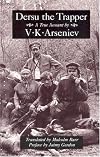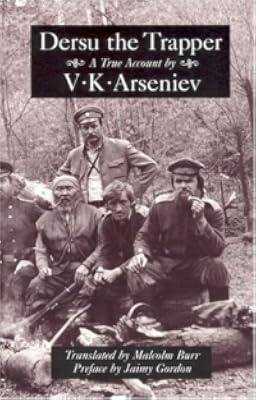
Dersu the Trapper
by Vladimir Arseniev
On This Page
Description
A memoir by Russian explorer Vladimir Arsenyev, covering his trips in 1902, 1906, and 1907 as the first European to explore remote portions of Siberia. Dersu Uzala was his native guide on these trips. The book describes their adventures deep in the wilderness. It is the source for the Kurosawa movie of the same name. A great story of exploration.Tags
Recommendations































Member Recommendations

by spiphany

rebeccanyc Frazier mentions Dersu (the book and the movie) in his wonderfully written story of his five trips to Siberia, a book which encompasses history, natural history, fascinating characters and more. Dersu the Trapper provides a much more detailed look at a narrower segment of Siberia at a time when it was still wilderness
Member Reviews
A more tender portrayal of a friendship between two people from unimaginably different backgrounds I haven't encountered anywhere. That friendship and a deeply observed look at what was even then a fast-vanishing landscape in far Eastern Russia a hundred years ago makes Dersu the Trapper an exceptional read. Arseniev was a surveyor, a passionate observer of nature and outdoorsman - a bit like TR and some others of that era, he behaved in paradoxical ways - if he felt like going out to shoot something he did - often, however, he would decide against it, or ask the men accompanying him to refrain - out of respect for both the animals and their endangered habitat. He could see too and mourn the destruction of this area, the animals, show more insects and birds particular to it, not to mention several tribes of native peoples (I'm afraid the Chinese come off very very badly in all regards in this book - although Europeans did no better in the blithe rapine of the North and South American continents). Arseniev is always even-handed and is careful to describe the helpful and kind Chinese folk he met too. But Dersu! A 'Gold' (one of the vanishing tribes) he has lived out of doors as a hunter, the majority of his life. Alone, after his family died of smallpox, he has wandered about catching a sable or finding ginseng here and there - his needs are few. He can look at a track that would mean nothing to you and me, tell you an entire story about the animal, its age, health, mood, intent..... The book has three parts, three different trips into the wild taig. In the first Dersu appears and with his quiet and unobtrusive authority enchants Arseniev and gains the respect of everyone and rapidly becomes indispensible. Arseniev never spares himself - arguing or disagreeing with Dersu about weather or which route to take - is the ultimate stupidity although he, Arseniev, never does quite come to understand fully the needs and depths of Dersu the man. In the second book Arseniev meets up with Dersu and this is a time of simple happiness in being in each other's company. In the third Dersu is declining and while they have some fine times, it is poignant. It is understandable from the first why Arseniev would value Dersu, less understandable what draws Dersu to Arseniev, but as you read you become aware that although Arseniev was a man of his time in some ways, in others he was one of those with a naturally open mind, a big heart, strong ethics and also confident in some way of himself so that he never minded admitting his own flaws and errors. Friendship is, of course, a mystery and one of the more wonderful joys of life when a true one comes your way. A lovely book. **** show less
Arseniev was an army officer with a taste for biology and ethnology, who spent much of his career leading scientific expeditions in the Russian Far East. In this selection from his memoirs he describes his friendship with the hunter Dersu Uzala, an indigenous Siberian (a member of the Gold tribe), who was his companion on several expeditions into the country between the Ussuri river and the Sea of Japan in the first decade of the 20th century.
Arseniev’s account of Dersu has obviously been written for readers who had been brought up on Mayne Reid and Fenimore Cooper (as anyone who has read Nabokov’s autobiography will know, Russians of that generation loved frontier adventure stories), and Jaimy Gordon reasons in his introduction to show more this reprint that Arseniev can’t have known the real Dersu for as long as he says he did, so the character as he appears in the book must be a composite. But that doesn’t detract from the enormous respect that Arseniev obviously has for his friend’s deep knowledge and understanding of the natural environment of the taiga. Dersu doesn’t go in for the kind of stunts that gave Fenimore Cooper a bad name: his analysis of what has happened in a particular place in the forest, or his predictions of changes in the weather, are always grounded in solid logic and close observation of signs that would be there for anyone to see, if we only knew where to look. More Sherlock Holmes than Natty Bumppo.
We also get a lot of Arseniev’s sheer enjoyment of the nature of Siberia: he very vividly communicates the pleasure he takes in seeing the plants and animals of the region, and meeting the many types of people who live there, although he does note how the region is in transition and some Chinese and Russian settlers are exploiting its resources in unsustainable ways, and mistreating indigenous people in the process.
This is also a book of its time — there is a lot of killing of animals, albeit mostly for food, and Arseniev and his companions allow themselves to take pleasure in doing this efficiently. The way Dersu’s broken Russian is represented in a kind of “Me Tarzan, You Jane” style might also come over to a modern reader as unnecessarily patronising and demeaning, but in fairness this might be more to do with the translation than Arseniev’s original.
All in all a great adventure story with some very interesting descriptions of the Russian Far East as it was a hundred years ago. show less
Arseniev’s account of Dersu has obviously been written for readers who had been brought up on Mayne Reid and Fenimore Cooper (as anyone who has read Nabokov’s autobiography will know, Russians of that generation loved frontier adventure stories), and Jaimy Gordon reasons in his introduction to show more this reprint that Arseniev can’t have known the real Dersu for as long as he says he did, so the character as he appears in the book must be a composite. But that doesn’t detract from the enormous respect that Arseniev obviously has for his friend’s deep knowledge and understanding of the natural environment of the taiga. Dersu doesn’t go in for the kind of stunts that gave Fenimore Cooper a bad name: his analysis of what has happened in a particular place in the forest, or his predictions of changes in the weather, are always grounded in solid logic and close observation of signs that would be there for anyone to see, if we only knew where to look. More Sherlock Holmes than Natty Bumppo.
We also get a lot of Arseniev’s sheer enjoyment of the nature of Siberia: he very vividly communicates the pleasure he takes in seeing the plants and animals of the region, and meeting the many types of people who live there, although he does note how the region is in transition and some Chinese and Russian settlers are exploiting its resources in unsustainable ways, and mistreating indigenous people in the process.
This is also a book of its time — there is a lot of killing of animals, albeit mostly for food, and Arseniev and his companions allow themselves to take pleasure in doing this efficiently. The way Dersu’s broken Russian is represented in a kind of “Me Tarzan, You Jane” style might also come over to a modern reader as unnecessarily patronising and demeaning, but in fairness this might be more to do with the translation than Arseniev’s original.
All in all a great adventure story with some very interesting descriptions of the Russian Far East as it was a hundred years ago. show less
I found this book fascinating on many levels, and much richer and deeper than the Kurosawa movie which I enjoyed when I saw it some years ago. I was spurred to get the book by references to it in Ian Frazier's wonderful Travels in Siberia. The book is an adventure story, an exploration of a remote rugged area and its plants, animals, and people, and a portrait of a remarkable man, Dersu.
In 1902, and again in 1906 and 1907, V. N. Arseniev was sent by the Russian government to make a geographic survey of the area north of Vladivostok and thus on the strip of Russia that drops down to the borders with China and Korea. "My duties included the making of a reconnaissance of the the chief rivers and of the central watershed, the range called show more Sihoté-Alin, which dominates the province. My orders covered the study of the zoology and botany of the district, and of the natives, both aborigines and immigrant." He was accompanied by some assistants and by some soldiers, along with pack horses. In the course of their work, they were confronted by many, often life-threatening, challenges, including predominantly weather and difficult terrain (both land and rivers), but also wild animals (including biting flies) and people.
However, they had the amazingly good fortune to very quickly run into Dersu (who actually found them), a native of the Gold(i) people, now apparently known as the Nanai. He and Arnseniev hit it off, and Dersu ended up accompanying them on the 1902 expedition and then, through another stroke of fate, on the later ones. Dersu had lived in the area for all his life, hunting and trapping, especially following an outbreak of smallpox that had killed his family. He was completely attuned to life outdoors, noticing and interpreting the smallest clues about weather, animals, and people. He could see a track in the ground and disturbance of nearby plants and tell what kind of person had been there, how long ago, what he was carrying, and more. He was a man of action, as when he more than once saved Arseniev's life, including building a shelter from reeds when a blizzard was coming in (highlighted int he movie), and a man of philosophy (he humanized all the animals, calling them "men," and he talked to them, and he also believed in not killing more animals than one needs for food and leaving supplies for the next person to use a hut). Arseniev admired him, respected his wisdom and values, and loved him; the reader comes to do so too, and Arseniev as well. They, and the very real hardships and adventures they share, are at the heart of this book.
But it is also a story of exploration, when there were still relatively unmarked lands to map: mountain ranges, rivers, forests, rocky outcrops. Of course, there were people who lived there, both, as Arseniev says, native and immigrant, who could serve as guides, on-trail and off. Most were friendly; some were not. The immigrants included Koreans and Chinese people, and in some cases the Chinese are excoriated for exploiting the native populations. Most people lived in extreme poverty, following traditional means of getting enough from nature to survive (including ingenious traps), although even at the beginning of the 20th century, before all its upheavals and "progress," Arseniev could see that these ways of life were destined to end, largely because of resource exploitation.
" 'All round soon all game end,' commented Dersu. 'Me think ten years, no more wapiti, sable, no more squirrel, all gone.'
It was impossible to disagree with him. In their own country, the Chinese have long since exterminated the game, almost every living thing. All that is left with them are crows, dogs, and rats. Even in their sea they have the trepangs, the crabs, the various shellfish, and all the seaweed. The Pri-Amur country, so rich in forests and wild life, awaits the same fate, if energetic measures be not taken soon to prevent the wholesale slaughter by the Chinese." p. 176
Even discounting his anti-Chinese sentiments (prejudice?), this is a prescient view of what was to happen worldwide later in the century.
Arseniev is entranced by the plants and animals he finds. His lengthy descriptions of the flora of different areas sent me running to Wikipedia to find pictures of some of them. And what remarkable animals: in addition to the wapiti and sable Dersu mentions, tigers, various kinds of deer, wolverines, seals, salmon, birds of all kinds, and more, more more. (Dersu can tell a lot about the weather from bird behavior.) Arseniev's sketchy drawings of some of the birds and other animals enhance the text. He is fascinated by what he sees, and was obviously completely the right person for the Russians to send on this expedition.
This book captures a moment in time. There was a revolution in 1905, and then the one that "shook the world" in 1917. As Jaimy Gordon (!) notes in her excellent introduction, Arseniev died in 1930 with a warrant out for his arrest, and his widow was arrested in 1937 and shot a year later as a Japanese spy. "Among other sagacities," she writes, "Arseniev had the good sense not to live to be old."
I loved this book, and am glad I saw the movie first, as it would have been a disappointment after the book. Kurosawa did a good job of capturing the more dramatic parts of the story, the ones that translate well into film, but he altered the meaning sometimes and made up a wife and son for Arseniev, and expanded the section, when Dersu briefly comes to live with Arseniev in Khabarovsk. show less
In 1902, and again in 1906 and 1907, V. N. Arseniev was sent by the Russian government to make a geographic survey of the area north of Vladivostok and thus on the strip of Russia that drops down to the borders with China and Korea. "My duties included the making of a reconnaissance of the the chief rivers and of the central watershed, the range called show more Sihoté-Alin, which dominates the province. My orders covered the study of the zoology and botany of the district, and of the natives, both aborigines and immigrant." He was accompanied by some assistants and by some soldiers, along with pack horses. In the course of their work, they were confronted by many, often life-threatening, challenges, including predominantly weather and difficult terrain (both land and rivers), but also wild animals (including biting flies) and people.
However, they had the amazingly good fortune to very quickly run into Dersu (who actually found them), a native of the Gold(i) people, now apparently known as the Nanai. He and Arnseniev hit it off, and Dersu ended up accompanying them on the 1902 expedition and then, through another stroke of fate, on the later ones. Dersu had lived in the area for all his life, hunting and trapping, especially following an outbreak of smallpox that had killed his family. He was completely attuned to life outdoors, noticing and interpreting the smallest clues about weather, animals, and people. He could see a track in the ground and disturbance of nearby plants and tell what kind of person had been there, how long ago, what he was carrying, and more. He was a man of action, as when he more than once saved Arseniev's life, including building a shelter from reeds when a blizzard was coming in (highlighted int he movie), and a man of philosophy (he humanized all the animals, calling them "men," and he talked to them, and he also believed in not killing more animals than one needs for food and leaving supplies for the next person to use a hut). Arseniev admired him, respected his wisdom and values, and loved him; the reader comes to do so too, and Arseniev as well. They, and the very real hardships and adventures they share, are at the heart of this book.
But it is also a story of exploration, when there were still relatively unmarked lands to map: mountain ranges, rivers, forests, rocky outcrops. Of course, there were people who lived there, both, as Arseniev says, native and immigrant, who could serve as guides, on-trail and off. Most were friendly; some were not. The immigrants included Koreans and Chinese people, and in some cases the Chinese are excoriated for exploiting the native populations. Most people lived in extreme poverty, following traditional means of getting enough from nature to survive (including ingenious traps), although even at the beginning of the 20th century, before all its upheavals and "progress," Arseniev could see that these ways of life were destined to end, largely because of resource exploitation.
" 'All round soon all game end,' commented Dersu. 'Me think ten years, no more wapiti, sable, no more squirrel, all gone.'
It was impossible to disagree with him. In their own country, the Chinese have long since exterminated the game, almost every living thing. All that is left with them are crows, dogs, and rats. Even in their sea they have the trepangs, the crabs, the various shellfish, and all the seaweed. The Pri-Amur country, so rich in forests and wild life, awaits the same fate, if energetic measures be not taken soon to prevent the wholesale slaughter by the Chinese." p. 176
Even discounting his anti-Chinese sentiments (prejudice?), this is a prescient view of what was to happen worldwide later in the century.
Arseniev is entranced by the plants and animals he finds. His lengthy descriptions of the flora of different areas sent me running to Wikipedia to find pictures of some of them. And what remarkable animals: in addition to the wapiti and sable Dersu mentions, tigers, various kinds of deer, wolverines, seals, salmon, birds of all kinds, and more, more more. (Dersu can tell a lot about the weather from bird behavior.) Arseniev's sketchy drawings of some of the birds and other animals enhance the text. He is fascinated by what he sees, and was obviously completely the right person for the Russians to send on this expedition.
This book captures a moment in time. There was a revolution in 1905, and then the one that "shook the world" in 1917. As Jaimy Gordon (!) notes in her excellent introduction, Arseniev died in 1930 with a warrant out for his arrest, and his widow was arrested in 1937 and shot a year later as a Japanese spy. "Among other sagacities," she writes, "Arseniev had the good sense not to live to be old."
I loved this book, and am glad I saw the movie first, as it would have been a disappointment after the book. Kurosawa did a good job of capturing the more dramatic parts of the story, the ones that translate well into film, but he altered the meaning sometimes and made up a wife and son for Arseniev, and expanded the section, when Dersu briefly comes to live with Arseniev in Khabarovsk. show less
I want to note the unobtrusive personality of the Russian officer, who tells us about the Gold he so admires and not about himself. He expresses freely that he feels like a child in Dersu's hands whenever the taiga turns frightening. He learns from him like a child, too, as Dersu laments the onset of the end for the taiga as she was. Expect to be saddened, but you're with a likeable guy who cares about what he sees and hasn't a macho bone in his body.
More by luck than judgement I read this alongside James Forsyth's A History of the Peoples of Siberia: Russia's North Asian Colony 1581-1990, and that proved interesting.
More by luck than judgement I read this alongside James Forsyth's A History of the Peoples of Siberia: Russia's North Asian Colony 1581-1990, and that proved interesting.
Siberia is fascinating, a huge, empty land spoiled by the forces of population and thuggery, and there are fascinating books about it. Dersu the Trapper is about the humanity and wilderness of the very right end of the country down low only barely contiguous with the full mass of land. It reads as a memoir, but the author of the preface, Jaimy Gordon, says, "We may be sure that the Dersu of the books is a composite character." This composite character has a reality on the page that we can use to represent what we have lost by being reared in houses with supermarkets nearby (a situation that the mountain men of the American west tried to avoid). And he foresees the devastation that will occur in the immediate future as more and more show more people push into the unspoiled land, some to live in it and some to plunder it.
I can happily read this kind of book that runs on like: It was cold and we could not get warm. We sat toasty by the fire. We had no food for days. We shot and ate a roe and left it for the ants. There were this tree and that tree and that other kind of tree and dentate leaves. It does that over and over. I suppose that could get long for people who find the chapter on whales in Moby Dick long, but what I bring away from the book is not the specific flora and fauna but the relationship to the land that the explorers, the trapper, the other trappers, the farmers... have, and how it related back to them — it sends storms and tigers against them.
The liberty of Dersu could not be sustained in most parts of the world today. And the author's liberty was lost to him as he went to an early death in the Soviet Union.
This book is a beautiful tragedy and a glimpse at the devastation our world likely faces. show less
Um dos melhores livros que tive a oportunidade de ler este ano. Desde o início o leitor fica preso à narrativa, que além de nos relembrar um bocado de geografia daquela porção da Ásia, nos faz pensar a natureza de modo muito diferente. O final é igualmente poderoso. Esta é uma bela história de amizade para se reler de tempos em tempos.
This book has been described as the Russian counterpart to [The Journals of Lewis and Clark], presumptuous, yet a helpful quick analogy for Americans. Arseniev was a Russian cartographer who undertook several expeditions in Siberia. His task was to map the territory and he also describes the plant and animal life of the area, as well as the people. This area is partially bordered by China, Korea and the Sea of Japan.
Dersu Uzala is a Nanai, called by the Russians Goldis, the indigenous people of the area here in Siberia and China. I simply had given no thought to indigenous people of most countries other than my own. Native Americans of course I knew about, some African tribes and South American tribes, Maori of NZ and Australia, Inuit, show more Degar (Montagnard) of course from Vietnam war, but heck my knowledge of world history from ANY period is pathetic. Thus my excitement over discovering Dersu. Dersu became the native guide for Arseniev's expeditions, and much, much more than that. They formed a strong and lasting friendship rooted in Dersu's profound humanity and generosity, and Arseniev's deep love and affection for Dersu. Dersu saved Arseniev's life many times. I am sorry to sound so cliche, but Dersu is truly one with nature, plants, animals, rocks, to the point of what some would call animism. This unity led to his understanding of and respect for life. He would not kill more than necessary to survive, nor overuse plants and taught the same to Arseniev. I enjoyed the descriptions of plants and animals and think any fan of [[John Muir]] would enjoy this book.
This is also an action story as you can imagine attempting to survive in the wild and desolate area would be. However, maybe most of the threats to their survival came from men. There were also descriptions of the different groups of people contacted on this trip and Dersu knew the helpful way to interact with each group, according to their customs and behaviors. He also knew which one to avoid!
I have read some about the indigenous groups I mentioned above, but now of course I want to study these groups from each continent. Wouldn't that make a great discussion group and a great reading list? I want to revisit my anthropology classes and learn it all again.
The meeting of Dersu with modern society of the time (1907 era) and the resulting interaction is of course an inevitable part of this story.
I also got the movie of Dersu from Netflix and it was excellent. Five stars for book and movie1 One of my all time favorites.
ETA: WHOOPS - got the movie from the library not from Netflix. show less
Dersu Uzala is a Nanai, called by the Russians Goldis, the indigenous people of the area here in Siberia and China. I simply had given no thought to indigenous people of most countries other than my own. Native Americans of course I knew about, some African tribes and South American tribes, Maori of NZ and Australia, Inuit, show more Degar (Montagnard) of course from Vietnam war, but heck my knowledge of world history from ANY period is pathetic. Thus my excitement over discovering Dersu. Dersu became the native guide for Arseniev's expeditions, and much, much more than that. They formed a strong and lasting friendship rooted in Dersu's profound humanity and generosity, and Arseniev's deep love and affection for Dersu. Dersu saved Arseniev's life many times. I am sorry to sound so cliche, but Dersu is truly one with nature, plants, animals, rocks, to the point of what some would call animism. This unity led to his understanding of and respect for life. He would not kill more than necessary to survive, nor overuse plants and taught the same to Arseniev. I enjoyed the descriptions of plants and animals and think any fan of [[John Muir]] would enjoy this book.
This is also an action story as you can imagine attempting to survive in the wild and desolate area would be. However, maybe most of the threats to their survival came from men. There were also descriptions of the different groups of people contacted on this trip and Dersu knew the helpful way to interact with each group, according to their customs and behaviors. He also knew which one to avoid!
I have read some about the indigenous groups I mentioned above, but now of course I want to study these groups from each continent. Wouldn't that make a great discussion group and a great reading list? I want to revisit my anthropology classes and learn it all again.
The meeting of Dersu with modern society of the time (1907 era) and the resulting interaction is of course an inevitable part of this story.
I also got the movie of Dersu from Netflix and it was excellent. Five stars for book and movie1 One of my all time favorites.
ETA: WHOOPS - got the movie from the library not from Netflix. show less
Members
- Recently Added By
Lists

Top Five Books of 2013
1,562 works; 721 members

Books Read in 2015
3,299 works; 126 members
Author Information

24+ Works 384 Members
Some Editions
Awards and Honors
Series
Belongs to Publisher Series
Work Relationships
Is contained in
Has the adaptation
Common Knowledge
- Canonical title
- Dersu the Trapper
- Original title
- Дерсу Узала
- Alternate titles*
- La taïga de l'Oussouri
- Original publication date
- 1923
- People/Characters*
- Dersu Usala; Wladimir Arsenjew
- Important places*
- russischer Ferner Osten, Ussurigebiet
- Related movies
- Dersu Uzala (1975 | IMDb)
- First words
- In the year 1902 I was engaged on a survey of the then unmapped country between the rivers Amur and Ussuri on the west and the Sea of Japan on the east, to the north of Vladivostok.
- Last words
- (Click to show. Warning: May contain spoilers.)There were quarry faces, dumps, embankments...all around bore the signs of another life.
- Original language*
- Russisch
- Disambiguation notice
- Not to be confused with "With Dersu the Hunter" which is an entirely different adaptation.
*Some information comes from Common Knowledge in other languages. Click "Edit" for more information.
Classifications
- Genres
- Travel, Nonfiction, Biography & Memoir
- DDC/MDS
- 915.77 — History & geography Geography & travel Geography of and travel in Asia Siberia Far eastern Siberia
- LCC
- DK771 .U9 .A8 — History of Europe, Asia, Africa and Oceania Russia. Soviet Union. Former Soviet Republics – Poland History of Russia. Soviet Union. Former Soviet Republics Local history and description Siberia
- BISAC
Statistics
- Members
- 305
- Popularity
- 104,564
- Reviews
- 14
- Rating
- (4.05)
- Languages
- 12 — Catalan, Dutch, English, Finnish, French, German, Hungarian, Italian, Japanese, Polish, Russian, Spanish
- Media
- Paper, Ebook
- ISBNs
- 43
- ASINs
- 5