On This Page
Description
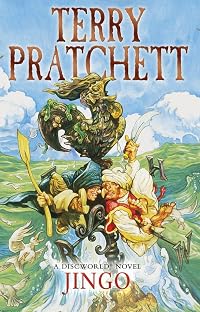
It isn't much of an island that rises up one moonless night from the depths of the Circle Sea -- just a few square miles of silt and some old ruins. Unfortunately, the historically disputed lump of land called Leshp is once again floating directly between Ankh-Morpork and the city of Al-Khali on the coast of Klatch -- which is spark enough to ignite that glorious international pastime called "war." Pressed into patriotic service, Commander Sam Vimes thinks he should be leading his loyal show more watchmen, female watch dwarf, and lady werewolf into battle against local malefactors rather than against uncomfortably well-armed strangers in the Klatchian desert. But war is, after all, simply the greatest of all crimes -- and it's Sir Samuel's sworn duty to seek out criminal masterminds wherever they may be hiding ... and lock them away before they can do any real damage. Even the ones on his own side. show lessTags
Recommendations




Member Reviews
One of Prachett's finest, this is a meditation on international politics, racism, war, and humanity delivered through the medium of low fantasy. It shouldn't work, but his astute eye and winning combination of cynicism, optimism, great characterisation, and really good jokes deliver. Perhaps not one for the Pratchett newbie, there might be a little too much backstory required to really appreciate the character development or motivations.
People love genre mash-ups. Genre mash-ups are the entire way that Marvel has kept its film line vital. Captain America: The First Avenger is superhero movie plus WWII film; Thor is superhero movie plus epic fantasy; Guardians of the Galaxy is superhero movie plus science fiction; Ant-Man is superhero movie plus heist film; it seems to me that Black Widow will be superhero movie plus espionage thriller.
But why is this? Is it just in that combining the tropes of two different familiar genres, something sufficiently new emerges as to be entertaining? I think that's part of it, but not all of it. Or, at least, not in the best cases. In the best cases, the writer is thinking through not just the features of a genre, but its project, and show more uses that to make some kind of commentary on one or both of the genres. Brian Michael Bendis and Michael Gaydos's Alias (a.k.a. Jessica Jones) is probably the gold standard of this for me: in combining superhero comics with noir, they use the powerlessness inherent in the noir genre to highlight the power fantasy inherent in the superhero genre. The stories of hopelessness told in Alias were heightened by taking place in a world of gods. On the other hand, as much as I enjoyed Alan Moore and Gene Ha's Top 10, I didn't feel like it really had anything to say via its combination of superheroics and police procedurals. It has good jokes, but it's mostly just the familiar beats of police procedurals with a veneer of superheroics on top: it's got all the features of its two genres, but it doesn't really do anything with their projects.
So what is Terry Pratchett doing in the City Watch books by combining heroic fantasy and police procedurals? Is he pulling an Alias or a Top 10? The dedication of the first City Watch novel, Guards! Guards!, might suggest he's doing the latter:
They may be called the Palace Guard, the City Guard, or the Patrol. Whatever the name, their purpose in any work of heroic fantasy is identical: it is, round about Chapter Three (or ten minutes into the film) to rush into the room, attack the hero one at a time, and be slaughtered. No one ever asks them if they wanted to.
This book is dedicated to those fine men.
Ohoho, okay, it's funny to give the generic guards of fantasy stories actual lives.
But actually this dedication isn't very accurate: the City Watch of these novels never ends up in a situation remotely like the one the dedication describes! Despite the title of the first book, there's no point an evil tyrant ever does something like shout out "Guards! Guards!" as Boldnose, Son of Whomever saves the day. So why is this dedication actually here?
It points to the fact that heroic fantasy and police procedurals have very different attitudes toward the role of violence. In heroic fantasy, violence is authorized by the individual's own moral certainty, if not his Heroic Destiny, and operates outside the law. The hero does whatever he has to do to change the world because it is Right. In procedurals, on the other hand, the police deploy violence to restore the status quo, which is the rule of law; their violence is only authorized inasmuch as it prevents crimes (i.e., violence not authorized by the state).
All of the City Watch novels in fact deal with this tension between political violence and what we might call regulatory violence. In Guards! Guards!, Men at Arms, and Feet of Clay, there's criminal conspiracies and murders and such, but the real crime is someone's attempt to place a true king on the throne of Ankh-Morpork. Attempts to remake the political structure of the land are the bread and butter of heroic fantasy-- indeed, the placing of a "true king" on the throne is usually how you know everything in your heroic fantasy adventure has Gone Right-- but are fundamentally illegal and immoral actions in a story about the rule of law. And in these stories, the villains are the people trying to restore the true king. (There are two interesting wrinkles about this, which I don't have time to go into here: Lord Vetinari, the patriarch of Ankh-Morpork, has no democratic legitimacy, he's just better than any alternatives, and there is a real true king in the series who could rule Ankh-Morpork and would do so justly... and he's content to be a cop.)
So I bring all this up here (as opposed to in my reviews of the other City Watch books) because I think the conflict between regulatory violence and political violence reaches its peak in Jingo. When a new piece of land is discovered in the sea between Ankh-Morpork and Klatch, both sides claim it posthaste. Soon, war fervor is beginning to sweep through Ankh-Morpork: Klatchians who have lived in the community for years start to come under suspicion and become the target of racist attacks. As xenophobia sweeps through society and as aristocrats prepare to line their own nests at the expense of the lower classes who will do the actual fighting and dying, Commander Vimes of the City Watch can do nothing but watch in frustration. Because it turns out that you can kill one man, and it's a crime-- but propel your nation into a war that will kill thousands, and it's patriotism. It's weird to think that Pratchett wrote this in 1997, when there are so many obvious echoes of 9/11 in it; it's pretty discomforting to read it in 2019, a time once again of heightened xenophobia. Reading it, I shared in Vimes's sense of powerlessness and despair. People told me the Discworld books were funny. They didn't tell me they would be like this!
The book's climax is amazing, and bears quoting at length. Vimes turns up just before the battle is due to begin, and attempts to arrest the head of the Klatchian army:
"Vimes, you have gone insane," said Rust [head of the Ankh-Morpork army]. "You can't arrest the commander of an army!"
"Actually, Mr. Vimes, I think we could," said Carrot. "And the army, too. I mean, I don't see why we can't. We could charge them with behavior likely to cause a breach of the peace, sir. I mean, that's what warfare is."
Vimes's face split in a manic grin. "I like it."
"But in fairness our—that is, the Ankh-Morpork army—are also—"
"Then you'd better arrest them, too," said Vimes. "Arrest the lot of 'em. Conspiracy to cause an affray," he started to count on his fingers, "going equipped to cause a crime, obstruction, threatening behavior, loitering with intent, loitering within tent, hah, traveling for the purposes of committing a crime, malicious lingering and carrying concealed weapons."
"I don't think that one—" Carrot began.
"I can't see 'em," said Vimes. (386-87)
It doesn't work, of course. The two armies do surrender (and Carrot reads them their rights!), but when one of Vimes's Klatchian allies asks what they're going to do now, Vimes can only say, "I never thought we'd get this far!" (390) Soon Lord Vetinari shows up, ready with political machinations that he deploys to bring the war to an end.
But by God, it ought to work that way, and that's what Pratchett taps into for four glorious pages. The detective story is, Pam Bedore tells us, about contamination and containment: "The police procedural emphasizes the police detective's liminality rather than his conformity, as the police hero tends to function at the limits of the law, struggling to pursue justice within the bounds of his numerous rules and scarce resources" (29). As far as the rules are concerned, leading thousands to death in a war-- as the heroes of heroic fantasy do all the time-- is perfectly legal. Vimes can arrest someone plotting the death of one other, but has no way to impose justice on someone plotting the deaths of thousands.
By bringing the police procedural into the heroic fantasy in Jingo, Pratchett shows how war warps our very notions of justice, and twists good people into bad. You couldn't tell this story in an ordinary heroic fantasy story: you need the police procedural to expose the injustice of it all.
Plus it's very funny. Obviously the side-plot with Lord Vetinari, Sergeant Colon, and Nobby adventuring in Klatch is hilarious, but my favorite joke is probably this one:
"Veni, vidi, vici." I came, I saw, I conquered.
As a comment it always struck Vimes as a bit too pat. It wasn't the sort of thing you came up with on the spur of the moment, was it? It sounded as if he had worked it out. He'd probably spent long evenings in his tent, looking up in the dictionary short words beginning with V and trying them out... Veni, vermini, vomui, I came, I got ratted, I threw up? Visi, veneri, vamoosi, I visited, I caught an embarrassing disease, I ran away? It must have been a big relief to come up with three short acceptable words. He probably made them up first, and then went off to see somewhere and conquer it. (213)
And it's moving. The sub-plot about Vimes's organizer (bingeley-bingeley beep!) starts off funny, but thanks to some timeline shenanigans, become quite a clever way to generate tension over a world that never came to be, but could have been quite significant, as you learn what kind of things could have happened there.
All of the City Watch novels are strong, but for me, Jingo is the master class in plotting, themes, humor, and character. It all comes together perfectly. show less
But why is this? Is it just in that combining the tropes of two different familiar genres, something sufficiently new emerges as to be entertaining? I think that's part of it, but not all of it. Or, at least, not in the best cases. In the best cases, the writer is thinking through not just the features of a genre, but its project, and show more uses that to make some kind of commentary on one or both of the genres. Brian Michael Bendis and Michael Gaydos's Alias (a.k.a. Jessica Jones) is probably the gold standard of this for me: in combining superhero comics with noir, they use the powerlessness inherent in the noir genre to highlight the power fantasy inherent in the superhero genre. The stories of hopelessness told in Alias were heightened by taking place in a world of gods. On the other hand, as much as I enjoyed Alan Moore and Gene Ha's Top 10, I didn't feel like it really had anything to say via its combination of superheroics and police procedurals. It has good jokes, but it's mostly just the familiar beats of police procedurals with a veneer of superheroics on top: it's got all the features of its two genres, but it doesn't really do anything with their projects.
So what is Terry Pratchett doing in the City Watch books by combining heroic fantasy and police procedurals? Is he pulling an Alias or a Top 10? The dedication of the first City Watch novel, Guards! Guards!, might suggest he's doing the latter:
They may be called the Palace Guard, the City Guard, or the Patrol. Whatever the name, their purpose in any work of heroic fantasy is identical: it is, round about Chapter Three (or ten minutes into the film) to rush into the room, attack the hero one at a time, and be slaughtered. No one ever asks them if they wanted to.
This book is dedicated to those fine men.
Ohoho, okay, it's funny to give the generic guards of fantasy stories actual lives.
But actually this dedication isn't very accurate: the City Watch of these novels never ends up in a situation remotely like the one the dedication describes! Despite the title of the first book, there's no point an evil tyrant ever does something like shout out "Guards! Guards!" as Boldnose, Son of Whomever saves the day. So why is this dedication actually here?
It points to the fact that heroic fantasy and police procedurals have very different attitudes toward the role of violence. In heroic fantasy, violence is authorized by the individual's own moral certainty, if not his Heroic Destiny, and operates outside the law. The hero does whatever he has to do to change the world because it is Right. In procedurals, on the other hand, the police deploy violence to restore the status quo, which is the rule of law; their violence is only authorized inasmuch as it prevents crimes (i.e., violence not authorized by the state).
All of the City Watch novels in fact deal with this tension between political violence and what we might call regulatory violence. In Guards! Guards!, Men at Arms, and Feet of Clay, there's criminal conspiracies and murders and such, but the real crime is someone's attempt to place a true king on the throne of Ankh-Morpork. Attempts to remake the political structure of the land are the bread and butter of heroic fantasy-- indeed, the placing of a "true king" on the throne is usually how you know everything in your heroic fantasy adventure has Gone Right-- but are fundamentally illegal and immoral actions in a story about the rule of law. And in these stories, the villains are the people trying to restore the true king. (There are two interesting wrinkles about this, which I don't have time to go into here: Lord Vetinari, the patriarch of Ankh-Morpork, has no democratic legitimacy, he's just better than any alternatives, and there is a real true king in the series who could rule Ankh-Morpork and would do so justly... and he's content to be a cop.)
So I bring all this up here (as opposed to in my reviews of the other City Watch books) because I think the conflict between regulatory violence and political violence reaches its peak in Jingo. When a new piece of land is discovered in the sea between Ankh-Morpork and Klatch, both sides claim it posthaste. Soon, war fervor is beginning to sweep through Ankh-Morpork: Klatchians who have lived in the community for years start to come under suspicion and become the target of racist attacks. As xenophobia sweeps through society and as aristocrats prepare to line their own nests at the expense of the lower classes who will do the actual fighting and dying, Commander Vimes of the City Watch can do nothing but watch in frustration. Because it turns out that you can kill one man, and it's a crime-- but propel your nation into a war that will kill thousands, and it's patriotism. It's weird to think that Pratchett wrote this in 1997, when there are so many obvious echoes of 9/11 in it; it's pretty discomforting to read it in 2019, a time once again of heightened xenophobia. Reading it, I shared in Vimes's sense of powerlessness and despair. People told me the Discworld books were funny. They didn't tell me they would be like this!
The book's climax is amazing, and bears quoting at length. Vimes turns up just before the battle is due to begin, and attempts to arrest the head of the Klatchian army:
"Vimes, you have gone insane," said Rust [head of the Ankh-Morpork army]. "You can't arrest the commander of an army!"
"Actually, Mr. Vimes, I think we could," said Carrot. "And the army, too. I mean, I don't see why we can't. We could charge them with behavior likely to cause a breach of the peace, sir. I mean, that's what warfare is."
Vimes's face split in a manic grin. "I like it."
"But in fairness our—that is, the Ankh-Morpork army—are also—"
"Then you'd better arrest them, too," said Vimes. "Arrest the lot of 'em. Conspiracy to cause an affray," he started to count on his fingers, "going equipped to cause a crime, obstruction, threatening behavior, loitering with intent, loitering within tent, hah, traveling for the purposes of committing a crime, malicious lingering and carrying concealed weapons."
"I don't think that one—" Carrot began.
"I can't see 'em," said Vimes. (386-87)
It doesn't work, of course. The two armies do surrender (and Carrot reads them their rights!), but when one of Vimes's Klatchian allies asks what they're going to do now, Vimes can only say, "I never thought we'd get this far!" (390) Soon Lord Vetinari shows up, ready with political machinations that he deploys to bring the war to an end.
But by God, it ought to work that way, and that's what Pratchett taps into for four glorious pages. The detective story is, Pam Bedore tells us, about contamination and containment: "The police procedural emphasizes the police detective's liminality rather than his conformity, as the police hero tends to function at the limits of the law, struggling to pursue justice within the bounds of his numerous rules and scarce resources" (29). As far as the rules are concerned, leading thousands to death in a war-- as the heroes of heroic fantasy do all the time-- is perfectly legal. Vimes can arrest someone plotting the death of one other, but has no way to impose justice on someone plotting the deaths of thousands.
By bringing the police procedural into the heroic fantasy in Jingo, Pratchett shows how war warps our very notions of justice, and twists good people into bad. You couldn't tell this story in an ordinary heroic fantasy story: you need the police procedural to expose the injustice of it all.
Plus it's very funny. Obviously the side-plot with Lord Vetinari, Sergeant Colon, and Nobby adventuring in Klatch is hilarious, but my favorite joke is probably this one:
"Veni, vidi, vici." I came, I saw, I conquered.
As a comment it always struck Vimes as a bit too pat. It wasn't the sort of thing you came up with on the spur of the moment, was it? It sounded as if he had worked it out. He'd probably spent long evenings in his tent, looking up in the dictionary short words beginning with V and trying them out... Veni, vermini, vomui, I came, I got ratted, I threw up? Visi, veneri, vamoosi, I visited, I caught an embarrassing disease, I ran away? It must have been a big relief to come up with three short acceptable words. He probably made them up first, and then went off to see somewhere and conquer it. (213)
And it's moving. The sub-plot about Vimes's organizer (bingeley-bingeley beep!) starts off funny, but thanks to some timeline shenanigans, become quite a clever way to generate tension over a world that never came to be, but could have been quite significant, as you learn what kind of things could have happened there.
All of the City Watch novels are strong, but for me, Jingo is the master class in plotting, themes, humor, and character. It all comes together perfectly. show less
This was my latest Discword reread, as I continue slowly making my way through the City Watch books. I have to say, I am very glad I embarked on this rereading exercise, even as sporadic as it is. These books are inevitably very much worth revisiting, and this one is perhaps more so than most.
Jingo sees a mysterious island suddenly rising from the depths of the ocean between Ankh-Morpork and the Klatchian empire, which leads to a looming war as both sides try to lay claim to the new piece of real estate.
It's got all the things one expects from a Disworld novel. It's funny, of course. Fred Colon and Nobby Nobbs, in particular, are trying very hard to outdo themselves as the bumbling comic relief. And the plot is pretty good. I didn't show more find it quite as engaging, in and of itself, as the plots of the previous City Watch books, but it serves as a vehicle for a lot of other wonderful stuff, and the payoff at the end is great. It also included some really good character stuff for Vimes. Well, admittedly, every book Vimes is in includes good character stuff for him, but this one features one of his most memorable moments ever. And there are also some sly, fun allusions to everything from Kennedy assassination conspiracy theories to Lawrence of Arabia.
But none of that is what makes this one notable. What makes it notable is that it's also a very strong satire of war, nationalism, and racism. A bit of satire or social commentary is utterly standard for Pratchett (and is possibly one of his best things, on a very long list of best things), but I think that it's usually done with a somewhat gentle touch, even if it's a gentle touch with a very sharp point. This time, though, it's full-bored, double-barrelled satire (to use a violent metaphor that's either highly appropriate or completely inappropriate, I'm not remotely sure which). In some ways, it's even more relevant now than when it was written, in 1997. Pratchett's depictions of racism and hostility towards immigrants from Klatch, the Discworld's equivalent of the Middle East, can get genuinely uncomfortable to read, for all that they're handled with Pratchett's customary light touch. But they're uncomfortable not in the wrong ways, but in exactly, precisely the right ones. Which leaves me feeling like maybe we could all do with a fresh read of this one about now. show less
Jingo sees a mysterious island suddenly rising from the depths of the ocean between Ankh-Morpork and the Klatchian empire, which leads to a looming war as both sides try to lay claim to the new piece of real estate.
It's got all the things one expects from a Disworld novel. It's funny, of course. Fred Colon and Nobby Nobbs, in particular, are trying very hard to outdo themselves as the bumbling comic relief. And the plot is pretty good. I didn't show more find it quite as engaging, in and of itself, as the plots of the previous City Watch books, but it serves as a vehicle for a lot of other wonderful stuff, and the payoff at the end is great. It also included some really good character stuff for Vimes. Well, admittedly, every book Vimes is in includes good character stuff for him, but this one features one of his most memorable moments ever. And there are also some sly, fun allusions to everything from Kennedy assassination conspiracy theories to Lawrence of Arabia.
But none of that is what makes this one notable. What makes it notable is that it's also a very strong satire of war, nationalism, and racism. A bit of satire or social commentary is utterly standard for Pratchett (and is possibly one of his best things, on a very long list of best things), but I think that it's usually done with a somewhat gentle touch, even if it's a gentle touch with a very sharp point. This time, though, it's full-bored, double-barrelled satire (to use a violent metaphor that's either highly appropriate or completely inappropriate, I'm not remotely sure which). In some ways, it's even more relevant now than when it was written, in 1997. Pratchett's depictions of racism and hostility towards immigrants from Klatch, the Discworld's equivalent of the Middle East, can get genuinely uncomfortable to read, for all that they're handled with Pratchett's customary light touch. But they're uncomfortable not in the wrong ways, but in exactly, precisely the right ones. Which leaves me feeling like maybe we could all do with a fresh read of this one about now. show less
Not one of the best Discworld instalments, but still a great addition to the series.
I think, however, this one may have actually grabbed my attention simply because it was the very next audio book I dived into right after the excellent and very scary [b:Dirty Wars: The World is a Battlefield|15814204|Dirty Wars The World is a Battlefield|Jeremy Scahill|https://i.gr-assets.com/images/S/compressed.photo.goodreads.com/books/1397271077l/15814204._SY75_.jpg|21540580]. So after reading about the subversive and psychotic wars waged by America and her enemies, I dive right into a burgeoning war on Discworld.
Oh, if only America had the cooler heads that inhabit Discworld.
Regardless, I was entertained, and I chuckled many times throughout this show more story, and honestly, that's all I can truly ask for from this series. show less
I think, however, this one may have actually grabbed my attention simply because it was the very next audio book I dived into right after the excellent and very scary [b:Dirty Wars: The World is a Battlefield|15814204|Dirty Wars The World is a Battlefield|Jeremy Scahill|https://i.gr-assets.com/images/S/compressed.photo.goodreads.com/books/1397271077l/15814204._SY75_.jpg|21540580]. So after reading about the subversive and psychotic wars waged by America and her enemies, I dive right into a burgeoning war on Discworld.
Oh, if only America had the cooler heads that inhabit Discworld.
Regardless, I was entertained, and I chuckled many times throughout this show more story, and honestly, that's all I can truly ask for from this series. show less
It's been so long, I thought this was the one with the big wooden chickens. Was it even chickens? Anyway, I can't remember which one had big wooden possibly-chickens, but this isn't it. Still, feckin brilliant, eh? Somewhere along the way the Discworld books stopped being comic fantasy and became the most sublime modern satire, such that a dark continent rising from the sea is merely the impetus for a lot of action around two nations deciding to have a war because a war is overdue frankly, and any old excuse will suffice. Commander Vimes has other plans, it being his job to keep the peace, after all.
Reread 2025: This one hits hard in places given current world events. It's amazing how some themes resonate across all eras of humanity and Pratchett captures it with his signature wit. That said, I would absolutely love to read the continuing adventures of Vetinari, Colon and Nobby. Those parts had me laughing so hard! Original review from 2012 below.
-----------------------
Veni, vidi, vici.
The island of Leshp, having been on the bottom of the Circle Sea for centuries, has risen to the surface exactly between Ankh-Morpork and the city of Al-Khali on the coast of Klatch. Although the island is small and of little value, both sides lay claim to the land. It is up to Commander Sam Vimes and the rest of the Watch to deal with the biggest show more crime of all: war.
Jingo is the 21st Discworld novel and the 4th with the City Watch theme. As always, Pratchett weaves a laugh out loud funny character comedy and successfully parodies our own culture and failings. This time around we have the war, politics, assassination, land disputes, science and weapons development, prejudice and racism. Some of the scenes with Corporal Nobs are priceless. show less
-----------------------
Veni, vidi, vici.
The island of Leshp, having been on the bottom of the Circle Sea for centuries, has risen to the surface exactly between Ankh-Morpork and the city of Al-Khali on the coast of Klatch. Although the island is small and of little value, both sides lay claim to the land. It is up to Commander Sam Vimes and the rest of the Watch to deal with the biggest show more crime of all: war.
Jingo is the 21st Discworld novel and the 4th with the City Watch theme. As always, Pratchett weaves a laugh out loud funny character comedy and successfully parodies our own culture and failings. This time around we have the war, politics, assassination, land disputes, science and weapons development, prejudice and racism. Some of the scenes with Corporal Nobs are priceless. show less
Jingo marks a shift in the Watch series between Vimes-the-cynical-cop and Vimes-the-reluctant diplomat. When a previous unknown island called Leshp rises exactly between Ankh-Morpork and the orientalist expy of Klatch, both sides sense an opportunity for a short victorious war, and it is up to Vimes and Vetinari to keep the peace however they can.
Much of the book is solid Discworld, but there are a few touches I liked. Vimes' imp-powered Disorganizer, playing out the fatal appointments from the sack of Ankh-Morpork as the two sides are about to come to blows is a particularly great scene. The humanization of all involved, and the frank anti-militarism are nice. I even enjoyed the Colin-Nobby-Vetinari B plot.
Much of the book is solid Discworld, but there are a few touches I liked. Vimes' imp-powered Disorganizer, playing out the fatal appointments from the sack of Ankh-Morpork as the two sides are about to come to blows is a particularly great scene. The humanization of all involved, and the frank anti-militarism are nice. I even enjoyed the Colin-Nobby-Vetinari B plot.
Members
- Recently Added By
Lists

Stories of War and Revolution
146 works; 55 members

Best Satire
188 works; 29 members

1990s
309 works; 17 members

Books I've Read More Than Once
602 works; 49 members

War Literature
101 works; 19 members

Top Five Books of 2015
811 works; 240 members

Genre Benders: Comic Fantasy
97 works; 16 members

Allie's Favourite 150 Books
145 works; 3 members

Books Read in 2023
5,638 works; 147 members

Mind Expanding Books by hackerkid
581 works; 8 members

Huxley's reading log 2016
84 works; 3 members

Which Books Made You Laugh Out Loud (Literally)
23 works; 2 members

Books You Bought in 2013
35 works; 3 members

Books Read in 2020
4,379 works; 123 members

Speculative Fiction to Read
706 works; 32 members

Best Books of the 20th Century
193 works; 5 members

Books Read in 2015
3,299 works; 126 members
Books Read in 2016
4,666 works; 199 members

Books Read in 2008
336 works; 8 members

Alphabetical Books
211 works; 3 members

Books Read in 2021
5,361 works; 113 members

Books Read in 2026
2,134 works; 70 members

Best books I read in 2013
152 works; 3 members

Books Read in 2025
4,128 works; 98 members
Our Favorite Comfort Reads
334 works; 200 members

Books Read in 2013
1,630 works; 51 members

Books Read in 2024
4,727 works; 128 members

SciFi/Fantasy Without Romance!
37 works; 1 member

Books Read in 2019
4,052 works; 108 members

Political Science Fiction
43 works; 3 members
Books read in 2015
213 works; 5 members

Eldritch Exarch Press - Appendix N
244 works; 1 member
Author Information

423+ Works 581,671 Members
Terry Pratchett was on born April 28, 1948 in Beaconsfield, United Kingdom. He left school at the age of 17 to work on his local paper, the Bucks Free Press. While with the Press, he took the National Council for the Training of Journalists proficiency class. He also worked for the Western Daily Press and the Bath Chronicle. He produced a series show more of cartoons for the monthly journal, Psychic Researcher, describing the goings-on at the government's fictional paranormal research establishment, Warlock Hall. In 1980, he was appointed publicity officer for the Central Electricity Generating Board with responsibility for three nuclear power stations. His first novel, The Carpet People, was published in 1971. His first Discworld novel, The Colour of Magic, was published in 1983. He became a full-time author in 1987. He wrote more than 70 books during his lifetime including The Dark Side of the Sun, Strata, The Light Fantastic, Equal Rites, Mort, Sourcery, Truckers, Diggers, Wings, Dodger, Raising Steam, Dragons at Crumbling Castle: And Other Tales, and The Shephard's Crown. He was diagnosis with early onset Alzheimer's disease in 2007. He was knighted for services to literature in 2009 and received the World Fantasy award for life achievement in 2010. He died on March 12, 2015 at the age of 66. (Bowker Author Biography) show less
Some Editions
Series


Belongs to Publisher Series
Work Relationships
Is contained in
Has the adaptation
Is abridged in
Common Knowledge
- Canonical title
- Jingo
- Original title
- Jingo
- Original publication date
- 1997-06-14
- People/Characters
- Sam Vimes (Sir, Commander of the Ankh-Morpork City Watch); Carrot Ironfoundersson (Captain, Ankh-Morpork City Watch); Fred Colon (Sergeant, Ankh-Morpork City Watch); Nobby Nobbs (Corporal, Ankh-Morpork City Watch); Havelock Vetinari (Lord, Ankh-Morpork Patrician); Lady Sybil Ramkin Vimes (show all 16); 71-hour Ahmed (Klatchian); Death [Discworld]; Leonard da Quirm; Prince Khufurah; Reg Shoe (Ankh-Morpork City Watch, zombie); Angua von Überwald (Sergeant, Ankh-Morpork City Watch, werewolf); Detritus (Sergeant, Ankh-Morpork City Watch, troll); The Librarian of Unseen University (wizard transformed into an orangutan); Solid Jackson (fisherman); Jenkins [Discworld]
- Important places
- Discworld (fictional planet); Ankh-Morpork, Discworld (fictional city); Leshp, Discworld (fictional island); Al-Khali, Discworld; Rats Chamber, Patrician's Palace, Ankh-Morpork, Discworld
- Dedication
- To all the fighters for peace
- First words
- It was a moonless night, which was good for the purposes of Solid Jackson.
- Quotations
- But...history was full of the bones of good men who'd followed bad orders in the hope that they could soften the blow. Oh yes, there were worse things they could do, but most of them began right when they started following ba... (show all)d orders.
"Taxation, gentlemen, is very much like dairy farming. The task is to extract the maximum amount of milk with the minimum of moo. And I am afraid to say that these days all I get is moo."
It was so much easier to blame it on Them. It was bleakly depressing to think that They were Us. If it was Them, then nothing was anyone's fault. If it was us, what did that make Me? After all, I'm one of Us. I must be. I've ... (show all)certainly never thought of myself as one of Them. No one ever thinks of themselves as one of Them. We're always one of Us. It's Them that do the bad things. - Last words
- (Click to show. Warning: May contain spoilers.)But that was later on - for now, gloriously uncomplicated and wonderfully clean, and hopefully with never and end, under a clear sky, in a world untarnished... there was only the chase.
- Blurbers
- Byatt, A. S.; Matthew, Christopher
- Original language
- English
- Disambiguation notice
- Please do not combine with either the play or the abridged audio. Thanks.
Classifications
Statistics
- Members
- 10,555
- Popularity
- 913
- Reviews
- 132
- Rating
- (4.01)
- Languages
- 15 — Bulgarian, Czech, Dutch, English, Estonian, Finnish, French, German, Hungarian, Italian, Polish, Russian, Spanish, Swedish, Turkish
- Media
- Paper, Audiobook, Ebook
- ISBNs
- 59
- ASINs
- 45