On This Page
Description
There is only one individual who can save the world from a disastrous collision. Unfortunately, he happens to be the singularly inept wizard Rincewind, who was last seen falling off the edge of the world.Tags
Recommendations


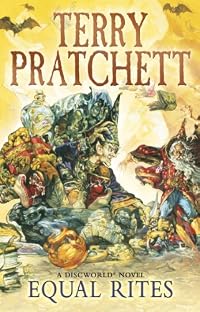

Member Recommendations
ogingero both have witty satirical humour in an original fantasy.
Member Reviews
"The sun rose slowly, as if it wasn't sure it was worth all the effort"
This re-read had me right from the opening line. I first read it when I was about 20, and while I enjoyed it then, I absolutely LOVED it now.
You see, it always baffles me when I see people list Pratchett books as children's or young adult. Yes, he has written about a half dozen or so kids books too, but I mean the rest of them. I can only assume that those people are literally judging said books by the cover, and think a cartoony cover must mean a kids book.
Sorry. no.
Sure, there's little in here that even the most worried of parents would want to keep away from their kids (except the odd mention of sex, and the occasional gruesome death or two), but that doesn't mean show more the book is meant for them.
You see, Pratchett was smart. I mean scary smart in a way that us mere mortals don't seem to be able to relate to. His books are layered with ideas, themes and other ways of tricking you into reading social, political or religious commentary disguised as a silly fantasy romp.
And even the very smartest of kids won't be able to grasp all those hidden layers unless they have actually experienced life a little.
Of course they will still enjoy the silliness of Rincewind and Twoflower's escapades, but they won't be able to appreciate the book fully until they are much older and have the life experience to help them relate to and interpret the deeper layers of the story.
Amended my rating to 5 stars. show less
This re-read had me right from the opening line. I first read it when I was about 20, and while I enjoyed it then, I absolutely LOVED it now.
You see, it always baffles me when I see people list Pratchett books as children's or young adult. Yes, he has written about a half dozen or so kids books too, but I mean the rest of them. I can only assume that those people are literally judging said books by the cover, and think a cartoony cover must mean a kids book.
Sorry. no.
Sure, there's little in here that even the most worried of parents would want to keep away from their kids (except the odd mention of sex, and the occasional gruesome death or two), but that doesn't mean show more the book is meant for them.
You see, Pratchett was smart. I mean scary smart in a way that us mere mortals don't seem to be able to relate to. His books are layered with ideas, themes and other ways of tricking you into reading social, political or religious commentary disguised as a silly fantasy romp.
And even the very smartest of kids won't be able to grasp all those hidden layers unless they have actually experienced life a little.
Of course they will still enjoy the silliness of Rincewind and Twoflower's escapades, but they won't be able to appreciate the book fully until they are much older and have the life experience to help them relate to and interpret the deeper layers of the story.
Amended my rating to 5 stars. show less
“The sun rose slowly as if it wasn’t sure it was worth all the effort.”
If you follow my reviews, you already know that I’m a sucker for English humor. I adore the sarcasm, wit, innuendo, and self-depreciation that the English apply with such skill. And the very English Sir Terry Pratchett is inventive, irreverent, ingenious, and imaginative as indicated! Before I read my first Pratchett novel, I did a little research. The advice I found was to start with “Guards, Guards,” followed by “The Light Fantastic”, and then “Soul Music”. I now wish I had just started with “The Color of Magic” and then just continued in order. You don’t have to, the books work standalone, but I think you’ll miss out on some subtleties show more if you jump around. Anyway, although “Guards, Guards!” is often held to be the best of Discworld (and I did love it), I enjoyed “The Light Fantastic” even more.
“It looked like the sort of book described in library catalogues as 'slightly foxed', although it would be more honest to admit that it looked as though it had been badgered, wolved and possibly beared as well.”
This book follows an inept wizard, Rincewind and an array of traveling companions, Twoflower – a naïve tourist, the luggage – a loyal, murderous suitcase with a set of centipede-like legs, and an elderly and toothless Conan the Barbarian. Chased by wizards and then spurred on by a looming apocalypse, the story ambles though a series of odd and hilarious locations such as a gingerbread house, a stone computer, a trans dimensional store, and ultimately climaxing at the Unseen University in the fabled town of Ankh-Morpork. The tale is fun and unpredictable, but the real joy is the continuous onslaught of humor. Pratchett is relentless and packs in more jokes, puns, and anecdotes in a chapter, than most comedic authors cover in an entire novel.
“The Luggage said nothing, but louder this time.”
Five zany stars for this fantastic romp though the twisted imagination of Sir Terry Pratchett that made me smirk, giggle, snicker, and right larf out loud from Page 1 to ‘The End!" show less
If you follow my reviews, you already know that I’m a sucker for English humor. I adore the sarcasm, wit, innuendo, and self-depreciation that the English apply with such skill. And the very English Sir Terry Pratchett is inventive, irreverent, ingenious, and imaginative as indicated! Before I read my first Pratchett novel, I did a little research. The advice I found was to start with “Guards, Guards,” followed by “The Light Fantastic”, and then “Soul Music”. I now wish I had just started with “The Color of Magic” and then just continued in order. You don’t have to, the books work standalone, but I think you’ll miss out on some subtleties show more if you jump around. Anyway, although “Guards, Guards!” is often held to be the best of Discworld (and I did love it), I enjoyed “The Light Fantastic” even more.
“It looked like the sort of book described in library catalogues as 'slightly foxed', although it would be more honest to admit that it looked as though it had been badgered, wolved and possibly beared as well.”
This book follows an inept wizard, Rincewind and an array of traveling companions, Twoflower – a naïve tourist, the luggage – a loyal, murderous suitcase with a set of centipede-like legs, and an elderly and toothless Conan the Barbarian. Chased by wizards and then spurred on by a looming apocalypse, the story ambles though a series of odd and hilarious locations such as a gingerbread house, a stone computer, a trans dimensional store, and ultimately climaxing at the Unseen University in the fabled town of Ankh-Morpork. The tale is fun and unpredictable, but the real joy is the continuous onslaught of humor. Pratchett is relentless and packs in more jokes, puns, and anecdotes in a chapter, than most comedic authors cover in an entire novel.
“The Luggage said nothing, but louder this time.”
Five zany stars for this fantastic romp though the twisted imagination of Sir Terry Pratchett that made me smirk, giggle, snicker, and right larf out loud from Page 1 to ‘The End!" show less
Rincewind, so ziemlich der erfolgloseste Zauberer der Scheibenwelt, ist noch immer mit Zweiblum, dem ersten (und vermutlich auch letzten) Touristen dieser Welt unterwegs. Nachdem beide über den Rand der Scheibenwelt stürzten, schien alles verloren - doch oh Wunder, die Scheibe hat sie wieder. Aber unversehens droht neues Unheil: Ein roter Stern droht unaufhaltsam alles zu vernichten und Rincewind scheint der Einzige zu sein, der dies verhindern kann. Doch er will nicht so richtig...
Pratchett erzählt hier die klassische Geschichte über Ausgrenzung und Verfolgung von Minderheiten, wenn die Mehrheit für ihre Ängste und Sorgen einen Schuldigen sucht. Auch Bücherverbrennungen sind Thema, wenn auch in der Pratchett-typischen Manier: show more "Jemand, der sein Leben in der Wildnis verbrachte, unter freiem Himmel, wusste ein gutes dickes Buch zu schätzen, das mindestens eine Lagerfeuersaison hielt - vorausgesetzt, man ging mit den Blättern sparsam um." Das Ganze wird (wie üblich) ausgeschmückt mit überbordender Phantasie: essbare Hexenhäuschen, hoch komplexe Steincomputer auf fliegenden Felsen, bissige Koffer aus intelligentem Holz - der Ideenreichtum Pratchetts kennt keine Grenzen.
Ein herrlicher Spaß mit einer etwas ernsten Geschichte im Hintergrund. show less
Pratchett erzählt hier die klassische Geschichte über Ausgrenzung und Verfolgung von Minderheiten, wenn die Mehrheit für ihre Ängste und Sorgen einen Schuldigen sucht. Auch Bücherverbrennungen sind Thema, wenn auch in der Pratchett-typischen Manier: show more "Jemand, der sein Leben in der Wildnis verbrachte, unter freiem Himmel, wusste ein gutes dickes Buch zu schätzen, das mindestens eine Lagerfeuersaison hielt - vorausgesetzt, man ging mit den Blättern sparsam um." Das Ganze wird (wie üblich) ausgeschmückt mit überbordender Phantasie: essbare Hexenhäuschen, hoch komplexe Steincomputer auf fliegenden Felsen, bissige Koffer aus intelligentem Holz - der Ideenreichtum Pratchetts kennt keine Grenzen.
Ein herrlicher Spaß mit einer etwas ernsten Geschichte im Hintergrund. show less
A fun romp from the late, great Terry Pratchett, and a marked improvement on the first Discworld book, The Colour of Magic. I said in my review of that earlier book that I needed more from its successor to be convinced of Pratchett's brilliance, and I am happy to say I have received such evidence. Similar in tone to The Colour of Magic, The Light Fantastic nevertheless has much more about it: for one thing, this one actually has a plot. The jokes also come much thicker and faster and never grate (I only groaned once: at the looters/luters pun on page 238). I'm not quite 'there' yet as a fan, but I'm becoming increasingly convinced that the Discworld is going to be a good place for me to spend the odd afternoon.
https://fromtheheartofeurope.eu/the-light-fantastic-by-terry-pratchett/
I think this was the first book I read by Terry Pratchett, and it was a delight to come back to it. The jokes are still funny, if no longer unexpected; the Luggage remains one of the greatest ever characters with no dialogue; and the overall plot of the world ending, or rather finding new birth, with the spell in Rincewind’s head key to the resolution, remains engaging. Perhaps now that I am 55 rather than a teenager, Cohen the Barbarian is not quite as funny a character.
The one joke that really made me laugh this time, and compelled me to read it out to my long-suffering spouse, was this:
He read that the Great Pyramid of Tsort, now long vanished, was made of one show more million, three thousand and ten limestone blocks. He read that ten thousand slaves had been worked to death in its building. He learned that it was a maze of secret passages, their walls reputedly decorated with the distilled wisdom of ancient Tsort. He read that its height plus its length divided by half its width equalled exactly 1.67563, or precisely 1,237.98712567 times the difference between the distance to the sun and the weight of a small orange. He learned that sixty years had been devoted entirely to its construction.
It all seemed, he thought, to be rather a lot of trouble to go to just to sharpen a razor blade. show less
I think this was the first book I read by Terry Pratchett, and it was a delight to come back to it. The jokes are still funny, if no longer unexpected; the Luggage remains one of the greatest ever characters with no dialogue; and the overall plot of the world ending, or rather finding new birth, with the spell in Rincewind’s head key to the resolution, remains engaging. Perhaps now that I am 55 rather than a teenager, Cohen the Barbarian is not quite as funny a character.
The one joke that really made me laugh this time, and compelled me to read it out to my long-suffering spouse, was this:
He read that the Great Pyramid of Tsort, now long vanished, was made of one show more million, three thousand and ten limestone blocks. He read that ten thousand slaves had been worked to death in its building. He learned that it was a maze of secret passages, their walls reputedly decorated with the distilled wisdom of ancient Tsort. He read that its height plus its length divided by half its width equalled exactly 1.67563, or precisely 1,237.98712567 times the difference between the distance to the sun and the weight of a small orange. He learned that sixty years had been devoted entirely to its construction.
It all seemed, he thought, to be rather a lot of trouble to go to just to sharpen a razor blade. show less
It has been far too long since I’ve read a Discworld novel.
I read Pratchett’s Dodger a couple years ago, but that one fell short for me – the humor and absurdity I love so much in Discworld was not there. I’ve been meaning to read more of this universe for the last couple years… but The Light Fantastic in particular? It’s been on my TBR since I read The Color of Magic in my senior English class. It’s been on my TBR longer than I’ve had an official, trackable TBR. So it’s about time I read it. I’d like to take a moment to thank my first ever Reading Rush for pushing me to acquire a copy. I read it in less than 24 hours.
Terry Pratchett’s writing is… not for everyone. I love it – I think he’s witty and quirky show more and while the series defies the vibrant way I usually like my world’s written, it’s still somehow endearing. I think the humor adds to that. The only author I can fairly compare him to is Douglas Addams – Discworld’s tongue-in-cheek humor reminds me of The Hitchhiker’s Guide to the Galaxy. It moves the story along while adding amusing asides that will make any reader chuckle at the sheer absurdity and casual commentary. It you like serious science-fiction, you find it in The Light Fantastic or any of his other works. But if you’re looking for a quick, amusing, fantasy (sci-fi?) read, then you need look no further. Discworld checks all my boxes for an amusing afternoon read.
Even though it’s been over a decade since I read The Color of Magic, I fell right back into this book. Twoflower’s hopeless optimism balanced by Rincewind’s cautious pessimism. They’re a really good pair, and when you throw in the Luggage as it’s own silent, ambling character, they’re a lucky, ambling trio. The character traits are clear without being crowded with too many adjectives. Pratchett doesn’t spend a lot of time describing visuals, and when he does, he’s blunt. As such, I have no idea the color of Rincewind’s eyes and while I know that Twoflower has hair, I have no idea what color. It leaves a lot of room for imagination, and it’s done in such a way that I never felt his style fell short… simply that he preferred to focus on different aspects of the story.
I particularly appreciated the plot in The Light Fantastic. I’ve read a lot of books lately with heavier levels of drama or romance – Pratchett doesn’t bother with all that fluff. There are whole scenes that are generally pointless other than to introduce a minor character or make a joke, but they are brief enough to be humorous. When it comes to the plot devices, there are a lot of times where the reader is asked to simply… trust. A particular scene comes to mind where someone asked Twoflower why he’s not scared about the impending red star, and he basically just shrugs his shoulders and says “Rincewind’s not afraid, and he’s afraid of everything, so it’s probably fine.” The twist at the end is perfect and creative and I loved it, but it was very quick. This is not the type of book you skim – it’s so deliberately written that if you read it too fast, you’ll miss something important.
Still, I think the pacing is important. Because it’s not flowery and descriptive, anything slower would come in monologues, and it would be, frankly, boring. I really liked that it was a quick, easy read. It’s different than most things being published these days, so it threw me at first… but I liked the difference. One thing I would caution – I think The Light Fantastic really requires reading The Color of Magic. Most of Discworld comfortably stands alone, but this one started off so quickly that I think I would have been a little lost if I hadn’t already been acquainted with the characters and the basic format of the world. Obviously, you can do as you please and jump in without reading book one – most of Discworld really does stand alone if you want – but I think it’s a betetr experience with some previous experience.
All said, I generally enjoyed this one. It was a breath of fresh air in my slew of current reads. Of course, I recommend anything Discworld, but I’ve always enjoyed Rincewind (and Death, Death’s scenes are the best) and The Light Fantastic is a particularly good installment. show less
I read Pratchett’s Dodger a couple years ago, but that one fell short for me – the humor and absurdity I love so much in Discworld was not there. I’ve been meaning to read more of this universe for the last couple years… but The Light Fantastic in particular? It’s been on my TBR since I read The Color of Magic in my senior English class. It’s been on my TBR longer than I’ve had an official, trackable TBR. So it’s about time I read it. I’d like to take a moment to thank my first ever Reading Rush for pushing me to acquire a copy. I read it in less than 24 hours.
Terry Pratchett’s writing is… not for everyone. I love it – I think he’s witty and quirky show more and while the series defies the vibrant way I usually like my world’s written, it’s still somehow endearing. I think the humor adds to that. The only author I can fairly compare him to is Douglas Addams – Discworld’s tongue-in-cheek humor reminds me of The Hitchhiker’s Guide to the Galaxy. It moves the story along while adding amusing asides that will make any reader chuckle at the sheer absurdity and casual commentary. It you like serious science-fiction, you find it in The Light Fantastic or any of his other works. But if you’re looking for a quick, amusing, fantasy (sci-fi?) read, then you need look no further. Discworld checks all my boxes for an amusing afternoon read.
Even though it’s been over a decade since I read The Color of Magic, I fell right back into this book. Twoflower’s hopeless optimism balanced by Rincewind’s cautious pessimism. They’re a really good pair, and when you throw in the Luggage as it’s own silent, ambling character, they’re a lucky, ambling trio. The character traits are clear without being crowded with too many adjectives. Pratchett doesn’t spend a lot of time describing visuals, and when he does, he’s blunt. As such, I have no idea the color of Rincewind’s eyes and while I know that Twoflower has hair, I have no idea what color. It leaves a lot of room for imagination, and it’s done in such a way that I never felt his style fell short… simply that he preferred to focus on different aspects of the story.
I particularly appreciated the plot in The Light Fantastic. I’ve read a lot of books lately with heavier levels of drama or romance – Pratchett doesn’t bother with all that fluff. There are whole scenes that are generally pointless other than to introduce a minor character or make a joke, but they are brief enough to be humorous. When it comes to the plot devices, there are a lot of times where the reader is asked to simply… trust. A particular scene comes to mind where someone asked Twoflower why he’s not scared about the impending red star, and he basically just shrugs his shoulders and says “Rincewind’s not afraid, and he’s afraid of everything, so it’s probably fine.” The twist at the end is perfect and creative and I loved it, but it was very quick. This is not the type of book you skim – it’s so deliberately written that if you read it too fast, you’ll miss something important.
Still, I think the pacing is important. Because it’s not flowery and descriptive, anything slower would come in monologues, and it would be, frankly, boring. I really liked that it was a quick, easy read. It’s different than most things being published these days, so it threw me at first… but I liked the difference. One thing I would caution – I think The Light Fantastic really requires reading The Color of Magic. Most of Discworld comfortably stands alone, but this one started off so quickly that I think I would have been a little lost if I hadn’t already been acquainted with the characters and the basic format of the world. Obviously, you can do as you please and jump in without reading book one – most of Discworld really does stand alone if you want – but I think it’s a betetr experience with some previous experience.
All said, I generally enjoyed this one. It was a breath of fresh air in my slew of current reads. Of course, I recommend anything Discworld, but I’ve always enjoyed Rincewind (and Death, Death’s scenes are the best) and The Light Fantastic is a particularly good installment. show less
Returning to Discworld in "The Light Fantastic", Terry Pratchett drops the reader right into the action as well as Rincewind and Twoflower, though rather unceremoniously into an enchanted forest. The inept wizard and tourist head back to Ankh-Morpork in a roundabout fashion including a quick stop to talk with DEATH, while being chased by competent wizards, mercenaries, and religious fanatics sparked by the big red star the world turtle is heading towards.
The magic of Discworld is better understood as well as the society of wizardry. But the most outstanding part is the humor that Pratchett spreads throughout the book from the subtle to the outrageous. Given that the book was first printed almost 30, the humor still holds up as Pratchett show more twists tropes and situations that any fantasy reader knows. By the end of the book you just want to see what Pratchett will do next in Discworld. show less
The magic of Discworld is better understood as well as the society of wizardry. But the most outstanding part is the humor that Pratchett spreads throughout the book from the subtle to the outrageous. Given that the book was first printed almost 30, the humor still holds up as Pratchett show more twists tropes and situations that any fantasy reader knows. By the end of the book you just want to see what Pratchett will do next in Discworld. show less
Members
- Recently Added By
Lists

Best Fantasy Novels
821 works; 361 members

20th Century Literature
1,161 works; 55 members

Favourite Books
1,817 works; 309 members

Recommend the 20 best books you've read in the last five years
2,168 works; 606 members

1980s
356 works; 23 members

Books I've Read More Than Once
602 works; 49 members

Cawthorn and Moorcock's Fantasy: The 100 Best Books
110 works; 7 members

Genre Benders: Comic Fantasy
97 works; 16 members

Books Read in 2014
2,341 works; 86 members

Huxley's reading log 2016
84 works; 3 members
Speculative Fiction to Read
706 works; 32 members

Books Read in 2023
5,547 works; 145 members

Mind Expanding Books by hackerkid
581 works; 8 members

Books Read in 2017
4,249 works; 129 members

Books on my Kindle
162 works; 3 members

Books Read in 2005
173 works; 7 members

One Book, Many Authors
441 works; 40 members
Everybody Has A 'Best Books List'. Here is mine.
20 works; 1 member

Funny Books
33 works; 2 members

Books Read in 2015
3,298 works; 129 members
Books Read in 2016
4,666 works; 199 members

Saiyuki Reload Best Summer Reads
159 works; 2 members
Humorous Science Fiction and Fantasy
28 works; 6 members

Books Read in 2018
4,360 works; 110 members

Books Read in 2019
4,052 works; 110 members

Books Read in 2021
5,361 works; 114 members

Allie's Wishlist
217 works; 2 members
Books Mentioned in the A+ Autostraddle Pop Up Discords Nov 2022 & Dec 2022
223 works; 3 members

SciFi/Fantasy Without Romance!
37 works; 1 member

Books Read in 2024
4,623 works; 126 members

Books Read in 2025
4,090 works; 97 members
Talk Discussions
Past Discussions
An Inauspicious Start in Good Show Sir! — bad science fiction and fantasy covers (March 2025)
Author Information

429+ Works 578,584 Members
Terry Pratchett was on born April 28, 1948 in Beaconsfield, United Kingdom. He left school at the age of 17 to work on his local paper, the Bucks Free Press. While with the Press, he took the National Council for the Training of Journalists proficiency class. He also worked for the Western Daily Press and the Bath Chronicle. He produced a series show more of cartoons for the monthly journal, Psychic Researcher, describing the goings-on at the government's fictional paranormal research establishment, Warlock Hall. In 1980, he was appointed publicity officer for the Central Electricity Generating Board with responsibility for three nuclear power stations. His first novel, The Carpet People, was published in 1971. His first Discworld novel, The Colour of Magic, was published in 1983. He became a full-time author in 1987. He wrote more than 70 books during his lifetime including The Dark Side of the Sun, Strata, The Light Fantastic, Equal Rites, Mort, Sourcery, Truckers, Diggers, Wings, Dodger, Raising Steam, Dragons at Crumbling Castle: And Other Tales, and The Shephard's Crown. He was diagnosis with early onset Alzheimer's disease in 2007. He was knighted for services to literature in 2009 and received the World Fantasy award for life achievement in 2010. He died on March 12, 2015 at the age of 66. (Bowker Author Biography) show less
Some Editions
Awards and Honors
Series


Belongs to Publisher Series
Work Relationships
Is contained in
Has the adaptation
Is abridged in
Common Knowledge
- Canonical title
- The Light Fantastic
- Original title
- The Light Fantastic
- Original publication date
- 1986-05
- People/Characters
- Rincewind; Twoflower; The Luggage; Ghenghiz Cohen (Cohen the Barbarian); Great A'Tuin; Ymper Trymon (show all 33); Galder Weatherwax; Bethan; Herrena, the Henna-haired Harridan; Greyhald Spold; Death [Discworld]; Swires; The Librarian of Unseen University; Belafon; The Bursar; Zakriah; Jiglad Wert; Ganmack Treehallet; Ysabell of Sto Helit; Pestilence; War; Famine; Kwartz; Krysoprase; Breccia; Jasper; Beryl; Gancia; Weems; Old Grandad; Dahoney; Lackjaw; Lumuel Panter
- Important places
- Ankh-Morpork, Discworld; Unseen University, Ankh-Morpork, Discworld; Discworld
- Related movies
- The Colour of Magic (TV movie | 2008)
- First words
- The sun rose slowly, as if it wasn't sure it was worth all the effort.
- Quotations
- It looked like the sort of book described in library catalogues as "slightly foxed", although it would be more honest to admit that it looked as though it had been badgered, wolved and possibly beared as well.
"What is it that a man may call the greatest things in life?"
- "Hot water, good dentishtry and shoft lavatory paper."
You can talk about tramps. You can talk about garlic. You can talk about France. Go on. But if you haven't smelled Ankh-Morpork on a hot day you haven't smelled anything. - Last words
- (Click to show. Warning: May contain spoilers.)Which soon became a glint among the stars, and disappeared.
- Blurbers
- Peters, Elizabeth; Pournelle, Jerry; Anthony, Piers; Michaels, Barbara; Ellison, Harlan; McCaffrey, Anne
- Original language
- English
- Canonical DDC/MDS
- 823.914
- Canonical LCC
- PR6066.R34
Classifications
Statistics
- Members
- 16,406
- Popularity
- 409
- Reviews
- 230
- Rating
- (3.80)
- Languages
- 22 — Catalan, Czech, Danish, Dutch, English, Estonian, Finnish, French, German, Hungarian, Italian, Lithuanian, Norwegian (Bokmål), Polish, Romanian, Russian, Serbian, Slovenian, Spanish, Swedish, Turkish, Portuguese (Portugal)
- Media
- Paper, Audiobook, Ebook
- ISBNs
- 103
- ASINs
- 64