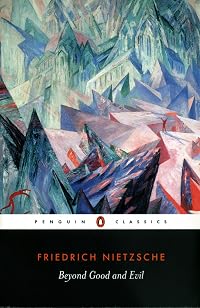
Beyond Good and Evil
by Friedrich Nietzsche 
On This Page
Description
Beyong Good and Evil expands on the ideas Nietzsche first published in Thus Spake Zarathustra. Darker in its philosophy, this text questions Christianity as a basis for moral thinking. In its place, Nietzsche calls for the use of bold critical thinking and individualism..
Tags
Recommendations


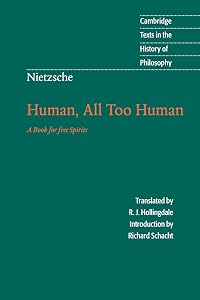
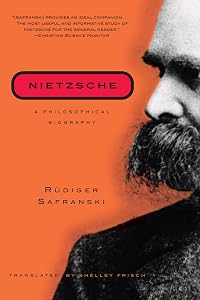



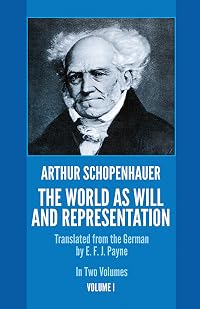






Member Recommendations


Member Reviews
"He who has really gazed… down into the most world-denying of all possible modes of thought – beyond good and evil… may have had his eyes opened to the opposite ideal: to the ideal of the most exuberant, most living and most world-affirming man…" (pg. 82)
Philosophy is a discipline that tends to deliver thoughts on the most profound and remarkable questions of human existence with no more energy, flair or brevity than you would find in the U.S. Tax Code. The exception to this unfortunate rule is Friedrich Nietzsche. A genius thinker, a tortured soul, a passionate artist and – perhaps speaking uncharitably – an unhinged ranter, his books are that rarest of all things: a philosophical discussion that does not bore or weary the show more reader, but instead electrifies him.
This is not to say that Beyond Good and Evil is easy to read, only that it rewards those who accept the challenge. I much preferred Thus Spoke Zarathustra, Nietzsche's artistic masterpiece which delivers his concepts with the lyricism and epic creativity of a Milton or Dante, but Beyond Good and Evil is a good companion piece, discussing his ideas in a more straightforward way – or at least as straight as Nietzsche's crooked wand will allow.
I won't discuss Nietzsche's specific ideas here; the only true way to imbibe them is through Nietzsche's own chaotic brew, and the abstractions and analyses of his commentators too often deny them their stimulating flavour. Nor, with respect to the author, do the specific ideas matter too much: what is compelling about them and about Nietzsche is the sense of depth and abyss, of epic power, of true art and galvanised chaos which reading them conveys. Nietzsche is a bracing air in a discipline plagued by stuffiness, and while his 'overman' concept seems almost quixotic more than a century later, in our world of influencers and company men, he deserves to be read by the regular, aspiring men of tomorrow and the overmorrow. show less
Philosophy is a discipline that tends to deliver thoughts on the most profound and remarkable questions of human existence with no more energy, flair or brevity than you would find in the U.S. Tax Code. The exception to this unfortunate rule is Friedrich Nietzsche. A genius thinker, a tortured soul, a passionate artist and – perhaps speaking uncharitably – an unhinged ranter, his books are that rarest of all things: a philosophical discussion that does not bore or weary the show more reader, but instead electrifies him.
This is not to say that Beyond Good and Evil is easy to read, only that it rewards those who accept the challenge. I much preferred Thus Spoke Zarathustra, Nietzsche's artistic masterpiece which delivers his concepts with the lyricism and epic creativity of a Milton or Dante, but Beyond Good and Evil is a good companion piece, discussing his ideas in a more straightforward way – or at least as straight as Nietzsche's crooked wand will allow.
I won't discuss Nietzsche's specific ideas here; the only true way to imbibe them is through Nietzsche's own chaotic brew, and the abstractions and analyses of his commentators too often deny them their stimulating flavour. Nor, with respect to the author, do the specific ideas matter too much: what is compelling about them and about Nietzsche is the sense of depth and abyss, of epic power, of true art and galvanised chaos which reading them conveys. Nietzsche is a bracing air in a discipline plagued by stuffiness, and while his 'overman' concept seems almost quixotic more than a century later, in our world of influencers and company men, he deserves to be read by the regular, aspiring men of tomorrow and the overmorrow. show less
Mostly read this as an sort of counter argument against Brothers Karamazov which I finished just before starting this. Nietzsche is someone I’ve sort of danced around my whole intellectual life - I started and stopped Zarathustra a few times in my late teens, and at some point got around to Birth of Tragedy which had a big impact on me. I find his ideas most cogent when considered as abstractions. I think his writing about art and artists is usually spot on and can be pretty inspiring. I can’t go there with him when it comes to his views on society and politics. Most of Nietzsche’s defenders seem to harp on the fact that he is often speaking metaphorically, symbolically, rhetorically. I think they are often right. But this being show more so doesn’t mean that these rhetorical choices sound regressive to the modern reader, and there are many moments where it does seem that he literally means what he has written. Perhaps Nietzsche would consider me a degenerated modern underling, devoid of nobility, but I can’t square his denunciations of equity and cultural mixing. I also find it strange that for a book about breaking down the dichotomies of morality is written in such a militant tone - he’s doesn’t seem to be much of a relativist.
Interesting that this year I accidentally read three of the most important philosophers of the 19th century, Marx, Dostoyevsky, and now Nietzsche. Certainly lots to learn from all of them, but I find Dostoyevsky to have the most to say about the breadth of human experience as it is lived today. His pragmatic attitude and down to earth realism when it comes to considering human nature is so prescient when you see what the work of the two others helped to inspire in the following century.
All in all, I find Nietzsche and his thought most useful when going to battle with myself. He sets himself up to antagonize the reader by transgressing boundaries that we seldom consider, much less cross over, in western society. Yet his views on how people can and should interact with one another seem simplistic in a modern world where interdependence is no longer a choice but a sociological imperative. To be an “individual” has a much different definition than it did in 1880, and so who could expect the ideas contained herein not to taste a little off to the modern palate? Yet the most “dangerous” idea contained in this book to my mind is that any edge lord can find his vindication in Nietzsche, claiming that they are stepping beyond the bounds of conventional, “slave” morality by abusing, oppressing, or mindlessly hoarding. show less
Interesting that this year I accidentally read three of the most important philosophers of the 19th century, Marx, Dostoyevsky, and now Nietzsche. Certainly lots to learn from all of them, but I find Dostoyevsky to have the most to say about the breadth of human experience as it is lived today. His pragmatic attitude and down to earth realism when it comes to considering human nature is so prescient when you see what the work of the two others helped to inspire in the following century.
All in all, I find Nietzsche and his thought most useful when going to battle with myself. He sets himself up to antagonize the reader by transgressing boundaries that we seldom consider, much less cross over, in western society. Yet his views on how people can and should interact with one another seem simplistic in a modern world where interdependence is no longer a choice but a sociological imperative. To be an “individual” has a much different definition than it did in 1880, and so who could expect the ideas contained herein not to taste a little off to the modern palate? Yet the most “dangerous” idea contained in this book to my mind is that any edge lord can find his vindication in Nietzsche, claiming that they are stepping beyond the bounds of conventional, “slave” morality by abusing, oppressing, or mindlessly hoarding. show less
This is one I'll probably need to revisit in a decade or so, to fully understand what Freddy is getting at.
What I can say is that Nietzsche is easily the most readable of all philosophers - you may not really grok what he's saying, but oh my, the way he says it! Just let the ideas wash about you like ocean water at the beach and take from it what you can.
Interesting to discover that now, when I've finally read his own words (translated by Kaufmann), it turns out most of the popular opinion or understanding of Nietzsche's philosophy is almost exactly opposite to what the man actually believed. A pro-semite, anti-authoritarian voice, a believer in art and the power of man to create his own meaning in the world without relying on the will show more of others, a virulent anti-nihilist. Yeah, I think I need to give it a few years to simmer and go through this one again. show less
What I can say is that Nietzsche is easily the most readable of all philosophers - you may not really grok what he's saying, but oh my, the way he says it! Just let the ideas wash about you like ocean water at the beach and take from it what you can.
Interesting to discover that now, when I've finally read his own words (translated by Kaufmann), it turns out most of the popular opinion or understanding of Nietzsche's philosophy is almost exactly opposite to what the man actually believed. A pro-semite, anti-authoritarian voice, a believer in art and the power of man to create his own meaning in the world without relying on the will show more of others, a virulent anti-nihilist. Yeah, I think I need to give it a few years to simmer and go through this one again. show less
With a philosopher nothing at all is impersonal.
As an armchair Platonist, I had a personal aversion to Nietzsche, whose whole purpose in life seemed to be to overthrow Platonism. After reading "Beyond Good and Evil", however, my attitude changed from aversion to pity, that is, pity in the Nietzschean sense.
To illustrate what I think of Nietzsche and his relation to Plato, let me introduce a Chinese fictional/mythical character, Sun Wukong (孙悟空), also known as the Monkey King. The Monkey King challenged the authority of the gods, stormed their dwelling, The Heavenly Palace, and proclaimed himself an equal of the gods. They appealed to the Buddha for help, after repeatedly failing to subdue the Monkey King. The Buddha made a wager show more with the Monkey King, who could travel 108,000 miles with one somersault, that the latter could not jump out of the former's palm. In order to prove his power, the Monkey King traveled as far as he could, and reached what he thought were the Five Pillars of Heaven. When he returned to confront the Buddha, he learned, to his chagrin, that those pillars were actually the Buddha's fingers. He lost and was imprisoned by the Buddha under a mountain for 500 years.
An attentive reader would have no difficulty guessing at my meaning: Nietzsche was the Monkey King, Plato the Buddha.
Firstly, Plato derived the notion of an eternal cyclic nature of the universe long before Nietzsche stumbled upon it and gave it a different name, "eternal recurrence". Apparently, like the Monkey King, Nietzsche was not immune to self-deception and illusions of grandeur, when he claimed that his philosophy was new and free of metaphysical presumptions.
Secondly, there is nothing new to the idea of "order of rank" either. Plato made a division of classes in his Republic. Nietzsche seems to share Plato's contempt for democracy, which is based on the assumption of equality among man. Both would assert that some men are fit to rule and others to be ruled.
Thirdly, Christianity has long inculcated the notion that suffering is necessary for the character development of human beings. Nietzsche borrowed the idea again, without acknowledging the source.
Fourthly, Nietzsche's philosophy is not grounded in biological facts, but rather, it is another subjective interpretation with assumptions and leaps. To use his own simile, the text may have disappeared under the interpretation, but it is still there, and each interpretation shall be evaluated according to its relation to the original. The philosopher can no more place himself above the standard of good and evil, than a translator can place himself above the original.
Fifthly, the ancient Greek philosophers believed that the ultimate purpose of philosophy is the attainment of the Good and the True. Nietzsche rejected the notion as utilitarian and ignoble. What noble value did he create by will to power that would set him above those philosophers he satirized? None. show less
The passage which really summed up this book for me was "Every deep thinker is more afraid of being understood than of being misunderstood." Yep, right there. It's what annoys me about a lot of philosophy - I just want people to be able to write clearly and honestly about what they actually mean. Nietzsche's language is so dense and impenetrable (and clearly deliberately so) that it is frustrating to read. There's definitely a whiff of the emperor's new clothes about this book.
And don't get me started on his views about women: "nothing is more foreign, more repugnant, or more hostile to woman than truth - her great art is falsehood, her chief concern is appearance and beauty." Oh dear, too late, I can't stop now: "When a woman has show more scholarly inclinations there is generally something wrong with her sexual nature. Barrenness itself conduces to a certain virility of taste...".
"Comparing man and woman generally, one may say that woman would not have the genius for adornment, if she had not the instinct for the secondary role."
I thought Erasmus's views were bad, but he lived four hundred years before Nietzsche. I had hoped that by the late nineteenth century 'deep thinkers' might have become more enlightened. Apparently not. show less
And don't get me started on his views about women: "nothing is more foreign, more repugnant, or more hostile to woman than truth - her great art is falsehood, her chief concern is appearance and beauty." Oh dear, too late, I can't stop now: "When a woman has show more scholarly inclinations there is generally something wrong with her sexual nature. Barrenness itself conduces to a certain virility of taste...".
"Comparing man and woman generally, one may say that woman would not have the genius for adornment, if she had not the instinct for the secondary role."
I thought Erasmus's views were bad, but he lived four hundred years before Nietzsche. I had hoped that by the late nineteenth century 'deep thinkers' might have become more enlightened. Apparently not. show less
The other evening, a few pages from the end of this work, I fell asleep listening to Alan Watts lecturing on virtues. I find it difficult to articulate the connection to Nietzsche, but what I comprehended as I awoke, while being in a state not dissimilar to that of Debussy's faun, was this rough recollection:
You cannot be virtuous. If you become virtuous and you are aware of being virtuous, then you are prideful and thus no longer virtuous. Virtues are not self-conscious, and you cannot consciously be virtuous. Breathing is a virtue. You don't think about it, you are not responsible for it, it happens 'un-self-consciously'. That is virtue.I understand that Alan Watts was discussing elements of Eastern philosophy, but Nietzsche show more mentions Eastern philosophy numerous times. Following Mortimer Adler's guidance in How to Read a Book, I now take notes in pencil in the margins of my books. This rather short book is full of notations; Latin, French, Greek, German, and Italian words and phrases; class consciousness, waiting too long to display one's genius, "the herd"; the Will to Power; morality; and so on. Too much to summarise here appropriately. But I read in Nietzsche a critique of mediocrity, and it provides me with an awakening to the class-based cringe that has been highlighted by my reading and study over the years. Alan Watts said something like being self-conscious won't help one to be virtuous. Benjamin Franklin wrote that although he worked to consciously improve himself, using his 13-week virtues checklist, he was aware that he could never be perfect. If I take into account Nietzsche's critique of the herd morality and religion, and the privilege of rank and the position adopted by others in relation to my lowly class-based existence (which doesn't manifest itself in any meaningful way outside my own head), then the idea of "beyond good and evil" makes some intuitive sense. Nonetheless, I am far from articulating Nietzsche's ideas beyond what I can grasp from a handful of his work. I may take some solace in that Franklin couldn't be virtuous, that Adler tells me there is nothing wrong with interpreting my reading without the aid of others, that Nietzsche writes much like La Rochefoucauld, and that he thought the Stoics were wrong. This is interesting because the Stoics advocated "living according to one's nature". As it is so natural, then how can one "will" oneself to live in a way that is predestined? This is one of the most helpful explanations of the deductive method! On flicking back through my notes, two things are noticeable. First, the race elements the Nazis picked up on (thanks to Nietzsche's sister, I believe). This is no worse than Jack London, writing not that long after Nietzsche and I encountered parts that wouldn't fit with Nazism. Second, the attitude towards women. This was written before universal suffrage, but clearly, Nietzsche was no John Stuart Mill. Indeed, Nietzsche was a critic of utilitarianism. I will finish with this quote on scholars and artists (I had heavily underlined it while reading - there is always a pencil on hand these days), one that brings together in Nietzsche's words what I felt in my "faunish" moment while listening to Alan Watts (pp. 142-3):
One finds nowadays among artists and scholars plenty of those who betray by their works that a profound longing for nobleness impels them; but this very need of nobleness is radically different from the needs of the noble soul itself, and is in fact the eloquent and dangerous sign of the lack thereof. It is not the works, but the belief which is here decisive and determines the order of rank - to employ once more an old religious formula with a new and deeper meaning - it is some fundamental certainty which a noble soul has about itself, something which is not to be sought, is not to be found, and perhaps, also, is not to be lost. -The noble soul has reverence for itself.It would seem that it is "beyond good and evil". show less
Maybe I'm just not smart enough to understand what Nietzsche is trying to express in this book, but I couldn't help but feel that parts of it were more "confused rambling" than "coherent philosophy", here are the central messages as I understand them though (contradictions and all):
-there is no external meaning other than what man applies to the world.
-there is nothing inherently superior in truth over untruth
-truth is multifaceted
-man can only advance by pushing ever farther into the limits of what is possible both morally and immorally
-a natural philosophy that relies on what nature dictates would seem cruelly amoral and unpredictable
-the grammatical structure of a language will influence the way its speakers think
-Descartes's show more statement "I think, therefore I am" is deeply flawed as it presupposes that 'thinking' is something 'I' do, rather than thoughts being things which 'I' receive, and the 'I' is also undermined as a single person may contain several separate 'I's which make up an individual as a collective.
-modern men have become weak willed as a result of society's goal to increase equality.
-there is a great need for people to develop their will or we will all be ruled by tyrants.
-Jewish people have strong wills.
-there are entirely too many Jewish people.
-women should give up their rights and power and stick to a primarily subservient role, which will somehow give them more power (?).
-different moral rules must be applied to rulers and those who are ruled.
-philosophers are alternately navel gazing idiots or warrior kings.
Overall I did not enjoy this book, the nihilist philosophy aside I thought the writing was confused and regularly had to try and puzzle out what he was trying to say. While there were a few gems 'gazing into the abyss the abyss gazes back, etc... The numerous self contradictions and unsupported statements, along with the apparent deliberate misinterpretations of other concepts for the purpose of making a point detracted from the book and made it feel like an overworked dog's dinner. It was also surprisingly antisemitic, and sexist, even considering the time period in which it was written. show less
-there is no external meaning other than what man applies to the world.
-there is nothing inherently superior in truth over untruth
-truth is multifaceted
-man can only advance by pushing ever farther into the limits of what is possible both morally and immorally
-a natural philosophy that relies on what nature dictates would seem cruelly amoral and unpredictable
-the grammatical structure of a language will influence the way its speakers think
-Descartes's show more statement "I think, therefore I am" is deeply flawed as it presupposes that 'thinking' is something 'I' do, rather than thoughts being things which 'I' receive, and the 'I' is also undermined as a single person may contain several separate 'I's which make up an individual as a collective.
-modern men have become weak willed as a result of society's goal to increase equality.
-there is a great need for people to develop their will or we will all be ruled by tyrants.
-Jewish people have strong wills.
-there are entirely too many Jewish people.
-women should give up their rights and power and stick to a primarily subservient role, which will somehow give them more power (?).
-different moral rules must be applied to rulers and those who are ruled.
-philosophers are alternately navel gazing idiots or warrior kings.
Overall I did not enjoy this book, the nihilist philosophy aside I thought the writing was confused and regularly had to try and puzzle out what he was trying to say. While there were a few gems 'gazing into the abyss the abyss gazes back, etc... The numerous self contradictions and unsupported statements, along with the apparent deliberate misinterpretations of other concepts for the purpose of making a point detracted from the book and made it feel like an overworked dog's dinner. It was also surprisingly antisemitic, and sexist, even considering the time period in which it was written. show less
Members
- Recently Added By
Published Reviews
ThingScore 100
Nietzsche's exploration of the dichotomy between good and evil, and his critique of traditional moral values, is as relevant today as it was when the book was first published. His razor-sharp wit and piercing insights force readers to confront uncomfortable truths about society, religion, and the human condition.........
added by Almatar
Lists

Will Durant's 100 Books: An Update
46 works; 4 members

Autores Alemanes en Librería
2 works; 1 member

Jordan B. Peterson's Recommended Books
104 works; 5 members

Filosofía - Clásicos
217 works; 1 member

el
1,139 works; 1 member

Books Read in 2022
5,168 works; 114 members

Books to Read
9 works; 1 member

My List
302 works; 1 member

Philosophy, Politics and Economics
61 works; 1 member

ENTENDIENDO LA FILOSOFÍA
16 works; 1 member

Greatest Books, allegedly
484 works; 9 members

10 Books that Screwed Up the World (And 5 Others that Didn't Help)
15 works; 1 member

How to Read a Book's Recommended Reading List
309 works; 10 members
1001 Books You Must Read Before You Die
1,448 works; 1,134 members

The Joe Rogan Experience Library
254 works; 3 members

Harold Bloom - The Western Canon: C. The Democratic Age
336 works; 15 members

Generation Joshua
115 works; 3 members

Existentialism
90 works; 11 members

German Literature
518 works; 55 members

Unread books
1,063 works; 87 members
Author Information

1,378+ Works 78,241 Members
The son of a Lutheran pastor, Friedrich Wilhelm Nietzsche was born in 1844 in Roecken, Prussia, and studied classical philology at the Universities of Bonn and Leipzig. While at Leipzig he read the works of Schopenhauer, which greatly impressed him. He also became a disciple of the composer Richard Wagner. At the very early age of 25, Nietzsche show more was appointed professor at the University of Basel in Switzerland. In 1870, during the Franco-Prussian War, Nietzsche served in the medical corps of the Prussian army. While treating soldiers he contracted diphtheria and dysentery; he was never physically healthy afterward. Nietzsche's first book, The Birth of Tragedy Out of the Spirit of Music (1872), was a radical reinterpretation of Greek art and culture from a Schopenhaurian and Wagnerian standpoint. By 1874 Nietzsche had to retire from his university post for reasons of health. He was diagnosed at this time with a serious nervous disorder. He lived the next 15 years on his small university pension, dividing his time between Italy and Switzerland and writing constantly. He is best known for the works he produced after 1880, especially The Gay Science (1882), Thus Spake Zarathustra (1883-85), Beyond Good and Evil (1886), On the Genealogy of Morals (1887), The Antichrist (1888), and Twilight of the Idols (1888). In January 1889, Nietzsche suffered a sudden mental collapse; he lived the last 10 years of his life in a condition of insanity. After his death, his sister published many of his papers under the title The Will to Power. Nietzsche was a radical questioner who often wrote polemically with deliberate obscurity, intending to perplex, shock, and offend his readers. He attacked the entire metaphysical tradition in Western philosophy, especially Christianity and Christian morality, which he thought had reached its final and most decadent form in modern scientific humanism, with its ideals of liberalism and democracy. It has become increasingly clear that his writings are among the deepest and most prescient sources we have for acquiring a philosophical understanding of the roots of 20th-century culture. (Bowker Author Biography) show less
Friedrich Nietzsche has a Legacy Library. Legacy libraries are the personal libraries of famous readers, entered by LibraryThing members from the Legacy Libraries group.
Some Editions
Awards and Honors
Series
Belongs to Publisher Series
Acquarelli [Demetra] (132)
Work Relationships
Is contained in
The Philosophy of Nietzsche: Thus Spake Zarathustra; Beyond Good and Evil; The Genealogy of Morals; Ecce Homo; The Birth of Tragedy by Friedrich Nietzsche
Contains
Is abridged in
Has as a student's study guide
Common Knowledge
- Canonical title
- Beyond Good and Evil
- Original title
- Jenseits von Gut und Böse: Vorspiel einer Philosophie der Zukunft
- Original publication date
- 1886-08
Classifications
Statistics
- Members
- 11,735
- Popularity
- 759
- Reviews
- 84
- Rating
- (3.83)
- Languages
- 23 — Catalan, Chinese, Czech, Danish, Dutch, English, Estonian, Finnish, French, German, Hungarian, Icelandic, Italian, Japanese, Norwegian (Bokmål), Panjabi, Polish, Portuguese, Romanian, Russian, Spanish, Swedish, Turkish
- Media
- Paper, Audiobook, Ebook
- ISBNs
- 465
- UPCs
- 1
- ASINs
- 144