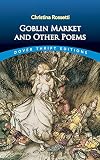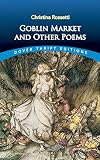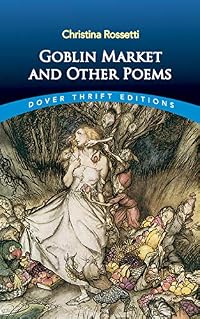
Goblin Market and Other Poems {Dover Thrift Edition}
by Christina Rossetti
On This Page
Description
Features 32 works -- among them "The Convent Threshold," "Up-hill," "Cousin Kate," "Winter: My Secret," "Maude Clare," and celebrated title poem.Tags
Recommendations




Member Recommendations
Member Reviews
Christina was the youngest of the glamorous and talented Rossetti siblings, three-quarter-Italian and brought up in England in the intellectual afterglow of the Byron circle. Apart from being one of the most distinguished women poets of her time (her only real competitor on this side of the Atlantic being Elizabeth Barrett Browning), she's also remembered as the model for many of her big brother's paintings, especially as the Virgin Mary. And, like her brother and the other Pre-Raphaelites, she was heavily involved with the Oxford Movement, a religious revival that aimed to restore some lost medieval piety and glamour to Anglicanism, but ended up sending some of its most prominent followers into the arms of Rome. Partly for religious show more reasons, Christina never married, although she had at least three offers.
Goblin Market and other poems was Christina's first properly-published collection. The title-poem — her best-known piece after "In the bleak midwinter" — is an odd kind of fairy-tale ballad about two sisters who get involved with a bunch of dodgy supernatural fruit-and-veg salesmen, naive on the surface, but full of all kinds of troubling sexual and religious undercurrents when you start to look at it closely — perfect exam-syllabus material, especially since it's written with so much verve and assurance that it's always great fun to re-read. And the girls come out on top in the end, which helps!
The rest of the collection is a bit mixed, but there's a lot of good stuff there. Short lyric poems where the poet imagines herself abandoned by her lover, rejecting a suitor, widowed, marrying in the presence of a former lover's ghost, lamenting the transience of life and the seasons, etc. Possibly there is a little more focus on death than we might be entirely comfortable with as modern readers: there is a remarkable number of poems in which the speaker of the poem turns out to be talking to us from beyond the grave. Not surprising to learn that Christina had some struggles with depression during her life. But some of these poems are among the strongest in the collection, like the sonnets "After Death" and "Dead before death". Or "Sweet Death" in the religious section at the end. And just occasionally there's a wry touch of humour, as in "No, thank you, John", a woman's exasperated complaint to a tedious suitor straight out of a three-volume novel, who thinks he just has to go on proposing to her for her to realise that she loves him.
Another notable long poem is "The convent threshold", which seems to be a kind of pendant to her brother's "Blessed Damozel" — the speaker of the poem is a woman who has been involved in a relationship that has gone wrong in some unspecified but spectacular way involving lots of blood. She has repented and is entering a convent, but on the doorstep she pauses to urge her lover to do the same, so that they can be reunited in Paradise later.
You sinned with me a pleasant sin:
Repent with me, for I repent.
Woe's me the lore I must unlearn!
Woe's me that easy way we went,
So rugged when I would return!
It's fun to re-read these poems after a gap without much exposure to Victorian poetry: sometimes what Rossetti has to say about religious and female experience might seem a little trite and obvious in hindsight, but that probably wasn't the case at the time, and it's clear that she meant every word of it. What remains striking above all is the confidence and strength with which she fits her deceptively simple language into a precision-aligned poetic structure. show less
Goblin Market and other poems was Christina's first properly-published collection. The title-poem — her best-known piece after "In the bleak midwinter" — is an odd kind of fairy-tale ballad about two sisters who get involved with a bunch of dodgy supernatural fruit-and-veg salesmen, naive on the surface, but full of all kinds of troubling sexual and religious undercurrents when you start to look at it closely — perfect exam-syllabus material, especially since it's written with so much verve and assurance that it's always great fun to re-read. And the girls come out on top in the end, which helps!
The rest of the collection is a bit mixed, but there's a lot of good stuff there. Short lyric poems where the poet imagines herself abandoned by her lover, rejecting a suitor, widowed, marrying in the presence of a former lover's ghost, lamenting the transience of life and the seasons, etc. Possibly there is a little more focus on death than we might be entirely comfortable with as modern readers: there is a remarkable number of poems in which the speaker of the poem turns out to be talking to us from beyond the grave. Not surprising to learn that Christina had some struggles with depression during her life. But some of these poems are among the strongest in the collection, like the sonnets "After Death" and "Dead before death". Or "Sweet Death" in the religious section at the end. And just occasionally there's a wry touch of humour, as in "No, thank you, John", a woman's exasperated complaint to a tedious suitor straight out of a three-volume novel, who thinks he just has to go on proposing to her for her to realise that she loves him.
Another notable long poem is "The convent threshold", which seems to be a kind of pendant to her brother's "Blessed Damozel" — the speaker of the poem is a woman who has been involved in a relationship that has gone wrong in some unspecified but spectacular way involving lots of blood. She has repented and is entering a convent, but on the doorstep she pauses to urge her lover to do the same, so that they can be reunited in Paradise later.
You sinned with me a pleasant sin:
Repent with me, for I repent.
Woe's me the lore I must unlearn!
Woe's me that easy way we went,
So rugged when I would return!
It's fun to re-read these poems after a gap without much exposure to Victorian poetry: sometimes what Rossetti has to say about religious and female experience might seem a little trite and obvious in hindsight, but that probably wasn't the case at the time, and it's clear that she meant every word of it. What remains striking above all is the confidence and strength with which she fits her deceptively simple language into a precision-aligned poetic structure. show less
I enjoyed some of Rossetti's shorter poems as I child (not that this is especially long), but was not familiar with this until I heard an extraordinary reading on BBC Radio 4 by Shirley Henderson. (There was an excerpt here, but it's no longer playable.)
It is a hypnotic poem about temptation, salivation, and salvation via sacrifice, told in contrasts: a sensible sister and a weak-willed one, getting gorgeous fruit from hideous goblins. It repeatedly combines religious and carnal imagery.
It can happily be read by or to a child, though as an adult, it's impossible to ignore the sensual allusions, starting on the very first page, with the goblins' tempting fare including “plump unpecked cherries”.
The whole story is dripping with the show more juice of ripe fruit, and the beguiling words of the hideous goblins trying to sell it.
Image: Arthur Rackham’s 1933 illustration is overtly sexual. The first illustrations were by Christina's brother, Dante Gabriel Rossetti, but I prefer Rackham's. (Source)
This story is about the language and imagery more than the plot, but if you don't want spoilers, stop reading now.
Story
Laura and Lizzie are sisters who come across the goblin men in the forest. Lizzie is all-too-aware of the dangers (later, she reminds her sister of how Jeanie wasted away after she “ate their fruits and wore their flowers”), but Lizzie lingers. She has no money, so pays with a lock of her golden hair, which in a mythical world, is clearly dangerous. But she tastes their fruit, and is euphoric at the sensations:
“She suck’d until her lips were sore...
And knew not was it night or day.”
Lizzie gets home safely, but craves more goblin fruit. Next morning, “the first cock crowed his warning” (Biblical and phallic!). The sisters go about their chores as normal.
“At length slow evening came:
They went with pitchers to the reedy brook;
Lizzie most placid in her look,
Laura most like a leaping flame.”
Laura listens for the call, and is shocked to realise her pure sister can hear it, but she no longer can.
“Day after day, night after night,
Laura kept watch in vain.
In sullen silence of exceeding pain.
She never caught again the goblin cry.
‘Come buy, come buy’.”
Just as her sister warned, Laura fades away:
“She dwindled, as the fair full moon does turn
To swift decay and burn
Her fire away”.
Yet every day, Lizzie is tormented by hearing the goblins' cry.
She “Long’d to buy the fruit to comfort her [Lizzie],
But fear’d to pay too dear.”
Nevertheless, eventually she takes a penny, and decides to get what her sister craves. Thus Lizzie has turned from tempted to temptress.
But instead of taking her money, the goblins assault her:
“Held her hands and squeezed their fruits
Against her mouth to make her eat”.
She resits, but is covered in pulp and juice - which she then urges her sister to take:
“Eat me, drink me, love me”
Is that eucharistic or sexual?
“Shaking with anguish fear, and pain,
She [Laura] kiss’d and kiss’d her with a hungry mouth”.
This time the juice is more like poison to her, yet it is also purgative, and restores her. The power of the love of a pure sister is thus demonstrated, and handed down to their own children.
Image: A moral makes a wholesome ending, by Arthur Rackham (Source)
Contrasts
There is a stark contrast in revulsion at the goblins themselves and the irresistible appeal of their fruit: like drugs and indeed, Victorian attitudes to sex.
Of the goblins:
“One tramp’d at a rat's pace...
One like a wombat prowl’d obtuse and furry.”
When they sense a victim, their movements are hungry:
“Came towards her hobbling,
Flying, running, leaping,
Puffing and blowing,
Chuckling, clapping, crowing.”
They fear she might leave without succumbing:
“Grunting and snarling...
One call’d her proud,
Cross-grain’d, uncivil;
Their tones wax’d loud,
Their looks were evil…
Barking, mewing, hissing, mocking,
Tore her gown and soil’d her stocking.”.
And, ah, the fruit:
“Bloom-down-cheek’d peaches...
Wild free-born cranberries…
Pears red with basking
Out in the sun,
Plums on their twigs;
Pluck them and suck them,
Pomegranates, figs.”
Who would not be tempted - are you Laura or Lizzie?
You can read the whole poem HERE. show less
It is a hypnotic poem about temptation, salivation, and salvation via sacrifice, told in contrasts: a sensible sister and a weak-willed one, getting gorgeous fruit from hideous goblins. It repeatedly combines religious and carnal imagery.
It can happily be read by or to a child, though as an adult, it's impossible to ignore the sensual allusions, starting on the very first page, with the goblins' tempting fare including “plump unpecked cherries”.
The whole story is dripping with the show more juice of ripe fruit, and the beguiling words of the hideous goblins trying to sell it.
Image: Arthur Rackham’s 1933 illustration is overtly sexual. The first illustrations were by Christina's brother, Dante Gabriel Rossetti, but I prefer Rackham's. (Source)
This story is about the language and imagery more than the plot, but if you don't want spoilers, stop reading now.
Story
Laura and Lizzie are sisters who come across the goblin men in the forest. Lizzie is all-too-aware of the dangers (later, she reminds her sister of how Jeanie wasted away after she “ate their fruits and wore their flowers”), but Lizzie lingers. She has no money, so pays with a lock of her golden hair, which in a mythical world, is clearly dangerous. But she tastes their fruit, and is euphoric at the sensations:
“She suck’d until her lips were sore...
And knew not was it night or day.”
Lizzie gets home safely, but craves more goblin fruit. Next morning, “the first cock crowed his warning” (Biblical and phallic!). The sisters go about their chores as normal.
“At length slow evening came:
They went with pitchers to the reedy brook;
Lizzie most placid in her look,
Laura most like a leaping flame.”
Laura listens for the call, and is shocked to realise her pure sister can hear it, but she no longer can.
“Day after day, night after night,
Laura kept watch in vain.
In sullen silence of exceeding pain.
She never caught again the goblin cry.
‘Come buy, come buy’.”
Just as her sister warned, Laura fades away:
“She dwindled, as the fair full moon does turn
To swift decay and burn
Her fire away”.
Yet every day, Lizzie is tormented by hearing the goblins' cry.
She “Long’d to buy the fruit to comfort her [Lizzie],
But fear’d to pay too dear.”
Nevertheless, eventually she takes a penny, and decides to get what her sister craves. Thus Lizzie has turned from tempted to temptress.
But instead of taking her money, the goblins assault her:
“Held her hands and squeezed their fruits
Against her mouth to make her eat”.
She resits, but is covered in pulp and juice - which she then urges her sister to take:
“Eat me, drink me, love me”
Is that eucharistic or sexual?
“Shaking with anguish fear, and pain,
She [Laura] kiss’d and kiss’d her with a hungry mouth”.
This time the juice is more like poison to her, yet it is also purgative, and restores her. The power of the love of a pure sister is thus demonstrated, and handed down to their own children.
Image: A moral makes a wholesome ending, by Arthur Rackham (Source)
Contrasts
There is a stark contrast in revulsion at the goblins themselves and the irresistible appeal of their fruit: like drugs and indeed, Victorian attitudes to sex.
Of the goblins:
“One tramp’d at a rat's pace...
One like a wombat prowl’d obtuse and furry.”
When they sense a victim, their movements are hungry:
“Came towards her hobbling,
Flying, running, leaping,
Puffing and blowing,
Chuckling, clapping, crowing.”
They fear she might leave without succumbing:
“Grunting and snarling...
One call’d her proud,
Cross-grain’d, uncivil;
Their tones wax’d loud,
Their looks were evil…
Barking, mewing, hissing, mocking,
Tore her gown and soil’d her stocking.”.
And, ah, the fruit:
“Bloom-down-cheek’d peaches...
Wild free-born cranberries…
Pears red with basking
Out in the sun,
Plums on their twigs;
Pluck them and suck them,
Pomegranates, figs.”
Who would not be tempted - are you Laura or Lizzie?
You can read the whole poem HERE. show less
There are many books and editions named "Goblin Market and Other Poems", and they are all mixed up on the LT work page, so I want to clarifiy what I read.
My edition is a bit peculiar: It is a kindle edition that I could not find a publisher for and it does not have page numbers. Well, it was one of the first kindle books I ever bought, or I would have looked out for these details. It consists of three parts. The first one seems to be the original Goblin Market and Other Poems as published in 1862. The second part is The Prince's Progress and Other Poems, originally published in 1866. Then there is a third part called Miscellaneous Poems which includes poems that have originally been published in magazines such as the Macmillan Magazine show more or Lyra Eucharistica. All of these were first published in the 1860s with the exception of the first three poems, two of which are from 1848 and one from 1850.
Many of the poems are utterly dark, they refer to death and even suggest a death wish, they speak of decay, the voidness and emptiness of the world. There are poems from the perspectives of dead persons, longing to be with the living or predicting their unavoidable fate. But there are also love poems, although many of them are marked by disappointment, longing and separation as well. Despite all of this sorrow, there is also wit, though, and sometimes the lyrical I shows a surprising confidence and strength of character.
Many poems include Christian themes as well, often alluding to the Bible, to the love of Jesus and the hope for Paradise.
The title poem, Goblin Market, reads like a fantasy tale: Two girls are lured by some dubious goblins who sell fruit. The sisters react to them differently and danger abounds. I read it several times because I found it so interesting. Its themes of sexual desire are hard to overlook, but there are also many other layers and symbols to unravel.
I do not have a lot of reading experience with Victorian poetry, but although it took me so long to read this collection I am glad that I did so. It was fascinating and rewarding, even if a bit repetitive. show less
My edition is a bit peculiar: It is a kindle edition that I could not find a publisher for and it does not have page numbers. Well, it was one of the first kindle books I ever bought, or I would have looked out for these details. It consists of three parts. The first one seems to be the original Goblin Market and Other Poems as published in 1862. The second part is The Prince's Progress and Other Poems, originally published in 1866. Then there is a third part called Miscellaneous Poems which includes poems that have originally been published in magazines such as the Macmillan Magazine show more or Lyra Eucharistica. All of these were first published in the 1860s with the exception of the first three poems, two of which are from 1848 and one from 1850.
Many of the poems are utterly dark, they refer to death and even suggest a death wish, they speak of decay, the voidness and emptiness of the world. There are poems from the perspectives of dead persons, longing to be with the living or predicting their unavoidable fate. But there are also love poems, although many of them are marked by disappointment, longing and separation as well. Despite all of this sorrow, there is also wit, though, and sometimes the lyrical I shows a surprising confidence and strength of character.
Many poems include Christian themes as well, often alluding to the Bible, to the love of Jesus and the hope for Paradise.
The title poem, Goblin Market, reads like a fantasy tale: Two girls are lured by some dubious goblins who sell fruit. The sisters react to them differently and danger abounds. I read it several times because I found it so interesting. Its themes of sexual desire are hard to overlook, but there are also many other layers and symbols to unravel.
I do not have a lot of reading experience with Victorian poetry, but although it took me so long to read this collection I am glad that I did so. It was fascinating and rewarding, even if a bit repetitive. show less
The title poem is so overwhelmingly sensuous that it belies the restraint theme. I interpret it as closer to an addiction->withdrawal tale where Laura gets the high and Lizzie the withdrawal. As for the rest, there, right in the middle of flowery death, was
No, Thank You, John
(excerpt)
"Let Bygones be bygones:
Don't call me false, who owed not to be true:
I'd rather answer "No" to fifty Johns
Than answer "Yes" to you."
There was another moment or two, but nothing so memorable in the -when I'm gone- and -life is vanity, true living is in heaven- verses that follow.
No, Thank You, John
(excerpt)
"Let Bygones be bygones:
Don't call me false, who owed not to be true:
I'd rather answer "No" to fifty Johns
Than answer "Yes" to you."
There was another moment or two, but nothing so memorable in the -when I'm gone- and -life is vanity, true living is in heaven- verses that follow.
Not a regular poetry reader, but found this lying around the house and checked it out. A lot of fun, great gothic imagery and sadness.
I often find that when I write reviews I waffle on far too much. All I can say about this book is that I find myself wanting more. I want to drink in more of Christinas' poetry and find out more about her, her life and history.
I was introduced to her through my love of her brothers' art. Dantes' art and Christina's poetry seem so compatible.
The Goblin Market is such a wonderful tale of desire, wanting, haunting and love. So much more than the initial thoughts (at the time) of it being a children's poem. Her other works in this book are so beautiful I cannot describe them in my words. These lack the poetic beauty Rossetti conjures. There is so much sadness, love and, yes, hope in these verses.
I love poetry but, up until now, have show more never found one that I could say 'Yes, this is IT'. But, reading this, I feel in Christina Rossetti, I have indeed found 'it'. I only wish I could conjure up so much emotion and feeling through my use of words as she show less
I was introduced to her through my love of her brothers' art. Dantes' art and Christina's poetry seem so compatible.
The Goblin Market is such a wonderful tale of desire, wanting, haunting and love. So much more than the initial thoughts (at the time) of it being a children's poem. Her other works in this book are so beautiful I cannot describe them in my words. These lack the poetic beauty Rossetti conjures. There is so much sadness, love and, yes, hope in these verses.
I love poetry but, up until now, have show more never found one that I could say 'Yes, this is IT'. But, reading this, I feel in Christina Rossetti, I have indeed found 'it'. I only wish I could conjure up so much emotion and feeling through my use of words as she show less
When I was a teenager I loved Christina Rossetti poems. Shortly after we moved back to California in the early 90’s I picked up this book but never got around to reading it. I stumbled across it a few days ago and decided this would be a good time to get it off my TBR pile. This is a Dover edition of the first book Rossetti published. I decided to save Goblin Market until last because it is quite long and I wanted to get back into her style before I tackled it. It was a wise decision. I’ve been reading a lot of 20th century poetry and at first it was a little difficult to get back into the rhythm of 19th century poetry-which, when I was a teenage I “specialized’ in! But once I got into the flow I once again became immersed in show more Rossetti’s world. Her poems are haunting and often sad. The introduction quotes Virginia Woolf as saying “Death, oblivion, and rest lap around your songs with their dark wave.” Her two main themes are sensual love and religious devotion. In her life she eventually renounced the first for the second. I now realize why I loved her so much back then. At sixteen I wanted to become a nun—and I wasn’t even Catholic. Even after all these years, I enjoyed these poems. Most were ones I either hadn’t ever read or have forgotten but I also encountered some “old friends.” I plan to look for more of her poems to see how she matured as a poet. My favorite poem of hers wasn’t in this book. show less
Members
- Recently Added By
Talk Discussions
Past Discussions
Victorian Poetry: In Memoriam A.H.H., Goblin Market and Other Poems, and other treasures in Club Read 2022 (November 2022)
Author Information

135+ Works 5,475 Members
All Editions
Series
Belongs to Publisher Series
Work Relationships
Contains
Common Knowledge
- Canonical title
- Goblin Market and Other Poems {Dover Thrift Edition}
- Original publication date
- 1994
- First words
- Morning and evening
Maids heard the goblins cry:
“Come buy our orchard fruits,
Come buy, come buy:
Apples and quinces,
Lemons and oranges,
Plump unpecked cherries,
Melons and raspberries,
Bloom-down-... (show all)cheeked peaches,
Swart-headed mulberries, - Last words
- (Click to show. Warning: May contain spoilers.)“For there is no friend like a sister
In calm or stormy weather;
To cheer one on the tedious way,
To fetch one if one goes astray,
To lift one if one totters down,
To strengthen while one stands.” - Original language*
- English
- Disambiguation notice
- This is the 1994 collection, edited by Candace Ward and published by Dover Publications.
It is not the same as the original 1862 publication of the same name, instead consisting of a selection of 53 poems from across a... (show all)ll of Rossetti's work.
Please do no combine with similarly named collections unless you are certain that the poems contained are identical.
*Some information comes from Common Knowledge in other languages. Click "Edit" for more information.
Classifications
Statistics
- Members
- 841
- Popularity
- 32,399
- Reviews
- 13
- Rating
- (3.92)
- Languages
- English, French
- Media
- Paper, Ebook
- ISBNs
- 12
- UPCs
- 2
- ASINs
- 10