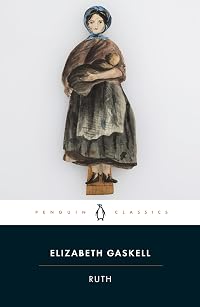
Ruth
by Elizabeth Gaskell
On This Page
Description
Fans of social realism will appreciate the surprisingly nuanced and multi-faceted perspective on Victorian era morals and mores offered in Elizabeth Cleghorn Gaskell's sweeping novel Ruth. The story follows the fortune of Ruth, an orphan who is tricked into an intimate relationship with an aristocrat who later abandons her when she is pregnant with his child. Ruth, distraught, struggles with the social strictures that paint her as an irredeemable sinner. Can she and her child survive? Read show more Ruth to find out.. show less
Tags
Recommendations













Member Recommendations
CurrerBell Hester Prynne has a spunkiness that Ruth Hilton lacks.

Member Reviews
Ruth is Elizabeth Gaskell’s tale of an orphaned girl who falls into the hands of an unscrupulous man and finds herself in the usual predicament that such girls face. What might, in our time, be a difficulty but barely raise an eyebrow, was, in Victorian times, a serious path to ruin for both the girl and her resultant child. Illegitimacy was not just a mistake, it was a sin, and the attitude of society was particularly cruel toward the woman involved, regardless of age, in this case 16, or circumstance, alone in the world and innocently naive.
There were, however, even in those times, those who were good and kind and wanted to see such a girl redeemed and not punished, and this story contains those souls as well. One of my favorite show more characters is Mr. Benson, the crippled gentleman who offers Ruth a chance to survive and make a better life. Ruth, in fact, becomes a story largely about redemption, the cost of judgmentalism, the hypocrisy of some professed Christians, and the value of truth when a lie seems the kinder route. No one could blame Ruth for anything other than desperation and poor judgment, but you could not say the same for many of those who have influence over her life.
This is not a perfect novel. One would wish to see Ruth as a more realistically flawed person, but to make the point Gaskell is pushing home requires her to be better than human and almost angelic. This is Victorian England, strictly religious, male dominated and wholly dismissive of the fallen woman; that Gaskell is brave enough to tackle the subject and point out the un-Christian tenets involved in shaming and shunning both these women and their children is remarkable. She holds up a mirror to society in a way that was sure to make a large sector uncomfortable. To do this, she makes Ruth not only pitiable, but good and overly repentant of her faults, which soon seem scarcely as bad as those of the men and women who condemn her.
This book was published a scant three years after [b:The Scarlet Letter|12296|The Scarlet Letter|Nathaniel Hawthorne|https://i.gr-assets.com/images/S/compressed.photo.goodreads.com/books/1404810944l/12296._SY75_.jpg|4925227], some 30 years before Hardy’s [b:Tess of the D'Urbervilles|32261|Tess of the D'Urbervilles|Thomas Hardy|https://i.gr-assets.com/images/S/compressed.photo.goodreads.com/books/1434302708l/32261._SY75_.jpg|3331021] and three years after Dickens’ [b:David Copperfield|58696|David Copperfield|Charles Dickens|https://i.gr-assets.com/images/S/compressed.photo.goodreads.com/books/1461452762l/58696._SY75_.jpg|4711940] in which he also addresses the dangers to young women swept into the circle of unscrupulous men. It is significant that society was beginning to turn its face toward this problem and that this book was among the early efforts to highlight the problem and decry the unfair prohibitions that kept fallen women from ever reclaiming useful lives. show less
There were, however, even in those times, those who were good and kind and wanted to see such a girl redeemed and not punished, and this story contains those souls as well. One of my favorite show more characters is Mr. Benson, the crippled gentleman who offers Ruth a chance to survive and make a better life. Ruth, in fact, becomes a story largely about redemption, the cost of judgmentalism, the hypocrisy of some professed Christians, and the value of truth when a lie seems the kinder route. No one could blame Ruth for anything other than desperation and poor judgment, but you could not say the same for many of those who have influence over her life.
This is not a perfect novel. One would wish to see Ruth as a more realistically flawed person, but to make the point Gaskell is pushing home requires her to be better than human and almost angelic. This is Victorian England, strictly religious, male dominated and wholly dismissive of the fallen woman; that Gaskell is brave enough to tackle the subject and point out the un-Christian tenets involved in shaming and shunning both these women and their children is remarkable. She holds up a mirror to society in a way that was sure to make a large sector uncomfortable. To do this, she makes Ruth not only pitiable, but good and overly repentant of her faults, which soon seem scarcely as bad as those of the men and women who condemn her.
This book was published a scant three years after [b:The Scarlet Letter|12296|The Scarlet Letter|Nathaniel Hawthorne|https://i.gr-assets.com/images/S/compressed.photo.goodreads.com/books/1404810944l/12296._SY75_.jpg|4925227], some 30 years before Hardy’s [b:Tess of the D'Urbervilles|32261|Tess of the D'Urbervilles|Thomas Hardy|https://i.gr-assets.com/images/S/compressed.photo.goodreads.com/books/1434302708l/32261._SY75_.jpg|3331021] and three years after Dickens’ [b:David Copperfield|58696|David Copperfield|Charles Dickens|https://i.gr-assets.com/images/S/compressed.photo.goodreads.com/books/1461452762l/58696._SY75_.jpg|4711940] in which he also addresses the dangers to young women swept into the circle of unscrupulous men. It is significant that society was beginning to turn its face toward this problem and that this book was among the early efforts to highlight the problem and decry the unfair prohibitions that kept fallen women from ever reclaiming useful lives. show less
"If she consents to let us take care of her , we will never let her stoop to request anything from him, even for his child"
This summer I made up my mind to read some Victorian novels I’ve always heard or read about. I’m particularly interested in the age of Queen Victoria and love the fiction of those years. I read and reviewed SHIRLEY by Charlotte Bronte (HERE) not long ago and now I’ve just finished my second book, RUTH by Elizabeth Gaskell.
When RUTH was published in 1853, Mrs Gaskell was sure it would be too disturbing for the Victorian readers, it would be surely condemned as “unfit subject for fiction”. Instead her bravery and mastery were rewarded by the favourable, thoughtful and often lengthy notices her second novel show more received. She had already published MARY BARTON in 1848 describing the appalling living conditions of factory workers and their families in Manchester. RUTH, instead, is about a fallen woman, seduced and abandoned with child. The challenge issued by Elizabeth Gaskell was not in introducing such a woman as a character in one of her novels but in placing her not at the margins (where many such women appeared in Victorian fiction) but rather at the centre of the story, since Ruth Hilton is, in fact, the heroine of this novel.
The Victorian frame of mind was characterised by extreme pruderie and strict morals and the fate of the so-called “fallen” women was being rejected, living as outcasts with their children, being very often forced to get a living from prostitution. What Gaskell tries to convey is sympathy with a conventionally unsympathetic character and situation. She dared defy the stiff perbenism of her middle-class readers writing a tale based on the real-life events experienced by a young unmarried mother whose cause she had personally taken up.
RUTH tells the story of a girl of respectable parentage, now orphaned and apprenticed to a dressmaker, who is seduced by a young squire, Henry Bellingham. When Bellingham abandons her in the Welsh village where she and her lover have been living, Ruth, pregnant and despairing, is rescued from attempted suicide by a dissenting minister, Mr Benson. He and his sister, Faith, subsequently take Ruth into their home in the northern English parish of Eccleston where Mr Benson serves, passing her off as Mrs Denbigh, a relative and widow. Under the shelter and tutelage of the Benson family home, Ruth enjoys a respectable existence for many years, bringing up her son, Leonard, and acting as daily governess to the children of Mr Benson's foremost parishioner, Mr Bradshaw. Ruth's identity and history are exposed however when, by unlucky coincidence, Bellingham (now Mr Donne) is returned as Member of Parliament for Eccleston. Following her own, and the Bensons' disgrace, Ruth devotes herself to caring for the victims of a typhus epidemic in the town and is finally acknowledged as a very generous kind creature.
The cruelty of Victorian morality's hypocritical "double standard" is depicted by Gaskell in several episodes and characters in this novel:
· Sally, the Bensons’ faithful servant, immediately understands Ruth’s real situation but accepts silently the fact that her beloved master has brought her into their home. Anyhow, she decides to punish the girl cutting all her beautiful locks and proposing her to wear a widow’s cap (p.121)
· Miss Faith Benson’s suffered acceptance of Ruth and her illeggitimate child must be worked on by her brother, Mr Banson, who seems Mrs Gaskell’s spokesman in more than one moment (pp. 100 -101)
· Mr Bradshaw’s harsh words express all his contempt – and that of the majority of the Victorian middle-classes - as soon as he discovers that the kind angelic woman, Mrs Denbigh aka Ruth, whom he trusted and appreciated so much as his own daughters’ governess, had had her child out of marriage .(pp.277-279)
These are just few examples of the attempt of the authoress to oppose the prevailing cruel hypocrytical outlook on the problem. Her opinion comes out in several pages and it is evidently pervaded by her strong sincere Christian faith. show less
This summer I made up my mind to read some Victorian novels I’ve always heard or read about. I’m particularly interested in the age of Queen Victoria and love the fiction of those years. I read and reviewed SHIRLEY by Charlotte Bronte (HERE) not long ago and now I’ve just finished my second book, RUTH by Elizabeth Gaskell.
When RUTH was published in 1853, Mrs Gaskell was sure it would be too disturbing for the Victorian readers, it would be surely condemned as “unfit subject for fiction”. Instead her bravery and mastery were rewarded by the favourable, thoughtful and often lengthy notices her second novel show more received. She had already published MARY BARTON in 1848 describing the appalling living conditions of factory workers and their families in Manchester. RUTH, instead, is about a fallen woman, seduced and abandoned with child. The challenge issued by Elizabeth Gaskell was not in introducing such a woman as a character in one of her novels but in placing her not at the margins (where many such women appeared in Victorian fiction) but rather at the centre of the story, since Ruth Hilton is, in fact, the heroine of this novel.
The Victorian frame of mind was characterised by extreme pruderie and strict morals and the fate of the so-called “fallen” women was being rejected, living as outcasts with their children, being very often forced to get a living from prostitution. What Gaskell tries to convey is sympathy with a conventionally unsympathetic character and situation. She dared defy the stiff perbenism of her middle-class readers writing a tale based on the real-life events experienced by a young unmarried mother whose cause she had personally taken up.
RUTH tells the story of a girl of respectable parentage, now orphaned and apprenticed to a dressmaker, who is seduced by a young squire, Henry Bellingham. When Bellingham abandons her in the Welsh village where she and her lover have been living, Ruth, pregnant and despairing, is rescued from attempted suicide by a dissenting minister, Mr Benson. He and his sister, Faith, subsequently take Ruth into their home in the northern English parish of Eccleston where Mr Benson serves, passing her off as Mrs Denbigh, a relative and widow. Under the shelter and tutelage of the Benson family home, Ruth enjoys a respectable existence for many years, bringing up her son, Leonard, and acting as daily governess to the children of Mr Benson's foremost parishioner, Mr Bradshaw. Ruth's identity and history are exposed however when, by unlucky coincidence, Bellingham (now Mr Donne) is returned as Member of Parliament for Eccleston. Following her own, and the Bensons' disgrace, Ruth devotes herself to caring for the victims of a typhus epidemic in the town and is finally acknowledged as a very generous kind creature.
The cruelty of Victorian morality's hypocritical "double standard" is depicted by Gaskell in several episodes and characters in this novel:
· Sally, the Bensons’ faithful servant, immediately understands Ruth’s real situation but accepts silently the fact that her beloved master has brought her into their home. Anyhow, she decides to punish the girl cutting all her beautiful locks and proposing her to wear a widow’s cap (p.121)
· Miss Faith Benson’s suffered acceptance of Ruth and her illeggitimate child must be worked on by her brother, Mr Banson, who seems Mrs Gaskell’s spokesman in more than one moment (pp. 100 -101)
· Mr Bradshaw’s harsh words express all his contempt – and that of the majority of the Victorian middle-classes - as soon as he discovers that the kind angelic woman, Mrs Denbigh aka Ruth, whom he trusted and appreciated so much as his own daughters’ governess, had had her child out of marriage .(pp.277-279)
These are just few examples of the attempt of the authoress to oppose the prevailing cruel hypocrytical outlook on the problem. Her opinion comes out in several pages and it is evidently pervaded by her strong sincere Christian faith. show less
“Ruth” is quite a departure from the likes of Elizabeth Gaskell’s “Mary Barton” and “North and South”. Those two novels were amongst many that I had to read whilst at university. I liked them enough to want to read more works by this author.
What I’ve read since has been hit or miss. I can state that if “Ruth” had been the first book I’d read by Elizabeth Gaskell then I would not have read any more of her fiction. The quality of the author’s writing is the only reason I’ve rated this novel two stars instead of one.
The title character is passive, placid, and too good to be true in many respects. The reason for this virtue is to compensate for her wicked sin of having a child out of wedlock. This act is upon what show more the novel revolves around.
I may have appreciated the themes in this book more if I’d lived during the 1800s, but then I like a lot of stories written during the 18th century that deal with topics that have little or no relevance today.
There are a few good scenes but a few is not enough in a lengthy novel. Few characters stand out as being especially interesting. Jemima is perhaps the most engaging, especially early on, but as the story progresses, her appeal digresses.
There’s a lack of real conflict and a heavy focus on religion, making this reader at least feel like I’m being preached to. I’m certainly all for Christian values and virtues, but when I read a novel I expect to be engaged by a convincing plot and strong characters, and don’t want to read a sermon.
To sum up in a list, I found this too mundane, too didactic, too slow, too repetitive, too uninspiring, too lacking in conflict, too much religious preaching, too pitiful in regards of the main character, and far too depressing.
If you’ve never read a Gaskell novel before and want to check her out, I’d recommend that you pick “Mary Barton” or, better still, “North and South”. But each to their own, as this is just my opinion.
She’s a great writer but the themes she writes about determines the quality of her work. show less
What I’ve read since has been hit or miss. I can state that if “Ruth” had been the first book I’d read by Elizabeth Gaskell then I would not have read any more of her fiction. The quality of the author’s writing is the only reason I’ve rated this novel two stars instead of one.
The title character is passive, placid, and too good to be true in many respects. The reason for this virtue is to compensate for her wicked sin of having a child out of wedlock. This act is upon what show more the novel revolves around.
I may have appreciated the themes in this book more if I’d lived during the 1800s, but then I like a lot of stories written during the 18th century that deal with topics that have little or no relevance today.
There are a few good scenes but a few is not enough in a lengthy novel. Few characters stand out as being especially interesting. Jemima is perhaps the most engaging, especially early on, but as the story progresses, her appeal digresses.
There’s a lack of real conflict and a heavy focus on religion, making this reader at least feel like I’m being preached to. I’m certainly all for Christian values and virtues, but when I read a novel I expect to be engaged by a convincing plot and strong characters, and don’t want to read a sermon.
To sum up in a list, I found this too mundane, too didactic, too slow, too repetitive, too uninspiring, too lacking in conflict, too much religious preaching, too pitiful in regards of the main character, and far too depressing.
If you’ve never read a Gaskell novel before and want to check her out, I’d recommend that you pick “Mary Barton” or, better still, “North and South”. But each to their own, as this is just my opinion.
She’s a great writer but the themes she writes about determines the quality of her work. show less
When lovely lady stoops to folly....
With its sticky, pious religiosity that is associated with the worst of Victoriana, this is probably the weakest of Gaskell's novels, very much reminding me of Harriet Beecher Stowe's The Pearl of Orr's Island. At least this much can be said for The Pearl of Orr's Island, though, that it was the single-most significant influence on Sarah Orne Jewett by legitimizing for her the use of Maine regional dialect. There's really very little that can be said for Ruth.
Like Hester Prynne, Ruth Hilton is an unwed mother in a less-than-tolerant society (though mid-19th Century Britain does not treat her as harshly as Puritan Boston treated Hester two centuries earlier). Ruth, though, does very much resemble The show more Pearl of Orr's Islandin the pious deaths of their eponymous heroines , though Stowe's Pearl, unlike Gaskell's Ruth, is chaste and pure.
Unlike The Scarlet Letter, Gaskell's Ruth reinforces the stereotypes of religiosity that Hawthorne condemns (though, in fairness, Gaskell does condemn social hypocrisy while at the same time reinforcing sincere religious opprobrium); and Ruth is far more accepting of her plight than Hawthorne's passive-aggressively resistant Hester. (Interestingly, Ruth was published in 1853, the year that Hawthorne took up the U.S. consulship in Liverpool, but Gaskell and Hawthorne crossed paths while never meeting.)
Overall, very disappointing. I've read Ruth in conjunction with a reading of Jenny Uglow's Elizabeth Gaskell: A Habit of Stories, but that's really its only value – a reading for the sake of "Gaskell completeness" in conjunction with reading a major current-day Gaskell biography. Charlotte Brontë was dead-on right in urging Gaskellnot to kill Ruth off at the end of the novel, which reinforces all the pious Victorian stereotypes of the "reformed sinner." show less
With its sticky, pious religiosity that is associated with the worst of Victoriana, this is probably the weakest of Gaskell's novels, very much reminding me of Harriet Beecher Stowe's The Pearl of Orr's Island. At least this much can be said for The Pearl of Orr's Island, though, that it was the single-most significant influence on Sarah Orne Jewett by legitimizing for her the use of Maine regional dialect. There's really very little that can be said for Ruth.
Like Hester Prynne, Ruth Hilton is an unwed mother in a less-than-tolerant society (though mid-19th Century Britain does not treat her as harshly as Puritan Boston treated Hester two centuries earlier). Ruth, though, does very much resemble The show more Pearl of Orr's Island
Unlike The Scarlet Letter, Gaskell's Ruth reinforces the stereotypes of religiosity that Hawthorne condemns (though, in fairness, Gaskell does condemn social hypocrisy while at the same time reinforcing sincere religious opprobrium); and Ruth is far more accepting of her plight than Hawthorne's passive-aggressively resistant Hester. (Interestingly, Ruth was published in 1853, the year that Hawthorne took up the U.S. consulship in Liverpool, but Gaskell and Hawthorne crossed paths while never meeting.)
Overall, very disappointing. I've read Ruth in conjunction with a reading of Jenny Uglow's Elizabeth Gaskell: A Habit of Stories, but that's really its only value – a reading for the sake of "Gaskell completeness" in conjunction with reading a major current-day Gaskell biography. Charlotte Brontë was dead-on right in urging Gaskell
Review by Karen Andreola: "In "Ourselves" Charlotte Mason uses RUTH to emphasize the importance of love in the right place. The way she describes the novel (with freshness) leaves me with the impression that she’d just reached the last page. Grace shines forth in this child-out-of-wedlock story.
We have:
. naïve Ruth’s awareness and confession of sin, sincere repentance,
. forgiveness, the fortitude to carry on, trusting God for future consequences – even in sorrow.
In this cautionary tale (high school up) Miss Mason lays more blame on the rich and spoiled young man (who gets off Scott-free) than the orphan. Because of its theme, in 1853, when RUTH was published, it was met with mixed Victorian responses – and not mild ones. show more Charlotte was a girl of 11, then. My guess is she read it as a young woman, well after the dust had settled of initial astonishment.
Despite its theme, RUTH is a clean read. I rooted for Ruth. And, I warmed up to the chapel minister and his sister who take Ruth into their family to care for her and her child, to save them society’s rejection and the poor house. The minister’s lie that Ruth is a recent widow/relative, could cost him his career.
A COINCIDENCE
A testimony on Christian radio took me by surprise. A young woman was considering giving up her baby for adoption. She met the couple who’d been waiting years for a baby. But after meeting, the couple made a new decision. Rather than adopt the baby, they welcomed this distraught mother under their roof, into their Christian family, and taught her how to be a good mother. She was full of gratitude. Today she ministers to women in prison. I gasped. Oh my. How beautiful is this?!! The unnamed woman's testimony instantly reminded me of RUTH, and my eyes filled with happy tears." show less
We have:
. naïve Ruth’s awareness and confession of sin, sincere repentance,
. forgiveness, the fortitude to carry on, trusting God for future consequences – even in sorrow.
In this cautionary tale (high school up) Miss Mason lays more blame on the rich and spoiled young man (who gets off Scott-free) than the orphan. Because of its theme, in 1853, when RUTH was published, it was met with mixed Victorian responses – and not mild ones. show more Charlotte was a girl of 11, then. My guess is she read it as a young woman, well after the dust had settled of initial astonishment.
Despite its theme, RUTH is a clean read. I rooted for Ruth. And, I warmed up to the chapel minister and his sister who take Ruth into their family to care for her and her child, to save them society’s rejection and the poor house. The minister’s lie that Ruth is a recent widow/relative, could cost him his career.
A COINCIDENCE
A testimony on Christian radio took me by surprise. A young woman was considering giving up her baby for adoption. She met the couple who’d been waiting years for a baby. But after meeting, the couple made a new decision. Rather than adopt the baby, they welcomed this distraught mother under their roof, into their Christian family, and taught her how to be a good mother. She was full of gratitude. Today she ministers to women in prison. I gasped. Oh my. How beautiful is this?!! The unnamed woman's testimony instantly reminded me of RUTH, and my eyes filled with happy tears." show less
This moral tale is told well and truly. There are the usual Victorian coincidences to move the plot along, although none that seem forced or unlikely. The backdrop of the tension between Anglicans and Dissenters, Whigs and Tories, rich and poor, show the tribalism that often causes misunderstanding and conflict, and makes humans treat individuals poorly in order to be admired by, or to further the perceived interests of, some group. The story is remarkable in that none of the characters is completely good or completely bad. Even the characterizations of minor characters hint at a full humanity. The author's motif that individual character and circumstances are so interwoven in determining what kind of person will result; and that even show more an admirable characteristic may be the cause of human flaw if it is nurtured in the wrong circumstances. For example, Ruth's pliable nature results in an admirable ability to learn her duty when she lives with the good influence of the Bensons, where that same pliancy had earlier caused her downfall by the seducing Bellingham. Interestingly enough, it is Jemima who is able to recognize the truth that changed circumstances could have resulted in a changed character, in regard to Ruth, and also in regard to herself. Jemima is able to see the good in Ruth that contrasts so much with her outward sins, as well as her [Jemima's] own inward evil despite her outward virtue. show less
4.25/5 RUTH? pub. 1853
MADAME BOVARY? pub. 1856
ANNA KARENINA? pub. 1873
TESS OF THE D'URBERVILLES? pub. 1891
All four are about women adulterers (referred to as “whores/harlots/wicked women“ in some of these novels, thanks to the societies they lived in). Gaskell paved the way for the other (perhaps) more famous novels. Her writing? Exquisite. Ruth's story? Tragic. Do I want to read more Gaskell? Absolutely.
MADAME BOVARY? pub. 1856
ANNA KARENINA? pub. 1873
TESS OF THE D'URBERVILLES? pub. 1891
All four are about women adulterers (referred to as “whores/harlots/wicked women“ in some of these novels, thanks to the societies they lived in). Gaskell paved the way for the other (perhaps) more famous novels. Her writing? Exquisite. Ruth's story? Tragic. Do I want to read more Gaskell? Absolutely.
Members
- Recently Added By
Lists

The Guardian's 1000 Novels Everyone Must Read
1,005 works; 550 members

1898 C.K. Shorter List of Best 100 Novels
100 works; 34 members

Classics you know you should have read but probably haven't
421 works; 406 members

Favourite 19th century fiction
257 works; 62 members

Folio Society
831 works; 53 members
Five star books
1,757 works; 108 members

Books Read in 2026
1,930 works; 66 members
Author Information

231+ Works 30,527 Members
Elizabeth Gaskell was born on September 29, 1810 to a Unitarian clergyman, who was also a civil servant and journalist. Her mother died when she was young, and she was brought up by her aunt in Knutsford, a small village that was the prototype for Cranford, Hollingford and the setting for numerous other short stories. In 1832, she married William show more Gaskell, a Unitarian clergyman in Manchester. She participated in his ministry and collaborated with him to write the poem Sketches among the Poor in 1837. Our Society at Cranford was the first two chapters of Cranford and it appeared in Dickens' Household Words in 1851. Dickens liked it so much that he pressed Gaskell for more episodes, and she produced eight more of them between 1852 and 1853. She also wrote My Lady Ludlow and Lois the Witch, a novella that concerns the Salem witch trials. Wives and Daughters ran in Cornhill from August 1864 to January 1866. The final installment was never written but the ending was known and the novel exists now virtually complete. The story centers on a series of relationships between family groups in Hollingford. Most critics agree that her greatest achievement is the short novel Cousin Phillis. Gaskell was also followed by controversy. In 1853, she offended many readers with Ruth, which explored seduction and illegitimacy that led the "fallen woman" into ostracism and inevitable prostitution. The novel presents the social conduct in a small community when tolerance and morality clash. Critics praised the novel's moral lessons but Gaskell's own congregation burned the book and it was banned in many libraries. In 1857, The Life of Charlotte Brontë was published. The biography was initially praised but angry protests came from some of the people it dealt with. Gaskell was against any biographical notice of her being written during her lifetime. After her death on November 12, 1865, her family refused to make family letters or biographical data available. (Bowker Author Biography) show less
Some Editions
Awards and Honors
Series
Belongs to Publisher Series
Work Relationships
Common Knowledge
- Canonical title
- Ruth
- Original title
- Ruth
- Original publication date
- 1853
- People/Characters
- Ruth Hilton (Mrs Denbigh); Henry Bellingham (Mr Donne); Thurstan Benson; Faith Benson; Mr Bradshaw; Jemima Bradshaw (show all 7); Walter Farquhar
- Important places
- England, UK; Wales, UK
- Epigraph
- Drop, drop, slow tears!
And bathe those beauteous feet,
Which brought from heaven
The news and Prince of peace.
Cease not, wet eyes,
For mercy to entreat:
To cry for vengeance
Sin doth never cease.
In ... (show all)your deep floods
Drown all my faults and fears
Nor let His eye
See sin, but through my tears.
Phineas Fletcher - First words
- There is an assize-town in one of the eastern counties which was much distinguished by the Tudor sovereigns, and, in consequence of their favour and protection, attained a degree of importance that surprises the modern travel... (show all)ler.
Ruth, published in three volumes in 1853, was Elizabeth Gaskell's second full-length novel. (Introduction) - Last words
- (Click to show. Warning: May contain spoilers.)The first time, for years, that he had entered Mr Benson's house, he came leading and comforting her son--and, for a moment, he could not speak to his old friend, for the sympathy which choked up his voice, and filled his eyes with tears.
(Click to show. Warning: May contain spoilers.)At the same time it never loses its sense of the way in which human beings behave, of their limitations and frailties, and of the potential that lies within them. (Introduction) - Original language
- English
Classifications
Statistics
- Members
- 1,264
- Popularity
- 19,380
- Reviews
- 29
- Rating
- (3.70)
- Languages
- 6 — English, French, Italian, Polish, Serbian, Spanish
- Media
- Paper, Audiobook, Ebook
- ISBNs
- 102
- ASINs
- 30