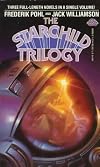
The Starchild Trilogy
by Frederik Pohl, Jack Williamson (Author)
Starchild (Collections and Selections — Omnibus 1-3)
On This Page
Description
This clinically oriented new volume in the Self-Assessment Colour Review series brings together a wide variety of cases and clinical situations which relate to diseases caused by parasitic agents primarily in small animals and domestic livestock. It also includes some cases involving some wild and exotic animals.The cases are presented randomly, and illustrated in full color. Each case scenario includes key questions regarding diagnosis, treatment and control of the infection. Detailed show more explanatory answers are given on the following page.The book offers an excellent re show lessTags
Recommendations



















Member Reviews
No likable characters. Character actions don't drive the story, they are powerless. The scifi is so fantastic that it goes straight to fantasy - ghosts, teleportation by mystical beings, space creatures that happen to create air pockets and food humans can eat.
An amazing feel for the cold war view of communism.
The fantastical elements remind me of nothing so much as Doctor Dolittle on the Moon - which is jarring against the totalitarian society portrayed.
Wasn't interested enough to finish it (I read the first book of the three in the collection, and the first 50 pages or so of the second) even though it's such a weird product of its time.
An amazing feel for the cold war view of communism.
The fantastical elements remind me of nothing so much as Doctor Dolittle on the Moon - which is jarring against the totalitarian society portrayed.
Wasn't interested enough to finish it (I read the first book of the three in the collection, and the first 50 pages or so of the second) even though it's such a weird product of its time.
Definitely some interesting ideas here. The first book is the best one, with a convincing scientific explanation of an inertialess drive, some interesting beasts, and a good story. The world is fairly convincing even after 40 years, although there's still quite a bit of this-is-what-happens-when-the-communists-win. The second book is well-written and fun, but the ending doesn't make a whole lot of sense. The author had an idea of where he was going but it doesn't get resolved really well. The third book really feels dated, with the men rescuing and the women being rescued, and the intelligent-star idea has some interesting points to it. It's also interesting to compare the science of the day to what we have today. Might be interesting show more to see how it holds up in another ten years, but I doubt I'll read it again. show less
The Reefs of Space; Starchild; Rogue Star
Ratings
Members
- Recently Added By
Author Information

641+ Works 42,940 Members
Frederik Pohl was born in New York City on November 26, 1919. More interested in writing than in school, he dropped out of high school in his senior year and took a job with a publishing company. After serving as a public relations officer in the United States Army from 1943 to 1945, he returned to publishing as copywriter for Popular Science, a show more literary agent for several sci-fi writers, and the editor for the magazines Galaxy and If from 1959 until 1969, with If winning three successive Hugo awards. His first published work, a poem entitled Elegy to a Dead Satellite: Luna, was printed in Amazing Stories magazine in 1937 under the pen name Elton Andrews. His first science fiction novels were published in the mid 1960's, some written in collaboration with other writers, others created alone. During his lifetime, he won over 16 major awards for his writing (much of which was published pseudonymously) including six Hugo Awards and three Nebula Awards. His works include Gateway, which won the Campbell Memorial, Hugo, Locus SF, and Nebula Awards, Beyond the Blue Event Horizon, and Jem, which won the National Book Award in 1979. He also embraced blogging in his later years, using his online journal as an ongoing sequel to his autobiography, The Way the Future Was. He died on September 2, 2013 at the age 93. (Bowker Author Biography) show less

Author Jack Williamson was born in Bisbee, Arizona on April 29, 1908. In the 1950's, he received both his BA and MA degress in English from Eastern New Mexico University. After receiving his PhD from the University of Colorado, he taught linguistics, the modern novel and literary criticism at Eastern New Mexico University until he retired in 1977. show more At the age of 20, he published his first story, The Metal Man, in a December 1928 issue of Amazing Stories. Since then he has written more than 50 novels and at least 15 short story collections. Some of his best known works are The Humanoids, The Legion of Time, Manseed, and Lifeburst. He also published numerous collaborations with fellow science fiction author Frederik Pohl. He received numerous awards including the Pilgrim Award from the Science Fiction Research Association, the Hugo Award, and the Nebula Award. He was an inaugural inductee in the Science Fiction and Fantasy Hall of Fame and was named a Grand Master of Science Fiction by the Science Fiction Writers of America in 1976. He died at his home in Portales, New Mexico on November 10, 2006. (Bowker Author Biography) show less
Some Editions
Series

Belongs to Publisher Series
Work Relationships
Contains
Common Knowledge
- Original publication date
- 1963 (The Reefs of Space) (The Reefs of Space); 1965 (Starchild) (Starchild); 1969 (Rogue Star) (Rogue Star)
- First words
- The sudden light hurt his eyes and woke him rudely from a dream of Molly Zaldivar.
- Last words
- (Click to show. Warning: May contain spoilers.)And the girl said firmly: 'Our children will see them all!'
- Disambiguation notice
- Italian translation of:
The reefs of space, Starchild, Rogue star
Classifications
Statistics
- Members
- 756
- Popularity
- 37,307
- Reviews
- 4
- Rating
- (3.28)
- Languages
- English, Italian
- Media
- Paper, Ebook
- ISBNs
- 8
- ASINs
- 21