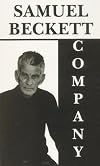
Company
by Samuel Beckett
On This Page
Description
In Company, a man lying on his back in the darkness of an enclosed room hears a voice speaking to him or to some other being. The voice reminisces about significant moments in some person's life: a young child being scolded by his mother for asking about the distance of the sky, a child being born while his father takes a walk to avoid the horrors of childbirth, a man wondering whether his lover is pregnant, a child being born the day Christ died. The relentless voice finally tells the man show more that words are ending, that the idea of one with you in the dark is only a fable. In the final moment, we find the man alone, ready for the metaphoric cycle to begin anew. Beckett has reduced the story line of Company to the sparest of prose which, in its distilled form, accentuates what Alvarado Alvarez calls his unfailing stylistic control and economy of language, his remorseless stripping away of superfluities. In Company we find the familiar themes from Beckett's earlier work, here reshaped and transfigured, in what is probably the most remarkable literary exploration of our day. show lessTags
Recommendations


































Member Reviews
A man lies alone in the dark thinking thoughts. I’d rather think my own thoughts than read Beckett’s. I enjoy my own company more.
Still very hard. Bought and read in 1982. Guess it needs another 20 years...before I get to understand it.
Ratings
Members
- Recently Added By
Lists

A Novel Cure
742 works; 23 members

Mustich's 1000 Books to Read Before You Die: A Life Changing List
1,001 works; 19 members
Author Information

530+ Works 43,058 Members
Nobel Prize winner (1969) Samuel Beckett was born on April 13, 1906 near Dublin, Ireland into a middle-class Protestant family. As a boy, he studied French and enjoyed cricket, tennis, and boxing. At Trinity College he continued his studies in French and Italian and became interested in theater and film, including American film. After graduation, show more Beckett taught English in Paris and traveled through France and Germany. While in Paris Beckett met Suzanne Deschevaus-Dusmesnil. During World War II when Paris was invaded, they joined the Resistance. They were later forced to flee Paris after being betrayed to the Gestapo, but returned in 1945. Beckett and Deschevaus-Dusmesnil married in 1961. Samuel Beckett's first novel was Dream of Fair to Middling Women. Among his many works are Murphy; Malone Dies; and The Unnameable. His plays include Endgame, Happy Days, Not I, That Time, and Krapp's Last Tape. In 1953, the production of Waiting For Godot in Paris by director and actor Roger Blin earned Beckett international fame. Beckett was awarded the Nobel Prize in Literature in 1969. His style was postmodern minimalist and some of his major themes were imprisonment in one's self, the failure of language, and moral conduct in a godless world. Despite his fame, Samuel Beckett led a secluded life. In his later years he suffered from cataracts and emphysema. His wife Suzanne died on July 17, 1989 and Beckett died on December 22nd of the same year. (Bowker Author Biography) show less
Awards and Honors
Notable Lists
Series
Belongs to Publisher Series
Work Relationships
Common Knowledge
- Canonical title*
- Compagnie
- Original title
- Company
- Original publication date
- 1979 (English) (English)
*Some information comes from Common Knowledge in other languages. Click "Edit" for more information.
Classifications
Statistics
- Members
- 275
- Popularity
- 117,241
- Reviews
- 2
- Rating
- (3.86)
- Languages
- 10 — Danish, Dutch, English, French, German, Italian, Norwegian (Bokmål), Portuguese, Spanish, Swedish
- Media
- Paper, Ebook
- ISBNs
- 15
- ASINs
- 4